Quote of the Month

When love and skill work together, expect a miracle. John Ruskin


Showing posts with label Julie Falatko. Show all posts

Tuesday, September 21, 2021

Dear Readers

Stitched in librarians' hearts are the words

the right book for the right reader at the right time.

When this happens, the world of that reader and those around them changes.  In their excitement at reading this book, they read it to others or speak about it with others.  These others in turn do the same.  Words are powerful.  They are even more transformative in books.

It is also said this purpose is shared by all those devoted to books and reading.  It is a gift happily given again and again.  Yours In Books (Cameron Kids, September 21, 2021) written by Julie Falatko with illustrations by Gabriel Alborozo is an endearing correspondence between two individuals,  One is a bookshop owner.  The other is someone seeking solitude to read.  During the course of their written conversations, we grow in understanding of the power of words lovingly written and illustrated in books.

Pine: A Bookshop
Knobby Pine Northeast of the Big Fir

Dear Sirs:

I received your marvelous catalog in the mail and
spent many long hours reading the descriptions
of all the books.

Owl T. Fencepost has requested a book be sent to his address at the 

Top of Oak
Near the Clearing
and the Noisy Small Animals.

He wants to soundproof his home so he can read in peace and quiet.  B. Squirrel, the bookshop owner, replies to Owl his desired title is out of stock.  Is there another title he wishes to purchase?

Well, Owl has decided to vacant his premises and wants to locate on an island far, far away from the Top of Oak.  As the second title is also out of stock, B. Squirrel decides to send a book encouraging Owl T. Fencepost to stay where he is.  You get the real sense of Owl's frustration in his next letter.  As he reads another book aloud, the noisy neighborhood children appear and want him to read it aloud to them.  He does this but writes it will be for the last time.  

The other thing readers will notice is the shift in the letter writing between B. Squirrel and Owl T. Fencepost.  Their greetings and closings are becoming friendly rather than professional.  A relationship is forming.  Instead of a book on fence building, B. Squirrel sends Owl T. a book on cooking and baking.

Each book B. Squirrel sends is having the opposite effect Owl T. wants in response to the boisterous children.  The evident humor and budding trust in their letter writing increases.  An invitation is issued by Bessie.  She wants Owl to visit the bookshop.  In the next several exchanges between Bessie and Owl, something is being planned by the children who now fill Owl's abode.  The messages between Owl and Bessie get shorter as anticipation and excitement build.  Books, reading, and most importantly, children, can make our lives better.  They did for a bookshop owner and an individual who thought he wanted to read in solitude.


There is an art to letter writing.  That art is even more evident when an author pens letters written between two characters.  Julie Falatko through the exchange of letters allows us to participate in the developing relationship between Bessie and Owl.

This friendship forms through their shared love of books.  In the titles of the requested books and those sent by Bessie to Owl, we are recipients of Julie Falatko's wonderful sense of finding and sharing joy and her keen observation skills of relationships.  Here are portions of a letter to Bessie from Owl and her reply.

However, the aromas of warm food heating on
my stove brought all the noisy neighborhood
children to my doorstep.  Please send The
Busy Owl's Guide to Food That Will Not Entice
Neighborhood Children to Stop By Uninvited.

The book you requested does not seem to exist.
Is it possible you were making a joke?  If so, I
am delighted.  It sounds like you and the children
might enjoy 50 Fanciful Biscuits and Cakes, which
I have enclosed, of course.


When you look at the open dust jacket, you get a preview of what artist Gabriel Alborozo imagined when reading the manuscript written by Julie Falatko.  To the left of the spine, on the back, is a close-up view of Owl T. Fencepost's writing desk.  He has started a letter to the bookshop.  His pen rests on the paper with his glasses nearby.  Stacks of books can be seen on either side as well as a vase with flowers and a matching teacup and saucer.  Through a picture window we get his view from the Top of Oak.

To the right of the spine, on the front, we see Owl and Bessie reading together in her bookshop with some of the children.  Do you see the snail in the lower right-hand corner?  It is a postal worker.  (I love the nod to snail mail.)  Another enchanting aspect are the two birds holding the paper, letter writing paper, with the text.

The book case is designed to be a book wrapped in brown paper, tied with two-tone string.  The bow is on the front along with a cancelled stamp.  The cancellation is for Oak Post Office.  A crowned owl is featured on the stamp.

Two distinct scenes are showcased on the opening and closing endpapers.  They are fine-lined drawings in black on creme.  The first is an overview of the oak in the lower, right-hand corner and the bookshop in the upper, left-hand corner.  Included are a pathway with a bridge over a stream, other trees, a pond, and a playground.  We zoom in to Owl's tree on the closing endpapers.  It is large and fills nearly all the right side, crossing the gutter as the treetops spread to the left.  Owl stands in his doorway holding a book as the children play below him.  Owl and Bessie, each holding a book, stand together on the title page.

These full-color images vary in size and perspective.  Many of them are double-page pictures with the letter placed on the side opposite most of the illustration.  Sometimes, for the purpose of pacing, single pages are devoted to the letters and their writers.  And to heighten the expectations of events to come, smaller visuals are grouped two to a page for several pages.  These illustrations reveal the personalities of Bessie and Owl in the descriptive and included details.  You will be thrilled with two wordless, double-page pictures.

One of my favorite illustrations is a double-page picture.  We are inside Owl's home.  Celebratory chaos is evident.  Birds are flying.  A bunny swings on a ceiling lamp.  A tiny hedgehog clings to the broom handle held by Owl.  Other animals are scampering about the room.  Owl holds a red balloon in one claw.  Food is scattered.  Is that water on the floor?  Is that a plunger a squirrel is holding?  Is that a roll of toilet paper unraveling?


If you are of the mind one can never have too many books to read or too many friends, Yours In Books written by Julie Falatko with artwork by Gabriel Alborozo is the title for you.  Read this book for sheer enjoyment or to promote a discussion about the power of books to change lives or how letter writing can forge friendships.  This title is charming from beginning to end and should find a place on both your personal and professional bookshelves.

To discover more about Julie Falatko and Gabriel Alborozo and their other work, please access their respective websites by following the link attached to their names.  Julie Falatko has accounts on Instagram and Twitter.  Julie Falatko chats with Heidi Fiedler at Book Magic.  Gabriel Alborozo is highlighted at Words & Pictures.  After watching this video, you'll be inspired to bake or you might get lost down the rabbit hole of acorn crafts, book making crafts or tea parties on Pinterest.

Saturday, May 18, 2019

Annual Animal Antics

In the northern hemisphere the longest day of the year marks the summer solstice.  It is the season most welcomed by many; especially those who've endured a long cold winter.  It is a time of annual celebrations, rituals and change-of-pace activities.  For some, summer isn't summer without first watching an old favorite movie.  For others it's a time to enjoy outdoor sports; hiking in the woods or going to a baseball game.  Gardeners, vegetable and flower, are working before dawn and after dusk.  Friends and families gather for reunions and much-awaited vacations.

Many memorable vacations involve camping.  Throughout the United States campgrounds abound in state and national parks with fairly modern to downright rustic conditions.  They are located in forests, mountains and along lakes, rivers and streams.  Most people are unaware of an entire population also awaiting summer and all those vacant human homes.  With huge hilarity in every respect The Great Indoors (Disney Hyperion, April 9, 2019) written by Julie Falatko with illustrations by Ruth Chan gives us the inside scoop on the highly anticipated annual antics by animals of the forest and field.

The bears always arrived first.

The four bears, a father, mother, teenager and baby, bring their suitcases inside the recently empty home of a human family who left for a week of camping.  The teenager calls dibs on the bathroom for preening.  In short order the next group arrives.  It's the beavers.

They stake a claim on the kitchen.  Based on their bags and conversations, they will be providing the meals for the entire group.  Following them are the deer who definitely have a flair for dancing, disco dancing to be precise.  No one questions the skunks desire for resting on the couch and exulting in the electricity.  The first night features the group gathered around the television served by the beavers' most excellent cuisine. 

Each subsequent day finds the bears, deer and skunks participating in their favorite activities, construction, music and social media, with complete uninterrupted abandon. They are well-fed by the zealous beavers.  They are feeling total bliss until the inevitable happens  Now they are victims of too-much-of-a good thing.

There is chaos in the kitchen.  A skunk drinks more than its share of coffee.  Someone is tasting the butter.  In fact, there is not-so-merry mayhem in every room in the house. A cacophony erupts.  It's time to head home in the outdoors.  With echoes of see you next year resonating in the now-deserted rooms, the humans return.  Surprise!


With a talent for finding the funniest side of any situation and flipping the ordinary to extraordinary, author Julie Falatko, starts building anticipation with her first sentence.  Alternating between pure narrative and priceless animal conversations, the gentle tension grows.  The animals are basking in all the modern conveniences the humans have abandoned for a week.  It's a total comedic contrast.

As the initial happiness starts to wan, the laughter factor increases.  You know with the shift in the statements made by the animals, something is going to happen.  Here are some sentences.

The skunks flopped onto the couch.
Ah, the simple life.
When you want light,
you just flip a switch.
So simple.

Just a small toaster fire!
You're not 
supposed to put
nacho cheese in
the toaster!


Upon opening the dust jacket readers get a full view of a portion of the interior of the human's home.  (The scene on the front extends over the spine to the left edge on the back.)  By the wide-eyed looks and grins on the animals' faces, we know shenanigans are in the offing.  The placement and font of the title text is akin to the beginning of an epic movie.  The objects not usually associated with animals are varnished.

To the left, on the back, along the wall are a vase in blue and white with a dragon on it, a chair and a row of four sets of slippers.  On the wall are two photographs from previous family trips.  (Perhaps the vase and picture of the Canadian Parliament building are nods to Ruth Chan's childhood.  Other items in the home refer to the Chinese culture and language which is wonderful to see.)  Spread across the book case is an entire floor mat reminiscent of Twister.  Three deer, one bear, three beavers and two skunks are showcased.  It's funnier than funny to see them stretched out as a beaver works the spinner.  It should be noted one of the skunks is using an electronic devise.

Ruth Chan incorporates the endpapers in her visual interpretation of this story.  On the opening endpapers as the sun rises the family leaves the quiet country setting of their home.  On the closing endpapers the setting has expanded.  We are now in the forest.  There are two signs of the indoors' camping trip.  Readers are sure to burst out laughing.

On the title page the family car has vanished.  Two bears, father and mother, are peering from behind a tree and a bunch of bushes.  On the verso and first page we move close to the front door as father bear walks inside the house.

Most of the illustrations rendered by Ruth Chan span two pages.  To supply pacing smaller illustrations are group together on single pages and perspectives are shifted.  At one point, it's as if the roof of the home has been removed so we can look into all the rooms at once.  Readers will be pausing on every page to look at all the details, tiny text and facial expressions mirroring emotions and the hair styles on the animals.  (Can you spot a picture of Ruth's dog and cat?)

One of my many, many favorite pictures is of the chaos in the kitchen as the week is ending.  It's a close-up of the sink, countertop and oven.  One skunk is asking if another little stinker drank all the coffee.  At the jittery aspect of said skunk, standing on the open oven door, there is no doubt it did drink the coffee.  On the left a deer is licking a stick of butter.  A beaver, on the right, trying to make something wants to know who keeps licking the butter?  A blender is shooting out a beverage (no lid) and the freezer door is wide open.  No one looks happy but readers will be giggling and grinning.


For the laughter, for a unit on summer vacations, camping or a theme of role reversal The Great Indoors written by Julie Falatko with illustrations by Ruth Chan is a rib-tickling romp showing what happens when the outdoors comes inside.  This collaboration between Falatko and Chan is filled with comedy.  You will want to have a copy in your professional and personal collections. 

To discover more about Julie Falatko and Ruth Chan and their other work, please follow the links attached to their names to access their respective websites.  Julie Falatko has accounts on Instagram and Twitter.  Ruth Chan has accounts on Instagram and Twitter.  The cover reveal for this book is hosted by Scholastic's Ambassador of School Libraries John Schumacher at Watch. Connect. Read.  He chats with both Julie and Ruth.  Julie Falatko is interviewed at Critter Lit.  Ruth Chan is the featured illustrator for The New York Times Books live Facebook chat.

Tuesday, January 1, 2019

Happy New Year 2019---One Little Word

Three hundred sixty-five days have come and gone in what seemed like a heartbeat.  Where did 2018 go?  Did someone speed up the clock?  The sense of not being able to catch up seemed stronger this past year.

Many people have been selecting one little word at the beginning of each calendar year for more than a decade.  The One Little Word project was started in 2006 by Ali Edwards.  For this first post of 2019, still having 2018 books to highlight, I decided to generate a list and assign a single word to each title.  I will include links to the author, illustrator and publisher when able to do so.  I will provide a passage from the book.  May everything that is right and good flourish in this coming year for each of you.

CONFIDENCE

Neck & Neck (Little, Brown and Company, June 5, 2018) written and illustrated by Elise Parsley

"I just

love 

this guy!"

At that, 
Leopold sighed and turned . . .
. . . and gasped

at the
gleaming smile

bobbing beside him.
Book Chat with the Illustrator: Elise Parsley Returns from LB School on Vimeo.


NEIGHBORHOOD

Hey, Wall: A Story Of Art And Community (A Paula Wiseman Book, Simon & Schuster Books For Young Readers, September 4, 2018) written by Susan Verde with illustrations by John Parra

Hey, Wall!

Guess what?

I'm ready to change all that.


Book trailer premiere with chat at Watch. Connect. Read. with John Schumacher


COMPASSION

I Am Human: A Book of Empathy (Abrams Books for Young Readers, October 2, 2018) written by Susan Verde with illustrations by Peter H. Reynolds  

I have a feeling of wonder.

I am amazed by nature.

I have a playful side.

I find joy in friendships.

I am Human.


PERSPECTIVE

The Wall In The Middle Of The Book (Dial Books for Young Readers, October 2, 2018) written and illustrated by Jon Agee  

Wait a second.  What's going on?!

This is not supposed to happen
on this side of the wall!


Book trailer premiere at 100 Scope Notes with Travis Jonker


CHOICE

Little Brown (Beach Lane Books, October 2, 2018) written and illustrated by Marla Frazee

He knew he could be a dog who would---if given
half a chance---chase balls, run in circles, nap in
the shade, or get muddy.

But Little Brown just watched the others . . .
and got crankier and crankier.  


UNITY

We've Got the Whole World in Our Hands (Orchard Books, an imprint of Scholastic Inc., October 9, 2018) written and illustrated by Rafael Lopez

We've got the rivers and the mountains
in our hands.
We've got the oceans and the seas
in our hands.
We've got you and you've got me
in our hands.
We've got the whole world
in our hands.


EXPLORE

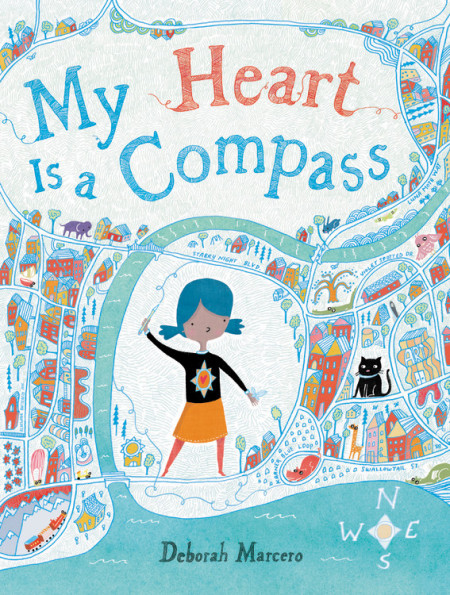
My Heart Is a Compass (Little, Brown and Company, November 6, 2018) written and illustrated by Deborah Marcero

It could have been anything.
Something exotic?
Something magical?
Did it even exist?
Where could she find such a thing?

For that, she needed a map.  Not an atlas or a globe.
To find the secret coordinates, she would
have to draw her own map.  

Watch the delightful book trailer premiere
at A Fuse #8 Production with Betsy Bird


STORY

No Boring Stories! (Viking, Penguin Young Readers, November 6, 2018) written by Julie Falatko with pictures by Charles Santoso

Those are boring stories!
I like books where strange stuff
happens.  But everyone says my
stories are too weird.

I think weird
stories are cool.

Remember the one you
wrote where the main
character was a discarded
shoe who loved to sing?

That sounds hilarious!


GIVE

Found. (Simon & Schuster Book for Young Readers, November 20, 2018) written by Jeff Newman with illustrations by Larry Day

This story is wordless.  It is a powerful statement on loss.  It speaks to giving when it's the hardest possible choice.  It's also about finding pure sweet love.


Monday, May 28, 2018

Super Shenanigans

When you spend time in the company of dogs, you realize there is hardly anything they won't do.  When they lock their mind on a goal, consider it accomplished by any means necessary.  They are perfectionists whether it's digging a hole to bury or unearth treasure, chasing annoying critters, searching for unattended food or saving human lives.

Their loyalty is unparalleled.  Author Julie Falatko, who debuted with Snappsy The Alligator (Did Not Ask to Be in This Book!) with illustrations by Tim Miller and followed with the companion title, Snappsy The Alligator And His Best Friend Forever! (Probably), has written a chapter book.  Two Dogs In A Trench Coat Go to School (Scholastic Press, an imprint of Scholastic Inc., May 29, 2018) with illustrations by Colin Jack is wildly funny.  These two dogs unconditionally love their boy.

CHAPTER ONE
Waldo was pacing the perimeter.  He was a small and scruffy dog who smelled like kibble plus something else he'd rather not discuss.

Sassy, the other pouch pal of the household and best buddy of Waldo, is currently taking a snooze.  She loves to sleep and eat.  In fact, those two things are on her mind pretty much all the time. She is quite a bit bigger than Waldo.  These canine companions are experts at keeping neighborhood squirrels as far away as possible.

Waldo and Sassy have noticed their boy, Stewart, has a problem.  His situation at school is far from being ideal.  His vibes when talking about school with his parents are not good.  To the dogs, it smells

like a weird mix of boredom and anxiety.

Their first plan of keeping him home fails at the sound of kibble in their dishes.  Their second plan of following him to school ends at the locked door to the building but Waldo reveals a learned skill.  He can talk like a human!  This leads to plan number three.

By climbing on top of Sassy and donning a trench coat, Waldo looks like a human; a very fur-covered human.  Waldo and Sassy gain entry to the building by pretending to be a new student.  Using the name of Salty Woofadogington from Liver, Ohio they became a member of Stewart's class.  Mrs. Twohey, Stewart's teacher, welcomes them reluctantly. (She thinks "Salty" is a spy.)

Salty's reaction to school is exuberant. Every educational encounter is embraced with joy.  Lunch in the cafeteria is the best part of the day but gym class, music and science experiments are equally enjoyed.  The only thing topping Frisbee football is howling as a vocal warm-up and licking the thigh on the class human skeleton.  Despite brightening up Stewart's hours with their presence, Waldo and Sassy know his growing worry is because of the Big Project and the Information Sheet.

On the night before the presentation, Sassy and Waldo assist Stewart with their expert knowledge.  And if you remember what their main job is, you know Stewart's Big Project and Information Sheet are going to be humdingers.  No one will have foreseen the riotous results.  It may involve Principal Barkenoff barging into the classroom, help from Bax the bully and an uninvited visitor from outside the classroom.  These two dogs (and Stewart) will never give up that trench coat!


You cannot read this book without knowing two things for sure.  Julie Falatko knows humor and dogs and combines them expertly.  From cover to cover, the new view of school, the process of problem solving, the focus on food (and squirrels) and the love and loyalty for Stewart by the dogs supply readers with loads of laughter.  The dialogue between Stewart, Waldo and Sassy and Salty and the members of the school scene and Stewart and his parents, who are oblivious to what is happening, is witty and comedic.  Here are some passages.

Sassy had reached the good part of her nap where the sun was so hot it was like a blanket of fire, plus she was so relaxed she couldn't move.  The only thing ruining this stellar nap was Waldo.  He kept walking by her head and clearing his throat, which sounded like a bullfrog doing a dog impersonation.

They dragged all the patio furniture together to make a ramp, hoping to "run like a gazelle" (Waldo's words) and "leap like a lion" (Waldo again) until "we soar majestically like beautiful eagles to the other side of the fence" (yep, Waldo).  Instead they "ran like hedgehogs until we crashed into the chairs and got our paws caught in the seats while they fell on our heads" (that's Sassy).
Then they napped for a bit.
Finally Sassy realized she was big enough to stand up, put her paw on the latch, and open the gate.
"Well, you would have saved us a lot of time if you'd done that two hours ago," said Waldo.

"I have no idea!" said Waldo.  Maybe we'll be tall enough to climb in through a window?"
"I'm not going to be tall enough to do anything if I don't nap first."
"Fine, fine, I have some important squirrel work to do anyway.  First thing tomorrow, we do this trench coat thing."
"After breakfast, right?"
"Are you kidding me?"  This might be the most important thing we ever do!  Of course after breakfast.  No way I'm doing this on an empty stomach."
"It's a deal."


The artwork of Colin Jack appears on nearly every page and at the very least an image is seen after every page turn.  Even the sketches (I'm reading an ARC for the second time.) are full of hilarity.  The loose lines convey one animated antic after another.

For the most part we are close to the characters and their actions.  Their facial expressions will have you laughing out loud.  The placement of all the elements contributes to the superb pacing.

One of my many favorite pictures is during gym class.  Salty is watching a thrown Frisbee.  Waldo, arms in the coat arms, is leaning into the throw.  Sassy appears ready to snatch it out of the air.  She has parted the coat opening and we can see her head.  Who will catch that Frisbee?


The sign of good humor is its lasting quality.  Even on a second read Two Dogs In A Trench Coat Go to School written by Julie Falatko with illustrations by Colin Jack will have you grinning and giggling.  This perspective of school from the two dogs is hysterical.  First in a series you'll want to have a copy (or two) on your professional and personal bookshelves.

To discover more about Julie Falatko and Colin Jack and their other work please follow the links embedded in their names to access their main sites.  Colin Jack also maintains a Tumblr account.  Julie can be found on Twitter and Facebook.  Scholastic's Ambassador of School Libraries John Schumacher chats with Julie and reveals the cover of the book on his site, Watch. Connect. Read.  Julie Falatko and author Ame Dyckman chat about humor and illustration at Scholastic.


Thursday, November 30, 2017

Everyone Needs A Chicken . . . Maybe

Not for the first time and hopefully not for the last time, during read aloud today several groups of students and I were laughing out loud . . . repeatedly.  Sometimes it was spontaneous but other times for a split second we would look at each other before bursting into gales of giggles.  These shared moments when the narrative reaches out and touches our collective and universal senses of humor are invaluable.

Even after the book cover is closed, the euphoria remains.  Everyone walks with a lighter step.  When debut author Julie Falatko and debut illustrator Tim Miller introduced readers to an agitated alligator and a bothersome bird in their first collaboration, Snappsy The Alligator (Did Not Ask to Be in This Book!)(VikingPenguin Young Readers Group, an imprint of Penguin Random House L. L.C., February 2, 2016), readers could literally not keep a straight face.  I think it's safe to say, this remains truer than true in the second book, Snappsy The Alligator And His Best Friend Forever! (Probably) (Viking, Penguin Young Readers Group, an imprint of Penguin Random House LLC, October 3, 2017).

Snappsy the alligator was the most interesting reptile in the whole world.

As the narrator proceeds to praise all the attributes of Snappsy in his usual extravagant manner, Snappsy is a tad bit uncomfortable with this declaration of friendship.  As the narrator, the chicken, continues proclaiming their closeness, Snappsy turns to exist his own home to go into town.  He requests to go alone.

Before he can even get out the door, the chicken tries to stop him with alternate activities like a sleepover.  Ever the rational one, Snappsy does remind him it's still morning.  When Snappsy finally leaves and arrives at the library, the chicken follows him like a shadow, remarking that they need a book on sleepovers.  Snappsy is not happy.  He craves quiet.  He is a solo sort of soul.

With every one of Snappsy's voiced ideas the chicken counters with ridiculous replies.  Who wears pizza on their heads like hats?  As they leave the grocery store, Snappsy has a handful of vegetables in the cart.  The chicken creates an overflowing pyramid with his selections.  As they get closer and closer to Snappsy's house, Snappsy get more and more irritated.

With every fresh announcement of their BFF-ness by the chicken, Snappsy's exasperation elevates.  (He does learn vital information about the chicken.)  With every offered opinion of what they should be doing, Snappsy's negativeness accelerates.  He snaps.

Finally in the absence of this nuisance, Snappsy can engage in his most desired pursuits.  Or can he?  The great manipulator strikes again.  And the chicken has one final twist to add to this tale.


The fabulous gift of comedic timing we saw in the first book is prevalent in this companion title.  Julie Falatko supplies a contrast in the manner in which the story is told by having not only a dueling dialogue but a narrative text which provides additional contrasts.  You could say the opposites attract theory is full-blown in this book.  For every outrageous, quirky remark the chicken makes, Snappsy gives a decidedly common sense answer.  Here is a sample passage.

Narrator:  Snappsy the alligator, who only occasionally stayed at home by
himself, set off to plan for a night of fun with his very best friend.

Snappsy:  I want to check 
out the new smoothie place.

The chicken:  Smoothies are for a morning of
boring.  Let's stop for popcorn!
Scary movies!


The image on the front of the dust jacket is the relationship of Snappsy and the chicken in a nutshell; both are determined but one is more optimistic about their friendship than the other.  In case readers are wondering why the setting is during the evening, a revelation of the book case offers a possible explanation. To the left, on the back of the dust jacket, within a thin white frame is Snappsy walking to town.  On the winding path, down the hill from his house and behind him are a line of animals, presumably in a conga line.  Beneath this illustration on the same nighttime canvas are two mice.  It looks as though they have popped up from behind the ISBN.  One is holding a magnifying glass and looking at the other.

The book case is fantastic!  That's all I am going to say.  I want you to have the distinct pleasure of laughing loud and long when you see the front and the back.  SQUEAK!  SQUEAK!  SQUEAK!  

On the opening and closing endpapers seventeen items you might see at a sleepover (the chicken's kind of sleepover) have been placed in three rows on a bright, white background.  Readers are treated to a continuation of the visual story from the book case on the title page. Rendered in

brush and ink and computer hocus-pocus

the pictures range in size from two pages to single pages and to several images on a single page with thin black lines framing them.  In keeping with the pacing and to emphasize a point Tim Miller also extends an image to the page edge or creates an oval shape with no frame.  In keeping with design balance and interest, elements sometimes break an obvious frame. 

The expressions on the faces of Snappsy and the chicken as well as their body language are downright hilarious.  Remember the two mice above the ISBN?  Can you find them again? 

One of my many favorite illustrations is the first one.  It is spread across two pages.  We are shown an interior of Snappsy's bathroom. (How can he have a bathroom this big inside that tiny wooden home?)  Snappsy is standing in front of the sink brushing his teeth.  Over the sink is a mirror but he is looking behind himself at the chicken who happens to be standing on the toilet seat.  The chicken is talking and holding this very book.  On a rack next to the sink hangs a towel with an embroidered initial S.  Next to the toilet is a magazine titled Smoothies Monthly.  A vase of tulips is on a small table.

As soon as you look at the book's dust jacket and book case you know you are holding a laughter generator in your hands.  Snappsy The Alligator And His Best Friend Forever! (Probably) written by Julie Falatko with illustrations by Tim Miller is loaded with contrasts as a friendship unfolds.  The text and the images work in perfect harmony to convey to readers the uneven line these two individuals follow toward those results.  When it comes to this chicken, you can be assured of one surprise after another.  You'll certainly want this companion title on both your professional and personal bookshelves.

To learn more about Julie Falatko and Tim Miller and their other work, please follow the links attached to their names to access the websites.  Julie has two very funny videos on her site about this book.  One refers to the first look at the book case and the other introduces us to this story.  (I love the dogs, Julie.)  At the publisher's website you can see one portion of the endpapers.  Julie talks about this book at the Nerdy Book Club.  This book is one of several titles highlighted by author, reviewer and blogger Julie Danielson on her blog, Seven Impossible Things Before Breakfast.  You get a peek at more interior images.  Tim Miller is interviewed at Brightly.  At KidLit TV Tim show us how to draw characters from Snappsy The Alligator and Moo Moo in a Tutu.

Monday, January 25, 2016

The Glory Of Story

Stories are everywhere.  According to Merriam-Webster story is defined as a history, an accounting, a statement of facts, an amusing anecdote, a fictional narrative such as a short story, the plot of a longer work and a well-accepted rumor.  It would seem the particular meaning assigned to story would depend on the teller.

Nothing is more enlightening than working with a group of students during a storytelling exercise with each person telling one and the others guessing whether it is the truth or a lie. For the most part the tales shared are genuine and without fabrication.  We are wired to tell stories, our stories.

We share those stories when it feels comfortable to do so.  Snappsy The Alligator (Did Not Ask to Be in This Book!)(Viking, Penguin Young Readers Group, an imprint of Penguin Random House L. L. C., February 2, 2016) with words by debut author Julie Falatko and pictures by debut illustrator Tim Miller elaborates on a day in the life of an annoyed alligator.  Truth, lies and humor abound.

Snappsy the alligator wasn't feeling
like himself.
His feet felt draggy.
His skin felt baggy. 
His tail wouldn't swish this way and that.
And, worst of all, his big jaw wouldn't SNAP.

Actually Snappsy is not having feet, tail or jaw problems.  He is simply hungry and in pursuit of food.  This intrusive unseen yarn spinner is prone to exaggeration.

When this is pointed out by none other than the protagonist, the teller takes another approach.  They drone on without expression stating what readers can easily see in the illustrations.  An increasingly frustrated reptile responds to these duller-than-dull statements which in turn elevates the false adjectives attached to the story line.

Snappsy finally arrives at the grocery store only to have more untruths spouted by the vexing voice.  Retracing his route Snappsy returns home, placing a no-nonsense sign on his door,

No Narrators Allowed!

before he closes it with considerable force.  This is indeed frustrating.  What could Snappsy possibly be doing inside?  The speculations offered are not flattering.

At his wit's end and feeling provoked the green guy proposes and proceeds with plans for a party.  As the festivities reach a high note, someone is peeking in the door.  One surprise after another will leave you as bamboozled as Snappsy.  You'll be giggling with glee too!


The comedic pacing in this story is priceless.  As written by Julie Falatko Snappsy is an unassuming, average alligator who wants nothing more than to enjoy a good meal and a good book.  On the other hand, the narrator seesaws between exaggeration, blandness and unwanted advice and comments while deftly evading reality and manipulating Snappsy and readers toward a desired conclusion.  The alligator's answers in dialogue clearly depict his growing agitation and eventual desire to be the best kind of character.  Here is another sample passage.

"It's just a store.  A grocery store! It's where I buy my FOOD."

Snappsy looked hungrily at the other shoppers...
...while loading his cart with pudding, peanut butter, pita bread, and popcorn.  


The dust jacket is the first funny indication of the story within a story we find in this title.  Snappsy holding a copy of the book as a group of character critters watch is already feeling peeved.  As you can see the gator is a sharp dresser (which has nothing to do with the quality of his teeth) sporting the stiff white collar and pink tie.  To the left, on the back, three stellar authors share their praise of the book.  Responses by Snappsy and the narrator will have you laughing.

The opening and closing endpapers on a white background show Snappsy engaged in ten different activities such as brushing his teeth, reading while wearing his fez, doing the hula and enjoying bath time with his rubber ducky.  They are identical except for two on the far right at the end.  The narrator is revealed.

Rendered in

brush and ink and computer hocus-pocus

Tim Miller brings considerable playfulness to the story in his images.  Snappsy's physical features begin the merriment with his thin body, long nose and wide eyes.  To match the cadence of the narrative Miller alternates between full pages framed in white, single pages with a closer perspective when Snappsy is speaking, and several illustrations on one page.  At one point two pages convey Snappsy's current state of mind in no uncertain terms.  Although his holding of a feather duster does defuse the emotion behind his statements.

Readers will relish all the tiny details included in the pictures. In the opening image two bugs are sitting behind a rock reading a book, later Snappsy searches for food using a telescope, a girl in the grocery store parking lot is reading a copy of this book, the items in the grocery store are shelved alphabetically and a duck is puzzling over the yellow ducky floating in Snappsy's kiddie pool outside his house.  What is the tiny mouse doing as he rests in Snappsy's little red wagon?  Is it the same one with a balloon problem at the party?

One of my favorite illustrations is Snappsy, hands on his hips, standing in the jungle on his way to the grocery store.  He is admittedly disgusted with the narrator's choice of words.  A flock of frightened birds are flying in panic.  A herd of bunnies are frantically fleeing.  Tiny creatures are peering from among the foliage.


Snappsy The Alligator (Did Not Ask to Be in This Book!) written by Julie Falatko with illustrations by Tim Miller is loaded with non-stop laughter.  The discrepancies between the unseen voice and the alligator's dialogue propel the plot toward a conclusion which only the clever narrator could foresee.  Don't be surprised if your readers begin wearing a pink tie, a fez, or party hats.  They might also start to crave chocolate pudding.

To learn more about Julie Falatko and Tim Miller please follow the links attached to their names to access their websites.  These will take you to their blogs also.  On Julie Falatko's blog there is a link to a series of five fun activities which you can use.  Tim Miller has several posts on his blog filled with his artistic process for this title plus a recent picture of him reading amid the huge east coast snowfall.  On Scholastic's Ambassador for School Libraries John Schumacher's blog Watch. Connect. Read. Julie Falatko visits as a guest for the cover reveal.  Tim Miller is interviewed at Miss Marple's Musings and at Seven Impossible Things Before Breakfast.  If you want to get a peek at the opening endpapers stop by the publisher's website. Both Falatko and Miller can be found on Twitter at @JulieFalatko and @TM_Illustration


Snappsy Did Not Ask to Be in This Video About How to Draw Him from Tim Miller on Vimeo.

Snappsy Shnibbles from Tim Miller on Vimeo.

UPDATE:  To celebrate Snappsy's release on February 2, 2016 blog posts appear on Scholastic's Ambassador for School Libraries John Schumacher's Watch. Connect. Read., super-stand-on-his-desk-yelling-I-Love-Reading teacher Colby Sharp's sharpread and the Nerdy Book Club

Julie Falatko and Tim Miller are featured on the podcast, Let's Get Busy, Episode #233

Author and teacher librarian Carter Higgins features the book on Design of the Picture Book

This interview at The Little Crooked Cottage is hilarious. 

UPDATE:  February 16, 2016  This title is the focus of a round table discussion at Seven Impossible Things Before Breakfast.


Update:  February 25, 2016 Tim Miller is interviewed at Brightly.

Update:  February 29, 2016 You'll enjoy this interview of Tim Miller at Awesome Artists.

Update:  August 6, 2016 Julie Falatko is interviewed at HenryHerz.com---Kidlit, Fantasy & Sci-Fi