When you read the word, hear the word, or see the place in passing, what is the first thing that comes to your mind? Is it the musical chatter of a collection of voices on a bouncing bus or filling a hallway? Is it the shouting laughter heard in a gymnasium or on a playground? Is it the voice of a calming adult in a tense situation or telling a story to a group of listeners leaning toward that person, hoping to become a part of the tale? Do you think of safe space, creative community, or excited exploration? Are the words mentor, best friend, or supportive stranger a part of that memory?
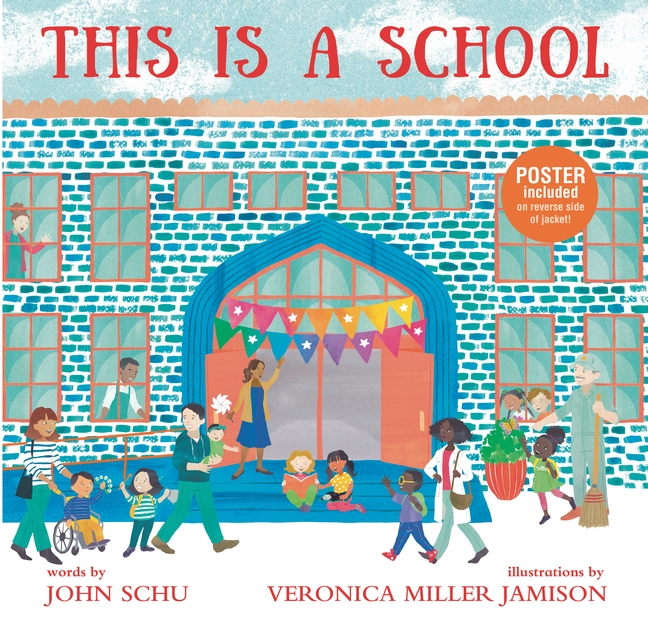
From the first time we walk through the door of our school, we are becoming. The people there, the places inside and outside those walls, and entire sensory experiences, individual and shared, shape and connect us. In This Is A School (Candlewick Press, March 29, 2022) words by John Schu and illustrations by Veronica Miller Jamison, we are able to see how our stories grow and intertwine with others. Within this book, rhythmic words and lively, vibrant images declare an invitation for infinite possibilities.
This is a kid.
This child is one of many in a class. Currently, the class is in the hall in this school. The atmosphere sings out a silent and vocal welcome.
In this school we are invited to see and hear. In our seeing and hearing, we seek answers. Each question is valuable to us and those around us. Sometimes, the replies are confusing, but that is okay. We are surrounded by those willing to assist us.
Each day, whatever we do, we do it individually and together. We promote each others' discoveries. We elevate our differences and similarities. If we cannot be together, we are still surrounded by those sending out their compassion to us any way they can.
It is here, in this school, we are building, layer by layer, our best selves. We play. We work. We have setbacks and victories. We are always seeing and hearing with everyone in this school. It is here that each child in each class knows they are significant, a piece in a beautiful whole.
With his first few sentences, John Schunot only takes a child (us) into a school, but warmly accepts us. We are told to look and listen. As each portion of his poem unfolds, we come to understand this is not any kid but every kid. In the initial scenario an encouraging, engaging cadence is established. After each scenario is disclosed, it is followed by four two-word affirmations.
We learn.
is in each of those four-phrase declarations.
John Schu also uses another technique to supply us with a reading rhythm. After the first setting, the others begin with a repeating phrase followed by a defining word. School and community are synonymous and both are in constant transition. Happy positivity binds each part of the narrative together until the end. It is here we are asked to again look and listen. We are more than we were in the beginning. Here is a passage.
Sometimes something happens,
and we can't all be together.
We learn.
We care.
We hope.
We heal.
Let take a moment to salute the choice of color palette we are introduced to on the open and matching dust jacket and book case. It resonates JOY! On the front, the right side, the teal and turquoise brick building with the splash of red orange around the windows is stunning. The hues in the pennants hanging across the doorway are reflected in the clothing worn by the characters. Do you notice how everyone is actively participating in this moment? Be sure to notice the details such as the butterfly, the objects held by several of the children and the pinwheel in the principal's hand. Here and throughout the book, children and adults from a variety of ethnicities are featured.
On the other side of a bright yellow spine, on the left, we are taken inside the school. Children sit on a circle rug in their library as their librarian reads aloud. Notebooks, paper, and writing utensils are near all the children on the rug. One child is walking toward the circle carrying a stack of books. The windows in the school are above the characters. Beneath them is a section of the brick wall.
When the jacket is removed from the case, the underside unfolds to become a poster. We are near the nine gathered children. There are books on shelves framing the image. There are books in stacks and scattered on the floor about them. They are reading and chatting with each other about what they are reading. This image brings to us the very real sense of togetherness found in the book. The children here reveal more about themselves as the pictorial enhancement is disclosed within the pages of the book.
The opening and closing endpapers are a layered pattern of pinwheels. They are all the same color, shades of orange and peach and turquoise and teal. The background is a very light teal and white.
are two-page pictures, full-page pictures and smaller images grouped on a single page. The children are highly animated with facial expressions, especially their eyes, portraying their emotions. Their clothing sometimes reveals their interests. Readers will want to observe all the extra elements. The bulletin board in the hallway foreshadows activities highlighted later in the story. Pinwheels appear again. And so do the adults we saw bringing their children to school in the morning and those adults greeting the kids. The size of the fonts and placement of text is perfection.
One of my many favorite illustrations is a double-page picture. It is for the words
This is a community, celebrating.
In the gymnasium, along the back wall, are a series of alternating colorful banners. Snowflakes of varying sizes are suspended in front of those banners. Along the top, the custodian, wearing a Santa hat, is stringing white lights. The school librarian and principal are assisting the children. As the kids set up a refreshment table and recognize different holidays, all of them are participating. Items focusing on Kwanzaa, Hanukkah, the Chinese New Year, and Diwali are shown. You can feel the happiness!
This book, This Is A School words by John Schu with artwork by Veronica Miller Jamison, is both timely and timeless. Regardless of your mood when you begin reading it, it will be much better, lighter, when you finish. This is a title to share anytime of the year. This is a title which will be requested to be read again repeatedly. This is wonderful because it is a read aloud gold. You will want to have multiple copies in your professional collection and at least one in your personal collection.
To discover more about John Schu and Veronica Miller Jamison and their other work, please follow the link attached to their names to access their websites. John Schu has accounts on Facebook, Instagram, and Twitter. Veronica Miller Jamison has accounts on Facebook, Instagram, and Twitter. The cover reveal was hosted by Travis Jonker, an elementary school librarian in Michigan at School Library Journal, 100 Scope Notes. There is a fabulous interview with both creators. The book trailer was premiered at John Schu's blog, Watch. Connect. Read.Husband and wife authors, Chris Baron and Jennifer Ziegler collaborate to bring us This One's Dedicated To . . .In their 45th episode, they chat with John Schu and Veronica Miller Jamison about their dedications in This Is A School and the book in general. John Schu and Veronica Miller Jamison chat with Ailsa Chang on NPR, All Things Considered about this book. John Schu was recently interviewed at Publishers Weekly. Through the publisher, author, podcaster, and fifth grade teacher Colby Sharp prepared a Teacher's Guide. At Penguin Random House, you can view interior images.
Be sure to visit the other sites in this blog tour honoring This Is A School
When individuals are confronted with an unfavorable situation, they want to remedy the circumstances as soon as possible or at the very least, ensure the same incident is not repeated. Moving forward on a new path is often challenging. In fact, the first step is often the hardest.
To hear a voice offering encouragement gives you strength. To find someone willing to shoulder the work with you is inspiring. To know you are not alone adds a lightness to your soul. Change Sings: A Children's Anthem (Viking, an imprint of Penguin Random House LLC, September 21, 2021) written by the youngest presidential inaugural poet in the United States of America, Amanda Gorman, with artwork by Loren Long is a beautiful portrait guaranteed to encourage, inspire and bring the lightness to every soul who savors the words and images. Each reader, of all ages, will understand their destiny to make a difference for the good of all. No action, however small, will fail to offer a positive impact.
I can hear change humming
in its loudest, proudest song.
I don't fear change coming,
And so I sing along.
This song is not soft, but strong. The narrator screams and dreams. What is done, again and again, fuels hope.
They join voices across our planet, past and present. They offer help to those who need it the most. They are staunch in their support of others who seek change.
For those who do not understand, a compassionate person asks them to join in the song. Being right is never wrong. Working together constructs sturdy structures for all to enjoy.
Countries of origin are recognized. Those things which seem to imply distinctions are doors into similarities. Like poets and songwriters of the past, this narrator realizes real change begins in each individual. When that thinking shifts inside us, we sow it. We release it into the world and grow love.
When you read these words written by Amanda Gorman, you don't know if you should do so silently or break into song, so you do both, separately and then together. Each rhyming sentence adds a layer, building from a single soul to many. We know this because the sentence beginnings alter from "I" to "We" with the concluding pages. Here is another couplet.
I hum with a hundred hearts,
Each of us lifting a hand.
I use my strengths and my smarts,
Take a knee to make a stand.
Rendered
by hand on illustration board, using acrylics and colored pencil
these pictures by Loren Longwe first see on the open and matching dust jacket and book case radiate in a rich color palette. The image spans from the left edge on the back and continues to the right edge on the front. The pieces of color on the wall behind the main character are like stained glass alluding to the sun, its rays and the symbolic rings of rainbow colors. The girl's face shows an open expression. In her hands, the guitar is offered to readers as an invitation. The text on the front and on the back is varnished. The text on the back is the first two sentences of the anthem.
A sunshine yellow covers the opening and closing endpapers. On the title page, between the text, a tuba, tambourine and drum sticks rest in grass. The first image spans two pages. A crisp white background provides the perfect space for us to meet the girl again as she sits strumming her guitar.
With each page turn, Loren Long supplies readers with his pictorial interpretation of the words. It is a journey, double-page illustration, by double-page illustration, from the girl to another child and then to another child. With each meeting a new instrument is given to the new character. We get a real sense of something growing.
We see the children cleaning up litter on a playground, feeding someone on the street, delivering groceries in a red wagon to those who cannot get their own, building a ramp for a child in a wheelchair, and cleaning up a storefront in their city. The children represent a range of ethnicity with endearing expressions. Their faces amid each setting glow with confidence and anticipation. They believe they are making a difference. They are.
One of my many favorite illustrations is a paved basketball court in the city. We are looking down on the scene. Basketball hoops are positioned on either side of the image. Chalk hopscotch boards are below each of them. Other chalk drawings are featured on the left and right. Chalk is scattered on the left near a bucket of chalk. In white a large outline of the continental United States spreads from basketball hoop to basketball hoop. Inside this outline is the girl with the guitar. She is handing a trombone to a boy who was playing basketball. With her is the reluctant boy with his dog, now holding a trumpet, the boy wearing a religious hat with the tuba, and a girl in a wheelchair holding a drum and accompanying sticks. This illustration is for a single sentence.
I talk not only of distances,
From where and how we came.
What a wonderful representation of those words and a beautiful lead to the next two sentences and a joyful visual.
No matter how many times you read, Change Sings: A Children's Anthem by Amanda Gorman with pictures by Loren Long, and believe me you will read it repeatedly, you will find a promise of great things in these pages. You will hum, sing and share this title. Be sure to have a copy on your personal bookshelves and professional bookshelves. Gift it to someone often.
To learn more about Amanda Gorman and Loren Long and their other work, please follow the link attached to their names to access their websites. Amanda Gorman has accounts on Facebook, Instagram, and Twitter. Loren Long has accounts on Facebook, Instagram, and Twitter. At the publisher's website, you can view interior pages and are offered a teacher's guide.
When something bad happens to us as individuals or to other individuals or groups, a range of emotions wash over us. We are stunned. We are deeply saddened. We want to know what we can do. Something Good (Little, Brown And Company, October 19, 2021) written by Marcy Campbell with artwork by Corinna Luyken addresses this kind of occurrence. It follows the response of students and staff at a personal and group level. It offers a positive answer for change.
The day the custodian found the bad-something
on the bathroom wall, all the girls from Mr. Gilbert's
class were called into the principal's office.
As Principal Martinez addresses the girls, there is a mixture of responses. She states in no uncertain terms:
"This kind of thing won't be tolerated at our school."
Even though told not to enter the bathroom, four girls do, curious about the bad-something. The four girls were overwhelmed by what they saw. There was silence, anger, tears, and a flight.
The locked bathroom created a detour for the girls. The bad-something had students looking at other students. Who would do this? In a short amount of time everyone knew what the bad-something was, including parents. Their reactions, like the girls, were mixed. In the following days, the bad-something changed everyone, not always for the good.
Principal Martinez called an all-school assembly speaking the same words as she did to the girls in Mr. Gilbert's class. Students were given buttons with ribbons in their school colors to remind them of what their school represented. Mr. Gilbert had a plan, too.
He spoke with his students as they all sat in a circle. Paint, brushes, and freedom of expression were given to the students as they entered the bathroom where the bad-something was found. Brush stroke by brush stroke the wall and the students were transformed, each contribution forming a wonderful whole. It was so beautiful, they continued for days, until they were amazed at their achievement. Painting, then poetry, healed a room full of students, a school full of individuals deciding to make a difference.
Through her words, Marcy Campbellpresents an intimate view of an intolerable event. Her first-person narrator brings us clearly and with intention into each moment of the evolving situation. We experience it with all the girls, the four girls, the entire student body, and with Mr. Gilbert's students. The thoughts and actions of the students are described with realism and a keen aptitude for the behavior of children in this position. Here is a passage.
We missed the days
before the bad-something
appeared, because everything
was different now. Some of us
felt worried or confused or sad
or angry. No one felt nothing.
With a limited color palette and her signature artwork, Corinna Luykengives readers on the front of the dust jacket a foreshadowing of the good something the students and their teacher create together. The predominant presence of yellow and the facial expressions on all the individuals suggest determination and a lightening of their spirits. On the back, to the left of the spine, is a display of three paint cans, yellow, teal, and rose. The colors in each rise like mist, erasing the bad-something. In the upper, right-hand corner are the words
The bad-something
has no place here.
On the book case, on either side of the spine, is a two-page interior picture. It shows in greater detail ten students painting an array of elements on the wall. On the far right one student is on a ladder as the other one steadies it. There are rosy flowers among dark teal leaves, dragons, a school, handprints, the sun and a row of people in pink along the bottom of the wall.
On the opening endpapers is the wall in the girl's bathroom. The bad-something has been painted over by the custodian in a dull color. On the closing endpapers we see how the students and their teacher remade the wall. On the left-hand side is the dedication and publication information. If you turn back a page, the title page is on the right and an author's note is on the left. By placing this information at the back, the narrative is given greater importance. The bad-something is never shown to readers.
The illustrations for this book were done in gouache, colored pencil, and ink on paper. They are two-page visuals with shifting perspectives for dramatic emphasis. While there is an overall feeling of softness when looking at these pictures, almost like chalk smudging, the linework is distinctive. The faces on the children are highly revealing. Each time you turn a page, it is like an emotional jolt, heartfelt and true.
One of my many favorite pictures is when Mr. Gilbert is seated in a circle with the students as he explains their art project. These twenty-five children are actively engaged. They know change is happening. They know they are going to be a part of the change. Most are leaning in with their heads raised. Several have their eyes closed. We can see those without their backs to us wearing their ribbon pins. The people are awash in pink, a bit of yellow and white. Their hair and faces display a variety of ethnicity. In front of Mr. Gilbert are paint brushes and rollers.
Sometimes when we seek a silver lining, we have to make it. In Something Good written by Marcy Campbell with pictures by Corinna Luyken, that is exactly what Mr. Gilbert and his students do. As Marcy Campbell states in her author's note, this book is the result of personal knowledge. What happens in this school is only one solution. This title is certain to promote discussions on an individual or group basis. I highly recommend it for your personal and professional collections.
By accessing the websites of Marcy Campbell and Corinna Luyken by following the link attached to their names, you can learn more about them and their other work. Marcy Campbell has accounts on Facebook, Instagram, and Twitter. Corinna Luyken has accounts on Facebook, Instagram, and Twitter. At the publisher's website is a video chat with the illustrator about this book and a two-page Teaching Tips document. At Mel Schuit's Let's Talk Picture Books, there is a short video showing the book case. At author, reviewer, and blogger Julie Danielson's Seven Impossible Things Before Breakfast this title is showcased. There are many pieces of art, process and final to view.
These four words, first day of school, are replete with a range of emotions for people of all ages. Whether it is your first day of school ever or the thirtieth year in a row, there is a strong blend of anticipation and anxiety, and knowing and not knowing. If you are new to the community, your feelings are heightened.
When your attire, physical characteristics, and actions are different than those of your classmates, you draw attention to yourself. Some of it is unkind. The New Kid Has Fleas (Roaring Brook Press, June 15, 2021) written by Ame Dyckman with illustrations by Eda Kaban follows a unique new student and another who, through chance, befriends her. It is a tale full of twists and truths.
I'm not sure about the New Kid.
The narrator, a fellow classmate, is trying to be his best, but it is hard when the new kid takes off her shoes so she can go barefoot, howls in music, and pursues a different kind of food for lunch. Another student, Molly, tells the children the New Kid has fleas. She quietly hears the revelation. Does it bother her?
Stewart and our narrator want to be partners during the science project, but their teacher has other plans. The students' names are put in a bowl and are paired through the luck of the draw. Stewart and Molly are paired. Our narrator is paired with the New Kid.
This is an after-school project. The duo rides the bus to the New Kid's home. When our narrator steps inside, he is terrified at the parents, and siblings of the New Kid.
In the first of several surprises, the siblings are fun. Snack time, while not our narrator's usual fare, is tasty. The New Kid is brilliant in helping with the science project. The next day at school, Molly is strangely absent. When it is time to present their science project, it is a howling success. Given a chance, we can discover rare gifts in others.
Simple declarative sentences, short phrases, and single words by author Ame Dyckman fashion a story replete with humor. Word play adds to the laughter factor. Through the first-person narrative we are able to witness a transformation from first impressions to lasting friendship. Here is a passage.
Mom and Dad say don't stare.
That I should put myself in her shoes.
But the New Kid doesn't wear shoes.
And it's hard not to stare . . .
Painted digitally by illustrator Eda Kabanthe images in this title, beginning with the matching front dust jacket and book case, are highly animated and brimming with visual interpretation. We see a range of responses on the students' faces when the New Kid boards the school bus. And we are curious to see the silhouette of a wolf as a place holder for the title text. Without a doubt, we have to open this book!
On the back of the dust jacket a loosely formed rectangle, framed in lots of white space, holds an interior image of the students outside for lunch. The New Kid is climbing out on a branch to grab a squirrel. Beneath the illustration is a wolf cub. On the back of the book case is another interior image surrounded by white space. It shows the narrator playing with the New Kid's siblings.
The background on the opening and closing endpapers is first a light robin's-egg-blue morning sky and second the shadowy purple of dusk. On the opening endpapers a tree top and branch extend from the left-hand side. A squirrel leaps off the branch. On the closing endpapers, from a bough crossing the gutter, left to right, a squirrel leaps. In the upper, right-hand corner another branch is visible. On its end is a nest.
Each illustration, double-page pictures, smaller images on a single page, and single-page pictures, done in full color asks readers to pause and notice the children. Their facial expressions convey a lot. The narrator's looks invite giggles and grins. Page turn after page turn readers will notice an underlying current of warmth as understanding leads to friendship.
One of my many favorite illustrations is a double-page image paired with the above-noted text. We are brought close to seven of the students, most seated at their desks. Sunlight from rows of square windows beams across the scene casting a glow on the large-checked floor tiles. Our narrator, the boy, seated at his desk and paused in his work, is looking at the New Kid. She is intently working, one leg outstretched and the other bent with her foot on the seat. One of her shoes is on the desk and the other is on the floor, laces undone.
This book, The New Kid Has Fleas, written by Ame Dyckman with illustrations by Eda Kaban with compassion and comedy explores being new and how acceptance by one person can change everything. This story is about looking at people with open eyes, minds, and hearts. You'll want to share this widely and often. Be sure to have a copy on your professional and personal bookshelves.
To learn more about Ame Dyckman and Eda Kaban and their other work, please follow the link attached to their names to access their respective websites. Ame Dyckman has an account on Twitter. Eda Kaban has accounts on Instagram and Twitter. At Macmillan you can view interior images.
When the first day of school is the first for the youngest students, each child brings something remarkable to the learning experience, to their classrooms. For some, they are fully aware of their gift. For others, it is yet to be revealed. Becoming Vanessa (Alfred A. Knopf, June 15, 2021) written and illustrated by Vanessa Brantley-Newton is about a little girl with a sparkling personality. Her story is beautifully transformative.
Mom pulled at Vanessa's hair as she got it ready for the
first day of school. Mom was excited, and Vanessa
could tell she wanted her to be excited, too.
Vanessa was wondering if the other children would like her. At breakfast, her father reassured her, telling her she is special. She questioned how her classmates would know this about her.
At her mother's suggestion, Vanessa selected her own favorite items to wear. These were certain to alert her classmates that she is someone they will enjoy. Their reaction to her distinctive apparel was not exactly as she expected. Everyone was friendly, though.
During circle time, Vanessa wnet first explaining her love of drawing butterflies and the anticipated arrival of a sibling. Their questions to her were direct. For the rest of the day, Vanessa struggled to be comfortable with her classmates. She was, in a word, miserable.
The next morning, Vanessa dressed to blend in. She told her parents she wished her name were shorter and easier to write. Then her mother told her the story of her name. At school, on this day, circle time was special when Vanessa spoke. Just as special as she is.
With her words, author Vanessa Brantley-Newtoncreates a character we love from the first page. She is genuine in her thoughts, feelings, and conversations. Through a mix of dialogue and narrative, we find ourselves identifying with her first day jitters and circumstances. Her supportive parents, welcoming classroom, and resilient character allow her to soar. Here is a passage.
After that, things only got worse.
"I can't see
past her hat!"
"Too many feathers!"
Even her shoes were pinching her feet.
When you look at the open and matching dust jacket and book case, you are immediately drawn to the girl on the front looking out her window at the butterfly resting on a branch. Her smile, her hair in the colorful, beaded ties, and wide eyes behind her round, blue glasses are utterly charming. The delicate curtains framing the scene are like butterfly wings. The heart inside the o is the finishing touch.
To the left, on the back, Vanessa is standing in a flower garden placed on a golden background. She is holding one of her butterfly pictures. Two butterflies fly toward her. On the front and back of the dust jacket Vanessa, her butterfly picture, the butterflies, and title text are varnished.
On the opening endpapers is a scene as if we are looking through Vanessa's bedroom window, white sheer curtains on either side. Against a blue sky are shrubs, treetops, and a large branch. A caterpillar, a chrysalis, and two butterflies are featured. On the closing endpapers dotted-line paths in a variety of hues loop as do the butterflies making those paths. It's a splendid display bursting with color.
Illustrator Vanessa Brantley-Newton rendered these double-page and single-page visuals
using Posca pens, acrylic paint, Magic Markers, crayons, and watercolor paint on a Bristol board and collaged with hand-painted, printed, and found papers.
Although we notice the extra details in each setting, we linger on the people. Their faces, body postures, and clothing tell us little stories about each one. There is a special magic in every element fashioning a memorable whole.
One of my many favorite illustrations is a double-page picture. In this picture a parent and their child are walking left to right on the first day of school. They are traveling down a city sidewalk. Here we see a marvelous diversity of children. Two mothers are walking with their sons and two fathers are walking with their daughters. Vanessa and her dad are leading the group. You can feel the hope.
Becoming Vanessa written and illustrated by Vanessa Brantley-Newton could be about any one of us. It is a story of finding and embracing your true self. It asks us to spread our wings and fly. I highly recommend this title for your professional and personal collections.
To learn more about Vanessa Brantley-Newton and her other work, please follow the link attached to her name to access her website. Vanessa Brantley-Newton has accounts on Facebook and Instagram. At Penguin Random House you can view interior images. Vanessa Brantley-Newton is a showcased artist on KidLit TV. In this video she demonstrates how to make a collage.
There are those students whose excitement at attending school for the first time can hardly be contained. They are super prepared. They have a vision of how their experiences at school will be. Little Bat in Night School (Houghton Mifflin Harcourt, June 29, 2021) written and illustrated by Brian Lies takes a character highlighted pictorially only in his four previous bat books and gives this creature his own voice. Let's join him as darkness descends.
Little Bat was ready. He had everything he needed.
He had all his supplies and a backpack to hold them. He kept wondering if it was time to go. He was thrilled to meet the other bats.
When he finally walked into his classroom, imagine his surprise at seeing all kinds of animals, owls, raccoons, a ferret, and only two bats. They were already playing and not inclined to play with Little Bat. Seeking a place to hide he found another classmate hiding. It was Ophelia, an opossum.
They decided to join the others in circle time. They learned a song and the science behind stars and the moon. When it came time for show-and-tell, Little Bat had something no one else did. The students snuggled in pockets for nap time. During art Little Bat learned a lesson worth remembering from another student.
A munch time accident led to laughter and kindness. Recess was an opportunity to build literally and in their minds. Just as story time was taking them on another amazing adventure, the first rays of dawn drifted into the classroom. Guess who talked non-stop all the way home?
In a word, this story, authored by Brian Lies, is delight. Little Bat's enthusiasm, revealed in dialogue, his thoughts and the narrative, is contagious. The interactions between Little Bat and his mother and his classmates, especially Ophelia, are authentic. Here is a passage.
Little Bat flew into a cubby to hide, but someone
else was already there.
"Hi---what are you doing?" he asked.
"I'm just . . . hanging out," she replied.
"Oh," Little Bat said. "Is it okay if I hang out
here too?"
"I guess so," she said. "But why aren't you out
there with them?"
Opening the book case, readers notice on the left text usually found on the front and end flaps of the dust jacket. There are also thumbnails of two of the bat books, Bats at the Beach and Bats at the Library. On the front, right side, front and center is the lovable Little Bat. Around him and in his hands are colored pencils, crayons, an alligator pencil sharpener, a glue stick, a water bottle, and his backpack. The legs sticking out are a snack. He is grinning in happiness for the night adventure to come.
The opening and closing endpapers are a midnight blue. On the title page, Little Bat is holding a drawing he made of himself, hanging upside down. His crayons are scattered at his feet. On the verso above a small scene of Little Bat and his mother flying to the school are the words of the dedication,
To teachers, who bring light to the darkness.
These illustrations rendered
with acrylic and watercolor paints and colored pencil on Strathmore paper
make excellent use of white space. It places emphasis on the full color, highly detailed images. Many of these are single-page pictures or groups of smaller visuals to indicate activities and to highlight pacing.
Brian Lies brings us close to Little Bat and the other characters in his life and school. We feel as though we are there with him. The fact that the setting of night school is a classroom in an actual school adds to the enchantment of the tale.
One of my many favorite pictures in a single-page illustration, edge to edge. We zoom to a deep blue alphabet wall hanging with pockets. Letters, capital and lower case, c, d, e, f, j, k, l, m, q, r, s, t are on the pockets. The students are nestled inside the pockets for nap time. What a clever idea!
We all have expectations for the first day (night) of school. Sometimes there are surprises as our favorite flyer discovers in Little Bat in Night School written and illustrated by Brian Lies. An open mind and an open heart can lead to the best kind of learning. I highly recommend this book for both your classrooms and your personal collection.
To learn more about Brian Lies and his other work, please follow the link attached to his name to access his website. Brian Lies has accounts on Facebook, Instagram, Pinterest, and Twitter. The cover reveal and interview for this title were hosted by Dr. Dylan Teut on his blog, Mile High Reading. At the publisher's website you can download an activity kit.
Stepping into a new school for the first time can be intimidating. When you are not fluent in the language spoken there, it can add to your unease. The rhythm of familiar words, the only ones you've known, comfort you as the unfamiliar words confuse you. Isabel and Her Colores Go to School (Sleeping Bear Press, July 15, 2021) written by Alexandra Alessandri with illustrations by Courtney Dawson explores the glorious mind of a little girl who carries colors with her to view the world around her. Told in Spanish and English with Spanish, this story is a heartwarming representation of finding your place and finding a friend.
The night before the first day of school,
Isabel sat cross-legged on her bed,
coloreando with her favorite crayons:
rojo, verde, azul, rosado, morado, violeta.
La noche antes de su primer dia de escuela,
Isabel se sento en su cama con las piernas cruzadas,
coloreando con sus crayones favoritos:
rojo, verde, azul, rosado, morado, violeta.
She was worried about not speaking much English. To her it was reflected in cool colors. Spanish was warmth and joy. The next morning, she begged her mother not to take her to school. At school when she embraced her before leaving, her mother gave her words of encouragement. Isabel was still on the verge of tears.
Stepping into the classroom, Isabel heard her teacher, Miss Page, call out a welcome. All kinds of colors swirled around Isabel as other students entered the room. When Miss Page called out different portions of the day, Isabel watched the other students to know what to do. She did not understand her teacher.
Not seeing a place for her on the rug for story time, Isabel felt like she was shrinking into herself. Then another little girl offered her a place to sit. Isabel understood the word here. They exchanged names. All was well until Sarah asked Isabel a question. Isabel did not understand. Sarah did not understand Isabel's reply. A cheerful start had turned to sadness.
After lunch, Miss Paige announced another task. Isabel heard a word similar to one of her favorite things to do. She worked using an array of colors. She held her finished drawing out to Sarah. The girls exchanged words with the same meaning, one in Spanish and the other in English. One final moment of happiness led Isabel to believe another hue would portray school.
The cadence of the carefully chosen, poetic words in each sentence, in Spanish and English, penned by Alexandra Alessandribeckon to readers. We stand side by side with Isabel as she struggles to understand and confronts her fears. Her colors paint a picture of her emotions for us. The literary techniques and figures of speech employed by Alexandra Alessandri are excellent. Here is a passage.
It's okay to be scared." Mami's voice was
soft and amber like a ripened mango.
She gave Isabel a squishy, squashy hug.
"Al mal tiempo, buena cara," Mam said.
"To bad times, a good face."
---Es normal tener miedo---dijo mami,
con su voz dulce y dorada como el mango maduro.
Ella le dio a Isabel un abrazo do oso.
---Al mal tiempo, buena cara.
The pictorial presentation on the front, right, of the open dust jacket not only introduces us to Isabel but the flow of colors embedded with flowers and leaves from her backpack, grows as it crosses the spine to the left. Across the back, left, of the dust jacket, it covers nearly all the space. It continues to the back flap. On the front flap with a white background is the book's description with Sarah and Isabel chatting beneath the text.
On the entire book case is the flow of colores with flowers and two purple birds, one on either side of the spine. These waves of colors and flowers are found in varying patterns on both the opening and closing endpapers. The text on the title page is a repeat of that found on the dust jacket. Small flowers frame the words.
These vivid, lively illustrations by Courtney Dawson, single-page pictures and double-page visuals, are a pleasing combination of complementary colors on a variety of canvases. Swirls accompany the colors as Isabel envisions them. For most of the images we are close to Isabel and the other children, creating an intimacy with the story.
The wide-eyed expressions on the children (and adults) portray an openness. There is a spirit of acceptance in the classroom atmosphere, in Sarah, and in Isabel. This openness allows the courage of Isabel to shine.
One of my many favorite illustrations is a single-page picture. On a crisp white background, we move close to Sarah and Isabel. They are seated on the floor and facing each other. Their faces are full of happiness as they tell each other their names in their own languages. This is a defining moment full of promise.
This bilingual, luminescent story, Isabel and Her Colores Go to School written by Alexandra Alessandri with illustrations by Courtney Dawson, will have you viewing your world with a different set of eyes. Whether read during a story time or one-on-one, readers will be eager to seek a color for distinguishing exemplary moments in their lives. I highly recommend this title for your professional and personal collections.
To learn more about Alexandra Alessandri and Courtney Dawson, please follow the link attached to their names to access their websites. Alexandra Alessandri has additional resources for this book at her site. Alexandra Alessandri has accounts on Facebook, Instagram, Pinterest, and Twitter. Courtney Dawson has an account on Instagram. The cover reveal was hosted by Las Musas. Two sites of several highlighting this book are Latinxs in Kid Lit and at Jena Benton, Writer and Illustrator.
Being true to yourself is at times a difficult task. You find yourself in the unenviable position of wondering how you will be perceived by your colleagues, friends, or family. If you already happen to be a distinctive individual for other reasons beyond your control, this challenge is multiplied.
As the only Tyrannosaurus rex in her kindergarten classroom of eleven human children and one teacher named Mrs. Noodleman, Penelope struggles with her innate inclination to consume her classmates as evidenced in We Don't Eat Our Classmates(Disney Hyperion, June 19, 2018) written and illustrated by Ryan T. Higgins. In the companion title, We Will Rock Our Classmates (Disney Hyperion, July 21, 2020) written and illustrated by Ryan T. Higgins, Penelope faces new concerns. Her heart's desire is to be valued for everything she is, not just seen for her physical characteristics.
Penelope was the only T. rex in her school. Sometimes that made her stand out a little.
Her classmates tended to only see a dinosaur in front of them. Penelope was much more than a dinosaur. She enjoyed playing, reading, and drawing. Penelope held great affection for music. Her greatest joy was to sing and play her guitar, rocking and rolling with abandon.
When Mrs. Noodleman announced the school talent show and left the sign-up sheet out for her students, Penelope was thrilled and apprehensive. First, she was worried about going near Walter, the class goldfish with dubious intentions. Second, she could not stop talking about the talent show at dinner with her parents in the evening. Penelope lived and breathed rock and roll.
When it came time for the school rehearsal, all Penelope's joy vanished as students voiced what she feared most. She could not perform. Why did she ever think a dinosaur could be anything but a dinosaur? At home that night, and the next day at school, Penelope withdrew in her despair. She crossed her name off the list for talent show participants.
As an observant parent, Daddy Rex popped into Penelope's bedroom after school on the second day. His words and the sharing of a family treasure worked magic on Penelope's sadness. To Penelope's astonishment the next day her newfound courage was met with a surprise courtesy of a few classmates. It's safe to say this talent show was unlike any talent show in Penelope's school's history, especially Walter's appearance.
The understated humor in each sentence written by Ryan T. Higginswill have you laughingbefore you even turn to the second page. To add meaning, depth, and more comedy to his statements, he includes supporting dialogue. Readers will appreciate the understanding shown by Ryan T. Higgins in assigning attributes and emotions to the color of Penelope's markers. Ryan T. Higgins is also aware, as a parent of three children, how valuable it is to include elements in a narrative which might have more meaning for adults. In particular, I am referencing the name of the band. Here is a passage with Daddy Rex reading to Penelope all tucked in bed for the night.
She loved to read.
Good night, tasty moose, all wrapped in baloney. Good night, tasty goose, with a side dish of pony. Mmmm. Ponies!
With the spotlight encircling Penelope on the stage, we know this kindergarten student is rocking her heart out. It's fun to see her fellow classmates watching from the side of the stage in amazement. Penelope and the title text are varnished. The shades of teal fade in the background, as our attention is focused on the full color used for Penelope. This is a technique Ryan T. Higgins employs throughout the book. He will have settings lighten to hues of a single color, still replete with details and Easter eggs. This brings the characters to the foreground.
To the left, on the back, of the dust jacket is a rectangular image. It is an interior illustration of Penelope happily playing her guitar in her bedroom. Surrounding this are praise statements for the first title.
Using white on a black background the bookcase reveals the outcome of the talent show. A rainbow extends from the main element on the front to its right. On the back a rainbow extends to the left of that main element. The text will have you laughing out loud. Please note the fine print!
On the opening and closing endpapers, a string is stretched from left to right across a yellow background. A series of clothes pins attaches drawings, all different to the string. They are children's artwork made for this book featuring each individual's talent. On the title page, a drum set is placed to the right of the center. On the larger drum are the initials GCH. There are other initials and first names tucked into images in this book.
The illustrations rendered
using scans of treated clayboard for textures, graphite, ink, and Photoshop
are single-page pictures on a variety of backgrounds and settings. When Penelope freezes on stage, the canvas goes black. For emphasis there are several double-page pictures. To further accentuate the emotional mood, our point of view shifts. We are brought close to specific items. Readers will be smiling repeatedly at all the facial expressions and body postures of Penelope and the other characters.
One of my many, many favorite pictures is a double-page picture. It is the night of the talent show. It is taking place in the gymnasium/auditorium. The background elements, and many of the people are in hues of purple. Closer to the front, the people are done in full color. Can you recognize some of them? On the left, gigantic and in full color, are Daddy Rex carrying a bouquet of flowers and Mommy Rex with a camera round her neck, along with her necklace. On the far-right side is the stage. Penelope and several classmates have pulled back the curtain and are surveying the crowd. Walter is in his fishbowl on the stage with an unusual object standing upright in his bowl. You can feel anticipation crackling in the air.
No matter how many times you read We Will Rock Our Classmates written and illustrated by Ryan T. Higgins, you'll find yourself smiling at every page turn. The combination of words, and artwork provide consummate comedy with impeccable pacing. Amid the laughter readers along with Penelope will find we all are made of many qualities making us distinctively wonderful. I highly recommend this title for your personal and professional collections.
To learn more about Ryan T. Higgins, you can follow the link attached to his name to access his website in progress. Ryan T. Higgins has accounts on Facebook, Instagram, and Twitter. Ryan T. Higgins also has some video episodes beginning with the one linked here on YouTube. At the publisher's website are several activity sheets for you to download. Ryan T. Higgins visits with author illustrator Jena Benton at her website about this title. I know you will enjoy the video.
Life leaves marks on every living thing, some are visible, and others are unseen. These marks symbolize all manner of things, events, encounters, values, or cultural practices. For many these visible signs or patterns are by choice. They are badges of honor. For all, they are reminders.
When these characteristics are noticed by others their reactions vary. They may be puzzled, curious, accepting, or critical. One thing is certain; in knowledge there is understanding and in understanding there are bridges not walls. Nana Akua Goes To School (Schwartz & Wade Books, June 16, 2020) written by Tricia Elam Walker with illustrations by April Harrison is an eloquent account of love in action.
It's Circle Time, Zora's favorite time of the day. She scoots to a spot next to Theodore and crisscrosses her legs on the rainbow-shaped rug.
As the class listens to their teacher, Mr. Dawson, he reminds them of the following Monday being Grandparents Day. When the grandparents come to school, they are speaking about
what makes them special.
Zora is worried about her Nana Akua coming to school. Nana Akua is the most-valued treasure that Zora holds in her heart, but sometimes people make unkind comments about or stare at the tribal marks on her face.
After school and at home, noticing her granddaughter's unhappy face, Nana Akua speaks with Zora and suggests an idea she has. Zora is not sure, but she agrees to bring the quilt Nana Akua made for her. On the quilt are Adinkra symbols. They signify valuable qualities like
beauty and care or learn from the past to build the future or strength and wisdom.
On that Monday both Nana Akua and Zora wear African clothing. Voices in the classroom murmur in appreciation. One by one the grandparents are introduced and each talks about their unique characteristics or abilities. After Zora presents her beloved grandmother, Nana Akua faces everyone in the classroom.
She addresses the children with affection and starts with a question. At one point she stands and walks among the listeners. She then proposes an activity so all present can achieve greater awareness. Zora's quilt figures prominently in this endeavor. At the close of this story Zora returns a distinctive gift to her grandmother.
This is a narrative steeped in compassion and gentleness. The words of Tricia Elam Walkerreveal a deep love of parents for children, of grandparents for grandchildren and of grandchildren for their grandparents. It is built on mutual respect and wisdom. A beautiful blend of text and conversation envelopes readers and brings them into the world of Zora and her Nana Akua. Words from other cultures are carefully woven into the story. Descriptions are poetic. Here is a passage.
When Zora's paapa brings her home from school, Nana Akua, her favorite person in the whole universe, is peeling potatoes for dinner. Although Nana's feet don't even reach the floor, she seems as tall as the giant playground slide. Maybe that's because she's filled to the brim with stories about growing up in West Africa, where people carve statues out of wood, trees drip with mangoes, and crayon-colored outdoor markets sell everything you can imagine.
There is majesty and sense of purpose present in the images on the front and back of the open and matching dust jacket and book case. The hues chosen by artist April Harrison are rich, royal and complementary. On the front, Nana Akua and Zora look forward together; each thinking their own thoughts, but also knowing how they are bound together, heart to heart. To the left, on the back, a colorful wider oval shape holds a picture of Nana Akua and Zora standing side-by-side in front of the classroom after they enter. This illustration is placed on a canvas that seems to be a wash of many of the shades used in these first two pictures.
On the opening and closing endpapers, placed on a similar background as the back image on the jacket and case, are a series of Adinkra Symbols And Their Meanings. They number twenty. Readers look at each one, wondering which might represent them best. With a page turn we see the verso and title pages. Readers will pause to read the dedications on the left as well as a note from the author. On the right, the title page, geometric shapes hold the Adinkra Symbols as the create a frame around the text.
Each vibrant illustration rendered in
mixed-media collage
by April Harrison spans two pages, a full page, or is a wide-shaped oval or circle on a collaged pale background. Every page turn invites us to pause, enjoying all the intricate details and the expressive facial features on all the characters. Each carefully placed element contributes to the vibrancy of these images. There is a current of interconnectedness flowing throughout all these pictures.
One of my many, many favorite illustrations is a circular picture on a single page. It is placed on a fusion of textures and hues depicting comfort and calm. The image is a close-up of Nana Akua and Zora. Nana Akua has paused her work in peeling potatoes for dinner. She sits in a sky-blue chair at a sky-blue table with intricate white stenciling on its top. Her eyes are closed as she wraps her arms around Zora giving her hug. Zora's eyes are closed, too, in total contentment.
More than once, no matter how many times you read Nana Akua Goes To School written by Tricia Elam Walker with art by April Harrison, you will pause, emotionally moved by the story. On the final page is a glossary, list of sources and acknowledgments. It is in celebrating our differences that compassion is elevated. I highly recommend this title for any collection.
Even seasoned students, teachers and parents will attest to feeling partly excited and partly anxious about the first day of school in any given year. For those gals and guys attending for the first time, every emotion is super-charged. They are going from the familiar to the unknown. This might not only be their first day at school, but they might be living in a completely new community with no chance of seeing any friends.
Upon their arrival we welcome all of them equally. We create a classroom community of mutual respect, compassion and support. We learn to laugh together with abandon for this is the song which soothes souls. Two recent book releases are fine, fine selections in creating an atmosphere of mutual joy and boosting creativity. The first, The Pigeon HAS to Go to School! (Disney Hyperion, July 2, 2019) written and illustrated by Mo Willems brings back a character guaranteed to elevate the merriment of everyone. This bird knows how to connect with every reader.
WAIT! Don't read that title!
Pigeon frantically calls out to readers because he knows once the words of the title are spoken, he's doomed to go to school. He simply does not understand why he has to go to school. He's certain he can't be taught anything new. He challenges readers to test his knowledge skills. Um . . .
He reminds anyone who will listen he is not a morning person. He longs to be too young to go to school. He is worried about not liking school at ALL! He's working himself into a major panic when he wonders if the teacher will even like pigeons.
Now he's dramatically tense about learning more than he's ever had to know. Will his brain be able to retain it all? What will happen if he learns too much?
True to form, Pigeon finally gets to the truth of all his anxiety. It's the newness of it all. Every single thing bothering him comes pouring out. He then presents a solution to these stressors. He demands there be a place to practice before having to go to school. As he lists the attributes of this place, one thing become abundantly clear. He's just described school. When his next question is answered by the appearance of a vehicle, nothing is going to stop this bird from going to school.
Without a doubt Mo Willems is a master of comic pacing; his page turns and punctuation are perfection. He also has the inside scoop on the commonality in the hearts of his audience. He begins with words a lot of students express; completely engaging us with Pigeon's perspective and personal conversation.
Pigeon's list of excuses is particularly hilarious because at one time or another, we've uttered them or heard them spoken. The exaggerated theatrics and roller coaster emotional line of thinking has us hooked on the narrative until the over-the-top witty conclusion. Here is a passage.
I wish I was a little chick again. A little-itty-bitty not-going-to-school- baby-waybie pigeon!
Just as he did with his 2004 Caldecott Honor winning introduction to this bird, Don't Let the Pigeon Drove the Bus! and the five companion titles, Mo Willems sets the stage with the title in a speech bubble on the front of the book case and Pigeon, with his facial expression and body posture, starts the story visually. To the left, on the back, Pigeon peeks from the left side stating:
I already know how to spel!
On the opening endpapers are nine empty school desks on a pale yellow background. Each of the chairs for the desks are a different color. An assortment of birds including Duckling and Pigeon fill those desks on the closing endpapers. Pigeon appears to be raising his wing to speak.
Larger than life, a panic-stricken Pigeon is flapping his wings, in a close-up to readers, on the verso and title pages. Throughout the narrative the background colors on full-page or double-page pictures alternate between shades of blue, green, brown, orange, pink, purple and gray. Portions of the text are hand-lettered by Mo Willems.
To accentuate an emotion Pigeon increases and decreases in size. He is very small on the page when we hear him say he is scared. As the speed of his statements become faster and more vital, the images are grouped in eight panels. There are two illustrations without words, but we have no doubt about what the Pigeon is feeling.
One of my many favorite illustrations is on a single page. Pigeon is lamenting the fact there is a lot to learn. On a light brown background, he is seated. He is learning back in a dramatic pose. His mouth is open with his tongue out and his eyes are rolled for effect.
The laughter factor is high in this new bird-tastic episode, The Pigeon HAS to Go to School! written and illustrated by Mo Willems. As readers giggle and grin listening to Pigeon, they know they have a friend who is expressing exactly what many of them are feeling. Make sure you include this wonderful title in your read aloud choices as well as giving it a place in your professional and personal collections.
To learn more about Mo Willems and his other work, please follow the links attached to his name to access his website and blog. Mo Willems/Pigeon has an account on Twitter. The Pigeon has a website, here. You'll love the video with children talking in response to the Pigeon about going to school. At the publisher's website is a series of activity sheets. The cover reveal and post for this title is at Publishers Weekly. An article about this book appears in the Wall Street Journal.
The second book is a companion title to two previous inventive publications, If I Built a Car and If I Built a House. If I Built a School (Dial Books For Young Readers, August 13, 2019) written and illustrated by Chris Van Dusen takes imagining the ideal space for learning to new heights. Teachers, gals and guys will flock to this school 365 days a year and adults will want to start their education all over again.
Jack, on the playground, said to Miss Jane, This school is OK, but it's pitifully plain.
If Jack were the designer everything would change. As he and Miss Jane explore HIS school they are greeted by a passel of puppies. Large animals found in a zoo like an elephant, camel, giraffe, zebra, panda and antelope are part of the welcoming crew. Seated in a shuttle, a glass tube looping around and around takes them to a class with a push of a numerical button.
The classrooms are perched like flowers on stalks with ceilings that open to let in the sun. Miss Jane is asked to go to the front of her place; writing with a stylus her words appear as if written on an invisible board. Students are seated at hover desks, looking like carnival bumper cars. (Is this fun or what?)
Visiting the library is an entirely new adventure with each and every book bending reality. Opening them leads to whatever is inside popping to the outside. Off to the gym,readers, Miss Jane and Jack go, with a skydiving wind tunnel plus other amazing opportunities to enjoy. If you're hungry, lunch is quite a treat with a special robot chef named Pete. Whatever delicious meal you order, he delivers.
As if everything has not been utterly splendid thus far, recess on this playground raises the bar. Can you see the zip lines or the three-story high slide? Or how about taking some horses for a ride? In the afternoon art, music or science is definitely focused on the future. Normal school buses are a thing of the past with field trips literally out of this world. Jack's School is sensational.
As soon as Jack says:
It's nothing at all like the school I have planned,
you know author Chris Van Dusen is going to have his protagonist revealing how his brilliant brain can construct a space everyone, especially students, will adore. For his four-to-eight-line, playful, poetic and first-person narrative, every two lines rhyme, creating expectations in readers and listeners alike. We find ourselves in tune with the cadence as one revelation after another unfolds, until Jack brings us full circle speaking what we all know to be true about learning. Here is a passage.
It's off to the gym, and this place is so cool! Around it, please note my perimeter pool. The pool's a deep oval that everyone likes--- You race underwater on submarine bikes! Up there is my trampoline basketball court. It's partly a bounce house and partly a sport. . . .
The bright, partly pastel and partly primary, colors shown on the matching and open dust jacket and book case, are a signature choice used by illustrator Chris Van Dusen. His details have a retro style to them, even though they propose futuristic designs through his main character. By the expressions and body language on Miss Jane, Jack and his pooch pal, and the visible classrooms, our anticipation grows.
To the left, on the back, the background is divided by a line reaching from the upper, left-hand corner to the lower, right-hand corner. On the right is the light teal hue and on the left is the pale yellow. In the center is Jack's dog sitting up on a stack of books, one paw lifted and balancing an apple on his nose. A pencil is between his ears.
On the opening and closing endpapers readers are in for an architectural spectacle in green and white. On the first set are twelve possible school plans including but certainly not limited to a moon school, a school that walks to you, a treehouse school or a fantastic underwater school. Commentary is written in Jack's handwriting. On the back is My School by Jack drawn in all its fabulous glory with loads of labels.
These illustrations rendered
with gouache on cold press illustration board
span single pages with text on the opposite page or two pages with text blended into the image. Sometimes we are given a panoramic view of an area and other times we are close to the action. Readers will be stopping at every page turn to note the details; one of the pooch pals only has two legs and has wheels harnessed to his back, there is a robot dog, there are trees growing inside the school, the teacher's desk has an aquarium in it and all the students' desks have lamps on them.
One of my many favorite pictures takes place in the library. Sky with puffy clouds can be seen through the ceiling and along the sides. Book-filled shelves are lined up on the far left and we can see more shelving on the right along a wall of windows. Closer to us is Jack seated at a table. On the left, his canine companion has his paws up on the table looking at what popped out of Jack's open book. His book is Jack and the Beanstalk. A giant stalk extends from the book on the left to the top of the right-hand side with fairytale Jack astride the beanstalk. Miss Jane is astonished. Another student's open book, which is this book, shows a wondrous mode of travel shooting upward.
Students, teachers and parents will be eager to attend this institution of education built by Jack in If I Built a School written and illustrated by Chris Van Dusen. You can be sure readers will be ready to design their own special kind of school inspired by the words and illustrations of this author/illustrator and his one-of-a-kind character, Jack. I highly recommend this title for your personal and professional collections.
To learn more about Chris Van Dusen and his other work, please visit his website and blog by following the links attached to his name. Chris Van Dusen does have an account on Twitter but it appears he is more active on his Instagram account. At the publisher's website you can view the title page. You'll find this interview with Chris Van Dusen at Art Of The Picture Book several years ago very interesting. Chris Van Dusen writes a post at the Nerdy Book Club to describe how this book evolved.
.png)


