My one grandparent I knew, my dad, and my mom were mentally and physically great before a heart quit beating, ALS took over, and old age (94) claimed each one respectively. For the last few years of her life, my mother resided in assisted living. When I shared a meal with her and other residents in the dining room, the occupants at our table would be deep in conversation when one would suddenly pause. You could see by the look on their face, they were desperately trying to recall a word or a thought. It was utterly heartbreaking to watch and experience this with them.
The loss of memory through the disease of Alzheimer's is particularly difficult to see happen to those we love. This disease is relentless and can affect people at different ages, young or old. Never Forget Eleanor (Harper, an imprint of HarperCollins Publishers, February 14, 2023) written by Jason June with pictures by Loren Long explores memory loss through the affectionate bond between a grandson and his grandmother. For as long as you can, you will remember this tender story about the power of words.
Elijah loved doing crossword puzzles with his
grandma Eleanor. She always seemed to know
every word in the dictionary.
Elijah read aloud the clue and Eleanor knew the answer almost before he finished. There wasn't a word she couldn't spell or understand. The best thing about her gift with words was the stories Grandma Eleanor would tell Elijah.
On Saturdays, Grandma Eleanor would hold special story sessions. Everyone in town would come to listen. Can you guess which one was Elijah's favorite?
When Elijah and Grandma Eleanor walked around town, she knew everyone's faces. She believed each face held a tale. They called her
"Never Forget Eleanor."
One day Elijah noticed his grandmother couldn't recall an answer to his clue or even remember the clue. One Saturday she forgot about story sessions. The next Saturday Grandma Eleanor was missing for the town tale telling. Elijah looked everywhere for her. He thought and thought about how to find her.
He remembered their crossword puzzle fun, their walks throughout town and meeting the individuals whose faces she always knew, and her Saturday story sessions. That was when an idea came to Elijah. He knew how to find and assist his grandmother. He had listened. He had learned. It was all about words and love and the help of those who named her
"Never Forget Eleanor."
From the first page of words written by Jason June, the genuine affection shared by Elijah and Eleanor is clearly present. Their conversations are like those between the best of friends as are their walks in the community and their wonderful Saturdays. The manner in which this story is told allows readers along with Elijah to understand the true beauty of Grandma Eleanor. She leads by example, embracing the best things in others and raising them up through her words. Here is a sentence.
As she spoke, Elijah felt like his grandmother's words danced in the air and wrapped him up in a warm hug.
When you look at the open and matching dust jacket and book case, the love between Grandma Eleanor and Elijah radiates from the front, right side. The color choices of artist Loren Long are complementary, hues of yellow and purple. The flower Elijah is offering his grandmother is worn behind her ear in many of the images. She holds the latest issue of the newspaper, folded to show the crossword puzzle they enjoy doing together.
To the left of the spine on a crisp white canvas is an interior illustration. Here Elijah and his grandmother are in the park. She sits on a bench near a small tree and a few flowers. Bunnies are near them, one on Eleanor's knee and the other in front of her. Elijah sits on the grass in front of her. All of them are listening to her tell one of her beloved tales.
On the opening and closing endpapers is a hue of purple. Under the text on the title page, the duo walk to the right with their backs to us. On the dedication page they sit face to face along the bottom of the page. The flower, a Black-eyed Susan, is between them
These illustrations by Loren Long were rendered using
gouache and color pencil.
There is a liberal use of white space to highlight the characters and whatever they are doing. Their body postures and facial expressions are lively and full of emotion, even in the sad times. It is absolutely wonderful when the inhabitants of the town all listen together when Grandma Eleanor is telling her stories regardless of their prey-predator status in our world.
The sizes of the pictures vary to enhance the pacing and to show the passage of time. Careful readers will notice the tiny details added by Loren Long. Words relative to this story are tucked in a newspaper article.
One of my many favorite illustrations is a double-page picture. It is of Grandma Eleanor and Elijah on a white background. It is in response to several sentences including the above-quoted one. From the left we see a portion of Grandma Eleanor's body. Her mouth is open as she tells Elijah a story. Her trunk and right arm are raised. Elijah is in the center of the right side. His arms are clasped as if to give himself a hug. On the tip of his trunk is a blue butterfly. In a circle around him are the words,
Legend says it's good luck when a butterfly lands on your nose.
Elijah looks at the butterfly and his grandmother with awe, a slight smile on his face.
Like Elijah we won't forget Never Forget Eleanor written by Jason June with artwork by Loren Long. There is an author's note and an illustrator's note at the close of the book talking about Alzheimer's disease and their very personal connections to it. I can't imagine a personal or professional collection without a copy of this gentle, truthful title.
To learn more about Jason June and Loren Long and their other work, please follow the link attached to their names to access their website. Jason June has a newsletter geared to slightly older audiences along with an account on Instagram. Loren Long has accounts on Facebook, Instagram, and Twitter. This book is featured by John Schu at his Watch. Connect. Read.with a conversation with the creators.
When individuals are confronted with an unfavorable situation, they want to remedy the circumstances as soon as possible or at the very least, ensure the same incident is not repeated. Moving forward on a new path is often challenging. In fact, the first step is often the hardest.
To hear a voice offering encouragement gives you strength. To find someone willing to shoulder the work with you is inspiring. To know you are not alone adds a lightness to your soul. Change Sings: A Children's Anthem (Viking, an imprint of Penguin Random House LLC, September 21, 2021) written by the youngest presidential inaugural poet in the United States of America, Amanda Gorman, with artwork by Loren Long is a beautiful portrait guaranteed to encourage, inspire and bring the lightness to every soul who savors the words and images. Each reader, of all ages, will understand their destiny to make a difference for the good of all. No action, however small, will fail to offer a positive impact.
I can hear change humming
in its loudest, proudest song.
I don't fear change coming,
And so I sing along.
This song is not soft, but strong. The narrator screams and dreams. What is done, again and again, fuels hope.
They join voices across our planet, past and present. They offer help to those who need it the most. They are staunch in their support of others who seek change.
For those who do not understand, a compassionate person asks them to join in the song. Being right is never wrong. Working together constructs sturdy structures for all to enjoy.
Countries of origin are recognized. Those things which seem to imply distinctions are doors into similarities. Like poets and songwriters of the past, this narrator realizes real change begins in each individual. When that thinking shifts inside us, we sow it. We release it into the world and grow love.
When you read these words written by Amanda Gorman, you don't know if you should do so silently or break into song, so you do both, separately and then together. Each rhyming sentence adds a layer, building from a single soul to many. We know this because the sentence beginnings alter from "I" to "We" with the concluding pages. Here is another couplet.
I hum with a hundred hearts,
Each of us lifting a hand.
I use my strengths and my smarts,
Take a knee to make a stand.
Rendered
by hand on illustration board, using acrylics and colored pencil
these pictures by Loren Longwe first see on the open and matching dust jacket and book case radiate in a rich color palette. The image spans from the left edge on the back and continues to the right edge on the front. The pieces of color on the wall behind the main character are like stained glass alluding to the sun, its rays and the symbolic rings of rainbow colors. The girl's face shows an open expression. In her hands, the guitar is offered to readers as an invitation. The text on the front and on the back is varnished. The text on the back is the first two sentences of the anthem.
A sunshine yellow covers the opening and closing endpapers. On the title page, between the text, a tuba, tambourine and drum sticks rest in grass. The first image spans two pages. A crisp white background provides the perfect space for us to meet the girl again as she sits strumming her guitar.
With each page turn, Loren Long supplies readers with his pictorial interpretation of the words. It is a journey, double-page illustration, by double-page illustration, from the girl to another child and then to another child. With each meeting a new instrument is given to the new character. We get a real sense of something growing.
We see the children cleaning up litter on a playground, feeding someone on the street, delivering groceries in a red wagon to those who cannot get their own, building a ramp for a child in a wheelchair, and cleaning up a storefront in their city. The children represent a range of ethnicity with endearing expressions. Their faces amid each setting glow with confidence and anticipation. They believe they are making a difference. They are.
One of my many favorite illustrations is a paved basketball court in the city. We are looking down on the scene. Basketball hoops are positioned on either side of the image. Chalk hopscotch boards are below each of them. Other chalk drawings are featured on the left and right. Chalk is scattered on the left near a bucket of chalk. In white a large outline of the continental United States spreads from basketball hoop to basketball hoop. Inside this outline is the girl with the guitar. She is handing a trombone to a boy who was playing basketball. With her is the reluctant boy with his dog, now holding a trumpet, the boy wearing a religious hat with the tuba, and a girl in a wheelchair holding a drum and accompanying sticks. This illustration is for a single sentence.
I talk not only of distances,
From where and how we came.
What a wonderful representation of those words and a beautiful lead to the next two sentences and a joyful visual.
No matter how many times you read, Change Sings: A Children's Anthem by Amanda Gorman with pictures by Loren Long, and believe me you will read it repeatedly, you will find a promise of great things in these pages. You will hum, sing and share this title. Be sure to have a copy on your personal bookshelves and professional bookshelves. Gift it to someone often.
To learn more about Amanda Gorman and Loren Long and their other work, please follow the link attached to their names to access their websites. Amanda Gorman has accounts on Facebook, Instagram, and Twitter. Loren Long has accounts on Facebook, Instagram, and Twitter. At the publisher's website, you can view interior pages and are offered a teacher's guide.
When something bad happens to us as individuals or to other individuals or groups, a range of emotions wash over us. We are stunned. We are deeply saddened. We want to know what we can do. Something Good (Little, Brown And Company, October 19, 2021) written by Marcy Campbell with artwork by Corinna Luyken addresses this kind of occurrence. It follows the response of students and staff at a personal and group level. It offers a positive answer for change.
The day the custodian found the bad-something
on the bathroom wall, all the girls from Mr. Gilbert's
class were called into the principal's office.
As Principal Martinez addresses the girls, there is a mixture of responses. She states in no uncertain terms:
"This kind of thing won't be tolerated at our school."
Even though told not to enter the bathroom, four girls do, curious about the bad-something. The four girls were overwhelmed by what they saw. There was silence, anger, tears, and a flight.
The locked bathroom created a detour for the girls. The bad-something had students looking at other students. Who would do this? In a short amount of time everyone knew what the bad-something was, including parents. Their reactions, like the girls, were mixed. In the following days, the bad-something changed everyone, not always for the good.
Principal Martinez called an all-school assembly speaking the same words as she did to the girls in Mr. Gilbert's class. Students were given buttons with ribbons in their school colors to remind them of what their school represented. Mr. Gilbert had a plan, too.
He spoke with his students as they all sat in a circle. Paint, brushes, and freedom of expression were given to the students as they entered the bathroom where the bad-something was found. Brush stroke by brush stroke the wall and the students were transformed, each contribution forming a wonderful whole. It was so beautiful, they continued for days, until they were amazed at their achievement. Painting, then poetry, healed a room full of students, a school full of individuals deciding to make a difference.
Through her words, Marcy Campbellpresents an intimate view of an intolerable event. Her first-person narrator brings us clearly and with intention into each moment of the evolving situation. We experience it with all the girls, the four girls, the entire student body, and with Mr. Gilbert's students. The thoughts and actions of the students are described with realism and a keen aptitude for the behavior of children in this position. Here is a passage.
We missed the days
before the bad-something
appeared, because everything
was different now. Some of us
felt worried or confused or sad
or angry. No one felt nothing.
With a limited color palette and her signature artwork, Corinna Luykengives readers on the front of the dust jacket a foreshadowing of the good something the students and their teacher create together. The predominant presence of yellow and the facial expressions on all the individuals suggest determination and a lightening of their spirits. On the back, to the left of the spine, is a display of three paint cans, yellow, teal, and rose. The colors in each rise like mist, erasing the bad-something. In the upper, right-hand corner are the words
The bad-something
has no place here.
On the book case, on either side of the spine, is a two-page interior picture. It shows in greater detail ten students painting an array of elements on the wall. On the far right one student is on a ladder as the other one steadies it. There are rosy flowers among dark teal leaves, dragons, a school, handprints, the sun and a row of people in pink along the bottom of the wall.
On the opening endpapers is the wall in the girl's bathroom. The bad-something has been painted over by the custodian in a dull color. On the closing endpapers we see how the students and their teacher remade the wall. On the left-hand side is the dedication and publication information. If you turn back a page, the title page is on the right and an author's note is on the left. By placing this information at the back, the narrative is given greater importance. The bad-something is never shown to readers.
The illustrations for this book were done in gouache, colored pencil, and ink on paper. They are two-page visuals with shifting perspectives for dramatic emphasis. While there is an overall feeling of softness when looking at these pictures, almost like chalk smudging, the linework is distinctive. The faces on the children are highly revealing. Each time you turn a page, it is like an emotional jolt, heartfelt and true.
One of my many favorite pictures is when Mr. Gilbert is seated in a circle with the students as he explains their art project. These twenty-five children are actively engaged. They know change is happening. They know they are going to be a part of the change. Most are leaning in with their heads raised. Several have their eyes closed. We can see those without their backs to us wearing their ribbon pins. The people are awash in pink, a bit of yellow and white. Their hair and faces display a variety of ethnicity. In front of Mr. Gilbert are paint brushes and rollers.
Sometimes when we seek a silver lining, we have to make it. In Something Good written by Marcy Campbell with pictures by Corinna Luyken, that is exactly what Mr. Gilbert and his students do. As Marcy Campbell states in her author's note, this book is the result of personal knowledge. What happens in this school is only one solution. This title is certain to promote discussions on an individual or group basis. I highly recommend it for your personal and professional collections.
By accessing the websites of Marcy Campbell and Corinna Luyken by following the link attached to their names, you can learn more about them and their other work. Marcy Campbell has accounts on Facebook, Instagram, and Twitter. Corinna Luyken has accounts on Facebook, Instagram, and Twitter. At the publisher's website is a video chat with the illustrator about this book and a two-page Teaching Tips document. At Mel Schuit's Let's Talk Picture Books, there is a short video showing the book case. At author, reviewer, and blogger Julie Danielson's Seven Impossible Things Before Breakfast this title is showcased. There are many pieces of art, process and final to view.
Prior to employment in what would be his last position, he worked in construction. After that, every working hour for forty-one years, this man labored in the same factory. He was a welder, a pipefitter, and a machinist. If something did not work as efficiently as it should, he would build a better one. He, like so many, was a thinker and a doer.
In a wonderfully poetic and slice-of-life artwork portrait, this man and countless other women and men are honored. Written by Lisa Wheeler with illustrations by Loren Long, Someone Builds The Dream (Dial Books for Young Readers, an imprint of Penguin Random House LLC, March 23, 2021) is a journey through the creative process. It shows how doers elevate the ideas of thinkers. The skills of many form finished beauty.
All across this great big world
jobs are getting done
by many hands in many lands.
It takes much more than one.
On a board with pencil, T-square, three-sided ruler, compass, and tracing paper or with a digital program, architects design and draw places for others to reside, roam, or pursue their own futures. From board or computer, others take trees, shaping them into lumber. and securing them into the architect's dream.A common purpose units this crew.
Bridges spanning from one point to another point are developed through academic adeptness by engineers. Sturdy steel holds them steady. This steel is made by the hands of those who dig, heat, melt, pour, and fuse. From the imagination of a sculptor comes forms. Those forms are fashioned from miniature to majestic into a fountain. Excavators, concrete specialists, plumbers, and welders are the company of achievers.
From the studies of scientists serving our planet comes the three-armed wind turbines. They are erected by those puzzle finishers who fasten pieces together to generate clean energy. The next time you visit an area of thrill rides and fascinating sights, remember the efforts of someone who dared to visualize and devise. Remember those who took those visualizations and plans and made them a reality.
Now, pause for a few minutes. What do you hold in your hands? It comes from the minds of creators, one working with words and the other working with paints and pencils. From there it travels to a group who take the text and art and place it on paper.
Each building, each bridge, each sculpture, each giant wind gatherer, each park and each book you see, enter and use comes from thinkers and doers. Each thing made by hearts, minds, and hands is a sign of hope. Hope in humans who gather and work together.
You are caught in the rhythm of words written by Lisa Wheeler as soon as you read the first two sentences. The rhyming cadence is enhanced with each featured dreamer's description followed by the word . . . But. It continues with the same sentence ending the actions taken by those who make the dream a reality. This repetition of specific words is a welcome refrain. It is captivating, bringing readers into this song for all workers. Here is a passage.
Someone works to dig the trench,
lay the drains, solder seams.
Someone needs to plumb the pipes.
Someone has to build the dream.
Strength is what you see on the front, right, of the open dust jacket. It shines in the steel of the bridge and in the stance of the worker. The angles and lines on both are similar. Each one is fortified for endurance in order to accomplish their goals. We are presented here, and throughout the book, with a full-color palette rooted in realism. The light in the clouds indicates both a beginning and an ending. The text is varnished.
On the left, back, is a panoramic view of the placement and construction of wind turbines. We are up and away from the work. The transporter trucks and heavy-duty machinery are tiny, as are the people.
On the book case is an image spanning from the far left, over the spine, and ending on the far right. It's a closeup of the bridge being built. We see a crane operator, a foreman, a welder, and three other construction people directing the placement of a beam. The clouds, sky and mountainous landscape in the background are breathtaking. Loren Long shifts the perspective from left to right. As our eyes move, he brings us closer and closer to the activity centered on the right.
The opening and closing endpapers are a steel blue. Readers are greeted with a row of construction vehicles, from left to right, extending from the center left to the far right, on the verso and title pages. Each image in this book was rendered
by hand on illustration board using acrylics, colored pencils, and whatever dust and dog hair happened to be floating around the studio.
The alternating double-page pictures, full-page pictures, and pictures crossing the gutter pair perfectly with the narrative. Each one appearing more powerful than the next. The details are incredible, as is the animation in certain scenes. Careful readers will see how a pictorial story begins and concludes with the first and final illustrations.
What is fabulous is the blend of people shown in each visual. Women and men working alongside each other are inspirational. Readers will be happy to see the inclusion of people from all walks of life. They will also love seeing cat and dog companions in many of the images.
One of my many, many favorite illustrations is a double-page picture. In the background numerous workers stand in buckets lifted by cranes to complete wiring and lighting. Construction vehicles chug from position to position. Metal workers attach sheets to a frame. (A dinosaur-themed amusement park is being constructed.) A man in the foreground on the right pulls cable from a large spool resting on a metal scaffold. As if we are standing in front of them, a worker nearly fills the frame on the left. Dressed in a t-shirt, hooded sweatshirt and a yellow safety vest, a crew member holds, with both hands, a coil of cord over their right shoulder. A bandana is visible under their silver hardhat. The look on their face is one of quiet determination and dedication. The upper portion of their face is in shadow from the brim of the hat.
For every dreamer and builder, for every thinker and doer, this title is for you. Someone Builds The Dream written by Lisa Wheeler with illustrations by Loren Long is a magnificent depiction of how things rise from ideas to become visible to all. I highly recommend this title for your personal and professional collections. Gift it to a builder you know.
To learn more about Lisa Wheeler and Loren Long and their other work, please follow the link attached to their names to access their websites. Lisa Wheeler has accounts on Facebook, Instagram, and Twitter. Loren Long has accounts on Facebook, Instagram, and Twitter. At the publisher's website you can view the verso and title pages. I know you will enjoy this conversation between Lisa Wheeler and Loren Long about this book highlighted in Publishers Weekly.
Autumn does not officially arrive until Tuesday, September 22, 2020, one week from today, yet people's thoughts have been turning to the solace found during December holidays as evidenced by the #Lightsforlife hashtag on social media in March of this year. Lights and holiday decorations appeared outside homes to spread cheer and support for others during this pandemic. In times of darkness people seek the opposite, they hope for the opposite.
A trio of Christmas titles, two last week, and one today, are contributing to the comfort. Each one tells a different story, but each presents the magical merriment found during this season. Happy Narwhalidays (A Narwhal and Jelly Book #5) (Tundra Books, September 8, 2020) written and illustrated by Ben Clanton continues the delightful tale of two friends, a narwhal and a jellyfish, who, more often than not, view the world through contrasting perspectives. In six short sections replete with their exuberant personalities and some fabulous facts, readers will find themselves singing in their minds, hearts, and maybe out loud.
Jingle Shells, Jingle Shells, Jingle All The Way!
Oh, What Fun It Is To Sing While Swimming In the Bay!
Jingle Shells, Jingle Shells, Jingle All The Way!
Narwhal is happily swimming wearing a red-and-white striped scarf with red ribbon wound around his tusk. Jelly, wearing a ski hat, is anything but happy. Jelly is shivering in the cold. Narwhal, in reply to Jelly, states the best part about this time of the year is the arrival of the Merry Mermicorn.
As you might expect, Jelly is completely skeptical about a being you can't see. Moving through the water, Jelly finds a mysterious package addressed to him. It contains six mittens. Jelly is sure Narwhal left this package. Now Jelly needs to find the perfect present for Narwhal. It is not easy, not easy at all.
After consulting with Shark, Octopus, Turtle, Shelly, Star, and Otty, Jelly is no closer to finding a gift for his friend. Suddenly Narwhal greets Jelly, noticing the wrapped gift. Instead of opening it, Narwhal imagines all the possibilities of what could be inside. To Narwhal, this is better than knowing. To Jelly, it is a relief.
The duo then writes a charming story about Super Waffle and Strawberry Sidekick and their encounter with a grumpy green jelly bean whose flavor is
pickle-scum
snail-slime puree.
At the close of the book, Narwhal offers something to Jelly. Jelly discovers the unexpected can be the best present. The holiday spirit spreads from the tip of Narwhal's tusk to the ends of Jelly's tentacles and out from the pages of the book.
With the exception of the two pages of Cool Facts and parts of The Mean Green Jelly Bean most portions of this book are told in the witty dialogue between Narwhal and Jelly. Author Ben Clantonreveals what readers have come to love about these characters in everything they say. Their conversations also offer much for readers to ponder about holiday celebrations and friendship. His use of puny language elevates the humor. Here is a passage.
And you've seen this
Merry Miracle-Corn
before?
Nope!
I think she
might be
invisible.
So how do you
know she exists?!
I can feel
it in my
flippers! She is
REAL!
Narwhal, that might
be frostbite you're
feeling.
Using his signature color palette for the Narwhal and Jelly books, illustrator Ben Clanton brings in the crisp shades of blue, white, red and yellow accented with his heavier black outlines. The contrast between the thinking of Narwhal and Jelly is evident on the front of the book case. Narwhal is joyous. Jelly is nearly freezing in the cold. The red color is in foil. On the left, back, four square panels further explain the difference in the duo's attitudes. And yes, you'll be smiling or laughing before you even open the book.
The opening and closing endpapers, in deep sea blue and white, are a pattern of Narwhal and Jelly in their winter attire. Jelly is still shivering. On the title page the twosome is placed inside a snow globe. On the verso and dedication page we read:
To GWEN! It is a gift to
be your papa!
(This says a lot about the heart and mind of Ben Clanton as reflected in his writing and artwork in this book and other titles in the series.)
The contents word is spelled out in red and green lighted bulbs on a string over the list of six sections. The art
was rendered in colored pencil, watercolor and ink, and colored digitally. The text was set in a typeface based on hand lettering by Ben Clanton.
Image sizes shift in excellent pacing to the narrative, double-page pictures, single-page pictures and panels grouped by six, three, five, two, or four. Most of them are outlined in a black line for framing. Sometimes a single element will break that border.
One of my many, many favorite pictures is on a half page, framed in black. The background is a radiating yellow. We see the upper portion of Narwhal's body from the bottom of the image. He is smiling with his eyes closed in contentment. In one of his flippers is the present from Jelly, with the tag For Jelly Narwhal on it. I wonder how many readers notice when Narwhal or Jelly are smiling, their mouths form a heart.
This newest title, Happy Narwhalidays (A Narwhal and Jelly Book #5) written and illustrated by Ben Clanton, in a well-loved series will be read repeatedly by individuals and shared from reader to reader. It's a marvelous blend of writing, illustrations, and words of wisdom. I can't imagine a professional or personal collection without a copy of this book.
To discover more about Ben Clanton and his other work, please access his website by following the link attached to his name. Ben Clanton has accounts on Instagram, and Twitter. Narwhal and Jelly have their own Facebook page and website. At the publisher's website you can listen to an audio clip and get a sneak peek at some interior images. Here is a link to an activity kit.
In a worst-case scenario, the old saying, dating back to Aesop, referring to wishes and their results, has come true for none other than Santa Claus. Activity at the North Pole, mere days before Christmas, has come to a screeching halt. All the elves are in a tizzy. Santa Baby (Henry Holt And Company, September 8, 2020) written by Jonathan Stutzman with illustrations by Heather Fox explains exactly what happens when wishes are granted in an extraordinary manner.
THERE WERE ONLY
four days until Christmas, and
Santa Claus was feeling old.
Let's face facts, folks. Santa Claus is old, very old. This year everything about his physical appearance screams his age! He is finding it harder and harder to control the reindeer, wander around on rooftops, slide down chimneys, and deliver presents. Every muscle and bone in his body creaks and cracks. His Christmas spirit is gone. He does not feel Ho! Ho! Ho! But he will not disappoint all the children around the world.
Santa Claus does the only thing he can think to do. He wishes using Christmas magic to be young again. It works! He goes from ancient, to middle age, then to young adult, and to a preteen. Does his anti-aging stop? It does not. Before Santa Claus knows what is happening, he is a baby!
All his attempts to communicate with the elves sound like baby talk. They panic. They try to teach this baby version of Santa Claus about the reindeer, chimneys, and presents. He eats the list of children and their gifts and will not eat vegetables to make him grow. And this baby does what babies do best, he cries.
Santa Claus knows it's up to him, even in this baby state, to save Christmas. It's Christmas Eve. He finally manages to utter three very important words which spur the entire population at the North Pole to act. When it seems as if a miracle is happening, another disaster befalls Santa Baby. Just as suddenly, a single act shapes the words for the best wish of all.
Sentence by sentence author Jonathan Stutzman sets the stage for Santa Claus's desperate wish by enumerating in descriptive detail all his dwindling physical and emotional attributes. When his wish backfires epically, the comedy just keeps coming with the endeavors of the elves failing over and over again. This leads us merrily to the almost miracle when calamity strikes again.
He cried with the fury of a thousand carolers.
We are, as is Santa Baby, happily surprised when the past becomes a part of the present. Jonathan Stutzman cleverly weaves the true spirit of the season into the final moments of the story. Here is another passage.
Santa Baby tried to calm the elves. He explained what happened, then laid out an easy, three-step plan for how to change himself back to normal.
But all the elves heard was . . .
Ga-ga goo-goo
GA-GA GOO-GOO,
GOO-GOO goo-goo
GA-GA goo-goo!
Christmas was in serious trouble.
The rich darker red canvas highlights the brighter red and white on Santa Baby's (and older Santa's) suits. The Santa Baby text is in a muted gold foil as is the framing, edging on the holly and berries and snowflakes. These details create a classic feel to the illustration. To the left, on the back, the same framing, holly and berries showcase a crying Santa Baby. Beneath him the text reads:
THIS CHRISTMAS,
THERE WILL
BE NO
SILENT NIGHT.
The book case features the Santa Baby and Santa Claus figures without the text and framing. On the opening and closing endpapers, with the same deep red background, are rows of snowflakes in several sizes and white dots. On the title page Santa Baby, wearing only a diaper and Santa hat, is looking at readers clearly bewildered.
Each illustration rendered by Heather Foxdigitally in her unique style conveys a multitude of moods, comedy, and tiny details like allowing readers to read the words written on letters to Santa. She manages to depict a range of facial emotions on Santa, Santa Baby, and the elves with the tiniest lines. Her images may be single-page pictures, edge to edge, a collection of smaller circular visuals on a single page, three horizontal pictures on a single page, or dramatic two-page illustrations.
One of my many, many favorite images is a full-page picture with a two-tone, radiating light red background. In the center, toward the bottom, is Santa Claus from the waist up. His arms are raised as he holds the star representing Christmas magic over his head. His eyes are closed, and his mouth is open as he exclaims:
"Make me
young again!"
Expect peals of laughter when you read Santa Baby written by Jonathan Stutzman with illustrations by Heather Fox aloud. You'll also be hearing requests of "read it again." The text and images combine in wondrous hilarious timing. Collections of Christmas stories, personal and professional, will not be complete without a copy of this title.
To learn more about Jonathan Stutzman and Heather Fox and their other work, please visit their respective websites by following the link attached to their names. Jonathan Stutzman has accounts on Facebook, Instagram, and Twitter. Heather Fox has accounts on Facebook, Instagram, and Twitter. The cover reveal for this title was hosted by Dylan Teut, executive director of the Plum Creek Children's Literacy Festival, on his blog, Mile High Reading. At the publisher's website you can view interior images.
After nearly two hundred years, the words of this poem never fail to resonate with those who read or hear it. Numerous times in the month of December over the course of my career with students engaged in a variety of activities, browsing for books, reading books, researching online, or completing a lesson, I would stand in a central location and say:
'Twas the night before Christmas, when all through the house
Not a creature was stirring, not even a mouse.
Each one of them stopped what they were doing. They moved toward me. We sat down and they leaned in to hear the rest of the words. This is the power of shared storytelling, to connect us to history and a celebration. Of my personal one hundred, sixty-two plus December holiday books, another seven are editions of the Christmas poem sometimes known as The Night Before Christmas. When I read this new edition, The Night Before Christmas (Harper, an imprint of HarperCollinsPublishers, September 15, 2020) by Clement C. Moore with pictures by Loren Long, I was immediately struck by the lovely, thoughtful, and loving visual interpretation.
The stockings were hung by the chimney with care,
In hopes that St. Nicholas soon would be there.
If you look closely at the bottom of the dust jacket and matching book case, in framing similar to the outlines of buildings, Loren Long gives readers an initial hint of his intentions. On the opening endpapers, on a canvas of white, there are four sets of children, preparing for Christmas. There is tree trimming, letter writing, the drawing of a large picture of a fireplace, and a table full of various stages of cookie making. On the closing endpapers, on the same crisp white background, we see the same children after the visit from St. Nicholas.
In an author's note prior to the beginning of the poem, Loren addresses his portrayal of St Nicholas based on specific words in the poem. Do you remember them?
He continues his commentary to readers about the universal impact of Christmas regardless of
who we are, where we live, or how we celebrate.
This author's note on the left and the title page on the right are placed in an enlargement of the four places shown on the jacket and case.
With a page turn we find ourselves for the first two phrases inside the living room of a farmhouse. Stockings hang from a mantel, and a trimmed Christmas tree is on the opposite side of the room. Three sets of children's boots are scattered across the floor in front of the fireplace. Between the fireplace and sofa, a table holds a plate of decorated cookies and a bunch of carrots for the reindeer. A beagle is curled and sleeping on the sofa. Through the main window is a barn, silo, and windmill coated with snow.
We next travel to the interior of a trailer. Two children are sleeping in another room in bunk beds. Their father is sleeping on the sofa in the living room with the family dog curled on a mat in front of the door. In the corner of this room on a card table is a small Christmas tree with the word LOVE stretched across the front. There are Christmas cookies on a plate there. A note over a coffee maker which says Santa with an arrow pointing down invites him to make a hot drink. Over the main window is a drawing of a fireplace with stockings hanging above it. On another table is a lighted Nativity creche.
From here we enter a room with two sleeping boys of different races. They have identical beds, bedspreads, and matching dressers on opposite sides of the room. Floating stars, crescent moons, gold Christmas ornaments, a rocket ship, and an airplane hang above them. Between them is a small table with a tiny Christmas tree on it. Four kittens are sleeping in three different spots in the room. Through their window is a snow-covered cityscape.
Inside the fourth home, a mother leaps from her bed, grabbing her glasses from her nearby dresser. Her hair is wrapped in a leopard print scarf.
When out on the lawn there arose such a clatter,
I sprang from the bed to see what was the matter.
Through double glass doors, bordered with lighted Christmas lights inside, we see a large full moon, homes with adobe sides and tiled roofs. Palm trees tower over the homes. Palm boughs can be seen near this home through the doors. A large wreath hangs in the center of the double doors.
Each subsequent page turn takes us to varying scenes inside and outside each of these four places. We see them from different perspectives, sometimes a bird's eye view or sometimes as if we are in the very room being featured. As the poem progresses, the details within the places change. A red-headed and bearded man looks out the upper window of the farmhouse. A Black man looks out the window of the city home. There is the silence of snow and Christmas lights over the entire trailer park. The brown-skinned mother peaks around the corner of the entrance to the living room as Santa comes down the chimney into a fireplace tiled in colors of the sea.
Closer inspection of the elements in the rooms reveals more about the occupants of these homes and how they celebrate. In the living room of the city home on the mantle is a Nativity creche and a Menorah. It is a children's Menorah with the candle holders as dogs. (This is an actual Menorah used by the son of librarian Susan Kusel.) On the plate of Christmas cookies in the home situated among palm trees is a piece of key lime pie.
Rendered using
acrylic paint and colored pencil
these illustrations by Loren Long are exquisite. Children from different racial or religious backgrounds, with a disability or different family structures will see themselves in these pictures. Each page turn invites a closer and longer look. Perhaps readers will see a character from one of Loren Long's previous titles.
I simply could not select a favorite illustration. I love them all. The play of light and shadow, the inclusion of details, and the progression of changes within each home are charming, fabulous, and the best of the best.
This edition of The Night Before Christmas by Clement C. Moore with pictures by Loren Long needs to be in each personal and professional collection. It is a splendid blend of the past with the present. It is memorable.
To learn more about Loren Long and his other work, please follow the link attached to his name to access his website. Loren Long has accounts on Facebook, Instagram, and Twitter. At the publisher's blog, Loren Long talks about four illustrations in this special book.
Not a day goes by without making connections with the world in which we live and all living things that dwell there. We spend hours with our attention focused on a variety of things but if we shift our perspective, even a little, it's amazing how our existence expands. We start to see, hear, smell, taste, and touch ordinary things, always there, but previously gone unnoticed.
We start to reimagine how to relate to everything. We inhale this newness like a breath of fresh air. if i was the sunshine (Atheneum Books for Young Readers, an imprint of Simon & Schuster Children's Publishing Division, May 7, 2019) written by Julie Fogliano with illustrations by Loren Long explores connections born from a deep affection.
if i was the sunshine and you were the day i'd call you hello! and you'd call me stay
Ten more four-line poems take readers gently through seasons and scenarios. Winter and spring speak softly and with a merry melody. When we bend to a flower, the odor tugs on our memories and gives us a name.
Back and forth we travel with a bird and a tree, an apple and a worm and a mountain and the sky. One makes a home, another enjoys a meal and yet another is the farthest and highest. A boat is tossed on the unpredictable waves of an ocean, but that same ocean intervenes.
When the cloud-filled sky darkens and thunder rumbles, one is gentler than the other, but they are essentially bound together. Have you ever stood outside, hardly daring to breathe and listening intently to utter silence? When the quiet is finally broken, either by a man-made noise or a sound from nature, what do you think?
On summer nights, watching fireflies blink on and blink off, we see them as signals. What does the darkness call them? At the close of a day, night comes. Morning will follow. One thinks ahead. Another tucks the moment in their heart with a wish.
In these eleven poems Julie Fogliano gives a star, a time of day, a greeting, a request, a season, a way voices are used, a scent, a body part, a flower, a bird, a tree, a residence and a state of being, to name a few, a voice. These statements of possibility followed by statements of truth are loving calls and responses. They ask us to look at our lives by shifting our points of view and savor each moment for its potential. By having the words at the end of lines two and four rhyme, she invites reader participation. We pause at the page turn rolling around a hopeful answer in our minds. Here is another poem.
if i was the silence and you were a sound i'd call you missing and you'd call me found
When you look at the open dust jacket, it's as if you've stepped undiscovered into two beautiful scenes. In the first the doe and fawn, watch geese fly as the sun first rises in the morning. (See how it touches the tops of the trees.) To the left, on the back, within a circle on a white canvas a mother bear and cub are watching the same sunrise in another part of the forest near a body of water. The parent looks forward and the cub looks at the parent. Loren Long uses the same shades of green, blue and yellow in both pictures. (This is the kind of calm you want to comfort you.)
On the book case a stunning winter painting is spread from left to right. Along the top leafless trees stand among snow-coated evergreens. A close-up of geese flying moves from the low corner to the high corner. Deer tracks make two loops on the snow below the birds. A fawn, small in perspective, looks up at the sight spread before it.
A sky blue covers the opening and closing endpapers. On the initial title page, inside a loose small circle, is the fawn. Opposite the text on the formal title page, the image from the back of the dust jacket is reversed. Each two-page image rendered in acrylic paint by Loren Long is like a framed piece in a gallery.
If you were to hang them on a wall, side-by-side in the order they appear in the book, they are connected by different points of view of the same area during different times of day, in different spots and in different seasons. With superb skill Loren Long shifts our perspective from a panoramic view of a mother and daughter heading to a barn in the early morning hours to them milking a cow under a tree together. The tiny silhouette of a mouse and squirrel appear in both pictures.
With a page turn, it's winter but nestled in the upper, left-hand corner is the barn. It's still there in the spring but now we can see the ocean in the distance. Next, we move closer to some of the settings, from the viewpoint of a skunk, a pileated woodpecker and the squirrels and worm in the very tree the woodpecker calls home. Remember the ocean? It's featured in four visuals before we move inland again. For the final four paintings we complete a circle, returning to the woods and the farm. You need to pause at every illustration to notice the details, the use of light and shadow and the breathtaking color palette.
One of my many, many favorite pictures of the double-page illustrations is the first winter scene. Stretching from the left, across the gutter and half-way into the right page is the form of a sleeping bear. The shape of its body forms a hill which narrows to its head resting on its paws. Over the top of the bear are hills covered in snow. At the top and on the left is the barn. Evergreen trees and leafless trees dot the entire landscape. In a "v" made by two hills is the quiet ocean, like glass as snow falls.
When two masters collaborate, readers are gifted with a book like if i was the sunshine written by Julie Fogliano with illustrations by Loren Long. It's a beautiful tribute to relationships and our connections with those relationships. I know you'll want a copy for your personal and professional collections. Read it often. Share it often. (Can you think of another four-line poem? What picture would make it perfect?)
To learn more about Julie Fogliano and her other work, you can visit her accounts on Facebook, Instagram and Twitter. To discover more about Loren Long and his work, please follow the link attached to his name to access his website. Loren Long also has accounts on Facebook, Instagram and Twitter. At the publisher's website you can view interior images and download activity sheets. Julie Fogliano and Loren Long are interviewed for their cover reveal at Scholastic's Ambassador of School Libraries John Schumacher's Watch. Connect. Read.
There is nothing quite like hearing a group of children singing and humming a melody as they leave the library. It all begins in story time but the memory of a tale well-told lingers for days, weeks, and yes, sometimes years. When a song is attached to a narrative it enables the listeners to recall all the details with clarity, note by note.
If another story, additional commentary, is added to the narrative of the tune along with charming and humorous illustrations, you are holding a read aloud treasure in your hands. Illustrated and adapted by author illustrator Loren Long, There's A Hole In The Log On The Bottom Of The Lake (Philomel Books, an imprint of Penguin Random House LLC, September 25, 2018) is a toe-tapping, hand-clapping, knee-slapping and laugh-out-loud rendition. It's joy you'll want to share as often as possible.
"Do you hear voices?" THERE'S A LOG ON THE BOTTOM OF THE LAKE. THERE'S A LOG ON THE BOTTOM OF THE LAKE.
A turtle and his companion, a snail, offer observations as the melodic poem unfolds. This particular log at the bottom of the lake is not whole but has a hole at either end and one right in the middle. As the snail attempts to right the turtle after an unfortunate tumble, a frog pops up through the hole.
A school of small fish swim near the duo prompting the turtle to hurry and join them. As the group switches directions, the song notes there is a hair on the top of the frog's head. (Have you ever seen a hair on a frog?) It now seems a fly has landed on that hair. (Is this fly minus the intelligence to survive? Does it know what frogs eat?)
Just when you think the verses can't get crazier, a gnat lands on the fly. The frog is directing all its attention on the bugs. The laws of nature dictate this is never a wise choice.
Another resident of the lake glides into the scene unseen. Suddenly, those who can scatter in a cloud of stirred-up sand. There's a . . .
As soon as the familiar text in the song appears, Loren Long skillfully starts to add the remarks of the turtle. They provide a comical contrast to the traditional tune. They also add another layer to the narrative leading us to the startling original surprise at the end of the song. Here is another verse with the turtle's accompanying dialogue.
THERE'S A GNAT ON THE FLY ON THE HAIR ON THE FROG IN THE HOLE IN THE LOG ON THE BOTTOM OF THE LAKE.
"Ugh, now his bug has bugs?"
As soon as you see the frog (on the opened and matching dust jacket and book case) peeking out of the hole in the log at the school of tiny fish swimming overhead, you know this book is going to be a whole lot of fun. The eyes and slight smile on the frog are loaded with anticipation. The deep shades of brown, green and blue replicate the underwater view in a lake with excellence. The light shining on the log, the frog and shimmering on the fish is rays from the sun. Certain words on the front of the dust jacket are varnished.
To the left, on the back, the image continues over the spine to the far edge. A large stone or stump extends at an angle along the left side. On the opening and closing endpapers, Loren has sketched and placed twenty small illustrations of the turtle and snail in various poses in shades of gray on a pale peach canvas. They are all precious, simply precious.
On the verso and title pages Loren gives us a hint of how the log with the hole lands at the bottom of the lake. Each of the following double-page pictures, rendered in acrylic and colored pencils, shifts the point of view according to the song and the placement of the turtle and snail. These alterations give emphasis to the words in the song, the secondary declarations and the slight tension building toward the conclusion. (It's guaranteed you'll burst out laughing at the final illustration.)
Each of the details in the visuals adds to the hilarity. The positions and facial expressions on the turtle and snail along with the frog, fly and gnat are sure to bring on the giggles. The single curly hair and the frog's feet are funnier than funny.
One of my many favorite illustrations is when the frog's head is sticking out of the hole. His eyes are looking up at the single hair on his head; as if he can't figure out how it got there. Two of the tiny fish are looking at it. This portion of the picture is on the right side. To the left the turtle and snail are floating. The remainder of the school of fish are swimming off the page to the left. The expression on the frog's face is hilarious! The turtle's look is one of shock.
As has been said frequently, there is far too little laughter in our world. We need it daily. If you want happy readers, There's A Hole In The Log On The Bottom Of The Lake adapted and illustrated by Loren Long is a surefire hit. With every verse you will be struggling to keep your tongue from twisting which adds to the total merriment. You'll probably want to get out your box of instruments to hand out to the children or if this is a read aloud for one or two, start strumming on your preferred string instrument or like turtle, you might want to start guitar lessons. You will certainly want to add this to your professional and personal collections.
To learn more about Loren Long and his other marvelous work, please visit his website by following the link attached to his name. Loren maintains accounts on Twitter and Instagram. At the publisher's website you can view the endpapers. Enjoy this video with Loren Long singing portions of the song.
She was in her twenties before she heard him say those three powerful words to her. He was a believer in actions speaking louder than words. There was no doubt of his love for her but to hear those words spoken to her with quiet purpose is a cherished memory.
Love manifests itself silently without fanfare in everyday moments, a smile or an extended hand. It can roar so the whole world is aware of its presence. Love (G. P. Putnam's Sons, an imprint of Penguin Random House LLC, January 9, 2018) written by Matt de la Pena with illustrations by Loren Long lifts up love so readers can rejoice in its beauty as it radiates into our hearts and surrounds our souls.
In the beginning there is light and two wide-eyed figures standing near the foot of your bed, and the sound of their voices is love.
If you listen and look you will hear it and see it in the city scene as you pass by in a taxi. Love makes an appearance no matter where you live or the time of day. You need to let it wash over you in the gifts given by Mother Nature and in the singular sounds of human progress.
Children of all ages in all seasons give love in their laughter. Reach out, share it and join in their joy. In the midst of tragedy, heartache, or a nightmare, a voice can shelter us or a pet can comfort us and speak of love. Love wraps around us every single day if we think about the people who are a part of our lives. What they do is a love song just for us.
Have you ever studied the face of a grandparent, parent or beloved adult? The wrinkles lining their faces represent paths traveled to give love. Do you remember family stories? Is there one member whose tales are taller than the others? This is love.
Strangers send love into the world when they pursue their musical passion. You have love too. It's seen in your reflection. So sweet children, wherever you go, there is love in you, in others, and in the world.
These twenty five sentences, these phrases, written by Matt de la Penaspeak of seeking and finding love in ordinary places, in spaces we share with others. He asks us to be aware and to understand the numerous forms of love. Readers will be connected to other readers through Matt's depictions of love beginning with his first sentence. This connection will broaden and grow deeper page by page. Here are three sentences, one following the other.
And in time you learn to recognize a love overlooked. A love that wakes at dawn and rides to work on the bus. A slice of burned toast that tastes like love.
When I first looked at the dust jacket with the shades of yellow and rich blues with a hint of purple, it wrapped around me like a hug. (When I left home for the first time going to college my mother made me a bedspread, pillow case and pillows in these colors. She said it was to remind me of her and her favorite flowers, violets.) Artists will tell you these hues are close to complementary. The front of this dust jacket reminds us storms will pass and sunshine (sunrises and sunsets) will always follow, like love. This image of the father and child with the yellow umbrella is precious. To the left, on the back, the darker blue color provides a canvas for a puddle spreading from the top, left portion. Reflected in the puddle is the child walking and carrying a closed umbrella. The title text is varnished.
On the book case a thin layer of grass spans from left to right. Along the top is a slightly larger layer of sky with wisps of clouds. In the center is bright golden yellow. This is deeply symbolic. On the opening and closing endpapers is a deep, deep shade of blue. On a background of pure white the initial title page shows the word love. On the formal title page the design of the book case is repeated.
Rendered in
collaged monotype prints, acrylic paint and pencil
the illustrations created by Loren Long will literally take your breath away. Some of them are loosely framed circles on a single page, others cross the gutter from left to right or right to left leaving a column for text and others span two pages framed in white. There are single page pictures too. Loren uses full color but his choices convey mood such as when the child is searching for love in a dream and can't find it. His perspectives represent shifts in emotion and emphasize those emotions.
The words of Matt de la Pena are enhanced by Loren Long's images. When Matt speaks of a ride in a cab through a city our eyes are immediately drawn first to the taxis lining the curb. We are aware of the layers of buildings in the background and the framing of the trees. We are transported to this park. A red balloon drifts in the air. We see the vendor's stand on the far left. A woman holding a hot dog in one hand and a dog leash, attached to her pup, in the other hand is watching. To the right a boy in a wheel chair is holding out a hot dog to a man resting on a bench. A single crutch is leaning against that bench. There are many stories in this scene. Each illustration Loren has given us is replete with details inviting discussion and contemplation.
One of my many favorite illustrations is the one for the above-quoted text. It is on a single page. Two children stand at a window. The younger of the two is looking outside the window. It's winter and a man carrying a lunch pail is trudging through the snow toward a bus. An older sibling is facing the boy, handing him a glass of juice and carrying a plate with burned toast on it. A large radiator is beneath the window. (My dad worked in the same factory for forty-one years. I still have the thermos he carried. I can't remember him ever missing a day of work. And I can't eat toast unless it's burned. My mom always burned the toast.)
Love written by Matt de la Pena with illustrations by Loren Long is as the title states but make no mistake, this is a book conceived and created with love by these two men. The words and images are about all of us. We can see and sense ourselves on every single page. You will want to have multiple copies of this title for your professional collections, at least one for your personal collections and this is one you will be gifting to others often. Thank you Matt de la Pena and Loren Long. Thank you with all of my heart.
To learn more about Matt de la Pena and Loren Long and their other work, please follow the links attached to their names to access their respective websites. Both of them have pages on their sites dedicated to Love. (Matt and Loren) Please visit those special pages for further understanding of their work on this title. At the publisher's website you are given a peek inside the book. Matt de la Pena and Loren Long are guests on NPR's All Things Considered. You will certainly want to visit Scholastic's Ambassador of School Libraries, John Schumacher's blog, Watch. Connect. Read., to read the interview with Matt and Loren. You can also view the marvelous book trailer too.
There comes a time in your life, hopefully when you are young, when you awake in the morning a sigh of gratitude escapes from your lips. As you step outside into the sun, rain, snow, calm or wind, heat or cold, you look around noticing light and shadow, shapes and angles. You see normal but deep inside you know it's a collection of tiny miracles.
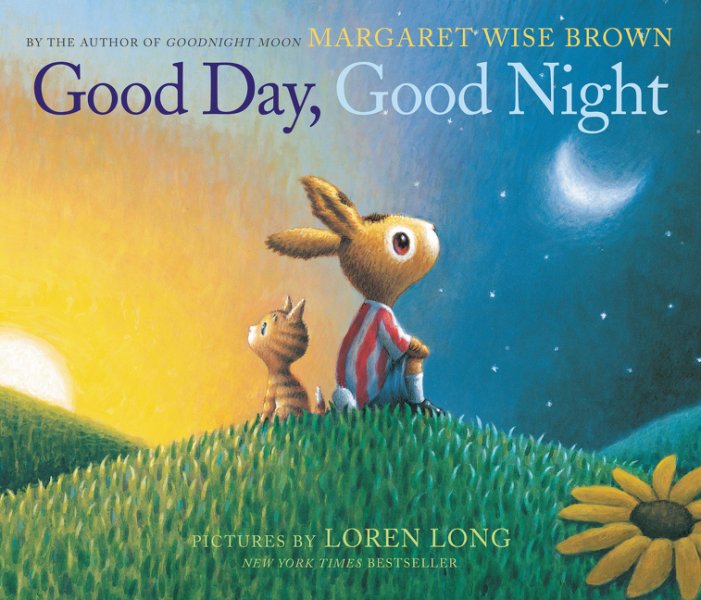
As you move through the hours of the day everything, where you go, the individuals you see and the things you do, reminds you, if you stop for the merest of moments, of the early morning thankfulness. Good Day, Good Night (Harper, an imprint of HarperCollinsPublishers, October 3, 2017) a never-before-published picture book written by Margaret Wise Brown with art by Loren Long is a gentle, affectionate poem of appreciation to the wonder of each and every day.
When the sun came up the day began.
One small soul, a bunny, saw it rise. Greetings rang out, not just to one but to everyone. It was time to bid the darkness farewell.
He looked up and saw the trees. He looked up and saw the birds. Bees busily flew away from their homes high in the trees. The bunny's companion, a tiny kitten, got a cup of milk for breakfast.
The morning was in full bloom. All the residents were asked to look for the wonder in this day. All the residents were asked to give this day their full attention. Live!
Later as the moon rose, another night started. Greetings again rang out wishing creatures a pleasant evening. Now inside the bunny bid his tiny kitten and teddy bear good night. He wasn't quite ready to go to sleep. He made sure inside and outside all those he knew received those soothing final two words. Rest well sweet rabbit.
Margaret Wise Brown in this book lifts simple words into eloquence. The repetition of good morning and good night as the bunny observes his natural world and daily surroundings supplies readers with a soothing cadence. It asks them to find the same joy as the bunny does. It's a lullaby. It's a prayer. It's masterful and beautiful.
The same tender, lasting charm we feel reading the words written by Margaret Wise Brown is elevated by the art of Loren Long. The two friends, the tiny kitten and bunny each greet the morning and the evening. The blend of the two parts of the changing skies is flawless. Notice the light and shadows on the grassy hill. See how the glow of the sun and moon highlights the characters' faces. I don't know about you, but I want to sit on that hill with them. To the left, on the back, the golden yellow from the sunrise provides a canvas for a tiny bee and Monarch butterfly facing each other.
Beneath the jacket on the book case, Loren brings the sunrise closer to us on the front and the night sky also closer on the left. To have them opposite of their appearance on the jacket signifies a continuum. A lush rolling landscape with a river winding through the created valley spans the opening endpapers. The sky shifts from deeper purple to pale lavender and then golden yellow as the sun rises. A single large tree sits in the open on one of the hills on the right side. It is the base from which the rabbit town radiates. On the closing endpapers night has fallen on the same scene. Tiny pinpricks of light are seen around the tree. Without a word being spoken the color palette for both of these says, "Hush, dear readers."
Rendered in acrylics on illustration board each image beginning on the title page, tells a story. Beneath the text, the bunny sits up in his bed, holding his teddy bear, and sees the sun rising through his bedroom window. All of the two-page pictures placed on matte-finished paper have a classic timeless quality. All are shown in full color but four are placed on a crisp white background.
The brush strokes ask us to reach out and feel the soft texture they emulate. The exquisite details ask us to stop and look at each picture carefully. Do you see the tiny mouse in the window of the bunny's house as he greets the day? The name of the newspaper another rabbit brings to homes is the Daily Warren. The Harey Dairy truckbrings milk. During the morning two ladybugs walk along a branch. At night they are tucked under the bird's nest. The caterpillar seen in two illustrations happens to be a Monarch caterpillar. Do you recognize the book one bee is reading to another at bedtime? You can't help but smile when you realize why there are two holes in the roofs of the vehicles. The bookends and bedside lamp in the bunny's bedroom are delightful. Careful readers will spy the mouse again. They will also recognize the spelling on the wooden blocks.
It's nearly impossible to select a favorite illustration. They all are gorgeous. One of my favorite pictures is when the bunny is getting ready to go to bed. The use of green, yellow and red is predominant on the furnishings and window frames. You realize where the flowers the bunny picked earlier have been placed. It seems as if his toy animals are watching him pet the tiny kitten on his bed. His teddy bear wearing a straw hat is ready for bed, sitting and waiting in the rocking chair. A fire burns in the stone fireplace hearth. (I would love to hang this picture on my wall.)
You will most definitely want to add Good Day, Good Night written by Margaret Wise Brown with pictures painted by Loren Long to your personal and professional collections. This is a book to have at your bedside to read when you first wake up and right before you go to sleep. It casts a spell of contentment and calm.
To learn more about Margaret Wise Brown and Loren Long and their other work, please follow the links attached to their names to access their websites. Loren offers looks at his process for this title on his website. Enjoy the book trailer and Loren's video about this book.