Quote of the Month

When love and skill work together, expect a miracle. John Ruskin


Showing posts with label Rabbits-Fiction. Show all posts

Wednesday, February 9, 2022

Click

Humans are not as quick to receive someone as their canine counterparts.  Dogs, regardless of your physical characteristics, readily give you their unconditional love.  Their loyalty is humbling in its purity.  Whether you are courageous or cautious, or aloof or friendly, or carefree or worried, their understanding of you, your flaws and strengths, is remarkable.  If you are fortunate enough to have a friend who views you in this manner, it is a cherished gift.

As someone who is shy, being among others, especially large groups, professionally or personally, is challenging.  It is not easy to join in small talk, offer comments in discussions, or provide answers to questions, even if you have correct responses.  You prefer to be an observer.  You prefer to blend rather than engage.  In Where Is Bina Bear? (GodwinBooks, Henry Holt and Company, January 11, 2022) written and illustrated by Mike Curato, readers are invited to a party.  One of the guests is most bashful, but has the best kind of friend, a cherished gift.

Tiny was having a big party.
But where was Bina Bear?

Bina Bear was hiding in the dark.  Bina Bear was trying to blend in with the wallpaper.  Bina Bear believed standing still with a lampshade on your head turned you into a lamp.  It was a good plan for concealment. 

When Tiny, a small rabbit and Bina's friend, asked if the object was Bina, a voice replied it was a lamp.  Bina next arranged to be a large table with a bowl of fruit resting on it.  The table graciously allowed Tiny to take a banana.

As Tiny moved outside and then back inside, each encounter with Bina Bear presented a new object which freely spoke with Tiny, but denied being Bina Bear.  Tiny voiced missing Bina Bear.  Wherever Bina Bear went and whatever she became, Tiny was there.

When Tiny asked if Bina Bear was all right, the bear said yes.  Bina Bear was not okay.  Through a compassionate conversation, Tiny realized what Bina Bear needed most.  Two hearts shined as one.


Spare, intentional text with specific word choices by author Mike Curato evoke an emotional response in readers.  Dialogue between Bina Bear and Tiny establishes their affectionate relationship.  The questions and answers further our comprehension of their bond. The decision to use fewer words leaves room for the artwork to elevate the story.  Here is a passage.

Excuse me, have you ---

I AM NOT BINA.  I AM A TREE.

Oh, okay.

Sigh . . . 

"nom nom nom" 

Do you want
some banana,
tree?

Yes.


One of the first things you notice about the open dust jacket is the color palette.  The bright yellow as a background on the front and back sings out hello.  The complementary hues used with the yellow heighten the greeting.  The cones of light above and below Bina Bear draw our eyes to the title text and to Bina Bear and Tiny.  The text, Bina Bear, and Tiny are varnished on the front.

To the left of the spine are three of the forms Bina Bear assumes to hide.  She is a table in the living room, a tree in the yard, and a chair.  The accompanying text contrasts with what readers can see.  Bina Bear and Tiny in these three scenes are varnished.

On either side of a yellow spine, the book case is purple.  It is Bina Bear.  All we can see of her is her eyes and nose enlarged on the front of the case.

The opening and closing endpapers are the same bright yellow.  On the title page is a full-page picture.  It is a party setting.  Balloons from the refreshment table are used to spell out Bina Bear in the title.  Bina Bear is peeking from the outside through an open door in the background.  Tiny is chatting with a squirrel.  Careful readers will notice a familiar character, trunk raised, near a plate of cupcakes.  The dog, Spot, is under the table, tongue out waiting for crumbs.  

These illustrations were rendered using

ink, colored pencil, watercolor, and digital.

The size of the visuals vary in accordance with the narrative. There are single-page images, two-page illustrations, two horizontal panels, top and bottom, across two pages, and two, three, and four images on a single page.  There are several dramatic wordless double-page pictures.  All the artwork is loosely framed.  The perspectives vary with the image sizes.  What artist Mike Curato conveys with his eyes alone is marvelous.

One of my many favorite illustratons spans two pages and is wordless.  We are inside a formal library.  The walls are papered in a fern design.  Ornate white bookcases line the walls on the left.  Between two of those bookcases is a Bina Bear bookcase.  Her arms and legs are arranged like shelves to hold books.  To the right of the gutter, French doors, now closed, open into the party.  On the far right, a plant hangs from the ceiling near a pink and green chair.  On the wood floor, stained pale pink, sits Tiny on a green pillow.  She is reading a book as big as she is.  One of her eyes is watching Bina Bear watch her.


This book, Where Is Bina Bear? written and illustrated by Mike Curato is for all those shy people to know they are seen.  It will build empathy in all those people who are not shy.  Readers will find a special place in their hearts for this bear and her rabbit friend.  I know you will want a copy of this title for all your collections, personal and professional.

For those desiring to learn more about Mike Curato and his other work, please follow the link attached to his name to access his website.  Mike Curato has accounts on Facebook, Instagram, and Twitter.  Mike Curato speaks further about his book on this additional site of his.  Mike Curato, this title and his artwork are featured by author, reviewer, and blogger Julie Danielson on her site, Seven Impossible Things Before Breakfast.  You can view interior images at the publisher's website.

Where Is Bina Bear? by Mike Curato from Let's Talk Picture Books on Vimeo.

Thursday, May 6, 2021

From The Start, Heart To Heart

When you least expect it, but need it the most, there it is.  You might be cresting a hill on a walk with your dog and the sight you see takes your breath away.  As you look through the different shades of spring budding on trees spread before you, in the distance hues of blue water like glass extend to an opposite shore. The shadows and light cast an enchanting spell on this moment.  There is silence.  Even your canine companion stills.  What if you had not glanced that way?

This beauty on this day is a symbol and a sign.  In What the World Could Make: A Story of Hope (Roaring Brook Press, May 4, 2021) written by Holly M. McGhee with illustrations by Pascal Lemaitre, two friends find the best life has to offer in the simple things given to them as they explore their world.  Each season brings the duo closer together, bound in mutual affection.

The friends thought it a wonder---
winter white flakes a gift from the sky.

Side by side they sat, as flakes fell on them.  They were amazed at the beauty.  Bunny wanted the snow to never stop.  Rabbit asked if Bunny was sure.  Bunny really wanted the memory to last always.  And Rabbit understood.

So, Rabbit made a snowball for Bunny.  It was large and perfectly shaped like their tails.  Now Bunny would have the memory of the winter white flakes always.

With the arrival of spring, Rabbit and Bunny were enticed by the colors and smells of lilacs.  During this season it was Rabbit who wanted the memory to last always.  As the most beloved kind of friends do for each other, Bunny made something extra special for Rabbit.  

Summer offered a delectable, tangy and crisp treat.  This present was presented by warmth, water, and tiny grains of ground rock and minerals.  As the days shortened, the rich glow of autumn supplied them with the perfect place to do what bunnies and rabbits do best---

JUMP!

That's what Bunny and Rabbit did, wondering at the wonder this year made for them.  

And then---


The words written by Holly M. McGhee in this story radiate from the pages, wrapping around you in a hug you want to last forever.  The friendship between Bunny and Rabbit is precious and pure, shown by their willingness to make a shared moment never end for the other.  Through the rhythmic sentences, repetition of phrases and conversations, we learn as they have.  Hope, like their love, is where you choose to find it.  It is provided each and every day and night of our lives.  Here is a passage from the story.

"I know what you mean,"
said Bunny this time.
"The kind of forever where
you remember it even after 
it ends!"


When you look at the front of the open and matching dust jacket and book case, you have questions.  Two rabbits, bunnies, with their backs to us are facing the sky, future, rosy with the rising (or setting) sun.  A field filled with possibilities stretches from them to the bottom of the jacket and cover.  On the front of the jacket the text and friends are varnished.

To the left of the spine, the back, there is a crisp white canvas.  Here, in the center, Bunny and Rabbit walk and splash, paw in paw, through shallow water.  On either side of them is a treat they will soon taste.

On the opening and closing endpapers is a delicate mint green.  On the title page, the image of Rabbit and Bunny sitting in the tree is placed between the text.  All the illustrations were rendered with

pen and ink and Adobe Photoshop

by Pascal Lemaitre.  One of the first things you notice about Pascal Lemaitre's artwork in this book is his superb use of space.  For many of the scenes Bunny and Rabbit are small, surrounded by a natural setting.  His fine lines and limited elements in each illustration convey a real sense of fascination.  The image sizes range from double-page pictures to a collection of smaller visuals on two pages and back to double-page images before this is repeated.  It is a pleasing flow enhancing the narrative.  The splendor of each season is portrayed in wonderful color choices.

His intricate details add to the endearing quality of the friends and their experiences.  Each of them is wearing colored scarfs with a white R on the red one for Rabbit and a white B on the green one for Bunny.  The quality of emotion conveyed with their eyebrows, eyes, button noses and mouths leaves no doubt in readers' minds as to the state of their minds and hearts. 

One of my many, many favorite illustrations is a double-page picture.  Across the top of the pages is a light purple wash with plump snowflakes falling in it.  Below this is white.  On the left side Rabbit is holding a large snowball and reaching toward Bunny.  Falling snow is shown on Rabbit and the slightly shadowed ground around her.  To the right of the gutter is Bunny.  She stands looking at Rabbit, expectant and happy, her paws clasped in front of her.  To the right of her is an evergreen tree laden with snow.  


When you finish reading this book, What the World Could Make: A Story of Hope written by Holly M. McGhee with illustrations by Pascal Lemaitre, you find yourself smiling.  In fact, you've been smiling the whole time and perhaps, you might be a bit teary by the tenderness expressed in words and artwork in this title.  Is there ever a time when we don't need hope?  Is there ever a time when we don't need to share the simple, freely given gifts of nature with someone who understands us completely?  I can't imagine a collection, personal or professional, without a copy of this book.

To learn more about Holly M. McGhee and Pascal Lemaitre and their other work, please access their respective websites by following the link attached to their names.  Holly M. McGhee has accounts on Facebook, Instagram, and Twitter.  Pascal Lemaitre has accounts on Facebook, Instagram, and Twitter.  This book is featured with an interview at Kathleen Temean's Writing and Illustrating.  At the publisher's website you can view interior illustrations.  


Thursday, May 7, 2020

A Double Dose Of Laughter

Regardless of your age, laughter can lift you up.  It can take an upside-down day, turning it right side up.  If you can share this laughter, the happiness it creates escalates.  Presently, it's a bit difficult to spread this form of joy with anyone other than those with whom you are sheltering or virtually, BUT . . .

When you think of authors and illustrators who make books filled with playful plots and comical characters, let us imagine they are there with us when we open the covers of their books.  As we laugh at their stories, it is as if they are laughing with us.  With this way of thinking, laughter is always shared.  Two April releases, graphic novels for younger readers (and readers young at heart), are welcome bursts of friendship and fun.

In the first title, Baloney And Friends (Disney Hyperion, April 14, 2020) written and illustrated by Greg Pizzoli, a crew of companions exhibit distinctive personalities.  It's their differences that make them dynamic.  None of them are without imperfections but together they form a flawless friendship.

A one-page full-color graphic in horizontal panels informs readers they will be enjoying a Get Started introduction, three stories and three two-page mini-comics.

Baloney + Friends
Get Started
(An Introduction Of Sorts)
Hello!
I'm Baloney!
This is my book.
All about me!
And me, too!
Oh. Hi, Peanut.

In this back-and-forth conversational exchange, we meet Baloney, Peanut, a blue horse, Bizz, a black, white, and yellow bee, and Krabbit, a cranky purple rabbit.  Baloney tries over and over to present his book and friends to readers, but he is constantly interrupted.  When it finally appears as though he can proceed without delays, Peanut is missing.  When you have to go, you have to go. (a bathroom break)

In the first story Baloney's magic show and trio of tricks are loaded with misconceptions.  What Baloney predicts does happen, but certainly not by magic.  His friends' responses are varied.  These in contrast to Baloney's actions are comedy gold.

Avoiding what you fear and overcoming that fear is addressed with candor and humor in the second narrative.  In musings Baloney reveals his hesitancy. In chatting with his friends, they become aware of his concerns.  It's Bizz's questions and then understanding which propel Baloney to be his best self with victorious though hilarious results.

To close this trio of tales Baloney and Peanut have a heart to heart chat about those things which make you feel sad.  An effort to lighten Baloney's mood only serves to display the depth of his despair.  As this is acknowledged, Baloney steps forward as true friends do.  Heart to heart is an art best buddies learn together.

In between the three stories the mini-comics range in their focus.  We are present during an arcade duel for player dominance, a rare peek at a hungry hero's craving for cookies and a closing championing the power of good stories.  Endings are the best beginnings.


By giving voice to these four characters, Greg Pizzoli illuminates those qualities which make each individual unique.  It is their singularity which endears them to us.  In them readers will see their strengths and weaknesses.  In these three stories and three mini-comics, Greg Pizzoli, through his written words, allows us to understand the benefit of embracing the complete individual, even if they are a work in progress.  (I'm looking at you, Krabbit.)  Although, to be fair, Krabbit elevates the laughter factor.  Here is a passage of dialogue.

Come and see the marvelous . . .
the masterful . . .
the magical . . .
The One And Only
Baloney!

Gasp!
A magic show! (Peanut)

Oh fun!  (Bizz)

Whatever . . .  (Krabbit)


As soon as you see the front of the book case, you'll start to fall in love with these happy-go-lucky friends.  Well, there is a scowl on Krabbit's face, but that's pure Krabbit.  The wide eyes, in the case of this book, are the secret to the soul of these characters.  They want us to be a part of their story.  The title text, Greg Pizzoli's name, the characters and the silver starburst are varnished.

To the left, on the back of the book case, the foursome is featured in four squares inside a larger square.  Above and below them is text you might see on the flaps of a dust jacket.  There are also glowing endorsements from two other admired author illustrator voices in the children's literature community, Ben Clanton and Laurie Keller.  Several elements here are varnished as well.

In a pattern of darker orange on lighter orange is a series of drawings of the fabulous four in a variety of positions.  Every so often the words:

Baloney
And Friends

are placed within the sketches. After this, prior to the title page, is a circle with the four friends and their names fashion a circular frame.  The title page is designed with a photograph of the pals.

Greg Pizzoli's panels shift in size to emphasize pacing and drama.  The color of the framing around the panels changes from white, to pale orange, purple, green, blue, black, royal blue, and red.  Sometimes the panels are outlined in a thin black line; other times the edges are scalloped or the image bleeds edge to edge.  Several times the characters appear outside a panel to designate their position with respect to each other or in reference to a memory.

Readers will recognize the masterful ability of Greg Pizzoli to create a range of emotions through his lines.  His facial expressions leave no doubt as to what his characters are feeling.  This is how we connect easily with the personalities.  This is why we love to laugh at their stories.

One of my many, many favorite illustrations is on a single page.  Baloney is on stage dancing in his black pants, black bow tie and black top hat and holding his magic wand.  He is throwing a glass previously filled with ice cubes in the air.  They magically (with the use of a heater and hair dryer) turned to water.  In front of the stage Peanut is clapping and saying

Amazing!

Bizz utters disgustedly

Oh, come on!

And Krabbit, as you might expect says:

That's
NOT
magic!

Their faces tell the whole story.


This book, Baloney And Friends written and illustrated by Greg Pizzoli, is a first-class graphic novel everyone will want to have on their personal and professional bookshelves.  Regardless of the number of times you read it, you'll find yourself either laughing or sighing more than once.  Greg Pizzoli makes books you want to hold next to your heart. At the close of the book four pages are dedicated to teaching you how to draw these characters.

To learn more about Greg Pizzoli and his other wonderful work, please follow the link attached to his name to access his website. Greg Pizzoli has accounts on Instagram and Twitter.  Greg Pizzoli has a YouTube channel.


In the first book in a new series readers get to meet two lovable animated animal creatures plus two of their friends.  Fox & Rabbit (Amulet Books, an imprint of Abrams, April 21, 2020) written by Beth Ferry with illustrations by Gergely Dudas is a gathering of adventures, one connected to the other, by friendship, fun and the letter F.  Each of the five stories is titled with three alliterative words.  The three words are a welcome to readers to participate.

STORY ONE
FAIR, 
FIREWORKS 
& FRED

 I see a whale.
Me too.
I see a
carrot.
Me too.
Now I see a
crab.
Me too.

I just made that up.
I didn't really see a crab.
Stop copying me.

I wasn't copying you.  I was
just being nice.

Humph.

In this first verbal exchange as Fox and Rabbit are lying on their backs gazing at clouds, we get an early glimpse into their personalities.  This duo sees and smells cotton candy which leads them to a fair. Immediately Rabbit wants to ride the Ferris wheel, but Fox is not excited.  Rabbit says he will win Fox a stuffed toy to hold when he rides the Ferris wheel.  Guess who wins all three games?  Guess who wins a stuffed toy lion?  Guess who ends up holding the stuffed toy lion when they finally ride the Ferris wheel at night?  Fireworks lead to a new name.  Rabbit still has to satisfy a yearning.  The result leads us into story two, but not without even more laughter at the expense of the late arrival of a turtle.

The next day, story two unfolds with an eager Fox ready for a day at the beach.  At every stage of this tale, Rabbit over prepares.  Fox presents the only thing necessary, a single item beginning with the letter F.  Rabbit stalls all day long about going in the water.  For every reason Rabbit supplies to not going in, Fox counters.  Rabbit eventually decides he loves the beach (and the water) a lot, so they stay for the sunset.  A gift floats to them in a bottle on the darkened water. 

The next day after weighing the pros and cons of their next trek into the unknown, Rabbit loads up a backpack and Fox carries a single item, a flashlight.  They have three geographic challenges with weather and fauna adding to the mix.  As they reach their goal, it's not what they expected but they learn some surprises are right in front of us all the time.

Sparrow, an already accepted foodie, steps in to assist Fox and Rabbit in their next endeavor.  As a guide Sparrow is the best.  Fox and Rabbit work harder than they thought possible all day.  Then there are days and days of watering and waiting.  When they see the outcome of their labors they are overjoyed until disaster strikes.  Forgiveness starts with the letter F and it's the foundation of friendship.

At the close of this first book of heartwarming discussions and feats, the charming companions watch a startling discovery grow.  From this a construction project and hours of time in the kitchen equal a backyard business.  Just when it looks as though this is a zinger, Sparrow turns it into a pleasant surprise.  As usual Turtle arrives at the end and the final line is the bow on this perfect present for readers.


As you read these five stories you can't help but think of all the fabulous fun (two letter Fs) Beth Ferry had finding words beginning with the letter F.  You can't help but wonder at the joy she felt creating the conversations between Fox and Rabbit.  Their banter is a linguistic delight.  They counter and contrast each other.  They question and answer each other.  They bring out the best in each other.

To tie the stories together, Beth Ferry frequently uses a phrase such as

Are you sure?
Sure as sunshine . . .
Sure as sand . . .

and the appearance of Turtle heightens the hilarity of each episode.  To enhance the personalities of Fox and Rabbit a cadence is established with repeating words and instances in their dialogue.  This is the glue that adheres and deepens their affection.  Here is one wonderful conversation of many.  Fox is speaking for most of the page.

Hurry up!
What's taking
so long?
The sun will be
setting soon.
Do you want to
pack the
toilet too?
Fred is getting 
antsy.
Ta-da!
I'm ready!
You're not bringing 
anything?
Oh, yeah.
Because flip-flops start
with F.


When you open the book case, on the right you can sense the total bliss Fox and Rabbit are feeling in the moment of being together in a field of dandelions.  This moment is extended in the image that begins on the spine and spans across the back.  In this picture the pale blue sky is filled with floating dandelion fluff.  Rabbit and Fox with Fred, the toy stuffed lion, on the ground are looking up as they stand in the same dandelion field.  Above them text like you might read on the front flap of a dust jacket is placed.  The characters, the title text and some elements on the back are varnished.

The opening and closing endpapers are pale blue.  For the initial title page dandelion fluff drifts on the same blue.  For the formal title page, the picture on the front is expanded, spreading over two pages.

Illustrator Gergely Dudas rendered these images

with graphite and ink and colored digitally.

Opposite each chapter page on the right, Fox and Rabbit are placed in a circle introducing readers to their following escapade.  Gergely Dudas places a series of small images on full-page pictures, places a series of panels on a single page, supplies wonder with full page pictures and generates his interpretation of the narrative with several series of wordless panels.  Most of the images are loosely bordered with a fine black line.

Readers will be fascinated with the combination of body postures and facial features on Fox, Rabbit, Turtle and Sparrow.  They convey a range of emotions.  The pacing is impeccable.  The humor is rich and true. 

One of my many, many favorite illustrations is when Fox and Rabbit are at the beach.  In a series of eight small square panels placed as two columns on a larger area of sand on most of the page beginning on the left, we are privy to a conversation and three wordless pictures at the end.

The conversation begins with Rabbit as Fox goes swimming again:

I'm going to dig for
treasure.  This was
probably
a pirate 
beach once.

Call me if you find
something good!

And by good I
mean gold!

Or silver.

Or gummy worms.

As Rabbit digs with Fred watching next to the hole, we see less of his body until only his ears are above ground.  Then on the far right is a cutaway of that beach area.  Rabbit is way, way down.  He must have dug for a considerable amount of time.  This picture leads into another comedic conversation when Fox returns from a swim.


Between the chatting of these two friends, Sparrow and Turtle, readers know they've met the best kind of individuals.  Fox & Rabbit written by Beth Ferry with illustrations by Gergely Dudas is a book, whether placed on your personal or professional bookshelves, that will have the well-loved look in short order.  We readers are fortunate another title is set to be released this year. 

To learn more about Beth Ferry and Gergely Dudas and their other work, please follow the links attached to their names to access their websites.  Beth Ferry has accounts on Instagram and Twitter.  Gergely Dudas has accounts on Facebook, Instagram and Twitter.  At the publisher's website you can view interior images.  The cover reveal for this book is hosted by Dylan Teut,  executive director of the Plum Creek Children's Literacy Festival at Mile High Reading.  Dylan Teut interviews Beth Ferry.  Betsy Bird, Collection Development Manager of the Evanston Public Library system, at School Library Journal, A Fuse #8 Production, interviews Beth Ferry about this book.

Tuesday, April 14, 2020

A Horde Of Hares

In our neck of the northern Michigan woods, the wild rabbits have huge appetites for . . . everything.  No item is safe from their voracious desire to sample a range of perennial plants and shrubs, regardless of the season.  They are both clever and determined despite the use of carefully placed and secured netting and burlap wrap. 

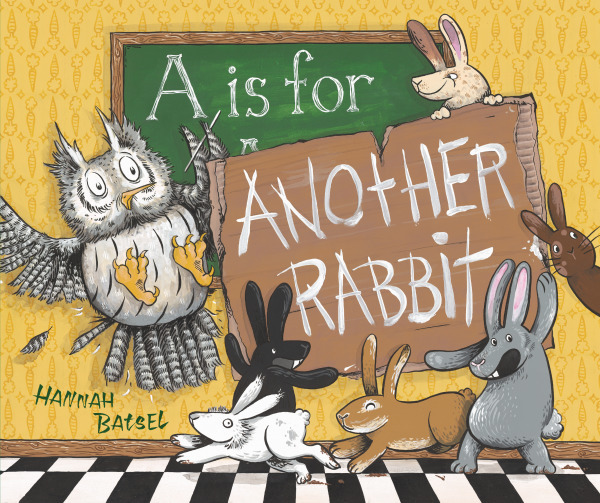
Most of them are the normal size of wild rabbits but one or two are rather large which confirms their considerable abilities not only in enjoying a banquet of edibles but in eluding the prevalent raptors and coyotes.  It's hard to know how many there are in residence, but their frequent appearances indicate their numbers are growing.  A is for Another Rabbit (Carolrhoda Books, an imprint of Lerner Publishing Group, April 7, 2020) written and illustrated by Hannah Batsel is an alphabet adventure gone awry due to an overabundance of bunnies.  Trust me when I relate that this is no laughing matter to one particular owl, but the hares find it hilarious (and you will, too.)

A is for A rabbit.

Wait---
rabbit starts with R! 

Yes, but "a rabbit" starts with A.

As you might surmise the letter B is represented by the word bunny which, I might add, is quickly pointed out by the disturbed owl as being a synonym for rabbit.  As the narrative proceeds through the letters of C and D, entire phrases represent those letters because of the first word in those very phrases.  A promise is made for the letter E.  Initially, the owl is happy because it seems this alphabet book is back on track until he uncovers a wily disguise. 

The presentations for letters F through J are outrageously focused on rabbits rather than the specific letters.  Owl is fearful of being fired.  Clearly Owl is getting more and more rattled when he mistakes the word Kit for Kite.  Kit happens to be the term for a baby . . . rabbit.

The farther into the alphabet we go, the more despondent Owl becomes. He's a complete bundle of nerves.  The unseen narrator convinces him to rest for a few pages after the letter P.  Owl readily agrees.

The silence that settles over the pages for Q is laden with suspense because the next letter is R for . . . RABBITS, oodles of rabbits.  Owl is flabbergasted as he shouts out S for stop!  An obvious message is conveyed.  With letters T through Y, it's fulfilled.  As the alphabet book comes to a close, Owl, frazzled to within an inch of his bird life, finally gets his wish.  Although, others get the last word.


Author Hannah Batsel begins her comedic tale immediately as we read the first three sentences.  It builds with each letter of the alphabet as the banter increases between Owl and the unseen narrator.  Every alphabetical statement, more preposterous than the last, is countered by Owl as his frustration escalates.  This supplies readers with humor which multiplies proportionality.  The pure fun at reading this text aloud increases with the use of alliteration and rhyming.  It's a joyful rabbit jubilee!  Here is a passage.

G is for Goodness me!
Another page
of rabbits?

Now, look here.  I may
be small, but I refuse to be
pushed around by a pack
of long-eared, carrot-eating
furballs!  If you don't stop
this nonsense, I'll---


The full-color images on the front and back of the open and matching dust jacket and book case declare shocked surprise and marvelous merriment. Clearly on the right, the rabbits have no intention of stopping their quest to occupy every single letter of this alphabet book, much to the dismay of Owl.  To the left a multitude of rabbits in an array of colors and attire are layered together.  Among them is a rabbit robot, a pastry chef rabbit carrying a cake with lighted candles, a rabbit wearing a Wisconsin cheesehead hat, a crown-wearing royal rabbit, a rabbit opera singer donned in a Viking helmet with horns and braids and rabbits wearing lion and alligator costumes.

On the opening endpapers in lavender as a canvas with brown etching is a gallery of animal portraits, meant to be a part of this alphabet book.  Owl is entering from the far-left walking along, carrying a book under one wing and a hot beverage in the other wing.  On the closing endpapers, a white rabbit on a ladder and with telltale red paint has made alterations to the gallery.  An exhausted Owl, beverage spilled and book on the floor, is sleeping on the sofa on the far right.

These images

painted with acrylics, black ink brush pens, and liquid gold leaf

by Hannah Batsel are a reflection of her gift of humor and love of rabbits per her dedication and note on the verso page.  On the title page Owl is quietly at rest in an easy chair in front of his fireplace.  Careful readers will notice an odd shape on the globe next to his chair. 

Each illustration spanning two pages or single pages is highly animated with bright and lively characters.  Their facial features especially those of Owl mirror every mood.  Readers will pause at each page turn to notice the details and myriad elements.  The use of white space is instrumental in depicting the comedy and drama to perfection most notably for the letter Q.

One of my many, many favorite illustrations is for the letter E.  Spanning across from the left, over the gutter and nearly to the edge on the right is an elephant.  This is no ordinary elephant.  This elephant is formed from patched gray blankets of different textures, with cardboard ears painted pink, cardboard tubes for tusks and a trunk manipulated by three rabbits and a stick contraption.  On the green and yellow tile floor are splatters of pink paint and a dropped paint brush.  Owl is basking in a glow of suspicious confidence with closed eyes.  This page is sure to evoke bursts of laughter.


This book, A is for Another Rabbit written and illustrated by Hannah Batsel, is a celebration of all things rabbit.  It is one of the funniest alphabet books with bunnies busting out of the seams. It can be used with other alphabet books, a unit about rabbits or a theme based on humor, one discussing what makes a book hilarious.  I highly recommend this title for your personal and professional collections.

To learn more about Hannah Batsel and her other work, please follow the link attached to her name to access her website.  At her website a page dedicated to this book provides a glimpse at illustrations.  Hannah Batsel has accounts on Facebook and Instagram.  At the publisher's website you can view interior images and read an excerpt.

Tuesday, February 4, 2020

A Single Seed

Last week a new initiative was announced by the Michigan Seed Libraries.  For the first time there is a One Seed, One State project in the State of Michigan.  Seed libraries are not new, but as stated at the Michigan Seed Library website, they are beneficial:

Seeds are one of the world's most valuable resources in sustaining plant biodiversity, preserving cultural heritage, and feeding communities across the globe.

Both the American Library Association and the Public Library Association have publications on the purpose and process of establishing seed libraries.

The worth of a single seed is never to be taken for granted.  All we have to do is stand among the towering giants in a grove of oaks or wander through a field of wheat to realize the veracity of this belief.  A single seed is a reminder of the greatness which grows from something small.  Hundred Feet Tall (Simon & Schuster Books for Young Readers, February 11, 2020) written by Benjamin Scheuer with illustrations by Jemima Williams is a tale (and a song) of a young rabbit who finds and plants a single seed.  These words are wrapped in hope and love.

Under the tree is a little brown seed
that you find in a dusting of snow.

As the seed is carried home by the young rabbit, a mental vow is made.  This seed is not alone.  It is to receive the best care possible.  Dirt is placed in a jar and the seed is placed in the dirt in that jar.

If we could hear what the seed has to say, we would hear words of gratitude.  This seed knows it will grow.  It will grow because of

love and light.

This jar holding dirt and the seed is watched daily by the young rabbit.  The youthful arborist notices all the changes; sprouting roots and little green shoots.  Soon it's taller than its caretaker can stand.

As a parallel to the growth of the seed readers welcome the family's newest member, the birth of a baby bunny.  Eventually the tree and its roots are much too tall and full for the jar.  As a community, the young rabbit, family and friends take it outside to reside in a small plot in front of their home.  Here all will enjoy the bounty the branches of the tree will provide. 


With a rhyming word at the end of the second and fourth lines, author Benjamin Scheuer issues an open invitation for reader participation. He switches it up with the words (chorus) spoken by the seed.  The cadence supplied by that rhyming has an extra beat.  Readers and listeners alike will be toe-tapping before the seed sprouts.  Here is a passage.

Up from the earth grows a little green stalk
with leaves that unfold to the sun.

Under the earth roots are growing and growing.
Something exciting's already begun.


The rustic, vibrant brick background spanning from the left edge to the right edge on the open and matching dust jacket and book case provides a splendid canvas for the text and our protagonist.  To the left, on the back, we read the words of the final line of the chorus.

One day
we'll STAND
at a HUNDRED feet
TALL.

The young rabbit, with those wide-rimmed red glasses, is delightful with a capital D.  The green in the leaves and the purple and yellow in the tape measure are wonderful contrasting colors.  Here the seed, now a small tree, is reaching toward its new height.  On the dust jacket the outlines of the brick and all the elements of the oval are varnished.

On the opening endpapers the main color on the jacket and case is used to sketch characters and scenes from the book on a crisp white canvas.  On the closing endpapers the young rabbit and new baby bunny are playing instruments above the music and words to Hundred Feet Tall.  A two-page picture of the tops of the buildings in the neighborhood, with the tree fully grown on the right, provides space for the verso and title page text.  (The dedication reads: 

For Elodie
With love from Mummy and Daddy xxx)

The illustrations rendered

both digitally and with watercolors

by Jemima Williams are double-page images, with the exception of two pages of four smaller illustrations showing the growth of the seed as we look through the young rabbit's window.  We can see the changing seasons by the weather outside and the decor inside the home.  Readers will be scanning the illustrations with every page turn to find the marvelous details Jemima Williams tucks into each one.

On the license plate of the family car it reads BU-NNY.  There is a picture of a teething ring on the bulletin board in the kitchen.  The father rabbit is holding a book about babies as he and his wife watch the young rabbit with the jar and seed planted inside it.  In addition to these elements in the pictures, readers get a very real sense of the love between the members of the rabbit family and of all the animals in their neighborhood, living in harmony and working for the common good.

One of my many, many favorite illustrations is a close-up scene of the young rabbit sleeping at night.  Dreamy clouds frame the image with the thicker and wider ones on the left for the placement of text.  Within the clouds are stems and leaves.  Between the bedroom window curtains is the jar with the tree on the windowsill.  On the right, nestled in bed, is the rabbit.  The book being read before sleep arrived has to do with a very large plant and a castle in the sky.  This particular book makes another appearance and coincides with the text on those pages.


The melody of a rhythm created with words and enlivened with charming images will engage multiple readers of Hundred Feet Tall written by Benjamin Scheuer with illustrations by Jemima Williams.  I can hardly wait for the book's release in a week to hear the song.  I'll probably be humming it for days.  The book will make a wonderful addition to a story time featuring rabbits, growth, seeds, trees or the value of each individual.  You may be small but there is more than one way to be tall.  I know you'll want to have this book in your personal and professional collections.

To learn more about Benjamin Scheuer and Jemima Williams and their other work, please follow the links attached to their names to access their websites.  Benjamin Scheuer has accounts on Facebook, Instagram, SoundCloud, Spotify and Twitter.  Jemima Williams has accounts on Facebook, Instagram and Twitter.  At the publisher's website you can view interior images.

Thursday, January 30, 2020

Save To Savor . . . And Share

We collect.  We gather.  We save.  What an individual chooses to collect, gather or save depends on their needs and wants.  Some items are necessary for life; others are reminders of moments in that life.  Some things are tangible, and others are not.  Those we hold in our minds.

We may find some things harder to collect, gather or save but this is what makes them all the more cherished by us. In A Jar (G. P. Putnam's Sons, an imprint of Penguin Random House LLC, January 21, 2020) written and illustrated by Deborah Marcero is a book which opens our hearts to possibilities.  It shows us how nothing can break the bond of friendship formed with love.

Llewellyn was a collector.
He collected things in jars.

Inside his jars were things representing all the wonder he witnessed around those objects.  If you looked inside his jars, you would see how observant Llewellyn was.  He gathered things he noticed as he wandered out in the world.  (He collected heart-shaped stones, just like me.  I already love this little guy.)

One evening something out of the ordinary happened.  The sky was an exquisite color of red and Llewellyn wanted to save it.  When he was at the edge of the water, he met Evelyn.  Llewellyn put some of that sunset glimmer in a jar and presented it to Evelyn.  You won't believe what the jar did all night long in Evelyn's bedroom.

Llewellyn and Evelyn became the best of friends, collectors of the marvelous things they saw, heard, tasted, smelled or felt.  Nothing was impossible.  During winter, spring and summer they filled jars with all the delights they shared; jars holding trips down ski hills, walks through a field of red tulips and summer shadows.

Jars of all shapes and sizes were placed on shelves lining the walls of Llewellyn's home.  One day, though, this all stopped.  Evelyn's family was moving. 

On one of those nights after Evelyn was gone, when sleep did not come easily, Llewellyn saw something, a collectible something.  He needed to share it with Evelyn.  Later, miles and miles away from Llewellyn, Evelyn saw something, too, a collectible something.  Friendship finds a way to keep love glowing and growing, spreading out.


When author Deborah Marcero speaks of Llewellyn and then, Evelyn, these are two children in which readers will immediately feel a kinship.  They, with respect and no fanfare, appreciate everything around them.  They notice things others might walk past.

Deborah Marcero draws us deeper into the story with her rich descriptions.  We find ourselves astonished and willing to join Llewellyn and Evelyn in their mutual quest to collect those exquisite moments which sometimes only happen once.  Here is a passage.

One night, the sunset painted the sky the color of
tart cherry syrup.  Llewellyn ventured down to the
shore with as many jars as he could carry.

(I don't know about you, but I don't think I'll ever look at a sunset again without thinking of tart cherry syrup.)


Every element on the front of the dust jacket is like one part of an enchanting whole.  The play of sunlight and shadow, the tall trees stretching past the top edge, the vast array of bluebells and Llewellyn and Evelyn, there together, with their jars is like the final piece in a perfect puzzle.  You want to sigh, and you do. 

To the left, on the back, is a canvas of a sunny yellow sky and slightly rolling hills of greens with a bit of blue and brown.  The setting sun, a fiery orb, casts long shadows of a single tree, Llewellyn and Evelyn.  A single sentence says:

FRIENDSHIP IS MAGIC.

The book case background is a bright golden yellow.  On the back, left, and on the right, front, are jars of all shapes and sizes, filled with a variety of items.  On the left, Evelyn is kneeling in front of a jar as a turtle comes out with a snail on its shell.  On the right, Llewellyn is reaching into an equally large jar.  He is close to a butterfly inside with two others and a leafy branch.  A cocoon hangs from the branch.

On the opening and closing endpapers is a pattern of wind-blown leaves in hues of green shifting to yellow, orange and red as they move from left to right.  On the back the color alterations are in reverse.  Butterflies float across the title page and over the gutter to the verso page.  They flutter on all sides of Llewellyn who stands on some grass and holds a jar.

Rendered

in pencil, watercolor, ink, and digital media

the illustrations elevate a lovely narrative to excellence.  Smaller images, more close-up of the characters, are placed within two-page pictures.  Although what has been collected remains in a jar, the memory attached to it swirls around the endearing characters.

Sometimes three smaller visuals in a row will be used to highlight one or two words.  They show a sequence of events.  Two-page illustrations and single-page pictures extend page edge to page edge to create a dramatic effect.  And sometimes jars, many jars filled with the beauty of a season, are all we see on a page.  The delicate details, fine lines and color selections by Deborah Marcero are stunning.

One of my many, many favorite illustrations is beneath the words:

the newness of spring . . .

The sky above our characters is a pale blue gray.  Rolling hills of tulips in hues of red and pink cover two-thirds of the single page.  The perspective goes from tulips that are almost the size of dots to much larger along the bottom of the page.  About halfway up the page are Llewellyn and Evelyn.  All we can see of them are their heads and upright ears and a tiny bit of the top of their clothing. This is utterly charming.


When you read this book, In A Jar written and illustrated by Deborah Marcero, no matter if it's the first time or the tenth time, you have to remind yourself to breath.  It's that striking in words and artwork.  This is a book your readers and listeners will ask you to read again and again.  I imagine a collection of jars filled with objects and memories will grow.  I highly recommend this for your personal and professional collections.

To learn more about Deborah Marcero, please follow the link attached to her name to access her website.  Deborah Marcero maintains accounts on Instagram and Twitter.  At the publisher's website you can view the endpapers.  Deborah Marcero is interviewed on the podcast Picturebooking.

Tuesday, August 20, 2019

The Need To Know

There comes a time in every person's life when their most-used phrase consists of a single word.  It is used frequently during a question and answer conversation.  Sometimes it's used repeatedly, perhaps because the ones saying it know how irritating it can be to some people.  Other times this three-letter word helps to satisfy a mind full of never-ending curiosity.  It's an inquisitiveness which will serve them well over the course of their lives.  It's a search to be informed, understand and become whole.

This single word is why.  It's used with the appropriate punctuation as the title of a new picture book by two-time Caldecott Honor winner (First the Egg and Green) and two-time Geisel Honor winner (First the Egg and One Boy), Laura Vaccaro Seeger.  Why? (Neal Porter Books, Holiday House, August 13, 2019) explores chats between a patient bear and a need-to-know rabbit, revealing the depth of their friendship.

"Why?"
asked the rabbit

"Because flowers need water
to grow," said the bear.

From watching the bear with his watering can to sitting on a hill with the bear at nighttime, the rabbit cannot stop asking one question after another question.  During daylight, after finding out why the bear had a telescope on the hill, rabbit needs to know about the bear's over consumption of jugs of honey.  Can you guess why?

Everywhere the bear goes, the rabbit follows, keeping up a constant conversation.  The rabbit even wonders about the bear's inability to follow him down his own hole to his home.  The rabbit's struggle to maintain his grip on a branch and a subsequent fall prompt two more inquiries and replies.

As the seasons shift the bear and the rabbit watch and ponder the flight of geese in their familiar formation.  From colorful leaves to falling snow, the rabbit seeks answers.  When a dead robin is discovered in the snow by the rabbit, the bear admits to sometimes not having the knowledge to respond.

The snow continues to coat the ground, becoming deeper and deeper.  The bear turns to go, but the rabbit asks him to stay.  Now it's the bear's turn to say:

"Why?"

The rabbit's words are guaranteed to elicit a collective sigh from all readers and listeners.


When I think of Laura Vaccaro Seeger, I think of her as a storyteller for our souls. She is a master of words and language, choosing them with care to convey exactly what we all need.  In this narrative we comprehend the curiosity of the rabbit but also value the capacity of the bear for kindness through their give and take dialogue.  When it switches with the bear asking the one-word question, the purity of both their hearts are revealed.


The illustrations in this title are rendered using watercolor.  When you open the dust jacket the bear's body extends over the spine to the back, creating an entire scene.  The layered colors in the sky, grass, and the bear's and the rabbit's bodies invite you to reach out and touch them.  This setting on the dust jacket, all of them throughout the book, emanate warmth and gentleness.

Beneath the jacket on the smooth, soft dark teal book case, the bear and the rabbit are embossed on the front. They are seated on a small hill next to and facing each other.  A lighter teal covers the opening and closing endpapers.  Laura Vaccaro Seeger begins her visual story on the title page.  The rabbit is hopping after the bear that is carrying a watering can.

Each page turn displays a luminous two-page picture with the exception of two pages.  These two pages have smaller images to accentuate the pacing, leading to bear's statement.   When Laura Vaccaro Seeger shifts her perspective, we stand in awe at the portrayal or want to leap into the closeness depicted in the illustration.  Is it me or do I see a tiny, tiny symbol of love in one picture?

The body postures on the bear and the rabbit as well as their facial expressions endear them to us.  These help to make us a part of their conversations.  This is why when seeing the concluding image of the story, which Laura Vaccaro Seeger paints on the verso page, readers will want to hug this book.

One of my many, many favorite visuals is a double-page picture.  The rabbit is tumbling from the branch he was holding after losing his grip on a windy day.  On a sky-blue background with wispy clouds, thicker in the corners, along the sides and along the top and bottom, he is shown three times, left to right.  First, he is facing left, on the left, like he is hopping in air.  Then, on the right, all his limbs are spread with his mouth wide open as he asks:

"Why?"

Nearing the right-hand corner, he is still on his back, but he is trying to slow his drop.  (Bear catches him on the next page.)


Why? written and illustrated by Laura Vaccaro Seeger is a book to cherish for its insightful presentation of friendship, for the exuberant spirit of inquiry and the huge capability for compassion exhibited by her characters.  It will find a place in all readers' souls.  It would be interesting to read this first without bear's replies to see what children's predictions might be based on the wonderful illustrations.   You could also have discussions on other why? circumstances.  I highly recommend you have a copy of this in your personal and professional collections.

To learn more about Laura Vaccaro Seeger and her other work, please follow the link attached to her name to access her website.  Laura Vaccaro Seeger has an account on Facebook and Twitter.   There is a five question Q & A at The Horn Book with Laura Vaccaro Seeger in December 2018.  Laura Vaccaro Seeger visits author Tara Lazar's Writing For Kids (While Raising Them to talk about her process and this book.  This book and Laura Vaccaro Seeger are highlighted at author, reviewer and blogger Julie Danielson's Seven Impossible Things Before Breakfast.  You will love seeing the artistic process.  At a publisher's website you can view the title page.

Monday, July 8, 2019

Centered

If you are the youngest or the oldest in your family, at school or your workplace or even in an array of places in the public arena, you know there are advantages and disadvantages in both circumstances.  These benefits and detriments will shift and change with time.  It's a distinct possibility when younger you often wish to be older or bigger, but once you are older and bigger, you can't turn back the clock.  Eventually we all discover each age and our place in it is to be appreciated.

Regardless of where you are or who you are with, if there are more than two, there is at least one who cannot claim to be the youngest or oldest.  This individual is in a distinct position.  Bunny in the Middle (Christy Ottaviano Books, Henry Holt and Company, July 2, 2019) lovingly created by author Anika A. Denise with illustrations by her husband Christopher Denise is an endearing tribute to all children whose years number not lower or higher than the others but are perfectly in-between the two.

When you're in the middle . . .
you're not the oldest
and you're not the youngest.  

You have the ability to help and the promise of help when you need it.  Sometimes being in the middle demands you take a stand to protect what you have.  Other times being in the middle requires you to give up something you value.  You have the gift of knowing.

You, as an in-between being, will be looked to as a leader.  In other instances, it is better to follow.  With this understanding comes the wisdom to be alone when necessary. 

There are unavoidable situations as a middle individual.  It's not often you get brand new things when those from older sibling will suffice.  Having your own room is entirely out of the question.  (Sometimes you wonder if sharing isn't your secret middle name.)

All these occasions can be experienced with compassion because as a middle you have more than one thing the youngest and oldest don't have.  This knowledge gives you the best of both worlds.  It gives you what every heart desires.


Using eleven wonderfully paced and spaced sentences Anika A. Denise composes a story of comfort and contentment.  With great care she presents instances in which readers will readily identify not only as a middle, but as the youngest or oldest.  Her word choices present a melodic, soothing cadence. Here is a single sentence.

When you're in the middle . . .

you know when to hold on,

when to let go . . .

and how to solve sticky situations.


You simply cannot look at the matching dust jacket and book case without inwardly or outwardly sighing.  These three bunnies balancing on a log bridge are utterly enchanting.  Their clothing, body positions and facial expressions are inviting.  We want to join them as part of this picturesque summer afternoon.  The soft texture and intricate details in the artwork here (and throughout the book) by Christopher Denise further enhance each moment.  This illustration continues along the spine.

To the left, on the back, on a sky-blue canvas, the siblings are seated together in a large overstuffed floral-patterned armchair.  The oldest is reading a copy of Hop Stars.  The middle child is looking at readers and waving one paw.  Looking at a stuffed teddy bear dropped on the floor, is the youngest child.

The opening and closing endpapers are a glorious summer scene in a lush green meadow filled with daisies.  The characters are placed near the top of the pages.  In the first on the left the youngest and middle are together looking intently at a butterfly.  The oldest one, on the right, with one paw casually on her hip, is watching them. On the closing endpapers the butterfly has moved to the right.  The youngest bunny is still on the left but is now holding a bouquet of daisies.  The middle and oldest child are watching the butterfly.  They are each holding a few blossoms.

The illustrations were rendered

with paper and pencil, Adobe Photoshop; and Procreate on iMac and iPad.  The artist also used an Apple Pencil and Wacom tablet.

On heavier paper, using white space with excellence, the images span two pages and single pages.  Each one welcomes readers to pause and become further acquainted with the characters and the settings in which they live.  Christopher Denise varies his points of view to enhance the text and pacing.  He brings us close to the bunnies but then moves back to let us see the larger area where they reside.

One of my many, many favorite illustrations (I love them all!) is for the final phrase in the sentence previously noted.  The three bunnies have made pink frosting for the baked cupcakes.  We are close to them.  On the right there is a portion of the interior of their home with sunlight shining in a window.  Otherwise the canvas is mostly white with some pale, pale green as light reflecting from the walls.  On the left, wearing the newly acquired white chef's hat is the youngest bunny standing on a chair and ready to scoop out frosting with one paw.  A red-and-white checkered towel and sifter is near her.  The large bowl crosses the gutter and extends nearly to the right edge.  There standing on a chair behind the bowl is the middle bunny with closed eyes, holding a wooden spoon and licking the pink frosting on it.  Bending over the bowl with a spatula in her paw is the oldest bunny on the far right and more in the foreground.


As Anika states in the end flap

"We created Bunny in the Middle . . . to celebrate the unique, sometimes challenging experience of being in the middle.  Middle kids are often sensitive, thoughtful, brave, peacemakers, risk-takers . . . the dear ones. 

Anika A. Denise as author and Christopher Denise as artist have completely and with much affection given us a book that wraps us in a hug.  No matter where you are, youngest, middle or oldest, you will be charmed by these three bunnies and especially by the one in the middle.  I highly recommend this title for your personal and professional collections.  This is a book to share repeatedly.

To learn more about Anika A. Denise and Christopher Denise, please follow the links attached to their names to access their websites.  Both have links to blogs from their websites.  Anika A. Denise has accounts on Instagram and Twitter.  Christopher Denise has accounts on Instagram and Twitter. Anika A. Denise is interviewed at Critter Lit.  At the publisher's website several interior images are there for you to view.

Tuesday, January 29, 2019

Listen, Little One

In the animal kingdom care of eggs, newborns and the littlest members of families is not limited to mothers.  There are notable fathers.  A single male lion, gorilla, or Arctic wolf guards entire large groups; prides, troops or packs.  Some sandpiper females leave the nest once the eggs are laid (she lays more than one batch of eggs per season) and for weeks a male takes care of the eggs and baby birds.  The same is true for Emperor penguins. The fathers carry a single egg on their feet, covering it with a brood pouch for warmth and protection.  They do this without eating for two months.  When the females return from hunting and feeding, the roles are reversed.

Truthfully the position of fathers in species is varied and fluctuates.  In his newest release author illustrator David Ezra Stein takes a traditional lullaby giving it a paternal perspective.  Hush, Little Bunny (Balzer + Bray, an imprint of HarperCollinsPublishers, January 22, 2019) is a soothing exploration of nature and nurturing as spring arrives.

Come, little bunny, don't be shy.
It's time to tell the snow goodbye.

A first scamper out-of-doors leaves the little bunny in tears.  Papa is there to offer comfort.  He assures the little one blue sky is coming and if it does not, there are tasty treats to be found.

When those treats are consumed, there's much more to do.  A bunny's heart sings when it can roam freely in a field.  If danger soars above, Papa knows what to do.  He takes his precious child below that field cuddled in a cozy hole.

If the hidden space gets a bit snug, the duo can pop out again to the grassy landscape.  Should a sudden shower begin to fall, shelter is found beneath blossoming branches.  Fortunately, Papa has an answer when the situation shifts.

Tears may fall again, but fireflies brighten a broken heart.  A bird sings as a sunset radiates across the horizon.  Two bunnies, one big and one little, make their way home.  Love endures in the spring.  Love endures in every season.


As you read the phrases penned by David Ezra Stein a melody, unbidden, begins to accompany your reading.  A rhyming word ends each one supplying a cadence not unlike the movements of rabbits.  One phrase is repeated twice connecting this narrative to the traditional lullaby.  Having Papa speak to his small child makes for a personal and participatory story.  Here is a passage.

And if the afternoon brings showers,
we'll stay by a tree that's hung with flowers.

And when those flowers blow away,
we'll find some other bunnies and play.


On the front, nose to nose, eyes to eyes, smile to smile and paws to paws an adult rabbit and small bunny have our full attention (I know you are sighing.).  The use of yellow, green and hues of blue hint of spring on this open and matching dust jacket and book case.  To the left, on the back, amid a pale yellow-washed canvas, the bunny is hopping toward the spine through spring blooms.  A ladybug decides to move, too.

A golden yellow covers the opening and closing endpapers.  On the title page beneath the text the little one peers from underneath foliage at the remaining snow.  All the images are rendered by David Ezra Stein in

mixed media on watercolor paper.

The size of the illustrations moves from double-page pictures to full-page illustrations loosely framed in black lines to full-page visuals in free-formed circular shapes.  Some of the full-page images spread from edge to edge.

Delicate pastel shades reflective of the season are highlighted by loose black brush strokes.  Tiny lines indicate fur and whiskers.  It's wonderful how the placement of the characters' eyes, ears and body postures clearly convey their every mood.  Due the perspective in each scene readers are fully engaged in each moment.  They will want to touch the pictures.  They will giggle, sigh and probably laugh out loud at the image depicting Papa and Little Bunny going home through the grass.  The heavier matte-finished paper is perfect for David Ezra Stein's artwork.

One of my many, many favorite illustrations is on a single page, edge to edge.  The sun is setting turning the sky golden and spreading a similar glow across the countryside.  A tree trunk frames the left side.  Branches extend from the left; one arches across to the right side.  Leafy vines with blossoms extend down from this branch.  Under this branch is a small pond.  On the back edge Papa and Little Bunny look into the water.  Lily pads float.  A tiny turtle rests on one.  On the branch a blackbird raises its head to sing.


As soon as you read Hush, Little Bunny written and illustrated by David Ezra Stein you will want to read it again to and with someone else.  This is a book to share one-on-one or with a group.  It can promote discussions on how our parents show love, support and care.  It could be paired with Good Day, Good Night, Dad By My Side, Gator Dad, The Wonderful Habits of Rabbits, How To Be A Bigger Bunny, and another David Ezra Stein book, Tad and Dad depending on whether your focus is fathers or rabbits.  To make your story time every more engaging you might want to have some musical instruments available.  I highly recommend this delightful title for your personal and professional collections.

To learn more about David Ezra Stein and his other work, please follow the link attached to his name to access his website. At the publisher's website you can view interior images. David Ezra Stein has an account on Twitter.  He shares process art in his Twitter feed.  The publisher also has an activity guide.

Update:  David Ezra Stein and this title are featured at author, reviewer and blogger Julie Danielson's Seven Impossible Things Before Breakfast on June 16, 2019.

Tuesday, July 24, 2018

A Terrifying Tale

There are not many things better than gathering around a campfire on a summer's night.  The only sounds, if you listen, are crickets chirping out calls, coyotes yipping in the distance or the occasional owl hoot.  You have either snagged one of the few chairs or you're one of several seated on a stump or a long log.  This is a first-class setting for a session of storytelling.  This is a night for scary stories; the scarier the better.

If the bugs are bothering you or a sudden rainstorm moves into the area, a tent with a lantern at its center is a cozy substitute.  You snuggle in your sleeping bag ready for a case of the shivers.  Big Bunny (Chronicle Books, March 20, 2018) written and illustrated by Rowboat Watkins is a witty salute to humankind's grand oral tradition.

Once upon a time,
there was a BIG BUNNY.

A ginormously SCARY bunny?

In reply to this question the bunny is not ginormously scary but simply big.  He does not live on an oversized floating carrot as the listener suggests but on a regular planet like our Earth.  And the carrots growing on this celestial sphere are completely typical carrots.  None of them will be winning any carrot competitions for size.

The listener is getting discouraged at the ho-hum quality of the plot.  Are there going to be any scary parts?  No matter what the teller says, it's not even close to being scary.  Even the introduction of trucks, bridges and trucker penguins does not heighten the listener's interest until the teller gives up.  Now the roles are reversed.

The action kicks into high gear.  That Big Bunny consumes all the bridges and all the trucks and he is still hungry.  (He does not eat the penguins because giraffes driving buses help them escape to Florida.) He inhales all the buildings and he is still hungry.  At this point the first teller asks for a pause, saying all this hunger and eating is worrisome.  What the second teller says next will either have you laughing out loud or shaking in your proverbial boots.


We all know there will be times when what the teller tells and what the listener perceives are two entirely different things.  The intentions of the teller are necessary for consideration also.  Rowboat Watkins delivers a masterful example of these discrepancies in this title. The conversational exchange between the first voice and the second voice are absolutely spot-on and downright hilarious.  When the second voice takes over the narrative, you can feel the tension building toward something.  You're not sure what it is but this makes the twist even more delicious.  Here is a passage.

BIG BUNNY ATE TEN 
CARROTS in ONE! BITE!
Not scary.
Without CHEWING!
Still not scary.
TWENTY carrots?
Nope.
TWO HUNDRED carrots?
Sorry.   


Looking at the unfolded dust jacket the reader can come to only one conclusion (well, maybe two).  This bunny is huge or the illustrator is playing with perception.  Look at that open mouth!  Look at those teeth!  There is nothing cute about that enormous nose.  To the left, on the back, our eyes are shocked by a fluffy tail taking up most of the space. 

The black background on the book case highlights the gazillion tiny carrots displayed.  The opening and closing endpapers are a visual contrast in point of view.  On the first against a blue sky peppered with white clouds are two large, very large, bunny ears, one on each side of the gutter.  Much smaller ears appear at the end against a nighttime sky.  On the title page the top of a large bunny head with ears, viewed from its back, frames the text.

Most of the images, pieced together with this & that, span two pages.  In this way, with shifts in perspective, Rowboat Watkins is able to depict the various storytelling techniques of the narrators.  Each picture welcomes study.  You need to look at all the details realizing their purpose.

One of my many favorite illustrations is across two pages.  The Big Bunny is lying on his side, his larger than large belly bloated from eating more carrots than you can imagine. His ears nearly touch the left side and his body with his feet extends over two-thirds of the right side.  His eyes are crossed in discomfort.  The trucks carrying all the carrots with a large carrot logo on their side are scattered about him like empty candy wrappers.  He has a truck in each paw and one rests on his stomach.  Peculiar noises are coming from his body.


If you want fun and funny all rolled into one singular story, Big Bunny written and illustrated by Rowboat Watkins is exactly what readers will want.  The pacing and humor are excellent.  This is certain to be a story time favorite.  I highly recommend this for your personal and professional collections.

To learn more about Rowboat Watkins and his other work, please visit his website by following the link attached to his name.  Rowboat maintains a Facebook page.  Rowboat is a guest at author, reviewer and blogger Julie Danielson's Seven Impossible Things Before Breakfast.  He has loads of process art for this title.  He was previously a guest at Elizabeth Dulemba's website.

Friday, March 9, 2018

Creative Destinations

Even thinking about it makes individuals smile.  It can be a day or a month.  It's welcome any time of the year.  It's a shift in the established routine.  It's a vacation!

Sometimes a shift in the established routine does not signal a vacation.  Sometimes grownups need to leave for a few days without their children.  Mama's Business Trip Bunny's Staycation (Scholastic Press, January 30, 2018) written and illustrated by Lori Richmond is about a little guy and his very inventive papa.

Mama is going away
on a business trip . . .
and Bunny doesn't like it one bit.

He knows daily rituals simply won't be the same without her.  Looking at her packed suitcase, Bunny has an idea.  Without the suitcase Mama can't go.  Although his six possible plans to make the suitcase disappear might work, a more brilliant thought comes to mind.  What if he goes with Mama?

With his very own suitcase packed he is ready but disappointment quickly follows. Mama can't bring Bunny.  She assures him she will return in five days.  Unable to stop crying during story time at bedtime, his papa tells him they are going to go someplace little bunnies can go.  They'll leave first thing tomorrow.

In the morning Bunny and Papa get to work.  With a large box, paper, scissors, tape, crayons, cardboard tubes, and ribbon they design a means for seeking and having one adventure after another. For the following three days the duo enjoy fun in a variety of specific spaces found around the world until on the last day, Bunny can't handle his missing mama.

Papa makes a suggestion but Bunny has another brilliant thought.  Father and son create through the rest of the day and into the night.  It's finally Friday!  Mama is happily surprised when she walks into the house.  Life really is one adventure after another.


From beginning to end readers of all ages can identify with the characters in this story.  Through Bunny's thoughts and voice (plus Mama and Papa), Lori Richmond speaks to the loss children feel when their parents have to leave and also to the mixed emotions of those parents leaving home and those parents staying behind with their children.  There is a simple truth in Bunny's words and brilliant thoughts which make us want to reach out and give him a hug.  When Lori Richmond introduces the calendar given to Bunny by his mama and when Papa hatches the plan for their trips, you know this is a loving family.  Here is a passage from the book.

That night, Bunny sniffles all the way through bedtime stories.
"Papa, I wish we could go somewhere little bunnies can go, too."

"Let's do it," said Papa.  "We'll leave in the morning."


That happy-go-lucky grin on Bunny's face on the front of the matching dust jacket and book case is sure to get reader's attention.  You have to wonder what has his attention.  Is it the jumping goldfish?  Is it the picture of Mama hanging above the tub?  Is it his handiwork using the red crayon?  The splash of red for the book title matches Bunny's clothing but also a significant element in many of the images throughout the title.

To the left, on the back, the trio, Bunny, Mama and Papa, are standing together within a lighter circle placed over the washed turquoise background.  Mama's suitcase sits next to her.  On the dust jacket certain portions of the illustrations are varnished.

The opening and closing endpapers in shades of purple are different.  In the first Bunny's drawings are taped to the canvas.  They feature all of his favorite things.  The closing endpapers are a mixture of photographs and parts of the adventures.  Both sets are sure to make readers grin.

Rendered in ink and watercolor and composited digitally Lori Richmond begins her visual interpretation of the story on the title page.  Bunny is happily making the creations featured on his bedroom wall.  The verso and first page show Papa working on his computer as Mama packs for her trip.  Bunny is looking gloomy.

The sizes of the images shift to enhance the flow of the narrative.  Two-page pictures change to single page illustrations or a series of smaller pictures are grouped on two pages.  Lori Richmond tends to make her characters bolder in the pictures, fading other items somewhat.  The most important details reach out to the reader initially.

You will find yourself pausing to look at the little extra touches in the visuals.  Bunny is always wearing a yellow cape and the homemade purple crown.  On the backs of all the electronic devices is a carrot with its leafy top.  A Bun Voyage sticker is on Mama's suitcase.  Bunny has bunny slippers on the floor in his bedroom.  Humor comes in the imaginary attempts of Bunny to make Mama's suitcase vanish or when the family goldfish is leaping into the toilet.

A favorite of many pictures spans two pages.  It's a close up of Bunny and Papa ready for their first adventure.  The cardboard car fills nearly all the right side, crosses the gutter and into the left side.  Papa is pushing the back of the car on the left. This vehicle is brimming with all types of materials needed to fashion their fantastical spaces, their staycations.  Bunny, as is Papa, is smiling.  He holds the calendar given to him by his mama.  These two are ready for action.


You will find yourself smiling as you close the cover of Mama's Business Trip Bunny's Staycation written and illustrated by Lori Richmond.  Each of these characters is genuine in their love for each other and in their willingness to make the best of a less than ideal situation.  And I guarantee after reading this book, you have to have, at the very least, materials ready for creative hands.  A box large enough to hold a passenger would be perfect.  Get ready for requests of repeat reading of this title you will want to have in your professional and personal collections.

If you desire to know more about Lori Richmond and her other work, please visit her website by following the link attached to her name.  At this website on the page for this book, Lori has another link you will want to follow. Lori maintains an account at Instagram.  Lori is highlighted at Your Creative Push.  On Our Minds, Scholastic's blog about books and the joy of reading, has a post about this title and other ideas for parents needing to be away from home.  Enjoy the videos.