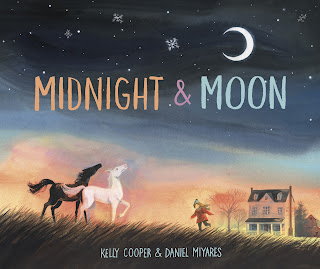
When you are taught to believe different is a good thing, you tend to look at the differences of others and differences in yourself with respect. Those things making us unique are treasures. Sometimes they make life more challenging, but there are those, who if not kindred spirits, understand our uniqueness. They will respond with compassion.
Through their understanding and compassion a lasting bond usually forms. In Midnight & Moon (Tundra, February 8, 2022) written by Kelly Cooper with illustrations by Daniel Miyares, readers are privy to the story of several of these beautiful, unbreakable bonds. In reading this book, we realize we can be the special individual needed by another even if we are one who needs help more often than others.
THE GIRL SPOTS THE WHITE FOAL,
tucked into the shadows of the poplar trees
like one of winter's last snowdrifts.
The child and her mother watch as the foal struggles to navigate its surroundings. By its actions, it appears to have diminished vision. Another foal, black, comes to its aid, its body pressing against the white foal.
The girl observes the world around her and expresses it through her drawing. When her mother asks her what they will name the two new foals, she writes her answer. By her actions, it appears the child is unable to speak.
Moon can hear what the other horses cannot. His sense of hearing is amplified. When he is unable to go where he needs to, he waits for Midnight to press his body close to his. Like Moon, the little girl has an increased ability to hear.
The two horses care for each other through touch and the whispers of nickers. At school, Clara finds friendship in a boy named Jack like Moon was found by Midnight. The seasons shift and the horses now need to come to the mother and her daughter for food. Moon comes to Clara where she has a pile of oats for him and him alone.
One day dark clouds gather in a winter sky. The horses move about uneasily. Inside the school, only Clara does not do show and tell. Outside, the storm is so sudden the horses are confused and the school bus nearly passes Clara's house in the blinding snow. Clara and her mother discover the horses are not at the barn. In the middle of a blizzard, will a child with no voice bring home a horse that cannot see?
Through the lyrical words penned by Kelly Cooper, we walk with Moon, Midnight, and their herd. We shadow Clara and Jack. As they move through the seasons, so do we. Kelly Cooper's observations of the world around her are evident in the detailed descriptions that make the reading of this narrative sensory and intimate. Here are two passages on a single page.
Moon can't see, but he hears sounds that other horses
ignore. The eggshell crack of a meadow lark hatching.
The glide of a salamander into the pond. He knows
every horse in the herd by the sound of its hooves.
When Moon doesn't know where he is, he whinnies
and waits. Thud-thud, thud-thud. He feels Midnight's
cheek against his shoulder.
The scene on the front, right, of the open dust jacket continues across the spine to the far left edge. The sunset sky mingles with the increasing darkness, a sprinkling of stars, a crescent moon, and a few snowflakes. The snowflakes foreshadow a dramatic highpoint in the narrative. Even though Clara runs toward Midnight and Moon on the right, she sits with Jack on a slight rise in the grass on the far left. This helps us to understand the beauty of the relationship she has with Jack and the horses.
A near magical but entirely realistic image spans the book case. Most of the left side indicates the forest. Midnight and Moon are facing right. Their bodies are positioned on either side of the spine. Moon leans toward the outstretched hand of Clara. In the break of the trees, a glow raditates above Clara and into a sky replete with warm hues.
On the opening endpapers it is a snowy depiction; a you-can-hardly-see-your-hand-in-front-of-your-face snowstorm. There is a change in the color on the right. When you turn to the closing endpapers, that color, spot glows, is replaced with Moon, Midnight, and the other horses in a line.
On the title page, artist Daniel Miyares shows the home of Clara and her mother. The barn is in the background. Trees blooming with spring blossoms are to the left and right of the house.
The illustrations in this title were
painted with gouache on paper.
There are double-page pictures, single-page visuals and smaller images surrounded by lots of white space. We are shown wide vistas and brought close to the children and the horses. These illustrations are atmospheric and emotionally-charged. The color palette and use of light and shadow is fabulous.
One of my many favorite illustrations is the two-page image for the above-noted text. On the left, we are shown Moon with Midnight pressing his cheek into Moon. We are close to them with only their heads and a portion of their necks visible. Around them are layers of grass and leaves. In the upper-right hand corner of this left side, nestled in the grass, is a bird's nest with three speckled meadowlark eggs. Along the bottom to the left and right of the gutter the herd of horses runs against the warm and pastel colors of an afternoon or morning sky.
This book, Midnight & Moon written by Kelly Cooper with artwork by Daniel Miyares, is an affirmation of the significance and value of honoring differences. It reminds us friendships can form through mutual respect between animals, humans and humans and animals. I highly recommend you place a copy of this title in both your personal and professional collections.
To learn more about Daniel Miyares and his other work, please follow the link attached to his name to access his website. Kelly Cooper has an account on Instagram. Daniel Miyares has accounts on Facebook, Instagram, and Twitter. At Penguin Random House, you can view interior images. Kelly Cooper and Daniel Miyares are interviewed together at Maria Marshall's site.
Regardless of your age, laughter can lift you up. It can take an upside-down day, turning it right side up. If you can share this laughter, the happiness it creates escalates. Presently, it's a bit difficult to spread this form of joy with anyone other than those with whom you are sheltering or virtually, BUT . . .
When you think of authors and illustrators who make books filled with playful plots and comical characters, let us imagine they are there with us when we open the covers of their books. As we laugh at their stories, it is as if they are laughing with us. With this way of thinking, laughter is always shared. Two April releases, graphic novels for younger readers (and readers young at heart), are welcome bursts of friendship and fun.
In the first title, Baloney And Friends (Disney Hyperion, April 14, 2020) written and illustrated by Greg Pizzoli, a crew of companions exhibit distinctive personalities. It's their differences that make them dynamic. None of them are without imperfections but together they form a flawless friendship.
A one-page full-color graphic in horizontal panels informs readers they will be enjoying a Get Started introduction, three stories and three two-page mini-comics.
Baloney + Friends Get Started
(An Introduction Of Sorts) Hello! I'm Baloney! This is my book. All about me! And me, too! Oh. Hi, Peanut.
In this back-and-forth conversational exchange, we meet Baloney, Peanut, a blue horse, Bizz, a black, white, and yellow bee, and Krabbit, a cranky purple rabbit. Baloney tries over and over to present his book and friends to readers, but he is constantly interrupted. When it finally appears as though he can proceed without delays, Peanut is missing. When you have to go, you have to go. (a bathroom break)
In the first story Baloney's magic show and trio of tricks are loaded with misconceptions. What Baloney predicts does happen, but certainly not by magic. His friends' responses are varied. These in contrast to Baloney's actions are comedy gold.
Avoiding what you fear and overcoming that fear is addressed with candor and humor in the second narrative. In musings Baloney reveals his hesitancy. In chatting with his friends, they become aware of his concerns. It's Bizz's questions and then understanding which propel Baloney to be his best self with victorious though hilarious results.
To close this trio of tales Baloney and Peanut have a heart to heart chat about those things which make you feel sad. An effort to lighten Baloney's mood only serves to display the depth of his despair. As this is acknowledged, Baloney steps forward as true friends do. Heart to heart is an art best buddies learn together.
In between the three stories the mini-comics range in their focus. We are present during an arcade duel for player dominance, a rare peek at a hungry hero's craving for cookies and a closing championing the power of good stories. Endings are the best beginnings.
By giving voice to these four characters, Greg Pizzoliilluminates those qualities which make each individual unique. It is their singularity which endears them to us. In them readers will see their strengths and weaknesses. In these three stories and three mini-comics, Greg Pizzoli, through his written words, allows us to understand the benefit of embracing the complete individual, even if they are a work in progress. (I'm looking at you, Krabbit.) Although, to be fair, Krabbit elevates the laughter factor. Here is a passage of dialogue.
Come and see the marvelous . . . the masterful . . . the magical . . . The One And Only Baloney! Gasp! A magic show! (Peanut) Oh fun! (Bizz) Whatever . . . (Krabbit)
As soon as you see the front of the book case, you'll start to fall in love with these happy-go-lucky friends. Well, there is a scowl on Krabbit's face, but that's pure Krabbit. The wide eyes, in the case of this book, are the secret to the soul of these characters. They want us to be a part of their story. The title text, Greg Pizzoli's name, the characters and the silver starburst are varnished.
To the left, on the back of the book case, the foursome is featured in four squares inside a larger square. Above and below them is text you might see on the flaps of a dust jacket. There are also glowing endorsements from two other admired author illustrator voices in the children's literature community, Ben Clanton and Laurie Keller. Several elements here are varnished as well.
In a pattern of darker orange on lighter orange is a series of drawings of the fabulous four in a variety of positions. Every so often the words:
Baloney And Friends
are placed within the sketches. After this, prior to the title page, is a circle with the four friends and their names fashion a circular frame. The title page is designed with a photograph of the pals.
Greg Pizzoli's panels shift in size to emphasize pacing and drama. The color of the framing around the panels changes from white, to pale orange, purple, green, blue, black, royal blue, and red. Sometimes the panels are outlined in a thin black line; other times the edges are scalloped or the image bleeds edge to edge. Several times the characters appear outside a panel to designate their position with respect to each other or in reference to a memory.
Readers will recognize the masterful ability of Greg Pizzoli to create a range of emotions through his lines. His facial expressions leave no doubt as to what his characters are feeling. This is how we connect easily with the personalities. This is why we love to laugh at their stories.
One of my many, many favorite illustrations is on a single page. Baloney is on stage dancing in his black pants, black bow tie and black top hat and holding his magic wand. He is throwing a glass previously filled with ice cubes in the air. They magically (with the use of a heater and hair dryer) turned to water. In front of the stage Peanut is clapping and saying
Amazing!
Bizz utters disgustedly
Oh, come on!
And Krabbit, as you might expect says:
That's NOT magic!
Their faces tell the whole story.
This book, Baloney And Friends written and illustrated by Greg Pizzoli, is a first-class graphic novel everyone will want to have on their personal and professional bookshelves. Regardless of the number of times you read it, you'll find yourself either laughing or sighing more than once. Greg Pizzoli makes books you want to hold next to your heart. At the close of the book four pages are dedicated to teaching you how to draw these characters.
To learn more about Greg Pizzoli and his other wonderful work, please follow the link attached to his name to access his website. Greg Pizzoli has accounts on Instagram and Twitter. Greg Pizzoli has a YouTube channel.
In the first book in a new series readers get to meet two lovable animated animal creatures plus two of their friends. Fox & Rabbit (Amulet Books, an imprint of Abrams, April 21, 2020) written by Beth Ferry with illustrations by Gergely Dudas is a gathering of adventures, one connected to the other, by friendship, fun and the letter F. Each of the five stories is titled with three alliterative words. The three words are a welcome to readers to participate.
STORY ONE FAIR, FIREWORKS & FRED I see a whale. Me too. I see a carrot. Me too. Now I see a crab. Me too. I just made that up. I didn't really see a crab. Stop copying me. I wasn't copying you. I was just being nice. Humph.
In this first verbal exchange as Fox and Rabbit are lying on their backs gazing at clouds, we get an early glimpse into their personalities. This duo sees and smells cotton candy which leads them to a fair. Immediately Rabbit wants to ride the Ferris wheel, but Fox is not excited. Rabbit says he will win Fox a stuffed toy to hold when he rides the Ferris wheel. Guess who wins all three games? Guess who wins a stuffed toy lion? Guess who ends up holding the stuffed toy lion when they finally ride the Ferris wheel at night? Fireworks lead to a new name. Rabbit still has to satisfy a yearning. The result leads us into story two, but not without even more laughter at the expense of the late arrival of a turtle.
The next day, story two unfolds with an eager Fox ready for a day at the beach. At every stage of this tale, Rabbit over prepares. Fox presents the only thing necessary, a single item beginning with the letter F. Rabbit stalls all day long about going in the water. For every reason Rabbit supplies to not going in, Fox counters. Rabbit eventually decides he loves the beach (and the water) a lot, so they stay for the sunset. A gift floats to them in a bottle on the darkened water.
The next day after weighing the pros and cons of their next trek into the unknown, Rabbit loads up a backpack and Fox carries a single item, a flashlight. They have three geographic challenges with weather and fauna adding to the mix. As they reach their goal, it's not what they expected but they learn some surprises are right in front of us all the time.
Sparrow, an already accepted foodie, steps in to assist Fox and Rabbit in their next endeavor. As a guide Sparrow is the best. Fox and Rabbit work harder than they thought possible all day. Then there are days and days of watering and waiting. When they see the outcome of their labors they are overjoyed until disaster strikes. Forgiveness starts with the letter F and it's the foundation of friendship.
At the close of this first book of heartwarming discussions and feats, the charming companions watch a startling discovery grow. From this a construction project and hours of time in the kitchen equal a backyard business. Just when it looks as though this is a zinger, Sparrow turns it into a pleasant surprise. As usual Turtle arrives at the end and the final line is the bow on this perfect present for readers.
As you read these five stories you can't help but think of all the fabulous fun (two letter Fs) Beth Ferryhad finding words beginning with the letter F. You can't help but wonder at the joy she felt creating the conversations between Fox and Rabbit. Their banter is a linguistic delight. They counter and contrast each other. They question and answer each other. They bring out the best in each other.
To tie the stories together, Beth Ferry frequently uses a phrase such as
Are you sure? Sure as sunshine . . . Sure as sand . . .
and the appearance of Turtle heightens the hilarity of each episode. To enhance the personalities of Fox and Rabbit a cadence is established with repeating words and instances in their dialogue. This is the glue that adheres and deepens their affection. Here is one wonderful conversation of many. Fox is speaking for most of the page.
Hurry up! What's taking so long? The sun will be setting soon. Do you want to pack the toilet too? Fred is getting antsy. Ta-da! I'm ready! You're not bringing anything? Oh, yeah. Because flip-flops start with F.
When you open the book case, on the right you can sense the total bliss Fox and Rabbit are feeling in the moment of being together in a field of dandelions. This moment is extended in the image that begins on the spine and spans across the back. In this picture the pale blue sky is filled with floating dandelion fluff. Rabbit and Fox with Fred, the toy stuffed lion, on the ground are looking up as they stand in the same dandelion field. Above them text like you might read on the front flap of a dust jacket is placed. The characters, the title text and some elements on the back are varnished.
The opening and closing endpapers are pale blue. For the initial title page dandelion fluff drifts on the same blue. For the formal title page, the picture on the front is expanded, spreading over two pages.
Opposite each chapter page on the right, Fox and Rabbit are placed in a circle introducing readers to their following escapade. Gergely Dudas places a series of small images on full-page pictures, places a series of panels on a single page, supplies wonder with full page pictures and generates his interpretation of the narrative with several series of wordless panels. Most of the images are loosely bordered with a fine black line.
Readers will be fascinated with the combination of body postures and facial features on Fox, Rabbit, Turtle and Sparrow. They convey a range of emotions. The pacing is impeccable. The humor is rich and true.
One of my many, many favorite illustrations is when Fox and Rabbit are at the beach. In a series of eight small square panels placed as two columns on a larger area of sand on most of the page beginning on the left, we are privy to a conversation and three wordless pictures at the end.
The conversation begins with Rabbit as Fox goes swimming again:
I'm going to dig for treasure. This was probably a pirate beach once. Call me if you find something good! And by good I mean gold! Or silver. Or gummy worms.
As Rabbit digs with Fred watching next to the hole, we see less of his body until only his ears are above ground. Then on the far right is a cutaway of that beach area. Rabbit is way, way down. He must have dug for a considerable amount of time. This picture leads into another comedic conversation when Fox returns from a swim.
Between the chatting of these two friends, Sparrow and Turtle, readers know they've met the best kind of individuals. Fox & Rabbit written by Beth Ferry with illustrations by Gergely Dudas is a book, whether placed on your personal or professional bookshelves, that will have the well-loved look in short order. We readers are fortunate another title is set to be released this year.
To learn more about Beth Ferry and Gergely Dudas and their other work, please follow the links attached to their names to access their websites. Beth Ferry has accounts on Instagram and Twitter. Gergely Dudas has accounts on Facebook, Instagram and Twitter. At the publisher's website you can view interior images. The cover reveal for this book is hosted by Dylan Teut, executive director of the Plum Creek Children's Literacy Festival at Mile High Reading. Dylan Teut interviews Beth Ferry. Betsy Bird, Collection Development Manager of the Evanston Public Library system, at School Library Journal, A Fuse #8 Production, interviews Beth Ferry about this book.
There are books you hold in your hands and the story within their pages somehow reaches out to you immediately. In this instance you are not abiding by the age-old proverb. The cover is an open invitation and you accept it eagerly.
Is it the image on the dust jacket which holds your attention? Does the author's name trigger a memory of another well-loved book they wrote? Are you fond of the artwork of the illustrator? With respect to this way, Charlie: Inspired by a real animal friendship (Abrams Books for Young Readers, April 21, 2020) written by Carol Levis with illustrations by Charles Santoso, it is a beautiful blend of all three. This title is guaranteed to find a place, a forever place, in your reader's heart.
Jack watched the new animals scamper, hop, flap, and trot their way into Open Bud Ranch.
Jack, a resident goat, knew some of the new arrivals would linger longer than others. Some, like him, would spend the remainder of their lives on Open Bud Ranch. Regardless of the outcome of any of these animals, Jack would keep his distance. That was his way. Charlie, a horse and a new arrival, did not keep himself separate from Jack. This angered Jack.
Antonia, a human caretaker, on the ranch explained what Jack noticed. Charlie was blind in one eye. She could not heal his blindness. Jack decided to watch Charlie. One thing about Charlie caused him to wonder. And one morning, Jack did an un-Jack like thing. He said
"This way, Charlie."
One goat dweller leads another horse dweller to his favorite field, sharing the delicious goodness and the warmth of the sun. The next day Jack led Charlie to another favorite part of the ranch. One day changed into another day, until Jack was guiding Charlie every day. The new friends would exchange questions and answers. The new friends cared for each other, helping them to overcome fears, some deeply hidden in their minds and hearts.
One morning, Jack became upset with Charlie's happy-go-lucky outlook and well-used phrase. They were both so shocked at his outburst, they didn't see an approaching storm. Frightening danger quickly turned into a disaster. Jack knew there was something he had to do for his Charlie. That's what friends do. The result of Jack's actions is nothing anyone could have predicted after his first meeting with Charlie. It is better, much better, actually better than the best.
Several times during the reading of this narrative penned by Caron Levis, readers will pause, overwhelmed by waves of emotion. The poetic portrayals of specific moments are breathtaking. The repetition of key phrases by Jack and Charlie not only connect them as friends but link them to readers through the rhythm of their story. With her words, Caron Levis discovers the extraordinary in the everyday. Here is a passage.
Jack noticed Charlie's eye had a soft glow--- like the moon, which often guided Jack when he felt lost in the dark. He wondered what Charlie used for a moon.
You know as soon as you see the open dust jacket, revealing the front and the back, this is an exceptional book. The color palette used for the pastoral landscape and the brush strokes in the sky, trees, grass and flowers fashion a soft Monet-like texture. On the front Jack, Charlie and the larger title text are varnished.
To the left, on the back, the scene from the front continues over the spine to the far left. Branches from a large tree stretch from the left edge, leafy boughs bleeding off the top. A smaller barn is placed in the upper, right portion of this back image. As on the front sunlight casts a golden glow.
On the front of the book case a lost-looking Charlie stands in an evening without stars. He is looking to the left. On the left, coming from the spine, in a bit brighter light, Jack is looking back at an emerging Charlie, encouraging him forward. Charlie is hesitant. In a second image toward a brighter light Charlie is following Jack as they both look ahead.
The opening and closing endpapers are a robin's egg blue. On the title page two green leaves drift between clouds in a sunny sky. On the verso and dedication pages readers are given a double-page picture of a truck bringing Charlie to the ranch. It is a calm scene full of hope and promise. The two leaves float over the entrance to the ranch. On the verso page this sentence says much about Charles Santoso and his work for this book.
The illustrations for this book were made with digital brushes and love.
To enhance the text the size of the illustrations vary from double-page visuals, with larger perspectives and much closer points of view, to single-page pictures, clusters of smaller illustrations, loosely-framed horizontal pictures on a double-page picture, and vertical panels across two pages. Each page turn represents Charles Santoso's skill in accentuating the magic found in certain moments. To focus on drama in one portion of the book, circle illustrations are inserted in larger pictures. The details in each picture are striking and captivating.
One of my many, many favorite illustrations spans two pages including three different images. On the left a smaller Jack watches a smaller Charlie as he walks around trying to navigate an area with one good eye. He staggers a bit and circles around and around. On either side of the gutter is a portion of Charlie's face close to us. On the left is his face with his good eye. On the right is his face with his blind eye. This part of his face is placed on a night setting. To the right, Jack is standing in a field backed by trees and shrubs. He is looking at the full moon overhead. This is the picture for the text already noted.
In a word, this book, this way, Charlie: Inspired by a real animal friendship written by Caron Levis with illustrations by Charles Santoso, is love. It's about an affection between two animals, each with something broken in them, who heal through their friendship. In an Author's Note Caron Levis talks about the real Jack and Charlie, her research and other animal friendships and human and animal relationships she knows. I highly recommend this title for both your personal and professional collections.
To learn more about Caron Levis and Charles Santoso and their other work, please visit their respective websites by following the links attached to their names. Caron Levis has additional resources for this title on her website. Caron Levis has accounts on Facebook, Instagram and Twitter. Charles Santoso has accounts on Facebook, Instagram and Twitter. At the publisher's website you can view interior images. This title and Caron Levis and Charles Santoso are featured on KidLit TV for the cover reveal and for a read aloud by Caron Levis. There is also another video, StoryMakers, where Caron Levis talks with Rocco Staino about this book. It is featured on the read aloud page.
Laughter is frequently mentioned on this blog. Its benefits are numerous; reducing stress, providing a physical and mental release, exercising specific areas of our bodies, and changing our mind set and perspective. Perhaps the best benefit is the connections we make, some lasting, with shared laughter. Humans and animals do respond favorably to humor.
Once you've read a book aloud to a group of children with laughter erupting again and again, the experience, the story and the title of the book remain. The memory of how an individual felt in your presence is lasting. With this in mind here are five books, previously not discussed here, guaranteed to generate laughter and requests of "read it again."
Mrs. Mole, I'm Home (Candlewick Press, June 7, 2018) written and illustrated by Jarivs is a journey in the absurd. When a character cannot see what readers can, the results are rip-roaring guffaws. What is lost is found but was it ever lost?
It had been a very long day at work for Morris Mole. His feet were aching, and his eyes were so tired.
This mole could hardly wait to leave the restaurant and spend time with his wife and children. There was one problem. Morris Mole could not find his glasses anywhere. He assumed because he had made the trip so many times, getting home without his glasses would be easy.
After burrowing a bit, he rose up from the tunnel announcing his presence with a happy greeting. He was not at his abode but the home of Mrs. Bunny and a bunch of baby bunnies. After an apology, he left burrowing.
Morris Mole popped up repeatedly with one joyous declaration after another. He arrived at a tree loaded with owls, an iceberg in Antarctica (It was dreadfully chilly there.), and a crocodile swampy haven. How was he ever going to get home without his glasses? Suddenly his sniffer caught a whiff of something he knew well. Morris Mole makes a promise, but a final page reveals the difficulty in keeping it.
With a hilarious blend of text and dialogue, Jarvissteers readers through a tunnel worth traveling. Repetition of key phrases before and after each mistake provides a continued connection. There is an inviting rhythm supplied with his appearance, his greeting, the discovery of his error and his leaving. Here is a passage.
Up he popped. "I'm home, my darlings. And how marvelous! You've run me a bath!" said Morris. "This is our swamp. NOT a bath!" snapped Crocodile. "And you better skedaddle before we have you for dinner!"
Surely by the look of the front of the matching dust jacket and book case, Mole has arrived exactly where he wants to be, but as readers discover it takes multiple attempts for success. The two hat-wearing worms shown here are Morris's companions on every portion of his trip which is a bit funny when you consider the favorite food of Morris. To the left, on the back, with a shift in canvas color from pink to teal the Mole family are shown in all their bespectacled wonder dancing at Morris's place of work.
The opening and closing endpapers are in deep shades of blue showing what Morris tunnels through to get home. Rendered in pencil, chalk, and paint and colored digitally the illustrations by Jarvis are full of comedy. Nearly all the pictures span two pages. His attention to detail is certain to have readers pausing at every page turn; carrots are everywhere in the bunny burrow, nearly all the owls are reading books, and some of the penguins are wearing ice skates.
Careful readers will notice the different hats the worms wear from place to place. When Jarvis shows Morris thinking, the additional dialogue in these scenes is funnier than funny. These are framed like a gallery as his mind moves from incident to incident.
One of my many favorite illustrations is when Morris arrives at Antarctica. As he pops through the ice penguins gather from their cave, some attired in scarfs, hats and one is carrying an umbrella. Another one is eating a popsicle. One is walking and using a cane. A full sun causes a bright light but it's still bitter cold. A penguin is balanced on the top of sign reading SOUTH POLE.
For those readers needing glasses they will easily identify with Morris. Who among us has not misplaced their eyeglasses? Mrs. Mole, I'm Home! written and illustrated by Jarvis is a story time winner. At the publisher's website you can view an interior image. The link attached to Jarvis's name takes you to his website. Jarvis has an account on Twitter.
For those of you who love the roar of engines, this next title will get your heart racing. The Princess And The Pit Stop (Abrams Books For Young Readers, July 10, 2018) written by Tom Angleberger with illustrations by Dan Santat is an unprecedented contest in an other-worldly realm. Fasten your seat belts!
Once upon a time, there was a Princess who made a pit stop. While the Birds and Beasts changed her tires, her Fairy Godmother told her she was in last place!
With only one lap left, most drivers would not have finished. This was no ordinary princess. She put the pedal to the metal.
The announcer could hardly keep up with all the cars and drivers she was passing. Humpty Dumpty and his nursery crew were left in the dust. The Three Bears were forced off the track. A trio of Wicked Witches became specks in the distance.
Drivers, normally found in fairy tales and nursery rhymes, were no match for this determined female champion behind the wheel. No curve was too tight. No hill and dale could stop her speed. No Jack or Jill or Big Bad Wolf or Three Little Pigs could best her.
The end of the race, the finish line, was getting closer and closer.
And the Gingerbread Man admitted. She CAN catch me!
Soon it was the Ugly Stepsisters and The Princess streaming down the final stretch. The crowd stands! The announcer croaks! Will this Princess and her Prince live happily ever after?
Every concise sentence builds tension page by page as author Tom Anglebergercombines terms from automobile racing expertly with known names from fairy tales and nursery rhymes. His word choices reflect the use of alliteration creating an upbeat cadence; roared, running and road. We can hardly sit still. We want to cheer out loud for this princess driving with purpose. Here are several passages.
SHE SPUN OUT RUMPELSTILTSKIN AND BUTTED IN FRONT OF THE THREE BILLY GOATS GRUFF!
SHE LEAPT PAST FLOPSY, MOPSY, and PETER RABBIT!
One look at the open dust jacket is all you need to know about this Princess and the pit stop she makes. Her body stance and facial expression are truly worth more than words can say. The faded background of the frog announcer, her fairy godmother (pit boss), the castle and black and white checkered flags foreshadow events to come. To the left, on the back, a huge question is answered. Readers in the know will understand the meaning of every detail as the Princess stands, arms on her hips, in front of her stopped car. (I love the crown element on her helmet and the car's hood.)
On the book case readers get a real sense of this Princess's attitude. On a nearly white canvas with a slight wash of blue, she strides toward her car. The car is facing the spine and her back is to us. To the left, the back of the case, she faces to the left. It's a portrait of her head done in shades of red and purple. Her facial features form a look of pure determination. Above her head reads:
"I am not afraid of storms, for I am learning how to sail my ship." ---Louisa May Alcott
On a background of white for the opening and closing endpapers illustrator Dan Santat displays all the race cars, forty-six in total. With a page turn we see a rainbow streak across white on two pages. It is the track of the Princess. A series of six panels follows showing the Princess racing. In the final one her gas gauge is nearly on empty. With a third turn, she is slowing into the pit as the title is being introduced to readers. As she zooms into her spot the text zooms with her on the title page.
In a blend of panels, full-page pictures, and double-page images Dan Santat introduces one humorous moment after the other. Readers won't want to miss a single element included in any of his scenes. The number on the Three Bears car is 3. One of the wicked witches is driving a broom. The dwarfs from Snow White are riding in mining cars.
One of my many favorite illustrations is on a single page. An enormous green truck with humongous wheels is speeding toward readers. There is enough room between the wheels for the Princess to race under and past the Giant. Beneath her the tiny car of Tom Thumb is left behind.
This is a fantastic introduction to fairy tales and nursery rhymes! The Princess And The Pit Stop written by Tom Angleberger with illustrations by Dan Santat will be enjoyed for its sheer entertainment but is sure to start a multitude of questions and a race for research. Links are attached to Tom Angleberger's and Dan Santat's names to access their websites. At the publisher's website you can view interior images. Both Tom and Dan are on Twitter and Instagramhere and here.
Are you ready to leap into more laughter? A frog who never fails to entertain (I Don't Want To Be A Frog, I Don't Want To Be BigandThere's Nothing To Do!)is back. In this book, I Don't Want To Go To Sleep (Doubleday Books For Young Readers, October 16, 2018) written by Dev Petty with illustrations by Mike Boldt, Frog refuses to do what frogs do in winter.
I can't wait for WINTER! Why? The snow! The fun! Pig told me all about it!
Frog is beyond excited about all the wintry activities like skating, drinking warm drinks and of course, the snow. When Owl points out that Frog can't do any of these things because he's a frog and frogs hibernate, he is indignant and confused. What is hibernate?
When Owl further offers an explanation with the statement Frog's dad is already hibernating, Frog starts to understand but he is not giving up yet. Can he get toasty by the fire like Cat? Can he get comfy like Pig in a plaid blanket? No and no, according to Owl. After another question with a less than ideal answer, Owl instructs the reluctant amphibian.
Frog is aghast! How can he have fun when he's buried in mud? He does not want to be like Bear who hibernates. Frog is frustrated, totally and completely. His friends try to help. They want to help but Frog's suggestion is not what they are expecting. Not. At. All. How many days is it until spring?
The happy-go-lucky, persistent-to-a-fault Frog and his quest to stay awake during winter is presented with wit by author Dev Petty. With a story told entirely in dialogue, readers are intimately involved in every aspect. Owl's dry but amusing and truthful replies give us a hint at his personality. In fact, the voices of the other animals, Pig, Cat and Rabbit, give us clear insight into their characteristics. All this input supplies us with comedy. Here is a passage between Frog and Owl.
I want to be like Pig. Pig sleeps in a fluffy plaid blanket.
You can't do that. Why not? First of all, you could get lost in here. Also, plaid isn't your color. Mostly, though, I'm taking his blanket.
How can you look at the front of the matching dust jacket and book case without laughing? The truth is, you can't. How many times have you uttered those exact words or heard them? I'll wager it's too many times to count. Readers identify with Frog. His owl toy is always with him for comfort.
To the left, on the back, Frog exclaims he will go to bed if we read him the three previous books. (Clever with a capital C) Mike Boldt begins and ends his visual interpretation on the opening and closing endpapers. On the first Frog is shouting out
NO SLEEP FOR ME!
as he strides toward the right edge. In the second set we see Frog as he is meant to be in winter.
Mike Boldt's illustrations rendered in vibrant colors make a bold statement as they extend the narrative and heighten the comedic drama. Speech bubbles in alternating colors hold the conversations. One of the double-page pictures with a single word on it will have readers rolling on the floor, laughing.
One of my many favorite pictures shows Frog sitting inside an ice skate and wearing a striped scarf. He is holding a red mug of hot chocolate with marshmallows floating in it. This image nearly fills the entire page. This is what Mike Boldt does very well; changing point of view to accentuate the story.
I Don't Want To Go To Sleep written by Dev Petty with illustrations by Mike Boldt is a charming and lively look at yet another aspect of this lovable frog and his animal companions. This would make a marvelous addition to a story time on frogs, hibernation, winter and bedtime. Links are attached to Dev Petty's and Mike Boldt's names to access their websites. The book trailer premiered at Watch. Connect. Read., the website of Scholastic's Ambassador of School Libraries, John Schumacher. You will enjoy the chat. At PictureBookBuilders Mike Boldt speaks about this book. Dev Petty has an account on Twitter and Instagram. Mike Boldt also has accounts on Twitter and Instagram.
Misconceptions play a large role in Horse Meets Dog (Balzer + Bray, October 30, 2018) written by Elliott Kalan with illustrations by Tim Miller. This is a classic case of what you see is not always what you get. As the argument escalates who do you think will win?
Wow!
You're very big.
In response to dog's statement Horse counters with his vision of the truth. He's not big, he is a regular-sized horse. He also says he was going to tell Dog how small he is for a horse. Believing dog is a baby, Horse cuddling him in his arms, tries to feed him a bottle of hay.
That does not go over well with Dog. He points out the problem with Horse's feet. Has he lost his paws? Horse wonders what is wrong with Dog's hair and his tail.
Deciding to start their relationship over, they exchange presents but it goes from bad to worse when Horse gives Dog a miniature saddle and Dog gifts Horse with a ball for playing fetch. When they expand on the reasons for these items, it gets funnier and funnier.
The conversation escalates with each believing the other is a weird version of themselves. Horse can't figure out what is wrong with Dog. His whinny is off key. Dog does not understand why Horse is such a huge dog. They get louder and louder and more insistent until the arrival of a small bird. Everything changes with the bird's first full sentence.
This meeting of "what-if" between a horse and a dog challenges how human (and animal) perception functions. Elliott Kalan supplies us with hilarity as these two characters try to convince the other of their truth. The story is told through dialogue apart from a few sound effects. This technique involves readers on a more personal level. Here is a passage.
It's a saddle.
In case a tiny person
wants to ride you. Will
you try on your new
saddle? Or would you
rather be rude?
(The saddle is now on Dog.)
Now what happens?
Someone sits on you, and
you take them wherever
they want to go. Fun!
That doesn't sound
like fun to me.
Rendered using brush and ink and digital hocus-pocus the signature illustrations of Tim Miller greet readers on the open and matching dust jacket and book case. By the smiles on the faces of Horse and Dog, readers have no idea what is about to follow. To the left, on the back, Dog is holding a mirror and puzzling over his face. Endorsements are written over this smaller picture. Bright sunny yellow covers the opening and closing endpapers.
On the title page the two characters' heads are positioned on either side looking at each other. On the verso page Horse is blow drying his mane. Dog is leaping with a ball in his mouth on the dedication page.
Thick black lines outline the comical Horse and Dog. Their wide-eyed looks heighten the laughter factor and increase the emphasis on what they are saying. Sometimes Tim Miller brings us close to the duo and other times we see their entire bodies. Some of the visuals extend page edge to page edge and others are framed in thick black lines.
One of my many favorite illustrations is after Dog has been fed the hay in the bottle. On a white canvas he is exclaiming
BLECH!
His eyes are huge. His mouth is wide open with his tongue hanging out. He is
spitting out the hay. The baby bottle is in his right hand.
Readers of all ages will greatly enjoy the exaggerated absurdity of this exchange between these two animals. Horse Meets Dog written by Elliott Kalan with illustrations by Tim Miller is a fabulous addition to any humorous story collection. It is certain to be a hit at story times. The link attached to Tim Miller's name takes you to his website. Both Elliott and Tim have Twitter accounts. For the book trailer premiere Elliot Kalan is a guest writer at Watch. Connect. Read., the site of Scholastic's Ambassador of School Libraries, John Schumacher.
We first met a funny fowl in Duck In The Fridge. He and his friends supply one little boy (now a father) with a nighttime memory he will never forget. In a companion title, Duck On A Disco Ball (Two Lions, November 1, 2018) written and illustrated by Jeff Mack, readers again get to enjoy the crazy antics of not only Duck but his two best friends, a mom and a dad!
Every night, it's the same old story. Why can't I stay up late like you? Because we're grown- ups, kiddo. And little guys need their sleep.
The little boy does not want to go to bed. He's afraid he will miss something fun, something important. All his complaints and excuses don't delay the inevitable. It's good night and sleep tight time. The problem for this child is every morning there are little things out of place. He wants to know what happens.
He speculates. Does his toy duck come alive? Does he paint with his parents? Do they have action adventures in the bath tub? One night he follows sounds and spies. He can't believe what he is seeing.
His parents and his duck are using the sofa for a diving exhibition. The living room is invaded by animals; a dog, cow, pony, elephant, sheep and other ducks. They are consuming mass quantities of food. It is a party beyond his most imaginative dreams. A loud disruptive crash fills the air and then . . . his parents and his duck are defying gravity.
Suddenly silence descends. In the morning the child wonders if it was all a dream. A discovery and a hilarious comment will have readers exploding with laughter.
Oh, the word play and puns are wondrous. You'll hardly be able to keep from continuously laughing (or groaning) once the shenanigans begin. Jeff Mack clearly has a masterful knack for arranging language to tell a humorous story. His combination of narrative by the child plus dialogue is excellent. Here are several passages.
Milkshakes, anyone? I just ordered a pizza. Great! Will it be long? No. It'll be round. Care for a cookie? No thanks. I'm stuffed. (says the boy's duck)
All readers will want to do is dance when they see Duck swinging on the disco ball on the front of the matching dust jacket and book case. His sheer happiness and the glittering ball tell a tale all their own. Similar vibrant colors are used to the left, on the back. Amid pastel rays, a spotted cow is raising her hoof in the air and posing like John Travolta in Saturday Night Fever. (When an author/illustrator makes these references, it expands the enjoyment to cover a larger age group. I burst out in laughter.)
The opening and closing endpapers are filled with rays and dots as if a disco ball is casting light on walls. Beneath the text on the title page the child, boy, is being swung between his mom and dad. Each illustration rendered in digital media is brimming with details asking readers to pause. They make reference to events to come and when the party starts each page is packed.
Varying in size the images are highly animated. Some span double pages, single pages or look like panels on a single page. The conversations appear in speech bubbles.
One of my many favorite pictures spans two pages. The background is bright yellow. Across the bottom the flower-patterned print sofa is placed with two red-feather pillows. Jumping and somersaulting in the air are the boy's parents and Duck. They are laughing and yelling
BACK- FLIP! BELLY FLOP! CANNON-BALL!!!
Peeking unseen over one of the arms is the boy, wide-eyed with amazement.
Every reader will be wishing for a duck like this duck. Duck On A Disco Ball written and illustrated by Jeff Mack is loads of fun. You might want to have some late seventies music on hand to play before or after reading this title. It's a perfect companion to the first title. To learn more about Jeff Mack and his other work, follow the link attached to his name to access his website. Jeff has accounts on Twitter and Instagram. Jeff Mack wrote an article for The Children's Book Reviewabout his writing and reading life.
Their domestication is inherently tied to human history. With their presence in our way of life, everything moved faster and more efficiently. There are still places on this planet where transportation by horse is the quickest method of travel. (On Mackinac Island in the state of Michigan the only way to move from place to place is by walking, bicycling or by horse-drawn carriage.)
Several years ago, a master illustrator, a paper engineer, acquired a parcel of land with an old barn. It was previously home to ten horses that lived on this property in New York's Hudson Valley. Today with the help of a crowd funding campaign it is now the 10 Horse Art Center. Ten Horse Farm (Candlewick Press, April 10, 2018) written and illustrated with breathtaking paper engineering by Robert Sabuda is a remarkable tribute to this farm and the marvelous animals who lived there.
Racing
Single words, with the exception of the final text, describe the actions of a different horse or horses in ten dazzling displays. In the first a brown horse is galloping from left to right, tail and legs extended past the boundaries of the book. A dog races alongside the horse, tongue hanging out in total bliss. Next, head bowed and resting,a second cream-colored horse quietly watches playful kittens in a field of flowers.
A rooster takes flight as a dark horse soars over a set of bars and off the top of the illustration. A wind mill seems to spin high above a horse nearly blending in with rows of wheat. Is that a goat playing tug-of-war with a horse? Whoever washed those clothes is in for a surprise.
A tiny mouse cautiously watches a gray horse kick its legs skyward. The entire animal is off the top of the page except for the front legs. Two horses with markings like large spots of paint nibble on apples in communal contentment. On the final visual Ten Horse Farm rises above the page framed by trees. All ten horses are featured and tucked into the pastoral scene. You'll need to turn the book to seek and find them all.
By employing the technique of a single word for each image, Robert Sabudaaccomplishes several things. He introduces and defines nine verbs for readers. He also allows his spectacular pop-up paper engineering to extend the meaning of those words through the actions of his horses.
Whether this is your first Robert Sabuda book or your tenth-plus title, as soon as you look at the front and back of the book case, you know you are holding something extraordinary. Notice the color of the spine and the rope detail. On the back the picture for the word Pulling is highlighted. We receive an invitation to notice the different horses and other animals on the farm.
Full-color resonates from every page turn. The majesty and movement of the horses draws our attention immediately. Presenting us with other farm creatures in some of the scenes, Robert Sabuda provides us with fun, humor and the beauty of the landscape around the farm.
One of my many, many favorite illustrations is for pulling. In this scene a horse, a Clydesdale, is pulling a farm wagon down a portion of two pathways edged with stones. The horse is prancing at the top of the page on the right. To the left the wagon, with wheels looking as if they are spinning, is full of all the farm animals we have seen. The rooster is crowing on the back with the mouse sitting near him. Kittens are lounging on crates behind the goat. The duck is attempting to fly away. At the front the dog seems to be calling out to the horse.
Each time you turn a page and view the pop-up pictures in Ten Horse Farm written and illustrated by Robert Sabuda, you are astounded at the meticulous artwork. Each image opens and closes with ease. These three-dimensional masterpieces are certain to inform and entertain readers of all ages. This title is a must have for your personal and professional book collections, especially for readers who appreciate and love horses. (With care this volume will last multiple readings.) This book would be wonderful paired with Tony, An Otis Christmas, If A Horse Had Words, and for older readers, Some Kind of Courage.
To learn more about Robert Sabuda and his other beautiful work, please follow the link attached to his name to access his website. At the publisher's website you can view an interior image. I know you will enjoy this book trailer.
When you enter your favorite indie book shop sometimes you are looking for a specific title. On another occasion you search a subject area or genre with no special book in mind. There are certain circumstances when after locating what you want, you are drawn to another shelf for no particular reason. It's uncanny how you reach for a book, read it and realize it speaks to your reader's heart.
You stop for a few moments wondering why this title speaks to your reader's heart. If A Horse Had Words (Tundra Books, June 5, 2018) written by Kelly Cooper with illustrations by Lucy Eldridge is one of those books. It addresses with great care and insight how bonds are built between humans and animals. Some animals have a large capacity for understanding and unconditional love.
THE FOAL IS BORN on a spring morning of sunshine and snowmelt.
She sees the signs of spring around her in the trees, flowers, fresh rainfall and the sky. Instinctively she knows she needs to stand. As she struggles to brace her body with her front legs pushing up, her back legs pull her down as they sink into badger hole.
A truck rumbles into view as she tries to get herself free. Stepping from the stopped vehicle a man and boy offer assistance. After the foal is pulled free by a gentle voice, a rope and her own will, she realizes she and the boy are alike. They both prefer to move as far off the ground as they can.
Seasons come and seasons go. The foal becomes a horse named Red Badger. The boy grows into a teen who likes peppermint candies. One day when the boy tries to ride Red Badger her love of the boy is overshadowed by her dislike of the ground. She bucks and kicks tossing him to the dirt. Red Badger is sold.
Many more seasons come and go. Red Badger is at a rodeo. None of the cowboys can stay in the saddle on her back. Again she waits in the chute for her next rider. She hears a remembered gentle voice. She smells a familiar scent. Elation.
A storytelling rhythm is supplied with the picturesque descriptions of Kelly Cooper followed by
If a horse had words, the word would be . . .
With her words she takes us to a place and time acquainting us with the moods and emotions of the horse and her boy. Sentence by sentence she builds the relationship between the two, one horse and one human, until a timeless friendship is forged. Here is a passage.
She is tall now, has to bend her head to sniff the pocket of the boy's shirt. She smells something sweet and sharp and delicious.
"Hello, Red Badger." If a horse had words, the word would be . . . Name.
A generous use of white space on the opened dust jacket draws our attention to the soft, lush images rendered in watercolor here and throughout the book. Each brush stroke contributes to the subtle textures, and the play of light and shadow. Spare lines depict emotions on the facial features of the boy and horse. They are older on the front. To the left, on the back, both of them are younger, joyously leaping on a sunny spring day. The text reads:
If a horse had words, the word would be . . . friend.
On the book case white is used as a strong element. It highlights the final pages of the book. On the left we see a herd of horses, the new companions of Red Badger. On the right, a boy (young man) and his horse are together again. They still move as far off the ground as possible.
On the opening and closing endpapers Red Badger is displayed in five different positions. The boy is shown in six. They make a jubilant repeating pattern on all four pages. Two of those are enlarged and used on the verso and title pages.
Each of the illustrations created by Lucy Eldridgespans either two pages, a single page or a series are placed on a single page. Sometimes a small image will be tucked above or below the text. Pictures are also used to frame text. The manner in which Lucy uses white space causes it to act more as light than white. It illuminates her watercolor illustrations.
One of my many favorite pictures is when the boy and foal first meet. The foal's back legs are stuck in the badger hole. The rope has been looped around her neck by the boy's father. The horse is not happy about this rope. The boy reaches in to touch her nose and softly whisper
"Shhhhhhh".
A pale green small hill is placed behind them on the lower portion of the page. Tiny purple flowers, crocuses, bloom in a patch in the lower right-hand corner. White covers most of the page above the foal and the boy.
It's a story of friendship. It's a story of remembered love. I can almost hear readers sigh with pleasure when reading or listening to If A Horse Had Words written by Kelly Cooper with illustrations by Lucy Eldridge. You will want to use this with a thematic story time on friendship or horses or both. I sincerely recommend this for both your personal and professional collections.
To learn more about Lucy Eldridge and her work please follow the link attached to her name to access her website. The publisher Tundra Books has an account on Instagram. You can view additional images there from this book. You can also see a preview of the beginning at the publisher's website.
In those homes receiving the daily newspaper in print or online, one of the most widely read sections is still the comics. The popularity of individual comic books has continued to rise in the last five years. Matching the popularity of comic books is graphic novels. It's nearly impossible to keep these titles on the shelves in our school and classroom libraries even with multiple copies.
Three cartoonists worked together to create Adventures in Cartooning: How to Turn Your Doodles Into Comics (First Second, an imprint of Roaring Brook Press, April 9, 2009). This title was followed by Adventures in Cartooning: Christmas Special! (First Second, an imprint of Roaring Brook Press, September 18, 2012), and Adventures in Cartooning: Characters in Action (First Second, an imprint of Roaring Brook Press, October 8, 2013). All three books have enjoyed places on professional and state award lists.
In 2015 the cartoonists, James Sturm, Andrew Arnold, and Alexis Frederick-Frost released the first in a series of books focusing on the Knight and her faithful horse, Edward. The first, Sleepless Knight(First Second, an imprint of Roaring Brook Press, April 7, 2015), follows the dynamic twosome on an eventful camping trip. As you might guess, not everything goes according to plan.
This will be the BEST camping trip EVER!
With nothing left behind in the packing, especially her Teddy, the hopeful Knight leads an overloaded Edward across the drawbridge toward a new and exciting escapade. After what appears to be a long and arduous trek, they stop for the night to make camp...still in sight of the castle. A crackling fire and an overindulgence of marshmallows set the stage for a restful night for the Knight and Edward, who is passed out from pure pleasure.
To her dismay the Knight can't find Teddy. She unintentionally awakens not one but two woodland creatures. Heading back to her tent and Edward a discovery is made which changes the entire evening for the Knight, Edward and the two woodland creatures. Pass the marshmallows, please.
Gryphons Aren't So Great(First Second, an imprint of Roaring Brook Press, September 8, 2015), the second volume, draws our attention to the Knight's deep desire to fly. In fact when the story opens she and Edward are defying the odds by jumping off a cliff. When they land safely in water, she and Edward catch sight of something they should not be seeing.
Faster, Edward! FASTER! We're flying! YEE-HAW!
A gryphon has left the mountain heights to soar near the castle. Edward tries and fails to protect the Knight but she is able to calm the strong beast. In no time at all the Knight is flying on the back of the gryphon promising to return soon. Edward can't follow her, so he waits and waits and waits. After darkness falls and the stars are shining a voice calls out to Edward. This being makes an offer Edward can't refuse.
In the morning the Knight awakens to see the gryphon is waiting for her on the ramparts. They take off climbing higher and faster. Yikes! They might be too high! Another form comes into view. The Knight is in serious peril. How can Edward possibly help her? Horses can't fly.
A game of fetch with Edward is interrupted by loud rumbling. It can't possibly be thunder because the sky is blue with fluffy white clouds. When the Knight looks in the same direction as Edward, she gets a shock. Ogres Awake!(First Second, an imprint of Roaring Brook Press, July 12, 2016), the third title, takes a tantalizing turn.
John Schumacher, Scholastic's Ambassador of School Libraries, revealed this cover on his blog, Watch. Connect. Read.
C'mon, Edward! Bring it back!! LET'S GO! CHOP CHOP!!!
Not one, not two, not three and not four but five giant ogres are sleeping in front of the Knight's tower castle. Lickety-split she and Edward ride to warn the King of the danger to the kingdom. Strangely enough the King would rather read a comic than heed her warnings because he has a plan in place. Her help is needed to make this plan succeed.
As each step of the strategy is revealed the Knight is more and more puzzled. Her weapon of choice, her sword, is exchanged for another implement. It is not until the final moment amid shouts of
For KING! For COUNTRY!
as the ogres are crashing into the castle, that readers along with the Knight, will understand. Does anyone have another spoon?
On January 24, 2017 the fourth book, Hocus Focus (First Second, an imprint of Roaring Brook Press) was released. Like the previous three books, the Knight and her loyal steed, Edward find themselves in a situation unlike any of the other predicaments. Impatience nearly destroys everything.
Wizard! I'm ALWAYS stuck peeling vegetables! You promised you would teach me MAGIC! Well, this magic potion requires peeled turnips to be added slowly over three days... It's all about the turnips...
The wizard leaves fully expecting the Knight to peel all the turnips. She has other ideas. Sneaking into the wizard's study she discovers all sorts of amazing ingredients, a book, Transformations for All Occasions, and the wizard's wand. Taking the wand and book, she and Edward set off to concoct a spell of giant proportions.
Still as impatient as ever the Knight does not follow the instructions of the spell as she should.
Let's just DOUBLE the recipe... This way, we don't have to cook it for so long.
As she reads from the book, Edward is following the directions until a worst case scenario happens. The words and wand in the incapable hands of the Knight backfire in a HUGE way. Bunny slippers are lost but a wand is found. There might be a lot of puke involved...and of course, turnips.
The short sentences liberally laced with humor guaranteed to generate laughter make this most recent book and the three earlier ones perfect for the youngest readers. Sound effects and one or two word exclamations add to the attraction. The contrast in the non-speaking Edward and the talkative Knight heightens the hilarity. The final words by the Knight are the crowning comedic touch. Here is another conversation.
DIRTY DIAPERS! It's easy to do magic when you have a magic wand! C'mon Edward! If the wizard won't teach us magic, then we'll just have to figure it out for ourselves! Drawn and colored in Adobe Photoshop using a Wacom tablet, with text hand-lettered on Vellum paper using Staedtler pigment liner pens, the images throughout are fully animated in a bright full color palette. Readers will enjoy looking at the tiny details throughout the book like those seen on the front of the book case; gems, a skull, a red feather, lab vessels, black cats and of course, the worm and the wand. On the opening endpapers step-by-step directions for drawing the Knight on the left and Edward on the right are given. (This is in all four books.) Each of them is shown in a variety of moods and activities. The Knight is doing the Boogie Woogie and playing a tuba. Edward is floating in a ducky inner tube in the water sipping a drink and he is also a space explorer. In the three previous books, how to draw the new characters is shown on the closing endpapers. In this latest book eight mix and match bodies are revealed. These are sure to produce plenty of giggles and grins.
The panels in this title are two or three to a page. Sometimes one panel will cover an entire page. For most of the pages it will be two vertical illustrations or two squares over or under a vertical picture. All of them are outlined in a black line. The speech bubbles blend very well into each panel. Bold text and punctuation creates the narrative's pacing.
We never seen the Knight's face as her helmet is always down but her body positions combined with her voice leave no doubt as to her emotional state. Edward's facial expressions are funny with a capital F. His body shape, on the chubby side, is a constant and highly chucklesome element.
One of my favorite illustrations of many is when the Knight and Edward are pouring more ingredients into the cauldron to double the recipe. The ground is littered with empty bottles and cartons. A small fire burns under the pot. Pink goo is running over the side as purple smoke rises into the air. At this point you know something is about to happen.
Hocus Focus written and illustrated by James Sturm, Andrew Arnold, and Alexis Frederick-Frost is another rollicking romp with two forever friends, the Knight and her horse, Edward. It's fascinating to see the interplay of this duo as they survive their adventures. Hand this (these) book(s) to anyone who loves a good story, enjoys cartooning and is a fan of graphic novels.
You can learn more about James Sturm and Alexis Frederick-Frost and their other work by following the links attached to their names. For more information about each of the previous books please follow the links attached to the titles. At the publisher's website you can view several interior pages for this fourth book. The exclusive cover reveal is here.James Sturm is interviewed at Comics Alliance about the Adventures in Cartooning books. All three creators take part in a discussion at Paste.
When book nerds take a break it's a safe assumption reading will be involved. Sometimes a couple of chapters stretch into an hour. The task at hand is resumed but completed as quickly as possible so the reluctantly-paused reading can begin again. An evening vanishes as well as most of the following morning until the final word is read. In less than twenty-four hours a two hundred thirty-four page book is consumed.
This kind of book makes everything else disappear as you drop into the story. This kind of book is worth SHOUTING about long and loud. Some Kind Of Courage (Scholastic Press, January 26, 2016) written by Dan Gemeinhart, author of the highly successful The Honest Truth(Scholastic Press, January 25, 2015), is one of those books.
CHAPTER 1 OCTOBER, 1890 OLD MISSION, WASHINGTON I reckoned it was the coldest, darkest hour of the night. That still hour just before dawn. Mama always called it the "angels and devils hour," on account of how only angels or demons would have any work worth doing at a time like that.
Twelve, nearly thirteen, Joseph Johnson is about to embark on a perilous journey but first he needs to escape the horrible clutches of his ne'er-do-well guardian, an avid fan of alcohol and plain questionable living. Joseph aims to take the money and a gun. Before you jump to any conclusions, the money was attained when Mr. Grissom sold Sarah, Joseph's horse, without his knowledge and the gun belonged to Joseph's deceased papa. It's more than a little tense when Grissom wakes from a drunken stupor but the young man prevails determined with every fiber of his being to get his beloved pony back. Now he just has to track down the devilish scoundrel, Ezra Bishop, more thief than honest horseman who has Sarah.
Several early morning encounters bring him sadness and thankfulness in equal measure as he heads toward the nearest town, Wenatchee. There, at the trading post, he befriends a Chinese youth about his age, "Ah-Kee", lost and alone. Through Joseph's acts of kindness, the two head south out of town following the Columbia River in pursuit of what they love the most, neither understanding a word the other says but instinctively knowing they are better together.
Each day brings them sometimes closer, other times farther away from their individual goals. A wake-up bathroom break is prelude to a too-close for comfort meeting with an angry grizzly. They've hardly had time to recover from this when the next morning hearing calls of distress they offer assistance to a Native American youth, older and larger than either Joseph or "Ah-Kee" and his younger sister. A race does result in them no longer having to travel on foot. Their arrival in Ellensburg brings them heart-stopping near to death for the second time completely altering their plans.
Mother Nature levels huge distractions on the boys not once but twice where death and life hang in balance for them and others they meet in their further travels toward the town of Yakima. (By now I've had a map out following along with the duo.) A parting of ways, a terrifying ride, and the ringing of gun shots will literally cause your heart to pause. So will the conclusion.
As soon as I read the date and location on the first chapter page, I knew I was in for a wild ride back into the West. Within two paragraphs readers are transfixed by Joseph's situation. This is the second paragraph.
I'd been lying too many sleepless hours in my sorry straw-stuffed bed, waiting for the old man to finally fall asleep. My plan had been burning all night in my mind like the last glowing embers in the fireplace, keeping my heart awake. Truth be told, my hands were a bit shaky as I finally crept, as quiet as could be, across the cabin's dirt floor toward where he lay snoring. And it weren't just the cold making 'em shake, neither. But my heart was as steady as a true horse, heading toward home.
This writing style supplied by Dan Gemeinhart gives us two things: valuable insights into the character of Joseph and his dilemma and a vivid picture of his surroundings. We are unquestionably captivated and compelled to keep reading. He has a knack for ending and beginning chapters with white-knuckle sentences.
Throughout the story dialogue and first-person musings attach us to Joseph. We cheer for those in his favor and condemn those who wish him harm. As Joseph meets people, characters either kind and caring, too gruff for goodness, nasty to the core or one in particular whose goodness pierces his evil demeanor in slivers, he is in frequent conversations with his conscience relying on the voices of his parent's teachings to help him make decisions. These perceptions engage readers, encouraging them to speculate how they might react in similar positions.
Gemeinhart allows us to see how Joseph's trek is not only measured in miles but in the growth of his personality. We, like Joseph, are not only shaped but the physical places in which we reside and visit but in the people who cross those paths. Another technique employed by Gemeinhart is to reveal Joseph's past as he converses with "Ah-Kee". The Chinese youth can't understand Joseph but his facial features and body posture imply compassion, putting Joseph at ease. Here are three additional passages from the book.
"Angel feathers," I said quietly, watching it fall. Ah-Kee looked at me. "That's what my sister called it. Katie." Saying her name out loud like that, after so long, made me want to smile and cry at the same time. It made me feel a whole different kind of alone. "When there was snow like this in the morning, I used to say it looked like sugar, like the whole world had gotten candied overnight. But she insisted it was feathers from the wings of angels, flying around at night watching over people." Ah-Kee sat there and listened with his solemn eyes. I blew my breath out in a foggy cloud. "Let's stoke the fire and eat some grub and hit the road." The air was a deep kind of cold, the sort of cold that tells your bones that fall is ending and winter is coming right up behind it. A mostly full moon threw its silver light on the snow-topped hills, the pines, the grass around the cabin. Off in the distance I could hear the river, tumbling its way through the night toward Yakima. I stood alone in the darkness. Well, with the moon it weren't all-the-way darkness. But I felt sure enough all-the-way alone. I wanted my horse back right then more than ever. The ax head shined bright as a bullet in the morning light. It glinted as it rose up, swift and deadly, then flashed as it came slicing down. I grunted and gasped.
There is something for everyone in Some Kind Of Courage written by Dan Gemeinhart. It's abundant adventure, total love of a horse for his boy and a boy for his horse, prevalent doses of how to decide right from wrong, inclusion of the discrimination against the Chinese and its introduction of persons residing in these particular Western settings, Native Americans, homesteaders, horse traders, agents, merchants and townsfolk, and outlaws, contribute to the excellence found within this historical fiction. It's downright suspenseful and flawlessly heartwarming.
To learn more about Dan Gemeinhart please follow the link attached to his name to access his website.