More than twenty-three years ago, a chocolate Labrador puppy was born. As the smallest dog in her litter, a powerful name was given to her by her human. She was called Xena. For fifteen years, she was a constant companion to a woman who had endured pain and was starting a new normal. The duo wandered, walked and ran in all kinds of weather. They shared adventures firmly stored in the human's mind and heart.
After Xena's death, fifteen blog posts beginning on December 2, 2015 and ending on December 21, 2015were written.In those posts conversations about our shared experiences lead to honoring a specific book focusing on a dog or dogs. Today I have the distinct pleasure of again paying tribute to the enrichment dogs bring to our lives.
Every action they take is based on the use of their enhanced senses, any training they may have, and a deep desire to give unconditional love. The collaboration of author Maria Gianferrari and illustrator Ishaa Lobo gives readers a title filled with the return of that love. To Dogs, with Love: A Love Letter to the Dogs Who Help Us (Roaring Brook Press, December 5, 2023) speaks truth in lyrical words and in lovingly-fashioned and researched artwork.
Dear Dogs,
Thank you for your tails
that whip and thump and pump,
Even when they're stubby---
They bring joy.
Each of eight passages begins with thanking dogs for one of their notable characteristics. Their ears never miss a sound. It's as if they understand every word we utter. With their eyes, they see us and what we cannot see.
As our hands stroke their fur, regardless of its length or texture, peace wraps around us. Their paws provide perspective in every step and stance. When we least expect it, dogs' tongues are the best kind of kisses. Kisses we need.
The phrase "the nose knows" is an authentic description of dogs' ability to sniff out anything good or bad in our surroundings, even our emotions. When a dog's head finds its way next to your head as you sleep, it is the best gift ever. An unbreakable bond, a lasting connection, is formed.
As the letter comes to a close, we thank them for all the actions they take every day to join us in our lives. They know when to give joy or soak up sadness. They bring calm as we drift off to sleep in their presence. We are filled with gratitude.
With every word author Maria Gianferrari writes we are aware of her gift as a wordsmith and of her fondness for all things dog. As she describes each physical attribute, we know she has witnessed and enjoyed the benefits of every aspect of a dog. Her use of rhyme and alliteration create a musical flow throughout this entire ode to our canine companions. Here is another passage.
Thank you for your fur,
Long
Or short,
Coiffed
Or curly---
Fuzzy for nuzzling,
Gifting comfort.
On either side of the spine on the dust jacket, illustrator Ishaa Lobo has drawn a cozy setting within the same room as indicated by the walls. She features a child nestled within the curve of a dog's body, each canine offering exactly what the child needs. Shown in the eyes of the children and dogs in each image, you know they have formed an attachment. On the book case (the surprise as some of my younger students call it), a different illustration is shown. It is a stunning interior picture spanning from the left edge to the right edge.
On the opening and closing endpapers, ten dogs are displayed in a variety of poses. We can see that some of them are wearing their therapy vests. On the title page and verso, dogs are cuddling with their dedicated humans and with a child reader resting on the floor.
These illustrations, rendered digitally with a tablet pencil, evoke a genuine warmth in the color palette, perspective, settings, and realistic details. For each physical attribute Ishaa Lobo decides which picture size best conveys a pictorial message. She varies the sizes between two-page illustrations, full-page visuals, and smaller vignettes. She sometimes chooses to bring us very close to a dog's paws, their head, or their connection to a human.
As you turn the pages of this book, you are aware of every line, every texture, and every setting. They work to create a window into the humans' lives changed by the presence of a dog. Outside a small cottage in a meadow is a table holding a vase, several journals and a pencil. Next to the table is a child in a wheelchair. A dog wearing a wheeled-harness rests its paws on their lap. Both move with wheels. There is an instant understanding between them and between us as readers.
One of my many favorite illustrations is the one featured on the book case. It is a wordless double-page interior picture. From left to right, we see five dogs and the tail of a sixth. They are all walking on leashes with their humans heading to the right. They are eager and focused. All we see of the humans are portions of their legs and feet.
I can already hear the gasps and sighs of readers, when they view To Dogs, with Love: A Love Letter to the Dogs Who Help Us written by Maria Gianferrari with artwork by Ishaa Lobo. At the close of the book two pages are devoted to A Note on Therapy Dogs. This is followed by two more pages informing us about the variety of therapy dogs and available resources. I already know I will need multiple copies of this inspiring title.
To learn more about Maria Gianferrari and Ishaa Lobo and their other work, please follow the link attached to their names to access their respective websites. Maria Gianferrari has accounts on Facebook, Instagram, and Twitter. Ishaa Lobo has accounts on Instagram and Twitter. There is an interview at Maria Marshall's website of these creators relative to their work and this book. At the publisher's website, you can view several pages of interior illustrations.
For Maria Gianferrari, dog love is the most pawsitive medicine of all! To Dogs, with Love is Maria's seventh book featuring beloved canine characters, following Being a Dog: A Tail of Mindfulness, Operation Rescue Dog, Hello Goodbye Dog, Officer Katz and Houndini, and the Penny & Jelly series.
Ishaa Lobo is (a) Children's Book Illustrator living in London. She is the illustrator of The Mystery of the Love List by Sarah Glenn Marsh; To Dogs, with Love by Maria Gianferrari; and There Always Room for One More by Robyn McGrath. Her next book, Bigfoot's Big Heart, written by Sarah Glenn Marsh, will be released next year. In her spare time she likes to visit galleries, go to the cinema, and go on walks. See her work at ishaalobo.com
Waiting for the next book in a series is far more exciting than waiting for your birthday or a special holiday. As the saying goes, a book is a gift you can open again and again. (attributed to Garrison Keillor)For early readers, those beings who are feeling the fire of story ignite in new ways, the return of beloved characters is like welcoming home our best friends. We can hardly wait to read about their new adventures and discoveries. Where will they go? Who will they meet? Will their new story make us laugh or cry or think about possibilities or maybe all of those and more?
Early readers and the books written for them are a joy to watch when they connect. As said in the previous posts, Early Reader Extravaganza and Early Reader Extravaganza #2, the engaging characters in these stories make lifelong bonds with readers. These characters stay with us for the rest of our lives.
For those of us who love canine characters, there is no better way to celebrate our shared experiences with them than through the laughter they provide and their special outlook on their lives and our lives. How fortunate we are to have within the past week two releases of the third book in an early reader series featuring dogs we cannot help but love. Doggo and Pupper Search For Cozy (Feiwel and Friends, an imprint of Macmillan Publishing Group, LLC, March 28, 2023) written by Katherine Applegate with illustrations by Charlie Alder is seven chapters of dog and cat logic destined to have readers smiling and laughing out loud before the final sigh at the end.
Chapter One
Bad News
"Bad news," said Cat. "The humans
had another idea."
"Uh-oh," said Doggo.
"Oh no," said Pupper.
As Doggo and Pupper question Cat about the bad news, they find out it is not ridiculous hats, bubble baths, fireworks, or vacuum cleaners. This bad news only affects Cat. The humans have purchased a new bed for Cat.
While the bed is identical to the previous bed, it lacks one essential property. It has no cozy. Cat declares there will be no more sleep for this feline fussbudget.
An outside adventure does not lift Cat's spirits. Neither does a discussion on pickiness. When Nap Time rolls around Doggo is ready for a snooze. Pupper, as you might expect, is not. Pupper can't quit talking and wondering about Cat and her bed.
That night during a storm, Pupper is truly glad to have Doggo close. Cat can not get settled; no place has cozy. So, guess what? No one sleeps. Doggo and Pupper know they have to fix this dilemma.
The next day after clever trickery (humans are gullible) on their parts, Doggo and Pupper go outside to locate the old bed. Digging in garbage cans is smelly business, but triumphant, or is it? Sometimes, cozy arrives exactly when it should.
Through a marvelous blend of narrative and dialogue, author Katherine Applegate further endears us to these individuals, Doggo, Pupper, and Cat. Their distinctive personalities are revealed in their conversations and antics. We sympathize with the sometimes-unsettling nature of change. The friendship between the trio has never been more apparent. Amid our empathy (and love) for them, we cannot help but find the hilarity in their reasoning. I found the parallels between the storm and Cat finding cozy to be fantastic storytelling. Here is a passage.
"Cat is never going to sleep again," said Pupper. "Why do I have to?"
Doggo opened one eye. "Trust me," he said.
"Cat will sleep again. Sleeping is her superpower."
"I wonder where her old bed is," said Pupper.
Doggo made an extra-loud snore.
Artist Charlie Alderenhances an already joyous story with her fun and funny illustrations. Her full-color pictures are lively and captivating. We can tell Doggo and Pupper extend their full sympathies to the plight of Cat by looking at the front of the book case. On the back of the case is text we would usually find on the front and back flaps of a dust jacket. There is a blurb for the book, information about the creators, and reviews for the series. The entire case is varnished.
The color of the title text on the front of the case is replicated on the opening and closing endpapers. Small images of Pupper, Doggo, Cat and pet toys decorate the title, verso, and contents pages. Prior to the beginning of each chapter, there is a large image on the left foreshadowing the chapter highlights with the text on the right.
Throughout the book, the picture sizes vary. We have dramatic double-page pictures followed by colorful single-page visuals. Sometimes, there is a group of smaller images on one page. These different illustration sizes amplify the text. By bringing us close to the activities portrayed, we feel as though we are a part of the story.
What readers will enjoy most are the facial expressions, body postures, and antics depicted of Doggo, Pupper, and Cat. They are highly animated, leaving no doubt as to their mood at any given moment. Readers will find themselves laughing page after page, sometimes for most of a chapter.
One of my many favorite illustrations is actually a group of images. There are six smaller pictures of Pupper doing everything but napping. He is flying with a balloon, ready for a swim with flippers, a tube, and snorkel, zooming on his belly on a skateboard, roller blading, standing on his head and hopping over a lounging Cat, sipping her drink through her striped straw, and Doggo on his back eating popcorn, the bowl on his stomach. This trio is comic and highly entertaining.
Readers will be cheering for these animal friends page after page in Doggo And Pupper Search For Cozy written by Katherine Applegate with artwork by Charlie Alder. I can only imagine readers will be rereading the first two books again after reading this one and then reading the third book for a second time. We simply don't want to let our favorite friends go. At the close of the book is Cat's Guide to Napping. These ten recommendations are sure to bring on the giggles. You will want at least one copy of this title in your professional collections and one for your personal bookshelves.
To learn more about Katherine Applegate and Charlie Alder and their other work, please visit the websites highlighting them by following the link attached to their names. Katherine Applegate has accounts on Facebook, Instagram, and Twitter. Charlie Alder has accounts on Facebook, Instagram, and Twitter. At the publisher's website, you can view interior pages to get a glimpse of the fun waiting for you.
A third dose of comedy (and truth as only dogs can tell us) is charming its way into our hearts and minds today. Fenway And The Loudmouth Bird (Make Way For Fenway series)(Putnam, G. Putnam's Sons, April 4, 2023) written by Victoria J. Coe with illustrations by Joanne Lew-Vriethoff is a treasured look in ten chapters at how our canine friends perceive their worlds and us. In this newest early reader, we can see Fenway is learning more with each experience. He is also making us better humans.
1
NANA'S
As soon as my short human, Hattie,
opens the car door, I hop outside.
My ears are perked. My nose is high.
And my tail is wagging.
I hear a lawn mower. I smell the
faint aromas of coffee, licorice,
and a little bit of cherry. And I
see sidewalks, grass, and rows of
buildings.
Now that Fenway has assessed his surroundings with his senses, he is delighted to know they are at Hattie's grandmother's home. This always means good things for Fenway. They will play his favorite game, Abracadabra, which involves treats.
Can you imagine Fenway's shock to discover a bird in Nana's home? Birds and squirrels (those nasty sneaks) belong outside. But Merlin is Nana's new feathered friend. To Fenway's chagrin, Merlin can talk human! And everyone is giving this bird their undivided attention. Fenway wants to play the Abracadabra game and get some treats. But wait, the treats are in the car.
As the group heads to the car, Fenway is hopeful, but Fetch Man and Food Lady leave with the treats. Now it's just Nana, Hattie, Fenway and that dratted bird, Merlin. Nana and Hattie play the Abracadabra game with Merlin who now knows how to call out Fenway's name in the you're-in-trouble voice. Fenway decides to turn his attention to the squirrels outside Nana's window. As he barks at them to protect Hattie and Nana, Merline starts squawking out SQUIRRELS! Fenway is wondering if Merline might get that squirrels are not a good thing.
Activities progress on day two, which puzzle Fenway and make Merlin uncomfortable. Fenway is starting to empathize with the bird. The afternoon gets interesting when Hattie and Nana leave the bird and dog alone. Fenway is awakened from a nap by calls from Merlin. The bird is even starting to bark. Yes, you read that right . . . bark. Something has upset the bird and Fenway, as is his purpose, is on the job.
Readers suddenly find themselves cheering even more for the determined little terrier. Will he be able to accomplish this newest feat? Merlin's calling of his name has changed in tone. Is that bird cheering for Fenway, too? When Nana and Hattie return, they are greeted by several surprises. The best one, according to Fenway, is the new words Merlin utters. GIVE FENWAY A TREAT!
With every book showcasing Fenway, we readers learn more about dogs and their minds and hearts. This is a gift author Victoria J. Coe gives to readers with each title. It is easy to understand how Fenway acts and reacts in each situation in this story through narrative, his thoughts, and dialogue.
Each individual, including Fenway, approaches each situation with expectations. When those are altered, adjustments must be made. The results of those adjustments are sometimes surprising and, in this case, highly favorable. Fenway learns a bump in the road can lead to a new pathway, one shared with friends. Here is a passage.
"FEN-way! FEN-way!" comes
from the big cage. I hear rustling
and jabbing sounds. What a racket!
I try to ignore him, but it's no
use.
"FEN-way! FEN-way!"
Why does Merlin have to be so
loud? It sounds like he's freaking
out in the cage. Is he mad at it
or something?
I get up and trot toward the cage.
"Quiet down, loudmouth!" I bark.
I watch him flit back and forth and
peck the metal bars. He's clearly
upset about something. Is he just as
sad as I am that Nana and
Hattie left?
Nobody looks more surprised than Fenway at the appearance of a parakeet at Nana's house. What's a dog supposed to do when a bird, who is clearly to be outside, is now inside? This bird looks as though it has something to say to Fenway. This image on the front, right side, of the matching dust jacket and book case, will have readers asking all kinds of questions before they start to gobble up the goodness of the story.
To the left of the spine is an introduction to this title, along with thumbnails of the three books in the series. There is also a nod to the original Fenway and Hattie title for older readers. On the title page, Fenway, tail wagging in happiness, greets readers.
These images in black, white, and gray by Joanne Lew-Vriethoffthroughout the book on cream-colored canvases convey the best moments in each chapter. We know exactly where Fenway is, who Fenway is with, and what all the characters are feeling. You will be pausing at page turns to study the details. Each illustration is as lively as our favorite Jack Russell terrier. Through these pictures our understanding of Fenway grows stronger.
One of my many favorite illustrations is actually a series of three smaller images on two pages. We see Fenway on the hunt for something lost. He is peering around the drapes in Nana's apartment. Then, we see the back portion of him snooping under the drapes. In the final one, all we see is Fenway's nose peeking from under the bottom of the drapes. This is so typical of dogs looking for something, I laughed out loud. They are always led by their super-sniffer noses.
The best part about Fenway is his ability to learn. In this third book in the early reader series, Fenway And The Loudmouth Bird written by Victoria J. Coe with artwork by Joanne Lew-Vriethoff, Fenway does not falter from his job of protecting his young human Hattie and the older humans around her. But, he, wise dog he is, shows us how friendships can form in the most unlikely of places. You will most definitely want more than one copy of this title on your professional bookshelves and one for your personal collections.
To learn more about Victoria J. Coe and Joanne Lew-Vriethoff and their other work, please take a few minutes to visit their websites by following the link attached to their names. Victoria J. Coe has accounts on Instagram, Twitter, and YouTube. Joanne Lew-Vriethoff has accounts on Facebook, Instagram, and Twitter. At the publisher's website, you can read an excerpt from the book plus view the chapter contents.
It is essential to remember our canine companions are emotional and social beings. They experience stress, confidence, loneliness, fear, courage, sadness, and happiness as do humans. For them and other animals, their responses to these emotions are how they survive. They, too, need to be around other dogs and humans. When walking or running with you, they greet other walkers, runners, and bikers with tail wags, prancing, and open mouths looking much like smiles. In the case of my Mulan, she refuses to move and sits patiently until the walker, runner, or bike rider has passed. This is her way of acknowledging them. Her personality is to contemplate the universe whenever possible.
If we remember we are their pack, the rewards are immeasurable. Don't Worry, Murray (Balzer + Bray, An imprint of HarperCollinsPublishers, June 7, 2022) written and illustrated by David Ezra Stein is about a precious pup who tries, with encouragement, to set his worries aside. It is a story of becoming brave, a little bit at a time.
Good morning, Murray!
When an unseen narrator (his human?) asks Murray why he won't go outside, Murray has three answers. Each sees him not faring well in the falling rain. In fact, in one scenario the water is so deep it is up to the middle of his tummy when he stands.
Murray is told not to be anxious. He needs to wear his raincoat. He does and is told he is a
Good boy.
Just when Murray thinks everything might be okay, a big blast of thunder scares him into hiding under a park bench.
In each of the next three situations, Murray is questioned about playing with the new dog in the park, attending a barbeque, and even going to bed. Each time Murray replies with possible negative outcomes. No one likes to have their favorite toy taken from them. No one likes to be frightened by fireworks. No one likes to be alone when they fall asleep; there might be monsters.
Murray tries to play with the new dog and attend the barbeque, but initial fun ends with the little guy cowering in fear. As promised, the narrator stays with Murray as he curls up on his bed to sleep. The voice continues to speak to Murray, recounting his day. Three final sentences send Murray into the sweetest of dreams.
Readers and listeners, canine and human, will readily identify with the concerns of Murray as presented by David Ezra Stein. The structure for each event is the same, supplying readers with a welcoming rhythm. Murray is asked a question. His reply is a series of wordless images. Murray is told not to worry and a suggestion is offered. Then, he is reminded of being a good boy. When disaster strikes, there is a single word question. This cadence leads us gently to the conclusion with the narrator summing up Murray's day and his accomplishments. Murray, like all of us, is reminded of his value. Here are three sentences.
Don't worry, Murray!
There won't be any fireworks.
Good boy, Murray! Good boy.
One of the first things you notice when looking at the open and matching dust jacket and book case are the eyes of Murray. He may be hearing don't worry, but his eyes are still brimming with concern. You want to encircle him with comfort like his bed does for him. And, the adorable dog toy lying next to him lets us know it is his favorite. He's keeping it close. The contrasting colors of blue and yellow suggest both worry and warmth. Murray on the front and back of the jacket along with the title text are varnished.
To the left of the spine, on a white background is a single small image. It is a relieved Murray lying in his bed. He is smiling with one eye closed in contentment and the other open to greet whoever happens to be there.
The opening and closing endpapers are a bright sunshine yellow. On the title, verso, and dedication pages Murray is shown in his bed. He is dreaming of running with abandon, curled with his front paws touching his back paws, and in a similar pose to the back of the jacket and case. These are on white canvases.
These pictures by David Ezra Stein were rendered using
bamboo pen and ink, charcoal, graphite, watercolor, crayon, and photocopy.
White space is used with excellence to draw our attention to Murray. There are full-page pictures, followed by a series of wordless scenes grouped on a single page, and subsequent full-page illustrations blended with smaller images on white canvases. This artwork heightens the narrative pacing. The facial expressions and body postures on Murray endear him to readers unconditionally. (Dog lovers will sigh aloud.)
One of my many favorite illustrations is when Murray has been convinced to go outside in the rain. He is wearing a yellow raincoat and matching yellow hat. Tail wagging and tongue hanging out in happiness, he looks at himself in a mirror. This is a canine with confidence. He is standing on a striped rug in a hallway with wooden floors with a window to the left and a small table to the right.
The artwork and writing of David Ezra Stein pair with perfection in Don't Worry, Murray. Murray's worries are shared by many children (and some adults) making this a wonderful title to share widely and often. The reassurances offered by the narrator are a soothing conclusion. We all need to know, bravery builds over time. I highly recommend this title for both your professional and personal collections.
To discover more about David Ezra Stein and his other work, please visit his website by following the link attached to his name. David Ezra Stein has accounts on Facebook, Instagram, and Twitter. You'll enjoy seeing remarks about this title on his social media accounts.
We have learned on our daily walks about other dogs we might encounter. We have timed leaving our home to avoid any conflicts (dogs off leash), but yesterday when walking past a newly renovated bed and breakfast, two tiny hairy white dogs came charging at us. It was not even seven in the morning. I was worried they would run into the road. And where were their humans?
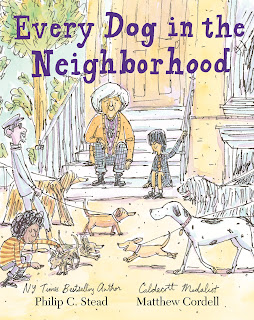
A bit later, a barefoot woman wearing a white bathrobe came after the dogs. They, barking, completely ignored her. When we moved to continue our walk, they still came after us. Thankfully, my companion did not bark back, but sat and then stood next to me. Understandably, she was reluctant to turn her back on them. Finally, the woman captured the dogs, apologizing and we walked up a hill toward home. Another thing Mulan and I have learned is the dog population in our tiny town swells in the summer. And we know, dogs will be dogs. Every Dog in the Neighborhood (Neal Porter Books, Holiday House, June 21, 2022) written by Philip C. Stead with artwork by Matthew Cordell is a lovely ode to dogs, their people and their commentary, community, and the affection between a child and their grandparent.
Grandma stirs a spoonful of honey into her tea and frowns. "Louis," she says, "it's going to rain today. I can feel it in my knees."
"Are you sure?" I ask. The weather is just fine in my knees.
Louis wants a dog. His grandmother says there are already plenty in the neighborhood. Louis knows from experience that
Grandma knows everything.
But, she doesn't know how many dogs there are in their neighborhood. At a stop during their rainy walk, Grandma makes a comment. Both Louis and his grandmother write letters to City Hall. This is the beginning of a quest for each.
The replies to their letters, another two letters, are discouraging. Louis decides his grandmother, again, knows best. They are going to take matters into their own hands.
Louis is going to count all the dogs in the neighborhood. Louis goes to every house, even the ones he knows do not have a dog. By chatting with his neighbors, Louis realizes more than the number of dogs. Louis is now privy to the people in the neighborhood, their dogs, and the bond between them. Each person shares a little bit more than whether they have a dog or not. Several times during the day, Louis finds his grandmother and they share a snack and conversation. (No text in this narrative refers to how Grandma spends her day.)
That evening, Louis informs Grandma about the number of dogs in the neighborhood. Grandma does not accept that number. And this is where I pause my recounting of this title. The concluding eleven pages left this reader teary-eyed and enjoying Louis and Grandma even more. We should all be so fortunate to have a grandmother like Louis.
Through Louis's voice and dialogue between Louis and his grandmother and Louis and their neighbors, Philip C. Stead takes us on a tour of the neighborhood and into the hearts of each resident. At each stop, Louis numbers the dogs and notes their name and something of interest. Readers will delight in the names of the dogs and how those names reflect on their people. Through the work of Louis during the day, Philip C. Stead is clearly and with intention leading us to a conclusion which will leave a mark on each reader's heart. Here is a passage.
"Excuse me, Mr. Pierce," I say. "I am counting every dog in the neighborhood. Do you have a dog?"
"I had a dog once," says Mr. Pierce. "His name was Harvey. He doesn't live here anymore. But he will always live in my heart."
"Does your heart live here?" I ask.
"Oh, yes," he says. "It has for many years.
That was good enough for me. I write down:
1. Harvey
One look at the right side of the open jacket and you cannot help but smile. As Grandma and Louis sit on the steps of their home, they smile at the people and their dogs walking. All those dogs, seven in all, are happy to be on a walk. Look at their faces! The color choices in this illustration radiate warmth. The title text is varnished a deep purple.
To the left of the spine, the entire scene continues. Other dog people and their dogs are out walking. We see other pets named in the narrative, cats, and a parrot and a Burmese python which are now free. Several pets and children are inside the next home, looking at the display outside. Either Thelonious or Monk are holding the ISBN in their mouth. Every individual is content.
On the book case, on a canvas of pale mint green, Matthew has fashioned a gallery. There are twenty unique frames in various shapes. Inside each one is a portrait of a named canine companion. The opening and closing endpapers are a rich golden orange yellow. On the title page is a smaller drawing, an image, of Louis and Grandma on the steps of their home. We can see it in its entirety. There are dogs and people out in front of them, enjoying the day.
Using
pen and ink and watercolor,
Matthew Cordell, in a style distinctively his own, with delicate and intricate details, takes us into this community of people with their dogs and other animal friends. (At one house, even before we read the text we can infer there are three animals there by the dishes outside the door.)(A nighttime walk contains a special visitor.) As we study each picture, through the looks on people's faces and their body postures, we are aware of their current emotional mood. Most of the images are single-page pictures, loosely framed in sketchy ink lines with wide white borders.
Matthew Cordell adds sound effects for impact. When Louis is telling us he is gathering what he needs for his survey, each item is drawn and labeled. Two pages prior to the conclusion include six wordless visuals. These hint at Grandma's work. Readers will notice, at least twice, references to a prior collaboration between Matthew and Philip. Who do you think named their dogs Wilbur and Orville? Two wordless illustrations bookend a dramatic two-page picture at the end of the book. In two words and one phrase they represent, bliss, success, and be the change.
One of my many favorite illustrations is for the words:
That's why I love her.
In this picture, Louis and Grandma are taking their walk wearing raincoats and using umbrellas. Rain puddles on the sidewalk at the unexpected downpour. Behind them, to the left and to the right, other walkers and their dogs are yelling and running for cover. (I love Grandma, too.)
Most certainly this is a book about dogs and their people, but Every Dog in the Neighborhood written by Philip C. Stead with artwork by Matthew Cordell is about finding goodness and community connections. It is about people from all walks of life and age rejoicing in a shared love. It is about one grandmother knowing the heart of her grandson and how to grow the heart of her neighborhood. I can't imagine any collection without a copy of this book.
To learn more about Philip C. Stead and Matthew Cordell and their other work, please access their websites by following the link attached to their names. Philip C. Stead has an account on Instagram he shares with his wife, Erin E. Stead. There is also a website titled The Stead Collection. Matthew Cordell has accounts on Facebook, Instagram, and Twitter. At Penguin Random House, you can view some interior images. I believe you will enjoy this interview with Philip C. Stead and Matthew Cordell at Kansas Public Radioabout this title.
If you want to have a complete sensory experience, consider a canine companion. Their heightened abilities will alert you to something long before it registers in your ears, eyes, or nose or before you venture to taste or touch it. Dogs walk through their surroundings ready to react. You learn to observe their every look, twitch of their nose, or swivel of their head. When they stop, you need to stop.
Sometimes, they are alerting you to something. Sometimes, they are telling you about themselves. In Hot Dog (Alfred A. Knopf, May 24, 2022) written and illustrated by Doug Salati, his first as both author and illustrator, a pup is collapsing under the weight of summer in the city. Fortunately, his human finally understands.
City summer
steamy
sidewalks
concrete
crumbles
sirens
screech
A dog and his human make their way down city streets, she with a list of errands in her hand. After their first stop, the dog is increasingly bombarded with a series of loud sounds compounded by the heat. After visiting the third building, the pup is nearly frantic with sensory overload.
Unable to take another step, the dog stops right in the middle of the road. The woman, awareness dawning, kneels down in the crosswalk, nose to nose with her furry friend. Picking up the dog, she yells for a taxi.
From taxi to train and then to ferry, they get farther and farther away from the city and the heat. They are closer and closer to a cool light wind and the salty scent of the sea. They arrive at an island with tall grasses, long stretches of sandy beach and white foamy waves. The dog runs in pure ecstasy.
There are hours of digging, barking, shaking, sniffing, finding, rolling, and romping. As the shadows lengthen, the pair enjoy the last rays of the sun and the soothing sound of the water washing on the shore. Under the light of a moon, they make their way home retracing their previous path. Cuddled together at their city apartment in their bed by a window, they fall asleep. Can you guess what fills the dog's dreams?
Spare, vividly descriptive text written by Doug Salati draws us deeply and immediately into this narrative. Two word alliterative phrases build toward a critical moment for the dog and his human. As the story shifts, the phrases are longer; longing is replaced with a wondrous reward. Concluding words lull readers, the pup, and his person into blissful dreams. Here is another phrase.
sun sinks down, swallowed by the sea
On the front, right side of the open dust jacket, the dog is in a state of bliss, away from the heat of the city, cooled by the sea. The closed eyes indicate a serene mental moment. In its mouth is a found treasure from hours of digging. To the left of the spine, on the back, on a canvas of sandy yellow is a picture of the dog looking at readers through their window in the city apartment. A double window fan supplies relief for them in their home. Beneath this image words by two-time Caldecott Medalist Sophie Blackall read:
"An utter joy from beginning to end!"
Across a hot orange background on the open book case is an extended scene from the book. It is the point where the woman goes to her dog stopped in the crosswalk in the middle of the road. They look into each other's eyes, nose to nose. Lines of the crosswalk spread from left to right. On the left, a pigeon flies away from a piece of half-eaten pizza and a paper plate on the crosswalk. Traffic sounds in a variety of fonts spread across the book case. This is a tender moment with the woman holding the dog's mouth and nose in her hand and a raised paw in her other hand.
In shades of reddish pink, the dog is drawn in numerous poses on the open and closing endpapers, In only one of the poses is it completely colored. The filled-in pose is different on each set of endpapers. On the title page, we see the dog in the apartment window. Its back is to us. This is a reversal of the viewpoint from the back of the dust jacket. On the verso the dog and his human are leaving their apartment building
These full-color illustrations
created using a combination of pencil and gouache on paper and Photoshop
are placed like panels on pages (horizontally and vertically) with sketchy outlines for framing with white space making columns for text or fashioning space between two images on a single page. The pictures are highly animated and intricately detailed. At times people will be only sketches on the edges of illustrations. Prior to the duo leaving for the beach, there are a lot of warm colors in the city settings to indicate the heat and the frustration the pup is feeling. For dramatic effect, there are several single-page pictures, edge to edge.
Once the pals get to the sea, the borders are loose and indicative of breezes. There are six pages of wordless pictures of all sizes which speak volumes. You want to cheer for this dog and his woman. She loves that the dog is loving the beach. As they return to the city, the framing is a blend of the hot day visuals and the breezy sea images. Careful readers will notice one new item the woman is carrying home. It is a promise.
One of my many favorite illustrations is a single-page picture, edge to edge. It is after the woman stops in the crosswalk in the middle of the street to kneel down to her dog. In this image on a hot orange-red background with yellow radiating lines, the woman stands, her one arm raised as she cries
"TAXI!!"
Her large straw hat and large blue-rimmed glasses frame her face and hair, hair the same color as the dog's fur. In her other arm she carries her pup, yellow leash dangling down. The dog is wide-eyed and smiling.
At times all individuals are overwhelmed by their surroundings and current situation. This is when it is time to take a break. In Hot Dog written and illustrated by Doug Salati, two friends find solace by the sea. Renewed they return to the city, ready to sleep and ready for their next adventure. I highly recommend this book for both your personal and professional collections. The words and illustrations provide a partnership as perfect as that between the dog and the woman.
To learn more about Dog Salati and his other work, please follow the link attached to his name to access his website. Doug Salati has an account on Instagram. At the publisher's website, you can view interior images. Doug Salati and this title are showcased by Julie Danielson at Seven Impossible Things Before Breakfast. There is process art and final art as well.
Dogs like humans have distinctive personalities and characteristics. After time spent together, you begin to understand them and they begin to understand you. You, as a human, come to accept there are things you will never change about your dog. You, also, realize they have wisdom beyond your capabilities. The thing is, this wisdom is not always applicable to a human's world. With over-the-top hilarity in words and pictures, author Dev Petty and illustrator Mike Boldt bring us Don't Eat Bees (Life Lessons from Chip the Dog)(Doubleday Books For Young Readers, May 31, 2022). This dog is all dog.
I am a smart dog.
I am only 7, but that is practically
50 in person years, so I already know
several important dog things.
To begin, Chip relays his opinions on cats and litter boxes, burying bones, and the unbelievable array of dog sizes and shapes. He then shifts to his most favorite thing in the world, eating. He loves chewing socks, but advises to avoid bees.
Paper, especially homework by his younger human, is one of his delectable delights. It keeps them with him longer when they have to redo their work. He also loves the Thanksgiving turkey. (Or is it the chase?) At all costs, he reminds us to avoid bees.
Grandpa's teeth are tasty. So is the cat's food. In fact, there is not much that Chip won't consume, except for bees and a couple of other yucky things, like fire.
By now you might be wondering why Chip is so persistent about not eating bees. It is a secret secret which this writer will not reveal. And of course, the cat is seeking revenge for the loss of its food as the comedic conclusion unfolds. Oh, Chip!
Told from Chip's point of view, this story penned by Dev Petty is laugh-out-loud funny from beginning to the end. Chip's initial claim of being smart followed by his commentary and logic is a constant cause of giggles and grins. Dev Petty's use of do and don't and a pro tip create a rhythm as the narrative is read. It invites us to keep turning the pages, so we can keep laughing. Here is a passage.
Do: Eat the cat food.
Just because you can.
Who's a dumb dog
now, Mittens?
Not me.
I don't eat bees.
How can you look at the front, right side, of the open and matching dust jacket and book case without laughing? Wide-eyed Chip who loves to eat everything is seriously thinking about gulping down the bee buzzing around him. The dotted yellow line indicating the path of the bee appears whenever Chip mentions not to eat bees.
On the back, to the left of the spine, on a turquoise canvas is a retro menu of
Chip's
DINER
Since 7 Years Ago
Under the headings of appetizers, entrees, and dessert are listed those items Chip mentions loving to eat in the story. Paw prints appear on the menu and as part of the menu heading. In true Chip fashion, the lower, left-hand corner of the menu has been bitten off. The ISBN is part of the menu.
Above a flower-covered field along the bottom of the opening and closing endpapers is a wide blue sky dotted with fluffy clouds. The clouds are not the same on each set of endpapers. In a different path on each set of endpapers is the yellow dotted line of a bee's path. This path continues on the verso and title pages. Chip, on the left, eyes the bee with extreme caution as it flies toward a flower on the right.
These lively, humorous pictures by Mike Boldtare placed on a variety of backgrounds and make excellent use of white space. Most are single-page pictures, but for dramatic effect (and maximum hilarity), there are five double-page pictures. The facial expressions, the eyes, and body postures like Chip's pointing paw add to the comedy.
The placement of Chip on the page and his size in the scene further contribute to the fun and funniness of this book. When Chip is speaking about Mitten and the litter box, all we see of Chip is the upper part of his head along the bottom of the page, looking up as the cat walks away from the smelly box. When Chip is running away with the Thanksgiving turkey, we are privy to the entire chaotic event of the table tipping, chairs falling, dishes crashing to the floor, and adult arms reaching toward Chip as he scampers away on the right of this two-page image.
One of my many favorite illustrations is a single-page picture on a bright yellow canvas. Chip is front and center with a tilted head. He is wearing a goofy grin exaggerated by the presence of Grandpa's false teeth. We see Chip's head and a small portion of his upper body. Around him, laughing are the daughter, Grandpa, and the mother. The daughter is hugging her stomach. Grandpa is crying, he is laughing so hard. And the mother is holding her phone, either because she has taken a picture or will take one soon. Chip's eyes are crossed.
Whether you are a dog person or not, everyone loves to laugh. This book, Don't Eat Bees (Life Lessons from Chip the Dog) written by Dev Petty with illustrations by Mike Boldt is so funny, you know parts or all of it are probably true. (I don't dare take my dog anywhere a bee might be. As we take our morning walks, if a bug comes near her she snaps it right out of the air and swallows it.) You'll want to add this title to your personal and professional collections to hear the sound of laughter ringing out as you read it.
To learn more about Dev Petty and Mike Boldt and their other work, including their previous collaborations, please follow the link attached to their names to access their websites. Dev Petty has accounts on Instagram and Twitter. Mike Boldt has accounts on Instagram, Twitter, Vimeo, and YouTube. At the publisher's website, you can view interior images. John Schu interviews both Dev Petty and Mike Boldt about this book on his blog, Watch. Connect. Read.Dev Petty stops by author Tara Lazar's blog, Writing for Kids (While Raising Them), to chat about writing this book.
For those sharing their lives with beings other than humans, each one has a preference with particular reasons attached to that preference. This reader has a fondness for dogs. Four Labrador Retrievers have been members of my family, sisters, Soot and Cinder, sweet Xena, and my wild child cuddlebug, Mulan. For this reason one saying I hold close to my heart is
Dogs are not our whole life, but they make our lives whole.
Roger Caras
Any title referencing dogs has my attention.
Whatever it is, when you begin and end with a dog, expect the extraordinary. I'd Like To Be The Window For A Wise Old Dog (Doubleday Books For Young Readers, April 5, 2022) written and illustrated by Philip Stead is a place to let your imagination spread as far as it will go. It's also a reminder to be more observant of the details you might miss at first glance.
Oh, I'd like to be
the raindrop
falling on a turtle shell
For the next two page turns, the rain continues. It makes a puddle for a leaper. It provides the opportunity for an umbrella, an elephant's umbrella, to supply shelter. And when the rain ends, at the most perfect moment, it fashions a wonder seen out the window. A window under which a dog sleeps.
The unseen narrator contemplates the movements of penguins, snails, honeybees, and those of a whale. They ponder mirroring those motions. With sure knowledge, this individual returns to wanting to be something which gives to another.
Where will the sunshine fall? Who will nest in an oak tree hollow? Who will hide in high green grasses?
We read of feathers and weather. We read of a hummingbird, mouse, and a quiet cat. Again, with sure knowledge, our wonderer goes to the window and the dog. As the window, the voice is filled with the happiness of the dog's thoughts as she gazes through the glass.
No matter how many times the book is read, the sheer beauty of the words carefully penned by Philip Stead surround the reader in a hug of serene speculations. Each pondering asks us to look and marvel at things we might take for granted instead of viewing them with gratitude. There is a musicality to the shifts in reflections from wanting to be something, to moving like something, and then to being something again. Philip Stead uses a bit of rhyming, alliteration, and metaphor. Here is another thought.
I'd like to be
the tall grass
standing with a mother deer
helping hide the little fawns
one two three
White is used masterfully by Philip Stead to elevate his full-color artwork throughout the book as first evidenced on the dust jacket. On the front, elements found in other illustrations are a part of this initial illustration. The blend of rain and the rainbow, the red ball and red bird, the blue and yellow coneflowers, and the wise old dog hint at continuity which can be comforting. To the left of the spine, on the white canvas is a mouse carrying an acorn. The mouse is flying with delicate angel wings. Beneath the mouse are the words:
And I sometimes wonder . . .
The book case is white and covered on both sides with raindrops. The raindrops are in the colors found in a rainbow. The opening and closing endpapers are the same shade of red as the bird and ball.
The first interior picture is of the window. It is raining outside. The red bird is singing in a tree with ginkgo-shaped leaves. The dog, her back to us, is staring out the window. Next to her is the red ball with a mouse seated on top of it. The next page turn we zoom to the bird singing in the rain. The background is blue with white drops, green leaves, brown branches, and the bright bird. On the title page, the dog now has the ball in her mouth. The mouse is running across the verso.
For his phrases, Philip Stead uses double-page pictures. His printmaking is exquisite with subtle shading and fine details. Before a final phrase or an alteration in phrases, words spread across two pages with no other artwork. The color of the letters is a hint of what is to come. As the narrative continues, figures from previous illustrations join other members culminating in a heartwarming array. Readers will pause at page turns to locate all the creatures. You will notice other smaller stories embedded in the artwork like the turtle and mouse moving the red ball to its final resting place.
One of my many favorite illustrations is of the elephant holding the umbrella in the rain. The background is white with blue raindrops. The elephant is facing to the left with the front portion of its body to the left of the gutter. Underneath the elephant's body it is white as light blue water puddles around it. Under the elephant's belly, eight tiny yellow birds are seeking shelter. Underneath the green umbrella in the elephant's trunk are two more yellow birds. Two other yellow birds are flying to the right near the elephant's trunk and head. There is something exceedingly soothing about this scene.
On the verso, the dedication by Philip Stead reads:
For Wednesday most of all
As previously stated when something begins and ends with a dog, it will be out of the ordinary. I'd Like To Be The Window For A Wise Old Dog written and illustrated by Philip Stead is indeed remarkable. It is one eloquent moment followed by another equally eloquent moment. It is uplifting. It is hopeful. It is a tribute to life. You will want a copy for both your professional and personal collections.
To learn more about Philip Stead and his other work, please follow the link attached to his name to access his website. Philip Stead shares a website with his wife titled The Stead Collection. They share an Instagram account, too. At the publisher's website, you can view the first few pages of this title. You can view more artwork from this book at R. Michelson Galleries. Philip and his wife, Erin, and Kevin Henkes and his wife, Laura Dronzek, were part of a virtual event on Friday, June 24, 2022. The four talk about their newest books. You can view this event hosted by Books of Wonderhere.
Of the many things attributed to dogs, one of the most endearing is their ability to make us laugh. Their body language, facial expressions, and antics are a constant source of joy. They welcome every moment of every day. In Bug On The Rug (Sleeping Bear Press, April 15, 2022) written by Sophia Gholz with illustrations by Susan Batori, a pup's beloved rug becomes an object of controversy and comedy.
Pug on a rug,
cozy and snug.
He's a rug-loving pug.
When along comes . . .
It's a bug! This bug is looking a tad bit too proud of his position on that rug. He has set up residence on Pug's rug.
Growling and buzzing ensues. Then Bug throws a stick, which Pug sets off to retrieve. Pug arrives back at his rug mad at that bug.
Pug grabs the rug and a tussle begins, until the duo crash into none other than Slug. Slug in not happy about being sandwiched between a fighting pug and bug. Slug says they are being selfish and rude.
Pug and Bug are filled with guilt. Sobbing Bug tells the tale of how he lost his home. Pug tearfully realizes the mistake he made. When Bug decides to leave, Slug makes a suggestion. The trio are enjoying the rug until . . .
With a keen sense of humor, author Sophia Gholz invites us into rhyming rhythmic fun-filled fiction. Her selection of words used to create this tale are delightful, true, and never forced but flowing. She shows readers how discord can be turned into harmony. Here is another passage.
Pug growls and howls.
Bug buzzes and scowls.
He might be small,
but Bug stands tall.
The open and matching dust jacket and book case give us a clear glimpse of the funny and frantic mischief-making about to happen between Pug and Bug. The characters in this tale all have wide-eyed expressions with exaggerated body characteristics, either small or large. On the dust jacket the image extends from flap edge to flap edge. On the right flap we are introduced to Slug who is looking surprised to see Bug on Pug's rug. Pug's body extends over the spine to the middle of the left side. There, a worm is looking cautiously at the happenings on the rug.
The opening endpapers include the publication information on the left and the title page on the right. There Bug has set up his new home on the rug. On the closing endpapers is the hilarious wordless conclusion. The looks on the characters' faces are totally laughable.
The illustrations by Susan Batorialternate between double-page pictures and full-page images. Her perspectives in these visuals shift from wide to close enhancing the pacing of the story. Humor is infused in every line of these highly-animated illustrations.
Readers will appreciate the added elements. When Bug builds his home on the rug, there is a Welcome mat outside his tent. He is drinking from a red and white polka-dotted cup. On a table next to him the red and white polka-dotted teapot sits. He has a tall lamp! Whenever the characters are thinking or remembering, those are shown in clouds above their heads.
One of my many favorite illustrations is a double-page picture. On the sides, local flora is shown. On the grass is the infamous rug. Looking off-kilter Pug, Bug, and Slug are on the rug. They have just slid and crashed into one another. Bug and Slug are squashed under Pug. They are dazed and bruised. This is the beginning of a change in the story.
This title, Bug On The Rugwritten by Sophia Gholz with artwork by Susan Batori, is read-aloud gold. Listeners and readers will be finger-snapping and swaying after the first few pages. The humorous phrases forming a story of sharing and friendship will remain with readers long after the book is closed. Your personal and professional shelves need to house a copy of this book.
As mentioned in a previous post, Early Reader Extravaganza, when we first learn to read our perceptions about our world change. We gobble up words to quench a hunger. It is a hunger to know, to understand, to explore, to travel to places real and imagined, to have sensory experiences, to laugh, to cry, to have our hearts warmed, broken and healed and to meet people like us and completely different from us. We feed this hunger as early readers by bonding with what we find within the pages of books; whether it is information satisfying our curiosity or characters and their situations that actively engage us.
For lovers of canines, two new early reader series supply loads of laughter and the antics of dogs living their best lives. Doggo And Pupper (Feiwel and Friends, March 23, 2021) and Doggo and Pupper Save The World (Feiwel and Friends, March 22, 2022) written by Katherine Applegate with illustrations by Charlie Alder take us into the home of an older dog living with a cat. Their humans decide to introduce another dog, a younger dog, into the family. The results are comedic to say the least.
Chapter One
Same Old, Same Old
Every night Cat asked,
How was your day,
Doggo?"
Every night Doggo said,
"Same old, same old."
Then he would wink at the
smiling moon and say, "Could have
been worse."
In support of his same old, same old assessment, Doggo in rhyming two word phrases, seven couplets, describes his day. He is quick to point out the value of quenching thirst and dispelling tiredness. To up the funny factor, we discover what Doggo does when his humans are absent.
The subsequent six chapters reveal how Doggo's humans decide to add pep and purpose to his days. Cat reminds and warns Doggo of the dire consequences of human intervention. The presence of Pupper changes everything. Doggo's days are wild because Pupper is wild. Pupper needs to go to charm school. He is not happy about this apparent requirement.
Upon his return, his humans are pleased with his behavior. Doggo is pleased, too. Cat is the first to point out that Pupper may have lost his wild ways, but he is hardly happy. That night Doggo is the one with an idea.
His sleepy humans allow Doggo to take the car keys. Road trip! Pupper and Doggo play and play and play. Would you believe they went to a drive-in movie? The duo silently sneak back inside their home. Cat has a few things to say the next day. Doggo replies with a familiar refrain.
Chapter One
Wonderful
In a sweet spot of sun,
Doggo dozed.
In a fine patch of dirt,
Pupper dug.
Life was good.
When Pupper spots a bird and her fledglings, he declares his desire to fly like Wonder Dog. He also expresses his fear of giant squirrels. Pupper believes he cannot be a hero because he worries. Doggo says Pupper does not need to fly to be a hero.
When their humans leave, Doggo, Pupper, and Cat watch a hero show on television. Pupper needs someone to save. Doggo picks the next show reminding him of his days in a rock band. Pupper decides being a hero might be less work than learning to be a drummer, but . . .
Pupper drums and drums and drums for more than a week. Cat is not happy. When Doggo announces a band is playing in the park the next day, Pupper can hardly wait to go. He is also distracted by the baby birds learning to fly.
The next morning on their way to the park, Pupper hears a chirping in some nearby bushes. Is it giant squirrels? It is one of the baby birds. It is all alone. Pupper knows the baby bird needs saving. The band is starting to play, but Pupper and Doggo wait until their work is done. As the dog duo savor the remaining hours of the day, they understand several things about music and heroes. We do, too.
Using a blend of short narrative phrases and sentences and lively canine/feline conversations, Katherine Applegateentertains readers from beginning to end. The interactions between Doggo and Pupper (and Cat) convey bits of wisdom, each character informing the other through their personalities. And in these short narrative phrases and sentences, conversations, and interactions, there is laugh-out-loud hilarity. Katherine Applegate also uses rhyming and alliteration when it is appropriate. This technique invites readers into the stories. Here are two passages, one from each title.
fashioned the full-color illustrations on the book case and throughout the book. Doggo and Pupper are showcased in the center on the front of both books. On the back of the book case, amid text you would normally find on the front and back end flaps of a dust jacket, Doggo, Pupper, and Cat are doing what they do best, enjoying each other and life. The characters and title text on the front of both books are varnished.
The opening and closing endpapers in the first title are a darker shade of sky blue. In the second title, the endpapers are the same darker orange we see on the front of the book case. After the title and verso pages, a contents page is supplied in both books. Small images are on these pages; a reflection of the characters and their activities in the chapters.
Opposite each chapter page is a full-page picture alluding to the chapter revelations. Throughout the books, the illustrations vary in size to complement the pacing of the narrative. There are two-page images, single-page pictures, edge to edge or surrounded by white space, groups of smaller images on one or two pages, framed and unframed, and there are vertical panels and horizontal panels. We are usually close to the characters which makes us feel a part of the story.
The expressions on the faces of the characters depict their every emotion. Some of the details, like Cat drinking through a long, striped curly straw, will have you giggling at the very least. All we see of the humans are portions of their bodies. We never see their faces.
One of my many favorite illustrations from Doggo And Pupper is a series of four images for the above-noted text. In the first image, Doggo is dressed like a ghost for Halloween. Cat, on top of a pumpkin, is howling with laughter. Doggo is wearing a yellow and white polka-dotted raincoat and booties in the second scene. In the third picture, Doggo's fur, ears, and tail are tied in a series of colorful bows. Doggo has been trimmed to the max in the final visual. Portions of Doggo's body are dyed pink to make it appear as if Doggo is a ballerina.
One of my many favorite illustrations from Doggo And Pupper Save The World is a double-page picture. It is a close-up of them finding the tiny bird, the fledgling, under the bushes. Pupper is peeking through the bushes on the left near the bird. Doggo has his head through the bushes on the right. We feel as though we are a part of this moment with them.
These two titles, Doggo And Pupper and Doggo And Pupper Save The World written by Katherine Applegate with artwork by Charlie Alder, are stellar early reader books. At the close of the first book is a list titled Doggo's Guide to Puppies. These ten items speak simple truths about puppies. At the end of the second book is another list of ten thoughts to guide readers. They are titled Pupper's Guide to Being a Hero. I highly recommend this series for your professional and personal collections. You might want more than one copy of each.
To learn more about Katherine Applegate and Charlie Alder and their other work, please follow the link attached to their names to access their websites. Katherine Applegate has accounts on Facebook, Instagram, and Twitter. Charlie Alder has accounts on Facebook, Instagram, and Twitter. At the publisher's website, you can view interior images for Doggo And Pupper and Doggo And Pupper Save The World.
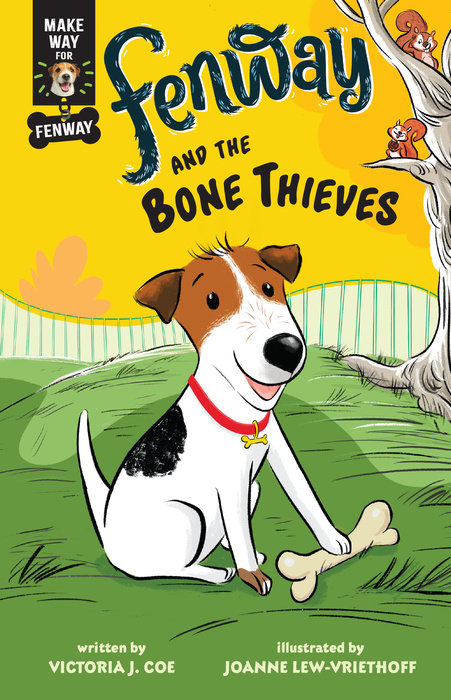
This second series of books highlights a character older readers already know. His name is Fenway, a Jack Russell terrier. He made a name for himself in the upper elementary/middle grade novels, Fenway and Hattie, Fenway and Hattie and the Evil Bunny Gang, Fenway and Hattie Up to New Tricks, and Fenway and Hattie In the Wild. With each title, readers are able to see the progress as Fenway and his human grow better together. In Fenway And The Bone Thieves (G. P. Putnam's Sons, May 3, 2022) and Fenway And The Frisbee Trick (G. P. Putnam's Sons, May 3, 2022) written by Victoria J. Coe with illustrations by Joanne Lew-Vriethoff, Fenway is still offering his spot-on insights in his own voice about his next-door neighbor dog friends, his humans, sneaky squirrels, and the elusive Frisbee.
1
THE TREAT PLACE
Everyone knows that dogs are
better than squirrels. Dogs make
humans happy. Dogs live
in houses. Dogs
ride in cars.
Squirrels do
none of these
things.
In this first of ten chapters, Fenway and his humans, Hattie, Food Lady, and Fetch Man are visiting the large store filled with special things for dogs. All Fenway can think about is treats. His humans steer clear of the treat section, adding yucky shampoo to the cart. It is only through sheer perseverance on Fenway's part, that a bone is added to the cart. Unfortunately, it ends up in the trunk of the car instead of his mouth.
Finally at home, with the bone in his mouth, Fenway shows his treasure to his neighbors, Patches and Goldie, two dogs enjoying their Dog Park next to Fenway's Dog Park. Then, Fenway hears a horrible and irritating sound. It is the chattering of not one but two squirrels. They are plotting to take away his bone. After successfully chasing them away, Fenway decides the only way to enjoy his bone is to hide it from the squirrels.
After lunch, the rain begins. Fenway is inside without his bone. Now he is thinking his big idea is not such a good idea. Nothing, not a single toy or game, can take away Fenway's desire for that bone, buried in the garden, outside in the rain.
The next morning when the rain has stopped, Fenway can hardly wait to get outside and dig up his bone. There are two huge problems. He can't remember where he buried it and the pesky squirrels are back. Many holes later, Hattie and her friend Angel, Patches' and Goldie's short human, discover the damage done by Fenway. As they chase him, he initially thinks it's a game, but it is most definitely not a game.
After a flowery shampoo, a nap complete with a squirrel nightmare, and another encounter with the sneaky squirrels in his Dog Park, Fenway makes a startling discovery. His perspective on the several days of the events are destined to have readers laughing and laughing. As he is finally chewing on his bone on the back porch, he gets a whiff of hot dogs. Yum!
1
THE BIG PARK
Romping in the Dog Park behind
our house is pretty awesome. But
riding in the car with Hattie and
Fetch Man is even better, because
we're going to the Big Park.
Fenway is having a rousing romp with Hattie and Fetch man in the Big Park. He loves chasing after the stick and returning it, sometimes reluctant to give it to Fetch Man. But that is all part of the game. Just when Fenway thinks the day can't get any better, he spots a Rottweiler leaping into the air to catch a Frisbee.
Fenway wishes with all his doggy heart he could do the same trick as Carmen. She is amazing at jumping in the air at the right moment. He tries to do her moves with a stick. It does not work. He needs a Frisbee.
No one seems to understand this need, not Hattie or Patches and Goldie. What's a dog to do? Several days later the Big Brown Truck arrives. After Fenway barks it away, Food Lady, Hattie and Fenway gather around a box. What do you think is inside?
Fenway and Hattie rush outside so Fenway can catch that new Frisbee in the air. He is so ready to perform a trick and receive the same praise as Carmen. All of a sudden there are the sounds of
CHIPPER-CHATTER-SQUAWK!
Later, a frustrated Fenway, who has not caught the Frisbee yet because of the sneaky squirrels, goes on a walk with his canine pals and their humans. Back home, Fenway convinces Hattie to throw the Frisbee in the house where there are no squirrel distractions. As you might imagine, it ends in disaster. That evening is very somber, but Fenway fails to understand. The next day at the Big Park, unintentionally, Fenway creates his own special trick. Try to read this without laughing. It is impossible. Oh, Fenway.
I've said it before, but I'll say it again. Author Victoria J. Coe knows dogs, especially this dog, Fenway. Each of the ten chapters in each book flows flawlessly with the same energy as if the words were written by a Jack Russell terrier. The chapters end with a sentence inviting us to proceed with anticipation to the next chapter. The upbeat narrative, Fenway's thoughts and conversations and those of the humans are thoughtful, exuberant, and funny. Here are passages from both titles.
CHIPPER-CHATTER-SQUAWK! sounds
behind me.
Uh-oh! The first squirrel is
headed this way! I should have
known the two of them were in this
together.
I run faster. "That bone is
mine!" I bark.
The big squirrel waits until I'm
about to lunge. Then he suddenly
hops up and scampers across the
Dog Park.
The chase is on! "You don't
belong here!" I bark. I follow
that squirrel
to the wooden
fence behind
the giant tree.
I thrust my snout into the box.
Whoopee! It smells like a Frisbee
that no other dogs have played
with. It must be my reward for
scaring away that truck.
Hattie reaches into the box and
pulls it out. "Ready, Fenway?" she
says.
I back up. "I'm ready!" I bark.
"I'm so ready!"
Hattie's elbow bends. She's going
to fling the Frisbee!
I leap onto the couch, racing
back and forth. Hooray! Hooray!
I'm going to catch that Frisbee in
midair!
You cannot look at the front, right side, of the matching and open dust jacket and book case for either book without smiling. Who can resist the happy-go-lucky look on Fenway's face? In both of these scenes, it is as if the illustrator has frozen a moment from the narrative. The back, left side, of both books features short descriptions of the books beneath the series title, Make Way For Fenway. Hanging from those banners is a bone-shaped dog tag with the words:
A little dog with a
GIANT personality!
The opening and closing endpapers for both books are creamy white, the same as the interior pages. Illustrator Joanne Lew-Vriethoffhas filled this book with images of varying sizes done in black, gray, and white. With the exception of only two, Fenway makes an appearance in all of them.
The vibrancy of Fenway's personality is reflected in the artwork. Even when he is still, it is as if he is ready to burst into action. Readers will pause at every illustration to appreciate the details included in the pictures. The facial looks on Fenway, the squirrels, Carmen, Patches, Goldie, and the humans leave no doubt as to what any of them are thinking. You can't help but smile, giggle, or laugh out loud.
In Fenway And The Bone Thieves, one of my favorite pictures is a double-page image with a phrase and two sentences placed in the upper, left-hand corner. On the left side a big squirrel with a gleam in its eyes, protruding teeth, and a big fluffy tail is ready to pounce on Fenway's bone which extends from the left side and over the gutter to the right. Toward the top of the right side in the Dog Park is Fenway. Flowers border the wooden fence behind him. He is aghast at the audacity of that squirrel. He is ready to run.
One of my favorite visuals in Fenway And The Frisbee Trick is a smaller illustration. It is a perfectly captured moment by Joanne Lew-Vriethoff. (I should know because it happens frequently at my own home.) The family sofa is placed in front of an arched large window. Fenway is on the sofa, standing on his hind legs with his front paws on the back of the sofa. He is watching the man from the Big Brown Truck carrying a package and walking toward their house. Fenway is barking in full security mode.
To have early readers based on a beloved dog character is, in the words of my canine companion, woof-tastic! Fenway And The Bone Thieves and Fenway And The Frisbee Trick written by Victoria J. Coe with illustrations by Joanne Lew-Vriethoff are brimming with humor and non-stop action whether read by an individual or as a read aloud. Readers will hardly be able to wait for another installment in the series. You will certainly need one or more copies of both books in your personal and professional collections.
By following the link attached to the names of Victoria J. Coe and Joanne Lew-Vriethoff, you can access their websites to learn more about them and their other work. Victoria J. Coe has accounts on Instagram and Twitter. Joanne Lew-Vriethoff has accounts on Facebook, Instagram, and Twitter. At the publisher's website, you can view interior images and read an excerpt for Fenway And The Bone ThievesandFenway And The Frisbee Trick. The cover reveal for these titles with author and illustrator interviews was hosted by educator Michele Knott at Mrs. Knott's Book Nook.




.tif)