Each time we step into the woods, regardless if the trail is known and well-traveled or barely visible and new, we can never totally predict what we will encounter. We are never sure what may happen during those encounters. The wild is full of surprises.
It's this unknown that sends shivers of anticipation or unease through the minds and hearts of those who enter the forest. If you happen to be the latter kind of individual, with a bundle of other things you fear, going into the woods is the last thing you want to do. Author illustrator Matthew Cordell shows us bravery can come when we least expect it in his new title, Evergreen (A Feiwel and Friends Book, an imprint of Macmillan Publishing Group, February 7, 2023). This squirrel's trek represents the special turning point when bravery sets us free to enjoy the best kind of adventure our world has to offer.
PART ONE
Magic Soup
Deep in Buckthorn Forest, at the
northernmost edge of Burr Valley high in the
tallest red oak tree, behind the closed curtain of a
bedroom window, hid a squirrel named Evergreen.
As soon as Evergreen hears her Mama utter three familiar words, her timid heart sinks. Her mother has more faith in her abilities than she does. Mama wants her to take soup to a very sick Granny Oak who lives in the opposite corner of Buckthorn Forest. Evergreen has never been in the woods alone.
One of the things Evergreen fears more than anything else is thunderstorms. Every sound she hears in the forest gives her pause, but so far no thunderstorms. A sudden terrifying sound leads Evergreen to a white rabbit trapped between two heavy rocks. The rabbit is naturally panicked thinking about hawks. Swallowing her own panic, Evergreen and the bunny, Briar, move the stones.
How does Briar repay Evergreen? That wily rascal steals the soup, but before Briar can vanish a hawk swoops from the sky. Does the hawk get Briar? Does Evergreen get the soup back? (Now would be a great time to recall the Aesop fable, The Lion and the Mouse.)
With Ember airborne again, Evergreen grasps the soup-filled acorn and starts to continue her travels when a bone-chilling sound pierces the air. An elder and his great-grandson are in need of her assistance. As she has done several times today, Evergreen places the anguish of another ahead of her own. With this feat, she surprises herself again. As she makes her way toward Granny Oak's home, she repeatedly finds herself facing friends and foes. So far, she has not spilled a single drop of soup!
GRRROOOAAARRR!
What is a squirrel who is definitely scared of her own shadow supposed to do upon hearing a sound like that? After this day's adventure, there is only one thing for her to do. Granny Oak needs the soup now. Upon returning home, she has no sooner hung up her shawl, when she hears Mama utter those same three words. Evergreen answers her mother's request with much more confidence this time, but . . . Yikes! Is that sound what she thinks it is?
Told in six sections, author Matthew Cordell uses the four middle parts to introduce us to forest characters whose expected personality traits offer unforeseen results; an enemy can be a friend, a friend can be a thief and a granny can be downright startling. Narrative and dialogue are deftly woven together to accurately describe a particular place, create tension-filled moments and astonishing twists and fashion a cast of memorable characters. Another thing Matthew Cordell does with each of these parts is to demonstrate how courage replaces dread when a being's heart has been supported with and filled with love. Mama makes more than magical soup. Here is a passage.
The first two stones were easy to step across. And the next one, too. But the next
stone was a big hop away.
Hop! She made it! The next stone was an even bigger hop. HOP! SLIP!
When readers look at the right side, front, of the open jacket, there is no doubt that squirrel is afraid. Framed by forest fauna and a vine, we can see anxiety etched in every line of her body and in her wide-eyed look. What has her so frightened? The title text is varnished.
As we move our eyes over the spine to the back, left side, we see more framing with intricate woodland vines and leaves before we look carefully at the circular image of Evergreen and Mama. They are seated in their home, spooning steaming soup into their mouths. Their eyes are closed in contemplation. (It is on the front and back of the jacket that only the most careful of readers can see the clever addition Matthew Cordell adds to specific images throughout this book. Oh, how I loved this when I discovered it. Thank you, Matthew!)
Across the entire book case is a bird's-eye view of Buckthorn Forest. This map shows fourteen labeled places amid trees, fields, hills, a mountain, a pond and a stream. The compass rose is a centered acorn with branches separating each of the directions.
On the opening and closing endpapers is a soft, grass green shade. A large full-page image bordered in vine announces each part. The illustrations vary in size to complement the text and supply readers with a stronger sense of pacing. The artwork as a whole provides an intimate experience bursting with emotion. (There is one heart-stopping double-page visual with only a sound and another double-page picture that accompanies shocking text.)
Rendered
with a 005 Micron pen and painted with watercolors,
the illustrations invite readers to pause and notice the elements within each one. The fine lines create floral details in Evergreen and Mama's home, notable expressions on the characters' faces and their physical portraits, and in the depiction of Buckthorn Forest. Sometimes a scene is shown to us in a panoramic view and other times we are so close to the action, we are there.
One of my favorite illustrations of many is a single-page picture. It captures every small creature's fears as it capture's Evergreen's terror. The image is framed in a leafy vine. The background is a field edged with trees along the top. Coming from the top of the frame are two feet with hooked talons belonging to Ember. The one on the right is just the open talons. The one on the left is more of the foot and talons. These talons grasp Evergreen, barely holding on to the soup-filled acorn. Her mouth is open in a scream. This is the second illustration certain to induce gasps from readers, if not shouts of Evergreen!
When you finish reading Evergreen written and illustrated by Matthew Cordell, you will go back to the beginning and read it again. With every reading something new will present itself to you in either the text or the artwork. And as you read it, you will wonder how he selected the names for his characters and the points on his map of Buckthorn Forest. Trust me when I say, people will be reading this title for generations to come. Be sure to have at least one or more copies in your professional and personal collections.
To discover more about Matthew Cordell and his other work, please follow the link attached to his name to access his website or visit his Facebook and Instagram accounts. At the publisher's website, you can view interior pages.
As mentioned in a previous post, Early Reader Extravaganza, when we first learn to read our perceptions about our world change. We gobble up words to quench a hunger. It is a hunger to know, to understand, to explore, to travel to places real and imagined, to have sensory experiences, to laugh, to cry, to have our hearts warmed, broken and healed and to meet people like us and completely different from us. We feed this hunger as early readers by bonding with what we find within the pages of books; whether it is information satisfying our curiosity or characters and their situations that actively engage us.
For lovers of canines, two new early reader series supply loads of laughter and the antics of dogs living their best lives. Doggo And Pupper (Feiwel and Friends, March 23, 2021) and Doggo and Pupper Save The World (Feiwel and Friends, March 22, 2022) written by Katherine Applegate with illustrations by Charlie Alder take us into the home of an older dog living with a cat. Their humans decide to introduce another dog, a younger dog, into the family. The results are comedic to say the least.
Chapter One
Same Old, Same Old
Every night Cat asked,
How was your day,
Doggo?"
Every night Doggo said,
"Same old, same old."
Then he would wink at the
smiling moon and say, "Could have
been worse."
In support of his same old, same old assessment, Doggo in rhyming two word phrases, seven couplets, describes his day. He is quick to point out the value of quenching thirst and dispelling tiredness. To up the funny factor, we discover what Doggo does when his humans are absent.
The subsequent six chapters reveal how Doggo's humans decide to add pep and purpose to his days. Cat reminds and warns Doggo of the dire consequences of human intervention. The presence of Pupper changes everything. Doggo's days are wild because Pupper is wild. Pupper needs to go to charm school. He is not happy about this apparent requirement.
Upon his return, his humans are pleased with his behavior. Doggo is pleased, too. Cat is the first to point out that Pupper may have lost his wild ways, but he is hardly happy. That night Doggo is the one with an idea.
His sleepy humans allow Doggo to take the car keys. Road trip! Pupper and Doggo play and play and play. Would you believe they went to a drive-in movie? The duo silently sneak back inside their home. Cat has a few things to say the next day. Doggo replies with a familiar refrain.
Chapter One
Wonderful
In a sweet spot of sun,
Doggo dozed.
In a fine patch of dirt,
Pupper dug.
Life was good.
When Pupper spots a bird and her fledglings, he declares his desire to fly like Wonder Dog. He also expresses his fear of giant squirrels. Pupper believes he cannot be a hero because he worries. Doggo says Pupper does not need to fly to be a hero.
When their humans leave, Doggo, Pupper, and Cat watch a hero show on television. Pupper needs someone to save. Doggo picks the next show reminding him of his days in a rock band. Pupper decides being a hero might be less work than learning to be a drummer, but . . .
Pupper drums and drums and drums for more than a week. Cat is not happy. When Doggo announces a band is playing in the park the next day, Pupper can hardly wait to go. He is also distracted by the baby birds learning to fly.
The next morning on their way to the park, Pupper hears a chirping in some nearby bushes. Is it giant squirrels? It is one of the baby birds. It is all alone. Pupper knows the baby bird needs saving. The band is starting to play, but Pupper and Doggo wait until their work is done. As the dog duo savor the remaining hours of the day, they understand several things about music and heroes. We do, too.
Using a blend of short narrative phrases and sentences and lively canine/feline conversations, Katherine Applegateentertains readers from beginning to end. The interactions between Doggo and Pupper (and Cat) convey bits of wisdom, each character informing the other through their personalities. And in these short narrative phrases and sentences, conversations, and interactions, there is laugh-out-loud hilarity. Katherine Applegate also uses rhyming and alliteration when it is appropriate. This technique invites readers into the stories. Here are two passages, one from each title.
fashioned the full-color illustrations on the book case and throughout the book. Doggo and Pupper are showcased in the center on the front of both books. On the back of the book case, amid text you would normally find on the front and back end flaps of a dust jacket, Doggo, Pupper, and Cat are doing what they do best, enjoying each other and life. The characters and title text on the front of both books are varnished.
The opening and closing endpapers in the first title are a darker shade of sky blue. In the second title, the endpapers are the same darker orange we see on the front of the book case. After the title and verso pages, a contents page is supplied in both books. Small images are on these pages; a reflection of the characters and their activities in the chapters.
Opposite each chapter page is a full-page picture alluding to the chapter revelations. Throughout the books, the illustrations vary in size to complement the pacing of the narrative. There are two-page images, single-page pictures, edge to edge or surrounded by white space, groups of smaller images on one or two pages, framed and unframed, and there are vertical panels and horizontal panels. We are usually close to the characters which makes us feel a part of the story.
The expressions on the faces of the characters depict their every emotion. Some of the details, like Cat drinking through a long, striped curly straw, will have you giggling at the very least. All we see of the humans are portions of their bodies. We never see their faces.
One of my many favorite illustrations from Doggo And Pupper is a series of four images for the above-noted text. In the first image, Doggo is dressed like a ghost for Halloween. Cat, on top of a pumpkin, is howling with laughter. Doggo is wearing a yellow and white polka-dotted raincoat and booties in the second scene. In the third picture, Doggo's fur, ears, and tail are tied in a series of colorful bows. Doggo has been trimmed to the max in the final visual. Portions of Doggo's body are dyed pink to make it appear as if Doggo is a ballerina.
One of my many favorite illustrations from Doggo And Pupper Save The World is a double-page picture. It is a close-up of them finding the tiny bird, the fledgling, under the bushes. Pupper is peeking through the bushes on the left near the bird. Doggo has his head through the bushes on the right. We feel as though we are a part of this moment with them.
These two titles, Doggo And Pupper and Doggo And Pupper Save The World written by Katherine Applegate with artwork by Charlie Alder, are stellar early reader books. At the close of the first book is a list titled Doggo's Guide to Puppies. These ten items speak simple truths about puppies. At the end of the second book is another list of ten thoughts to guide readers. They are titled Pupper's Guide to Being a Hero. I highly recommend this series for your professional and personal collections. You might want more than one copy of each.
To learn more about Katherine Applegate and Charlie Alder and their other work, please follow the link attached to their names to access their websites. Katherine Applegate has accounts on Facebook, Instagram, and Twitter. Charlie Alder has accounts on Facebook, Instagram, and Twitter. At the publisher's website, you can view interior images for Doggo And Pupper and Doggo And Pupper Save The World.
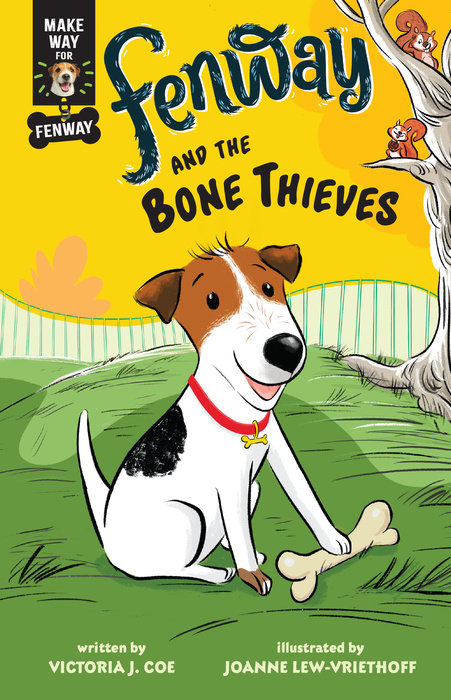
This second series of books highlights a character older readers already know. His name is Fenway, a Jack Russell terrier. He made a name for himself in the upper elementary/middle grade novels, Fenway and Hattie, Fenway and Hattie and the Evil Bunny Gang, Fenway and Hattie Up to New Tricks, and Fenway and Hattie In the Wild. With each title, readers are able to see the progress as Fenway and his human grow better together. In Fenway And The Bone Thieves (G. P. Putnam's Sons, May 3, 2022) and Fenway And The Frisbee Trick (G. P. Putnam's Sons, May 3, 2022) written by Victoria J. Coe with illustrations by Joanne Lew-Vriethoff, Fenway is still offering his spot-on insights in his own voice about his next-door neighbor dog friends, his humans, sneaky squirrels, and the elusive Frisbee.
1
THE TREAT PLACE
Everyone knows that dogs are
better than squirrels. Dogs make
humans happy. Dogs live
in houses. Dogs
ride in cars.
Squirrels do
none of these
things.
In this first of ten chapters, Fenway and his humans, Hattie, Food Lady, and Fetch Man are visiting the large store filled with special things for dogs. All Fenway can think about is treats. His humans steer clear of the treat section, adding yucky shampoo to the cart. It is only through sheer perseverance on Fenway's part, that a bone is added to the cart. Unfortunately, it ends up in the trunk of the car instead of his mouth.
Finally at home, with the bone in his mouth, Fenway shows his treasure to his neighbors, Patches and Goldie, two dogs enjoying their Dog Park next to Fenway's Dog Park. Then, Fenway hears a horrible and irritating sound. It is the chattering of not one but two squirrels. They are plotting to take away his bone. After successfully chasing them away, Fenway decides the only way to enjoy his bone is to hide it from the squirrels.
After lunch, the rain begins. Fenway is inside without his bone. Now he is thinking his big idea is not such a good idea. Nothing, not a single toy or game, can take away Fenway's desire for that bone, buried in the garden, outside in the rain.
The next morning when the rain has stopped, Fenway can hardly wait to get outside and dig up his bone. There are two huge problems. He can't remember where he buried it and the pesky squirrels are back. Many holes later, Hattie and her friend Angel, Patches' and Goldie's short human, discover the damage done by Fenway. As they chase him, he initially thinks it's a game, but it is most definitely not a game.
After a flowery shampoo, a nap complete with a squirrel nightmare, and another encounter with the sneaky squirrels in his Dog Park, Fenway makes a startling discovery. His perspective on the several days of the events are destined to have readers laughing and laughing. As he is finally chewing on his bone on the back porch, he gets a whiff of hot dogs. Yum!
1
THE BIG PARK
Romping in the Dog Park behind
our house is pretty awesome. But
riding in the car with Hattie and
Fetch Man is even better, because
we're going to the Big Park.
Fenway is having a rousing romp with Hattie and Fetch man in the Big Park. He loves chasing after the stick and returning it, sometimes reluctant to give it to Fetch Man. But that is all part of the game. Just when Fenway thinks the day can't get any better, he spots a Rottweiler leaping into the air to catch a Frisbee.
Fenway wishes with all his doggy heart he could do the same trick as Carmen. She is amazing at jumping in the air at the right moment. He tries to do her moves with a stick. It does not work. He needs a Frisbee.
No one seems to understand this need, not Hattie or Patches and Goldie. What's a dog to do? Several days later the Big Brown Truck arrives. After Fenway barks it away, Food Lady, Hattie and Fenway gather around a box. What do you think is inside?
Fenway and Hattie rush outside so Fenway can catch that new Frisbee in the air. He is so ready to perform a trick and receive the same praise as Carmen. All of a sudden there are the sounds of
CHIPPER-CHATTER-SQUAWK!
Later, a frustrated Fenway, who has not caught the Frisbee yet because of the sneaky squirrels, goes on a walk with his canine pals and their humans. Back home, Fenway convinces Hattie to throw the Frisbee in the house where there are no squirrel distractions. As you might imagine, it ends in disaster. That evening is very somber, but Fenway fails to understand. The next day at the Big Park, unintentionally, Fenway creates his own special trick. Try to read this without laughing. It is impossible. Oh, Fenway.
I've said it before, but I'll say it again. Author Victoria J. Coe knows dogs, especially this dog, Fenway. Each of the ten chapters in each book flows flawlessly with the same energy as if the words were written by a Jack Russell terrier. The chapters end with a sentence inviting us to proceed with anticipation to the next chapter. The upbeat narrative, Fenway's thoughts and conversations and those of the humans are thoughtful, exuberant, and funny. Here are passages from both titles.
CHIPPER-CHATTER-SQUAWK! sounds
behind me.
Uh-oh! The first squirrel is
headed this way! I should have
known the two of them were in this
together.
I run faster. "That bone is
mine!" I bark.
The big squirrel waits until I'm
about to lunge. Then he suddenly
hops up and scampers across the
Dog Park.
The chase is on! "You don't
belong here!" I bark. I follow
that squirrel
to the wooden
fence behind
the giant tree.
I thrust my snout into the box.
Whoopee! It smells like a Frisbee
that no other dogs have played
with. It must be my reward for
scaring away that truck.
Hattie reaches into the box and
pulls it out. "Ready, Fenway?" she
says.
I back up. "I'm ready!" I bark.
"I'm so ready!"
Hattie's elbow bends. She's going
to fling the Frisbee!
I leap onto the couch, racing
back and forth. Hooray! Hooray!
I'm going to catch that Frisbee in
midair!
You cannot look at the front, right side, of the matching and open dust jacket and book case for either book without smiling. Who can resist the happy-go-lucky look on Fenway's face? In both of these scenes, it is as if the illustrator has frozen a moment from the narrative. The back, left side, of both books features short descriptions of the books beneath the series title, Make Way For Fenway. Hanging from those banners is a bone-shaped dog tag with the words:
A little dog with a
GIANT personality!
The opening and closing endpapers for both books are creamy white, the same as the interior pages. Illustrator Joanne Lew-Vriethoffhas filled this book with images of varying sizes done in black, gray, and white. With the exception of only two, Fenway makes an appearance in all of them.
The vibrancy of Fenway's personality is reflected in the artwork. Even when he is still, it is as if he is ready to burst into action. Readers will pause at every illustration to appreciate the details included in the pictures. The facial looks on Fenway, the squirrels, Carmen, Patches, Goldie, and the humans leave no doubt as to what any of them are thinking. You can't help but smile, giggle, or laugh out loud.
In Fenway And The Bone Thieves, one of my favorite pictures is a double-page image with a phrase and two sentences placed in the upper, left-hand corner. On the left side a big squirrel with a gleam in its eyes, protruding teeth, and a big fluffy tail is ready to pounce on Fenway's bone which extends from the left side and over the gutter to the right. Toward the top of the right side in the Dog Park is Fenway. Flowers border the wooden fence behind him. He is aghast at the audacity of that squirrel. He is ready to run.
One of my favorite visuals in Fenway And The Frisbee Trick is a smaller illustration. It is a perfectly captured moment by Joanne Lew-Vriethoff. (I should know because it happens frequently at my own home.) The family sofa is placed in front of an arched large window. Fenway is on the sofa, standing on his hind legs with his front paws on the back of the sofa. He is watching the man from the Big Brown Truck carrying a package and walking toward their house. Fenway is barking in full security mode.
To have early readers based on a beloved dog character is, in the words of my canine companion, woof-tastic! Fenway And The Bone Thieves and Fenway And The Frisbee Trick written by Victoria J. Coe with illustrations by Joanne Lew-Vriethoff are brimming with humor and non-stop action whether read by an individual or as a read aloud. Readers will hardly be able to wait for another installment in the series. You will certainly need one or more copies of both books in your personal and professional collections.
By following the link attached to the names of Victoria J. Coe and Joanne Lew-Vriethoff, you can access their websites to learn more about them and their other work. Victoria J. Coe has accounts on Instagram and Twitter. Joanne Lew-Vriethoff has accounts on Facebook, Instagram, and Twitter. At the publisher's website, you can view interior images and read an excerpt for Fenway And The Bone ThievesandFenway And The Frisbee Trick. The cover reveal for these titles with author and illustrator interviews was hosted by educator Michele Knott at Mrs. Knott's Book Nook.
the right book for the right reader at the right time.
When this happens, the world of that reader and those around them changes. In their excitement at reading this book, they read it to others or speak about it with others. These others in turn do the same. Words are powerful. They are even more transformative in books.
It is also said this purpose is shared by all those devoted to books and reading. It is a gift happily given again and again. Yours In Books (Cameron Kids, September 21, 2021) written by Julie Falatko with illustrations by Gabriel Alborozo is an endearing correspondence between two individuals, One is a bookshop owner. The other is someone seeking solitude to read. During the course of their written conversations, we grow in understanding of the power of words lovingly written and illustrated in books.
Pine: A Bookshop
Knobby Pine Northeast of the Big Fir
Dear Sirs:
I received your marvelous catalog in the mail and
spent many long hours reading the descriptions
of all the books.
Owl T. Fencepost has requested a book be sent to his address at the
Top of Oak
Near the Clearing
and the Noisy Small Animals.
He wants to soundproof his home so he can read in peace and quiet. B. Squirrel, the bookshop owner, replies to Owl his desired title is out of stock. Is there another title he wishes to purchase?
Well, Owl has decided to vacant his premises and wants to locate on an island far, far away from the Top of Oak. As the second title is also out of stock, B. Squirrel decides to send a book encouraging Owl T. Fencepost to stay where he is. You get the real sense of Owl's frustration in his next letter. As he reads another book aloud, the noisy neighborhood children appear and want him to read it aloud to them. He does this but writes it will be for the last time.
The other thing readers will notice is the shift in the letter writing between B. Squirrel and Owl T. Fencepost. Their greetings and closings are becoming friendly rather than professional. A relationship is forming. Instead of a book on fence building, B. Squirrel sends Owl T. a book on cooking and baking.
Each book B. Squirrel sends is having the opposite effect Owl T. wants in response to the boisterous children. The evident humor and budding trust in their letter writing increases. An invitation is issued by Bessie. She wants Owl to visit the bookshop. In the next several exchanges between Bessie and Owl, something is being planned by the children who now fill Owl's abode. The messages between Owl and Bessie get shorter as anticipation and excitement build. Books, reading, and most importantly, children, can make our lives better. They did for a bookshop owner and an individual who thought he wanted to read in solitude.
There is an art to letter writing. That art is even more evident when an author pens letters written between two characters. Julie Falatko through the exchange of letters allows us to participate in the developing relationship between Bessie and Owl.
This friendship forms through their shared love of books. In the titles of the requested books and those sent by Bessie to Owl, we are recipients of Julie Falatko's wonderful sense of finding and sharing joy and her keen observation skills of relationships. Here are portions of a letter to Bessie from Owl and her reply.
However, the aromas of warm food heating on
my stove brought all the noisy neighborhood
children to my doorstep. Please send The
Busy Owl's Guide to Food That Will Not Entice
Neighborhood Children to Stop By Uninvited.
The book you requested does not seem to exist.
Is it possible you were making a joke? If so, I
am delighted. It sounds like you and the children
might enjoy 50 Fanciful Biscuits and Cakes, which
I have enclosed, of course.
When you look at the open dust jacket, you get a preview of what artist Gabriel Alborozo imagined when reading the manuscript written by Julie Falatko. To the left of the spine, on the back, is a close-up view of Owl T. Fencepost's writing desk. He has started a letter to the bookshop. His pen rests on the paper with his glasses nearby. Stacks of books can be seen on either side as well as a vase with flowers and a matching teacup and saucer. Through a picture window we get his view from the Top of Oak.
To the right of the spine, on the front,we see Owl and Bessie reading together in her bookshop with some of the children. Do you see the snail in the lower right-hand corner? It is a postal worker. (I love the nod to snail mail.) Another enchanting aspect are the two birds holding the paper, letter writing paper, with the text.
The book case is designed to be a book wrapped in brown paper, tied with two-tone string. The bow is on the front along with a cancelled stamp. The cancellation is for Oak Post Office. A crowned owl is featured on the stamp.
Two distinct scenes are showcased on the opening and closing endpapers. They are fine-lined drawings in black on creme. The first is an overview of the oak in the lower, right-hand corner and the bookshop in the upper, left-hand corner. Included are a pathway with a bridge over a stream, other trees, a pond, and a playground. We zoom in to Owl's tree on the closing endpapers. It is large and fills nearly all the right side, crossing the gutter as the treetops spread to the left. Owl stands in his doorway holding a book as the children play below him. Owl and Bessie, each holding a book, stand together on the title page.
These full-color images vary in size and perspective. Many of them are double-page pictures with the letter placed on the side opposite most of the illustration. Sometimes, for the purpose of pacing, single pages are devoted to the letters and their writers. And to heighten the expectations of events to come, smaller visuals are grouped two to a page for several pages. These illustrations reveal the personalities of Bessie and Owl in the descriptive and included details. You will be thrilled with two wordless, double-page pictures.
One of my favorite illustrations is a double-page picture. We are inside Owl's home. Celebratory chaos is evident. Birds are flying. A bunny swings on a ceiling lamp. A tiny hedgehog clings to the broom handle held by Owl. Other animals are scampering about the room. Owl holds a red balloon in one claw. Food is scattered. Is that water on the floor? Is that a plunger a squirrel is holding? Is that a roll of toilet paper unraveling?
If you are of the mind one can never have too many books to read or too many friends, Yours In Books written by Julie Falatko with artwork by Gabriel Alborozo is the title for you. Read this book for sheer enjoyment or to promote a discussion about the power of books to change lives or how letter writing can forge friendships. This title is charming from beginning to end and should find a place on both your personal and professional bookshelves.
To discover more about Julie Falatko and Gabriel Alborozo and their other work, please access their respective websites by following the link attached to their names. Julie Falatko has accounts on Instagram and Twitter. Julie Falatko chats with Heidi Fiedler at Book Magic. Gabriel Alborozo is highlighted at Words & Pictures. After watching this video, you'll be inspired to bake or you might get lost down the rabbit hole of acorn crafts, book making crafts or tea parties on Pinterest.
Readers know you can't judge a book by its cover, but we also know a cover can be an incentive. A cover can ask us to stop and look. There, if we look closely enough, we see a bit of a story. This bit of a story offers an overture to what might unfold in the body of the book.
If there are characters portrayed on those jackets and cases, we can take clues from their facial expressions and body language. We Love Fishing! (A Paula Wiseman Book, Simon & Schuster Books for Young Readers, February 23, 2021) written by Ariel Bernstein with illustrations by Marc Rosenthal examines the concept of the word we. In the events in this tale, there is a me who has a contrasting outlook. Therein the comedy resides.
Bear, Porcupine,
Otter, and Squirrel
love fishing.
When you keep reading each one, Bear, Otter, and Porcupine, issues individual statements in agreement, except for Squirrel. Squirrel says---
They love fishing.
Bear, Porcupine, and Otter glorify the merits of fish consumption. Squirrel can't stand the odor of fish.
Walking through the woods to get to the fishing spot is sheer delight for the exuberant trio. Squirrel lacks even the slightest desire for exercise, finding fault with ever step taken. As you can surmise, fishing from the boat is a pastime enjoyed by three and abhorred by a fourth.
When the rain begins, comments by Bear, Porcupine, and Otter are the height of optimism. Squirrel laments the condition of his fur. When it appears as though a fish is hooked, happiness is met with confusion. Keeping the fish in the net, unfortunately is Squirrel's task.
A mishap is met with stunned silence . . .initially. Will the bonds of friendship hold? Only Fish knows.
The sentences written by author Ariel Bernstein and the rhythm they generate make this narrative a joy to read, silently or aloud. First, we read a declarative statement, followed by three collaborative assertions and one dissenting remark. What elevates the humor is Squirrel is apt to make several verbal observations, all in contrast to the majority opinion. In the true style of a storyteller, Ariel Bernstein fashions a pause, a point of reflection, before the cadence resumes. Here is a partial passage with a sentence by Otter and several, but not all, by Squirrel.
I don't know
what I love more.
Walking or
fishing.
Can we take a taxi?
I stepped on
a pebble.
Ack! I see a fly!
Look at the cheery faces on Otter, Bear, and Porcupine on the front of the dust jacket. Then, when you focus on Squirrel, you get a hint as to the divergence in points of view and fun to come. The color choices imply a happy-go-lucky day outside in a relaxed natural setting. The wide spine with the row of fish also offers a clue as to the upcoming happening. The wide blue border continues on the back. There we see Squirrel repelled by the slippery Fish, barely in the net. Squirrel, the net, Fish and a small portion of the boat are set on the cream background. The title text is raised and varnished. The fish on the spine border are varnished.
On the book case, on a canvas of the same bright blue as the spine border, the image from the back of the jacket is placed in a smaller circle. On the front is the same illustration as on the front of the jacket, smaller, and framed by an oval blue-green line. Bordering that line is an wider oval of cream, framed in a green line. Within this is the Fish pattern. This is placed on the bright blue background.
On the matching opening and closing endpapers, we are greeted with an underwater scene. Waves in varied shades of turquoise are a superb canvases for fishes and Fish. They are swimming in two different directions. Bubbles form in two vertical rows, top to bottom, one on the left side and one on the right side. Fish is approaching the hook on a line. On the title page the foursome is gathered, three gleeful about fishing and Squirrel totally grumpy.
were rendered in Prismacolor pencil and digital color.
White, cream, is a strong element in all the pictures. Texture, shading and light figure prominently. The illustrations shift in size to accentuate the pacing. Readers will enjoy all the added details; the lures in Bear's collection, Otter's love of supreme ice cream sundaes, Porcupine's intensity, tongue out, as he fishes, and Squirrel's passion for acorns.
One of my many favorite illustrations spans two pages. It features a close-up of the red and yellow boat ono the lake. Bear, eyes closed, is stretched out on his back in the bow of the boat. A pole behind him has a line in the water. Over him Porcupine holds a reel and pole with another line in the water. At the end of Bear's feet, Otter, wearing his fisherman's cap, holds the net. On the back seat Squirrel sits, hands on either side of his face. Just off the right side of the stern, Fish is poking its head above the water. This picture complements the text splendidly.
Throughout all our lives, our friendships will always be tested. In this book, We Love Fishing! written by Ariel Bernstein with illustrations by Marc Rosenthal, the art of compromise, amid grumbling, is displayed wonderfully, full of laughter and yes, love. You will enjoy having this title as a part of your personal and professional collections. It's sure to promote discussions after the giggling dies away.
To discover more about Ariel Bernstein and Marc Rosenthal and their other work, please access their websites by following the link attached to their names. Ariel Bernstein has accounts on Facebook, Instagram, and Twitter. Marc Rosenthal has accounts on Facebook and Instagram. At the publisher's website you can view interior illustrations.
Sometimes as soon as you read a title aloud, bursts of laughter can be heard throughout the gathered listeners during a story time. Certain words are overloaded with hilarity. That hilarity, though, can vanish in a second if the word is used to diminish an individual's character or worth.
Don't Call Me Fuzzybutt! (Sleeping Bear Press, March 15, 2021) written by Robin Newman with illustrations by Susan Batori shows us how anger can escalate. In that anger, civility is set aside. Taking the high road seems out of reach. The Golden Rule is forgotten.
Bear needed a lot of sleep. Two hundred and
forty-three and a half days, to be precise.
Anything less and he turned grizzly.
In addition to needing the specified number of days for sleep, Bear could hear the softest noise. He could hear the sound of one raindrop. It woke him up.
He fashioned attire to block out noise. Through signs, he notified his neighbors of his need for silent sleep. And he cut down trees to make a soundproof door. On his first hibernation day, he went blissfully to sleep until . . .
PECK!
PECK!
PECK!
woke him up.
What Bear did not know was the trees he cut down were architectural wonders created by Woodpecker. Woodpecker was dismayed to find all his homes were gone. Rabbit, Mouse, and Squirrel had no clue as to the disappearance of said structures.
Woodpecker hung up flyers offering a reward. He finally noted sections of his houses strewn in a path to Bear's new den door. Using his signature work ethic, Woodpecker was taking back what was his.
With every peck, Bear's frustration grew. He roared. Outside his den, he asked a question horrifying Rabbit, Mouse, and Squirrel at the use of one word. Woodpecker heard it and confronted Bear. Bear stomped back inside and fell asleep.
Considering his ability to hear even the softest sound, Woodpecker unintentionally woke Bear again, this time with a different noise. In a much longer encounter, tempers of both parties flared into a nasty blaze of name-calling. Two wounded individuals called a truce and constructed a plan. After two hundred and forty-three and a half days, spring was not the only renewal enjoyed by forest friends.
With her first three sentences, author Robin Newman opens the door for a problem to enter. The slight tension increases when we learn of Bear's hearing abilities. With the presentation of Woodpecker's dilemma, we understand a clash is coming.
Robin Newman uses the storytelling rule of three with skill. The repetition of key phrases and application of alliteration provide a cadence welcoming reader participation. The combination of descriptive dialogue and equally illuminating narrative achieve a flawless flow. Here are two passages.
Before Bear could say "salmon and honey on toasted pumpernickel bread," he was asleep.
But lately his houses were disappearing.
"WHAT HAPPENED TO MY RUSTIC RANCH,
COZY COTTAGE, AND SOLAR-POWERED DUPLEX?"
Woodpecker went looking.
On the double-page image spread from the left to the right, back to front, on the matching dust jacket and book case, readers are given a view of Bear's den with the door built from Woodpecker's houses, the autumn forest with its golden glow, and the cast of characters. Clearly Woodpecker and Bear are disgruntled. Rabbit, Mouse, and Squirrel are skittish about what has happened and about what might happen next. Illustrator Susan Batori first exhibits her inclusion of tiny details in the flight of the honeybee above the final title word and in the items on and near Bear's den.
The opening and closing endpapers are a crisp white. Bear and Woodpecker, with angry glances and arms-crossed stances, are on the title page. The other three creatures are looking at them, afraid.
To enhance and complement the pacing of the story Susan Batori employs a blend of full-page pictures crossing the gutter, smaller insets grouped together, full-page pictures, edge to edge, and dramatic double-page pictures. Emotions are heightened with alternating perspectives. We are brought close to characters or given a larger view of their forest setting, even from a bird's eye view.
What is notable about these images are the facial features on the characters, specifically the eyes. The wide-eyed looks convey a range of emotions. Underlying the seriousness of what unfolds, there is a current of humor in the pictures and individual items. Bear's nightshirt includes a pattern of honeybees. On the flyer Woodpecker posts it reads:
WANTED
(pictures of houses)
REWARD
BUGS
One of my many favorite pictures is a single-page picture toward the end of the story. It's a close-up of Bear all snuggled in bed, dreaming of a honeybee and its honeycomb. He is wearing his knitted cap and earmuffs. His teddy bear is under the covers with him as he sleeps. Off to the left side is Woodpecker, wing to his beak, making the SHHH gesture.
Relevant and timely, Don't Call Me Fuzzybutt! written by Robin Newman with illustrations by Susan Batori will engage readers from beginning to end with the clever, rhythmic language and lively pictures. This book is guaranteed to inspire discussions and group projects. I hope you will all add a copy to your personal and professional collections.
By following the link attached to Robin Newman's and Susan Batori's names, you can access their websites learning more about them and their other work. Robin Newman has accounts on Facebook, Instagram, and Twitter. Susan Batori has accounts on Behance, Facebook, Instagram, and Twitter. The cover reveal with an essay by Robin Newman is hosted at Nerdy Book Club. At Books of Wonder on March 13, 2021, there is a virtual launch. You can view some portions of interior illustrations in Susan Batori's Instagram feed. Here is the link to a post on Robin Newman's Facebook page for a follow-up activity.
A circle is much more than a geometric shape. Symbolically, it has more than one interpretation. When we are seated in a circle, no one is more important than another. All are equal. A circle is said to represent eternity, having no beginning or no ending. It depicts wholeness.
It signifies perfection. For those who love the sweet fried circles known as doughnuts, this meaning rings true. Two book publications at the end of September focus on this delicious pastry. Donut Feed The Squirrels (A Norma And Belly Book)(RH Graphic, an imprint of Random House Children's Books, September 29, 2020) written and illustrated by Mika Song is a charming and comical, five chapter graphic novel about two best friends who develop an obsession for doughnuts.
Belly!
Wake up.
I'm making
pancakes!
You are?
I am.
Yes!
Yesss!
The problem is Belly and Norma are so excited about their pancake breakfast, the pancakes burn to a crisp. Belly suggests chestnuts for their morning meal. This is their plan until Norma gets a whiff of
crispy, sugar, oil,
and a hint of
linden flowers.
Belly and Norma plus the entire squirrel population in their community smell it. It's a doughnut food truck. Now they all want doughnuts. Norma and Belly have another scheme.
It seems the cook and owner of the truck does not consider chestnuts a good form of payment. Norma and Belly end up soaking wet after being sprayed. They dry out so fluffy their mentor, Gramps, thinks they resemble dandelions. Gramps, Norma, Belly, and another youngster devise a strategy to get inside the truck and gather a bunch of doughnuts.
As with many ventures, things do not go smoothly. One hilarious incident, inside and outside the truck, after another are certain to have you laughing and cheering at the same time. Later, while a festive squirrel gathering is happening, the frustrated food truck baker makes a startling discovery. Surprises come in all shapes and sizes. Yum!
Told entirely in dialogue with some sound effects, author Mika Songprepares a textual feast for readers. The snappy conversations between Belly and Norma and the other characters are tinged with friendship, love of community, humor and valuable insights on life. Characters' traits are revealed through these exchanges. Here are two adjoining passages.
Yuck.
I hate being wet.
It's sunny---we'll dry
in no time.
See!
Mr. Spritzer
better hold on to
his donuts.
Let's just play
Frisbee and
forget about
the donuts.
I can smell
them, Belly.
Come on! I have a plan.
Have you ever seen more animated, happy-go-lucky looking squirrels than Norma and Belly on the front of the open book case? You know based on the title and the placement of a doughnut above them, escapades are in the offing. To the left, on the back, Norma and Belly are placed on the upper portion with words reading:
Norma and Belly
Would Really Really Really Really Like
A Dounut.
The bottom portion contains text you would usually find on a front flap of a dust jacket. On the back the colors are reversed, green on top and yellow on the bottom.
The same green is used for the opening and closing endpapers. Norma and Belly in lively positions are shown on both title pages. On the dedication page, the food truck is on its way to the park.
Rendered
with pencils, sumi brushes, sumi ink, and watercolor on watercolor paper
the illustrations in the various sizes of panels depict warmth, a form of casual coziness. Mika Song changes the perspectives to further engage readers in the intimate details of the story. There is a narrow black line framing the panels and the speech bubbles. Many of the panels are wordless and guaranteed to make you laugh out loud.
Two of my many, many favorite illustrations are after Norma and Belly dry out from being spritzed and when Belly is inside the food truck. The first one is a half-page picture. It's when we first see the duo after they are dried. Their fur is so fluffy, their size is doubled. They are extra-poufy, everywhere. In the second image, a bit larger than a half page, Belly has started up one of the machines. The doughnuts are moving up on a belt. One moves off the top into the air. Belly is riding it and screaming
Wheee!
Readers will be reading Donut Feed The Squirrels (A Norma And Belly Book) written and illustrated by Mika Song repeatedly. They will be thrilled to know Apple Of My Pie is the second planned adventure with this twosome. You'll want to have several copies of this book in your professional collections and at least one in your personal collection.
To learn more about Mika Song and her other work, please follow the link attached to her name to access her website. Mika Song has accounts on Instagram and Twitter. At the publisher's website you can view multiple pages. Mika Song reads all five chapters aloud. Below you can view the first one where she presents it in
Kamishibai-style using her original watercolor pages.
More than seventeen years ago, readers met an irresistible character with appealing opinions. This effervescent personality is coated in chocolate and colorful candy sprinkles. His name is Arnie, and he is a doughnut. In HELLO ARNIE!: An Arnie The Doughnut Story (Christy Ottaviano Books, Henry Holt And Company, September 29, 2020) written and illustrated by Laurie Keller readers are treated to a bit of a mystery.
Hi, Plain!
Good
morning,
Glazed!
Hey,
Long John!
Arnie is moving through the bakery shouting greetings to all his pastry pals. And they reply in one loud chorus. Arnie is proud he knows everyone in the bakery until Cinnamon Twist points out he does not know everyone. He does not know the reader. YIKES!
Arnie is quick to point out that the reader (you) is the largest doughnut he has ever seen. In fact, he makes several references as to how big you are. His thinking then evolves to the type of doughnut you are.
He is eager to help you find your proper place on the doughnut trays. Through a series of comparisons, Arnie reaches an astonishing conclusion. (He does take a few moments to discuss the virtues of sprinkles and the lack of them on you, the reader.)
Arnie decides, rather reluctantly, you are not a doughnut. How is this possible? Well then, what are you? Is it possible you are a __________________!?
By using Arnie's voice as narrator, author Laurie Keller, places readers directly in his story. His genuine commentary, questions and answers strike the center of readers' hearts. You'll probably be laughing, too. His brief conversations with Cinnamon Twist and Long John and the choral responses of the entire bakery of doughnuts add extra sweetness to this tasty tale. Here is a passage.
What kind of
giant doughnut
ARE you anyway?
WHAT?!
You don't
know what
kind?
The tiny, printed pattern (mini doughnuts) spreads across the front, spine, and back of the open dust jacket. The hues of those small forms shift from teal to purple and to pink, almost like reflected sunlight. Arnie with his wide-eyed look, open mouth, and animated arms and legs is in his full glory. He makes an appearance on the back to talk about this book and to point out the four other books in which he stars. On both the front and the back of the dust jacket, Arnie is varnished, along with the thumbnails of the other titles, and the main title text on the front. This text is also raised.
The book case back is identical to the dust jacket. On the front we have moved closer to Arnie. His face fills the entire front of the book case, his grin lighting up our lives.
On a white background, the opening and closing endpapers are covered in red, yellow, blue, pink, and green sprinkles. On the verso, dedication, and title pages, illustrator Laurie Keller has created a double-page picture of a doughnut machine and a large dough bowl with a curved chute dropping doughnuts into hot oil. Can you spy a character from another of her popular books walking across the top of the title page?
Each illustration rendered
with markers, colored pencils, pen and ink, acrylic paint, collage, and digital drawing
is highly animated spanning either two pages, single pages, or two smaller visuals on a single page. The backgrounds shift through a series of pastel shades or feature the checkered colors of the bakery. Sometimes there are two different backgrounds on a single page like panels to separate moments. Laurie Keller's collage technique is fabulous.
One of my many, many favorite illustrations covers two-thirds of a page. Arnie is looking closer at the reader, at you. In his left hand he is carrying a clip board and blue pencil. This is how he is keeping track of observations. His left eye is closed in concentration. In his right hand he is holding a magnifying glass held up to his right eye. This eye, as seen through that glass, is HUGE! He is trying to see if you have filling coming out of your head.
Written and illustrated by Laurie Keller, HELLO ARNIE!: An Arnie The Doughnut Story shows us a character at his personal best. He tackles the mystery of who we are with his usual exuberance. When he reaches a conclusion, he embraces it with his truth. Arnie is a character to love. I know you will want to have a copy for your professional and personal collections. (And wouldn't it be great if there was an Arnie The Doughnut plush toy?)
To discover more about Laurie Keller and her other work, please follow the link attached to her name to access her website. Laurie Keller has accounts on Facebook, Instagram, and Twitter. At the publisher's website you can view interior images. Laurie Keller was recently featured at Only Picture Books and author Tara Lazar's Writing For Kids (While Raising Them). Enjoy the charming book trailer.
If you are asked to name your favorite part of the Christmas season, what is your answer? Also, what one word best describes what Christmas means to you? Like many things in life it is to be expected our replies would be a reflection of our age, experiences and current circumstances. Maybe our responses would be different from one year to the next.
Sometimes we get so caught up in the preparations for the events attached to the celebration, we never truly pause to reflect on either of these questions. Our time is completely occupied with the cooking and baking, the decorating, the sending of Christmas cards and selecting the gifts to be given. In Finding Christmas (Albert Whitman & Company, October 1, 2017) written by Lezlie Evans with pictures by Yee Von Chan, three friends find themselves in an unexpected situation with life-changing results.
The Little Burrow was nearly ready for Christmas.
Hare was singing carols at the top of his voice as he placed decorations on the tree. Squirrel was placing finishing touches on freshly baked cookies. Mouse was leaving their home. She still had to find the perfect present for Hare.
It seemed like Mouse had barely left the house when she returned deeply agitated. She needed their help immediately. Squirrel and Hare followed her through the snowy woods until they came to a swallow lying on the ground, a thin blanket of snow covering her. The three carried the ill bird back to their Little Burrow.
Placing her close to the fire covered in blankets was not helping. She did not move. Hare had an idea. He gave Squirrel his gift. Squirrel was puzzled and did not want to open it yet, but Hare insisted. Inside was Squirrel's favorite thing. He understood it would help the swallow.
Next Squirrel gave Mouse her gift to open. Inside was an item surely meant to keep the chill of winter from reaching her. She understood it would help the swallow. All night long the trio tended the swallow.
When Christmas morning arrived Hare, Squirrel and Mouse were talking about their gifts for each other. Mouse, of course, was sad she had no gift for Hare. As the light of a new day filled The Little Burrow, something else was carried on the air. Hare did have a gift from Mouse.
With her storytelling skills author Lezlie Evanstakes readers into the heartwarming relationship of the three friends within the first six sentences. As the story continues we come to understand how much their affection is for each other by their gifts. We also realize their true character in their willingness to give to another in greater need. The repetition of a single phrase strengthens our knowledge of this. Here is a passage before Mouse's sudden return.
As Squirrel pulled the last batch of cookies from the oven, Hare hit a high note. "Could you tone it down a bit?" asked Squirrel. Hare had been singing at the top of his lungs all morning. "But music's my favorite part of Christmas," said Hare. "Music helps bring the Christmas spirit." Though tomorrow was December 25th, it didn't feel like Christmas yet.
The charm of a woodland setting and the three friends who dwell within its surroundings are immediately felt by readers who look at the matching, opened dust jacket and book case. The blue-gray background with snowflakes provides an ideal canvas for the windows into the warmth of The Little Burrow. Delicate, intricate details in each setting and in the leaves, berries and nuts framing each of them contribute to the overall enchantment. To the left, on the back, again framed in holly leaves and berries, a red ribbon, ferns, berries, pine boughs, oak leaves and acorns, Mouse, Squirrel and Hare are doing their best to awaken the swallow and keep her warm.
A muted forest green covers the opening and closing endpapers. On the title page readers are given a view of The Little Burrow as if we came upon it in the woods. Snow is mounded over the rounded roof. Light glows in the windows on either side of the circular door. Smoke drifts upward from the chimney. Trees frame the home.
Illustrator Yee Von Chaninvites us into the world of these woodland creatures with two-page pictures, single page pictures, edge to edge and single page images in loose circular or oval shapes. She alters the perspective to heighten the mood of the narrative. Her fine lines and exquisite elements remind us elegance is found in the simple things. Readers will notice she includes two other birds in several illustrations; each of them is wearing a scarf to maintain their warmth in winter.
One of my many favorite illustrations takes us close to The Little Burrow. We are looking inside it on Christmas Eve along with two birds who are perched on the window ledge. The window covers nearly two pages, framed in snow and the outside of the home. Through the window we can see Hare loading a log on the fire, Squirrel feeding tea to the swallow, placed on a rug and covered in blankets, and Mouse offering a comforting touch. A part of their Christmas tree, table with a plate of cookies and stove are visible. A tray with a tea pot and cups is on the floor near the swallow. We are looking at love.
Through the words of Lezlie Evans and the artwork of Yee Von Chan Finding Christmas is an engaging and heartfelt story of the best this season brings. It is a gentle reminder to follow the Golden Rule, to choose compassion, whenever the opportunity presents itself to us. You will want to add this title to your professional and personal collections.
To discover more about Lezlie Evans and Yee Von Chan and their other work, please follow the links attached to their names to access their websites. Here is a link to the advent calendarLezlie Evans recommends creating in her interview for the book trailer premiere at Scholastic's Ambassador of School Libraries, John Schumacher's blog, Watch. Connect. Read.At the publisher's website you can view interior pages. Lezlie Evans is interviewed about this book and her work at the Albert Whitman Blog. She is also interviewed about this title and her process at Picture Book Playlist. At Yee Von Chan's website she lists the other social media connections she has in which you can see her work. She has another website called Whimsy Whimsical.
People will never stop debating the subject of destiny. There are those who fervently believe it is predetermined; everything happens according to a plan. For many it is thought to be controlled by each individual. Each choice made serves to direct us down a particular path. If obstacles block the way, additional decisions may or may not alter the original course.
As a whole the domesticated canine clan seems to be fairly certain about the course of each day regardless of their human companions. They know what they enjoy. They know what they need. And they know how to get what they need and enjoy. Percy Dog Of Destiny (Boyd Mills Press, March 28, 2017) written by Alison McGhee with illustrations by Jennifer K. Mann is a tale of one determined dog who adores his ball.
Dog park? What ho!
At the sight of his leash, Percy knows fun with friends is in his near future. Before he can even consider leaving he has to find his ball. After checking all his favorite, familiar spots in the house, he locates it sitting in his personalized bowl. Percy is ready!
Along the way to the dog park Percy meets Molly, a poodle, Oatmeal Raisin Cookie, a dachshund, and Fluffy, a Great Dane. Each one of them is carrying their prized possessions. Four happy pooch pals race through the gate and along the fence. Wait...where's Fluffy? Oh, there he is.
They sniff and greet each other except for Fluffy. The big guy would rather take a whiff of a nearby flower. They enjoy other tail-wagging doggy diversions with Fluffy favoring a more individual approach to each one.
In the midst of their fun a squirrel taunts Percy, challenging him. This squirrel wants his ball. There is no way that squirrel is getting Percy's beloved ball. When Percy summons his crew, the rotten rodent makes a move. Woof! Woof! What a fetch-tastic surprise!
When a dog love a ball, nothing else will do. Wherever they go, the ball goes with them. In this narrative author Alison McGhee displays her understanding of this canine characteristic perfectly. Told in first pooch point of view, short sentences provide readers with the inside scoop on Percy's thoughts and actions. Alison masterfully manipulates the plot toward the unexpected conclusion with a cadence created by Fluffy's signature deviations from the norm. Percy's "pet-names" for his ball are guaranteed to bring on the giggles and grins. Here are two sample passages.
Where's my special ball? There you are, my little porkie pie. Time to pee on the tree. Oh, Fluffy.
Percy is one perky pooch as clearly shown on the matching front of the dust jacket and book case. That ball is going with him forever and always. Look at the spine which extends to the left in the same width. Those paw prints are moving forward with purpose. To the left, on the back, the three friends, Molly, Oatmeal Raisin Cookie and Fluffy, are walking away from us as Percy stands over the ISBN with his tail happily wagging. The combination of the pale yellow with the red reaches out and grabs your attention. The opening and closing endpapers are covered in the same rich, radiant red.
Beneath the text on the title page, Percy is looking forward at readers with his ball firmly held in his mouth. Jennifer K. Mann uses white space as an element in her design and layout. It frames the other elements on each page. She might have a single major image on one or two pages or display several on a page as when Percy is looking for his ball in the beginning. She has him checking inside a shoe, a dresser drawer, a toilet and a waste basket.
The perspective is always at a dog's level. When Percy's human sets off to the dog park with him, all we see are legs and the leash coming from above Percy. The pictures rendered in pencil and digital paint have a casual but realistic feel to them. The lines are loose and flowing. If the expressions on Percy and his friends don't have you laughing out loud, the squirrel is sure to do the trick.
One of my favorite illustrations is when the four friends are running through the gate into the dog park. The sheer bliss they are feeling is evident is their stretched body postures. Even though each one is holding their favorite toy, you can see them smiling. This image spans two pages. The outline of the fence is spare with flowers along the outside and flowers inside the park within enclosures. We can see the trunks of several trees and birds and butterflies flying. The squirrel makes a first appearance; a foreshadowing of his dastardly intentions.
This book, Percy Dog Of Destiny, written by Alison McGhee with illustrations by Jennifer K. Mann is fabulous! With every reading it gets funnier and funnier. The pacing supplied by the blend of text and images, as any dog lover can tell you, is superb. Readers will be asking you to read this again and again. For a delightful read aloud session I would pair this with award winning titles, A Ball For Daisyby Chris Raschka and Ballby Mary Sullivan.
To discover more about Alison McGhee and Jennifer K. Mann please visit their websites by following the links attached to their names. You can view interior images at Jennifer's site. I know you will enjoy reading the post at author, reviewer and blogger Julie Danielson's Seven Impossible Things Before Breakfast when she chats with Jennifer. There is a lot of artwork to enjoy.