Quote of the Month

When love and skill work together, expect a miracle. John Ruskin


Showing posts with label Identity (Philosophical concept)-Fiction. Show all posts

Tuesday, January 25, 2022

Gifted With . . .

When we enter this world, we have undiscovered potential.  Those closest to us, our family members, may try to steer us toward a generational family tradition or occupation.  They may see us as the next great beekeeper, politician, educator, doctor, grocer, carpenter, chef, clothing designer, gardener, or musher.  Even though the choices seem limitless, the path we follow, according to them, is already defined.

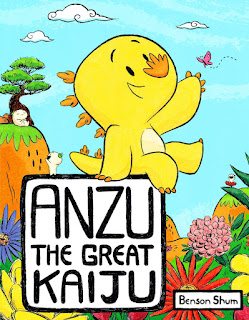
Our gift or gifts do not always align with their desires.  Sometimes, they are the exact opposite of family expectations.  If we are fortunate, we will be supported regardless of which direction we take.  As the monster in Anzu The Great Kaiju (Roaring Brook Press, January 11, 2022) written and illustrated by Benson Shum discovers, sometimes such approval is not quickly or easily earned.
All great kaiju are born with a superpower
to strike fear in the heart of their given city.

Anzu desires to follow in his family's footsteps.  He does have a conspicuous dilemma.  It is hard to 

strike fear in the heart of 

your city when your superpower is of the floral variety.  Yes, Anzu has flower power!  He sees and summons loveliness everywhere.

When Anzu reaches a certain age, he is assigned a city.  He can hardly wait to cause chaos.  His mother and father decide to first demonstrate by example what he needs to do.  He must unleash wild weather and earthly upheaval.

Alas, Anzu conjures up wreaths and necklaces of flowers and a playground appears when he uproots a huge tree.  The residents in his city are wildy ecstatic.  No matter what he does, they get happier and happier.  There is a contrast in the air between  the despondency of some and the pure bliss of others.  What is Anzu to do?

Now, Grandmother steps on the scene.  She tells him to dig deep into the powers passed to him from those of his past.  Anzu does this and there is an enormous resonating sound.  No one is more surprised than Anzu at this result.  Anzu has a decision to make.  Only his heart has the best answer.


With his first sentence, author Benson Shum fills us with anticipation.  When we learn of Anzu's superpower, in light of this statement, we are struck by the incongruity of this monster's situation.  It is a bit humorous, and a lot wonderful.

Anzu's story is told with a mix of added sound effects, conversation, and narrative.  Benson Shum's word choices not only convey the mood of the moment, but bring us into the action with their welcoming cadence.  Each of the family members speaks their truth with affection for one another.  In keeping with the back and forth between rumble-tumble turmoil and flower-power glee, we are privy to the conflict facing Anzu between pleasing one's family and staying true to yourself.  Here is a passage.

SHWACK!

Vines and flowers erupted,
twirled and swirled into a
jungle of seesaws and slides.

"A great kaiju should unleash havoc," Dad said.
"NOT happiness."


How can you not want to reach out and hug bold yellow and orange Anzu when seeing him perched on the framed title on the dust jacket?  His happiness is contagious to everything around him as color bursts forth in the form of flowers and butterflies while the tiny residents of his city enjoy the effects of his superpower.  Anzu and the title text box are varnished on the front of the dust jacket.

To the left of the open dust jacket, on the back, is white space.  Above the ISBN at the bottom, two teeny residents are laughing as they balance on a seesaw.  Above them a cascade of flowers spin from left to right.  Toward the top Anzu is placed in a rectangular frame with a teal background.  He is exclaiming 

PEW PEW PEW 

as flowers come from his mouth.

The book case is a vibrant spring green.  Covering the back and a large portion of the front is an array of flowers in shades of red, purple, pink and yellow with glossy green leaves.  On the front Anzu is lying on his back, smiling and looking at the wonder his superpower has created.

The opening and closing endpapers appear to be an open guidebook on monster superpowers.  Opposite each depiction of the monster is a list of their superpowers.  There are circles around some of the superpowers.  Throughout the pages are hand-drawn stars, hearts and other doodles.

Rendered

with watercolor and ink and compiled digitally

these illustrations are as spirited as Anzu.  Colorful backgrounds showcase the other cheerful hues.  Black lines accent the glorious selected shades.  Sometimes, on a crisp white background wider lines will frame the text and an image.  A smaller framed visual and text are placed on a double-page picture for maximum effect.  The image sizes reflect the text and focus on the facial expressions and body postures of the characters superbly.  The final two-page picture is wordless and represents the marvelous conclusion.

One of my many favorite illustrations is after Anzu's first attempt at terrifying the citizens of his newly acquired city.  The background is sky blue.  There is a dirt and grassy dirt mounds along the bottom.  Garlands of flowers are floating from the sky in bright colors.  The tiny beings are dancing.  One shouts Hula!  Garlands are on the ground and hanging from the mounds.  Anzu's mother stands to the right of all this merriment, holding a garland and looking distressed.  She is a lot taller and thinner than Anzu, a light teal in color with large white spiny plates down her back.


There comes a time, many times, in our lives when we have to decide what is best for us and best for those around us.  This title, Anzu The Great Kaiju written and illustrated by Benson Shum, shows readers with great joy how to be guided by your heart and to stay true to yourself.  I highly recommend you place a copy in both your personal and professional collections.  This is to be shared often and widely especially as a read aloud.  

To learn more about Benson Shum, please follow the link attached to his name to access his website.  Benson Shum has accounts on multiple social media platforms including Facebook, Instagram, and Twitter.  Benson Shum wrote a guest post this month on author Tara Lazar's Writing for Kids (While Raising Them) during Storystorm.  Benson Shum is interviewed about his work and this title on author Erin Daley's site, author illustrator Jena Benton's site, writer Vivian Kirkfield's site, and Kaitlyn Leann Sanchez's Math is Everywhere.  At the publisher's website you can view multiple interior images.

Tuesday, November 3, 2020

A Delightful Doughut Duo

A circle is much more than a geometric shape.  Symbolically, it has more than one interpretation.  When we are seated in a circle, no one is more important than another.  All are equal.  A circle is said to represent eternity, having no beginning or no ending.  It depicts wholeness.

It signifies perfection.  For those who love the sweet fried circles known as doughnuts, this meaning rings true.  Two book publications at the end of September focus on this delicious pastry.  Donut Feed The Squirrels (A Norma And Belly Book)(RH Graphic, an imprint of Random House Children's Books, September 29, 2020) written and illustrated by Mika Song is a charming and comical, five chapter graphic novel about two best friends who develop an obsession for doughnuts.

Belly!
Wake up.
I'm making 
pancakes!
You are?
I am.
Yes!
Yesss!

The problem is Belly and Norma are so excited about their pancake breakfast, the pancakes burn to a crisp.  Belly suggests chestnuts for their morning meal.  This is their plan until Norma gets a whiff of 

crispy, sugar, oil,
and a hint of 
linden flowers.

Belly and Norma plus the entire squirrel population in their community smell it.  It's a doughnut food truck.  Now they all want doughnuts.  Norma and Belly have another scheme.

It seems the cook and owner of the truck does not consider chestnuts a good form of payment.  Norma and Belly end up soaking wet after being sprayed.  They dry out so fluffy their mentor, Gramps, thinks they resemble dandelions.  Gramps, Norma, Belly, and another youngster devise a strategy to get inside the truck and gather a bunch of doughnuts.

As with many ventures, things do not go smoothly.  One hilarious incident, inside and outside the truck, after another are certain to have you laughing and cheering at the same time.  Later, while a festive squirrel gathering is happening, the frustrated food truck baker makes a startling discovery.  Surprises come in all shapes and sizes.  Yum!


Told entirely in dialogue with some sound effects, author Mika Song prepares a textual feast for readers.  The snappy conversations between Belly and Norma and the other characters are tinged with friendship, love of community, humor and valuable insights on life.  Characters' traits are revealed through these exchanges.  Here are two adjoining passages.

Yuck.
I hate being wet.
It's sunny---we'll dry
in no time.

See!

Mr. Spritzer
better hold on to 
his donuts.
Let's just play
Frisbee and
forget about
the donuts.

I can smell
them, Belly.
Come on! I have a plan.


Have you ever seen more animated, happy-go-lucky looking squirrels than Norma and Belly on the front of the open book case?  You know based on the title and the placement of a doughnut above them, escapades are in the offing.  To the left, on the back, Norma and Belly are placed on the upper portion with words reading:

Norma and Belly
Would Really Really Really Really Like
A Dounut.

The bottom portion contains text you would usually find on a front flap of a dust jacket.  On the back the colors are reversed, green on top and yellow on the bottom.

The same green is used for the opening and closing endpapers.  Norma and Belly in lively positions are shown on both title pages.  On the dedication page, the food truck is on its way to the park.

Rendered

with pencils, sumi brushes, sumi ink, and watercolor on watercolor paper

the illustrations in the various sizes of panels depict warmth, a form of casual coziness.  Mika Song changes the perspectives to further engage readers in the intimate details of the story.  There is a narrow black line framing the panels and the speech bubbles.  Many of the panels are wordless and guaranteed to make you laugh out loud.

Two of my many, many favorite illustrations are after Norma and Belly dry out from being spritzed and when Belly is inside the food truck.  The first one is a half-page picture.  It's when we first see the duo after they are dried.  Their fur is so fluffy, their size is doubled.  They are extra-poufy, everywhere.  In the second image, a bit larger than a half page, Belly has started up one of the machines.  The doughnuts are moving up on a belt.  One moves off the top into the air.  Belly is riding it and screaming

Wheee!


Readers will be reading Donut Feed The Squirrels (A Norma And Belly Book) written and illustrated by Mika Song repeatedly.  They will be thrilled to know Apple Of My Pie is the second planned adventure with this twosome.  You'll want to have several copies of this book in your professional collections and at least one in your personal collection.

To learn more about Mika Song and her other work, please follow the link attached to her name to access her website.  Mika Song has accounts on Instagram and Twitter.  At the publisher's website you can view multiple pages.  Mika Song reads all five chapters aloud.  Below you can view the first one where she presents it in 

Kamishibai-style using her original watercolor pages.


More than seventeen years ago, readers met an irresistible character with appealing opinions.  This effervescent personality is coated in chocolate and colorful candy sprinkles.  His name is Arnie, and he is a doughnut.  In HELLO ARNIE!: An Arnie The Doughnut Story (Christy Ottaviano Books, Henry Holt And Company, September 29, 2020) written and illustrated by Laurie Keller readers are treated to a bit of a mystery. 

Hi, Plain!
Good
morning,
Glazed!
Hey,
Long John!


Arnie is moving through the bakery shouting greetings to all his pastry pals.  And they reply in one loud chorus.  Arnie is proud he knows everyone in the bakery until Cinnamon Twist points out he does not know everyone.  He does not know the reader.  YIKES!

Arnie is quick to point out that the reader (you) is the largest doughnut he has ever seen.  In fact, he makes several references as to how big you are.  His thinking then evolves to the type of doughnut you are.  

He is eager to help you find your proper place on the doughnut trays.  Through a series of comparisons, Arnie reaches an astonishing conclusion.  (He does take a few moments to discuss the virtues of sprinkles and the lack of them on you, the reader.)

Arnie decides, rather reluctantly, you are not a doughnut.  How is this possible?  Well then, what are you?  Is it possible you are a __________________!?  


By using Arnie's voice as narrator, author Laurie Keller, places readers directly in his story.  His genuine commentary, questions and answers strike the center of readers' hearts.  You'll probably be laughing, too.  His brief conversations with Cinnamon Twist and Long John and the choral responses of the entire bakery of doughnuts add extra sweetness to this tasty tale.  Here is a passage.

What kind of
giant doughnut
ARE you anyway?

WHAT?!
You don't 
know what 
kind?


The tiny, printed pattern (mini doughnuts) spreads across the front, spine, and back of the open dust jacket.  The hues of those small forms shift from teal to purple and to pink, almost like reflected sunlight.  Arnie with his wide-eyed look, open mouth, and animated arms and legs is in his full glory.  He makes an appearance on the back to talk about this book and to point out the four other books in which he stars.  On both the front and the back of the dust jacket, Arnie is varnished, along with the thumbnails of the other titles, and the main title text on the front.  This text is also raised.

The book case back is identical to the dust jacket.  On the front we have moved closer to Arnie.  His face fills the entire front of the book case, his grin lighting up our lives.

On a white background, the opening and closing endpapers are covered in red, yellow, blue, pink, and green sprinkles.  On the verso, dedication, and title pages, illustrator Laurie Keller has created a double-page picture of a doughnut machine and a large dough bowl with a curved chute dropping doughnuts into hot oil.  Can you spy a character from another of her popular books walking across the top of the title page?

Each illustration rendered

with markers, colored pencils, pen and ink, acrylic paint, collage, and digital drawing

is highly animated spanning either two pages, single pages, or two smaller visuals on a single page.  The backgrounds shift through a series of pastel shades or feature the checkered colors of the bakery.  Sometimes there are two different backgrounds on a single page like panels to separate moments.  Laurie Keller's collage technique is fabulous.

One of my many, many favorite illustrations covers two-thirds of a page.  Arnie is looking closer at the reader, at you.  In his left hand he is carrying a clip board and blue pencil.  This is how he is keeping track of observations.  His left eye is closed in concentration.  In his right hand he is holding a magnifying glass held up to his right eye.  This eye, as seen through that glass, is HUGE!  He is trying to see if you have filling coming out of your head.


Written and illustrated by Laurie Keller, HELLO ARNIE!: An Arnie The Doughnut Story shows us a character at his personal best.  He tackles the mystery of who we are with his usual exuberance.  When he reaches a conclusion, he embraces it with his truth.  Arnie is a character to love.  I know you will want to have a copy for your professional and personal collections.  (And wouldn't it be great if there was an Arnie The Doughnut plush toy?)

To discover more about Laurie Keller and her other work, please follow the link attached to her name to access her website.  Laurie Keller has accounts on Facebook, Instagram, and Twitter.  At the publisher's website you can view interior images.  Laurie Keller was recently featured at Only Picture Books and author Tara Lazar's Writing For Kids (While Raising Them).  Enjoy the charming book trailer.

Tuesday, July 14, 2020

Canine Confidence And Companions

It has never been more apparent how fortunate we humans are to be a part of our canine companions' packs.  Their constant presence and unwavering unique personalities are a source of comfort.  Their responses to each day's sensory experiences provide a perpetual parade of expected and unexpected results.  In other words, dogs are a source of hope.

Two titles released in spring of this year focus on these wonderful creatures who have chosen to spend their lives with us.  The first, Lone Wolf (Greenwillow Books, an imprint of HarperCollinsPublishers, May 19, 2020) written and illustrated by Sarah Kurpiel, is a debut picture book looking at how opinions of others can influence us.  When a seed of doubt is planted, sometimes we need a shift in our outlook to realize we are exactly where we need to be.

Maple loved
being the Parker
family dog.

She had a regular routine with each member of the family.  The puzzling thing to Maple was what happened when they went on walks.  Repeatedly people thought she looked like a wolf.  As often as possible, with neighbors and in the classroom at school, the children presented the facts.  Maple was a Husky, not a wolf. 

Maple started to compare herself to other dogs.  She did look more like a wolf.  She engaged in wolf-like activities.  Was she in fact a wolf?

As life would have it, an opportunity in the form of a gate accidentally left open, gave Maple the opening she needed.  She raced for the woods where wolves enjoy living.  Unfortunately, her wolf-like traits failed her out in the wild.  What was easier at home was much harder here.  As darkness cloaked the woods, she missed her pack.

In the nick of time Maple recalled what would normally happen during this time of day.  This was her most beloved thing in the world.  She used her nose to ensure success.  She also discovered a pack is not a pack, if one member is missing.


When the story begins and continues, we are not sure if an observer is speaking or if it is Maple.  Whoever is narrating, it engages readers so we are ready to hear this story, because who among us has not wished our dogs could talk or someone else could understand what they wish to say.  Author Sarah Kurpiel gives each family member a role in Maple's life.  Her combination of Maple's musings and neighbors' dialogue heightens the authenticity. There is a rhythmic beat as each sentence builds on the one before and after it.  The storytelling three is used to great effect.  Here is a passage.

Maybe she was a wolf.  And wolves belong
in the wild, not in houses or dog parks,
not on couches or sidewalks. 


When you first look at the open dust jacket, with only a portion of Maple's head visible on the front, you are not sure if this is a story about a wolf or a dog.  The dotted line and background color continue over the spine, the line looping through more flowers and into the woods in the upper, left-hand corner on the back.  The line, Maple's face and the text are varnished.  The crescent moon tucked into the "o" is a nice design element. 

On the book case the pale teal hue is used again.  In white circles on the back and on the front are two different images.  On the back, Maple is looking out a large window of her home.  On the front she is peeking from behind a big tree in the woods.  These illustrations are done in only two colors except for Maple.

On the opening and closing endpapers on the pale teal with white and black are a series of dogs, of all shapes, sizes, and breeds.  Among them is Maple, looking at several with curiosity.  One of the dogs, a bull terrier, is shown with a wheelchair, wheels attached to its back portion with a harness.  On the title page, the dotted line continues with Maple howling between the text placement.  On the verso and dedication pages are a series of pictures on a wall of the family and Maple and the out-of-doors.  Avery, the daughter, uses a power wheelchair for mobility. 

The illustrations created digitally by Sarah Kurpiel are brimming with details and familial warmth.  They range in size from double-page pictures, to a series of three smaller visuals on a full page, and to full-page pictures.  Sometimes for emphasis two double-page horizontal images will appear together, one on the top, and the other on the bottom.  The circles used on the book case, appear again with a change in purpose.  Point of view figures in the emotional impact.

One of my many, many favorite illustrations takes place near the end of the story.  It's a double-page picture with two separate scenes, beautifully combined.  It's at night in the summertime.  Fireflies are glowing, surrounding the characters.  Light and shadow contribute with excellence.  Perspective elevates the emotional moments. (Saying any more will take away from the impact this will have on readers.)


Lone Wolf written and illustrated by Sarah Kurpiel is a charming exploration of identity and the roles we each assume in a pack with our dogs.  In Maple we are able to discover how our qualities are what make us special.  Embracing who we are adds value to each and every day.  I highly recommend this title for your personal and professional collections.

To learn more about Sarah Kurpiel and her other work, please access her website by following the link attached to her name.  Sarah Kurpiel has accounts on Instagram and Twitter.  At the publisher's website you can download two pages of activity sheets.  At Scholastic's Ambassador of School Libraries, John Schumacher's Watch. Connect. Read., the book trailer is premiered along with a conversation.  Sarah Kurpiel and this book are showcased at author Tara Lazar's Writing for Kids (While Raising Them) and at author Susanna Leonard Hill's site.


More times than not, people will say humans mirror their dogs.  They will point out similar physical characteristics and even, behaviors.  In this second book, Ollie and Augustus (Candlewick Press, May 26, 2020) written and illustrated by Gabriel Evans, this could not be farther from the truth.  These two best buddies look nothing alike, but nevertheless, they are inseparable.  Will an upcoming event change their friendship?

Ollie was small---like a pickling jar or a shoebox.

Augustus was big---like a fridge or a table.

This duo did all sorts of things together.  They enjoyed people watching, dressing up, digging and stick collecting.  (One of these last things was Ollie's favorite thing to do.  Another was Augustus's favorite thing to do.  You can guess.)

Neither of them was perfect.  They did get on each other's nerves.  They were grouchy to each other, but they always resolved their discontent.

Soon, their schedule was going to change.  Ollie was going to start school.  He was worried about Augustus.  What would Augustus do without him?  Ollie had a plan.

He posted all the lovable qualities about Augustus on a poster seeking a friend.  He mentioned all the other things they loved to do.  The next day, a long line of dogs were ready to audition.  Not one dog understood Augustus.  And he had no desire to do what they wanted to do.  The friend hunt was an utter failure.

On his first day at school Ollie worried about Augustus.  What did Augustus do all day?  He did what he was meant to do.  And Ollie, at the end of the day, did what he knew would make Augustus the happiest.


Oh, my . . . Gabriel Evans has a way with words, words to describe the quirky characteristics of two best friends.  As he tells of their shared activities it reads like a gentle and highly singular song.  Each of the narrator's observations leaves room for the exquisite illustrations to expand the story.  Humor is evident in what Ollie thinks about Augustus and in contrast to what Augustus thinks about Augustus. Here is a passage.

Ollie had an idea.
Wanted: Friend for Augustus.

Augustus has a fun,
outgoing personality.

He enjoys long walks
in the park,
weekend trips to the beach,
watching sunsets 
over a bowl of
water,
and Friday nights at home.


There is something enormously endearing about the picture of Ollie and Augustus standing together on the front of the open and matching dust jacket and book case.  They look nothing alike, yet we come to realize, they are perfect together.  The color palette on the jacket and case is limited and maintained throughout the book.  To the left, on the back, Ollie is racing down the cobblestone street on his tricycle with Augustus hanging on for dear life on the back.  This is our first hint of the comedy found within the pages of this book. 

On the opening and closing endpapers the pale golden canvas is continued.  In a series of fifteen snapshots of their lives, drawn in brown and white and yellow, we get to experience further adventures with this pair of pals.  Ollie wearing a chef's hat is mixing up a batch of cookies.  Some, already baked and sitting on the counter, are being investigated by Augustus.  In another photograph, they are in the garden.  Augustus is facing Ollie, backward in a wheelbarrow.  Ollie is peeking out from a giant flowerpot.

These illustrations by Gabriel Evans,

done in watercolor, gouache, and pencil

are whimsical, fine-lined, and highly detailed.  Sometimes they are opposite a page of text, alone with lots of white space.  They are clustered together, small intricate vignettes of Ollie and Augustus sharing their hours.  There are full-page pictures and double-page pictures for dramatic effect.  These images are also, at times, in opposition to the words, supplying hilarity for the reader.

One of my many, many favorite illustrations is one of four on a single page.  It is the image for Ollie's and Augustus's tree climbing.  A rather tall slender tree is featured.  It has an array of branches covered in delicate, small leaves at the top.  Ollie is near the top center sitting in a notch with his arms spread out on either side.  Augustus is seated on the lowest, but still remarkably high, limb on the right.  The lone branch with leaves is pointing toward the ground.  You can't help but wonder how Augustus got to that limb.  You can't help but wonder how the limb can hold his weight.  That is the beauty of this book.


Readers will want to hear the story of Ollie and Augustus written and illustrated by Gabriel Evans over and over again.  They will love the relationship between this boy and this dog.  They will laugh at their daily adventures and their favorite things to do.  You will want to have this huggable book in your professional and personal collections.

To learn more about Gabriel Evans and his other work, please follow the link attached to his name to access his website.  Gabriel Evans has accounts on Facebook, Instagram and Twitter.  At the publisher's website you can view an interior image, including one of my favorite illustrations.  At Penguin Random House are more interior pictures for you to view.

Friday, December 7, 2018

It's Beginning To Look A Lot Like .. #4

They date back to the 16th century during the reign of Queen Elizabeth I.  She had a special baker to fashion men shaped like foreign dignitaries and people in her court. They were made of gingerbread.  Gingerbread men (and women) have become an important feature of Christmas food presentations.  They have also been a part of the folktale realm for more than 150 years.  To our delight tellers of stories have given readers and listeners numerous variations.

The one constant in most of the stories is the tasty treat is usually running as fast as they can.  Tough Cookie: A Christmas Story (Christy Ottaviano Books, Henry Holt and Company, September 11, 2018) written and illustrated by Edward Hemingway offers readers an appetizing twist.  A brand-new tradition is about to race into your repertoire of holiday tales.

Once upon a time, while Fox
was visiting Christmastown,
in the Land of Holiday Treats . . .

A cookie, fresh from the oven, ran to the bakery door and declared how delicious he was.  Fox could hardly wait to catch this little rascal and savor his sweetness.  The cookie taunted him 

Run, run, as fast as you can!
You can't catch me---
I'm the Sugar Cookie Man!

Fox was fast, faster than the cookie.  He reached out, grabbed him and bit that cookie's head.  YUCK!  He tasted horrible.  He was the worst sugar cookie Fox had ever tasted.

Well, let me tell you; cookie was mad on two accounts.  He had a bite mark on his head and no sugar cookie wants to be told they taste disgusting.  In addition, Fox told him he was so hard, he broke one of his teeth.  Cookie, Tough Cookie, burst into tears.

Fox decided to befriend the little guy attempting to help him be sweeter and faster.  A trip to Christmastown Spa, including a dip in scrumptious eggnog with other luscious choices, running in the Sweet Treat Christmas Race and building a gingerbread home in Cookie Cutter did nothing to improve Cookie's circumstances. He was more depressed than ever.  Always the optimist, Fox was sure something good would happen.  And it did!

Suddenly a chorus of voices pointed out the truth to Cookie and Fox.  How had they missed this tiny but important detail?  Now everything was tree-mendous for Cookie; toughness can be an asset for cookies and their foxy friends.


When Edward Hemingway begins with once upon a time you know you're in for a treat.  The words Christmastown and Land of Holiday Treats conjure marvelous visions.  The blend of crisp, descriptive dialogue and concise, natural narrative create a captivating flow.  Edward uses repetition and clever wordplay to cook up a storytelling cadence with ample seasonings of humor.  Here is a passage.

And that's when Cookie crumbled.

I'm not sweet.
I'm not fast.
I can't even make a
gingerbread house.
Everything I do 
is half-baked!  


It's impossible not to smile when looking at the matching, opened dust jacket and book case.  Wide-eyed Cookie and all his confection companions are grinning with happiness.  Even Fox is joining in the merriment.  On the front Edward Hemingway introduces us to the color palette used in this book.  Snow drifts gather on the title text or maybe it's frosting.  It's Christmastown, after all.

To the left, on the back, Cookie, featured in a circle of white on a pale mint green background, is running and chanting his familiar phrase.  The opening and closing endpapers are patterned in rows of rectangles in a variety of colors.  They are canvases for seventy-five treats (plus Christmas decorations and gifts) with one more for Fox who is leaning over and sipping one of those mouthwatering goodies.  Cookie is shining in the near center.  The eyes, positions of arms and legs and exquisite details in these portraits are wonderful.  

Rendered with oils on board sprinkled with Adobe Photoshop the illustrations throughout this title spanning double pages, single pages and partial pages contribute to stellar pacing.  The speech bubbles and narrative placement are pleasing.  The background elements with the previously mentioned intricate details present a setting readers will be eager to visit.  

One of my many favorite illustrations is the first double-page picture.  We are given a bird's-eye view of a crossroads in Christmastown.  The brick buildings are enchanting.  Peeking out of most of the windows are wide-eyed treats.  A bluebird (of happiness) sings above the Christmastown Bakery sign. The word bakery looks to be fashioned from bread; like the bread displayed in the window.  Bright candy-shaped lights hang along the roof edge.  Fox, standing in front of the bakery, is dreaming of sweet treats.  A candy cane is riding a bike down Sugar Street with a peppermint passenger.  A whip-cream topped drink, cupcake and candied apple are running down Spice Avenue.  A Santa Claus mural on a building faces Spice Avenue.  In the town square a decorated tree is glowing.  It's snowing. 


When you read the title text on the front of the jacket and case you wonder why a gingerbread man, front and center, is smiling.  Why would a tough cookie be smiling?  When you read Tough Cookie: A Christmas Story written and illustrated by Edward Hemingway you'll be smiling too.  It's entertaining from beginning to end.  It's gives us a fabulous new beginning and ending on a traditional tale.  It inspires us to keep seeking our rightful place in the scheme of things.  It also encourages us to start baking because we are craving sweet treats.  With that end in mind Edward includes two separate recipes at the close of the book.  I know you'll want to add this title to your personal and professional book collections.  

To learn more about Edward Hemingway and his other work, please follow the link attached to his name to access his website.  You can view interior images at Edward's site and at the publisher's website.  Edward maintains accounts on Twitter and Instagram.  You'll enjoy this article published about the book in the Bozeman Daily Chronicle.

Friday, September 22, 2017

Us

Have you ever noticed how our canine companions have numerous things in common with children? They greet each day as a new adventure, looking for fun or creating their own.  They use all their senses to experience each moment.  Unless past circumstances dictate differently, they approach all humans as equal individuals.  Age, physical characteristics, and abilities do not figure in their opinion of us.  They see inside us.

If you watch a group of little children playing with puppies, you can see this is true.  As dogs grow older this remains the same.  When children grow older sometimes this changes, but it need not be so.  Why am I me? (Scholastic Press, August 29, 2017) written by Paige Britt with pictures by Sean Qualls and Selina Alko explores how we see ourselves and how others see us.

Why am I 
me . . .

. . . and 
not you?

As a boy and his father and a girl and her mother wait to board a rapid transit train, the questions begin in their minds.  They are curious about their outward appearances and the possibilities hidden inside.  As they ride in the car, each continues their internal musings.

They both look around at the variety of people in their presence; young and old, light and dark skins (and all the marvelous shades in between) and the different attire.  They both wonder why people are the way they are.  What makes them unique?  What makes them who they are?

The two children then ask who they might be if they were different.  They even think if another person were them, would that person be the same as they are?  As the train reaches a stop, they both get off with their parents.

It is now evening with stars sparkling in the darkened sky.  They both are still thinking about their own special individuality.  A gift is then freely given.


Ten questions and a two-letter word reply written by Paige Britt are a poetic interlude on a large life query.  It is a gentle exploration as a child would think but as adults could or perhaps should think.  Observations by the children further their interest and ultimately give them their answer.  Here is another question.

Who in the world are we . . .

. . . if we aren't you and me?


The rich choice of color seen on the matching dust jacket and book case is a reflection of the treasure waiting to be discovered in each individual person.  The image on the front, to the right, of the boy and girl overlapping with the shared star sparkling in their eyes seems to suggest the waiting wonder in our world.  To the left, on the back, we are shown the array of people found in the subway car.  (Our lives are better with all of us together.)

On the opening endpapers a quiet neighborhood mirrors the diversity of residents.  Many of them appear later inside the subway car, including the boy and his father.  Rendered in acrylic paint, colored pencil and collage the illustrations by Sean Qualls and Selina Alko continue to unfold the story as the title page shows another street with the girl and her mother walking by shops and people.  On the verso and dedication pages the transit is shown above ground.  The children and their parents have arrived there.  On the closing endpapers, it is nighttime in a neighborhood.  A street light glows. We can see both the boy and girl through windows warm with light in separate buildings.

Each picture spans across two pages.  The imaginings of the boy and the girl are noticeable in their facial expressions; curious, fascinated and hopeful.  Readers will also enjoy looking at all the individual faces of the people on the train and in the world outside as it is passed by the passengers.

Sean and Selina vary the point of views throughout the book but also inside the train.  At one point we are close to the boy and girl and then we step back to see all the other people around them.  Even when the boy is watching children at play in a park (a more panoramic view) as the train speeds by his face is larger at the window focusing on his question.  As the story comes to a close, we are brought near to the children with them looking out at us.  This brings us more deeply into the narrative.

One of my many favorite pictures is of the boy and his father and the girl and her mother on the train.  We are close to them.  The boy, holding his book and skateboard, is looking down.  His father holding an open book has paused in his reading to gaze at his son.  The girl, on the right, is looking at the boy.  Her mother is looking at her.  There are many emotions in this scene; all of them are wonderful.  I really like the star on the boy's shirt and the yellow bird on the girl's shirt.  You can see tiny print on the pages of the boy's book.


Regardless of how many times you read Why am I me? written by Paige Britt with pictures by Sean Qualls and Selina Alko you will be enveloped by its beauty.  The quality of contemplation it invites in readers will vary but will surely promote inner reflection and outward discussions. You need to share this book as often as you can.  I highly recommend it for your professional and personal bookshelves.

To discover more about Paige Britt, Sean Qualls and Selina Alko and their other work please follow the links attached to their names to access their websites.  Sean Qualls also maintains a blog.  This title is featured at Seven Impossible Things Before Breakfast, the blog of author, reviewer and blogger Julie Danielson. And you must read the interview between these three collaborators at author Chris Barton's website, Bartography.