Quote of the Month

When love and skill work together, expect a miracle. John Ruskin


Showing posts with label Puppies-Fiction. Show all posts

Tuesday, April 4, 2023

Early Reader Extravaganza #3

Waiting for the next book in a series is far more exciting than waiting for your birthday or a special holiday.  As the saying goes, a book is a gift you can open again and again. (attributed to Garrison Keillor) For early readers, those beings who are feeling the fire of story ignite in new ways, the return of beloved characters is like welcoming home our best friends. We can hardly wait to read about their new adventures and discoveries.  Where will they go?  Who will they meet?  Will their new story make us laugh or cry or think about possibilities or maybe all of those and more?

Early readers and the books written for them are a joy to watch when they connect.  As said in the previous posts, Early Reader Extravaganza and Early Reader Extravaganza #2, the engaging characters in these stories make lifelong bonds with readers.  These characters stay with us for the rest of our lives. 

For those of us who love canine characters, there is no better way to celebrate our shared experiences with them than through the laughter they provide and their special outlook on their lives and our lives. How fortunate we are to have within the past week two releases of the third book in an early reader series featuring dogs we cannot help but love.  Doggo and Pupper Search For Cozy (Feiwel and Friends, an imprint of Macmillan Publishing Group, LLC, March 28, 2023) written by Katherine Applegate with illustrations by Charlie Alder is seven chapters of dog and cat logic destined to have readers smiling and laughing out loud before the final sigh at the end.

Chapter One
Bad News

"Bad news," said Cat.  "The humans
had another idea."
"Uh-oh," said Doggo.
"Oh no," said Pupper.

As Doggo and Pupper question Cat about the bad news, they find out it is not ridiculous hats, bubble baths, fireworks, or vacuum cleaners.  This bad news only affects Cat.  The humans have purchased a new bed for Cat.

While the bed is identical to the previous bed, it lacks one essential property.  It has no cozy.  Cat declares there will be no more sleep for this feline fussbudget.

An outside adventure does not lift Cat's spirits.  Neither does a discussion on pickiness. When Nap Time rolls around Doggo is ready for a snooze.  Pupper, as you might expect, is not.  Pupper can't quit talking and wondering about Cat and her bed. 

That night during a storm, Pupper is truly glad to have Doggo close.  Cat can not get settled; no place has cozy.  So, guess what?  No one sleeps.  Doggo and Pupper know they have to fix this dilemma.  

The next day after clever trickery (humans are gullible) on their parts, Doggo and Pupper go outside to locate the old bed.  Digging in garbage cans is smelly business, but triumphant, or is it?  Sometimes, cozy arrives exactly when it should.


Through a marvelous blend of narrative and dialogue, author Katherine Applegate further endears us to these individuals, Doggo, Pupper, and Cat.  Their distinctive personalities are revealed in their conversations and antics.  We sympathize with the sometimes-unsettling nature of change.  The friendship between the trio has never been more apparent.  Amid our empathy (and love) for them, we cannot help but find the hilarity in their reasoning.  I found the parallels between the storm and Cat finding cozy to be fantastic storytelling.  Here is a passage.

"Cat is never going to sleep again," said Pupper.  "Why do I have to?"
Doggo opened one eye.  "Trust me," he said.
"Cat will sleep again.  Sleeping is her superpower."

"I wonder where her old bed is," said Pupper.
Doggo made an extra-loud snore.


Artist Charlie Alder enhances an already joyous story with her fun and funny illustrations.  Her full-color pictures are lively and captivating.  We can tell Doggo and Pupper extend their full sympathies to the plight of Cat by looking at the front of the book case.  On the back of the case is text we would usually find on the front and back flaps of a dust jacket.  There is a blurb for the book, information about the creators, and reviews for the series. The entire case is varnished.

The color of the title text on the front of the case is replicated on the opening and closing endpapers.  Small images of Pupper, Doggo, Cat and pet toys decorate the title, verso, and contents pages. Prior to the beginning of each chapter, there is a large image on the left foreshadowing the chapter highlights with the text on the right.

Throughout the book, the picture sizes vary.  We have dramatic double-page pictures followed by colorful single-page visuals.  Sometimes, there is a group of smaller images on one page.  These different illustration sizes amplify the text.  By bringing us close to the activities portrayed, we feel as though we are a part of the story.

What readers will enjoy most are the facial expressions, body postures, and antics depicted of Doggo, Pupper, and Cat.  They are highly animated, leaving no doubt as to their mood at any given moment.  Readers will find themselves laughing page after page, sometimes for most of a chapter.

One of my many favorite illustrations is actually a group of images.  There are six smaller pictures of Pupper doing everything but napping.  He is flying with a balloon, ready for a swim with flippers, a tube, and snorkel, zooming on his belly on a skateboard, roller blading, standing on his head and hopping over a lounging Cat, sipping her drink through her striped straw, and Doggo on his back eating popcorn, the bowl on his stomach.  This trio is comic and highly entertaining.

Readers will be cheering for these animal friends page after page in Doggo And Pupper Search For Cozy written by Katherine Applegate with artwork by Charlie Alder.  I can only imagine readers will be rereading the first two books again after reading this one and then reading the third book for a second time.  We simply don't want to let our favorite friends go.  At the close of the book is Cat's Guide to Napping.  These ten recommendations are sure to bring on the giggles.  You will want at least one copy of this title in your professional collections and one for your personal bookshelves.

To learn more about Katherine Applegate and Charlie Alder and their other work, please visit the websites highlighting them by following the link attached to their names.  Katherine Applegate has accounts on Facebook, Instagram, and Twitter.  Charlie Alder has accounts on FacebookInstagram, and Twitter.  At the publisher's website, you can view interior pages to get a glimpse of the fun waiting for you.


A third dose of comedy (and truth as only dogs can tell us) is charming its way into our hearts and minds today.  Fenway And The Loudmouth Bird (Make Way For Fenway series)(Putnam, G. Putnam's Sons, April 4, 2023) written by Victoria J. Coe with illustrations by Joanne Lew-Vriethoff is a treasured look in ten chapters at how our canine friends perceive their worlds and us.  In this newest early reader, we can see Fenway is learning more with each experience.  He is also making us better humans.  

1
NANA'S

As soon as my short human, Hattie,
opens the car door, I hop outside.
My ears are perked.  My nose is high.
And my tail is wagging.

I hear a lawn mower.  I smell the
faint aromas of coffee, licorice,
and a little bit of cherry.  And I
see sidewalks, grass, and rows of 
buildings.

Now that Fenway has assessed his surroundings with his senses, he is delighted to know they are at Hattie's grandmother's home.  This always means good things for Fenway.  They will play his favorite game, Abracadabra, which involves treats.

Can you imagine Fenway's shock to discover a bird in Nana's home?  Birds and squirrels (those nasty sneaks) belong outside.  But Merlin is Nana's new feathered friend.  To Fenway's chagrin, Merlin can talk human!  And everyone is giving this bird their undivided attention.  Fenway wants to play the Abracadabra game and get some treats.  But wait, the treats are in the car.

As the group heads to the car, Fenway is hopeful, but Fetch Man and Food Lady leave with the treats.  Now it's just Nana, Hattie, Fenway and that dratted bird, Merlin.  Nana and Hattie play the Abracadabra game with Merlin who now knows how to call out Fenway's name in the you're-in-trouble voice.  Fenway decides to turn his attention to the squirrels outside Nana's window.  As he barks at them to protect Hattie and Nana, Merline starts squawking out SQUIRRELS!  Fenway is wondering if Merline might get that squirrels are not a good thing.

Activities progress on day two, which puzzle Fenway and make Merlin uncomfortable.  Fenway is starting to empathize with the bird.  The afternoon gets interesting when Hattie and Nana leave the bird and dog alone.  Fenway is awakened from a nap by calls from Merlin. The bird is even starting to bark.  Yes, you read that right . . . bark.  Something has upset the bird and Fenway, as is his purpose, is on the job.

Readers suddenly find themselves cheering even more for the determined little terrier.  Will he be able to accomplish this newest feat?  Merlin's calling of his name has changed in tone.  Is that bird cheering for Fenway, too?  When Nana and Hattie return, they are greeted by several surprises.  The best one, according to Fenway, is the new words Merlin utters.  GIVE FENWAY A TREAT!


With every book showcasing Fenway, we readers learn more about dogs and their minds and hearts.  This is a gift author Victoria J. Coe gives to readers with each title.  It is easy to understand how Fenway acts and reacts in each situation in this story through narrative, his thoughts, and dialogue. 

Each individual, including Fenway, approaches each situation with expectations.  When those are altered, adjustments must be made.  The results of those adjustments are sometimes surprising and, in this case, highly favorable.  Fenway learns a bump in the road can lead to a new pathway, one shared with friends.  Here is a passage.

"FEN-way! FEN-way!" comes
from the big cage.  I hear rustling
and jabbing sounds.  What a racket!
I try to ignore him, but it's no
use.
"FEN-way! FEN-way!"
Why does Merlin have to be so
loud?  It sounds like he's freaking
out in the cage.  Is he mad at it 
or something?

I get up and trot toward the cage.
"Quiet down, loudmouth!" I bark.

I watch him flit back and forth and
peck the metal bars. He's clearly 
upset about something.  Is he just as
sad as I am that Nana and 
Hattie left?


Nobody looks more surprised than Fenway at the appearance of a parakeet at Nana's house.  What's a dog supposed to do when a bird, who is clearly to be outside, is now inside?  This bird looks as though it has something to say to Fenway.  This image on the front, right side, of the matching dust jacket and book case, will have readers asking all kinds of questions before they start to gobble up the goodness of the story.  

To the left of the spine is an introduction to this title, along with thumbnails of the three books in the series.  There is also a nod to the original Fenway and Hattie title for older readers.  On the title page, Fenway, tail wagging in happiness, greets readers.

These images in black, white, and gray by Joanne Lew-Vriethoff throughout the book on cream-colored canvases convey the best moments in each chapter.  We know exactly where Fenway is, who Fenway is with, and what all the characters are feeling.  You will be pausing at page turns to study the details.  Each illustration is as lively as our favorite Jack Russell terrier.  Through these pictures our understanding of Fenway grows stronger. 

One of my many favorite illustrations is actually a series of three smaller images on two pages.  We see Fenway on the hunt for something lost.  He is peering around the drapes in Nana's apartment.  Then, we see the back portion of him snooping under the drapes.  In the final one, all we see is Fenway's nose peeking from under the bottom of the drapes.  This is so typical of dogs looking for something, I laughed out loud.  They are always led by their super-sniffer noses.


The best part about Fenway is his ability to learn.  In this third book in the early reader series, Fenway And The Loudmouth Bird written by Victoria J. Coe with artwork by Joanne Lew-Vriethoff, Fenway does not falter from his job of protecting his young human Hattie and the older humans around her.  But, he, wise dog he is, shows us how friendships can form in the most unlikely of places.  You will most definitely want more than one copy of this title on your professional bookshelves and one for your personal collections.  

To learn more about Victoria J. Coe and Joanne Lew-Vriethoff and their other work, please take a few minutes to visit their websites by following the link attached to their names.  Victoria J. Coe has accounts on Instagram, Twitter, and YouTube.  Joanne Lew-Vriethoff has accounts on Facebook, Instagram, and Twitter.  At the publisher's website, you can read an excerpt from the book plus view the chapter contents.

Wednesday, May 4, 2022

Early Reader Extravaganza #2

As mentioned in a previous post, Early Reader Extravaganza, when we first learn to read our perceptions about our world change.  We gobble up words to quench a hunger.  It is a hunger to know, to understand, to explore, to travel to places real and imagined, to have sensory experiences, to laugh, to cry, to have our hearts warmed, broken and healed and to meet people like us and completely different from us.  We feed this hunger as early readers by bonding with what we find within the pages of books; whether it is information satisfying our curiosity or characters and their situations that actively engage us.

For lovers of canines, two new early reader series supply loads of laughter and the antics of dogs living their best lives.  Doggo And Pupper (Feiwel and Friends, March 23, 2021) and Doggo and Pupper Save The World (Feiwel and Friends, March 22, 2022) written by Katherine Applegate with illustrations by Charlie Alder take us into the home of an older dog living with a cat.  Their humans decide to introduce another dog, a younger dog, into the family.  The results are comedic to say the least.

Chapter One
Same Old, Same Old

Every night Cat asked,
How was your day,
Doggo?"

Every night Doggo said,
"Same old, same old."

Then he would wink at the 
smiling moon and say, "Could have
been worse."

In support of his same old, same old assessment, Doggo in rhyming two word phrases, seven couplets, describes his day.  He is quick to point out the value of quenching thirst and dispelling tiredness.  To up the funny factor, we discover what Doggo does when his humans are absent.

The subsequent six chapters reveal how Doggo's humans decide to add pep and purpose to his days.  Cat reminds and warns Doggo of the dire consequences of human intervention.  The presence of Pupper changes everything.  Doggo's days are wild because Pupper is wild.  Pupper needs to go to charm school.  He is not happy about this apparent requirement.

Upon his return, his humans are pleased with his behavior.  Doggo is pleased, too.  Cat is the first to point out that Pupper may have lost his wild ways, but he is hardly happy.  That night Doggo is the one with an idea.

His sleepy humans allow Doggo to take the car keys.  Road trip!  Pupper and Doggo play and play and play. Would you believe they went to a drive-in movie?  The duo silently sneak back inside their home.  Cat has a few things to say the next day.  Doggo replies with a familiar refrain.


Chapter One
Wonderful

In a sweet spot of sun,
Doggo dozed.
In a fine patch of dirt,
Pupper dug.
Life was good.

When Pupper spots a bird and her fledglings, he declares his desire to fly like Wonder Dog.  He also expresses his fear of giant squirrels.  Pupper believes he cannot be a hero because he worries.  Doggo says Pupper does not need to fly to be a hero.

When their humans leave, Doggo, Pupper, and Cat watch a hero show on television.  Pupper needs someone to save.  Doggo picks the next show reminding him of his days in a rock band.  Pupper decides being a hero might be less work than learning to be a drummer, but . . .

Pupper drums and drums and drums for more than a week.  Cat is not happy.  When Doggo announces a band is playing in the park the next day, Pupper can hardly wait to go.  He is also distracted by the baby birds learning to fly.

The next morning on their way to the park, Pupper hears a chirping in some nearby bushes.  Is it giant squirrels?  It is one of the baby birds.  It is all alone.  Pupper knows the baby bird needs saving.  The band is starting to play, but Pupper and Doggo wait until their work is done.  As the dog duo savor the remaining hours of the day, they understand several things about music and heroes.  We do, too.


Using a blend of short narrative phrases and sentences and lively canine/feline conversations, Katherine Applegate entertains readers from beginning to end.  The interactions between Doggo and Pupper (and Cat) convey bits of wisdom, each character informing the other through their personalities.  And in these short narrative phrases and sentences, conversations, and interactions, there is laugh-out-loud hilarity.  Katherine Applegate also uses rhyming and alliteration when it is appropriate.  This technique invites readers into the stories.  Here are two passages, one from each title.

"Watch out, Doggo," said Cat one day.  "I
think the humans have an idea."
She licked a paw.  "Remember the last time
they had an idea?

Doggo remembered.

It was not pretty.


They turned a corner.
The breeze was soft.

It smelled like ice cream.
It held happy voices.


Illustrator Charlie Alder using

a combination of collage and digital techniques

fashioned the full-color illustrations on the book case and throughout the book.  Doggo and Pupper are showcased in the center on the front of both books.  On the back of the book case, amid text you would normally find on the front and back end flaps of a dust jacket, Doggo, Pupper, and Cat are doing what they do best, enjoying each other and life.  The characters and title text on the front of both books are varnished.

The opening and closing endpapers in the first title are a darker shade of sky blue.  In the second title, the endpapers are the same darker orange we see on the front of the book case.  After the title and verso pages, a contents page is supplied in both books.  Small images are on these pages; a reflection of the characters and their activities in the chapters.

Opposite each chapter page is a full-page picture alluding to the chapter revelations.  Throughout the books, the illustrations vary in size to complement the pacing of the narrative.  There are two-page images, single-page pictures, edge to edge or surrounded by white space, groups of smaller images on one or two pages, framed and unframed, and there are vertical panels and horizontal panels.  We are usually close to the characters which makes us feel a part of the story.

The expressions on the faces of the characters depict their every emotion.  Some of the details, like Cat drinking through a long, striped curly straw, will have you giggling at the very least.  All we see of the humans are portions of their bodies.  We never see their faces.

One of my many favorite illustrations from Doggo And Pupper is a series of four images for the above-noted text.  In the first image, Doggo is dressed like a ghost for Halloween.  Cat, on top of a pumpkin, is howling with laughter.  Doggo is wearing a yellow and white polka-dotted raincoat and booties in the second scene.  In the third picture, Doggo's fur, ears, and tail are tied in a series of colorful bows.  Doggo has been trimmed to the max in the final visual.  Portions of Doggo's body are dyed pink to make it appear as if Doggo is a ballerina.  

One of my many favorite illustrations from Doggo And Pupper Save The World is a double-page picture.  It is a close-up of them finding the tiny bird, the fledgling, under the bushes.  Pupper is peeking through the bushes on the left near the bird.  Doggo has his head through the bushes on the right.  We feel as though we are a part of this moment with them.


These two titles, Doggo And Pupper and Doggo And Pupper Save The World written by Katherine Applegate with artwork by Charlie Alder, are stellar early reader books.  At the close of the first book is a list titled Doggo's Guide to Puppies.  These ten items speak simple truths about puppies.  At the end of the second book is another list of ten thoughts to guide readers.  They are titled Pupper's Guide to Being a Hero.  I highly recommend this series for your professional and personal collections.  You might want more than one copy of each.

To learn more about Katherine Applegate and Charlie Alder and their other work, please follow the link attached to their names to access their websites.  Katherine Applegate has accounts on Facebook, Instagram, and Twitter.  Charlie Alder has accounts on Facebook, Instagram, and Twitter.  At the publisher's website, you can view interior images for Doggo And Pupper and Doggo And Pupper Save The World.


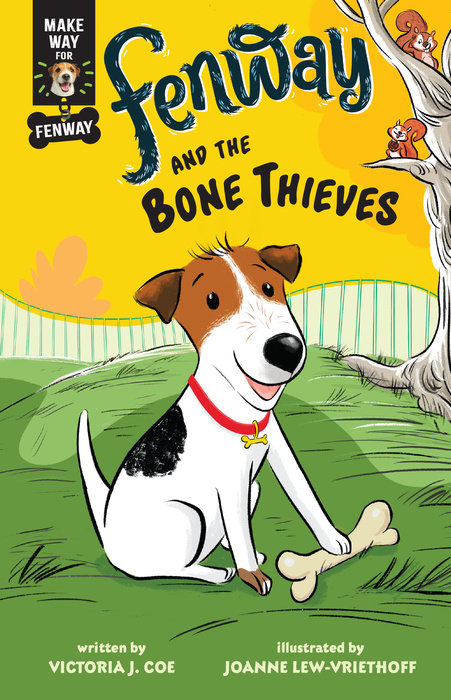
This second series of books highlights a character older readers already know.  His name is Fenway, a Jack Russell terrier.  He made a name for himself in the upper elementary/middle grade novels, Fenway and Hattie, Fenway and Hattie and the Evil Bunny Gang, Fenway and Hattie Up to New Tricks, and Fenway and Hattie In the Wild.  With each title, readers are able to see the progress as Fenway and his human grow better together.  In Fenway And The Bone Thieves (G. P. Putnam's Sons, May 3, 2022) and Fenway And The Frisbee Trick (G. P. Putnam's Sons, May 3, 2022) written by Victoria J. Coe with illustrations by Joanne Lew-Vriethoff, Fenway is still offering his spot-on insights in his own voice about his next-door neighbor dog friends, his humans, sneaky squirrels, and the elusive Frisbee.

1
THE TREAT PLACE

Everyone knows that dogs are
better than squirrels.  Dogs make
humans happy.  Dogs live
in houses.  Dogs
ride in cars.
Squirrels do
none of these
things.

In this first of ten chapters, Fenway and his humans, Hattie, Food Lady, and Fetch Man are visiting the large store filled with special things for dogs.  All Fenway can think about is treats.  His humans steer clear of the treat section, adding yucky shampoo to the cart.  It is only through sheer perseverance on Fenway's part, that a bone is added to the cart.  Unfortunately, it ends up in the trunk of the car instead of his mouth.

Finally at home, with the bone in his mouth, Fenway shows his treasure to his neighbors, Patches and Goldie, two dogs enjoying their Dog Park next to Fenway's Dog Park.  Then, Fenway hears a horrible and irritating sound.  It is the chattering of not one but two squirrels.  They are plotting to take away his bone.  After successfully chasing them away, Fenway decides the only way to enjoy his bone is to hide it from the squirrels.

After lunch, the rain begins.  Fenway is inside without his bone.  Now he is thinking his big idea is not such a good idea.  Nothing, not a single toy or game, can take away Fenway's desire for that bone, buried in the garden, outside in the rain.

The next morning when the rain has stopped, Fenway can hardly wait to get outside and dig up his bone.  There are two huge problems.  He can't remember where he buried it and the pesky squirrels are back.  Many holes later, Hattie and her friend Angel, Patches' and Goldie's short human, discover the damage done by Fenway.  As they chase him, he initially thinks it's a game, but it is most definitely not a game.  

After a flowery shampoo, a nap complete with a squirrel nightmare, and another encounter with the sneaky squirrels in his Dog Park, Fenway makes a startling discovery.  His perspective on the several days of the events are destined to have readers laughing and laughing.  As he is finally chewing on his bone on the back porch, he gets a whiff of hot dogs.  Yum!


1
THE BIG PARK

Romping in the Dog Park behind
our house is pretty awesome.  But
riding in the car with Hattie and 
Fetch Man is even better, because
we're going to the Big Park.

Fenway is having a rousing romp with Hattie and Fetch man in the Big Park.  He loves chasing after the stick and returning it, sometimes reluctant to give it to Fetch Man.  But that is all part of the game.  Just when Fenway thinks the day can't get any better, he spots a Rottweiler leaping into the air to catch a Frisbee.

Fenway wishes with all his doggy heart he could do the same trick as Carmen.  She is amazing at jumping in the air at the right moment.  He tries to do her moves with a stick.  It does not work.  He needs a Frisbee.

No one seems to understand this need, not Hattie or Patches and Goldie.  What's a dog to do?  Several days later the Big Brown Truck arrives.  After Fenway barks it away, Food Lady, Hattie and Fenway gather around a box.  What do you think is inside?  

Fenway and Hattie rush outside so Fenway can catch that new Frisbee in the air.  He is so ready to perform a trick and receive the same praise as Carmen.  All of a sudden there are the sounds of 

CHIPPER-CHATTER-SQUAWK!

Later, a frustrated Fenway, who has not caught the Frisbee yet because of the sneaky squirrels, goes on a walk with his canine pals and their humans.  Back home, Fenway convinces Hattie to throw the Frisbee in the house where there are no squirrel distractions.  As you might imagine, it ends in disaster.  That evening is very somber, but Fenway fails to understand.  The next day at the Big Park, unintentionally, Fenway creates his own special trick.  Try to read this without laughing.  It is impossible.  Oh, Fenway.

I've said it before, but I'll say it again.  Author Victoria J. Coe knows dogs, especially this dog, Fenway.  Each of the ten chapters in each book flows flawlessly with the same energy as if the words were written by a Jack Russell terrier.  The chapters end with a sentence inviting us to proceed with anticipation to the next chapter.  The upbeat narrative, Fenway's thoughts and conversations and those of the humans are thoughtful, exuberant, and funny.  Here are passages from both titles.

CHIPPER-CHATTER-SQUAWK! sounds
behind me.
Uh-oh! The first squirrel is
headed this way!  I should have 
known the two of them were in this 
together.
I run faster.  "That bone is
mine!" I bark.
The big squirrel waits until I'm 
about to lunge.  Then he suddenly
hops up and scampers across the
Dog Park.
The chase is on!  "You don't
belong here!" I bark.  I follow
that squirrel 
to the wooden
fence behind
the giant tree.


I thrust my snout into the box.
Whoopee! It smells like a Frisbee
that no other dogs have played
with.  It must be my reward for
scaring away that truck.
Hattie reaches into the box and
pulls it out.  "Ready, Fenway?" she
says.
I back up.  "I'm ready!" I bark.
"I'm so ready!"
Hattie's elbow bends.  She's going
to fling the Frisbee!
I leap onto the couch, racing
back and forth.  Hooray!  Hooray!
I'm going to catch that Frisbee in
midair!

You cannot look at the front, right side, of the matching and open dust jacket and book case for either book without smiling.  Who can resist the happy-go-lucky look on Fenway's face?  In both of these scenes, it is as if the illustrator has frozen a moment from the narrative.  The back, left side, of both books features short descriptions of the books beneath the series title, Make Way For Fenway.  Hanging from those banners is a bone-shaped dog tag with the words:

A little dog with a
GIANT personality!

The opening and closing endpapers for both books are creamy white, the same as the interior pages.  Illustrator Joanne Lew-Vriethoff has filled this book with images of varying sizes done in black, gray, and white.  With the exception of only two, Fenway makes an appearance in all of them.

The vibrancy of Fenway's personality is reflected in the artwork.  Even when he is still, it is as if he is ready to burst into action.  Readers will pause at every illustration to appreciate the details included in the pictures.  The facial looks on Fenway, the squirrels, Carmen, Patches, Goldie, and the humans leave no doubt as to what any of them are thinking.  You can't help but smile, giggle, or laugh out loud.

In Fenway And The Bone Thieves, one of my favorite pictures is a double-page image with a phrase and two sentences placed in the upper, left-hand corner.  On the left side a big squirrel with a gleam in its eyes, protruding teeth, and a big fluffy tail is ready to pounce on Fenway's bone which extends from the left side and over the gutter to the right.  Toward the top of the right side in the Dog Park is Fenway.  Flowers border the wooden fence behind him.  He is aghast at the audacity of that squirrel.  He is ready to run.

One of my favorite visuals in Fenway And The Frisbee Trick is a smaller illustration.  It is a perfectly captured moment by Joanne Lew-Vriethoff. (I should know because it happens frequently at my own home.)  The family sofa is placed in front of an arched large window.  Fenway is on the sofa, standing on his hind legs with his front paws on the back of the sofa.  He is watching the man from the Big Brown Truck carrying a package and walking toward their house.  Fenway is barking in full security mode.


To have early readers based on a beloved dog character is, in the words of my canine companion, woof-tastic!  Fenway And The Bone Thieves and Fenway And The Frisbee Trick written by Victoria J. Coe with illustrations by Joanne Lew-Vriethoff are brimming with humor and non-stop action whether read by an individual or as a read aloud.  Readers will hardly be able to wait for another installment in the series.  You will certainly need one or more copies of both books in your personal and professional collections.

By following the link attached to the names of Victoria J. Coe and Joanne Lew-Vriethoff, you can access their websites to learn more about them and their other work.  Victoria J. Coe has accounts on Instagram and Twitter.  Joanne Lew-Vriethoff has accounts on Facebook, Instagram, and Twitter.  At the publisher's website, you can view interior images and read an excerpt for Fenway And The Bone Thieves and Fenway And The Frisbee TrickThe cover reveal for these titles with author and illustrator interviews was hosted by educator Michele Knott at Mrs. Knott's Book Nook.

Thursday, April 29, 2021

Contrary Companions

For readers of this blog, to you it comes as no surprise I am an over-the-top lover of dogs.  My life feels less than whole unless I am sharing it with a dog.  What you may not know is one of my all-time favorite dog books is Homer by Elisha Cooper.  I wrote about it here.  Even reading it today, my eyes filled with tears.  Dogs give love freely.  Dogs understand the meaning of family.  Dogs recognize and experience complete contentment.

In his latest book, Elisha Cooper again turns to canine and feline characters. (Two cats are featured in his 2018 Caldecott Honor winning title, BIG CAT, little cat.)  In YES & NO (Roaring Brook Press, April 13, 2021), Elisha Cooper presents the essence of dogs and cats and their attitudes to daily life.  Their responses to an unseen narrator are both profound and delightful.  Let's meet this puppy and its cat (or as the cat would say, let's meet the cat and its puppy).

Good morning, good morning!
It's time to wake up.

The puppy responds to the voice and the next question with a resounding yes.  The cat replies with a distinct no.  The next two questions asked receive wholehearted positives from the dog and barely audible negatives from the cat.  So begins a day of contrasts.

When it comes to mealtime, the puppy is ecstatic, but readers understand why the cat says it has previously eaten.  When requested to play nicely together, the puppy is thrilled.  The cat can't get away fast enough.  They are finally told to romp around outside. 

For the puppy this is the next best thing to paradise.  For the cat, it is tolerated.  Apparently, the activities in which they are engaged are not quite appropriate.  They are implored to find others.  This time both of them do, but what has the cat's attention?  Hole digging is unacceptable!  They must go now and take care of each other.  Soon they've, after wandering and wondering, left the yard for a grassy hilltop.

Here in silence and still as stone, they sit.  Side by side they look at the world spread before them.  Too soon, they are called home.  Now, the puppy answers no to all the questions.  The cat does not speak.

The puppy, like many of us, is reluctant to end a beautiful day.  It is the cat that eases the youngster into rest.  With the final query, the puppy finally says yes, but the cat . . . 


For those sharing their lives with cats or dogs or both, they know it is perfectly natural to speak in conversation with them as if they speak human language themselves.  This technique by Elisha Cooper to introduce the unseen narrator is ingenious and simply perfect.  The replies of the puppy and cat written by Elisha Cooper are typical to the extent you'll find yourself laughing out loud.  They ring with veracity, leaving room for his illustrations to extend their meaning.  Here is a passage.

Can we all clean up a little?

Yes!

Never.  


In looking at the open dust jacket, the puppy's and the cat's personalities are apparent.  The one looks ready to play and cuddle and the other has their back to you.  Here they are quintessential yes and no.  The puppy's body is completed on the spine and slightly to the left of the spine.  Rolling on the background on the back are three pieces of fruit, knocked from the kitchen table in one of the morning scenes.

The open book case presents a night setting.  We are looking directly down on the home, yard, and hill.  It's like an architectural landscape drawing in shades of gray and silver.  The area is framed in a heavy black line and wider shadow.  The cat sits on the hill facing the home.  There is an exquisite sense of calm in this picture.

On the opening and closing endpapers is the same scene.  From the bottom up we see a silhouette of the land, trees, home, and hill.  In the first one, the cat sits on the hill as the sun rises.  It is in hues of orange.  In the second one, the colors are tones of deep blue with a full moon over the chimney of the house.  The cat watches, looking at its home.

Elisha Cooper created these illustrations

with ink and watercolor.

He begins the pictorial story on the verso and title pages with a double-page picture.  The cat is climbing from the outside through an open window.  The cat is moving toward the puppy curled on a rusty-red blanket on the floor.  The title text is placed on the closed curtain of a window.

The illustrations place an emphasis on the pacing altering in size from full-page pictures to a collection of smaller images to indicate motion, and to dramatic two-page visuals.  Your eyes flow wonderfully from page turn to page turn, illustration to illustration.  There is never a doubt as to the mood or emotions of the puppy or cat.  Elisha Cooper depicts them masterfully. The disparity between the puppy's exuberance and the cat's indifference are priceless.  

When they initially go outside, every possible position of the dog is indicated in eight small pictures.  The cat calmly walks along the top of a fence.  When the unseen narrator finally sends them out of the yard, Elisha Cooper gives readers not one, not two, not three, but four marvelous two-page, wordless illustrations. 

One of these is one of my many, many favorite pictures in this title.  We move in closer to the puppy and cat as they reach the crest of the hill.  To the left and behind the puppy are patchwork pastures and farm buildings.  To the right of the cat are rolling, sharply peaked hills.  On the left, the puppy stretches in a familiar position of smelling the air with its nose lifted to get the best possible smell.  On the right, the cat sits, back to us with its tail tip peeking through the grass.  It is staring in the distance.  This is the ideal setting to prepare readers for the next picture which is breathtaking and tender.


There is something extraordinary about YES & NO written and illustrated by Elisha Cooper.  With each page turn this knowledge grows in you.  This is not only a book about contrary companions.  This is a book about looking at life differently and finding harmony.  This harmony is reached when common values are found and shared.  I highly recommend you place a copy or two on your professional shelves and have a copy in your personal collection.

To learn more about Elisha Cooper and his other work, please follow the link attached to his name to access his website.  At his website you can view one of my favorite illustrations.  Elisha Cooper has accounts on Facebook and Instagram.  At the publisher's website you can view interior illustrations.  I know you will enjoy reading Elisha Cooper's guest post at the Nerdy Book Club titled How To Write A Great Children's Book.  And you must read this conversation between Elisha Cooper and Betsy Bird at School Library Journal, A Fuse #8 Production.  (It's good to know I am not the only one who gets teary looking at some of the pictures.)

Saturday, June 16, 2018

Barnyard Buddies

Spring has been in full swing for many weeks now.  The word weeks instead of months (the spring equinox in 2018 was March 20th) is used because in northern Michigan the worst snow storm of the 2017-2018 winter season was April 13th to April 17th.  It's only been two months since there was two feet of snow on the ground in many places.

Mother Nature has been busy catching up; the wild buttercups and daisies are blooming, an abundance of birdsong begins each day and hordes of insects are hatching. In more domesticated scenes, farms, babies are being born.  Pip & Pup (Godwin Books, Henry Holt and Company, April 24, 2018) written and illustrated by Eugene Yelchin introduces readers to two newborns who aren't quite sure what to think about each other.

As this wordless delight begins an egg cracks open.  With a lot of effort, a tiny chick emerges and hardly believes the shell was its home.  Finding a perch on the barn roof, the fluffy bundle of yellow fashions binoculars with its feathered wings.  It spies a puppy, sleeping deeply.

The puppy is curled next to the large wheel of a tractor.  In order to get the dozing canine's attention, the chick decides to give its nose a quick peck.  It works splendidly with the pup barking at the now alarmed chick.  Scurrying in frantic circles among the other animals, the chick makes it safely back to the two-part shell.

All of sudden at thunderstorm blows over the farm.  Inside the shell the chick is safe using the smaller piece as a cap.  The pup is not as fortunate.  It is frightened and wet.  In a series of scenes the chick arrives, assesses the situation and offers the only form of comfort available.  It's perfect for the pup.

As the storm diminishes and blue sky and sunshine appear, the relationship between the two barnyard buddies gets stronger.  There are comical antics and laughter until disaster strikes.  Of course, the puppy has a solution even if it's not an exact match.


Beautifully conceived by Eugene Yelchin this tale of springtime camaraderie will connect with a variety of readers.  The idea of new life seeking out other new life certainly strikes a chord with readers finding themselves in completely new situations.  The introduction of the inclement weather provides a venue for kindness to build a bridge between the two.


Beginning with the dust jacket, the illustrations rendered in colored pencils, oil pastels, and digital painting are an open invitation to hug this book.  That chick and that puppy on the front of the jacket are adorable with a capital A.  Behind them to the left, on the back, the grass extends with a fence and barn buildings above it.  A bright sun is peeking from a cloud.  The text is varnished as are the puppy and chick on the flaps.

The book case is covered in yellow with flecks of orange, a charming duplication of downy baby chicken feathers.  On the opening and closing endpapers a delicate sky blue hints at the happy ending.  The first image, the cracking egg appears before the title page.  Opposite the title page are six comical pictures of the chick peeking and seeking from the broken shell.

Each wordless illustration is brimming with mood and emotion.  We feel curiosity, wonder, surprise, humor, kindness and the love of friendship.  The manner in which Eugene Yelchin places the elements on each page has us filling in the words in our minds.  He has chosen to make some parts of the picture more prominent (darker) than others, giving us a true sense of perspective which shifts from page to page providing pacing.  There is a special quality to his technique which draws us into each moment.

Most of his illustrations are single page with a fine red line framing them.  To celebrate the end of one thing and the beginning of another six vertical panels span two pages. You will laugh out loud at the final image at the close of the book.  It appears above the dedication and publication information.

One of my many, many favorite illustrations is actually two on opposite pages.  On the first one, on the left, the chick nearly fills the page.  It is standing on the peak of the barn roof. A few clouds are drifting by in the background.  The chick is lifting its wings to its eyes forming binoculars.  It is looking right at the reader.  On the next page within two circles is the sleeping puppy.  It's as if we are seeing this canine cutie through binoculars.  Around the two circles is a brushed green shade.


Without a doubt this book, Pip & Pup written and illustrated by Eugene Yelchin, will become a story time and bedtime favorite.  This is an excellent story without words singing its way into our hearts. When it's read aloud, I know you will hear sounds of laughter.  I know you will hear sighs.  I highly recommend this title for your personal and professional collections.

To learn more about Eugene Yelchin and his other work, please visit his website by following the link attached to his name.  He includes several interior images on his site.  Eugene Yelchin also maintains a Facebook page.  At the publisher's website you can view additional images including the two favorites I mentioned here.

Friday, March 24, 2017

Two Halves Of A Happy Whole

Children are attracted to puppies.  Puppies gravitate toward children.  You simply can't keep them apart.  Once they have been introduced to one another, they are inseparable.  After visiting an elementary school classroom several times, my sixth month old puppy instantly perks up at the sound of children's voices.  These younger humans and their canine counterparts share much in common.

Yesterday was National Puppy Daya celebration started in 2006 to recognize how human lives are changed when puppies enter them.  (It also helps to bring awareness to the many orphan puppies needing forever homes.)  One of the most delightful new titles to express this irrepressible joy is Puppy, Puppy, Puppy (Boyd Mills Press, an imprint of Highlights, April 4, 2017) written by Julie Sternberg with illustrations by Fred Koehler.

As the sun rises,
Baby enjoys breakfast,
and Puppy enjoys breakfast.
And Baby says,
"Puppy."

As the morning progresses Baby and Puppy get dressed or is it make a mess?  Gardening takes on a whole new meaning.  Mom and Dad are carefully turning the soil among the flowering masses.  The youngest duo are enjoying the benefits of a hose, plucking a bunch of flowers and wearing dirt is the new attire of the day.

Bath time is a mix of suds and mud; footprints and pawprints patterned on the bathroom floor and wall.  Whew!  After all this morning excitement it is time for a snooze.  Baby is tucked away in one place and Puppy is gated in another space.  Two tuckered-out parents slump side by side in sleep.

Puppy spies Baby's toy.  No gate is going to stop this puppy from spending time with a pal.  No crib is going to stop this baby from being with a best buddy.  While parents rest and later as the afternoon passes, Baby and Puppy are stuck together by friendship glue.

As the night sky darkens Puppy and Baby prepare for bedtime.  They must be exhausted by now, but not too tired to raise a chorus at the moon.  How long will they slumber?  Only the sun knows.


Author Julie Sternberg starts with a trio of paragraphs sharing the same rhythmic sentences only altering the activity for each.  This firmly establishes the reader's presence within the story.  Bathtime and naptime break this pace but create new ones.  The original beat begins anew as Sternberg reinforces the bond formed between the baby and the puppy as the afternoon continues and the day closes.  Here is the naptime passage.

Baby wails,
"Puppy!
Puppy!
Puppy!"

Puppy cries.
Baby cries.

Mommy and Daddy say,
"Shh, Puppy.  Puppy, shh.
Shh, shh, shh."


I don't know how you can look at the matching dust jacket and book case without smiling or laughing out loud.  Those pawprints and handprints all over the title text and the puppy enjoying the baby's spilled food speak volumes.  The pale yellow background superbly accents the other elements on the front.  To the left, on the back, is a scene from nighttime slumber of Baby curled on the floor and Puppy using the child as a pillow.  The opening and closing endpapers are the same bright, sky blue as the title text.

Fred Koehler does not waste any space beginning the pictorial story on the title page.  Surprised parents are standing with gift-giving grandparents as Baby opens a box with Puppy leaning out.  The happiness on Puppy's and Baby's faces express an instant bond.  Opposite the verso page on the dedication page Baby and Puppy are eye-to-eye, each one clasping their treasured toys.

Rendered digitally Koehler extends the text with humor in his pictures which will have you giggling throughout the narrative.  It's the expressions on the parent's faces amid the chaos created by Puppy and Baby which tell another tale.  Most of the visuals extend page edge to page edge across two pages.

His backgrounds are usually the pale yellow, a pale blue or a dark purplish brown.  These backgrounds hold the setting done in line drawings and varied hues of the background color.  The main elements are done in full color.  It's a wonderful effect.

One of my many, many favorite pictures is the garden scene.  It is a pale yellow background with lighter yellow clouds.  Across a portion of the lower half is a garden full of red flowers.  On the left, at the top of the garden, Mommy and Daddy are working.  Mommy is bent over either digging or hoeing.  Daddy has stopped and is leaning with one hand on his shovel.  His other hand is pointed toward Mommy's shoulder.  You can almost hear him saying, "Ah dear, you might want to look at Baby and Puppy."  The toys, the bone and blue monster, are sticking out of the mud.  The puppy is spraying the hose at Baby.  Baby is pulling out flowers.  They are both literally coated in mud.


Puppy, Puppy, Puppy written by Julie Sternberg with illustrations by Fred Koehler is absolutely perfect for National Puppy Day or any day of the year when you want to share the delight of a baby and puppy together.  This blend of story and illustrations is guaranteed to generate laughter.  These two, an author and an illustrator, certainly know how to present the essence of puppies and babies within the pages of a book.

To learn more about Julie Sternberg and Fred Koehler and their other work, please visit their respective websites by following the links attached to their names.  Julie Sternberg is featured at HenryHerz.com, and All The Wonders, Let's Get Busy, Episode 198 with teacher librarian Matthew Winner.  Fred Koehler is showcased at The Writers' Loop, The Picturebooking Podcast, and All The Wonders, Let's Get Busy, Episode 240 with Matthew Winner.