Quote of the Month

When love and skill work together, expect a miracle. John Ruskin


Showing posts with label Eugene Yelchin. Show all posts

Saturday, June 16, 2018

Barnyard Buddies

Spring has been in full swing for many weeks now.  The word weeks instead of months (the spring equinox in 2018 was March 20th) is used because in northern Michigan the worst snow storm of the 2017-2018 winter season was April 13th to April 17th.  It's only been two months since there was two feet of snow on the ground in many places.

Mother Nature has been busy catching up; the wild buttercups and daisies are blooming, an abundance of birdsong begins each day and hordes of insects are hatching. In more domesticated scenes, farms, babies are being born.  Pip & Pup (Godwin Books, Henry Holt and Company, April 24, 2018) written and illustrated by Eugene Yelchin introduces readers to two newborns who aren't quite sure what to think about each other.

As this wordless delight begins an egg cracks open.  With a lot of effort, a tiny chick emerges and hardly believes the shell was its home.  Finding a perch on the barn roof, the fluffy bundle of yellow fashions binoculars with its feathered wings.  It spies a puppy, sleeping deeply.

The puppy is curled next to the large wheel of a tractor.  In order to get the dozing canine's attention, the chick decides to give its nose a quick peck.  It works splendidly with the pup barking at the now alarmed chick.  Scurrying in frantic circles among the other animals, the chick makes it safely back to the two-part shell.

All of sudden at thunderstorm blows over the farm.  Inside the shell the chick is safe using the smaller piece as a cap.  The pup is not as fortunate.  It is frightened and wet.  In a series of scenes the chick arrives, assesses the situation and offers the only form of comfort available.  It's perfect for the pup.

As the storm diminishes and blue sky and sunshine appear, the relationship between the two barnyard buddies gets stronger.  There are comical antics and laughter until disaster strikes.  Of course, the puppy has a solution even if it's not an exact match.


Beautifully conceived by Eugene Yelchin this tale of springtime camaraderie will connect with a variety of readers.  The idea of new life seeking out other new life certainly strikes a chord with readers finding themselves in completely new situations.  The introduction of the inclement weather provides a venue for kindness to build a bridge between the two.


Beginning with the dust jacket, the illustrations rendered in colored pencils, oil pastels, and digital painting are an open invitation to hug this book.  That chick and that puppy on the front of the jacket are adorable with a capital A.  Behind them to the left, on the back, the grass extends with a fence and barn buildings above it.  A bright sun is peeking from a cloud.  The text is varnished as are the puppy and chick on the flaps.

The book case is covered in yellow with flecks of orange, a charming duplication of downy baby chicken feathers.  On the opening and closing endpapers a delicate sky blue hints at the happy ending.  The first image, the cracking egg appears before the title page.  Opposite the title page are six comical pictures of the chick peeking and seeking from the broken shell.

Each wordless illustration is brimming with mood and emotion.  We feel curiosity, wonder, surprise, humor, kindness and the love of friendship.  The manner in which Eugene Yelchin places the elements on each page has us filling in the words in our minds.  He has chosen to make some parts of the picture more prominent (darker) than others, giving us a true sense of perspective which shifts from page to page providing pacing.  There is a special quality to his technique which draws us into each moment.

Most of his illustrations are single page with a fine red line framing them.  To celebrate the end of one thing and the beginning of another six vertical panels span two pages. You will laugh out loud at the final image at the close of the book.  It appears above the dedication and publication information.

One of my many, many favorite illustrations is actually two on opposite pages.  On the first one, on the left, the chick nearly fills the page.  It is standing on the peak of the barn roof. A few clouds are drifting by in the background.  The chick is lifting its wings to its eyes forming binoculars.  It is looking right at the reader.  On the next page within two circles is the sleeping puppy.  It's as if we are seeing this canine cutie through binoculars.  Around the two circles is a brushed green shade.


Without a doubt this book, Pip & Pup written and illustrated by Eugene Yelchin, will become a story time and bedtime favorite.  This is an excellent story without words singing its way into our hearts. When it's read aloud, I know you will hear sounds of laughter.  I know you will hear sighs.  I highly recommend this title for your personal and professional collections.

To learn more about Eugene Yelchin and his other work, please visit his website by following the link attached to his name.  He includes several interior images on his site.  Eugene Yelchin also maintains a Facebook page.  At the publisher's website you can view additional images including the two favorites I mentioned here.

Thursday, February 16, 2017

No To No Noise

Most living creatures make sounds; some are either too high or too low for humans to hear.  Squirrels chatter from the safety of a branch if you invade their space.  Crickets announce the approximate temperature by chirps made from rubbing their wings.  (You have to do a little math but it works.) Male birds sing in the morning with more clarity and frequency often to attract potential mates.  The bugling of a bull elk will stop you in your tracks.  It is eerie and magnificent at the same time.  Purring in cats can signify happiness, be a call for attention and promote healing.  Dogs bark for a variety of reasons.  Rest assured they will teach you what each bark means.

The point is all these beings make their sounds instinctively.  It's a part of what makes them who they are.  If they are silent when they should not be, then something is not quite right.  We humans make sounds for more reasons than we can possibly list.  What would we do if silence was demanded of us without question? The Rooster Who Would Not Be Quiet (Scholastic Press, January 31, 2017) written by Carmen Agra Deedy with illustrations by Eugene Yelchin explores the idea of silence, noise and the choice to be one or the other.

There once was a village where the streets rang with song from morning till night.

Inside and outside homes the sounds rang out from human voices, animals, and machines.  Of particular interest was every last soul sang in the shower.  As you might think, La Paz was anything but peaceful.

All this noise started to bother the residents of this village.  They blamed the mayor and promptly dismissed him.  In his place Don Pepe was elected on his promise of complete quiet.  How would he accomplish this feat?  He passed laws, lots of laws.

La Paz was not only peaceful; it was utterly void of any sound.  People who loved to sing left.  Others who stayed, sang in a whisper of a whisper.  Seven years passed.

One day a rooster, his ten chicks and hen strutted into town, roosting in a lovely mango tree.  As a newcomer he knew nothing of the laws, so when the sun rose in the morning he crowed.  Where do you think that mango tree was planted?  It was right underneath the mayor's window!

Not once, not twice, not three times but four times, this mayor took away what made the rooster happy to get him to stop singing but he would not.  Nearly out of his mind, the mayor issued a final threat but the rooster was ready with a reply.  It will make you want to stand up and sing.


No matter how many times a story is read if it stays wrapped around your heart and finds a permanent place in your mind, it changes you.  Perhaps the shift is slight giving strength where needed or maybe it will reverse your thinking.  This is the power of the words written by Carmen Agra Deedy in this book.

Initially as she writes we see a village completely change per their desires but you can't help but wonder if she is asking us to remember to be careful of what wishes we make.  Each time the mayor intimidates the plucky gallito with an ultimatum and action, his answers create a rhythm.  This back and forth series of sequences gradually build tension leading us to the inspirational conclusion. Here is a passage.

"Still singing?" snapped Don Pepe. "You have no tree.  Remember?"
"I have no tree," said the gallito.  "But I have my hen and chicks.  How can I keep from singing?"
"Will you sing if I throw you in a cage---alone?" threatened Don Pepe.
"I may sing a lonelier song," said the stubborn gallito.  "But I will sing."
And he did.  


On the opened matching dust jacket and book case Eugene Yelchin uses bright cheerful colors to announce the title and the character of the plucky gallito.  It's our first hint of the courage this bird reveals in the story.  The illustration seen on the front (right) extends over the spine to the back, including the hen and the rest of the chicks.  It's important to note the attention the chicks are giving their parent.  They are listening.  They are learning.  One is singing too.

One of the blue hues from the jacket and case covers the opening and closing endpapers.  The words, the song of the rooster,

Kee-kee-ree KEE! 

are placed in a pattern in varying sizes across the pages.  Beneath the text on the title page the rooster strides in confidence.  He appears again in the same pose, chicks and hen behind him, across the verso and dedication pages.

These pictures

rendered in oil pastel, colored pencil, gouache, and acrylic

are spirited and in superb synchronization with the narrative, enhancing it with Eugene Yelchin's special techniques.  He uses single page images opposite a page of text and double-page pictures surrounding words.  His color choices and lines are altered to reflect the mood of the story.  His depiction of the mayor, Don Pepe is marvelous.  He looks as dastardly as he is.  The contrast between this man and the rooster is utterly perfect.

One of my favorite illustrations of many is the first one.  Across the upper portion of the single page picture is a brilliant deep blue sky with an orange sun and pale golden clouds.  Beneath them on a hill is the village, stucco buildings and tile roofs with spires of churches rising up.  This is the upper third of the illustration.  The hill is a series of fields and roads with grazing horses, cows and goats.  A single bicycle rider is moving down the main road to the village.  The wonderful thing is Yelchin has placed large musical notes and a staff over the fields, incorporating them into the pattern of the rows.


This book, The Rooster Who Would Not Be Quiet!, written by Carmen Agra Deedy with illustrations by Eugene Yelchin is essential to every collection, professional and personal.  This story is powerful and timeless.  I expect and would welcome a chorus of crowing after each and every reading.

To learn more about the work of Carmen Agra Deedy and Eugene Yelchin please visit their respective websites by following the links attached to their names.  They both feature interior images from this title at their sites.  Make sure to stop by Seven Impossible Things Before Breakfast hosted by author, reviewer and blogger Julie Danielson to view some artwork and read her words about this title.  This book is included on a list of 2017 titles at Latinxs in Kid Lit.  Carmen Agra Deedy is featured at Time For Kids and KidLit 411.  Eugene Yelchin is showcased at Publishers Weekly and the International Literacy Association.   I hope you enjoy the video with Carmen Agra Deedy speaking about stories as much as I did.


Friday, March 20, 2015

Cat One, Dog Won

One late summer afternoon as I was strolling down the streets in a tiny town located along the shore of Torch Lake in Michigan, a tiny kitten followed me wherever I went, purring and rubbing against my legs.  After some inquires with the local shop owners, it appeared this wee bundle of fur was an orphan.  By the time I decided to give it a home, someone else with children offered to take it.

Apparently fate already had another companion ready to become part of my family.  I just didn't know it yet.  The winning team of author Lee Wardlaw and illustrator Eugene Yelchin who gave us Won Ton:  A Cat Tale Told in Haiku has followed with an equally engaging and humorous companion title, Won Ton and Chopstick:  A Cat and Dog Tale Told in Haiku (Henry Holt and Company, March 17, 2015).  Like me, Won Ton has no idea about the canine creature about to take up residence in his home.


The Routine
It's a fine life, Boy.
Nap,
play,
bathe,
nap, eat, repeat.
Practice makes purrfect.

When Won Ton awakens from one of his naps, sights and sounds alert him to a disturbance in his household.  A closed door appears to hold the answer to his question.  When it opens, he is aghast!  His boy...yes HIS boy...is holding a puppy.  This simply cannot be true.

Running from the room yowling in protest, Won Ton finds out who is taking center stage now.  He is gently put aside.  When his boy and sister try to name the canine intruder, Won Ton's suggested name, as you may guess, is not even close to their proposals.

When Won Ton attempts to lay down the law, as to what is what in the four-footed realm, he finds himself on an unwanted vacation in the great outdoors.  Not even the prospect of a wayward mouse can lessen the cat's loneliness.  Back inside for another day, our feline friend decides to take a different approach.

The toilet paper caper does not end well.  With both cat and pup now relegated to the joys of fresh air, Won Ton is delighted to encourage the youngster in a variety of "oh no" activities.  Bath time, rain time and trash time follow with the duo striking a tentative partnership.

What Won Ton knows to be true is pups make good pillows, their language of arfs, howls and whining is almost incomprehensible and

practice makes purrfect.

Only time will tell how this tale unfolds.  And the pup's name, given by Won Ton, you ask?  It's a poetic masterpiece.


In an author's note contained in the verso, Lee Wardlaw explains the form, senryu, used in writing these thirty-seven (haiku) poems, the later favoring nature over the imperfections sometimes present in relationships which is showcased in the former.  Each selection focuses with appreciation on feline features while emphasizing the apparent "que-sera-sera" nature of the newcomer.  The contrast between the two depicted in the thoughts of Won Ton provide for numerous humorous moments.  The pacing prevalent through word selections will have readers feeling like the characters portrayed.  Here are two poems from The Naming.

Sis goes first:  "Sushi,
Cookie, Noodle, Scraps,"  Great Rats!
It's a dog, not lunch.

Brutus?  Ninja?  FANG?
Cats don't laugh, Boy, but I might
make an exception.


Looking at the front of the identical dust jacket and book case, one thing is obvious.  The puppy is looking at Won Ton with perky curiosity.  The cat, on the other paw, is reserving judgment for now...maybe forever.  To the left, on the back, on a sky blue background, the first title with endorsements is highlighted.  At the bottom a smaller picture of Won Ton shows him with head bowed, one paw resting on his forehead.  The opening and closing endpapers, alternating in another shade of blue and green, are patterned in a mouse toy and a red Kong.  Beneath the text on the title page the backs of Won Ton and Chopstick are shown sitting side by side on a bright pale yellow canvas.

With only a few exceptions the illustrations, rendered in

graphite and gouache on watercolor paper,

spread over both pages either as a single image or two separate pictures joined by an element from one crossing the gutter into the other.  Only three times does the background hue remain the same designating important events in the story.  Eugene Yelchin has a discerning eye for pairing background colors together creating an enjoyable sequence and extending the text.

His lines used for Won Ton and the puppy capture the essence of cat and dog.  Sometimes only a portion of one or the other is needed to convey their presence.  The body postures and eyes for both Won Ton and Chopstick speak clearly about their personalities.

One of my favorite two pages is of the puppy wrapped in a towel in the bathroom after his encounter with a rather smelly wild creature.  The blend of pastel tile work with the polka-dotted towel and the placement of bones, rubber ducky and brush are perfect.  To the right on a plain pale spring green background is Won Ton cleaning himself.  His tale extends into the bathroom scene.


Both cat and dog lovers, anyone of any age who enjoys our furry friends, is going to thoroughly enjoy repeated readings of Won Ton and Chopstick:  A Cat and Dog Tale Told in Haiku written by Lee Wardlaw with illustrations by Eugene Yelchin.  With each reading the humor grows as you come to know each of the characters.  Practice reading it aloud so you get the voice of Won Ton right as well as the cadence of these poems.  Be sure to pair it with the first title.  You might also want to use in with My Big Dog by Janet Stevens and Susan Stevens Crummel.

To discover more about Lee Wardlaw and Eugene Yelchin and their work, please follow the links attached to their names to access their websites.  This link takes you to an interview of Wardlaw, Three Questions For Lee Wardlaw:  Advice For Young Writers And Illustrators, life advice and WON TON AND CHOPSTICK at author and illustrator, Debbie Ridpath Ohi's website.  Yelchin includes the entire dust jacket and four double-page interior visuals at his site; one of which is the favorite I mention.  If you follow this link to the publisher's website you can view more interior pages.  Links here are for a printable teacher's guide and an activity kit.

Thursday, April 21, 2011

Snow Day+National Poetry Month=Time For Good Reads

After ten years of writing for advertising Bob Raczka's first son was born.  This reintroduced him to the world of children's books.  Loving the creativity that this venue offered him, he was able to publish his first book five years later.  Most of his books deal with art perhaps because of his love of drawing which began as a boy. But I truly believe that there is a poet sharing a part of his heart with his love of art. Then again, is not one the other?


In an earlier post, December 27, 2010, I reviewed his outstanding book, Guyku: A Year of Haiku for Boys (HMH Books for Young Readers, October 28, 2010.  This spring he further extends his gift of writing poetry with Lemonade and other Poems Squeezed from a Single Word (Roaring Brook Press, March 15, 2011).  Twenty-two puzzling poems with a punch can be found within the pages of this slim volume.

What Raczka has done, using only the letters in the title of each poem, is to string combinations of those letters down the page which refer back to or describe a scene relative to that word.  So his readers can measure their creativity to his, on the following page he puts the letters in order revealing those words he combined to complete his thought.  What we have is pure poetic pleasure!

No matter how much fun Rob Raczka had piecing these together, readers will have just as much or more.  And without a doubt pen and paper in hand they will begin to compose their own.  The simple, light, red, black and gray graphics of  Nancy Doniger distinctly compliment each poem hinting at the final solution while never detracting from the readers' quest.


Not wanting to seem partial to the canine corner of the world  (despite the fact that Dogku written by Andrew Clements and illustrated by Tim Bowers occupies Xena's Pick of the Month spot on the circulation desk in our elementary media center) it seems appropriate that Won Ton; A Cat Tale Told in Haiku (Henry Holt & Co., February 15, 2011) should be highlighted.

Lee Wardlaw using one of the most ancient forms of poetry tells the story of a shelter cat that finds himself a boy and a home.  These thirty-three haiku poems cleverly convey the reluctant but hopeful yearning of being chosen, the give and take adjustment in a different environment and the mutual love between the new friends.  Wardlaw is no stranger to the finickiness of felines as her precise selection of text captures the essence of all things cat; aloofness, casual interest, and reluctant insecurity.  Readers are brought full circle with the closing poem which will have them softly as cat's fur whispering, "Oh."


Coupled with this verse are illustrations by Eugene Yelchin that truly heighten the attitude of this cat.  Using graphite and gouache on watercolor paper Yelchin had me laughing out loud at the antics, emotions and facial expressions displayed by this creature.  As a pair Lee Wardlaw and Eugene Yelchin are purr-fectly matched.

Two of my favorite poems are:

What do you mean "Ewww"?
How is my tuna breath worse
than peanut butter?

Your tummy, soft as
warm dough.  I knead and knead, then
bake it with a nap. 


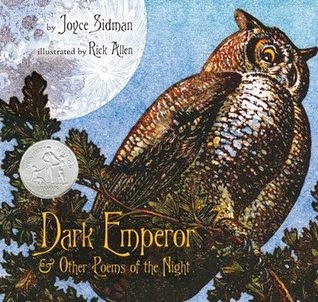
One of the Newbery Honor Medalists for 2011 was Joyce Sidman's Dark Emperor & Other Poems of the Night (HMH Books for Young Readers, September 6, 2010)  Sidman is no stranger to awards.  Two previous books, Song of the Water Boatman and Other Pond Poems and Red Sings from Treetops were Caldecott Honor winners, illustrated by Beckie Prange and Pamela Zagarensky respectively.


Twelve beautifully executed poems grace the pages of this mystical volume.  Readers feel as though they are quietly walking through the hours of inky, velvet shadow seeing it with new eyes.  To start a rhyming, lyrical verse invites all those inhabitants of the dark to come forth and be who they are.

...Come feel the cool and shadowed breeze,
come smell your way among the trees,
come touch rough bark and leathered leaves:
Welcome to the night....

 Each subsequent poem features those creatures of the nighttime as well as the flora that surrounds them bringing strangers, that we are, into their world.  Through a variety of poetic forms and techniques, song, rhyme, free verse, or concrete, Sidman illuminates those particular qualities that make each subject unique.

Whether the pacing and placing of text is that of the poet or the illustrator it contributes to the overall richness of this work.  As if the poems are not enough readers are treated to concise sidebars on the far right of each two page spread giving further details about each dweller of the dark. 

As stated on the back of the title page,

The prints in this book were made by the process of relief printing.  A drawing or sketch is transferred onto a block of wood or, in this instance, a sheet of linoleum mounted on wood, and the drawing is then cut and carved away using a variety of tools.  The areas left uncut are covered with ink and printed on paper by hand or on a press; a number of blocks can be cut and then successively printed in different colors, with the different blocks being "registered" or aligned to create a multicolored print.  The prints for Dark Emperor were each printed from at least three blocks (and in some instances as many as six) and then hand-colored with a strongly pigmented watercolor called gouache.

Rick Allen is an extraordinary artisan in his particular medium.  Extending the illustrations beyond the intended borders tempts readers to venture further noticing the subtle nuances of particular scenes.  Smaller graphics within the poems either highlight the intended subject or lend a bit of humor.  Careful viewers can follow one creature as it meanders through each poem among all the midnight magic acting as our guide.

Do yourself a favor by following Allen's link to his web site.  When considering the process of completing each piece, the results are amazing.