Quote of the Month

When love and skill work together, expect a miracle. John Ruskin


Showing posts with label Rick Allen. Show all posts

Monday, November 24, 2014

Solstice Sleep, Solstice Sights

The winter solstice signals the shortest day and the longest night of the year in the Northern Hemisphere.  Bare branches wave in the winds.  Only the cawing of crows, the honking of migrating geese or chirping of chickadees breaks the silence.  The snow reveals those beings still awake; footprints betraying their nocturnal travels.

Mother Nature demands this rest, this sleep of renewal.  Winter Bees & Other Poems of the Cold (Houghton Mifflin Harcourt, November 4, 2014) written by Joyce Sidman with illustrations by Rick Allen recreates this natural interlude in all it's fascinating elegance.  We listen. We read. We marvel. And we grow in understanding.

Dusk fell
and the cold came creeping,
came prickling into our hearts.

This is the first sentence in the first poem of twelve titled Dream Of The Tundra Swan; transporting us into the residents' realm.  Not only can we claim a clear vision of white wings shaking off gathered flakes of ivory but to know these creatures soar up to 5,000 feet in the air is astounding.

Readers may shiver not from cold but from the thought of thousands of garter snakes gathering to slumber together in the same spot year after year.  Water drops drop from clouds gathering vapor on formed crystals moving without direction, each one different, and each one adding to the growing crowd to layer the ground with snow.  A moose moves with its mother from one spring season to the next weathering winter depths on tall thin legs built for its bulk.

Did you know busy honey makers huddle around their queen, a living buzzing ball?  Beavers hide beneath the ice all winter never seeing the light of day unless it dimly shines through the walls of their mound of sticks and chips.  Ravens and wolves work together in the air and on land, not in complete harmony, to find food.

If voles are fortunate snows will fall deep enough so tunnels can offer protection and passage.  Clever predators are always ready to listen, dig and capture them. Those sentinels, standing silent except for the creaking and cracking on bitter windy days, those trees survive through the ages.

Chickadees cheerfully maneuver from point to point seeking food until the shift in seasons.  Tiny arthropods gather by the thousands as winter weakens and those early floral harbingers send out their skunky scent.  A change is coming.


Poetic master, Joyce Sidman, creates amazingly realistic images with her words. Reading her poetry is an experience for our senses bringing us into the essence of her subject.  Free verse, rhyming patterns, repetition, and two voices speaking surround us with their pulse, Nature's heartbeat in rhythm to our own. Here are two examples from this title.

In the fat white wigwam
made of ripped chips and thrashing twigs
is a heart of fur, curled and cozy,
far beneath the winter sunshine.
(Under Ice; a pantoum)

From dawn to dusk in darkling air
we glean and gulp and pluck and snare,
then find a roost that's snug and tight
to brave the long and frozen night.
(Chickadee's Song)

To the left of each poem are short informative paragraphs offering intriguing details about each subject.  They are the types of facts which get to the heart of each.  They are the types of facts which will garner even more appreciation for each animal, snowflakes, first flowers and trees.


Unfolding the matching dust jacket and book case, readers are greeted by the first of fifteen illustrations spanning across two pages.  With a color palette as icy as the temperature except for the warmth of the featured beings, we are moved to the woodland as surely as if we walked through a door.  Many parts of this world sleep and slow but others are as animated as the foxes moving over the snow.  A steely blue-gray covers both the opening and closing endpapers.  After the turn of the title page highlighting a moose deep in the snow facing readers, a tree branch spans from left to right, final clinging autumn leaves falling, shifting to bare twigs and huge snowflakes drifting downward.  At the book's close the branch is there again.  Snowflakes leave to reveal new buds.

Rick Allen rendered these artistic pieces as stated in this portion taken from the verso.

The individual elements of each picture (the animals, trees, snowflakes, etc.) were cut, inked, and printed from linoleum blocks (nearly two hundred of them), and then hand-colored.  Those prints were then digitally scanned, composed, and layered to create the illustrations for the poems.  

You want to pause at each visual to gaze in wonder at the details, the movement, the background and the texture.  You can hear wings being lifted in flight, the soft fall of snowflakes and crunching and tearing of moose teeth on willow.  Every scene is a study in the marvels of animal and plant adaptation shown in varied perspectives.  In every double-page image but three the fox can be seen.

Several of my favorite illustrations are of the moose and its mother foraging and resting together to sleep. The shades of color in the background are a striking contrast to the warm browns of their fur.  The beavers moving beneath the ice, gathering sticks, swimming and curling up inside their lodge is fantastically portrayed; the shadows of being near the bottom of the stream against the clarity of the room.  Having walked the woods for many years in the early spring to see the first flower, skunk cabbage, I know this close-up view is perfect.  The reflection of the fox drinking in the pool of water is stunning.


Winter Bees & Other Poems of the Cold written by Joyce Sidman with illustrations by Rick Allen is a beautifully conceived and executed work.  The poetry literally sings off the pages, elevated by breathtaking art.  This title would be a welcome addition to a personal or professional collection.  Reading it aloud is mesmerizing.  A single page glossary is included on the final page.

To learn more about Joyce Sidman and Rick Allen please follow the links embedded in their names to visit their personal websites.  Joyce Sidman has several extra items for her titles including videos.  Here is a link to an educator's guide for this book.  Author and blogger at Seven Impossible Things Before Breakfast, Julie Danielson, interviewed Rick Allen recently.  The questions and his answers along with the pictures and artwork are wonderful.

Thursday, April 21, 2011

Snow Day+National Poetry Month=Time For Good Reads

After ten years of writing for advertising Bob Raczka's first son was born.  This reintroduced him to the world of children's books.  Loving the creativity that this venue offered him, he was able to publish his first book five years later.  Most of his books deal with art perhaps because of his love of drawing which began as a boy. But I truly believe that there is a poet sharing a part of his heart with his love of art. Then again, is not one the other?


In an earlier post, December 27, 2010, I reviewed his outstanding book, Guyku: A Year of Haiku for Boys (HMH Books for Young Readers, October 28, 2010.  This spring he further extends his gift of writing poetry with Lemonade and other Poems Squeezed from a Single Word (Roaring Brook Press, March 15, 2011).  Twenty-two puzzling poems with a punch can be found within the pages of this slim volume.

What Raczka has done, using only the letters in the title of each poem, is to string combinations of those letters down the page which refer back to or describe a scene relative to that word.  So his readers can measure their creativity to his, on the following page he puts the letters in order revealing those words he combined to complete his thought.  What we have is pure poetic pleasure!

No matter how much fun Rob Raczka had piecing these together, readers will have just as much or more.  And without a doubt pen and paper in hand they will begin to compose their own.  The simple, light, red, black and gray graphics of  Nancy Doniger distinctly compliment each poem hinting at the final solution while never detracting from the readers' quest.


Not wanting to seem partial to the canine corner of the world  (despite the fact that Dogku written by Andrew Clements and illustrated by Tim Bowers occupies Xena's Pick of the Month spot on the circulation desk in our elementary media center) it seems appropriate that Won Ton; A Cat Tale Told in Haiku (Henry Holt & Co., February 15, 2011) should be highlighted.

Lee Wardlaw using one of the most ancient forms of poetry tells the story of a shelter cat that finds himself a boy and a home.  These thirty-three haiku poems cleverly convey the reluctant but hopeful yearning of being chosen, the give and take adjustment in a different environment and the mutual love between the new friends.  Wardlaw is no stranger to the finickiness of felines as her precise selection of text captures the essence of all things cat; aloofness, casual interest, and reluctant insecurity.  Readers are brought full circle with the closing poem which will have them softly as cat's fur whispering, "Oh."


Coupled with this verse are illustrations by Eugene Yelchin that truly heighten the attitude of this cat.  Using graphite and gouache on watercolor paper Yelchin had me laughing out loud at the antics, emotions and facial expressions displayed by this creature.  As a pair Lee Wardlaw and Eugene Yelchin are purr-fectly matched.

Two of my favorite poems are:

What do you mean "Ewww"?
How is my tuna breath worse
than peanut butter?

Your tummy, soft as
warm dough.  I knead and knead, then
bake it with a nap. 


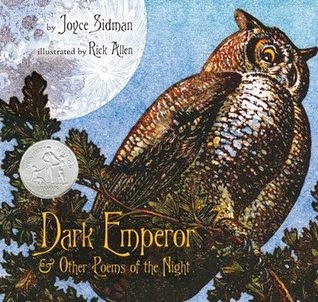
One of the Newbery Honor Medalists for 2011 was Joyce Sidman's Dark Emperor & Other Poems of the Night (HMH Books for Young Readers, September 6, 2010)  Sidman is no stranger to awards.  Two previous books, Song of the Water Boatman and Other Pond Poems and Red Sings from Treetops were Caldecott Honor winners, illustrated by Beckie Prange and Pamela Zagarensky respectively.


Twelve beautifully executed poems grace the pages of this mystical volume.  Readers feel as though they are quietly walking through the hours of inky, velvet shadow seeing it with new eyes.  To start a rhyming, lyrical verse invites all those inhabitants of the dark to come forth and be who they are.

...Come feel the cool and shadowed breeze,
come smell your way among the trees,
come touch rough bark and leathered leaves:
Welcome to the night....

 Each subsequent poem features those creatures of the nighttime as well as the flora that surrounds them bringing strangers, that we are, into their world.  Through a variety of poetic forms and techniques, song, rhyme, free verse, or concrete, Sidman illuminates those particular qualities that make each subject unique.

Whether the pacing and placing of text is that of the poet or the illustrator it contributes to the overall richness of this work.  As if the poems are not enough readers are treated to concise sidebars on the far right of each two page spread giving further details about each dweller of the dark. 

As stated on the back of the title page,

The prints in this book were made by the process of relief printing.  A drawing or sketch is transferred onto a block of wood or, in this instance, a sheet of linoleum mounted on wood, and the drawing is then cut and carved away using a variety of tools.  The areas left uncut are covered with ink and printed on paper by hand or on a press; a number of blocks can be cut and then successively printed in different colors, with the different blocks being "registered" or aligned to create a multicolored print.  The prints for Dark Emperor were each printed from at least three blocks (and in some instances as many as six) and then hand-colored with a strongly pigmented watercolor called gouache.

Rick Allen is an extraordinary artisan in his particular medium.  Extending the illustrations beyond the intended borders tempts readers to venture further noticing the subtle nuances of particular scenes.  Smaller graphics within the poems either highlight the intended subject or lend a bit of humor.  Careful viewers can follow one creature as it meanders through each poem among all the midnight magic acting as our guide.

Do yourself a favor by following Allen's link to his web site.  When considering the process of completing each piece, the results are amazing.