Quote of the Month

When love and skill work together, expect a miracle. John Ruskin


Showing posts with label Human-animal relationships-Fiction. Show all posts

Tuesday, April 4, 2023

Early Reader Extravaganza #3

Waiting for the next book in a series is far more exciting than waiting for your birthday or a special holiday.  As the saying goes, a book is a gift you can open again and again. (attributed to Garrison Keillor) For early readers, those beings who are feeling the fire of story ignite in new ways, the return of beloved characters is like welcoming home our best friends. We can hardly wait to read about their new adventures and discoveries.  Where will they go?  Who will they meet?  Will their new story make us laugh or cry or think about possibilities or maybe all of those and more?

Early readers and the books written for them are a joy to watch when they connect.  As said in the previous posts, Early Reader Extravaganza and Early Reader Extravaganza #2, the engaging characters in these stories make lifelong bonds with readers.  These characters stay with us for the rest of our lives. 

For those of us who love canine characters, there is no better way to celebrate our shared experiences with them than through the laughter they provide and their special outlook on their lives and our lives. How fortunate we are to have within the past week two releases of the third book in an early reader series featuring dogs we cannot help but love.  Doggo and Pupper Search For Cozy (Feiwel and Friends, an imprint of Macmillan Publishing Group, LLC, March 28, 2023) written by Katherine Applegate with illustrations by Charlie Alder is seven chapters of dog and cat logic destined to have readers smiling and laughing out loud before the final sigh at the end.

Chapter One
Bad News

"Bad news," said Cat.  "The humans
had another idea."
"Uh-oh," said Doggo.
"Oh no," said Pupper.

As Doggo and Pupper question Cat about the bad news, they find out it is not ridiculous hats, bubble baths, fireworks, or vacuum cleaners.  This bad news only affects Cat.  The humans have purchased a new bed for Cat.

While the bed is identical to the previous bed, it lacks one essential property.  It has no cozy.  Cat declares there will be no more sleep for this feline fussbudget.

An outside adventure does not lift Cat's spirits.  Neither does a discussion on pickiness. When Nap Time rolls around Doggo is ready for a snooze.  Pupper, as you might expect, is not.  Pupper can't quit talking and wondering about Cat and her bed. 

That night during a storm, Pupper is truly glad to have Doggo close.  Cat can not get settled; no place has cozy.  So, guess what?  No one sleeps.  Doggo and Pupper know they have to fix this dilemma.  

The next day after clever trickery (humans are gullible) on their parts, Doggo and Pupper go outside to locate the old bed.  Digging in garbage cans is smelly business, but triumphant, or is it?  Sometimes, cozy arrives exactly when it should.


Through a marvelous blend of narrative and dialogue, author Katherine Applegate further endears us to these individuals, Doggo, Pupper, and Cat.  Their distinctive personalities are revealed in their conversations and antics.  We sympathize with the sometimes-unsettling nature of change.  The friendship between the trio has never been more apparent.  Amid our empathy (and love) for them, we cannot help but find the hilarity in their reasoning.  I found the parallels between the storm and Cat finding cozy to be fantastic storytelling.  Here is a passage.

"Cat is never going to sleep again," said Pupper.  "Why do I have to?"
Doggo opened one eye.  "Trust me," he said.
"Cat will sleep again.  Sleeping is her superpower."

"I wonder where her old bed is," said Pupper.
Doggo made an extra-loud snore.


Artist Charlie Alder enhances an already joyous story with her fun and funny illustrations.  Her full-color pictures are lively and captivating.  We can tell Doggo and Pupper extend their full sympathies to the plight of Cat by looking at the front of the book case.  On the back of the case is text we would usually find on the front and back flaps of a dust jacket.  There is a blurb for the book, information about the creators, and reviews for the series. The entire case is varnished.

The color of the title text on the front of the case is replicated on the opening and closing endpapers.  Small images of Pupper, Doggo, Cat and pet toys decorate the title, verso, and contents pages. Prior to the beginning of each chapter, there is a large image on the left foreshadowing the chapter highlights with the text on the right.

Throughout the book, the picture sizes vary.  We have dramatic double-page pictures followed by colorful single-page visuals.  Sometimes, there is a group of smaller images on one page.  These different illustration sizes amplify the text.  By bringing us close to the activities portrayed, we feel as though we are a part of the story.

What readers will enjoy most are the facial expressions, body postures, and antics depicted of Doggo, Pupper, and Cat.  They are highly animated, leaving no doubt as to their mood at any given moment.  Readers will find themselves laughing page after page, sometimes for most of a chapter.

One of my many favorite illustrations is actually a group of images.  There are six smaller pictures of Pupper doing everything but napping.  He is flying with a balloon, ready for a swim with flippers, a tube, and snorkel, zooming on his belly on a skateboard, roller blading, standing on his head and hopping over a lounging Cat, sipping her drink through her striped straw, and Doggo on his back eating popcorn, the bowl on his stomach.  This trio is comic and highly entertaining.

Readers will be cheering for these animal friends page after page in Doggo And Pupper Search For Cozy written by Katherine Applegate with artwork by Charlie Alder.  I can only imagine readers will be rereading the first two books again after reading this one and then reading the third book for a second time.  We simply don't want to let our favorite friends go.  At the close of the book is Cat's Guide to Napping.  These ten recommendations are sure to bring on the giggles.  You will want at least one copy of this title in your professional collections and one for your personal bookshelves.

To learn more about Katherine Applegate and Charlie Alder and their other work, please visit the websites highlighting them by following the link attached to their names.  Katherine Applegate has accounts on Facebook, Instagram, and Twitter.  Charlie Alder has accounts on Facebook, Instagram, and Twitter.  At the publisher's website, you can view interior pages to get a glimpse of the fun waiting for you.


A third dose of comedy (and truth as only dogs can tell us) is charming its way into our hearts and minds today.  Fenway And The Loudmouth Bird (Make Way For Fenway series)(Putnam, G. Putnam's Sons, April 4, 2023) written by Victoria J. Coe with illustrations by Joanne Lew-Vriethoff is a treasured look in ten chapters at how our canine friends perceive their worlds and us.  In this newest early reader, we can see Fenway is learning more with each experience.  He is also making us better humans.  

1
NANA'S

As soon as my short human, Hattie,
opens the car door, I hop outside.
My ears are perked.  My nose is high.
And my tail is wagging.

I hear a lawn mower.  I smell the
faint aromas of coffee, licorice,
and a little bit of cherry.  And I
see sidewalks, grass, and rows of 
buildings.

Now that Fenway has assessed his surroundings with his senses, he is delighted to know they are at Hattie's grandmother's home.  This always means good things for Fenway.  They will play his favorite game, Abracadabra, which involves treats.

Can you imagine Fenway's shock to discover a bird in Nana's home?  Birds and squirrels (those nasty sneaks) belong outside.  But Merlin is Nana's new feathered friend.  To Fenway's chagrin, Merlin can talk human!  And everyone is giving this bird their undivided attention.  Fenway wants to play the Abracadabra game and get some treats.  But wait, the treats are in the car.

As the group heads to the car, Fenway is hopeful, but Fetch Man and Food Lady leave with the treats.  Now it's just Nana, Hattie, Fenway and that dratted bird, Merlin.  Nana and Hattie play the Abracadabra game with Merlin who now knows how to call out Fenway's name in the you're-in-trouble voice.  Fenway decides to turn his attention to the squirrels outside Nana's window.  As he barks at them to protect Hattie and Nana, Merline starts squawking out SQUIRRELS!  Fenway is wondering if Merline might get that squirrels are not a good thing.

Activities progress on day two, which puzzle Fenway and make Merlin uncomfortable.  Fenway is starting to empathize with the bird.  The afternoon gets interesting when Hattie and Nana leave the bird and dog alone.  Fenway is awakened from a nap by calls from Merlin. The bird is even starting to bark.  Yes, you read that right . . . bark.  Something has upset the bird and Fenway, as is his purpose, is on the job.

Readers suddenly find themselves cheering even more for the determined little terrier.  Will he be able to accomplish this newest feat?  Merlin's calling of his name has changed in tone.  Is that bird cheering for Fenway, too?  When Nana and Hattie return, they are greeted by several surprises.  The best one, according to Fenway, is the new words Merlin utters.  GIVE FENWAY A TREAT!


With every book showcasing Fenway, we readers learn more about dogs and their minds and hearts.  This is a gift author Victoria J. Coe gives to readers with each title.  It is easy to understand how Fenway acts and reacts in each situation in this story through narrative, his thoughts, and dialogue. 

Each individual, including Fenway, approaches each situation with expectations.  When those are altered, adjustments must be made.  The results of those adjustments are sometimes surprising and, in this case, highly favorable.  Fenway learns a bump in the road can lead to a new pathway, one shared with friends.  Here is a passage.

"FEN-way! FEN-way!" comes
from the big cage.  I hear rustling
and jabbing sounds.  What a racket!
I try to ignore him, but it's no
use.
"FEN-way! FEN-way!"
Why does Merlin have to be so
loud?  It sounds like he's freaking
out in the cage.  Is he mad at it 
or something?

I get up and trot toward the cage.
"Quiet down, loudmouth!" I bark.

I watch him flit back and forth and
peck the metal bars. He's clearly 
upset about something.  Is he just as
sad as I am that Nana and 
Hattie left?


Nobody looks more surprised than Fenway at the appearance of a parakeet at Nana's house.  What's a dog supposed to do when a bird, who is clearly to be outside, is now inside?  This bird looks as though it has something to say to Fenway.  This image on the front, right side, of the matching dust jacket and book case, will have readers asking all kinds of questions before they start to gobble up the goodness of the story.  

To the left of the spine is an introduction to this title, along with thumbnails of the three books in the series.  There is also a nod to the original Fenway and Hattie title for older readers.  On the title page, Fenway, tail wagging in happiness, greets readers.

These images in black, white, and gray by Joanne Lew-Vriethoff throughout the book on cream-colored canvases convey the best moments in each chapter.  We know exactly where Fenway is, who Fenway is with, and what all the characters are feeling.  You will be pausing at page turns to study the details.  Each illustration is as lively as our favorite Jack Russell terrier.  Through these pictures our understanding of Fenway grows stronger. 

One of my many favorite illustrations is actually a series of three smaller images on two pages.  We see Fenway on the hunt for something lost.  He is peering around the drapes in Nana's apartment.  Then, we see the back portion of him snooping under the drapes.  In the final one, all we see is Fenway's nose peeking from under the bottom of the drapes.  This is so typical of dogs looking for something, I laughed out loud.  They are always led by their super-sniffer noses.


The best part about Fenway is his ability to learn.  In this third book in the early reader series, Fenway And The Loudmouth Bird written by Victoria J. Coe with artwork by Joanne Lew-Vriethoff, Fenway does not falter from his job of protecting his young human Hattie and the older humans around her.  But, he, wise dog he is, shows us how friendships can form in the most unlikely of places.  You will most definitely want more than one copy of this title on your professional bookshelves and one for your personal collections.  

To learn more about Victoria J. Coe and Joanne Lew-Vriethoff and their other work, please take a few minutes to visit their websites by following the link attached to their names.  Victoria J. Coe has accounts on Instagram, Twitter, and YouTube.  Joanne Lew-Vriethoff has accounts on Facebook, Instagram, and Twitter.  At the publisher's website, you can read an excerpt from the book plus view the chapter contents.

Tuesday, February 7, 2023

Dream. Believe. Act.

The other morning it was too icy and too cold to walk our normal route. When my canine companion and I roamed around the backyard, two chickadees swooped into a bush right next to us.  For several moments their cheerful chatter banished the bitter winter chills and wind.

Their presence brought back memories of other encounters with fellow chickadees, one brave enough to land on the tip of a cross country ski pole.  There are also those magical marvelous minutes too near a bull elk.  His haunting bugle echoing over me alone in the deep snow of Pigeon River State Forest forty years ago.  Some things stay with you forever.

These unplanned meetings are a reminder of our stewardship toward this planet we share with a myriad of living creatures.  So many wild beings are in need of our assistance and protection.  They are not alone, though, as Sanctuary: A Home for Rescued Farm Animals (Clarion Books, January 31, 2023) written and illustrated by Julia Denos shows us.  Her thoughtful text and heartwarming artwork are a precious ode to those animals who might be overlooked in our endeavors to make life for all those on our planet better.

It is dark, but I can see your light.

The voice of a child speaks to an animal, reassuring them about the security they seek.  They need to look no longer.  Another child tells a group of animals, they are to be given names rather than numbers.  Here they matter.

In this space, all are free to be themselves.  Animals can simply live for the sake of living.  They need not worry about supplying others with any form of food.  Their bodies are safe from harm.  They and their young can grow to oink, moo, and cluck to their hearts' content.

In this place, humans will heal, not hurt.  In this place animals can sleep without worry.  In this place, dreams do come true.

Sometimes, adults cannot believe children see things as they are, but they do.  They do see things as they are and they open their hearts and minds.  Nothing is more honest, valuable, or formidable than children who know their hearts and minds.  Their words become actions.


Through the voices of five children, author Julia Denos offers hope, hope for the rescued animals, hope for the children who love those animals, and hope for healing in our world. Each of the children offers comfort and expected joy to the animals who arrive and live in the sanctuary.  The word here is used repeatedly as reinforcement and a promise.  Its use does precede a soliloquy by the final child. Here she shares the truth all the children believe.  It is an opportunity for readers to participate in the same truth.  Here is a passage.

Here is home.  Where you can be
who you were born to be, just like me.

Let's feel the earth, stretch our legs,
lift our hooves, and spread our wings!


The child featured on the right, front, of the matching dust jacket and book case, is nuzzling nose to nose with a new guest at the sanctuary.  The light between their heads signifies the connection between those giving love and those in need of love.  The field filled with dandelions (and their wishes), tiny forget-me-nots, and clover stretches across the front and the back. 

The girl's body crosses the spine and her blue jean-clad legs extend to the far left side on the back, left, of the jacket and case.  Near the girl's waist are two, fuzzy yellow baby chicks.  On a hill behind her graze a cow and calf and a sow and piglets.  At the top of the hill is a barn.  There are sparkles of light around the barn and a ray of light coming from the barn.  Julia Denos has pinpricks of light on the entire image.

On the opening and closing endpapers, the backgrounds and patterns on each are reversed.  Left becomes right and right becomes left.  On the one the background hues are rose and golden yellow washes.  On the other, shades of blue, and a bit of green and yellow color the canvas.  On each are different prints made by the animals' feet.  Amid the tiny dots of light are dandelion seeds, a dandelion and dandelion leaf, clover leaves, a four-leaf clover, feathers, a butterfly, a bee, and the stalk of another flower.  

On the dedication, verso and title pages, a single illustration shows readers the rolling hills, flowers, birds and the barn of the sanctuary.  A beautiful blue sky fills most of the two pages.  These pictures rendered in

graphite, watercolor, acrylic, and digital paint

are double-page visuals, single-page illustrations or two images on a single page.

Most of the single page images are loosely framed with liberal white space bordering that framing.  The animals are realistically portrayed as are the children.  It is the use of color, lines, and brush strokes which give them a softness, a welcome gentleness.  This invitation asks readers to pause, looking for delicate details like a honey bee resting on a clover blossom, a butterfly poised on the tip of a horn, a spider hanging from a web in the barn as animals curl against each other during a rainstorm or the heart-shaped earrings one of the girls is wearing.

One of my many favorite illustrations (besides the final, double-page picture) is the one for the above-quoted text.  It is a two-page visual.  On the left side, beneath a blue sky, one of the children dances with a pig near one of the barns.  In front of them is barnyard dirt stretching left to right.  In front of the dirt is meadow grass filled with clover.  Among the clover on the left are two bunnies, one brown and the other white with brown spots.  On the right side just above the meadow grass, a white, feathery turkey stands with wings outstretched, some feathers drifting down to the dirt.  Happiness and contentment radiate from this scene.


This book, Sanctuary: A Home for Rescued Farm Animals written and illustrated by Julia Denos, is an exquisite treasure.  It could be used in animal studies or discussions about the care of our planet and its inhabitants.  At the close of the book, Julia Denos writes a moving two-page letter 

Dear Caregiver,

This letter is about animals and children, specifically farm animals. It speaks about how human society has treated the farm animals.  At the close of the letter, she lists seven 

small ways you can make big changes 

before she signs 

I'll be dreaming with you.
Julie

At the bottom of the first page of the letter, in small print, Julia Denos asks readers to look for nine wild plants in her illustrations.  On the back jacket flap, it states that Julia Denos has always been a lover of animals.  In 2017, she became vegan.  She has a rescued cat and dog and likes to visit animal sanctuaries.  This book is certain to find a permanent place in readers' hearts, hearts championing for animals.  You will want to place a copy on your personal and professional bookshelves.

To discover more about Julia Denos and her other work, please follow the link attached to her name to access her website.  Julia Denos has accounts on Facebook, Instagram, and Twitter.  She is most active on Instagram.

Wednesday, May 4, 2022

Early Reader Extravaganza #2

As mentioned in a previous post, Early Reader Extravaganza, when we first learn to read our perceptions about our world change.  We gobble up words to quench a hunger.  It is a hunger to know, to understand, to explore, to travel to places real and imagined, to have sensory experiences, to laugh, to cry, to have our hearts warmed, broken and healed and to meet people like us and completely different from us.  We feed this hunger as early readers by bonding with what we find within the pages of books; whether it is information satisfying our curiosity or characters and their situations that actively engage us.

For lovers of canines, two new early reader series supply loads of laughter and the antics of dogs living their best lives.  Doggo And Pupper (Feiwel and Friends, March 23, 2021) and Doggo and Pupper Save The World (Feiwel and Friends, March 22, 2022) written by Katherine Applegate with illustrations by Charlie Alder take us into the home of an older dog living with a cat.  Their humans decide to introduce another dog, a younger dog, into the family.  The results are comedic to say the least.

Chapter One
Same Old, Same Old

Every night Cat asked,
How was your day,
Doggo?"

Every night Doggo said,
"Same old, same old."

Then he would wink at the 
smiling moon and say, "Could have
been worse."

In support of his same old, same old assessment, Doggo in rhyming two word phrases, seven couplets, describes his day.  He is quick to point out the value of quenching thirst and dispelling tiredness.  To up the funny factor, we discover what Doggo does when his humans are absent.

The subsequent six chapters reveal how Doggo's humans decide to add pep and purpose to his days.  Cat reminds and warns Doggo of the dire consequences of human intervention.  The presence of Pupper changes everything.  Doggo's days are wild because Pupper is wild.  Pupper needs to go to charm school.  He is not happy about this apparent requirement.

Upon his return, his humans are pleased with his behavior.  Doggo is pleased, too.  Cat is the first to point out that Pupper may have lost his wild ways, but he is hardly happy.  That night Doggo is the one with an idea.

His sleepy humans allow Doggo to take the car keys.  Road trip!  Pupper and Doggo play and play and play. Would you believe they went to a drive-in movie?  The duo silently sneak back inside their home.  Cat has a few things to say the next day.  Doggo replies with a familiar refrain.


Chapter One
Wonderful

In a sweet spot of sun,
Doggo dozed.
In a fine patch of dirt,
Pupper dug.
Life was good.

When Pupper spots a bird and her fledglings, he declares his desire to fly like Wonder Dog.  He also expresses his fear of giant squirrels.  Pupper believes he cannot be a hero because he worries.  Doggo says Pupper does not need to fly to be a hero.

When their humans leave, Doggo, Pupper, and Cat watch a hero show on television.  Pupper needs someone to save.  Doggo picks the next show reminding him of his days in a rock band.  Pupper decides being a hero might be less work than learning to be a drummer, but . . .

Pupper drums and drums and drums for more than a week.  Cat is not happy.  When Doggo announces a band is playing in the park the next day, Pupper can hardly wait to go.  He is also distracted by the baby birds learning to fly.

The next morning on their way to the park, Pupper hears a chirping in some nearby bushes.  Is it giant squirrels?  It is one of the baby birds.  It is all alone.  Pupper knows the baby bird needs saving.  The band is starting to play, but Pupper and Doggo wait until their work is done.  As the dog duo savor the remaining hours of the day, they understand several things about music and heroes.  We do, too.


Using a blend of short narrative phrases and sentences and lively canine/feline conversations, Katherine Applegate entertains readers from beginning to end.  The interactions between Doggo and Pupper (and Cat) convey bits of wisdom, each character informing the other through their personalities.  And in these short narrative phrases and sentences, conversations, and interactions, there is laugh-out-loud hilarity.  Katherine Applegate also uses rhyming and alliteration when it is appropriate.  This technique invites readers into the stories.  Here are two passages, one from each title.

"Watch out, Doggo," said Cat one day.  "I
think the humans have an idea."
She licked a paw.  "Remember the last time
they had an idea?

Doggo remembered.

It was not pretty.


They turned a corner.
The breeze was soft.

It smelled like ice cream.
It held happy voices.


Illustrator Charlie Alder using

a combination of collage and digital techniques

fashioned the full-color illustrations on the book case and throughout the book.  Doggo and Pupper are showcased in the center on the front of both books.  On the back of the book case, amid text you would normally find on the front and back end flaps of a dust jacket, Doggo, Pupper, and Cat are doing what they do best, enjoying each other and life.  The characters and title text on the front of both books are varnished.

The opening and closing endpapers in the first title are a darker shade of sky blue.  In the second title, the endpapers are the same darker orange we see on the front of the book case.  After the title and verso pages, a contents page is supplied in both books.  Small images are on these pages; a reflection of the characters and their activities in the chapters.

Opposite each chapter page is a full-page picture alluding to the chapter revelations.  Throughout the books, the illustrations vary in size to complement the pacing of the narrative.  There are two-page images, single-page pictures, edge to edge or surrounded by white space, groups of smaller images on one or two pages, framed and unframed, and there are vertical panels and horizontal panels.  We are usually close to the characters which makes us feel a part of the story.

The expressions on the faces of the characters depict their every emotion.  Some of the details, like Cat drinking through a long, striped curly straw, will have you giggling at the very least.  All we see of the humans are portions of their bodies.  We never see their faces.

One of my many favorite illustrations from Doggo And Pupper is a series of four images for the above-noted text.  In the first image, Doggo is dressed like a ghost for Halloween.  Cat, on top of a pumpkin, is howling with laughter.  Doggo is wearing a yellow and white polka-dotted raincoat and booties in the second scene.  In the third picture, Doggo's fur, ears, and tail are tied in a series of colorful bows.  Doggo has been trimmed to the max in the final visual.  Portions of Doggo's body are dyed pink to make it appear as if Doggo is a ballerina.  

One of my many favorite illustrations from Doggo And Pupper Save The World is a double-page picture.  It is a close-up of them finding the tiny bird, the fledgling, under the bushes.  Pupper is peeking through the bushes on the left near the bird.  Doggo has his head through the bushes on the right.  We feel as though we are a part of this moment with them.


These two titles, Doggo And Pupper and Doggo And Pupper Save The World written by Katherine Applegate with artwork by Charlie Alder, are stellar early reader books.  At the close of the first book is a list titled Doggo's Guide to Puppies.  These ten items speak simple truths about puppies.  At the end of the second book is another list of ten thoughts to guide readers.  They are titled Pupper's Guide to Being a Hero.  I highly recommend this series for your professional and personal collections.  You might want more than one copy of each.

To learn more about Katherine Applegate and Charlie Alder and their other work, please follow the link attached to their names to access their websites.  Katherine Applegate has accounts on Facebook, Instagram, and Twitter.  Charlie Alder has accounts on Facebook, Instagram, and Twitter.  At the publisher's website, you can view interior images for Doggo And Pupper and Doggo And Pupper Save The World.


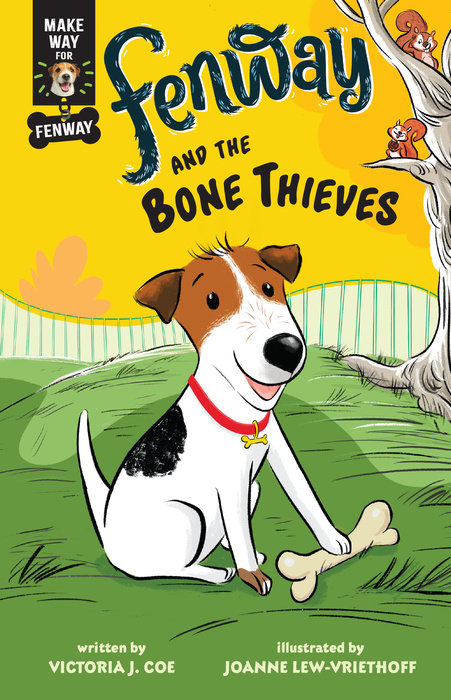
This second series of books highlights a character older readers already know.  His name is Fenway, a Jack Russell terrier.  He made a name for himself in the upper elementary/middle grade novels, Fenway and Hattie, Fenway and Hattie and the Evil Bunny Gang, Fenway and Hattie Up to New Tricks, and Fenway and Hattie In the Wild.  With each title, readers are able to see the progress as Fenway and his human grow better together.  In Fenway And The Bone Thieves (G. P. Putnam's Sons, May 3, 2022) and Fenway And The Frisbee Trick (G. P. Putnam's Sons, May 3, 2022) written by Victoria J. Coe with illustrations by Joanne Lew-Vriethoff, Fenway is still offering his spot-on insights in his own voice about his next-door neighbor dog friends, his humans, sneaky squirrels, and the elusive Frisbee.

1
THE TREAT PLACE

Everyone knows that dogs are
better than squirrels.  Dogs make
humans happy.  Dogs live
in houses.  Dogs
ride in cars.
Squirrels do
none of these
things.

In this first of ten chapters, Fenway and his humans, Hattie, Food Lady, and Fetch Man are visiting the large store filled with special things for dogs.  All Fenway can think about is treats.  His humans steer clear of the treat section, adding yucky shampoo to the cart.  It is only through sheer perseverance on Fenway's part, that a bone is added to the cart.  Unfortunately, it ends up in the trunk of the car instead of his mouth.

Finally at home, with the bone in his mouth, Fenway shows his treasure to his neighbors, Patches and Goldie, two dogs enjoying their Dog Park next to Fenway's Dog Park.  Then, Fenway hears a horrible and irritating sound.  It is the chattering of not one but two squirrels.  They are plotting to take away his bone.  After successfully chasing them away, Fenway decides the only way to enjoy his bone is to hide it from the squirrels.

After lunch, the rain begins.  Fenway is inside without his bone.  Now he is thinking his big idea is not such a good idea.  Nothing, not a single toy or game, can take away Fenway's desire for that bone, buried in the garden, outside in the rain.

The next morning when the rain has stopped, Fenway can hardly wait to get outside and dig up his bone.  There are two huge problems.  He can't remember where he buried it and the pesky squirrels are back.  Many holes later, Hattie and her friend Angel, Patches' and Goldie's short human, discover the damage done by Fenway.  As they chase him, he initially thinks it's a game, but it is most definitely not a game.  

After a flowery shampoo, a nap complete with a squirrel nightmare, and another encounter with the sneaky squirrels in his Dog Park, Fenway makes a startling discovery.  His perspective on the several days of the events are destined to have readers laughing and laughing.  As he is finally chewing on his bone on the back porch, he gets a whiff of hot dogs.  Yum!


1
THE BIG PARK

Romping in the Dog Park behind
our house is pretty awesome.  But
riding in the car with Hattie and 
Fetch Man is even better, because
we're going to the Big Park.

Fenway is having a rousing romp with Hattie and Fetch man in the Big Park.  He loves chasing after the stick and returning it, sometimes reluctant to give it to Fetch Man.  But that is all part of the game.  Just when Fenway thinks the day can't get any better, he spots a Rottweiler leaping into the air to catch a Frisbee.

Fenway wishes with all his doggy heart he could do the same trick as Carmen.  She is amazing at jumping in the air at the right moment.  He tries to do her moves with a stick.  It does not work.  He needs a Frisbee.

No one seems to understand this need, not Hattie or Patches and Goldie.  What's a dog to do?  Several days later the Big Brown Truck arrives.  After Fenway barks it away, Food Lady, Hattie and Fenway gather around a box.  What do you think is inside?  

Fenway and Hattie rush outside so Fenway can catch that new Frisbee in the air.  He is so ready to perform a trick and receive the same praise as Carmen.  All of a sudden there are the sounds of 

CHIPPER-CHATTER-SQUAWK!

Later, a frustrated Fenway, who has not caught the Frisbee yet because of the sneaky squirrels, goes on a walk with his canine pals and their humans.  Back home, Fenway convinces Hattie to throw the Frisbee in the house where there are no squirrel distractions.  As you might imagine, it ends in disaster.  That evening is very somber, but Fenway fails to understand.  The next day at the Big Park, unintentionally, Fenway creates his own special trick.  Try to read this without laughing.  It is impossible.  Oh, Fenway.

I've said it before, but I'll say it again.  Author Victoria J. Coe knows dogs, especially this dog, Fenway.  Each of the ten chapters in each book flows flawlessly with the same energy as if the words were written by a Jack Russell terrier.  The chapters end with a sentence inviting us to proceed with anticipation to the next chapter.  The upbeat narrative, Fenway's thoughts and conversations and those of the humans are thoughtful, exuberant, and funny.  Here are passages from both titles.

CHIPPER-CHATTER-SQUAWK! sounds
behind me.
Uh-oh! The first squirrel is
headed this way!  I should have 
known the two of them were in this 
together.
I run faster.  "That bone is
mine!" I bark.
The big squirrel waits until I'm 
about to lunge.  Then he suddenly
hops up and scampers across the
Dog Park.
The chase is on!  "You don't
belong here!" I bark.  I follow
that squirrel 
to the wooden
fence behind
the giant tree.


I thrust my snout into the box.
Whoopee! It smells like a Frisbee
that no other dogs have played
with.  It must be my reward for
scaring away that truck.
Hattie reaches into the box and
pulls it out.  "Ready, Fenway?" she
says.
I back up.  "I'm ready!" I bark.
"I'm so ready!"
Hattie's elbow bends.  She's going
to fling the Frisbee!
I leap onto the couch, racing
back and forth.  Hooray!  Hooray!
I'm going to catch that Frisbee in
midair!

You cannot look at the front, right side, of the matching and open dust jacket and book case for either book without smiling.  Who can resist the happy-go-lucky look on Fenway's face?  In both of these scenes, it is as if the illustrator has frozen a moment from the narrative.  The back, left side, of both books features short descriptions of the books beneath the series title, Make Way For Fenway.  Hanging from those banners is a bone-shaped dog tag with the words:

A little dog with a
GIANT personality!

The opening and closing endpapers for both books are creamy white, the same as the interior pages.  Illustrator Joanne Lew-Vriethoff has filled this book with images of varying sizes done in black, gray, and white.  With the exception of only two, Fenway makes an appearance in all of them.

The vibrancy of Fenway's personality is reflected in the artwork.  Even when he is still, it is as if he is ready to burst into action.  Readers will pause at every illustration to appreciate the details included in the pictures.  The facial looks on Fenway, the squirrels, Carmen, Patches, Goldie, and the humans leave no doubt as to what any of them are thinking.  You can't help but smile, giggle, or laugh out loud.

In Fenway And The Bone Thieves, one of my favorite pictures is a double-page image with a phrase and two sentences placed in the upper, left-hand corner.  On the left side a big squirrel with a gleam in its eyes, protruding teeth, and a big fluffy tail is ready to pounce on Fenway's bone which extends from the left side and over the gutter to the right.  Toward the top of the right side in the Dog Park is Fenway.  Flowers border the wooden fence behind him.  He is aghast at the audacity of that squirrel.  He is ready to run.

One of my favorite visuals in Fenway And The Frisbee Trick is a smaller illustration.  It is a perfectly captured moment by Joanne Lew-Vriethoff. (I should know because it happens frequently at my own home.)  The family sofa is placed in front of an arched large window.  Fenway is on the sofa, standing on his hind legs with his front paws on the back of the sofa.  He is watching the man from the Big Brown Truck carrying a package and walking toward their house.  Fenway is barking in full security mode.


To have early readers based on a beloved dog character is, in the words of my canine companion, woof-tastic!  Fenway And The Bone Thieves and Fenway And The Frisbee Trick written by Victoria J. Coe with illustrations by Joanne Lew-Vriethoff are brimming with humor and non-stop action whether read by an individual or as a read aloud.  Readers will hardly be able to wait for another installment in the series.  You will certainly need one or more copies of both books in your personal and professional collections.

By following the link attached to the names of Victoria J. Coe and Joanne Lew-Vriethoff, you can access their websites to learn more about them and their other work.  Victoria J. Coe has accounts on Instagram and Twitter.  Joanne Lew-Vriethoff has accounts on Facebook, Instagram, and Twitter.  At the publisher's website, you can view interior images and read an excerpt for Fenway And The Bone Thieves and Fenway And The Frisbee Trick.  The cover reveal for these titles with author and illustrator interviews was hosted by educator Michele Knott at Mrs. Knott's Book Nook.

Wednesday, October 27, 2021

Purr-fectly Perfect

Our furry feline friends have personalities as distinctive as our own.  They can be unpredictable and creatures of habit at the same time. We find ourselves embracing them despite these contrasting characteristics.  Unlike most of their canine counterparts, sometimes it can take years before they allow themselves to be a part of a human family.

It takes a special kind of person to persist in loving a cat when they have not thought of loving anyone at all.  Negative Cat (Nancy Paulsen Books, an imprint of Penguin Random House LLC, August 31, 2021) written and illustrated by Sophie Blackall is about a persistent boy.  The cat he loves is also persistent, but not in the way the boy desires.  This is their story, a "tail" waiting to be told.

On Day 427 of asking for a cat . . .

a miracle happened.  The boy's parents said yes!  There were conditions attached to this affirmative response.  The least appealing was the necessity of reading for twenty minutes every day.  

Reading was not this child's favorite thing to do.  He read slowly.  He had to read aloud.

At the shelter, it was hard to select only one cat, but he did.  He named the cat Maxmilian Augustus Xavier, Max.  At home, the cat paid no attention to the comforts and treats, and toys supplied by the boy.  This cat stared at the wall.  This cat was negative in every respect.

In return for kindness by family members, the cat did undesirable things like putting its tail in the butter and eating flowers.  The parents and older sister were ready to return it to the shelter.  A call was placed.

In a last-ditch effort to keep this cat he loved, the boy scrambled to do some of the items on the conditions' list, most importantly, his least popular.  And another miracle happened.  In fact, the boy's classmates joined him at the shelter once a week, expanding on that unexpected revelation.


What readers might not grasp at the beginning, but is our first clue about this boy's nature, is the fact he asked for a cat for 427 days.  Sophie Blackall wants us to know the significance to this child of having a cat.  She wants us to understand his tenacity.  This builds page by page through first-person narrative and dialogue, past and present, until the joyful addition to their family.  When it looks as though the joy is fleeting, we are once again reminded of this boy's deepest desire to do anything to keep Max.  At this point you don't know whether to sigh or cheer, so you do a little bit of both.  Here is a passage.

The next day, I surprise Max with a toy mouse.
(He is not surprised.)

I tickle him with a feather.  (He is not ticklish.)

I tell him all my best jokes.  (He doesn't even smile.)


The wide band of blue on the spine complements the shades of orange (and tan) used in the canvas, wall, flooring and cat on the front, right, and back, left, of the open book case.  In looking at the front, you wonder what would prompt a cat to stare at a wall.  On the back, we are given a hint of things to come.  Text above and below a circular image is that usually found on the front and back flaps of a dust jacket.  It introduces us to the book and to author illustrator, Sophie Blackall.  In that illustration the boy is writing on his laptop as Max watches, seated in the boy's lap.

On the opening and closing endpapers in blue and white is an array of childlike drawings of cats of all shapes and sizes.  The cats and their features are outlines.  The canvas is polka dotted.    On the title page the tiny mouse toy is placed between the text.  The publication information and dedication page are opposite the first page.  In fact, the illustration on the first page is the right side of a double-page picture.  

The illustrations in this book were created digitally and superimposed on the reverse side of vintage wallpaper salvaged from a falling-down house.

Readers, with every page turn, will stop to notice the details. These details are full of humor.  It isn't that the boy simply begs for a cat with drawings, but he makes a cat-shaped snowman in winter.  He makes cat ears on his head from soap during his bath.  He has his mother read him Brendan Wenzel's They All Saw A Cat.  And . . . he reads Max one of the oldest picture books in the United States still in print, Wanda Gag's Newbery Honor book, Millions Of Cats.

The perspectives in the visuals and their sizes shift to convey emotions and enhance the pacing.  There are groups of small insets, double-page pictures, single-page images, horizontal panels, and diagonal panels.  The dialogue is shown in longer, loose speech balloons.

One of my many, many favorite illustrations is a double-page picture of the boy celebrating the yes answer from his parents.  On the pale orange background is a green-striped oval rug.  He is kneeling on the rug on his knees supported by his hands.  His head is back, his eyes are closed, and he is laughing as he kicks up his heels.  He repeats three times:

I'm getting a cat!


Look no further than Negative Cat written and illustrated by Sophie Blackall for the ultimate silver-lining title.  With a marvelous blend of images and text, page turn by page turn, when hope is fading, it rises again through the magic of reading aloud.  I highly recommend this book for both your professional and personal collections.

To learn more about Sophie Blackall and her other work, please access her website by following the link attached to her name.  Sophie Blackall has accounts on Facebook, Instagram, and Twitter.  Sophie Blackall writes a guest post about this book at the Nerdy Book Club.  Sophie Blackall is interviewed about this book, others, and her work at The Children's Book Review.  At the publisher's website you can view interior images.


We know when we look at the world through the eyes of another, the world can become completely altered.  Two or more individuals can be looking at the same space and focus on entirely different elements.  This is how our perceptions of our immediate and extended surroundings increase and our imaginations are keener.  Inside Cat (Chronicle Books, October 12, 2021) written and illustrated by Brendan Wenzel presents a cat's eye view as it moves throughout its building.  This cat believes what it sees, floor by floor, is a realistic representation of the outside.

Inside Cat knows many windows,
finds a view wherever it goes.

This Inside Cat sees portions of the outside.  It looks through windows of all shapes and sizes, geometric designs on walls, floors, and ceilings.  Some windows stand alone, and others share a space next to each other.

Each window is a chance to pause and ponder.  Each display a bit different, look by look.  The glass in these windows is clean, dirty, bubbled, and broken.  It is shuttered.  It is open.

Some things seen through the windows remain the same, frozen.  Other things are in motion.  Is it a group of on-your-mark-get-set-go birds or a swarm swooping through the city?  It that an enormous snack or the display on an ice cream truck?

As Inside Cat moves from floor to floor, there are small treats and short snoozes to take.  Now wide awake, Inside Cat maintains it knows people up and down and all around.  It maintains it knows what it sees, and smells is true.  Inside Cat is certain it knows everything, until . . .


The use of language in this book by Brendan Wenzel is superb.  It is written like a poem with the first sentence and another three sentences bookending the center portions.  There is beautiful alliteration and rhyming.  The last sentence at the beginning of a new portion, a group of words, leads to multiple examples of that statement.  With every reading, the text becomes more melodic.  Here is a passage.

Glass all dusty.
Glass so streaky.
Glass gone gloomy.
Glass way freaky.  . . .

View to view,
floor to floor.

Knows the windows,
walls, and more.


Upon opening the dust jacket, flap edge to flap edge, the entire body of Inside Cat is supplied to readers.  The body and tail extend to the left of the spine.  The large eyes on the front draw our focus to the central theme of the narrative.  What is this cat's point of view?  The white of the cat's eyes and the title text are varnished.

A rusty red is the canvas on the book case.  Large portions of the front, right, and back, left, are filled with the cat's home.  It appears to be a unique building in the shape of a cat.  Inside Cat is peering through one of the windows, a cat's eye.  This is wonderfully ingenious.

On the opening endpapers the background shifts to a midnight blue.  The house is now shown in blue and white soft, flowing lines giving us the inside view of all the rooms.  In this perspective wherever there is a window, we see the outside.  The cat is still looking out the same window, although its eyes have shifted to the side.

With a page turn, we are on the double-page image for the title page.  Inside Cat is looking outside at a sunny floral depiction.  (I will say nothing about the closing endpapers which hold the publication and dedication information.  Everyone needs to see that for the first time without explanation.)

These images by Brendan Wenzel 

were rendered in a variety of media, including cut paper, colored pencil, oil pastels, marker, and the computer.

Every picture invites you to stop and stare as does the cat.  The inside views are in blue and white, faint outlines like you would expect to see on an architect's drafting board.  The outside views are in full color.  In each setting, inside and outside, they are bursting with items revealing the lives of the human dwellers or the cat's imagination toward the conclusion.  Readers will be looking in each visual for the tiny creature which seems to follow Inside Cat, at a discreet distance, of course.  Inside Cat is drawn with loose lines indicative of a careful, curious explorer.  Though Inside Cat is indeed careful and curious, it is also highly animated.

One of my many favorite pictures, two-page as they all are, is for the text above-noted.  Inside Cat is portrayed in five different poses at four windows.  The first one is so dirty Inside Cat's paws are covered with dirt, leaving behind paw prints on the steps, ottoman, the next window and the wall.  The third window is covered in dark paper to fashion a Halloween scene, one corner turned down to show the world outside.  The final window is an abstract, stained-glass of the sun in pastel colors with bright orange.  In this visual, it is as if Inside Cat is strolling through an art gallery.


No matter how often you read Inside Cat written and illustrated by Brendan Wenzel, you will find something new each time.  The words will sing to you and the illustrations are like a map leading you to an amazing discovery.  I can't imagine a personal or professional collection without this title.

By following the link attached to Brendan Wenzel's name you can access his website to learn more about him and his work.  Brendan Wenzel has accounts on Facebook, Instagram, and Twitter.  At the publisher's website you can view interior images.  At librarian, guest lecturer at Rutgers, and writer John Schumacher's Watch. Connect. Read., Brendan Wenzel talks about this book.

Friday, October 23, 2020

Furry Friends Find Fun And Family

They are the ultimate companions.  Their distinctive personalities provide us with constant comfort and laughter.  Truthfully, without them our worlds would be incomplete.  They make us wholly human.

For this reason, let us look at three publications in the last five months with feline or canine characters.  In the first title, Joy (Candlewick Press, June 6, 2020) written by Yasmeen Ismail with illustrations by Jenni Desmond, a kitten shows us how to release merriment with total abandon.  You'll be ready to join this frisky feline in mere seconds.

Oh, boy! Oh, boy!
My favorite toy.
I feel joy!

A red ball of yarn caught in the paws of this mischief maker fashions a red tangled trail, until another object gets the scamp's attention.  A blue ball bounces across a room, over its other animal occupants, with the kitten close to it.  Momentarily pausing for an affectionate cuddle with a cat parent, the kitten, along with the ball, is off and running into a nearby lamp.

Kitten and ball go, go, go, until stopped by colliding into the large resident dog.  Several unplanned moves later, some due to the rambunctious dog, finds the youngster outside.  Down, down, down the steps of the porch, the little furry one boings and bounces.

This does not feel good.  This hurts.  The kitten wants its mom or dad.  In a quick minute, a parent is there, offering the necessary care.  Back inside they go, to curl up together in their bed.  Wait!  Oh, no . . . off the kitten goes.


Whether read silently or aloud the words by author Yasmeen Ismail will send your soul dancing with their rhyming, alliteration, and onomatopoeia.  Each carefully chosen word mirrors the antics of the kitten and her current favorite toy.  In addition to the tale of happiness the sentences tell, readers will be reassured by the gestures and care given by the parent to the kitten.  Here is a passage.

Shake,
rattle,
and

ROLL,

this happy soul! 


When you open the matching dust jacket and book case, you are introduced to the story's characters, and the use of full color on white which is prevalent throughout the book.  The kitten, beginning her dance of glee on the front is varnished along with the yarn and title text.  To the left, on the back, the adult cat holds the kitten close in their red, green, and blue plaid bed.  A single curled string of red yarn is on the floor to the left of and behind the bed. 

On the opening and closing endpapers done in the bright red shown on the jacket and case is a tangle of white yarn strung across both pages and coming to rest as a white ball of yarn in the lower, right-hand corner.  On the dedication, verso, and title pages we see a sleeping adult in the bed on the left.  Bouncing dashes indicate the jumping of the kitten that has left the bed to begin the chase with the red ball of yarn.

Illustrator Jenni Desmond using

mixed media

depicts all the elation this kitten feels and displays.  Her images span two pages, portions of single pages, or are grouped together on a single page to portray movement and passage of time.  Cleverly placed dashes indicate the movement of the kitten and its current favorite toy.  At times, the words follow the same path as the dashes.  The facial expressions on the animal characters, especially the kitten, convey their every mood.  The perspective is usually one of observer in the room, but several times to place dramatic emphasis on a point in the narrative, we move close to the kitten.

One of my many favorite illustrations is a double-page picture.  Across the bottom on a canvas of crisp white the lamp has fallen and is bent from left to right with the shade resting in the lower, right-hand corner.  Above the lamp in a series of loop-de-loops made by the dashes, the words on top, the kitten and blue ball travel.  Above the lamp and shade on the right, the kitten mid flip, is grinning in absolute satisfaction.

If you want to make your heart happy, experiencing the energy of that happiness, then this book is for you.  Joy by Yasmeen Ismail with illustrations by Jenni Desmond is a read aloud delight on every page.  I highly recommend this title for a storytime focusing on pets, playfulness, and to present how word play can create a mood or a moment.  You'll want to add this book to your professional and personal collections.

To learn more about Yasmeen Ismail and Jenni Desmond and their other work, please follow the link attached to their names to access their websites.  Yasmeen Ismail has accounts on Instagram and Twitter.  Jenni Desmond has accounts on Facebook, Instagram, Pinterest, and Twitter.  At the publisher's website you can view an interior image.  At Penguin Random House you can view other portions of the book.


It's not often a dog is categorized as a foodie.  Oh, we know how amazing it is that they can distinguish between the fruit, vegetable, and cheese drawer in the refrigerator.  When the cheese drawer is opened, they appear next to you, seated and ready for a treat, with the speed of light.  Their ability to distinguish one from the other is the stuff of legend.  They do love certain foods over other delicious delights.

In her debut picture book as author and illustrator Alexandra Thompson explores food, and the delectable life of a French Bulldog.  In A Family For Louie (Putnam, G. P. Putnam's Sons, June 6, 2020), we follow this canine foodie whose life is almost perfect, except for one thing.  He knows magical moments are better when shared.

Louie considered himself a
dog of very fine tastes.

He knew every chef in town.

He enjoyed the best restaurants and their finest fare for breakfast, lunch, and dinner.  He never missed dessert.  In a park fountain he bathed before retiring in the evening with a book and a cup of hot cocoa.  As far as Louie was concerned this life of his was as heavenly as a gourmet meal.

Louie did notice other dogs sharing their days with humans.  Louie decided it might be nice to have a family.  What he did not expect was how hard it was to find a family.  One had terrible food choices, and another one had . . . horror of horrors . . . a cat!

As the sun dropped beneath the horizon, Louie's spirits dropped too.  Maybe there was no family for him.  Louie wandered from the park to the town.  What was this?  A new bakery?

Outside the bakery was a little girl Louie did not recognize.  She was friendly.  Louie was uncharacteristically shy.  It seemed that a cupcake could win the heart of a very particular French Bulldog.


When the story begins author Alexandra Thompson paints an endearing picture of Louie with her words.  We immediately identify with the life he has made for himself.  This seemly perfect life is an ideal segue into what Louie needs most.  Humor plays an important part in his attempts to find a family leading us into a gentle, welcome resolution.  Here is a passage.

The next day, Louie saw
a family having a picnic
at the beach.

He thought he might ask to join them,
but when Louie approached . . .

they were eating Jell-O salad
and sardine sandwiches!


These digitally designed illustrations by illustrator Alexandra Thompson convey with detailed charm Louie, his love of food, and his search for a fuller life.  In looking at the open dust jacket readers get a glimpse on the front, right, and back, left, of what that life can be for Louie.  On the front he is looking into the new bakery window with the little girl and her mother as silhouettes.  The title appears as though it is the name of the bakery.  The framing on the window is framing his new beginning.  

To the left, on the back, is a circular, decorative frame around a picture of Louie and the little girl.  They are both holding cupcakes with the cherry on top already consumed.  There is sheer contentment on their faces.  The words above them read:

Life is sweeter
when shared with friends.

The book case is a double page image of a country scene.  The background is a pale blue sky with pink light and clouds.  To the right of the spine on a hillside with meadow flowers, Louie, the little girl, and her mother are seated beneath a tree having a picnic. 

The opening and closing endpapers tell a tale too.  They represent Louie's life before and after he meets his new family.  It's a scene in the city featuring a single arched window in a wall with lanterns on either side.  

Each visual is either a double-page picture, a group of smaller images, or a single-page illustration.  Due to the technique employed by Alexandra Thompson, your eyes are immediately drawn to Louie in each one.  His distinctive facial expressions and body postures depict his every mood.  You'll find yourself falling in love with this little dog.

One of my many favorite illustrations is a full-page picture.  It's nighttime in the town.  In the background stars glow in the sky as lights shine in building windows.  Two trees on the left side of the park stand in dark dusky purple silhouette.  On the right side is a large tree with roots extending across the entire page.  Beneath those roots Louie has carved out a space for himself.  We see it in a cutaway.  The sight of him reading, snuggled in a blanket with his cup of hot cocoa, is precious.


Readers will become attached to the character in this story who is looking for a family.  A Family For Louie written and illustrated by Alexandra Thompson is about finding the most valuable piece missing from the puzzle that is your life.  I know this book will be a favorite for storytimes.  Give your listeners their favorite stuffed toy dog to hold when you share this book with them.  You'll want to add this to your professional and personal collections and gift it to dog lovers you know.

To learn more about Alexandra Thompson and her other work, follow the link attached to her name to access her website.  She has accounts on Facebook, Instagram, and Pinterest.  Alexandra Thompson is a guest at author Katelyn Aronson's site.  At the publisher's website you can view the opening endpapers.  I believe you'll enjoy the reading of this book by its creator.


Sometimes our furry friends' personalities take zeal to an over-the-top level.  They see the world around them in an entirely different light than those with whom they share it.  It is this contrast which generates roll-on-the-floor hilarity.

There is a new cat in town who fits this description with excellence.  No Fuzzball! (Orchard Books, an imprint of Scholastic Inc., August 4, 2020) written and illustrated by Isabella Kung is a debut release certain to leave a lasting impression long after the final word is read.  Get ready readers for a riotous read on the wild side.


Hello, I am

NOFuzzball.

Perhaps you have never heard a name like this before,
but that is because you have not met
a queen like me.

This cat believes she is a queen because her humans, her subjects, scream at her, calling her name throughout the house.  She is certain they honor her every request when they are really going about their day. When she sees a packed suitcase, she is certain it is a present for her.

Her family is not happy she decides it is a new bed.  Tending to her ruffled fur after being lifted out of the suitcase, she is unaware they have left the house.  She is shocked at this discovery.  How could this happen?!

She muses about their possible reasons for leaving.  She is thrilled they took the dog, 

that disgusting slobbering mess.

Now she can nap in peace.

She is surprised to find them still absent after her nap, so she starts to roam around the house, worrying about possible scenarios in which they are hurt or kidnapped. In order to dispel these fears, she is determined to be a different kind of ruler.  She does her queenliest best as a cat of cats to spruce up the house.  Will they love what she has done to the place (palace)?  What do you think?


Told in the words of her queenship, humor is replete on every page. The authenticity of No Fuzzball's remarks, her point of view, is purr-fect.  As you read this story, it is hard not to think of author Isabella Kung as a cat whisperer.  Here is a passage.

A queen cannot tolerate such disrespect!
I demand a formal apology . . .

Wait, they left?

How dare they
forget their place?!

What has gotten into them?


There is no doubt in your mind when looking at the open book case, this cat is a bundle of energy, somewhat out of control to her humans, but having the time of her life.  She is a maker of messes.  A destroyer of calm.  And she will always cause you to giggle and grin.  The yellow ribbons on the right, front, cross over the spine to wind around, framing a collection of cat toys on the left, back.  In the center are sentences from the start of the narrative.  In a stroke of genius, a smaller No Fuzzball is casually leaning on the ISBN.

On the opening and closing endpapers readers are treated to the many moods of No Fuzzball.  The 15 images on the first set of endpapers are placed on a white canvas with red as an accent color.  The second set of 15 visuals with blue as the extra hue are also on a white background.  Here is also information about Isabella Kung.

On the verso and title pages it appears as though torn lavender paper reveals orange paper under it.  On the title page No Fuzzball is ripping the paper to reveal the No in the title.  She is at her catastrophic best.

These illustrations by illustrator Isabella Kung span two pages, single pages, or several smaller visuals are grouped on a single page.  No Fuzzball's fur is textured to the point you feel as though you might want to touch it, but you won't because this is No Fuzzball.  Shades of purple and red lend themselves to special marked moments.  It's the looks on the face of No Fuzzball and her subjects which will have you bursting into laughter.

One of my many favorite illustrations is a double-page picture.  It's when No Fuzzball is taking a nap.  Four lighted shapes of the sun shining through a window move from left to right, two on either side of the gutter.  These shapes are outlined in a golden orange color.  They are placed on a wooden floor in a muted purple.  No Fuzzball moves around in different positions which are typical but also comedic.


If you are looking for loads of fun and funny, No Fuzzball written and illustrated by Isabella Kung, her debut release, is a claw-some selection.  The constant comparison between the cat's beliefs and reality provide readers with a true page-turner.  You'll be asked to read it repeatedly.  I highly recommend this title for your personal and professional bookshelves.

To learn more about Isabella Kung, please follow the link attached to her name to access her website.  Isabella Kung has accounts on Instagram and Twitter.  Isabella Kung is a guest on Book Q&As with Deborah Kalb, The Soaring '20s and at Jena Benton Writer & Illustrator.  At the publisher's website you can view interior images.  Isabella Kung was part of a Scholastic Book Fair Book Joy Live event hosted by Scholastic's Ambassador of School Libraries, John Schumacher.  Please take a few moments to enjoy these two videos.