It is essential to remember our canine companions are emotional and social beings. They experience stress, confidence, loneliness, fear, courage, sadness, and happiness as do humans. For them and other animals, their responses to these emotions are how they survive. They, too, need to be around other dogs and humans. When walking or running with you, they greet other walkers, runners, and bikers with tail wags, prancing, and open mouths looking much like smiles. In the case of my Mulan, she refuses to move and sits patiently until the walker, runner, or bike rider has passed. This is her way of acknowledging them. Her personality is to contemplate the universe whenever possible.
If we remember we are their pack, the rewards are immeasurable. Don't Worry, Murray (Balzer + Bray, An imprint of HarperCollinsPublishers, June 7, 2022) written and illustrated by David Ezra Stein is about a precious pup who tries, with encouragement, to set his worries aside. It is a story of becoming brave, a little bit at a time.

Good morning, Murray!
When an unseen narrator (his human?) asks Murray why he won't go outside, Murray has three answers. Each sees him not faring well in the falling rain. In fact, in one scenario the water is so deep it is up to the middle of his tummy when he stands.
Murray is told not to be anxious. He needs to wear his raincoat. He does and is told he is a
Good boy.
Just when Murray thinks everything might be okay, a big blast of thunder scares him into hiding under a park bench.
In each of the next three situations, Murray is questioned about playing with the new dog in the park, attending a barbeque, and even going to bed. Each time Murray replies with possible negative outcomes. No one likes to have their favorite toy taken from them. No one likes to be frightened by fireworks. No one likes to be alone when they fall asleep; there might be monsters.
Murray tries to play with the new dog and attend the barbeque, but initial fun ends with the little guy cowering in fear. As promised, the narrator stays with Murray as he curls up on his bed to sleep. The voice continues to speak to Murray, recounting his day. Three final sentences send Murray into the sweetest of dreams.
Readers and listeners, canine and human, will readily identify with the concerns of Murray as presented by David Ezra Stein. The structure for each event is the same, supplying readers with a welcoming rhythm. Murray is asked a question. His reply is a series of wordless images. Murray is told not to worry and a suggestion is offered. Then, he is reminded of being a good boy. When disaster strikes, there is a single word question. This cadence leads us gently to the conclusion with the narrator summing up Murray's day and his accomplishments. Murray, like all of us, is reminded of his value. Here are three sentences.
Don't worry, Murray!
There won't be any fireworks.
Good boy, Murray! Good boy.
One of the first things you notice when looking at the open and matching dust jacket and book case are the eyes of Murray. He may be hearing don't worry, but his eyes are still brimming with concern. You want to encircle him with comfort like his bed does for him. And, the adorable dog toy lying next to him lets us know it is his favorite. He's keeping it close. The contrasting colors of blue and yellow suggest both worry and warmth. Murray on the front and back of the jacket along with the title text are varnished.
To the left of the spine, on a white background is a single small image. It is a relieved Murray lying in his bed. He is smiling with one eye closed in contentment and the other open to greet whoever happens to be there.
The opening and closing endpapers are a bright sunshine yellow. On the title, verso, and dedication pages Murray is shown in his bed. He is dreaming of running with abandon, curled with his front paws touching his back paws, and in a similar pose to the back of the jacket and case. These are on white canvases.
These pictures by David Ezra Stein were rendered using
bamboo pen and ink, charcoal, graphite, watercolor, crayon, and photocopy.
White space is used with excellence to draw our attention to Murray. There are full-page pictures, followed by a series of wordless scenes grouped on a single page, and subsequent full-page illustrations blended with smaller images on white canvases. This artwork heightens the narrative pacing. The facial expressions and body postures on Murray endear him to readers unconditionally. (Dog lovers will sigh aloud.)
One of my many favorite illustrations is when Murray has been convinced to go outside in the rain. He is wearing a yellow raincoat and matching yellow hat. Tail wagging and tongue hanging out in happiness, he looks at himself in a mirror. This is a canine with confidence. He is standing on a striped rug in a hallway with wooden floors with a window to the left and a small table to the right.
The artwork and writing of David Ezra Stein pair with perfection in Don't Worry, Murray. Murray's worries are shared by many children (and some adults) making this a wonderful title to share widely and often. The reassurances offered by the narrator are a soothing conclusion. We all need to know, bravery builds over time. I highly recommend this title for both your professional and personal collections.
To discover more about David Ezra Stein and his other work, please visit his website by following the link attached to his name. David Ezra Stein has accounts on Facebook, Instagram, and Twitter. You'll enjoy seeing remarks about this title on his social media accounts.
UPDATE: This title is featured with artwork at Julie Danielson's Seven Impossible Things Before Breakfast on July 15, 2022.
We have learned on our daily walks about other dogs we might encounter. We have timed leaving our home to avoid any conflicts (dogs off leash), but yesterday when walking past a newly renovated bed and breakfast, two tiny hairy white dogs came charging at us. It was not even seven in the morning. I was worried they would run into the road. And where were their humans?
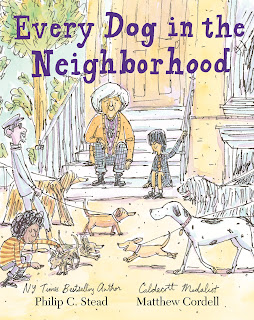
A bit later, a barefoot woman wearing a white bathrobe came after the dogs. They, barking, completely ignored her. When we moved to continue our walk, they still came after us. Thankfully, my companion did not bark back, but sat and then stood next to me. Understandably, she was reluctant to turn her back on them. Finally, the woman captured the dogs, apologizing and we walked up a hill toward home. Another thing Mulan and I have learned is the dog population in our tiny town swells in the summer. And we know, dogs will be dogs. Every Dog in the Neighborhood (Neal Porter Books, Holiday House, June 21, 2022) written by Philip C. Stead with artwork by Matthew Cordell is a lovely ode to dogs, their people and their commentary, community, and the affection between a child and their grandparent.
Grandma stirs a spoonful of honey into her tea and frowns. "Louis," she says, "it's going to rain today. I can feel it in my knees."
"Are you sure?" I ask. The weather is just fine in my knees.
Louis wants a dog. His grandmother says there are already plenty in the neighborhood. Louis knows from experience that
Grandma knows everything.
But, she doesn't know how many dogs there are in their neighborhood. At a stop during their rainy walk, Grandma makes a comment. Both Louis and his grandmother write letters to City Hall. This is the beginning of a quest for each.
The replies to their letters, another two letters, are discouraging. Louis decides his grandmother, again, knows best. They are going to take matters into their own hands.
Louis is going to count all the dogs in the neighborhood. Louis goes to every house, even the ones he knows do not have a dog. By chatting with his neighbors, Louis realizes more than the number of dogs. Louis is now privy to the people in the neighborhood, their dogs, and the bond between them. Each person shares a little bit more than whether they have a dog or not. Several times during the day, Louis finds his grandmother and they share a snack and conversation. (No text in this narrative refers to how Grandma spends her day.)
That evening, Louis informs Grandma about the number of dogs in the neighborhood. Grandma does not accept that number. And this is where I pause my recounting of this title. The concluding eleven pages left this reader teary-eyed and enjoying Louis and Grandma even more. We should all be so fortunate to have a grandmother like Louis.
Through Louis's voice and dialogue between Louis and his grandmother and Louis and their neighbors, Philip C. Stead takes us on a tour of the neighborhood and into the hearts of each resident. At each stop, Louis numbers the dogs and notes their name and something of interest. Readers will delight in the names of the dogs and how those names reflect on their people. Through the work of Louis during the day, Philip C. Stead is clearly and with intention leading us to a conclusion which will leave a mark on each reader's heart. Here is a passage.
"Excuse me, Mr. Pierce," I say. "I am counting every dog in the neighborhood. Do you have a dog?"
"I had a dog once," says Mr. Pierce. "His name was Harvey. He doesn't live here anymore. But he will always live in my heart."
"Does your heart live here?" I ask.
"Oh, yes," he says. "It has for many years.
That was good enough for me. I write down:
1. Harvey
One look at the right side of the open jacket and you cannot help but smile. As Grandma and Louis sit on the steps of their home, they smile at the people and their dogs walking. All those dogs, seven in all, are happy to be on a walk. Look at their faces! The color choices in this illustration radiate warmth. The title text is varnished a deep purple.
To the left of the spine, the entire scene continues. Other dog people and their dogs are out walking. We see other pets named in the narrative, cats, and a parrot and a Burmese python which are now free. Several pets and children are inside the next home, looking at the display outside. Either Thelonious or Monk are holding the ISBN in their mouth. Every individual is content.
On the book case, on a canvas of pale mint green, Matthew has fashioned a gallery. There are twenty unique frames in various shapes. Inside each one is a portrait of a named canine companion. The opening and closing endpapers are a rich golden orange yellow. On the title page is a smaller drawing, an image, of Louis and Grandma on the steps of their home. We can see it in its entirety. There are dogs and people out in front of them, enjoying the day.
Using
pen and ink and watercolor,
Matthew Cordell, in a style distinctively his own, with delicate and intricate details, takes us into this community of people with their dogs and other animal friends. (At one house, even before we read the text we can infer there are three animals there by the dishes outside the door.)(A nighttime walk contains a special visitor.) As we study each picture, through the looks on people's faces and their body postures, we are aware of their current emotional mood. Most of the images are single-page pictures, loosely framed in sketchy ink lines with wide white borders.
Matthew Cordell adds sound effects for impact. When Louis is telling us he is gathering what he needs for his survey, each item is drawn and labeled. Two pages prior to the conclusion include six wordless visuals. These hint at Grandma's work. Readers will notice, at least twice, references to a prior collaboration between Matthew and Philip. Who do you think named their dogs Wilbur and Orville? Two wordless illustrations bookend a dramatic two-page picture at the end of the book. In two words and one phrase they represent, bliss, success, and be the change.
One of my many favorite illustrations is for the words:
That's why I love her.
In this picture, Louis and Grandma are taking their walk wearing raincoats and using umbrellas. Rain puddles on the sidewalk at the unexpected downpour. Behind them, to the left and to the right, other walkers and their dogs are yelling and running for cover. (I love Grandma, too.)
Most certainly this is a book about dogs and their people, but Every Dog in the Neighborhood written by Philip C. Stead with artwork by Matthew Cordell is about finding goodness and community connections. It is about people from all walks of life and age rejoicing in a shared love. It is about one grandmother knowing the heart of her grandson and how to grow the heart of her neighborhood. I can't imagine any collection without a copy of this book.
To learn more about Philip C. Stead and Matthew Cordell and their other work, please access their websites by following the link attached to their names. Philip C. Stead has an account on Instagram he shares with his wife, Erin E. Stead. There is also a website titled The Stead Collection. Matthew Cordell has accounts on Facebook, Instagram, and Twitter. At Penguin Random House, you can view some interior images. I believe you will enjoy this interview with Philip C. Stead and Matthew Cordell at Kansas Public Radio about this title.


