Quote of the Month

When love and skill work together, expect a miracle. John Ruskin


Showing posts with label David Ezra Stein. Show all posts

Thursday, July 14, 2022

To The Dogs #3

It is essential to remember our canine companions are emotional and social beings.  They experience stress, confidence, loneliness, fear, courage, sadness, and happiness as do humans.  For them and other animals, their responses to these emotions are how they survive.  They, too, need to be around other dogs and humans.  When walking or running with you, they greet other walkers, runners, and bikers with tail wags, prancing, and open mouths looking much like smiles.  In the case of my Mulan, she refuses to move and sits patiently until the walker, runner, or bike rider has passed.  This is her way of acknowledging them.  Her personality is to contemplate the universe whenever possible.

If we remember we are their pack, the rewards are immeasurable.  Don't Worry, Murray (Balzer + Bray, An imprint of HarperCollinsPublishers, June 7, 2022) written and illustrated by David Ezra Stein is about a precious pup who tries, with encouragement, to set his worries aside.  It is a story of becoming brave, a little bit at a time.

Good morning, Murray!

When an unseen narrator (his human?) asks Murray why he won't go outside, Murray has three answers.  Each sees him not faring well in the falling rain.  In fact, in one scenario the water is so deep it is up to the middle of his tummy when he stands.  

Murray is told not to be anxious.  He needs to wear his raincoat.  He does and is told he is a 

Good boy.

Just when Murray thinks everything might be okay, a big blast of thunder scares him into hiding under a park bench.

In each of the next three situations, Murray is questioned about playing with the new dog in the park, attending a barbeque, and even going to bed.  Each time Murray replies with possible negative outcomes.  No one likes to have their favorite toy taken from them.  No one likes to be frightened by fireworks.  No one likes to be alone when they fall asleep; there might be monsters.

Murray tries to play with the new dog and attend the barbeque, but initial fun ends with the little guy cowering in fear.  As promised, the narrator stays with Murray as he curls up on his bed to sleep.  The voice continues to speak to Murray, recounting his day.  Three final sentences send Murray into the sweetest of dreams.


Readers and listeners, canine and human, will readily identify with the concerns of Murray as presented by David Ezra Stein.  The structure for each event is the same, supplying readers with a welcoming rhythm.  Murray is asked a question.  His reply is a series of wordless images.  Murray is told not to worry and a suggestion is offered.  Then, he is reminded of being a good boy.  When disaster strikes, there is a single word question.  This cadence leads us gently to the conclusion with the narrator summing up Murray's day and his accomplishments.  Murray, like all of us, is reminded of his value.  Here are three sentences.

Don't worry, Murray!
There won't be any fireworks.

Good boy, Murray!  Good boy.


One of the first things you notice when looking at the open and matching dust jacket and book case are the eyes of Murray.  He may be hearing don't worry, but his eyes are still brimming with concern.  You want to encircle him with comfort like his bed does for him.  And, the adorable dog toy lying next to him lets us know it is his favorite.  He's keeping it close.  The contrasting colors of blue and yellow suggest both worry and warmth.  Murray on the front and back of the jacket along with the title text are varnished.

To the left of the spine, on a white background is a single small image.  It is a relieved Murray lying in his bed.  He is smiling with one eye closed in contentment and the other open to greet whoever happens to be there. 

The opening and closing endpapers are a bright sunshine yellow.  On the title, verso, and dedication pages Murray is shown in his bed.  He is dreaming of running with abandon, curled with his front paws touching his back paws, and in a similar pose to the back of the jacket and case.  These are on white canvases.

These pictures by David Ezra Stein were rendered using

bamboo pen and ink, charcoal, graphite, watercolor, crayon, and photocopy

White space is used with excellence to draw our attention to Murray.  There are full-page pictures, followed by a series of wordless scenes grouped on a single page, and subsequent full-page illustrations blended with smaller images on white canvases.  This artwork heightens the narrative pacing.  The facial expressions and body postures on Murray endear him to readers unconditionally.  (Dog lovers will sigh aloud.)

One of my many favorite illustrations is when Murray has been convinced to go outside in the rain.  He is wearing a yellow raincoat and matching yellow hat.  Tail wagging and tongue hanging out in happiness, he looks at himself in a mirror.  This is a canine with confidence.  He is standing on a striped rug in a hallway with wooden floors with a window to the left and a small table to the right.


The artwork and writing of David Ezra Stein pair with perfection in Don't Worry, Murray.  Murray's worries are shared by many children (and some adults) making this a wonderful title to share widely and often.  The reassurances offered by the narrator are a soothing conclusion.  We all need to know, bravery builds over time.  I highly recommend this title for both your professional and personal collections.

To discover more about David Ezra Stein and his other work, please visit his website by following the link attached to his name.  David Ezra Stein has accounts on Facebook, Instagram, and Twitter.  You'll enjoy seeing remarks about this title on his social media accounts.

UPDATE:  This title is featured with artwork at Julie Danielson's Seven Impossible Things Before Breakfast on July 15, 2022.


We have learned on our daily walks about other dogs we might encounter.  We have timed leaving our home to avoid any conflicts (dogs off leash), but yesterday when walking past a newly renovated bed and breakfast, two tiny hairy white dogs came charging at us.  It was not even seven in the morning.  I was worried they would run into the road.  And where were their humans? 

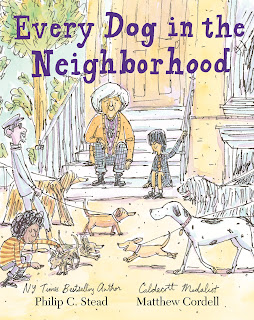
A bit later, a barefoot woman wearing a white bathrobe came after the dogs.  They, barking, completely ignored her.  When we moved to continue our walk, they still came after us.  Thankfully, my companion did not bark back, but sat and then stood next to me.  Understandably, she was reluctant to turn her back on them.  Finally, the woman captured the dogs, apologizing and we walked up a hill toward home.  Another thing Mulan and I have learned is the dog population in our tiny town swells in the summer.  And we know, dogs will be dogs.  Every Dog in the Neighborhood (Neal Porter Books, Holiday House, June 21, 2022) written by Philip C. Stead with artwork by Matthew Cordell is a lovely ode to dogs, their people and their commentary, community, and the affection between a child and their grandparent. 
Grandma stirs a spoonful of honey into her tea and frowns.  "Louis," she says, "it's going to rain today.  I can feel it in my knees."

"Are you sure?" I ask.  The weather is just fine in my knees.

Louis wants a dog.  His grandmother says there are already plenty in the neighborhood.  Louis knows from experience that 

Grandma knows everything.

But, she doesn't know how many dogs there are in their neighborhood.  At a stop during their rainy walk, Grandma makes a comment.  Both Louis and his grandmother write letters to City Hall.   This is the beginning of a quest for each. 

The replies to their letters, another two letters, are discouraging.  Louis decides his grandmother, again, knows best.  They are going to take matters into their own hands.  

Louis is going to count all the dogs in the neighborhood.  Louis goes to every house, even the ones he knows do not have a dog.  By chatting with his neighbors, Louis realizes more than the number of dogs.  Louis is now privy to the people in the neighborhood, their dogs, and the bond between them.  Each person shares a little bit more than whether they have a dog or not.  Several times during the day, Louis finds his grandmother and they share a snack and conversation.  (No text in this narrative refers to how Grandma spends her day.)

That evening, Louis informs Grandma about the number of dogs in the neighborhood.  Grandma does not accept that number.  And this is where I pause my recounting of this title.  The concluding eleven pages left this reader teary-eyed and enjoying Louis and Grandma even more.  We should all be so fortunate to have a grandmother like Louis.


Through Louis's voice and dialogue between Louis and his grandmother and Louis and their neighbors, Philip C. Stead takes us on a tour of the neighborhood and into the hearts of each resident.  At each stop, Louis numbers the dogs and notes their name and something of interest.  Readers will delight in the names of the dogs and how those names reflect on their people.  Through the work of Louis during the day, Philip C. Stead is clearly and with intention leading us to a conclusion which will leave a mark on each reader's heart.  Here is a passage.

"Excuse me, Mr. Pierce," I say.  "I am counting every dog in the neighborhood.  Do you have a dog?"
"I had a dog once," says Mr. Pierce.  "His name was Harvey.  He doesn't live here anymore.  But he will always live in my heart."
"Does your heart live here?" I ask.
"Oh, yes," he says.  "It has for many years.

That was good enough for me.  I write down:

1. Harvey 


One look at the right side of the open jacket and you cannot help but smile.  As Grandma and Louis sit on the steps of their home, they smile at the people and their dogs walking.  All those dogs, seven in all, are happy to be on a walk.  Look at their faces!  The color choices in this illustration radiate warmth.  The title text is varnished a deep purple.

To the left of the spine, the entire scene continues.  Other dog people and their dogs are out walking.  We see other pets named in the narrative, cats, and a parrot and a Burmese python which are now free.  Several pets and children are inside the next home, looking at the display outside.  Either Thelonious or Monk are holding the ISBN in their mouth.  Every individual is content.

On the book case, on a canvas of pale mint green, Matthew has fashioned a gallery.  There are twenty unique frames in various shapes.  Inside each one is a portrait of a named canine companion.  The opening and closing endpapers are a rich golden orange yellow.  On the title page is a smaller drawing, an image, of Louis and Grandma on the steps of their home.  We can see it in its entirety.  There are dogs and people out in front of them, enjoying the day.

Using

pen and ink and watercolor,

Matthew Cordell, in a style distinctively his own, with delicate and intricate details, takes us into this community of people with their dogs and other animal friends.  (At one house, even before we read the text we can infer there are three animals there by the dishes outside the door.)(A nighttime walk contains a special visitor.)  As we study each picture, through the looks on people's faces and their body postures, we are aware of their current emotional mood.  Most of the images are single-page pictures, loosely framed in sketchy ink lines with wide white borders.

Matthew Cordell adds sound effects for impact.  When Louis is telling us he is gathering what he needs for his survey, each item is drawn and labeled.  Two pages prior to the conclusion include six wordless visuals.  These hint at Grandma's work.  Readers will notice, at least twice, references to a prior collaboration between Matthew and Philip.  Who do you think named their dogs Wilbur and Orville?  Two wordless illustrations bookend a dramatic two-page picture at the end of the book.  In two words and one phrase they represent, bliss, success, and be the change.

One of my many favorite illustrations is for the words:

That's why I love her.

In this picture, Louis and Grandma are taking their walk wearing raincoats and using umbrellas.  Rain puddles on the sidewalk at the unexpected downpour.  Behind them, to the left and to the right, other walkers and their dogs are yelling and running for cover.  (I love Grandma, too.)


Most certainly this is a book about dogs and their people, but Every Dog in the Neighborhood written by Philip C. Stead with artwork by Matthew Cordell is about finding goodness and community connections.  It is about people from all walks of life and age rejoicing in a shared love.  It is about one grandmother knowing the heart of her grandson and how to grow the heart of her neighborhood.  I can't imagine any collection without a copy of this book.  

To learn more about Philip C. Stead and Matthew Cordell and their other work, please access their websites by following the link attached to their names.  Philip C. Stead has an account on Instagram he shares with his wife, Erin E. Stead.  There is also a website titled The Stead Collection.  Matthew Cordell has accounts on Facebook, Instagram, and Twitter.  At Penguin Random House, you can view some interior images.  I believe you will enjoy this interview with Philip C. Stead and Matthew Cordell at Kansas Public Radio about this title.  

Thursday, December 16, 2021

Fowl Play

How did the chicken wake up?  It had an alarm cluck. 
What do you call a chicken crossing the road?  Poultry in motion
Why did the chicken cross the road?  To bock traffic!
Why did the turkey cross the road?  To prove he wasn't chicken!

Those four questions and answers are only a few in a multitude of fowl hilarity. Chickens and their feathered friends have long been the object of comedy routines, jokes, and tall tales.  They've even made it into the world of polka with the famous chicken dance.  Be prepared to grin, giggle, and guffaw as you enjoy this trio of titles recently released.


In two previous books, Interrupting Chicken and Interrupting Chicken And The Elephant Of Surprise, author illustrator David Ezra Stein introduces and entertains readers with the actions and conversations between a lively little red chicken and her patient papa.  In the third title, Interrupting Chicken: Cookies For Breakfast (Candlewick Press, October 26, 2021), the delightful duo take readers once more into the world of the classic written word.  There is nothing like a craving for cookies to get your morning off to an exuberant start . . . for some.

It was bright and early for the little red chicken.

Papa is not ready to wake up on a Saturday morning until little red chicken mentions breakfast in bed.  Cookies are not what he has in mind.  There will be no cookies for breakfast, but Papa reading a book aloud is the next best thing.

Little red chicken snuggles in next to her father eager for him to begin reading nursery rhymes.  Not more than one is read before she interrupts with her own version of completing There Was An Old Woman.  There might be a mention of cookies. 

Again Papa says there will be no cookies for breakfast.  You won't believe what vitamin little red chicken says are in cookies!  This scenario is repeated two more times as the reading aloud resumes.  The charming youngster inserts cookies into nursery rhymes, a proverb, and her own brand of common sense.

Papa is getting a little stressed and asks for a break.  Our clever protagonist pens and draws her own RIME.  A loud sound puts a stop to the comfy morning cuddle between this father and his daughter.  Papa has a most delicious reply to the noise.  


When we read David Ezra Stein's first sentence, we get a hint of how the morning is going to be.  The contrast between the on-fire vigor of the child and her father's desire to keep sleeping are typical and comedic.  Between their laugh-out-loud funny conversations and the nursery rhymes, most reworded by the little red chicken, an engaging cadence is created.  (I counted the mention of cookies and cookie at least twenty-five times.)  Here is a passage.

"Chicken."
"Yes, Papa?"
"I told you, we can't have cookies so early."
"I heard the early bird gets the cookie."

"That's worm."
"Well, you can have a worm, but I'd rather have a cookie!"
Papa yawned.  "We'll have breakfast soon.
Let's just read a little longer."
"Okay!" said the little red chicken. 


Using

watercolor, water-soluble crayon, china markers, pen, opaque white ink, and tea

the artwork of David Ezra Stein asks us to jump into the story with as much liveliness as the little red chicken does onto her father's bed.  On the open and matching dust jacket and book case, her enthusiasm is on full display.  Their humorous conversation is already beginning on the front, right side.  To the left, on the back, with the bedroom wallpaper as a canvas, we read the words of the little red chicken.

I sure like cookies a lot!

The speech balloons on the front and back are varnished.

A bright spring green covers the opening and closing endpapers.  On the informal title page, David Ezra Stein starts his pictorial interpretation.  The little red chicken is carrying a kitchen chair somewhere.  She has dropped her toy stuffed elephant.  A double-page picture spans edge to edge for the formal title page.  It is a wonderful view of the interior of the chickens' kitchen.  Our eyes move from the refrigerator across an arched doorway into another room, and then to the stove with pots and pans hanging from a rack under a hood to a window with a table and chairs, and finally to cupboards on the far right.

On the left side prior to the first single-page picture and on the right side of the final single-page picture, David Ezra Stein has placed a page using the bedroom wallpaper, green with large yellow flowers with reddish orange centers.  Throughout the book, the images range in size from smaller visuals on a single page to illustrations crossing the gutter to full-page pictures and two-page pictures.

The two-page pictures are the open book Papa is reading to little red chicken.  Included on these pages are her appearances when she interrupts and adds her own dialogue between the nursery rhyme characters.  The limited color palette of the nursery rhyme pages contrasts with excellence to the full-color illustrations of the little red chicken, her papa and their home.  The facial expressions on Papa, the little red chicken, and the nursery rhyme characters are side-splitting.

One of my many favorite illustrations is a picture which crosses the gutter.  On the left, we see Papa in bed with his little red chicken.  She is holding an open book and a pencil.  Her toy stuffed elephant is nestled with Papa on his right side.  The box of cookies is on the left side of the little red hen.  A light glows near her on a bedside table.  The bed crosses the gutter.  Taped on the foot of the bed, we are shown affectionate drawings by the little red chicken for her papa.  Her art materials are scattered on the floor near an ottoman where she was working.  


This third book, Interrupting Chicken: Cookies For Breakfast written and illustrated by David Ezra Stein, is as enchanting and funny as the previous two titles.  You can expect to hear a chorus of "read it again" every time you finish reading this either one-on-one or to a group of listeners.  I highly recommend this title for your personal and professional collections.

To discover more about David Ezra Stein and his other work, please visit his website by following the link attached to his name.  David Ezra Stein has accounts on Facebook, Instagram, and Twitter.  David Ezra Stein is interviewed at Judy Newman at Scholastic.  At the publisher's website, you can access and download a nine-page series activity kit.  At Penguin Random House, you can view many happy interior images.


According to Merriam-Webster, there are three major definitions for the word magic.  They involve a special power welded by special people, tricks, and influence or skill.  The word impossible is tied to two of these definitions.  What is not mentioned in any of these meanings is the word chicken.  Perhaps the people at Merriam-Webster need to have a chat with two creative talents, author Adam Rubin and illustrator Adam Rex.  This duo's new collaboration, Gladys The Magic Chicken (Putnam G. P. Putnam's Sons, October 26, 2021) gives a new interpretation to that word, magic.  You'll be laughing before you've even finished the first page.

THIS ALL HAPPENED
a long, long, long. long, looong time ago.
Three thousand years before your grandma's
grandma's grandma was born.

In these long ago times there lived a chicken, a dancing chicken.  Gladys, the dancing chicken, was a follower.  Each day she went to the pasture with the sheep, a dog, and a shepherd.  One day, for the first time in his short life, this shepherd saw his reflection in a puddle.  He was stunned.

When Gladys comforted the boy, he wished to be beautiful.  Years passed and that boy became a strong, handsome man.  When a traveling peddler came to town, that man saw himself in a mirror.  (He had never seen a mirror.)  Again, he was stunned.  He kissed Gladys and declared her to be 

"A MAGIC, WISH-GRANTING CHICKEN." (At this point, I am laughing out loud.)

The wily peddler acquired Gladys by giving the shepherd that mirror.  Gladys went from place to place with that businessman who was offering her for sale.  She did not sell and that man made a wish.  Poof! No more Gladys.

Gladys was shocked as she moved from a cooking pot to the arms of a heroic swordsman.  From there she became a gift and the object of a hard-to-forget song.  Before this chicken, said to be magical, could really get settled at a royal palace, she found herself on the high seas with a band of pirates.  What?!

No sooner than one could think avast me hearties, Gladys landed on a deserted beach which was not really deserted because this was Gladys, after all.  A fancy, footwork frolic was observed and a wild ride caused Gladys to yield yet another of her eggs.  That brought Gladys to the best conclusion for a dancing chicken who might or might not have had special powers.  Magical, indeed.


Some of the best kinds of stories are circle stories.  Adam Rubin has written this one masterfully.  The setting he fashions, Ancient Times, allows him to play with language and historical facts.  His named cast of characters describes their occupations and sometimes their characteristics like the

Long-Bearded Bandit and the

Learned Princess.

His blend of narrative, dialogue, and authorial asides is marvelous, just like Gladys.  You will be swept away by his word choices brimming with action.  Here is a passage.

CRASH!
BANG!
BOOM!

The Learned Princess shrieked as a Fearsome Pirate swung through the window, flipped through 
the air, and landed on the floor with a sword clenched in her teeth.  Gladys let an egg go ploop.

"YOU'RE COMING WITH ME." threatened the Fearsome Pirate.
"I'M HERE TO KIDNAP YOU FOR RANSOM!"

"HOORAY!" squealed the Learned Princess.

HOORAY? asked the Fearsome Pirate.  . . .


You will be hard-pressed to look at the open and matching dust jacket and book case without bursting into giggles.  Gladys, in all her dancing glory, is looking a tad uncomfortable at the accolades she is receiving and at being placed on a pedestal.  Her eyes here and throughout the book convey more than words ever could.  Gladys, the flower at her feet, and the title text are varnished.

To the left of the spine, on the back, a continuation of the Ancient Times brushed golden tones acts as a canvas.  Here is a very, very, very old stone portrait of a chicken with the face of a wise man or deity.  It is placed in the upper, left-hand corner like it is holding up a roof at the top of a pillar.

There are four horizontal panels separated by black lines on the opening and closing endpapers.  In these panels Gladys is featured, symbolically, in her travels.  The drawing is precise, almost like it has been cut and stenciled.  In the opening endpapers it is black on a rich deep pink.  On the closing endpapers, the elements are repeated on metallic dark gold.  These pink and gold colors are used again in a beautiful design decision.

The title page is done in hues of pink, purple, blue and gold.  It showcases an old city with lightning coming from the cloud above it.  Gladys sits in that cloud amid the title text.

Drawn digitally, these illustrations by Adam Rex are guaranteed to have readers pausing at every page turn beginning with the map opposite the dedication and publication information page.  The map is titled

THE WORLD OF
ANCIENT 
TIMES
WITH CHICKEN
SNACKS BY REGION.

The pictures throughout are replete with details and bold, bright colors. 

Single-page images blend to the next one.  Smaller illustrations grouped two to a page accentuate pacing.  Double-page pictures are dramatic.  When the ancient language is spoken it is placed in narrow scrolls with a different font.  White space, dark space, and perspective are magic in the skilled hands of Adam Rex.

One of my many favorite pictures is a single-page illustration.  It is a dark scene in hues of blue.  We are in the dungeon of the palace of the Purple Pooh-bah.  There is stonework, stairs, and archways leading into seemingly endless hallways.  On the right side a heavy grate is placed in the floor.  From the grate stretch two narrow scrolls.  They read:

CURSE YOU, MAGIC CHICKEN!

cried the Long-Bearded
Bandit.

THIS IS NOT WHAT I MEANT!


Prepare to laugh yourself silly reading Gladys The Magic Chicken written by Adam Rubin with illustrations by Adam Rex.  The combination of text and artwork makes this a classic tale to be told again and again.  You might find yourself humming a tune and singing the words ending with

ABRA-COCK-A-DOODLE-DEE-DOO!

Make sure you have a copy on your personal and professional bookshelves.

By following the link attached to Adam Rubin's and Adam Rex's names, you can access their respective websites to learn more about them and their other work.  Adam Rubin has an account on Twitter.  He also has a more adult website here.  Adam Rex has accounts on Facebook, Instagram, and Twitter.  At the publisher's website you can view some interior images.  This inventive duo are interviewed about this book at School Library Journal, A Fuse #8 Production, by Betsy Bird.

Chicken Literacy from Adam R on Vimeo.


When the temperature drops thirty degrees in twelve hours with wind chills in the teens, it is cold outside.  No matter how much winter wear you don, the bitter breeze finds a way to give you the shivers.  As you walk from one point to the other, sometimes in place and other times as if a giant hand is pushing you, you wonder if you will ever be warm again.  In Cold Turkey (Little, Brown and Company, November 23, 2021) written by Corey Rosen Schwartz and Kirsti Call with illustrations by Chad Otis, this bird knows that frigid temperatures equals loads of clothes.  Will this bird survive wandering in his neighborhood?

Turkey woke up c-c-cold.
He wheezed, "It's ten degrees!

I need to b-b-bundle up
before I f-f-freeze!"

Turkey first met Sheep.  She was quivering from the effects of the storm.  Turkey gave her his hat.  Turkey was not quite as warm when he met Chick.  Her feathers and nest of hay were not helping her.  Perhaps Turkey's wing warmers would help her.

No longer standing, Horse could barely make a sound.  Cow could not even crouch to combat the wild wind.  It was a miracle Pig was not purple from the wild weather.  At each stop, Turkey relinquished an article of clothing.

Turkey was no longer bundled.  Turkey was shaking as the blizzard blasted his bare body.  He could hardly wait to get home.  

Unbeknownst to Turkey, his barnyard friends had an unexpected state in store for him.  Each one and Turkey, too, had new descriptive names.  Turkey went from warm-hearted on the inside and from cold to _____ on the outside.


Authors Corey Rosen Schwartz and Kirsti Call have a knack through inventive wordplay for spinning narratives with a catchy cadence.  Their rhyming couplets for each animal followed by a two-word alliterative descriptor bring smiles to listeners.  These are an open invitation to participate in the story.  As the tale unfolds, readers see the results of a generous spirit and the warmth friendship brings.  Here is a passage.

Cow was qu-qu-quivering.
"I can't help but complain.

This wind is a cow-tastrophy!
It's udderly insane."

QUIVERING
COW


The crisp white background for the front and back of the open and matching dust jacket and book case with scattered snowflakes is certain to induce chills.  Even covered in clothing, Turkey is one cold bird as evidenced by the shiver marks and blowing leaves and weeds.  Notice how those weeds extend over the spine.  

To the left, on the back, Turkey and his friends are shown in a circular image.  Their cold faces all point to him in the center.  Each one of them is labeled with their alliterative names, except for Cold Turkey.

On the opening endpapers artist Chad Otis gives readers a bird's eye view of the barnyard blanketed in snow.  A dotted line indicates the path Turkey takes from friend to friend.  This view offers a hint at the conclusion.  Night has fallen on the scene on the closing endpapers.  There are still a few flakes of snow falling but it is otherwise calm.  The dotted line has been replaced with prints in the snow.  A glow on the far right reveals the toasty conclusion.

These images rendered

in pencil, scanned textures, and digital paint

convey a realistic sense of time and place.  You'll be reaching for your favorite coat, hat, and mittens before you leave with Turkey to go outside.  Evidence of the wind and snow has filtered into Turkey's home.  Brrrr . . .

As Turkey moves from animal to animal, the layering of snow on objects combined with gusts of wind, drifting flakes, and blowing leaves and twigs is highly convincing.  White is used superbly as an element contrasting with the colors of the animals, Turkey and his clothing.  Chad Otis has us initially standing back to watch the exchange between Turkey and the other five animals, but when Turkey gives away an article of clothing and the animal is given their two-word name, we are brought close to the location.  Readers will enjoy the added details and facial expression on the characters.

One of my many favorite images of all these two-page pictures is for the words

HUDDLING HORSE.

On the left side Horse's face and upper portion of his body is highlighted.  Horse is extremely cold, but now his nose is wrapped in Turkey's scarf.  Horse is holding it in place with his two foot hooves.  On the right side of the picture, Turkey is walking away, getting colder and colder.  He is wearing only two more pieces of clothing.  Head bent, he plods through the deepening snow.  To the left of him, a fence is coated in snow.  In the distance, on the right, we can see the outline of the farmhouse.


Readers will be tapping their toes and clapping their hands in time to the wondrous words penned by Corey Rosen Schwartz and Kirsti Call and in response to the enhancing illustrations by Chad Otis when they hear or read Cold Turkey.  This book would make a fantastic reader's theater.  You'll want to add a copy to both your personal and professional collections.

To learn more about Corey Rosen Schwartz, Kirsti Call, and Chad Otis and their other work, please follow the link attached to their names to access their websites.  Corey Rosen Schwartz has accounts on Facebook, Instagram, and Twitter.  Kirsti Call has accounts on Facebook, Instagram, and Twitter.  Chad Otis has accounts on Facebook, Instagram, and Twitter.  At the publisher's website, you can download an activity sheet.

Tuesday, January 29, 2019

Listen, Little One

In the animal kingdom care of eggs, newborns and the littlest members of families is not limited to mothers.  There are notable fathers.  A single male lion, gorilla, or Arctic wolf guards entire large groups; prides, troops or packs.  Some sandpiper females leave the nest once the eggs are laid (she lays more than one batch of eggs per season) and for weeks a male takes care of the eggs and baby birds.  The same is true for Emperor penguins. The fathers carry a single egg on their feet, covering it with a brood pouch for warmth and protection.  They do this without eating for two months.  When the females return from hunting and feeding, the roles are reversed.

Truthfully the position of fathers in species is varied and fluctuates.  In his newest release author illustrator David Ezra Stein takes a traditional lullaby giving it a paternal perspective.  Hush, Little Bunny (Balzer + Bray, an imprint of HarperCollinsPublishers, January 22, 2019) is a soothing exploration of nature and nurturing as spring arrives.

Come, little bunny, don't be shy.
It's time to tell the snow goodbye.

A first scamper out-of-doors leaves the little bunny in tears.  Papa is there to offer comfort.  He assures the little one blue sky is coming and if it does not, there are tasty treats to be found.

When those treats are consumed, there's much more to do.  A bunny's heart sings when it can roam freely in a field.  If danger soars above, Papa knows what to do.  He takes his precious child below that field cuddled in a cozy hole.

If the hidden space gets a bit snug, the duo can pop out again to the grassy landscape.  Should a sudden shower begin to fall, shelter is found beneath blossoming branches.  Fortunately, Papa has an answer when the situation shifts.

Tears may fall again, but fireflies brighten a broken heart.  A bird sings as a sunset radiates across the horizon.  Two bunnies, one big and one little, make their way home.  Love endures in the spring.  Love endures in every season.


As you read the phrases penned by David Ezra Stein a melody, unbidden, begins to accompany your reading.  A rhyming word ends each one supplying a cadence not unlike the movements of rabbits.  One phrase is repeated twice connecting this narrative to the traditional lullaby.  Having Papa speak to his small child makes for a personal and participatory story.  Here is a passage.

And if the afternoon brings showers,
we'll stay by a tree that's hung with flowers.

And when those flowers blow away,
we'll find some other bunnies and play.


On the front, nose to nose, eyes to eyes, smile to smile and paws to paws an adult rabbit and small bunny have our full attention (I know you are sighing.).  The use of yellow, green and hues of blue hint of spring on this open and matching dust jacket and book case.  To the left, on the back, amid a pale yellow-washed canvas, the bunny is hopping toward the spine through spring blooms.  A ladybug decides to move, too.

A golden yellow covers the opening and closing endpapers.  On the title page beneath the text the little one peers from underneath foliage at the remaining snow.  All the images are rendered by David Ezra Stein in

mixed media on watercolor paper.

The size of the illustrations moves from double-page pictures to full-page illustrations loosely framed in black lines to full-page visuals in free-formed circular shapes.  Some of the full-page images spread from edge to edge.

Delicate pastel shades reflective of the season are highlighted by loose black brush strokes.  Tiny lines indicate fur and whiskers.  It's wonderful how the placement of the characters' eyes, ears and body postures clearly convey their every mood.  Due the perspective in each scene readers are fully engaged in each moment.  They will want to touch the pictures.  They will giggle, sigh and probably laugh out loud at the image depicting Papa and Little Bunny going home through the grass.  The heavier matte-finished paper is perfect for David Ezra Stein's artwork.

One of my many, many favorite illustrations is on a single page, edge to edge.  The sun is setting turning the sky golden and spreading a similar glow across the countryside.  A tree trunk frames the left side.  Branches extend from the left; one arches across to the right side.  Leafy vines with blossoms extend down from this branch.  Under this branch is a small pond.  On the back edge Papa and Little Bunny look into the water.  Lily pads float.  A tiny turtle rests on one.  On the branch a blackbird raises its head to sing.


As soon as you read Hush, Little Bunny written and illustrated by David Ezra Stein you will want to read it again to and with someone else.  This is a book to share one-on-one or with a group.  It can promote discussions on how our parents show love, support and care.  It could be paired with Good Day, Good Night, Dad By My Side, Gator Dad, The Wonderful Habits of Rabbits, How To Be A Bigger Bunnyand another David Ezra Stein book, Tad and Dad depending on whether your focus is fathers or rabbits.  To make your story time every more engaging you might want to have some musical instruments available.  I highly recommend this delightful title for your personal and professional collections.

To learn more about David Ezra Stein and his other work, please follow the link attached to his name to access his website. At the publisher's website you can view interior images. David Ezra Stein has an account on Twitter.  He shares process art in his Twitter feed.  The publisher also has an activity guide.

Update:  David Ezra Stein and this title are featured at author, reviewer and blogger Julie Danielson's Seven Impossible Things Before Breakfast on June 16, 2019.

Wednesday, September 19, 2018

Pachyderm Problems

Children's love of telling stories is a constant source of delight.  Realizing the power in setting their imaginations free, they see this as a source of shared joy.  Their ability to connect dots and design a plot outside the box is a unique and amazing gift.

Once they get started they cannot contain themselves.  One story leads to another story and to a third story.  One individual will hear a part of their story in another's story.  It's an endless, glorious chain of stories.  In 2011 a Caldecott Honor book, Interrupting Children (Candlewick Press, August 10, 2010) written and illustrated by David Ezra Stein acquainted readers with Papa and Chicken, a father and daughter, with a daily ritual of reading a bedtime story.  Actually they read more than one story leading readers from one hilarious incident to the next.  Interrupting Chicken And The Elephant Of Surprise (Candlewick Press, September 11, 2018) written and illustrated by David Ezra Stein is the phenomenal companion title.  Papa and Chicken are at their wonderful best.

It was after school for the little red chicken.

After Papa greets Chicken she begins to tell him about her day at school.  Her teacher taught them about the elephant of surprise in every story.  Papa patiently explains it is an element of surprise.  His definition of an element of surprise rather than clarifying Chicken's mistake reinforces her use of the word, elephant. She states this meets the Whoa factor criteria.

Papa is convinced there will be no elephant in the story Chicken chooses for them to read.  As Papa reads, suddenly an elephant does pop up in the story's dialogue, courtesy of the little red chicken.  In the ensuing conversation between father and daughter one is convinced The Ugly Duckling has an elephant of surprise in it because all good stories do.

At Chicken's suggestion another book is chosen.  No one is more stunned at the presence of an elephant in Rapunzel than the prince and Papa.  Chicken, on the other wing, is thrilled and happy for the discovery.

By this time Papa is frustrated with all this silliness but allows Chicken to choose the required third story to complete her homework assignment.  The appearance of a pachyderm in this tale is even more ridiculous.  In Papa's final attempt to demonstrate the lack of elephants in all stories, he makes up his own story.  A burst of boisterous laughter is guaranteed from all readers at the twist Papa's tale takes and in the final sentence of this book.


The first sentence in this book, as it the previous title, is an honest-to-goodness simple statement of fact.  This astutely leads us into the conversational narrative between Papa and his little red chicken.  David Ezra Stein's sense of humor shines in every exchange between the daughter and father.  No matter what Papa says, Chicken manages to support her theory (and love of elephants) and of course, Ms. Gizzard's lesson.

When the fairy tales are being read by Papa and inserted into this book, David masterfully selects the perfect spot for an elephant to enter the story.  This creates excellent comedic pacing with maximum marvelous results.  Here are two adjoining passages.

With all haste, the prince began to climb.  When he
reached Rapunzel, he gazed at his love, and she said, ---
Surprise! I'm an
elephant!
You've done 
it again!
You're welcome!

Chicken, I know there is no elephant in Rapunzel.
That is just plain ludicrous."

"Don't you feel sorry for the elephant, Papa? . . ."


It's impossible to look at the opened, matching dust jacket and book case without at least cracking a smile.  This introductory verbal exchange between Chicken and Papa sets the stage for repeated hilarity.  The blue elephant peeling back the paper and laughing heightens the mirth readers are already feeling.  David Ezra Stein's color choices here and throughout the book grab our attention and keep it.

To the left, on the back, is another speech bubble placed on top of the rose-patterned upholstery of Papa's chair.  It reads:

WHoa!  I didn't
know That was
going to Happen!

The opening and closing endpapers are covered in a deep, rosy-coral shade found in the roses.  On the initial title page, Chicken is peering through the window of her school bus as rain falls.  The title text is on a full, two-page picture of the interior of the little red chicken's home.  Seen through the front room window, the school bus has stopped.  Hints of Chicken's love of elephants are tucked into the image several times.

Rendered in

watercolor, water-soluble crayon, china marker, pen, opaque white ink, and tea

the illustrations contain animated characters ready to walk out of the book into our lives . . . and they do!  Some of the visuals extend from left to right crossing the gutter, cover a single page or are smaller and surrounded by liberal amounts of white.  When David inserts the four pages of the fairy tale into the story, they are in a complete different style.

The color choices are few and muted with a traditional, older illustrative technique.  This allows the presence of the elephant along with Chicken to stand out.  The elephant is garbed in appropriate attire, wings and feathers of a swan, a dress and long braids of hair and a grass skirt and coconut top.  The facial expressions on the other individuals in those fairy tales at the sight of the elephant are funnier than funny.

One of my many favorite illustrations is when Chicken is taking the third fairy tale book out of the bookcase.  This picture, loosely framed, extends from the left to the right over the gutter.  Chicken, on the left, is standing on the matching ottoman to Papa's chair and is holding the book.  Papa, on the right, has slipped down in his chair with legs extended and his glasses are clasped in one of his wings.  To the right on the floor next to Papa's chair is the box of cereal and carton of milk, still out after Chicken's snack.  Her bowl and his cup of coffee rest on a side table.  You get a real sense of Papa's patience, Chicken's determination and anticipation for the next round of laughter.


The stellar use of wordplay in Interrupting Chicken And The Elephant Of Surprise written and illustrated by David Ezra is excellent entertainment elevating it to be enjoyed by readers of all ages.  You can read this for fun, for a unit on fairy tales, for a study on the use of language or as a bedtime story.  I highly recommend you share this repeatedly and often as you can with as many as you can.  You'll want to have a copy in your personal and professional collections.

To learn more about David Ezra Stein and his other work, please follow the link attached to his name to access his website.  At the publisher's website you can view an interior image. (I know you're going to laugh.)  For the cover reveal and an interesting discussion about the book, take a few minutes to read this post at Publishers Weekly.  David participated in The New York Times Books Live Art.