Quote of the Month

When love and skill work together, expect a miracle. John Ruskin


Showing posts with label Storytelling-Fiction. Show all posts

Tuesday, December 13, 2022

Taking Wings With Story

On discovering the December 2022 issue of School Library Journal in my mailbox, I let out a whoop of joy at seeing the cover.  I hugged the magazine to my heart as I walked back from the road to the inside of my home.  For several days, it was on the kitchen counter so I could see it as I walked from room to room.  

The image on the front of the issue created by author illustrator Guojing is a marvelous representation of her 2022 book, The Flamingo (Random House Studio, September 07, 2022).  In this illustration of a pale blue sky sprinkled with a few stars, a glowing full moon is centered.  Flying in front of the moon and soaring upward is a flamingo, wings outstretched.  Upon the flamingo's back is the child protagonist from the story.  The beauty of this scene is layered in meaning as is The Flamingo.

part one
A Trip to Visit Lao Lao
All on My Own

Most of the 140 pages in this two chapter book hold wordless panels.  We see a plane, flamingo pink in color, flying from a city.  After it lands, the girl greets her grandmother, Lao Lao.  Lao Lao drives them to her home in a land of sunshine, palm trees, and a nearby beach.  In exploring her grandmother's home, the child finds a pink and white feather resting in a flamingo-shaped mug.

That night after a bath and dinner, Lao Lao, when asked, starts the story of the feather.  As a little girl she and her dog make an exciting discovery on the beach.  It is an egg.  She fills her bicycle basket with sand and carries the egg home.  She makes a nest for it in a container next to her bed.  Lao Lao stops the story for the night.

The next day, Lao Lao and her granddaughter walk on the beach and find a turtle hatching from its shell.  This prompts Lao Lao to continue the story of her egg found many years ago.  When Lao Lao's egg cracks open a bird emerges, a flamingo.  She cares for the bird and it goes everywhere with the girl and her dog.  On one of their first outings, the flamingo rests on the girl's head as she and her dog sit watching the sunset on the water.

Each day Lao Lao tells her granddaughter more about her flamingo.  As the bird grows, so does their affection for each other.  They are inseparable, until one day the bird flies up, up, and away, leaving behind a single feather.  Lao Lao as a child waits and watches for the flamingo, hoping for its return.  After that point in her story, to the surprise of Lao Lao and the girl, a stunning sight awaits them as they walk on the sandy shore.

part two
My Turn to Fly Home

When the girl has to return to the city, Lao Lao presents her with a prized possession.  Back in her apartment, the buildings, sights and sounds are in sharp contrast to the beach and Lao Lao's home.  One night, a full moon outside her window supplies the light, the necessary spark, the girl needs to make an extraordinary gift for Lao Lao.  The realm of imagination and reality merge and close a distance with love.


In reading the dedication, readers are privy to some of the inspiration behind this story conceived by Guojing.  It reads:

This book is dedicated to
my mother, who said I'm her flamingo,
my son, who arrived when I completed this book,
and my grandma in heaven, who gave me the happiest childhood.

Clearly, the affection between family members is the heart beating in the pages of this book.  This love bridges generations, space, and time.  It lives in story.


When you open the dust jacket, you see images from the two chapters of the book.  On the right side, the front, a flamingo visits the girl on the fire escape outside her bedroom window.  This illustration will have readers asking questions.  Why is the flamingo there?  How does it find this girl?  What does it want?  What does the girl want?  To the left, on the back, is a close-up of one of my many favorite pictures.  It is of Lao Lao as a child with her dog and the baby flamingo.

On the book case, Guojing has placed another interior picture.  It spans left to right, featuring Lao Lao as a little girl.  She is running across the beach with her dog on the left side.  Sky and beach appear nearly as one in shimmering shades of gold.  On the right, the flamingo glides past a glowing sun.  

On the opening endpapers, a pale blue sky is edged along the bottom and the right side in billowing clouds.  The closing endpapers appear as a continuation of that sky.  Two flamingos are shown on the left side, flying to the left.  On the two-page picture for the title page a plane in flamingo pink flies to the left from the right side.

These breathtaking illustrations 

rendered in Photoshop, watercolor, and colored pencil

are wordless panels in an array of arrangements to portray the passing of time, emotional moments, and place.  The varying perspectives bring us deeply into the story.  Sometimes we are only shown a portion of an element, like a set of airplane landing wheels squealing to a stop on the runway or feet in flamingo slippers after a bath or a beak pecking its way out of an egg.  Other times we look down on the flamingo flying over the beach along the water's edge with Lao Lao on her bike and her dog running ahead.

The color palette used in this story signifies the present in limited color with spots of pink in lighter and darker hues.  When Lao Lao's memory story and other "flights" of imagination are showcased brighter, full color is used.  The pacing, size of the panels, and their placement is exquisite.  These images speak volumes giving us a story of generational love, the magic of memory, and the power of sharing stories, real and imagined.

One of my many favorite images (It is nearly impossible to select only one.) is of Lao Lao as a little girl.  It is a double-page picture.  The sea is rippled by a gentle breeze.  A few clouds linger in the sky.  Both are colored in the warmth of a sun dipping close to the horizon.  On the left side is a large stone.  Seated on the stone facing the sea is Lao Lao, her dog, and the tiny flamingo.  Lao Lao's dog is to the left of her.  Her left arm is reaching behind the dog in a hug.  On her head is the baby flamingo.  This scene, like so many in this book, is tender and moving.


Even after having read The Flamingo by Guojing repeatedly, you will find yourself profoundly affected each time.  No one tells a story like Guojing.  Her artwork envelops you completely.  If you have not read her other two books, The Only Child and Stormy, please do.  I highly recommend this title for all your collections.  

To discover more about Guojing and her other work, please access her website by following the link attached to her name.  Guojing has accounts on Instagram and Twitter.  Guojing and this title are highlighted at School Library Journal, A Fuse #8 Production with an interview by Betsy Bird and at School Library Journal with an interview by Andrew Eliopulos regarding her cover art for the magazine.  At the publisher's website, you can view interior images.

Monday, December 5, 2022

Spellbinding . . .

When writing a blog post, I always go to the Library of Congress or the Michigan eLibrary to find the subject headings for a given title to add to my post.  Sometimes, I do not agree with the selections and I will add my own.  For this post, the subject headings made me smile.  They spoke to truths I hold deep in my heart.  Our minds' memories hold the stories of our lives, and all the stories we've heard and read.  This is powerful magic.

Each memory, ours and those of others, enrich our lives.  They enlarge our view of the world.  They transport us to other places and other times.  With each story, the magic around us and beyond the four directions gets stronger and stronger.   In Witch Hazel (Little, Brown And Company, October 11, 2021), author illustrator Molly Idle presents a visual and written masterpiece.  It is a tale to be savored by one generation and passed to another generation, over and over.  It will be remembered.

IN THE SPRING, Hilda helped Hazel sweep the front porch.

Hilda enjoys spending her days with Hazel.  They, like the season mentioned in the first sentence, are old and new, wise woman and youth. In sweeping the porch, Hazel recalls how she as a child would spend hours with her 

furry friend

reading stories together.  Hilda wants to hear one.  In telling of their adventures, Hazel leaves part of these stories with Hilda and her 

furry friend.  

When summer arrives, the duo move inside to the music room.  Here Hazel recalls, as a young woman, playing music for and with a songbird.  She then tells Hilda how she released the bird, giving it freedom.  Hilda becomes Hazel's songbird in the sultry summer.

Dusting in the parlor in the autumn, Hilda asks Hazel about a portrait over the mantelpiece.  It is Hazel as a grown woman.  She is gowned in all her glory at a ball.  She is wrapped in magic as much as Hilda is now wrapped in a scarf Hazel is knitting for her.

Hazel stays in bed during winter.  Hilda lovingly cleans her room and  keeps Hazel company.  This time it is Hilda who magics stories for Hazel, stories of Hazel's life she shared with Hilda.  Memories swirl around in the room.  In the spring, it is not the same for Hilda and

her furry friend.

There is sadness, but also joy in remembering.  Our stories never really end.


Great care by author Molly Idle is evident in her writing of this story.  The pauses in the narration are excellent.  The word choices reflect each of the seasons.  They also mirror the particular portion of Hazel's life being revealed.  The blend of narrative and dialogue welcomes us into the lives of Hazel and Hilda.  This, too, allows for the images to extend the story into elegance.  Here is a passage.


IN THE SUMMER, Hilda helped give the music room an airing.  The old piano bench creaked a bit as Hazel sat upon it.

Hazel creaked a bit, too.

She laid her hands, feather light, upon the keys.


If there were hues for memory, storytelling, and magic, then the color palette you see on the open dust jacket (and throughout the book) are those used by artist Molly Idle here.  The sepia tones, cream, and white are exquisitely rendered using

graphite and Prismacolor pencil on Stonehenge paper.

Each line, each use of light and shadow, and each detail brings us into the story.  We are already asking ourselves questions as we look at the image on the right.  What is now?  What is memory?  What is the story being told?  The floral fan element in the four corners on the right and left sides is a portion of the feather duster used by Hilda.  The leaves in the oval frame appear like hearts . . . or is it love surrounding these two wonderful beings?  On the back, the left side, another smaller oval fashions a border for Hazel's hat in white and clouds of sparkles.  The words above it read:

The stories passed down
from our loved ones
become a part of us. 

On the book case there is a shift in the images on both the front and back.  On the front, Hilda has the broom.  Its tip touches the broom held by Hazel, now appearing only in white.  The cat is real.  In the oval on the back, with leaves more realistic, is a stack of books.  Next to them is Hilda's feather duster.

The endpapers created by Molly Idle are a part of this story.  In the first set Hazel sits on the steps of her home.  She holds her broom with the feather duster on the bottom step.  A tree to the right of the house provides a branch for a swing to hang.  Younger Hilda with a kitten waves at Hazel on the far right side.  In the closing endpapers, Hilda now sits on the porch step, imaging the scene we saw on the opening endpapers.  Hilda now holds the broom as she looks at Hazel from the past.  Her cat, now larger, watches Hilda and her kitten of the past on the right side.  The bushes and vines on either side of the porch have grown and are blooming.

On the title page, Hazel, now standing with her broom, holds out the feather duster for Hilda who sits in the swing hanging from the tree.  Each subsequent page turn gives readers a single page image or a group of smaller pictures representing the passage of time or a large double-page illustration drawing us deeper into the story.  When Hazel's stories are told, they are wordless.  You cannot help but look at every single item in each scene.

What magic is the broom bringing into the setting?  Items from Hazel's stories are left behind.  Why do you think this is shown?  Hazel's hat is not always on her head.  Hilda is growing up as is her kitten.  At the same time, Hazel is showing signs of getting older between spurts of remembering her youth.  The three-page gatefold toward the end of the book is gasp-worthy, leading us to a poignant end and beginning.

One of my many favorite illustrations is a double-page visual.  Here Hazel is seated on the piano bench with her hands on the left side of the keyboard.  Hilda is to her right with her hands on the keyboard.  Hazel's broom is propping up the piano's lid.  Her hat rests on the tip at the top of the lid.  Magic floats from the piano to the open window.  There stands a youthful Hazel watching her bird fly to freedom.  Hilda's cat holds the feather duster in its mouth.  The bird cage next to the piano is empty.


This book, Witch Hazel written and illustrated by Molly Idle, is an ode to the power of memories and  stories, and the connections forged between generations by those memories and stories.  Each sentence brings us into the life of Hazel, her past, and her present with Hilda.  The artwork transforms wherever we are into the magical realm where Hazel and Hilda are.  I highly recommend you place a copy in your personal and professional collections.

To learn more about Caldecott Honoree Molly Idle and her other work, please follow the link attached to her name to access her website.  Molly Idle has an account on Instagram.  She chats about this book at A Fuse #Eight Production with Betsy Bird and at The Children's Book Review with Bianca Schulze.

Tuesday, September 6, 2022

When Darkness Settles

There is no sleep.  Dreams are not dreamed.  Wishes are not made.  No day is complete or concludes without it.  What is this priceless phenomenon?

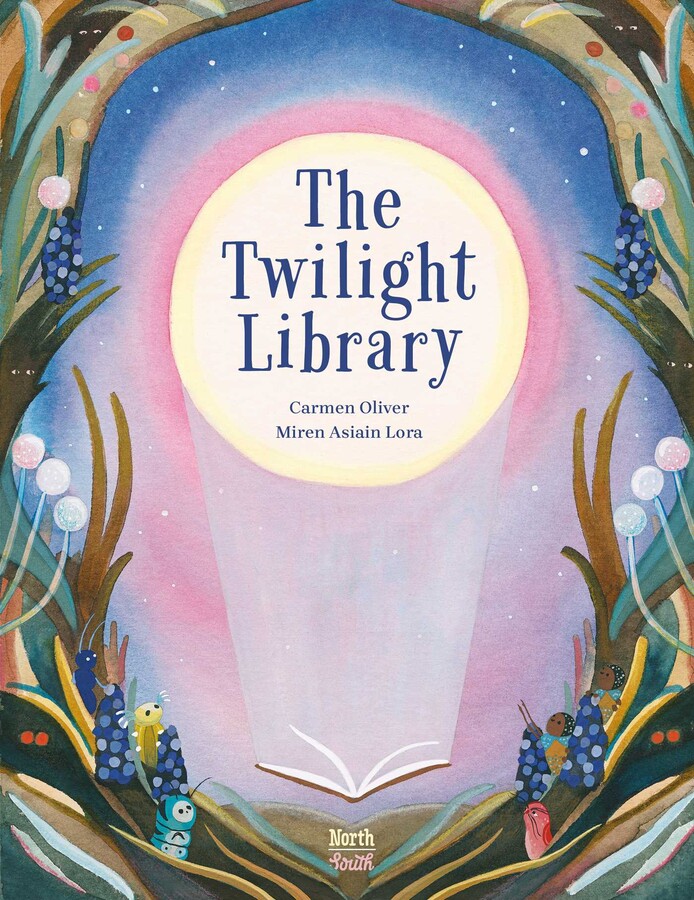
It is the need for story.  It is the longing to hear or read that which another believes is important for us to hear or read.  The Twilight Library (North|South Books, September 6, 2022) written by Carmen Oliver with illustrations by Miren Asiain Lora takes readers into an enchanting world.  In this world, a special being in a special space uses the power of words to take listeners on a sensory journey to places their hearts desire.

The sun slips behind the horizon;
the creatures of the night awaken.
Someone is calling them.

This voice implores them to come.  This voice wants to tell a tale.  Do the creatures of the night listen?  They do.

Some step lively to a rhythm.  Others start, stop, and go again.  Still more glide through the darkening skies, some lower to the ground and others high above the treetops.

Fireflies glow off and on and off and on.  A soothing breeze whispers through stems and leaves.  All these 

creatures of the night

gather at The Twilight Library, anticipation filling their souls. The Night Librarian, a weaver of webs and words, moves closer to her listeners.

She takes them to a place alive with color.  There, their hunger is satisfied by an array of food the likes royalty has never seen.  They are enveloped by thoughts of their most beloved sanctuaries.  They are asked to breathe wondrous odors and listen to nature's notable melodies.  They, together as one, are transported to realms fashioned by their imaginations.  All too soon dawn arrives.  But . . .


These phrases penned by Carmen Oliver calm readers like a lullaby.  Her blend of narrative and the words of the Night Librarian take us to one place before magic lifts us to another.  Repetition of key words fashions a cadence.  Alliteration draws us deeper into the spell cast by The Twilight Library and the storyteller residing there.  We, like the 

creatures of the night,

are completely captivated.  Here is a passage.

Nighthawks wind through the canopy,
hunting for the voice that beckons.

"Come, come, come, my friends,
let me spin, spin you a story."


Readers get their first peek at the marvelous color palette used by artist Miren Asiain Lora for this book on the open dust jacket.  Her hues depict the display of light prevalent when day is leaving and night is descending.  The framing by leaves, stems and flowers on the front, right side, of the jacket is the same on the back, the side to the left of the spine.

On the front, notice the tiny creatures looking at the light of a moon rising from the pages of a book.  Do you see the eyes shining from darkened nooks?  On the back, the creatures are absent.  Between the branches and stems, a single string of webbing is stretched.  Hanging in the webbing are books, spines out.  Two fireflies are moving left to right.

The book case presents two scenes.  On the back, to the left of the spine, is a starlit sky with a crescent moon in the upper, right-hand corner.  Two small trees rise above the ground along the bottom.  The sky is immense.  To the right of the spine, the sun is still above the horizon in a sky of peaches and pinks.  Above this, a deepening blue and purple with a few stars indicate the coming of dusk.

The opening endpapers present us with a rolling dip in a meadow.  A few butterflies make their way to the right.  The sun is slowly heading toward the horizon.  On the closing endpapers we have moved to the entrance/exit of The Twilight Library and the Night Librarian hanging there.  Her storytelling is over for tonight.  To the right, the crescent moon and a few lingering stars dot the sky.  Along the horizon, a pink glow begins.

These illustrations were rendered using watercolor, gouache, and crayon.  On the title page, a few strands of webbing are strung toward the title text along the bottom.  The remainder of the double-page image is an eloquent sky as the sun sets.  Each two-page picture throughout this title gives us either a panoramic view of a setting or brings us close to the 

creatures of the night.

Readers will be fascinated by the details, looking for the tiny inhabitants of forest and field with each page turn.  The plant life on close inspection appears somewhat exotic.  The first view of The Twilight Library is gasp-worthy.  When the Night Librarian begins the stories, we are shown a mix of reality and imagination in the visuals.  Will readers notice the added detail to the appearance of the forest and field beings as the stories are told?

One of my many favorite illustrations is when we are very close to two fireflies going to The Twilight Library.  The flowers, leaves and stems are enlarged, filling all of the right side and along the bottom on the left portion of the picture.  Above the flowers, leaves, and stems on the left are a wide array of shimmering dots.  Above them are the fireflies surrounded by glowing balls.  There is a deep blue sky with a few seeds drifting on the breeze.


After reading this book, The Twilight Library written by Carmen Oliver with illustrations by Miren Asiain Lora, readers will wonder how many such libraries are hidden in the gardens, parks, fields, and forests surrounding their homes.  If they allow themselves to truly imagine, perhaps they might believe there are Twilight Libraries everywhere around the world.  The beauty of the words and images in this title recognize and uplift the power of story.  You will want a copy of this book in your professional and personal Twilight Libraries.

To learn more about Carmen Oliver and Miren Asiain Lora and their other work, please access their websites by following the link attached to their names.  On Carmen Oliver's website are downloadable resources for this book.  Carmen Oliver has accounts on Facebook, Instagram, Pinterest, and Twitter.  Miren Asiain Lora has an account on Instagram. Carmen Oliver wrote a guest post including the cover reveal for this book on author Cynthia Leitch Smith's Cynsations.  You can view interior images at the publisher's website and at Simon & Schuster.  At the publisher's website is a conversation with the illustrator about her work on this book.

The Twilight Library by Carmen Oliver and Miren Asiain Lora from Let's Talk Picture Books on Vimeo.

Sunday, October 10, 2021

Three Days Of Reading

On Friday, very early in the morning, life delivered an unexpected break in my daily routines.  It lasted for several days.  So, I read and read and read.  And I am still reading.


The first book I finished I started on Thursday night.  Your Heart My Sky: Love in a Time of Hunger (Atheneum Books for Young Readers, March 23, 2021) written by Margarita Engle is an exquisite portrait of living on the island of Cuba in the summer of 1991.  It is told in three voices of two teenagers, Liana and Amado, and a wise singing dog.  In this novel in verse, each poem, no more than three pages in length, is breathtaking.  You pause after reading each one.  I am still thinking about how Margarita Engle could embed such heartbreak, longing, and beauty into these poems.  Each poem is titled.


Although the government of Cuba is calling this el periodo especial en tiempos de paz, the special period in times of peace, for the majority of people it is a painful, frightening time of starvation.  Liana and Amando, have decided to forgo the government summer camp of farm labor.  It puts them both at a future disadvantage and on the radar of a government in total control of its people.


A chance encounter (or not if you believe the dog and I do) finds the duo working together in their desperate search for food for themselves and their families.  Their relationship gives them courage to do things like trading on the black market, helping those who shelter in caves before trying to make it off the island, and growing their own food in their family’s patios.  They do all this under the threat of discovery.


As their love grows, feeding their bravery, a tension enters their story.  Decisions need to be made.  Which comes first, hope or love?  Does one invite the other?  Or do they arrive together? 


Here is one of the poems.


Ode of Paz

Amado and Liana


Roaming

nomad

unpredictable

visitor

exhaling

aromas

of 

love’s

hunger

and hunger’s

love.  


There is a two-page author’s note at the conclusion of the book.  At the publisher’s website is a curriculum guide.  There is a short conversation with Margarita Engle and additional poems at The Book Page for the cover reveal.


On September 28, 2021, The Beatryce Prophecy (Candlewick Press) written by Kate DiCamillo with artwork by Sophie Blackall was released.  One of several reasons I was eager to read this was after watching a video on Instagram posted by Sophie Blackall. (https://www.instagram.com/p/CUXUk2cAZxC/)  Sophie Blackall was right.  Once I started the book, I did nothing else until I finished it.  Hours passed as the stories of a goat, a monk, a girl, and a boy unfolded and intertwined.


The goat, Answelica, is believed to be a demon by the monks of the Chronicles of Sorrowing.  Brother Edik dreads being anywhere near the beast who thrives on butting and biting the monks.  One morning his fear spikes as he enters the barn.  He finds a feverish young girl sleeping next to the goat, holding one of the goat’s ears.


The girl cannot remember anything about herself except her name.  Her name is Beatryce.  There are others who know exactly how she came to be alone with bloody and muddy clothing.  It has to do with a prophecy.


There will one day come a girl child who will unseat a king and bring about a great change.


The boy, Jack Dory, lost his parents in the dark woods by the hand of a wicked robber.  He lived with an older woman, Granny Bibspeak, until she died when he was twelve.  He remains in her home in a village that admires and respects the boy.  Jack Dory has the gifts of speed, remembrance, and mimicry.


Kate DiCamillo with this tale of mystery, intrigue, betrayal, haunting pasts, revenge, love and stories casts a spell that lingers long after the last word is read.  She reminds us how profoundly some things have changed, and others have not.  Sophie Blackall with her luminous endpapers, gorgeous first letters of each chapter, and full- and partial-page images breathes life into the characters and their circumstances.  Here is a passage.  


They were three:  Jack Dory, Beatryce, and a goat.

Jack Dory did cartwheels as he walked down the road.

He followed the cartwheels with several handsprings.

“You cannot do this, can you?” he said, calling back to Beatryce.

“I cannot do it because I must walk along and pretend to be a monk,” said Beatryce.

The satchel was slung across her chest.  It bumped against her hip as she walked.  Her heart felt heavy.

But the goat did not seem worried.  Answelica ran to Jack Dory, kicking up her heels and shaking her head, and then she ran back again and walked at a sedate pace beside Beatryce.

Jack Dory started to whistle a jaunty song.

Beatryce looked down at the goat.  She said, “I think he pretends to be happy.  I think that deep inside he is sad.  Those he loves are dead.  He is alone in the world.”

Answelica looked up at her, listening.

“I am not afraid,” Beatryce said to the goat. “I will not be afraid.”

Answelica nodded.

She bumped her head against Beatryce’s leg.  Beatryce took hold of her ear.

“I am not afraid at all,” said Beatryce again.


At the publisher’s website you can download a teacher’s guide, a curriculum guide, and a sample chapter.  You can also view an interior illustration. The cover reveal and a conversation between Kate DiCamillo, Sophie Blackall, and John Schumacher, librarian, guest lecturer at Rutgers, and writer, on his site, Watch. Connect. Read., is enlightening.


A graphic novel, an ARC, kept me turning pages faster than the lightning flashing during a weekend afternoon storm.  City of Dragons #1: The Awakening Storm (Graphix, an imprint of Scholastic) written by Jaimal Yogis with illustrations by Vivian Truong follows Grace as she absorbs the death of her father, the move to Hong Kong with her mother and new stepfather, starting classes at a private school, meeting three new distinctive friends, and the hatching of a dragon egg in her bathroom.  It seems the tales of an emperor and nine dragons she remembers her father telling her are not myth but reality.


Ramesh, her first-day friend, and Grace, through Ramesh’s tech skills, sneak away from a class field trip.  An old woman in the market speaks one word repeatedly to Grace as she holds her hand.  Then she gives her an egg.  The hatched egg, now concealed in Grace’s backpack the next day at school, brings two more students, Jing and James, into the group.  


That evening as the foursome try to figure out what the creature (Nate, named after Grace’s father) is, their only conclusion is that it is a dragon, a water dragon.  Very quickly they are pursued by unsavory characters who are part of a cult seeking to bring an enemy of the ancient Yellow Emperor back to power.  Unable to find the original old woman, they ask an elderly fishman known as the Southern Prophet for help.


Non-stop action heightened by realistic and witty dialogue by Jaimal Yogis amid detailed, expressive, and highly animated panels by Vivian Truong are certain to keep readers on the edge of their seats.  Hank, Grace’s stepfather, is not as he appears.  His boss, Dr. Kim has secrets of her own.  The Southern Prophet mourns the loss of his one true love, Mazu, a woman of the sea.  A trip to an island, a kidnapping, a wicked storm, and a series of earthquakes that might not be earthquakes elevate the tension.


This title is the first in a series.  The final page builds anticipation for the next book.  At the publisher’s website you can view eight interior pages.  Jaimal Yogis and Vivian Truong are interviewed about this title at The Beat.

Saturday, December 12, 2020

Worth The Wait

Upon waking each morning, many of us have daily ambitions.  Our choices hopefully aim us toward our desired direction.  Although life being what it is, our paths are rarely in a straight line. They are a series of zigs and zags and steps forward and back and back and forward again.

Whether we reach our aspirations for the day, with the fading light and start of night, we all, eventually, crave similar things.  Two autumnal titles draw our attention to this special time.  The first, A Story for Small Bear (Schwartz & Wade Books, an imprint of Random House Children's Books, October 13, 2020) written by Alice B. McGinty with illustrations by Richard Jones, follows a cub trying to accomplish all that is required so she can receive her heart's desire.

When a late autumn wind
swirled into their den after noontime nap,
Small Bear shivered.  Brrrrr.

Mama knew today was the day to start their winter rest.  First, there was work to be done.  Small Bear needed to help for her wish to come true.  Small Bear had to remain focused. 

Spruce sprigs were gathered to add comfort to their cave.  Small Bear noticed and climbed into her favorite cozy hollow in the spruce tree.  She did not want to leave.  Remember the bitter wind, it blew, reminding her of what the day's end would bring.

There were two more stops.  There were two more tasks.  There were two more distractions.  

Brrrrr.

Small Bear did not want to leave but the icy wind pushed her to find Mama.  Mother and daughter walked to their den.  Inside, Small Bear asked Mama a question.  Her gentle but strong voice beginning with 

Once there lived . . .

was the answer Small Bear wanted to hear.  A promise was kept.


Using a combination of narrative and dialogue, author Alice B. McGinty weaves a tale of family, preparation, and the power of story.  Lyrical, descriptive phrases guide the characters and readers through the final day before a winter's rest begins.  Repetition of specific words and phrases supplies readers with a serene, but at times playful cadence.  Here is a passage.

No dilly.
She knew that's what Mama would say.
Still, she rolled and wriggled and played some more.

No dally, Small Bear thought.
But it was so hard to leave!


The textured, full color images on the open and matching dust jacket and book case ask readers to reach out to the characters, to join them.  On the front, framed by late summer and autumn flowers and leaves, Mama and Small Bear present the perfect picture of parental care.  By placing the bolder colors in the foreground with softer colors in the background, we are drawn into this moment of intimacy within a larger domain.

To the left of the spine, on the back, a portion of an interior illustration is used.  Small Bear is high in a tree, enjoying the acorns.  She has her head turned over her shoulder, watching the sun fading.  Beneath her the words read:

Small Bear wants to play---
but wind is biting,
winter knocking. . . .
Will she save time for stories?

On the pale cream canvas on the opening endpapers leaves in year-end colors are scattered.  The closing endpapers are a reflection of the change in the seasons.  Snowflakes of all sizes fall on a light turquoise background.  A close-up of a meadow scene with a bunny and a bird is placed between the text on the title page.

Rendered

in acrylic and watercolor paint and edited in Adobe Photoshop

the illustrations by Richard Jones highly complement the text, elevating it in realistic, soothing, and marvelous scenes.  We are treated to double-page pictures, edge to edge, full-page images with rounded corners and some elements breaking the frame, smaller visuals in unusual shapes or gathered in geometric forms on two pages to provide pacing.  Perspective is altered to place the characters in their proper settings, but we are never far and sometimes very close to Small Bear and her endeavors.

One of my many, many favorite illustrations is a double-page picture.  Small Bear is swimming in the river.  On the left the river winds between two shores, one filled with meadow flowers and the other a small grove of trees.  Mama is ambling to the left in the trees.  Close to us on the right Small Bear moves her paws splashing.  Water birds take flight above her.  The sky mirrors the time of day.


Play comes naturally for this little bear, but the words of her mother guide her toward her one wish before they sleep.  The strength of tale-telling rings true in A Story for Small Bear written by Alice B. McGinty with artwork by Richard Jones.  For a quiet time, bedtime, discussing the benefits of sharing tasks, or for the changing seasons, this book is one you will want to have on your personal and professional bookshelves.

To learn more about Alice B. McGinty and Richard Jones and their other work, please follow the link attached to their names to access their websites.  At Alice B. McGinty's website is a parenting guide to use along with this book.  At Richard Jones' website he has pictures from the book for you to see.  Alice B. McGinty has accounts on Facebook, Instagram, and Twitter.  Richard Jones has accounts on Facebook, Instagram, and Twitter.  At a publisher's website you can see the opening endpapers, the verso and title pages, and the first two pages.


Some of those things we hold closest to our hearts are as varied and individualistic as we all are.  Others are daily moments we share in common with a multitude of people.  It is in those common hours we find what makes us a part of a larger whole.  Mr. Brown's Bad Day (Candlewick Press, Nosy Crow. November 10, 2020) written by Lou Peacock with illustrations by Alison Friend is a comical and ultimately endearing day in the life of a distinguished tiger gentleman.

Mr. Brown was a very important businessman.
He always carried a very important briefcase,
and he worked in a very important office.

Mr. Brown made numerous financial decisions daily.  He was in and out of meetings.  Every minute was packed with very important activities.  Regardless of the hustle and bustle of working in the very important office, Mr. Brown never missed taking a break for lunch and bringing his very important briefcase with him.

One day as Mr. Brown was seated on a bench in the park eating his lunch, he did not see a baby grab his very important briefcase and take it away.  When he discovered it was missing, he was frantic.  Luckily, he saw the baby with the briefcase.  He followed it at a brisk walk.

In a quirk of fate, the very important briefcase was snagged on the cart of an ice cream peddler.  As the peddler paused his bicycle, Mr. Brown thought he was getting close to his very important briefcase. Yikes!  The very important briefcase is on the move again courtesy of a student on a field trip.  Every time Mr. Brown gets near his very important briefcase, it moves.  Dapper Mr. Brown is getting very frazzled.

Mr. Brown's day is not good.  Finally, looking worse for the wear, Mr. Brown catches up to the students and their teacher, roaring about his very important briefcase with invaluable items inside.  In the dark Mr. Brown walks home with his cherished possession and its contents.  Once there, he checks inside his very important briefcase.  Time for bed, Mr. Brown.


The sheer fun of this book by author Lou Peacock is how she wraps readers into the wild chase of Mr. Brown trying to retrieve his very important briefcase.  The use of the words very important and the words fortunately and unfortunately repeatedly generates hilarious tension.  We are so involved in the retrieval of the briefcase; the conclusion is the sweetest of surprises.  The blend of text and dialogue is exactly right bringing us deeper into Mr. Brown's dilemma.  Here is a passage.

Fortunately for Mr. Brown, the line was moving quickly  . . .

but unfortunately for Mr. Brown,
when the schoolchildren got off the ride,
they took Mr. Brown's very important
briefcase with them.

And then they went to catch the bus.


When readers look at the open and matching dust jacket and book case, they see from left to right a foreshadowing of events to come.  Against the blue building on the city sidewalk is the teacher and three students.  The teacher is a smartly dressed zebra with a kitten and alligator youngster trailing behind her.  On the front the pup is trying to warn Mr. Brown about the next disastrous step he is about to take.  There are three pigeons, two in flight, on the back.  As if the banana peel is not bad enough, notice the fourth pigeon above the W in the title text.  All the elements on the front of the dust jacket except for the sidewalk and building are varnished.

In lighter hues of blue, lightly shaded and outlines of buildings provide readers with a view of Mr. Brown's city on the opening and closing endpapers.  Light clouds, nearly like fog, cover the blue sky.  On the initial title page are three pigeons resting on the ground, looking for food.  On the formal title, verso and dedication pages, the cityscape is in the background.  Vehicles and city inhabitants move down the street and on the sidewalk.  Mr. Brown walks toward the right side of the double-page picture.  The author's and illustrator's names are placed on the side of a truck like a business name.

Mixed media

illustrations by Alison Friend cheerfully and humorously depict every portion of Mr. Brown's day.  The animals are highly animated with facial expressions revealing their moods.  Full-color images span two pages, single pages and sometimes two horizontal pictures are on a single page.  Readers will find themselves looking for extra details and additional pastimes within the visuals.  Alison Friend alters the perspective in keeping with the narrative as when Mr. Brown and others are standing on the ground looking up at the Ferris wheel ride as his very important briefcase goes higher and higher.  It is as if we are seated on the Ferris wheel looking down.

One of my many, many favorite pictures is a two-page picture when Mr. Brown is pursuing the baby elephant who picked up his briefcase.  The park path winds across from the upper left-hand corner to the lower, right-hand corner.  Mr. Brown is walking across the bridge in the upper, left-hand corner.  Along the way all kinds of children and their parents are engaged in a variety of pursuits.  A dropped ice cream cone (the baby elephant's) is being consumed by pigeons.  An alligator is soaking its feet in the park pond.  You can't look at this picture without smiling.


This book, Mr. Brown's Bad Day written by Lou Peacock with illustrations by Alison Friend, is a day to remember.  We come to understand through a delightfully funny series of mishaps why the very important briefcase has that designation.  I know readers will want to read or hear this book again and again.  I highly recommend it for your professional and personal collections.  Good night.  Sweet dreams.

To learn more about Lou Peacock, the link attached to her name takes you to the Nosy Crow page dedicated to her.  The link attached to Alison Friend's name takes you to her agency page.  Alison Friend has accounts on Facebook, Instagram, and Twitter.  At the publisher's website and Penguin Random House you can see interior images.

Tuesday, June 9, 2020

A Titan-Type Of Tale

Tales told from generation to generation take on a life of their own.  They are embedded in familial traditions.  They are the threads binding all the members into a single woven tapestry.  Most, upon examination, are based on truth or the possibility of truth.  They are universal with respect to taking what seems to be ordinary and having it transform into something wondrous.

This shift is the power of storytelling, enveloping all who listen.  Octopus Stew (Holiday House, August 17, 2019) written and illustrated by Eric Velasquez is a story brimming with anticipation as soon as you look at the jacket and case.  Each page turn heightens the readers' awareness of something fantastical about to happen.

When Grandma saw my painting of Super Octo, she got the idea to make pulpo guisado, octopus stew---not exactly my favorite dish.

A small question asked by the boy, Ramsey, was quickly rebuffed by his determined grandmother.  Later he had to relinquish his superhero cape to accompany her to the store to purchase an octopus for the stew.  He took lots of pictures of the fish on display.  His grandmother bought the largest octopus.

As they proceeded to the cashier, Ramsey tried to tell his grandmother an important fact he located online about octopuses, using his phone.  She was not interested.  At home Grandma prepared the octopus, putting it in a pot to boil.  Ramsey avoided the entire process.

Later when Grandma came to join Ramsey in the living room, the duo heard weird sounds from the direction of the kitchen.  The noises grew louder and louder.  When Ramsey and his grandmother stood in the doorway to the kitchen, they were shocked by the sight which greeted them.  The octopus was enormous.  It was outside the pot.  It was alive!

Hiding and thinking with speed reserved for heroes, Ramsey put on his cape (and one on his perro), raced to the kitchen, held forth an object and made a loud demand to the octopus holding his grandmother.  At this point the tale takes one of two surprising twists.  Each conclusion relies on the reader's capacity for stepping into the unexpected with their eyes wide open.


As soon as the story starts, the personalities of Ramsey and Grandma are revealed through the narrative and their dialogue.  This technique, of blending text and conversation, used by author Eric Velasquez enhances the intimacy of the story for readers.  Using a mix of Spanish and English plus sound effect selections takes readers farther into the experiences of the boy and his grandparent.  Careful choice of words builds the suspense readers feel until they are faced with not one, but two, startling revelations.  Here is a passage.

Then Grandma came to sit with me while I did my
homework.  All of a sudden, strange noises started to
come from the kitchen.
Blimp, Blump, Brr, Blimp, Blump, Brr.
"Que sera eso? What could that be?" Grandma 
asked.  "Ramsey, quedate aqui.  Voy a ver. Stay here."


One look at the front of the matching dust jacket and book case and readers know they are in for an amazing adventure.  Chana, Ramsey's dog, Ramsey, and Grandma are astounded by the sight before them.  Hints of what they are seeing are behind them like steam on the blue canvas.  Grandma's arm and open hand held in front of Ramsey for protection are a sign of her affection for him.

To the left, on the back, on a lighter shade of blue, rows of fish, as seen at the market, are arranged along the bottom. On the opening and closing endpapers Eric Velasquez has placed a bright yellow background.  Vertical rows of white circular shapes like those found on an octopus are shown.

These illustrations rendered

in oil on Fabriano 300 lb. hot press watercolor paper

are rich and realistic.  Bold full-color images, highly animated, are spread across double pages or on single pages framed in a white border.  At times to enhance the pacing two smaller pictures are included on a single page.  For a highly dramatic effect a large, nearly full-page picture is laid on a double-page visual.  At a turning point in the narrative a wonderful, four-page gatefold will leave readers gasping.  The facial expressions on the characters heighten every moment and mood.  You'll find yourself completely captured by their story.

One of my many, many favorite illustrations spans two pages.  On the right-hand side Ramsey is leaning out from behind his grandma.  His dog is leaning to the left of and behind him.  Grandma is standing, legs spread apart with one hand to her heart and mouth wide open in the doorway to the kitchen.  On either side of the doorway are the bright yellow walls of the kitchen.  The refrigerator is on the far left.  The floor is a rusty red tile.  Stretching from the top on the right to the far left are two gigantic octopus legs with the huge suckers visible.  A large

Thump!

is above one leg as it strikes the refrigerator.  The lid to the pot is on the floor.


From the minute you look at this book, you know you're about to enter into something marvelous.  Octopus Stew written and illustrated by Eric Velasquez is the best kind of storytelling, leading you into the extraordinary with two stunning twists.  Oh, this book is a superb title for sharing repeatedly, one-on-one or with a group.  I highly recommend it.  At the close of the book is a splendid author's note and a glossary of non-standard Spanish Eric Velasquez says was spoken in his home. 

To learn more about Eric Velasquez and his other work, please follow the link attached to his name to access his website.  Eric Velasquez has accounts on Facebook, Instagram and Twitter.  You can learn more about Eric Velasquez in an interview at the Center for the Collaborative Classroom. A poster is available to download at the publisher's website.   At another publisher's website you can view interior images.  School Library Journal interviews Eric Velasquez during a Facebook live event about this book.

Monday, July 29, 2019

Facing Frightful

Whether you are gathered in a classroom, a library, around a campfire, or wrapped in sleeping bags or blankets for a sleepover, one of the most memorable and satisfying activities is storytelling.  Most will agree scary stories, those tales crammed with creepiness, the unexpected and bone-chilling probabilities, are the most requested.  Listeners (and tellers) can venture into circumstances too terrifying to experience themselves and are brought back to safety at the story's end.  With each scary story heard (or told), courage grows.

The most frightening stories are those steeped in reality.  Scary Stories for Young Foxes (Henry Holt and Company, July 30, 2019) written by Christian McKay Heidicker with art by Junyi Wu recounts the horrors of truth with stunning authenticity.  Readers will alternately be riveted or unnerved by the words they read.

THE HAUNTED SEASON had arrived in the Antler Wood.
The sky grayed, the leaves blushed red, and mist
coiled through the trees like something alive.  Even
the pumpkins began to rot and show their true
faces. 

Seven kits are begging their mother for a scary story.  Each of her suggestions is met with a groan.  Nothing is scary enough.  As she settles in for the night, she warns them not to go to Bog Cavern.  An old storyteller lives there.  The tales she tells are too grim to be repeated.

The seven, of course, leave the safety of their den after their mother falls asleep, making their way through the darkening woods to Bog Cavern.  At first the storyteller, an ancient fox, says they are too young for these tales. She warns them of scary stories having two sides, light and dark.  One can guide you and the other can consume you.  There are eight stories to tell.  How many of the kits will be brave enough to remain to hear the final tale?

The seven listening kits are first introduced to Mia, her mother, her four siblings and their teacher Miss Vix.  A fatal turn of events has Mia and her mother running for their lives out of Eavey Wood, pursued by those who wish to devour them.  In the pause before the next tale begins, questions are asked and the shadowy voice from the dark entrance cautions them to be patient.

Six listening young foxes meet Uly, a young male kit with a deformed front paw.  He lives in Boulder Fields with six cruel sisters and a caring mother.  Uly is unable to care for himself without his mother's assistance. An unexpected visitor named Mr. Scratch forces Uly to make choices he would rather not make.  There are now five kits, listening intently.

In the next tale Mia and her mother suffer hideous, skin-crawling, encounters with a human guaranteed to leave readers stunned and wondering if they will ever read certain classic books again.  We are not even sure Mia is alive before four kits are leaning in to hear about Uly, at the edge of a foreboding forest trying to find food.  In seeking something to eat, Uly comes upon something he has never seen.  Fortunately, he saves Mia from certain death.

In the final four stories Mia and Uly truly struggle to stay alive, suffering the stuff of nightmares for foxes (and humans).  At times the evil and forces of nature are truly overwhelming, but the needs of others are a powerful motivator.  Soon there are three little foxes, then two and finally as the night moves toward dawn, only the youngest remains listening to the storyteller.  She, like readers, is torn between abject, gasping fear and the absorbing need to know what happens to Mia and Uly.  We like the young foxes and finally, the youngest, are told not all kits survive.  Is the end of a tale really the end?


First you have to know, there is hardly a second for you to recover from one harrowing incident to the next.  Thankfully, author Christian McKay Heidicker has two to six pages between the tales for conversations between the listening kits and the storyteller.  These do serve to provide momentary relief but also heighten the anxiety before the next portion begins.  In these pauses the atmosphere, the setting at Bog Cavern, is continually enhanced for readers.

Without a doubt, readers will enter the world of Mia and Uly completely.  The settings and circumstances in which they find themselves are depicted vividly.  We are emotionally tied to every experience.  Here are some of the earlier passages I marked.  (After this, I could not stop reading for a single moment until I read the last word.)

Yes, it may have been wise for fox kits to stay close to the den once the leaves began to fall.  But the fog and the frost and the old crimson moon had stirred something in their whiskers.

"But," the storyteller said, "if you don't listen closely . . . if you turn tail from the horror and don't stay till the end, then the darkness of the story can swallow all hope.  It can frighten you so deeply you'll never want to leave your den again. . . ."

Her mom slipped through the wind-woven vines, and Mia followed, nosing through the tangle until the leaves came to an abrupt end and the world opened like a gasp.  The sky beamed upon an emerald meadow.  A soft wind blew pale stripes across the grass, sweeping as far as Mia's eyes could see.


Scary Stories for Young Foxes written by Christian McKay Heidicker with art by Junyi Wu elevates the meaning of scary story to a whole new level.  With a striking use of language complemented by black and white drawings, readers will be too spooked to stop reading.  At the beginning of each tale is a full-page image relative to the story and a single smaller illustration is placed within each tale.  One stunning design tecnique is when we are in the present rather than the tales, the pages turn black with white text and small sticks act as framing.  You'll want to have this title for your personal and professional collections but beware . . .truthfully, beware.  (This post is written using an advanced reader's edition.)

To discover more about Christian McKay Heidicker and Junyi Wu and their other work, please follow the links attached to their names to access their respective websites.  Christian McKay Heidicker maintains accounts on Facebook and Twitter.  I think you be appropriately chilled by the book trailer as seen at Romper.  You can read an excerpt from this title at the publisher's website.