Quote of the Month

When love and skill work together, expect a miracle. John Ruskin


Showing posts with label Magic-Fiction. Show all posts

Monday, December 5, 2022

Spellbinding . . .

When writing a blog post, I always go to the Library of Congress or the Michigan eLibrary to find the subject headings for a given title to add to my post.  Sometimes, I do not agree with the selections and I will add my own.  For this post, the subject headings made me smile.  They spoke to truths I hold deep in my heart.  Our minds' memories hold the stories of our lives, and all the stories we've heard and read.  This is powerful magic.

Each memory, ours and those of others, enrich our lives.  They enlarge our view of the world.  They transport us to other places and other times.  With each story, the magic around us and beyond the four directions gets stronger and stronger.   In Witch Hazel (Little, Brown And Company, October 11, 2021), author illustrator Molly Idle presents a visual and written masterpiece.  It is a tale to be savored by one generation and passed to another generation, over and over.  It will be remembered.

IN THE SPRING, Hilda helped Hazel sweep the front porch.

Hilda enjoys spending her days with Hazel.  They, like the season mentioned in the first sentence, are old and new, wise woman and youth. In sweeping the porch, Hazel recalls how she as a child would spend hours with her 

furry friend

reading stories together.  Hilda wants to hear one.  In telling of their adventures, Hazel leaves part of these stories with Hilda and her 

furry friend.  

When summer arrives, the duo move inside to the music room.  Here Hazel recalls, as a young woman, playing music for and with a songbird.  She then tells Hilda how she released the bird, giving it freedom.  Hilda becomes Hazel's songbird in the sultry summer.

Dusting in the parlor in the autumn, Hilda asks Hazel about a portrait over the mantelpiece.  It is Hazel as a grown woman.  She is gowned in all her glory at a ball.  She is wrapped in magic as much as Hilda is now wrapped in a scarf Hazel is knitting for her.

Hazel stays in bed during winter.  Hilda lovingly cleans her room and  keeps Hazel company.  This time it is Hilda who magics stories for Hazel, stories of Hazel's life she shared with Hilda.  Memories swirl around in the room.  In the spring, it is not the same for Hilda and

her furry friend.

There is sadness, but also joy in remembering.  Our stories never really end.


Great care by author Molly Idle is evident in her writing of this story.  The pauses in the narration are excellent.  The word choices reflect each of the seasons.  They also mirror the particular portion of Hazel's life being revealed.  The blend of narrative and dialogue welcomes us into the lives of Hazel and Hilda.  This, too, allows for the images to extend the story into elegance.  Here is a passage.


IN THE SUMMER, Hilda helped give the music room an airing.  The old piano bench creaked a bit as Hazel sat upon it.

Hazel creaked a bit, too.

She laid her hands, feather light, upon the keys.


If there were hues for memory, storytelling, and magic, then the color palette you see on the open dust jacket (and throughout the book) are those used by artist Molly Idle here.  The sepia tones, cream, and white are exquisitely rendered using

graphite and Prismacolor pencil on Stonehenge paper.

Each line, each use of light and shadow, and each detail brings us into the story.  We are already asking ourselves questions as we look at the image on the right.  What is now?  What is memory?  What is the story being told?  The floral fan element in the four corners on the right and left sides is a portion of the feather duster used by Hilda.  The leaves in the oval frame appear like hearts . . . or is it love surrounding these two wonderful beings?  On the back, the left side, another smaller oval fashions a border for Hazel's hat in white and clouds of sparkles.  The words above it read:

The stories passed down
from our loved ones
become a part of us. 

On the book case there is a shift in the images on both the front and back.  On the front, Hilda has the broom.  Its tip touches the broom held by Hazel, now appearing only in white.  The cat is real.  In the oval on the back, with leaves more realistic, is a stack of books.  Next to them is Hilda's feather duster.

The endpapers created by Molly Idle are a part of this story.  In the first set Hazel sits on the steps of her home.  She holds her broom with the feather duster on the bottom step.  A tree to the right of the house provides a branch for a swing to hang.  Younger Hilda with a kitten waves at Hazel on the far right side.  In the closing endpapers, Hilda now sits on the porch step, imaging the scene we saw on the opening endpapers.  Hilda now holds the broom as she looks at Hazel from the past.  Her cat, now larger, watches Hilda and her kitten of the past on the right side.  The bushes and vines on either side of the porch have grown and are blooming.

On the title page, Hazel, now standing with her broom, holds out the feather duster for Hilda who sits in the swing hanging from the tree.  Each subsequent page turn gives readers a single page image or a group of smaller pictures representing the passage of time or a large double-page illustration drawing us deeper into the story.  When Hazel's stories are told, they are wordless.  You cannot help but look at every single item in each scene.

What magic is the broom bringing into the setting?  Items from Hazel's stories are left behind.  Why do you think this is shown?  Hazel's hat is not always on her head.  Hilda is growing up as is her kitten.  At the same time, Hazel is showing signs of getting older between spurts of remembering her youth.  The three-page gatefold toward the end of the book is gasp-worthy, leading us to a poignant end and beginning.

One of my many favorite illustrations is a double-page visual.  Here Hazel is seated on the piano bench with her hands on the left side of the keyboard.  Hilda is to her right with her hands on the keyboard.  Hazel's broom is propping up the piano's lid.  Her hat rests on the tip at the top of the lid.  Magic floats from the piano to the open window.  There stands a youthful Hazel watching her bird fly to freedom.  Hilda's cat holds the feather duster in its mouth.  The bird cage next to the piano is empty.


This book, Witch Hazel written and illustrated by Molly Idle, is an ode to the power of memories and  stories, and the connections forged between generations by those memories and stories.  Each sentence brings us into the life of Hazel, her past, and her present with Hilda.  The artwork transforms wherever we are into the magical realm where Hazel and Hilda are.  I highly recommend you place a copy in your personal and professional collections.

To learn more about Caldecott Honoree Molly Idle and her other work, please follow the link attached to her name to access her website.  Molly Idle has an account on Instagram.  She chats about this book at A Fuse #Eight Production with Betsy Bird and at The Children's Book Review with Bianca Schulze.

Tuesday, August 23, 2022

On Being The Oldest Sibling

Being the oldest child in a family has perks.  In the beginning, as the only child you are everything to your parents.  Every single first is documented.  With the arrival of a younger sibling, everything shifts away from you.  This is a bit of a shock.  The shock grows larger when another realization dawns.

You are assigned more responsibilities.  It's safe to say, some are okay.  Others stink, literally and figuratively.  In The Baby-Changing Station (Megan Tingley BooksLittle, Brown And Company, August 2, 2022) written by Rhett Miller with illustrations by Dan Santat, older brother James initially believes a wish has been granted.  He learns, as most of us do, to be careful about making wishes.

People have names
And my name is James.
I'm a regular ten-year-old kid.
I always thought
I was nice but I'm not.
I feel bad 'bout this thing that I did.

James is lamenting the fact he is no longer in the spotlight.  Joe, his new baby brother, has taken this from him.  Everything Joe does is adorable, even the gross stuff.  If James commits even the tiniest infraction, in his parent's eyes he is not nice.  James begins to plot how to get rid of Joe. Taking him back to a store or sending him in return mail are out of the equation.

When Thursday rolls around, the family goes to The Magical Pan, the best pizzeria in town.  Mom, Dad, and James are stuffed with this delicious treat, when Joe starts to grimace.  Then, the air fills with a tell-tale odor.  

Dad looks at Mom.  Mom looks at Dad.  They both look at James.  James reluctantly takes Joe to the men's room Baby-Changing Station.  Surprisingly efficient, probably motivated by the smell, James has Joe clean and happy in a jiffy.  It is then that James notices a screen over the table.

The screen offers to make Joe disappear with a push of a button.  In his place, there are three options (cool stuff to own).  A huge plus is all memories of Joe will be erased from the family's minds.  As each choice appears, James has visions of future fun.  A countdown from ten to zero begins on this one time offer.  Will he or won't he push that button?  A single word shouted at the end gives us a warm-hearted answer.


By the time you get to the second six line stanza in this narrative, the cadence captures you to the point you might be ready to dance.  James's first person rhyming words by Rhett Miller speak to the truth a first child feels when a younger brother or sister arrives.  Readers will readily find themselves laughing at the dilemma Joe presents to James.  The screen above the baby-changing station seemingly granting James's fervent wish is sheer genius as are James's thoughts when each option is presented.  The rhyming beat, the first person viewpoint, the humor, and the three choices all build toward a conclusion certain to elicit a sigh of satisfaction from readers.  Here is another passage.

Before I could question
This crazy contention
A picture appeared on the screen.
Some weird-looking glasses
With high-tech attachments,
Camouflage, dark brown and green. 

NIGHT VISION SPECS
TWO COMPLETE SETS
ALLOW YOU TO SEE IN THE DARK

(Page turn completes stanza)


As soon as you see the open dust jacket, with Dan Santat's signature artwork, you know you are in for an interpretive pictorial treat.  In both images, right front and left back, the screen above the changing table holds text.  On the front James and stinky Joe have just entered the men's room.  (Notice the green fumes.)  On the back, Joe sits on the changing table, clean and much less smelly.  He is wide-eyed with his head and eyes raised.  Above him, the sign makes the first verbal announcement.  One look at this and readers will laugh out loud.

On the book case, we zoom in to the changing table, pre-change.  On the right side, Joe down to his diaper seems to be oblivious to the fumes.  On the left, James has laid out all the necessary supplies.  He has wipes, a towel, a clean diaper, pins, and BABY BUTTER.

On the opening and closing endpapers are eight different kinds of diaper folds.  Each one is labeled next to diagrams indicating numbered steps.  Who knew?

These illustrations 

were done in color pencil, watercolor, and Adobe Photoshop.

Each image, single-page or double-page, enhances the text with extra doses of comedy.  The facial expressions are off-the-charts funny.  Usually, we are brought close to the characters and their actions like when Joe is grimacing and loading his diaper as Mom, Dad, and James watch with apprehension.  When James is imagining three different futures with one of the possible selections, readers will wish they could jump into the scene.

One of my many favorite illustrations is a two-page visual.  It is nighttime.  A large dark area with scalloped edging on the corners fills the pages.  There is a sprinkling of stars.  Four boys with flashlights are shining them in the park.  Three are in the background and one is closer to the front on the left.  On most of the right side and with some crossing of the gutter is James and Baby Joe.  Baby Joe is wearing a onesie and carrying a flag.  Both boys are running with mouths wide open and arms spread at their sides.  They are the only two wearing night-vision goggles.  They have captured the flag and a ton of fun.


In this book, The Baby-Changing Station written by Rhett Miller with illustrations by Dan Santat, readers will connect with the family dynamics depicted in exuberant rhyming words and equally rambunctious artwork.  They will knowingly laugh and rejoice at the uplifting ending.  This will be a much requested story time title.  I highly recommend it for your personal and professional collections.

To learn more about Rhett Miller and Dan Santat and their other work, please follow the link attached to their names to access their websites.  Rhett Miller has accounts on Facebook, Instagram, and Twitter.  Dan Santat has accounts on Facebook, Instagram, and Twitter.  Rhett Miller and Dan Santat were interviewed about this book at School Library Journal, A Fuse #8 Production by Betsy Bird.

Monday, April 22, 2019

Giving Wings To Hope

From beginning to end every moment is captivating.  The characters, compelling in every respect, embody all that is right and good and true and shades of the opposite, too.  There are many places in our world literally mirroring the book's setting of mountains and mining, dense forests and valleys with rivers. At the same time these places and scores of other locations are figuratively identical in having the Dust, yellow-eyed monsters, and feeling the absence and silence of riders and weavers of light.  When you complete a captivating title with compelling characters in a scene similar to your own, or one you can easily visualize, heightened with elements of possibility, you can't turn the pages fast enough.  When you are done, the sense of triumph is so complete and sincere, you have no choice.  You must read it again. . .immediately.  And you do.

Upon the second reading, you pause and place small markers at sentences and paragraphs, profound and timeless.  Even though you know the characters, setting and plot, your sensory experience is still exquisite.  At the end, you have tears in your eyes, again.  This is the experience readers will have when reading the latest title, Over the Moon (Scholastic Press, March 26, 2019) written by Natalie Lloyd.

Once there was a girl brave enough
to draw a question mark in the
dust that covered her heart.

1
Mallie Ramble

Dustflights are trained to sense explosions in the Down 
Below.
Honeysuckle is my papa's Dustflight, a tiny yellow bird they give every miner in Coal Top.  When I was a little girl, Honeysuckle brought me heaps of comfort as I watched Papa walk to the mines.  I couldn't go with him to the Down Below.  But our brave yellow bird could.  She perched like a speck of plump sunshine on his shoulder.

For people living in Coal Top, on the tip of Forgotten Mountain, life is a daily drudgery of survival either working in the gold mines for boys and men or for girls and women, toiling as servants for the rich people in Windy Valley.  Twelve-year-old Mallie Ramble has completed her week's work only to be paid for two days, two Feathersworth. (Mrs. Tumbrel can do whatever she desires.)  Her oldest son, Honor Tumbrel, an entitled bully, has left more work for Mallie but also given her, and us, a hint of things to come.

Before Mallie hurries to the train platform for the ride back home, a little bit of miracle floats through an open window at the Tumbrel house.  It's a flat piece of something special, vibrant with tiny rays of color, a Starpatch.  Before the Dust settled and covered the sky, mountain people wove starlight like threads on a loom into cloth which they fashioned into all sorts of things.  This cloth gave people a sense of strength, calm and above all, hope.  There are no more weavers because there are no more stars.

Denver Ramble, Mallie's seven-year-old brother has ridden the train down to meet her.  On the hour ride back to the top, she tells him the story of the Starbirds, large wild horses with enormous wings, that used to carry weavers to the stars every night.  This was before the Dust.  This was before Dustblobs hung in trees and fell on people sucking out everything good in their hearts until they healed.  This was when Forgotten Mountain was called Bright Mountain.  This was when people were still allowed to sing.  This was before monsters with yellow eyes and shaped like nightmares roamed and slithered through the woods at night.

That evening, a terrified Mallie and Denver hide in the loft as Guardians storm into their home.  They are demanding Denver work in the mines unless the family can pay four thousand Feathersworth they owe in debt.  They have only seven days to pay it in full.  (Mallie's father is blind from an accident and he also lost his voice in the mines.)

The next morning, a flyer Honor Tumbrel left in his clothing for Mallie to wash, gives her an idea which could save her family.  She meets a childhood friend of her age, Adam Peyton, with the same flyer and idea.  Together they gather with other boys (boys only and orphans preferred) in the West Woods.  Initially the head Guardian, Mortimer Good, tells them they are to gather gold from the tops of mountains in the surrounding ranges.  These mountains are impossible to climb.  Initially he hands them only a rope and tells them to go into the woods, the woods full of monsters.  Mallie has to do this.  Each completed mission equals one thousand Feathersworth.

What the brave boys and Mallie discover in the woods is the key to the-better-than-best thing.  Mallie's new companion, and the other boys who stay with their companions, face danger beyond anything they can have imagined.  There is treachery among them.  The bond Mallie forges with her companion and her increasing skill regardless of her handicap (She's missing her right arm and hand below her elbow.) spread confidence in her mind and hope in her heart until . . . a sinister evil is revealed.  Chapter by chapter danger, hope and malevolent deeds clash until a breathtaking conclusion leaves you feeling like you are sitting beneath a cascade of fireworks.  Sometimes the hero you and everyone else needs is you.  Who will tell the tale you live?


When Natalie Lloyd writes, you want to step into her worlds.  Even when aspects of fantasy enter the story, you find yourself accepting it as real.  You expect to look up and see a Starpatch floating on the wind.  You expect to hear a noise outside your window because a Starbird wants to go for a midnight ride.  Improbable is not a word ever to be associated with a Natalie Lloyd book.

The dialogue between the characters paints pictures of their personalities.  Her mountain people have fierce loyalties and form friendships for life.  Their love places others first.

Each moment is descriptively described in distinct details.  We are there with the characters.  Here are some passages.

As the night, and the cold, presses in around us, the train circles slowly toward the town on the tip of Forgotten Mountain:  Coal Top.  I always imagine this train looking like a big steel snake.
Hissing as it climbs.
Bright eyes beaming into the darkness.
And we're all here stuck in the belly of the beast . . .
The night wind howls as it blows against the steel.  A lantern swings from the ceiling at the front of our train car, sending firelight flickers across our faces with every jolt.

And then I see it! Close to the ground, I see yellow eyes . . .two beady, bright yellow eyes with black slits in the center.  The eyes are fixed on me.  And they tilt, just slightly, as if the face belonging to those eyes is smiling. 
Delightedly.
I back against the tree and slink to the ground.  Cold sweat trickles down my face.  My whole body shakes, fiercely.
I will never make it out of here.  I'll never get out of the West Woods.  I'll never get to tell Mama, Papa, and Denver how much I love them.  Not to their faces, anyway.
" I love you Denver," I whisper.  Fear has flattened most of my voice, but I had to get those words out.  And I hope they float to him like a dream, like a Starpatch, one he can keep forever to think about me.
Suddenly, the air above me is shattered by wild flapping, a sound like quilts snapping against the wind.
Huge quilts.
Boom.
Something lands on the ground, shaking the earth all around me.

"I'm not finished!" Iggy jabs her finger at her chest, like she's pointing to her heart.  "The name my papa gave me was Iggy Thump.  He also called me brave and smart and wonderful.  So, Iggy means all that to me.  So you can call me crabby if you want, Mallie-girl.  You might be crabby, too, if you were missing somebody like I am.  I don't care what you call me.  Because love told me who I am.  That's all I have to say to you."


Over the Moon written by Natalie Lloyd addresses the need for all of us to not stop questioning; to believe there is something more than---We can only live the stories we're given.  It's about courage, hope and love in all its many forms.  It's about the strength of belief and making magic whenever we can, as often as we can.  The dust jacket illustration by artist Gilbert Ford extends from the front back over the spine to the left, showing the expanse of the mountain range, the monsters, woods and homes.  Careful readers will notice the addition of a roaring fire in the lower, left-hand corner.  On the book case Mallie and the winged horse are embossed on the front in the lower, right-hand corner of a lavender color.  The spine is yellow with the text in blue.  On the opening and closing endpapers readers see words, wish, shine, love, dream, gallop, sparkle, soar, and hope, in white and light blue on blue.  I highly recommend this title for your personal and professional book collections.

To learn more about Natalie Lloyd and her other work, please follow the link attached to her name to access her website.  Natalie has an older blog here.  It's full of her earlier writing and musings.  Natalie Lloyd has accounts on Instagram and Twitter.  The cover reveal by teacher librarian Matthew Winner is here.  At the publisher's website you can read an excerpt and listen to about six minutes of the audio book.  Enjoy the preview.


Tuesday, February 5, 2019

May Your Aim Be True

One surefire sign of a captivating story with memorable characters is when nearly seven hundred pages are consumed in a few days. (Insert three for the word few.)  Another clear indication is when you pause in your reading or finish the first or second book in a series, but you're not sure where or when you are.  It's as if your real life has been replaced with another place in another time.  What makes this even more mind-boggling is if the fictional people you've been reading about are struggling with the same issue.

On February 6, 2018 readers were introduced to the first book in a unique fantasy adventure series.  Arlo Finch in the Valley of Fire (Roaring Brook Press) written by John August is a white-knuckle ride through a blend of worlds. A twelve-year-old boy's already chaotic life takes an enormous shift.

Pine Mountain
IT DIDN'T LOOK LIKE A HOUSE AT ALL.
True, it had many of the things you expect to see in a house---singles, windows, bricks---but they didn't seem to be arranged in a house-like way.  Instead, the building slumped against the wooded hillside like a pile of debris left over from a proper home.

Arlo, his fifteen-year-old sister, Jaycee and their mother have arrived at her childhood home in Colorado.  They are sharing it with their Uncle Wade.  They have moved from place to place since their father fled to China three years ago to escape arrest by the FBI.  (Their father uses computers to decipher secret codes.)

In less than forty-eight hours and after his first day at school, Arlo is starting to believe their new community is more than mountains covered in evergreens.  Cooper, a ghost dog, his mom and uncle's former pet, visits the home on a regular basis with a fixed routine.  A girl from another place appears and disappears with warnings and information for Arlo.  What are faerie beetles (that cause people to be covered in purple goo and jingle like tiny bells) and how can the Long Woods be everywhere?  An invitation and Tuesday night meeting of the Rangers adds a whole new dimension to Arlo's thinking.

Arlo is assigned to Blue Patrol of the Rangers with his two new friends, Wu and Indra.  Given the Ranger Field Book, he is sure many of his questions will be answered but Arlo has no idea how many new challenges will pop up in and around Pine Mountain.  On the first hike the Rangers take after Arlo is sworn in, the Wonder, thunderclaps, wisps, and snaplights become a part of his new vocabulary.  He also narrowly escapes death.

Arlo, Indra and Wu frequently consult the Culman's Bestiary of Notable Creatures held by the school librarian, Mrs. Fitzrandolph, under lock and key.  What Arlo believed is fiction or legend is proving to be true.  When snow comes to their community, the Rangers' focus shifts to the upcoming Alpine Derby.  This event, involving multiple patrols from other regions, tests members on their sled racing sprint,

signals, knots, rescue, identification, fire

and above all, teamwork.

A compass given to Arlo by his uncle leads to more than the four points, a Night Mare (as in evil horse with horns) tries to destroy Arlo, and the Alpine Derby leads to a life and death situation for the Blue Patrol.  There is more than one kind of being with unimaginable powers after Arlo.  Is it because he has one green eye and one brown eye?  There is also someone who might help him.  It certainly won't be an adult.  Even though most of them were Rangers as children, it's been erased from their minds.  Why?  Puzzles, clues, other-worldly beings and split-second choices lead readers to a heart-racing, satisfying conclusion but leave them wanting much more of Arlo, his friends, family and the Rangers. 

When John August writes you want to read and keep reading.  His creation of worlds within worlds is spellbinding.  Between his descriptions of place and time, the point of view in which he writes and conversations among his characters, you simply can't turn the pages fast enough.  He has layers of questions and answers and clues and false leads.  His characters are fully developed, each with their special skills and gifts and importance to the story.  Many times, he will end and begin a chapter with a cliff-hanger thought or comment. Here are a few passages.

Uncle Wade continued.  "For now, it's probably best you stay out of the forest.  Just in case."
Arlo's mom got out of the car.  "Would you help me bring in the groceries?" she called.
Arlo asked his uncle what was in the forest.
"Again, it's not bad, it's not good.  It's just dangerous if you're not ready."

Loyalty was not an oath you swore in front of witnesses, or spitting in your hand before you shook to seal the deal.  It wasn't a contract.  It was just there.  Loyalty was a promise you never needed to make.

Then he heard a dog barking.  It was frantic.  Ferocious.
Arlo pulled down the blindfold, squinting in the light.  He was indeed facing the road.  Cooper was barking at the forest, which wasn't so unusual.  Except, Arlo realized, I shouldn't be able to hear him.  The ghostly dog's bark was loud and clear in the cold air.
Closing the compass, Arlo took a few steps forward.  The dog glanced back at him, then continued barking at the forest.  Its tail was down.  A ridge of fur stood up along its spine.  
"What is it?" Arlo asked.
The dog couldn't answer.  It didn't need to.
Something was coming out of the woods---a dark shape moving quickly through the trees.


In a matter of mere seconds after finishing Arlo Finch in the Valley of Fire, it's guaranteed readers will be compelled to begin the second volume.  Hardly a heartbeat will pass before the first book is set to rest and Arlo Finch in the Lake of the Moon (Roaring Brook Press, February 5, 2019) written by John August is picked up and the first page is turned.  Immediately we find ourselves in a scenario real and highly impossible at the same time.

The Broken Bridge
THEY WEREN'T COMING.
He didn't blame them.  It sounded crazy, and he hadn't made much sense on the phone.  You just have to hurry!
But why?  What had he found?

Summer vacation is approaching.  Arlo is honing his skills with his compass and his ability to go into the Long Woods and return home.  When Indra and Wu arrive, Arlo takes them to a sight they can hardly believe.  Two gigantic architectural wonders are before them; two arches with a bridge extending from them across a chasm.  There is a large gap in the broken bridge.  The most intriguing thing is standing on the opposite side.  It is the Blue Patrol, Wu, Indra, the twins, Jonas and Julie but not Arlo or Connor.  How can Wu and Indra be in two places at once?  And where is Arlo?  What has happened to Connor?

After a discovery, a toss and a narrow escape from trolls, the trio now twenty miles from home, hitch a ride with Arlo's Uncle Wade.  Again, the topic of another patrol in the past, the Yellow Patrol, is asked but an evasive answer is given.  On the first day of summer vacation, Arlo's sister leaves for China to visit their father and Uncle Wade heads out to Jackson Hole to deliver some of his unique taxidermy creations.  Arlo and his mom have the house to themselves.  The time they spend together, except for the frightening stranger in the diner, is the proverbial calm before the storm.

The following week all the Pine Mountain company patrols are headed to Camp Redfeather for two life-changing weeks.  They are joined by other companies from other regions. Two strange circumstances happen immediately; Russell Stokes, a bully in the Pine Mountain Red Patrol has something unusual on his body and a new member is assigned to Blue Patrol.  What is attached to Russell?  And what or who is Thomas?

As each chapter is read, events seem to be leading and building toward the first chapter.  Connor is taken from camp by helicopter and Wu ends up leading the patrol.  A class in elementary spirits heightens mysteries for Arlo and his friends with yet another discovery in the middle of the lake at the Giant's Fist, a rocky island.  Messages from the past (or is it the future) are hidden beneath tree bark.  For readers, and perhaps Arlo, it's beginning to be clear, something is assuming each patrol members identity at various times.

A sudden storm creates a shaky alliance.  A crafty shapeshifter, of sorts, offers an explanation.  An old map of the camp supplies another clue.  A late-night ride in a canoe with a full moon tips the members into astounding revelations.  Lives in the present and the past hang in a precarious balance.  Events are swirling around all the characters so fast you have to remind yourself to breathe.  As in the first title, the end is more than rewarding but we are hooked.  We want more.  Take heart, it will be delivered.


As you read this second book in the series, you find yourself stopping repeatedly amazed at the intricate pieces author John August fits together.  The masterful mix of past and present and not one, not two but three worlds, supplies a high-octane pace.  The purpose and strength of the Rangers' vow is deftly woven into the narrative.  You find yourself more and more attached to all the characters as their personalities are more deftly defined. Here are some passages.

"I'm twelve," Arlo protests.  "Almost thirteen."
"And I'm almost forty.  But honestly, deep down, I'm still the
same girl I always was.  People don't really change.  They just get
more like themselves."

She smiled.  "If you follow these rules, you will likely never 
speak to me.  And that is as it should be.  I am not your mother.
I am not your teacher.  In the end, the confidence to solve your
own problems is the most important skill a Ranger must learn.
That is what this place can teach you, if you let it.  May your path
be safe."

None of their puzzles were in their original boxes.  Whenever
he'd buy a new one, Arlo's dad would immediately dump the
pieces into a plastic bag and discard the box.  "The point of a 

puzzle is to discover the answer," he'd say.  "It's the mystery, the
process, the surprise.  If you're trying to recreate the image
on the box, then what's the point?"


Arlo Finch in the Valley of Fire and Arlo Finch in the Lake of the Moon (released today) both written by John August are books readers of all ages (adults, too) are going to thoroughly enjoy.  It's a given if either of these are read aloud to one, a few or an entire classroom, you will be able to hear a pin drop and multiple voices will be begging you not to stop.  Friendship, family, a preservation of the past, appreciation of the present and protection of the future and an underlying current of all-things-are-possible fill the pages of these books.   (You will never think of scouting in the same light again.)  I highly recommend both titles for your personal and professional collections.  The third volume, Arlo Finch in the Kingdom of Shadows is set to be released next year.

To learn more about John August and his other work, please follow the link attached to his name to access his website.  Excerpts from Arlo Finch in the Valley of Fire and Arlo Finch in the Lake of the Moon are at the publisher's website.  John August has an account on Twitter.  John August wrote a post at the Nerdy Book Club.  There are articles/interviews about the Arlo Finch series at Publishers Weekly, SciFi Pulse and Entertainment.  There is a special Arlo Finch Tumblr account.  You can view the trailer for the series here and at the author's website.

Thursday, April 26, 2018

Girl Power Graphic Novels---The Blog Tour

Being asked to participate in the First Second week long event showcasing graphic novels championing female characters is indeed an honor.  During this five day tour twenty sites are offering posts about one or more individual titles or new titles in a current series.  All readers will find something to like about these stories and the lively individuals coming to life within the pages.

Machine parts, candles, Jell-O and desserts are made using molds.  This does not work well when applied to people.  In fact the idiom, they broke the mold, implies uniqueness in characteristics.  Certainly when one follows their passion, building on their gifts, and loves doing this, they have probably stepped outside any predetermined role for them.

In the spring of 2012 readers were introduced to a young girl, a character, who most definitely does not conform to expectations.  She, her brother and best friend burst on the children's literature scene in Giants Beware! (First Second, April 10) written by Jorge Aguirre with illustrations by Rafael Rosado.  The entire crew plus royalty numbering seven returned in Dragons Beware! (First Second, May 12, 2015) written by Jorge Aguirre, illustrations by Rafael Rosado, story by Jorge Aguirre and Rafael Rosado and color by John Novak.

The third book, Monsters Beware! (First Second, March 13, 2018) written by Jorge Aguirre, art by Rafael Rosado, story by Jorge Aguirre and Rafael Rosado and color by John Novak continues The Chronicles of Claudette with a powerful edge-of-your-seat adventure.  Claudette, her brother Gaston, who loves almost nothing more than cooking and Marie, the daughter of the Marquis who does not want to go to finishing school, are selected to represent Mont Petit Pierre in the Warrior Games due to Claudette's clever and quick thinking.  No one at this time is aware of the extreme danger the entire kingdom is facing.

A long time ago,
in a town not too 
far away . . .
A young girl from the Mountain Citadel
moved to Mont Petit Pierre.

Because of her undeniable battle skills . . .
. . . she was chosen to represent the town
in the elite WARRIOR GAMES, along with a
boy named Augustine and a young marquis.

Gaston is reciting this story of his mother who through saving the lives of the two boys gets Mont Petit Pierre banned from the Warrior Games until now.  What the reader will learn is she married Augustine, Claudette's and Gaston's father, but later was lost.  Eight teams are competing in the games.  All the members of the teams appear to be ready, willing and able except for Gaston and Marie.  Claudette, on the other hand, is brimming with confidence, enough for all three.

Hilarity begins on the first day when instead of battling monsters the event is butter churning. The Marquis's wife has persuaded him to change the events due to their daughter's participation.  As the day closes the mystery begins.  It seems the team from The Great Lakes Kingdom has vanished.  That night Gaston (and readers) witnesses a horror.

The next day during truffle hunting the danger to everyone escalates at top speed.  No one, not even Claudette, believes what Gaston and now Marie have seen.  Evil is lurking under disguise.

A final competition changes everything for the trio after Claudette makes a hard choice.  But oh, readers this is not the end.  The captivating conclusion will leave you breathless and cheering.


From beginning to end, every single conversation, every piece of dialogue, crackles with excitement, humor and the strength of friendship and family (good and evil).  Jorge Aguirre writes with the sure knowledge of his audience weaving his story to reach as many readers (and listeners) as possible.  You can't help but feel as though you have been invited to participate in the tale.  This third book, full of unexpected twists and turns, will find a special place in your heart.  Here is a passage.

Can't you convince the Marquis to pick me for the Warrior Team?
Please, Poppa! Please!!!
I could win the games
for our town.
I'm a winner.
Winning is my 
thing.
  
There are more
important things than
winning, Claudette.

Sure...
There's also
honor, glory,
and bashing
monsters for
the fun of it.
But winning is 
my main thing.


There's no doubt about the personality of Claudette and her determination to be a champion when you view the front of the cover.  We know evil is lurking in the foreground but we're not sure what (or who) is there yet.  Marie, Gaston and Valiant, the dog, let us know whatever it is; we might want to think about running.  This is what illustrator Rafael Rosado conveys with excellence.

The panels range in size to depict superb pacing.  Sometimes smaller images are placed within a larger picture.  Speech bubbles contribute to the emotions of the characters in each sequence.  Point of view enhances those moods.  We move from humorous to absolute fear in seconds.

One of my favorite illustrations of many is a small panel among four on a single page.  Claudette is looking completely aghast at the fact they are looking for truffles instead of battling monsters.  She is wide-eyed and downcast sitting next to an overturned wooden bucket.  She is leaning on the top.  Valiant is on top next to her arm.  It's her expression which will have readers laughing out loud.  Rafael Rosado is a genius with facial features.


Once you start Monsters Beware! written by Jorge Aguirre with art by Rafael Rosado, story by Jorge Aguirre and Rafael Rosado and color by John Novak you won't be able to stop.  These characters and their adventures are like family.  I highly recommend this title and this series for both your professional and personal collections.

To learn more about Jorge Aguirre and Rafael Rosado please visit the series website by following the link embedded in Jorge Aguirre's name.  At the publisher's website you can view interior pages. There are many others links in the blog post about the second book referenced above but this interview at The Beat Comics Culture is not included.


If you thought you might be through with monsters, you are most certainly not. Scarlett Hart: Monster Hunter (First Second, April 3, 2018) written by Marcus Sedgwick with art by Thomas Taylor is about an orphan girl whose famous monster hunter parents were killed in action.  Her problem is she is not allowed by decree of the Royal Academy for the Pursuit and Eradication of Zoological Eccentricities to hunt for monsters.  She is too young.

Midnight . . .
The Academy has announced that another monster is on the loose.

I really think you ought to put your seat belt on, Miss Hart.

Scarlett is riding in a car affectionately called Dorothy with her butler named Napoleon.  He resides with her and Mrs. White the housekeeper and cook at Ravenwood Hall.  They do indeed encounter a monster who favors gulping down humans but before they can nab it and claim the reward, their nemesis, The Count, gets a picture of the monster claiming the kill.  Why didn't Scarlett get it first?  She saves a human child at the scene.

If Scarlett is caught hunting by the Watch (police) they could lose everything.  Does that stop her from hunting or Napoleon from going to T. R. A. P. E. Z. E to get word on the next monster?  It does not.  Each time they track down a monster, they know it could be their last time.

One evening Napoleon mentions a secret book called The Codex Monstrorum which explains why the monsters came.  The story hints it might offer an explanation about Scarlett's parents' deaths.  What Scarlett discovers about the book and the dastardly person who possess it, could spell disaster for their entire city.  There's more than one kind of monster.

Marcus Sedgwick does not disappoint as a graphic novelist.  At his website, a link which is attached to his name, you can access a micro-site for Scarlett Hart Monster Hunter which is wonderful.  Don't miss the site of illustrator Thomas Taylor.  He has lots of links relative to the artwork for this title.  You will be leaping from your seat at seeing some of the scenes.  At the publisher's website you can view interior images. 

This title is full of non-stop action from the first page as a monster gulps down an unsuspecting sailor on the docks and it rarely stops until the surprising ending.  You will read the final word and smile and hope there is a sequel being written.  Readers are going to gobble this up like monsters.


More than half way through The City on the Other Side (First Second, April 24, 2018) written by Mairghread Scott with art by Robin Robinson I can safely say I might stay up all night to finish it.  The time is not long after the huge earthquake in San Francisco on April 18, 1906.  We humans attribute it to scientific causes BUT . . .

There is a war being fought in the land of fairies between the Seelie and the Unseelie Courts.  It is quickly easy to understand why one side needs to win over the other.  It is the timeless battle between good and evil.

A girl, a human, discovers she has the ability to pass through the veil from her world into the realm of fairy.  She is the key to stopping the war.  She has a quest to complete.  She has allies, one unexpected but she also has powerful enemies.

Readers won't want to miss this title.

Please follow the links embedded in the creators' names to access their websites.  At the publisher's website you can view interior images.  Mairghread Scott and Robin Robinson are interviewed at Book Riot, Comicosity, and The Beat Comics Culture


Friday, August 18, 2017

A Courageous Climb--Mighty Jack And The Goblin King Blog Tour

We've all experienced those moments when the end result of a situation is in question.  A ball is pitched, the batter swings and hits.  The ball soars, seemingly suspended in the air.  Everyone in those few seconds wonders if it is a home run.  Dark clouds swiftly move across the sky, wind whips weeds, leaves and branches, thunder rumbles and there is a flash of lightning.  With a pounding heart you wonder if you will reach shelter in time.  These and numerous other circumstances happen every single day.  And usually we don't have to stand by for long to get an answer.

In works of fiction these cliffhanger scenarios can be particularly tense because readers may have to wait until a sequel or companion title is published.  You are so caught up in the action you don't realize you have come to the last page until astonished you stare at the final words.  You simply can't believe it!  This is exactly what happens in Mighty Jack (First Second, September 6, 2016) written and illustrated by Ben Hatke.  This wild variation on Jack and the Beanstalk leaves you wanting more as soon as possible.  Let me tell you, the second title, Mighty Jack And The Goblin King (First Second, September 5, 2017), is an equally rip-roaring ride in the unexpected.  It is worth every second of the wait.

RMPH!
Climb!
I'm trying!
Use my shoulder
to--That's it, now--
HRRGH!
OW!
GASP!
HUFF!
I wonder-
HUP!
I wonder where we are?
Let's find out. 

Jack and his friend Lilly are in pursuit of the ogre who captured Jack's little sister Maddy.  They have been climbing a beanstalk but where it goes is out of this world...literally.  This beanstalk acts as a bridge between worlds suspended in space.

Before they can even catch up with the ogre, a mischief of evil rats causes the separation of Lilly and Jack.  Against all instincts, Jack has to leave Lilly, injured and lying hundreds of feet beneath him.  Saved and healed by goblins ousted from their castle by giants and those rats, Lilly realizes the goblins expect her to marry their king.

Finding a way into the castle with assistance from ones he saves, Jack is horrified by the fate in store for his sister.  Her blood and bones will serve to help the giants maintain control of the castle, a nexus point between worlds.  If the device being heated is not feed a human when it is ready, it will explode.  Even Phelix, a dragon friend whose appearance is timely and uncanny, can't help Jack save Maddy.

Beneath the castle, in the sewers, a battle wages, with a spectacular and surprising result.  Laws governing goblins are strange and wonderful. Within the castle, Jack faces seemingly insurmountable obstacles.  A din grows and a machine growls.

There are battles, physical, mental and emotional, choices and sacrifices.  Nothing will ever be exactly normal for the trio again.  Adventure is there waiting...and needing their presence.


There is nary a doubt about the heart of Ben Hatke.  With each beat his gift as a storyteller is made visible through his words (and his art).  His characters reside in worlds conducive to the events in which they find themselves.  It is the very definition of high adventure.

In this volume we see Jack and Lilly as comrades with a common goal even though for a significant part of the narrative they are engaged in separate secondary tales.  These story lines allow them to mature emotionally as tough choices are presented to both of them.  When Hatke brings them together again, they are a stronger team.

What readers will appreciate is the sense of humor which surfaces throughout this story.  Not only are the conversations in which it appears funny but they contribute to the exquisite pacing.  As the story is told another treat for readers is the marvelous manner in which Hatke answers previous questions weaving every thread together to fashion a fantastical fabric.


 When you look at the front of the jacket and case of this title, you know Jack, his sister Maddy and Lilly will be in a fight for their lives.  You wonder about the glowing-eyed creatures and the rats.  Are they friend or foe?  What kind of place contains all those pipes?  A page turn reveals Jack and Lilly standing on the enormous beanstalk, now no longer going up but across.  A wordless, two page spread opens the story with a single, gloved hand reaching through vines and rocky cliffs.

The art for this book was drawn on laser printer paper with Sakura Pigma Micron pens (sizes 005, 01, 05, and 08) over lightly colored pencil.  Colors were accomplished digitally using Photoshop.

Most of the panels are framed in a wider white border but their sizes and shapes vary to keep our eyes moving at the same cadence as the story.  Sometimes Hatke has images with no words to emphasize a point.  He may place one or more smaller illustrations over a large two-page picture.

I have many favorite images but I can't tell you about some of them without spoiling the story, which I would never do.  In one of the scenes in which you find yourself cheering, we seen a group of goblins in a chamber with Lilly.  They are garbed in cloaks, tunics, helmets and armor and some have swords.  Lilly has just adjusted her wedding attire.  Her stance is determined as is her expression.  She says

Bring me a sword.


To date I have read Mighty Jack And The Goblin King written and illustrated by Ben Hatke twice.  There are specific sections which I have read over and over and over again.  Hatke never fails to entertain and surprise us.  His characters, with their strengths and weaknesses, are inspirational to the core.  This title as well as Mighty Jack is going to be very popular.  I would have multiple copies available.  I am already acquiring some for my Halloween giveaway.

If you desire to learn more about Ben Hatke and his other work please visit his website and Tumblr pages by following the links attached to his names.  At the publisher's website you can view several interior illustrations.  You will enjoy watching this video in which Ben Hatke talks about this work.

To visit other blogs participating in this tour follow this link to First Second to get a full list.


Friday, April 21, 2017

Holding Happiness In Your Arms

There is at least one; one always there every single day offering constant comfort.  When you wake up in the morning it's the first thing you see and as you drift off to sleep at night, it follows you into your dreams.    It listens to all your conversations without passing judgment; agreeable to a fault.  It accompanies you wherever you go.  Each gal and guy has a toy, a doll or a stuffed animal supporting them through childhood.

Regardless of the lifespan of this beloved object, the memory of its presence will endure forever.  In her authorial debut, illustrator Stephanie Graegin portrays the priceless partnership between a girl and her cherished toy.  Little Fox in the Forest (Schwartz & Wade Books, February 28, 2017) will make a forever mark on your heart; a breathtaking story without words.

A little girl snuggles in bed with her stuffed toy fox.  Leaving for school she places it on the shelf with her other stuffed animal toys and books.  During her day she thinks often of her fox.

Returning home the duo is inseparable.  Before taking it to show and tell she goes through a box of pictures; the fox is always with her.  After school she stops at the playground, leaving her fox safely tucked in her backpack.  As she swings she sees a real fox sneak away taking her precious pal.

She follows.  And her friend, a boy, gathers her backpack and goes after her.  They wander deep into the forest but can't find the fox carrying her fox.  Knocking on a tiny door at the base of a tree trunk a squirrel gives them directions.  Meanwhile, the fox dreaming of the wonders to be shared with this new friend has a bit of trouble too.

Stepping through the arch in a hedge the children enter another realm; a wondrous place populated by animals.  They seek the fox asking all for help.  A previous encounter by a particular bear aids in their efforts.  Kindred spirits display acts of generosity.


When you open the dust jacket a lush forest scene unfolds.  All the elements hint at events to come in the story, the fox running with the girl's toy fox, the door in the tree trunk and the weasel peeking from behind the tree.  To the left on the back the children are looking for the two foxes as other animals watch from behind trees.  A vest-wearing bear walks away from them in the opposite direction.  A rust-colored bird watches from within the tree branches.  This initial image is filled with delightful details.

On the book case covered in golden cloth, a portrait of the little fox from the forest is placed in an oval shape on the front.  The frame is formed of an array of leaves and flowers.  In shades of blue the opening and closing endpapers are a close-up of the shelf in the girl's bedroom.  Titles on the books hint of the adventure awaiting readers and the resolution.  They are identical except for one important object on the far right on the closing endpapers done in full color.

Rendered in pencil, watercolor, and ink and then assembled and colored digitally the illustrations by Stephanie Graegin appear as single pages, a series of square and rectangle panels on single pages, and for emphasis span two pages.  Until the little fox comes from the forest the color used is the same as the endpapers, hues of blue.  The little fox is in full color.  As the animals appear they are in full color also.  This contrast builds a gentle tension.  Readers know something wonderful is soon to be revealed.

Every time a page is turned you are invited by the exquisite parts of the whole to pause, forming the narrative in your mind.  You can envision the conversations through the facial expressions and body postures.  Your amazement grows until you gasp in surprise and then you finally release a soft sigh at the conclusion.

One of my favorite illustrations of many is when the little fox is running through the woods carrying the girl's fox.  The sneaky weasel wearing a black hat and black jacket is looking at him from behind bushes.  The little fox is dreaming of what joy his new friend will bring as they share a book together, have a tea party and dance.  This is shown in a large thought bubble.  The little girl did some of these same things with the toy.


The telling of this story, the theft, the journey, the discovery, the shared loved for a single toy and the understanding actions of the two, the girl and the fox, is beautiful.  Little Fox in the Forest conceived and illustrated by Stephanie Graegin resonates with readers long after it has been read.  It's one of those books you want to carry with you everywhere, like a beloved stuffed animal.  You will be asked to share this often and you will do so with pleasure.

To discover more about Stephanie Graegin and her other work please visit her website by following the link attached to her name.  You can get a peek inside this book by following this link to the publisher's website.  The Children's Book Review features Stephanie Graegin and the Little Fox in two separate posts.  Random House has a Teach-Alike post with this title.  Stephanie Graegin was showcased by author, reviewer and blogger Julie Danielson at Seven Impossible Things Before Breakfast in 2014.  Stephanie Graegin has an account on Instagram.  Here are two posts about this title here and here.

Thursday, December 1, 2016

A Heart's Desire Is Heard

Never doubt the significance of first impressions.  I am not saying they are always right.  Upon closer examination, those initial perceptions may need to be altered.  With that being noted, sometimes when you read a book for the first time your reaction is exactly as it should be.  What you need to do next, after enjoying it multiple times, is to decide why the book left a mark on your heart.

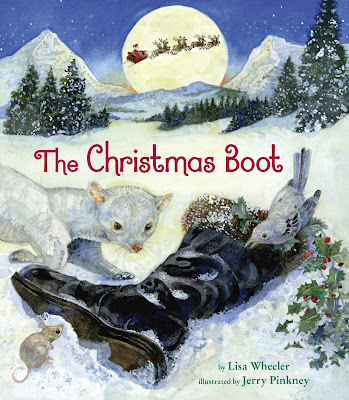
Is it the text which made a connection?  Are the illustrations such they will cause a sensory experience?  Is it a beautiful blend of narrative and images?  Upon first reading The Christmas Boot (Dial Books for Young Readers, Penguin Young Readers Group, an imprint of Penguin Random House LLC, October 18, 2016) written by Lisa Wheeler with illustrations by Jerry Pinkney I was visibly moved.  You will be too.

Deep in the forest on Christmas morning, Hannah Greyweather gathered bundles of kindling wood.  For her, this day was no different from any other.

Hannah has adapted to her aloneness by chatting out loud to the surrounding flora and fauna.  They, of course, are silent in their replies to her commentary.  Arms full of wood; she spies something out of the ordinary in the pristine snow.  It's a black boot.

It looks so comfortable and cozy she slips her left foot inside.  Compared to her feet wrapped in rags and numb with cold, this feels downright divine.  Hannah is more than a little surprised when the large boot quickly conforms to the size and shape of her foot.  Hannah cannot believe her good fortune.  As she climbs into bed that night she speaks aloud her desire for the matching boot for her right foot.

What you need to remember is this is Christmas Day.  There is a great deal of magic in the air on Christmas Day.  Hannah is shocked to see two boots next to her bed the following morning. Having warm feet as she goes about her business in the forest gives her a new outlook on life.  On this second night she chats aloud to the left boot about her wonderful good luck.  She remarks how much happier she would be with two warm mittens.

To her utter surprise a pair of mittens, one each inside each boot, awaits Hannah in the morning.  This fantastic happening has her wondering if she should wish for more; a comfy bed, delicious food and a large home.  She does not but goes outside to gather some chestnuts.  She is so thrilled with her warm feet and warm hands; she makes a snowman before setting off for home.

What she sees in place of her humble house is astounding.  Inside the sights are even more remarkable.  As nice as all of this is, something feels a little strange to Hannah.  While she is thinking about this, there is a knock on her door.  Her visitor believes she has something belonging to him.  After an evening of conversation, he winks and leaves her with two gifts and an even more welcome surprise in the morning.


There is a specific storytelling rhythm established with the writing of Lisa Wheeler in this book.  It connects Hannah to her surroundings and us to Hannah.  With each of her observations said aloud, Wheeler has a reply:

The mountain didn't answer.
The forest remained silent.
The walls did not reply.

This technique reinforces Hannah's aloneness setting the stage for the final two surprises.

Wheeler's mix of dialogue, mostly Hannah talking out loud, with the narrative also contributes to the story's pacing.  We feel a genuine relationship developing between us and this woman.  Here are two consecutive passages. (only a portion of the second one)

"Glory be!" Hannah said to the right boot.  "How did you get here?"
The boot didn't say.
Then Hannah Greyweather placed both her feet into those warm black boots.  They fit most comfortably.

As she went about her wood-gathering, Hannah had a spring in her step that hadn't been there for years.  She danced in the spruce grove, skipped along the creek bed, and even made snow angels on the hillside.


How is it that every book illustrated by Jerry Pinkney causes you to feel like you are holding a living, breathing marvel in your hands?  Upon opening the matching dust jacket and book case readers are greeted with an entire winter wonderland scene which extends to the edge of the flaps.  Notice the shifts in perspective from the close-up of the boot with the holly draped over the top and the animals curiously looking at it and then to the mountain in the distance with Santa Claus in his sleigh and his reindeer crossing in front of a full moon.  To the left, on the back, the body of the weasel continues.  A snowy white hare watches from the bottom.  Toward the top tucked in among the spruce trees is Hannah's tiny, one-room home, lights glowing from the windows.  One of the shades of blue from the jacket and case covers the opening and closing endpapers.

In a beautiful snowy scene with Hannah leaving her home for wood-gathering, footprints marking her path, the title, author, illustrator and publisher text has been placed.  Rendered in

pencil, Prismacolor pencils, and watercolor on Arches cold press watercolor paper

the illustrations are stunning in their eloquent detail.  The lines and brush strokes convey the crisp chilly air, the silence of the soft snow on boughs and branches, the sound of birds chirping greetings and Hannah's breath making fog and her voice ringing out wherever she may be.  In each picture outside there are animals with Hannah.  They feel a kinship with this woman of their world.

The interior of her home conveys the simplicity of her life; cooking over an open fire, a bucket of water nearby, light from a kerosene lamp, a bed made of birch branches and homemade quilts to keep Hannah warm at night. The patterns on all her clothing are bright, cheerful and intricate.  Hannah's face is lined with life.  The depictions of the animals are so real you expect them to leave the page and join you.  Jerry Pinkney alters his image sizes from double page to single page to two pictures together on a single page or a smaller picture inserted in a large visual.  Every page turn is a delightful surprise.

One of my many favorite (I love all of them.) illustrations is wordless.  It covers two pages.  Hannah is lying on her back making a snow angel, laughing.  One hare is next to her right hand raised in happiness.  Another hare has its front paws on her left boot.  Birds are singing next to her left leg.  Another bird has come to rest on her outstretched left hand.  The weasel is watching from the far right-hand corner.  This is true, pure bliss.


If you are looking for a new Christmas book for your personal or professional collections or to give as a gift, I highly recommend The Christmas Boot written by Lisa Wheeler with illustrations by Jerry Pinkney.  This is a title to be treasured for years and years to come.  And I promise you the ending will cause you to sigh or shed a few tears.  Please share this book repeatedly.

To learn more about Lisa Wheeler and Jerry Pinkney and their other work please follow the links attached to their names to access their websites.  You can get a sneak peek at the inside at the publisher's website.  This title is celebrated at PictureBookBuilders with an interview of Lisa Wheeler.  Enjoy the book trailer.

Friday, August 26, 2016

On Shimmering Wings

It is said seven or was it twelve were invited to celebrate the birth of a child; an eighth or perhaps a thirteenth was overlooked.  Good things were gifted to this princess except for one, an evil curse not to be undone.  It is also said there was another girl, in another story, an orphan except for a harsh stepmother and two nasty stepsisters.  In the moment of her greatest sadness a special one appeared to offer her riches beyond her dreams.

There might be a reason these stories dating back hundreds of years, though called fairy tales, rarely have these creatures in them.  Possibly the explanation is fairies are everywhere.  A Fairy Friend (Christy Ottaviano Books, Henry Holt and Company, May 10, 2016) written by Sue Fliess with illustrations by Claire Keane is a vision of possibility.

There are fairies in the sky.
All around you, fairies fly,
Flit and flutter, tumble, twirl,
When the wind blows, fairies swirl...

Fairies are indeed about in the fields and forests.  If gazing out a window in the evening they can be seen racing past, astride their faithful steeds...dragonflies.  Maybe the cool breath of air we feel brush our cheek in our dreams is the touch of a winged visitor.

You can search those fields and forests for one of these tiny friends but the best thing to do is welcome them and send them an invitation.  Build them a wee cottage out of bits and pieces you find in those areas they enjoy.  Tiny twigs, feathery ferns, fragrant flowers and soft green moss are beautiful materials.

You must be sure to include a proper bed and bath by thinking small thoughts and finding small things.  What would you use for a bath or to soften a fairy's bed?  Pour love and petals into a pot to cook a favorite food.  Carry it carefully, setting it softly down and in view.

You wait, watch and approach in silence.  Your reward will be a dream comes true; hands full of happiness, lessons lifting you to new heights, safety and cozy comfort.  As with all things loved, they need to be free.  But remember...the joy in a return is worth the time apart.


There is a lively, light happiness in the words selected by Sue Fliess  Her use of rhyme and alliteration has woven belief into the fabric of this story.  Each two line phrase hums a musical cadence of magic.  Here are two more sample passages.

Wings of fairies shimmer, spark,
Twinkle, glimmer in the dark.
Shiny spots or wisps of light
Could be fairies in your sight.


As soon as you touch the heavy dust jacket you start to marvel at the eloquence of this book.  On the front and back of the dust jacket the majority of the images are embossed.  The title text and the main illustration on the back are done in foil.  Shiny spot varnish is used on the center picture on the front.  Without even opening this title it is a magnet for those wanting to read about fairies.  (The book case matches the jacket without the varnish, embossing and foil.)

On the opening and closing endpapers in soft, natural colors four smiling fairies are enjoying themselves among leaves, branches and flowers.  There might be some fairy dust floating about them too.  Across the dedication and verso page a fairy swings leaving tiny petals in her wake.  On the title page the young girl is seated in a tire swing as her canine companion watches.

The pictures, rendered in watercolor and Photoshop by Claire Keane, create dream-like visions, delicate and flowing.  Some spread across two pages, others are on single pages and several single pages hold groups of three or two images.  All the illustrations are loosely framed in soft, brush strokes.  The expressions on the girl, her dog and the fairies are full of pure merriment.  There are subtle hints of humor when the dog seeks and sees the fairies before the girl does.

One of my favorite illustrations is the first one in the story spanning two pages.  Our perspective is that of the fairies playing among the tree tops.  Beneath the fairies the girl, wearing a backpack and carrying a net, is strolling in search of fairies.  Her dog, walking behind her, looks up at the tree tops spying the playful beings.  On the right-hand side in the upper corner we can see the girl's home.


Anyone who reads A Fairy Friend written by Sue Fliess with illustrations by Claire Keane will be searching outside for tiny twigs, feathery ferns, fragrant flowers and soft green moss as soon as they finished the final word.  Eventually you may find a fairy residing in your newly built home or a friend of a fairy from the nearby fields or forests.  One copy in your classrooms and libraries will not be enough.  This little treasure will rarely be on the bookshelves.

To learn more about Sue Fliess and Claire Keane and their other work please visit their websites by following the links attached to their names.  On Claire Keane's website you can view interior images from this title.  She also maintains Tumblr pages.  Sue Fliess wrote a guest post about this title for Scholastic's Ambassador of School Libraries John Schumacher's blog, Watch. Connect. Read. There is a different interior image to be seen at the publisher's website.

Friday, August 19, 2016

The Power Of Three

For those taking the time to look, patterns of three can be found repeatedly in our collective cultures, its literature and religion.  Every living thing has birth, life and death.  Time is measured in the past, present and future.  Stories have a beginning, middle and an ending.  In nursery rhymes there are three little kittens, three blind mice and three bags of wool.  We have listened to and read the tales and an assortment of variations of Goldilocks and the Three Bears, The Three Billy Goats Gruff and The Three Little Pigs.  Characters are given three guesses and three wishes.  How often have we heard the third time is the charm?

For readers who have great affection for characters and their story lives, the most wonderful use of the number three is the word trilogy.  To know, in spite of the wait, two more books in a fictional world formed in the mind of an author will follow is sheer bliss.  In 2013 author and illustrator Aaron Becker introduced us to the enchantment found in his wordless 2014 Caldecott Honor book, Journey (Candlewick Press).

The story in book two, Quest (Candlewick Press, August 26, 2014) begins on the title page.  The girl and the boy she met in Journey are continuing to ride a tandem bicycle they drew using her red marker and his purple marker.  Seeking shelter beneath a bridge during a rain shower, they are asked by the King of Pallonezia, who steps through a doorway, to assist in saving him and his kingdom.  Following a map, they travel to particular prominent points in other lands gathering pieces of light which hold a promise.  Their success is a crowning achievement for them and their companion, a purple phoenix.

Readers' patience was rewarded with the release of Return (Candlewick Press, August 2, 2016) conceived and illustrated by Aaron Becker.  This third wordless volume is as fascinating as the previous two.  It is a more intimate and moving conclusion than Journey or Quest; the completion of a circle.


As in the first book, the girl brings her red kite and red ball to her father, who is drawing at his drafting table.  He is too busy to notice her requests.  She goes back to her bedroom drawing a red door and steps back into Pallonezia carrying the ball with her.  Later her father looks down at the floor noticing her dropped red kite.  Going into her bedroom, he sees and walks through the doorway.

In the distance his daughter's red ball is on the dock.  As a strange mechanical dragon floats by him, he steps on board.  It carries him along the waterways to Pallonezia and the platform where his daughter, the King, the boy and the purple phoenix have gathered.  Before any familial issues can be resolved, the evil emperor is revealed.

In the ensuing chaos some are able to escape due to the boy's creativity but it's only temporary before tragedy strikes again.  The inventive, quick-thinking daughter rescues a few. Cave walls tell a tale.  Wickedness arrives intent on capturing all goodness.  A trap is sprung...twice.  An artist and a daughter close a distance and step through a door of possibilities.


Whether you have read the two previous books or not, looking at the open dust jacket you are fully aware the girl carrying a red marker and a red ball has just entered an extraordinary world.  The lights and lanterns are glowing in the evening darkness as fireflies blink off and on.  You may wonder why she is wearing a crown.  You may also wonder why on the back, to the left, a crown has settled on the bottom of a sea with two fish and a seahorse wondering the same thing.  Beneath the jacket on a cloth cover of deep steel blue a kite is embossed.

The opening and closing endpapers are similar to those found in the first volume, a rich red in color with sketches of images.  These illustrations ask us to engage in activities like baseball, fishing, checkers, skating or reading. With a page turn Aaron Becker starts this story on the title page.  There are hints of events to come in this first visual of the daughter in her father's study/studio.

Rendered in watercolor, pen and ink the illustrations continue with a cutaway of the girl's home as she draws the red door to reenter Pallonezia. (I found myself comparing this picture with the cutaway in Journey.)  With a single exception all of the full or double page pictures extend edge to edge.  When Becker places several smaller vignettes on white space it is to show a quick succession of time or intensify a specific moment.  Becker's lush landscapes will have you gasping for breath either in awe of the panorama spread before you or at the tension in a situation right before your eyes.  His intricate fine lines and exquisite attention to detail will have you flipping back and forth through the pages.

One of my favorite illustrations is a close-up picture of the father on his arrival to Pallonezia.  He is standing on the dock along the stream holding his daughter's red ball.  Floating around the corner is the mechanical dragon.  Lanterns are strung from tree to tree.  Fireflies are flying through the forest.  The lights are reflected in the water.  You can feel the balmy air.  You can hear the night noises.  Your senses are shifting into high alert.


Return conceived and illustrated by Aaron Becker is a marvelous, magical adventure exploring the strength which comes from allowing our imaginations to freely explore.  Friendship, loyalty, family and love are woven throughout this final journey, quest and return to home.  It is a wonderfully rewarding read for all ages.

To discover more about Aaron Becker and the two previous titles please visit his website by following the link attached to his name.  To view interior images please follow this link to the publisher's website. The publisher has created an Aaron Becker's The Journey Trilogy Activity Kit.  The book cover premiere for this title is found at All The Wonders hosted by teacher librarian Matthew Winner.  The book trailer premiere is at 100 Scope Notes hosted by teacher librarian Travis Jonker.  Aaron Becker visits All The Wonders Podcast, Episode 277 hosted by Matthew Winner.  Aaron Becker visits KidLit TV in an interview with Rocco Staino on StoryMakers and on Ready Set Draw! Aaron Becker's Watercolor Journey.  Aaron Becker was previously interviewed at Smart Books for Smart Kids, School Library Journal, and KidLit 411.  He is the subject of a post at The Huffington Post.  Enjoy the videos.


To celebrate the release of Return the final volume in Aaron Becker's triology, Candlewick Press is giving away a copy of Journey and Quest.