Quote of the Month

When love and skill work together, expect a miracle. John Ruskin


Showing posts with label Cooking-Fiction. Show all posts

Wednesday, July 7, 2021

Grandmothers-Feeding Our Hearts And Our Bodies

Last evening a character, a grandfather, in a story was complaining repeatedly about getting old.  He did not have one good word to say.  Everything was wrong about adding years to your life.  By the time the adventure he, his lifelong friend, his grandson and his grandson's friends shared was coming to an end, he remarked to his grandson about the grave error in his previous thinking.  He realized getting old was a gift.  It is one of the best gifts of all best gifts.

This change in perspective which many elders hold dear and live as a truth allows them to relish their neighbors, friends, and family.  For many of them, this joy is expressed in the art of cooking.  Dumplings for Lili (Norton Young Readers, an imprint of W. W. Norton & Company, June 1, 2021) written and illustrated by Melissa Iwai is a story of one granddaughter, many grandmothers, and the search for specific ingredients.  Which dumpling is the best?

It's a special day
when Nai Nai says:

Lili, do you
want to help
me make
baos?

These delectable delights are Lili's favorite food.  Her grandmother has passed to her granddaughter eight secrets in making them taste scrumptious. Side by side they work until a startling discovery is made.  There is no cabbage to help with the eighth secret.  

Lili rushes to Babcia, another grandmother, who lives on the sixth floor to borrow cabbage. Unfortunately, the elevator is out of service.  She and her pooch pal, Kiki, run up the flights of stairs.  Babcia does have cabbage, but she is out of potatoes for making her pierogi.  She makes a request of Lili.  Down she and Kiki go to the second floor.  

Once there, Granma has potatoes by lacks an item for her recipe.  Up and down the stairs Kiki and Lili go from one grandmother to another, receiving and giving necessary food elements for each of their delicacies.  She and Kiki are exhausted.  Finally, they are back with Nai Nai.

Later, six grandmothers and Lili meet outside, each bringing a version of their dumpling dishes.  It is a gathering of goodness, for hearts and bodies.  And yes, dear reader, one more dumpling makes an appearance, a seventh dumpling.  It is another of the best gifts of the best gifts.


Like blending the elements in a recipe, author Melissa Iwai combines narrative and conversation to welcome readers to go on this journey of culture, language, and cooking with Lili.  The secrets are interlaced in the story flawlessly.  Word choices convey the lively spirit of Lili, Kiki, and the beloved grandmothers.  Here is a passage.

As Kiki and I are about to leave, she says, "!O, cielos!
I'm out of cumin! How will I finish my tamales?"

I remember that Nonna on 3rd floor has lots of
spices in her kitchen.  "Don't worry, Abuela," I say.
"Kiki and I will go ask Nonna for cumin!"


The first hint readers have of the happiness found in the pages of this book is on the open and matching dust jacket and book case.  On the front, we meet Lili framed in shades of green flora as she inhales the wondrous odor of the cooked baos.  Around those we see dumplings representing food traditions from other countries. 

To the left, on the back, the spring green hue continues, covering the entire surface.  Dancing in the center are Lili and Kiki.  Kiki's front paws are being held by Lili, as the dog balances on its hind legs.

On the opening and closing endpapers, a culinary bliss greets readers.  Placed on a canvas of pale blue are recreations of six kinds of dumplings in an enticing pattern.  They are labeled in white, fatayer, ravioli, bao, pierogi, tamale, and Jamaican beef patty.

On the initial title page, two bao, one with a missing bite, are featured.  A two-page illustration, including the apartment building on the left with the grandmothers and Lili in windows, is displayed for the formal title page.  Pigeons roost and fly around the homes.

The images in this book rendered in watercolor and layered digitally by artist Melissa Iwai are a visual gallery of diversity.  Through her research, elements representing each culture are included in the depictions of each grandmother's home.  The details ask readers to pause at each page turn, noticing what is on the shelves and the walls.  Many of the significant words are shown in speech bubbles. 

The pictures vary in size from double-page images to a group of smaller illustrations on a single page, and single-page pictures, with and without framing.  These, along with different perspectives, enhance the careful pacing.  Readers (this reader) will especially enjoy the large double-page image mapping Lili's adventure up and down the stairs of the six floors.  It reminds us of names and dumplings.  Careful readers will also note the passage of time by looking at the various clocks on the walls.  

One of my many, many favorite illustrations is that of Nai Nai tying the back of the apron on Lili.  There is something loving and intimate about this action between a grandmother and her granddaughter.  It is a single-page picture.  We are close to the duo.  The colors in Nai Nai's clothing and glasses are reflected in the fruit on the pockets of Lili's apron.  Kiki is seated and watching near the kitchen table.  Tools needed for the making of the baos are placed on the table.


For a commemoration of food, grandmothers, friends, family, and an array of cultures, Dumplings for Lili written and illustrated by Melissa Iwai is an exceptional selection.  Through her writing and artwork, it is a sensory experience, one we would gladly duplicate.  At the close of the book, two pages are dedicated to Nai Nai's Baos.  There we can use ingredients and secrets to make our own baos.  Melissa Iwai's delicate drawings show us exactly how to fold the dumplings.  I highly recommend this title for both your professional and personal collections.

To learn more about Melissa Iwai and her other work, please visit her website by following the link attached to her name.  Melissa Iwai has accounts on Facebook, Instagram, and Twitter.  This book and the writing and illustrating process are showcased at Kathleen Temean's Writing and Illustrating, Jama Rattigan's Jama's Alphabet Soup, and librarian, collegiate lecturer, and writer John Schumacher's Watch. Connect, Read.  At the publisher's website you can preview portions of the book.


Tuesday, June 9, 2020

A Titan-Type Of Tale

Tales told from generation to generation take on a life of their own.  They are embedded in familial traditions.  They are the threads binding all the members into a single woven tapestry.  Most, upon examination, are based on truth or the possibility of truth.  They are universal with respect to taking what seems to be ordinary and having it transform into something wondrous.

This shift is the power of storytelling, enveloping all who listen.  Octopus Stew (Holiday House, August 17, 2019) written and illustrated by Eric Velasquez is a story brimming with anticipation as soon as you look at the jacket and case.  Each page turn heightens the readers' awareness of something fantastical about to happen.

When Grandma saw my painting of Super Octo, she got the idea to make pulpo guisado, octopus stew---not exactly my favorite dish.

A small question asked by the boy, Ramsey, was quickly rebuffed by his determined grandmother.  Later he had to relinquish his superhero cape to accompany her to the store to purchase an octopus for the stew.  He took lots of pictures of the fish on display.  His grandmother bought the largest octopus.

As they proceeded to the cashier, Ramsey tried to tell his grandmother an important fact he located online about octopuses, using his phone.  She was not interested.  At home Grandma prepared the octopus, putting it in a pot to boil.  Ramsey avoided the entire process.

Later when Grandma came to join Ramsey in the living room, the duo heard weird sounds from the direction of the kitchen.  The noises grew louder and louder.  When Ramsey and his grandmother stood in the doorway to the kitchen, they were shocked by the sight which greeted them.  The octopus was enormous.  It was outside the pot.  It was alive!

Hiding and thinking with speed reserved for heroes, Ramsey put on his cape (and one on his perro), raced to the kitchen, held forth an object and made a loud demand to the octopus holding his grandmother.  At this point the tale takes one of two surprising twists.  Each conclusion relies on the reader's capacity for stepping into the unexpected with their eyes wide open.


As soon as the story starts, the personalities of Ramsey and Grandma are revealed through the narrative and their dialogue.  This technique, of blending text and conversation, used by author Eric Velasquez enhances the intimacy of the story for readers.  Using a mix of Spanish and English plus sound effect selections takes readers farther into the experiences of the boy and his grandparent.  Careful choice of words builds the suspense readers feel until they are faced with not one, but two, startling revelations.  Here is a passage.

Then Grandma came to sit with me while I did my
homework.  All of a sudden, strange noises started to
come from the kitchen.
Blimp, Blump, Brr, Blimp, Blump, Brr.
"Que sera eso? What could that be?" Grandma 
asked.  "Ramsey, quedate aqui.  Voy a ver. Stay here."


One look at the front of the matching dust jacket and book case and readers know they are in for an amazing adventure.  Chana, Ramsey's dog, Ramsey, and Grandma are astounded by the sight before them.  Hints of what they are seeing are behind them like steam on the blue canvas.  Grandma's arm and open hand held in front of Ramsey for protection are a sign of her affection for him.

To the left, on the back, on a lighter shade of blue, rows of fish, as seen at the market, are arranged along the bottom. On the opening and closing endpapers Eric Velasquez has placed a bright yellow background.  Vertical rows of white circular shapes like those found on an octopus are shown.

These illustrations rendered

in oil on Fabriano 300 lb. hot press watercolor paper

are rich and realistic.  Bold full-color images, highly animated, are spread across double pages or on single pages framed in a white border.  At times to enhance the pacing two smaller pictures are included on a single page.  For a highly dramatic effect a large, nearly full-page picture is laid on a double-page visual.  At a turning point in the narrative a wonderful, four-page gatefold will leave readers gasping.  The facial expressions on the characters heighten every moment and mood.  You'll find yourself completely captured by their story.

One of my many, many favorite illustrations spans two pages.  On the right-hand side Ramsey is leaning out from behind his grandma.  His dog is leaning to the left of and behind him.  Grandma is standing, legs spread apart with one hand to her heart and mouth wide open in the doorway to the kitchen.  On either side of the doorway are the bright yellow walls of the kitchen.  The refrigerator is on the far left.  The floor is a rusty red tile.  Stretching from the top on the right to the far left are two gigantic octopus legs with the huge suckers visible.  A large

Thump!

is above one leg as it strikes the refrigerator.  The lid to the pot is on the floor.


From the minute you look at this book, you know you're about to enter into something marvelous.  Octopus Stew written and illustrated by Eric Velasquez is the best kind of storytelling, leading you into the extraordinary with two stunning twists.  Oh, this book is a superb title for sharing repeatedly, one-on-one or with a group.  I highly recommend it.  At the close of the book is a splendid author's note and a glossary of non-standard Spanish Eric Velasquez says was spoken in his home. 

To learn more about Eric Velasquez and his other work, please follow the link attached to his name to access his website.  Eric Velasquez has accounts on Facebook, Instagram and Twitter.  You can learn more about Eric Velasquez in an interview at the Center for the Collaborative Classroom. A poster is available to download at the publisher's website.   At another publisher's website you can view interior images.  School Library Journal interviews Eric Velasquez during a Facebook live event about this book.

Friday, August 31, 2018

Seasonal Success

Central locations, streets and parks, are gathering spaces for plentiful produce.  Rows of white-tented booths are bursting with fruits, vegetables, fresh-baked breads and pastries, honey and flowers.  All the hours, days and weeks of work are spread before browsers and shoppers alike.

There is nothing quite like the farmers' markets in August.  In our local area there is at least one for five days of the week.  Some communities have markets twice a week.  Summer Supper (Random House, May 8, 2018) written by Rubin Pfeffer with pictures by Mike Austin is a spirited salute to those who plant in the spring and relish the results in summer.

Shovel soil.
Sow seeds.

With each page turn following the initial text, actions of the families farming and gardening are told through words beginning with the letter "s".  In each accompanying illustration other "s" words label elements in the scene; a word like string, sticks, or sun.  In order for those seeds to grow water adds moisture to the dirt.

Sprinkle, sprinkle.

Soon bits of green are seen, getting taller and taller.  Color bursts forth in the form of flowers, fruits and vegetables.  A shape stands tall among them, guarding the garden.  You're doing a stellar job, Mr. Scarecrow.

In time those fruits, vegetables and flowers are picked and placed like a vivid still life on tables for buyers to see.  As the day begins to end a family gathers in the kitchen preparing, simmering and mixing ingredients.  A group gathers around a large table for an outside supper.

As the sun drops below the horizon the families, now full of home-grown food, make musical memories.  Later many hands share in kitchen clean-up.  There are bedtime rituals and one typical, final surprise beginning with the letter "s", of course.


One of the first things readers will do after reading this book is take a deep breath and wonder how Rubin Pfeffer thought of all these words beginning with "s".  Then they will think of all the fun he must have had searching out these words and how clever he is to have successfully linked them together for this story.  The alliteration supplied by the short, succinct sentences creates a spirited cadence.  Here is another sentence.

Sizzle, swirl, swish, SAUTE!


The soothing golden yellow canvas with hints of green on the matching dust jacket and book case provide the perfect glow of a summer's day highlighting the bounty of fruits, vegetables and flowers carried by the barefoot boy.  It continues over the spine and to the left, on the back, as cornstalks and blossoms frame the words

SEE
SUMMER
SUPPER,
STEP
BY 
STEP!

The same boy stands on the far left of the opening endpapers, now with a hose in hand watering the soil.  Rows labeled with signs for all the "s" vegetables, fruits and flowers are displayed in bright colors.  A bluebird (happiness) watches.  The kettle the boy is holding on the front of the jacket and case becomes a placeholder for the text on the title page.

All of the two page illustrations by Mike Austin in full color present lively and animated scenes.  He alters his perspective inviting readers into each situation.  When the children and a parent are planting the view is larger. We move in a bit closer as a little girl waters the new shoots.  When a bird and chicken inspect a worm we are even closer plus Mike gives us a cross-section of the roots attached to the sprouts, shoots and stalks.

The white text is placed along the bottom of each picture within a colored band alternating between reds, shades of green, hues of blue, orange, brown, purple, pink, and maroon.  The characters' features are minimal but convey every emotion.  Readers will appreciate the mix of races shown in the images.  On the closing endpapers, Mike Austin again features the boy among a vista bursting with enlarged flowers, vegetables and fruits.  He is carrying a pea pod so big it stretches past and above his spread arms.

One of my many favorite illustrations is of the scarecrow.  Across the bottom of the page are sprightly and brightly hued daisies.  On the left and right are cornstalks and big-faced sunflowers.  On the left, poles and string hold up tomato plants. Four birds are squawking and in flight.  One has dropped a strawberry.  The scarecrow is wearing a large-checked shirt in many colors.  Red gloves are his hands.  He is smiling from cheek to cheek.  On his head, over his straw hair, is a baseball cap.


For a unit on farming, gardening, seeds, summer, food, families, alliteration or simply for fun, Summer Supper written by Rubin Pfeffer with pictures by Mike Austin is superb.  Readers and listeners alike will savor the sounds made by the words and feel the happiness in all the images spread throughout their collective souls.  I highly recommend this title for your professional and personal collections.

To learn more about Rubin Pfeffer and Mike Austin and their other work, please follow the links attached to their names to access their websites.  Author Johnell Dewitt features Rubin Pfeffer in his role as literary agent on his site.  At the publisher's website you can view interior images.

Tuesday, October 31, 2017

Food For Body and Soul

Many believe cooking to be an art form as well as a labor of love.  Regardless of how simple or complex the dish being prepared is, the quality of the ingredients contributes to the sensory results; the way it looks, smells and tastes.  No two people, even when following the same recipe will achieve the same outcome.  Not everyone knows about the secret ingredient.

With the winds howling outside here in southern Michigan and the promise of rain and possibly snow in the air, there's no better time to create comfort food in the kitchen.  A little more than seven years ago, author illustrator Melissa Iwai gave us Soup Day (Christy Ottaviano Books, Henry Holt and Company, September 28, 2010).  In this title a little girl and her mother venture out from their apartment in the city into the snowy weather to visit the local market.  Once there they select the vegetables with the most vibrant colors and appropriate shapes, vividly described for readers.

Home again the vegetables are cleaned and chopped into particular shapes; squares, circles, and cubes are placed in the pot to saute.  Step by step a story of cooking and playful waiting unfolds.  Upon the arrival home of the father in the evening, the three sit down to a dinner of homemade soup topped with confetti made of parsley.  The title closes with the inclusion of the Snowy Day Vegetable Soup recipe.


Today, October 31, 2017, Halloween, readers receive another treat, the release of Pizza Day (Christy Ottaviano Books, Henry Holt and Company) written and illustrated by Melissa Iwai.  Just the mention of the word pizza brings to mind memories of shared meals with friends and family as slices of this deliciousness are happily consumed.  In this companion title to Soup Day a boy and his father work and play together to prepare a pie uniquely their own.

Today is pizza day.

Excitement and summer sunshine are in abundance as a little boy and his father gather tools and a basket for a visit to the garden outside their home.  The family dog, Caesar, runs along beside them.  The results of their sowing seeds earlier in the spring are visible; plants filled with tomatoes, peppers, carrots, onions and basil.  Specific amounts of each are collected, carried inside and cleaned.

Next the two work to make the dough for the crust.  After the ingredients are measured and mixed in a large bowl, the real fun begins.  The gooey concoction, placed on a hard surface, is punched and pulled by hand until it's smooth and shiny.  Back in the bowl and covered, it rests so it can rise.

Vegetables from the garden are mixed to make a sauce now simmering on the stove.  While the dough and sauce transform into delectable delights, the father and his son join Caesar outside for games real and imaginary.  Before they know it, it's time to complete the pizza.

The dough, puffy and full, is rolled into a round on the pan.  The sauce, rich and thick, is poured into a blender and then on top of the crust.  The next layer is other sliced vegetables and this is topped with grated cheese.  Into the oven this piece of scrumptious perfection is placed.  As the twosome pick up outside, mom arrives home.  It's pizza picnic time!


In this and the previous title, Melissa Iwai makes with her words the adventure mixed with a bit of magic cooking can and should be.  Her simple initial statement declares the beginning of a promise.  When the duo are in the garden the amount of vegetables picked are named along with descriptive adjectives and verbs;

Five juicy red tomatoes plucked from the vine.

Moving into the kitchen the listing of the ingredients as the dough and sauce are made generates anticipation.  The two, the dough and the sauce, are tied together with the comparison of sleeping and waking and the boy's whispered words.  Warmth and naturalness are added to the experience with the inclusion of playing outside, putting away the tools and toys and the cleaning of the dog.  What makes this story accessible to all ages is the first person, the boy's, point of view.  Here are several sample sentences.

I mix it all together with a wooden spoon.
It turns into a big, sticky, squishy lump. (page turn)

Daddy dumps 
the dough onto
the board.


When you look at the front of the dust jacket (I am working with an F & G.  My copy has not arrived yet.) you can almost smell the aroma of the pizza wafting into the air in the shown swirls.  The expression on the boy's face leaves no doubt as to his thoughts.  The details Melissa includes, the toppings on the pizza and the freckles across the boy's nose and cheeks, add to the realistic charm.  To the left, on the back, within an oblong frame like a recipe card is an introduction to the book.  A small watering can, rolling pin, tiny twig of basil, several tomatoes, a grater and cheese are pictured.

The opening and closing endpapers are patterned in scattered tomatoes, basil and mushrooms on first a cream and then a spring green background.  Across the verso and title pages on a canvas of crisp white are a sprinkling of gardening and cooking tools and ingredients.  Rendered in acrylics, collage, Adobe Photoshop and Adobe Illustrator the illustrations may span two pages, edge to edge, single pages with loose frames surrounded by liberal white space or a series of smaller images to portray the passage of time.

The bright, full color images are bursting with energy.  Each scene supplied with elements full of the everyday radiate the affection shared by all the family members including Caesar. A towel hanging over the kitchen sink, a vase of sunflowers sitting on the window ledge, an open cupboard of kitchen tools and ingredients in view, Caesar jumping up and licking the boy, pots and pans hanging from the ceiling, rubber boots, one laying on its side, near a rug by the door and a calendar attached to the refrigerator are seen as the dad says goodbye to his wife leaving for work.  This first picture is followed by others of similar and varying perspectives.  We might be at the boy's level as he picks tomatoes within the garden or see the family gathered around the picnic table eating the pizza from a slightly above angle.  Singing off of every single page is the happiness of this entire day seen on the faces of the characters.

One of my many favorite pictures is when the boy is in the garden.  It is a two-page picture.  On the left he is kneeling in the dirt with the tomato vines replete with their fruit making a green wall around him.  He is wearing a blue and white striped shirt, blue overalls and red tennis shoes.  To the right crouched down on his front paws, tail wagging in the air, is Caesar.  He is sniffing the lettuce.  Identifying stakes are sticking up for tomatoes and peppers.


Pizza Day written and illustrated by Melissa Iwai is a scrumptious story with a tasty resolution.  Every reader will want to have a pizza day as soon as possible.  This title is sure to inspire and encourage gardening and cooking together.  The secret ingredient is love which radiates throughout this book.  At the end Melissa include a two page recipe for the dough and sauce as well as a step-by-step set of instructions complete with an Anatomy of Pizza.  You will want to make sure you have a copy on your professional bookshelves and in your personal collection.

To discover more about Melissa Iwai and her other work, please take a few moments to visit her website by following the link attached to her name.  On her blog she has a post talking about this title.  She maintains an account on Instagram which you will enjoy.  At the publisher's website you can view interior images including one of my favorites.  A teacher's guide and activity guide are also available there.  At Scholastic's Ambassador of School Libraries, John Schumacher's blog, Watch. Connect. Read.he and Melissa chat about Pizza Day and libraries.  Just before I clicked Publish on this post, I checked the blogs I have listed that I check every single day.  I was delighted to see this title featured at Jama Rattigan's Jama's Alphabet Soup.  You must go there to read her review and interview with Melissa Iwai.  Melissa Iwai is also a guest on All The Wonders, Episode 399 chatting with teacher librarian Matthew Winner.  Be sure to watch the book trailer.

Tuesday, December 29, 2015

Seasons Readings-A Trio Of Treats

Thirty years ago graphic artist Mary Engelbreit issued a poster with text reading

a book is a present you can open again and again.  

The saying is attributed to Barry Liebman, an owner of Left Bank Books at the time, located in Saint Louis, Missouri.  The poster was designed for Left Bank Books.  In all these years the popularity of the phrase and its meaning has never waned.  This is due, in part, to the veracity of the statement.

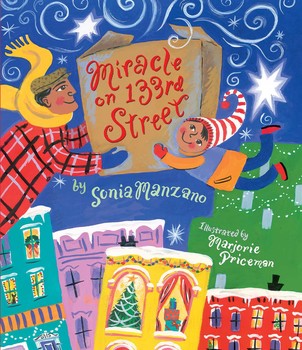
Christmas 2015 has come and gone but there are three titles yet to be highlighted on this blog which celebrate the spirit of the season.  Each is a gift to be cherished whenever the book makes its way into the hands of a reader whether it's the first time or the hundredth time it's been read. The first, Miracle on 133rd Street (Atheneum Books for Young Readers, an imprint of Simon & Schuster Children's Publishing Division, September 22, 2015) written by Sonia Manzano with illustrations by Marjorie Priceman, focuses on food and a definition of family.


Jose was decorating the tiniest Christmas tree ever.  It was practically a twig---and what was he supposed to do with the leftover ornaments anyway?

A shout from the kitchen has both he and his father, also named Jose, rushing to the room.  His mami is also lamenting the smallness of living in an apartment in New York City and the size of her oven.  She wishes she was back in Puerto Rico.  When Jose jokingly says they need a pizza oven for the size of her roast, Papi agrees.

The two, Jose and his papi, bundle up and place the roast in a large box.  As they move through the building down to the street, their neighbors are not exactly spreading holiday cheer either.  One has children home on vacation who are irritating her into a frenzy, an older couple are sad their children will not be visiting, Mr. Franklin is certain they are not thinking straight to leave the building this time of year, money woes, and shopping stress are expressed by others.  Outside children are enjoying the snow or cranky about having to shovel it.

Mr. Ray is happy to share his oven at the pizzeria.  Jose gazes at the large Christmas tree in his shop and falls asleep waiting for the meat to cook.  Within seconds of Papi waking him up, Jose is cast under the spell of the smell filling the room.  Mami's combination of ingredients is marvelously magical, boosting him and his mood.

On their journey back to the apartment, accompanied by an invited Mr. Ray, stars hang like lamps in the dusky sky.  The trio nearly floats along, the bouquet weaving around others, inspiring good will.  As they travel up the stairs, doors open, moods shift, guests gather and a Christmas miracle descends.


A blend of narrative and dialogue by Sonia Manzano raises awareness in readers of what the season might be for many of us.  We can choose to emphasize what might be wrong or recall the sensations of Christmases in the past and those in the present to lift us up so we can help others.  Page by page Manzano uses this story to increase the lightness felt in the soul of her readers.  Here is a sample passage.

Then she sniffed the air, paused, and turned back.
"Well, it is a beautiful tree.  And just the right size," she said.
And then the aroma formed a halo around Mr. Happy's head and he said, "Oh, just take it, no charge.  It's Christmas Eve."
Jose and his father looked at each other, then continued on their way, weaving and wafting until they got to their building.
"Look at this...ohhh..." Yvonne took a sniff, dropped her shovel, and followed them inside.
"Wait for me!" her brother said.


When you open the brightly colored matching dust jacket and book case rendered using gouache and ink by Caldecott-honor-winning Marjorie Priceman the illustration extends to the left edge.  All the beauty of the snow, Christmas decorations and starry night mix to make us feel the same happiness felt by Jose and his papi.  On the opening and closing endpapers white swirls on rich red elevate the warmth.  Spirals in blue move across both of the title pages as Jose, Papi and Mr. Ray carry the roast homeward beneath and next to the text.  In a stroke of cleverness the verso information is in the shape of a Christmas tree on the next page and also on the following dedication page.

Nearly all the images span two pages in a flow of cheerful hues with the vivid golden yellow prevalent on all the pages along with red and orange.  The emotions attached to these shades reach out and surround readers.  The expressive gestures and facial features on all the characters make their attitude alterations more evident.  To heighten the start of Jose and his father's trip to the pizzeria Priceman makes a design change; a vertical image.

I could easily frame many of these pictures.  One of my favorites is Jose, Papi and Mr. Ray walking home after first leaving the shop.  Our focus is on the three as they cross the bridge; water to the right and the city to the left, both more in the background.  All are experiencing a form of euphoria from the odor radiating from the roast as it is carried.  Stars and spirals dance about them.

Miracle on 133rd Street written by Sonia Manzano with illustrations by Marjorie Priceman is a classic tale of Christmas joy dispersed by the memories a smell conjures in the minds of the characters.  If you wish to learn more about Sonia Manzano please follow the link attached to her name to access her website.  At the publisher's website five interior pages are shown including my favorite.  Jama Rattigan exuberantly speaks about this book at Jama's Alphabet Soup. Julie Danielson, author, reviewer and blogger, also talks about this title at Seven Impossible Things Before Breakfast.

I was thrilled when Marjorie Priceman graciously agreed to answer some questions about this book.

What influenced your color palette for the story and for Mami’s memories?

The color palette for Mami's memories is meant to evoke the warmth and sunshine of Puerto Rico in contrast to the icy cold New York winter. 

Did you have a particular street in mind when you created Jose’s neighborhood and apartment building?

The street where Jose lives is not actually a particular street (The title Miracle on 133rd St. was chosen long after the artwork was finished.) but an impression of a vibrant and diverse New York neighborhood with a mix of buildings, shops and people.

I really love the inclusion of a vertical picture.   What prompted the decision to do this in the story?

The vertical picture was a way to show all of Jose's apartment building in one spread and is something I like to do as a surprise for the reader.

What is your favorite smell you associate with Christmas?

My favorite Christmastime smell is fresh pine tree.


On the same day, September 22, 2015 Samurai Santa: A Very Ninja Christmas (Simon & Schuster Books for Young Readers) written and illustrated by Rubin Pingk leaped onto the children's literature scene.  It zips and zings with a lively cast of characters.  Holiday surprises abound.

Christmas Eve was the most PERFECT snow day of the year. Yukio had never seen such BIG snowflakes.  They seemed full of magic.

Like the first snow of the season, snow falling on the eve of Christmas Day elicits excitement in young hearts and the young at heart.  Yukio is hugely disappointed to see no one else outside to participate in what he hopes will be an EPIC snowball fight.  None of his ninja companions dare participate, especially on this night, for fear of appearing on Santa's naughty list.  

In Yukio's mind Santa is spoiling his fun.  He, unlike his friends, does not care about the consequences.  This ninja wants an EPIC snowball fight.  The only way this can happen is to rid Ninja Village of jolly old Saint Nick.  

Cautiously, carefully, Yukio waits and watches as Santa goes about his business.  In the quiet of the night a loud large gong sounds as the ninja shouts 

"INTRUDER!"

All the young ninjas wake up looking for this mysterious trespasser garbed in red.  He is not to be found inside or outside.  

Suddenly a SAMURAI appears on the hilltop surrounded by a very spirited group of snowmen ready for a fight...a snowfall fight.  For hours the battle rages.  As the sun rises the ninjas and Yukio realize what they have done.  Upon entering their home another shock awaits these snowball-loving young warriors.  


Short simple sentences invite readers to participate in Yukio's Christmas adventure.  Rubin Pingk uses descriptive, highly-charged words to great effect.  It's all readers can do to not jump right in and join the ninja fun.  Here is a sample passage.

All the GOOD little ninjas were asleep, but not Yukio.
Santa squeezed, slouched, slithered, and stumbled DOWN the chimney...
...while Yukio WAITED for the PERFECT moment to surprise SANTA.


A swarm of eager ninjas with Yukio in the lead in pursuit of the EPIC-snowball-fight-wrecking Santa span from edge to edge across both sides of the matching dust jacket and book case.  The limited color palette of red, white, and shades of gray is used throughout the title.  The opening endpapers and initial title pages feature rows of ninja faces mixed with snowman looks and one very special Santa and Yukio.  The closing endpapers tell a different tale.  The more formal title page and verso present a calm wintry landscape in the snowy mountains, evergreens coated in white as smoke rises from chimneys.  

Each illustrative image rendered digitally by Rubin Pingk, shifting in perspective and size, pairs with the text to create a flawless flow.  Within the narrative the use of a larger font and capital letters places emphasis on specific words also contributing to the pacing.  Anticipation grows as the pages turn.  There is not a wasted moment or movement.  

One of my favorite picture sequences is for the passage cited.  On a background of black we first see Santa climbing into the chimney within a circle of gray.  Beneath him in a smaller circle of red, Yukio waits.  To the right as Santa moves down the chimney it twists and turns like jumbled pipework before he drops, looking quite surprised.  These images, like many, are full of humor.


Samurai Santa: A Very Ninja Christmas written and illustrated by Rubin Pingk is pure fun from beginning to end.  I know everyone will want to read it more than once especially aloud.  Please visit Rubin Pingk's website by following the link attached to his name.  At the publisher's website are six interior illustrations.  My favorite is one of them.  At Scholastic's Ambassador for School Libraries, John Schumacher's blog, Watch. Connect. Read., Rubin Pingk reveals the book trailer for this title.  Don't miss it. 


Running as fast as he can The Gingerbread Man Loose at Christmas (G. P. Putnam's Sons, an imprint of Penguin Group (USA), October 13, 2015) written by Laura Murray with illustrations by Mike Lowery races toward readers.  Christmas is coming.  The Gingerbread Man, his teacher and classroom chums are busily working like elves.

 One white snowy morning, I popped from my bed.
My teacher was calling.
WAKE UP,
SLEEPYHEAD!

She is announcing to the class a plan to

make, say, or do

something unique for people in the community.  They all put on their collective creative thinking caps.  The Gingerbread Man is making a special treat for a special someone. 

Wrapped in coats, hats, scarves and mittens they walk from school through the city streets singing songs, handing out baked goods and homemade cards.  Prominent figures in their city, a police woman, the garbage man and public librarian receive their gifts.  The dentist, grocer, and veterinarian are greeted with smiles.  Everyone is uplifted by their cheerful gestures.  

Suddenly the weather changes prompting the teacher to turn the group back toward the school.  The Gingerbread Man tries to tell them he still needs to present his present.  He's not heard.  Without another word he runs, as fast as he can, to find one special shop.  The wind and wet take a toll on our sweet friend.

Will his goodness be noticed? Cleverness gives The Gingerbread Man the help he needs.  At the conclusion he and his student buddies make merry magic for a distinctive individual.   


Readers and listeners will want to clap and tap as the words penned by Laura Murray playfully romp off the page.  Her rhymes effortlessly elicit the gladness felt by those who spread and receive gratitude.  By taking readers on a tour of the town we are introduced to those members meaningful to the students and The Gingerbread Man in their everyday lives here and in other communities.  Here are a couple sample passages.

The town was so merry! The storefronts aglow. Each window was frosted with icy snow.
We stopped a police lady, sang her a song.  She smiled really big as she waved us along. 


No matter the season, the front of the matching dust jacket and book case is sure to bring on grins as The Gingerbread Man gazes.  The toy shop window all decked out in holiday decor is brimming with glee.  On the back, to the left, The Gingerbread Man, away from the rest of the group is trying to make one final stop as the chilly wind blows.  The opening and closing endpapers, the first in green and white and the second in red and white, are labeled maps of important places in the town.  

Mike Lowery created these images in pencil, traditional screen printing and digital color.  Some are full page or cover two pages.  Many are framed like panels in graphic novels or comics.  Dialogue appears in speech balloons.  The layout and design create energy like the story.  

One of my favorite illustrations is of the town and the streets covering two pages.  At the top on the left a small image shows some of the students and The Gingerbread man ready to leave the classroom.  Residential and business sections of the community are shown and appropriately labeled.  Among the snow, several snowmen make an appearance. 

The Gingerbread Man Loose at Christmas written by Laura Murray with illustrations by Mike Lowery is a jolly journey of thankfulness with students, their teacher and The Gingerbread Man among townsfolk.  At the back of the book in a pocket is a poster.  On the back are four story stretcher activities.  For more information on both Laura Murray and Mike Lowery be sure to follow the links attached to their names to access their respective websites.  

Friday, November 27, 2015

Thanksgiving Treasures-Tradition #5

For the Thanksgiving post this year, I decided to enlarge my tradition by including books newly published in 2015.  My previous four posts focused on books published as long ago as 1994 and as recently as 2013.  Those four posts, Thanksgiving Treasures--Tradition, Thanksgiving Treasures-Tradition #2, Thanksgiving Treasures-Tradition #3, and Thanksgiving Treasures-Tradition #4, feature artists interpretations of people gathering at meals, a Shaker hymn depicted by a Caldecott award winning talent, a mother and daughter question and answer conversation about the most thankful thing, an overabundance of guests in a too-small room, a poem turned song celebrated by a notable artist, a Newbery award winning author addressing her ideas on joy, gratitude and prayer, a wish by a beloved relative and a collection of Native American poems.

The bitter cold temperatures, despite the clear blue sky and sunshine, coupled with the recent snowfall are the superb excuse for remaining inside cozy and content, chatting with family and friends, watching an old favorite movie, or reading a new book.  This national holiday, Thanksgiving Day, is a time to give our attention to those we value most.  It's a reminder of those good things, small and large, which fill our days all year.


Author Eileen Spinelli has paired with first time children's book illustrator Archie Preston to give readers Thankful (ZonderKidz, September 1, 2015).  It's a joyful expression of life's everyday moments.  Playfully presented by children we come to understand the value of an attitude of gratitude.

The waitress is thankful for comfortable shoes.
The local reporter, for interesting news.

A sister and brother are donning clothing either from a dress-up filled armoire or their parent's closet.  Admiration of footwear and a dozing cat create headlines for a grateful reporter.  Seeds poking through dirt in rows, a handy hose, words and the cadence of language and a book make for a happy gardener, fireman, poet and the two siblings.

A painter, a clown, and a doctor appreciate those things most necessary for their success.  After a day of journeying from one point to another, a hotel is a welcome destination.  A dancer and a drummer have more in common than you might imagine.

A preparer of meals, a maker of clothes, a royal ruler and a honey helper salute simple but sometimes necessary pleasures.  Votes, boats, birds and words are showcased by those who cherish them the most. Glitter and glue lead me straight to you.


We follow those hard-working people in service to others, those creative people who express themselves through the arts, those who provide life's necessities, those who govern and rule and those who follow their hearts through hobbies.  Eileen Spinelli places a rhyming word at the end of phrases one and two and starts all over again with the next thoughts.  She lifts us up with her observations.  Here is another sample.

The artist is thankful
for color and light.
The clown, for her costume
silly and bright.


The childlike wonder displayed on the matching dust jacket and book case as a boy and a girl enjoy an autumn day is an introduction to the same positive outlook seen in every illustration throughout this title.  On the back, to the left, an interior image is supplied within a loose circle on the same glowing pale yellow background.  The rich golden orange from the title font on the front is found on the opening and closing endpapers.  A page turn gives us the dedication page with a yawning cat, a personality seen in many of the illustrations. The verso and title pages begin the story of the siblings.

Their portrayal of each of the named twenty people is a splendid interpretation by Archie Preston. His visuals extend the text with charm and humor.  Many elements found in one set of pictures appear later to complete his part in the storytelling.

Loose lines, pastel hues, shading and light and use of white space help his single page, page and one-half and double-page pictures to envelope the reader in sheer delight.  One of my favorite picture sequences is for the words featured above.  The brother, wearing an artist's beret, is painting his sister posed in her ballerina costume on the arm of the sofa in the living room.  Watercolor paints are scattered on the rug and in a box.  A large container of water nearby holds a brush.  He is also holding a brush and artist's palette.  This is a single page, edge to edge, illustration.  On the following page on a background of white, the sister is looking at the finished painting.  He is looking at her with pride.  The painting is what you would expect of someone his age.  It is adorable.


Stepping back in time Sharing The Bread: An Old-Fashioned Thanksgiving Story (Schwartz & Wade Books, September 22, 2015) written by Pat Zietlow Miller with illustrations by Jill McElmurry gives readers a look at a family preparing a holiday meal.  Like integral parts on a well-balanced machine fused together with love, they work together.  We begin with Mama.

Mama, fetch the cooking pot.
Fetch our turkey-cooking pot.
Big and old and black and squat.
Mama, fetch the pot.

The pot can't do its job without a fire that's hot.  Papa brings in the wood for the stove.  Dough rises for the bread, gets punched and rises once more for loaves formed by Sister.

The eldest brother works on the cooking turkey making sure it stays moist.  Grandpa and Grandpa lend a hand with traditional treats and sweets. Mashing potatoes and pouring the cider are tasks well-suited to Auntie and Uncle.  Let's not leave out the baby who needs to stay sleeping until the feast is ready to be served.

Place mats are cut and pasted and set on the table.  Once done the younger brother gives a holler to one and all.  It's time to gather, sit and count the blessings.  It's time to reap the rewards of everyone's efforts.  It's time to share the bread.


Whether read silently or aloud the words penned by Pat Zietlow Miller roll sweetly from the printed page into your mind.  Four rhyming lines describe each activity with cheerful satisfaction.  Miller alternates her technique; three like words to one different and two like words to two different.  At the end of three tasks she binds them with another two line rhyme.  Here is another passage.

Mash. Top. Pour. (And rest.)
Food and loved ones. We are blessed.


Unfolding the dust jacket and opening the matching book case, you will feel a slow smile spread over your face as your eyes move from left to right.  The family members numbering nine (the baby is resting) stand in a row holding portions of the Thanksgiving feast ready to bring it to the table.  Rosy, ruddy cheeks and quiet smiles say more than words in this peaceful portrait of a shared accomplishment.  The colors used in the framing for the title cover the opening and closing endpapers.  Rustic red for the first and steel blue for the second; perhaps suggestive of the passage of time, a day spent in working as one.  On the title page three items of food sit upon a mirror image of the title text from the front.  The family dog is looking longingly at all of them.

Rendered in gouache on watercolor paper Jill McElmurry through painstaking research recreates vivid scenes of rooms, clothing and household items from the nineteenth century.  There is an underlying glow in all her images filling single pages, double pages or groups of three smaller illustrations.  Some extend edge to edge.  Others are loosely framed in white.

Readers will stop to seek out the inviting details within each picture; the dog and cat sharing a water dish, resting together or waiting for a bite of food, the shared looks of affection between the mother and father, the flour in the hair of the younger brother helping to make the bread, the grandfather holding the littlest brother so he can stir the berries, and the carved candle holders and high chair for the baby.  Each visual is filled with warmth and affection.  Perspectives shift to further make us feel like participants in this celebration.

One of my favorite illustrations is in the kitchen.  Several members are gathered around the stove as the turkey is being basted.  The dog's tail is thumping in pleasure; eyes closed as the odor is sniffed.  Grandmother and Mama hold pies.  The cat is resting on a top shelf.  Papa is washing dishes but manages to make eye contact with Mama.  Kitchen implements line the walls and shelves.  Soft swirls indicate the smells of home-baked bread, cooking berries, and a turkey nearly ready to eat.


It's a pleasure to recommend both of these titles, Thankful written by Eileen Spinelli with illustrations by Archie Preston and Sharing The Bread: An Old-Fashioned Thanksgiving Story written by Pat Zietlow Miller with illustrations by Jill McElmurry, for this holiday season or any time we need to remember to be grateful.  Both are most memorable in text and illustrations and inspiring in their stories.  They are meant to be shared.

To learn more about Eileen Spinelli, Pat Zietlow Miller or Jill McElmurry and their other work please follow the links attached to their names to access their websites. Here is a link to the publisher's website for Sharing The Bread: An Old-Fashioned Thanksgiving Story where additional pictures can be viewed.  A Read Aloud & Food Drive Activity Kit has been created for this title.  Pat Zietlow Miller is interviewed at Publishers Weekly.  Jill McElmurry is interviewed at Picture Book Builders.  During PiBoIdMo Pat Zietlow Miller was a guest poster on author Tara Lazar's blog, Writing for Kids (While Raising Them).  This title is highlighted at Jama Rattigan's wonderful blog, Jama's Alphabet Soup.

Tuesday, January 27, 2015

A Sweet Delicacy Travels Through Time

There is an abundance of moments brimming with calm (not to be confused with quiet), comfort and connection when people gather to share a meal.  If it's been prepared by one or more of them, it's even better.  It's almost like a dance when you work with someone in the kitchen making food for family or friends.

Some of my most treasured items are handwritten recipes from those friends and family members.  They are like Valentines, expressions of love and a willingness to share something of value.  A Fine Dessert:  Four Centuries, Four Families, One Delicious Treat (Schwartz & Wade, January 27, 2015) written by Emily Jenkins with illustrations by Sophie Blackall offers readers an opportunity to follow a recipe from place to place from time to time.

A bit more than three hundred years ago, in an English town called Lyme, a girl and her mother picked wild blackberries.

They picked with purpose but enjoyed an occasional taste as they filled their baskets. Saved cream from daily milk given by their cow was beaten with twigs gathered and bound in a bunch.  Fifteen minutes passed before the cream was whipped.

Washed with cool clean well water the berries were smashed and strained in muslin to remove the seeds.  Added sugar sweetened them before they were folded into the whipped cream.  To wait to be eaten with supper, the confection was stored near ice carefully saved inside a cellar carved within a nearby hill.  It was served to the immense satisfaction of the family with the younger cook later savoring every last taste from the bowl.

This is the pattern painted with words in which the three other places, Charleston, South Carolina, Boston, Massachusetts and San Diego, California are visited.  For each the gathering and assembling of the ingredients alters.  For each the people who enjoy the dessert changes according to the historical period in which they live.

When we move forward one hundred years, a mother and daughter again picked the berries but they were slaves on a southern plantation.  The utensil for beating improved from wood to wire as had the acquisition of the cream.  Storage prior to dinner was now inside in a specially conceived box in a basement.  The mother and her daughter hid to enjoy the last of the blackberry goodness from the bowl.

In the year 1910 a girl and her mother purchased the blackberries from a street vendor.  The cream in a glass bottle was delivered in the morning.  After a cookbook was consulted for the recipe, beaters cut the whipping time to five minutes.  Water for rinsing and storage for cooling were accessible in the kitchen.  When the time was right nothing was left in the mixing bowl.  It was licked clean.

About five years ago a father and his son went to a store to purchase the berries and the cream.  While his dad used the computer to locate the recipe, the boy whipped the cream with an electric mixer.  As you can imagine the time was considerably shorter than in 1710 and not nearly as physically taxing.  Water for rinsing and storage for cooling were modernized.  A diverse array of family and friends gathered to enjoy the meal and this Fine Dessert.  And the bowl left in the kitchen...


Emily Jenkins with the sure knowledge of a storyteller supplies listeners and readers with a guide, like an extended hand beckoning us to follow, for each of the four scenarios.  We are eager to meet the new families.  We want to know how they get the berries, cream and water.

It's interesting to see the time expended and tool used to whip the cream.   For each of the family members whipping the cream, three separate phases are delineated. Word choices vary depicting a sound.  Within three hundred years, once the Blackberry Fool is made, the means for keeping it cool are similar but much more convenient as the years pass.

What makes each of these stories more intimate is the repetition of certain acts and phrases.  The parent asking the child if they want to lick the spoon or spatula, the use of different colored dishes for serving, the

Mmmmm.  Mmmmm.  Mmmmm.

after family members eat the dessert and the final bowl licking in the kitchen or hidden from view in the cupboard.  We find ourselves looking for the changes and ties across time.


The cream color on the dust jacket, used as a backdrop for all the illustrations throughout the book, speaks to us of a shared history.  Sophie Blackall frames the first daughter with the brambles from a blackberry bush, her home in the background.  On the left of the opened jacket, the back, beginning with 1710 each child is holding a bowl of the Blackberry Fool as they walk toward the right above the appropriate dates also framed in the leaves with berries.

Beneath the dust jacket, the book case is a striking array of blackberry branches filled with leaves and ripening or ripened berries.  Small white butterflies flutter among the vines.  For the endpapers Blackall

squished blackberries through a sieve with a spoon and used the purple juice

like paint.  The title page is a swirl of leaves and berries with five circles framed to showcase the title and each of the dates with the homes.

Like Emily Jenkins with her words Sophie Blackall has formed a lovely layout depicting the expected shifts but also featuring the timeless quality of making this dessert between the generations.  Using Chinese ink, watercolor, and the blackberry juice she varies her images in size from two pages, to smaller pictures on a single page, to three images on one page showing the passage of time, to four small vignettes encased in delicate blackberry vines done in two colors, to a single page and finally to a large visual crossing the gutter to form a column for text on the opposite page.  Her fine lines draw attention to all the detail given to each home, the clothing worn by the families, and the furniture and decor in each dwelling.

The facial expressions, body movements and actions of the family members endear us to each of them.  We smile knowingly at the son giving a scrap of food to a nearby cat at the table, we join in the cheerful conversation of a mother and daughter picking berries, we can't help but giggle at the baby tugging on his sister's skirt and gaze longingly at the gathering beneath glowing jars hung in a garden as a child chases a firefly.   The matte-finished paper adds to the sensory texture of Blackall's pictures.

One of my favorite scenes is of the mother in 1910.  She is first shown reading a recipe book with the bowl and beaters in front of her on the table.  She is next using the beaters to whip the cream intent on her task.  In the final element in this image she is holding the bowl of whipped cream with the beater standing up in the bowl.  I love the expression on her face!  She's looking off the page.  You don't know if someone else has got her attention or if she is looking to see if she can sneak a taste of the cream unnoticed.


Every aspect of A Fine Dessert:  Four Centuries, Four Families, One Delicious Treat written by Emily Jenkins with illustrations by Sophie Blackall is scrumptious.  The dust jacket, book case, endpapers, interior illustrations and fascinating narrative will captivate and charm readers of all ages.  It's a delectable blend of history, family and food.  This title will be placed on my 2016 Mock Caldecott list.  Both Emily Jenkins and Sophie Blackall include wonderful notes at the book's end.

To discover more about Emily Jenkins and Sophie Blackall please visit their websites by following the links attached to their names.  Sophie Blackall chronicles her illustrative process on her blog. On the School Library Journal Curriculum Connections blog a post provides for educational extensions.  TeachingBooks.net lists numerous resources including four interviews.  At Publishers Weekly both Emily Jenkins and Sophie Blackall are interviewed about this book.  Here is a link to This Picture Book Life paying tribute to the work of Sophie Blackall. UPDATE October 23, 2015 Sophie Blackall writes a response to comments on Calling Caldecott on her blog.

I am about to clean my purchased blackberries with water running from my kitchen sink.  I will strain the berries with a spoon in a small-holed colander.  Whipping the cream with my electric mixer, I will gradually add in the sugar and probably double the amount of vanilla listed in the recipe at the back of the book.  There is no doubt in my mind I will be spooning this treat directly from the mixing bowl into my waiting mouth. Yum...yum...