For many of us entering a library, whether it's for the public, a school or even our personal collections, it supplies us with a sense of homecoming. In this space, an infinite number of stories are housed. They enrich and enlarge our imaginations. Through them we travel into the past, present, and future with greater understanding and compassion. These stories give us answers to questions while leading us to more discoveries and answers we didn't even know we desired. Armed with the truths they provide, our knowledge of our planet and its inhabitants, plant and animal, grows. Not only does our knowledge grow but so does our admiration for the complexity of intertwined systems functioning every second of every day.
For those of us who have spent most of our adult lives serving patrons of all ages in libraries, we are witness to the remarkable moments when readers are connected to the story they need or want. We not only listen to them with our minds, but also our hearts. This is how bridges are built between books and readers. When that bridge is built, when that connection is forged, something nearly indescribable happens. We see it in their eyes, their demeanor, and their body posture. It is joy. This joy is wonderfully expressed in words by John Schu and in artwork by Lauren Castillo in their first collaboration, This Is A Story (Candlewick Press, March 14, 2023). This book shows us the power of story, our stories and the stories of others.
This is a word.
SEA
That word, sea, is then shown on a page, a page within a book. That book is one of many on a shelf. It is waiting on one of many shelves in a library. (We are beginning small and keep seeing a larger view.) When we step back farther, there are people in a city, a city with that library.
Some of the people in the city are traveling to the library, seeking help, help in finding answers. That book, one of many on a shelf of many shelves, is given to a child by a librarian. So begins the reading. So begins a special connection.
There are other readers here, finding what they need and finding what they want. In the pages of the books they read, their minds keep stepping back, (like we do in the beginning of this story) enlarging what is known, imagined, and hoped. Each of these readers have something else, a valuable something else . . . hearts. Their hearts will increase in their ability to make connections in the books they are reading and in every facet of their lives.
Walking through the doors of a library is walking into a
world of reading.
Like most seeds, this world starts with the tiniest thing and the youngest person. An early interest is nurtured and encouraged to flourish. It is nurtured and encouraged to flourish through a story.
With intention author John Schu builds his narrative, his poem, from a single word. He takes us on a journey with that word until the book with that word is placed in the hands of a child by the librarian. Word, book, reader, and story create an unbreakable and lasting link.
We go from that single reader to other readers, who similarly have questions, ideas, hopes, imaginations that can blossom without limits through reading. John Schu, then, takes us back to the beginning. It is here the idea of starting small is reinforced. Word by word, they are strung together to give us a story. The final sentence he writes will resonate with every reader and every person who has brought a story to a reader.
(The text in this book is very precise. At this point I usually supply readers with a passage from the book, but I will not here. I do not want to diminish anyone's experience in reading this title.)
For every time I have seen a child hug a book, or every time I have hugged a book, for the sheer happiness that book brings, the visual on the front, right side of the matching dust jacket and book case, is pure perfection. This is STORY. The colors around the child radiate warmth. Along the bottom they mirror her love of the sea and sea horses. Her eyes are closed because that is what we do when we are overwhelmed by the joy in a moment.
To the left of the spine on a white background, the girl is carrying an armload of books, followed by her little brother. He is carrying his beloved stuffed toy cat. This is a nod to author John Schu's cat, Lou Grant.
When the jacket is removed from the case, readers get a larger glimpse of the meticulous care and exquisite details artist Lauren Castillo brings to this book. On the underside of the jacket are eleven children, from a variety of ethnic backgrounds, seated in a semi-circle reading. Our sea horse-loving girl is included. For nearly all the books, we can see enough of the jackets and cases to recognize the titles. (At this point, you might want to get your magnifying glass and start making a list of titles. I did.) One of the boys is wearing a yarmulke. Another child has a hearing aid. In bright red under this array of readers are the words HAPPY, HAPPY READING!
That same red covers the opening and closing endpapers. On the title page is an intimate scene of the little girl's father giving her a library card. For the dedication page, Lauren Castillo has created a double-page view of the father carrying his son down the stairs of their home. A cat looks out the window. Ahead of them on the sidewalk, the little girl walks carrying a sea horse kite and striped bag.
A pure white page supplies the space for the first sentence, opposite a wash of blue green for the word,
SEA. Each illustration in this title was rendered
in ink, watercolor, and pastel.
They are single-page pictures and glorious two-page visuals. We are brought as close as possible to each setting, giving us a personal, participatory experience. For the words,
This is a book on a shelf . . .
we see the book that is the focus of the first portion of this title. It is shelved with other like books, many which we can identify. (Readers will see friends here on this shelf, too.)
Just like the words of John Schu, Lauren Castillo's artwork begins small, growing and increasing our view until a double-page wordless picture features the front of the library. When we step inside that library with the girl, her father, and brother, we might gasp. Not only is a librarian looking like John Schu standing there, but along the top of the shelves are books we know and love. Again, the artwork enhances the words to the point where we believe we are there in every moment written and illustrated. With each page turn, readers are shown with or around books we have read and enjoyed. (I started to cry in the visual of a child reading the One and Only Ivan. Here Lauren Castillo has placed elements from the books above the readers' heads.)
One of my many favorite illustrations is a double-page picture. Across the top hangs a series of colorful pennants. On the right side in the background, in shades of golden orange, are three adjoining shelves outlined in darker lines. In front of them, the librarian is squatting down to be at the level of the girl. In his hands he holds the book about sea horses. The child is reaching toward it, knowing he is
connecting
her to what she wants and needs. To the right of them on the floor is the sea horse kite, its string wound around a spool.
Love of story, books, reading, readers, authors, illustrators, librarians, and libraries is tucked into every page of This Is A Story written by John Schu with artwork by Lauren Castillo. Like the child on the front of the jacket and case, readers will finish this book and hug it close. It is most definitely a heartprint book. It invites discussions about story, books, reading, readers, authors, illustrators, librarians, libraries, and favorite books. I can't imagine a professional or personal library without a copy on its shelves.
To discover more about John Schu and Lauren Castillo and their other work, please follow the link attached to their names to access their websites. At John Schu's website are two videos about this title. John Schu has accounts on Facebook, Instagram, and Twitter. Lauren Castillo has accounts on Facebook, Instagram,Twitter, Vimeo, and YouTube. The cover is revealed by author, blogger, and teacher librarian Travis Jonker on School Library Journal, 100 Scope Notes, including a chat with the creators. Through the publisher, author, podcaster, and fifth grade teacher Colby Sharp has prepared a Teacher's Guide. At The Children's Book Podcast, author John Schu and artist Lauren Castillo chat with Matthew Winner about this title. At the publisher's website, you can view an interior image. At Penguin Random House, you can view a series of interior visuals.
UPDATE: Author Erin Dealey hosts John Schu on her blog with a seven-question series about this book.
There is no sleep. Dreams are not dreamed. Wishes are not made. No day is complete or concludes without it. What is this priceless phenomenon?
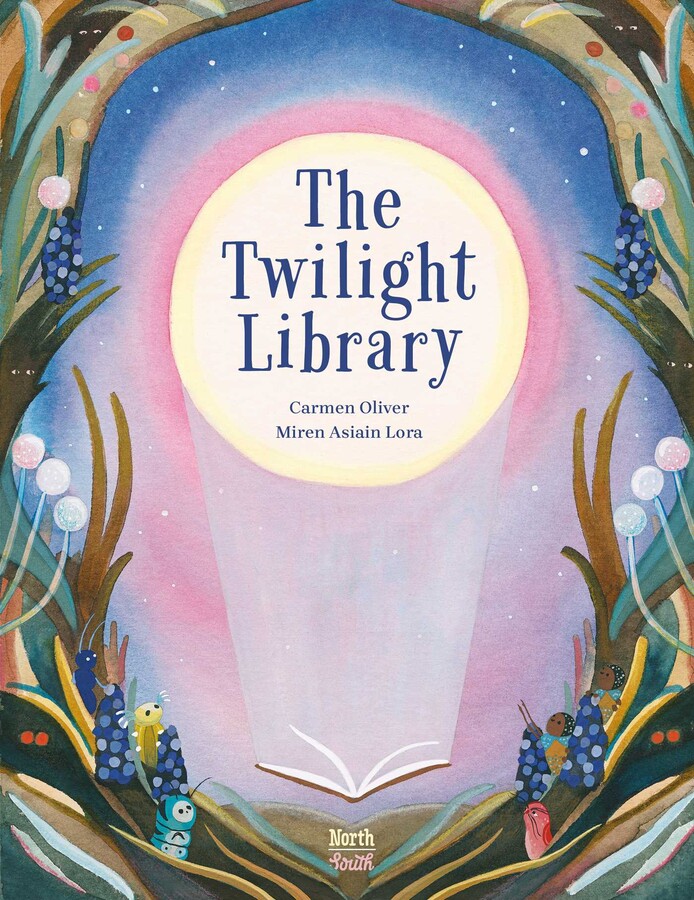
It is the need for story. It is the longing to hear or read that which another believes is important for us to hear or read. The Twilight Library (North|South Books, September 6, 2022) written by Carmen Oliver with illustrations by Miren Asiain Lora takes readers into an enchanting world. In this world, a special being in a special space uses the power of words to take listeners on a sensory journey to places their hearts desire.
The sun slips behind the horizon;
the creatures of the night awaken.
Someone is calling them.
This voice implores them to come. This voice wants to tell a tale. Do the creatures of the night listen? They do.
Some step lively to a rhythm. Others start, stop, and go again. Still more glide through the darkening skies, some lower to the ground and others high above the treetops.
Fireflies glow off and on and off and on. A soothing breeze whispers through stems and leaves. All these
creatures of the night
gather at The Twilight Library, anticipation filling their souls. The Night Librarian, a weaver of webs and words, moves closer to her listeners.
She takes them to a place alive with color. There, their hunger is satisfied by an array of food the likes royalty has never seen. They are enveloped by thoughts of their most beloved sanctuaries. They are asked to breathe wondrous odors and listen to nature's notable melodies. They, together as one, are transported to realms fashioned by their imaginations. All too soon dawn arrives. But . . .
These phrases penned by Carmen Oliver calm readers like a lullaby. Her blend of narrative and the words of the Night Librarian take us to one place before magic lifts us to another. Repetition of key words fashions a cadence. Alliteration draws us deeper into the spell cast by The Twilight Library and the storyteller residing there. We, like the
creatures of the night,
are completely captivated. Here is a passage.
Nighthawks wind through the canopy,
hunting for the voice that beckons.
"Come, come, come, my friends,
let me spin, spin you a story."
Readers get their first peek at the marvelous color palette used by artist Miren Asiain Lora for this book on the open dust jacket. Her hues depict the display of light prevalent when day is leaving and night is descending. The framing by leaves, stems and flowers on the front, right side, of the jacket is the same on the back, the side to the left of the spine.
On the front, notice the tiny creatures looking at the light of a moon rising from the pages of a book. Do you see the eyes shining from darkened nooks? On the back, the creatures are absent. Between the branches and stems, a single string of webbing is stretched. Hanging in the webbing are books, spines out. Two fireflies are moving left to right.
The book case presents two scenes. On the back, to the left of the spine, is a starlit sky with a crescent moon in the upper, right-hand corner. Two small trees rise above the ground along the bottom. The sky is immense. To the right of the spine, the sun is still above the horizon in a sky of peaches and pinks. Above this, a deepening blue and purple with a few stars indicate the coming of dusk.
The opening endpapers present us with a rolling dip in a meadow. A few butterflies make their way to the right. The sun is slowly heading toward the horizon. On the closing endpapers we have moved to the entrance/exit of The Twilight Library and the Night Librarian hanging there. Her storytelling is over for tonight. To the right, the crescent moon and a few lingering stars dot the sky. Along the horizon, a pink glow begins.
These illustrations were rendered using watercolor, gouache, and crayon. On the title page, a few strands of webbing are strung toward the title text along the bottom. The remainder of the double-page image is an eloquent sky as the sun sets. Each two-page picture throughout this title gives us either a panoramic view of a setting or brings us close to the
creatures of the night.
Readers will be fascinated by the details, looking for the tiny inhabitants of forest and field with each page turn. The plant life on close inspection appears somewhat exotic. The first view of The Twilight Library is gasp-worthy. When the Night Librarian begins the stories, we are shown a mix of reality and imagination in the visuals. Will readers notice the added detail to the appearance of the forest and field beings as the stories are told?
One of my many favorite illustrations is when we are very close to two fireflies going to The Twilight Library. The flowers, leaves and stems are enlarged, filling all of the right side and along the bottom on the left portion of the picture. Above the flowers, leaves, and stems on the left are a wide array of shimmering dots. Above them are the fireflies surrounded by glowing balls. There is a deep blue sky with a few seeds drifting on the breeze.
After reading this book, The Twilight Library written by Carmen Oliver with illustrations by Miren Asiain Lora, readers will wonder how many such libraries are hidden in the gardens, parks, fields, and forests surrounding their homes. If they allow themselves to truly imagine, perhaps they might believe there are Twilight Libraries everywhere around the world. The beauty of the words and images in this title recognize and uplift the power of story. You will want a copy of this book in your professional and personal Twilight Libraries.
To learn more about Carmen Oliver and Miren Asiain Lora and their other work, please access their websites by following the link attached to their names. On Carmen Oliver's website are downloadable resources for this book. Carmen Oliver has accounts on Facebook, Instagram, Pinterest, and Twitter. Miren Asiain Lora has an account on Instagram. Carmen Oliver wrote a guest post including the cover reveal for this book on author Cynthia Leitch Smith's Cynsations. You can view interior images at the publisher's website and at Simon & Schuster. At the publisher's website is a conversation with the illustrator about her work on this book.
Stepping into one is like coming home. It is as if all the words on all the pages are wrapping around you in a comforting and welcoming hug. Their representation of living beings, places, and things, real and imagined, form infinite possibilities and ultimately hope. Hope is potent.
This is what a library does for many people. For me, as a patron and as a professional librarian, libraries have always meant sanctuary in all its varied interpretations. Love In The Library (Candlewick Press, February 8, 2022) written by Maggie Tokuda-Hall with illustrations by Yas Imamura is a story of finding light in darkness. It is the story of how a flicker can grow into a flame that burns for generations.
Tama did not like the desert.
She brushed the dust from her eyes as she walked to the library.
The barbed wire fences and guard towers cast long shadows over her path.
She always did her best not to look at the guards.
Tama was the camp's librarian because she enjoyed books. As she approached the library, there was George holding a stack of books. He waited for her to arrive every morning.
For a year Tama and George had been at the Minidoka camp, interned there for being Japanese American and previously residing along the western coast of the United States. Minidoka was not the only camp but like all the other camps, the living conditions were intolerable and the camps were completely wrong.
Tama, not knowing if or when she would leave the camp, felt trapped by the sameness of her days. Her thoughts about this sameness filled her mind with unease and doubt. Thankfully, she found solace in the library and in the presence of George.
One day Tama whispered her word for the worlds revealed in the pages of books and George questioned her out loud as he smiled. She shushed him. Tama tried, but she could not smile. George asked her a question again, and Tama could not respond as tears welled in her eyes. Then, Tama, asked George a question. George did not smile, but Tama had her answer. From that day forward the sameness for Tama, and for George, changed.
Based on the truth of her maternal grandparents' lives at Minidoka, Maggie Tokuda-Hall writes with the same music in her heart as a composer penning a symphony. In this narrative Maggie Tokuda-Hall takes the symphony, supplying readers with the notes used to make the final piece. Her word choices are intentional. They take us into the camp providing us with intimate details of the conditions there. We are privy to the thoughts swirling in Tama's mind. We are there in the moments when she and George converse. Single recurring words provide powerful connections throughout the book. Here is a passage.
"What's wrong?" George asked.
"Nothing. Or everything," Tama said. She did not need to tell him what she meant.
He knew. Everyone in Minidoka knew. "I try not to complain. I know this isn't fair, but I
also know there is nothing to be done. I try not to be afraid. But I'm just so---so---"
It's like walking through a portal into history when you look at the open and matching dust jacket and book case. On the right side, front, we see Tama and George, with his usual armload of books. This is the world they make for themselves inside the walls of the library. When we look through the window, their harsh reality is presented in the form of the barbed wire fence and manned guard tower. To the left, on the back, is the building housing the library. Behind it, the barbed wire fence stretches beyond our sight. Several people are near the building. Two are carrying books. A third man is working in the yard. This image is used within the book.
The opening and closing endpapers reflect the grim history faced by those forced into the camps. Barbed wire fencing stretches from left to right across a rocky and sparsely vegetated land. Behind this is a gray-green sky. We are close to the fence as if standing in front of it. On the title page are crumpled internment instructions and a single suitcase. The suitcase depicting all they were allowed to bring.
are both heartbreaking and healing. Each captured scene, whether it is a double-page picture, a single-page loosely framed image, or a full-page illustration, places us in the world of Tama and George. The varied perspectives enhance the emotional impact.
The body postures and facial expressions on the people mirror a range of moods. Light and shadow are used superbly. In one picture a ray of sunshine illuminates George as he sits at a library table with an open book. George is the ray of sunshine in Tama's life.
One of my many favorite illustrations is a single-page picture. It is as if we are looking down on the setting. Most of the page is the surface of the library table. On it are two open books. A hand, Tama's hand, extends across the right side of the pages of the book closest to us. Seated across from the book farthest from us is George. We see his upper body, one arm resting on the table, and the other arm and hand as it reaches out to softly touch Tama's fingers. This gesture is meaningful. This image completely elevates and complements the written words.
Oh my goodness. This book. This book, Love In The Library written by Maggie Tokuda-Hall with artwork by Yas Imamura, is striking in every respect. The text and images will take your breath away. In an author's note on two concluding pages, including a picture of Tama and George, Maggie Tokuda-Hall talks about the story of her grandparents, internment camps and the cruelty of placing the Japanese Americans there. In subsequent compelling paragraphs she addresses present day racism, the tradition of racism in America, and what we can do to fashion a better future. I highly recommend this title for both your personal and professional collections.
By following the link attached to their names, you can access the websites of Maggie Tokuda-Hall and Yas Imamura to learn more about them and their other work. Maggie Takuda-Hall has accounts on Instagram and Twitter. Yas Imamura has accounts on Instagram and Twitter. At the publisher's website, you can download another author's note and a teacher's guide. At Penguin Random House, you can view interior images. Both creators are interviewed at We Need Diverse Books about this title. They are outstanding interviews. Author, reviewer, and blogger Julie Danielson highlights this title along with some interior illustrations at her site, Seven Impossible Things Before Breakfast.
Seeing kindergarten students browsing in the library, selecting books of their choice, and checking them out for the first time never grows old. Their pride and excitement in this accomplishment fills your soul with happiness. When they gather to hear a story read from a book, they get as close to you as possible. They (and many older students) lean in as if to absorb every line. They relish the cadence of the words. After that story time, the book's popularity is assured.
Later, they will check out the book, to share it with others or retell the story in their own words. Book to book, person to person, stories live. Book's Big Adventure (A Paula Wiseman Book, Simon & Schuster Books For Young Readers, February 9, 2021) written by Adam Lehrhaupt with illustrations by Rahele Jomepour Bell is a tribute to the lasting power of books and the story inside each one.
Book was new.
The cover bright and shiny.
Its home a prominent shelf.
This book did not stay on the shelf. It left, riding in a car, going on a picnic, and being read aloud at bedtime. Happiness filled Book.
Unfortunately, Book lost its spot on the notable shelf. It was less visible on a lower shelf. Soon Book was not bright and shiny but dusty and dull. Book's adventures were less frequent.
In time, Book was placed on another shelf. It watched other titles come and go. Book was worried. Would Book ever have another adventure? Oh, how Book wanted to feel that joy again!
One day, the worst thing happened. Book fell and came to rest underneath the bookshelves. Late one night, a beam of light warmed Book. Book was held in loving hands and read. Then, just when Book's hopes soared, Book was left in a scrambled mess with other books. Fortunately, Book was not there long. Fortunately, Book was about to discover how leaving reveals the greatest adventures of all.
Giving life to an inanimate object has been done well with simple, declarative sentences by author Adam Lehrhaupt. We all understand the feeling of being in a new situation or having something new. We can identify with experiences associated with newness. We also know the sadness of loneliness and isolation. By assigning these very real emotions to Book, we are attached to these events, these circumstances in this narrative. The use of phrases and single words places greater emphasis on each situation. Here is a passage.
So no one noticed it.
Book sat on its shelf.
Longing.
Wishing.
Until . . .
When you first look at the open dust jacket, the delight you feel when finding the perfect book is reflected on the facial features of Book. The design of the block lettering for the words, THE BOOK, the red color for Book, and the bright yellow title text all say enter, hope is found here. On the other side of the spine, on the back, to the left, we are looking slightly down on the scene. Between a sleeping child and their sleeping dog, both nestled under the covers, is Book, smiling with closed eyes. The mix of patterns on the wallpaper, the rug on the floor, and the comforter and pillows is cheerful. A lamp on the nightstand casts a glow. On the front, the title text, Book and the hands holding Book are varnished. The title text is raised.
The book case is Book. The opening and closing endpapers are orange. The initial and formal title pages are yellow with red letters for the title text.
rendered using digital brushes and scanned, hand-printed textures
span single and double pages on matte-finished paper. A variety of perspectives complement the pacing giving us sometimes an overview and other times, intimacy. You will find the passage of time presented within a single image. The facial looks on the people, from diverse backgrounds, mirror contentment. Readers will have themselves pausing on page turns to notice included details. What will they see when they look on the bookshelves in the final child's bedroom?
One of my many favorite illustrations spans two pages. Book is discovering the proverbial notation of what one finds unappealing, another finds something to love. On the left, close to readers, a child is clasping Book in their hands. Book nearly fills this entire page. A portion of the child's shoulder and arm cross the gutter. On the right side is a portion of a bookcase. On top is a globe, a toy Ferris wheel, and a glimpse of a beautifully painted pony. You can easily read the titles of the books on the shelf. The designs in the wallpaper and the child's clothing make a wonderful combination.
From one who knows children respond to the idea of lonely books on the shelf waiting to be checked out, this book, Book's Big Adventure written by Adam Lehrhaupt with illustrations by Rahele Jomepour Bell, will resonate with readers and listeners alike. At the close of the book in an Author's Note, we read about giving a second life to books through donations. There is also a list titled Book Donation Ideas. You'll want to have a copy of this book available on your personal and professional bookshelves.
To discover more about Adam Lehrhaupt and Rahele Jomepour Bell and their other work, please access their websites by following the link attached to their names. Adam Lehrhaupt has accounts on Facebook, Instagram, Pinterest, TwitterandYouTube. Rahele Jomepour Bell has accounts on Facebook, Instagram, and Twitter. At the publisher's website you can view interior illustrations.
Throughout the United States and around the globe, there are specific structures, statues, and natural monuments or areas distinctive to specific places. We don't need a sign or a map to know where we are. Those formations are as familiar to us as the place we call home.
If we see Mount Kilimanjaro, we know we are in Tanzania, Africa. We know we are in Paris, France if we see the Eiffel Tower. Standing on the edge of the Grand Canyon signifies we are in the state of Arizona. When we face an enormous building and see statues of resting lions on either side of the steps leading to the large entrance, we know we are about to walk inside the New York Public Library. These statues are the main characters in recent publications. The first, Lost in the Library: A Story of Patience & Fortitude (Henry Holt and Company, August 28, 2018) written by Josh Funk with illustrations by Stevie Lewis, takes readers through the wonders to be found in this marvelous institution as one lion searches for the other missing lion. These artistic collaborators created a companion title, Where Is Our Library (A Story of Patience & Fortitude) (Henry Holt and Company, October 27, 2020). In this newest adventure the duo discovers the contents of their favorite place have disappeared.
Just after midnight, as all New York dozed,
Silently dreaming in bed,
The last of the shops and the markets had closed,
When Fortitude lifted his head.
Now Patience was awake. The twosome was ready to spend the night reading. They enjoyed wandering around the New York Public Library when it was empty of patrons but not empty of books! The children's room was bookless!
Fortitude lead Patience to the bright lights in the center of the city, but the books were not in Times Square. Patience proposed a plan. Off the friends went to the sanctuary and past Central Park Zoo.
Arriving at the pond, the
clever old man with the hat
had not a clue. Alice (of Wonderland) suggested another statuesque literary fellow might assist them. HCA gave them a list of buildings to browse. Off the pals went from branch to branch, finding old and new stories but not their well-known tales. As the hours rushed past, the lions knew they needed to move fast.
Even the recommendation of a kite dragon failed to yield results. The approach of dawn started to light the sky. The dejected lions headed back to rest. Within mere minutes of home, they made a surprising discovery. Indeed, to read was to succeed.
Author Josh Funk has a knack for fashioning poetic narratives. In this tale of the two lions, the first and third, and second and fourth lines of each paragraph rhyme. Although dialog is part of these paragraphs; the rhythm flows flawlessly. We move through the night with curiosity, concern, and longing at each stop along with the feline friends. Here are two passages.
"I once heard the tale of a clever old man
Who sits with a hat in the park.
I'll bet if we ask him, he'll help if he can."
With that, they ran off in the dark.
They entered the park by some fancy hotels
And skirted a fountain or two.
Stealthy as foxes and swift as gazelles,
They scurried by Central Park Zoo.
When you open the dust jacket, the cityscape with lights glowing in windows continues its nocturnal vista on the other side of the spine to the left edge of the back. Neatly, here, the first title fits into the buildings with this text,
Patience and Fortitude,
the noble lions---and best friends---
who stand guard in front of the famed
New York Public Library,
are ready for their next adventure.
The lively figures of Patience and Fortitude on the right, front, speculate where they might journey to locate the missing books. Clearly, they are enjoying the sights of the city.
On the book case a matte-finished black is the canvas for architectural etchings of buildings. They are done in the golden yellow shown on the front of the dust jacket for the title text. The buildings are placed to emphasize perspective.
On the opening and closing endpapers we find Patience and Fortitude on a black background. On both sets of pages tiny floral details are present. In the first endpapers, the lions look forlornly at only six books between them. An abundance of books, most of them open, appear with the duo on the closing endpapers. The two lions are at rest in the top corners of a wide column of text reading:
The Sights of Where Is Our Library?
Six bulleted sections offer further information.
On the verso, dedication, and title pages Patience and Fortitude are walking toward the Children's Center with a single light illuminating them. A thin line of light comes from the Children's Center doorway.Each two-page picture and single-page image is a marvelous portrait of the lions, the New York Public Library, Stephen A. Schwarzman Building, sights in the city, and other branches of the library by illustrator Stevie Lewis. The color palette accentuating nighttime is wonderful!
Readers will by enthralled by her attention to detail along with her literary liberties. The marquees in Times Square glimmer with the names of books and references to felines. When Patience and Fortitude enter the branch libraries careful readers will see more beloved book titles like Ida, Always, Nana in the City, Red & Lulu, The Gardener, and The Curious Garden.
One of my many, many favorite illustrations is a double-page visual. It shows the feline friends traveling through Central Park. Many of the prominent features of the park are shown. They start in the upper, left-hand corner looping back and forth, cross the gutter and loop around the pond to the group of statues from Alice in Wonderland. Their trip is highlighted by longer dashes in a contrasting hue to the shades of night, but alike those colors in the carousel.
Whether readers live in or near New York City or thousands of miles away, they will be captivated by the explorations found in Where Is Our Library? (A Story of Patience & Fortitude) written by Josh Funk with artwork by Stevie Lewis. You'll want to use this in a storytime about libraries, books, reading, or for the sheer fun of adventure. I know your personal and professional collections will benefit from having a copy of this book.
To learn more about Josh Funk and Stevie Lewis and their other work, please follow the links attached to their names to access their respective websites. Josh Funk has accounts on Facebook, Instagram, Twitter, and YouTube. Stevie Lewis has accounts on Facebook, Instagram, and Tumblr. Both Josh Funk and Stevie Lewis are guests at Maria Marshall's site. At the publisher's website you can view interior images. There is also an activity guide for both books.
We know with a certain mindset we see things wherever we go that otherwise might be missed. If we are actively seeking the little details, beauty, kindness, and the best life has to offer, we will find it. It is not always easy, but with focus we will discover treasures of all shapes and sizes, some fleeting, and others lasting a lifetime.
There are remarkable human beings who do perceive life as an entire sensory experience. They are all the more exemplary for their sharing of their discoveries. In Digging For Words: Jose Alberto Gutierrez and the Library He Built (Schwartz & Wade Books, September 8, 2020) written by Angela Burke Kunkel with illustrations by Paola Escobar (Rescatando Palabras: Jose Alberto Gutierrez y la biblioteca que creo escrito por Angela Burke Kunkel, ilustrado por Paola Escobar, traducido por Teresa Mlawer),we are introduced to a man whose work is alive in those he serves. Two separate individuals connect through their shared love of story. It's a blend of fact and fiction based upon the truth.
In the city of Bogota, in the barrio of
La Nueva Gloria, there live two Joses.
Little Jose stirs in his bed. The early-morning light wakes
him.
En la ciudad de Bogota, en el barrio
La Nueva Gloria, viven dos Joses.
El pequeno Jose se despereza en la cama. La luz de la
manana lo despierta.
A child living in Bogota longs for Saturday. On Friday, he rides his bike to school, he tries to listen to his teacher, and plays futbol (soccer) with his friends. He knows tomorrow is filled with promise.
A man living in Bogota contemplates his day. He did not complete his schooling as a child. He left to become a bricklayer to help support his family. We are told he nevertheless read each night with his mother.
Un cuento at the end of a long day felt like Paradise.
Un cuento al final de la jornada era como estar en el Paraiso.
In the evening, the boy returns home. In the evening, the man gets ready to collect the garbage from other areas of Bogota. He works all night. What this man, this grown Jose, does is search through the trash for treasure. His treasure is books. It all began many years ago when he found a copy of Anna Karenina by Leo Tolstoy. That book was his doorway into another world. He has never stopped searching for other doorways.
At the close of every shift, Jose brings home gathered books, placing them in stacks and on bookshelves, his library. On Saturday, the younger Jose runs like the wind with the other neighborhood children to enter Paradise at the older Jose's home. There they spend hours looking through all the collected books of all shapes and sizes covering a wide range of subjects and interests. That night the labors of Jose, the garbage collector, will be enjoyed by children all over La Nueva Gloria, until next Saturday when they, like Jose the child, will again enter Paraiso.
Readers will gravitate to the narrative supplied by debut picture book author, Angela Burke Kunkel. She combines the story of a fictional child with that of the real Jose Alberto Gutierrez. Given the work of Jose Alberto Gutierrez, the fictional child is apt to be true.
The writing of Angela Burke Kunkel is clear, concise, and lyrical. Spanish words are a part of the story, carefully placed so their meaning is easily discernable. So vivid are her descriptions, we find ourselves seated next to Jose as his trunk makes its nightly runs, and we find ourselves running along with Jose toward his Saturday destination. Here is a passage in English and Spanish.
A few pages to read, a few hours to dream,
and then it is a new day. Tonight, he revisits
Macondo, a magical village deep in the jungles
of Colombia, and he is lost in a place where
times moves by its own rules.
Varias paginas que leer, varias horas para
sonar, y asi comienza un nuevo dia. Por la
noche, nuevamente visita Macondo, un pueblo
magico en lo mas profundo de la selva de
Colombia, y se pierde en ese lugar, donde el
tiempo transcurre a su ritmo.
When you look at the front, right, of the open dust jacket you see a man and a boy, smiling. Stacks of books frame them on either side. From the pages of an open book, we see the stories each find in their books depicted. It's easy to imagine this very scene happening each day in the library Jose Alberto Gutierrez has made for the people in his barrio. To the left, on the back, a garbage trunk moves through the nighttime streets of Bogota. The words read:
Jose scans the sidewalks as he drives,
squinting in the dim light.
He searches the household trash
for hidden treasures . . . books!
Mientras Jose manejo su camion de basura,
escrudina las aceras de la ciudad
entrecerrando los ojos bajo la tenue luz.
Busca entre la basura de las casas
tesoros escondidos . . . !Libros!
On the book case in a wash of muted yellow with streaks of blue, we see the younger and older Jose. The child is on the left, bending down to pick up a book. A trail of five books lead to the far right with the older Jose, carrying a stack of books, as he runs off the right edge.
On the opening and closing endpapers artist Paola Escobar begins and concludes her visual interpretation. On the first beneath a stary sky, brilliant with several larger stars, and a crescent moon, Jose drives his truck, lights shining in front of his vehicle. Beneath a streetlamp, a can holds bags of trash. Next to the can is a stack of books. On the second, the scene is the same, but empty of the truck, the trash, and the books.
These illustrations by Paola Escobar rendered digitally are filled with details of life in the barrio of both the child and the man. Their size alternates in keeping with the narrative and its pacing. The eagerness of the boy and the contemplative and determined nature of the man are vividly portrayed. The two-page pictures are marvelous, giving us multiple perspectives, allowing us to see realty and the magic found in story.
One of my many favorite pictures is an overview of the cityscape of Bogota at night. Beginning in the upper, left-hand corner Jose and his truck wind back and forth and back and forth from stop to sop from left to right to the left of the gutter, crossing the gutter, and then winding back through the city up into the hills to the right of the gutter. Beneath the streetlamps are the garbage cans. We can see Jose stopping, carrying bags to his trunk, and searching for books. This gives us a superb overview of the enormity of this man's accomplishments, night after night, book by book.
I highly recommend this title for your personal and professional collections, supplying both the English and Spanish editions, for your readers. There is a beauty in both, in the use of language, and in the illustrations. This book, Digging For Words: Jose Alberto Gutierrez and the Library He Built (Rescatando Palabras: Jose Alberto Gutierrez y la biblioteca que creo) written by Angela Burke Kunkel with illustrations by Paola Escobar, translation by Teresa Mlawer, is a powerful reminder of the power of one. At the close of the book is an author's note, descriptions of books featured in the narrative, and selected online sources.
To learn more about Angela Burke Kunkel and Paola Escobar, please follow the link attached to their name to access their respective sites. Angela Burke Kunkel has accounts on Instagram and Twitter. Paola Escobar has accounts on Instagram and Twitter. Angela Burke Kunkel is highlighted at KidLit411, The Soaring '20s, and at author Tara Lazar's Writing for Kids (While Raising Them). At the publisher's website you can view interior images in both the Spanish and English editions. Angela Burke Kunkel is interviewed about this book by Scholastic's Ambassador of School Libraries, John Schumacher, at his site, Watch. Connect. Read.
To view the other selections this week by participants in the 2020 Nonfiction Picture Book Challenge, please visit Kid Lit Frenzy hosted by educator Alyson Beecher.
Sometimes it feels more like home than home. It's as if all the stories, real and imagined, are cloaking you in complete comfort. For centuries this space has been a sanctuary; a sanctuary always worth saving.
Our libraries, public, academic, school and personal, whether housing 168 million items like the largest library in the world, The Library of Congress or a shelf in a home holding a few treasured volumes, represent our ability to rise to new heights. The Library of Ever (Imprint, Macmillan Children's Publishing Group, April 30, 2019) written by Zeno Alexander takes us on a search for something we are unaware we need. It asks and answers questions. It leaves us with thoughts to ponder. Nothing in eleven-year- old Lenora's life will ever be the same again. Do you dare to have your life change, too?
Lenora was wretchedly unhappy.
Her parents on a global tour have left her with an inattentive nanny intent on turning every day into a shopping spree. Naturally, Lenora is dragged along in her wealthy parents' limousine, but she would much rather be in any other place offering her mental stimulation. When they make an unexpected stop at the library, it's a golden opportunity for Lenora.
Having slipped away from her absentminded au pair, Lenora first comes to the assistance of another child being bullied by a strange man wearing unusual attire and claiming to be a librarian. She then suddenly finds herself standing in front of an enormous stone entry where there was previously a blank wall. Above the archway the words read
KNOWLEDGE IS A LIGHT.
A tall, tall woman, obviously someone in charge, comes up to Lenora as she is trying to take in the sight around her. In this place there are bookshelves lining the walls beyond visibility above and below her as she stands on a bridge spanning a tower. After answering four crucial questions from the woman with the emphatic words, I do, Lenora finds herself hired as a Fourth Assistant Apprentice Librarian.
Well, readers, hang on to your proverbial hats. In each room, of this collection of all knowledge in the universe, in which Lenora finds herself, those four crucial questions she answered assist her as she travels through space and time, battles the worst kind of enemy imaginable repeatedly, sails seas in a row boat on a gigantic globe, shrinks and unshrinks herself (How else can she help ants and tardigrades?), assumes the shape of an animal to find that which is lost and suffers the fate of falling into an frightening trap.
From one breathtaking adventure into the next, continually followed by malevolent forces, Lenora, using what she knows and what she learns, barely survives. A lost soul adds frightening information to the girl's daring assignments. With an astonishing blend of action, the final chapter reveals a mind-blowing cliffhanger loaded with anticipation.
The mysterious author Zeno Alexander, traveler of history and world libraries and provider of exquisite dinner parties and caretaker of extinct plants writes with sure knowledge based upon his friendship with Lenora. With adept descriptions this entire narrative plays like a movie in your mind. We are keenly aware of every moment through the mix of Lenora's thoughts and the characters' conversations. We experience amazement, increasing confidence, unbelievable circumstances and chilling adversaries. No one will look at librarians in quite the same way again; unless, of course, you are a librarian. Here are some passages.
"But wouldn't it make more sense for me to work on things I already know about?" Lenora asked. "Not at all!" Malachi arched one eyebrow. "Whyever would you want to do THAT? You'd learn absolutely nothing!"
She looked up at the skylight. She thought the sun would keep the room comfortable. But the sun, didn't seem to be shining anymore. In fact, out of nowhere, dark clouds had gathered high in the sky. That still didn't explain the cold, which was getting worse by the second. Patrons were beginning to look around with concern, muttering about the temperature. Lenora thought perhaps she could find a thermostat somewhere and turn up the heat. She peered beneath the desk. And then she heard something. A muffled crash, far away among the stacks. And she thought: Something fell. Other than that crash, everything was quiet. The usual busy library sounds had gone dead silent. . . ."I thought you were wise enough to understand that children must be discouraged from asking questions that will make them curious and fretful. Perhaps I overestimated you. After all, you're just a child yourself." "Maybe," said Lenora, with equal frost. "But I'm also a librarian. And I'm not going to hide the truth from anyone."
Are there action-packed feats? Indeed, there are. Is there a cast of out-of-this world characters? Without a doubt there are. Are there profound truths woven into this tale of Lenora about light versus dark, the power of knowledge and the utmost need to protect it? Yes! Yes! Yes! These things in this book, The Library Of Ever written by Zeno Alexander, the first title in a new series will appeal to a wide range of readers of many ages. I highly recommend this book for your professional and personal collections.
To learn more about Zeno Alexander please follow the link attached to his name to access his website. He maintains accounts of Instagram and Twitter. At the publisher's website you can read an excerpt. There is an activity guide here. This interview of Zeno Alexander at The Winged Pen gives you insight into his personality. We're in for quite a ride, readers.
With the number of books being published each month in a given year, it's an overwhelming task to read all those which may interest a reader. It's a good problem to have but sometimes it may take months before you read a title. You shuffle books on and off your purchase list. You move volumes from top to middle to bottom of your to-be-read stack and back to the top again.
Finally a book makes its way into your home. And then a day comes when you know you have to read it; it's calling to you. The Mermaid's Purse (G. P. Putnam's Sons, an imprint of Penguin Random House LLC, October 4, 2016) written and illustrated by beloved Michigan author illustrator Patricia Polacco is one of those books. When such a book fills your heart with joy and your eyes with tears, you know the saying of "a story chooses you" is completely true.
A clap of thunder roared at exactly the moment my grandmother came into the world during a raging storm in 1883 on her parents' farm in Locke Center, Michigan. She was the first of nine children.
At this baby's birth the midwife declared
"God's blessing and gifts will fall upon this child like spring rain."
This precious girl, given the name Estella, was born in a Mermaid's Purse, a protective sac. From that moment forward she was living proof of the midwife's prophecy.
Her affinity for predicting storms was uncanny. It was astonishing how early she learned to speak and read. As she grew older she saved every penny earned to purchase books. Her collection grew larger and larger to the point her father volunteered to build her a library.
One fine day a group of her father's friends gathered and constructed a perfect little library for her. One, Fred Barber, an apprentice, could not take his eyes off of Estella. Another, cranky Pig Ears Lonsberry thought the whole thing was total foolishness. As the last stack of books was carried from house to library, a storm rolled into the area. Right then and there Estella named her library the Mermaid's Purse.
Estella decided to start taking books in a cart from farm to farm, giving the men and their families who had helped her a chance to enjoy the benefits of a book. Local children came to the Mermaid's Purse for storytelling. It wasn't until a book actually helped a farmer on the verge of losing an entire herd of sheep, that Estella's books demonstrated their purpose.
Storms in all seasons came and went with Estella knowingly warning those around her. More than one life was saved. It was a terrible event though, a twister, destroying everything this generous spirit held dear which truly portrayed the admiration the community felt for Estella and her Mermaid's Purse.
Gather close readers. When Patricia Polacco writes it's as if she is within the same space as you are, softly telling you a tale, sometimes true, casting a spell to bring you into that remarkable world. She is a master at creating a true sense of place and making the characters fully alive. There is an emotional impact in her stories touching on those things all people believe are valuable. She invites and unites us with her words. Here is a sample passage.
She swam to a large rock in the center of the pond. She no more than scrambled up on it when she heard a low rumbling off in the distance. The sky was darkening and the clouds glowed with shards of lightning. "Get out of the water!" she warned the boys. All scrambled out but one. Moon Eyes Fred. "Fred!" she shouted. "Thunderstorms are something I know about. That lightning is closer than you think." No sooner had she said those words than there was a bright flash of light and Freddisappeared beneath the surface of the water. Stella jumped in and pulled him toshore.
From the moment you hold the matching dust jacket and book case in your hands, you know another Patricia Polacco jewel will be added to the treasure on your bookshelves. Who is the girl reading on a pile of books? What is a Mermaid's Purse? To the left, on the back, this same girl is handing a book from a cart full of books to a dubious farmer? The opening and closing endpapers are pale sky blue with darker blue vertical stripes. With a page turn an image of a midwife holding a newborn announces the introduction describing Estella's birth.
Rendered in pencils and markers each illustration created by Patricia Polacco, in full color, spans two pages. Although she painstakingly portrays the settings, inside and outside homes, it is the depiction of her characters which reaches out to readers. Clothing, quirky traits and personalities reflected in faces and body postures bring her people to life on the pages. We sincerely connect to her people.
One of my many favorite illustrations is when the clouds burst with rain on the day they move all of Estella's books from her home to the Mermaid's Purse. On the left of the two-page picture she is standing in the rain, legs spread as she runs and arms open wide. Her head is lifted to the sky as she names her library. On the left several of the workers, including Fred Barber watch astonished outside the library. You will find yourself feeling as though you are standing in the middle of the storm, rain pelting your body and laughing with happiness along with Estella.
If ever there was a book depicting the power of books, reading and libraries, The Mermaid's Purse written and illustrated by Patricia Polacco is that book. You find your heart swelling with gratitude for the soul of this girl. This is a true story based upon the life of Patricia Polacco's grandmother. On the last page she includes several photographs of Estella at different points in her life. Stella eventually donated her collection of books to the Williamston Public Library in Michigan where she taught school,
...where books from it still remain today.
To learn more about Patricia Polacco and her other work please visit her website by following the link attached to her name. She is holding an open house on July 22, 2017 at her home in Union City, Michigan. Patricia Polacco is interviewed on video at Reading Rockets. Patricia Polacco is active on Facebook.
To be sure most of my best memories of libraries under my care are those days when they were filled with children wandering the shelves, small groups gathered together quietly laughing over a book, a single child silently reading in a cozy corner or others seeking answers by connecting virtually with factual research. When we gathered for story times, collectively experiencing an array of emotions and discussing all manner of topics, bonds with books were formed. As wonderful as all those remembrances are, the evenings, weekends and vacations when I walked through those doors into complete silence, shelves filled with books lining the walls, are an entirely different experience.
For me there is no other way to explain it other than a combination of joy and reverence. This place which holds thousands of stories, from information and from imaginations, collected over generations and housed in a single location, to this day, still amazes me. Bunny's Book Club (Doubleday Books for Young Readers, February 7, 2017) written by Annie Silvestro with illustrations by Tatjana Mai-Wyss is a story which replicates that joy and reverence every single time you hold the book in your hands and read the words.
Bunny loved books.
This love grew from listening to stories being read to children from books at the library. During warmer weather the woman with the red glasses held story time outside but now it was colder. There were no animals inside the library. Bunny had to have books. Bunny had to read. Bunny needed a plan.
Late one night he left his snug home with a flashlight. Every possible opening on the outside of the library was locked up tight. Then Bunny noticed the book return.
For a rabbit wanting to read, a book return was no challenge at all. He was so hoppy when he got inside. Soon he had a stack ready to borrow and take to his burrow. Bunny became a nighttime patron of the pages.
His absence was noted and a curious friend came knocking. Bunny did what any lover of books would do. He shared his secret. It was passed from one animal to the next until one night a woman in red glasses changed everything.
Debut picture book author Annie Silvestroreaches out to readers with her first sentence sending an alliterative melody by using bunny and books. She continues by telling us how this affection is formed, the problem Bunny encounters and his solution through the voice of a narrator. When first one and then more animal characters appear, conversations are included, welcoming readers more personally into the story.
Her descriptive words draw readers into the thoughts and actions of Bunny and company. The transformation of getting caught up in a story, the sense of victory when a hurdle is cleared and the deep sense of satisfaction in spreading good fortune among companions are portrayed by Silvestro wonderfully. We can't help but become attached to these forest friends and their shared fondness for books and reading. Here is a sample passage.
"Are you sure this is a good idea?" said Porcupine. "Calm your quills," said Bunny. "I'm too prickly---I'll never fit!"
Bunny pushed and shoved until... POP went Porcupine. Bunny slipped in and flipped on his flashlight.
One word immediately comes to mind when looking at the front of the dust jacket, adorable. Look at all those woodland creatures actively reading together! The delicate details, the tiny daisies, the little mushroom and the decorative pennants add to the charm as does the title placed on a banner tied to the tree. (I am using an F & G.) To the left on the back on a canvas of light spring green Bunny is heading home after a trip to the library, his flashlight creating a beam of light as he balances books on his head. Above this circular image are the words
When you open a book, you discover a world...
The opening and closing endpapers in shades of light brown are a pattern of circular-like shapes formed by decorative scrolls. On the outside of these are acorns, oak leaves and mushrooms. On the inside are the characters in a variety of poses reading books. On the first set of endpapers something extra has been added which is utterly delightful. For many it's a reminder of falling in love with books and libraries. For others it will prompt lovely discussions.
Each illustration, regardless of the size, asks readers to pause, looking at every single element. The quality of the technique employed by Tatjana Mai-Wyss makes you want to reach out and touch the page. It's a mixture of fine and firm lines and soft colors and more prominent shades.
To show Bunny's thoughts she inserts smaller pictures within a large illustration or includes them above a visual. His movements are truly like those of a rabbit in the wild; a cluster of images, up and down, left and right, on two pages. His home is as comfortable as a cottage with over-stuffed furniture, old-fashioned lamps and hanging light bulbs, checked curtains and a stone fireplace.
One of my many favorite illustrations spreads over two pages. It's a large overview of the front of the library at night. Trees and bushes frame the back, left and right. Bunny is carrying his small red flashlight. To show how he checks for any possible opening seven circles, tied together with a trail of dots, show him looking in every nook and cranny.
Bunny's Book Club written by Annie Silvestro with illustrations by Tatjana Mai-Wyss certainly belongs in the huggable category. It honors the wonder of reading, books and libraries through the endearing tale of Bunny and his friends. It conveys how the determination of one can spread enormous and lasting happiness to others. You must have this on your professional and personal bookshelves.
To discover more about Annie Silvestro and Tatjana Mai-Wyss and their other work, visit their websites by following the links attached to their names. Annie and Tatjana are on Twitter @anniesilvestro and @mai_wyss They are also on Instagram @anniesilvestro and @tatjanamaiwyss Tatjana is on Facebook. You can view interior portions of the book at the publisher's website. Annie is interviewed at Picture Books Help Kids Soar and at Karlin Gray's website. Annie stops by Author Darlene Beck-Jacobson's website to chat about libraries.
They eagerly look in her direction, quietly waiting. They know storytime today is going to be out of the ordinary. When their librarian comes to the circle and sits in her chair she is carrying something in addition to the book. In her arms is a puppy. This puppy is as excited to meet the children as they are to meet her. Over the years this librarian realizes the comfort and joy this dog brings to her students as they grow up together. The dog seems to instinctively understand on any given day what a child may need.
We see this as a gift. They see it as their job. Canines' affection for humans is unconditional and constant. Madeline Finn and the Library Dog (Peachtree Publishers, October 1, 2016) written and illustrated by Lisa Papp is the story of a reading journey. It is a story of the best kind of friendship.
I do NOT like to read! Not books. Not magazines. Not even the menu on the ice cream truck.
Reading aloud in the classroom is even more of a struggle for Madeline Finn. The words are tricky for her to comprehend and speak. When someone quietly laughs at her attempts, it's disheartening.
She gets stickers like her classmates but their stickers are stars and her stickers are hearts. Her stickers say
Keep Trying.
If only she could get a star.
Madeline Finn knows what a star means. She makes a wish on a star. She wishes to be a good reader, especially a good out-loud reader. For an entire week Madeline works and waits for her wish to come true. It does not.
On a Saturday visit to the library, Mrs. Dimple, the librarian, greets Madeline with the promise of a surprise. Madeline reminds her she does not like to read. When Madeline walks into the children's room, it is filled with dogs. Mrs. Dimple suggests she read to a rather large white dog named Bonnie.
Regardless of her stumbling with words Bonnie keeps on sitting next to Madeline and continues to watch her and listen. For many Saturdays Bonnie and Madeline sit side by side in the library. On the Saturday before her next read aloud, Bonnie and Mrs. Dimple are absent. Madeline is not sure what to do but wishes can come true with extra unexpected surprises too.
With each sentence we feel a connection to Madeline as she tells her story. She shares her innermost feelings with us. Lisa Papp's descriptions of her endeavors are realistically depicted. It's important to note there are caring, compassionate adults portrayed in the figure of Madeline's mother, her teacher and Mrs. Dimple the librarian.
As the story progresses Papp deepens our bond with Madeline as her bond grows with Bonnie through her simple sentences and word choices. We read about her confidence growing in the repetition of a single phrase. Here is another sample passage.
At first, I'm nervous. I get the letters mixed up. The words don't sound right. But then I look at Bonnie, and she looks right into my eyes. She doesn't giggle.
Rendered in pencil, watercolor, and digital coloring the illustrations, beginning with the matching dust jacket and book case, are absolutely huggable. The pale green background, the soft colors and the position of Madeline leaning against a patient Bonnie with books scattered around them add up to pure bliss. To the left on the back an interior image of Madeline and Bonnie is placed above the words:
This is Bonnie. She's a great listener.
A soft sandy hue covers the opening and closing endpapers. Throughout the book a similar shade is used, textured almost like fabric. On the initial title page a stack of books is a seat for Madeline's ever present stuffed bunny toy. One of her heart stickers is next to the books. A frustrated Madeline, arms crossed, is standing with her bunny, books fanning out from her on the floor, on the title page and with the books crossing the gutter to the verso.
Papp varies her image sizes to provide pacing. A full page picture can bleed across the gutter where two smaller visuals appear in vertical panels. To intensify a moment the illustration may cover two pages. To depict a sadder moment the image is alone, a loose circle surrounded by more of the background color. The delicate details in all the images supply gentleness to the story.
Many of these illustrations are favorites but the series of pictures when Madeline is first reading to Bonnie are completely endearing. On the left are three framed images. First Madeline is reading with her back to Bonnie. Then she turns around and reads to her. In the third picture Madeline looks up from her book at Bonnie. On the right, in a larger illustration are just the faces of Madeline and Bonnie. Bonnie looks right at Madeline with complete trust. It is a defining moment for Madeline.
We all know readers who need to emerge from their reading cocoons. To do so in the presence of a dog (and to watch this happen) is indeed wonderful. Madeline Finn and the Library Dog written and illustrated by Lisa Papp is a charming, delightful portrayal of a truth which can and does happen. I can predict this will be a favorite of readers and listeners alike.
To learn more about Lisa Papp and her other work please visit her website by following the link attached to her name. This links to an entry about this title at the publisher's blog.