Quote of the Month

When love and skill work together, expect a miracle. John Ruskin


Showing posts with label Insects-Fiction. Show all posts

Tuesday, June 28, 2022

To The Dogs #1

For those sharing their lives with beings other than humans, each one has a preference with particular reasons attached to that preference.  This reader has a fondness for dogs.  Four Labrador Retrievers have been members of my family, sisters, Soot and Cinder, sweet Xena, and my wild child cuddlebug, Mulan.   For this reason one saying I hold close to my heart is

Dogs are not our whole life, but they make our lives whole.

Roger Caras

Any title referencing dogs has my attention.

Whatever it is, when you begin and end with a dog, expect the extraordinary.  I'd Like To Be The Window For A Wise Old Dog (Doubleday Books For Young Readers, April 5, 2022) written and illustrated by Philip Stead is a place to let your imagination spread as far as it will go.  It's also a reminder to be more observant of the details you might miss at first glance. 

Oh, I'd like to be
the raindrop
falling on a turtle shell

For the next two page turns, the rain continues.  It makes a puddle for a leaper.  It provides the opportunity for an umbrella, an elephant's umbrella, to supply shelter.  And when the rain ends, at the most perfect moment, it fashions a wonder seen out the window.  A window under which a dog sleeps.

The unseen narrator contemplates the movements of penguins, snails, honeybees, and those of a whale.  They ponder mirroring those motions.  With sure knowledge, this individual returns to wanting to be something which gives to another.

Where will the sunshine fall?  Who will nest in an oak tree hollow?  Who will hide in high green grasses?

We read of feathers and weather.  We read of a hummingbird, mouse, and a quiet cat.  Again, with sure knowledge, our wonderer goes to the window and the dog.  As the window, the voice is filled with the happiness of the dog's thoughts as she gazes through the glass.


No matter how many times the book is read, the sheer beauty of the words carefully penned by Philip Stead surround the reader in a hug of serene speculations.  Each pondering asks us to look and marvel at things we might take for granted instead of viewing them with gratitude.  There is a musicality to the shifts in reflections from wanting to be something, to moving like something, and then to being something again.  Philip Stead uses a bit of rhyming, alliteration, and metaphor.  Here is another thought.

I'd like to be
the tall grass
standing with a mother deer
helping hide the little fawns

one     two     three


White is used masterfully by Philip Stead to elevate his full-color artwork throughout the book as first evidenced on the dust jacket.  On the front, elements found in other illustrations are a part of this initial illustration.  The blend of rain and the rainbow, the red ball and red bird, the blue and yellow coneflowers, and the wise old dog hint at continuity which can be comforting.  To the left of the spine, on the white canvas is a mouse carrying an acorn.  The mouse is flying with delicate angel wings.  Beneath the mouse are the words:

And I sometimes wonder . . .

The book case is white and covered on both sides with raindrops.  The raindrops are in the colors found in a rainbow.  The opening and closing endpapers are the same shade of red as the bird and ball.

The first interior picture is of the window.  It is raining outside.  The red bird is singing in a tree with ginkgo-shaped leaves.  The dog, her back to us, is staring out the window.  Next to her is the red ball with a mouse seated on top of it.  The next page turn we zoom to the bird singing in the rain.  The background is blue with white drops, green leaves, brown branches, and the bright bird.  On the title page, the dog now has the ball in her mouth.  The mouse is running across the verso.

For his phrases, Philip Stead uses double-page pictures.  His printmaking is exquisite with subtle shading and fine details.  Before a final phrase or an alteration in phrases, words spread across two pages with no other artwork.  The color of the letters is a hint of what is to come.  As the narrative continues, figures from previous illustrations join other members culminating in a heartwarming array.  Readers will pause at page turns to locate all the creatures.  You will notice other smaller stories embedded in the artwork like the turtle and mouse moving the red ball to its final resting place.

One of my many favorite illustrations is of the elephant holding the umbrella in the rain.  The background is white with blue raindrops.  The elephant is facing to the left with the front portion of its body to the left of the gutter.  Underneath the elephant's body it is white as light blue water puddles around it.  Under the elephant's belly, eight tiny yellow birds are seeking shelter.  Underneath the green umbrella in the elephant's trunk are two more yellow birds.  Two other yellow birds are flying to the right near the elephant's trunk and head.  There is something exceedingly soothing about this scene. 


On the verso, the dedication by Philip Stead reads:

For Wednesday most of all

As previously stated when something begins and ends with a dog, it will be out of the ordinary.  I'd Like To Be The Window For A Wise Old Dog written and illustrated by Philip Stead is indeed remarkable.  It is one eloquent moment followed by another equally eloquent moment.  It is uplifting.  It is hopeful.  It is a tribute to life.  You will want a copy for both your professional and personal collections.

To learn more about Philip Stead and his other work, please follow the link attached to his name to access his website.  Philip Stead shares a website with his wife titled The Stead Collection.  They share an Instagram account, too.  At the publisher's website, you can view the first few pages of this title.  You can view more artwork from this book at R. Michelson Galleries. Philip and his wife, Erin, and Kevin Henkes and his wife, Laura Dronzek, were part of a virtual event on Friday, June 24, 2022.  The four talk about their newest books.  You can view this event hosted by Books of Wonder here.


Of the many things attributed to dogs, one of the most endearing is their ability to make us laugh.  Their body language, facial expressions, and antics are a constant source of joy.  They welcome every moment of every day.  In Bug On The Rug (Sleeping Bear Press, April 15, 2022) written by Sophia Gholz with illustrations by Susan Batori, a pup's beloved rug becomes an object of controversy and comedy.

Pug on a rug,
cozy and snug.

He's a rug-loving pug.
When along comes . . .

It's a bug!  This bug is looking a tad bit too proud of his position on that rug.  He has set up residence on Pug's rug.  

Growling and buzzing ensues.  Then Bug throws a stick, which Pug sets off to retrieve.  Pug arrives back at his rug mad at that bug.

Pug grabs the rug and a tussle begins, until the duo crash into none other than Slug.  Slug in not happy about being sandwiched between a fighting pug and bug.  Slug says they are being selfish and rude.  

Pug and Bug are filled with guilt.  Sobbing Bug tells the tale of how he lost his home.  Pug tearfully realizes the mistake he made.  When Bug decides to leave, Slug makes a suggestion.  The trio are enjoying the rug until . . .


With a keen sense of humor, author Sophia Gholz invites us into rhyming rhythmic fun-filled fiction.  Her selection of words used to create this tale are delightful, true, and never forced but flowing.  She shows readers how discord can be turned into harmony.  Here is another passage.

Pug growls and howls.
Bug buzzes and scowls.

He might be small,
but Bug stands tall.


The open and matching dust jacket and book case give us a clear glimpse of the funny and frantic mischief-making about to happen between Pug and Bug.  The characters in this tale all have wide-eyed expressions with exaggerated body characteristics, either small or large.  On the dust jacket the image extends from flap edge to flap edge.  On the right flap we are introduced to Slug who is looking surprised to see Bug on Pug's rug.  Pug's body extends over the spine to the middle of the left side.  There, a worm is looking cautiously at the happenings on the rug.

The opening endpapers include the publication information on the left and the title page on the right.  There Bug has set up his new home on the rug.  On the closing endpapers is the hilarious wordless conclusion.  The looks on the characters' faces are totally laughable.

The illustrations by Susan Batori alternate between double-page pictures and full-page images.  Her perspectives in these visuals shift from wide to close enhancing the pacing of the story.  Humor is infused in every line of these highly-animated illustrations.

Readers will appreciate the added elements.  When Bug builds his home on the rug, there is a Welcome mat outside his tent.  He is drinking from a red and white polka-dotted cup.  On a table next to him the red and white polka-dotted teapot sits.  He has a tall lamp!  Whenever the characters are thinking or remembering, those are shown in clouds above their heads.

One of my many favorite illustrations is a double-page picture.  On the sides, local flora is shown.  On the grass is the infamous rug.  Looking off-kilter Pug, Bug, and Slug are on the rug.  They have just slid and crashed into one another.  Bug and Slug are squashed under Pug.  They are dazed and bruised.  This is the beginning of a change in the story.


This title, Bug On The Rug written by Sophia Gholz with artwork by Susan Batori, is read-aloud gold.  Listeners and readers will be finger-snapping and swaying after the first few pages.  The humorous phrases forming a story of sharing and friendship will remain with readers long after the book is closed.  Your personal and professional shelves need to house a copy of this book.

To learn more about Sophia Gholz and Susan Batori and their other work, please visit their websites by following the link attached to their names.  Sophia Gholz has accounts on Facebook, Instagram, and Twitter.  Susan Batori has accounts on Behance, Facebook, Instagram, and Twitter.  The book trailer premiered along with an author interview at Watch. Connect. Read., the blog of librarian and writer John Schu.  There are more author and illustrator interviews about this book at Kathleen Temean's Writing and Illustrating and at Good Reads With Ronna.

Tuesday, June 4, 2019

Considering A Choice

There is nothing as desirable as the last of a whole lot of things.  It does not matter if it's the last for a day, month, season, year or possibly forever.  We all understand how vital the remaining minutes of light before night comes are when something needs to be done outside.  Is there anything more delicious than the final scoop of your favorite ice cream?  The world is bathed in magic on full moon nights.  It's hard to wait an entire month for the next one to appear.  It could also be cloudy!  The conclusion of summer vacation is bittersweet.  It's full of wonderful memories but signals the end of a welcome season, and for many a return to a more restricted schedule.

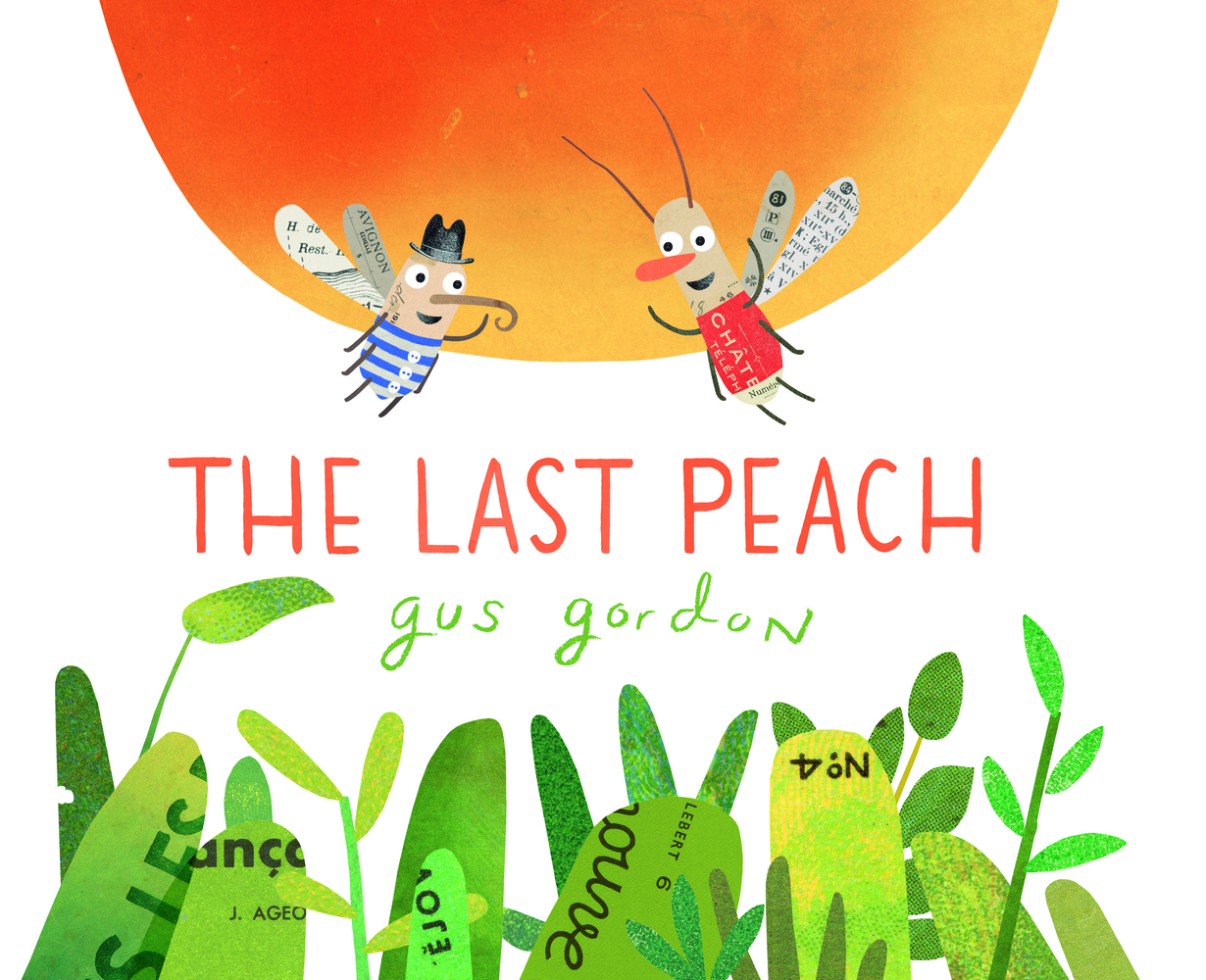
When faced with a last item, the situation is more complicated when appreciation turns into desire and that desire is denied for a variety of reasons.  The Last Peach (Roaring Brook Press, April 2, 2019) written and illustrated by Gus Gordon explores this dilemma with considerable insight.  Two bugs find themselves debating multiple issues after their magnificent discovery.

Oh my, now THAT is a fine peach!

Yes, indeed, the finest! 

After extolling the virtues of the peach, the bugs decide it must be eaten . . . immediately.  When they are ordered to stop because it is the final fruit of the season, they pause with reluctance.  This pause is short-lived.  As they are about to consume the peach in earnest, another bug interrupts.  It might only be good on the outside.

The duo reaches an alternative to full-blown consumption, but they talk themselves out of that approach. With their imaginations working overtime, they wonder about the magical qualities of the peach.  They wonder if they should share the peach.  They even suppose what the peach would say if it could speak.

Their musings proceed to over-the-top status when a poem is penned for the fruit.  Quiet, respectful gazing at the peach by both suddenly turns into a bitter feud.  Perhaps only one of them deserves the peach.  As suddenly as the argument starts, it stops.

With the consistency of a swinging pendulum on a clock, the bugs' minds switch back to the beginning.  The perfection of the peach outweighs any of their cravings.  They bid it adieu.  What?!  What kind of ending is this?  A page turn reveals a most hilarious turn of events.


Told entirely in dialogue author Gus Gordon spins a tale replete with some of life's biggest questions.  Through the back-and-forth discourse of the two bugs we see them wrestling with possibilities.  Humor plays a big part in their contemplations.  Here is a passage.

It might be a magical peach!  What if we ate it and could suddenly do magical things?

LIKE FLY! 

YES!

Hang on, we can already fly . . .

Oh, yeah.


Everything about these two insects, when we first see them on the front of the matching dust jacket and book case, depicts hilarious.  Look at their bodies dressed in shirts with one wearing a hat.  Notice their long noses, expressive body positions, and, dare I say it, bug-eyed looks.  Their bodies and the text on the jacket are varnished.

To the left, on the back, a green from the foliage is used as the canvas.  Within a small circle the duo is looking directly at readers. Their arms are lifted in greeting.  On the opening and closing endpapers, artist Gus Gordon has illustrated in three rows of six, left to right, eighteen peaches.  They appear lifelike and as if categorized in a botany catalog.  They are gorgeous.

On the verso a red beetle (with seven legs) stops above the informational text and under the dedication.  On the right, the last peach hangs from the top of the title page above the text.  Rendered in predominantly collage, the illustrations, with the exception of two wordless, double-page pictures, are full-page visuals on the left.  The narrative is placed on the right.

During their conversations, to emphasize pacing and emotional moments, the points of view shift from image to image.  We are taken very close to the bugs; only seeing the upper portion of their bodies.  We are then given a wider scene including branches, leaves, flowers and the peach.  Readers will enjoy seeing other bugs come and go in the illustrations.  One might be wearing a hat, a bow tie, eyeglasses or overalls.  It's interesting to observe the red shirt of the one bug from picture to picture.

One of my many favorite illustrations is a wider perspective of the two bugs and the peach.  Rounded, oval-shaped leaves frame the sides.  Leaves and flowers stretch from the bottom of the page.  That red beetle is crossing a large leaf along the bottom.  Nearly in the center and extending from the left side is a long leaf.  The companions are standing on it with their backs to us.  Deep in a discussion, they look at the peach, a portion hanging down from the top.


It is easy to imagine the laughter resonating in the room when The Last Peach written and illustrated by Gus Gordon is either read silently by one or listened to by many during a storytime.  Be sure to read it using voices.  It invites creative drama either as a readers' theater or a puppet show.  You'll want to have a copy of this on your personal and professional shelves especially for a theme on decisions, perspective or insects.

To discover more about Gus Gordon and his other work, please visit his website by following the link attached to his name.  Gus Gordon maintains an account on Instagram.  At the publisher's website you can view interior images.  Gus Gordon is interviewed at Kids' Book Review, and Creative Kids Tales.


Tuesday, December 9, 2014

Those Rascal Residents Down The Road

There are things over which we have little or no control in our lives.  Two of them are bugs and neighbors.  We know the former is essential to maintaining the balance in our environment and there are those who believe they will outlast all other living beings on our planet.  To be truthful one of the benefits of winter is being able to enjoy the out-of-doors without flies or mosquitoes buzzing around your head.  Granted you are bundled up like an Arctic explorer but the joy of being bug free is worth it.  As to the latter, despite your best efforts, it's much like flipping a coin.  People seem to have varying definitions of being friendly, cooperative or even civil.  Some neighbors are downright scary.  

More than seven years ago Mark Newgarden and Megan Montague Cash collaborated on a title, Bow-Wow Bugs a Bug (Harcourt, June 1, 2007), addressing the unexpected presence of a bug in a terrier's life.  Without benefit of words we follow this dog as he follows the bug around a square block in a daytime adventure with less than normal events.  On November 11, 2014 the duo brings readers another longer wordless book (there have been other concept books showcasing this character, the last in 2009), Bow-Wow's Nightmare Neighbors (A Neal Porter Book, Roaring Brook Press).  In the darkest part of the night trouble looms. 

Unlike the first book the opening and closing endpapers include the title, verso and dedication pages. An ornate pattern looking like flocked-wallpaper in a Victorian home is colored in black and gray.  The scroll work design features cats.  The text for each of the pages is placed on a white, gray and black background surrounded by an embellished gray on gray frame of three different shapes like hanging pictures.  A page turn reveals on the left a complete black canvas except for the tips of three white tails.  

On the first page Bow-Wow is sleeping peacefully on his cozy teal-colored bed.  It's the same shade as his collar.  Through an open window a full moon hangs in the star-studded sky.  Three cat faces are peering over the window sill.  All we can see of the smaller one is a pair of ears.

Bow-Wow is shocked awake when something bites his tail.  As he leaps into the air his bed vanishes out the window.  Howling with unhappiness he follows a trail to a house; the sight stopping him in his tracks.  It is the very definition of haunted.  But a dog needs his bed.

Inside he falls through floors, glares at a picture with moving eyes, and is followed by ghostly cats.  Yelping with pain his tail continues to be nipped again and again.  Several encounters with items thought to be his bed lead him on a chase and frighten an unwanted guest.  Alert and using all his senses, he heads upstairs.  

Terror with a toilet, an exploding closet and a colorful room deepen the spookiness but the nose knows.  Before Bow-Wow can make a move a gigantic shock allows him to see that which cannot be seen.  Leaping in fear out into the stormy night, our furry friend finds himself in a perilous position.  

Lightning ignites a change in thinking.  An eerie exodus ensues. This is a night to remember.  Sweet dreams?


Impeccable layout and design contribute to perfect pacing.  Each of the images is framed in heavy black lines as are many of the elements in the pictures.  White space further delineates each panel.  

Mark Newgarden and Megan Montague Cash vary the number of illustrations on each page to control the flow of the narrative.  All are square or rectangular.  At times, to give the reader an inside scoop, almost as an aside, a single page square will contain a circular picture surrounded by black.  Point of view shifts supplying emotional impact.  

To create an atmosphere, once inside the haunted house, most of the illustrations are done in a palette of gray and black with Bow-Wow, his collar and items in teal the only additional hues used.  To draw our attention to pain or a temporary loss of sight additional spots of color appear.  In the final pages of the story more color is shown, pulling readers toward a warm resolution. 

I have read this book over and over and over and each time I see a new detail.  Perhaps every single element is not initially consciously recognized but it enriches the collective whole.  For Mark Newgarden and Megan Montague Cash to conceive and produce this pictorial story achieving those results is impressive.  

One of my favorite illustrations is divided by black lines and white space framing it into nine elements; Bow-Wow falling down the tunnel.  Several others are prized for their humor; the group of four showing Bow-Wow following his bed up the stairs with the tops of the stairs lifting after he passes to reveal seven ghost cat heads or the five pages involving the toilet in the bathroom switching picture sizes back and forth.  The final three visuals are classic comfort.


If you have a reader who likes a hauntingly good tale filled with twists and turns, then hand them Bow-Wow's Nightmare Neighbors written and illustrated by Mark Newgarden and Megan Montague Cash.  It's storytelling at its very finest.  Readers, like me, will be compelled to open the front cover again as soon as the back cover is closed.  

For more information about both of the authors/illustrators please follow the links embedded in their names to access their respective websites.  The Bow-Wow books have their own web pages linked here.  This title is listed as one of The Horn Book Fanfare picks for 2014.  An article appeared in Publishers Weekly, The Return of Bow-Wow.  I thoroughly enjoyed this interview of the two by Philip Nel at The Comic Journal, Nightmare Neighbors, Dream Collaborators.  

Monday, March 10, 2014

Marvelous Menagerie

Careful gardeners spend much of their time at plant level, working the soil and tending to the growth of the flowers, vegetables and shrubs.  When doing this, they are greeted by intriguing sights.  Hikers who realize they are alone in a forest, depending on the time of year, will find the silence gradually filling with sound.  These beings we see and hear may be small, but they are mighty in importance.

Their communities fill our undeveloped landscapes, backyards and cities.  Just in time to herald in another spring Some Bugs (Beach Lane Books, March 4, 2014) written by Angela DiTerlizzi with illustrations by Brendan Wenzel inched, leaped and flew into readers' hands last week.  Let's go for a walk on the buggy side of life.

Some bugs STING.
Some bugs BITE.
Some bugs STINK.
And some bugs FIGHT.

With those four statements we are winding our way down the possibility path of questions and answers.  Which bugs do which things?  Which bugs would never sting, bite, stink or fight?  Let's explore some more to get it right.

These interesting, incredible insects either move on land, through the air, over and under water slowly, quickly, smoothly or in spurts.  They can form a ball to make themselves appear small.  Is that a leaf, a twig, stem or stalk?  Hiding to stay safe, you won't hear them talk.

Later, danger departed, their noise fills the air like a crazy critter band.  They create, carry and search according to some internal command.  Let's seek, peek and find these living prizes whether wearing their finest or sporting disguises.


Angela DiTerlizzi certainly know her audience; conveying the realm of insects with a rhythm and rhyme certain to generate interest and movement in equal measure.  Using the title words repetitively she encourages a give-and-take relationship between the reader and the narrative while pointing out the individual characteristics of her bug personalities.  When authors piece words together to form a cadence, a musical melody takes shape.  DiTerlizzi takes readers up to a delightful crescendo, dropping down to a softer moment before releasing us to partake in a joyous adventure.


Upon opening up the dust jacket covering the matching book case, we see a single illustration stretching from flap edge to flap edge. We zoom in on the bug's world as if we have become one of them.  It's a mixed media montage of color, light and suspended sound. The bright golden yellow in the flower petals becomes the solid background of the opening and closing endpapers.

On the initial title page a single bug peeks out from blades of grass.  The two page spread for the formal title page begins the illustrative story; a cat walks outside down a stone pathway, insect nets and a glass jar in sight.  A lone ladybug crawls down a stick from the rain gutter. (On the final page, the verso, the ladybug is crawling back up into the spout.)

All of the visuals span across two pages; each a bug's eye view except for the final two.  What Brendan Wenzel does is to focus on certain sections of a greater whole, until the wide angle view of the entire backyard.  It's a wonderful concept, beautifully executed.

To tell you the truth, it's almost impossible to pick a favorite illustration.  What Wenzel does with a single sentence is fantastic and fun.  His pictures for

Some bugs curl up in a Ball.
And some bugs TAKE.  

are lighthearted and captivating.  For the first we see a raccoon peering over a log with fungus ledges at a forest floor covered in mushrooms, pill bugs, a lady bug and a woolly bear caterpillar.  In the second we see an army of ants busily removing items from a picnic basket above and below the ground.


No matter how many times I've read this book, Some Bugs written by Angela DiTerlizzi with illustrations by Brendan Wenzel, I end up smiling.  It's a lively look, a bright and busy book, about a world within our world.  Prior to the publication information and dedication, two pages are dedicated to identifying all the pictured insects.

I can see using this book as a reader's theater or turning it into a small play.  It could be paired with Ladybugs by Gail Gibbons, Bugs Galore by Peter Stein with illustrations by Bob Staake or Bugs by the Numbers:  facts and figures for multiple types of bugbeasties by Sharon Werner and Sarah Forss.  For more information about Brendan Wenzel please follow the link to his website embedded in his name above.  Follow this link to a recent interview of Angela DiTerlizzi at John Schumacher's website, Watch. Connect. Read.