Quote of the Month

When love and skill work together, expect a miracle. John Ruskin


Showing posts with label Alphabet-Fiction. Show all posts

Friday, August 26, 2022

What R We Going To Do?

Over the years most of us will enjoy sharing our lives with a pet.  Their companionship is invaluable, even though most of them cannot speak our language.  In fact some of the most peculiar pets are not even alive.  In 1975, Gary Dahl subsequently became a millionaire with his introduction and invention of the Pet Rock.  Cleverly packaged with instructions, it was an instant phenomenon.  In the early 1980s another kind of pet, this one a living plant, skyrocketed to fame.  Chia Pets are still being produced today thanks to Joe Pedott and his company.

Regardless of the kind of pet in your life, you probably would be as shocked as the protagonist in this story when she wakes one morning.  My Pet Feet (Simon & Schuster Books For Young Readers, August 23, 2022) written by Josh Funk with illustrations by debut picture artist Billy Yong is an alphabetical quest.  Through a laugh-out-loud narrative with equally funny images, we journey to right a wrong realizing we need the total twenty-six member team.

Today I woke up and was about 
to feed my pet when---

"What happened to my pet feet?
I mean my pet feet.  Why can't I say 'FEET'?"

It seems that Doodles, this child's pet ferret has become her pet feet.  Pet feet?!  Scanning her room for possible answers, she notices the letter r is missing from her alphabet mural.  Running to her friend Lucas for help, this girl is in for another series of surprises.

The world minus the letter r has turned into mayhem.  Lucas is no longer her friend but a fiend.  She and Doodles run from a flock of cows (crows) seeking shelter at the doo (door) of the town hall, but they obviously cannot get inside.  In desperation, the girl and Doodles climb to the top of a cane (crane) beside the structure.

From this vantage point, she ponders this problem.  What has happened to all the eighteenth symbols of the alphabet?  In her frustration, she declares she does not want pet feet forever.  At Doodles' hurt expression, she hurries to apologize, but Doodles runs away.  She tries to catch him.  She tries to find him.  Doodles is nowhere to be found.  

Determined not to give up, she finally discovers him at a sandy beach.  Across and on the water, they spy a pirate ship.  Oh, yes my friends, a pirate ship.  Boarding the vessel after a swim, guess what they discover? Quickly, one letter r and a second letter r are given to Doodles.  Back home, everything is normal, or is it? Bedtime supplies the duo with another startling stumper.  


Stellar wordsmith Josh Funk presents readers with an instant dilemma.  It's not every day you wake up to find your pet ferret has been reduced to feet.  With a combination of first person narrative and dialogue, we traverse this mystery with the girl and Doodles.  The tension is heightened when it is apparent no one else notices this travesty except the girl and her furry friend.  Alliteration contributes to the fast-paced cadence.  Here is a passage.

"Come back!" I shouted.

I chased Doodles past a fog and toad,

by the old babbling book, down a tail,

and into a gassy field.


Digitally rendered, the illustrations by Billy Yong are as highly animated throughout the book as we see on the dust jacket.  (I am working with an F & G.)  The bright, light blue canvas spans the entire jacket.  By the wide-eyed expressions on the girl and her ferret we know, even before opening the book, disaster has struck.  To the left of the spine, within a circle we see the girl hugging her beloved pet, her whole pet.  There is a vivid green border around this image.  The first sign of this illustrator's cleverness and attention to detail are four bees buzzing in the lower, right-hand corner just to the left of the spine.  One of the bee's wings covers the letter r in Schuster.

The opening endpapers in a midnight blue feature drawings in a light blue.  They are elements created by the missing letter r.  On the closing endpapers, in a dark rust, the drawings in light brown showcase items after the letter r has been restored.

Billy Yong makes use of every single space to tell his pictorial story.  The double-page picture for the title page is a scene of the child's home with large palm trees to the left.  In one of the windows, she is waking up, stretching her arms, and yawning.  The top of the home's two windows are decorated with the likeness of the top of a ferret's head.  On the first two-page visual we get another hit of the conclusion to the story as we look outside from inside the girl's bedroom.

The images' sizes shift from double-page pictures to single-page illustrations and then to a series of smaller visuals to indicate a thought process.  Readers will enjoy the two-page vertical image when the climb is made to the top of the crane.  White space is used to excellent effect.  Careful readers will notice humorous details.  (I nearly fell out of my chair when I realized what was dragging a bagel across the street.)

One of my many favorite illustrations is the second two-page picture.  This is when the girl first steps outside her home.  On the street winding past her home and through the neighborhood, kids are racing by on go-cats.  These vehicles are pure fun.  The one on the left is close to readers.  The child in the driver's seat is having their best day ever.  Across the street on the right is a park.  Here a policewoman is barely holding onto a wild hose.  Water, in jet mode, shoots out the end as the hose twists and turns.


Author Josh Funk and artist Billy Yong have taken "what if" to hilarious new heights in My Pet Feet.  Certain to generate laughter in readers and listeners as well as promote discussions about the importance of letters, words, and language, this title is a welcome addition to the picture book realm.  You will want to have a copy for your professional collections as well as a spot on your personal bookshelves.

To learn more about Josh Funk and Billy Yong and their other work, please follow the link attached to their names to access their websites.  Josh Funk has accounts on Facebook, InstagramTwitter, and YouTubeBilly Yong has accounts on Facebook, Instagram, Pinterest, and TwitterJosh Funk was a guest blogger at Tara Lazar's Writing for Kids (While Raising Them) earlier this year.  Billy Yong was interviewed several years ago at Character Design References.  At the publisher's website you can view interior images including the entire dust jacket.

Be sure to visit other stops on the virtual tour for this title.  You never know what you will learn.


Thursday, August 20, 2020

Curiosity, Courage, And Communication

In his poem, Mending Wall, poet Robert Frost has one of the speakers repeat twice:

good fences make good neighbors.

Undoubtedly this poem and this particular line have been discussed and debated more times than we can count.  Fences are decorative.  They do provide protection for pets and young children and discourage wild creatures.  Fences designate boundaries.  In this respect fences act as a sanctuary, but do they make good neighbors?  

Fences, if they are strong and sturdy, with a foundation become walls, like those forming homes.  Hopefully, they are still safe spaces.  What happens when these walls are outside our homes keeping us from leaving or seeing beyond their heights?  Every Little Letter (Dial Books for Young Readers, an imprint of Penguin Random House LLC, August 4, 2020) written by Deborah Underwood with illustrations by Joy Hwang Ruiz takes us to a place of walled cities.  As has happened often in human history, children (the littles) are the impetus for change, change for the better. 


Once upon a time,
there was a city of letters
surrounded by walls.

The only distinguishing feature about the letters was their size; otherwise they were the same.  Everywhere they looked they saw the letter H (h).  It was comforting to these letters to be surrounded by the walls, regardless of the fact other letters were located outside their confines.

Among the inhabitants was one curious little h.  She had questions about the other letters.  Were they even real?  One day, she got her answer.

Peeking through a hole in the wall she saw an i.  They both reached and together they formed:

hi.

Unfortunately, a large H saw this, and the hole was patched.  

In her sadness the little letter h formed a plan.  Using paper airplanes, she sent out a flurry of letters to i.  One happened to land within the walls of the letter o.  Soon the air was filled with letters.  The little letters loved this idea.  Their worlds were expanding word by word until . . . the big letters discovered the little letters' activities.

The little h hid two letters.  By moving them around, she designed another strategy.  In the dark of night, the little letters put her solution to their problem into action.  Daybreak revealed the results.  Were the large letters shocked?  Was their fear too great?  Words, brave, bold, and true won.


When picture books have broad appeal across the ages, there is something special about them.  This book penned by Deborah Underwood is one of those books.  Using letters as her characters makes them easily recognized by the youngest reader.  The concept of the twenty-six letters living in walled cities is timely and timeless. The rhythm fashioned by her words is one of exploration, and extraordinary elation, an ebb and flow of setbacks, persistence, and resonating revelations.  Her simple, but profound words supply readers with inspiration and more importantly, hope.  Here is a passage.

The idea spread from one small letter to another.

The x's tic-tac-toe
games became much
more exciting.

The b's playground
was full of surprises.

And the y's finally
got some answers.


The image extending across the front and back of the open and matching dust jacket and book case cheerfully greets readers with a combination of pastel and bright hues.  It radiates happiness through the letters' facial looks and body postures, and asks a question.  What do we need to know about every little letter and their position on the stone wall?  On the front the letters are varnished.

The sky, stone wall, and scenery stretch over the spine to the far-left edge.  The wall diminishes in a small valley before continuing upward again.  Standing in front of it are the little letter h holding a paper airplane and an even smaller h shaped like a dog.  

The opening and closing endpapers are a reflection of the beginning and conclusion of this lively and uplifting narrative.  Across a pastoral landscape, on the opening endpapers, are rows of letters in alphabetical order enclosed in walls with two clouds hanging in the upper, left, and right-hand corners.  The same landscape is present for the closing endpapers as are the letters, but warm light beams from the left to the right.  One more element is missing.

These illustrations by Joy Hwang Ruiz 

created digitally, with the help of ProCreate

span partial, single, and double pages.  They, with lots of charming details, are highly animated.  They display a range of emotions building toward the final double-page picture luminous in its joy.

One of my many, many favorite illustrations is when the little letter h and the little letter i extend their hands through the hole in the wall.  The double-page picture portraying this moment is pure bliss.  A rainbow of color glows on the pages.  In white hi appears in several different kinds of fonts.  The little letter h is to the left of the gutter.  The little letter i is to the right.  Both their hands are stretched to the gutter.  Above their heads in a shared speech balloon is the word hi in cursive.  


This is a book to read repeatedly.  This is a book to inspire discussions and to inspire change.  Every Little Letter written by Deborah Underwood with illustrations by Joy Hwang Ruiz is a title for all ages to serve as a beginning, and a reminder of what we can accomplish.  I can't imagine a personal or professional collection without a copy of this book.

To learn more about Deborah Underwood and Joy Hwang Ruiz and their other work, please access their websites by following the links attached to their names.  Deborah Underwood has accounts on Facebook, Instagram, and Twitter.  Joy Hwang Ruiz has accounts on Instagram, and Twitter.  On the publisher's website you can view the opening endpapers.

Tuesday, April 14, 2020

A Horde Of Hares

In our neck of the northern Michigan woods, the wild rabbits have huge appetites for . . . everything.  No item is safe from their voracious desire to sample a range of perennial plants and shrubs, regardless of the season.  They are both clever and determined despite the use of carefully placed and secured netting and burlap wrap. 

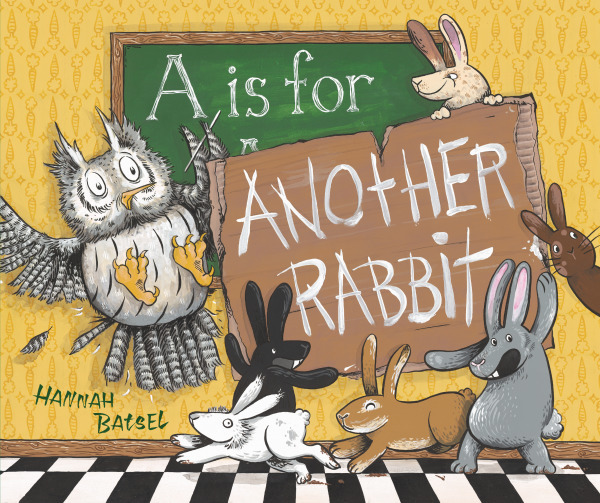
Most of them are the normal size of wild rabbits but one or two are rather large which confirms their considerable abilities not only in enjoying a banquet of edibles but in eluding the prevalent raptors and coyotes.  It's hard to know how many there are in residence, but their frequent appearances indicate their numbers are growing.  A is for Another Rabbit (Carolrhoda Books, an imprint of Lerner Publishing Group, April 7, 2020) written and illustrated by Hannah Batsel is an alphabet adventure gone awry due to an overabundance of bunnies.  Trust me when I relate that this is no laughing matter to one particular owl, but the hares find it hilarious (and you will, too.)

A is for A rabbit.

Wait---
rabbit starts with R! 

Yes, but "a rabbit" starts with A.

As you might surmise the letter B is represented by the word bunny which, I might add, is quickly pointed out by the disturbed owl as being a synonym for rabbit.  As the narrative proceeds through the letters of C and D, entire phrases represent those letters because of the first word in those very phrases.  A promise is made for the letter E.  Initially, the owl is happy because it seems this alphabet book is back on track until he uncovers a wily disguise. 

The presentations for letters F through J are outrageously focused on rabbits rather than the specific letters.  Owl is fearful of being fired.  Clearly Owl is getting more and more rattled when he mistakes the word Kit for Kite.  Kit happens to be the term for a baby . . . rabbit.

The farther into the alphabet we go, the more despondent Owl becomes. He's a complete bundle of nerves.  The unseen narrator convinces him to rest for a few pages after the letter P.  Owl readily agrees.

The silence that settles over the pages for Q is laden with suspense because the next letter is R for . . . RABBITS, oodles of rabbits.  Owl is flabbergasted as he shouts out S for stop!  An obvious message is conveyed.  With letters T through Y, it's fulfilled.  As the alphabet book comes to a close, Owl, frazzled to within an inch of his bird life, finally gets his wish.  Although, others get the last word.


Author Hannah Batsel begins her comedic tale immediately as we read the first three sentences.  It builds with each letter of the alphabet as the banter increases between Owl and the unseen narrator.  Every alphabetical statement, more preposterous than the last, is countered by Owl as his frustration escalates.  This supplies readers with humor which multiplies proportionality.  The pure fun at reading this text aloud increases with the use of alliteration and rhyming.  It's a joyful rabbit jubilee!  Here is a passage.

G is for Goodness me!
Another page
of rabbits?

Now, look here.  I may
be small, but I refuse to be
pushed around by a pack
of long-eared, carrot-eating
furballs!  If you don't stop
this nonsense, I'll---


The full-color images on the front and back of the open and matching dust jacket and book case declare shocked surprise and marvelous merriment. Clearly on the right, the rabbits have no intention of stopping their quest to occupy every single letter of this alphabet book, much to the dismay of Owl.  To the left a multitude of rabbits in an array of colors and attire are layered together.  Among them is a rabbit robot, a pastry chef rabbit carrying a cake with lighted candles, a rabbit wearing a Wisconsin cheesehead hat, a crown-wearing royal rabbit, a rabbit opera singer donned in a Viking helmet with horns and braids and rabbits wearing lion and alligator costumes.

On the opening endpapers in lavender as a canvas with brown etching is a gallery of animal portraits, meant to be a part of this alphabet book.  Owl is entering from the far-left walking along, carrying a book under one wing and a hot beverage in the other wing.  On the closing endpapers, a white rabbit on a ladder and with telltale red paint has made alterations to the gallery.  An exhausted Owl, beverage spilled and book on the floor, is sleeping on the sofa on the far right.

These images

painted with acrylics, black ink brush pens, and liquid gold leaf

by Hannah Batsel are a reflection of her gift of humor and love of rabbits per her dedication and note on the verso page.  On the title page Owl is quietly at rest in an easy chair in front of his fireplace.  Careful readers will notice an odd shape on the globe next to his chair. 

Each illustration spanning two pages or single pages is highly animated with bright and lively characters.  Their facial features especially those of Owl mirror every mood.  Readers will pause at each page turn to notice the details and myriad elements.  The use of white space is instrumental in depicting the comedy and drama to perfection most notably for the letter Q.

One of my many, many favorite illustrations is for the letter E.  Spanning across from the left, over the gutter and nearly to the edge on the right is an elephant.  This is no ordinary elephant.  This elephant is formed from patched gray blankets of different textures, with cardboard ears painted pink, cardboard tubes for tusks and a trunk manipulated by three rabbits and a stick contraption.  On the green and yellow tile floor are splatters of pink paint and a dropped paint brush.  Owl is basking in a glow of suspicious confidence with closed eyes.  This page is sure to evoke bursts of laughter.


This book, A is for Another Rabbit written and illustrated by Hannah Batsel, is a celebration of all things rabbit.  It is one of the funniest alphabet books with bunnies busting out of the seams. It can be used with other alphabet books, a unit about rabbits or a theme based on humor, one discussing what makes a book hilarious.  I highly recommend this title for your personal and professional collections.

To learn more about Hannah Batsel and her other work, please follow the link attached to her name to access her website.  At her website a page dedicated to this book provides a glimpse at illustrations.  Hannah Batsel has accounts on Facebook and Instagram.  At the publisher's website you can view interior images and read an excerpt.

Monday, January 6, 2020

There's "Snow" Better Time To Read

It began in the early afternoon yesterday.  It was not stopping.  The entire landscape looked as though it was dipped in vanilla frosting.  The wind gusts sculpted lovely shapes and rang my three sets of wind chimes.  Winter is back full throttle. 


Late, late last night the snow finally stopped but the winds are still howling.  The big lake, Lake Michigan, is wild and beautiful today.  A walk along the shoreline needs to be done with respect.


Two of three publications released in November 2019 remind us of all the fun-filled activities to be enjoyed outside in winter.  The third book focuses on a hesitate hibernator.  In an alphabetical journey with a new-found friend, he makes his way back home.

When The Snow Is Deeper Than My Boots Are Tall (Godwin Books, Henry Holt and Company, November 5, 2019) written by Jean Reidy with illustrations by Joey Chou will have eager readers ready for a romp in the out-of-doors.  There is something special about an unexpected snowstorm.  It's an open invitation brimming with possibilities.

Jump up in the morning.
Winter's here at last!
Gobble down my pancakes.
Getting dressed so fast. 

Our happy narrator compares the snow depth throughout the story by his size.  It begins as

deeper than my toes are tall.

Before he gets garbed in his winter gear and sets foot outside, it's much deeper.  He joyfully leaves prints wherever he goes.  The family cat and dog join in his snowball fight with the neighborhood children and when he makes a snowman.

It keeps on snowing and the wind is still blowing.  A huge gust snatches his hat and now the snow depth matches the book's title.  This little guy is in need of rescue.

Near but not too near, loving parents pick him up.  The adventuresome boy, dog and cat are carried through the snow until they all take a minute or two or three to leave their shapes in the snow.  A final gaze at a vast starry sky is a prelude to an appreciative snuggle inside by a cozy, crackling fire.


Author Jean Reidy pens a wonderful rhyming story which will have readers clapping and toe-tapping by the second page turn.  Repeating the deeper than phrase but adding to its descriptions asks for reader participation.  Jean Reidy also includes single alliterative action words and the repetition of certain words together to heighten the rhythm.  Here is a passage.

Step!
Stamp!
Stomp!
Run!
Tracks in the white.

Splet!
Splat!
Splot!
Fun!
Snowball fight!


Illustrator Joey Chou using hues of blue and purple contrasting with vivid colors in clothing and interior and exterior scenes of the boy's home manages to portray a winter's snowy, blowy and chilly day with excellence.  On the front of the dust jacket the boy is gleefully swung between his parents as the family pets watch.  To the left, on the back, we are brought in close, to the boy and his pets engaged in making snow angels as two birds fly over them.  Specific elements are varnished to reflect light on the snow and title text.

On the book case in shades of turquoise as a background with large snowflakes in darker turquoise, white and purple, an interior illustration is featured.  It shows the boy romping in the snow, leaving his footprints and handprints.  He moves from left to right into four different positions before running toward the right-hand corner.

The opening and closing endpapers are covered in a bright orange similar to the boy's scarf.  The images, rendered by digitally painting in Adobe Photoshop, are all double-page pictures with shifting perspectives to enhance the pacing.  Several times we get a bird's eye view.  We are brought close to the characters for emotional impact.  Readers will delight in the extra details like the cat and dog paw prints on the frost-covered window pane

One of my many favorite illustrations is of the boy making a snowman.  On the left he is rolling the head toward the two other large snowballs on the right.  His snowball on the left already has eyes, a smiling mouth, a carrot nose and twigs sticking out the top for hair.  The medium snowball has a red bow tie on it.  The cat is peeking out the top.  The largest snowball has yellow boots for feet.  The dog, paws on top, is looking at the cat and his boy and is barking.

To learn more about Jean Reidy and Joey Chou and their other work, please follow the links attached to their names to access their respective websites.  Jean Reidy has accounts on Facebook and Twitter.  Joey Chou has accounts on Instagram, Tumblr and Twitter.  At the publisher's website you can view interior images.  The link is attached to their name.


A Day for Skating (Candlewick Press, November 5, 2019) written by Sarah Sullivan with illustrations by Madeline Valentine is sure to have readers reaching for their skates and searching for the nearest ice.  If you can't walk to it, it's time for a trip.  Then, get ready to glide, twirl and zoom over the frozen surface.

Mittens, boots, parka, cap.
Crisp cold. Branches snap.
Clear pond, shining ice.
Laced-up skates---check them twice.

An adult, little girl and pet dog head to the skating pond in their car.  At the ice, the little girl struggles to maintain her balance but her companions, human and canine are there to offer support and help.  After the tumble, the trio head inside the warming hut with others for a snack and hot chocolate.

Later, back outside, we watch others skating hand-in-hand, playing hockey, dancing and racing.  Everyone seems to be enjoying their day on the ice.  At dusk, a roaring fire in a brick pit outside is a place to get warm and change from skates to boots.  Others gather by the fire with the adult, little girl and their dog.

Back home there's a warm bath to take off the chill, and a favorite book to read in bed. What's happening at the ice now that everyone is home?  Only the full moon knows for sure.


Through the words written by author Sarah Sullivan is seems as if we are there at the pond and at the child's home at the end.  Most of the two lines rhyme at the end, giving us a descriptive vision of place, time and the emotional mood.  There is a distinctive flow mirroring the actions of the characters until we, like the little girl, are lulled into calm at the conclusion.  Here is a passage.

Good friends gliding in a row.
Holding on and letting go.


Rendered digitally and using watercolor and colored pencil, the illustrations by Madeline Valentine transport us to the pond on the matching and open dust jacket and book case.  On the front the girl and her parent skate together amid a hockey player and group of figure skaters.  The crisp, cold setting is deftly depicted in cooler colors with bright splashes in the clothing worn by the skaters. 

The scene continues over the spine to the left.  Five skaters, hand-in-hand fashion a line whipping around on the ice.  Behind them is the warming hut, the dog and another father and his son. Readers will be pleased to see different ethnic groups represented.

On the opening endpapers, the parent, little girl and dog are riding in their car to the pond down a county road with a snowy landscape behind them.  On the closing endpapers we are at the pond at night.  We can see the warming hut and a portion of the pond.  Deep purples broken with white snowflakes and a large shining moon portray an atmospheric scene.  On the verso and title pages we are treated to an overview of the parking lot, warming hut, ponds with skaters and the bridge.

The majority of the images are double-page pictures with smaller illustrations featuring actions in a short time period.  The expressions on the characters are those of pure joy whether they are on the ice, in the warming hut, cozy around the fire outside or when our main characters are happily at home.  Readers will appreciate the fine line work and details.

One of my many favorite illustrations is a close-up of people gathered around the outdoor fire pit.  On the left are several children and an adult, and the girl, her parent and dog.  On the right a child, skates over their arm, is close to the pit, arms and hands outstretched to savor the heat.  Careful readers will notice new guests off the edge to the right.  They are a hint of things to come.

Links are attached to the names of Sarah Sullivan and Madeline Valentine, so you can learn more about them and their work by accessing their websites.  Sarah Sullivan maintains accounts on Facebook, Instagram, Pinterest and Twitter.  Madeline Valentine maintains accounts on Instagram and Twitter.  At Candlewick Press and at Penguin Random House you can view interior illustrations.  Here is a link to a nine-page activity kit found at the author's website.


Bear Is Awake!: An Alphabet Story (Dial Books For Young Readers, an imprint of Penguin Random House LLC, November 26, 2019) written and illustrated by Hannah E. Harrison is an enchanting story of an unlikely and unexpected friendship.  A winter's nap is interrupted for reasons unknown.  A girl's morning is interrupted, too, but she handles it with pure perfection.

Aa  awake
Bb  big bear
Cc  cozy cabin
Dd  doorbell ding-dong!

As you might expect, the letter e reveals entirely different responses from the bear and the girl.  The bear is thrilled with his entrance into the cottage.  The girl is surprised out of her mind.  For each letter of the alphabet the story unfolds from one hilarious moment to the next.

The girl decides they need to go on an excursion.  She puts a large hat on the bear, and they set off down the road into town.  The townspeople and children are terrified.  The bear is having a ton of fun and the girl is trying to keep him acting nicely.

After a trip to the market and back at the cottage, a pancake breakfast makes for two happy people.  The more she learns (from reading a book she got when they visited the library), the girl knows the bear must go back to his home.  The trip is partially fun filled, long and a tiny bit sad.  Now tucked in for his long winter's nap, the bear (and readers) will notice the treats and promise left behind.


Every carefully chosen word by Hannah E. Harrison moves us through this delightfully charming narrative laden with humor.  The single words, double words, triple words and one group of four are sometimes alliterative but nevertheless, fashion a cadence.  Together this collection of alphabetically arranged words do tell a story but they leave plenty of room for the marvelous illustrations.  Here are the words for the letter o.

Oo  oblivious officer
       outlandish outfit


As soon as you look at the front of the matching dust jacket and book case, not a second later, you'll be filled with merriment.  That bear and that girl are having the most fun either of them have ever had.  Notice the shadows made by their arms and legs as they form their snow angles and their footprints and paw prints in the snow.  To the left, on the back, still on a background of white, an interior image of the girl tying the hat on the bear is placed between text that reads:

What would you do if A Bear Came to the Door?

A. Run!
B. Scream!
C. Give the bear a warm hat and head to the library for advice.

On the opening and closing endpapers, with a blue-on-blue color scheme, a map of the community, the girl's cabin and surrounding woods, the stream, mountains and bear's home are shown.  There is one difference between the first and second set of endpapers.  Readers will have fun with the added detail.

Illustrator Hannah E. Harrison begins the pictorial story on the title page with the bear still sleeping inside his den but by the first page turn, a squirrel has moved to the top of the den when the bear wakes up. 

The artwork for this book was created with Winsor & Newton Designers gouache on Strathmore 400 series 184 lb. mixed media paper with vellum surface.

The image sizes vary between double-page pictures, full-page pictures, and several images on a single page.  Readers won't know whether to burst out laughing (which they will undoubtedly do) or point out all the tiny elements Hannah E. Harrison includes in her pictures.  The bear is using a single sharp claw to ring the doorbell.  The bear glances back at the lion on the library steps.  The baby touching the bear's fur during story time is completely at ease.  All the children are watching the bear or carrying on as usual.  The librarian is the one looking rather uncomfortable.

One of my many, many favorite illustrations is on a single page.  The bear and the girl are in the supermarket at the check-out counter.  The cart is ahead of the girl and the cashier; the items are already in a bag.  The big, bulky bear is squashed into the seat, wearing the seatbelt and cautiously waving one paw at the cashier.  The cashier is trying to ring the cash register and take the girl's money while keeping an eye on the bear.  The girl, her back to us, is holding out her money.  This is the nice part of the letter n.  (You should see the naughty scene on the previous page.)


Follow the link attached to Hannah E. Harrison's name to access her website and learn all about her other enchanting books.  Hannah E. Harrison has an account on Facebook.  You might enjoy this interview of Hannah E. Harrison on Brightly.  At the publisher's website you can view the title page.


When The Snow Is Deeper Than My Boots Are Tall written by Jean Reidy with illustrations by Joey Chou, A Day for Skating written by Sarah Sullivan with illustrations by Madeline Valentine and Bear Is Awake!: An Alphabet Story written and illustrated by Hannah E. Harrison are three fabulous books for a winter theme whether they are read separately or together.  They offer multiple opportunities for story stretcher activities.  All of them are lively and full of cheer.  Who could ask for anything more?  I highly recommend all three for your personal and professional collections.

Tuesday, April 23, 2019

Harnessing A Power

Despite the order in which they are placed, forward, backward or all jumbled up, this team of twenty-six is unbeatable.  When they go against any adversary, they will emerge victorious.  They can harbor mysteries.  They can comfort, heal and save.  They can move quickly and quietly or if necessary, they can roar like a lion.  They remain steadfast but are fluid enough to function for the well-being of multitudes.  This team of twenty-six are the letters of our alphabet.

They can work individually but function superbly in certain combinations.  Anyone can weld their power.  The Magic of Letters (Neal Porter Books, Holiday House, April 23, 2019) written by Tony Johnston with art by Wendell Minor is abracadabra!

Letters

hold

magic.

When you
know
their
secrets,
they open
worlds.

We learn at an early age to form the sound for each letter.  We say them over and over, chanting their names.  Soon we arrange them to make our name.  We say this over and over, chanting it like a miracle.

Letters can be used to represent strength.  A single word can stand for a foundation on which great things are made.  These foundations are timeless and true.

Other words made with the magic of letters describe a specific movement, a noise or the way something feels when we touch it.  Still more words make us laugh, hungry or take us into another world.  It's delightful to say them out loud.  What can we create if we connect them together?

As we use letters to build words, and then more words, and then, even more words, we can make creative and crazy and compassionate connections.  We can read creative, crazy and compassionate connections written by others.  In this the magic of letters is revealed.


There is something about the word magic which causes us to pause. Sometimes without even knowing we are doing it, we hold our breaths in anticipation.  With her first three words author Tony Johnston takes us into that pause.  Unlike many magicians, she discloses the secrets of the magic of letters. 

She walks readers through learning each letter, then using those letters to make a series of single words describing anything you can imagine but she doesn't stop there.  Her narrative continues by taking those words to complete thoughts.  She shows us how the magic works with examples.  Here is a passage.

Letters hold
surprises.
If you swinkle
them sweetly,
new words
appear---
like swinkle.


If you are familiar with the artwork of Wendell Minor (Daylight Starlight Wildlife, Wild Orca: The oldest, wisest whale in the world, or Night Train, Night Train) you realize looking at the open and matching dust jacket and book case, the illustrations for this book are stunningly different.  Yet on close examination, the line work we've come to appreciate is present.  Rendered with graphite on paper and digital tools these images take readers on a journey between imagination and reality.

To begin, a rabbit and a black top hat are synonymous with magic.  In this instance the rabbit is the magician as letters spill from the black hat and scatter.  For most of the illustrations throughout the book, the crisp white canvas used on the jacket and case is continued.  It showcases the other elements with excellence.  To the left, on the back, the spectacle-clad rabbit is taking a bow as two words form from inside the hat.  Can you guess what they are?

On the opening and closing endpapers, the vivid hue in the title text is used as the color.  On the initial title page, the rabbit, in front of the hat, is looking up and holding the letter "g".  Other letters spill off the right edge and continue to scatter, left to right, across the formal title page.  With a page turn the first two sentences are placed between the ears of the rabbit as he looks eagerly and straight at the reader.  All we see is his front paws, head and ears.  (This effect is used again beautifully.)

The picture sizes vary in tandem with the pacing and narrative; spreading across two pages, full pages or partial pages.  They are whimsical, lively and as unpredictable as magic.  The rabbit drives a huge dump trunk with words spilling out the back; words like trees, heart, art, libraries, time and diversity.  Words the author calls mighty words.  For the word quesadilla, a row of smiling vegetables and fruits, bookend a portion of this delectable food which stands in place for the letter "a" in quesadilla.

One of my many favorite illustrations spans two pages.  It's for the phrase

Giggling
words
like
flibbertigibbet.

Along the bottom of the page is a grassy expanse.  Brightly-colored tulips begin on the left, cross the gutter and grow to the right edge.  Among these on the right is a jack-in-the-box with a rising sun on the front.  A happy-go-lucky clown with arms and hands extended is smiling.  His suit and hat are red-and-white polka dotted.  The word flibbertigibbet is in shades of pink, orange and red and is written across both pages.


The Magic of Letters written by Tony Johnston with art by Wendell Minor is a celebration of letters, words they make and how we say, write and read them.  It is packed with power and energy.  This book can be used in a theme on alphabets, writing, reading or creativity.  You will certainly want a copy on your professional and personal book shelves.

To learn more about Wendell Minor and his other work, please follow the link attached to his name to access his website.  He devotes a page to this title showing several interior images.  Wendell Minor maintains an account on Twitter.

Tuesday, December 11, 2018

Animal Idiosyncrasies

There will be books you read which cause an excitement to grow within you.  Each page turn reveals more inventiveness, information, humor, or opportunities.  You can't wait to read it aloud.  You can't wait to tell someone else about it.

This book, Owls Are Good at Keeping Secrets: An Unusual Alphabet (Random House Children's Books, December 4, 2018) written by Sara O'Leary (The Boy And The Blue Moon and This Is Sadie) with illustrations by Jacob Grant, is one of those books.  Readers will be continuously wondering, between bouts of giggles, if there is some truth to the statements.  Who knew our animal friends had so many hidden talents and quirks?

Aa
Alligators think you'd like them
if you got to know them.

Letter by letter from a to z, we learn and laugh.  Bears with boo-boos are just like children.  Kisses are the most requested method for healing.  It will come as no surprise elephants' hearts are most joyful when bathing.  Foxes get frantic when they can't take more photographs. 

At times the smallest creature is the most eager to explore.  Aim high little hedgehog!  Gals and guys aren't the only ones who miss their own beds during sleepovers.  Iguanas are known to be wide-eyed awake in the middle of the night.  The unicorns of the sea actually enjoy solitude.

You'll never guess which guests arrive first at a celebration.  (Clue: They wear masks twenty-four hours a day.)  One book is never enough.  Adorable voles value reading.

When you reach the letter z, you'll be grinning from ear to ear.  You'll also not be surprised at the deepest desire of zebras.  It's guaranteed you'll quickly go back to the beginning to read each animal's declaration again.


The sentences written by Sara O'Leary are infused with whimsy and wit.  She uses the physical characteristics and habits of the animals to supply readers with comedy.  We find ourselves laughing because the revelations are curiously close to the truth or completely ridiculous.  Here is another sentence.

Quail get quite tired of being
told to be quiet. 


You can already feel humor radiating from the front of the matching dust jacket and book case.  We are drawn into the image by the darker color palette and the two owls, wing tips to mouths seeking our silence and suggestive of them hiding something.  To the left, on the back, eleven of the animals are peering in from the sides and staring up at the owls.  They frame six questions about the alphabet animals.  The title text and animals are varnished.

On a sand-colored canvas on the opening and closing endpapers white letters, a to z, are placed in four rows.  The critters for each upper-case letter at the beginning are tucked behind them.  At the end, lower-case letters highlight the animals in front of them.    On the title page under the text sits the zebra, in two shades of pink.  He's holding a toy zebra.

The illustrations rendered by Jacob Grant are showcased by their placement on a white canvas.  The thicker matte finished paper is excellent for the images which range in size and shape; extending over the gutter, loose frames with elements breaking those borders, and even a cut-away picture.  The range of colors are muted.

The added elements in each scene increase the hilarity and charm.  The alligator is holding a bouquet of flowers.  Chipmunks are scampering around their house while a disgruntled parent, holding a mug with a steaming beverage, watches.  Giraffes are riding a bicycle built for two.  Two young yaks are grinning at their own jokes. 

One of my many favorite illustrations is on a full page.  Five iguanas are having a sleepover.  They are laying in a row under the cover of a large palm leaf.  The iguana on the right end is sitting up and afraid.  He is grasping a tiny purple teddy bear. 


You can be sure whether this book is read silently by an individual, shared one-on-one or with a group, there will be loads of laughter.  Owls Are Good at Keeping Secrets: An Unusual Alphabet written by Sara O'Leary with illustrations by Jacob Grant is assuredly an entertaining book about letters and animals, but it is much more.  It issues an invitation to readers to think of other animals and what they might think or do.  Readers can also delve into nonfiction research about these animals and other creatures. You will want a copy of this title on your professional and personal bookshelves.

To learn more about Sara O'Leary and Jacob Grant, please follow the links attached to their names to access their websites.  Jacob Grant also has a Tumblr site.  At the publisher's website you can view some interior pages. The book trailer is premiered at teacher librarian Matthew Winner's site along with some sentence starters that Sara and Jacob finish.  Jacob is interviewed by Maria MarshallSara and Jacob have accounts on Twitter.  You can find Sara and Jacob on Instagram.


Friday, September 1, 2017

On The Run

When you have small children or pets as members of your family (depending on the type of pet, of course) you get in the habit of checking as to their whereabouts before you open any door of your home.  The lure of the outside world is strong.  You would think the music of the Sirens is calling to them.  If they are faster at running through the opening than you are at closing the door, they are soon speeding away like a cheetah.  You imagine them yelling at the top of their lungs, "I'm free! I'm free!"  (If they are little children, they probably are shouting and laughing these very words.)

The truth is, sometimes being loose in the world is not an entirely positive experience.  The Little Red Cat Who Ran Away and Learned His A B C's (the Hard Way) (Little, Brown And Company, September 5, 2017) written and illustrated by Patrick McDonnell follows the adventures of a family feline that makes an escape.  As soon as he leaps off the front porch, races down the hill and starts on a straightaway, he realizes he has made a mistake.  Without the benefit of words but with award-winning artwork inviting and prompting a story in our minds, we eagerly turn the pages as our twenty-six letter alphabet dictates the flawless flow of action.

The first frightening encounter is with an alligator and is quickly followed by a meeting with a bear.  As the trio passes a coop, a chicken joins the line of runners.  Not watching as wisely as they should be, they nearly ram a sleeping dragon.  This frightens the chicken so much another runner joins the group.  Can you guess who (what) it is?

Everyone knows what an angry dragon breathes.  This necessitates the five frantic fleeing critters to don protective eyewear.  Now there are six on the move.  One dreams.  Six slip and slide.  After passing through a habitat better suited to primates, they are noticed by royalty.  One of them points to a poster.

As the middle of the alphabet is reached, the six seek new heights, again not paying attention.  Fortunately (Remy Charlip) an invention is handy.  Where are they now?  Do they need a break?  What time of day is it?

As in most tales with a bit of magic, when they least expect it and can hardly take another step, help arrives.  Greetings are given and six are soothed.  A crescent moon shines down, guiding some one way and one little red cat in another direction.  It's been a long day.  There's no place better than one's own bed.


When looking at the opened dust jacket (I am reading the F & G.) you can immediately feel a grin start to form.  That little red cat is most definitely in a bit of trouble.  The design and layout are superb introducing us to the six prominent characters chasing through the title text.  The black and white checks on either side of the spine add a touch of classic to the overall effect.  There is even a tiny little red cat above the Little, Brown And Company logo.

To the left, on the back, a tumbled group of alphabet letters in black except for A, B, and C are chasing the cat.  The opening and closing endpapers are an array of larger alphabet letters, all twenty-six.  A, B, and C are in their respective colors.  There seems to be a mix of words in the arrangement.  Can you find any?

Right after the opening endpapers, Patrick McDonnell begins the story.  Something wakes up the little red cat.  One eye pops open.  (This is just like Mulan who is dead-to-the-world asleep until I open the refrigerator door.)  Spread across two pages an image shows the open front door before the title page text starts.  Opposite the verso, the little red cat runs out the door and across the porch.

The use of white space as an element is exceptional.  This allows for a more stunning effect when it is replaced with snow, trees and vines, and a changing sky color as the day shifts into night.  All of the illustrations with the exception of seven allow a single page for each letter.  The others have larger, two-page pictures for a single letter.  For some of the letters two pages combine two letters in a single image.  You even get to turn the book for a surprising vertical visual.

One of my many, many favorite pictures is for the letter E.  Even thinking about it makes me laugh out loud.  And that's all I'm going to say except this illustration with all the little extra details throughout the title reveals a super sense of humor on the part of Patrick McDonnell.


If you are looking for your next new favorite alphabet book, The Little Red Cat Who Ran Away and Learned His A B C's (the Hard Way) written and illustrated by Patrick McDonnell is the book for you.  If you want lots of excitement and adventure, this is the book for you.  If you want to talk about plot and pacing, this is the book for you.  If you want to laugh and hear your readers and listeners say, "Read it again!" this is the book for you.  I highly recommend this title.

To discover more about Patrick McDonnell and his other work including his famous Mutts comic strip, follow the two separate links attached to his name to access websites.  Enjoy the book trailer.

Monday, January 30, 2017

Blame It On The Ball

On January 23, 2017 the American Library Association announced their annual Youth Media Awards in what is one of the premiere events in the children's literature world.  Twenty-one separate categories honor distinguished works and their creators.  One of the categories is the (Theodore Seuss) Geisel Award.  It is given to

the author(s) and illustrator(s) of the most distinguished American book for beginning readers published in English in the United States during the preceding year.

This year there was one award winner and four honor selections.  Of those honor selections I have previously written about The Infamous Ratsos and Good Night Owl.  I did read the winner We Are Growing:  A Mo Willems' Elephant & Piggie Like Reading! Book written and illustrated by Michigan author illustrator Laurie Keller.  It definitely qualifies as one of the most hilarious books of 2016.  Upon reading one of the other honor books, Oops Pounce Quick Run!: An Alphabet Caper (Balzar + Bray, an imprint of HarperCollinsPublishers, February 16, 2016) written and illustrated by Mike Twohy, it's easy to see why the committee gave it notice.

Asleep

A story unfolds with this single word.  We look inside the home of a mouse quietly resting in a reclining chair opposite a hole in the wall.  With the next word, ball, the nap is interrupted, starting a series of actions each beginning with a letter of the alphabet.

As the ball is held by the surprised mouse a large nose and eye of the canine variety seek the said ball.  Quicker than you can call look out, paws reach into the hole for the lost toy.  One scared mouse escapes through the home's entrance lickety-split.  And the race commences in earnest.

Through the kitchen and living room they run until the baffled dog can't find the mouse.  Now where could the tiny creature be?  Ah! Ha!  The pooch's pounce misses.  They tear toward the mouse's house.  Whew!  He made it.

In a clever twist on the chase and race theme, the tiny creature has a better idea.  The dog is an exceedingly pleased pup.  And there you have it readers...wisdom for the win.


With true brilliance Mike Twohy strings single words, sometimes two and even a single letter, to fashion a story full of fun and energy.  The only time the character(s) are not moving is at the beginning and the end which is another stroke of genius; a circle story in several respects.  Twohy shifts the focus from one character to another and to both with flawless ease generating a captivating pace.


The fast and furious lines on the front of the matching dust jacket and book case leave no doubt as to the commotion and comedy found inside this book.  In this scene the canine seems to have the upper paw but when you look to the left, at the back, a different "tail" is told.  The dog has been placed on the same pristine white background in the center.  By the movement of his head from left to right and back again, you know he has lost sight of the mouse.

The opening and closing endpapers are the bright orange color of the ball.  On the initial title page Twohy sets the stage by showing us the mouse hole beneath the text.  All of the single page illustrations, rendered in India ink and felt-tip pens, are on single pages with the exception of the letter H.

To heighten interest the first letter is shown in different colors; bright pink, blue, orange, red, teal, blue, and grass green.  The images are showcased by continuing to use the crisp white background.  Spot color is added to the characters or one or two items in the scene.  The body language and facial expressions convey emotion with clarity and a great deal of humor.

One of my many favorite illustrations is for the letter X.  I wish I could tell you more but I don't want to spoil it for you.  I can't look at it without bursting out in laughter.


You will want to plan on having multiple copies of Oops Pounce Quick Run!: An Alphabet Caper written and illustrated by Mike Twohy on your professional and personal bookshelves.  It's an imaginative and intelligent use of the alphabet to tell a story.  And best of all...your guys and gals are going to love it.

At the publisher's website you can get a brief overview on Mike Twohy.  He does have a yellow Labrador who enjoys his ball.  There is also a short view of some pages with audio.

Saturday, December 10, 2016

New Views Of The ABCs

They have been a part of literature for centuries, a gathering of the twenty-six letters of our alphabet.  These books are not only a means of learning the letters but practicing the sounds of each.  Usually the upper and lower case letters are displayed with items beginning with each letter.  Over the years the titles have become more elaborate using phrases, sentences and poems.  Sometimes a story will unfold as each letter is introduced.  Or the letters may be a means of acquainting readers with a particular subject or theme.

On September 13, 2016 two very different and highly unique alphabet books were released.  An Artist's Alphabet (Candlewick Studio, an imprint of Candlewick Press) written and illustrated by renowned artist Norman Messenger is a stunning depiction of the obvious and extraordinary.  Every letter will have you thinking about what you see and what the artist is trying to portray.

To begin we see two acrobatic persons elegantly costumed; the first is standing, legs apart, on top of a horse's back to create a capital letter A.  The second has shaped her body in a backward bend to form the lower case a.  The letters B and b are fairly straightforward also but the letter c asks us to extend our minds.  It is the dust jacket image.

What does this represent?  Is it meant to define curve, crest, curl or something else entirely?  Even this stretch does not compare to the letter d.  Two cats' bodies make the upper and lower case letters.  Are we to find something relative to d within these visuals?

The multiple letters for e look to be something from monsters of mythology.  Two tools, one large and the other pocket size, signify the letters f.  Do they stand for fix? The forms for the letter h, types of homes, are true wonders.

The artwork for i, k, l and m offers possibilities but the pictures for the letters j and n have me baffled but intrigued.  Is our artist using beauty alone from our world to fashion letters?  Perhaps in these depictions as in the letter o, there is no tie to the specific letter.  The mystery continues for letters q (snakes), r (shapes of trees) and s (two kinds of chains).  T through z will offer readers equally apparent and striking representations.


Oh, how fascinating it would be to engage Norman Messenger in conversation before, during and after his creations were conceived.  Each one invites us to pause and stretch our thinking.  Even those which appear to conjure those things which are familiar, we wonder if we should not continue to ponder more.


All of the illustrations rendered in watercolor and pencil are eloquent with meticulous details as seen on the dust jacket of the extended waves, water dripping and splashing.  The book case takes portions of the visuals for many of the letters designing a frame for the title text and image on the front and a blurb about the book on the back.  The opening and closing endpapers display capital letters of the alphabet in muted varied colors.  These extend to create frames for the text on the verso and title pages.

Half of the letters extend over two pages; the others are pictured on single pages.  Messenger alternates between using people, animals, plants, fantastical creatures, inanimate items and other natural phenomenon.  His designs and layouts include a small square, with lines like school paper, to host the capital and lower case letters.  In additional to the tiny finer points, his use of light and shadow is superb.

One of my favorite illustrations of many is for the letter l.  It is shown on a single page.  From top to bottom a richly embroidered boot sans laces is highlighted on the left.  To the right is a package of laces, wrapped in paper.  The company logo is ABC.

An Artist's Alphabet conceived and illustrated by Norman Messenger is an imaginative, gorgeous gallery of these twenty-six symbols of our language.  It would be a wonderful title to use for lively discussions and creative writing.  I recommend it for professional collections and it is a must-have for alphabet book collectors.  All ages will be able to appreciate the excellence of this title.

To learn more about Norman Messenger please follow the link attached to his name.  At the Candlewick Press website you can view the interior pages for letters k and l.  At the Walker website you can see the book case and the interior illustrations for letters c, d, k, l, n and r.


As a result of a winning Kickstarter project began in 2014 another one-of-a-kind alphabet book is available for readers of all ages.  The minds behind this project Benedikt GroB and Joey Lee worked closely with Price Stern Sloan, an imprint of Penguin Random House to bring us ABC: The Alphabet from the Sky.  It's as if we have all taken wing and are viewing the world from an entirely new perspective.

In the introduction we are welcomed to trek across America.  We are asked to view the landscape with a discerning eye, focusing on a specific point.  We are also reminded there is more to each one of these pictures than a single letter.  We might find other letters or individual items.

For each letter of the alphabet two pages are filled, edge to edge, left to right.  In the upper, left-hand corner of each scene we are asked to locate the letter.  In the lower, right-hand corner we are given the place name, the state in the United States, and the exact coordinates, the longitude and latitude.

A letter may be formed by rows of homes, a winding road, a specialized building, a parking lot, landforms or a body of water.  You may see the same letter in a scene but not the one selected by the creators.  Sometimes the letters pop but other times you really need to look.  It's a geographical search and seek.

The questions and statements posed for each letter vary.  They encourage us to pursue our quest. They ask us to find, spot and uncover hiding places.

There's an O here somewhere.


The illustrations found in this title are derived from satellite images in the public domain from the United States Geological Survey, National Geospatial Program.  These two people, Benedikt GroB and Joey Lee created a program and a database to locate letters within these images.  The A, B, and C seen on the front of the matching dust jacket and book case are not necessarily those found within the interior of the book.  To the left, on the back, twenty-six more letters have been located.  The opening and closing endpapers are large aerial views; one more natural than the other.

If you should have trouble spotting any of the letters within the book, at the conclusion two pages give you a close-up of all twenty-six letters.  Four more pages contain squares of other letters of the alphabet, sixty-one in all, found in satellite pictures.  This adds to the fun and continues to test your skills of observation.


ABC: The Alphabet from the Sky conceived, written and illustrated by Benedikt GroB and Joey Lee is a challenging, engaging volume sure to provide hours of looking at our country with a much wider field of vision.  When we strive to look with a different set of eyes, this can carry over into other aspects of sensory perceptions.  Can you see letters of the alphabet inside your home, school and other facilities or outside in familiar places?

To learn more about Benedikt GroB and Joey Lee please follow the links attached to their names to access their websites.  Five interior views are available at the publisher's website.  Here are three separate links to their Kickstarter campaign here, here and here.  You might enjoy reading this article at Slate.


Tuesday, July 12, 2016

I'm at #NerdCampMI So... For Day Two A Past Top Post

When you gather more than one thousand people for an event there are bound to be incidents of crankiness over the course of more than twelve hours during a summer day in July given human nature.  But in all honesty when those more than one thousand people are members of the Nerdy Book Club attending NerdCampMI the positive energy does not allow for anything but the best kind of day.  Every single session I attended on day one was upbeat, informative and charged with a love of books, reading, children's literature and filled with people who are passionate about what they do.

As I stated yesterday for today I am providing the second top post read during the #pb10for10 event in August.  If I were to rewrite this post, these books would most definitely be included but I doubt if I could keep the number under fifteen.  (As it is, I added a couple of books at the end.)  Keeping the list to ten is nearly impossible to do.  The Fabulous Twenty-Six is my gathering of favorite alphabet books for the sheer fun of reading them and using them to extend the experience in the classroom with other activities.   I hope you enjoy my summaries and my selections.


Wednesday, February 24, 2016

In Their Mind's Eye

We dream.  We dream during sleep.  We dream when we're awake.  Our dreams allow us to explore possibilities.  We humans are not alone in the act of dreaming.

Scientific evidence through testing confirms dogs dream in a similar fashion to us.  They happen to dream of their dog days and activities.  Author illustrator Kim Krans wonders artistically, without words, in her newest title, ABC Dream (Random House, January 19, 2016) on what images might be found in our twenty-six letters' thoughts as they drift into deep sleep.

Some of the elements finding their way into the minds of the letters are recognized as having been represented in other alphabet volumes but their presentation here is highly original and exceptionally imaginative.  An apple is poised on the top of an A patterned in argyle.  It has been pierced by two arrows.  An apple core is at its base being eaten by ants.  These insects are crawling along the single letter and the arrows.

There is movement in many of the letters' dreams.  A braid swings.  A chicken pecks at cupcake crumbs. Dandelion seeds drift.

As in our own restful inspirations we readers look and suspend belief as flights of fancy form.  An egg balances in the starry universe.  Fish float by fireflies. A happy hedgehog is wearing a party hat patterned in hearts.

Jellyfish journey.  Lambs lay on lace.  A nest is nestled in a nook.  A panda ponders amid puzzle pieces.  A queen's crown adorns a bird's crest.  A rope curtains off a change in the weather.  We are challenged by the ideas the letters give, asking us to think beyond the concrete.

The letter U takes the front image twisting it in speculation.  Zinnias scatter across the plain occupied by the African horse with the distinctive stripes and upright mane.  Though the last letter has revealed its musings we begin again wanting to join in the ABC Dreams once more.


Other than the twenty-six individual letters featured in each single or double-page illustrations, there is no text.  With that being said, these pictures speak volumes.  They are alive with questions and answers.  How did those two arrows get so close to one another in the apple?  Who ate the apple?  Did they leave it knowing it would be a feast for the local ant community?  Kim Krans is asking us in silence to participate.


When you open the matching dust jacket and book case the resplendent unicorn's neck and upper portion of its body continues across the spine to the ISBN framed by leaves.  Leaves are placed in the upper left hand corner, over the spine, and off the front lower-right edge.  Elements from the interior pages are placed throughout this illustration; fireflies, a fish, a dragonfly, a celebratory hedgehog and the dandelion seeds. There is spot burnished gold along the unicorn's horn on the jacket.

The endpapers are filled with rows of repeating alphabet letters in outline.  Spots of color outline some of them.  Kim Krans continues to place small items from other images on the verso and title pages.  The heavier, matte-finished paper is an excellent choice for her pictures rendered in pen and ink and watercolor washes.

With the exception of letters E, N, O, and W the canvas for the illustrations is white.  Most of the visuals extend over two pages.  Any highlighted animals are participating in the dreams; the dog looks upward at the dragonfly, a fox watches the fish and fireflies, a kitten plays with the tendrils of the jellyfish and wasps feast on forgotten fruit.

Thicker lines border the letters but the intricate details in other elements welcome readers to stop and look at each image trying to guess what each dream discloses.  Krans uses color sparingly for emphasis.  Design items will have readers gasping in delight as in the manner in which the H and I pages are joined.

One of my favorite letter dreams is for the T.  At first glance you see tigers next to a tree trunk taking up a large portion of the left side of a single page.  Not only does this represent tiger, tree, and trunk but two and tired.


Not only is ABC Dream conceived and illustrated by Kim Krans an object of beauty but it will promote endless conversations about design, layout, the use of color and the elements in each image.  Each letter's dream has a story to tell.  This is a must have for collectors of alphabet books.  It is a wonderful addition to personal and professional bookshelves.

To learn more about Kim Krans and her other work visit her personal website and The Wild Unknown by following the links attached to her name.  For a few interior illustrations please visit the publisher's website.  Kim Krans is interviewed about this title at The Children's Book Review.  Enjoy the video peek at the book below.  Stand-on-a-desk-shouting-I-love-reading educator Colby Sharp interviews Kim Krans at sharpread.  You will love these questions and Krans' answers.


ABC Dream from the wild unknown on Vimeo.