Quote of the Month

When love and skill work together, expect a miracle. John Ruskin


Showing posts with label Dinosaurs-Fiction. Show all posts

Monday, May 2, 2022

Evolving Into

It is not only determined by a date on the calendar.  The shift from standard time to daylight savings is not a sole indicator.  Its arrival is truly announced by a sound.  It is a sound absent for many months, then one day it returns.  The sound's melody greets the day, surrounds us, and lifts into the sky.

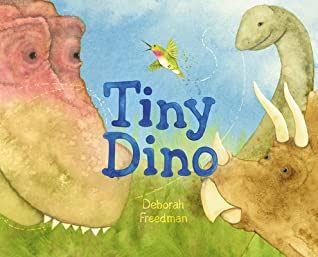
This sound is the chorus of birdsong.  These avian marvels are returning to their homes, some staying and others moving farther north.  They are the true heralds of spring.  To add to the fascination of their essential existence, author illustrator Deborah Freedman in her newest release Tiny Dino (Viking, an imprint of Penguin Random House LLC, April 19, 2022) explores the direct connection between dinosaurs and birds.
Long ago, there were many kinds of dinosaurs.

Stomp!
Clomp!
Tromp!

After these first few words, readers are asked a question.  A voice replies with

I'm a dinosaur!
I'm a dinosaur!

It is the voice of a hummingbird.

Hummingbird continues to joyfully declare kinship with dinosaurs.  When a turtle friend asks about the stomping and clomping dinosaurs did with their feet, the hummingbird points out the similarities between the toes of a Tyrannosaurus rex and the bird's toes.  Turtle and now friend frog point out the huge toe size and the huge bone size of the dinosaur.

Hummingbird proclaims that both have hollow bones.  Each time Hummingbird's friends suggest what they believe to be a difference, Hummingbird counters that said characteristic is shared.  When pals Turtle, Frog, and Mole state dinosaurs had claws and were fierce, the tiny avian verbally explodes.  Hummingbird is

FIERCE!

When a crocodile approaches, Turtle, Frog, and Mole flee.  With all this dinosaur talk, they believe Crocodile to be a dinosaur.  Crocodile says he is not a dinosaur.  Hummingbird agrees, but supplies all the physical features they share.  They are related.  Turtle asks one final question.  Hummingbird shouts out her refrain.


With absolute conversational clarity, author Deborah Freedman takes readers into the story of a hummingbird that proves his truth.  Each time Hummingbird declares he is a dinosaur, one of his friends counters with facts they believe disproves his statement.  He then shows they are wrong with supporting evidence.  In this manner, Deborah Freedman introduces an engaging cadence while providing information about dinosaurs, birds, and other animals.  There are also factual captions next to detailed drawings of relevant, enlarged characteristics.  Here is a passage.

But look---
I have scales
on my toes.

And you 
have scales on
your toes!

Crocodiles and birds have
similar scales, called scutes.
Researchers believe that
feathers evolved from scales!


The image on the dust jacket extends from flap edge to flap edge.  The body of the Tyrannosaurus rex continues over the spine to the far left.  On the left side of the jacket, the back, readers can see one of the dinosaur's feet is holding the ISBN.  The body of the Stegosaurus, similarly stretches to the right flap edge.  Hummingbird is already voicing his truth to the listening trio of featured prehistoric creatures.  The title text and front flap text are varnished.

Hues of light blue, softly textured, are the canvas on the book case.  The Tyrannosaurus rex is outlined in white in the same position as shown on the jacket.  A darker blue dotted loop-de-loop pattern indicates the flight of Hummingbird.  The bird is flying toward the right edge of the front of the book case.  The posture of Hummingbird mirrors determination.

The narrative begins and concludes on the opening and closing endpapers.  The images are wordless.  On the first set Crocodile, Mole, Frog, Turtle and a white bird are moving to the right edge.  A Brontosaurus, also moving to the right, fills both sides.  Above them in a faintly blue sky, a flaming asteroid falls from the left-hand corner.  They are moving through a grassy landscape. On the final endpapers with a faint blue sky and grassy area, Crocodile, Turtle, Frog, and Mole move to the right.  In the sky Hummingbird loops toward the right.  White outlines show us the three dinosaurs showcased on the dust jacket.

Prior to the title page, another illustration has two dinosaurs running as the asteroid gets closer.  On the title page, a question is asked.  Hummingbird answers, three times.  The third answer contains the title text.  Turtle is entering from the right edge.

With each page turn, readers will feel their appreciation growing at the presentation of the story and the information.  Set in pastel watercolor washes are different shaped speech balloons containing the conversations.  When physical traits are compared, those are done in white on blue.  They are intricate.

White space is masterfully used.  It creates pauses in the pacing.  Perspectives shift to furnish us with a sense of being a part of the story.  The majority of the images are double-page pictures.  

One of my many favorite pictures contains a lot of white space.  It spans two pages.  On the far left we see portions of Mole's, Frog's and Turtle's bodies peeking in from the left.  Above them, Hummingbird hovers.  On the far right, just one eye and the large mouth of Crocodile is presented.  (He is coming from the right edge.)  His mouth is open.  Some sharp teeth are depicted.  Crocodile is saying

Pardon me!
Did I hear that dinosaurs
still roam the earth?


Whether this book, Tiny Dino written and illustrated by Deborah Freedman, is read by an individual or as a group read aloud, you can expect to have it read repeatedly.  To have the facts woven artfully in the narrative and images is a gift.  At the close of the book are an author's note and a list of resources.  Even here, Deborah Freedman still educates us while continuing the story along the bottom of both pages.  I highly recommend this title for both your personal and professional collections.

To discover more about Deborah Freedman and her other books, please visit her website by following the link attached to her name.  Here is a link to Lesson & Activity Ideas, & Resources made by Deborah Freedman.  Deborah Freedman has accounts on Facebook, Instagram, and Twitter.  At the publisher's website, you can view interior illustrations.

UPDATE:  Deborah Freedman is interviewed about this title at Writers' Rumpus.  The interview is in-depth and includes her artistic process.  (July 1, 2022)

Tuesday, August 4, 2020

An Appetite For Music

Being true to yourself is at times a difficult task.  You find yourself in the unenviable position of wondering how you will be perceived by your colleagues, friends, or family.  If you already happen to be a distinctive individual for other reasons beyond your control, this challenge is multiplied.

As the only Tyrannosaurus rex in her kindergarten classroom of eleven human children and one teacher named Mrs. Noodleman, Penelope struggles with her innate inclination to consume her classmates as evidenced in We Don't Eat Our Classmates (Disney Hyperion, June 19, 2018) written and illustrated by Ryan T. Higgins.  In the companion title, We Will Rock Our Classmates (Disney Hyperion, July 21, 2020) written and illustrated by Ryan T. Higgins, Penelope faces new concerns.  Her heart's desire is to be valued for everything she is, not just seen for her physical characteristics.

Penelope was the only
T. rex in her school.

Sometimes that made her
stand out a little.

Her classmates tended to only see a dinosaur in front of them.  Penelope was much more than a dinosaur.  She enjoyed playing, reading, and drawing.  Penelope held great affection for music.  Her greatest joy was to sing and play her guitar, rocking and rolling with abandon.

When Mrs. Noodleman announced the school talent show and left the sign-up sheet out for her students, Penelope was thrilled and apprehensive.  First, she was worried about going near Walter, the class goldfish with dubious intentions.  Second, she could not stop talking about the talent show at dinner with her parents in the evening.  Penelope lived and breathed rock and roll.

When it came time for the school rehearsal, all Penelope's joy vanished as students voiced what she feared most.  She could not perform.  Why did she ever think a dinosaur could be anything but a dinosaur?  At home that night, and the next day at school, Penelope withdrew in her despair.  She crossed her name off the list for talent show participants.

As an observant parent, Daddy Rex popped into Penelope's bedroom after school on the second day.  His words and the sharing of a family treasure worked magic on Penelope's sadness.  To Penelope's astonishment the next day her newfound courage was met with a surprise courtesy of a few classmates.  It's safe to say this talent show was unlike any talent show in Penelope's school's history, especially Walter's appearance.


The understated humor in each sentence written by Ryan T. Higgins will have you laughing before you even turn to the second page.  To add meaning, depth, and more comedy to his statements, he includes supporting dialogue.  Readers will appreciate the understanding shown by Ryan T. Higgins in assigning attributes and emotions to the color of Penelope's markers.  Ryan T. Higgins is also aware, as a parent of three children, how valuable it is to include elements in a narrative which might have more meaning for adults.  In particular, I am referencing the name of the band.  Here is a passage with Daddy Rex reading to Penelope all tucked in bed for the night.

She loved to read.

Good night, tasty moose,
all wrapped in baloney.
Good night, tasty goose,
with a side dish of pony.

Mmmm. Ponies! 


With the spotlight encircling Penelope on the stage, we know this kindergarten student is rocking her heart out.  It's fun to see her fellow classmates watching from the side of the stage in amazement.  Penelope and the title text are varnished.  The shades of teal fade in the background, as our attention is focused on the full color used for Penelope.  This is a technique Ryan T. Higgins employs throughout the book.  He will have settings lighten to hues of a single color, still replete with details and Easter eggs.  This brings the characters to the foreground.

To the left, on the back, of the dust jacket is a rectangular image.  It is an interior illustration of Penelope happily playing her guitar in her bedroom.  Surrounding this are praise statements for the first title.

Using white on a black background the bookcase reveals the outcome of the talent show.  A rainbow extends from the main element on the front to its right.  On the back a rainbow extends to the left of that main element.  The text will have you laughing out loud.  Please note the fine print!

On the opening and closing endpapers, a string is stretched from left to right across a yellow background.  A series of clothes pins attaches drawings, all different to the string.  They are children's artwork made for this book featuring each individual's talent.  On the title page, a drum set is placed to the right of the center.  On the larger drum are the initials GCH.  There are other initials and first names tucked into images in this book.

The illustrations rendered

using scans of treated clayboard for textures, graphite, ink, and Photoshop

are single-page pictures on a variety of backgrounds and settings.  When Penelope freezes on stage, the canvas goes black.  For emphasis there are several double-page pictures.  To further accentuate the emotional mood, our point of view shifts.  We are brought close to specific items.   Readers will be smiling repeatedly at all the facial expressions and body postures of Penelope and the other characters.

One of my many, many favorite pictures is a double-page picture.  It is the night of the talent show.  It is taking place in the gymnasium/auditorium.  The background elements, and many of the people are in hues of purple.  Closer to the front, the people are done in full color.  Can you recognize some of them?  On the left, gigantic and in full color, are Daddy Rex carrying a bouquet of flowers and Mommy Rex with a camera round her neck, along with her necklace.  On the far-right side is the stage.  Penelope and several classmates have pulled back the curtain and are surveying the crowd.  Walter is in his fishbowl on the stage with an unusual object standing upright in his bowl.  You can feel anticipation crackling in the air.


No matter how many times you read We Will Rock Our Classmates written and illustrated by Ryan T. Higgins, you'll find yourself smiling at every page turn.  The combination of words, and artwork provide consummate comedy with impeccable pacing. Amid the laughter readers along with Penelope will find we all are made of many qualities making us distinctively wonderful.  I highly recommend this title for your personal and professional collections.

To learn more about Ryan T. Higgins, you can follow the link attached to his name to access his website in progress.  Ryan T. Higgins has accounts on Facebook, Instagram, and Twitter.  Ryan T. Higgins also has some video episodes beginning with the one linked here on YouTube.  At the publisher's website are several activity sheets for you to download.  Ryan T. Higgins visits with author illustrator Jena Benton at her website about this title.  I know you will enjoy the video.

Tuesday, July 31, 2018

Taking A Bite

Every time we've walked in the past twenty months it's the same thing.  Anyone within hearing distance can detect a voice continually saying, "Leave it, leave it, leave it!"  Labradors are known for their love of food but this one, my Mulan, has an appetite for everything.  It's like having a vacuum cleaner on the end of a leash.

At least with young humans you don't have to worry as much about them having an appetite for everything.  Educators welcoming students, especially kindergarten students, on the first day usually need not add a "do not eat" phrase to a discussion about classroom behavior.  Of course if one of your students happens to be a carnivorous dinosaur, educators might need to rethink the rules.  We Don't Eat Our Classmates (Disney Hyperion, June 19, 2018) written and illustrated by Ryan T. Higgins is a comedic tale of a student with a craving for children . . . as an entree.

Penelope Rex was nervous.
It's not every day a
little T. rex starts school.

Penelope's mind was filled with questions but of utmost concern was the number of teeth her classmates have.  Wearing her backpack and carrying her lunch box, both covered with ponies because she loved to eat them, Penelope entered her classroom to discover there were not dinosaurs there but children.  She did what any normal T. rex would do.  She ate them.

Mrs. Noodleman, her teacher demanded she spit them back out.  She obeyed her.  Determined to have a good first day regardless of her first transgression, she gave it her best.  Standing at the bottom of a slide with an open mouth at recess was highly inappropriate.  Telling a boy he could sit on her plate at lunch was hardly the actions of a friend.  Her classmates avoided her.  It was a lonely first day.

After school her dad chatted with her about the drawbacks of consuming your classmates.  Oh, how Penelope tried the next day but her true nature prevailed.  It seemed everyone wanted to be where Penelope was not.  Perhaps Walter the goldfish would be Penelope's pal.

Longingly, as an overture of friendship, she stuck her finger into his fishbowl.  Wowee!  She wasn't expecting that to happen.  There was a definite change in Mrs. Noodleman's classroom from that day forward.  (Goldfish are so unpredictable.)


Every sentence Ryan T. Higgins writes is brimming with humor.  The statements are in contrast to normalcy and have a distinct dinosaur perspective, so we can't help but giggle and grin; lots of little gals and guys like ponies but not because they

are delicious.

Ever so slowly all these plot points laden with hilarity are leading us to the twist we don't envision.  These points are aided by dialogue which is out and out laughter inducing.  Here is a passage.

"Penelope Rex," her father asked,
"did you eat your classmates?"

"Well . . . maybe sort of 
just a little bit."


One look at the opened dust jacket front and we know this little dinosaur simply can't help eating her classmates.  Look at the overturned chairs.  Look at the two tennis shoes, especially the one covered in drool coming from Penelope's mouth.  To the left, on the back, on a purple textured canvas is a smaller image with the pony lunchbox, a single box of apple juice and a stack of sandwiches, several breaking the frame.   Portions of both the front and back are varnished.  The title text is raised.

On the book case a single illustration features Walter.  His bowl is on the shelf at school but he is currently alone.  A series of connected straws leave his mouth and travel to that single box of apple juice on the right side of the spine.  This is intriguing to say the least and gives a hint of the shifts in this story.

On the opening and closing endpapers on a paler lime green a line is stretched from the left to the right.  Hanging with clips is a series of dinosaur drawings.  All sixteen are different.  They reflect varying degrees of artistic ability.  (Notice the dedication page.)  Beneath the title page text Penelope is saying

HEY KIDS!
You will never be
eaten by a T. rex.
They are extinct.
I promise!

The illustrations rendered using scans of treated clayboard for texture, graphite, ink, and Photoshop span single and double pages.  These add emphasis to the narrative creating superb pacing.  Sometimes Ryan will place two smaller pictures on a single page.

Readers will be rewarded if they pause at each illustration.  Many significant elements refer to things found in real life. (On several of the images the setting is muted in a limited palette but looks like a particular place.)  There are other items; some reinforcing Penelope's existence.  Do you know why there is a motorcycle on the bookcase in her bedroom?  Does the map hanging on her wall resemble a world you know?  This attention to details in his artwork elevates Ryan's narrative and heightens the fun we have reading this book.

One of my many favorite illustrations is when Penelope walks into her classroom on the first day and eats all eleven of her classmates.  It spans two pages.  On the far left Walter sits in his fishbowl on the shelf.  At the now empty tables on the left and partially in the gutter are overturned chairs.  Penelope standing with bulging cheeks and meekly holding her arms in front of her has a tennis shoe dangling from her mouth.  Mrs. Noodleman, hand on her hip and book in the other hand, demands that Penelope spits the students back out.  The expression on Penelope's face is hysterical.


Reading this story silently or aloud will have one or more readers and listeners laughing with total abandon.  We Don't Eat Our Classmates written and illustrated by Ryan T. Higgins is a blast from the past into our present with the best kind of results.  It's one hundred percent perfection.  You will want a copy (or two) for your professional collections as well as your personal collections.

To learn more about Ryan T. Higgins and his other work, please visit his website by following the link attached to his name.  You can get some activity sheets at the publisher's website.  Ryan is highlighted at three different posts at Publishers Weekly, PW KidsCast: A Conversation with Ryan T. Higgins, Q & A with Ryan T. Higgins, and T. Rex Problems: Spotlight on Ryan T. Higgins.  Ryan visits KidLit TV and chats with author Phil Bildner on Phil's Fast Five, Podcast Bunny Presents #11, and at author illustrator Jena Benton's Simply 7 Interview. 

Tuesday, January 9, 2018

Dino Dilemma

Between more than 230 million and sixty-five million years ago dinosaurs roamed this planet. (It's fairly difficult to wrap your thinking around a time frame in the millions of years.)  For them it was survival of the strongest and cleverest until a significant event caused them to become extinct.  Today many scientists believe they still live on in birds.

The fascination dinosaurs hold for student readers (and many adults) has never lessened.  Their size, power and capabilities continue to captivate.  To have a dinosaur as a pet or personal friend is the ultimate wish of many.  Don't Forget DEXTER! (Two Lions, January 1, 2018) written and illustrated by Lindsay Ward is about a dinosaur, a toy dinosaur, whose human, his best friend, has vanished.

Hello?

Is anyone there?

Dexter T. Rexter, Dexter, has recently noticed Jack, his best buddy, is missing.  They were together at the doctor's office waiting for a checkup.  Dexter has been alone for a long time.  

He asks us if we have seen Jack, even drawing a picture in his likeness with crayons.  When we don't recognize him (he's a stick figure), Dexter has a mini-meltdown.  The fish in the office aquarium and the receptionist have no answer for Dexter.

Dexter needs to take a new tactic so he sings their song.  When Jack doesn't appear in response to the music, he sings. . . er. . . shouts it again.  This dinosaur is starting to panic.  Then a horrible thought pops into his head.  He quickly dismisses it due to his outstanding physical qualities which he enumerates.  Like the worm worry is, another equally horrible thought zaps his mind.  Comparing himself to others is definitely not working until a voice calms him.  

Determined to find Jack, Dexter attempts a daring escape.  His failure and where he falls has him lamenting all the things he won't be able to do with Jack.  A scream echos in the room.  Remembered. 


To relate Dexter's predicament to us in his own voice allows author Lindsay Ward to add vital emotion to the story.  His dialogue is lively, genuine and exactly as one would think when left alone. Humor is supplied in the form of Dexter responding to implied replies from readers.  Here is a passage.

How can you NOT remember him?!
He was just here!
I'm sorry.  I didn't mean to shout.
Please don't go!


Who can resist the orange dinosaur on the pale blue background looking at them on the front of the matching dust jacket and book case?  We already know from the added speech balloons, Dexter will be speaking to us and making us part of his story.  On the other side of the yellow spine, Dexter is standing on a darker blue rug on the blue floor.  He is looking up and saying:

Hello?
Is anyone up
there?

The same orange used to color Dexter covers the opening and closing endpapers.  Similar lines are spoken by Dexter on the title page.  The verso and first pages are a two-page picture of the doctor's office with tiny Dexter wondering why he is minus his best friend, Jack.

Rendered in printmaking ink, colored pencil, and cut paper the images span two pages, single pages or a series of pictures to portray and enhance pacing.  The backgrounds vary between shades of blue, pale yellow, orange and cream.  Interest is peaked in the shift in perspective, placement of text, pointing arrows and descriptive speech balloons.  Dexter's eyebrows, eyes and mouth leave no doubt as to his current state of mind.

One of my many favorite illustrations is the one for the above cited text.  Dexter is standing on the blue rug on the blue floor right next to the low table with crayons and paper on top.  The point of view brings us close to him.  He is holding up the drawing of Jack.  Jack has lots of curly hair and he is drawn in red crayon; the same color as Dexter's spikes.  An arrow from the words


MY FRIEND

points to Jack.  All we see of Dexter is his hands holding the picture, the top portion of his head and his eyes.  You can tell his claws are made from children's writing paper which is a very welcoming illustrative touch.


No dinosaur story time will be complete without Don't Forget DEXTER! written and illustrated by Lindsay Ward.  Children will easily connect with the feeling of being alone or will recall those times when they have forgotten friends.  Get ready to read it with emotion and humor in your voice and expect requests for it to be read again.  You'll enjoy reading the closing flap where Lindsay discloses the inspiration for this book.

To learn more about Lindsay Ward and her other work, please follow the link attached to her name to access her website.  There is a short interview with Lindsay at The Children's Book Review.  Lindsay is the founder of Critter Lit, a place where you can get free one-time critiques.


Tuesday, January 2, 2018

He Came From The Egg

It has stood the test of time.  It's a tale of being the distinctly unusual member of a family.  There is rejection.  There is acceptance and ultimately great beauty.

Hans Christian Andersen's The Ugly Duckling was written and published 174 years ago.  Dino Duckling (Orchard Books, October 2017, UK, Little, Brown And Company, January 9, 2018, US) written and illustrated by Alison Murray is a charming, original story based on this classic.  In this tale, from the beginning, this odd child out is nurtured.  This is how a heart is made whole.

Even as an egg,
Dino Duckling was different.

BOOM
BOOM
CRUNCH

At birth he was bigger than his duckling siblings, growing faster and much, much larger.  It was hard for him not to feel as though he did not belong but Mama Duck treated him with the same love and affection as her other babies.  As one season passed into the next, he was taught the same skills as the other three.  He also learned how to be a member of a family, sharing and caring for each other.

The most important value Mama Duck cultivated in her children was to 

celebrate their differences.

Even though one has a family who cherishes uniqueness, it's another thing for the world to view you in the same way.  This is hard for the particular individual who is the object of ridicule but Mama Duck was ever attentive and reassuring.

Spring into summer and summer into fall had the ducklings practicing their flying techniques with greater diligence.  No matter how he tried, Dino Duckling could not get himself airborne.  He realized with sadness his differences separated him from his family.  He was alone.

As the cold settled around him, he closed his eyes and he cried.  In his sorrow Dino Duckling forgot Mama Duck's words but she did not.  Heading south was first and foremost a family affair.


Sentence by sentence Alison Murray puts her own special spin on this well-known tale.  This mother embraces the special characteristics Dino Duckling exhibits.  The words different and difference are used repeatedly to supply a rhythm.  When the skills taught to the ducklings are listed and Dino Duckling is trying to fly, another type of cadence is created.  Mama Duck's familial sayings are poems that rhyme and which welcome audience participation.  Here is a passage.

Sometimes Dino Duckling
couldn't help feeling different,
but Mama Duck always said,

"Big and wide,
sleek and slim,
we're a family
and we all fit in."

Different didn't make
any difference to her.


The bright pastel colors introduced on the opened book case are used throughout the title.  On the front of the United States cover all the family members are looking at Dino Duckling with devotion.  To the left, on the back, is a smaller interior scene with the three ducklings using Dino Duckling's back and tail like a slide into the pond.  Mama Duck watches proudly from the water. 

On the opening and closing endpapers Alison Murray, in cream and pale blue, has portrayed four horizontal scenes of life with Mama Duck, the ducklings and Dino Duckling.  There is a notable difference between the two endpapers in keeping with the story's conclusion.  On the initial title page Dino Duckling's egg provides a place for the title text.  On the formal title and verso pages the creamy hue is the canvas for dinosaur and duckling tracks from left to right.  A tiny duckling is quacking up at Dino Duckling as he walks off the right.  All we see is his tail.

Rendered digitally and with screenprinting the illustrations printed on a heavier matte-finished paper spread across two pages, single pages and with several smaller pictures on a single page to emphasize pacing.  Most of the images are loosely framed by the background placed on the cream color.  With a few lines the expressions on the duckling's, Mama Duck's and Dino Duckling's faces convey each mood.

The settings Alison Murray depicts are made more realistic through the inclusion of details.  Blackbirds are nesting in the tree Dino Duckling breaks as he walks, squirrels scampering on the branches.  Schools of fish in the pond, a hovering dragonfly and reed-lined banks clearly define their home. As the seasons shift the sky, flowers and trees reflect those changes.

One of my many favorite illustrations spans across two pages.  There is a heavy use of hues of blue to represent the time of day and Dino Duckling's mood.  He is lying down along the length of the pond, eyes closes and crying.  Behind him tree trucks in black stretch skyward.  Three fall leaves tumble among the fresh falling snowflakes.  Patches of reeds frame Dino Duckling.  On the other bank two tiny mice watch him, concerned.


From the first time to the fifth time my fondness for Dino Duckling written and illustrated by Alison Murray continues to grow.  It is a joy to read aloud.  In fact, you will undoubtedly be asked to read it again and again.  Alison Murray has a gift for reaching her intended audience with a lovely blend of words and art.  I highly recommend this for your professional and personal collections.

To learn more about Alison Murray and her other work, please follow the link attached to her name to access her website.  I think you will enjoy watching her Merry Christmas Dino Duckling short drawing video.   She also has a resources link.

Friday, October 27, 2017

Gigantic Gift

The requests from students to read Christmas stories have already started; especially those tales containing favorite characters.  A thought fleetingly passes through my mind about Halloween not even being over yet, but retail stores have had shelves of December holiday decorations up for several weeks.  Perhaps these children's requests are built upon the belief and the hope this particular holiday season can and will bring out the best in individuals.

It is a time for friends and family, those we see frequently or those we only see once a year, to gather. Our thoughts turn to tradition and the art of giving.  Santa Rex (Viking, Penguin Young Readers,  an imprint of Penguin Random House LLC, October 17, 2017) written and illustrated by Molly Idle is the fourth title in a series featuring prim and proper Cordelia, her younger brother with his constant teddy bear companion, and their four bigger than big best buddies, Rex, Alan, Rosemary and Clarence.  Each episode with these characters leaves a mark of laughter on your heart.  The one for this book will twinkle.

EXPECTING company for Christmas?

Don't look up unless you want to see two large eyes peering through the windows above the door.  Yes, readers, Rex and company have arrived to join in the night-before, merry making activities.  If you desire success, you need to have a lengthy to-do list. 

Without a minute to spare garlands of holly, chains of paper and strings of popcorn are hung.  The room is filled with inventiveness as paper snowflakes are cut and hung on the windows.  (You might want to pay close attention to your curtains when there's a dinosaur on the premises.)  With the decorations done, it's time to create and bake confections in the kitchen.  They're so yummy, it's nearly impossible to not gobble them in great gulps.

In anticipation of a visit from Santa, it's important to hang your stockings on the fireplace mantle.  If you don't have one or it has been accidentally destroyed, improvise. The final act of the evening is to embellish the evergreen.  There is an order to follow if it is to be done correctly.  If you aren't careful the finishing touch is the crashing final touch.

It's off to bed with visions of a special visit swirling in sleeping minds.  No one is prepared for the spectacle awaiting them downstairs in the morning.  No one could be merrier about this one very special Christmas.


Reading like the simple, but ultimate guide book on celebrating Christmas, our faithful unseen narrator leads us to believe nothing could be easier than following the suggestions.  With these spare statements Molly Idle leaves a wide window open for potential problems to appear for those prone to perfection like Cordelia.  As we read each one our expectations build toward what we surely know is going to be less than normal.  What Molly does, though, with great skill is to leave us with an undeniable truth about this holiday and most importantly, the value of two or more is superior to one.


Whether you have read the three previous titles or not, the front of the matching dust jacket and book case will have you more than a little curious about a Tyrannosaurus rex wearing a Santa hat in front of a pile of presents.  Clearly Cordelia and her younger brother are excited about the possibilities this holiday will bring.  The design and layout are as precise as you might expect if our young lady character is the artist.  This is perfection.  Molly Idle is already welcoming us into a situation which will be loaded with comedic contrasts.  To the left, on the back, are small versions of the three other title front covers with praise from professional reviewers.

The opening and closing endpapers are patterned in large red and white stripes like a close-up of a candy cane.  On the final set there is a very distinct difference. (I'm trying not to laugh as I already imagine the exclamations by the young listeners who will hear me read this story.)  On the title page we are privy to the exquisite care Molly gives to each element in her images.  The word Santa is strung with Christmas lights. The teddy bear is there holding scissors as Cordelia and her brother wrap a gift.  This gift is seen several times in the story but we do not know the contents until the very end.

Each illustration reveals the meticulous selection of color choices for the interior of the home with which we are familiar, the dinosaurs, the attire of the children and the wonderful atmosphere of the holiday.  Hilarity and contrast begin with the list.  The stegosaurus is munching on the end of it.  In fact, you need to watch him.  He eats a lot of things throughout this story.

Molly includes images ranging from glorious two-page pictures to framed single page visuals and also has more than one framed image on a single page.  Those that are framed are done in two thin red lines.  For some of the sentences there will be several pictures enhancing those words.  They usually reflect results guaranteed to generate giggles.  A vertical surprise will have you gasping and grinning.

It's nearly impossible to select a favorite illustration. These pictures are pure charm.  One I enjoy and I know readers will too takes place in the kitchen.  The background is shades of mint green and white appliances with mint green and pale yellow tile flooring.  This draws our attention to the characters.  On the left side of this double-page picture Cordelia in her red dress and red and white striped apron is holding a tray with cookies and a glass of milk for Santa.  She is looking aghast at the disappearance of the rest of the cookies from the table which stretches from left to right across the gutter.  On the right is Rex with a bulging cheek and evidence of the cookie in his tiny hand.  The stegosaurus is consuming the table cloth.  Cordelia's brother is hiding a cookie behind his back and also has a bulging cheek.  His teddy bear, next to him, is hoping some of the cookie crumbs will land close enough for him to grab.


No Christmas collection would be complete without the addition of Santa Rex written and illustrated by Molly Idle.  This beloved cast of characters shines as brightly in this title as they have in the previous titles.  As noted on the front flap

Here is a book that shares one of the happiest spirits of Christmas---laughter.

To learn more about Molly Idle and her other work, please follow the link attached to her name to access her website.  You can get a peek at the endpapers on the publisher's website.  Please take a few moments to enjoy this interview of Molly at Art of the Picture Book.  I have blog posts about Tea Rex, Camp Rex and Sea Rex, the other three delightful and hilarious titles.

Thursday, March 30, 2017

Carrying Courage

Reaching a hand in my pocket I brush my fingers over the five smooth stones.  For decades they have been my constant traveling companions, in a jacket or pair of jeans, on the dashboard of the car or on the kitchen window sill, ready for our next adventure.  Are you thinking, why five smooth stones?  According to accounts David had five stones with him when facing Goliath.  It wasn't that he lacked courage or faith but he believed in being prepared.  Goliath had four other family members.

My dad, one of the most courageous people I have ever known, I learned a few years ago carried a small New Testament Bible, a gift from and inscribed by my mom, with him always during World War II.  He was stationed in the Aleutian Islands for more than a year.  Bravery comes in all shapes and sizes.  Sometimes we can hold it in our hands.  Sometimes we hold it in our hearts.  Sometimes something we hold in our hands places it in our hearts.  Dad And The Dinosaur (G. P. Putnam's Sons, an imprint of Penguin Random House LLC, March 28, 2017) written by Gennifer Choldenko with illustrations by Dan Santat is a story of finding courage and the love fathers can lend to this discovery.

Nicholas was afraid of the dark outside his door, the bushes where the giant bugs lived, and the undersides of manhole covers.

To Nicholas his dad feared nothing.  In order to go where he feared to go and do what he feared to do, Nicholas had the help of a dinosaur.  It was a small toy replica which fit nicely in his hand.

Dinosaurs were not afraid of anything.  With this dinosaur by his side, Nicholas had the same courage as his dad, Big Nick.  One evening his mom told his dad how he bravely climbed a rock wall.  She mentioned how Little Nick seemed to have inherited the same can-do spirit found in Big Nick's family.

If Nicholas could not hold the dinosaur he would tuck it in a safe spot or tie it to himself with a handy chord.  If you were to peek under Nick's pillow at night, you would find his dinosaur there.  One day a game of soccer was played against a formidable foe.  To Nick a dinosaur could beat a Gorilla, the nickname for a goalie on the opposing team.  He scored!

The game was won but Nicholas felt lost.  His dinosaur was missing!  He could not tell his mom.  He was miserable.  Much later, after Little Nick had gone to bed and was having his worst fears visit his dreams, Big Nick came home.

Sometimes acknowledging fear is an act of bravery.  Dads are good at being our best helpers.  And our secrets are safe with them.


On the jacket flap Gennifer Choldenko indicates she wrote this book to

celebrate all the many great dads she knows.

She splendidly accomplishes this by first telling us of those things Little Nick fears in contrast to Little Nick believing his dad fears nothing.  When she tells us how those three things Little Nick fears most are confronted by his dinosaur, we identify strongly with him.  We understand why his confidence grows.  Each time he bravely rises above a situation, Little Nick feels like he connects more with his dad.

With this part of the story in place plus the great word choices and blend of narrative and dialogue, his dad's response to the lost dinosaur is more deeply felt by readers.  We want to hug Little Nick and Big Nick.  Here are two sample sentences.

Dinosaurs like the dark, bugs are nothing to them, and they eat manhole covers for lunch and everything under them for dinner.  

Nicholas's face lit up like a glow stick.


When first looking at the matching dust jacket and book case for this title, with no knowledge of the story, you feel a sense of mystery.  You are asking yourself about the connection between this dad, his son, the son's dinosaur and the larger than life dinosaur amid the stars.  Within an oval on the back, to the left, the dad and son are looking through the telescope together.  On the jacket and case, the choice of color palette heightens this feeling of something important to be discovered.

On the opening endpapers we zoom in to see the lower half of the boy's body.  He's wearing a soccer uniform with one knee raised and his foot on the ball.  Careful readers will see the toy dinosaur peeking out the top of his sock where it's been placed.  On the closing endpapers the first image has an added character in the background.  We can now see the entire boy's body.  On the black background of the title page a hand is extended toward the text.  Resting in the palm is the toy dinosaur.

Rendered in pencil, watercolor, ink, acrylic and Photoshop these illustrations by Dan Santat extend page edge to page edge on two pages.  His perspectives in this title are marvelous.  In the first picture the boy is opening the back door, stepping outside cautiously toward his father.  With a page turn we move close to only the boy's hand holding his dinosaur on the left with the dinosaur from his mind's eye extending across the sky over his dad on the right.  In another situation Big Nick is watching a video of his son playing soccer on the left while talking with Little Nick on the phone who we see on the right.  Little Nick is very close to us.  These altered points of view contribute to the outstanding pacing.

One of my many favorite pictures is at the beginning of the narrative with Little Nick striding outside at night.  He is swinging his arms in confidence as he holds the dinosaur.  Behind him on the left and stretching across the gutter to the right is the huge dinosaur.  It's gobbling up a manhole cover and one of the things underneath it.  Groups of stars outline the dinosaur's body.  We are looking slightly up at Nicholas.  It's a great angle.


This book, Dad And The Dinosaur written by Gennifer Choldenko with illustrations by Dan Santat, will be a welcome addition to bookshelves at home and in school and public libraries.  The theme is universal for who among us has no fear?  And how many of us over the years have carried objects to give us courage?  Thank you Gennifer Choldenko and Dan Santat because you both get it...you really do.

To discover and learn more about Gennifer Choldenko and Dan Santat and their other work, please visit their websites by following the links attached to their names.  Dan Santat also maintains an Instagram account.  You can view the opening endpapers at the publisher's website.  Don't miss the book trailer premiere at teacher librarian Travis Jonker's blog, 100 Scope Notes, located at School Library Journal. You will enjoy reading the comments from both the author and the illustrator.

Thursday, August 18, 2016

It's A Sure Thing

It's referenced in children's nursery rhymes and songs.

Old Mother Hubbard

Old Mother Hubbard
Went to the cupboard,
To give the poor dog a bone;
When she came there,
The cupboard was bare,
And so the poor dog had none.

This Old Man

This old man, he played one,
He played knick-knack on my thumb;
With a knick-knack paddywhack,
Give the dog a bone,
This old man came rolling home.

It's verified and explained in scientific studies on canine evolution.  Dogs love bones.  

If there is a bone to be found, our pooch pals will find it.  One Hundred Bones (Templar Books, an imprint of Candlewick Press, April 26, 2016) written and illustrated by Yuval Zommer begins with a single dog on a daily mission.  He digs digging.

Scruff was not like other dogs.

Scruff was a stray; a dog without a home.  No human cared for him.  When the other neighborhood dogs walked by wearing collars and leashes, Scruff, free as could be, dug holes.  This did not make the humans happy.

"Get off my lawn!" Mr. Fusspot warned.

No one, least of all Scruff, liked to be treated poorly, so he left.  Roaming around the countryside this super sniffer smelled something downright delicious.  He dug a hole, going down deeper and deeper. What he found boggled his mutt mind.

This was no ordinary discovery.  Scruff knew this was not a one-dog job.  Heading back to the city, he asked

 Percy the pug, Pixie the poodle, Sidney the sausage dog and Ada the Afghan

for assistance.  There was simply no way they would entertain the thought of getting dirty until Scruff mentioned one word. Bones.

Not only did they unearth bones and more bones and still more bones; these did not resemble any they had previously seen.  Being clever canines, they knew where to go and how to get there.  Scruff's affection for dirt and digging lead to more than an assembled, fierce fossil. This time his rewards were forever.


The technique used by Yuval Zommer to tell this story involves a rhythmic repetition.  When the narrator makes a statement, it is followed by several supportive examples.  For instance he does this in describing why Scruff is not like other dogs, the distress the humans have for his digging, Scruff searching for a more peaceful place, and the kind of bones Scruff finds.  This tale will have readers leaning in to listen.  Here is a sample passage.

"Ten bones, twenty bones.
thirty bones...whoa!
Forty bones, fifty bones,
with lots more to go!"

And away Scruff ran
back over the hills,
through the woods,
across the fields,
and into town.


When you look at the front of the matching dust jacket and book case with those dogs holding bones in their mouths, it looks normal except for one thing.  Where are they?  Are those curtains?  Already Yuval Zommer is creating interest with questions.  The expressions on his dogs' faces are alert and curious.  On the back, to the left of the opened jacket and case, Scruff is placed in two colorful loose ovals on a grass green canvas with scattered bones.  These two images foreshadow events.

The opening and closing endpapers and first page turn are a pale brown shade, as if dirt has been rubbed on the paper.  A frame is created with a variety of the found bones.  Rendered digitally using a full color palette the illustrations are as lively as the characters.

White is used by Zommer to supply a loose border around his pictures of varying sizes which place emphasis on his text.  The details in each setting feature delicate leaves, flowers, mushrooms, ferns, vegetables, roots and birds.  These birds seems to be observers of the doggy happenings.  Careful readers will note additional elements which designate the specific geographical setting of the city.  It's a definite nod to dogs that the only part of humans seen in this story is their legs or in the case of the professor from the shoulder down.

One of my favorite illustrations, on a single page, is of Scruff deep, deep underground.  You are given a cross-section of his digging efforts; a zig-zag tunnel before his discovery of the mound of bones.  Roots are weaving through the dirt.  Scruff is holding a rather large bone in his mouth.  His expression definitely says he needs more help.


Let's suppose for a moment dogs have a complete command of the English language.  Let's also suppose we humans are perfectly aware of this.  Can you imagine the chaos the words one hundred bones would cause if stated to one or more dogs?  Thinking about this and reading One Hundred Bones written and illustrated by Yuval Zommer is sure to make most readers grin from ear to ear, regardless if they are dog lovers or not.  Be sure to share this title repeatedly for the sheer entertainment value or with a theme focusing on teamwork, friendship, dinosaurs, dogs or bones.

To learn more about Yuval Zommer and his other work, please follow the link attached to his name.  Yuval Zommer chats at Library Mice about the inspiration for this book.  You can view interior images at two publishers' websites here and here. 

Tuesday, March 22, 2016

Woof-tastic Exploits

Sharing an adventure with a best buddy is much better than going alone if for no other reason than you will have someone to corroborate your unbelievable stories.  A pal can offer additional protection in the face of unexpected challenges and invaluable assistance in making split-second decisions.  Their support when your get-up-and-go has gone and when witnessing true beauty is priceless.

When either of you can make the other laugh or the two of you are laughing together or even better if you can make those around you laugh, this is simply the best.  With the release of two books in a brand new series classic comedy teams of William Abbott and Lou Costello, Stan Laurel and Oliver Hardy, George Burns and Grace Allen, Lucille Ball and Vivian Vance (Ethel) and Tim Conway and Harvey Korman are going to have to relinquish a portion of the limelight to the dog duo found in Haggis And Tank Unleashed #1: All Paws on Deck (Scholastic, January 5, 2016) and Haggis And Tank Unleashed #2: Digging for Dinos (Scholastic, February 23, 2016).  Author Jessica Young and illustrator James Burks deliver to readers non-stop action packed with hilarity.

Haggis was bored.
It was too early for lunch.
It was too late for barking at the mail carrier.
And the cat next door had gone inside.

Tank, on the other paw, was not bored.  She was riding down a hill in her wagon reading of pirates, treasure and sailing on the Seven Seas.  Before Haggis could formulate any sort of negative campaign to her suggestions, Tank turned her wagon into a ship, the Golden Biscuit, to transport them toward rare riches.

Still reluctant Haggis finally agreed to set sail as Captain Scurvy with first mate Bootleg Bonny (Tank).  Pirate lingo and orders were tested and provisions were packed.  Haggis settled into the role of leader but Tank could not, despite genuine attempts, seem to get the hang of first mate duties especially tying knots.  They were not one of her talents.

A bottle found at sea revealed a drawing of a treasure map on a desert island or was it a dessert island?  A trail was traced and possible x-marks-the-spot holes changed the landscape.  Our twosome was tried and tired.  Setting sail for home proved to be difficult without a cooperating breeze but a squeaky toy, a monster from the watery depths and a canon blast did what Mother Nature could not.  The best and biggest bonus awaited them.


Haggis woke up early and got ready for the day.
He clipped his toenails.
He snipped his mustache.
He polished his dog tag until it sparkled. 

As usual Tank disregarded grooming in favor of reading.  Completely taken with tales of dinosaurs, Tank convinced Haggis to go on an expedition looking for these prehistoric giants.  Extinction was not in Tank's vocabulary when adventure called.

Loaded with provisions and wearing appropriate attire, the canine companions soon walked along a tropical forest path.  Though, truth be told, their tracking skills were lacking.  I'm surprised they did not get dizzy.

Suddenly a set of big tracks and loud noises frightened the pals and accidentally led them to not one, not two but three dinosaur eggs.  A dilemma developed for keeping them warm until big mama appeared.  Eye-opening dinosaur discoveries were made until the situation became too hot for our heroes.  Suds and sleep remained.


Targeted for early readers and part of the Scholastic Branches books, these titles will appeal to all readers for the wit woven into the narrative written by Jessica Young.  Word play abounds in the six chapters in each book; homophones playing a huge part in the humor supplied in the conversations between Haggis and Tank.  A comedic mix of text and dialogue move the pace quickly from one moment to the next.  Here are a several sample passages. Tank's voice is in red.  Haggis's voice is in blue.  The text is in bold and black.

Hey! Why did you do that?
Because we're stuck in the middle of the ocean with no food, no water, and no hope of finding land!  We're drifting in endless circles of doom, and I can't take that squeaking anymore!  I just need a little peace!
A little piece of what?
GAAAAAH!

Suddenly, Tank spotted a speck in the distance.
The speck was moving.
Look, Captain Scurvy!
There's something swimming in the water!
That's a tall tale.  Quit making up stories.
It is a tall tail!
Uh-huh.


Tank looked at the egg.  She had an idea.
I'll egg-sit you until your mama gets back.  Maybe I'll even hatch you!
Hatch who?
Bless you, Haggis!
No, hatch who?
Two sneezes!  I hope you're not getting a cold?
I'm not sneezing!  I'm asking you who---who are you going to hatch?
A baby dinosaur!


From the front of the two book cases it's easy to see that the Great Dane, Tank, and the Scottish terrier, Haggis, are set to imagine the best possible tales.  James Burks entices readers by highlighting an exciting episode from each title tying in other elements from more than one chapter.  Each book begins with a double page spread and ends with a wordless single page image.

The pacing is developed through layout and design similar to graphic novels employing a variety of single page pictures and pages divided by multiple illustrations.  Each title contains at least five two-page visuals.  A smaller inset might be placed in some of these.

A full color palette will captivate readers as well as the extra details.  Long eyelashes on Tank, the tartan plaid on Haggis' dog bed, the small black bones encasing the page numbers, the glowing clouds when the duo transition from reality to a fantastic world, Lockout Rock in the shape of a telescope, the duo wearing life jackets when they are in the rowboat, and the shape of their dog tags add to the overall fun experienced when reading about these furry friends.  Using speech bubbles with different colored fonts helps readers to discern between the two characters.

One of my favorite illustrations from the first title is when Tank is chewing on her squeaky toy over and over and over again.  She is happily oblivious to the growing frustration of Haggis until he shouts in annoyance with his captain's hat lifting off his head.  It's a close-up of the two dogs enhancing their current moods.

In the second book one of my favorite images is before their adventure starts.  Tank is digging like crazy in the back yard looking for another bone.  All she finds is a dirty tennis ball and Haggis, who if you remember has recently groomed himself, has disappeared.  Of course, Haggis is buried under a pile of dirt.  Only his ears and tail are visible.


Haggis And Tank Unleashed: All Paws on Deck and Haggis and Tank Unleashed: Digging for Dinos written by Jessica Young with illustrations by James Burks are rip-tickling, first rate adventures.  Readers will find themselves bursting out loud with laughter and rolling their eyes at the silly conversations between these two friends.  You should plan on multiple copies for your professional shelves and expect I-want-to-read-it-first discussions (arguments) in your home.  Four paws up high for these books!

Please visit Jessica Young's and James Burks's websites to discover more about them and their other books by following the links attached to their names.  Scholastic has designed a special website for this series.  It includes excerpts from each title, an After-Reading Guide, a Hunt for homophones with Haggis and Tank!, and a Draw your own pirate ship flag! sheet.

Friday, October 23, 2015

Egg-Citing Encounter

There are advantages and disadvantage to being alone.  Of course, it usually depends how much time you find yourself without company.  Is it hours, days or almost always?  A few hours without the hustle and bustle of daily life can be a sought-after miracle.  If this extends to day after day, month after month and year after year, it is an adjustment but certainly allows for thoughtful reflection on any and all things inside and outside your world.

A disadvantage is seeing something wondrous and having no one to chat with about it but remember there are those discoveries better kept to yourself.  They are simply too hard to explain.  Lizard from the Park (Simon & Schuster Books for Young Readers, September 8, 2015) written and illustrated by Mark Pett (The Boy And The Airplane and The Girl And The Bicycle) represents the many phases of friendship, both joyous and challenging.

Like most days, Leonard walked home by himself.  On this particular spring afternoon, he took a shortcut through the park.  

Before we turn to the next page, let's pause a minute here.  First, Leonard is alone.  Second, he is taking a shortcut.  I can already feel the tension and anticipation increasing, can't you?  Now he's in

the deepest, darkest part.

We readers and listeners of stories know Leonard's life is about to change.

Leonard finds an egg and it's extraordinary...at least to Leonard.  He does exactly what a curious boy who is alone most days would do.  He plops it into his backpack.  Leonard lives in a large city in an apartment at the top of his building.

The egg never leaves his side for the rest of the day.  That night the two are snuggled together in bed.  When morning comes what is inside the egg decides to come out.  It is a lizard which Leonard promptly names Buster.

Over the next several weeks Leonard is thrilled with Buster's company sharing the things he enjoys doing most in his favorite places.  When the season shifts into summer Leonard notices two things about Buster which cause him some concern.  As the end of autumn nears and a holiday approaches Leonard hatches a plan which has to work.  It will lift them both up, up and away into fresh friendships.


When Mark Pett introduces us to Leonard regardless of our individual personality, we are drawn to him for his solitude and energy.  Pett has an easy, matter-of-fact but intimate way of narrating Leonard's and Buster's story.  With one or two but sometimes three sentences per page or per illustration, we are privy to every thought and action of the two.  Repetition of certain phrases connects one part of the story to another like pieces on an elegantly stitched quilt.  Here is a sample passage.

In the weeks following, Leonard took Buster everywhere. They spent their mornings together, their afternoons together, and they spent their in-between together. 


Unfolding the dust jacket and opening the matching book case moves readers to a park surrounded by a large city and introduces us to the two characters.  By viewing the back, to the left, we know exactly which city this is by the reading place selected by Leonard for him and Buster.  The finely wrought details and soft shading employed by Pett using charcoal and digital painting welcome us into this charming, thoughtful tale.  His use of pale purple is especially appealing.  A light, bright spring green colors the opening and closing endpapers.

The verso and first page is a single image of the buildings on the left with Leonard walking into the park on his way home from school.  The next two pages have him in the thickest part of the park.  When he spies the egg Pett sets a smaller framed rectangle within the larger picture.  With flawless placement the illustrations shift size from double pages, to single pages, to almost two pages with a narrow vertical visual.

Sometimes a group of small vignettes will be surrounded by the cream background softly framing them.  The wordless two page image showcasing Leonard's plan for Buster will have readers cheering.  Careful observers will notice the repeated presence of another even before Leonard does.

One of my favorite sequences of illustrations is Leonard trying to help Buster blend in with the other people.  His disguises are hilarious.  In the final image readers will burst out laughing at the inability of even Leonard to help Buster look like a regular guy any longer.  Personally I think the picture of Leonard reading with Buster between the lion's paws should be a poster to promote literacy with a friend.


Tender and triumphant Lizard from the Park written and illustrated by Mark Pett is a quiet treasure.  How fortunate for Buster to have a friend like Leonard, clever and creative who puts others before himself.  This book is a joy to read repeatedly.

To learn more about Mark Pett and his other work please visit his website by following the link attached to his name.  Head on over to the publisher's website to view six interior images including one of my favorites.

Thursday, May 14, 2015

By The Sea, By The Sea, By The Beautiful Sea

In exactly eleven days an official holiday will signal the unofficial beginning of summer.  Memorial Day weekend is when many individuals will meet with family and friends to travel to the nearest parks and lakes to enjoy a little rest and relaxation for the first time this year.  It's a time to reap the benefits of unhindered sunrises and sunsets, sand and hopefully some solitude.

For others living along one of the coasts, the days will bring about an entirely different kind of adventure.  Those large bodies of water hold mysteries within their depths.  You never know what might wash up along the shores.  In their newest undertaking Cordelia, her younger brother, his teddy bear companion, and her prehistoric pals, Rex, Alan, Rosemary and Clarence, whose delightful antics we've enjoyed in Tea Rex and Camp Rex, are headed for some seaside merriment.  Sea Rex (Viking, an imprint of Penguin Group (USA), May 26, 2015) is sure to send you packing for your next excursion with a smile on your face.

READY for a carefree day of fun in the sun?
Gather your friends...

Upon arriving at the beach one must take precautions to fully appreciate all this trip has to offer, keeping safety in mind.  This might mean staying within eyesight of the life guard.  If you don't use the proper amount of sunscreen, the sun's rays will keep you uncomfortably warm for days.

Tiptoeing into the water is far too slow.  Go for the cannonball jump!  Watch out for those sudden colossal waves which are a surfer's delight but can create mayhem on the shore.  Everyone knows the sand along the sea reveals endless treasures.  Cordelia and company find seashells to be full of surprises; sharp, loud and gigantic.

When you flip open the lid on your picnic basket new friends will flock to your side.  In fact, they might get carried away (or carry someone away).  If you should race to the rescue, kindly observe the cardinal rules for swimming.  You simply never know what lurks beneath the surface.

This is a day for making memories or sand castles.  It's full of snoozing, floating and snacking.  It's best done with Rex and his roomies.


Charming as ever, like a guide from a bygone era, Molly Idle gives voice to an unseen speaker.  With each statement we are privy to numerous pieces of particular recommendations and several golden nuggets of life advice.  Key words add to the anticipation of searching for the discrepancy between the narrative and the images.  As soon as I read carefree I knew the opposite was going to be true on more than one occasion.  Our fearless formal friend seems to be the recipient of things gone awry which simply creates more fun for the reader.


Beginning with shades of blue on the front and back of the dust jacket (I'm working with an F & G), Molly Idle takes us to the water with its cool colors.  You can't help but rejoice in the playful nod by Idle to another classic cover of a swim at sea.  Readers familiar with the two previous titles will be as happy as Rex and Cordelia to see the two friends reunited.

In this title the crown over Rex is formed from anchors to maintain the theme.  Details like this spell excellence.  The red and white in SEA are those found in a life tube. The opening and closing endpapers contain similar elements but subtle changes point to the storyline; how we begin and finish.  A bug-eyed crab has been busy.

Rendered in Prismacolor pencils on vellum finish Bristol each illustration tells its own story starting with the title page; Cordelia, her brother and teddy bear dressed and ready for a trek to the seashore. With skill Idle supplies pacing in her picture sizes; alternating between small insets, framed single pages, two-page, edge to edge visuals and smaller framed pictures on a single page.  Idle's layout is impeccable.

Mood, motion and lots of humor are generated with facial features, body postures and intricate line work.  You can't help but laugh when you see the tiny sailor hat on the head and the teeny pail and shovel in the hands of Rex. Careful readers will see that even with a pail full of sunscreen one member of the crew seems to have acquired a rather unique sunburn.

One of my many favorite illustrations is a wordless double-page span of Rex, Cordelia, her brother, his teddy bear and a persistent seagull.  Rex is resting on his back, wearing a toothy grin, holding Cornelia's umbrella with the seagull on top over his face and his inner tube's face.  Cordelia's brother is sleeping on Rex's stomach.  The teddy bear is perched on Rex's curled tail peering over the side.  Cordelia is stretched on her beach towel, her hand holding a spot in her book, as she looks up at Rex.  She is definitely wondering why her umbrella has been moved.


Whether you have read the companion titles or not, you are going to thoroughly enjoy Sea Rex written and illustrated with mastery by Molly Idle.  Each character will charm you as the contrast between the text and images depicts one moment of comedy after another.  At the conclusion you will want to give each one a hug after you have walked to the beach to sit beside them.  This book is meant to be shared.

For more information about Molly Idle and her other titles please follow the link attached to her name to access her website.  This interview at Andrea Skyberg|Author & Artist gives us a tour of Molly Idle's studio.

Friday, March 13, 2015

Ready For Some Fun! Fun! Fun!?

Have you ever seen something in the distance thinking it is one thing, only to discover upon closer inspection it's something else entirely?  Have you ever bent down to pick something up and have it move quickly away just as your hand was about to touch it?  Both of these scenarios will leave you either laughing or gasping for breath.

Sometimes a change in the weather will alter the reality of your perceptions.  For those people living in Michigan, a walk in the rain along the northern beaches brings to light the collectible Petoskey stones.  Without water they appear like any other grayish rock; their honeycomb formations hidden.


In Steven Weinberg's debut picture book, Rex Finds an Egg! Egg! Egg! (Margaret K. McElderry Books, an imprint of Simon & Schuster Children's Publishing Division, February 24, 2015) a baby Tyrannosaurus rex carries his misconception through rather tumultuous times.  His explorations reveal a wayward object next to a nearby nest.  His delight however is short-lived.

Rex finds an ...
Egg?
Egg.
EGG!

As our toothy prehistoric youngster grasps his latest treasure, a too-close-for-comfort volcano decides to erupt.  It's time to skedaddle.  Momentarily out of harm's way, stopping to catch his breath, he gazes with fondness at his egg.

His focus on his newly acquired, spotted keepsake causes him to overlook the fact he is near the edge of a cliff. Within a matter of seconds he is falling down, down, down to the deep sea.  Surprise is etched on all the faces of the watery residents and Rex.

Fortunately a kindly Sauroposeidon lifts our wayward pal to the surface.  Whew! His relief is temporary as a Pterodactyl zooms in taking him skyward.  In a series of moments which portrays Rex like a character in a comedy of errors, he finally comes to a rolling halt with his precious prize firmly held in his hands.

It seems Rex has completed a circle back to the nest and unfortunately the volcano.  As it explodes once more, the little guy loses his grip on his

EGG!

Panic stricken he watches, races and screeches to a halt.  An even smaller dinosaur announces a conclusion identical to what Rex notices.  As the two eye each other new misunderstandings abound.  A familiar noise sends them running.


The repetition of words beginning with the title is an open invitation for reader participation.  With this cadence continuing in several subsequent sentences, Steven Weinberg then switches to a series of single word action verbs adding to the adventure before bringing Rex full circle.  The final sequence lulls you into the surprising twist with ease.  Here are the two passages following the first one.

Now he must...
Run. 
Run!
RUN!

Rex loves his ...
Egg!
Egg!
Egg!


The color palette introduced on the matching dust jacket and book case is, in a word, playful.  The bright yellow, red, purple, and two shades of green are the perfect complement to our spirited baby dinosaur.  The back, to the left, is the pattern of the egg.  On the opening endpapers land prehistoric creatures are pictured in red, pale yellow and pale blue.  Each is identified by name, as are the egg and a rock.  On the closing endpapers Steven Weinberg features creatures found in the water.  The colors are reversed with red still acting as an outline and text color.  All of the verso information is contained within an egg shape except for the dedication which reads:

For
CASEY!
CASEY!
CASEY!

Rendered in watercolor and digitally, the illustrations boldly span across double, single and two split pages.  The lines and color combinations radiate a child-like exuberance, each choice made with intention.  Readers are well aware of every emotion Rex experiences, picture perspective changing with each event.

One of my favorite illustrations is the first two-page spread.  It sets the stage immediately for all the action which follows.  Careful readers may notice the discrepancy in Rex's observations but at this point they can't quite be sure.  Here Weinberg foreshadows the entrance of the additional dinosaur.  There is a lot to be noticed in this first image other than color, layout and design.


Whether shared at storytime or bedtime, Rex Finds an Egg! Egg! Egg! written and illustrated by Steven Weinberg is a surefire winner.  The vibrancy in the word choices, simple sentence structure, color and images is a child magnet.  Being able to chime in on the repetitive words is the final glowing touch.

To learn more about Steven Weinberg please follow the link attached to his name to visit his website.  The initial illustration mentioned above is shown here.  Four other interior visuals can be found at the publisher's website.   For more about Steven Weinberg and this book read Steven Weinberg On His Children's Book, Rex Finds An Egg in the Brooklyn Magazine.  Even more can be discovered about Steven Weinberg, this book and other titles plus process art by stopping at Seven Impossible Things Before Breakfast hosted by author and blogger, Julie Danielson.