Quote of the Month

When love and skill work together, expect a miracle. John Ruskin


Showing posts with label Birds-Fiction. Show all posts

Sunday, March 12, 2023

There's Magic In The Melody

We are time travelers when notes from a certain song reach our ears.  Those notes take us back to people, places, and events.  We remember where we were, who we were with, and how those songs were sung or played for us.  In this respect, music is magic.  It is everywhere if we listen.

It whistles through the masts of "on the hard" sailboats in winter.  It splashes on the sandy shore when waves roll across the lake.  It floats from branch to branch when chickadees and cardinals call to each other in the morning.  For this reason, music is a bridge, too, between us and what surrounds us daily as well as to our past. Bravo, Little Bird! (A Paula Wiseman Book, Simon & Schuster Books for Young Readers, February 21, 2023) written by Annie Silvestro with artwork by Ramona Kaulitzki is the heartwarming story of an old man and the bond his music makes with a bird.  Their relationship transcends death in a truly beautiful tribute to the power of music, family, and friendship.

The old man and his wife lived high on a hill.  Each
day, notes from the old man's piano drifted out the
window, down the hill, and into the valley below.


A small bird, Little Bird, heard every note.  Those notes lead her from the valley to the old man's window.  She built her nest outside that window.  Soon Little Bird joined the old man in making music.  The old man exclaimed,

Bravo, Little Bird!

Each day Little Bird would serenade the old man playing on his piano as the old woman painted next to her husband.  Before long, a boy, the couple's grandson, came for a visit.  When introduced to him, Little Bird sang a celebratory tune.

The house on the hill was filled with melodies as the grandson learned everything he could about making music from his grandfather. Little Bird warbled and the old woman hummed along.  Where do you think all this music went?  It whirled around on currents of air, winding down to the valley.

During this time, Little Bird had three babies, the boy grew bigger, and the old man grew older.  The boy played the piano in his grandfather's place as Little Bird and her babies sang.  One morning there was no music except for a single sorrow-filled note by Little Bird.  Little Bird, her babies, the boy and his grandmother simply did not have the heart for making music.

Down in the valley, a cardinal missed the music.  Traveling to the hilltop, the cardinal heard from Little Bird about what happened.  Curious from this encounter, Little Bird flew to the valley.  What she heard there, gave her an idea.  In the evening, the boy and his grandmother stepped outside, hearing a symphony of sound, all the music, all the songs, previously played by the old man.  It was enchanting!  (Who do you think made that music?)


Like your favorite pleasant place or cozy comforter, the words in this story penned by Annie Silvestro wrap around you and send your soul soaring. She uses alliterative word combinations and repeating phrases to fashion a welcoming cadence. Whenever an individual masters a musical melody, the word 

Bravo

is used as praise and encouragement.  The right amount of dialogue is blended into the narrative to make the story more intimate for readers.  Here is a passage.

The old man played joyful, jolly music.
Sad, soulful music.
Beautiful, bountiful, breathtaking music.
All the while the old woman listened
and hummed as she painted beside him.


On the right side, the front of the open and matching dust jacket and book case, we see Little Bird, the boy and his grandfather.  They are enveloped in a swirl of musical notes, one of the many songs played by Grandfather on his piano.  One man, an old man, and his music reshaped the hearts of the residents of the hillside and valley.  As this image suggests, it began with Little Bird and the boy.  The title text is raised to the touch and embossed in foil.

To the left of the spine, a smaller circular illustration is placed on a canvas of palest green, almost a  cream.  It is of the boy with outstretched arms, dancing.  Little Bird's babies fly and sing around him.  The background in the circular picture is a pale green.

A sky-blue hue covers the opening and closing endpapers.  On the initial title page, Little Bird sings a melody which loops around the title text.  On the formal title page, verso and dedication pages, musical notes dip and wrap around the text.  They come from a song being played by Grandfather on his piano on the right page of the two pages.

These visuals by Ramona Kaulitzki

rendered digitally in Photoshop,

span two pages or full pages, edge to edge or surrounded by liberal amounts of white space.  They are highly animated, uplifting, and feature a merry mix of human and animal residents of the valley.  Readers will pause after page turns to notice all the delicate details.

One thing which I find comforting and intentional is the clothing worn by the old man, the old woman, and their grandson.  It does not change throughout the book.  Neither does that of the other residents in the valley.  I believe this brings the humans closer to the showcased animals who do not change their feathers or fur.

One of my many favorite illustrations is a full-page picture placed on a crisp white canvas.  Little Bird is poised at the top of the pages singing.  Notes loop from her, go around the old man playing at his piano on the right, and the old woman, painting toward the bottom of the page under Little Bird.  The old woman is painting a picture of Little Bird on a leafy branch.  Each of these individuals is content and happy.


We can never have enough hope in our lives.  Hope is held in the pages of Bravo, Little Bird! written by Annie Silvestro with illustrations by Ramona Kaulitzki.  In this title, hope is carried on the notes of shared music.  Use this book for a study on the power of music to weave stories, stories that never end.  It should have a place on your personal and professional bookshelves.

To discover more about Annie Silvestro and Ramona Kaulitzki and their other work, please access their websites by following the link attached to their names.  Annie Silvestro has accounts on Facebook, Instagram, and Twitter.  Ramona Kaulitzki has accounts on Behance, Facebook, Instagram, Pinterest, and Twitter.  At the publisher's website, you can view the open dust jacket and multiple interior images.  At author Tara Lazar's Writing For Kids (While Raising Them), the cover was revealed. 

Monday, May 2, 2022

Evolving Into

It is not only determined by a date on the calendar.  The shift from standard time to daylight savings is not a sole indicator.  Its arrival is truly announced by a sound.  It is a sound absent for many months, then one day it returns.  The sound's melody greets the day, surrounds us, and lifts into the sky.

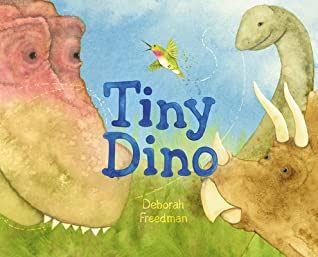
This sound is the chorus of birdsong.  These avian marvels are returning to their homes, some staying and others moving farther north.  They are the true heralds of spring.  To add to the fascination of their essential existence, author illustrator Deborah Freedman in her newest release Tiny Dino (Viking, an imprint of Penguin Random House LLC, April 19, 2022) explores the direct connection between dinosaurs and birds.

Long ago, there were many kinds of dinosaurs.

Stomp!
Clomp!
Tromp!

After these first few words, readers are asked a question.  A voice replies with

I'm a dinosaur!
I'm a dinosaur!

It is the voice of a hummingbird.

Hummingbird continues to joyfully declare kinship with dinosaurs.  When a turtle friend asks about the stomping and clomping dinosaurs did with their feet, the hummingbird points out the similarities between the toes of a Tyrannosaurus rex and the bird's toes.  Turtle and now friend frog point out the huge toe size and the huge bone size of the dinosaur.

Hummingbird proclaims that both have hollow bones.  Each time Hummingbird's friends suggest what they believe to be a difference, Hummingbird counters that said characteristic is shared.  When pals Turtle, Frog, and Mole state dinosaurs had claws and were fierce, the tiny avian verbally explodes.  Hummingbird is

FIERCE!

When a crocodile approaches, Turtle, Frog, and Mole flee.  With all this dinosaur talk, they believe Crocodile to be a dinosaur.  Crocodile says he is not a dinosaur.  Hummingbird agrees, but supplies all the physical features they share.  They are related.  Turtle asks one final question.  Hummingbird shouts out her refrain.


With absolute conversational clarity, author Deborah Freedman takes readers into the story of a hummingbird that proves his truth.  Each time Hummingbird declares he is a dinosaur, one of his friends counters with facts they believe disproves his statement.  He then shows they are wrong with supporting evidence.  In this manner, Deborah Freedman introduces an engaging cadence while providing information about dinosaurs, birds, and other animals.  There are also factual captions next to detailed drawings of relevant, enlarged characteristics.  Here is a passage.

But look---
I have scales
on my toes.

And you 
have scales on
your toes!

Crocodiles and birds have
similar scales, called scutes.
Researchers believe that
feathers evolved from scales!


The image on the dust jacket extends from flap edge to flap edge.  The body of the Tyrannosaurus rex continues over the spine to the far left.  On the left side of the jacket, the back, readers can see one of the dinosaur's feet is holding the ISBN.  The body of the Stegosaurus, similarly stretches to the right flap edge.  Hummingbird is already voicing his truth to the listening trio of featured prehistoric creatures.  The title text and front flap text are varnished.

Hues of light blue, softly textured, are the canvas on the book case.  The Tyrannosaurus rex is outlined in white in the same position as shown on the jacket.  A darker blue dotted loop-de-loop pattern indicates the flight of Hummingbird.  The bird is flying toward the right edge of the front of the book case.  The posture of Hummingbird mirrors determination.

The narrative begins and concludes on the opening and closing endpapers.  The images are wordless.  On the first set Crocodile, Mole, Frog, Turtle and a white bird are moving to the right edge.  A Brontosaurus, also moving to the right, fills both sides.  Above them in a faintly blue sky, a flaming asteroid falls from the left-hand corner.  They are moving through a grassy landscape. On the final endpapers with a faint blue sky and grassy area, Crocodile, Turtle, Frog, and Mole move to the right.  In the sky Hummingbird loops toward the right.  White outlines show us the three dinosaurs showcased on the dust jacket.

Prior to the title page, another illustration has two dinosaurs running as the asteroid gets closer.  On the title page, a question is asked.  Hummingbird answers, three times.  The third answer contains the title text.  Turtle is entering from the right edge.

With each page turn, readers will feel their appreciation growing at the presentation of the story and the information.  Set in pastel watercolor washes are different shaped speech balloons containing the conversations.  When physical traits are compared, those are done in white on blue.  They are intricate.

White space is masterfully used.  It creates pauses in the pacing.  Perspectives shift to furnish us with a sense of being a part of the story.  The majority of the images are double-page pictures.  

One of my many favorite pictures contains a lot of white space.  It spans two pages.  On the far left we see portions of Mole's, Frog's and Turtle's bodies peeking in from the left.  Above them, Hummingbird hovers.  On the far right, just one eye and the large mouth of Crocodile is presented.  (He is coming from the right edge.)  His mouth is open.  Some sharp teeth are depicted.  Crocodile is saying

Pardon me!
Did I hear that dinosaurs
still roam the earth?


Whether this book, Tiny Dino written and illustrated by Deborah Freedman, is read by an individual or as a group read aloud, you can expect to have it read repeatedly.  To have the facts woven artfully in the narrative and images is a gift.  At the close of the book are an author's note and a list of resources.  Even here, Deborah Freedman still educates us while continuing the story along the bottom of both pages.  I highly recommend this title for both your personal and professional collections.

To discover more about Deborah Freedman and her other books, please visit her website by following the link attached to her name.  Here is a link to Lesson & Activity Ideas, & Resources made by Deborah Freedman.  Deborah Freedman has accounts on Facebook, Instagram, and Twitter.  At the publisher's website, you can view interior illustrations.

UPDATE:  Deborah Freedman is interviewed about this title at Writers' Rumpus.  The interview is in-depth and includes her artistic process.  (July 1, 2022)

Wednesday, September 8, 2021

Handheld Hilarity 3

Reading a newsletter yesterday written by a soon-to-be-published romance author, who is also a master teacher and friend, two words tied her series of thoughts together.  Those two words, silver linings, ask us to look beyond our current circumstances.  When we seek silver linings, they will reveal themselves to us.  Sometimes they are a tiny sliver.  Other times, they are huge, life-changing moments.  

For many of us, books which make us grin or giggle, or guffaw are the silver linings every time we read them.  They are silver linings which never fail us.  When a character returns to a series of books, it means more fun is in the offing.  We first met him eight years ago in Crankenstein and again in A Crankenstein ValentineHe has returned in Trick Or Treat, Crankenstein (Little, Brown And Company, August 17, 2021) written by Samantha Berger with illustrations by Dan Santat.  In this newest entry, a beloved holiday is not as it should be.

Do you know what today is?
Crankenstein knows what today is.
It's a day that rhymes with Schmalloween, and
it's Crankenstein's FAVORITE day of the year.

His first inkling the day is awry is a throbbing toothache.  It goes downhill further when his brother fails to recognize his costume identity.  And just when he thinks it can't get any worse, it does.  No one mentions a raging rainstorm was coming.

Every activity at school to celebrate the holiday is off kilter.  What are the chances of someone else having the same costume and standing next to Crankenstein in the parade?  That night in his neighborhood trick-or-treating, someone is handing out toothbrushes instead of candy.  What kind of person does that?

Some other neighbor has a weird idea of frightening decorations. Crankenstein is not happy at being scared.  Back home, finally, his sly brother is swiping his candy.  What has happened to 

Crankenstein's FAVORITE day of the year

Wait! Is that the doorbell ringing?  Opening the door, Crankenstein is shocked at what he sees.  He bursts out laughing.  He keeps on laughing when he sees a lot more great minds who think alike.


This author, Samantha Berger, knows comedy.  She understands how delighted readers are in the contrast between the expected and the reality.  AND either through experience or observation, she has included the perfect pairs of opposites.  Initially, she creates a rhythm through the use of the word

EXCEPT

bringing it back to great effect at the close of the story.  She then establishes another cadence which increases Crankenstein's grit-your-teeth frustration and our rib-tickling laughter.  Here is a passage.

EXCEPT---when his brother doesn't know
WHAT he's supposed to be, and laughs till he falls
off the couch.

Crankenstein would say,
MEHHRRRR!


Look at the front, right side of the dust jacket!  Everything screams Halloween and not any ordinary Halloween.  This is a Halloween gone wrong.  There are webs in the title text with a black spider dangling between the K and O.  Bats fly around Crankenstein on an orange background.  The handle on his treat bag is ripped, spilling his collected candy.  His signature reply to his fateful events is carved into the jack-o-lantern.  Crankenstein's face allows for no denying his current mood.  To the left, on the back, in shades of gray is a silhouette of Crankenstein shouting his displeasure.  Across Crankenstein's form is a toothbrush with a jack-o-lantern, TRICK or TREAT tag hanging from the handle.  Adding insult to injury along the handle it reads:

Dr. Spooner DDS 555-9874

On the book case, on a cream background, is Crankenstein.  On the front he is facing us in his 

ROBO AVENGER COSTUME

with all the parts labeled.  On the back Crankenstein has turned his back to us.  Four parts of his costume not previously shown are labeled.

You cannot, I repeat cannot, just glance at the opening and closing endpapers.  Illustrator, Dan Santat, has fashioned a collage of enlarged candy.  Each of the candies have been renamed to depict the spookiness of Halloween.  The wrappers are familiar, but the names are decidedly not.  Have you had

TOOTHROT
It suffices  

or

Original
Skulltills
Imbibe The Spectrum!

Even some of the information on the verso has been "Halloweened." 

Each of the double-page illustrations (and a group of smaller panels) were rendered in Adobe Photoshop.  All the scenes inside Crankenstein's home depict a love of his favorite holiday.  There are ghoulish lamps and lampshades, and Halloween cups, glasses, bowls, placemats, pillows, and blankets.  The exaggerated facial expressions will have you grinning from ear to ear.  For most of the pictures, we are close to the action.  We are a part of this story. 

One of my many favorite illustrations is the only panoramic setting.  Across most of the two pages are hues of green formed into a corn maze. Four costumed classmates of Crankenstein are gleefully running down several pathways on the left.  Across the top of the page is a gray sky with a smattering of darker rain clouds and some parked vehicles on the right.  On the bottom of the image, to the right of the gutter (with one arm crossing the gutter), is a scarecrow.  He is looking grim.  Where is Crankenstein you ask?  Two arms with clenched fists extend straight up in a row on the right.  Above those arms in a speech balloon is a visual of an angry face.  Crankenstein is lost! 


Guaranteed to make you smile at the least and surely laugh out loud, Trick Or Treat, Crankenstein written by Samantha Berger with illustrations by Dan Santat is a feast of fun.  Readers will relate to the mishaps but will be pleasantly surprised by the conclusion.  Treat yourself to a copy for your professional and personal bookshelves.

To discover more about Samantha Berger and Dan Santat and their other work, please visit their respective websites by following the link attached to their names.  Samantha Berger has accounts on Facebook, Instagram, and Twitter.  Dan Santat has accounts on Facebook, Instagram, and Twitter.  


Many individuals use meal preparation as an act of love or as an artistic expression.  There are a few others, a very few, harboring an ulterior motive.  One such fellow is found in Chez Bob (Little, Brown And Company, September 21, 2021) written and illustrated by Bob Shea.  This alligator has a voracious appetite but is loath to exert himself.  What he lacks in energy and ambition, he more than makes up for it in ingenuity.

Bob worked very
hard at being lazy.

"Being lazy is making me very hungry,"
said Bob to no one.

Bob hopes his request for birds to fly directly into his mouth will work.  They flee with haste.  He then observes how grass entices birds to it because of its seeds.  Like the proverbial lightning strike, Bob has a plan.

His long snout will house a birdseed restaurant.  It will be so successful, other alligators will want to purchase his idea.  He will be wealthy, but most importantly, he will no longer be hungry. 

The first bird at Chez Bob is impressed.  Bob has to let him go rather than eat him.  He is going to spread the word about the delectable meal on the menu.  Chez Bob is an international success.  Before long, a community surrounds Bob and his restaurant.  There is a school for the youngsters and a library for everyone.  As a member, new member, of this flock, Bob participates in a service project.  He joins a book club? Oh, Bob!  

Mother Nature exerts her will.  Bob has a huge decision to make.  Birds or breakfast?  What could possibly be worth more than fame and fortune?


When author Bob Shea pens a story, his keen sense of humor shines in every sentence.  His blend of narrative and Bob's personal voice and thoughts is true and perfectly paced.  The hilarity escalates with Bob acting and saying one thing and thinking about consuming the birds at the same time.  Then, in the best possible manner, a dilemma is presented.  It is a heightened what-if moment.  Readers will appreciate the choices made by both Bobs.  Here is a portion of one passage and the following two sentences.

"Oh, then I will not eat you,"
said Bob.

"What?" said the bird.

"I said, 'So nice to meet you,' "
said Bob.

And he couldn't wait to meet
the bird's tasty friends.

Soon Chez Bob was
the talk of the trees.
Birds flew in from all
over the world to eat
on Bob's face.


(Please note I am working with an F & G.  I was hoping to have a copy this week, but unfortunately, they have been delayed.  The anticipation grows.)

The expression on Bob the alligator's face on the right side of the open dust jacket has me laughing out loud every time I see it.  That smirky grin with one hand attempting to cover it is priceless.  Bob salting the bird as the bird salts its seeds is over-the-top comical.  The choice of the teal canvas makes Bob and the bird shine.

On the left, back of the dust jacket, Bob is seated on a navy background.  Birds are around him, his hat, and his face.  It is movie night.  On the end of his nose is the screen.  Bob is scooping popcorn into his mouth as birds nibble what is on the ground.

On a spring green canvas with short yellow and blue blades of grass, birds of a variety of colors gather on the opening endpapers.  On the far left, a pink worm looks at the group of birds aghast.  With the same background, the closing endpapers tell a different tale.  It is a blur of bicycles, birds, and Bob . . . on a bicycle.  The verso and title pages present a double-page picture of Bob lazily resting on the edge of the water with the jungle flora and fauna around him.

The color palette of blues, greens, purple, yellow, pink and white welcomes readers to the story.  The images, double-page pictures and single-page pictures, are highly animated.  When Bob opens his mouth, he opens it WIDE!  The tiny details in some of the scenes ask readers to pause.  There are birds in lounge chairs around a pond.  There are birds riding on a roller coaster.  There is a tiny bus with two passengers and a capped driver.

One of my favorite illustrations is when Bob is taking his patrons on a sunset dinner.  Among the lily pads, some flowers holding candles, are a frog happily waving as Bob passes and a turtle rowing a boat nearby.  Bob, mostly above the beautifully hued water, is wearing his chef's hat, eyeing his customers, and smiling.  Across his back are tiny tables with red-and-white-checked tablecloths. Pairs of birds are seated, enjoying their birdseed meals and chirping conversationally.


Sometimes when the best-laid plans shift in their results, so do personalities.  Our protagonist in Chez Bob written and illustrated by Bob Shea is a prime example.  Innocence can soften the cleverest and hungriest heart.  If you are looking for a title replete with laughs that lead toward newfound friendship, this book comes highly recommended for both your personal and professional collections.

To learn more about Bob Shea and his other work, please follow the link attached to his name to access his website.  Bob Shea has accounts on Facebook, Instagram, and Twitter.  This title is featured at author, reviewer, and blogger Julie Danielson's wondrous Seven Impossible Things Before Breakfast.  There are many process pieces there to see.  
UPDATE:  Please enjoy this interview with Bob Shea about this title at Max's Boat on September 16, 2021.

Bob Shea Presents CHEZ BOB from LB School on Vimeo.

Book Chat with the Illustrator: Bob Shea for CHEZ BOB from LB School on Vimeo.

Thursday, April 8, 2021

A Kindred Spirit Encounter

In can happen in mere seconds.  In those moments knowing you have found a kindred spirit; the ordinary is elevated to the unbelievable.  It is thrilling to fathom you have discovered a being so close to singing the same song as your own soul.  It changes everything.

Your viewpoint of the world is brighter regardless of how each day unfolds.  The light in me sees the light in you (Nancy Paulsen Books, an imprint of Penguin Random House LLC, March 16, 2021) written and illustrated by Lori Nichols follows two individuals and their discovery of each other.  It is a heartwarming appreciation for those rare and most cherished bonds.

It happened one day.
First I heard you.

When you hear something new, something enchanting, you seek it until it is found.  A little girl met a tiny red bird for the first time on this day.  She knew they were a quintessential match.

From that day forward, they were inseparable.  To them, the wind was a symphony.  To them, clouds were possibilities.  To them, a favorite tree was an aromatic delight and a delicious delicacy.

Rain days were play days.  Sharing food and flying was good for one and not yet enjoyed by the other.   Together in silence was a bit like pure bliss.

And then, without warning, the tiny red bird was not heard or seen.  Poppy was gone.  Again, everything changed.  Robin was lost without her true friend.  One night, something extraordinary happened as Robin slept.  Upon awakening, she carried a new realization with her.  Some lights are never extinguished.


The simple but profound (and sometimes humorous) sentences written in this narrative by Lori Nichols are a poetic window into something unseen but stronger than a diamond and more valuable.  Through the voice of Robin, we are privy to her found treasure, her emptiness, and ultimate wisdom.  A form of repetition of phrases supplies a welcoming cadence and brings us full circle in the best possible manner.  Here is a partial sentence.

and smelling the branches
of our favorite tree.
(Well, I like smelling them---
you usually just pecked for bugs.) 


Happiness glows on and out from the matching dust jacket and book case.  The colors here and throughout the book are light and airy.  Can you see the white outline around Robin and her tiny red bird friend, Poppy?  The pastel points of light are an excellent and delightful selection to signify their special connection.  I really like the choice to have the text color match that of Robin's overalls.  

To the left of the spine, on the back, amid points of light is a single red feather.  This is just beneath text reading:

The moment Robin and Poppy meet, they know
they will always be connected.

Below these are praises for two previous books of Lori Nichols, Maple and Maple & Willow Together.

On the opening and closing endpapers is an exquisite pattern.  The background color is a hue of the t-shirt color Robin is wearing.  White and the red of Robin's hair form sprigs of flora, a single feather, and paper airplanes.  This is in reference to the pair's shared adventures and Robin's final awareness.  On the title page, a tiny blue line spirals through the points of light.  It depicts the flight of the shown tiny red bird, Poppy.

The images 

were rendered in watercolor, colored pencil, collage, and digital techniques.

White space is used masterfully on the heavy, matte-finished paper.  The pictures are full-page, double-page and a grouping of smaller visuals.  The fine lines, delicate details, and soft greens and blues fashion a calm and encompassing joy.  Readers will watch to see if a certain squirrel and little green frog appear in each new scene.  Their playful expressions are as charming as those on Robin and Poppy.  (I love how the squirrel in one picture is peeking at the paint cans and in the next picture its footprints are one of those colors.)

One of my many favorite illustrations is a double-page picture.  It is a rainy-day setting.  On the left a large tree extends off the page and over the gutter.  Foliage springs up around it in shades of blue and green.  The same kind of foliage and some of the tree leaves appear in the upper and lower corners on the right side.  Blue lines and white drops fall heavily on the left, but on the right where Robin and Poppy are, there is a lightness around them.  Wearing a yellow raincoat and boats, Robin happily splashes in puddles.  Poppy, head held high, is leading the way through those very puddles.


Not for the first time, I wish there were a huggable classification for picture books.  This book, The light in me sees the light in you written and illustrated by Lori Nichols, is one of those books.  There are several sentences in here to be read often.  Two might bring you to tears, they are that truthful. We all will or have known unparalleled joy with another and experienced the loss of them.  In this title, we are given hope, and yes, light.  I highly recommend this book for your personal and professional collections.

To learn more about Lori Nichols and her other work, please follow the link attached to her name to access her website.  Lori Nichols has accounts on Facebook, Instagram, Pinterest, Twitter, and YouTube.  At the publisher's website you can view the title page.

Wednesday, March 24, 2021

Go With The Flow

One of the many things you learn from being near or on water for most of your life is, it never stays the same.  Every minute, hour, or day, whether it is a stream, river, inland lake or one of the Great Lakes, it changes.  A difference in temperature, humidity, or wind determines if it is as smooth as glass, rippled, or rocky with waves.  Its fluid moods beckon to a host of flora, fauna, and humans.  A student of watery realms gains essential life insights.

Paddling down creeks or rivers rafting or canoeing, it is easy to observe our feathered friends, either as frequent visitors or residents.  Mel Fell (Balzar + Bray, an imprint of HarperCollinsPublishers, February 2, 2021) written and illustrated by Corey R. Tabor captures the can-do spirit of young kingfisher.  Determined thinking bolsters bravery.

One day, when Mama was away,
Mel decided it was time to learn to fly. 

Her sister, Pim, and her brother, Pip, were certain this was not the best idea.  Mel, having the good sense to be scared, was nevertheless going to fly.  Today was the day.  Springing up from the branch, she dove.

It was a long way down.  The affectionate squirrels tried to catch her.  Their attempts were not fruitful.  Buzzing bees simply could not stop her.  Down she went.  As you might assume, the efforts of a neighborly spider were unsuccessful.  

Mel fell straight down, plunging into the water.  She caught the right-sized fish in her sharp beak.  Using her wings, she surged from the water.  She was flying!  Up and up and up she went.

As she passed each of the resident tree members, they cheered for the courageous Mel.  When Mel reached the family branch, Mama was home.  Looking at each other, they spoke identical thoughts.  Attitude.


Using dialogue with narrative, author Corey R. Tabor fashions a tale guaranteed to keep you on the edge of your seat as you applaud the efforts of this young bird.  The tension builds as each of the friends try to prevent what they assume is a disaster.  Yet, Corey R. Tabor builds humor into the story with his word choices and descriptions as Mel whizzes past the tree trunk, on the way down and on the way up.  Here is a passage.

The squirrels tried to catch her.  They
really did.  They'd grown quite fond of
those squeaky little chirpers upstairs.

Blast!
Nuts!
Oof!
Aieeeeeee!

But it was no use.  They
missed her by a whisker.


The position of the text in relation to the spine on the matching dust jacket and book case is your first hint the reading of this book is going to be turned a bit.  To read the title horizontally, left to right, as it appears above, you need to put the spine on top.  The cheerful, full color palette with animated characters on the front, right, is another clue as to the enchanting events unfolding inside the covers.  The title text is raised to the touch.

To the left, on the back, with the spine on top, the textured white canvas continues.  On the left side is Mel's tree.  It stretches from top to bottom.  We can see the three bird siblings and Mama, the owl family, the beehive, the spider's web, and three squirrel tails sticking out from hollows in the trunk.

On the opening and closing endpapers and the first inside page is a vibrant pattern in two hues of spring green.  It features leaf prints like those on Mel's tree.  At the front, the next page is a close-up of the tree with the trunk on the right, branches extending off the top and left side.  At the back, the trunk is still on the right.  A single branch sticks out from the kingfisher home.  Mel is pushing one of her siblings to the edge of that branch.  The other one is holding to the branch with most of their body still in the hole.  This page also contains an author's note, the dedication and publication information.

On the title page (You are still reading this book turned.), the trunk of the tree on the right is shown from the top to the bottom of two pages.  Mama is on a branch above the nest hole in the trunk.  Mel is peering outside.

These illustrations rendered with

pencil, colored pencil, and acrylic paint, and assembled digitally

are vertical two-page pictures on the textured, white canvas on a matte-finished, heavier paper.  The one exception for the background is when we see Mel moving in the water.  At this point we turn the book again, so Mel is flying up.  The tree trunk is always on the right side.  

It's the facial expressions on the animals which elevate the humor as do their physical attempts to stop Mel on her way down.  Mel's eyes are closed all the way down until just before she hits the water.  Her eyes are closed on her way home but this time she spins her body around.

One of my many, many favorite illustrations is when Mel is flying up to her home.  Toward the bottom of the page two branches bleeding off the left side form a large "v".  Inside the "v" the spider has spun a web.  Mel shoots through the web, threads showing her speed upward.  Off to the right the spider spells "yay" and claps with all eight of her hands.  Mel has spun showing us her breast.  The fish in her beak is looking worried.  (There is more humor involving the fish at the end.)


Original in words, design and artwork, this book, Mel Fell written and illustrated by Corey R. Tabor, shows the results of adding a dive of faith plus resolve to equal success.  Whether you read this one on one or to a larger group, this is a story time treasure.  I highly recommend you add this title to your personal and professional collections.

To learn more about Corey R. Tabor and his other work, please follow the link attached to his name to access his website.  At the publisher's website you can read a sample.  They also have a book trailer there which supplies an example of how to read this title.

UPDATE:  On April 20, 2021 this title is highlighted by author, reviewer, and blogger, Julie Danielson at Seven Impossible Things Before Breakfast.  Here Corey R. Tabor talks about the spark for this book and his illustrative process.


By canoe, by raft, by fishing boat, by speed boat, by pontoon, by yacht, by houseboat or by sailboat, with every trip this passenger has stories to tell.  It can be a simple sunny day cruise.  It can be the most amazing fish tale every told.  It can be a my-dad-will-never-let-me-drive-the-boat-again-after-I ran-it-up-on-the-dock escapade.  It can be an I-can't-believe-I-survived ocean exploit.  These narratives, when combined with other multiple water travels, are an individual's existence from first to last breath.  In Sail (Little, Brown and Company, March 9, 2021) written and illustrated by Dorien Brouwers, readers explore the wild, wonderful, unpredictable, and sometimes frightening ride called life. 

We all have ships to sail
in life's adventurous tale. 

It does not matter the size or type of vessel.  There is one for each of us.  We release a ship from its moorings and with openness seek that which awaits us.

Regardless of the shape and height of the waves, we bravely welcome them.  If we feel as though we are off course, look to the sails and change direction. Stay sharp as the wind tosses the boat. 

If we tumble into the water, swim.  There are secrets beneath the waves, waiting to be found.  Go down.  Go deep.  Hold those secrets close.

When it is time, we rise to the surface. We do so with more knowledge and understanding.  From there, back in our boat, we go forward knowing there is much more to explore and achieve.  


Reading like a poem, a lullaby, and a loving letter offering encouragement, this book written by Dorien Brouwers asks us to be our best selves regardless of where we go and what we encounter.  Using watery realms analogous to life with us as sailors in a boat of our choosing, rhyming couplets create a comforting narrative.  In each of the couplets, emphasis is placed on a single word.  When those single words are strung together, they make a buoyant ring around the reader.  Here is a passage.

Search the ocean for the light.
Breathe in deep and don't lose sight.


The swirl of blue and white hues seen on the front of the dust jacket moves over the spine to the left, fashioning a vast expanse of water and opportunities.  The school of tiny fish racing in an arc on the front indicate a fast-moving current.  To the left, on the back, a smaller group of fish meander through the ocean.  This setting with the sailboat and its single passenger with a seabird flying nearby is the essence of anticipation.  

A whirlpool spins across the opening and closing endpapers.  It's a wild blend of blues and white.  Fish in both colors swim with the circular currents in constant motion.  On the verso and title pages, a double-page picture of a seascape presents several different kinds of sailboats in a sheltered space, a calm sea, with a red and white lighthouse on a nearby point of land.

Each two-page picture in this book was rendered

with watercolor on 220gsm Daler Rowney paper with monoprinted details added to it.

Their eloquent, textured depictions display sensory scenes.  In a superb mix of light and shadow, a variety of perspectives draws us into each image.

We are standing on a dock next to a row of boats, some large enough to dwarf us.  As our boat moves off the right side of the visual, we reach down to pull a large anchor loose from the bottom.  When a stormy sea surrounds us, we hold tight to the sail lines, trying to follow the right path.  Now in the ocean, we silently swim down and among the colorful creatures and plants.  Each perspective offers an original possibility.

One of my many, many favorite illustrations is in the murky depths.  Starfish, jellyfish, rays, scallops, and fish glide and rest.  Swimming with a school of fish is the child.  They are moving toward a giant vibrant octopus who occupies most of the left side.  In three of its arms, it holds keys.  What do these keys unlock?  I imagine each reader will have an answer, some the same and others strikingly divergent.


This book, Sail written and illustrated by Dorien Brouwers, like the water on which we traverse, will take on fresh meanings each time it is read with readers of all ages.  At the close of the title is a page of six questions with the heading,

Some Things to Think About.

This is a book which needs to be on your personal and professional bookshelves.

To learn more about Dorien Brouwers and her other work, please access her website by following the link attached to her name.  You can see interior illustrations at her website.  Dorien Brouwers has accounts on Instagram and Twitter. At the publisher's website is a marvelous, illustrated chat with the author about the book and her images.

(Note:  I was working with an F & G when writing this post.)

Thursday, December 26, 2019

Winging It

To leave that which provides comfort requires a certain kind of bravery and, sometimes, an unintended impetus.  An unplanned incident might place us in a position not of our choosing.  We are faced with choices for which we have no experience.  We are completely unprepared.  This is a frightening feeling.

To alleviate this fear, our first thought is to return to comfort as soon as possible.  In fly! (Beach Lane Books, an imprint of Simon & Schuster Children's Publishing Division, September 17, 2019) conceived and illustrated by Mark Teague a fledgling is faced with an undesirable dilemma.  Its challenge appears insurmountable.

In this wordless tale a baby bird with a ceaseless need for worms finds itself in an unfortunate situation.  As the day begins, its parent serves up worm after worm.  Tiring of the child's demands the parent makes one of their own.  It wants the bird to come out of the nest, to the branch and be fed the next worm there.

In a fit of frustration and wanting only the next worm, the fledgling furiously leaps out of the nest and tumbles to the ground.  YIKES!  The parent flies down to asses any harm, and then tells the baby bird to fly back to the nest.

This is not at all what the child wants to do.  The baby bird suggests hopping on its parent's back for a ride back to the nest.  To the parent, this is ridiculous.  All kinds of birds fly.  The baby bird proposes a hot air balloon, a hand glider, itself as a superhero or an airplane pilot.  This infuriates the parent.

In an effort to reason with its baby, the parent mentions a journey to be taken toward a southern region in autumn.  The responses from the fledgling are numerous modes of transportation; none of which are flying with its wings.  The baby bird is now laughing uncontrollably.

As nightfall arrives, in a final tactic, the parent describes three more scenarios.  Then the parent does the unthinkable.  As you might expect, the baby bird acts accordingly.  The result is as surprising as it was in the morning.  Sweet dreams.


The baby bird balanced on the edge of the nest on the front of the matching dust jacket and book case has no intention of flying.  It's much too far from the nest to the ground for flying.  The only thing on its mind is worms.  To the left, on the back, on a canvas of white, the baby bird is explaining to its frustrated parent why flying is not an option. The text on the front is varnished.  The image on the back is varnished.

On a sky-blue background on the opening endpapers are five rows of nests.  The baby bird is in or on the nest in a variety of positions.  On the closing endpapers, a similar background is used.  The baby bird is blissfully happy in several different poses after resolving its problem.  On the title page the title is much larger than on the jacket and case.  Beneath it is Mark Teague's name above the nest.  In the nest, the egg has just opened.

Rendered in acrylics by Mark Teague, the illustrations in this title speak the proverbial thousand words every time.  To begin, two full-page pictures set the stage for the hunger of the baby bird and the constant presentation of a worm by the parent.  The first double-page picture introduces the use of speech bubbles, all pictorial.  These conversations begin the conflict between the parent and child and the ultimate quandary for the baby bird.

The use of single-page images, two-page visuals and two double-page vertical displays are brilliant in providing splendid pacing with every page turn.  Mark Teague also places a smaller image on a larger double-page picture.  Sometimes the borders of his pictorial speech bubbles go off a page.  The facial expression on the baby bird and parent elevate the hilarity to laugh-out-loud funny.  We are also privy to masterful use of perspective.

One of my many, many favorite illustrations is a double-page picture.  On a crisp, white background a swirl of blue like a pathway begins in the upper, left-hand side and winds up and down to the upper, right hand side.  The baby bird is positioned on three points on this path.  In its pictorial balloons of speech, it is hurtling off a sky jump, flying like a super bird and piloting a single-seat airplane.  With each revelation it shouts and snickers harder.  In the lower, right-hand corner is the parent bird looking right at readers.  Its mouth is turned down.  Its wings are hugged to its sides.  Squiggles of steam rise from its head.  This contrast is the comedy.


Regardless of the number of times you read fly! written (conceived) and illustrated by Mark Teague, you'll find yourself laughing.  This book will appeal to readers of all ages because of the humor and how many can connect to the reality being depicted.  I highly recommend this title for your professional and personal bookshelves.

At the National Center for Children's Illustrated Literature there is an entry for Mark Teague.  This is a video from NCCIL 2016.


There is a Q & A with Mark Teague at Publishers Weekly by Sara Grochowski dated July 13, 2017.  At the publisher's website you can view multiple interior images.  They have a link to a three-page guide about sharing wordless picture books with young readers.  They also have a video with instructions in making Your Own Fly! Bird.

Tuesday, October 22, 2019

Numbering Our Avian Neighbors

On September 19, 2019 headlines filled social media feeds with shocking information.  Since 1970 the bird population in Canada and the United States diminished by nearly three billion.  Yes! Three billion! (You can read about it at Science News, NPR Science, NBC News and The Cornell Lab of Ornithology.)  The study did not indicate specifically what the cause might be, but other researchers believe degradation by humans and loss of habitat is a top contender especially for grassland birds whose numbers decreased the most.

One of the methods for determining this decline in the avian numbers is by comparing data collected for decades by the

North American Breeding Bird Survey, the National Audubon Society Christmas Bird Count and the International Shorebird Survey

comprised of everyday dedicated people citizen scientists.  Bird Count (Peachtree Publishing, October 1, 2019) written by Susan Edwards Richmond with illustrations by Stephanie Fizer Coleman focuses on a mother and daughter participating with other community members in the National Audubon Society sponsored Christmas Bird Count.  It's a lively, informative story in both words and images certain to engage readers.

I shake Mom in the dark.  "Wake up, sleepy head! It's Bird Count Day."
One Sunday each winter we take part in a bird census called the Christmas Bird Count.  On this day, we go out and count every bird we see or hear.

As mother and daughter get dressed in their winter clothing, we are informed that people from Canada to Antarctica will be participating.  Soon a knock on the door announces the arrival of Big Al.  He's their team leader and driver for the day.  Throughout the day, they will visit the same places they do every year.

For the first time Ava is given the task of tally taker.  Initially the trio hears is the call of a great horned owl.  Hearing a bird is the same as seeing a bird.  A cheerful chickadee calls out next and is counted.  A large V of Canada geese pass over the car.  Five slash marks are added to the sheet.  At a field only Ava sees a mockingbird, so it is not included on the list.

Sometimes Ava, her mother and Big Al need to whisper to not frighten the birds.  Sometimes they must be very still so a bird reveals itself.  Sometimes a bird blends in with its surroundings and Ava, her mother or Big Al need to heighten their detecting eyes.  Whether they are standing or driving every single bird seen or heard is part of the count.

Coloration, activities and bird calls are used in the identification.  If Ava, her mother and Big Al don't agree on the tally for a large group of birds, they take an average.  Driving through residential areas, bird feeders are a hot spot for smaller birds and larger birds seeking to make a meal of the smaller birds.  Toward the end of their route, they pursue a lead to locate a special bird and Mother Nature gives them a surprise.  As the sun dips below the horizon, several long-awaited events make for a remarkable Christmas Bird Count.


Readers easily step into this story through Ava's narration and the dialogue between her, her mother and Big Al.  We become further engaged in what Ava reveals page turn by turn by the pacing.  Author Susan Edwards Richmond carefully weaves factual information into the text while maintaining the excitement of this annual excursion.

We are also learning about a variety of birds, twenty-four in total, as the tally increases with each stop and all the points in-between the beginning and end of their day. It's as if we are going on a scavenger hunt.  Here is a passage.

"Nothing flying right now," Big Al observes.
We scan the trees, looking for familiar shapes.
"Tallest oak," Mom whispers.  "Two o'clock."
Big Al and I read the tree like a big clock
face, with noon at the top and six at the bottom.

There it is, a big bird of prey with its feathers
fluffed up.  Its back is brown, its belly white.
One red-tailed hawk.
"Let's find its mate," Al says.  He and Mom
search the other trees.  But I stick with the same
tree, sure the other hawk is there.
I check the tree again. "Six o'clock," I say.
"Close to the trunk."
"Good eye, Ava," says Big Al. 


Everything about the matching dust jacket and book case, welcomes the reader to pick this book up and open it.  The pale wintry sky dotted with snowflakes spanning flap edge to flap edge and mirrored in the lens of Ava's binoculars is a wonderful technique.  The color of her hat and the title text is a lighter shade of the red shown on the cardinals on the right jacket flap and the heads of the eleven turkeys crossing the back of the jacket and case.  Ava's mittens, scarf and coat complement each other.  The chickadee on the T is the final perfect touch.

The same shade of the wintry sky is used as a canvas color for the opening and closing endpapers.  With a first page turn we see a single chickadee resting in a leafless bush as the snow falls.  Another page turn has a variety of birds in flight across the verso and title pages with one exception.  The chickadee has positioned itself on the T again.  The placement of a raven on the title page is of importance, too.

Each image rendered by Stephanie Fizer Coleman digitally is a full-page visual, partial-page picture with liberal use of white space, or nearly a double-page image with space left for the tally text.  The tally text is written in a ringed notebook on the right side of the illustration using what appears to be a font similar to the title text.  The perspective of the images varies in sync with the narrative.  We are sometimes near the characters, given a bird's eye view or a wider view of a particular setting.

Even though it's winter Stephanie Fizer Coleman adds bits of color in clothing, the color of Big Al's truck, the birds, signage on buildings, the buildings or a stunning sunset behind the school buses.  Careful readers will notice extra details.  Ava's pajamas are printed with birds.  Christmas evergreen wreaths are hanging in the windows of the Bagel Bin shop.

One of my many favorite illustrations is a bird's eye view of a bird's eye view.  It's as if we are looking down on the five Canada geese flying over the community.  It appears they are following the path the street is making through the neighborhood.  Homes in brown extend back from the road connected by their driveways.  A few carefully placed shrubs and trees are seen looking directly at their tops.  Almost to the far right of the street, the lights from Big Al's truck shine ahead.  The color palette is subdued by striking against the snowy ground.


It's guaranteed readers will be ready to join a local Christmas Bird Count after reading Bird Count written by Susan Edwards Richmond with illustrations by Stephanie Fizer Coleman.  (I know I am.) The enthusiasm Ava, her mother and Big Al have for this yearly adventure is contagious and heightened through the words and artwork of these two creators.  This title would be wonderful for a unit on birds, citizen scientists and their value, seasonal projects and for the pure happiness associated with enjoying Mother Nature.  At the close of the book are more facts about each of the birds named in the book, an author's note and additional resources.  I highly recommend this title for your professional and personal collections.

Be sure to visit the websites of Susan Edwards Richmond and Stephanie Fizer Coleman by following the links attached to their names to discover more about them and their other work.  Susan Edwards Richmond has accounts on Facebook and Twitter.  Stephanie Fizer Coleman has accounts on Instagram and Twitter.  The book trailer is premiered at the Nerdy Book Club.  Author Susanna Leonard Hill interviews Susan Edwards Richmond on her site.  Susan Edwards Richmond and Stephanie Fizer Coleman are both interviewed at #ONTHESCENEIN19  At the publisher's website there are resources galore; an excerpt, a teacher's guide, a one-page bird survey, an author interview and an illustrator interview.  I know you will enjoy this video with Stephanie Fizer Coleman talking about her illustrative process for this book.


Thursday, April 11, 2019

A Rhyming Ritual

When reading aloud the musicality of words will seriously undermine the ability of readers of all ages, but more importantly of younger readers, to sit still.  Once they feel a rhythm made by words they want to move.  They also want to repeat those words, making them into a melodious mantra.  There's been many, many visits to the library with students leaving in a line as they walk down the hallway whispering words as they do their own inventive dance.

In her debut picture book, author Cheryl B. Klein collaborates with artist Tomie dePaola to bring readers Wings (Atheneum Books for Young Readers, March 5, 2019).  A rhyming poetic interlude of twelve single words and various punctuations is enhanced with lively, expressive images.  It's an ode to new life, flight, self-confidence and the sheer pleasure of the sounds made by combinations of letters.

Wings!

Four curious baby birds sit in a nest.  One opens its wings.  This is a first.  Moving from the safety of the group, this brave soul grasps the edge of the nest and gazes at the distance from the nest to the ground.

In a moment of courage, with no instruction or practice, the baby bird jumps.  It does not end as well as it could have.  It hurts.  It's wet.

Something good attracts the bird's attention.  There is a decision to make.  There is an action to take.

Three siblings rejoice at the persistence, ingenuity and generosity of their nestmate.  That baby bird is downright jubilant.  A soul and body soar.


All the emotions felt by this baby bird beat in readers' hearts as the words are read silently or aloud.  Cheryl B. Klein cleverly and with intention strings these words together to tell us a tale of adventure.  All these words rhyme supplying a special cadence.  This beat is enhanced by the insertion of periods, pauses, exclamation points and a single question mark.  This encourages irresistible participation. 


There is not a group of listeners circled around a reader for story time that won't sigh when they see the front of the open and matching dust jacket and book case.  They will readily identify with the baby bird perched on the edge of the nest.  They all know about balancing on the edge of something trying to decide if they should jump or not.  The title text and the baby bird on the edge of the nest on the jacket are raised to the touch.

To the left, on the back, the courageous tiny bird, greets its parents as they rest, side-by-side, on a nearby branch.  A snail seen throughout the book is resting on the ISBN.  Instead of continuing the pale blue seen on the front, a soft lavender is the canvas for the back.  On the opening and closing endpapers is a lighter variation of the bright pink colors used in the baby birds.  A double-page picture for the verso and title pages shows two trees on either side, one holds the nest and on the other the parents rest and watch.

Rendered by collage using Avery full-sheet labels with markers for the color and the background paper was painted using acrylics, these illustrations are a departure from the usual technique in the artwork of Tomie dePaola.  Nevertheless, readers can see hues associated with his work in these images.  The backgrounds alternate between pale yellow, light orange, light pink, pale lavender, pale green and a pale bird's egg blue.  These canvases highlight the vibrant pink, blue, green, brown, orange and purple hues in the palette.

Readers will delight in the perspectives presented by Tomie dePaola.  For the first few pages we are close to the nest and the actions of the baby bird.  At one point, for maximum effect we move closer to the baby bird's face full of discouragement.  For one of the words only a portion of the baby bird is shown.

Wordless illustrations bridge between one word and the next placing emphasis on the pacing.  The book closes with the final of four visuals without words.  Careful readers will note the emotions shown in the eyes of the baby bird throughout the book.

One of my many favorite illustrations is for the word Wrings.  On a pale lavender two-page canvas bright spring green stretches along the bottom.  A blue puddle takes up half of the space.  On the left readers will notice something special moving into the scene.  On the right the curious snail watches the bird, shaking droplets out of its feathers.  You can almost hear the combination of water and wings.


For a theme on rhyming, spring, poetry or birds I highly recommend Wings written by Cheryl B. Klein with illustrations by Tomie dePaola.  I can see this story expanding into creative dramatics with listeners acting out each word.  It would be a wonderful readers' theater.  You could have children expand the list of rhyming words.  You will want to have a copy for your personal and professional collections.  With this book, the theory of less-is-more takes flight.

To discover more about Cheryl B. Klein and Tomie dePaola and their other work, please follow the links attached to their names to access their websites.  Cheryl's website is highly informative.  She offers thoughtful extensions for her books and her other skills.  Tomie dePaola has a blog linked to his name, too.  Cheryl B. Klein has accounts on Instagram and Twitter.  Tomie dePaola has an account on Facebook. On October 22, 2018 Tomie dePaola was the featured illustrator at The New York Times Books with a video on Facebook.  This is a lovely look at Tomie dePaola's work.  He reads from a previous title.  Cheryl B. Klein and Tomie dePaola are interviewed by Elizabeth Bird at A Fuse #8 Production, School Library Journal for the cover reveal.  To view interior images please visit the publisher's website.

Tuesday, February 19, 2019

Can't Stop Talking

There are more than a few educators who believe it's true.  They know just before and after a full moon, their students will be a little "more" of everything.  On those days when a class comes to the library, it seems as if every single student is talking.  They all have thoughts to share . . . vocally and at the same time.

Usually there are only one or maybe two people a week who can't stop talking.  They are well-known by their classmates and for the most part fondly accepted.  Author Tammi Sauer and illustrator Dave Mottram introduced readers to such an individual in Wordy Birdy (Doubleday Books for Young Readers, an imprint of Random House Children's Books, February 8, 2018). Fortunately, this bird with a gift for gab has great friends.

Meet Wordy Birdy.
Wordy Birdy has lots to say.
It starts the moment she wakes up.
See?

Every tint of the sunrise sky is noted.  Wordy Birdy even stops to greet herself in a mirror.  She chats about her likes and dislikes.  The questions are non-stop.  Does she ever listen for the answers?  No. No. No.  Her forest friends, Rabbit, Raccoon, and Squirrel, realize this quirk in her behavior, continuously commenting.

One morning Wordy Birdy needs to listen. She does not.  She ignores warning signs.  Squirrel asks her to stop.  Rabbit tells her to turn around.  Wordy Birdy keeps walking and talking.  Raccoon begs her to

RUN FOR YOUR LIFE! 

This walking and talking non-listener finally notices a lot of darkness ahead.  She notices big white circles and large white triangles.  Several loud roars later, it dawns on her trouble is too close for comfort.

In her time of need her trio of companions courageously suggests a course of action.  Does she heed their words?  Will she live to talk another day? 


Apparently, she does because this month a companion title is released.  This bird is as chatty as ever.  Wordy Birdy Meets Mr. Cougarpants (Doubleday Books for Young Readers, an imprint of Random House Children's Books, February 5, 2019) written by Tammi Sauer with illustrations by Dave Mottram will have talkers and non-talkers alike sharing loads of laughter.

In case you haven't heard, this is Wordy Birdy.

I LOVE my name.
Wordy Birdy. Wordy Birdy. Wordy Birdy.
Hey! That rhymes!

This bird is unable to breathe without speaking.  She is also always on the move.  One fine day she and her three trusty pals go camping.

After enjoying the hike, setting up their tents and snacking on s'mores by a comfy, crackling fire, Wordy Birdy is still offering non-stop observations and declarations of love about everything and everyone in sight.  As you can imagine, much later Squirrel, Raccoon and Rabbit are exhausted and ready for bed.  Wordy Birdy is not.

Wordy Birdy is excited to commence snacking on pickles, bean burritos and mashed potatoes.  With the mini-feast consumed Wordy Birdy should desire to shut her eyes along with her three companions.  She does not. 

Telescope to her eye, she spots the perfect stars, wishing stars.  In the middle of wishing for everything from a pony to a tuba, Wordy Birdy discovers a rather large, hungry cougar stalking into their camp.  Does Wordy Birdy finally choose to stop talking?  Before you answer that question readers, remember this is Wordy Birdy. 


Both titles are overflowing with comedy.  With the skill of a master wordsmith Tammi Sauer blends short narrative sentences with character dialogue.  There is an ongoing discourse between the two.  Repetitive questions are answered with repetitive replies; supplying readers with an engaging cadence.  We are a part of the story.  You might also encounter a pun.  Here are two passages from the first and recent book.

But she never stops talking long enough to get the answers.
Wordy Birdy is not the world's best listener.

Oh, puh-lease. (Rabbit)

Are we talking
about the same
bird here? (Raccoon)

Okay. Okay. Wordy Birdy is
terrible at listening.

That's more like it. (Squirrel)

She never listens to anybody.


Late that night, Squirrel rubs his eyes.

Time for bed, everybody. (Squirrel)

Squirrel goes to bed.
Rabbit goes to bed.
Raccoon goes to bed.
Does Wordy Birdy go to bed?


If you don't wonder what's going to happen next by looking at the front of the matching dust jackets and book cases, you'll might want to check for a pulse.  The expressions on Wordy Birdy's face and the look the cougar is giving readers are completely giggle-worthy.  Careful readers can see the outline of words lining the background canvas of both books.  The title text is varnished on the jackets as are the characters.  The title text is also raised. 

To place emphasis on the chattiness of Wordy Birdy, to the left, on the back conversations are replete.  On the first Wordy Birdy is standing with her three pals talking to readers.  Raccoon has a reply ready.  On the second book, Wordy Birdy Meets Mr. Cougarpants, five photographs placed on a yellow background with leaves, are labeled with more Wordy Birdy chatter.

On the opening and closing endpapers of the first book, the story starts and ends, verbally and visually.  The characters and their conversations in speech bubbles are shown on a white background.  On the new title a series of different photographs, without captions, cover the opening and closing endpapers.  They feature the friends and those things Wordy Birdy enjoys the most.

With a page turn illustrator Dave Mottram begins his pictorial enhancement of the text with a double-page image for the verso and title pages.  Wordy Birdy is displayed as her exuberant self exclusively on a white canvas.  In the second title Wordy Birdy, Rabbit, Squirrel and Raccoon are seated around a campfire with the forest and starry sky surrounding them.

Keeping in mind the narrative and pacing, Dave Mottram alternates between double-page pictures and a few full-page images.  Readers will pause with each page turn to notice the included small details; a paw print on a sign, a hidden sign slowly revealed, a shadow that moves from illustration to illustration and the zipper pull on Wordy Birdy's backpack.  Most hilarious are the facial expressions and body postures on the characters.  They are burst-out-laughing excellent.

Two of my many, many favorite illustrations, one from each book, are in the first Wordy Birdy is blissfully unaware of any danger despite Rabbit's warning.  In the second title it's when everyone notices the cougar at the campsite.  First trees frame the characters and line the forest path.  On the left Squirrel, clinging to a tree trunk, is speaking.  Wordy Birdy is pointing and talking about a pinecone, a sign (reading WRONG WAY), a rock and a leaf.  On the right Rabbit is frantically pointing for Wordy Birdy to turn around and retrace her steps.  I love the mop of hair on top of Rabbit's head.

In the second image on the right items from the campsite have flown in the air.  A mug, juice box, telescope. frying pan, Bag O' Burritos, lantern, cup, jar of pickles, camera and another cup border a huge speech bubble reading:

WHAT!?!

Portions of their tents are visible.  On the right a terrified, wide-eyed Rabbit and Raccoon are standing, frozen to the ground.  Equally frightened is Squirrel who jumped up and is being held in Raccoon's arms.  Behind this stars shine in the night sky.


You won't be able to read Wordy Birdy and Wordy Birdy Meets Mr. Cougarpants written by Tammi Sauer with illustrations by Dave Mottram just once.  You will read, or be requested to read, them repeatedly.  You won't be able to stop smiling or bursting out loud with laughter.  Not only are these two books hilarious but they show the value in knowing when to listen and when to speak out.  At the core of both is the power of friendship.  I highly recommend them for both your personal and professional collections. 

To learn more about Tammi Sauer and Dave Mottram, please visit their websites by following the links attached to their names.  You can find Tammi and Dave on Instagram.  They also have accounts here and here on Twitter.  At Penguin Random House you can view interior images from Wordy Birdy and Wordy Birdy Meets Mr. Cougarpants.  For the release of the first book Tammi Sauer has a guest post on humor at Picture Book Builders.  Tammi Sauer was interviewed at Critter Lit on July 26, 2018.