Quote of the Month

When love and skill work together, expect a miracle. John Ruskin


Showing posts with label Best friends-Fiction. Show all posts

Friday, January 28, 2022

Poles Apart , But . . .

It is safe to say the phrase "opposites attract" will continue to be researched and debated for many years to come.  There are supporting factors on both sides.  If you think about it, as I have, what a loss for our world if there were no "opposites".  What if we walked outside to discover all snowflakes were alike?  What if scanning the forested hills in autumn, there was only a single color?  What if our planet was populated in a single species in one color, one size and one shape rather than the abundance of species in a multitude of colors, shapes and sizes, flourishing in a variety of habitats in various seasons?  

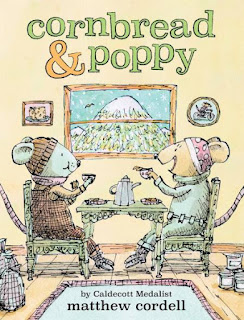
Can not the same be said for the individuals in our lives?  This does not mean we don't feel a certain joy in spending time with kindred spirits. We do, but is the joy any less when we feel a rapport, sometimes for our entire lives, with someone deemed to be our opposite?  In Cornbread & Poppy (Little, Brown and Company, January 4, 2021), a new early reader series, Caldecott Medalist (Wolf In The Snow) Matthew Cordell explores in three chapters the enduring friendship of two mice who approach many things differently except for one thing.
The First Snow
It was winter.  The first snowflake had fallen.

Cornbread, snug in his home, was organizing all the food he had collected in autumn.  He tucked away fruit preserves, grains, and cheese.  He worried and planned to make sure he had enough to last the long winter.  

Poppy, his friend, did not worry or plan.  She was a carefree soul, preferring to spend her time biking, hiking and seeking out all kinds of adventure.  She did not gather fruit, grains, or cheese.  Her food, even at this early date, was nearly gone.

Now her phrase,

Nah, I'll do it later!

was coming back to haunt her.  Cornbread went with Poppy to all the vendors and nearby neighbors.  They had no food.  When Poppy suggested they travel up Holler Mountain, he grew frantic.  (Even daring Poppy had misgivings about trekking up the mountain, but she needed to eat.)

Cornbread offered a series of reasons not to go up the mountain.  The most serious one was the disappearance of the last mouse to scale the heights, but Poppy was his best friend.  They packed essentials in Poppy's wagon, donned warm clothing, and began to climb in the rapidly increasing snowfall.

To say, they found food on the steep ascent would not be true.  To say, they did not meet their mortal enemy, an owl, would not be true.  To say they had not one but several shocking encounters would be totally true!  There were a lot of surprises on Holler Mountain (and afterward), but the best thing about this risky wintery endeavor was the one thing Cornbread and Poppy always had in common, their affection for each other.


After having read this charming title several times, I can say with certainty the pacing is pure perfection.  The blend of narrative and conversation done with a keen sense of humor by Matthew Cordell had me bursting aloud with laughter more than once.  In these three chapters, Matthew Cordell establishes the personalities of the two friends through a rhythmic presentation of their opposite habits and life views.  He takes you to the edge of a situation with you expecting it to go a certain way and when it does not, you are drawn further into the story of Cornbread and Poppy.  Here is a passage.

The snow crunch. . .crunch. . .crunch. . .crunched
around them.  The owl had landed.

Sniff. . .sniff. . . "Is that mice I smell?" said a
voice.

Cornbread and Poppy shivered.  The shrub
shivered.  

"I like mice!" said the voice.

The shrub shivered.

Poppy grabbed a stone and stood up.

"I'll save you, Cornbread!  Run!"


One of the first things you notice about the open and matching dust jacket and book case is the signature lines and intricate details often found in the artwork of Matthew Cordell.  The clothing, shoes, scrollwork on the furniture, the artwork on the walls, and Holler Mountain in the distance through the window are all clues to the adventures which are to follow in the pages of the book.  Do you notice how the tea in Poppy's cup is splashing out?  That's probably because she rarely sits still.  And what is flying near the peak of Holler Mountain?  The color palette shown here is used throughout the book.

To the left of the spine, on the back, Cornbread and Poppy, now wearing skis with poles, are gliding through evergreens down a snowy slope.  Why are they wearing backpacks?  And is cautious Cornbread smiling?  You can feel your anticipation growing.

The opening and closing endpapers are a bright, light turquoise like the sky over Holler Mountain.  After the title page which shows us portraits of Cornbread and Poppy against the majesty of Holler Mountain, we read the dedication above a picture of the duo standing together.  It says:

To Julie---
the Poppy to my Cornbread

The illustrations rendered

in pen and ink with watercolor

shift in size to complement and elevate the text.  They fill portions of a page, an entire page with loose framing, or are grouped together to show the passage of time.  There is one two-page wordless visual.  Sometimes tiny sound effects are included.

If the pictures represent a thought or memory, a scalloped border outlines the scene.  The elements in the images ask you to pause.  The signs for each of the merchants reflect what they sell and the current status of their goods.  The town grump has a doormat reading NOPE.  The expressions on the faces of the characters leave no doubt as to their emotional state.

One of my many favorite illustrations is a single page picture, loosely framed.  Within the frame is Holler Mountain.  Standing, side by side, with most of their bodies in the frame are Poppy and Cornbread.  They are staring up at the mountain at its base.  Their feet are outside the frame as is Poppy's wagon.  This is not just a picture of a mountain two mice are about to climb.  This represents everything about Cornbread and Poppy.  No matter what they have to scale in life, they will do it together, regardless of the reason for them being where they are.


After reading this first book in a new early reader series, Cornbread & Poppy written and illustrated by Matthew Cordell, you'll want to climb to the top of Holler Mountain and shout out how wonderful it is.  Not only is it engaging from beginning to end for an individual to read, but as a read aloud your listeners will be asking you to read it repeatedly.  And you will, because each time is like the first time.  I highly recommend you have a copy on your professional and personal bookshelves.  AND the next book in the series, Cornbread & Poppy at the Carnival, is set to release toward the end of June, 2022.

To learn more about Matthew Cordell and his other work, please access his website by following the link attached to his name.  Matthew Cordell has accounts on Facebook, Instagram, and Twitter.  At the publisher's website you can (and will) enjoy listening to a podcast with Matthew speaking about this book.  Matthew Cordell and this book are highlighted at author, reviewer, and blogger Julie Danielson's Seven Impossible Things Before Breakfast.  There is process artwork.

Matthew Cordell Presents CORNBREAD & POPPY from LB School on Vimeo.

Tuesday, May 5, 2020

Friendship Lost. Friendship Found.

In our collective memories most of our first (and sometimes our only) best friends are not human.  We may find an animal in the wild who visits us, or we visit.  Perhaps we hold a special place in our hearts for an animal who has resided in our homes, currently or in the past.  For many the comfort and confidence provided by a toy is the key to our contentment.  If in the presence of a wild animal, an animal who lives with us or a beloved toy we feel all is right with the world, then this individual is the truest of friends.

This special kind of friendship is cherished.  If it is taken from us, we do whatever is necessary to regain it.  And that journey, if we are fortunate, reveals rewards we can never have expected.  In her first longer book, the start in a series, author illustrator Lauren Castillo generously gives us Our Friend Hedgehog: The Story Of Us (Alfred A. Knopf, an imprint of Random House Children's Books, May 5, 2020).  These nine chapters plus an introduction are 128 pages of heartwarming enchantment certain to resonate with generations of readers.

Sometimes you make a friend and it feels 
like you have known that friend your entire
life.

For a long time on an island lived Hedgehog and her friend Mutty, a toy stuffed dog.  They were inseparable living a life of soothing satisfaction. Their lives were suddenly upended on the day of the Terrible Storm.  Mutty, in a swirl of wild wind, blew from the island and Hedgehog.

Shaking off her deep despair, Hedgehog left the island, swimming to the forest.  Despite calling and calling for Mutty, he was not found.  Deciding to rest on a pile of leaves for the night, Hedgehog found herself plunging down a hole.  Wow!  Hedgehog landed in Mole's home.  The kindly creature with a flair for languages had a plan for finding Mutty.  The newly formed duo headed through tunnels, seeking Owl, who resided at Lookout Point.

Owl, displaying definitive wisdom and astute physical qualities, bolstered the saddened Hedgehog and her new pal, Mole.  A notebook, a drawing, and a flight to gather ideas was the next phase of this quest.  Three hearts and heads provided companionship and clarity.  At Beaver's dam, amid his gruff denials, a discovery was made.

A rousing ride on the river, a treasure-hunting mother and a lost photograph pointed the group of animals toward a home on a hill.  A girl, Annika Mae Flores, held the key to Hedgehog's happiness.  Collected clues created a new tale, a tale of friends rescuing each other and themselves.


To have this narrative told in the voice of Annika Mae Flores, means she is the kind of person with a tender and listening heart.  It indicates as an author Lauren Castillo wanted this character to hear all the other stories before creating a single story of the further adventures of this cast.  It is as if Annika Mae Flores is a weaver gathering threads to fashion a beautiful tapestry of their shared lives.

Each chapter heading with a minimum amount of words describes a character, an object, or a feeling.  In these chapters Lauren Castillo uses language to depict places and events vividly.  Her dialogue shapes the characters' personalities for readers.  Here are several passages.

She took a deep breath, jumped in, and set
off on a journey to find her dear friend.
The river was rough, but luckily Hedgehog
was a good swimmer.  She could swim all
the strokes, including the backstroke (which
was her favorite.) 

"Hooty hoot, who goes there?" called
Owl.  Owl never missed a trick.
"Guten Tag, Owl! Good day," said Mole.
"This is my new friend, Hedgehog.  She
needs our help."
"Help?" Owl perked up.  "What kind of
help?"
"I lost my best friend, in the . . . " Hedgehog
trailed off, beginning to weep again.
"Foggy weather is terrible for hide-and-
seek, my little hoglet."
Mole spoke for Hedgehog.  "We are not
playing hide-and-seek, Owl.  We are talking
about a friend in peril."
"Hmm, peril?" Owl pondered.  "You mean
very serious and immediate danger.  Well,
I do happen to have fast wings and excellent eyes.


(Please note I am writing this blog post using an ARC.)

In a pleasing scene of the area near the river, Lauren Castillo has framed the friends in greenery teaming with life.  Tiny ladybugs, several butterflies and a comical snail join the companions.  Each of the friends, Hen and Chicks, Beaver, Hedgehog, Mutty, Mole, Annika Mae and Owl are exhibiting their most endearing qualities within a full color palette.

To the left, on the back, with their backs to us sit the friends.  With a large sunflower on the left and a tall marsh flower on the right, they are seated in between them.  First is Hen and Chicks (One chick is perched on the sunflower.), then comes Owl, followed by Annika Mae, Mutty, Hedgehog with an arm around Mutty, Beaver and finally Mole. Above them the introduction is placed.

On the opening endpapers is a map of Hedge Hollow.  Hedgehog's Island, Mole's Hole, Owl's Lookout, Hen and Chicks' Marsh and Beaver's Dam are shown and labeled.  On the top of the hill with the river winding around and behind it is Annika Mae's House.  This is followed by an initial title page with Hedgehog and Mutty seated and facing each other.  Hedgehog is on the left on a white canvas, facing the formal title page.  With a page turn, opposite the publication information, is the dedication page.  This dedication says a lot about Lauren Castillo and this book.

After the Table of Contents is The Cast.  Here we meet all the characters, left to right in a row.  Before each chapter begins a double-page picture displays the essence of what readers can expect.  Taped to (placed on) this image is a meaningful photograph.  Above each chapter beginning is a stamp done in black.  It is a single symbol representing the chapter.

These illustrations rendered

using pen, pencils, watercolor, and Photoshop

shift in size to punctuate the pacing.  They may be a cluster of three small illustrations on a single page, single-page pictures, double-page pictures or a full-page visual extending over the gutter.  The attributes on the characters are detailed and textured.  (You'll find yourself wanting to hug all of them, even somewhat grumpy Beaver.)  The elements in their homes will have readers stopping to notice each one.  They have been carefully placed with purpose.  Lauren Castillo has used white space with excellence.

One of my many, many favorite illustrations is across the top half of two pages with the narrative underneath it.  We are inside Mole's Hole.  On the left buttons are on the walls acting as hooks.  To the right of them is a handheld mirror upside down.  There are several acorns and a mushroom.  To the right of the gutter is Hedgehog looking at Mole on the right.  She is standing in the doorway to a tunnel.  A wreath of leaves arches over this opening.  This picture exhibits a friendship forming.


This enchanting tale of single stories becoming part of a greater story is one of the most heartwarming stories of 2020. Our Friend Hedgehog: The Story Of Us written and illustrated by Lauren Castillo is one of those books you'll read over and over again for the joy which builds from beginning to end.  Like life, there are moments of sadness and struggle, but love and companionship triumph.  We can all be grateful to Lauren Castillo for giving us this marvelous book you'll want to have on your personal and professional bookshelves.

To learn more about Lauren Castillo and her other work, please follow the link attached to her name to access her personal website.  Her blog is linked here.  Lauren Castillo has accounts on FacebookInstagram and Twitter.  Lauren Castillo and this book are featured on teacher librarian extraordinaire Travis Jonker's blog, 100 Scope Notes at School Library Journal.  You'll love seeing all the process artwork.  At Scholastic's Ambassador of School Libraries John Schumacher's Watch. Connect. Read., Lauren is showcased for the cover reveal and conversation and book trailer premiere in a second post.  Both are linked here.  Last week Lauren Castillo did a virtual book launch with an interactive video presentation at Midtown Scholar Bookstore. We could comment during the launch and ask questions later.  It is linked here.

UPDATE:  Please take a few moments to read this interview about this title with Lauren Castillo in Kirkus.  Lauren Castillo has created several printable activity sheets for readers linked here and here.

Monday, October 7, 2019

Comical Companions Continue . . . Again

Yesterday as I read a story aloud, a patron and I were giggling as we huddled over the book.  This is one more incident proving the transformative and restorative power of children's books.  Their influence is undeniable regardless of a person's age.

Children's books can supply deep insight by elevating the everyday into classic, memorable moments.  The characters and their words in these books become a part of shared conversations with readers and listeners.  Hopefully, there will never come a day when Let the wild rumpus start won't call to mind the name of a boy and the book he calls home.

Children's books portray what normally would be impossible or absurd and make it believable.  They alter your perspectives so you can share the comedy of a talking worm and talking snail being best friends.  Several years ago we met two hilarious creatures who rarely stray far from the ground in Snail & Worm: Three Stories About Two Friends (Houghton Mifflin Harcourt, May 3, 2016).  They returned to delight us in Snail & Worm Again: Three Stories About Two Friends (Houghton Mifflin Harcourt, March 28, 2017) which garnered a Theodore Seuss Geisel Honor Award in 2018.  For the sake of readers who've fallen in love with this humorous duo (and those who've just met them on a recent Sunday afternoon), Snail & Worm All Day: Three Stories About Two Friends (Houghton Mifflin Harcourt, September 24, 2019) written and illustrated by Tina Kugler is a joyful respite.

Best Day Ever

Hello!
Hi! 
Guess what?
It is the best day ever!

When Snail starts to list all the reasons this is the best day ever, Worm is puzzled.  Those three events are not good things.  Snail proceeds to clarify. It's not his best day ever but three other animals are having best days ever for a variety of developments.  These explanations make a lot more sense to Worm, then Snail delivers a punchline certain to have readers bursting out laughing.

In the next story Snail is sauntering along at well . . . a snail's pace.  He comes upon a large mound with a dark opening.  In his mind, it's a cave.  With his usual innocence, he calls out a greeting.  Four legs and a head appear.

Snail panics, thinking it's a dragon about to consume him.  All the turtle wants to do is sleep, so he withdraws into his shell.  Snail is yelling for help when Worm appears.  No matter what Worm says, Snail does not understand.  What he says and does continues the comedy.  Worm, like a true friend, is ever the patient pal.

Night descends in the third story with Snail asking Worm to tell him a story.  He can't get to sleep.  In the course of their conversation, a give and take of questions and answers, the last tale is told.  Doubts are alleviated and friendship wins the day.

Good night.


By the second page turn readers' hearts are filling up with mirth at the verbal exchange between Worm and Snail, even if this is the first time you've met them.  Tina Kugler continually exhibits a masterful skill in her word selection and pacing.  We are constantly engaged in the conversations of these two friends, but we are also questioning Snail's thought processes and admiring Worm's dedication and capacity for compassion.  These three stories, told entirely in dialogue, exhibit the depth of their friendship and reveal their very distinct personalities. Here is a passage.

Are you in the story too?
I will be lonely if
I am in a story
all by myself.

All right.
I will be in the story too.

How can you tell the
story if you are also
in the story?

Maybe we can tell 
the story together?


When you open the dust jacket and look at the matching book case underneath, you know, without a sliver of doubt, the book is brimming with happiness.  First the color palette mirrors our natural world at its vibrant best.  The rich golden yellow background helps the varied greens, orange of Snail's shell, the red shades, the rich plum and of course, Worm's pink, pop off the pages.  The design on the front and back of the dust jacket extends to the edges of the flaps. 

To the left, on the back, artist Tina Kugler has placed large tree and plant leaves with the etching of a delicate series of leaves in red.  Worm peeks out from the ISBN, as if in greeting.  Snail is tucked into the lower corner of the left book flap edge.

A gorgeous teal canvas covers the opening and closing endpapers.  White outlines of leaf blades, stems and flowers are intricately drawn across both pages.  It's as if they've been preserved between pages after a walk in the world of Snail and Worm, so we can view them again and again.

The illustrations rendered with acrylic on pastel paper, collage, and digital media are a cheerful mix of color and comedy.  The ability of Tina Kugler to convey a mood or thought with the eyes of Worm or Snail, circles with dots, is uncanny.  The title of each story is embedded in the first image.

The picture sizes vary from full-page pictures with white space as frames to ovals or rectangles, two or three to a page, full-page visuals, edge to edge or double-page images.  Each one contributes to the pacing.  Many times, elements will break the framing to add balance and appeal.

One of my many, many favorite pictures is on a full page, edge to edge.  Snail is speaking about the best day ever for Frog.  On a pale, pale blue sky a bunch of cattails branch from the upper, right corner.  On one of them sits a frog watching the water.  On another leaf over the water in the lower, left corner is Snail and Worm is below him.  They, too, are looking at the water.  Fish are swimming as Frog blows bubbles under water.  It's her best day ever for learning how to do this.


When you open a book with Snail and Worm as characters, you know you're about to laugh and have your heart swell with the goodness of their friendship.  In Snail & Worm All Day: Three Stories About Two Friends written and illustrated by Tina Kugler we encounter their trademark comedy and the endearing warmth of their attributes.  You'll definitely want a copy of this title (along with the previous two) in both your personal and professional collections.

To discover more about Tina Kugler and her other work, please visit her website by following the link attached to her name.  Tina has accounts on Facebook, Instagram and Twitter.  There are wonderful sneak peeks at her artwork on her Instagram feed.
   

Saturday, August 10, 2019

Geniune Greetings

There is an array of emotions present at arrivals and departures.  There is either great happiness, deep sadness or a combination of the two.  It's important to remember hello is not necessarily equated with joy nor is goodbye synonymous with sorrow.  Circumstances and the individuals involved dictate the emotional mood.  The people present can make a difference.

Children can see even the tiniest light in a looming darkness.  They are a gift.  Goodbye, Friend! Hello, Friend! (Dial Books for Young Readers, July 2, 2019) written and illustrated by Cori Doerrfeld takes us through the ups and downs of a little girl's day-to-day world with a large emphasis on seeking and finding the proverbial silver lining through friendship.

Bye, Mom.

Every goodbye . . .
. . . leads to a hello.

Hi, I'm Charlie!

Stella is not very happy about leaving her mother at home, but at school she immediately meets a new friend, Charlie.  She is no longer sitting alone at lunch or alone when riding the school bus.  There are playdates outside in piles of leaves and card games inside under a blanket fort on a chilly winter afternoon.

When snow creations melt under a spring sun, rainy days offer new merriment.  All the activities during a summer day last for treasured moments but they lead to new pursuits as the sky darkens.  What do you think they do outside on a summer night?

When a beloved pet passes away, Charlie is there to comfort Stella.  Together they celebrate a life which brought comfort.  Encouragement is given to try new endeavors.  When learning something new, the next attempt can yield amazing results.

These two friends are inseparable.  When one of the girls has to move, this goodbye is difficult.  Is there a hello to be found in this heartbreak?  Remember readers, there is always a hello, even if sometimes you make it yourself or decide to give it away.


The beauty in the words written by Cori Doerrfeld is they leave room for readers to reflect on their personal memories.  The toggling back and forth between goodbye words followed by the hello words supplies an engaging cadence, both uplifting and supportive.  A few speech bubbles at the beginning and ending of the story, provide a circle effect and reinforce the idea of being open to positive possibilities.  Here is a single sentence.

Goodbye to almost giving up . . .
. . . is hello to one more try.


When you look at the open and matching dust jacket and book case, the pure bliss shown by the characters envelopes you.  The looks on their faces, and their body language, on the front are ones of mutual affection.  Their colorful clothing set against the paler blue sky and field of flowers draws our eyes to them.  The text, Stella, Charlie and the butterflies are varnished.

To the left, on the back, it's nighttime.  On a slight hill are Charlie, Stella's dog and Stella.  Their backs are to us.  The girls are pointing with their outside hands to stars.  Their other hands rest on the back of Stella's dog.  This scene is brimming with contentment.

On a canvas of white on the opening endpapers in the lower, right-hand corner, is Stella, seated on the floor, putting on her red cowboy boots before leaving for school.  Her dog is licking her cheek.  With white as the background on the closing endpapers we see, in the lower, left-hand corner, Charlie removing a familiar letter from her mailbox.

The illustrations rendered using

digital ink, Dr. Pepper, and a good dose of nostalgia

by Cori Doerrfeld use very page turn to extend the narrative.  On the verso and title pages Stella's dog is running toward her and her mother as she feeds her goldfish.  Her mother is holding the dog's leash.

For most of the pictures, they span across two ages. For the sake of pacing there are full-page images and several images on a single page.  The matte-finished paper is excellent for the hues of colors used by Cori Doerrfeld.  Readers will love pausing at page turns to enjoy all the detailed elements.  Cori Doerrfeld adds items which reveal the season and her skies depict the time of day and weather.  Careful readers will notice the absence of the fishbowl after the goldfish dies, but will they notice what is on the table and wall in one of the final illustrations?  Dog lovers will adore the presence of Stella's dog in most of the activities.

One of my many, many favorite illustrations is of the two girls inside and underneath their blanket fort.  In the background, left to right, is the heat radiator, the window with snow falling outside and Gill swimming in his fishbowl on the table.  The red and white plaid blanket is stretched over several chairs.  Two more blankets are placed on the living room rug.  The two girls are lying on their stomachs with their knees bent.  Each is holding playing cards; others are scattered in front of them.  Along the floor are toy cars, building blocks, crayons and paper, a plate with sliced apples and a bowl of popcorn.  Stuffed toy animals along with Stella's sleeping dog are keeping them company.


Whatever age you are, Goodbye, Friend! Hello, Friend! written and illustrated by Cori Doerrfeld will fill you with hope.  It encourages us to seek, or if circumstances ask us to make, happiness, however small.  It allows us to see even in the most sorrowful events, there will be a change for the better; especially with the help of a friend.  I highly recommend this title for your personal and professional collections.

To learn more about Cori Doerrfeld and her other work, please follow the link attached to her name to access her website.  Cori Doerrfeld has accounts on Facebook, Instagram and TwitterCori Doerrfeld is featured at Brightly and at Book Q&As with Deborah Kalb.  At the publisher's website you can view the opening endpapers.

Tuesday, May 28, 2019

Imitation Is The Sincerest . . .

One of the best parts of three-day holiday weekends is the extra time for reading.  Memorial Day 2019, like those of past years, is a time to reread favorite series.  It's a traditional way to get ready for summer.  One favorite collection, leaving us with a lighter heart, is the Elephant & Piggie set written and illustrated by Mo Willems.  From 2007 to 2016 the twenty-five titles entertained readers of all ages.  In 2016 a new series entered the children's literature world, Elephant & Piggie Like Readingand it's still growing.  The work of other authors/illustrators is featured in this collection of books Elephant and Piggie enjoy reading. (I laughed and laughed yesterday reading sixteen of the Elephant & Piggie books plus four in the Elephant & Piggie Like Reading! group.)

The beauty of books in a series is the growing excitement in waiting for the next title.  Harold & Hog Pretend For Real! (Hyperion Books for Children, an imprint of Disney Book Group, May 7, 2019) written and illustrated by Dan Santat is well worth the wait.  It's an imagination sensation.

Elephant
Gerald!

LOOK!

What is it, 
Piggie?

I found 
a book about 
an ELEPHANT
and a PIG!

Piggie runs to Gerald with this very book in her hands.  The two best friends can hardly wait to read a book about an elephant and a pig.  Before they start reading it, the page is turned. Hog and Harold are thrilled they see their two literary heroes.

Immediately, Harold has a bright idea.  He thinks they should pretend to be Elephant and Piggie.  Hog is not convinced this is a good idea.  In the blink of an eye, Harold produces glasses for himself and a Piggie nose for Hog.  And just like that, Harold is certain they have become Elephant and Piggie.

Hog is confused not knowing how to be Piggie.  Harold offers one suggestion after the other.  When Hog, now Piggie, points out how that sounds scary, he mentions it's a good thing Gerald, really Harold, is cautious.  Harold demonstrates how he will be mindful as he smiles, dances and flies all at the same time.  Now Hog is totally frustrated.  Gerald, the real Gerald, would not act like this.  Harold and Hog are startled to realize Hog is more like Gerald and Harold is more like Piggie.  What a dilemma!

As the duo start to speculate further about how they are not like Elephant and Piggie, their logic takes a wrong turn.  It only last moments because true friends with two hearts beating as one find the best kind of answer.  Before the story ends, more laughter and characters enter the fun. 


What makes a book written by Dan Santat sing off the pages is his keen sense of humor, sincerity and pursuit of presenting the soul of a story to his readers.  In this title, told entirely through dialogue, the sentences, page by page, emphatically reveal the true character of Harold and Hog.  The word choices and pacing leave room for reader interpretation as well as the stellar illustrations providing emphasis and contrast to the text.  Here is a passage.

You are so lucky, "Piggie."

You get to smile . . .

and dance . . .

and fly . . .

ALL AT THE SAME TIME!

STOP!
What is wrong?
I cannot
do THAT!
Why not?


One look, one long look, at the front of the book case and readers will see hilarity is forthcoming.  First, we have the "disguises" worn by Harold and Hog and their differing expressions.  The words Elephant & Piggie have been covered by Harold & Hog.  Mo Willems has been crossed out and replaced by Dan Santat.  This is going to be no ordinary story. 

On the opening and closing endpapers, as in the other Elephant & Piggie Like Reading! books, the famous duo is reading the book we hold in our hands.  Careful readers will see the renowned bird who wanted to drive a bus behind Elephant, leaning on his head and reading, on the second set of endpapers.  Three page turns into the book and readers begin to discover the real nature of this story when Hog turns the previous page.  Then Harold and Hog walk to stand in front of a screen. 

Dan Santat's facial expressions and body positions, the exaggerated hesitancy on Hog and the over exuberance of Harold, are highly effective and downright funny.  The two images with no words are perfectly placed.  You can almost hear readers' gasps and sighs and see knowing nods of understanding.

One of my many, many favorite illustrations spans two pages.  Harold as Gerald is demonstrating to Hog as Piggie three things Piggie enjoys doing:  smiling, dancing and flying.  Seeing Harold in these three stances with his face full of joy is funny but Hog standing in front of him is guaranteed to have readers burst out laughing.  Hog is wide-eyed and has absolutely no desire to smile, dance or fly.


Harold & Hog Pretend For Real! written and illustrated by Dan Santat is a brilliant execution of a story with characters imitating other characters.  It's about discovering your essential self and celebrating this wonderful being you are.  It's a tribute to the friendship found in the Elephant & Piggie books.  It's going to be read repeatedly.  I highly recommend this title for your professional and personal collections.

To discover more about Dan Santat and his other work, please follow the link attached to his name to access his website.  Dan Santat has accounts on Instagram and Twitter.  At the publisher's website there is an educator's guide.  I believe you will enjoy these interviews at Creative Playdate podcast and Literati with Dan Santat.

Thursday, November 30, 2017

Everyone Needs A Chicken . . . Maybe

Not for the first time and hopefully not for the last time, during read aloud today several groups of students and I were laughing out loud . . . repeatedly.  Sometimes it was spontaneous but other times for a split second we would look at each other before bursting into gales of giggles.  These shared moments when the narrative reaches out and touches our collective and universal senses of humor are invaluable.

Even after the book cover is closed, the euphoria remains.  Everyone walks with a lighter step.  When debut author Julie Falatko and debut illustrator Tim Miller introduced readers to an agitated alligator and a bothersome bird in their first collaboration, Snappsy The Alligator (Did Not Ask to Be in This Book!)(VikingPenguin Young Readers Group, an imprint of Penguin Random House L. L.C., February 2, 2016), readers could literally not keep a straight face.  I think it's safe to say, this remains truer than true in the second book, Snappsy The Alligator And His Best Friend Forever! (Probably) (Viking, Penguin Young Readers Group, an imprint of Penguin Random House LLC, October 3, 2017).

Snappsy the alligator was the most interesting reptile in the whole world.

As the narrator proceeds to praise all the attributes of Snappsy in his usual extravagant manner, Snappsy is a tad bit uncomfortable with this declaration of friendship.  As the narrator, the chicken, continues proclaiming their closeness, Snappsy turns to exist his own home to go into town.  He requests to go alone.

Before he can even get out the door, the chicken tries to stop him with alternate activities like a sleepover.  Ever the rational one, Snappsy does remind him it's still morning.  When Snappsy finally leaves and arrives at the library, the chicken follows him like a shadow, remarking that they need a book on sleepovers.  Snappsy is not happy.  He craves quiet.  He is a solo sort of soul.

With every one of Snappsy's voiced ideas the chicken counters with ridiculous replies.  Who wears pizza on their heads like hats?  As they leave the grocery store, Snappsy has a handful of vegetables in the cart.  The chicken creates an overflowing pyramid with his selections.  As they get closer and closer to Snappsy's house, Snappsy get more and more irritated.

With every fresh announcement of their BFF-ness by the chicken, Snappsy's exasperation elevates.  (He does learn vital information about the chicken.)  With every offered opinion of what they should be doing, Snappsy's negativeness accelerates.  He snaps.

Finally in the absence of this nuisance, Snappsy can engage in his most desired pursuits.  Or can he?  The great manipulator strikes again.  And the chicken has one final twist to add to this tale.


The fabulous gift of comedic timing we saw in the first book is prevalent in this companion title.  Julie Falatko supplies a contrast in the manner in which the story is told by having not only a dueling dialogue but a narrative text which provides additional contrasts.  You could say the opposites attract theory is full-blown in this book.  For every outrageous, quirky remark the chicken makes, Snappsy gives a decidedly common sense answer.  Here is a sample passage.

Narrator:  Snappsy the alligator, who only occasionally stayed at home by
himself, set off to plan for a night of fun with his very best friend.

Snappsy:  I want to check 
out the new smoothie place.

The chicken:  Smoothies are for a morning of
boring.  Let's stop for popcorn!
Scary movies!


The image on the front of the dust jacket is the relationship of Snappsy and the chicken in a nutshell; both are determined but one is more optimistic about their friendship than the other.  In case readers are wondering why the setting is during the evening, a revelation of the book case offers a possible explanation. To the left, on the back of the dust jacket, within a thin white frame is Snappsy walking to town.  On the winding path, down the hill from his house and behind him are a line of animals, presumably in a conga line.  Beneath this illustration on the same nighttime canvas are two mice.  It looks as though they have popped up from behind the ISBN.  One is holding a magnifying glass and looking at the other.

The book case is fantastic!  That's all I am going to say.  I want you to have the distinct pleasure of laughing loud and long when you see the front and the back.  SQUEAK!  SQUEAK!  SQUEAK!  

On the opening and closing endpapers seventeen items you might see at a sleepover (the chicken's kind of sleepover) have been placed in three rows on a bright, white background.  Readers are treated to a continuation of the visual story from the book case on the title page. Rendered in

brush and ink and computer hocus-pocus

the pictures range in size from two pages to single pages and to several images on a single page with thin black lines framing them.  In keeping with the pacing and to emphasize a point Tim Miller also extends an image to the page edge or creates an oval shape with no frame.  In keeping with design balance and interest, elements sometimes break an obvious frame. 

The expressions on the faces of Snappsy and the chicken as well as their body language are downright hilarious.  Remember the two mice above the ISBN?  Can you find them again? 

One of my many favorite illustrations is the first one.  It is spread across two pages.  We are shown an interior of Snappsy's bathroom. (How can he have a bathroom this big inside that tiny wooden home?)  Snappsy is standing in front of the sink brushing his teeth.  Over the sink is a mirror but he is looking behind himself at the chicken who happens to be standing on the toilet seat.  The chicken is talking and holding this very book.  On a rack next to the sink hangs a towel with an embroidered initial S.  Next to the toilet is a magazine titled Smoothies Monthly.  A vase of tulips is on a small table.

As soon as you look at the book's dust jacket and book case you know you are holding a laughter generator in your hands.  Snappsy The Alligator And His Best Friend Forever! (Probably) written by Julie Falatko with illustrations by Tim Miller is loaded with contrasts as a friendship unfolds.  The text and the images work in perfect harmony to convey to readers the uneven line these two individuals follow toward those results.  When it comes to this chicken, you can be assured of one surprise after another.  You'll certainly want this companion title on both your professional and personal bookshelves.

To learn more about Julie Falatko and Tim Miller and their other work, please follow the links attached to their names to access the websites.  Julie has two very funny videos on her site about this book.  One refers to the first look at the book case and the other introduces us to this story.  (I love the dogs, Julie.)  At the publisher's website you can see one portion of the endpapers.  Julie talks about this book at the Nerdy Book Club.  This book is one of several titles highlighted by author, reviewer and blogger Julie Danielson on her blog, Seven Impossible Things Before Breakfast.  You get a peek at more interior images.  Tim Miller is interviewed at Brightly.  At KidLit TV Tim show us how to draw characters from Snappsy The Alligator and Moo Moo in a Tutu.

Monday, October 23, 2017

A Quest For Truth

There is an essence, a spark, deep within every living being.  At its most basic level it's a need to find the means to survive. How, when and where it grows is left to each individual.  No being has absolute control over what may happen but their response shapes the size and durability of the flame burning within them.

For some existing in extreme dire circumstances keeping the fire aglow is a minute by minute struggle.  In her debut novel for children, The Wonderling (Candlewick Press, September 26, 2017), author and illustrator Mira Bartok weaves the fabric of a world unlike any place you have previously encountered.  It is, like our world, full of darkness and light, good and evil, kindness and cruelty.  Thrumming beneath it all is ancient magic.

In Part The First: On the Mysterious Origins of the Wonderling & His Arduous Life at Miss Carbunkle's Home for Wayward & Misbegotten Creatures we read:

Chapter 1
An Inauspicious Beginning

BEFORE HE WAS CALLED THE WONDERLING, he had many names:  Puddlehead, Plonker, Groundling, and Spike, among others.  He didn't mind these much, not even Groundling.  The name he truly disliked was the first he ever remembered being called:  Number Thirteen.

This being referenced is no more than three feet tall, probably remaining this height his entire life.  He looks somewhat like a fox but walks upright; a mix of animal and human known as a groundling.  Unfortunately he only has one ear, a right ear.  He has no recollection of his life other than living at the Home ruled by harsh, demanding and thoroughly evil, Miss Carbunkle.  About his neck hangs a cord holding a medallion stamped with the number thirteen.  He does as the rules dictate and is quiet, trying to be invisible.  His demeanor invites, through no fault of his own, the attention and bullying of a sly, wily rat named Wire and his two cronies, Mug and Orlick.

Number Thirteen hides and keeps with him at all times a scrap of blue blanket monogrammed with a letter he believes to be M.  Tucked inside it is a tiny gold key.  These two connections to his past are his only solace.  He is without friends until the fateful day, a Sunday, when the wards of the Home are outside in the yard.  Doing something brave and dangerous, something he has never done, earns this groundling a steadfast friend.  Her name is Trinket.  She is a brilliant inventor, small and shaped like a kiwi but lacking any sort of wings.  She gives Number Thirteen the name of Arthur.

Friends can change your perspective.  Friends can visit you in the infirmary where you learn shocking facts about Miss Carbunkle and meet her niece, compassionate Nurse Linette.  Friends can tell you about your beautiful voice singing as you sleep.  Friends can and do help you escape.  Oh, yes, friends change everything.

Both Arthur and Trinket have questions needing answers.  What neither of them can imagine are these leading them to meet a young child living inside a tree with his family, discover the disparity in the shining city of Lumentown, live and work for a kind-hearted, thieving scoundrel, encounter The Songcatcher, suffer and live in fear in Gloomintown, a subterranean world beneath Lumentown, become friends with a valiant mouse, uncover a diabolical plot and travel with lightning speed on the back of a night crow as big as a horse.  As threads from Arthur's previous life are woven into his current, constantly shifting status challenges mount creating numerous life and death situations, necessitating instant decisions.  Readers will come to understand in some souls the spark is but a single note waiting to release a powerful song.


When thinking of this title penned by Mira Bartok it's as intricate and singular as each individual.  Layer after layer reveals a little bit more of the entire story but an aura of mystery and magic still remains at the satisfying conclusion.  The past, primeval and more current, figures prominently in the paths chosen by characters within the narrative.

Mira Bartok excels at world building with highly exquisite descriptions of places, seasons and weather.  This enhances the moods and outlooks of the characters.  Her characters through their thoughts, conversations and the narration are living, breathing beings molded by choices and fate.  They embody charity and wickedness in varying degrees. Here are some sample passages.

Two dim-witted mastiffs the size of calves stood chained together in front of the gate, barking incessantly and salivating so much that small puddles of drool gathered at their feet.  At night, beneath the eerie glow of the gaslight, the guard dogs resembled a slobbery Cerberus, the three-headed guardian of hell---minus one head, of course.  The dogs responded to one voice only, that of the headmistress, Miss Carbunkle, who ruled over her dominion with a cold, impenetrable heart.


Arthur heard a haunting sound.  It was the hoot of an owl.  He and Trinket watched its silhouette flash by, wings spread across the indigo sky, then disappear.

"Miss Carbunkle gives them a bad name," said Trinket.  She motioned upward with her beak.  "Owls, hawks, falcons and such.  Even Merlyn the magician had an owl as a friend." 

A gust of wind shuddered through the trees, and the two friends, a bit fearful, burrowed closer together beneath the old gray blanket.  Comforted, they lay still, gazing up at the sparkling night wrapped around them.

All of a sudden Trinket hopped out from under the blanket.  "Arthur! Make a wish! Do it right now!" 

"What?"

"Make a wish.  It's the perfect night for it.  Come on!"


"...And without our dreams, we are nothing."


Rendered in ink, gouache and graphite the images created by Mira Bartok heighten the atmosphere of this title.  Beginning with the dust jacket in cool tones with hints of luster on the varnished elements, we are transported to Arthur's world.  We immediately wonder about the mechanical beetles and their part in this story.  On the back, to the left, is a depiction of the pamphlet advertising the warmth and welcome given to the wards of Miss Carbunkle's Home for Wayward and Misbegotten Creatures. It is, without a doubt, a complete fabrication.

After a full length picture of Arthur beneath the text on the title page, we are treated to a map of The World Of The Wonderling.  Elegant illustrations are placed on the table of contents and each of the three parts.  Each chapter begins with a small visual and within some chapters other pictures are placed to elevate a moment.  Spot color is carefully placed on the otherwise sepia-toned images.

One of my favorite pictures of several is a loose oval taking up nearly a page.  It features Arthur and Trinket seeking shelter near the huge tree.  They are nestled under the old blanket gazing up at the starry sky.  Trinket is reaching toward Arthur certainly imploring him to make a wish.


It's easy to imagine reading this aloud to a gathered group of gals and guys.  They will hang on every word, begging you to keep reading The Wonderling written and illustrated by Mira Bartok. Each reader will literally reach a point where they can't stop reading compelled by this world, its inhabitants, the intertwining of their lives and the heroes who emerge.  I highly recommend you place a copy of this title on your professional and personal bookshelves.

To learn more about Mira Bartok and her other work, please follow the link attached to her name to access her website.  At Penguin Random House you can view several interior pages, including the map.  Publisher Candlewick Press has developed discussion questions.  There is a website dedicated to The Wonderling.  Teacher librarian, former Caldecott Committee member and blogger, Laura Given chats with Mira Bartok on her blog, LibLaura5.  There is an article posted at Publishers Weekly about The Wonderling prior to its publication.  Mira Bartok chats with Corinna Allen, Live at ALA, Books Between, Episode 35.  Please take a few minutes to watch this video.  It will endear you to Mira Bartok and her book completely.


UPDATE:  Scholastic's Ambassador of School Libraries, John Schumacher, chats with Mira Bartok at Watch. Connect. Read. October 25, 2017

Monday, July 31, 2017

New Pooch In Town

Children all around the world continuously cheer the existence of grandmothers, grandfathers, aunts and uncles.  Their appearance and role in gals' and guys' lives is one of constant support and surprise.  When you think they are as predictable as sunrise and sunset, they do something out of the ordinary changing your whole life.

There are probable millions of children who would never have the pleasure of enjoying life with an animal companion if it were not for these fearless family members who bestow them on grateful relatives.  Once they get over the shock most parents welcome the new addition.  Acclaimed author Patricia MacLachlan, who willingly includes dogs as characters in many of her books, presents a new early chapter book series, Barkus Book 1 (Chronicle Books, June 6, 2017) with cheery illustrations by French artist Marc Boutavant.

Barkus
On a windy day, my favorite uncle, Uncle Everton, knocked on our door.  He wore a long plaid overcoat and black wool cap.

Uncle Everton was not alone. He brought Barkus, a very large, exuberant brown dog, as a present for his niece, Nicky.  Barkus was very clever, gifted in the trick department and did not bite.  To Nicky's way of thinking Barkus was perfect.

On the following Monday Nicky had to go to school assuring Barkus she would be home before he knew it.  Nicky kept turning around, sure she was being followed but no one was there.  As soon as she walked into her classroom, Barkus ran in behind her.  Barkus barked when Mrs. Gregolian wrote DOG on the blackboard.  (I told you he was clever.)

One day the mail brought a gift for Barkus, a treat from Uncle Everton for his birthday.  A snow day spoils plans for a party but that night a saddened and quiet Barkus has a wag-tastic gathering courtesy of unexpected guests.  It was a happy hubbub for everyone (even Mom and Dad).

Spring and spring vacation came but it was unexciting until Barkus brought home a baby...kitten.  Signs, phone calls and a whole lot of hope resulted in another change in Nicky's home.  To close this five chapter book, three friends discover the thrill of an overnight adventure in the backyard and the riches to be found in a story grown straight from the heart.


Some books seem to be better when you read them silently alone and others are better when read aloud with others but there are some remarkable books when read either way the story goes straight to the reader's heart.  Patricia MacLachlan is one of those authors capable of writing this type of narrative.  Many times when reading these short but delightful chapters, I found myself stopping to read a passage out loud.

Her gift is to create a seamless flow from event to event in this book.  Each of these episodes ties together with a rhythm formed by word choices. We become emotionally attached to the characters through the narrative and dialogue, experiencing their every mood.  Here is a sample passage.

Spring had come and it was vacation.
I was bored.
Barkus was bored.
"Barkus needs something new and exciting," I said.
"I don't think Barkus needs something new and exciting," said father.
But he was wrong. 


One of the first things readers will notice about this title is the trim size.  It fits perfectly in the hands of the intended audience.  The splash of yellow dots spans both sides of the opened dust jacket on white canvas.  The array of colors in the title text introduces readers to the color palette used throughout the book.  The expressions on Barkus's and Nicky's faces, along with their high-five, tell a story too.  I think it's safe to say, they are the best of friends.

The red hue used in the title text becomes the background for the book case.  A close-up of a joyful Barkus is drawn in black on the front and crosses the spine a bit to the left. A blend of multi-colored smaller dots covers the opening and closing endpapers.  Beneath the text on the title page Nicky is painting pictures of her two new friends.  The canvas for this image is the same bright yellow as the dots on the jacket.

Illustrator Marc Boutavant alters his picture sizes in keeping with the storyline.  He may give us a single page picture, an image which crosses the gutter or a series of smaller visuals to signify the rambunctious natures of Barkus and Nicky.  When he uses both pages it's to heighten the emotion of total merriment.  Readers will enjoy the wide-eyed looks on the characters.

One of my many favorite illustrations is on Barkus's birthday, the snow day.  Marc Boutavant has placed three images on a single page.  Nicky and Barkus are playing in the snow.  At the top they start to run with Barkus watching Nicky.  Her eyes are closed in complete bliss.  In the next scene they are jumping.  This time Barkus has his eyes closed.  In the final picture the pals are belly down in the snow, eating it.  This is how you enjoy winter.  This is how you enjoy life.


Barkus written by Patricia MacLachlan with illustrations by Marc Boutavant is a wonderful beginning to a marvelous early chapter book series.  Readers (this one included) will be more than ready for the next set of adventures shared by these two best buddies.  You will want multiple copies on your professional bookshelves and at least one for your personal bookshelves.  I plan on having a couple of copies to hand out for Halloween.

At the publisher's website you can view interior images.  They have also created a teacher's guide.  Here is a link which speaks about Marc Boutavant when he visited the United States in 2013.  Marc Boutavant is featured by author, reviewer and blogger Julie Danielson at Seven Impossible Things Before Breakfast and by author and blogger Cynthia Leitich Smith at Cynsations.  As I did in a recent post for another Patricia MacLachlan book, Someone Like Me, here are two of my favorite videos featuring this versatile author.


Friday, March 17, 2017

Comical Companions Continue

Can you hear that sound?  It's the music of shared laughter.  This happens when readers get to enjoy the company of their favorite characters over and over.  When those characters maintain the personalities we've previously appreciated, it makes the hilarity far richer.

Another marvelous transformation takes place with the readers and listeners.  When they leave the story walking out into the real world, a bear is no longer just a bear.  It may be Winnie the Pooh.  A spider is simply not a spider, it could be Charlotte.  Our view of the world is changed forever.

Last year readers met two creeping, crawling companions whose brand of comedy will always have us giggling repeatedly.  Snail & Worm: Three Stories About Two Friends won the Cybil Award for best Easy Reader.  This lovable duo is back in Snail & Worm Again: Three Stories About Two Friends (Houghton Mifflin Harcourt, March 28, 2017) written and illustrated by Tina Kugler.  Neither will a snail nor a worm ever be anything but Snail and Worm.  If you see one, you will be looking for the other.  And you will be listening very carefully for their next outrageous and heartwarming chat.

Hey! Wow!
What's going on?
LOOK---I grew wings!
Wow!

A sleeping Snail wakes when a feather falls on Snail's shell.  When Snail tells Worm the wings will be used to fly away, Worm is understandably sad.  At first Snail thinks Worm doesn't like the wings but Worm explains.

A silent sorrow descends on the two pals.  Then a stiff breeze blows the wings (feather) away.  Wise words are uttered by both Snail and Worm.

During their next conversation Snail finds a penny thinking it is a mirror.  The penny is facing out showing the portrait of President Abraham Lincoln.  In kindly but truthful queries and observations, Worm points out the differences between Snail's actual physical traits and those of the former president.  Readers will be shocked not once but twice as the ending depicts silliness and sensitivity at the same time.

In their third meeting Snail is suffering from an identity crisis.  Comparisons with a beetle, rock and flower leave Snail feeling dissatisfied.  As a true friend Worm steps in voicing a glass-half-full attitude.  While Worm and readers feel the relief of a personal disaster being averted, Snail's final remark is sure to trigger guffaws and groans.


The three stories are told entirely in dialogue using short, lively sentences uttered by Snail and Worm. What Tina Kugler does with her words is to leave pauses for her characters' and readers' thoughts and for her images to broaden and deepen the amiable discussions.  It's the final line in each story which reveals the extent of her skill when we are unexpectedly touched by tenderness or absolute folly.  Here is a sample passage.

Are you sure that is a mirror?
Yes, of course.
I am so handsome.
I did not know I was so handsome.
Are you sure that it your reflection?
Why, yes.
Look at my 
handsome chin.


If we were to look at the world from the perspective of a worm or of a snail, the plants, the flowers and leaves, would appear as Tina Kugler has placed them on the large illustration covering the matching dust jacket and book case.  Her blend of full color and line drawings creates a whimsical atmosphere perfect for her two characters.  The smiling faces on Snail and Worm welcome readers and advise us of the joy to follow.  Having Snail hanging upside down is superb.

A warm, golden orange-yellow covers the opening and closing endpapers.  Etched on these in white are ferns, leaves and stems.  A nearly identical picture of the duo as seen on the front of the jacket and case appears on the title page with wildflowers in the two lower corners.  Flowers, leaves, ferns and stems are placed on all the pages reminding us of the habitat of these two buddies.

Snail's eyes on the antenna with his curved mouth and Worm's longish nose and quirky mouth portray a full range of emotions.  It's amazing how much can be done with the placement of a dot in an eye.  Tina alters her picture's sizes depending on the point in the narrative.  Most of them are loosely framed or extend page edge to page edge.  She sometimes places Snail and Worm in their own small portrait-like shapes.  In this title her two-page wordless visual is very profound.

One of my favorite illustrations of many is a close-up of Snail and the "mirror".  The Lincoln penny is resting against a leafy stem as Snail's antenna arch up and gaze at it.  Snail is ridiculously happy.  Tina has placed a single leaf in the lower, right-hand corner as if to hold the picture in place.


The intended audience, actually anyone who wants to add joy into their day, will take great pleasure in Snail & Worm Again: Three Stories About Two Friends written and illustrated by Tina Kugler.  These short but sometimes tender and other times deliriously funny tales are worthy of repeated readings.  In fact when read aloud today as soon as the book was finished a voice rang out, "Will you read it again?"  "Right now?" I asked.  "Yes, right now."

To discover more about Tina Kugler and her other work please visit her website by following the link attached to her name.  Snail and Worm have their own website.  Tina is interviewed at KidLit Artists on June 20, 2016.  Enjoy some of the tweets about this book.


Monday, May 2, 2016

Comical Companions

Picture books, fiction and nonfiction, change the way you see everything.  I mean EVERYTHING.  They throw the doors to imagination and information wide open.  They insure we see the big picture and the teeny-tiny details others might not notice.  They heighten our senses and super charge our emotions.

You will find yourself looking above, to the right and left and below your line of vision. If you listen closely, kneeling down in the grass or dirt, you might hear surprising things.  Snail & Worm: Three Stories About Two Friends (Houghton Mifflin Harcourt, May 3, 2016) written and illustrated by Tina Kugler is a collection of satisfyingly silly conversations.

MEET MY FRIEND
Hello!
Want to play?
Let's play!

Snail is speaking to a gray lump happily requesting participation in a game of tag.  We know before Snail does who the winner will be.  As slow as snails are, they are much faster than a stationary stone.

When Worm pops out of its hole to inquire whether Snail is chatting with a rock, Snail actually names it Bob.  Continuing the nonsense, Worm names a stick as if they are best pals, too.  Snail's final statement even dumbfounds Worm.

When these two down-to-earth crawlers meet again, Snail is contemplating a lofty quest with Worm offering encouragement.  New heights are reached and perspectives shift although gravity plays a big part.  Again the last words are Snail asking a you've-got-to-be-kidding-me question.

Worm's pet is missing.  As every physical attribute is described to Snail, who wants to help find the absent critter, they all add up to a very scary spider.  When Worm's pet is revealed and in turn, Snail's Rex, Snail delivers the final dose of hilarity.


Told entirely in dialogue Tina Kugler has her readers' attention from page one and keeps it until the closing words.  Her simple, straightforward sentences are brimming with cheerful goofiness.  In between our giggles and guffaws, one thing is perfectly clear.  These two friends are a perfect pair.  Here is another sample passage.

Wow.
Look at
that 
tall 
flower.
That is a tall flower.
I want to be
tall, too.
I wish I could
climb
to the top
of that flower.
Do you think 
I can?
I am so small.
The flower is very,
very tall.
You can do it!


Rendered in acrylic on pastel paper, collage, and digital media the illustrations beginning with the dust jacket (I am working from an F & G) supply readers with a feeling of complete elation.  The opened jacket displays a full image set in a grassy landscape.  On the title page Snail and Worm are again framed in sticks above the title text in red and golden yellow with a design of leaves on the outer edges.  The brilliant green hues with the bright splashes of red along with pink, brown, gray, purple and a little bit of yellow are used within the interior pages.

For each of the three stories, Tina Kugler places the title on an opening scene.  The size of her pictures, surrounded by ample white space, enhances and controls the pacing.  Her illustrations vary in shape from full page squares, to groups of vertical visuals, ovals, small clusters of squares, circles and rectangles, two large double-page pictures and shapes mirroring leaves.

The portrayals of Snail and Worm are fully animated.  With the slightest curve of a line indicating body posture and expressions around both their mouths along with the placement of dots for eyes, readers are fully aware of their moods and thoughts.  You will find yourself laughing often.

One of my favorite illustrations is when Snail meets Worm's pet.  On a white background are several plants along the far left edge.  Worm is peeking through its hole in the grass on the same side wearing a big grin while speaking.  On the right Snail is looking up in welcoming appreciation replying in kind.  The pet looms over Snail equally happy.


Young readers are not going to be able to read Snail & Worm: Three Stories About Two Friends written and illustrated by Tina Kugler without getting caught up in the hilarity.  (I still chuckle after several readings of all the stories.)  The remarks and observations by these two are absolutely ridiculous.  I guarantee with friends like Snail and Worm you can always count on your days being filled with delightful comedy.

To learn more about Tina Kugler please follow the link attached to her name to access her website.  You can also read her blog and the Studio Kugler site from there.  Tina Kugler has created a series of fun activities to go with this book.  On Scholastic's Ambassador for School Libraries, John Schumacher's blog, Watch. Connect. Read., Tina Kugler revealed the cover for this title as well as offering comments about the contents.  UPDATE:  Tina Kugler is interviewed at KitLitArtists, June 20, 2016.

Monday, April 25, 2016

The Best Advice

Regardless of the decade some things will always remain true about maneuvering the often tricky paths of grades six, seven and eight.  It's a major fork in the road of life; from one moment to the next we alternate from hardly being able to wait to become an adult and then yearning for the distinctive blessings of childhood.  Change is in the air, sometimes like a slow soft breeze but other times like a roaring tornado.

On those rare days when everything seems aligned, we rejoice thankful for our families, our friends and ourselves. Cici Reno #Middle School Matchmaker (Sterling Children's Books, April 19, 2016) written by Kristina Springer is a refreshing look at middle school.  Just like real life, things are never quite as they appear to be at first glance.


Cici Reno @yogagirl4evr 32m
CHILD'S POSE -Knee, drop your butt to your heels,
reach forward.  Head down and focus on breathing.
Makes life's problems easier to handle.   

Ugh.  My nail polish is smudged.

Cici Reno and several friends are enjoying a final late summer day at the community pool.  In the course of their conversation we get our first peek at Cici's skills in personal relationships.  She has a knack for helping others to be their best possible selves.

By the second chapter we are introduced to her best friend Aggie who has recently returned home from a summer spent with her Dad and stepmom.  While Cici is surprised by Aggie's physical growth spurt, "boobs", she is confident enough to protect Aggie when necessary and offer her support.  In the evening when Aggie and Cici join their other girlfriends at the hooray-for-another-school-year bonfire, we become fully aware of Aggie's crush on Cici's brother's buddy and hockey teammate, Drew.  We know the stage has been set for what promises to be an interesting series of events as Aggie goes completely tongue-tied when she has a chance to speak with Drew.

Coming home after school to see Drew sitting in her kitchen with her brother, Luke, startles Cici.  She is definitely attracted to his sincere and charming attributes plus he is easy on the eyes.   In her bedroom later checking out his Twitter page, an idea pops into her mind.  Why doesn't Aggie talk to Drew via Twitter without giving him her name?

Aggie thinks this is a fantastic plan but she is simply can't summon the courage to give it a try.  Against her better judgment, Cici agrees to pose as Aggie using a fake name.  So now a triangle of sorts begins with Drew none the wiser.  Aggie is learning about Drew through Cici.  Drew is learning about Aggie and Cici (she can't help but refer to her own interests sometimes). And Cici finds herself forming a first love for Drew.

As the online chats between Drew and Sera Froste (Cici) get longer, more interesting and more fun the tension starts to grow.  When you throw Cici's pesky older brother Luke, Aggie's new interest in volleyball and a request from Drew into the mix, not even Cici's love of practicing yoga at her mother's studio can calm the emotional swirl taking place.  Friendships are tested.  Honesty wins.


After two readings, and nearly a third, of this title, I can sincerely say Kristina Springer sees right into the hearts of middle school age gals and guys and pours it out on the pages of Cici Reno #MiddleSchoolMatchmaker.  Her understanding of how they think and feel is apparent in the conversations between the characters and through Cici's voice.  Life in and out of school is depicted realistically with complete clarity; cafeteria chatter, hallway encounters, hockey and volleyball games, meetings at the mall, yoga classes and school dances.

The adults, Cici's mom and dad, Aggie's parents, the two women, Peg and Claire, in the yoga classes and teachers at the school are solid, positive and important fixtures in the teens (nearly teens) lives.  Their advice, their singular personalities and pure normalness provide the perfect amount of stability and humor.  Everyone needs people like this in their lives especially at this age.

Several techniques Springer employs make this title even more appealing.  Each chapter begins with a tweet from Cici Reno describing a particular yoga pose and its purpose.  We come to realize the significance of this in Cici's life; how it keeps her grounded. When Sera Froste @SeraFrosted and Drew @drewlingness are chatting on Twitter their conversations are supplied as if we are reading them on a screen.  We are right there with them.  And my reader's heart loves that familiar authors' names and book titles are mentioned.  Drew and Cici as Aggie do bond over a shared interest in a particular series.  Here are some sample passages.

I like myself well enough.  But that thing about looks being deceiving is totally true in my case.  My outside just hasn't caught up to my inside yet.  On the inside, I'm heading toward high school, and on the outside, I'm just starting fifth grade.

Dad comes in and pours himself a cup of coffee.  "Did you brush our teeth?" he asks.
I roll my eyes at him.  "Seriously?" Being a dentist, he's slightly obsessed with my teeth.  But I'm in seventh grade now; I think I have tooth-brushing under control.
Dad mimics my eye roll and in an ultra-dramatic voice he says, "Like ohmigod, my Dad is such a loser.  He, like, totally cares about my dental hygiene.  As if, gag me with a spoon, ohmigod." He takes a sip of his coffee and looks at me expectantly, smiling.
"I'm sorry, what language was that?" I ask him with a chuckle.
Dad laughs.  "Mock me now but when you're the last of your friends in the nursing home to still have your own teeth, you'll thank me.  Of course, I'll be dead."

I'm happy.  And it's all because of Drew.  We chatted for over an hour last night and he's just so sweet and smart.  I have no clue how he can be friends with my brother.  Most of Luke's friends are smelly, belching, obnoxious troll-like beings that need to take their shoes and socks off to count to twenty.  Well, except for Luke's friend, Matt---he's missing a toe.  ...


Cici Reno #MiddleSchoolMatchmaker written by Kristina Springer is a spirited and funny look at life among middle school friends, siblings and first loves.  The strength of the characters, especially the connections among the group of girls, is completely uplifting.  I predict this book will never be on the shelves.  Hooray for Cici Reno and for her creator, Kristina Springer.

To learn more about Kristina Springer and her other work please follow the link attached to her name to access her website and blog.  She is also on Twitter at @TinaSpringer and @yogagirl4evr  You can find her on Instagram too.

I am so happy Kristina Springer agreed to answer some of my questions in celebration of the release of this book and as part of the blog tour.


From reading your bio on your website I understand you were a writer for a weekly Internet Love Column for a year.  Did any of the experiences from writing this column influence the characters in Cici Reno #MiddleSchoolMatchmaker?  Or did you draw your main inspiration from the theme in the play Cyrano de Bergerac?  Or is it a combination of both?


You’re bringing me back! The Internet Love column was one of my first writing gigs and the Internet romance stories were CRAZY. Back then I was interviewing mostly adults and it was pre-match.com days so people were meeting on aol, in chatrooms, etc. Totally different times than our current social media so no, it didn’t influence me with Cici. My inspiration for Cici came from the Cyrano play as well as my own foray into middle school matchmaking in 7th grade. Of course back then we didn’t have the Internet so it was more so three-way calling type stuff. All the Internet influences come from my currently spending too much time on social media.


Your main character’s mother has a business, Peony Lane Yoga Studio, in a strip mall close to their home.  Cici finds solace for her body and mind there.  In fact each chapter begins with a tweet that Cici sends out on Twitter about a specific pose.  How long has the practice of yoga been a part of your life?  How has it influenced you or your writing?


I completely adore yoga! And strangely, I didn’t get into it until about three years ago. I’ve always enjoyed group exercise classes and was a real spin class fiend for years. But then my knee got banged up and my doctor said to stop all the hopping around Zumba-class type stuff. I had avoided yoga up until then because I thought it would be too slow moving but I was wrong! I tried a class one day and fell hard for it. It really does make me feel tons better physically and calms down my racing mind. I always leave class feeling amazing. And my two daughters (9 & 11) love it now too and take classes with me. Which is awesome!! It’s stressful being a kid and yoga helps them deal with life’s problems and release negative energy. Not to mention they love being better than me at it since they can get into a lot of the tough positions that I can’t. I got the idea for the yoga angle with the book when I was in class a couple of years ago and I had this really cool, laid back teacher. And I thought to myself, boy I bet her kids are really chill too. And it hit me that I should have a main character who's mom owns a yoga studio so she could be a yoga enthusiast too and hang out there a lot.


My copy of Cici Reno looks like a porcupine from all the sticky notes marking great passages, many of them filled with humorous insights by Cici.  I like that she takes an upbeat view of life while still being portrayed with a typical array of middle school, human of any age, emotions.  Was this intentional to have her be more grounded than most of the other girls her age?  Is this what gives her the ability to understand people and offer advice?  Also do you have a favorite comedian or comedy show?  (You have a wonderful sense of humor displayed in your writing.)


Thank you! J And yes, I was really trying to make Cici a well-grounded kid that friends often went to for advice. Someone I’d have LOVED to be friends with in middle school. And her confidence within herself juxtaposed nicely with her small physical stature. Somewhere in the book Cici even thinks something like, on the inside she feels like she’s headed for high school while on the outside she looks like she’s in the 5th grade. All the yoga has helped her be more zen about things also and being around so many different types of people who frequent her mom’s studio has given her insight too.
My all-time favorite comedian ever since I was a little kid is Lucille Ball. I’ve always been a huge I Love Lucy fan. And my very favorite comedy show for the last couple of years has been Impractical Jokers. I’m obsessed with them. The pranks they do are so much like how me and my friends were growing up.


Cici’s older brother Luke is wonderfully typical for an older brother.  Do you have an older brother?  Is he based upon someone else you have known?


Yes, I do have an older brother. I have three brothers in all (I’m the second oldest). And yep, Luke is based loosely on my older brother. My brother has been coming to my book signings for years, claiming that he was the muse for my writing. So I thought hey, I’ll make a character a bit like him so he can truly say he inspired me.  And, during my tween years I may have had a crush or five on various boys from my brother’s soccer teams. ;-)


One of the most important things in this book, for me, is that the girls in Cici’s group and her best friend Aggie, while not always seeing eye to eye with one another offer constant support.  This is refreshing and important in middle school novels.   Was there a specific reason you chose to not have an adversary for any of the characters in this book? 


With this particular book, I wanted to show what good strong friendships could be. Again, the kind of group I’d love to have hung with in middle school. And with having four kids (7, 9, 11, and 13), I find we talk about friendships and the way to be a good friend so much in my household and I liked having something reflect some of the values I try to teach my kids. My girls will come home from school and tell me some really doozies of the dramas going down at school and I try to help them understand where it’s coming from, why people do or say what they do, to believe in themselves and know who they are, and to always try to be kind.


Your website has definite appeal for your readers.  Did you design it yourself?


No, Denise Biondo from Biondo Studio did! http://www.biondostudio.com/ Isn’t she amazing? All I told her was that I was a coffee-obsessed kind of girl and would love a café look and this is what she designed.


Is there anything else you would like your readers to know Kristina?  Can we expect to see more of Cici and the characters in this book in the future? 

 
Yes, e-mail me and let me know if you do the poses in the front of each chapter! When I wrote the tweets I was picking poses that helped aid something in the particular chapter—like helping to heal a broken heart for example. I’ve been reading the book out loud to my kids each night and all four of them immediately jump up and do whichever pose I read. It’s so cute, I love it! And yes, I’m hard at work on a second Cici Reno book as we speak! It will be part of the Yoga Girl series.

Thanks so much for letting me chat with you! I hope your readers enjoy Cici Reno #MiddleSchoolMatchmaker!


It's been a pleasure chatting with your Kristina.  I am looking forward to the second book in the series.