Quote of the Month

When love and skill work together, expect a miracle. John Ruskin


Showing posts with label John Parra. Show all posts

Wednesday, September 11, 2019

From One Small Object A Large Idea Grew

Throughout our lives people and their actions influence our mindset and, consequently, our actions.  These people's connections to us may last for decades or less than a day.  They are family members, friends, teachers or mentors or complete strangers.  Most of them we welcome into our world.  When a few leave, we breathe a sigh of relief, but make no mistake, they leave a mark.

For many, our parents or one of our parents offer love and support lasting beyond their lifetimes.  Our memories of their words and deeds guide us when we least expect it or when we need it the most.  Little Libraries, Big Heroes (Clarion Books, Houghton Mifflin Harcourt, September 3, 2019) written by Miranda Paul with illustrations by John Parra is about a special man who took his grief and started a movement which has spread throughout the world.

FOR THOUSANDS OF YEARS, 
people have loved stories about heroes.

Mythical heroes, historical heroes, and even . . .

Some heroes are ordinary people, like you and me, who become extraordinary.  Todd (Bol) was one of them.  He struggled with reading in school but his mother, a teacher, was in disagreement with his teachers at school.  She told him he

was gifted.

She believed he would accomplish great things.

After graduating from school, Todd found work and the pleasure that comes with lending a helping hand.  Then his mother died.  He was overcome with a deep sorrow.  He remembered how his mother taught children in the neighborhood to read.  Holding this thought in his mind and heart, Todd got busy.

From pieces of old wood, he constructed a one-room schoolhouse with a door on the front.  Inside this schoolhouse, he placed books.  Anyone could take one for free.  It was not successful at first but one day a rummage sale nearby drew the attention of neighbors.  They loved Todd's little library, taking and giving books.

With the help of his friend, Rick, and members of their families, they built other little libraries, hoping to sell them.  No one came, so Todd and Rick decided to reverse the process.  They took these first thirty-two libraries from one state to another.  This was a success!  Word spread from person to person and place to place.  The little free libraries were featured on radio and television.

Do you know how many libraries were established in the first year?  Four hundred!  People who cared for them were (are) called stewards.  Some of these stewards, in turn, have become heroes.  They rise in the face of natural disasters.  They place Little Free Libraries where there is no access to books due to funding.  Did you know there is a Little Free Library on a hiking trail in Canada?  Wherever people are, Little Free Libraries are placed by heroes, people like you and me.


One of the first things you realize when reading this book researched and written by Miranda Paul is the value of building on someone's belief in you.  We should never dismiss what other people see in us.  This is how an average person makes the biggest impact on the greatest number of individuals.

With each paragraph Miranda Paul shapes and reinforces the idea of all of us having the capacity to achieve our ideas by portraying how Todd Bol persevered with the help of friends and family.  She includes specific examples, highs and lows in the endeavor and small moments of conversation to further engage readers in this marvelous story about this remarkable man.  Here is a passage.

Todd told them about his mom.  People
loved his story.  It reminded them of 
ordinary heroes they knew.

Soon, neighbors who had never met
before were gathered around, chatting like
old friends.  They grabbed books.  They gave
books.  The little library became the center
of their neighborhood. 


On the open and matching dust jacket and book case, first, on the front, readers need to pause and look at all the intricate details, artist, John Parra has included.  It's interesting to think about their significance.  He has featured people of all ages and occupations.  Todd Bol and his friend Rick are a part of the group, enjoying the success of their Little Free Library.

To the left, on the back, the pale blue background continues.  Pink and blue clouds hover over a row of books along the bottom of the page.  A blue bird soars near the top.  This is also where the ISBN has been placed; in the upper right-hand corner.  On the dust jacket many of the items are varnished on both the front and back.

On the opening and closing endpapers, the pale blue background provides a canvas for a row of colored book spines like those seen on the back of the jacket and case.  With a page turn, on the right, is the title text and the original Little Free Library with a blue bird perched on top.  The images throughout the book are either double-page pictures or full-page visuals.  The shift from one to the other is for pacing and effect.

Rendered in acrylic paint on illustration board the images enhance the text beautifully.  They bring in elements important to Todd's life such as actual family photographs and Little Free Library designs.  Careful readers will notice the license plate on Todd's truck as they travel and set Little Free Libraries throughout various states.  By observing the details placed by John Parra readers can speculate where in the world Little Free Libraries are.

One of my many, many favorite illustrations spans two pages.  On the left is Todd standing on the back of his pickup truck.  The truck bed is filled with Little Free Libraries and posts.  On top of one of the libraries is a blue bird.  (Another is flying from the right.) Todd has his right arm lifted in greeting as he faces readers.  Three people, friends and family, are carrying Little Free Libraries from just left of the gutter to almost the right side.  The fourth, a little girl, is standing near a library already on its post as another man shovels dirt.


There is something powerful when we look at the life of another person, someone like you or me, who was able to begin something still flourishing today.  Little Libraries, Big Heroes written by Miranda Paul with illustrations by John Parra is a tribute to a marvelous man but also a promise to all readers.  At the close of the book is an author's note, more about Little Free Libraries, more about the people and events in this book, a short list of resources, and a dedication page with special words in memory of Todd H. Bol.  I highly recommend this title for your personal and professional collections.

To learn more about Miranda Paul and John Parra and their other work, please visit their respective websites by following the link attached to their names. Miranda Paul has a blog here.  John Parra has interior images from this book at his website.  Miranda Paul has accounts on Facebook and Twitter.  John Parra has accounts on Facebook, Instagram and Twitter.   The cover reveal is here.  The book trailer is premiered at School Library Journal, A Fuse #8 Production by Elizabeth Bird, Collection Development Manager of the Evanston Public Library system.


I am honored to have had the opportunity to participate in a question and answer conversation with both Miranda Paul and John Parra.  Their answers will endear you even more to this fabulous title.  You will also by privy to the depth of commitment and work both have done with this book (with all their books).

For Miranda:

In your author’s note, you mention first seeing a Little Free Library in 2011.  Where is that library located?  Did you get the idea to write this book then, or did something else prompt you to tell this man’s story?


The first Little Free Library I saw was somewhere in Wisconsin, though I don’t remember exactly where as we were traveling in another part of the state from where we lived at the time. (I doubt I even had a smartphone yet to snap a quick picture…) I didn’t have the idea to write the book immediately. I simply wanted to find out more about it—and possibly join the movement or figure out how to spread these to places I’d been that could benefit greatly from such an idea. It was about two years later that I ran into one of Todd’s family members, and then Todd himself, quite serendipitously. And by then I already had been collecting research on the organization and decided this would make a great book.

When researching for your nonfiction books like this one, what do you do first?  Do you seek an overview? Do you have a list of questions you want to answer?


I often start simply by reading as much as I can about a subject, and recording interviews if there are experts or witnesses. Often, something I read will lead me to something else, and so on. Once I have a lot of the big idea swirling in my head, that’s when a common thread or a certain angle begins to form, and I do another round of research that’s more targeted toward the specific tack I’m taking or the new questions I have. 

As a side note, I sold Little Libraries, Big Heroes to the publisher way back in 2015. Because the publisher was doing restructuring, and a host of other reasons, the book got delayed—and the LFL organization grew by leaps and bounds during those years. Therefore, I had to re-research and update some numbers at least twice—I think there were only about 30,000 LFLs when I first wrote it. And I made some changes to the text when the brilliant editor Lynne Polvino stepped in and helped me reshape it. Of course, when Todd passed away rather suddenly last fall, we added the memoriam which appears at the end of the book as well.


How did you choose what specifics to include to signify Todd as an ordinary, often struggling in school, child?  I am referring to this paragraph.


In school, he didn’t feel heroic.  Even though his mother had been a teacher who loved books, reading was difficult for him.  He was often scolded for asking too many questions, and was told that he wasn’t a good student.

One of my children took much longer to learn to read than the other, and he’s a question-asker. He’s on the spectrum, and generally thinks differently than many of his peers. In that and other ways, I made a connection to Todd’s story that I could appreciate in an intimate way. A personal way into a subject is important whenever I am working on a book, no matter if it’s about science or nature or a person’s life. In talking to Todd and Rick, and other Stewards, I was continuously struck by how humble they were and how they viewed themselves as ordinary. The impact of some of these libraries, and the program in general, is quite far-reaching—yet if you passed some of these individuals on the street, you might not even look twice. In a world where there’s plenty of bad news, it’s an encouraging feeling to know we’re walking among ordinary heroes pretty much everyday, everywhere.

You follow this paragraph with something his mother said to him in second grade which he carried in his heart always.  What words would you offer to young readers to carry in their hearts?

I want children to know, “This book is for you.” No matter how old or young you are, where you live, or what your skills may be, you have something to offer the world. You may feel that it’s something small, almost nothing at all, and that’s ok, because a lot of little drops make an ocean. A hero is not a one-size-fits-all term. Your story matters. Don’t be afraid to share your story, and enjoy listening to others’ stories.


For John:

After reading Miranda’s manuscript, what did you do first in your artistic process?  Did you start sketching out pictures her words presented in your mind? Did you do research on Todd Bol first?  (I know readers are curious about your process before completing the paintings in acrylic on illustration board.)

For Little Libraries, Big Heroes, like many of my other picture books based on biographies, the first official step is the research. In this case I reached out to Todd Bol, founder of Free Little Libraries, to see if he was willing to speak to me and provide possible reference material that I could use for creating the work. Todd was extremely helpful and wonderful in this regard. I think my first phone call with him went so well that we spoke well over an hour. He talked of his childhood, focus, motivation, and how his whole adventure in Little Free Libraries started. We stayed in touch throughout the project. I also researched online and obtained reference material for additional info and inspiration. The follow up steps was to sketch all the characters. Todd of course is there, as are many other real people mentioned in the book. Soon settings and backgrounds were established and a few Easter eggs thrown in for good measure. All sketches are usually scanned so I can manipulate composition and size. Once the drawings were approved by the publisher the final process was to paint. I still work mostly traditionally using acrylic on board.

In several of your books, including this one, you employ a technique in framing your images which adds a texture to them.  How do you do this? Why do you do this?

The texture is greatly inspired from my love of American Folk Art and Mexican Ex-Voto / Retablo style paintings. Many people think I paint on wood because of the scratched textured background in my work but I am actually using illustration board. There is a process where I add three to four different background layers of various colored acrylic paints, after which is sandpapered into to give it that worn and old fashion look. This provides my foundation. Once complete, I transfer the sketch to the board through masking out shapes and painting various elements. As characters and scenes take shape, the final steps are to add details and shading. The completed image with its worn look, gives the viewer the idea that the paintings are old, yet familiar, as if you could have found them in your grandmother’s attic.

I noticed there are pictures on the wall of Todd’s home as a little boy.  Are those replicas of actual photographs you discovered in your research?

Yes, they are based on actual photos Todd emailed me showing his family and childhood including his mom. I like that the art personalizes the book and connects it back to him as well as some of the other contributors and Stewarts in the Little Free Libraries organization. One of my favorite spreads in the book shows the first appearance of Todd standing in front of some kitschy and fun wallpaper that is actually based on wallpaper from his home growing up.

A blue bird, or perhaps a swallow, is seen in many of the illustrations in this book (and in your other books).  What is the significance of including this bird in your artwork?

I enjoy using birds, insects, animals, and nature in general throughout my books. As a child I loved the outdoors as well as going to the Natural History Museum and seeing the dioramas teeming with life. I sort of think that my painting are like those dioramas with life going on all around us even if we are not always aware it’s there. Birds especially have a special meaning of freedom with their flight. In a metaphorical way they can also represent a person’s idea(s), that is received or being sent.


Be sure to visit Kid Lit Frenzy hosted by educator Alyson Beecher to view the other titles selected this week by participants in the 2019 Nonfiction Picture Book Challenge.


Tuesday, January 1, 2019

Happy New Year 2019---One Little Word

Three hundred sixty-five days have come and gone in what seemed like a heartbeat.  Where did 2018 go?  Did someone speed up the clock?  The sense of not being able to catch up seemed stronger this past year.

Many people have been selecting one little word at the beginning of each calendar year for more than a decade.  The One Little Word project was started in 2006 by Ali Edwards.  For this first post of 2019, still having 2018 books to highlight, I decided to generate a list and assign a single word to each title.  I will include links to the author, illustrator and publisher when able to do so.  I will provide a passage from the book.  May everything that is right and good flourish in this coming year for each of you.

CONFIDENCE

Neck & Neck (Little, Brown and Company, June 5, 2018) written and illustrated by Elise Parsley

"I just

love 

this guy!"

At that, 
Leopold sighed and turned . . .
. . . and gasped

at the
gleaming smile

bobbing beside him.
Book Chat with the Illustrator: Elise Parsley Returns from LB School on Vimeo.


NEIGHBORHOOD

Hey, Wall: A Story Of Art And Community (A Paula Wiseman Book, Simon & Schuster Books For Young Readers, September 4, 2018) written by Susan Verde with illustrations by John Parra

Hey, Wall!

Guess what?

I'm ready to change all that.


Book trailer premiere with chat at Watch. Connect. Read. with John Schumacher


COMPASSION

I Am Human: A Book of Empathy (Abrams Books for Young Readers, October 2, 2018) written by Susan Verde with illustrations by Peter H. Reynolds  

I have a feeling of wonder.

I am amazed by nature.

I have a playful side.

I find joy in friendships.

I am Human.


PERSPECTIVE

The Wall In The Middle Of The Book (Dial Books for Young Readers, October 2, 2018) written and illustrated by Jon Agee  

Wait a second.  What's going on?!

This is not supposed to happen
on this side of the wall!


Book trailer premiere at 100 Scope Notes with Travis Jonker


CHOICE

Little Brown (Beach Lane Books, October 2, 2018) written and illustrated by Marla Frazee

He knew he could be a dog who would---if given
half a chance---chase balls, run in circles, nap in
the shade, or get muddy.

But Little Brown just watched the others . . .
and got crankier and crankier.  


UNITY

We've Got the Whole World in Our Hands (Orchard Books, an imprint of Scholastic Inc., October 9, 2018) written and illustrated by Rafael Lopez

We've got the rivers and the mountains
in our hands.
We've got the oceans and the seas
in our hands.
We've got you and you've got me
in our hands.
We've got the whole world
in our hands.


EXPLORE

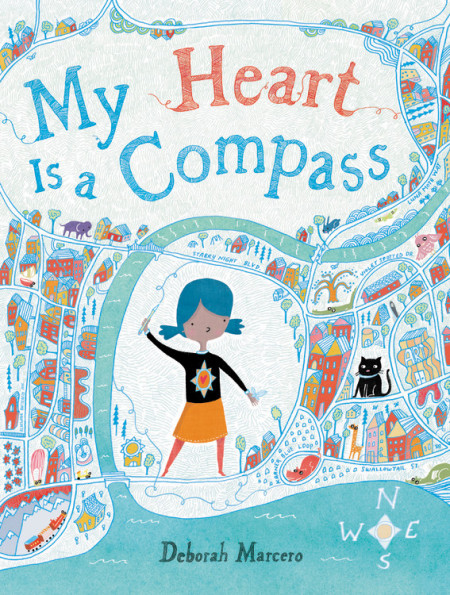
My Heart Is a Compass (Little, Brown and Company, November 6, 2018) written and illustrated by Deborah Marcero

It could have been anything.
Something exotic?
Something magical?
Did it even exist?
Where could she find such a thing?

For that, she needed a map.  Not an atlas or a globe.
To find the secret coordinates, she would
have to draw her own map.  

Watch the delightful book trailer premiere
at A Fuse #8 Production with Betsy Bird


STORY

No Boring Stories! (Viking, Penguin Young Readers, November 6, 2018) written by Julie Falatko with pictures by Charles Santoso

Those are boring stories!
I like books where strange stuff
happens.  But everyone says my
stories are too weird.

I think weird
stories are cool.

Remember the one you
wrote where the main
character was a discarded
shoe who loved to sing?

That sounds hilarious!


GIVE

Found. (Simon & Schuster Book for Young Readers, November 20, 2018) written by Jeff Newman with illustrations by Larry Day

This story is wordless.  It is a powerful statement on loss.  It speaks to giving when it's the hardest possible choice.  It's also about finding pure sweet love.


Monday, November 23, 2015

The Soul Of A City

The last week in August 2005 a nation, admittedly persons around the world, watched with growing alarm as a force of nature spun toward the southern edge of the United States.  On the 29th it reached landfall along the Gulf Coast.  Hurricane Katrina stretched some four hundred miles with sustained winds reaching between one hundred and one hundred forty miles per hour. The loss of life, the loss of a way of living and personal property was catastrophic.

One man, Cornelius Washington, in the wake of devastating destruction dug deep into his heart doing what he had done daily.  Marvelous Cornelius: Hurricane Katrina and the Spirit of New Orleans (Chronicle Books, August 4, 2015) written by Phil Bildner with illustrations by John Parra is an inspirational tribute to an extraordinary human being.  His strength in the face of events beyond his control was a spark that fueled flames in others.

In the Quarter,
there worked a man
known in New Orleans as Marvelous Cornelius.

Cornelius was known for his cheerful salutations to all he saw each morning, afternoon and evening on his route.  Men, women and children raised their hands and voices in returned greetings.  Cornelius was a sanitation worker spreading joy throughout the city riding on the back of the big truck.

This man took tremendous pride in his work; realizing we all have jobs to do, so we need to do them in the best possible way.  His calls rang out like trumpets.  His beats on the side of the truck and clashing of lids were like the matching percussion in a big brass band.

He moved from curb to truck with the skills of an acrobat and the smoothness of a dance king, bags sailing through the air.  People happily paused to watch or join Cornelius, marveling at the magic he dispersed.  This all stopped when the storm struck.

The mighty wind and water stirred the city into a stew of destruction.  When they finally receded Cornelius felt the weight of the world on his shoulders as he saw the piles of rubble farther than his eyes could see.  He sobbed.  He then got to work from the back of his truck.  So did others in his city, the state, and the nation.  One man's spirit rallied others then and still does today.


One person can make a difference.  Once man's presence can brighten a day and lighten a load.  Phil Bildner gives respectful recognition to such an individual with words lifting off the page like the notes in a song, sung in a storyteller's voice.  Bildner has Cornelius acknowledge three distinct people as the story begins.  They play an essential role toward the end of the tale.  Alliteration describes the worker's day.  The rhythms in the Crescent City ring out in this man's every action.  Here is a passage.

BANG!
He clapped the covers like cymbals and
twirled the tins like tops.  Whizzing and
spinning back and forth across the street.


Rendered in paint the two separate illustrations seen on the front and back of the matching dust jacket and book case speak to the spirit of the man and the work ethic he presented to all who encountered him.  The perspective on the front depicts Cornelius as a larger than life figure in the city he loved.  The rays of the sun are akin to the rays of cheer and go-to attitude of this man.  He was a sunrise to the people before and after Katrina.  To the left on a background of burnished orange Cornelius is waving as he rides on the back of the truck.  On the opening and closing endpapers forty-eight different symbols of the city are patterned in small rectangles.  A city street, a row of houses, spans from left to right as the truck passes on the verso and title pages.

Single page and double-page images display a full range of color with a nod to the architecture of the vibrant city of New Orleans.  Greens, blues and the blush of dawn provide the background colors.  Readers will note the bluebird, a symbol of happiness, seen in the first picture is visible repeatedly throughout the book.  When Cornelius makes a decision to begin his work after the storm even though the odds against him are huge, the bluebird returns with a sprig of green.  This is most definitely a nod to the receding of the waters and sadness being replaced with determination and hope.  The tiny details, ants in the street, logos on the discarded items Cornelius picks up, the clothing worn by the residents, the vines growing on railings, a bee on a string of lights, street musicians, an umbrella caught in the wind, the type of boats on the water, and the NY 2 NO on the side of a bus tell us about the care John Parra takes when creating his visuals.

One of my favorite illustrations is the first one of Cornelius kneeling in the center of a street, a can held in one hand, a bag in the other.  He is smiling as he looks at a bluebird perched on a curved handle poking from the can.  Rays are radiating behind him.  On either side are rows of homes people out and about enjoying the day.  At the top two ribbons arc from a star on the left is New, on the right is Orleans.  

Readers, this reader, can't help but feel gratitude toward author Phil Bildner and illustrator John Parra for bringing our attention to this man in Marvelous Cornelius: Hurricane Katrina and the Spirit of New Orleans.  The text and images raise it to the status of tall tale as intended but the truth of this life well-lived glows on every page.  Phil Bildner explains further in an Author's Note.  

To learn more about Phil Bildner and John Parra and their other work please visit their respective websites by following the links attached to their names.  If you go to the publisher's website there are several interior images and a teacher's guide.  Two years earlier John Parra was a guest at author, reviewer and blogger Julie Danielson's Seven Impossible Things Before Breakfast.  Two years ago Phil Bildner stopped by Scholastic's Ambassador for School Libraries John Schumacher's blog Watch. Connect. Read. Stop by Latin@s in Kid Lit to read In the Studio with Illustrator John Parra.  A series of blog posts at Color Me a Kidlit Writer showcase this title.  Phil Bildner talks about A Modern Day Folktale: MARVELOUS CORNELIUS Blog Post.  CELEBRATING THE SPIRIT OF NEW ORLEANS 10 YEARS AFTER KATRINA is an essay by Phil Bildner revealing the story behind this book.  Teacher librarian Matthew C. Winner talks with Phil Bildner and John Parra in Let's Get Busy, Episode #175 podcast.  John Parra reads this title aloud on KidLit TV.  You are going to enjoy this.


Update:  March 2, 2016 John Parra is interviewed at GROG.

Wednesday, March 5, 2014

Bringing Books To Readers

Happy World Read Aloud Day!  

Earlier this year (February 13, 2014) John Schumacher had a guest on his blog (Watch. Connect. Read.)Pam Allyn for LitWorld.  The post talked about The World Read Aloud Blogging Challenge.  The questions in this challenge could be asked and answered anytime of the year.  Each World Read Aloud Day raises awareness of the importance of reading aloud for readers and listeners.

It also shifts the focus to those children, people, who have no books, no access to libraries or other forms of the written word.  Published in 2010 Jeanette Winter's book, Biblioburro:  A True Story from Colombia (Beach Lane Books, an imprint of Simon & Schuster Children's Publishing Division) pays tribute to the life of one man making a difference, bringing books to children who would otherwise have none.  His travels are creating transformations one reader at a time.

Deep in the jungles of Colombia, there lives a man who loves books.  His name is Luis.

Luis loves books so much his house is filled with them.  His wife, Diana, wonders about their growing numbers.  Her worries give Luis an idea. 

Two burros, Alfa and Beto, become new members of the Soriano household.  They will carry Luis and crates filled with books into the mountains to children.  Each week they travel to a different remote village.

These trips are not without their trials and tribulations.  The burros can determine the arrival time when one or the other refuse to move.  Once a bandit stopped Luis, taking a book but warning him money would be necessary next time.

Arriving in a village Luis reads to the gathered children; sometimes handing out masks for them to wear.  Books are eagerly and happily chosen before he leaves.  On his return home in the evening Luis knows the children he visited on this day will be doing the same thing he is before bedtime...reading.


What Jeanette Winter does in this book, making it more of an intimate experience for the reader, is to focus on a specific village Luis visits.  After introducing readers in the narrative to Luis, his wife, Diana, and the two burros, Alfa and Beto, she centers the story on a trip to the village of El Tormento.  Her descriptions of the time of day and surrounding hillside in the jungle help readers to feel as though they are on the burro with Luis.  The insertion of dialogue increases our personal attachment to the story.  Here is a sample passage.

Deep in the hills, the path is lonelier than ever.
Bird songs are the only sounds they hear.
Then, from deep in the shadows,
a bandit leaps out!
"Please let us pass," Luis says.
"The children are waiting." ...

Using acrylic paint with pen and ink Jeanette Winter depicts a true sense of place and people.  The matching jacket and case reflect the subject of the book filling the illustrations with flora and fauna found in the Colombian jungles.  On the back surrounded by white space Luis sits on a rock reading as butterflies land on his hat and shirt.  The opening endpapers are a bright turquoise; the closing endpapers a rich lavender. 

All of the pictures in this book extend from edge to edge across both pages using the same radiant color palette as seen on the cover.  Butterflies are featured on every visual (as are many other creatures) including the final evening spread.  Given the symbolism attached to them, this is particularly pleasing.  

One of my favorite illustrations is wordless.  Luis is seated on a rock reading to a group of children wearing pig masks.  The burros are watching as vivid orange butterflies land and fly about the people.  In small light turquoise ovals like speech bubbles we see the pictures from the story Luis is reading.  


Biblioburro:  A True Story From Colombia written and illustrated by Jeanette Winter is one of those very special books illuminating the life of single individual who choose to share his passion with others.  Who knows how the lives of those children he brings books to will be changed?  Jeanette Winter provides more information on a single page author's note at the book's end.  Here is a link to the publisher's website offering viewers a glimpse of more pages from the book as well as a video.


Another wonderful book which recounts the travels of Luis Soriano Bohorquez is Waiting for the Biblioburro (Tricycle Press, an imprint Random House Children's Book, 2011) by Monica Brown with illustrations by John Parra.  In this fictional story of a little girl named Anna, we learn her teacher has left their village.  No one is there to teach the children any longer, to give them new reading materials.  Ana makes up stories to fill her longing for books, entertaining her younger brother.  

One day, she hears the sound of burros clip-clopping into her village.  It's a man carrying a sign reading Biblioburro.  He explains his moving library, reads stories to the children and lets them choose books to borrow.  

At the suggestion of Luis, while waiting for his return and wondering when it will be, Ana writes a book about the two burros.  Guess what is placed in the book carriers when the Biblioburro leaves after his next visit?  A reader.  A writer.  Children are being changed.


In her author's note Monica Brown reveals how she came to write this book after getting to know Luis Soriano Bohorquez.  Beneath her author's note is a glossary of the Spanish words she wove into her narrative adding an authenticity to the telling.  The way she has written this book is to show the beautiful circle made by Luis's generosity.  One reader is reaching out to many; they in turn are reaching others.

There is a folk art quality to the illustrations created with acrylics on board by John Parra.  Pictures vary, extending edge to edge, across one or two pages.  His colors are more centered in earth tones.  His images of how reading fuels the imagination are simply beautiful.  I am especially fond of the two pages showing the days of the week in Spanish, time swirling about, as Ana waits for the return of the Biblioburro.  The inclusion of her parents, flora, fauna and elements from her daily life is excellently designed.

Please follow the links embedded in the author and illustrator names above to their websites.  There is much more about their work there.  


For further reading and information about Luis Soriano Bohorquez please visit this link to Teaching kids to read from the back of a burro at CNN and this link to a PBS documentary point of view page, Luis Soriano:  News Updates from the Back of a Burro.  Random House has many pages devoted to this book at their website linked here.  Included are a teacher's guide, an excerpt, a look inside and related links.  


I thank Alyson Beecher for hosting this challenge each week at Kid Lit Frenzy.  My reading of nonfiction picture books is increasing by leaps and bounds.