Quote of the Month

When love and skill work together, expect a miracle. John Ruskin


Showing posts with label Rafael Lopez. Show all posts

Wednesday, February 2, 2022

Lift Your Arms

Nearly thirty-seven years ago, I read a book with a collection of stories, many remaining in the coveted places of my heart.  Some of those narratives became a part of storytelling in my school libraries at the high, middle, and elementary levels.  In the past few days I reread the entire collection of tales found in the book authored by Virginia Hamilton with illustrations by Leo and Diane Dillon.  The People Could Fly: American Black Folktales is divided into four sections focusing on

animals, real, extravagnat, and fanciful, supernatural and other slave tales of freedom.

These stories are rich in tradition and cultural history, educating and entertaining us about a resilient, noble, determined, and hopeful people.  The last tale in the book takes the name of the title, The People Could Fly.  Without fail, each time I read this story tears well in my eyes.  These tears are jubilant for the people who could fly and heartbroken for those left behind.  

In her closing paragraph, Virginia Hamilton says:

"The People Could Fly" is a detailed fantasy tale of suffering, of magic power
exerted against the so-called Master and his underlings.  Finally, it is a powerful
testament to the millions of slaves who never had the opportunity to "fly"
away.  They remained slaves, as did their children.  "The People Could Fly" was
first told and retold by those who had only their imaginations to set them free. 

At the close of their newest collaboration, The Year We Learned To Fly (Nancy Paulsen Books, an imprint of Penguin Random House LLC, January 4, 2022) written by Jacqueline Woodson with illustrations by Rafael Lopez, Jacqueline Woodson makes reference to the words of Virginia Hamilton and the artwork of Leo and Diane Dillon in their 1986 Coretta Scott King Award winning title. (It also received a Coretta Scott King Illustrator Honor Award that year.) For all those who find themselves in a time and place they would rather not be, this book reveals a gift.  It shows us how to use this gift, a gift we all possess.

That was the year we learned to fly . . .

It began in the spring.  Storms raged nonstop.  A sister and her brother were confined to their home.  Their grandmother advised them to

use those beautiful and brilliant minds of yours.

She continued telling them exactly what they needed to do.  They did it, leaving their home and exploring their city, now blooming with a glorious array of flowers.  

Summer arrived.  The twosome could not agree on anything.  It seemed the only thing they were good at was arguing.  Their grandmother, in her wisdom, repeated her words.  Holding hands, sister and brother, forgot their anger.

As the shorter days and longer nights of autumn came, the girl and boy knew they could leave whenever they desired.  Their grandmother had taught them what had been passed from generation to generation, beginning with the people torn from their homes in Africa and brought across the water on ships.  Dreaming was believing.  You were (are) never alone in needing to fly.

The family moved in winter.  Everything and everyone was different.  The new neighborhood children were not friendly, but the sister and brother used remembered the words of their grandmother.  Their generosity was contagious.


Although author Jacqueline Woodson takes us through a year, season by season, of boredom, anger, loneliness, and newness, the awakening of the children's gift through the wisdom of their grandmother could aptly apply in any given situation at any given time.  In fact, as established through her poetic words used to design a cadence, the grandmother makes reference to others who might be in the same circumstances as the siblings.  These beautiful poetic instructions are enhanced by the repeated mention of another phrase.  Both combine to fashion a text that lifts readers as high as they desire to go.  Here is a passage.

That was the autumn our rooms felt too big and lonely
with only us in them and the darkness coming on so fast.
But while we hugged ourselves against the too-quiet of it all,
we remembered
that we didn't have to be stuck anywhere anymore.


When you look at the girl gazing upward on the right side of the matching and open dust jacket, you wonder what has her attention.  Are her feet on the ground or is she already flying?  What does the background indicate to you as a reader?  The wash of pastel colors seen here on the front extends over the spine to the left, back, of the jacket and case.  There, along the bottom, are three brilliant butterflies.  Above them are excerpts from starred reviews for the previous collaboration by these creators, The Day You Begin.  The text on the front is slightly raised and varnished.

Readers will be intrigued by the opening and closing endpapers.  They offer, prior to the reading of the book, an opportunity for discussion.  Both sets of endpapers show the same tree in the same setting.  The tree is placed on the right side.  On the lowest, right-hand branch a single cluster of leaves hangs down.  That is where the similarities end.  The background colors differ, as do the hues used in the ground.  There are additions in the closing endpapers.  What do they indicate?  Do these endpapers refer to other images within the book with leaves in them? (Personally, I love the leaves whenever they appear.  I have my theories.)

These illustrations by Rafael Lopez 

were created  with a combination of acrylic paint on wood, pen and ink, pencil, and watercolor, and put together digitally in Photoshop.

Each of them, double-page pictures, are full of color, emotion, and the frustration and exuberance of any given moment.  We understand how confined the children feel as the storm batters their apartment building and the other buildings in their community.  We feel deep respect for the depiction of their grandmother dressed in shades of orange, red, and purple wearing a regal and tradtionally-patterned dhuku,  And when the children fly we are there with them, uplifted and enjoying the vivid hues of the flowers and trees.

Careful readers will notice one particular bird and butterfly which seem near to the sister and brother in many of the pictures.  Rafael Lopez includes a bit of humor through the family dog.  When the children cannot seem to decide who should feed the dog, the dog, holding his dish in his mouth, patiently waits.  In two of the double-page illustrations, Rafael Lopez includes imagery from historical events woven into first, the girl's hair, and second, as portraits placed in large leaves clustered near the ground on the left of the following picture.

One of my many favorite two-page visuals is for the words referring to autumn. (It is the text above-noted.)  It is in the evening.  The background is a wash of purple hues with a bit of green and black.  The children on the right, appear to be reading in bed.  The quilt extending along the bottom of the left goes up and over the shoulders of the girl.  The orange red leaves on the quilt start to float off and around the two children.  This creates a cozy, tent-like image.  The girl is seated.  Her brother, under the covers, is in front of her.  She is holding the book she is reading aloud in front of him.  It is The Day You Begin.  There is a golden glow around and above the shoulders of the girl.  


This book, The Year We Learned To Fly written by Jacqueline Woodson with artwork by Rafael Lopez, is a marvelous tribute and an invitation to everyone.  We all have 

brilliant and beautiful minds.

With them we can accomplish as much as we can imagine and more.  What will we do with this ability?  I highly recommend you place a copy of this title in both your personal and professional collections.

To learn more about Jacqueline Woodson and Rafael Lopez and their other work, please access their websites by following the link attached to their names.  Jacqueline Woodson has accounts on Instagram and Twitter.  Rafael Lopez has accounts on Instagram and Twitter.  At the publisher's website you can view the title page. and verso.

Thursday, September 5, 2019

She Gave Him Joy

A lot of people have playlists of music they prefer.  Some will have multiple playlists; one for exercise, one for creativity, one for concentration or relaxation.  Different music speaks to different people at different times.  Conversely a certain song or musician can connect and has connected with thousands of people during human history.

In the United States of America, for four years (and truthfully for some time before and after), this nation was torn by the Civil War from April 12, 1861 to April 9, 1865.  In December of 1853, on a different continent, a baby girl was born.  Dancing Hands: How Teresa Carreno Played The Piano For President Lincoln (Atheneum Books for Young Readers, August 27, 2019) written by Margarita Engle with illustrations by Rafael Lopez is the story of this musically gifted child who helped heal a grieving parent and national leader and his family.  One person can and will continue to make a difference. 

WHEN TERESA was a little girl
in Venezuela, Mama sang lullabies
while Papa showed Teresita how
to let her happy hands dance
across all the beautiful
dark and light keys
of a piano.

In making melodies on the piano, Teresa learned several things.  She was able to make sounds which imitated those inhabitants in the natural world.  Playing the piano was hard and took a lot of work but it was a way to soften her sadness and share her joy with others.  By the time she was six she could write her own songs.  A year later she performed in a small space within a cathedral.  Isn't this amazing?

At eight years old her life changed drastically.  She and her parents had to flee their country due to war, leaving everything she knew and loved behind her.  Their ship after sailing on stormy seas landed in New York.  The people and the language they spoke did little to make her feel welcome plus the United States was engaged in the Civil War.

Playing on a new piano saved this child.  She practiced and practiced.  Music of all kinds filled the air in her home.  She was soon given a new nickname, the Piano Girl.  Something wonderful happened to Teresa.  People loved her music and she was soon performing on stage with other musicians.

Perhaps she was wondering if her life could get any better than playing piano music for people and traveling to other cities.  It did get better.  She received a request to play for President Abraham Lincoln and his family at the White House!  She was ten years old.

What could she do during a war with streets in Washington DC lined with soldiers and exhausted nurses?  What could she do to lift the sadness filling the Lincoln family's hearts? An accomplished artist and statesman found their way to common ground.


With a mind and heart focused on poetic expression, Margarita Engle pens a biography both captivating and factual.  She supplies us with exquisite imagery of the land and wildlife in Venezuela, the travels aboard the ship to the United States, a scene from the Civil War and the memorable event of playing for the Lincoln family.  A repetition of a descriptive phrase for the piano keys creates a flawless flow from one section of the story to the next portion.  Here are two passages from a three-passage page.

Without a new piano,
Teresa would have felt even more lonely,
but soon she discovered that wherever one is,
some people are friendly, drawn together
by songs.

Musicians came to her home,
playing along while they listened
to the dazzling notes
of her dancing hands.


The image seen on the front of the matching dust jacket and book case is a stunning portrait of Teresa's ability to part the darkness of war and death with her remarkable piano music.  The flowers and birds reflect not only the particular piece she is playing but her ability to bring the cheer and charm of her native land with her wherever she goes.  The scene on the front extends to the left edge of the jacket flap.  The dark cloud blooms for most of the back, parts for a small space and continues.  White tents for soldiers dot the hillside outside of a small community shown on the far-left bottom.

Certain elements of the front and back of the jacket and case are replicated on the opening and closing endpapers.  The first offers a countryside at war with a single tiny bird flying in the sky.  On the second a historical note occupies a large portion on the left, then Teresa's piano has sheets of music taking wing mixed in with flowers and a brightly colored bird. (This bird appears several times throughout the book.) The dark clouds are moving away on the right and on the left.

The illustrations for this book were rendered in mixed media (acrylic on wood board, using sticks and other tools to paint; watercolor; construction paper; pen; and ink), and then assembled digitally

by Rafael Lopez.  Apart from two full-page pictures, all the images are double-page visuals.  Each one not only depicts a specific moment but conveys strong emotions.  Color choices supply us with joy, fright, sadness, and worry.  We are wrapped in Teresa's world.

Details reflect place and historical context.  All the people are fully animated according to the scene.  These illustrations are guaranteed to invite discussions and further research.

One of my many, many favorite pictures is of the family fleeing their home in Venezuela.  It captures these moments with sincere clarity.  Dark clouds scallop across the top of two pages.  Rain beats down diagonally on the right, across the gutter and on a portion of the left.  On the hills on the left, buildings are on fire and smoking.  In the foreground barrels drift in the ocean on the left due to the storm.  On the right a schooner is trying to ride out the horrific weather.  Beneath the ship and filling the lower half of the right side is a portrait of Teresa.  Her head is bowed, and her eyes are closed.  It's a breathtaking representation.  We see a side of her face, as she is facing right.


This book, Dancing Hands: How Teresa Carreno Played The Piano For President Lincoln written by Margarita Engle with illustrations by Rafael Lopez, is the kind of nonfiction sure to excite and encourage readers.  If one ten-year-old child can bring contentment to a grieving family with her music, think what you or I or everyone else can do with our combined talents.  I highly recommend this title for your personal and professional collections.

To learn more about Margarita Engle and Rafael Lopez and their other work, please follow the links attached to their names to access their websites.  Margarita Engle has accounts on Facebook, Instagram and Twitter.  Rafael Lopez has accounts on Facebook, Instagram and Twitter.  At the publisher's website you can view interior images.


Please be sure to visit Kid Lit Frenzy hosted by educator Alyson Beecher to view the other titles selected this week by participants in the 2019 Nonfiction Picture Book Challenge.


Tuesday, January 1, 2019

Happy New Year 2019---One Little Word

Three hundred sixty-five days have come and gone in what seemed like a heartbeat.  Where did 2018 go?  Did someone speed up the clock?  The sense of not being able to catch up seemed stronger this past year.

Many people have been selecting one little word at the beginning of each calendar year for more than a decade.  The One Little Word project was started in 2006 by Ali Edwards.  For this first post of 2019, still having 2018 books to highlight, I decided to generate a list and assign a single word to each title.  I will include links to the author, illustrator and publisher when able to do so.  I will provide a passage from the book.  May everything that is right and good flourish in this coming year for each of you.

CONFIDENCE

Neck & Neck (Little, Brown and Company, June 5, 2018) written and illustrated by Elise Parsley

"I just

love 

this guy!"

At that, 
Leopold sighed and turned . . .
. . . and gasped

at the
gleaming smile

bobbing beside him.
Book Chat with the Illustrator: Elise Parsley Returns from LB School on Vimeo.


NEIGHBORHOOD

Hey, Wall: A Story Of Art And Community (A Paula Wiseman Book, Simon & Schuster Books For Young Readers, September 4, 2018) written by Susan Verde with illustrations by John Parra

Hey, Wall!

Guess what?

I'm ready to change all that.


Book trailer premiere with chat at Watch. Connect. Read. with John Schumacher


COMPASSION

I Am Human: A Book of Empathy (Abrams Books for Young Readers, October 2, 2018) written by Susan Verde with illustrations by Peter H. Reynolds  

I have a feeling of wonder.

I am amazed by nature.

I have a playful side.

I find joy in friendships.

I am Human.


PERSPECTIVE

The Wall In The Middle Of The Book (Dial Books for Young Readers, October 2, 2018) written and illustrated by Jon Agee  

Wait a second.  What's going on?!

This is not supposed to happen
on this side of the wall!


Book trailer premiere at 100 Scope Notes with Travis Jonker


CHOICE

Little Brown (Beach Lane Books, October 2, 2018) written and illustrated by Marla Frazee

He knew he could be a dog who would---if given
half a chance---chase balls, run in circles, nap in
the shade, or get muddy.

But Little Brown just watched the others . . .
and got crankier and crankier.  


UNITY

We've Got the Whole World in Our Hands (Orchard Books, an imprint of Scholastic Inc., October 9, 2018) written and illustrated by Rafael Lopez

We've got the rivers and the mountains
in our hands.
We've got the oceans and the seas
in our hands.
We've got you and you've got me
in our hands.
We've got the whole world
in our hands.


EXPLORE

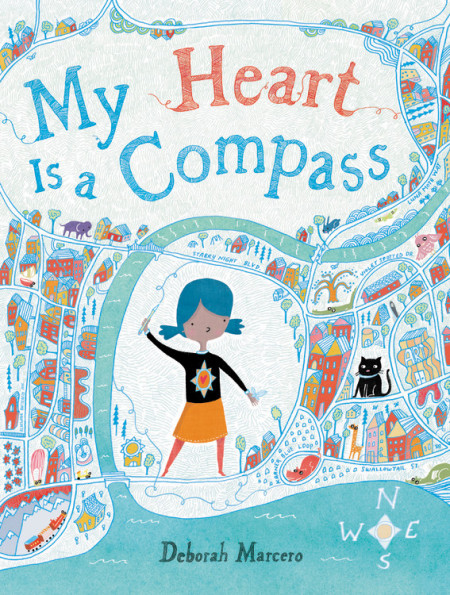
My Heart Is a Compass (Little, Brown and Company, November 6, 2018) written and illustrated by Deborah Marcero

It could have been anything.
Something exotic?
Something magical?
Did it even exist?
Where could she find such a thing?

For that, she needed a map.  Not an atlas or a globe.
To find the secret coordinates, she would
have to draw her own map.  

Watch the delightful book trailer premiere
at A Fuse #8 Production with Betsy Bird


STORY

No Boring Stories! (Viking, Penguin Young Readers, November 6, 2018) written by Julie Falatko with pictures by Charles Santoso

Those are boring stories!
I like books where strange stuff
happens.  But everyone says my
stories are too weird.

I think weird
stories are cool.

Remember the one you
wrote where the main
character was a discarded
shoe who loved to sing?

That sounds hilarious!


GIVE

Found. (Simon & Schuster Book for Young Readers, November 20, 2018) written by Jeff Newman with illustrations by Larry Day

This story is wordless.  It is a powerful statement on loss.  It speaks to giving when it's the hardest possible choice.  It's also about finding pure sweet love.


Sunday, September 16, 2018

Each Day Start Anew

It does not matter how old you are.  It does not matter how many times you've done this in the past.  Each time, it's like starting over.  You step into an unfamiliar setting, glancing around only to discover your outward appearance is different.  Your brave, confident, inside-self grows a little bit smaller.

It should not be, but for children this is particularly challenging.  Children are courageous, compassionate and more willing to embrace change.  They are in the process of becoming their best selves and this is what makes them vulnerable.  The Day You Begin (Nancy Paulsen Books, an imprint of Penguin Young Readers Group, August 28, 2018) written by the National Ambassador for Young People's Literature Jacqueline Woodson with illustrations by award-winning Rafael Lopez explores through beauty in words and images first time apprehensions.

There will be times when you walk into a room and no one there is quite like you.

One or more things about you set you apart from the other people.  The language you speak or the accents given to the words you use are unique.  Saying your name out loud makes laughter fill the room until your teacher repeats it.  Then it envelopes you in welcoming warmth.

What do you say when the other children speak of summer visits to other countries and states, proudly holding mementos in their hands?  Your summer was a comfort to your sister.  Days of shared joy and love, quiet naptimes and hours of reading filled your shimmering-hot weeks.

What do you do when your beloved ethnic food is looked upon as strange at lunchtime?  What if no one will play with you at recess because you don't share the same skills?  This is when you call out to your inside-self asking it to be bold.

You realize, as you tell the tale of your summer, the light of awareness sparks in the eyes of those listening.  You are still a wonderful individual, as are they, but little similarities reach out to join in friendship.  Be strong, little one, your confidence is contagious.


There is a question at Jacqueline Woodson's website,

Do you think you'll ever stop writing?

Her reply shines through each word she carefully places on the pages of her books.

When I stop breathing.

In this title, the unseen narrator softly chats with a child (all children) eloquently using language to fashion scenarios so real you can recall the familiar ache of being different.  The repetition of specific phrases supplies a gentle refrain. Each portion of this story is a layer building toward a marvelous result waiting to be found and released.  Here is a passage.

And in that room, where no one else is quite like you, you'll look down
at your own empty hands and wonder What good is this
when other students were flying
and sailing and
going somewhere. 


All of the poetic truth of Jacqueline Woodson's words is depicted by the vivid, lively and heartwarming images of Rafael Lopez.  The uncertainty the little girl senses is reflected in her body posture and face on the front of the matching dust jacket and book case.  The shifting shades in the varnished colors of the text hint at the color palette. The beauty coming from her book is symbolic of the power of shared stories.  The ruler placed on the door is used several other times within the interior of the book.  This is sure to promote discussions on its significance.

To the left, on the back, text is framed with leaves, trees and flowers from the children's native countries.  Shades of muted green paint a pastoral scene on the opening and closing endpapers.  A grasshopper perches on a stem and a bird rests on a flower stalk.  A single rose-colored blossom, petals closed, is the only other hue on the opening endpapers.  The conclusion of the story is mirrored in the closing endpapers as the grasshopper leaps into the air with two other insects.  Two other birds join the first in flight.  How many flowers do you think are in bloom now?

Rendered

with a combination of acrylic paint on wood, pen and ink, pencil, and watercolors, and put together digitally in Photoshop

these illustrations begin their story on the verso and dedication pages as the child sits in her apartment window reading on a summer day.  All of the pictures extend from page edge to page edge across two pages with the exception of the final wordless single page, the perspective a birds-eye view of pure bliss found in contented children.  Rafael Lopez's rich visuals focus on the children striking a chord in our hearts.

At times we are drawn close to their faces to accentuate a moment.  Other times we step back as imagining and wonder resonate from his scenes. Birds and natural landscapes flow from page to page.

One of my many, many favorite illustrations is of the boy dismissed from playing with the other children at recess.  He walks to the edge of the ground bordering a pool of water.  The sky glows with the heat of those first few days of school, a full-bright sun hanging in the sky on the left over a single home.  The boy also on the left, closed book in hand, looks into the water. The water does indeed reflect what is above with a brilliant alteration.  The boy is grinning holding a now-opened book.  There is a yellow glow around him.  From the book loveliness pours forth in vines, leaves and blossoms.

Surely this title has been used to start many classroom sessions.  The Day You Begin written by Jacqueline Woodson with illustrations by Rafael Lopez transcends age inspiring all who read it to bring out our brave, willing to speak our truths with others.  How else are we to make our world better for everyone?  How else are we to discover our connections while preserving our singularities?  This book has my highest recommendation for your personal and professional collections.

To read and learn more about Jacqueline Woodson and Rafael Lopez and their other work, please visit their websites by following the links attached to their names. Both Jacqueline and Rafael maintain Twitter accounts and Instagram accounts here and here.  At the publisher's website is a teacher's guide for Jacqueline Woodson books, including this title.

Friday, April 7, 2017

Gracias A Todos

When we meet people from the past, people who lived and died during our lifetimes and those still living among us today, our world becomes larger, more colorful and fascinating.  Their example elevates our thinking; these people who made this place we share better, raise us up.  If they can do it, we can do it.

Author Margarita Engle continues to enlighten readers in her most recent title Bravo! Poems About Amazing Hispanics (Godwin Books, Henry Holt and Company, March 14, 2017) with illustrations by Rafael Lopez.  Highly respected individuals for their contributions find a place in the pages of this book.  Some of them will be familiar to readers, others will be new and welcome acquaintances.

The first of eighteen poems is:

JUAN DE MIRALLES 
1713-1780
Cuba

I believe in the good cause
of American independence from England.
Thousands of soldiers from Spain
and all regions of Latin America
are fighting side by side
with George Washington's men,
as we struggle to defeat the British. ... 

As a close friend of George Washington, he helped the troops to combat scurvy by sending ships to Cuba to bring back fresh fruit.  Born a few years after Juan De Miralles dies, Felix Varela leaves Cuba in fear of his life.  Kindness saves him and the Irish immigrants settling in New York after the potato famine who he assists.  The medicinal skills and courage of Juana Briones, a rancher in California earned her the name of the Founding Mother of San Francisco.

Her home in Florida was a refuge for poets. His poems voicing freedom caused him to be imprisoned at sixteen.  They were friends united in their beliefs, both born and died in Cuba.

Sometimes our path is not known until we are older.  Ynes Mexia, a botanist, shows us how determination can create opportunities.  His method of painting birds and the results show us how to love Nature's creatures.  Perhaps this woman, the first to fly an airship (even before Wilbur and Orville Wright), soared with those very birds captured on canvas.  Her teaching methods focused on the use of English, Spanish, Tewa and Tiwa and her cookbooks blended the old with the new.

A storyteller and a cowboy, Arnold Rojas, kept his culture alive.  Pura Belpre was the first Puerto Rican hired in the New York Public Library System.  Her name is attached to the prestigious award given to Latino authors and illustrators each year by the American Library Association.  Another first was held by George Melendez Wright, chief of the Wildlife Division for America's national parks; protecting and preserving animals under his care.

A woman rises up to champion for women's rights and care for children in poverty.  A man, stricken with asthma, looks for cures through research.  Another man takes his "noise" and makes music.  Remembered for his tireless peaceful protests to better the life of farmworkers, his name is synonymous with labor and civil rights.

His life was lost in a tragic airplane accident flying to assist those in need but his baseball records cannot ever be changed.  Roberto Clemente was the first Latino to reach 3,000 hits.  He was a mentor to many; reading and writing whatever he could find as his family moved with the crops.  He was the first Latino leader of a University of California campus.  Tomas Rivera.


Imagine this.  You and others are seated in a small, comfortable theater in the round.  In the center is a stage; also seated are persons born as early as 1713 and who died as recently as 2011.  A hush falls over the room.  It remains as each one of these eighteen people read the poems, in their own voice, as written by Margarita Engle.  As the final sentence

Sometimes the best way to teach is by example.

is read the silence stays for several heartbeats until as one the entire audience stands and delivers their applause.

This is exactly how you feel when reading this title.  You are drawn into the lives of these individuals by the words chosen by Margarita Engle.  For each person she gives us their name, their birth and death dates and their country of origin.  As they talk to us those sterling moments of their lives are revealed as is the journey they took to accomplish their achievements.  Here is the portion of another poem.

JULIA DE BURGOS
1914-1953
Puerto Rico

Six of my twelve brothers and sisters
died of hunger, but my gentle mother
took me for long walks
beside a river
of beautiful dreams.

I learned to love nature and the island,
even though we were so poor that I
had to climb into classrooms
through a window, because we
could not afford school tuition. ...


Opening the dust jacket you can see the black background for the title text extended to the spine and the left two-thirds of the back.  Four more geometric portions of portraits are displayed to the left of the spine vertically.  Each face, on the right and the left of the jacket, conveys the full emotional intensity of the person, capturing them at their best.  On a turquoise background on the front and a purple background on the back of the book case, Rafael Lopez features a girl first and then a boy benefiting, like all who read this volume, from the variety of lives depicted.  The girl is lying on her back holding an open book over her face.  Drops of water, a rainbow of colors, fall from the pages.  The boy is seated, knees up with a book held in his hands.  His head and neck are rainbow striped with a strip in the middle black with stars.

Each of the people are given an entire page for their portrait.  The backgrounds reflect the time period and their successes.  A portion of the background appears next to their name on the opposite page along with a small image acting as a symbol of their remarkable deeds; a fruit with leaves formed of American flags for Juan De Miralles, a stylized bird standing on a paint brush sprouting leaves for Louis Agassiz Fuertes and a fashionably dressed smaller version of Aida De Acosta with wings.  These illustrations rendered in 

a combination of acrylic on wood, pen and ink, watercolor, construction paper, and Adobe Photoshop

belong on the walls of an art gallery or museum.  They are stunning!

One of my favorites of many is Juana Briones.  Behind her is a golden canvas with a symbolic sun, rays extended, over her right shoulder.  She is standing tall facing us, part of her long hair back and up.  In her right hand she holds a basket filled with herbs, balanced on her hip.  In her left hand she holds a small decorated pot.  To the left and right of her are two large floral herbs.  A small layer of purple extends along the bottom.  She is wearing a striped black and gray skirt, white, round-necked blouse and a shawl knotted in front.  Her face is full of quiet strength.


I have read these poems over and over, the warmth and greatness of these people filling my soul.  Bravo! Poems About Amazing Hispanics written by Margarita Engle with illustrations by Rafael Lopez is a book needed on all professional and personal bookshelves.  This book will inspire you to research more about each person. At the close of the book Margarita Engle lists more influential Latinos on two pages.  Four more pages expand on the information about the eighteen notable Latinos in this book.

To learn more about Margarita Engle and Rafael Lopez please visit their websites by following the links attached to their names.  Rafael Lopez has several pages from this book showcased on his site.  He also maintains another website here.  At the publisher's website you can see some pages not shown at Lopez's website.  Margarita Engle wrote a post for the Nerdy Book Club, January 20, 2017.

Monday, July 4, 2016

Shades Of Brilliance

With each season of the year, even in those months when the outside world is sleeping, nature sends us color.  It may only be a flash of rich red from a swooping cardinal or vivid blue from a chattering jay, but its vibrancy is a message.  It's a reminder of associating color with the excitement of being fully alive.

Not only does Mother Nature send us little pieces of color when there is nearly none but the burst of hues from one season to the next or from a dry spell ended with a rain storm seems to happen in hours rather than days.  Sometimes people take their lessons from the natural world.  They make loveliness bloom where there was none.  Maybe Something Beautiful: How Art Transformed A Neighborhood (Houghton Mifflin Harcourt, April 12, 2016) written by F. Isabel Campoy and Theresa Howell with illustrations by Rafael Lopez is inspired by a true story of people who did that very thing.

In the heart of a gray city, there lived a girl who loved to doodle, draw, color, and paint.

No piece of paper was ever blank for very long in her presence.  Her joy came from making shapes and adding bright colors to each of them.  The very special thing about Mira was she did not guard this happiness but shared it with others; giving them her small pieces of artwork.

One day Mira taped a golden, smiling sun to a wall in her community.  The very next day a man was looking intently at that sun as if peering through the lens of a camera using his hands as a frame.  His pocket was stuffed with paint brushes.  He gave a curious reply to Mira's question.

Then faster than a lightning strike he took a can of paint and one of those brushes and began to cover the gray.  After he answered Mira's second question, she found herself being handed a paintbrush.  More gray vanished under a burst of booming brilliance.  He drew and she painted.

Their work did not go unnoticed.  Something new and exciting was taking place in this neighborhood.  People were arriving to participate.  People were dancing.  People stopped.

The policeman arrived.  An extraordinary thing happened next.  It grew and grew and grew until Mira made one final choice.  Perhaps an idea could take flight.


Working together F. Isabel Campoy and Theresa Howell have created eloquent scenes with their words.  In picture books word choice is important; they have excelled at their selections.  Instead of saying

In the center of a gray city

they used the word heart.  This immediately brings the reader into the soul of the city and the story.

They also invite readers further into their narrative by naming specific individuals as recipients of Mira's pictures; also stating exactly what Mira has drawn and colored on those pages.

On her way to school one day,
Mira gave a round apple to Mr. Henry, 
the owner of the shop down the street.

For emphasis they have added sound effects and the names of specific dances as the joy spreads.  This story reads like poetry with a mix of descriptive text and conversation.  Here is another partial passage.

... The shadows scurried away.
Sky blue cut through the gloom.
The man's laughter was like a rainbow
spreading across the sky.


The matching dust jacket and book case extends beyond the boundaries of the folded flap and book case edges.  Left to right on the dust jacket, on either side of Mira's colorful joy, the city extends in its grayness, edge to edge.  The white background is indicative of the blank pages Mira transforms with her art.  The buildings on the book case are carefully continued to the opening and closing endpapers.  On the first the entire city is dull except for one glowing window with a single colored tree outside that window.  On the second set of endpapers the efforts of the community are evident as is the final act of Mira, a messenger in flight on sky blue rather than a washed-out gray canvas.

The joy spoken of by the authors on the first page is portrayed by illustrator Rafael Lopez in a two-page image for the title.  A smiling Mira walks along a city street represented by a living leafy branch.  She is painting a butterfly as she walks toward a transformed cityscape with a smiling sun at the end.

Rendered in a combination of acrylic on wood, original photography, and digital art all of the illustrations span across two pages.  For full impact and asking readers to pause, two appear vertically.  In another two pictures the point of view shifts close to Mira and other characters speaking with her.  Exquisite facial details and spirited body movements capture the happiness filling the community.  Each picture is like a mural of magical moments growing.

One of my favorite illustrations is the first vertical image.  Across the sides and a portion of the top Rafael Lopez has placed black and white stylized swirls (clouds or smoke?); the sun peeking out from one on the right side.  Leaping into the air is the man laughing; paint can in one hand and brush in the other, coloring the sky; his striped shirt, black tennis shoes and pink socks a revelation of his talents.  His feet hover over the gray buildings.  On one wall is Mira's tiny picture of the smiling sun.


Based upon the real work of Rafael Lopez and his wife Candice in the community of East Village outside of San Diego, California, Maybe Something Beautiful: How Art Transformed A Neighborhood written by F. Isabel Campoy and Theresa Howell with illustrations by Rafael Lopez will fill you with utter and complete elation.  With every page turn the words and visuals will lift your spirits inspiring you to make beauty wherever you go.  A four page note from the authors with illustrations is included at the end of the book.  This is a highly recommended title.

To discover more about F. Isabel Campoy, Theresa Howell and Rafael Lopez please follow the links attached to their names to access their respective websites.  Rafael Lopez maintains a blog.  Here is a link to an entire site dedicated to this title.  It is filled with resources.  F. Isabel Campoy is interviewed at the Children's Book Academy and at Multicultural Children's Book Day.  Rafael Lopez is interviewed at La Bloga.  Author, reviewer and blogger Julie Danielson features art from this book at Seven Impossible Things Before Breakfast.  Enjoy the book trailer.


UPDATE:  This title is celebrated at All The Wonders with several activities, a podcast and an additional video.  September 12, 2016

Friday, May 22, 2015

Barriers Broken With A Beat

Inherent in everything adults do should be a wish for the world to be better for those following in their footsteps.  Our children need to believe all things are possible.  Opportunities should be available for them to pursue regardless of their gender.

It would seem music would rise above any obstacles, visible or invisible but there was a time in a place this was not so.  Drum Dream Girl:  How One Girl's Courage Changed Music (Houghton Mifflin Harcourt, March 31, 2015) written by Margarita Engle with illustrations by Rafael Lopez is a poetic and pictorial tribute to a girl who felt the earth's rhythm.  Every place held potential for making a measured melody.

On an island of music
in a city of drumbeats
the drum dream girl
dreamed...

In her mind's eye she captured a cadence, sounding it out on conga or bongo drums and the timbales.  Her hands carried the beat to the instruments.  Unfortunately on this island only boys and men were allowed to play drums.

This did not stop the girl from dreaming.  It only made her desires grow stronger.  Hearing others make music set beats singing in her heart.  Wherever she walked, she listened.

In the picturesque park, with the cavorting carnival dancers or alongside the dragon drummers, she felt the tempo.  Even in her own home, constantly reminded drumming was not for girls, she moved her fingers on every surface, playing the conga or bongo drums and the timbales.  In her dreams she could do anything.  And she did it well.

So impressed with her skills, her older sisters invited her to play in their all-girl dance band. At first her father was firm in his refusal.  Perhaps her determination to continue, even alone, softened his stance for he found her a teacher.  Learn. Learn. Learn. Practice. Practice. Practice.  Dreams, drumming dreams, do come true.


When Margarita Engle wrote the poetry for these pages, it's as if her words are drumming.  Alliteration and onomatopoeia will have your fingers moving without you even being aware.  Based upon the life of Chinese-African-Cuban Millo Castro Zaldarriaga, the girl's passion for making music with her drums is visible on every page.  Here is another sample portion of a passage.

...so the drum dream girl
had to keep dreaming
quiet
secret
drumbeat
dreams.


Rendered in acrylic paint on wood board the matching dust jacket and book case and interior illustrations by Rafael Lopez take readers into another time and place.  The rich, vivid darker colors are truly like stepping into dreams.  Wanting to play drums on an island filled with music, even though she was a girl, did not stop her from hoping.  On the back, to the left of the opened jacket and case, a smiling man in the moon looks down on her as she sleeps on a conga drum suspended among tree branches near the water.  The opening and closing endpapers feature a night scene of lush flora and fauna native to her island.  A stunning two page illustration of the girl sitting on a crescent moon drumming above the island of music provides the canvas for the text on the title page.

Nineteen double-page images, two vertical, with breathtaking beauty enhance and extend the language used by Engle. The depicted people and animals are fully alive whether the moment is real or magical.  The girl is in splendid harmony within her world and in her dreams.

There are many of these illustrations which are favorites but one which stands out with particular emotional impact is the one when her father decides to let her learn with a teacher.  On the left a larger smiling moon is watching through tree branches within purple clouds.  A flying bird with legs is on the lower cloud.  Between the two clouds is the drum dream girl playing.  Colored ribbons are wrapping around her.  The ends of the ribbons, gathered together, are held by her father, on the right, standing outside their home at night.  He is pulling her toward him.  The look on their faces conveys happiness and love.


Drum Dream Girl:  How One Girl's Courage Changed Music by Margarita Engle with illustrations by Rafael Lopez is filled with hope.  The melodic words and eloquent paintings blend with natural elegance.  This book is for those who know dreams come true and for those wishing they do.  A Historical Note and Acknowledgments supplies further information about Millo Castro Zaldarriaga.

To learn more about Margarita Engle and Rafael Lopez, please follow the links attached to their names to access their websites.  Here is the link to Rafael Lopez's blog.  Julie Danielson, author and blogger at Seven Impossible Things Before Breakfast, speaks with both Engle and Lopez here, Beating the Drum for Women's Rights.  Toward the end of 2011 Julie Danielson featured Rafael Lopez on her blog.  Follow this link to a discussion guide. Educator Alyson Beecher shares her views on this title at Kid Lit Frenzy.  Enjoy the book trailer.  Update:  November 23 2015 As an introduction to one of the #SharpSchu December selections Scholastic Ambassador of School Libraries John Schumacher interviews Rafael Lopez at Watch. Connect. Read.