Quote of the Month

When love and skill work together, expect a miracle. John Ruskin


Showing posts with label Susan Verde. Show all posts

Wednesday, November 3, 2021

Better Together #4

Each day circumstances present opportunities for us to discover potential personality traits or increase (or decrease) those we already have.  We may be shocked at what is revealed.  It is in these revelations our confidence grows.  Our comfort in expressing ourselves is deepened and widened.  

We come to understand there is more than one definition for certain attributes.  Be Strong (Roaring Brook Press, August 10, 2021) written by Pat Zietlow Miller with illustrations by Jen Hill, a companion title to their Be Kind (Roaring Brook Press, February 6, 2018), addresses this very concept.  A young girl struggles with being strong and its various meanings and power.  Her ultimate understanding benefits everyone.

My school gym has tall walls.
I never noticed them before.
But, today I have to climb them.

Classmates make it to the top of the wall without struggling.  Tanisha cannot get beyond the bottom.  She does not have the strength to pull herself up.

Some days, trying to lift the simplest things, are hard for her.  Her family tells her to be strong.  This is how you get through the tough times in life.

When she asks for help, Dad, Mama, and Grandma Zee give her real-life examples of strength.  Being strong is sacrificing your time to help others, speaking up again and again to right a wrong, and committing to a goal.  At school and home, Tanisha notices moments to put their advice in action.

Dad, Mama, and Grandma Zee each offer one more suggestion.  Sometimes the tasks she attempts seem daunting, but first one thing, then another thing, and finally a third thing keep her going. And Tanisha learns the most important definition of being strong.  What do you think it is?


To begin, Pat Zietlow Miller gives us a problem.  Climbing a rock wall is a situation many have faced, so we can easily find ourselves identifying with the protagonist.  She uses this to present other perspectives on being strong, other than the obvious physical one.  In the characters of Dad, Mama, and Grandma Zee and their instances, we see applications for being strong.  These applications are (or may be) present in each of our communities.  Pat Zietlow Miller establishes a rhythm in her storytelling by repeating three two-word phrases three times, connecting separate portions of the narrative.  Here is a passage.

Grandma Zee says being strong means not giving up.
Like when she started running.

At first, she barely jogged a block.
She worried people would laugh.
But she keeps going.

Day after day.
Block after block.
Even when it rains.


One look at the children holding up the sign displaying the title text on the front, right, of the open and matching dust jacket and book case sends a strong impression.  The diverse ethnicity and colorful array of clothing suggest differing personalities who have united in a common cause.  Of particular interest is the purple hue surrounding them.  Purple can imply royalty or in this case, future leaders strong in the knowledge of themselves.

To the left of the spine, on the back, Tanisha and Grandma Zee are featured on a pale and tiny herringbone pattern of white and gray.  They are seated on mats and working on touching their toes.  Over their heads are the words:

Together, we can be strong.

The people and the area closest to them on both the front and the back are varnished on the dust jacket.

The opening and closing endpapers are covered in the bright orange shade shown on the front of the jacket and case in the one child's clothing.  Tanisha and Grandma Zee are presented on the title page using a part of an interior illustration.  Together, they lift a heavy backpack, each grabbing a strap.

Jen Hill rendered these pictures using

gouache on paper and retouched with Adobe Photoshop

The image sizes, full-page pictures, double-page pictures, and two smaller pictures on a page, supply readers will different perspectives.  At times we are observers, watching Tanisha being strong enough to be on stage playing her accordion.  Sometimes we are standing with Tanisha, as if we are her shadow.  These are intimate but brief time periods with this character.

In several of the illustrations, Jen Hill uses white space as an additional element allowing the other elements to seek and hold our attention.  The tiny features on the characters' faces convey a range of emotions.  This is no easy task, but Jen Hill does it splendidly.

One of my many favorite illustrations is on a single page.  It is in the school cafeteria.  Two circular tables are placed next to each other.  Around these muted-yellow tables are deep purple blue chairs.  The cafeteria trays are an orange red in color.  Groups of students at both tables present a diverse representation.  We see Tanisha's strength at work on the table closest to us, toward the bottom of the page.  She is placing a sign on the table.  It reads:

make a friend.


Endearing readers to these characters and their circumstances in Be Strong written by Pat Zietlow Miller with illustrations by Jen Hill is accomplished by the realism portrayed in word and images.  We know people who encounter these same happenings.  And this title offers hopeful, doable solutions readers can use in their own situations.  I highly recommend this title for your personal and professional collections.

In accessing their websites by following the link attached to their names, readers can learn more about Pat Zietlow Miller and Jen Hill and their other work.  Pat Zietlow Miller has accounts on Instagram, Pinterest, and Twitter.  Jen Hill has accounts on Facebook, Instagram, Twitter, and Vimeo.  At Macmillan Publishers you can view interior images.  Pat Zietlow Miller has a guest post at PictureBookBuilders about this title.  She has a video interview at Action News 2, Wisconsin about this book and her other work.


Like the word, strong, the word courage has multiple meanings.  For some individuals, courage is instinctive.  For others, it is learned.  I Am Courage: A Book of Resilience (Abrams Books for Young Readers, September 7, 2021) written by Susan Verde with art by Peter H. Reynolds is the sixth book in a series by these two talented collaborators.  The focus on a single word is enhanced through a first-person narrative of affirmations.

When there are challenges in front of me,
when I feel unstable,
like I might fall . . .

This child's voice tells us that in spite of obstacles and hesitancy, there is a can-do attitude found within them.  Like the engine in the classic The Little Engine That Could, this child keeps going.  Bit by bit with a heart full of faith, this child realizes possibilities.  They state:

I am courage.

Instinct, recognition of one's strengths, and endurance, even in the face of fear, keeps this child moving forward.  A stumble does not stop this person because they have learned to ask others for help.  All these things give this child the courage to use their experiences to support others.

This confidence helps this child to continue no matter what happens.  This child constantly looks to their core for courage.  This, in turn, inspires others.  

I becomes we.  The qualities of one become the qualities of others.  The journey of one becomes the journey of many . . . together.


You cannot read the words written by author Susan Verde in this book without, page by page, feeling a spark inside you grow brighter and brighter.  Through the mindset of this child, we look at each setback as a test to ace.  Throughout the narrative after a series of thoughts, Susan Verde follows with two word:

I am.

She does use courage after those two words several times, but she also uses words synonymous to courage or words in support of courage.  This is how the story flows toward a conclusion embracing other persons in their quest for courage.  Here is a passage.

I can know there is no shame
in sharing.  I tell my story.

I can step in when others are struggling.
I know how to help.


There is much to be learned when removing the dust jacket and opening it up.  For this book, the illustration on the right, front, introduces us to the main character, the voice in this story.  This child, wearing a shirt with a symbolic flame within a shield, is the picture of resilience fueled by courage.  The body language says I stand strong.  In fact, this child radiates this attitude.  The first three title words are done in foil.

On the back, to the left of the spine, the child with their bike is joined by two other children with their bikes and a canine companion.  Each is carrying a flag bearing the flame.  As a reader we wonder how one becomes three (plus one more brilliant being).

Also, by removing the dust jacket, we view a stunning book case.  It is done entirely in black and shades of yellow.  From left to right, with the bikers riding to the right in a row, they appear as a force, a force for good.  The flags are now on the back of each bike.  The dog is carrying a flag in its mouth.  There is a wide band of black at the bottom representing the path.  The children and their bikes are in black except for a lighter yellow inside the wheels.  The background is a marbled golden yellow.  (We later realize this is an interior image.)

A rose swirl, a center spiraling outward, covers the opening and closing endpapers.  Perhaps this is a depiction of the deep down of which the protagonist speaks.  Each illustration by Peter H. Reynolds was

created using traditional and digital inks, gouache, watercolor, and tea.

These double-page and full-page pictures tell their own story.  Peter H. Reynolds uses a boy traveling on his bike to elevate the text by Susan Verde.  He begins with a palette of purple and blue hues transitioning to light, bright, white and yellow as canvases.  He works the dog into the story, first as something possibly to fear, but an accident changes this outlook.  As presented, we cannot help but relate to the three children.

One of my many favorite illustrations (besides the book case) is a single-page picture.  Night has fallen and stars pinprick along the top of the page.  Between a grove of trees, a small tent is pitched.  In the foreground the three children sit on big rocks around a small campfire.  The two boys sit across from each other, the dog, head on paws, next to his human.  The fire lights the face of the girl who needs help.  The main character is telling his story of courage and resilience.


You will want to keep this title, I Am Courage: A Book of Resilience written by Susan Verde with art by Peter H. Reyolds, ready to read repeatedly.  At the close of the book is an author's note and four yoga poses and breathing exercises to inspire you to be your best self.  You will want to have a copy of this book in both your professional and personal collections.

To learn more about Susan Verde and Peter H. Reynolds and their other work, please access their respective websites by following the link attached to their names.  Susan Verde has accounts on Facebook, Instagram, and Twitter.  Peter H. Reynolds has accounts on Facebook, Instagram, and Twitter.  At the publisher's website, you can view interior images.  There are activity sheets to download.


Blog posts, Better Together #1, Better Together #2and Better Together #3, provide other titles to use with these two books if you like.

Friday, September 25, 2020

Shaping Our Place In Society

From the time we first enter this world, until we exit, we are, by tiny steps or great leaps, a growing part of a glorious whole.  Whether we act alone, or with others, we are striving to not only find our place in society, but to help others find their place.  We protect.  We preserve.

If the last few years, specifically this year, have taught us nothing else, from this collection of days we know to take nothing for granted.  We know deep gratitude.  We know we cannot be silent, except when it is necessary to fuel our determined actions.  

Within the last two months four special books with a common theme have been released.  Each provides us with information, guidance, and inspiration.  They, individually and together, work as a means for discussions.  V Is For Voting (Henry Holt And Company, July 21, 2020) written by Kate Farrell with illustrations by Caitlin Kuhwald is an alphabet book designed to explain how each individual can make a difference.  It's an invitation we cannot refuse.

A is for active participation.
B is for building a more equal nation.

The next two letters focus on citizenship and our diversity.  It is followed by the need for all of us to be involved.  It is important to keep informed by a free press.  Our government is not only about leading the people but offering guidance.  H speaks to the truth of lands lost to occupation.  

Each person has a purpose, beginning in our communities.  As we pass the middle of the alphabet, we are reminded that each vote is important.  We cannot forget those who paved the way for a better life for future generations.

We need to have goals and stick to those goals, even if it means protesting.  We need to seek answers to our questions and hold those who represent us accountable. Education by 

talented teachers

gives us facts, and the ability to gather additional facts.  

Each time we vote, we are gaining ground toward change for the good.  Each time we vote, we exercise our rights.  Each time we vote, our voice is heard.


The strength of each statement for each letter is like a symphony building toward a crescendo.  Kate Farrell increases our participation in her narrative by rhyming the final word in each pair of letters. Sometimes, she will add another short sentence to the first to fashion the rhyme. Each sentence begins with the letter followed by is for.  Here is another couplet for a single letter.

S is for suffrage---the right to vote.
This fight is ongoing, not history's footnote.


When you open the cover (I am working with an F & G.  My copy has not yet arrived.), the colorful, bold images of illustrator Caitlin Kuhwald are an ideal complement to the text. Her focus on using red, white, and blue, and diverse people is a realistic nod to our country.  The girl, front and center, is shown, as are some of the other people, throughout the book. 

To the left, on the back, two other children are featured protesting.  The boy is holding a sign which reads:

V IS FOR
VOTING TO
MAKE YOUR 
VOICE HEARD!

To his right the girl has extended her left arm, fingers holding up the peace sign.

On the opening and closing endpapers are rows and rows of boxes.  In between the black boxes are hearts, stars and peace signs in shades of red.  Many of the boxes have a red x through them to indicate voting.  This design is placed on a cream background.

Throughout the book, the image sizes shift from single-page pictures, edge to edge, to double-page pictures, edge to edge.  For many of them two letters are used in a single illustration.  We see mixed-race families, people of different religious beliefs, and single-parent families.  Historical figures are used as examples with particular statements. In all the people's faces, readers will see calm, but resolve.

One of my favorite illustrations is a full-page image.  It features the neck and chin, torso, and one hand of a distinctive individual.  This beloved person is wearing a black robe with a white lace collar.  Their hand is over their heart.  It interprets these words:

J is for judges.  They're meant to be fair.
To be neutral, unbiased, objective, they swear.


Every collection, personal and professional, will want to have a copy of V Is For Voting written by Kate Farrell with illustrations by Caitlin Kuhwald.  Now, more than ever, all ages need to make educated decisions and exercise their right to vote.  At the close of the book is a short author's note and five discussions about the people highlighted in the letters G, N, S, T and U.  There is also A VOTING RIGHTS TIMELINE.

To learn more about illustrator Caitlin Kuhwald and her other work, please follow the link attached to her name to access her website.  Caitlin Kuhwald has accounts on Instagram and Twitter.  At the publisher's website you can view a series of interior images including the final two pages.


Every day we read or hear about the achievements of a single person.  We are encouraged by the power of their deeds regardless of the size of those deeds or the size or age of the person.  They make us brave.   The POWER of ONE: Every Act of Kindness Counts (Alfred A. Knopf, August 25, 2020) written by Trudy Ludwig with illustrations by Mike Curato is a beautiful portrait of change.

Sometimes One can feel like
a small and lonely number.

But don't let this little number fool you. 

It only takes one person to reach out to another person who needs comfort or support.  Beginnings start with one.  With this one, change is shaped.

One person listens.  One person smiles.  This is the start of connected hearts.

This one being can invite other people to listen and smile, comfort and show support.  Working together heals our souls, those injured and those who caused injury.  Extended warmth and heartfelt ideas make bridges linking more generous hearts.

We need to acknowledge and remember the miracle of a single seed.  Together these single seeds can feed physical and emotional hunger.  This is 

The POWER of ONE.


The words written by Trudy Ludwig in this story read like a poem.  Her spare, truthful text makes profound statements and supplies examples in support of those statements.  They also allow us to think between each page turn, imagining how these apply to our own lives.  Her repetition of the word one, is, like the word, powerful.  Here is another sentence.

One warm hug . . .

can lift our spirits up when
we're feeling down.


The front of the open dust jacket not only signifies the implications of the title, but hints at images to come in the body of the book.  The flower and its seeds are important.  Can you see the outline of other people in the glowing background?  To the left, on the back, is a depiction of the child on the front, seated on the ground, after cruel words hurt her.  The first, one, girl to comfort her is kneeling next to her.  This image is beneath the words:

One is the starting point for change.

Beneath the illustration are two endorsements.

On the book case artist Mike Curato shows us a close-up picture of a lush garden, full of leaves, ferns, pods, and fronds.  They are in shades of blues and greens.  Rising and curling from the right side of the spine is a single stem with a red and open flower on it.  Small sparkles in white come from the center.

The opening and closing endpapers are a cheery yellow.  Prior to the title page a wordless image tells the tale of verbal injury with a single soul watching.  Another two-page picture continues this tale for the title page.

On heavy, matte-finished paper  

using pencil, colored pencil, gouache, watercolor, paper, digital color, and photo collage

Mike Curato makes a mix of colorful elements and those in tones of black and gray.  This brings our attention to the main characters and his visual interpretation of the story.  He alternates between more panoramic views to those close to the people.  Sometimes a single item fills the page or captures our attention because it is alone in a larger context.  

The single flower growing as a symbol of friendship, apology, and forgiveness is wonderful.  The continued growth of the garden shows how one can multiple into many.  Many readers will see themselves in the children, from diverse races, highlighted here.

One of my many, many favorite pictures is for the passage above noted.  It spans two pages.  On the left is an enormous garden filled with blue and green leaves of all varieties.  From this garden a single stem has expanded to include three large red flowers and a smaller red one.  The largest flower blooms from the stem to the right of the gutter.  Inside the girl is being given a hug by the boy who hurt her, and she is hugging him back.  Under and to the right of them, another girl is smelling the tiny flower.


We have a choice to hurt and to heal.  The POWER of ONE: Every Act of Kindness Counts by Trudy Ludwig with illustrations by Mike Curato is a lovely example in words and artwork of the art of healing.  It presents to readers loving possibilities.  At the close of the book is a letter from Trudy Ludwig titled Planting Seeds of Kindness in Your Community.  It is followed by Recommended Books for Young Readers and Recommended Websites.  I highly recommend this title for your professional and personal collections.

To learn more about Trudy Ludwig and Mike Curato and their other work, please follow the link attached to their names to access their respective websites.  Trudy Ludwig has accounts on Facebook, Instagram, Pinterest, and Twitter.  Mike Curato has accounts on Facebook, Instagram, and Twitter.  At the publisher's website you can view interior images.


It happened the day after our forty-fifth president was inaugurated.  It was January 21, 2017.  At this time, it is the largest single day event, a protest, in United States history.  It is called The Women's March 2017. Based upon a true story Love Is Powerful (Candlewick Press, September 8, 2020) written by Heather Dean Brewer with illustrations by LeUyen Pham follows a little girl as she and her mother get ready to show the world how strong love is.

Mari spilled her crayons onto the
table.  They made a messy rainbow.

"What are we coloring, Mama?"
she asked.

Mama smiled.  "A message for the
world."

Mari was concerned how the world would hear their message.  It's a huge place.  Her mother said 

love is powerful.

Mama wrote words on one poster, too small, Mari thought for the world to see.  On her sign, thinking of her family and friends, Mari wrote her message, the words of her mother.  

Wearing coats to warm them in the cold, the duo left their apartment, going down on the elevator to the street below.  There, they joined a crowd of people.  Again, Mari was concerned people could not hear their message in all this noise.

Soon, Mama lifted Mari to her shoulders.  From there Mari saw the sea of people stretching beyond her sight.  They were carrying signs and cheerfully chatting and shouting.  Still wondering if people could hear her message, Mari called it out.

To her surprise a single voice called it back.  She called it out again.  More voices called it back.  This four-letter word released its full potential that day, started by the voice of a child, a child who now knew the truth.


We happily join in this story as we read or listen to the conversation between Mari and her mother at the start of the book.  Author Heather Dean Brewer engages us immediately with this technique.  Mari's mother's reply to each of her questions with the title words increases the connection to the event in which they are participating.  Layer by layer it draws us toward the amazing conclusion.  Here is a passage.

Some held signs like Mari's, all saying different things.
Everyone cheered as they walked together.  Mama joined
them.  Mari bobbed above the crowd like a canary fluttering
over trees.  She felt as tall as one of the buildings. 


You can feel the sense of purpose when you look at the front, right, of the open dust jacket.  People are peaceful and happy to be able to voice their views in protest.  Not only does this scene mirror the title, but it mirrors the mood of the crowd.  The title text, solid red hearts, Mari and her mother are varnished.  It's a wonderful design style to combine bright colors with muted colors.

To the left, on the back, we are shown, on a canvas of pinkish lavender a picture of Mari and Mama.  Within a loose frame done in red crayon they are seated at the table making their posters.  The string of hearts hangs in their window behind them.  

On the book case, back and front, is a collage, in separate but blended squares, of people from the march.  You can tell these images represent all the marches on that day from around the world.  In the center on the right front, in a large square of its own, is the title.

The opening and closing endpapers are a lavender.  A two-page picture of the buildings in hues of gray of Mari's neighborhood, with the occupants standing in lighted windows, is the setting for the title page.  Artist LeUyen Pham rendered these pictures 

in watercolor, gouache, pencil, and ink.

Their size shifts with the text, enhancing its pacing. There are large images crossing the gutter to make a column for text.  There are double-page pictures with double-page smaller horizontal visuals underneath them.  Sometimes there are small vignettes accompanying the text.  There are full-page illustrations.  There is one large double-page vertical picture requiring you to turn the book.  There are three smaller vertical illustrations attached to one huge swirl of humanity on a full page.

Love abounds in every picture.  So does happiness, mirrored on all the faces.  We are always aware of where Mari and Mama are.  Readers will pause to notice the details; the items in Mari's and Mama's home which make it theirs, the words on the protesters' signs, the diversity of the participants in the march, and all the illustrations have hearts in them.

One of my many, many favorite images is for the quote above noted.  It is a close-up view of the marchers.  Buildings are behind those on the right and on the far left.  We see a collection of smiling faces, mouths open in cheers, and many holding signs.  There are adults and children.  Mari on Mama's shoulders is on the left side.  She watches all this in joyful contemplation.


Love Is Powerful written by Heather Dean Brewer with illustrations by LeUyen Pham is as strong as its title.  It presents an intimate portrait of happiness found when words are brought alive by actions.  At the close of the book is a letter from the real Mari along with a picture of her at the march.  This title has my highest recommendation for your personal and professional collections.

To learn more about Heather Dean Brewer and LeUyen Pham and their other work, visit their websites by following the link attached to their name.  Heather Dean Brewer has accounts on Instagram and Twitter.  LeUyen Pham has accounts on Facebook and Instagram.  At Watch. Connect. Read., the site of Scholastic's Ambassador of School Libraries, John Schumacher, Heather Dean Brewer and LeUyen Pham talk about this book.  At Penguin Random House you can view interior images.


In a beautiful continuation of their collaboration, author Susan Verde and artist Peter H. Reynolds, bring to readers another thoughtful title.  This book guides readers in making a difference.  No matter how small you are, you can bring change to yourself and more importantly, to others.  I Am One: A Book of Action (Abrams Books for Young Readers, September 15, 2020) welcomes you to make the first move.

How do I 
make a difference?

It seems like a tall order
for one so small.

The young child is told things of beauty begin with one.  One seed planted in the ground, one stroke of a paintbrush, or one brick removed from a wall can lead to the greater good.  Are not gardens, paintings, and friends better?

When a wall is gone, we can form bonds with those we were previously unaware.  Still using the number one, each gesture increases the bond between the two individuals.  A word, a hug, and a candle pave the path for the duo.

They arrive at a body of water.  A drop of candlewax in the water produces a ripple, growing and growing and growing.  The friends ride on the swells in a boat carrying their special cargo to new shores.

There they are greeted by others. Individuals, working together, to create a transformation.  They take what was, forming a marvelous masterpiece.


From her initial and only question, author Susan Verde weaves a tapestry of story.  Each of her carefully crafted thoughts add color and detail.  The common thread is the word one.  She begins with the first child, but with the mention of a brick and breaking down walls, another character is welcomed.  It is at this point, the color and detail become more vivid and intricate, representing the realm of possibility.  Here are two companion sentences.

I can use my
One soft voice
to start a friendship. 

I can perform
One act of kindness
to start a connection.


The color white is superbly used throughout this title to highlight the characters and their actions.  The spiral of hues of blue on the front of the dust jacket behind the first child symbolizes the ripples from the single drop of wax.  To the left, on the back of the dust jacket is an interior illustration of the first child leaning over the water so the single drop of wax can fall.  The second child is watching the effect.  The color palette selected by Peter H. Reynolds is full of warmth and calm here and on every single page.

On the book case, on a canvas of pure crisp white, a rainbow brush stroke like a wave moves from the left to the right of the opened case.  A tiny bird flies toward the gutter from the upper, left-hand corner.  Riding on the crest of the wave on the right side is a bright pink boat carrying the children, their precious cargo and a rainbow tree.  

The opening and closing endpapers are washed circles of turquoise.  On the title page is a close-up of the boat with the first child, the contents of the boat, the dog of the second child, and the tiny bird on the dog's head.  Rendered

using ink, gouache, watercolor, and tea

these pictures are portraits of endearing characters and their actions.  Each intricate line, element and color uplift and extend the words.

One of my many, many favorite illustrations is for the words:

I can perform
One act of kindness
to start a connection.

It is a single-page picture.  Behind the first child on the left are outlines of bricks in the wall.  Several bricks are on the ground.  This child is bending over to give a treat to the dog.  The second child is seated on the ground near a fire and a candle.  Tiny flowers bloom from grassy mounds.


This fifth book, I Am One: A Book of Action written by Susan Verde with illustrations by Peter H. Reynolds, in this stellar series is important.  It is important to understand each one of us can contribute to making the world better for others.  Each action no matter how small puts us on the right path.  At the close of the book is a two-page author's note including a mindfulness meditation and a self-reflection activity.  This book has my high recommendation to be included in both your personal and professional collections.  The other titles in the series are I Am Yoga, I Am Peace: A Book of Mindfulness, I Am Human: A Book of Empathy, and I Am Love: A Book of Compassion.

To discover more about Susan Verde and Peter H. Reynolds and their other work, please follow the link attached to their name to access their websites.  Susan Verde has accounts on Facebook, Instagram, and Twitter.  Peter H. Reynolds has accounts on Facebook, Instagram, and Twitter.  At the publisher's website are additional resources to use with this book.

Previously I wrote a post about Sometimes People March written and illustrated by Tessa Allen.  You might want to include that title with these for a unit of study, a story time, or to promote discussion.

Wednesday, July 24, 2019

Good To Go

As educators we see them in the hallways, cafeteria, playground, arriving and leaving school, at assemblies, on field trips and in our classrooms.  These gals and guys prefer to be moving nearly constantly.  At times their pizzazz level can be hard to channel in the right direction, but repeatedly, my admiration for their ability to keep going grows.  Their let's-go attitude is contagious. 

When your activity switch is up and on, you can go farther and faster.  Unstoppable Me (Farrar Straus Giroux, July 23, 2019) written by Susan Verde with pictures by Andrew Joyner is an ode to super-charged children.  It highlights the positive potential of every single one.

I am movement

This little guy continues to state his other attributes; heat and static electricity.  These characteristics maintain their optimum operation through food and play.  When he is among other children, all the great rewards of companionship give him extra exuberance.

As if he is the quintessential dynamo, he points out his benefits.  No part of the natural world is harmed to maintain his movements.  He goes without needing batteries or coal or oil.  Water is his preferred propellant.

You name a type of motion; this little guy can do it with gusto.  He's like a rubber ball, a top, a weed that rolls with the wind and a backhoe.  He makes, takes apart and makes something new.  Nothing in his path stops him.  He is the ultimate artist of avoiding obstacles.

When asked by his father to lower his speed, he does, but not for long.  A little bit of rest goes a long way with this fellow.  Does he start to slow down as he gets ready for bed?  He does not.  He even dreams with the same amazing sense of stamina.  His final words are a gift to all of us.


As the mother of a child bustling with get-up-and-go and needing to move, author Susan Verde speaks from experience.  Her choice of words exemplifies the most wondrous things about children like this boy.  You can feel the force of liveliness on every page.  To have a first-person narrative, warmly welcomes all readers into this child's everyday life.  (It's interesting to note there is not punctuation at the end of every sentence, phrase or word.  This seems to signify the constant action without pause.)  Here is a passage.

I'm a supersonic dreamer!

I can leap, soar, and
reach for the stars


It's clear from the front of the matching dust jacket and book case, this boy embraces life with endless energy. His running stance, open arms and the wide, happy grin on his face speak volumes.  The children and adults around him and his furry friend seem to mirror his emotions and engagement with life.  The boy and the title text are varnished.

To the left, on the back, a bright yellow canvas showcases the words:

zip!
zap!
zoom!

in the same vibrant red as the title on the front.  Our protagonist is featured spinning, painting the exclamation point and racing away with his dog next to the respective words.  The opening and closing endpapers are a bold teal shade which continues on the first page, last page and the title page.  On the title page the boy is shown leaping up on the bed over his sleeping parents.  This begins the illustrator's, Andrew Joyner's, visual interpretation of the story.

Double-page pictures, full-page pictures and several images grouped on a single page place emphasis on pacing and the overall exhilaration of the narrative.  The expressions on all the characters' faces are of happiness with a heavy dose of an optimistic attitude.  The bold colors, lines and point of view in the illustrations are certain to lift readers into the boy's joy.  The heavier black font adds to the vigor depicted in the text.  The multitude of details will have readers pausing at page turns or re-reading the story.

One of my many favorite pictures is a double-page picture for the words:

Powered by PLAY!

In this scene the boy is running into a playground populated by more than thirty children all in motion and engaged in a variety of tasks.  They are from different racial and ethnic backgrounds as are the portrayed adults.  No matter what your age is, you'll want to jump into their midst.  You can play tag, blow bubbles, climb tires or crawl underneath them, have a pretend tea party, play a guitar and sing at the top of your voice, march, jump, or play in the sandbox. 


The importance of children seeing themselves in books cannot be stressed enough; not only for their sakes but for the sakes of others, too.  This book, Unstoppable Me written by Susan Verde with pictures by Andrew Joyner, in words and artwork, focuses on qualities as sources of pride.  This is a book to have in your personal and professional collections so all readers can receive and accept each individual as they are.  We need to raise each other higher with compassion.  This book does this with excellence.  Author Susan Verde talks about her own exuberant child in an author's note and her purpose for writing this book.

To learn more about Susan Verde and Andrew Joyner and their other work, please access their websites by following the links attached to their names.  Susan Verde has accounts on Facebook, Instagram and Twitter. Dylan Teut, Director of the Plum Creek Children's Literature Festival, chats with Susan Verde on his blog, Mile High Reading, about this title and her writer's life.  At the publisher's website you can view interior images.

Tuesday, January 1, 2019

Happy New Year 2019---One Little Word

Three hundred sixty-five days have come and gone in what seemed like a heartbeat.  Where did 2018 go?  Did someone speed up the clock?  The sense of not being able to catch up seemed stronger this past year.

Many people have been selecting one little word at the beginning of each calendar year for more than a decade.  The One Little Word project was started in 2006 by Ali Edwards.  For this first post of 2019, still having 2018 books to highlight, I decided to generate a list and assign a single word to each title.  I will include links to the author, illustrator and publisher when able to do so.  I will provide a passage from the book.  May everything that is right and good flourish in this coming year for each of you.

CONFIDENCE

Neck & Neck (Little, Brown and Company, June 5, 2018) written and illustrated by Elise Parsley

"I just

love 

this guy!"

At that, 
Leopold sighed and turned . . .
. . . and gasped

at the
gleaming smile

bobbing beside him.
Book Chat with the Illustrator: Elise Parsley Returns from LB School on Vimeo.


NEIGHBORHOOD

Hey, Wall: A Story Of Art And Community (A Paula Wiseman Book, Simon & Schuster Books For Young Readers, September 4, 2018) written by Susan Verde with illustrations by John Parra

Hey, Wall!

Guess what?

I'm ready to change all that.


Book trailer premiere with chat at Watch. Connect. Read. with John Schumacher


COMPASSION

I Am Human: A Book of Empathy (Abrams Books for Young Readers, October 2, 2018) written by Susan Verde with illustrations by Peter H. Reynolds  

I have a feeling of wonder.

I am amazed by nature.

I have a playful side.

I find joy in friendships.

I am Human.


PERSPECTIVE

The Wall In The Middle Of The Book (Dial Books for Young Readers, October 2, 2018) written and illustrated by Jon Agee  

Wait a second.  What's going on?!

This is not supposed to happen
on this side of the wall!


Book trailer premiere at 100 Scope Notes with Travis Jonker


CHOICE

Little Brown (Beach Lane Books, October 2, 2018) written and illustrated by Marla Frazee

He knew he could be a dog who would---if given
half a chance---chase balls, run in circles, nap in
the shade, or get muddy.

But Little Brown just watched the others . . .
and got crankier and crankier.  


UNITY

We've Got the Whole World in Our Hands (Orchard Books, an imprint of Scholastic Inc., October 9, 2018) written and illustrated by Rafael Lopez

We've got the rivers and the mountains
in our hands.
We've got the oceans and the seas
in our hands.
We've got you and you've got me
in our hands.
We've got the whole world
in our hands.


EXPLORE

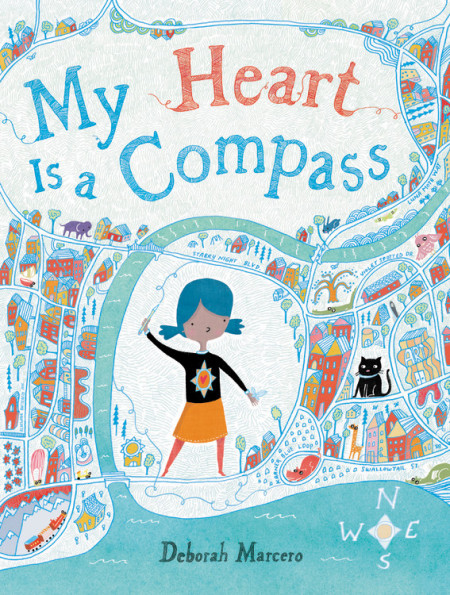
My Heart Is a Compass (Little, Brown and Company, November 6, 2018) written and illustrated by Deborah Marcero

It could have been anything.
Something exotic?
Something magical?
Did it even exist?
Where could she find such a thing?

For that, she needed a map.  Not an atlas or a globe.
To find the secret coordinates, she would
have to draw her own map.  

Watch the delightful book trailer premiere
at A Fuse #8 Production with Betsy Bird


STORY

No Boring Stories! (Viking, Penguin Young Readers, November 6, 2018) written by Julie Falatko with pictures by Charles Santoso

Those are boring stories!
I like books where strange stuff
happens.  But everyone says my
stories are too weird.

I think weird
stories are cool.

Remember the one you
wrote where the main
character was a discarded
shoe who loved to sing?

That sounds hilarious!


GIVE

Found. (Simon & Schuster Book for Young Readers, November 20, 2018) written by Jeff Newman with illustrations by Larry Day

This story is wordless.  It is a powerful statement on loss.  It speaks to giving when it's the hardest possible choice.  It's also about finding pure sweet love.


Tuesday, June 26, 2018

Feeling Those Groovy Vibrations

At times (or maybe all the time) people prefer to write in silence. For others the subject matter demands the playing and listening of a particular type of music or a collection of songs.  Perhaps these melodies awaken, inspire or enhance our imaginations and inventiveness.

Words given to us or words which enter our minds connect to our past experiences and the tunes bound to those moments.  It's as if there is a beat running through our blood waiting to be beckoned.  Rock 'N' Roll Soul (Abrams Books For Young Readers, May 15, 2018) written by Susan Verde (I Am Peace: A Book of Mindfulness Abrams Books for Young Readers, September 26, 2017) with illustrations by Matthew Cordell (The Only Fish In The Sea A Neal Porter Book, Roaring Brook Press, August 15, 2017 and Caldecott Medal title Wolf In The Snow Feiwel and Friends, an imprint of Macmillan, January 3, 2017) introduces readers to a character who feels and finds a rhythm everywhere she goes.

I may not own a drum kit
or an electric guitar.

I might not have a keyboard
or a mic like a rock 'n' roll star.

This bundle of musical energy is always moving.  She is ready, willing and more than able to participate in the school talent show and she declares:

I've got a
Rock 'n' Roll
SOUL!

As she makes her way home at the end of the day, items discovered along the way become instruments to play.

When she walks through the door, a one-string guitar and a bowl and wooden spoon help her invent a tune.  Even the rain drops on the roof pulse with a special pitter-patter.  Which form of this tuneful art finds a special place in this gal's heart?

Her nighttime dreams are brimming with hip-hop, classical, blues and jazz crooning to her moods.  She can be as wild and loud as a rocker or as calm and quiet as a folk musician.  Every combination of notes vibrates within her.

Early morning tasks set the stage for the show.  Out the door she dances.  Walking down the hall to the auditorium she goes.  What will she do?  Only she knows because this girl has a . . .   


It's guaranteed you'll be dancing, singing, clapping or toe-tapping by the time you finish reading this rhyming poetic tale penned by Susan VerdeEach couplet creates a cadence building toward a crescendo as the girl takes the stage.  (Using her as the narrator provides a more intimate atmosphere for all of us.) She is confident.  She is creative.  She knows exactly what to do and Susan Verde wants each reader to know, too.  Here are another two lines.

Keep it down?  Keep it quiet?
Oh, I can keep it soft . . .
but the music in my world NEVER shuts off.


Upon removing the dust jacket from the book and unfolding it, you can't stop yourself from smiling.  The exuberance of the girl portrayed on the front lets us know she is ready to, no; she is leaping into song and dance.  (The text and the girl are varnished.)  The use of primary colors (plus green) adds a special spark to the musical depictions.  To the left, on the back, one of the interior images is used.  The girl, left leg lifted and arms raised over her head, looks like a ballerina ready to twirl.  With eyes closed she is moving to the music heard through her headset.  A group of students are enjoying her performance.  The placement of the ISBN is pure perfection.

The book case is nearly identical to a different interior image.  More hues of red in the curtains are used for added warmth.  In front of a cheering student body the girl is bowing on the stage.  Eyes closed and smiling, her arms are outstretched.

The opening and closing endpapers are a shade of green seen in the title text.  Rendered in pen and ink and watercolor throughout, Matthew Cordell begins his illustrative story with the first page turn.  The girl is calmly strolling along listening to her music.  The notes in red, blue and yellow pour forth like a path around and in front of her.  Another two pages have the notes increasing as she is shown in six different poses grooving to the tunes.  Across the verso and title pages the trail of notes continues as she quietly walks beneath the title text.

Loosely framed in wide borders of white space Matthew Cordell uses single page, smaller images grouped together on a single page and bold, vibrant double-page pictures to present another layer of the narrative.  There is a lively quality to the students and the school in general.  On one of the walls is a large READ sign above the lockers.  On the inside of the main doors the words SCHOOL IS COOL are written.

Matthew adds sound effects to his illustrations as the girl makes her way through the day and evening and the next morning.  Several times he shifts the point of view bringing us close to her.  When she is dreaming about the various musical genres, black, white and gray are used except for her within the scene.  She is in full color as an orchestra conductor, blues singer alone on a stage within a spotlight, saxophone player strolling down a street with a band or as a folk singer.  Every single time you read this you will notice more of the intricate details included in each visual.

One of my many, many favorite illustrations is when the girl is walking home from school.  On a single page Matthew has placed skyscrapers in the background on a sunny day.  We are close to the girl with her face in the foreground.  She is looking at us.  Her closed fist is moving quickly from left to right across her lower face.  Inside she holds pebbles making a Chikk-a, Chikk-a, Chikk-a sound.  We can't see her mouth but from her eyes we realize she must be smiling.


All readers will want to do after reading Rock 'N' Roll Soul written by Susan Verde with illustrations by Matthew Cordell is to read it again and again and then they will want to sing or dance or sing and dance.  Exhilaration radiates from the pages.  This book shouts out about being who you want to be.  This title would be wonderful to use in those numerous libraries participating in the Collaborative Summer Library Program 2018 whose theme is Libraries Rock!  You'll want to have a copy of this book on your personal and professional bookshelves.

To learn more about Susan Verde and Matthew Cordell and their other work, please visit their websites by following the links attached to their names.  You can get to Susan's blog through a link at her website.  Matthew's blog link is attached to his name.  Both Susan and Matthew have accounts on Twitter.  The book trailer premiered on (Scholastic's Ambassador of School Libraries) John Schumacher's blog, Watch. Connect. Read.  You'll enjoy the interview questions and answers.  Susan is featured on Behind the BookI also had the distinct privilege to interview Susan in another post here.  Matthew is showcased on The Author Village and 24 Carrot WritingEnjoy the KitLit TV videos. 


Tuesday, October 17, 2017

A Conversation with Susan Verde

Good morning, Susan.  I am thrilled to be meeting you virtually with hopes of spending time, even a little, with you in real life sometime in the near future.  After lots of rain these past few days, we have blue sky dotted with big fluffy white clouds, warmth and gusty breezes.  Let’s imagine for a few moments, the two of us are sitting on my back deck, soaking up the fresh air and holding cooling cups of tea.


Hi Margie!
Thank you for this interview. I can feel the gentle breeze and taste the warm tea...is it chamomile? It’s lovely.


I’ve just finished rereading all six of your children’s picture books, The Museum, You and Me, I Am Yoga, The Water Princess, My Kicks: A Sneaker Story! and I Am Peace: A Book of Mindfulness.  Each of the beautiful stories in these books is told from the first person point of view.  Would you please explain why these stories are told from this perspective?

Often when I am writing I am calling forth many of my own experiences and emotions so there is definitely an element of “me” personally coming into play. However, I also feel that hearing the “I” gives the reader a chance to really embody the story and “become” the character. With “I” there is an instant connection. Even if it’s an experience the child has never had or someone who might look different from the reader, in the first person the story becomes an experience that is possible and a feeling or set of feelings to contemplate and explore and perhaps emphasizes the universal qualities of the character. Any good story will do that whether it’s in first person or not but it’s definitely the way I tend to write.


All of your books, even My Kicks: A Sneaker Story! with its exuberance, have an undercurrent of gentle serenity about them.  To what do you attribute this?  Is this a conscience effort on your part?

What a lovely thing to say Margie. I can’t really say that it is a conscious effort but my approach to the ups and downs of life is to try to handle them with care and calm. Maybe being a mom or a teacher or perhaps even having a mindfulness practice have influenced this approach. Each experience in life is an opportunity to notice and proceed with kindness and my hope is that kids should feel that no matter what they are going through it’s okay...they are okay.


I would like to shift our conversation to your most recent title, I Am Peace: A Book of Mindfulness.  What prompted you to write a companion title to I Am Yoga?


I Am Yoga was meant to capture the way yoga makes us feel and how it helps us manage our feelings. Mindfulness is a component of yoga but also a practice unto itself so it seemed like a natural follow up. Children have a lot of stress, just like adults and mindfulness is a way of helping children manage. I Am Peace is intended to give them yet another tool just like yoga and to show them that it’s the peace we feel inside that helps us show compassion and empathy to others.


The comparison of the character’s jumbled thoughts to swiftly moving water, then riding on those thoughts adrift in a boat and eventually finding an island beneath the narrator’s feet is truly inspired.  Was there a specific event or moment when this analogy came to you?

In one of my trainings we learned many ways to help children connect to their breath as it is the best way to formally practice mindfulness and bring attention away from distressing thoughts. Using the image of breath as an anchor when our “ship of thoughts” is being carried away was one technique. I loved it so much and found it really helpful when talking about our worries and emotions and how we can get swept away. I couldn’t wait to use the analogy. Kids get it when you can give them something relatable and visual to connect to their experience. They know just what it means to be carried away by moving water...by too many thoughts and worries and what it means to come ashore and feel land under their feet.   


This is the fifth collaboration with Peter H. Reynolds as the illustrator of your words.  Were you aware before seeing his art of the three images without words which join your text, I make a difference to I can hug a tree… ?

Working with Peter is pure joy. When I write I know he will make the words come to life in a beautiful way that captures my intentions but with his own style. He is a very mindful person and artist. Because of our partnership and the fact that we really work in a collaborative way I often get sneak peeks of what’s to come and we have some back and forth. I did get to see this part ahead of time but I certainly wasn’t expecting it and when I saw it I was blown away albeit not surprised. The whole spread was such a moment of mindfulness. Kids love to see the dropping seeds and make predictions and then consider how the spilling of seeds is an act of sharing with and connecting to nature.


What is your wish for this title and its readers?

My wish is that I Am Peace makes mindfulness accessible to teachers, parents and especially kids. It can feel like an esoteric term and we hear it all of the time these days but it is really simple to practice and has measurable physiological and emotional benefits. I hope this book inspires the practice of noticing without judgement and being kind to oneself. We all have stress and big emotions but there are ways to get through it and find more peace within. I hope they learn that even with these tools they will make mistakes but again with kindness and awareness they can learn from their mistakes and not hold onto them. I often ask the children I visit and work with to talk about their worries and stresses and then ask them if they find it easy to be kind to someone else when they are feeling upset within themselves. Of course the answer is no. But, if we can cultivate more peace inside then we can share peace with others. Just imagine what this could do to our world…. I just have to say that children are so smart. They are willing to go deep and look inside and have so much wisdom to share. It’s through them that we can really effect change.


I hope you have a few more moments for some other questions.  I shared this book with two kindergarten classes this past week.  I think they might like to know a little bit more about you and your family.


What made you decide to shift your life’s work from working in the classroom as an educator (with a Bachelor’s degree in Elementary Education and a Master’s degree in Reading Remediation) to teaching yoga and mindfulness to children of all ages with a full-time writing career?

I loved being a classroom teacher! When I had my children I took some time away from teaching but continued to practice yoga to stay sane as a mom of 3 and as a person in the world! As my kids got a bit bigger I began to think about how I could continue my work with children but I felt like I wanted to have a different experience than being in a classroom full time. My own yoga practice was so beneficial for me that it made sense to share it with children especially in the school setting where they feel so much stress and need more support even at a young age. That’s when I decided to become a kid’s yoga and mindfulness teacher. Best decision ever! Writing is something that I have been doing for as long as I can remember and mindfulness and yoga support that creative process. It is sometimes hard to juggle all of these things but I am fortunate because as challenging as they can be (and they can be VERY challenging), teaching, writing and parenting are all things that fill my soul and I am grateful everyday.  


If you could describe the location of your home and your house using your senses how would that be?

Ooh I love this question! My house is at the end of a long winding road lined by strong tall trees and lots of green in the summer and brown in the fall and white in winter. The house is covered in brown shingles and natural wood and there are big windows all around. Our street has other houses painted white and yellow with quiet neighbors until it’s summer then voices are heard and dogs are being walked and kids are skateboarding on the road. The tops of the trees that fill our yard let in the sunlight in warm patches. The leaves rustle in the breeze and fall in crunchy piles in Autumn. You can smell the ocean and the fresh cut grass and whatever is cooking in the kitchen when you stand in the backyard. Inside, the house smells like lavender oil and sometimes the stinky feet of teenagers. You can feel the grass between your toes and the hard pavement of the driveway and the itchy bites of mosquitoes in summer and the refreshing cool water in our pool. If you catch us on the right day you can taste the vanilla cupcakes that my daughter will no doubt be famous for someday. There are always sounds outside and in.. deer eating plants, crickets used for feeding pets chirp and our pet frog croaks, squirrels dance on the roof, and sometimes woodpeckers make the sound of a mini drill on the side of the house. There are talking children and clanging pots and pans, my daughter playing her ukulele and singing and my sons rapping and all of us occasionally breaking into spontaneous dancing AND a barking dog. There is always something to hear even when it’s quiet.


How old are your three children?  Do they practice mindfulness?

My boys, Josh and Gabe are twins and are on the verge of being 14 and Sophia is 12. They do practice mindfulness meditation and have reached a point where they are pretty good at  connecting with their breath and being kind to themselves when they feel overwhelmed or caught up in a big emotion and as teenagers they have a lot of big emotions!  They are also pretty good at reminding me to take a breath when I get overwhelmed. I love to see them doing the things they are passionate about and being fully present and in the moment. Gabe is a surfer, Josh pays football and Sophia sings. When they are doing those activities it is amazing to see how connected they are to their own experience. It’s mindfulness in action!  


What kind of dog do you have?  How did he/she get their name?

Our dog is a Coton de Tulear. It’s a fancy name but he’s really just a scrappy little white fluffy doggie who barks too much but is very loving. We were reading a lot of Harry Potter when we got him and I wanted to call him Neville but that was quickly dismissed so we just started calling out names and someone said Gizmo (could have been me thinking of the movie Gremlins) and we all agreed on that! Not much of a story but it has turned out to be the perfect name. He is definitely a Gizmo.


I couldn’t be happier to have been able to spend this morning with you Susan.  Thank you for chatting with me and visiting Librarian’s Quest.  I am wishing you PEACE.  

Thank you Margie! I am grateful for the time together and have really enjoyed answering all of your thoughtful questions. It has been truly wonderful. I wish you PEACE as well.  

To learn more about Susan Verde and her books please take a few moments to visit her website. She has links at her site to articles she has written for other publications on yoga and mindfulness.  By following the links attached to five of her books listed above you can read my blog posts.