Quote of the Month

When love and skill work together, expect a miracle. John Ruskin


Saturday, February 23, 2013

Twitterville Talk #89

Besides all the connections with wonderful people, the constant stream of information and the additional book titles which make our TBR piles sway and nearly topple, I love the good-natured bantering back and forth between authors and illustrators; the encouragement they give to each other.  Twitter provides endless opportunities to its users.  Have a wonderful, restful weekend.  Take time to read.  Don't forget to look for the giveaway.


There's nothing like starting off a weekend (last) with news from a master storyteller.  Sharon Creech announced the cover reveal of her new book, coming this fall, titled The Boy on the Porch.  I for one can't wait.  This link will take you to the post.

Thanks to author Sharon Creech for giving us this gem to hold in anticipation and for the tweet.


Here is (in my opinion) a great response to the restraints being leveled against the reading rights of our students, Reading Rants:  Get Those Readers Out Of the Box.


Thanks to fifth grade teacher extraordinaire and blogger at Read, Write, Reflect,  Katherine Sokolowski for this tweet. 


Richard Byrne, educator and blogger at Free Technology for Teachers, provides a link to A Free Complete Guide to Evernote plus additional informative links.

Thanks to Richard Byrne for this tweet and many others constantly.


Scroll through the Smithsonian Education page titled Mr. President:  Profiles of Our Nation's Leaders containing a quote and short list of facts for each.

Get ready for the celebration for Read Across America with these multiple links: Seusville, 11 Seuss-gestions, Read Across America song, Reader's Oath, and try these recipes.

Author/illustrator Loreen Long has created a character near and dear to his fans' hearts, Otis the Tractor.  Here is the book trailer for the newest installment in a charming series.


The 100th Toy Fair was held in New York City this month.  Check this out---By the Dozen at Toy Fair: Top Library Picks.


Remember to mark your calendars for School Lunch Superhero Day in May.  Head to this link for more information.

This is always fun to do with students, Bank Street CCL Announces Irma Black Award, Cook Prize Finalists.  To the first person who can tell me how many Irma Black Award finalists there are this year and name one of them in a DM on Twitter or in the comments section I will send a copy of I Haiku You by Betsy E. Snyder. (I have two copies of this to give away and both have been won.)


Thanks to John Schumacher, teacher librarian, 2011 Library Journal Movers & Shakers, and blogger at Watch. Connect. Read. for these tweets.


Politics:  We the People/Focus On is an extensive list of resources offered by School Library Journal for President's Day or any day really.

Thanks to School Library Journal for this resource and tweet.


Don't forget this Sunday, February 24th at 8PM EST Colby Sharp and guest, Katherine Sokolowski will be hosting #titletalk on Twitter.  The topic will be historical fiction.


Thanks for this tweet goes to Donalyn Miller, educator and author of The Book Whisperer:  Awakening  the Inner Reader in Every Child.


If you're looking for some stellar listening time check out these 10 Favorite Podcast Inspirations.

Here's a great post, The Case for Digital Citizenship in Schools.

Thanks to teacher librarian and blogger at The Styling Librarian,  Debbie Alvarez, currently in Hong Kong, for these tweets and this post.


One can't help but get goosebumps after reading this post Twitter Connections: Curious George and Aristides de Sousa Mendes regarding the creators of Curious George, H. A. Rey and Margaret Rey.

Thanks for this post and tweet go to Teresa Rolfe Kravtin, blogger at A Rep Reading and southeast publisher rep.


One of my PLN members is organizing between three different teachers a bracket for books.  Check out her post---March Madness The Bookish Way.  Follows her blog for updates.

Thanks to an amazing teacher and blogger at Maria's Melange, Maria Selke, for this post and tweet.


For author John Green's fans this is indeed the best of the best news---'The Fault in Our Stars' Movie Lands Director.


Thanks to John Green for this tweet.


Even though it's been several weeks since the announcement of the American Library Association Youth Media Awards, in preparation for a unit next year this article might make for a good discussion starter, Caldecott Secrets.

This is Mo Willem's reaction to the winning of his recent Geisel Award.


Thanks to the Association for Library Service to Children for this tweet.


Her impact in the world of children's and young adult literature will never fade.  This week she's in the news---At 75, Judy Blume draws crowds with first film adaption.


Thanks to author, Ellen Potter for this tweet.


Loads of extras for Gary Schmidt's Okay for Now courtesy of Houghton Mifflin Harcourt Books for Younger Readers.  Thanks for this tweet.


In case you need ideas for using Thinglink for Education  head on over to this bag of goodies. Wow!

Thanks to Donna Baumbach, retired professor, for this tweet.


It's getting closer.  Do you have visits ready for Skyping?  Look what author Kate Messner had done; Skype with an Author on World Read Aloud Day.

Thanks for this tweet and this comprehensive list.


There is a new kid on the block, a consortium on Facebook and Twitter combining the talents of the bloggers at Seven Impossible Things Before Breakfast, 100 Scope Notes, A Fuse #8 Production and  Nine Kinds of Pie.

Thanks to Julie Danielson at Seven Impossible Things Before Breakfast for this tweet.


The beautiful artwork of Brian Selznick and Grace Line is featured on the Children's Book Week poster and bookmark.  Both are ready to be downloaded.

Thanks to the Children's Book Council for this tweet.


I will never forget reading A Monster Calls...never.  It is the first book to win both the Carnegie Medal and the Kate Greenaway Medal.  This is a wonderful interview with the illustrator Jim Kay.

Thanks to author Patrick Ness (A Monster Calls) for this tweet.


This is a gathering of some of the things I really enjoyed reading this week.  I hope you do too.


This particular tweet and the link to a post filled me with great joy.


Friday, February 22, 2013

Defiance in December

What I remember of significant events in American history, being taught in my classrooms growing up, are a few dedicated paragraphs, names of important individuals and the accompanying dates.  It was through the reading of historical fiction, my father's favorite, that my attraction to American history grew.  The expanded, personal perspectives offered by this genre made it come alive; no longer a series of dry lists of events, persons and dates.

One individual author who consistently creates the same lure of historical fiction in his writing of nonfiction is Russell Freedman.  Freedman's 1988 Newbery Medal book, Lincoln: A Photobiography and his Newbery Honor in 1994 for Eleanor Roosevelt: A Life of Discovery altered what I knew to be true about both these individuals.  Through impeccable documentation he brings the past into the present giving readers a sense of reliving alongside the participants.  A new entry in the Russell Freedman Library of American History, The Boston Tea Party (Holiday House, August 1, 2012), with illustrations by Peter Malone, increases the reader's perception of the circumstances prior to and after the night's activities nearly 240 years ago.

Everyone knew there was going to be trouble when the merchant ship Dartmouth, carrying 114 chests of fine blended tea, sailed into Boston Harbor on November 28, 1773.

Within twenty-four hours of the ship's arrival thousands of colonists had gathered in protest, eventually meeting in the large Old South Church to voice their concerns.  Those gathered voted to not allow the delivery of the tea; no taxes should be paid when they had no voice in Parliament.  Governor Hutchinson, knowing his loyalties to be with the King, demanded the tea be unloaded.

Before that happened two more tea ships arrived, the Eleanor and the Beaver.  The governor ordered British war vessels to block the exit of those three until the tea was delivered and the tax paid.  With tensions rising and the twenty-day due date on the Dartmouth nearing, the people needed to take action.

Another meeting was called; so many people arriving they spilled out into the streets, the Old South Church packed to capacity.  Again the Governor would not honor their requests.  Sam Adams, a commanding member of the Sons of Liberty spoke and was answered from the back with shouts and phrases promising deeds of daring.

Freedman continues his description of the evening of December 16, 1773 in a compelling, narrative including more intimate details, remembrances of those involved; a schoolboy holding a lantern so men could disguise their faces with paint resembling the Mohawk Indians, another describing the reasoning behind the disguises and a rope maker's apprentice locked in his room who made his escape by constructing a rope from his bedding so he could participate.  A mate on the Dartmouth documented the crowd's arrival in the ship's log.  By the use of lanterns and torches as light as day the protesters emptied all the ships of their tea and only the tea.

He continues his conversation with his readers with further inside information; the use of shovels to spread the tea at low tide, the sweeping of the ship's decks when they were done, and the relative quiet which pervaded the night's accomplishments.  You can almost hear the whispered talking as the men made their way home moving through the night knowing the implications of their Boston Tea Party.  Freedman's ability to include the smallest incident with historical importance is what breaths life into his visions of the past; truth triumphs.

Here is a single passage from this title as an example of his writing style.

It was just before six o'clock.  Night has fallen.  The rain had stopped.  A thin young moon was rising over Boston.  A bunch of men disguised as Mohawk Indians, carry axes and hatchets, were hurrying down Milk Street toward the harbor, heading for Griffin's Wharf where the three tea ships were anchored.  


Using two pages for all of his illustrations, Peter Malone elevates the text with his realistic, rich watercolor paintings.  A sense of the past is generated with the color palette and muted tones.  One can only imagine the amount of research needed to recreate colonial America; the details on the buildings, exterior and interior, the streets, the harbor and the ships.

By altering his layout we are either given an observer's view, a bird's eye view or a participant's view of the days during this time period.  The emotional mood is as carefully portrayed on individual faces as is the clothing of each person regardless of their station in life.  Freedman's words may make us feel like we are walking with the people in the past, but Malone's paintings bring the past into our presence.


An attractive portrayal in words and pictures invites readers to participate in The Boston Tea Party written by Russell Freedman illustrated by Peter Malone.  A two page introduction precedes the body of the book followed by a map of the town of Boston, an afterword, bibliography, comments about the importance of tea to the colonists, a timeline, source notes and an index.  Holiday House has provided a three page teaching guide linked here.  An earlier title in this series is Lafayette and the American Revolution.

Thursday, February 21, 2013

To See...To Be...

What I see in the natural world, from the tiniest raindrop to the ferocious approach of a thunderstorm, from a tiny tree toad making his home on my front porch to walking near a bull elk in a snow-covered meadow, hearing his bugle, is what prompted me to pursue a hobby in photography from the earliest days of printing in my own darkroom to the marvels of digital today.  From color schemes to patterns to design and layout we humans use Mother Nature's marvels in our lives capturing and creating to decorate, cloth and imitate.  We liken ourselves to her creatures; fly like an eagle, swim like a fish.

Indeed one of Charles Caleb Colton's more well-known quotes is "Imitation is the sincerest form of flattery".  In the case of Molly Idle's new title, Flora and the Flamingo (Chronicle Books, February 5, 2013), imitation is depicted as perhaps, flattery, but more importantly as an overture.  In this case it is an invitation to a lasting, mutual respect; friendship.

Without a single word in the entire volume, we are introduced first to a flamingo as part of a double spread for the title.  With a turn of page the same flamingo has changed from a graceful landing to a one-legged pose, straight as an arrow. We see a hint of Flora in the lower, far-right corner, one brown flipper and part of a leg.

To our delight on the next set of pages there are two flaps; one on the left page, the other on the right.  On the left the flamingo is still at attention.  On the right Flora is mimicking his stance.

When the flaps are lowered we see the flamingo turn to sharply glance at Flora.  She turns away whistling, hands behind her back in a pose of nonchalance, when her flap is lowered.  It is beginning, that loveliest of dances, the getting to know one another, step by step.

As the flamingo moves through a series of elegant positions, Flora carefully copies as best as she can until they stop, heads bent and covered. Then the two new flaps are lowered.  Quick peeks are exchanged.

 Both are giving the other a backward-through-the-legs look when unexpectedly the flamingo airs his frustration at Flora's presence; the force tumbling her in a backward roll.  Eventually re-thinking his emotional outburst, the flamingo extends a wing but Flora is reluctant to accept the request.  Her ultimate decision leads to a succession of brilliantly beautiful ballet movements by two beings perfectly in tune with each other.


The front and back jacket and cover allude to the friendship which will be forged within the pages of this wordless title.  Buttercup yellow opening and closing endpapers mirror the shades on Flora's bathing cap.  The color palette of pink, brown and yellow with hints of gray on large expanses of white space combined with the refined, slightly old-fashioned feeling of the illustrations (Flora's bathing suit, cap and flippers) define the overall emotional impact of this title.  Without a single sound being stated we still hear hope, bewilderment, acceptance and sheer, pure joy through the soft visuals created by Molly Idle.

The delicate branches covered in pale pink blossoms which frame the top of all the pages add balance to the figures.  In the beginning a single blossom sits near the two characters until it lands on Flora's head, petals broken. As Flora and the flamingo come together first one larger, then a smaller blossom gently float down from the branches; one becomes two.

The shape and form of wings, arms, and legs with the expressive eyes, mouth and beak conveys the subtle shifts in mood and dance with amazing clarity.  Altering the size of the flaps increases the impact of the actions taken by the two characters.  Using heavier stock for the pages provides for a richness in addition to being more durable.


You can't help but be mesmerized with every page turn in Flora and the Flamingo created by Molly Idle.  Her illustrations full of warmth and humor, dance and a blossoming friendship are absolutely glorious.  One reading will not suffice. No, not at all. Get ready for repeated readings. Who wouldn't want to share or experience this joy again and again?


Wednesday, February 20, 2013

Think Outside, Then Put It Inside

With numerous web 2.0 and 3.0 applications being mentioned by people in the know on a weekly basis it's hard not to feel overwhelmed by all the opportunities but it is certainly interesting to test them out.  A site with templates, ClassTools, one of which I reviewed more than a year ago, Fakebook, has a new one.  One of my favorite tech people, Richard Byrne of Free Technology for Teachers brought it to his readers' attention in a post last week; test-driving a new item called BrainyBox.

Like the other templates on the site, BrainyBox is free of charge with no registration requirements.  Any resources made, stay on their server permanently as long as they are used during any given twelve month period.  This particular template contains a precise format for mini-presentations.

When you first access BrainyBox this image appears on the screen.  BrainyBox is a cube, six sides, which displays items you wish to have highlighted on a specific topic.  I explored options by clicking on the numbered buttons.  This first visual is side one.

Side two gives you some features; text and multimedia can be inserted, you can password protect your creation, it can be embedded in a blog or website, it works on tablets as well as desktops.  Further buttons explain that a widget (which is one of the templates on ClassTools) can be embedded on one of the cube sides as well as videos from Vimeo and YouTube.  To design your own,  click on the New button.

Next click on the Edit button.  The tool bar across the top row allows:

  • upload an image
  • insert/edit embedded media (Flash, HTML5 video, HTML5 audio, Quicktime, Shockwave, Windows Media, Real Media and Iframe)
  • text can be in bold, italics or underlined
  • margins can be aligned left, center or right
  • cut, copy and paste are offered
  • insert or removed bulleted lists
  • undo/redo and
  • insert or remove links
Underneath you can select your font style and size, remove formatting, insert a special character, emotions, text color, background color, spell check, insert horizontal line and edit HTML code.

Placing text on a side is pretty straightforward as is an image.  Once placed each can be altered by the offered options.  An image can be resized using the tiny markers on the sides and corners.

If you wish to embed a link in an image, click on the image.  It will become highlighted and the link icon at the top is now available.  You can enter in the URL, set a target (it will open in that window or a new one) and name the link which will appear when you mouse over the image.  (To embed a link in text simply highlight it.)

For three of the sides I used Jing to capture website pages and downloaded the images.  I was able to add links to the sites so the pages in their entirety could be read.  It was as easy to add a YouTube video to one of the sides.  Copy the URL code acquired by clicking the share button under the video and paste it in the correct box.

Each time you complete your tasks for a side you need to click the Done editing button in order to advance to another side.  To start you must always click on Edit.  When you are finished with all the sides, click on the Save button.  

A new window opens asking you to enter in a password.  A new message asks you to make note of the unique URL created for your BrainyBox.  When you click OK the special URL appears at the top of the page in the address line.  Also beneath your BrainyBox creation you can now click the Share button on the far right.  

There are three options:  URL Link or Embed Code, QR Code and Download Web Shortcut.  There are three sizes for the HTML Embed Code.  I did a simple right mouse click of save image as for the QR code.  Over the course of the next two weeks the first grade classes in my building are going to be Skying with author Ame Dyckman.  I designed a cube featuring her debut book, Boy + Bot.


This new template, BrainyBox, as part of the ClassTools site maintained for at least ten years by Russel Tarr, Head of History at the International School Toulouse, France, is excellent.  It's absolutely perfect for the educational setting; no fees or registration and simple to learn and use.  It's headed for a spot in my bigger-by-the-day virtual toolbox.     


Tuesday, February 19, 2013

A Winged Wonder

Recently, over the course of many days I've been on a journey from the bottom of the world to the top and back.  Places with names like Rio Grande, Tierra del Fuego, Argentina, Lagoa do Peixe National Park, Brazil, Delaware Bay, United States, Southampton Island, Canada, Mingan Archipelago, Quebec and Maranhao, Brazil, have been some of the stops on my itinerary.  For part of the trip I've gone nearly five thousand miles without rest, food or water in all kinds of weather.  And...I've done this all from the comfort of my own home.

When reading Moonbird: A Year On The Wind With The Great Survivor B95 (Farrar Straus Giroux) written by Phillip Hoose I became, for more than 120 pages, intimately involved in a world within the world at large.  One particular bird, a red knot, who uses those geographical points as stepping-stones in his yearly voyage completely captivated my attention, as beat by beat of heart and wing I've been with him.  Rarely has filling my book gap challenge been so emotionally moving.

Meet B95, one of the world's premier athletes.  Weighing a mere four ounces, he's flown more than 325,000 miles in his life---the distance to the moon and nearly half way back.

On February 20, 1995 a team of scientists working in Argentina banded about 850 red knots.  Six years later one of them, the only survivor identified to date by black bands, was captured again.  He was given another band, a tiny orange flag, bearing B95.  When I turned to page 22 and read the account of his capture again in 2007, even with my limited knowledge, I found myself completely attached to this miracle of bone, muscle and feathers.

In the subsequent seven chapters (as in the first one) each are started with a relevant quote, followed by meticulously detailed but compelling documentation of all the stops along B95's flight for a given year.  We are privy to his physical changes, his flight patterns, the challenges faced in his diminishing food supplies, and how he protects himself from potential enemies. We follow he and his companions to their Arctic destination, the breeding grounds where growth and habitats of these astonishing winged wonders are related to us.

Between each chapter, which additionally informs us of the drastic decline in red knot population and possible causes, the precarious numbers of horseshoe crabs whose eggs B95 needs to survive, how to band birds and note statistics with care and caution, the explanation of a bellwether site (the first indicator of trends), geolocators and the long flight back to the south, readers are introduced to notable persons who have dedicated their lives to red knots.  We meet Clive Minton, Patricia Gonzalez, Brian Harrington, Amanda Dey, Guy Morrison and Ken Ross, and young Mike Hudson.


Phillip Hoose's writing style is informative, passionate and filled with personal details.  His descriptions of place and time bring us to those exact moments.  He endeavors and succeeds in bringing understanding of his subject to his reading audience.  Here are a few excerpts from this title:

But there was more to it than that. "He was alive," remembers Gonzalez, her voice catching in the telling.  "Still alive."...The bird remained calm in Gonzalez's grasp, even though her hands were trembling as she worked.  "I kept talking to him," she remembers.  "I kept saying, 'Forgive me, please, I won't hurt you.  I will release you soon.'  The heat of his tiny body was warming my hands and his heart was beating so fast.  As I was working, I kept wondering, 'How can such a fragile thing be so powerful?' "

Tonight, as the wind rises, B95 stands on one leg in the shallow lagoon, surrounded closely by his flock mates.  He tucks his bill under a wing, but he doesn't drop his guard.  B95 sleeps with one eye open.  So do the others.  A roosting flock of knots is like a single organism equipped with hundreds of eyes and ears.

If B95's birth year was typical, his parents had little to eat during their first few days in northern Canada.  Deep snow still banked against cobblestone ridges and blanketed much of the land, though bare patches of earth appeared and widened under the melting heat of the sun that hung low in the sky almost all day long.


Stunning full color photographs (most with explanatory phrases), captioned maps, added framed, featured topics, and diagrams are prevalent throughout this volume.  An extensive appendix, source notes (chapter by chapter), bibliography (books, articles, scientific papers, Internet and multimedia resources), acknowledgments, picture credits and an index are included in the back.  A list of Hoose's previous books and contents precede his narrative.


As evidenced by its numerous awards (The Robert F. Siebert Informational Book Medal Honor 2013) this year (follow the link to Phillip Hoose's website embedded in his name above) Moonbird: A Year On The Wind With The Great Survivor B95 is a stunning work of nonfiction.  All readers will become acutely aware of the important role each specie plays in the workings of our ecosystem.  We need them and they need us to be stewards of this planet.

Please go to Phillip Hoose's website to read and listen to many resources relative to this work.

Monday, February 18, 2013

Is It The Truth Or A ...?

Consistently, year after year, the most requested stories during storytelling units are the scary ones.  Before each session I'm careful to preface it with a discussion of the significance of this type of tale.  My students have come to know I will never tell a story beyond their ability to feel safe, despite their pleas of "tell us one that's really scary".  Due to older brothers and sisters they know when fourth grade rolls around they can finally hear "The Night of the Sasquatch".

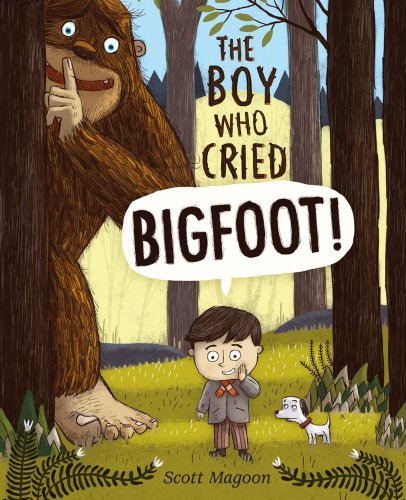
Even after they've heard it, when they've gone to middle school, they want me to tell it again and again.  Perhaps one of the reasons is the story of Sasquatch sits on the line between probable and improbable, true or false.  In his newest title, The Boy Who Cried Bigfoot! (A Paula Wiseman Book), author/illustrator Scott Magoon puts his very special spin on the Aesop fable, The Shepherd Boy and the Wolf.


This is the story of my friend Ben and how we first met.

The first thing readers discover about Ben is he likes telling stories; one particular story over and over.  (At this point you need to insert the word fibs in place of the word stories.) He's pretty creative in his use of gestures and sound effects.

Riding to the edge of the woods on his trusty bike, Ben, like the shepherd boy, is trying to convince people he is seeing something he, in fact, has not seen.  He even goes so far as to fabricate footprints.  As the narrator states:

What a tenacious little fellow he was.

People come once, twice, even three times when he claims to have seen Bigfoot but they finally realize they've been deceived.  Left alone Ben and his faithful canine companion are pondering their precarious position when the silence in the woods is broken by the sound of a stick snapping.  It would seem the teller of this tale has decided to make an appearance.

Not only does he reveal himself but he wants to take Ben's bike for a spin.  Guess who hops on for a ride?  Ben is beside himself, calling for help as loud as he can; his two treasures having vanished into the woods.

Alone in the dark, but not for long, Ben does some thinking.  He needs to convince his family (and neighbors) how his fabrications finally came true.  Ben's a clever little guy; perhaps this new scheme will work.


From the beginning the technique Scott Magoon uses to have an unseen narrator speaking to readers generates an inviting air of mystery.  This simple, conversational tone coupled with Ben's and the secondary characters' dialogues intensifies the interest.  Magoon explains, in a blog post here, how this particular twist on the fable developed.  Of course, even this essay does not explain the final delightful two pages.


Readers know immediately what Ben does not by opening the jacket and cover to reveal Bigfoot hidden, but not hidden, behind a tree in the woods. (The dog does, though.)  Opening and closing endpapers, green on green, feature a pattern of Bigfoot prints though careful viewers will notice a subtle difference between the two.  Digitally-rendered two-page spreads throughout follow Ben on this day to remember; the color palette reflecting the changing light.

Deft, fine lines designate physical characteristics, personality and emotions; especially in the eyes.  While the dog never utters a single sound readers are acutely aware of his reaction in each illustration through his facial expressions and body movements; in a word-hilarious.  It's this attention to details that elevates this larger-than-life legend of learning to excellence.


Travel with Ben on his bike with his best buddy in The Boy Who Cried Bigfoot! written and illustrated by Scott Magoon as he discovers truth really is stranger than fiction.  Readers will be smiling long before the identity of the narrator is divulged with laughter quickly following.  For more art and the process of bringing this book to publication follow this link to an interview at Seven Impossible Things Before Breakfast.  

Saturday, February 16, 2013

Twitterville Talk #88

There is so much happening in the world but the one constant every single day on Twitter is the amazing conversations and connections with people who share similar passions.  I can't state it strongly enough or often enough.   Enjoy your weekend, take time for reading and look for the giveaways.


It's only February but so many wonderful new books have had birthdays, my pile continues to grow up and out.  But one of many titles which has brought much joy is Open This Little Book (reviewed here) by Jesse Klausmeier with illustrations by Suzy Lee.  I could not resist including this interview, Author and Illustrator Open Up About Open This Little Book, because of all the extra visuals.

This looks like lots of fun; a way to expand the reading experience.  Craft:  How to Make a Where The Wild Things Are Costume


Dav Pilkey draws up more great ideas on the benefits of reading.


It doesn't matter whether you live in the state of Illinois or not, this is a fantastic resource of titles plus extras for books in the 2014 Rebecca Caudill list located here, here and here.

What's Izik? Introducing a Swipier, Slashier Search is a review of an app for tablets that looks user-friendly and worth a try.

Kid Lit Authors, Illustrators Visit Sandy Hook Elementary School  This is wonderful.
Katie Davis covered the visit here too.

Don't forget to stop by and participate in the Books Kids Love, Part II survey.

Thanks to John Schumacher, teacher librarian, 2011 Library Journal Movers & Shakers, and blogger at Watch. Connect. Read. for these tweets.


For obvious reasons the buzz about the ALA Youth Media Awards (and all the award lists still being announced) is as strong as ever.  This is one of many interesting articles about Katherine Applegate, Two and one-half questions for Katherine Applegate and Michael Grant.

Courtesy of The Horn Book---Recommended love stories.  One of my favorite love stories (ending brought me to tears) of 2012 is the final one listed under Intermediate.  To the first person who gives me the title in the comments or sends me a DM on Twitter I have an extra copy of the new Lisa Graff book, A Tangle of Knots, to send them. (This book has been won.)

You don't see this every day---Fiction to Fashion ; coordinating your clothing to match your favorite books.

Thanks to The Horn Book for this interview and these tweets.


Have you marked your calendar for the #SharpSchu book club on Twitter at 8PM EST on February 20th?  This episode will be a discussion, an evening with and about author, Laurel Snyder.  Visit this link for more information.

Thanks to Colby Sharp, teacher, co-host of the book club, co-host of the Nerdy Book Club and blogger at sharpread.


For the good of all our students---Know your rights! UNICEF and partners have developed an adolescent-friendly version of the United Nations Declaration on the Rights of Indigenous Peoples.

Thanks to Crystal Brunelle, teacher librarian and blogger at Reading Through Life for this tweet. 


Teacher librarian, Chris Roberts, created this Symbaloo to assist her students' parents on Internet Safety.

Many thanks to her for this tweet and for the work in creating this resource.


Book love and an interview with a Caldecott Honor winner, 2013 Caldecott children's book illustrator Peter Brown inspired by N. J. childhood

Thanks to Travis Jonker, teacher librarian and blogger at 100 Scope Notes for this tweet.


Donalyn Miller, teacher and author of The Book Whisperer: Awakening The Inner Reader in Every Child has posted her latest presentation Slideshare for all to use, Learning from Lifelong Readers

Many thanks to her for her continued generosity and for this tweet.


Announcing the Caldecott 75th Anniversary Scrapbook is another great way to participate in the celebration this year but also for future reference.

Thanks to the Association for Library Services to Children for this tweet.


Courtesy of Literacyhead, Love from Literacyhead, are some activities to tuck away for next year.  I reviewed Literacyhead here.  It's a wonderful site.

Thanks to Literacyhead for these free items and for this tweet.


If you are looking for the most up-to-date data on School Library Impact Studies follow the link and read.

This certainly caught the attention of many this week and will continue to do so, A warning to college profs from a high school teacher

The 2012 Cybils Awards  To the first person, in the comments or via DM on Twitter, who can tell me the title which won in the Fiction Picture Books category, I will send them a copy of David Ezra Stein's Love Mouserella.

Many thanks to Teri Lesesne, professor and blogger at The Goddess of YA Literature: pearls from the goddess for these tweets.


Handy for students, colleagues, bloggers and anyone else you know--Flickr, Explore, Creative Commons

100 Things Kids Will Miss If They Don't Have a School Librarian in Their School


Thanks for these tweets goes to teacher librarian and blogger at The Daring  Librarian, Gwyneth Jones.


Are you looking for a story stretcher for Rocket Writes A Story by Tad Hills?  Look no further than here.  His new friend Owl becomes a place to store words.

Thanks to author Tad Hills for this tweet.


Check out this list so you can Skype With An Author On World Read Aloud Day!


Thanks to author Kate Messner for this list and for this tweet.


One of the very best things about Twitter is the opportunity to witness the good-natured exchanges between author and illustrators.  Look what happened this week---It's Your Big Day, Judy Blume! Happy Birthday, Love Your Biggest Fans

This is your chance--Vote in the 2013 Kiddo Awards!

Thanks to author Tom Angleberger for these tweets.


Tuck this little gem, Peter H. Reynolds' Gift to You:  Create Your Own Plant A Kiss Seed Packet, away for next Valentine or the next time you read Plant A Kiss by Amy Krouse  Rosenthal with illustrations by Peter H. Reynolds.

Thanks to Terry Shay, educator and blogger at TJ on a Journey for this tweet.


This little infographic gets down to basics--5 1/2 Best Twitter Practices

Thanks to teacher JoEllen McCarthy for this tweet.


Guess who's doing the new covers for the Harry Potter books? (Clue: Amulet series)---A New Look for Harry Potter


Thanks to Publishers Weekly for this tweet.


This may be my favorite author/illustrator interview of all time.  A video interview with Sarah Stewart and David Small.  I've watched it twice since Wednesday.  The world of children's literature is lucky these two are a part of it.

Head on over and get a copy of the kit for Hats Off to Reading for March.

Thanks to Reading Rockets for this interview and these tweets.


Wow!  More good news for John Rocco's Blackout. 

Thanks to Children's Book Council for this tweet.


For people who appreciate and treasure picture books---Oliver Jeffers:  Maurice Sendak's Jumper and Me is a must read.

Thanks to HarperCollins for this tweet.


What can I say?  People keep writing the best things.  Enjoy the collected quotes and thoughts from this week.

I had to include this first tweet as it reminded me of Axle Annie written by Robin Pulver with illustrations by Tedd Arnold.