Quote of the Month

When love and skill work together, expect a miracle. John Ruskin


Showing posts with label fables. Show all posts

Thursday, April 16, 2015

To Play Or To Work

Their world beneath our feet is a series of tunnel roadways leading to the queen's residence.  I wouldn't be a bit surprised to see some form of John Heywood's timeless quotation,

Many hands make light work

strategically mounted along their hidden passages.  Never at rest, always on the move, all the members of team ant know what to do and when to do it.

As a classic piece of folklore a fable uses animals to convey a moral or lesson.  None are more recognized than those of Aesop.  None are more gorgeous in their retelling than those of Caldecott Medal winner, Jerry Pinkney.

On April 7, 2015 a companion to The Lion & The Mouse (Little Brown Books for Young Readers, 2010 Caldecott Medal) and The Tortoise & The Hare (Little, Brown and Company, October 1, 2013) was released.  In the first book the setting is the African Serengeti and in the second title we travel to the American Southwest.  In the third book, The Grasshopper & The Ants (Little, Brown and Company), we find ourselves in the woodlands.

When first looking at the dust jacket, you will want to take your time to notice the exquisite details deftly depicted by Pinkney.  For mere moments a group of Ants have paused to listen to the music man, the Grasshopper, who carries his drum set, banjo and concertina with him everywhere.  The delicate wings on his back are breathtaking.

The staff in pastel shades of blue, pink and yellow swirling about him indicates the lightness of the melody.  Dandelion seeds, like wishes, float on the air.  This illustration extends to the left, the back, in a lush view of the forest floor, filled with leaves, flowers, Ants, a monarch butterfly, a caterpillar and a lady bug, wings spread ready to soar.  (It should be noted the front flap images align with the opening endpapers.)

Beneath the jacket on the book case, with a white canvas, framed in dandelion leaves and flowers are portraits of the Grasshopper and an Ant observing the reader.  On the back is the Ants' winter abode with the note laden staff twisting forth from an opening.  This picture is outlined in holly branches and leaves.

Both the opening and closing endpapers are a naturalist's delight in an array of leaves, flowers and the Ants' stump home covered in shelf fungus.  Both feature the Ants busy at work.  Only the Grasshopper is featured differently.  I wonder how many readers will stop to identify all the leaves and flowers.  With a page turn we see the title spread across two pages; the letters formed from leaves, tiny twigs, and flowers.  The Grasshopper and the Ants are busy doing what they do best.

In a series of twelve spectacular double-page visuals Jerry Pinkney gives his signature spin on the tale. (There is also a gasp-worthy surprise toward the end.) In addition readers can see two framed single pages where elements break out from the lines and two edge-to-edge single page pictures as well as the final illustration.  At one particular point in the narrative he even uses a set of smaller framed images to enhance the pacing and add a bit of tension.

"Why work so hard?"
sang Grasshopper.
"It's spring and time to go fishing."

"No time to relax,"
said the Ants.

With these three sentences Pinkney begins.  As the seasons progress Grasshopper asks the same question with alterations to his words.  The Ants reply in kind.  Each time Grasshopper's phrases are increased making his invitation more enticing.  In the autumn and winter the Ants do not reply.  Grasshopper finally realizes his activities would be better if shared.

For the remainder of the book all of the illustrations are wordless with one exception.  A wise matriarch offers a cup of compassion.  It is humbly accepted.

All these illustrations are deserving of being framed.  One of my favorites is when the first snow comes.  The Ants are nowhere in sight but Grasshopper is beside himself with glee, wings extended, hovering above trees branches and lingering fall leaves in rustic reds and browns.  Snowflakes are falling in all shapes and sizes.  Concertina music rides the breeze.  (At this point Grasshopper is not wearing his leaf snowshoes yet.)


When you first hold this book in your hands, after you look at the dust jacket and book case, you can't help but run your fingers over the heavy smooth matte-finished paper.  It's like you have to touch the beauty.  Please add The Grasshopper & The Ants written and illustrated by Jerry Pinkney, a true national treasure, to your professional and personal collections.  Share it with everyone as often as you can.  You will enjoy reading the Author's Note on the final page.

To learn more about Jerry Pinkney and his other work please visit his website by following the link attached to his name.  If you access the TeachingBooks website they have many resources about Jerry Pinkney.

Tuesday, November 12, 2013

A Race...Life Lessons

Tucked in a corner of one of my bookcases is a much loved set of four books.  These four books, The Tall Book of Make Believe, The Tall Book of Bible Stories, The Tall Book of Christmas and The Tall Book of Nursery Tales are my earliest childhood connection to a vast array of classic stories and poems.  They all show signs of repeated readings; only one still has its jacket.

Illustrated by the 1956 Caldecott Medal winner, Feodor Rojankovsky, The Book of Nursery Tales, introduced me to fairy tale and fable favorites.  The lesson taken from the race of mismatched opponents has served me well again and again over the years.  Jerry Pinkney's latest release, The Tortoise & The Hare (Little, Brown and Company) is a gorgeous retelling of a cherished tale, a companion to his Caldecott Medal winner, The Mouse & The Lion.


Every single time I hold a book with illustrations by Jerry Pinkney, its like I have an incomparable treasure in my possession.  A heavy matte-finished jacket with a double-page illustration edge to edge introduces the two main characters, front and center, and several smaller supporting members of the cast on the back.  Set in the American Southwest, the color palette reflects the warm and sunny, dry and dusty surroundings.  Beneath the jacket, the cover is wordless, in two frames a close-up of the Tortoise and the Hare facing one another appears on the front.  On the back in a single, framed picture, the duo are walking away side by side.

Opening endpapers feature a desert vista, filled with rocky formations and flora native to the region; a barn, silo, windmill and garden are tucked in the upper left-hand corner.  Dotted lines show the route the racers will soon follow.  Tortoise is resting on a stump, head tucked into his shell, as hare hops hurriedly down the trail toward him.

The first page turn reveals another two page visual dedicated to the title as well as beginning the story.  Animals are running toward Hare and Tortoise as the two converse.  Another group off to the side are chatting excitedly.

On your marks, 
get set...
Go!

Hare's walking stick and black and white checked kerchief given to Coyote, to use as a visual starter, has dropped as the verbal signal is given.   Hare leaps away down the route.  Tortoise negotiates the path at a much slower pace; mice, bees, a grasshopper, moths, a bird and lizard offering advice and encouragement.

Startled frogs scurry and splash as Hare hops unannounced over their watery residence.  They gleefully guide and ride Tortoise as he swims through the pond.  So far ahead he has lost sight of Tortoise, Hare can't help but notice and slow for a lush garden full of lettuce.

Digging, eating and sleeping are the next order of business for Hare.  Tortoise, on the other hand, tumbles, plods and passes.  The race ends as it has for centuries but Pinkney enhances the outcome with his personal perspective; much can be learned from both sides of a story.


Jerry Pinkney uses the text of the closing line,

Slow and steady wins the race!

to add energy and tension to his retelling.  As we readers watch Tortoise picture by picture move along, the first word is added.  In the next visual the first two words are included.  Each time, a new word is added until the thought is complete.  In your reader's mind it makes a rhythmic beat, building to the finish.  Other than the opening lines these are the only words used in the narrative.

In an Artist's Note at the book's end, Jerry Pinkney explains his choice of setting, color palette, ending and reason for clothing his characters.  Rendered in graphite, watercolor, colored pencils, gouache and pastel, these illustrations pulse with life.  A very real sense of emotion and personality traits of all the characters is conveyed with affection.

Readers are treated to colorful, animated double page illustrations or smaller framed panels with some elements leaving the confines of the lines to represent life and movement.  The choice of clothing for each of the animals is sure to evoke smiles among all readers.  I believe my favorite illustration is of Tortoise emerging from the stream, one frog perched upon his back, another still in the water, arms upraised and a third leading the way laughing and leaping.


Jerry Pinkney's The Tortoise & The Hare, is a brilliant and masterfully artistic interpretation of a well-known fable.  I, for one, am thrilled with his illustrating of classic fables, nursery rhymes and fairy tales.  His valued perspectives contribute more than can be measured to the world of children's literature.  I believe every collection should include these titles.

Make sure to visit Jerry Pinkney's website by following the link embedded in his name.  PW KidsCast: A Conversation with Jerry Pinkney is an audio interview in which he discusses this latest book.  The widget below allows you to see pictures from inside the book.  Enjoy Jerry Pinkney talking about his work in the video below.


Monday, February 18, 2013

Is It The Truth Or A ...?

Consistently, year after year, the most requested stories during storytelling units are the scary ones.  Before each session I'm careful to preface it with a discussion of the significance of this type of tale.  My students have come to know I will never tell a story beyond their ability to feel safe, despite their pleas of "tell us one that's really scary".  Due to older brothers and sisters they know when fourth grade rolls around they can finally hear "The Night of the Sasquatch".

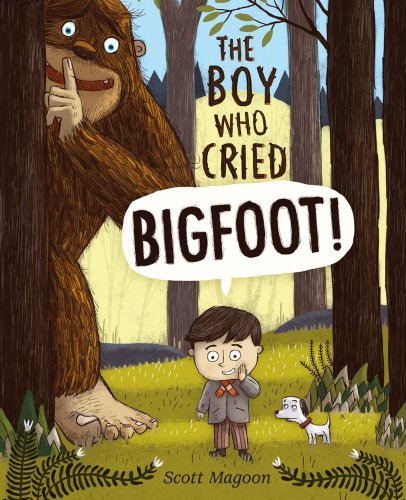
Even after they've heard it, when they've gone to middle school, they want me to tell it again and again.  Perhaps one of the reasons is the story of Sasquatch sits on the line between probable and improbable, true or false.  In his newest title, The Boy Who Cried Bigfoot! (A Paula Wiseman Book), author/illustrator Scott Magoon puts his very special spin on the Aesop fable, The Shepherd Boy and the Wolf.


This is the story of my friend Ben and how we first met.

The first thing readers discover about Ben is he likes telling stories; one particular story over and over.  (At this point you need to insert the word fibs in place of the word stories.) He's pretty creative in his use of gestures and sound effects.

Riding to the edge of the woods on his trusty bike, Ben, like the shepherd boy, is trying to convince people he is seeing something he, in fact, has not seen.  He even goes so far as to fabricate footprints.  As the narrator states:

What a tenacious little fellow he was.

People come once, twice, even three times when he claims to have seen Bigfoot but they finally realize they've been deceived.  Left alone Ben and his faithful canine companion are pondering their precarious position when the silence in the woods is broken by the sound of a stick snapping.  It would seem the teller of this tale has decided to make an appearance.

Not only does he reveal himself but he wants to take Ben's bike for a spin.  Guess who hops on for a ride?  Ben is beside himself, calling for help as loud as he can; his two treasures having vanished into the woods.

Alone in the dark, but not for long, Ben does some thinking.  He needs to convince his family (and neighbors) how his fabrications finally came true.  Ben's a clever little guy; perhaps this new scheme will work.


From the beginning the technique Scott Magoon uses to have an unseen narrator speaking to readers generates an inviting air of mystery.  This simple, conversational tone coupled with Ben's and the secondary characters' dialogues intensifies the interest.  Magoon explains, in a blog post here, how this particular twist on the fable developed.  Of course, even this essay does not explain the final delightful two pages.


Readers know immediately what Ben does not by opening the jacket and cover to reveal Bigfoot hidden, but not hidden, behind a tree in the woods. (The dog does, though.)  Opening and closing endpapers, green on green, feature a pattern of Bigfoot prints though careful viewers will notice a subtle difference between the two.  Digitally-rendered two-page spreads throughout follow Ben on this day to remember; the color palette reflecting the changing light.

Deft, fine lines designate physical characteristics, personality and emotions; especially in the eyes.  While the dog never utters a single sound readers are acutely aware of his reaction in each illustration through his facial expressions and body movements; in a word-hilarious.  It's this attention to details that elevates this larger-than-life legend of learning to excellence.


Travel with Ben on his bike with his best buddy in The Boy Who Cried Bigfoot! written and illustrated by Scott Magoon as he discovers truth really is stranger than fiction.  Readers will be smiling long before the identity of the narrator is divulged with laughter quickly following.  For more art and the process of bringing this book to publication follow this link to an interview at Seven Impossible Things Before Breakfast.