Quote of the Month

When love and skill work together, expect a miracle. John Ruskin


Showing posts with label Jerry Pinkney. Show all posts

Saturday, December 19, 2020

Above And Below-Hope

When you stand on the shores of a vast body of water, you can never be sure what resides beneath the surface.  Scientists, through research, have given us many answers, but mysteries remain.  More than 180 years ago an author used the ocean as the setting for one of his more widely read fairy tales.  Hans Christian Andersen's The Little Mermaid is one of those stories you never forget reading for the first time.  

Highly acclaimed and beloved author illustrator Jerry Pinkney has adapted the story for new generations of readers.  His illustrations are as lush and eloquent as the ocean in all its glory.  The Little Mermaid (Little, Brown and Company, November 3, 2020) written and illustrated by Jerry Pinkney is remarkable in every aspect.

Far out in the ocean and miles below the surface, two
realms sat divided by sea mountains.

On one side of the mountains evil lurked.  It was the home of the Sea Witch, known for her selfishness and hunger for power.  On the other side of the mountains was the realm of the mighty Sea King.  There he and his four daughters resided.  The daughters were warned to never enter the Sea Witch's domain.

Of the four daughters, Melody, had a magnificent voice and a curious spirit.  She was not content with her expected behaviors.  She told stories about the objects from above, drifting down into their watery world.  Her sisters did not understand her fascination.  One day when Melody's guardian, an elder sea turtle, rose to the surface for air, she followed.

Breaking through the waves, she gasped at the sight of flying fish, whales leaping above the water, and the warm ball in the sky, the sun.  What astonished her the most was a girl walking on 

two sticklike legs

along the sandy beach.  Melody started to sing, and the girl turned to watch her and waved.

Urged back into the sea by her guardian, Melody knew she could not walk upon the sand.  She knew the girl could never come down into the ocean.  At that moment, a sea snake slithered near her and lured her with promises to the forbidden darkness on the other side of the mountains.  There the Sea Witch proposed a bargain.  It terrified Melody, but she sang into the shell offered to her, giving the wicked being her enchanting voice.  Swimming to the surface, she looked around marveling at the sights and drank the Sea Witch's potion.

The girl on the beach, Zion, and Melody spent the entire day together until near dusk.  In response to a question, Melody cleverly explained how she arrived on land.  Zion decided to give her a gift, too.  After a profound comment by Zion, the course of events changed dramatically.  The bonds of friendship once formed cannot be broken by place or time.  Deep within us, a fight for right and light will give us the strength we need.


With each reading of this singular adaption of The Little Mermaid by master storyteller Jerry Pinkney, you'll find the words wrapping around you like swirls of water when you swim.  His choice of words is extraordinary, painting pictures as vivid as his artwork.  Dialogue is a part of the narrative bringing intimacy to many pivotal portions of the tale.  Here is a passage.

As her scales fell away, Melody found it more difficult to swim
as she drifted toward the shore.  At last she felt fine sand against
her skin and winced as a sharp shell cut into her foot.  She was just
starting to stand on wobbly legs when she heard a girl's voice.

"Hello!" said the smiling stranger.  "It's you, isn't it? From out
in the ocean?" The girl reached with a steadying hand.  "I'm Zion.
What's your name?"

Melody tried to answer, but no sound left her lips.  Instead,
she smiled back, shivering as the breeze whipped through the
seaweed clinging to her body.


When you open the dust jacket, the scene shown on the front, right, extends to the flap edges on the right and on the far left of the back.  Over the spine and on the left, Melody's tail bends and moves in the water with the tips of the end breaking the surface in bubbling splashes.  Three seagulls, on the back, fly over wise words from the narrative.

"You should never give up
your voice . . .
for anything."

On the right flap two smaller fish seem to dance near Melody.  The hues of green and blue with the radiant yellow of the sky complement the light in Melody's face and the sparkle of her attire and the water around her.  

On the book case, it's as if we are looking down on the surface of the ocean.  We are looking at the backs of Melody and her guardian, the old sea turtle.  They are swimming in a marbleized array of blues and greens.

On the opening endpapers is a depiction of the Sea King's realm, his castle of coral, lighting the surrounding area of ocean animal and plant life.  With a page turn, on the left mermaids and merman dance in a spin of blue and fish.  Opposite, on the title page, Melody and her guardian swim to the right.  On the closing endpapers are the dedication and information about the book.  The scene is from land looking across the water, waves crashing against the shore as the sun sets.  A lighthouse sits on a cliff on the far-left side.  There are two pairs of elements which signify the friendship of the girls and gifts given.  Already, as readers, we are enveloped in the fine details Jerry Pinkney includes in this beautiful book.

Jerry Pinkney's illustrations rendered 

using pencil and watercolor on Arches cold-pressed paper  

are mesmerizing and opulent.  Each double-page picture takes us deeply into the story.  We become a party of Melody's journey in finding her purpose, and of her family recognizing that purpose. 

To assist in pacing there are four single-page illustrations, although two of them are joined by identical elements.  Perspectives shift flawlessly to accentuate portions of the story.  You can't help but pause to enjoy the illustrations which enriches the text.  This is a tale to savor.

One of my many, many favorite images is that which enhances the portion of text quoted above.  On the left side, the pearly full moon is setting among lingering clouds.  A wash of the ocean moves toward shore as a single seagull watches the two girls on the right.  Melody, not sure of her new legs, is wrapped in Zion's shawl.  On her head is a crown of sea plants.  Seaweed drapes over her body.  In her left hand she holds the doll she found in the ocean.  Zion reaches out to help Melody tucking the fabric around her body.  She is wearing a brightly colored hat and scarf, a striped shirt, denim vest and short skirt.  The two new friends stand on the sandy beach as waves wash around their feet.


The adaptation of The Little Mermaid written and illustrated by Jerry Pinkney is one of the finest I have ever read.  On a lovely double-page visual, Jerry Pinkney includes an author's note speaking about his motivation for creating this book.  This illustration is a wordless continuation of the story before the closing endpapers.  (Truthfully, I love this picture, too.)  I can't imagine a collection, personal or professional, without a copy of this book.  

To learn more about Jerry Pinkney and his other work, please follow the link attached to his name to access his website.  There is more about Jerry Pinkney in a page at the Norman Rockwell Museum website.  In a guest post at School Library Journal, Jerry Pinkney speaks about this book.  Here is a link to the book launch at Books of Wonder.

Wednesday, October 30, 2019

A Destination As A Beginning

There comes a time when each person must make a decision. Will they follow the plan in their head, that which has been committed with pencil or pen to paper, or release the passion in their heart?  For it is when they have the courage to set the passion free, they realize they are not alone.  There are others who share the same beliefs.  There are others willing to work together to make change happen; a change ensuring a better world for everyone.

For one man, a man whose name is etched in history forever, the time for making a decision came often, but never was the choice more memorable than on August 28, 1963.  In A Place To Land: Martin Luther King Jr. and the Speech That Inspired a Nation (Neal Porter Books, Holiday House, August 27, 2019) written by Barry Wittenstein with illustrations by Jerry Pinkney we are transported.  We are moved.  We are uplifted by the beauty expressed in words and art to never forget.

Martin Luther King Jr.
was once asked if the hardest part
of preaching was knowing where to begin.

You might be surprised by his reply.  He felt

"The hardest part is knowing where to end."

He likened it to being aloft and having no understanding of where to come down.  On the evening of August 27, 1963 Martin Luther King Jr. was meeting with his most trusted and wisest advisors in the lobby of the Willard Hotel in Washington, D. C.  It was the night before the March on Washington.  He was seeking their input for the speech he was to give at the Lincoln Memorial.  They offered recommendations and he listened.  Then he left to pen the words in his hotel room.

Until 4 in the morning Martin Luther King Jr. wrote and rewrote on a lined, yellow legal-sized pad.  Andrew Young, a pastor, watched him work as he tried to make every word count, words intent on reaching into the souls of more than 250,000 people in attendance and thousands and thousands more listening and watching at home on radios and televisions.

Standing at the podium waiting to read words but knowing he needed more, Martin Luther King Jr. began to speak.  He reached deep into American history, weaving the words of democratic documents into those from the Bible and poetry of Langston Hughes.  Everything he knew up until this point became a part of this speech, but something was missing.

Mahalia Jackson, a gospel singer in the crowd near Martin Luther King Jr., called out a suggestion, once and twice.  It was exactly what this great man needed to hear.  The speaker became a preacher releasing his passion.

I HAVE A DREAM.

By 4 in the afternoon Dr. King was meeting with President John F. Kennedy.  At 8 in the evening, back at the hotel, Martin Luther King Jr. and those same men he met with the evening before were jubilant.  The road ahead would be fraught with obstacles but now his dream, their dream, had been heard around the world.


Every time I read this book, every single time, I feel as those I've stepped back into 1963 and am standing with Martin Luther King Jr.  Barry Wittenstein has penned history with a poetic perspective.  His research is evident in his ability to create a setting as real as if it's happening now.  These settings are emotionally charged. A subtle tension is supplied with the times of day written above a portion of the text.  Within his narrative he places actual words spoken by the participants fashioning a seamless flow.  Here is a passage.

Again, she shouted,
"Tell them about the dream,
Martin!  Tell them about the dream!"

The Baptist preacher,
son, grandson, and great-grandson of Baptist preachers,
carefully moved the script off to the side.

Martin was done circling.
The lecture was over.
He was going to church,
his place to land . . .


When you open the matching dust jacket and book case so you can view the back to the left and the front at the right, you are completely captivated by the peaceful power emanating from the portraits of Martin Luther King Jr. In the first we see him as a thoughtful thinker with a backdrop appearing like stained-glass windows.  In the second his mouth is open as he faces left to speak before the crowd that August day in 1963.  His hand is raised to articulate what he is saying.  He is wearing a button to commemorate the March on Washington for Jobs & Freedom.  Surrounding him is a collage of signs held by marchers, the Capitol building, a portion of the American flag, a bird in flight and clippings of actual photographs from that day.  It is here that readers get their first glimpse of the glorious technique used by artist Jerry Pinkney throughout this book.  The title text is embossed in foil.

On the opening and closing endpapers a bright sky blue shown on the front of the jacket and case is used.  The first page turn shows Martin Luther King Jr., pencil in hand, thinking about what to write in his speech.  Around him are portions of buildings and a partial piece of lined paper from a yellow legal pad.  On the title page, on the left, is a large recreation of the Willard Hotel.  Jerry Pinkney has labeled it on the left side.  (He provides labels throughout the book for key peoples' names.)  On the right side of the title page is a bird's eye view of the Lincoln Memorial and nearby landscape; as if we are looking at a map.

Each double-page picture rendered

using graphite, color pencil, watercolor and collage on Arches watercolor paper 

is a masterpiece of layout, design and creativity.  Jerry Pinkney's people look as though they could walk right off the pages.  Their facial features, body positions and hand movements are astonishing.  In A Note from the Artist Jerry Pinkney says:

With exhaustive---oftentimes dizzying---research, I gathered materials, acquiring a Hip Pocket Guide of The United States Constitution: What It Says, What It Means, reading articles and personal accounts, and sifting through hundreds of images.  With so many sources, I knew early on that I would use collage as a way to reinforce place.

This was and is (in my humble opinion) a brilliant decision.

Readers will pause at each page turn to study the illustration.  They will look at all the elements wondering at their significance.  This promotes greater understanding of this historical era and its crucial significance.

One of my many, many favorite illustrations is for a four-hour stretch of time in which Martin Luther King Jr. is working in his hotel room on the speech.  The text is placed on the left side.  Tucked between the text and gutter is a drawing of the face of Langston Hughes whose poetry is said to have influenced Martin Luther King Jr. in this speech (and other speeches).  Beneath this is what appears to be pieces of wallpaper, a coffee pot, partially sketched and part of a real photograph, a glass for water, a coffee cup, a Holy Bible and a telephone.  To the right Martin Luther King Jr. is holding a pencil and a yellow legal pad with a corner crossing the gutter.  He is listening to Andrew Young who is reaching out to touch his shoulder.  It is a moment of friendship.  It is a moment of two men with shared dreams exchanging ideas.


Each library, professional and personal, will want to have a copy of A Place To Land: Martin Luther King Jr. and the Speech That Inspired a Nation written by Barry Wittenstein with illustrations by Jerry Pinkney.  It is a marvelous collaboration between a gifted wordsmith and a beloved artist of distinction.  It captures the hours before the speech and the events after with excellence.  The final sentence and illustration will resonate.  At the close of the book both the author and illustrator include notes.  There are paragraphs on The Willard Hotel Advisors, Other Voices, and Who Spoke at the March on Washington.  Sources are given for the quotations and there is a bibliography.

To learn more about author Barry Wittenstein and illustrator Jerry Pinkney and their other work, please follow the links attached to their names to access their websites.  Barry Wittenstein has accounts on Facebook, Instagram and Twitter.  Barry Wittenstein is interviewed at Author Q&As with Deborah KalbJerry Pinkney is interviewed at The Horn Book and at Publishers Weekly about this book.  At Penguin Random House you can view the first few images.  At the publisher's website is a link to a Limited Edition First Look with a letter from Neal Porter and notes from the author and illustrator.  Several double-page breathtaking pictures are shown.

UPDATE:  December 17, 2019 Art is shared by author, reviewer and blogger Julie Danielson at Seven Impossible Things Before Breakfast including a link to the discussion about this title at The Horn Book's Calling Caldecott.

UPDATE:  There are now available many resources such as author and illustrator interviews and an educator's guide at the publisher's website.


To view the other titles selected this week by participants in the 2019 Nonfiction Picture Book Challenge, please go to Kid Lit Frenzy hosted by educator Alyson Beecher.


Saturday, May 13, 2017

A Trio Triumphs

More than one hundred fifty years ago a fairy tale emerged from a far north country.  It is a story based on need and greed.  The one prompts teamwork to overcome a bully dominated by the other.

Some versions have shown it to be a contest where there are only winners and a loser.  The Three Billy Goats Gruff (Little, Brown and Company, May 9, 2017) written and illustrated by Jerry Pinkney asks readers to ponder other possibilities.  It extends the "what if" beyond the story's ending.

A long time ago, on the rocky side of a river, there lived a family of three hungry billy goats Gruff.

There was little if any food on their side of the river but on the other side grass-covered hills rolled from one into another.  They could easily reach this veritable feast by crossing a nearby bridge.  The challenge was the troll who lived beneath the bridge.  He was hungry too...for goats.  (In case you are wondering why they never waded across in the river, danger lurked in the waters.)

As the hungriest of the three goats, the little one dared to cross the bridge first.  A loud voice boomed from beneath the bridge demanding the identity of the one who walked the bridge.  The little billy goat answered as did the troll.  Convinced by the smallest of the trio, the troll allowed him to continue as he waited for a larger meal.

As clever as the first goat, the middle-sized goat assured the troll there was a third goat, a bigger goat, about to fatten himself with the grass on the other side.  The cranky troll waited.  To say he was shocked by the events which followed would be an understatement.

The biggest billy goat Gruff did not walk upon the bridge.  He smashed through the gate causing the troll to screech out his question.  A verbal exchange escalated to a physical encounter with the troublesome troll tumbling off the bridge into the water.  If you think his life was in danger you would be right.  If you think he was never seen again, you might be wrong.


A vision of the setting is created by the words of Jerry Pinkney.   It's easy to understand why those hungry goats wanted to cross the bridge.  It's also easy to see why they waited so long to battle the bully under that bridge.  Pinkney supplies a storytelling rhythm with the repetition of

trip, trap! trip, trap! trip, trap!

It continues with the question asked by the troll and the following conversation with each billy goat; making for an ideal audience participation tale.  A gentle tension is generated by this cadence building toward Pinkney's version of closing events.  Here is a sample passage.

"It's only I," the littlest billy goat squeaked.
"I'm heading up the hillside to make myself fat."

"I'm going to gobble you up!"
declared the troll.

"Oh, no, don't eat me!" cried the littlest goat.
"Wait until the next billy goat crosses.
He's much bigger than me."


When you open the dust jacket the large image spanning the entire space, even a little bit on each of the flaps, you can't help but marvel at the realistic portrayals of the goats, the rich color of their coats, the angles of their legs and hooves, position of their tails and their facial features.  Amid this wondrous display Jerry Pinkney includes the bridge on the right and to the left, on the back, the troll with one of his companion crows, greedily watches.  On the book case the

wild grasses 

thriving on the other side of the river cover the entire space, lush and green.

The story begins and continues on the opening and closing endpapers.  On the first we are shown a panoramic vision of the rocky home of the billy goats, the river, bridge, troll's home and his vantage-view station.  On the second the scene is the identical but entirely different at the same time.  A change in the sky's shades and the light's reflection declares more than the end of the day.  On the title page picture we zoom in on the two sides of the river and the bridge, goats moving across toward the troll, and the title text placed along the bridge.

The art for this book was created using pencil and watercolor on Arches cold-pressed paper, each illustration laid from page edge to page edge across two pages.  At times to supply pacing one image stretches across the gutter for only another half page, leaving space for a smaller, close-up picture. When the first billy goat crosses the bridge we see the view above and below the bridge, goat and troll in his dark abode.  The troll gets bolder with the larger goats, standing on the bridge challenging them.

As the largest of the three billy goats Gruff charges onto the bridge, Mr. Pinkney has fashioned a stunning gatefold.  We as readers are amid the action.  During the following page turns elements break the framing and a large picture is placed over an even larger illustration several times.  Altered perspectives heighten the emotions of the individual moments.

One of my many favorite illustrations is on a half-page.  It is of the smallest billy goat Gruff before he crosses the bridge.  He is looking at the BEWARE sign secured at the top of the gate.  You can compare his size easily; feeling his fear and his bravery.


This reader is happier than you can imagine with the retellings of folklore by one of children's literature's finest authors and illustrators.  Each one is a treasured gem.  The Three Billy Goats Gruff written and illustrated by Jerry Pinkney is perfect.  At the close of the book Jerry Pinkney in an Artist's Note speaks about his interpretation of the tale through his words and art.  It is a must read.

To learn more about this marvelous man and his other work please visit his website by following the link attached to his name.  Author, reviewer and blogger Julie Danielson highlights this title on her blog, Seven Impossible Things Before Breakfast.  Margaret Kimball talks about the process for the lettering on the dust jacket here.

Thursday, December 1, 2016

A Heart's Desire Is Heard

Never doubt the significance of first impressions.  I am not saying they are always right.  Upon closer examination, those initial perceptions may need to be altered.  With that being noted, sometimes when you read a book for the first time your reaction is exactly as it should be.  What you need to do next, after enjoying it multiple times, is to decide why the book left a mark on your heart.

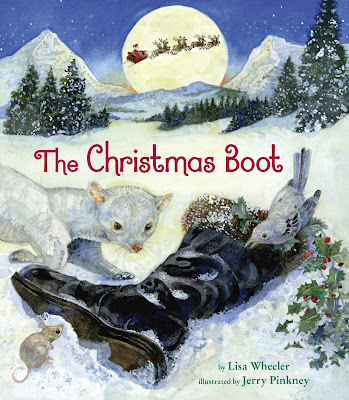
Is it the text which made a connection?  Are the illustrations such they will cause a sensory experience?  Is it a beautiful blend of narrative and images?  Upon first reading The Christmas Boot (Dial Books for Young Readers, Penguin Young Readers Group, an imprint of Penguin Random House LLC, October 18, 2016) written by Lisa Wheeler with illustrations by Jerry Pinkney I was visibly moved.  You will be too.

Deep in the forest on Christmas morning, Hannah Greyweather gathered bundles of kindling wood.  For her, this day was no different from any other.

Hannah has adapted to her aloneness by chatting out loud to the surrounding flora and fauna.  They, of course, are silent in their replies to her commentary.  Arms full of wood; she spies something out of the ordinary in the pristine snow.  It's a black boot.

It looks so comfortable and cozy she slips her left foot inside.  Compared to her feet wrapped in rags and numb with cold, this feels downright divine.  Hannah is more than a little surprised when the large boot quickly conforms to the size and shape of her foot.  Hannah cannot believe her good fortune.  As she climbs into bed that night she speaks aloud her desire for the matching boot for her right foot.

What you need to remember is this is Christmas Day.  There is a great deal of magic in the air on Christmas Day.  Hannah is shocked to see two boots next to her bed the following morning. Having warm feet as she goes about her business in the forest gives her a new outlook on life.  On this second night she chats aloud to the left boot about her wonderful good luck.  She remarks how much happier she would be with two warm mittens.

To her utter surprise a pair of mittens, one each inside each boot, awaits Hannah in the morning.  This fantastic happening has her wondering if she should wish for more; a comfy bed, delicious food and a large home.  She does not but goes outside to gather some chestnuts.  She is so thrilled with her warm feet and warm hands; she makes a snowman before setting off for home.

What she sees in place of her humble house is astounding.  Inside the sights are even more remarkable.  As nice as all of this is, something feels a little strange to Hannah.  While she is thinking about this, there is a knock on her door.  Her visitor believes she has something belonging to him.  After an evening of conversation, he winks and leaves her with two gifts and an even more welcome surprise in the morning.


There is a specific storytelling rhythm established with the writing of Lisa Wheeler in this book.  It connects Hannah to her surroundings and us to Hannah.  With each of her observations said aloud, Wheeler has a reply:

The mountain didn't answer.
The forest remained silent.
The walls did not reply.

This technique reinforces Hannah's aloneness setting the stage for the final two surprises.

Wheeler's mix of dialogue, mostly Hannah talking out loud, with the narrative also contributes to the story's pacing.  We feel a genuine relationship developing between us and this woman.  Here are two consecutive passages. (only a portion of the second one)

"Glory be!" Hannah said to the right boot.  "How did you get here?"
The boot didn't say.
Then Hannah Greyweather placed both her feet into those warm black boots.  They fit most comfortably.

As she went about her wood-gathering, Hannah had a spring in her step that hadn't been there for years.  She danced in the spruce grove, skipped along the creek bed, and even made snow angels on the hillside.


How is it that every book illustrated by Jerry Pinkney causes you to feel like you are holding a living, breathing marvel in your hands?  Upon opening the matching dust jacket and book case readers are greeted with an entire winter wonderland scene which extends to the edge of the flaps.  Notice the shifts in perspective from the close-up of the boot with the holly draped over the top and the animals curiously looking at it and then to the mountain in the distance with Santa Claus in his sleigh and his reindeer crossing in front of a full moon.  To the left, on the back, the body of the weasel continues.  A snowy white hare watches from the bottom.  Toward the top tucked in among the spruce trees is Hannah's tiny, one-room home, lights glowing from the windows.  One of the shades of blue from the jacket and case covers the opening and closing endpapers.

In a beautiful snowy scene with Hannah leaving her home for wood-gathering, footprints marking her path, the title, author, illustrator and publisher text has been placed.  Rendered in

pencil, Prismacolor pencils, and watercolor on Arches cold press watercolor paper

the illustrations are stunning in their eloquent detail.  The lines and brush strokes convey the crisp chilly air, the silence of the soft snow on boughs and branches, the sound of birds chirping greetings and Hannah's breath making fog and her voice ringing out wherever she may be.  In each picture outside there are animals with Hannah.  They feel a kinship with this woman of their world.

The interior of her home conveys the simplicity of her life; cooking over an open fire, a bucket of water nearby, light from a kerosene lamp, a bed made of birch branches and homemade quilts to keep Hannah warm at night. The patterns on all her clothing are bright, cheerful and intricate.  Hannah's face is lined with life.  The depictions of the animals are so real you expect them to leave the page and join you.  Jerry Pinkney alters his image sizes from double page to single page to two pictures together on a single page or a smaller picture inserted in a large visual.  Every page turn is a delightful surprise.

One of my many favorite (I love all of them.) illustrations is wordless.  It covers two pages.  Hannah is lying on her back making a snow angel, laughing.  One hare is next to her right hand raised in happiness.  Another hare has its front paws on her left boot.  Birds are singing next to her left leg.  Another bird has come to rest on her outstretched left hand.  The weasel is watching from the far right-hand corner.  This is true, pure bliss.


If you are looking for a new Christmas book for your personal or professional collections or to give as a gift, I highly recommend The Christmas Boot written by Lisa Wheeler with illustrations by Jerry Pinkney.  This is a title to be treasured for years and years to come.  And I promise you the ending will cause you to sigh or shed a few tears.  Please share this book repeatedly.

To learn more about Lisa Wheeler and Jerry Pinkney and their other work please follow the links attached to their names to access their websites.  You can get a sneak peek at the inside at the publisher's website.  This title is celebrated at PictureBookBuilders with an interview of Lisa Wheeler.  Enjoy the book trailer.

Thursday, April 16, 2015

To Play Or To Work

Their world beneath our feet is a series of tunnel roadways leading to the queen's residence.  I wouldn't be a bit surprised to see some form of John Heywood's timeless quotation,

Many hands make light work

strategically mounted along their hidden passages.  Never at rest, always on the move, all the members of team ant know what to do and when to do it.

As a classic piece of folklore a fable uses animals to convey a moral or lesson.  None are more recognized than those of Aesop.  None are more gorgeous in their retelling than those of Caldecott Medal winner, Jerry Pinkney.

On April 7, 2015 a companion to The Lion & The Mouse (Little Brown Books for Young Readers, 2010 Caldecott Medal) and The Tortoise & The Hare (Little, Brown and Company, October 1, 2013) was released.  In the first book the setting is the African Serengeti and in the second title we travel to the American Southwest.  In the third book, The Grasshopper & The Ants (Little, Brown and Company), we find ourselves in the woodlands.

When first looking at the dust jacket, you will want to take your time to notice the exquisite details deftly depicted by Pinkney.  For mere moments a group of Ants have paused to listen to the music man, the Grasshopper, who carries his drum set, banjo and concertina with him everywhere.  The delicate wings on his back are breathtaking.

The staff in pastel shades of blue, pink and yellow swirling about him indicates the lightness of the melody.  Dandelion seeds, like wishes, float on the air.  This illustration extends to the left, the back, in a lush view of the forest floor, filled with leaves, flowers, Ants, a monarch butterfly, a caterpillar and a lady bug, wings spread ready to soar.  (It should be noted the front flap images align with the opening endpapers.)

Beneath the jacket on the book case, with a white canvas, framed in dandelion leaves and flowers are portraits of the Grasshopper and an Ant observing the reader.  On the back is the Ants' winter abode with the note laden staff twisting forth from an opening.  This picture is outlined in holly branches and leaves.

Both the opening and closing endpapers are a naturalist's delight in an array of leaves, flowers and the Ants' stump home covered in shelf fungus.  Both feature the Ants busy at work.  Only the Grasshopper is featured differently.  I wonder how many readers will stop to identify all the leaves and flowers.  With a page turn we see the title spread across two pages; the letters formed from leaves, tiny twigs, and flowers.  The Grasshopper and the Ants are busy doing what they do best.

In a series of twelve spectacular double-page visuals Jerry Pinkney gives his signature spin on the tale. (There is also a gasp-worthy surprise toward the end.) In addition readers can see two framed single pages where elements break out from the lines and two edge-to-edge single page pictures as well as the final illustration.  At one particular point in the narrative he even uses a set of smaller framed images to enhance the pacing and add a bit of tension.

"Why work so hard?"
sang Grasshopper.
"It's spring and time to go fishing."

"No time to relax,"
said the Ants.

With these three sentences Pinkney begins.  As the seasons progress Grasshopper asks the same question with alterations to his words.  The Ants reply in kind.  Each time Grasshopper's phrases are increased making his invitation more enticing.  In the autumn and winter the Ants do not reply.  Grasshopper finally realizes his activities would be better if shared.

For the remainder of the book all of the illustrations are wordless with one exception.  A wise matriarch offers a cup of compassion.  It is humbly accepted.

All these illustrations are deserving of being framed.  One of my favorites is when the first snow comes.  The Ants are nowhere in sight but Grasshopper is beside himself with glee, wings extended, hovering above trees branches and lingering fall leaves in rustic reds and browns.  Snowflakes are falling in all shapes and sizes.  Concertina music rides the breeze.  (At this point Grasshopper is not wearing his leaf snowshoes yet.)


When you first hold this book in your hands, after you look at the dust jacket and book case, you can't help but run your fingers over the heavy smooth matte-finished paper.  It's like you have to touch the beauty.  Please add The Grasshopper & The Ants written and illustrated by Jerry Pinkney, a true national treasure, to your professional and personal collections.  Share it with everyone as often as you can.  You will enjoy reading the Author's Note on the final page.

To learn more about Jerry Pinkney and his other work please visit his website by following the link attached to his name.  If you access the TeachingBooks website they have many resources about Jerry Pinkney.

Tuesday, November 12, 2013

A Race...Life Lessons

Tucked in a corner of one of my bookcases is a much loved set of four books.  These four books, The Tall Book of Make Believe, The Tall Book of Bible Stories, The Tall Book of Christmas and The Tall Book of Nursery Tales are my earliest childhood connection to a vast array of classic stories and poems.  They all show signs of repeated readings; only one still has its jacket.

Illustrated by the 1956 Caldecott Medal winner, Feodor Rojankovsky, The Book of Nursery Tales, introduced me to fairy tale and fable favorites.  The lesson taken from the race of mismatched opponents has served me well again and again over the years.  Jerry Pinkney's latest release, The Tortoise & The Hare (Little, Brown and Company) is a gorgeous retelling of a cherished tale, a companion to his Caldecott Medal winner, The Mouse & The Lion.


Every single time I hold a book with illustrations by Jerry Pinkney, its like I have an incomparable treasure in my possession.  A heavy matte-finished jacket with a double-page illustration edge to edge introduces the two main characters, front and center, and several smaller supporting members of the cast on the back.  Set in the American Southwest, the color palette reflects the warm and sunny, dry and dusty surroundings.  Beneath the jacket, the cover is wordless, in two frames a close-up of the Tortoise and the Hare facing one another appears on the front.  On the back in a single, framed picture, the duo are walking away side by side.

Opening endpapers feature a desert vista, filled with rocky formations and flora native to the region; a barn, silo, windmill and garden are tucked in the upper left-hand corner.  Dotted lines show the route the racers will soon follow.  Tortoise is resting on a stump, head tucked into his shell, as hare hops hurriedly down the trail toward him.

The first page turn reveals another two page visual dedicated to the title as well as beginning the story.  Animals are running toward Hare and Tortoise as the two converse.  Another group off to the side are chatting excitedly.

On your marks, 
get set...
Go!

Hare's walking stick and black and white checked kerchief given to Coyote, to use as a visual starter, has dropped as the verbal signal is given.   Hare leaps away down the route.  Tortoise negotiates the path at a much slower pace; mice, bees, a grasshopper, moths, a bird and lizard offering advice and encouragement.

Startled frogs scurry and splash as Hare hops unannounced over their watery residence.  They gleefully guide and ride Tortoise as he swims through the pond.  So far ahead he has lost sight of Tortoise, Hare can't help but notice and slow for a lush garden full of lettuce.

Digging, eating and sleeping are the next order of business for Hare.  Tortoise, on the other hand, tumbles, plods and passes.  The race ends as it has for centuries but Pinkney enhances the outcome with his personal perspective; much can be learned from both sides of a story.


Jerry Pinkney uses the text of the closing line,

Slow and steady wins the race!

to add energy and tension to his retelling.  As we readers watch Tortoise picture by picture move along, the first word is added.  In the next visual the first two words are included.  Each time, a new word is added until the thought is complete.  In your reader's mind it makes a rhythmic beat, building to the finish.  Other than the opening lines these are the only words used in the narrative.

In an Artist's Note at the book's end, Jerry Pinkney explains his choice of setting, color palette, ending and reason for clothing his characters.  Rendered in graphite, watercolor, colored pencils, gouache and pastel, these illustrations pulse with life.  A very real sense of emotion and personality traits of all the characters is conveyed with affection.

Readers are treated to colorful, animated double page illustrations or smaller framed panels with some elements leaving the confines of the lines to represent life and movement.  The choice of clothing for each of the animals is sure to evoke smiles among all readers.  I believe my favorite illustration is of Tortoise emerging from the stream, one frog perched upon his back, another still in the water, arms upraised and a third leading the way laughing and leaping.


Jerry Pinkney's The Tortoise & The Hare, is a brilliant and masterfully artistic interpretation of a well-known fable.  I, for one, am thrilled with his illustrating of classic fables, nursery rhymes and fairy tales.  His valued perspectives contribute more than can be measured to the world of children's literature.  I believe every collection should include these titles.

Make sure to visit Jerry Pinkney's website by following the link embedded in his name.  PW KidsCast: A Conversation with Jerry Pinkney is an audio interview in which he discusses this latest book.  The widget below allows you to see pictures from inside the book.  Enjoy Jerry Pinkney talking about his work in the video below.


Friday, December 2, 2011

How I Wonder What You Are

Every time I hold a book written and illustrated by Jerry Pinkney in my hands, it is with joyful anticipation.  Pinkney is the recipient of the Caldecott Honor Award five times; 1988-Mirandy and Brother Wind, 1989-The Talking Eggs, 1995-John Henry, 2000-The Ugly Duckling, and 2003-Noah's Ark.  In 2010 he was awarded the Caldecott Medal for The Lion & The Mouse.  He was inducted into The Society of Illustrators Hall of Fame for Distinguished Achievement in the Art of Illustration by The Society of Illustrators in 2011.

In 1806 English author, Jane Taylor at the age of 23 penned a poem called The Star.  This poem provides the lyrics for the well known nursery rhyme song, Twinkle, Twinkle, Little StarJerry Pinkney's interpretation of those lyrics in his words and illustrations is portrayed in his most recent title, Twinkle, Twinkle, Little Star (Little, Brown and Company).


A visual feast worthy of framing jackets the front and back covers in lush shades of blue as a small vessel  is gently lifted skyward from frothy flowers by the breath of a kind wind.  The front and back covers picture the same vessel smaller now still blown by the wind among the huge starry sky a benevolent moon smiling.  Front endpapers are awash in the changing colors of dusk moon gazing at the first star rising.

A stone wall cloaked in morning glories two robins flying across, threads in beaks, a ladybug, ants, and butterfly create a lively scene as a small chipmunk peers from a hole in the wall across a ground carpeted in dandelions young and old; a vivid landscape for a title page.  It is this chipmunk who will guide readers through the song as his adventures unfold; as his dreams are realized.  Stars are seen in dandelion fluff, centers of flowers, in a cluster of petals, among a spider's web and as fireflies glimmer.

As this furry pipsqueak popping with personality invades the robin's nest his escape fashioned from those sticks transforms him to sailor extraordinaire skimming through the night breezing past nocturnal friends.  As fate would have it he tumbles from his craft to a water lily overturned by a fish seeking his evening meal.  Surprised water critters ogle our adventurer as a swan's head dips to his rescue. 

Lifting from her nest chipmunk nestled in her feathery fold, flying she is silhouetted against the moon; they are one.  Home again our sailor, still in his coat small boat next to his side, sleepily dreams.  The closing endpapers are his darkened home; he snuggled in a nest of leaves as a single bright star looks down upon him through his hole in the wall.

Jerry Pickney's illustrations done in pencil, watercolor, and colored pencils on paper are breathtaking in their attention to detail, color spectrum and artistic technique. Variation in layouts, full page, full framed page bleeding to the previous page, small vignettes whose graphics extend beyond the frame two or four to a page, a blue circle and several insets are delicacies for a pictorial gourmet.  At times several wordless pages connect the chipmunk's journey to the next lyrical lines.  Where Pickney chose to place the text and type is sheer perfection.

The display type was hand-lettered by Leah Palmer Preiss.  At times this type, either rendered in white or a shade of blue, graces white space with a small bit of complimentary visuals or is spread across sky or water.

Twinkle, Twinkle, Little Star by Jerry Pickney is a stellar contribution to children's literature evoking a sense of wonderment among our natural world by an explorer who dares to dream. I love Mr. Pickney's explanations in the Artist's Note on character selection, his creative process and what he hopes reader's will discover.  At his web site linked above he includes several other illustrations from this title; each one a treasure.  It does not get any better than this.