Quote of the Month

When love and skill work together, expect a miracle. John Ruskin


Showing posts with label Scott Magoon. Show all posts

Wednesday, August 25, 2021

Melodies With Meaning

When we reach out to the world, human and natural, music is everywhere.  Some of the tunes are without words, but still speak volumes to us.  For those seeking to communicate with language, it might not be one we comprehend.  We know understanding what is said can have a greater impact on some individuals more than on other people. 

In this newest offering, author Jamie A. Swenson and artist Scott Magoon in collaboration present an interesting dilemma.  Chirp! Chipmunk Sings For A Friend (A Paula Wiseman Book, Simon & Schuster Books for Young Readers, July 13, 2021) follows this creature yearning for someone to sing with her.  This is a story of her search and the outstanding outcome.

Chipmunk lived on a rock.

From the first light of day until the stars scattered across the darkened sky, Chipmunk chirped.  Her songs mirrored a range of emotions.  Rock could listen, but Rock could not sing.  Chipmunk decided to find someone to accompany her.

Pinecone agreed to meet Rock.  Pinecone was a perfect match for Rock, but not for Chipmunk.  She left again.  

Log was willing to meet Rock and Pinecone, but Chipmunk could not move Log.  She started to sing out her feelings.  Raccoon heard Chipmunk and asked her to keep singing.  Together they attempted to move Log.  Nothing worked. 

The duo sang out their feelings and were heard.  Moose came to listen.  After they were done, Moose agreed to help them move Log.  It did not go as expected.  No, it did not.  There are listeners and there are singers.  Sometimes, they find each other.


In this gentle, musical tale penned by Jamie A. Swenson, readers encounter a willingness to step into Chipmunk's journey.  Jamie A. Swenson uses the technique of three to great advantage creating a pattern and rhythm, inviting reader participation.  It is used in reference to songs, listening friends, moving, and singing friends.  Her combination of narrative and dialogue elevates the pacing.  Here is a passage.

"That is a sad song," said Raccoon.
"It is the song of my heart," said Chipmunk.
"It is beautiful," said Raccoon.  "Keep singing."

Chipmunk smiled and sang a bit more.
Raccoon swayed and tapped her paw.


One of the first things you realize upon opening the matching dust jacket and book case is the flow of the images rendered by Scott Magoon.  The illustration on the front, right, moves over the spine on the left and over the crease of the flap on the front.  The picture on the back continues to the edge of the back flap.  Chipmunk on the front is hopeful, ready to find a companion to share in her singing.  Her gaze asks us to join her.  The main title is in green foil.  Chipmunk is varnished.

To the left, on the back, Chipmunk is upright on her back legs.  She is swaying to her song.  It moves in double loops above her.  Do you hear this song of longing?

A bright spring green covers the opening and closing endpapers.  On the title page, Chipmunk is peeking from behind Rock.  What will she find?  These digital images by Scott Magoon are atmospheric.

They bring us close to Chipmunk and the other characters, but also give us expansive views of Chipmunk's world.  The facial traits on the characters are animated and textured.  Even Rock, Pinecone, and Log urge us to touch them.  The matte-finished paper adds to the softness of the narrative and the visuals.  Many of the pictures are placed on a crisp white background.  Most of them are single-page images except for several double-page illustrations to accentuate significant moments.  And sometimes the single page visuals cross the gutter just a bit.

One of my many favorite illustrations is a single-page picture.  Chipmunk is speaking to Pinecone.  Pinecone agrees to meet Rock.  It is a close-up of the twosome.  Chipmunk is so hopeful with one paw holding Pinecone and the other raised for emphasis.  Pinecone is tilted with needles attached to the tiny tip.


Readers will identify with the characters in this charming story, Chirp! Chipmunk Sings For A Friend written by Jamie A. Swenson with art by Scott Magoon, of hope and joy fulfilled.  Who among us, at one time or another, have not wished for someone to share what makes us the happiest?  This is a book to keep close as the conclusion is worth singing about loud and clear.  You will want to have copies on both your professional and personal bookshelves.

To learn more about Jamie A. Swenson and Scott Magoon and their other work, please access their respective websites by following the link attached to their name.  Jamie A. Swenson has accounts on Facebook, Instagram, and Twitter.  Scott Magoon has accounts on Facebook, Instagram and Twitter.  At the publisher's website you can view interior illustrations and the dust jacket.


Each week in our community, the area farmers come to market.  Their stalls and tents dot the space between the main street and the harbor on Round Lake.  The air is charged with people hoping to find fresh fruits, fresh vegetables, freshly cut flowers and other home-grown products.  Sellers are equally enthusiastic people will find their offerings enticing enough to select and buy.  A Song of Frutas (Atheneum Books For Young Readers, an imprint of Simon & Schuster Children's Publishing Division, August 13, 2021) written by Margarita Engle with illustrations by Sara Palacios is a generational tale of supreme happiness and memories to hold in your heart.  It is written in a blend of Spanish and English. 

When we visit Abuelo, I help him sell frutas.
We sing the names of each fruit
as we walk, out footsteps like drumbeats,
our hands like maracas, shaking
bright food shapes
while we chant
with a rhythm:

As granddaughter and grandfather stroll through a town in Cuba singing, people in their homes listen and buy the fruit.  On the streets, other pregoneros sing.  Grandfather sings even louder, his song rising above the rest.

It is the only way for him to compete with the man selling tamales or the woman holding up her fresh herbs.  There is also a woman with a heavenly song persuading people to purchase her delicious treats.  This child's best memories are of New Year's Eve.

On this day people gather to buy grapes from her grandfather.  Twelve grapes are needed per person.  Do you know why?  Think of wishes and a better future for everyone.

Soon the granddaughter leaves for home.  She no longer sings with her grandfather in his town.  The two have discovered another way to sing.  It is a different kind of music, a symphony of one soul embracing a beloved soul.


This book, this poem, by Margarita Engle is uplifting from the first words we read.  Her presentation of Spanish and English supplies its own special kind of song.  Her similes ring radiantly across the pages.  Her descriptive words, her adjectives, take us deeply into this narrative.  Here is a passage.

Best of all is la dulcera,
a woman with the voice
of an angel, who croons so sweetly
in praise of los caramelos---
chocolates and other delicious candies.
Sabroso!
Tasty!


Looking at the front, right, of the open and matching dust jacket and book case, you can't help but feel your spirit soaring.  The beaming faces of el abuelo and his granddaughter, singing about his fruit, are the essence of happiness.  Artist Sara Palacios infuses her images with cheer through her bright color choices.  To the left, on the back, we are fortunate to view an interior visual.  Here a basket loaded with fruit is being pulled up to a balcony by a mother.  Her daughter watches.  Below grandfather and granddaughter lift and wave in gratitude at the exchange.  On the dust jacket front, the title text, grandfather, granddaughter and the dog are varnished.

Sunshine yellow covers the opening and closing endpapers.  On the title page the duo is putting fruit in containers.  The grandfather holds a bunch of grapes.  On the dedication page, they and their two dogs are making their way to the town, a cart loaded with their fruit.

Each digitally rendered illustration, two-page pictures, single-page images, and groups of smaller visuals, heightens the energy found in the text.  The blue of the sky shown in many of the pictures is like a reflection of the sea surrounding the island.  The buildings are as varied in their hues as the fruit.

The facial expressions on the granddaughter and her grandfather as well as most of the other people in the community are brimming with joy.  They have, through Sara Palacios, chosen to receive their days with hope.  (I am more than happy to see the two canine companions which add to that joy.)

One of my many favorite pictures is the second double-page image.  We move close to the grandfather and his granddaughter as they hold out their fruit singing.  They are near their cart with buildings and that brilliant blue sky behind them.  Their two dogs are close, contentedly listening to the singing.  The boxes of fruit are labeled with their names in Spanish.  A woman and another man curiously watch.  Will they buy these splendid fruits?


A Song of Frutas written by Margarita Engle with illustrations by Sara Palacios will have you wishing you could join this girl and her grandfather.  This book honors the traditions of los pregoneros, the New Year's Eve wishes on each of twelve grapes, the music of the spoken and written word, and the love between a grandparent and child.  At the close of the book in an author's note, Margarita Engle addresses Spanglish, Travel Restrictions, Los Pregoneros, and New Year's Eve.  I highly recommend this title for your professional and personal collections. (Please note this title is also released in Spanish.)

To discover more about Margarita Engle and Sara Palacios, please follow the link attached to their names to access their websites.  Margarita Engle has accounts on Facebook, Instagram, and Twitter.  Sara Palacios has an account on Tumblr.  To showcase this title Margarita Engle is interviewed at A Fuse #8 Production, School Library Journal and We Need Diverse Books.  At the publisher's website you can view interior images.  Here is a link to an activity page.

Monday, June 10, 2019

From Your Soul

Striving to make a dream come true takes dedication, determination, desire and a great deal of practice.  Given the chance to exhibit the results of your endeavors is exciting.  When other members of your family with the same interests are a part of the event, your eagerness is magnified. 

You would think that an individual close to you (really close to you), would be supportive.  In fact, you should be able to count on them as your most ardent cheerleader.  Linus The Little Yellow Pencil (Disney Hyperion, June 4, 2019) written and illustrated by Scott Magoon follows the creative ups and downs of an artist with a pessimistic critic.  It's not easy to stay on point in those kinds of conditions.

The family art show was coming up, and only the art with the most heart would win the grand prize.

Linus, the little yellow pencil, is entering the contest for the first time.  Ernie is Linus's eraser.  He has a hard time finding anything good to say about Linus's drawing.  Ernie is first worried and then very angry.  Linus, in his opinion, has no talent.

Every dot, line and object Linus draws are erased by Ernie.  Now Linus has nothing for the contest.  He watches his family preparing for the exhibition.  Brush is happily painting as Ink, Red Paint and Orange Paint comment.  Linus is a tad bit jealous.  Pen and Crayons are passionately pursing their entries.  

Ernie's lack of confidence in Linus seeps into his psyche.  His happy-go-lucky spirit is fading.  When Ernie suggests they not go to the show, it is heart-breaking.  Both Linus and Ernie are starting to wonder if each other are right.  With nowhere left to go, Linus enters a nearby cave.

Inside the cave, Linus meets a being who has a distinct kinship with him.  During their conversation woes are expressed and advice is given.  Popping out of the cave, Linus is a changed little yellow pencil,

sharper than ever, 

he works with renewed vigor until an idea pops into his mind.  It's a concept with a collaborative twist.  The evening of the family art show is one everyone will remember.


Using carefully constructed simple sentences with a mix of dialogue and characters' thoughts, Scott Magoon writes a story mirroring situations and emotions in which readers will identify.  He clearly portrays the battle between loving what you do and being brave enough to keep doing it.  Readers will appreciate the wordplay within the narrative; especially the double meanings.  Here is a passage plus a little bit more.

Linus drew more, but Ernie flipped.
"You can't even make a stick figure?!"
"Oh, I don't know," said Linus.  "I like this one."
"No, trust me," said Ernie.

So Linus tried again . . .
and again.

But it was no use.

Ernie didn't like a single mark Linus made.

Rubba-dubba-rubb went Ernie.
And Linus's lines were gone.


When readers look at the smiling face of Linus on the front of the dust jacket, it is their understanding this little yellow pencil enjoys what he does.  Every portion of this illustration is lifelike, asking us to reach out and touch the page.  We can see texture, but the text is raised so we can feel it, too.  You can see faint images used as a background.  These are Linus's drawings.  

It is when the dust jacket is opened the other end of this pencil comes into view on the back, to the left.  It is cranky, doubting Ernie, enlarged just like Linus.  The line drawn by Linus is being erased.  Eraser bits fall to the left of Ernie.  The text on the back reads:

What 
will
draw
them
together?

A yellow post-it-note in the lower, left-hand corner shows a zebra sketch.  The ISBN covers most of the zebra's body.  (Clever, Scott Magoon, clever)

From left to right and crossing the spine are small colored squares on the book case.  Some are in rows; others are placed on top of these loose rows.  Inside the squares are examples of artwork after Linus's idea grew in his mind.  In the lower, right-hand corner on the front the title has been written in a yellow square.

On the opening endpapers a large drawn squiggle moves from left to right, nearly top to bottom, on a yellow canvas.  In black and white on the closing endpapers a burst of artwork in rays shines from the upper, right-hand corner to the far-left side.  This is a glorious example of Linus's grand design.

Using scanned paper texture and Photoshop Scott Magoon's illustrations are a marvelous medley of characters and artistic styles.  Items found in artist's studios and on their tables are brought to life with dots and lines and ingenuity.  Drawing notebooks and a worktable provide a canvas for the papers and artwork.  The depiction of Linus in the cave is superb.  (Look at Ernie's face!)

The picture sizes are nearly all double-page visuals.  The perspective shifts in sync with the narrative.  Emotion is embedded in every single one.  These tools of the artists' trade are fully animated expressing and experiencing human qualities.

One of my many, many favorite illustrations is on a single page.  It highlights a good portion of the text previously noted.  On a plain creamy yellow background, Linus has drawn a stick figure in the lower, left-hand corner.  There is a grassy area at the bottom with lines rising from the ground.  A stick is standing in the middle of this area.  Three branches with leaves extend from the stick.  A smiling face is in the center with an eye and eyebrow on either side and a smile curving underneath.  Ernie is erasing the grassy area on the right.  Linus is trying to draw a swirling line, but he is clearly unhappy.


Like the winner of the art show, this book, Linus The Little Yellow Pencil written and illustrated by Scott Magoon, has the most heart.  It's not only about following your heart but also about helping someone else to see the art in their heart.  It's a hopeful, lively look at staying true to your calling but to be willing and brave enough to change.  I highly recommend this title for your professional and personal collections. (The dedication is simply lovely.)

To learn more about Scott Magoon and his other work, please follow the link attached to his name to access his website.  He has a great deal of information and resources about this title.  Scott has accounts on Instagram and Twitter.  Scott Magoon is interviewed at Creative North Shore, The Write Space and Critter Lit.   


Friday, February 1, 2019

An Appetite For Laughter

Sometimes when a book ends, it's not the final conclusion.  Oh, no . . . there is more story to tell.  The characters have a lot more to say.  They have a lot more to do.  When we are introduced to them, it's just a beginning full of promise.

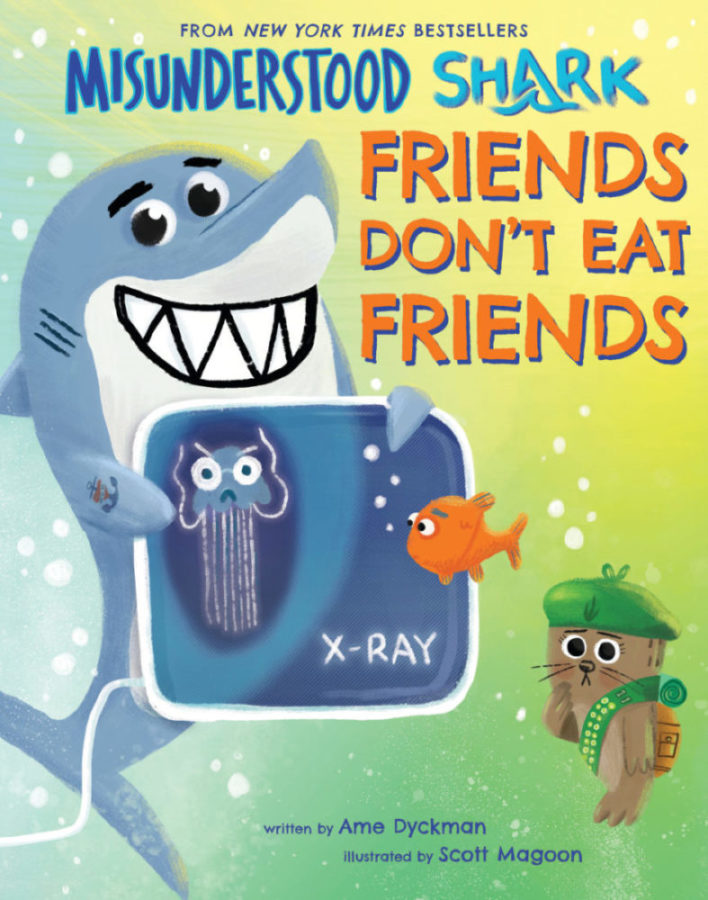
As the final pages and the closing endpapers, are disclosed in Misunderstood Shark (Orchard Books, an imprint of Scholastic Inc., April 24, 2018) readers feel disbelief as they try to digest what has happened.  The unknown fate of the fabulous Underwater World with Bob leaves us (and him) in the dark.  The companion title and sequel Misunderstood Shark Friends Don't Eat Friends (Orchard Books, an imprint of Scholastic Inc., January 29, 2019) written by Ame Dyckman with illustrations by Scott Magoon makes everything less murky as we peer into the depths of the water. 

Last time, on
Underwater World
with Bob . . .

Shark ATE ME!
Get me
OUT OF HERE!

"That's strange!
I can HEAR Bob.
But I can't SEE Bob."

As we barely get the page turned Shark has ejected Bob, a jellyfish, out of his stomach and the show does indeed try to go on.  The problem is Bob having a tizzy about being consumed by Shark.  When Shark realizes people are watching him, again, he utters his now famous defense.

"You MISUNDERSTOOD!"

Apparently, he was giving Bob an up-close-and-personal view of his inner self.  Bob's not buying it until his crew reminds him of his show.  We are then privy to one of his fun facts about sharks.  We go quickly from bones to cartilage to boogers. Bob is still not placated.  He WAS eaten.  Shark demands proof.

Suddenly the video feed is stopped.  Shark has expelled something else.  It's gross!  It's Bob's glasses.  Bob with dignity and an air of righteousness relates another fun fact about shark stomachs. (Who knew?)

Bob issues an ultimatum, followed a third fun fact.  Shark is in tears.  An argument about the definition of friendship has Shark clearly upset and he leaves.  When one of the crew remarks on his state of being, Bob panics.  They must STOP Shark!  Bob continually shares fun facts as they locate Shark.

There is a misunderstanding about Shark being in his cave pouting and a deeper discussion about the characteristics of friendship.  In an al-arm-ing turn of events everyone, Bob, Shark, the crew, and the people are horrified.  One watery resident is not.  Will this episode be a win for friendship?  Will the show continue?  Will anything change?  There are so many questions.  Stay tuned.

That's a WRAP!


No matter how many times you read this title, it is guaranteed you will be giggling and guffawing.  This is what happens when words and combinations of words are written by someone who has comedy running in their writer veins. Ame Dyckman is one of those people. Her sense of pacing is pure perfection.

The conversations between Bob and Shark along with the side commentary by the recording crew, other dwellers in their watery realm plus the people watching completely engage readers from endpapers to endpapers and everywhere in-between.  It's as if we are a part of the story.  With Shark in complete denial about who he is and what he is capable of doing, we are constantly laughing.  Here is a passage.

He's in his Sulking Grotto!

"Go 'way!"


THIS is his feeding frenzy? SUGAR?

You'll get cavities, Shark!

"Actually, shark teeth are coated in
fluoride.  Sharks don't get cavities!"

I'm so jealous.


As soon as you open the almost-matching dust jacket and book case, you'll feel the corners of your mouth curving into a smile.  From the back, left, to the front the recording and directing crew, and the tiny orange fish are aghast at what Shark has done and is doing.  How can he be grinning so broadly when he's eaten Bob?  Understandably Bob is not happy.  The X-RAY cord on the front runs to the back with the ISBN acting as a power source.  There is a clever touch to the title text with the wave and the shape of "A" in SHARK.

The canvas extends to both flap edges.  At the bottom of the back flap we see a new character who plays a part in this new volume.  On the front flap conversations are already beginning with comedic commentary.  Instead of wearing swimming gear as they did in the first book, Ame Dyckman and Scott Magoon are wearing boating head gear in their portraits on the back flap.  

Scott Magoon uses every inch of space to start and end the narrative along with his pictorial interpretations beginning and concluding with the endpapers.  His full-color palette with vibrant colors and bold sweeping lines invite reader participation.  Altering his point-of-view brings us further into the tale of Bob and Shark.  On the verso and title pages, text is held in place by Shark's body, the clapperboard and the squid's hat band.  

To add to the back and forth conversations and arguments of Bob and Shark small images are grouped on single pages before broadening into a double-page picture for emphasis.  At one point Scott Magoon adds a diagram/cut-away of a shark's body with Shark's changes which heightens the hilarity.  The variations in the background colors tend to determine mood and upcoming shifts in the narrative.

One of my many favorite illustrations is on a single page.  The background has gone a darker shade of ghastly green.  We are shown a close-up view of the scene.  Shark has turned green and is trying to hold his mouth closed.  His eyes are yellow.  The octopus, wide-eyed and frantic, holding the microphone boom and wearing headphones is yelling.

CUT THE VIDEO!
HE'S GONNA---

We know what's going to happen, but we have no idea why or what the results will be.  We must turn the page.


If you like laughter, books about sharks and other sea creatures, and titles about the ups and downs (and eating) of friends, Misunderstood Shark Friends Don't Eat Friends written by Ame Dyckman with illustrations by Scott Magoon is an excellent selection for you.  This is without a doubt a read-aloud winner.  You're sure to have requests for "read it again."  I highly recommend this title for your personal and professional book collections.  Be sure to follow the link to my blog post about the first book.  I include other titles you could use for a "swimmingly-super" story time.

To learn more about Ame Dyckman and Scott Magoon and their other work, please follow the links attached to their names to access their websites.  Both Ame and Scott have accounts on Twitter.  You can find Scott on Instagram.  You'll want to visit the publisher's website for some fun additional activities.  Ame Dyckman was interviewed this past November at Writers' Rumpus.

Friday, July 13, 2018

RUN! SWIM! For Your Lives!

Having survived more years than we can imagine, they have our deepest respect and for some of us, our fear.  They are serious apex predators of the sea.  To utter their name at an ocean beach full of swimmers is certain to have people scurrying in total panic.  In reality we harm more of them in any given year than they harm us.

Sharks have inspired blockbuster movies, week-long television series and bestselling books.  One of the newest titles with these fascinating fish as a central character is Misunderstood Shark (Orchard Books, an imprint of Scholastic Inc., April 24, 2018) written by Ame Dyckman with illustrations by Scott Magoon.  By the time you finish reading this book your respect for sharks will be strengthened as you roar with laughter.

Here we go,
Underwater World with Bob
broadcasting live
in 3 . . . 2 . . . 
. . . 1 . . .
Hey! Who did this?!

Bob barely has his first few sentences finished when a grinning shark bursts into view.  Needless to say several of the crew, two squid, are ready to run.  Bob, a jellyfish, reminds Shark not to eat a fish, a tiny orange one in his grasp, in front of the people watching.

When Shark realizes people can see him, his sweet reply is contrary to what they and everyone on the watery set believe to be true.

You misunderstood!

He says he was only showing the fish his new tooth.  Trying to recapture the audience's attention Bob entertains us with a 

Fun Fact 

about sharks and their teeth.  Continuing to speak Bob thinks he is chatting with Shark but the wily predator is after something, a baby seal, swimming on the surface. 

A similar scenario ensues with readers learning another informative item about sharks and their appetites.  Just when Bob (and dare I say readers) is beginning to trust Shark, he takes off in hot pursuit of an enticing scent.  As Shark speeds toward 

BLOOD

Bob decides to give us another interesting detail about sharks and their sense of smell.

Shark is closing in on the source of the blood.  People are scattering across the sand, leaving their belongings behind.  Shark is despondent at this treatment.  He was only trying to help.  Bob and the two squid are offering comfort (and comedy) at this current situation.  Will an act of compassion change the dynamics of Underwater World with Bob?  Stay tuned.


When it comes to writing humor Ame Dyckman is masterful.  By telling the tale through dialogue, it's as if we are viewing this entire show in real life.  Even before the narrative starts, the comments of the television crew are sure to have readers smiling.  They continue to offer tidbits of opinions heightening the humor.

By using repeating phrases in each situation Ame invites audience participation.  As we join in Bob's and Shark's refrains, we have no idea what Shark will say next, but when he does answer it's so ridiculous we can't help but laugh.  This rhythm sets us up grandly for the surprising conclusion.  Here is a passage.  

"Fine, Shark.  Maybe you weren't going to eat that fish . . ."
"Shark?"
"Where's Shark?"
"Oh, no." 


As soon as you open the dust jacket you know you are in for a delightful treat.  The image stretches from flap edge to flap edge.  On the back flap, Ame and Scott wearing appropriate swimming gear for above and below the water look as though they are characters in the book.  A group of green and blue fish swims below.  On the front flap Bob and the two squid offer comments intermingled with the blurb.  

Looking at the front we already know things might not go as Bob plans.  His look and the expression on Shark's face are not quite the same.  The design cleverly places Shark's fin in place for the letter "a".  To the left, on the back, the octopus, the cameraman, the two squid, the tiny orange fish and the baby seal are watching.  The ISBN is placed on the clapperboard.  The sea creatures, Ame and Scott are varnished on metallic blue hues.  On the book case all of the text has been removed except for the clapperboard.  The ISBN is replaced with the title of the show. 

The opening and closing endpapers are part of the story.  The squid, Bob and Shark offer conversation on both sets.  One features the sea in daylight and the other as darkness comes.  On the title and verso pages, the dedications and publication information are placed inside air bubbles.  One of the squid is holding the clapperboard with the title text (slightly alerted) on it.

All of the illustrations are bold and bright spanning single or double pages.  Sometimes Scott Magoon places a series of illustrations on a single page to indicate the passage of time and to accentuate pacing.  There is even a dramatic vertical, double-page picture.  To give us an indication of the importance of a particular point in the story the point-of-view will be switched; when Shark first sniffs the blood.

The layout of the elements is excellent; when Shark first appears during the show, when Bob is following Shark as he swims toward the baby seal, or when Shark starts to cry at the beach.  Readers will be looking for all the extra details like the tattoo on Shark's fin.  And the facial expressions on all the characters are outstanding.

One of my many favorite illustrations is a two-page image.  It's a scene with Shark sobbing at the people running away from him.  A first aid box with three bandages falling out of it is in the water next to Shark.  Beneath him Bob is talking to listeners (readers) about how likely it is to be bitten by a shark as opposed to being bitten by a person.  A crab, clam and starfish are watching.  On the right the two squid, one holding the clapperboard and the other the microphone boom pole offer opinions.  The first is wearing sunglasses on its forehead.  The other is wearing earphones.  These characters are all placed in an underwater seascape.


For a story time featuring humor or sharks, Misunderstood Shark written by Ame Dyckman with illustrations by Scott Magoon is a surefire winner.  This duo's combination of words and artwork will have readers laughing like loons.  For an interesting and funny shark theme I would pair it with Swimming With Sharks: The Daring Discoveries of Eugenie Clark written by Heather Lang and illustrated by Jordi Solano, Shark Lady: The True Story of How Eugenie Clark Became the Ocean's Most Fearless Scientist written by Jess Keating with illustrations by Marta Alvarez Miguens and DUDE! written by Aaron Reynolds with illustrations by Dan Santat.  You will want this title on your professional and personal bookshelves.

To learn more about both Ame Dyckman and Scott Magoon and their other work, please follow the links attached to their names to access their websites.  Scott has loads of extras about this book on his site.  Both Ame and Scott have Twitter accounts.  You can find Scott on Pinterest and Instagram.  The cover for this title was revealed by Scholastic Ambassador of School Libraries, John Schumacher, on his blog, Watch. Connect. Read.  He chats with both Ame and Scott.  Next you'll want to head over to the publisher's website to see what they offer regarding this title for readers.  Enjoy the videos.


UPDATE:  There's lots of fin-tastic fun at the OOM On Our Minds, Scholastic's blog with Ame and Scott, July 23, 2018. Ame Dyckman is interviewed at SHARKS 4 KIDS, July 27, 2018.  

Monday, March 26, 2018

Teaming Toward Triumph

As a human fortunate to have shared her life with four canine companions, it is without reservation I declare they save lives.  When my beloved Xena passed away on November 30, 2015, she took a part of my heart but left behind a larger portion filled with unconditional love and loyalty which humbled me.  Today another dog, a wild child of one year and six months, is softly snoring at my feet as I write.

Almost five years ago on April 15, 2013 during the Boston Marathon a bombing injured more than two hundred people and three individuals lost their lives.  No one is the same after an event like this.  It scars you on the inside and for those more than two hundred people; it scars you on the outside.  Authors Jessica Kensky and Patrick Downes were injured.  Jessica is a double amputee and Patrick is an amputee.  Rescue & Jessica: A Life-Changing Friendship (Candlewick Press, April 3, 2018) with illustrations by Scott Magoon is the story of a girl named Jessica, a younger version of adult Jessica Kensky based upon her truths.  It speaks of the unbreakable bond formed with a service dog named Rescue.

On a special farm in the countryside, a pup named Rescue was in training.  He was learning to help people who could not see.  But he was worried.

This pup was worried because he had been told he was better suited to be a service dog.

"Service dogs work beside their partners, instead of in front of them."

Rescue wanted to be the best he could be.

A girl in a nearby hospital was also worried.  She had lost one leg and was in danger of losing her right leg.  How was she going to be the best she could be?

On the farm Rescue trained and worked hard.  At the hospital Jessica was adjusting to life with a prosthetic leg.  Although they both made huge gains, Rescue and Jessica were still uncertain about their future.  All this changed on the day they met.

They taught each other what they had learned on the farm.  Back in the city, they were a team with Rescue providing assistance and Jessica making sure Rescue got to be a dog.  One night Jessica was not at home but she was back in the hospital.  Rescue never left her side as she slept.  Now Jessica needed to adjust to life with two prosthetic legs.

Every step of the way Rescue served Jessica as she invented a new normal.  They were inseparable (and still are). Dogs are sent here to deliver happiness.  Jessica knows this to be true.  So does Rescue.


An appealing technique used by authors Jessica Kensky and Patrick Downes is to tell the story of Rescue and Jessica separately for the first portion of the book.  This allows readers to develop a strong relationship with both Rescue and Jessica.  We feel a deep kinship with each of them.  As their individual narratives unfold, we begin to secretly cheer for them to form a partnership.  When this happens we know these two beings will bond for life.

Using a blend of narrative and dialogue makes this story more realistic.  Also key phrases are repeated when speaking of Rescue and Jessica prior to them meeting. The number of sentences and paragraphs used create a natural storytelling rhythm from page turn to page turn.  Here is a passage.

Rescue was proud of all he had accomplished,
but he still worried.

He was named in honor of a brave firefighter.

He had big shoes to fill.

Rescue wanted to help people, just like his
namesake. 


Using a pale background with familiar images of the Boston cityscape, illustrator Scott Magoon is able to highlight Rescue and Jessica using bolder colors with pops of red in them and in the title text.  It's clear to see them as a team with their eye contact and heads tilted toward each other.  This image is certain to generate discussion even before the story is read.  Children are curious, having a need to know.

To the left, on the back, Rescue is featured in his dog house.  A tennis ball rests between his paws.  Leaning against the house are a pair of crutches.  (I am working with an F & G from the publisher.)  On the title page Rescue as a pup is trotting toward the reader beneath the text.

Rendered digitally each image is textured, timely, animated and brimming with emotion capturing the moods of Rescue and Jessica.  Rescue is so perfectly portrayed you expect him to leap into your lap for a snuggle.  Jessica in and out of the hospital is featured exactly as you would expect anyone to be in her situation.  Her facial expressions denote worry, uncertainty, happiness and victory.  (According to an illustrator's note the brother of young Jessica shown in most of the pictures is based upon Patrick Downes.)

The image sizes and perspectives vary in sync with the rhythm of the narrative.  Some of them cover more than a page and others are much smaller and grouped on a single page.  Readers will pause on pages to notice the details such as the inclusion of a particular constellation in the surrounding dark in the hospital room after Jessica's right leg was removed.

One of my many favorite illustrations is when Rescue is still on the farm in training.  It spans a single page.  Set in a meadow with a forest behind it is a house for ducks.  Heading up the ramp is a mother duck followed by five ducklings.  On the outside of the house a sign reads:

FRESH EGGS TODAY

Rescue's trainer is leaning against the left side of the home.  Rescue is pulling a rope to open the door of the house for the ducks.  He is wearing his blue training cape, collar and muzzle.


No reader will remain unmoved after reading Rescue & Jessica:  A Life-Changing Friendship written by Jessica Kensky and Patrick Downes with illustrations by Scott Magoon.  Your admiration for the skills acquired by both the dog and his human (and Patrick) will grow page by page.  In the face of seemingly unsurmountable odds these two prevail like the champions they are.  This book will indeed serve to inform readers about persons with disabilities and their service dogs.  I highly recommend this title for both your professional and personal collections.  At the close of the book is an author's note and acknowledgments.

To learn more about Jessica Kensky, Patrick Downes and Rescue follow @rescueboston on Twitter.  They are also on Instagram.  Please follow the link attached to Scott Magoon's name to access his website.  Scott highlights this title on more than one page at his site.  He is also running in the 2018 Boston Marathon to raise money for Rescue's Racers.  At the publisher's website you can view an interior image.  Candlewick Press also has a teacher's guide and nine pages of questions and answers with Jessica Kensky, Patrick Downes and Scott Magoon which are a must read.  At another publisher's website, Penguin Random House, you can view additional pictures.  At Scholastic's Ambassador of School Libraries, John Schumacher's site, Watch. Connect. Read., you will enjoy the discussion with Scott Magoon.  Also there are three videos you need to watch.  They will further endear you to this title. 

UPDATE:  Please read this article in the Boston Globe on March 30, 2018.

Monday, March 13, 2017

Amy Krouse Rosenthal A Tribute

On March 3, 2017 one of the most remarkable, poignant pieces I have ever read was written by Amy Krouse Rosenthal in The New York Times.  In this essay titled You May Want to Marry My Husband we learned of Amy's diagnosis of ovarian cancer and her very limited time left on this planet.  From that day forward I have not been able to stop thinking about her or the article.  It, like all the books she wrote, is filled with unconditional love.  Today, March 13, 2017, we learned that Amy Krouse Rosenthal, at the very young age of 51, left this world.


Three days ago the publishing house Chronicle Books wrote on their blog about wishing Amy or others more.  There is a card you can print out to give away.  There is never not enough time to wish someone more.

Amy recently released a book in August 2016 titled Textbook.  There is an official website for this book with the subtitle, not exactly a memoir.  It is said to be totally Amy, full of life.

Have you seen this TED talk by Amy?  Take some time to listen and watch.  This woman embraced the belief in all of us being connected.


Whenever you read Amy's children's books, you want to hug them.  Everything she has to say in her stories is delightful, truthful lessons on life.  You feel like her books such as Friendshape, I Wish You More, Exclamation Mark, Wumbers, This Plus That: Life's Little Equations, and Plant A Kiss are gifts straight from her heart.

To honor the life of this beautiful woman I am giving away three sets of four of her books, I Wish You More illustrated by Tom Lichtenheld, Spoon illustrated by Scott Magoon, Cookie: Bite-Size Life Lessons illustrated by Jane Dyer and Plant A Kiss illustrated by Peter H. Reynolds. 


Thursday, September 22, 2016

In The Darkness Dwells...

When you move into a new house, go to stay someplace else on vacation for a week or two or visit friends in their home for several days, it takes time to adjust to the room arrangements and where things are placed in those rooms.  If you are used to a light switch being on a certain side of a doorway when you enter a room and it's not there, it can be a little bewildering for a few seconds especially if it's dark.  It can be more disconcerting when you're in a strange room at night during a storm and the lights suddenly go out.

As you are trying to navigate in the total blackout your senses are heightened. You might see or hear something real or imagined.  I Will Not Eat You (A Paula Wiseman Book, an imprint of Simon & Schuster Books for Young Readers, September 6, 2016) written by Adam Lehrhaupt with illustrations by Scott Magoon is about a very specific dark place with a very particular inhabitant.  You are definitely going to be surprised several times.

Theodore lived in a cave.
It was a quiet cave,
and that's the way he liked it.

A chatty bird flapped its wings outside Theodore's cave one morning.  It made so much noise he wondered if the bird was offering to be his next meal.  There was not even the slightest inkling of emptiness in Theodore's stomach so he quietly told the noisy creature to leave.

"I will not eat you."

After the bird left a howling wolf approached the darkened entrance.  Again the thought popped into Theodore's head about consuming this beast.  A little more irritated this time, he told the annoying canine to move away from his cave.  He was not hungry.

A third animal, one of the largest of the big cats, strolled up to the cave growling.  Theodore was certainly not hungry and did not like the noise.  He told the uninvited guest to go.  By now afternoon had turned into evening.

To Theodore's amusement (insert eye roll) a boy rode his toy horse to the cave and gave a loud roar.  By this time the state of Theodore's belly was changing.  In a loud voice, far from welcoming, he told the irksome child to skedaddle or he would, without a doubt, gobble him up.  What did this boy do in the face of danger?

What he did was the proverbial last straw.  Theodore raced from the cave in hot pursuit.  The boy ran. Theodore ran.  This went on until something extraordinary happened not once but twice. The results are quite unbelievable.  And the last line...be prepared to laugh out loud.


When Adam Lehrhaupt spins a tale, you know nothing is going to unfold exactly as you might expect.  In this book he lures readers into the center of the story with the three animal visits to Theodore's cave.  The musings of Theodore form a repetitious pattern with the dragon's replies showing his increasing exasperation. The short spirited narrative and dialogue are utterly perfect leading us unknowingly toward the surprises after the fourth "guest" or "entree" appears.  Here is a sample passage.

But Theodore wasn't hungry.
"Go away, loud wolf," he grunted.
"I will not eat you."
The wolf jogged away.


It's the darkest part of dark on the dust jacket; the varnished, bright, golden text (hand-lettered) accentuating the cave entrance with the menacing eyes.  What could possibly be inside that cave? To the left, on the back, among the forest foliage we see three more pairs of eyes, alluding to the appearance of these creatures in the story.  On the book case all is revealed during the light of an early spring morning in the future. All four visitors happily surround the cave opening.  The two glowing eyes look directly at us.  (Readers will notice the change in elements of the boy's attire.)  The opening and closing endpapers are vastly different.  On the first the forest scene is bleak in shades of black and gray like late November.  On the second the sky is awash in the color of new day.  The trees are full of leaves.  There are flowers around the cave.

Scott Magoon's digitally rendered illustrations begin to put a singular enhancement on the story on the verso and title pages. The blush of early morning in autumn in the forest greets readers in a two-page image.  All of the pictures span both pages, edge to edge.  By the change in the color palette for the sky and flora we see the shift in time of day and the seasons.  The eye color of Theodore reflects these differences.

In the one visual where all we see is the darkened interior of the cave, the ground in front and the eyes, the entire tension of the story is intensified.  It makes the approach of the boy more startling.  Carrying his stick pony, a shining flashlight, a shield (a garbage can lid with a star painted on it) and his wooden sword and wearing a blanket cape and muddy boots, he is the classic figure of a knight of the royal boyhood realm.  In keeping with darker colors, a shadow of Theodore gives us our first hint of his identity.

One of my favorite illustrations is for the moments before the double surprises are revealed.  On the left is a close-up of the boy's face. He's covered in muddy streaks and flowers.  His mouth is wide open.  In the beam of his flashlight we see the grandeur of the dragon, wings outstretched, tail behind the boy and standing tall.  Whiskers shoot out from either side of his nose. His eyes are full of amazement or amusement.  Flowers surround his head and face.  His mouth is wide open too.  The colors of black, hues of blue, white, golden yellow, red and brown make for a striking image.


I Will Not Eat You written by Adam Lehrhaupt with illustrations by Scott Magoon is a delightfully dark story which will leave you guessing more than once.  It invites participation with the reoccurring phrases.  You'll want to get your props ready to use this book in a creative drama storytime.

To learn more about Adam Lehrhaupt and Scott Magoon please visit their websites by following the links attached to their names.  Scott Magoon has numerous images on his site showing the illustrative process for this title.  At the publisher's website you can view six interior images.  Both Adam and Scott are interviewed by educator Dylan Teut about this book on his site Mile High Reading.  Scholastic News Kids has an interview with Scott Magoon.


UPDATE:  The book trailer premiere is up at Scholastic's Ambassador of School Libraries, John Schumacher's blog Watch. Connect. Read. today, September 23, 2106.  It's perfect!

Monday, April 14, 2014

Don't Forget To...

It can't be done quickly.  It's best when done with intention.  When hiking in a forest of pines, wading in the shallows of the ocean or walking by potted spring flowers in a display, stop, close your eyes and inhale.  The results are marvelous and sensory.  When you exhale, it will probably be accompanied by a sigh.

As adults or children, we understand what this deliberate action may produce; infants need to learn.  All you have to do is watch a toddler smell a hyacinth for the first time to know this to be true; their facial expression and body language will tell the tale.  On April 1, 2014 Breathe (A Paula Wiseman Book, Simon & Schuster Books for Young Readers) written and illustrated by Scott Magoon was released into the wild.  Let's go to the arctic and see what we can see.

Breathe, little whale!

Riding on top of his mother, a whale is reminded to take air in and let it out.  His parent does not stop there.  Play as long as you can, as often as you can.

Practice what you do best; swim, again and again.  Most of all, the baby whale needs to breathe.  Diving, exploring, and making new friends have their place in his daily activities.

Pausing to listen, then joining in the chorus of sounds is warmly recommended.  Even if danger lurks nearby, do not be afraid.  There are other answers.  This giant of the ocean knows affection is to be given and received, dreams are supported, sleep follows the end of each day and most of all, it ends as it begins...

Breathe.

For a baby whale, navigating through his frozen world may seem simple (to us) but it's important.  Scott Magoon's spare text, one to seven words per illustration, is a reflection of these essential activities.  No word or words are wasted.  While the narrative is a mother whale speaking to her baby, the meaning will be easily understood by the youngest of human listeners and readers; a sense of security and peace is prevalent.

My first step is always to open the dust jacket, looking at the extent of the illustration.  Scott Magoon has chosen to extend this one flap edge to flap edge, including ice floes, a vast cool blue sky, flying puffins and a variety of fish schools swimming along with the white whale.  Beneath this the book case is an exact replica.  A pattern of the mother whale with her baby breathing covers the opening and closing endpapers.

A bird's eye view of the chilly region, water winding between ice with seven whales swimming just below the surface (one breathing) is so lovely you might have to remind yourself to breathe.  Magoon uses this to showcase the title page and verso.  Throughout this volume all the digitally rendered illustrations are spread across two pages.

Color palette and shading mirror the location above and below the ocean; a richness and texture is found in all of them.  Bubbles, swirls and easy, flowing lines enhance the movement of the whale and the fascination the water world brings to readers.  Creatures shown in the illustrations are native to the region; their eyes, like those of the whales, add to the lightheartedness of the pictures.

One of several favorite illustrations is for the words...

Listen to the sea.
Sing.

It is a vast undersea scene with the baby whale in the upper left-hand corner singing, sounds circling out and around him.  The shifting colors, hues of blue and purple, provide the background for another whale, a squid, other fish, a shark, two turtles and a narwhal.  Light from a sunny sky filters down through the water.


No matter your age, even on the most hectic of days, the reading of Breathe written and illustrated by Scott Magoon is guaranteed to fill you with serenity.  It is perfectly perfect for a group read aloud with younger students or to share as a one-on-one with someone special.  Use it to introduce a specific unit or just because the words, pictures, design and layout work seamlessly together.

Please be sure to access Scott Magoon's official website by following the link embedded in his name.  For more illustrations follow this link to the publisher's website. UPDATE (April 29, 2014) Please visit Seven Impossible Things Before Breakfast hosted by Julie Danielson where Scott Magoon talks about his process for creating the artwork for this title.

Monday, February 18, 2013

Is It The Truth Or A ...?

Consistently, year after year, the most requested stories during storytelling units are the scary ones.  Before each session I'm careful to preface it with a discussion of the significance of this type of tale.  My students have come to know I will never tell a story beyond their ability to feel safe, despite their pleas of "tell us one that's really scary".  Due to older brothers and sisters they know when fourth grade rolls around they can finally hear "The Night of the Sasquatch".

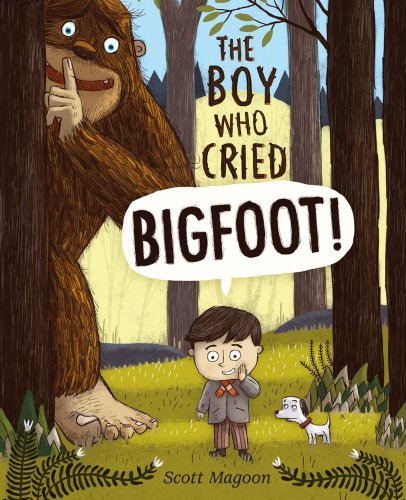
Even after they've heard it, when they've gone to middle school, they want me to tell it again and again.  Perhaps one of the reasons is the story of Sasquatch sits on the line between probable and improbable, true or false.  In his newest title, The Boy Who Cried Bigfoot! (A Paula Wiseman Book), author/illustrator Scott Magoon puts his very special spin on the Aesop fable, The Shepherd Boy and the Wolf.


This is the story of my friend Ben and how we first met.

The first thing readers discover about Ben is he likes telling stories; one particular story over and over.  (At this point you need to insert the word fibs in place of the word stories.) He's pretty creative in his use of gestures and sound effects.

Riding to the edge of the woods on his trusty bike, Ben, like the shepherd boy, is trying to convince people he is seeing something he, in fact, has not seen.  He even goes so far as to fabricate footprints.  As the narrator states:

What a tenacious little fellow he was.

People come once, twice, even three times when he claims to have seen Bigfoot but they finally realize they've been deceived.  Left alone Ben and his faithful canine companion are pondering their precarious position when the silence in the woods is broken by the sound of a stick snapping.  It would seem the teller of this tale has decided to make an appearance.

Not only does he reveal himself but he wants to take Ben's bike for a spin.  Guess who hops on for a ride?  Ben is beside himself, calling for help as loud as he can; his two treasures having vanished into the woods.

Alone in the dark, but not for long, Ben does some thinking.  He needs to convince his family (and neighbors) how his fabrications finally came true.  Ben's a clever little guy; perhaps this new scheme will work.


From the beginning the technique Scott Magoon uses to have an unseen narrator speaking to readers generates an inviting air of mystery.  This simple, conversational tone coupled with Ben's and the secondary characters' dialogues intensifies the interest.  Magoon explains, in a blog post here, how this particular twist on the fable developed.  Of course, even this essay does not explain the final delightful two pages.


Readers know immediately what Ben does not by opening the jacket and cover to reveal Bigfoot hidden, but not hidden, behind a tree in the woods. (The dog does, though.)  Opening and closing endpapers, green on green, feature a pattern of Bigfoot prints though careful viewers will notice a subtle difference between the two.  Digitally-rendered two-page spreads throughout follow Ben on this day to remember; the color palette reflecting the changing light.

Deft, fine lines designate physical characteristics, personality and emotions; especially in the eyes.  While the dog never utters a single sound readers are acutely aware of his reaction in each illustration through his facial expressions and body movements; in a word-hilarious.  It's this attention to details that elevates this larger-than-life legend of learning to excellence.


Travel with Ben on his bike with his best buddy in The Boy Who Cried Bigfoot! written and illustrated by Scott Magoon as he discovers truth really is stranger than fiction.  Readers will be smiling long before the identity of the narrator is divulged with laughter quickly following.  For more art and the process of bringing this book to publication follow this link to an interview at Seven Impossible Things Before Breakfast.