Quote of the Month

When love and skill work together, expect a miracle. John Ruskin


Showing posts with label Deborah Freedman. Show all posts

Monday, May 2, 2022

Evolving Into

It is not only determined by a date on the calendar.  The shift from standard time to daylight savings is not a sole indicator.  Its arrival is truly announced by a sound.  It is a sound absent for many months, then one day it returns.  The sound's melody greets the day, surrounds us, and lifts into the sky.

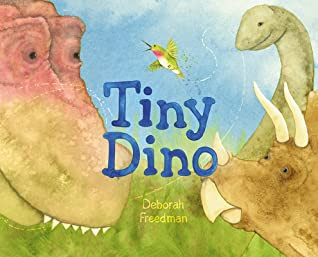
This sound is the chorus of birdsong.  These avian marvels are returning to their homes, some staying and others moving farther north.  They are the true heralds of spring.  To add to the fascination of their essential existence, author illustrator Deborah Freedman in her newest release Tiny Dino (Viking, an imprint of Penguin Random House LLC, April 19, 2022) explores the direct connection between dinosaurs and birds.
Long ago, there were many kinds of dinosaurs.

Stomp!
Clomp!
Tromp!

After these first few words, readers are asked a question.  A voice replies with

I'm a dinosaur!
I'm a dinosaur!

It is the voice of a hummingbird.

Hummingbird continues to joyfully declare kinship with dinosaurs.  When a turtle friend asks about the stomping and clomping dinosaurs did with their feet, the hummingbird points out the similarities between the toes of a Tyrannosaurus rex and the bird's toes.  Turtle and now friend frog point out the huge toe size and the huge bone size of the dinosaur.

Hummingbird proclaims that both have hollow bones.  Each time Hummingbird's friends suggest what they believe to be a difference, Hummingbird counters that said characteristic is shared.  When pals Turtle, Frog, and Mole state dinosaurs had claws and were fierce, the tiny avian verbally explodes.  Hummingbird is

FIERCE!

When a crocodile approaches, Turtle, Frog, and Mole flee.  With all this dinosaur talk, they believe Crocodile to be a dinosaur.  Crocodile says he is not a dinosaur.  Hummingbird agrees, but supplies all the physical features they share.  They are related.  Turtle asks one final question.  Hummingbird shouts out her refrain.


With absolute conversational clarity, author Deborah Freedman takes readers into the story of a hummingbird that proves his truth.  Each time Hummingbird declares he is a dinosaur, one of his friends counters with facts they believe disproves his statement.  He then shows they are wrong with supporting evidence.  In this manner, Deborah Freedman introduces an engaging cadence while providing information about dinosaurs, birds, and other animals.  There are also factual captions next to detailed drawings of relevant, enlarged characteristics.  Here is a passage.

But look---
I have scales
on my toes.

And you 
have scales on
your toes!

Crocodiles and birds have
similar scales, called scutes.
Researchers believe that
feathers evolved from scales!


The image on the dust jacket extends from flap edge to flap edge.  The body of the Tyrannosaurus rex continues over the spine to the far left.  On the left side of the jacket, the back, readers can see one of the dinosaur's feet is holding the ISBN.  The body of the Stegosaurus, similarly stretches to the right flap edge.  Hummingbird is already voicing his truth to the listening trio of featured prehistoric creatures.  The title text and front flap text are varnished.

Hues of light blue, softly textured, are the canvas on the book case.  The Tyrannosaurus rex is outlined in white in the same position as shown on the jacket.  A darker blue dotted loop-de-loop pattern indicates the flight of Hummingbird.  The bird is flying toward the right edge of the front of the book case.  The posture of Hummingbird mirrors determination.

The narrative begins and concludes on the opening and closing endpapers.  The images are wordless.  On the first set Crocodile, Mole, Frog, Turtle and a white bird are moving to the right edge.  A Brontosaurus, also moving to the right, fills both sides.  Above them in a faintly blue sky, a flaming asteroid falls from the left-hand corner.  They are moving through a grassy landscape. On the final endpapers with a faint blue sky and grassy area, Crocodile, Turtle, Frog, and Mole move to the right.  In the sky Hummingbird loops toward the right.  White outlines show us the three dinosaurs showcased on the dust jacket.

Prior to the title page, another illustration has two dinosaurs running as the asteroid gets closer.  On the title page, a question is asked.  Hummingbird answers, three times.  The third answer contains the title text.  Turtle is entering from the right edge.

With each page turn, readers will feel their appreciation growing at the presentation of the story and the information.  Set in pastel watercolor washes are different shaped speech balloons containing the conversations.  When physical traits are compared, those are done in white on blue.  They are intricate.

White space is masterfully used.  It creates pauses in the pacing.  Perspectives shift to furnish us with a sense of being a part of the story.  The majority of the images are double-page pictures.  

One of my many favorite pictures contains a lot of white space.  It spans two pages.  On the far left we see portions of Mole's, Frog's and Turtle's bodies peeking in from the left.  Above them, Hummingbird hovers.  On the far right, just one eye and the large mouth of Crocodile is presented.  (He is coming from the right edge.)  His mouth is open.  Some sharp teeth are depicted.  Crocodile is saying

Pardon me!
Did I hear that dinosaurs
still roam the earth?


Whether this book, Tiny Dino written and illustrated by Deborah Freedman, is read by an individual or as a group read aloud, you can expect to have it read repeatedly.  To have the facts woven artfully in the narrative and images is a gift.  At the close of the book are an author's note and a list of resources.  Even here, Deborah Freedman still educates us while continuing the story along the bottom of both pages.  I highly recommend this title for both your personal and professional collections.

To discover more about Deborah Freedman and her other books, please visit her website by following the link attached to her name.  Here is a link to Lesson & Activity Ideas, & Resources made by Deborah Freedman.  Deborah Freedman has accounts on Facebook, Instagram, and Twitter.  At the publisher's website, you can view interior illustrations.

UPDATE:  Deborah Freedman is interviewed about this title at Writers' Rumpus.  The interview is in-depth and includes her artistic process.  (July 1, 2022)

Friday, May 14, 2021

Transition

On any given day, moment to moment, change is happening all around us.  Some of the transformations are so subtle, it is the following day before we recognize them.  Other shifts announce themselves in glorious splendor.  Mindful observers realize variations, regardless of their size, are extraordinary.

When we are grounded in extraordinary, our sensory awareness expands.  Is Was (Atheneum Books for Young Readers, May 4, 2021) written and illustrated by Deborah Freedman explores change in its many forms.  Through her spare text and distinctive paintings, she introduces possibilities for rethinking how we perceive change. 

This sky is
the same sky that
was blue,


                       but now is 

Clouds have moved into the blue sky.  Soon it is raining hard enough to satisfy a thirsty earth and its inhabitants.  When it stops, the rain goes from is to was, becoming perfect pools.

A fox approaches as an energetic chipmunk, a yellow songbird, and a buzzing bee drink and fashion a melody.   Quickly, everyone but the fox scatters.  The pools of water are no longer for savoring or singing.  Their previous purpose is abandoned.

As the story wraps around readers, there is a constant fluctuation as we follow each of the inhabitants moving in their world.  There are new sounds.  Light goes from bright to shadowed.  Safety is replaced with danger.  The world stills.  

In that stillness, other things are apt to become abundantly clear.  Reach out with all your senses and your marvelous mind.  You will discover the undeniable beauty of our living planet.    


Through impeccable pacing and word selection, author Deborah Freedman tells a story that speaks to every living individual's heart.  She has taken the essence of life and placed it within the pages of this book.  Two words, is and was, supply unbreakable connections bringing everything full circle.  Here is another sentence.

Where singing was,

a buzz is 

. . . . . . . . . . . . . . . . .i z z z z z z z z z z z


You cannot simply give the open dust jacket one look.  You need to pause and study every element, flap edge to flap edge.  It pulses with quiet energy.  From the left edge at the bottom the fox moves through the grass, past a group of stones.  Overhead a raptor glides and gazes, looking for an opportunity.  Near the stones on the branches of a shrub, a spider spins a web.  To the left and under the web, the bee flies toward the fox.  As rays of light and hues of blue transition near the spine, the outline of a child appears.  Do you see?  Watch as this child swings back and forth in the changing colors.  The yellow songbird is near the leafy branches at the top and the chipmunk rests at the base of the trunk.  The golden grasses extend to the right flap edge.

For the book case, left edge to right edge, the scene is the same except it is now night.  Stars pepper the darker sky.  The chipmunk is now on the left, on top of one of the stones.  On the right side, right of the tree, a bat soars.

A pale mint green covers the opening and closing endpapers.  On the initial title page, the yellow songbird flies past the text to the right.  A single cloud frames the other side of the text.  On the formal title page an increasingly cloudy sky makes a canvas.  IS is on the left.  WAS is on the right.  You understand a transition is happening. 

Each double-page image was

rendered in watercolor and pencil

by artist Deborah Freedman.  Each one is more breathtaking than the previous one.  The placement of words and letters in the illustrations is masterful.  Sometimes we are close enough to the lovely beings to be as one with them.  We understand their instincts and responses.  In other settings, Deborah Freedman has us stand back, more as watchers, so we get an enlarged outlook.  There are two wordless visuals.  You have to remind yourself to breathe.  When humans are presented near the end, the magic increases.

One of my many, many favorite illustrations is for two words.

Quiet is.

We move closer to the stones on the left with the single stone in front of the spider web.  The spider rests on that stone.  The yellow songbird flies between the stones.  The chipmunk is peeking from its hiding space.  There is grass along the entire bottom.  The right side is filled with the blossoming lower branches of the tree.  Only the sharpest of eyes will see what is hidden among those blossoms.


Brilliant in concept and excellent in its achievement, this book Is Was written and illustrated by Deborah Freedman is one to be read often and shared widely.  You will want to gift this repeatedly.  You will want to have a copy on your professional and personal bookshelves.  And you cannot read the dedication at the end without being deeply moved.  (Okay, I got teary.) Thank you, Deborah Freedman for this book.

To learn more about Deborah Freedman and her other wondrous books, please follow the link attached to her name to access her website.  Deborah Freedman has accounts on Facebook, Instagram, and Twitter.  At the publisher's website you can view the entire dust jacket, book case and some interior images.

Friday, April 5, 2019

Doing What We Do

The shifts from one season to the next, twice a year, have been marked over the past decade, at least, by long periods of rain stretching from days into weeks.  Sometimes, initially, it is a welcome respite after a summer drought or a winter of too much snow; other times it causes great distress on the land, on the waterways and on the wildlife.  In balance, water is life.

Earthworms, during rain, crawl from the earth to better breathe.  They are caretakers of our soil.  Every specie and its actions are linked.  Even the tiniest task can impact those affected by its absence or presence.  In Carl and the Meaning of Life (Viking, April 2, 2019) written and illustrated by Deborah Freedman an earthworm is asked a question for which he has no answer.  Like all good stewards he seeks the truth.

Carl was not a bird.

There are many things Carl was not, but without a doubt Carl was an earthworm.  His days were spent in earthworm activities in the dirt.  He moved constantly, made endless burrows, chewed and consumed fallen debris and left castings behind to nourish the soil.

One day a field mouse wanted to know why Carl did all those things day after day.  Carl did not know why but he wanted to discover the answer.  His fluffy soil making stopped.

In turn he questioned a rabbit, a fox, and a squirrel.  Their replies simply did not fit Carl.  The earthworm's search continued for a very long time until the fluffy soil changed to hard, unproductive ground.  The animals left this waste land.  In loneliness Carl let out a sniffle.  A sniffle sound came back to him.  He was not without company.

At the plight of this creature, Carl now realized what had happened to the dirt.  He worked and worked for months and months creating fluffy soil.  A single voice made an observation.  Carl found his truth.


Deborah Freedman has the ability to find the extraordinary in the ordinary.  Through her words we have pondered siblings, play, friendship, the act and art of storytelling, bravery, places we call home and now how to find our purpose and place in the world.  Through the narrative and conversations Carl has with other animals we discover how, for many of us, we do what we do because we love to do it.  We rarely ask why.  As we journey with Carl the why for him, for the other animals and for us becomes crystal clear.  Every word, every thought and every sentence connect us to the undeniable, beautiful meaning of life.  Here is a passage.

"Why are you talking to a fox?!"
cried a squirrel.

Carl was startled.
"Because the field mouse is waiting
and wants to know what I am here for!"

The squirrel declared,
"I'm here to plant trees.
Trees are where I sleep."


When you open the dust jacket the mound of grass-covered dirt continues on the other side of the spine extending downward in an arc.  A doe, raccoon, bear and beaver meander in the grass.  Deborah Freedman features the fox, field mouse, squirrel, rabbit, an important tiny creature and her yellow bird along with Carl on the front due to their conversations.  Signature soft, delicate colors form each animal and the setting.  The words Carl are embossed as if they are burrows in the dirt.  (I am working with an F & G.  My copy has not arrived yet.  If you wish to see the book case go to @MrSchuReads on Twitter for the date of March 16, 2019.)

The opening and closing endpapers are lush fields in varying shades of grassy green.  There is a notable difference on the closing endpapers.  A double-page picture for the title page is an early morning sky, purple gray with rays of light shining toward Carl, perched on a small mound of dirt beneath the text.  Most of the illustrations, rendered in pencil, watercolor, and bits of colored pencil, and assembled in Photoshop, span two pages.

Intricate details form each animal. Careful readers will see the tiniest of creatures in the scenes; dragonflies, a bumblebee, a praying mantis, a moth, and a spider web.  They will also see flashes of the yellow bird shown at the beginning in the body of the book and on the verso at the end.  Deborah places animals on one page and has them move into another scene.  This gives us the very real sense of Mother Nature always being in motion.

Three times a circle, like a magnifying glass, brings us close to Carl, enlarging him in comparison to his surroundings.  For emotional impact Deborah Freedman changes the background colors.  Carl is placed small and alone in darkness, a vast waste land, and on white.  Several times the script used for the title text supplies emphasis on words within the narrative.

One of my many, many favorite illustrations spreads across two pages.  Carl is raised up and speaking with the rabbit on the left side.  Above them, partially hidden and intently watching is the fox.  In the field replete with flowers on the left and right, shown as pale shades of green, six bunny babies are leaping.  Deborah Freedman has depicted them exactly as they are apt to play.  There is something soothing about this scene in its normalcy. 


Despite our physical stature or the size of our accomplishments Carl and the Meaning of Life written and illustrated by Deborah Freedman allows readers to see their value in our world.  Carl is one of the most endearing earthworms readers will ever meet.  I highly recommend this title for your personal and professional collections.

To learn more about Deborah Freedman and her other work, please follow the link attached to her name to access her website.  At her website you can see interior views from this book and her other titles. Deborah has accounts on Instagram and Twitter.  At the publisher's website you can view the opening endpapers.  At Scholastic's Ambassador of School Libraries, John Schumacher's site, Watch. Connect. Read., Deborah Freedman stops to chat about this book.  (You can see the book case there, too.)

Tuesday, February 14, 2017

From That, This

Having a canine companion affords you great lengths of time for reflection and retrospection.  Whether you are ambling up and down the hills of a disc golf course, strolling along the Lake Michigan shoreline, winding through northern Michigan woods or standing in your own backyard, your mind wanders where it might otherwise not go.  You wonder about the land and lakes hundreds of years ago, who might have lived there or walked along the same path you do today.  It's hard not to believe we are all connected regardless of the dates spanning our lifetimes.

In her newest title author illustrator Deborah Freedman takes these musings one more step.  She offers readers an opportunity to explore deeper connections, connections to the gifts given to us by our planet.  This house, once (Atheneum Books for Young Readers, an imprint of Simon & Schuster Children's Publishing Division, February 28, 2017) is both intelligent and beautiful. It has one of the best first sentences I have ever read.

This door was once a colossal oak tree about three hugs around and as high as the blue.

Building from the door which opens into a sanctuary, a home, we are asked to think about stones.  Where were they before they became a part of this abode?  They were waiting to be awakened.

We have an entrance.  We have a foundation.  Now come the walls fashioned from the earth; from dirt to the dignity of making a space, a place of hope and happiness for the dwellers therein.

To keep out the seasons, endeavoring to shelter from cold, heat, wind and wet a roof is made.  Sturdy hands sculpted shingles from shapes centuries in the making.  Let's open the door and step inside to the warmth within these four walls sitting on a secure foundation protected by the created canopy.

Our views are sharpened and framed by tiny elements gathered and heated into a liquid that hardens, transparent and tough.  In the glow of dancing light from a fire more moments emerge, allowing us to insert a comma in our thinking.  Let's seek, let's learn, let's know.


In words like a lilting melody we are asked by Deborah Freedman to imagine with care and clarity about the beginnings of those elements which comprise our homes.  She supplies this refrain by presenting a poetic statement about each of these materials.  This artful writing requests us to not only think but to express gratitude.  In addition we can't help but wonder even farther back.  An oak tree grows from an acorn.  And acorn comes from an oak tree but how did the acorn get planted.  This train of thought is absolutely marvelous and important.

These stones were once below,
underground, deep asleep...


When you open the dust jacket for This house, once you instantly feel calm envelope you.  The deep rich shades of purple, the starry sky and crescent moon allow us to begin to imagine.  Is the house in snow or clouds or both?  The spot color of red for the door knob and the raised foil for the title are the ultimate finishing touches of design.

The pale lavender hue used for the text on the spine becomes the canvas across the book case.  On the front of the case the same shade of foil from the jacket etches the house into the background.  On the spine the foil is used again.  On the opening and closing endpapers a soft gray, like stones, provides the color.  With a page turn we have an initial title page, stones lying in grass.  For the formal title page a kitten appears among the stones as oak leaves in clothed in autumn hues drift down across two pages.

Another page turn continues the line of stones but a squirrel, leaping frog and turtle make an appearance as the leaves gather in a pile.  A tiny yellow bird hovers above the publication information on the left and the dedication is on the right.  You must read it.

A lovely, truly lovely rhythm is made by Deborah with her images rendered in pencil, watercolor, and bits of colored pencil and pan pastel, with an assist from Photoshop.  She begins with a white canvas, two pages, with her words on the left and a small but significant illustration on the right.  The next two pages are a stunning wordless extension of the first picture adding in her delightful creatures.  In these gorgeous two-page visuals she may give us a more panoramic view or take us in close.  Some shade of purple unifies all the pages.  Careful readers will notice the presence of one animal in all of them from beginning to end, a circle.

One of my many favorite illustrations (They are all stunning in their soft texture and lightness of line and luminosity.) is for the mud.  Across two pages we have a light purple sky gently framed in pale blue.  Shades of brown form the mud.  Grass, stones and oak leaves are placed on this ground.  The kitten is slapping the surface, paws socked in dirt.  Splashes of mud move upward as the frog happily leaps.  A turtle slowly moves toward the frog and kitten.  Watching this all this activity is the tiny yellow bird.  This picture is filled with life and.... a deep love for our planet.


Right now I have a small stack of books (two) which I want to put under my pillow each night and which are on my desk all day, every day.  This house, once written and illustrated by Deborah Freedman is joining this group.  This book will go deep into every heart imploring us to think more completely and to move through life with gratitude.  This book is one which must be on all bookshelves.

To discover more about Deborah Freedman and her other work take a few moments to visit her website by following the link attached to her name.  At the publisher's website you can view interior pages.  Artwork from this title and process pictures are featured at author, reviewer and blogger Julie Danielson's blog, Seven Impossible Things Before Breakfast.  Deborah Freedman is showcase at Life's An Art!.

UPDATE:  Deborah Freedman is interviewed by educator and director of The Plum Creek Children's Literacy Festival, Dylan Teut on his blog, Mile High Reading, February 23, 2017.

Friday, September 23, 2016

Waiting And Wishing

One of the things I remember most about my classroom years, kindergarten through high school graduation, is knowing the answers over and over again but being too afraid to raise my hand.  I was painfully quiet except when with close friends.  My solace was in books; books allowed me the freedom to be everything I felt inside on the outside as long as I was reading.

Upon finding out a speech class was required for all incoming freshmen in college, I felt true fear.  What saved me were grim determination and a deep desire.  Teaching was my passion.  If I was going to teach and teach well, this shyness had to go.  In our speech class we were given the opportunity to give our speech the week before it would be graded.  Every single time I not only elected to do this but also volunteered to go first.  To fulfill a dream I forced the fear away.

Reading a book about a character who views their world in much the same way we do ours, encourages us.  Shy (Viking, September 27, 2016) written and illustrated by Deborah Freedman is a book which calls to readers as soon as they see the title.  Let's answer the invitation!

Shy was happiest between the pages of a book.

If a book offered possibilities in a place other than where Shy resided, it was wonderful.  Books about birds, all types of birds, were Shy's favorite kind of books.  Do you think it was because they could fly away?  Do you think it was because they had such a panoramic view of the world?

He knew birds were champion singers of songs, but Shy had never heard a bird sing.  Wait a minute.  That was a real bird singing.  That's a real bird singing near Shy.

Shy wanted to say something but what if he got tongue-tied or worse yet started talking a mile a minute without making a lick of sense.  While he was debating what to do, the bird flew away.  The bird and her song were so lovely, Shy finally made a decision.  He followed the bird.

The world, the vast wide world Shy walked through, was more beautiful than he had imagined.  He could hardly believe all the animals he was seeing.  Quite unexpectedly bird song filled the air; lots of birds' songs. Would Shy find his special golden yellow bird?  Then his heart filled with joy.  She was here.

He could hardly wait to speak with her.  Being in the presence of this bird opened a door long closed inside Shy.  Darkness came and all the birds left; Shy's happiness going with them.  He had waited too long. Returning home, Shy found comfort where he always had.  Would Shy hear the song he loved again?  And if he did, what would Shy do?


With nine carefully chosen words Deborah Freedman piques our curiosity. Who is Shy?  Why is he happiest between the pages of a book?  What do the words between the pages of a book mean in reference to this story?  With a page turn the following sentence completes the spell surrounding us with magic which never leaves, growing stronger sentence by sentence.  We care deeply for Shy whoever or whatever he is.

Two times we read Shy's thoughts as he gets close to speaking with the golden yellow bird.  We understand his desires and the dilemma he faces.  In a marvelous classic stroke of storytelling brilliance Freedman uses a third scenario to reveal Shy's identity and to unfold the results of a decision.  The song the bird sings

treep treep troo-lee

is true bliss to read aloud.  Here is a passage.

He made his way over acres and acres...
Shy felt like he was walking through one of his books,
though it was all far more wondrous
than it ever looked in pictures.


As soon as you open the dust jacket the natural color palette on the single image pulses with peace and quiet.  Nineteen animals of land and air are walking or flying toward and around the title text except for the ostrich with its head in the sand.  A tiny mole noses the ISBN.  (I am working with an F & G.)  Every delicate line and soft stroke of her brush works to create the essence of shyness.  On the title page using the same hues but slightly lighter,  Deborah Freedman has the golden yellow bird turning up the lower right-hand corner of the page as if to say...come, please read this story.  For the next three page turns various shades of the golden yellow are used as the narrator speaks about Shy.

On the third image the top book in the stack of volumes on birds is open to a scene of pale sky blue on white with the golden yellow bird flying from left to right.  When the bird becomes real in the next picture it's like we've zoomed in on the open book.  Freedman maintains variations on these golden yellow and blue colors until the animals and chorus of birds appear.  In a breathtaking change of background she adds rich, dusty reds and oranges as the sun sets. Her night skies are like a comfy blanket.

When the identity of Shy is shown to readers, they will gasp at his placement, color and what he says.  In fact, in every single visual, rendered with pencil, watercolor and bits of colored pencil assembled in Photoshop, all of the elements work to provide a sense of stepping into serenity as if it's a place instead of a state of being.  Details like the faint titles on the spines of the books, notes of songs shown as circular bubbles and the birds in full color with the other animals watching them in more muted tones work to give readers masterful illustrations.

One of my favorite images of many is when the focus of the picture is on seven birds.  It is when Shy discovers his golden yellow bird is present and singing.  Eight faint large circles are positioned around them.  Beneath them, much smaller in scale, readers will be able to find ten animals gazing upward, all of them happy to see and listen to the birds.  The background is pale blues, greens, yellow and brown in overlapping sloping hills.  You want to walk right into this picture joining the animals.


A timeless tale of being afraid but finally willing to follow what you want most, Shy written and illustrated by Deborah Freedman will resonate with readers of all ages.  It's the desire to express your love of something or someone which will give you the confidence you need.  You can't put a price on the reward which fills your heart. The pacing in the text and illustrations and the manner in which they enhance one another is stunning.

To learn more about Deborah Freedman and her other work please follow the links attached to her name to access her original and more recent websites.  You can view my favorite picture and another image at author, reviewer and blogger Julie Danielson's blog Seven Impossible Things Before Breakfast.  There's still time to visit this very special website dedicated to Shy.


UPDATE:  Deborah Freedman wrote a post for the Nerdy Book Club on September 25, 2016 about this title.  She speaks about her idea of a book; every inch available to an author and an illustrator.

UPDATE:  Deborah Freedman is a guest on All The Wonders, Episode 291 hosted by teacher librarian Matthew Winner. 

Tuesday, April 7, 2015

Talented Tale Tellers

Every morning, noon and night, despite your plans, is an adventure.  When you wake up you believe you have full knowledge of how your day is going to unfold.  You check your calendar, the news and the weather report.  You have gathered all the necessary tools to accomplish your day's tasks.

Of course if your calendar is still on March instead of April, an appointment might be missed.  A banner flashing an emergency message on your television screen about unexpected electrical repairs by city workers could foil your attempts at cooking meals.  Opening your front door to see additional snow instead of the predicted partly cloudy day will definitely put a damper on leaf raking.

If a rather spirited frog happens to hop into your world, everything, absolutely everything, will shift.  By Mouse & Frog (Viking, an imprint of Penguin Group (USA), April 14, 2015) written and illustrated by Deborah Freedman is a story about a story.  This tale starts and stops and starts and stops and explodes in creative craziness.

One morning,
Mouse woke up especially early,
eager to write a brand-new story.

With the time-honored words of

Once upon a time

Mouse begins with a quiet scene of a table being set for tea using a pencil to draw the items, a table, a chair, a cup and saucer, a spoon, a tea pot and a single flower in a vase.  Into this serene setting bursts Frog.  He's sure the table is being readied for his presence.  In fact, pencil now in his hand, he proceeds to add cake, a big cake, to the offered refreshments.

Without a word to Mouse, Frog decides to include a King as a guest.  As Frog would have it, this particular royal has a hankering for ice cream,

all elevendy-seven kinds.

Still mopping up the spilled tea, Mouse is aghast at the mess this melting treat will make.  Oblivious to his friend's distress, Frog has the King declare an open invitation to all in the kingdom for cake and ice cream.  Weaving words and waving his pencil Frog's version of this tale fills the page.

In a fit of frustration, Mouse puts a stop to this story.  When Mouse airs his views, Frog counters.  Clearly their ideas do not match. In a flurry of explanations to characters, erasures and painting, a blank canvas awaits a fresh opening.

A deflated Frog listens as Mouse speaks and draws.  Sensing his revisions are still not what his friend desires, Mouse proposes a change.  Leaping to the challenge, grinning with gusto, and grabbing another pencil, Frog joins Mouse.  Two minds are ready to call in the magic.


As in her previous title, The Story of Fish & Snail, Deborah Freedman introduces readers to wonderfully likable personalities.  We can readily identify with the calm and routine-is-right Mouse as well as the spontaneous and exuberant Frog.  Their differences of opinion as presented in dialogue and their individual versions of the story supply gentle tension and much laughter.  We come to understand how wide Frog's reading world is with his insertion of bits and pieces from other books and tales.  Here is a sample passage.

"Frog.  I am busy today," said Mouse. "I'm writing a story.
Once. Upon a. Time. Mouse woke up early and set the table..."
"For Frog!" repeated Frog.
"...for tea," said Mouse.
"And cake!" added Frog.
"May-be," sighed Mouse.  


I simply can't help it.  I start smiling as soon as I see the dust jacket of this book.  (I'm working with an F & G.) There is something completely endearing in the creatures Deborah Freedman brings into our world.  You can already tell Frog is the more energetic of the two.  Mouse is intently finishing the painting of mouse.  A container filled with a rainbow of color clasped in Frog's hand signals his willingness to explore and add variety.  The butterflies have always meant to me something new is on the way.  To the left, on the back, in a continuation of the blue and white as several butterflies hover near the pencil-drawn table which holds the ISBN.

On the front and back flaps Freedman has Mouse and Frog speaking and interacting with the text on both.  On the opening endpaper Mouse is on the ladder painting white over a soft beige on the page with a can near the bottom of the ladder.  Tucked in the lower right-hand corner is the container of colored pencils.  Everything is white on the closing endpapers except for a single butterfly on the left and a can of paint, brush and pencil along with the ladder, bucket and mop on the right.  There are no words leaving interpretation to the reader.

For the title pages Mouse is on the ladder continuing to paint everything white; the paint can and container of pencils close at hand.  Rendered in pencil, pastel, watercolor and gouache then assembled in Photoshop, the illustrations span across single and double pages.  The way Freedman uses white space with the other mediums is marvelous.

She begins slowly with black and white; the only color in Mouse and the container of pencils.  With Frog's entrance a splash of green is introduced along with the spilled tea.  It is never stated in the text that the tea pot falls from the table.  Her illustrations extend and enhance with excellence.  When Mouse first sighs, the spilled tea is being mopped.  As Frog embellishes his story, more hues appear.  The dragon's fire is a purple haze and the background for the next page.

Freedman's features on the drawn character's and Frog's and Mouse's faces are brimming with emotion, welcoming us into both stories.  The animated antics of both Frog and Mouse, how they use their hands and feet, are delightful.  As she did on the dust jacket flaps, the closing page and publication information page feature Frog and Mouse in conversation.  Trust me, you are going to laugh.

One of my many favorite illustrations is the second set of two pages.  The look on Frog's face as he announces his wishes joyfully jumping on the page is a clear contrast to the look of shock on Mouse's face.  Mouse's stance, feet spread wide, tail straight up and mouth wide open, is hilarious.  This image sets the tone for the differences between the two friends.


Every single thing about By Mouse & Frog, the text and pictures, is masterfully done by Deborah Freedman.  This story is about how stories and the art of compromise develop.  Please read it aloud with voices as often as you can.  I can hardly wait to add it to my 2016 Mock Caldecott list.

To learn more about Deborah Freedman please visit her website by following the link attached to her name.  An earlier interview at Seven Impossible Things Before Breakfast hosted by author and blogger Julie Danielson can be found here.  Deborah Freedman wrote/drew a guest post at author Tara Lazar's PiBoIdMo, Deborah Freedman Begins Drawing. Update:  An Educator's Guide to the Works of Deborah Freedman is now available.


Monday, May 13, 2013

Jump Right In!

When you live in a state surrounded by water filled with inland lakes and rivers, learning to swim is a necessity.  After nearly drowning during lessons at the YMCA, swimming under water became less frightening than swimming on the water.  My wise and caring Dad helped by placing coins in the shallow section to be retrieved by jumping in and swimming along the bottom of the lake.

Sometimes it's more important to feel safe.  Sometimes it's more important to do what you can when you can.  Deborah Freedman's newest release, The Story of Fish & Snail (Viking, June 2013), is about trust; leaving safety and doing more than you think you can to be where you want to be.


Every day...
Snail sits in one special spot, waiting 
for Fish to come home with a story.

On this day Fish returns home excited by the discovery of a new book.  Snail is thrilled with this news, too, wondering if Fish will tell the tale.

Delight turns to dismay when Snail learns this story is not going to be told.  Fish wants Snail to come into the new book.  Fish's zest for the vastness of a watery wonder filled with adventure in this fresh tome completely overlooks Snail's sense of security in staying exactly where Snail is.

Snail fails to see the joy in secret treasure and a pirate ship.  Snail finds pleasure in princesses, kittens and sleeping in the same spot.  With these thoughts voiced, Fish responds that what Snail likes is boring.   

Taunts are tossed between the two; voices getting louder and sentences getting shorter until...with a flash Fish leaves their book. But...but...but...how can this be?  Snail is in a story about Fish and Snail with no Fish.

Snail calls.  Snail looks.  Snail leans.  With a leap of faith toward friendship, Snail astounds Fish.


Told entirely in dialogue except for the introductory and closing sentences, Deborah Freedman instantly invites readers into the intimacy of Fish's and Snail's world.  Within a few conversational exchanges it's easy to understand the two personalities; the one preferring the comfort of routine, the other needing the challenge of change.  This is even enhanced further by the word choices given to Fish upon returning from the new book; 

"Ahoy, Snail!" ...
"Arrrgh, Snail, I promise we can come back here later. ..."

It's also crystal clear, though passionate about their respective positions, they are bound to one another.


In looking at the two-page array of the cover, splashes of water following Fish leaping toward Snail, the three colors against the blacks, grays and white of the bookcase, you can't help but feel the pure elation of the moment.  Lightly tinted blue-green watery opening and closing endpapers welcome readers.  Zooming back from the cover image the title page shows an open book in the thematic color palette, on a stack of the tonal black books, a huge splash of water with the glimpse of a golden tail on the left with the information on the right.  The verso and first page of the narrative continue with the same perspective giving readers a clue as to the smaller world in which Snail and Fish live; a fish bowl.

As the conversation begins and intensifies we move in closer and closer; Fish's movement about the page highlighted by splashes and bubbles as if swimming in water.  We are well aware of the emotional state of each by the position of eyes and eyebrows.  The viewpoint shifts again after Fish leaves to capture the lengths...and heights Snail needs to conquer to follow Fish.  All of the illustrations extend over two pages.

Freedman's use of watercolor and pencil and/or ink with the contrasting limited color palette skillfully presents the realm of a fish bowl or ocean within a book within a book.  You can't help but be amazed at this portrayal of speculative visualizing.  I adore so many of these illustrations but two of my favorites are:  the pile of books in front of the book shelves with the huge SPLOOSH! reaching to the top of the stack representing Snail's bravery and the two friends on the wavy pages of the new book, alternate personas in place as they embark on their journey.


The playful pal and comfortable companion are delightfully depicted in The Story of Fish & Snail written and illustrated by Deborah Freedman.  When it comes to friendship, living the story is much better than listening to the story; your world grows, your spirit soars and your heart is brimming with happiness.  Oh, let me tell you; this book is meant to be shared...again and again.  This would be lots of fun as reader's theater or at the very least be sure to use a special voice for each of the characters.

I've placed links to Deborah Freedman's website and her blog with her names above.  Update:  An Educator's Guide to the Works of Deborah Freedman is now available.

Wednesday, December 21, 2011

Bawk, Bawk, Whoops!

Much as children and dogs can't resist jumping in a muddy puddle, the cover of Blue Chicken written and illustrated by Deborah Freedman, shows that a particular chicken with three duckling companions are having splish-splashing fun in blue paint.  Who can resist such gleeful abandon?  It makes you want to join in immediately.

So you do.  Opening the book, endpapers reveal a pale gray room, two window frames giving a view of a steel blue day, rain falling, clouds hanging low with a barn nearby.  The title page follows, zooming out showing an artist's table complete with jars of paint, brushes, a water jar with brushes, a pencil and a barnyard graphic in front of a four-framed window. With the next turn of page one of the chickens in the coop pops up her head coming to life off the illustration.

An unseen voice exclaims that the painting is nearly finished and today is a good day for painting the barn, then noticing that perhaps one of the chickens wants to help.  Dipping her white head in a pot of blue paint it spills over her and a great deal of the painting.  Before long it spreads turning the world completely and totally blue.

HELP!

The repentant little fowl is so sorry.  Perhaps there is a way to make the farm critters not so blue...literally. With the help of a baby duck the two tip, tip, tip that jar of water.  Thank goodness, those hues of blue are washed away...except for the sky, as it should be. 

Zooming back readers see through the window the outside sky has been rinsed clear also,  making it a good day for painting the barn.    Looking back at the illustrator's table what do we see?  Some artistic ducklings and the chicken trying to move a jar of red paint.  Closing endpapers tell the tale of what they accomplish.

Deborah Freedman, using watercolor, pencil, ink and a bit of Photoshop, conveys clearly and cleverly the emotion on the barnyard animals aghast at their dilemma and the panic of the chicken.  Charming happiness portrayed when the problem is solved so delightfully can't help but bring smiles.  I'm smiling now just thinking about it.

Spare melodic text compliments two page spreads flowing like the medium used to create them. 

Playful use of paint, exuberant, curious, creative characters and the splendid blend of a paper and real world lift Blue Chicken written and illustrated by Deborah Freedman skyward.  Who doesn't want to be happy?  It's guaranteed for readers of this book.  I foresee a chorus of read it again, each and every time this title is shared.

For a memorable, delightful interview of Deborah Freedman go to this link at Seven Impossible Things Before Breakfast.  Freedman's website can be accessed by the link attached to her name at the beginning of this post.  Update:  An Educator's Guide to the Works of Deborah Freedman is now available.