In my adult life, I have bought and sold ten houses. Last June I moved into the eleventh house. In most of those homes, there was a small piece of paper on display I read everyday with these words:
The beauty of the house is order,
the blessing of the house is contentment,
the glory of the house is hospitality.
I am currently struggling with the first line as organizing my considerable book collection is time consuming, but this eleventh house is slowly becoming a home filled with a happy, tail-wagging canine and her human who both enjoy visitors.
Each individual holds their own meaning of home in their mind and heart. In The Mouse Who Carried A House On His Back (Candlewick Press, August 30, 2022) written by Jonathan Stutzman with illustrations by Isabelle Arsenault readers come to understand some of those definitions. They also realize how houses become homes within the context of welcoming.
Vincent was a mouse with boots on his feet,
a hat on his head, and a house on his back.
He had traveled many miles and lived many places,
but today Vincent would live here,
because he knew it was where he needed to be.
Vincent stopped on a grassy hill. The sky stretched as far as his eyes could see. He removed his boots, hat, and his house.
A weary and grumpy frog soon hopped toward Vincent. Vincent offered his house as a place to rest. The frog laughed. Obviously, the house was too small, but peering inside it was definitely bigger than it looked.
As the day progressed Vincent was visited by a hungry cat, a rain-and-wind tossed family of hedgehogs, and a bunch of other animal residents of the forest. Each time, the mouse would offer his house as a sanctuary. Each time the animals believed the house was too small to accommodate them, but they were wrong. The house grew and grew and grew.
As all the gathered beings were about to enjoy a feast in the soothing sanctuary of Vincent's house, there was a knock at the door. It was now dark outside. Standing at the door was a bear, a bear who was hungry and lost. Vincent was his usual cheerful, inviting self. The other animals were not. Their voices rose in protest. Vincent knew where he was needed and no one was going to change what he believed to be true.
With every reading the musicality of this story, in a blend of dialogue and narrative, by Jonathan Stutzman grows more evident. We are initially introduced to the main protagonist and his house. Each time an animal appears we are reminded of this mouse's characteristics and the characteristics of his house. Carefully chosen words clearly indicate the condition of each animal upon their arrival. This is paired with a perfect suggestion by Vincent as to what his house offers. There is a repetition of key phrases. Jonathan Stutzman brings us full circle with his closing sentences. Here is a passage.
Clouds billowed in the west, and in blew a family of hedgehogs---one by
one by one by one by one by one by one---each wet and tousled by a
mighty storm.
"Terrible weather in the valley," squeaked the youngest.
"Come in, come in!" said Vincent with a smile. "I have warm blankets
and beds and a crackling fire." . . .
The artwork on the open book case is a single vibrant image. Vincent, moving to the right, has passed through a mass of stunning blooms covering the left, back, and continuing to the right of the spine on the front. The house he is carrying on his back is the first of many cut-outs throughout the book. What we see is a hint of the gorgeous opening and closing endpapers. The array of blooms on these endpapers is stunning.
On the back of book case is text that would normally appear on the front and back flaps of a dust jacket. At the top is a short description of Vincent and his house. Toward the bottom we read about Jonathan Stutzman and Isabelle Arsenault.
The floral display continues on the two-page illustration for the title page. Here Vincent, on the right, has placed his house down for a moment. Almost all the double-page pictures contain a cut-out of Vincent's house with sizes that shift.
Her characters are highly animated with facial expressions indicating their particular moods. Readers will be fascinated by their clothing. Each time we look inside Vincent's home, there are added elements to make the interior more pleasing. You find yourself looking in anticipation each time a page is turned. Once inside the animals are relaxed and happier. Readers will gasp at the four-page gatefold. Be sure to look in the windows.
One of my many favorite images is when the cat and frog are already inside Vincent's house. On the left, through the cut-out house, one of the hedgehogs is gazing inside. There are now four hanging lamps with unique shades. You can see the cat and frog's shoes, removed, as well as Vincent's boots. The table is longer with more chairs and place settings. The frog and cat are seated there enjoying a cup of tea. There is now a brick fireplace with plates along the mantle. A roaring fire there spreads warmth. Two beds are in front of the fireplace. Other beds can be seen on the left. Spare blankets are stacked on a stool. There are several rugs on the floor.
The first time I read The Mouse Who Carried A House On His Back written by Jonathan Stutzman with illustrations by Isabelle Arsenault, I felt as though I had been presented with something rich and rare. We are enchanted from beginning to end by Vincent and his uplifting spirit and kindness. In his eyes, all are equal. Hopefully as the animals leave his home, his generous spirit will go with them and us. You can't help but wonder how Vincent knows where he needs to be. This book is sure to generate discussions. I highly recommend this title for your personal and professional collections.
To learn more about Jonathan Stutzman and Isabelle Arsenault and their other work, please visit their websites by following the link attached to their names. Jonathan Stutzman has accounts on Facebook, Instagram, and Twitter. Isabelle Arsenault has accounts on Facebook and Instagram. At the publisher's website, you can view an interior illustration. At Penguin Random House, you can see additional interior pictures.
It is safe to say the phrase "opposites attract" will continue to be researched and debated for many years to come. There are supporting factors on both sides. If you think about it, as I have, what a loss for our world if there were no "opposites". What if we walked outside to discover all snowflakes were alike? What if scanning the forested hills in autumn, there was only a single color? What if our planet was populated in a single species in one color, one size and one shape rather than the abundance of species in a multitude of colors, shapes and sizes, flourishing in a variety of habitats in various seasons?
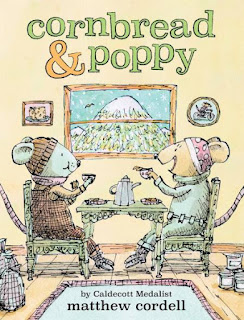
Can not the same be said for the individuals in our lives? This does not mean we don't feel a certain joy in spending time with kindred spirits. We do, but is the joy any less when we feel a rapport, sometimes for our entire lives, with someone deemed to be our opposite? In Cornbread & Poppy (Little, Brown and Company, January 4, 2021), a new early reader series, Caldecott Medalist (Wolf In The Snow) Matthew Cordell explores in three chapters the enduring friendship of two mice who approach many things differently except for one thing.
The First Snow
It was winter. The first snowflake had fallen.
Cornbread, snug in his home, was organizing all the food he had collected in autumn. He tucked away fruit preserves, grains, and cheese. He worried and planned to make sure he had enough to last the long winter.
Poppy, his friend, did not worry or plan. She was a carefree soul, preferring to spend her time biking, hiking and seeking out all kinds of adventure. She did not gather fruit, grains, or cheese. Her food, even at this early date, was nearly gone.
Now her phrase,
Nah, I'll do it later!
was coming back to haunt her. Cornbread went with Poppy to all the vendors and nearby neighbors. They had no food. When Poppy suggested they travel up Holler Mountain, he grew frantic. (Even daring Poppy had misgivings about trekking up the mountain, but she needed to eat.)
Cornbread offered a series of reasons not to go up the mountain. The most serious one was the disappearance of the last mouse to scale the heights, but Poppy was his best friend. They packed essentials in Poppy's wagon, donned warm clothing, and began to climb in the rapidly increasing snowfall.
To say, they found food on the steep ascent would not be true. To say, they did not meet their mortal enemy, an owl, would not be true. To say they had not one but several shocking encounters would be totally true! There were a lot of surprises on Holler Mountain (and afterward), but the best thing about this risky wintery endeavor was the one thing Cornbread and Poppy always had in common, their affection for each other.
After having read this charming title several times, I can say with certainty the pacing is pure perfection. The blend of narrative and conversation done with a keensense of humor by Matthew Cordell had me bursting aloud with laughter more than once. In these three chapters, Matthew Cordell establishes the personalities of the two friends through a rhythmic presentation of their opposite habits and life views. He takes you to the edge of a situation with you expecting it to go a certain way and when it does not, you are drawn further into the story of Cornbread and Poppy. Here is a passage.
The snow crunch. . .crunch. . .crunch. . .crunched
around them. The owl had landed.
Sniff. . .sniff. . . "Is that mice I smell?" said a
voice.
Cornbread and Poppy shivered. The shrub
shivered.
"I like mice!" said the voice.
The shrub shivered.
Poppy grabbed a stone and stood up.
"I'll save you, Cornbread! Run!"
One of the first things you notice about the open and matching dust jacket and book case is the signature lines and intricate details often found in the artwork of Matthew Cordell. The clothing, shoes, scrollwork on the furniture, the artwork on the walls, and Holler Mountain in the distance through the window are all clues to the adventures which are to follow in the pages of the book. Do you notice how the tea in Poppy's cup is splashing out? That's probably because she rarely sits still. And what is flying near the peak of Holler Mountain? The color palette shown here is used throughout the book.
To the left of the spine, on the back, Cornbread and Poppy, now wearing skis with poles, are gliding through evergreens down a snowy slope. Why are they wearing backpacks? And is cautious Cornbread smiling? You can feel your anticipation growing.
The opening and closing endpapers are a bright, light turquoise like the sky over Holler Mountain. After the title page which shows us portraits of Cornbread and Poppy against the majesty of Holler Mountain, we read the dedication above a picture of the duo standing together. It says:
To Julie---
the Poppy to my Cornbread
The illustrations rendered
in pen and ink with watercolor
shift in size to complement and elevate the text. They fill portions of a page, an entire page with loose framing, or are grouped together to show the passage of time. There is one two-page wordless visual. Sometimes tiny sound effects are included.
If the pictures represent a thought or memory, a scalloped border outlines the scene. The elements in the images ask you to pause. The signs for each of the merchants reflect what they sell and the current status of their goods. The town grump has a doormat reading NOPE. The expressions on the faces of the characters leave no doubt as to their emotional state.
One of my many favorite illustrations is a single page picture, loosely framed. Within the frame is Holler Mountain. Standing, side by side, with most of their bodies in the frame are Poppy and Cornbread. They are staring up at the mountain at its base. Their feet are outside the frame as is Poppy's wagon. This is not just a picture of a mountain two mice are about to climb. This represents everything about Cornbread and Poppy. No matter what they have to scale in life, they will do it together, regardless of the reason for them being where they are.
After reading this first book in a new early reader series, Cornbread & Poppy written and illustrated by Matthew Cordell, you'll want to climb to the top of Holler Mountain and shout out how wonderful it is. Not only is it engaging from beginning to end for an individual to read, but as a read aloud your listeners will be asking you to read it repeatedly. And you will, because each time is like the first time. I highly recommend you have a copy on your professional and personal bookshelves. AND the next book in the series, Cornbread & Poppy at the Carnival, is set to release toward the end of June, 2022.
To learn more about Matthew Cordell and his other work, please access his website by following the link attached to his name. Matthew Cordell has accounts on Facebook, Instagram, and Twitter. At the publisher's website you can (and will) enjoy listening to a podcast with Matthew speaking about this book. Matthew Cordell and this book are highlighted at author, reviewer, and blogger Julie Danielson's Seven Impossible Things Before Breakfast. There is process artwork.
For some reason, the move from daylight savings to standard time has been a struggle in 2021 (and 2022) for some individuals. It seems the canine community, in this home and in the households of neighbors, is refusing the necessary adjustment. Waking, walking, eating of meals, and sleeping remain on daylight savings hours. This makes their humans' schedules a tad bit off every single day.
This situation, coupled with my dog's acute awareness when a deer, fox, or rabbit happens to be nearby, has diminished our actual time of rest. There is nothing like a dog's loud barking to make you sit upright out of a sound sleep in the middle of the night. . .or is there? After reading Everybody In The Red Brick Building (Balzer + Bray, an imprint of HarperCollinsPublishers, October 12, 2021) written by Anne Wynter with illustrations by Oge Mora, it is apparent we are not alone. Uninterrupted bedtime rest is not necessarily the norm.
Everybody in the red brick building was asleep.
The slumber of the people in the red brick building was suddenly disturbed by a loud vocal outburst by Baby Izzie. It did not go unnoticed by Rayhan. He was decidedly worried about his parrot. The startled bird let out a boisterous screech.
Those two unusual noises instigated a late night game by three pals during a sleepover. (Did Natalia just shoot a rocket out her bedroom window?) In short order, a cat made a mad dash from her sleeping space to the top of a car. This action triggered the car's alarm.
Parental responses were swift. The participants in these nighttime romps began to settle to a new set of sounds. A street sweeper and falling acorns combined to begin a symphony.
A breeze created another melody. A dozing feathered friend added harmony. Like the very best of stories, this one circled back to the beginning.
Author Anne Wynterwrites with the sure knowledge of a storyteller. Each time a new character is introduced, a clamorous noise is associated with them. This noise is repeated with the additional commotions, adding layers and building toward the loudest sound, the car alarm in the street. This technique is employed again as we circle back to the beginning. Readers cannot help but participate in this late night awakening and lullaby. Here is a passage.
Woken up by a WaaaAAH!,
a Rrack! Wake Up!,
and a Pitter patter STOMP!,
Natalia dropped from her bunk to
launch her brand-new light-up rocket.
As soon as you look at the matching dust jacket and book case, you wish you lived in the red brick building. The entire image spans from flap edge to flap edge on the jacket and edge to edge on the case. The characters in the windows on the front, right, of the jacket and case are lively. The hint of nighttime sky we view on the front extends across the back, left, in brush strokes of shades of blue. Beneath this expanse, colorful homes line the bottom, windows dark. The text on the front of the jacket is varnished.
A pale turquoise covers the opening and closing endpapers. The night sky is the background for the title, publication information, and dedication pages. In this night sky, stars leave white-line trails behind them.
used acrylic paint, gouache, china markers, patterned paper pastels, and old book clippings to create the collage illustrations for this book.
The selected colors reflect the more subdued lighting of nighttime, yet they are still a vibrant blend of hues. Each double-page picture calls out to the reader, asking them to stop and notice the detailed depictions.
The facial expressions on the characters convey each mood superbly. We see upset, worry, glee, triumph, and fright before calm settles over each individual. Closed eyes and whispered conversations signal calm. For most of the images, we are close to the actions of the characters. Sometimes a group of smaller insets are on a double page spread to indict the quick passage of time and shift in events.
One of my many favorite illustrations shows readers four windows in the red brick building. The first four windows, on the left, give us a peek inside the homes where the parents have intervened. This is a huge shift in the progression of the action. The parrot squawks a goodnight, a father clicks off a flashlight, a mother comforts a fussy baby, and a girl reclaims her rocket as her mother presses the off button on her car alarm. The next set of four windows on the right are dark. The lights are off, but we can still see elements from the earlier pictures. Wonderful.
In a universal sense and on an everyday level this title, Everybody In The Red Brick Building written by Anne Wynter with illustrations by Oge Mora, allows us to see that the world or our home, family, or friends send disruptions to what we consider normal. And, despite those disruptions, peace is restored. I highly recommend this title for both your personal and professional collections.
To learn more about Anne Wynter and Oge Mora and their other work, please follow the link attached to their names to access their websites. Anne Wynter has accounts on Facebook and Instagram. Oge Mora has accounts on Facebook, Instagram and Twitter. At the publisher's website there is a Home and Community Classroom Kit which includes this title and three other books. Anne Wynter is interviewed at Picture Book Builders and Kidlit in Colorwith respect to this title. This book is showcased at We Need Diverse Books with an interview of Oge Mora.
Sometimes, thankfully not every time, something unforeseen or annoying can keep us from falling into much needed sleep. A branch rubbing against your window by a shift in the wind's direction is bothersome. You make a mental note to trim it as soon as morning arrives. In Awake (Roaring Brook Press, October 19, 2021) written and illustrated by Mags Deroma something unforeseen happens to a little girl and her furry friend, Oscar. Something usually not in her bedroom has taken up residence.
In a big, big city, on a busy city street, there is a pretty tall
building. At the tipity-top of that tall building is my bedroom.
Just before turning out her light, a very sleepy girl and her dog are suddenly not so sleepy. The girl notices a spider. It's surprising how you can go from dead tired to eyes-wide-open awake in a flash.
Sleep is impossible when you share your room with a spider. There is nothing available to end its life. It cannot be thought away.
Still, the girl persists in imagining all manner of options to rid her room of that spider. Her schemes, in her mind, grow larger and larger. Wait! The spider is moving.
Quick as a wink, the glass on her nightstand is grabbed and encloses the unwelcome guest. It is then, on closer examination, a change occurs. With understanding, fear leaves and is replaced with compassion.
With the protagonist as narrator, author Mags Deromaencourages readers to identify deeply with the little girl. The words in her sentences fashion a welcoming cadence. Her descriptions of place and time are those easily identified by many of us. Here is a passage.
I know! The WATER SPOUT!
Just like the RAIN,
I'll WASH the spider out!
But
then out comes
the sun . . .
and dries up
all the rain . . .
and that big hairy
spider CANNOT come
up the spout again,
thank you very much!
The limited color palette used throughout the book is introduced to readers on the dust jacket. These muted shades lend a warmth to the darkness of night. The use of red here and in the interior portions of the book is highly effective. On the front, both the little girl and Oscar, her dog, have their gaze on the intruder. The placement of the text, spider and the characters is marvelous!
To the left of the spine, which replicates the red-and-white stripe of the little girl's pajamas, is a sky dotted with stars surrounding the tall building. In the front and to the right side of this building, street lamps glow. The only other light we see is from the arched window of the little girl's bedroom. She is petting Oscar.
The book case is entirely black with one exception. On the front are only two very large eyes. They are the eyes of the spider.
On the opening endpapers amid what could be a horizon at dawn or dusk are lines of hues of orange. On the right side in a column are phrases to ponder. The word OPEN is used three times. It is followed by symbols of eyes, mind, and heart. The final three words say:
TO BE AWAKE.
On the closing endpapers amid a starry sky are seven cut-out pieces of paper. They advise readers on how
TO RELOCATE a SURPRISE GUEST.
Readers are instructed on the necessary materials, giving the guest a name,
(TAKE A
DEEEEEEP
BREATH!),
and the step-by-step process.
On the title page, on the right side we are close to the little girl as she brushes her teeth before bedtime. Through the doorway we see Oscar, nose to the floor, next to the spider. On the left side, the verso, on black is the dedication and publication information. The publication information is in the shape of a spider web done in white. Clever.
These illustrations by Mags Deroma were
made with paint and soft pastels on a gazillion pieces of cut paper, all collaged together.
Each picture is full of details, asking us to absorb the atmosphere in each scene. Some are more highly charged emotionally than others. There are double-page illustrations and single-page visuals. Sometimes we are brought close to the action and other times we stand back to view the city, the little girl's bedroom, or all her ideas for eliminating the spider.
At one point we are slightly above the capture of the spider. All we see is the little girl's arms and hands on the glass over the spider. There is the top portion of her head. And a bit of her emotionally charged movement flickering in the lower, right-hand corner. A single word is on this two-page illustration. This, in turn, opens to a gatefold, four pages of a spectacular view of the city. There are layers of buildings, bridges, and a city street shimmering with lights. On the street directly in front of the tall building, the little girl's home, we can see the names of the businesses. Along the bottom of the page is the window sill of the bedroom. The spider peeks out through the glass. On the right side, in the corner, is a spider web. (Earlier in the story, careful readers will notice Oscar as he tries to give a specific book to his little girl.)
One of my many favorite illustrations accompanies the third sentence in the book. It is the second double-page picture. On the left, the little girl is kneeling on her bed, wearing her pajamas, ready to pull the chain on her bedside lamp sitting on her nightstand. Oscar is lying on the wood plank floor, with his eyes closed. Around her bed are several books and a round bin holding treasures. Other items are hanging on her wall. They seem to indicate her sense of adventure and imagination. On the right is the wall with two arched windows in her bedroom. We can see a small section of an easy chair.
There is nothing more off-setting than discovering you are sharing your bedroom with a creature not to your liking. Awake written and illustrated by Mags Deroma describes this event to perfection as well as taking us through the thought process of the little girl as she tries to resolve her problem. That she shares this experience with Oscar makes her and her story more endearing to readers. This book will promote discussions galore and will be asked to be read often. Plan on placing a copy on your personal and professional bookshelves.
To learn more about Mags Deroma and her other work (This is her picture book debut.), please follow the link attached to her name to access her website. Mags Deroma has accounts on Instagram and Twitter. At the publisher's website, you can view interior illustrations.
Every babysitter, sibling, parent or caregiver is aware of the myriad of challenges faced when shaping children into a bedtime ritual. Having them follow that ritual is an even harder challenge. Just when you think everyone is starting to snooze, there will be the sound of bare feet on floors or giggles or the classic asking for a drink of water. Forty Winks: A Bedtime Adventure (Abrams Books for Young Readers, October 26, 2021) written by Kelly DiPucchio with pictures by Lita Judge is a lovable, engaging and humorous view of patient parents and their thirty-eight mouse children settling down to sleep.
"It's time for bed!" the Wink parents said
Their routine was the same every night.
Mama and Papa lined up their big brood,
all thirty-eight children in sight.
Each child is called by name, thirty-eight alliterative, rhyming names. First, the entire crew enjoys a drink and two kinds of snacks. They eat at different speeds and with different styles. From there, as you can imagine the mess, they head to pails full of suds for their nightly baths.
Now spotless from head to toe, they dress in cozy flannel pajamas. Brushing of teeth ensues, two mice at a time at the sink. Mama reads each of the Winks a book. (Whew!) Of course, they want one more.
Prayers are said as they snuggle into bed, some more quickly and quietly than others. As a whole they are restless, not ready to rest. Some moments later, Mama and Papa believe they are all slumbering when someone asks for a drink of water.
How many of the Winks do you think then need a drink? Later, much later, as they burrow into their bedding, all forty of the family of Winks fall sound asleep. Outside their home, sunlight brightens the horizon, until . . .
By the time you get to the third page in this narrative by Kelly DiPucchio, you find yourself smiling. That smile stays with you until the end of the book, and then, a little bit longer. The rhyming rhythm of the words, especially the thirty-eight names mentioned twice, wraps around you and lifts you up. Alliteration is in abundance. Here is a passage.
The loud, hungry pack was served up a snack
of cider and crumb cake and cheese.
Some sipped and some slurped,
some gobbled and burped,
while others said "thank you" and "please".
From left to right on the open dust jacket, artist Lita Judge, has featured all forty of the Winks. They are all in their pajamas . . . well, most of them are. Some are wearing fuzzy slippers. Their antics are hilarious as you can see by the front of the dust jacket. A couple of them are already asleep. Having them climbing among the title text mirrors their energy throughout the bedtime routine. The text and the mice are varnished.
On the book case, an interior illustration is used. We are looking down on most of the sleeping Wink mice. Continuing in full-color, we see them nestled in beds, single, double, and bunk, a large stuffed turtle pillow, a toy airplane, cars from a train, and in the basket of a floating air balloon. A circus tent is there for them to play and sleep inside. Slippers, toys and some stuffed toy animals are on the floor. Many of them are holding stuffed toy animals or each other. Some of their artwork hangs on a string stretching across the round window.
On the opening and closing endpapers all forty Winks are showcased in portraits. The frames around them are pale yellow. They are a fantastic complement to the watercolor washed sky-blue background.
On the verso and title pages, the entire family is spread along the bottom with the exception of several mice in the airplane, balloon basket, and climbing down a ladder from the balloon. They are, as is to be expected, highly animated and happy. These illustrations in a variety of sizes
were made with pencil and watercolor.
The physical characteristics of the mice are realistic as Lita Judge nursed a baby mouse left on her doorstep, by a concerned neighbor, back to health. Their facial expressions conveying their moods and their body postures depicting total exuberance are certain to have readers stopping to be sure not to miss a single intricate element. Every line made and every color chosen work together beautifully.
One of my many favorite illustrations is a single-page picture. Ten of the Wink youngsters are gathered around a table, devouring their snacks of cider, crumb cakes, and cheese. Most are seated on stools, one is on the floor, and another is standing on a stack of books on a chair. A blue cupboard is behind them to the right. Something has spilled on the floor. One of the little mice, walking off the page to the right, has stepped in it and leaves footprints. Readers will pause to look at their clothing. One of them is wearing an outfit that looks like a tiny bear cub.
This book, Forty Winks written by Kelly DiPucchio with pictures by Lita Judge, is assuredly an enchanting extension of the title's definition. It presents an everyday event multiplied by thirty-eight. It is a read aloud treasure. I wonder how many of the names you will remember when asked to list them at the end. Your collections, personal and professional, won't be complete without a copy of this title.
To learn more about Kelly DiPucchio and Lita Judge and their other work, please access their websites by following the link attached to their names. Kelly DiPucchio has accounts on Facebook, Instagram, and Twitter. Lita Judge has accounts on Facebook, Instagram, Pinterest, and Twitter. At the publisher's website you can view interior illustrations. There is an article about this book in The Oakland Press (Michigan).
For the first post in this series, Sweet Dreams, here is the link.
For those who read aloud, whether to a single soul or a group of listeners, when the story generates, first, giggles and then outbursts of laughter, the atmosphere in the setting changes. It is charged with a special connection. Uniting through happiness is lasting, sometimes for decades. You don't forget it.
When it comes to wishing, you need to carefully weigh all the consequences attached to a wish. Our favorite grumpy, not fun-loving bear is back (somewhat) in a new title, The Bruce Swap (Disney Hyperion, May 4, 2021) written and illustrated by Ryan T. Higgins. His housemates, the mice, Rupert, Thistle, and Nibbs, and the geese, wish Bruce was less like himself and more like them. Due to the paper-consuming geese, a comedy of errors unfolds on this day.
There was a letter in the mailbox
at 13 Go Away Lane.
No one would ever know except for a reader what the letter said because a goose ate it. It announced a visit from Bruce's fun, fun, fun cousin, Kevin. Bruce detested fun. In fact, that night each of Bruce's housemates made wishes about Bruce because he lacked any inclination toward fun (or sandwiches).
The next morning Bruce left the house to go fishing. He wrote a note explaining his absence. Guess who ate it? Guess who showed up at the house looking like Bruce but acting like the housemates wishes came true?
Even when the bear said his name was Kevin, no one believed him. They knew their wishes were granted. The fun started in earnest. Candy was bountiful. Multiple pizzas were ordered. Outdoor activities were celebrated inside the house. And the noise was deafening. Moving to the outdoors, downright dangerous stunts were performed.
Kevin's fun, fun, fun friends arrived and added to the craziness. Three mice and four geese looked around, saw a humongous mess and realized too much of a good thing is not a good thing. Kevin did not like messes, so he drove away with his pals.
Can you imagine what Bruce was going to say when he got home? You'll be surprised more than once as this story concludes. Three cheers for grumps!
With every sentence author Ryan T. Higginspens in this title, you can feel the humor growing. He uses the repetition of a single word or phrases for emphasis and to fashion a cadence. One two-word combination he inserts into the story is guaranteed to have readers and listeners rolling on the floor laughing. His blend of narrative and dialogue is flawless. Here are two passages.
Early the next morning, before the first rays of sun crept
across Soggy Hollow, Bruce woke up to go on a fishing trip.
Alone.
By himself.
He left a note, of course.
Gone fishing.
Don't make
a mess!
---Bruce---
But nobody read that note either.
NOM NOM NOM
One look at the open dust jack, front and back, and you know something the exact opposite of ordinary is in the offing for Bruce and his housemates. On a blue background on the back, to the left, is a photograph of Bruce and Kevin. Their facial expressions could not be more different. There is one grump and one goof featured. This photograph is varnished. On the front, to the right, Bruce on the left is totally unaware of Kevin. His fun, fun, fun grin is shocking to Rupert. On this image the title text is varnished.
The book case design mirrors that of a pizza box in red and white check. In the center is a circle framed in green. On the front and back a bear, wearing a chef's hat, is showcased in red on white within that circle. One is Kevin and one is Bruce. Let the hilarity commence.
On the opening endpapers Bruce has placed sixteen signs around his home, advising people what they can't do. The final sign in his paws reads:
NO PLAYING.
Behind the signs and Bruce are his home on the right and the lake across both sides.
Kevin has worked his fun on the closing endpapers. The lake, trees, and Bruce's house are all the same. The signs have all been changed by Kevin. Each NO has been crossed out and GO is written in green next to the crossed-out NO. Kevin stands at the NO PLAYING sign with a green marker in his paw. He has already altered that sign.
These illustrations by Ryan T. Higgins
created using scans of treated clayboard for textures, graphite, ink, and Photoshop
send the hoopla soaring (much like Rupert who finds himself attached to an airborne kite). The facial expressions on all the characters depict every emotional moment from glee to despair and other moods between the two. Readers will pause at every page turn to enjoy all the details. Images span single pages but cross the gutter to join spot visuals on the previous page. Other single-page pictures, panels and partial-page illustrations accentuate pacing and the story line. For dramatic effect double-page pictures tell a story all their own. Most of the conversation is found in speech balloons.
One of my many favorite pictures is a single-page image. We are in the living room of Bruce's home. It has been transformed into an indoor swimming pool. Water is nearly up to the window casements. Kevin wearing a red-and-white striped swimming suit, floaties on his arms, a bathing cap, and swim goggles is having fun. The geese and mice are not so sure. One is grasping the floating telephone. Two others are using a door as a raft. Rupert remarks:
This might be an
electrical hazard.
Regardless of how many times The Bruce Swap written and illustrated by Ryan T. Higgins is read, laughter will resound each and every time. The return of beloved characters coupled with the narrative, dialogue, and comical illustrations are an unbeatable combination. You'll want to have a copy of this title for both your personal and professional collections.
To learn more about other titles by Ryan T. Higgins go to his page at the publisher's website by following the link attached to his name. Ryan T. Higgins has accounts on Facebook, Instagram, and Twitter. At the publisher's website is a link to a lengthy guide on the work of Ryan T. Higgins. It would be great for an author study.
Several weeks ago, when I stepped out on the front porch with my canine companion to begin our last stroll for the day, panic and a stench overwhelmed me. It was not quite pitch black outside yet. Where was the skunk? Was it on the lawn? Was it under the porch? Was every person's nightmare about to unfold? We were lucky this time. Something Stinks! (Penguin Workshop, an imprint of Penguin Random House LLC, June 15, 2021) written and illustrated by Jonathan Fenske is about a being with an experience similar to mine with one huge difference. A skunk can't figure out where a horrible smell is emanating. (I don't know about you, but I am laughing already.)
Pee-yew!
Something STINKS!
The narrator continues by telling us how fortunate we are not to smell what he is smelling. We are then told exactly how stinky it is. Comparisons are made to three kinds of stink. How can it be stinkier
than a rotten tuna and onion sandwich?
Skunk then informs us he will track down the source of this odoriferous aroma. No nook or cranny will be overlooked. When he offers up the source as underpants, he is mistaken. The scent is increasingly worse.
It seems to be following Skunk. He then asks the reader to move in closer so he can make sure it is not they who stink. Really?
By now Skunk is getting nauseous. He asks for readers' help. When there is a response, he can't comprehend the words or gestures. Skunk is at his wit's end. Suddenly, a change clears the air. What has happened? We know, but Skunk is oblivious.
From the first words out of Skunk's mouth, written by Jonathan Fenske, the hilarity begins. We are active participants in the story as Skunk speaks directly to us in short sentences. Questions are asked and replies are given. To elevate the humor, another character, a fly, adds commentary. Here is a passage.
Wonderful.
Now the smell is
getting WORSE.
Like someone or someTHING
has been dragging a great big
cloud of stink everywhere!
The two hues of green shown on the front and back of the open book case clearly indicate an odor capable of inducing illness. By the placement of the darker of the two, readers realize the origin of the stink. The presence of the fly, first smiling on the front, and then with eyes crossed in displeasure on the back, suggests the extent of the stench. The text on the back is an introduction to the story with Skunk speaking to us.
On the opening and closing endpapers is a pattern of Skunk, much smaller, standing almost sheepishly amid the smell. He has no idea he is the cause of the odor. Zipping around him in loops and swirls is a dotted white line on the green canvas. This is the flight pattern of the fly who makes an appearance on the closing endpapers. On the title page, a perplexed Skunk stands trying to locate the source of the stink.
These illustrations by Jonathan Fenske range in size from double-page pictures to single-page images, and groups of smaller visuals to supply pacing. Often, we are brought very close to Skunk, further inviting us into the story. His expressive wide-eyed looks, exaggerated facial features, and gestures contribute to the laughter factor.
Background colors are either gruesome green or crisp white. Every line is spotlighted. This raises our awareness of the situation in which Skunk finds himself. You can't help but laugh!
One of my many favorite pictures is on a half-page. Skunk is trying unsuccessfully, to figure out what the reader is telling him. In this image he is saying:
I see you pointing.
On the green background with the green odor gathering at the bottom is the upper part of Skunk's face with one arm. His hand is placed on his forehead as he tries to see. His eyes are wide open. He is looking squarely at us. He just doesn't get it. Therein is increased comedy.
With a book like Something Stinks! written and illustrated by Jonathan Fenske, you know how readers will respond. Even now I can hear peals of laughter. And once this laughter starts it won't stop, even when the story ends. This is going to be a much-requested story time favorite. You'll need a copy in your professional and personal collections.
To learn more about Jonathan Fenske and his other work, please follow the link attached to his name to access his website. Jonathan Fenske has accounts on Instagram and Twitter. At the publisher's website you get a peak at the initial title page.
Perspective and point of view shape more than we are aware. Numerous times student discussions lead to a whole new approach to a lesson. These students present a thought, or an idea previously not considered. It is refreshing and mind-blowing. What's not to love about that?! It is apparent we need to continuously and consciously alter how we see things, the grandest landscapes, and the tiniest elements in those landscapes.
Early this year a cast of characters drove into the children's literature realm. Road Trip! A Whiskers Hollow Adventure (Candlewick Press, February 9, 2021) written and illustrated by Steve Light takes us into a tiny community within a woodland world. Four friends travel toward a desired necessity. Points along their path disclose more than destinations.
It was a beautiful day in Whiskers Hollow,
more beautiful than a hubcap shining in the sun.
Bear rambles down the road in his trusty truck. Usually a good driver, Bear crashes into an acorn resting on the middle of the branch. Now, he needs a new headlight.
For this, Bear races toward Rabbit's house. He asks his help in finding a new headlight. Rabbit would rather eat, regardless of the time of day. Bear assures him a snack is in his future.
Bear and Rabbit speed to Mouse's house. Bear requests Mouse's assistance. Mouse is a tad bit anxious. He agrees to go, bringing his tried and true first-aid kit.
When they arrive at Donkey's house, he is ready to go. Donkey, a perpetual optimist, leads the way on his scooter. He knows how to find Elephant's Old Junk Tree.
Nothing stops the foursome, even when they reach Elephant and his tree full of treasures, discovering there is no headlight for Bear's truck. As long as they are there and together, they have fun. An unexpected slip, a muddy plunge, and a watery solution are revealing. Sometimes when looking for one thing, you are reminded of something else just as essential.
With four words, nearly as powerful as once upon a time, at the end of his third sentence, author Steve Light, opens our minds and hearts to the approach of a charming storytelling event. Declarative sentences and equally straightforward dialogue, welcome us into the story of these four friends. Repetitive phrases link phases of the narrative together fashioning a comfortable cadence. In these companionable conversations, much is shown to us about the personalities of Bear, Rabbit, Mouse, and Donkey. Here is a passage.
The three friends arrived at Donkey's place.
"Let's go---road trip!" said Bear. "I need a new light for my old truck.
Can you help us find the way to Elephant's Old Junk Tree?"
Donkey knew the way because Donkey loved junk.
"Follow me friends!"
When you open the dust jacket, one of the first things you notice is the image spans from left to right with a break for the spine placement. On the back, left, a large gray tree trunk is the canvas for portraits of the four friends, introducing them to readers. On the branch which extends into the center of the right side hangs a sign. This sign offers pictorial directions to Elephant's Junk Tree. Two tiny crickets are seated on the top corners of the ISBN. One is reading.
On the front, the four are driving with haste to find a replacement headlight for Bear's trusty truck. They all lean into this journey, following Donkey. Notice the body posture of Donkey filled with calm confidence. It is here we come to understand how small Whiskers Hollow and its inhabitants are.
On the book case, illustrator Steve Light presents a series of roadways tree to tree, tree branch to tree branch. They pass by windows and doors in multiple homes. There are stoplights, tow trucks, and vehicles of all shapes and sizes. You will notice a large portion of activity revolves around the removal of the acorn responsible for Bear's crash.
On the opening and closing endpapers is a muted spring green. Carefully labeled and drawn with intricate detail is a map of Whiskers Hollow in black. All these sites hold infinite possibilities for future excursions.
With a page turn, a double-page image shows us on the left a cutaway of the interior of Bear's Den. Above it a tree branch stretches to the far right. Bear drives with quickness on that branch on the title page. In the O of Road an acorn is shown. An acorn is used for the dot on the exclamation point.
Rendered
in pen and ink and gouache
the illustrations, ranging in size and perspective, are a study in the art of exquisite elements. Fine lines take us deep into Whiskers Hollow. We leave our world behind, shrinking to miniature. Each page turn is an invitation to pause and study the image(s) before us.
One of my many favorite pictures is a single-page illustration. It is framed with wide white space and a thin black line. The color palette is spare. There are hints of blue, yellow, and brown, black and white. The four friends are sitting together on an enormous pile of junk. They are enjoying snacks, beverages, and each other. It is a scene of peace in the presence of those who love you just as you are.
Whether read with a large group or one on one, this book, Road Trip! A Whiskers Hollow Adventure written and illustrated by Steve Light is an precious possession to be savored repeatedly. Readers will wish they could step into this marvelous world and enjoy all it offers along with the four friends, Bear, Rabbit, Mouse, and Donkey. You'll want to add a copy of this gem to your personal and professional collections.
To learn more about Steve Light and his other work, please visit his website by following the link attached to his name. Steve Light has accounts on Facebook, Instagram, Pinterest, Twitter. Interior pictures can be viewed at Penguin Random House. Steve Light chats with author, reviewer, and blogger Julie Danielson about this title at Seven Impossible Things Before Breakfast. You will love, love, love the conversation and artwork. The virtual launch was held at Books of Wonder.
Instead of shifting to a tiny world within our world, a small creature decides to collect everyday human items. To her, what we take for granted is a gift. Dakota Crumb: Tiny Treasure Hunter (Candlewick Press, July 6, 2021) written by Jamie Michalak with illustrations by Kelly Murphy is certain to have you looking at your surroundings with new eyes. You might decide to start your own assortment of special objects.
IN THE GREAT, BIG CITY,
in the great, big museum,
a clock tick-tocks past midnight.
Doors are locked.
Guards keep watch.
All is still, until . . .
From the shadows, an individual moves. It's a mouse. Her name is Dakota Crumb. She is a hunter of treasures. Tonight, she carries a map. Tonight, is the night she will locate with courage a
famous priceless treasure.
She needs to carefully move past ancient warriors. Wait a minute! Someone has left a remarkable painting (stamp) which she adds to her bag. In a room filled with gigantic beings from lore, she spies another forgotten figure (It looks familiar.)
Past a caretaker, intrepid Dakota moves, map in paws. In the Egypt room, a wicked cat is seated, guarding all the ancient articles. Behold! There is the treasure of all treasures, exactly where it is supposed to be. (It tastes like grapes.)
As a new day dawns, silent paws take this gatherer home. Does she sleep? No, she does not. Today is special. To her friends, by day, she is Miss Crumb, proprietor of Mousehole Museum. As the great big city sleeps, by night she is a hunter of the greatest gifts left behind.
With each page turn readers are more attached to this character and her exploits. Author Jamie Michalak uses simple sentences for maximum results, creating a mysterious pacing. Alliteration, rhyming and sound effects add to the suspense. Verb choices elevate the nighttime atmosphere. Here is a passage.
Whoosh!
WHOA!
Too slow.
Dakota escapes by a whisker.
Heave ho! Into Dakota's sack it goes!
Tick-tock goes the clock.
But where's the treasure?
Dakota checks her map and travels on.
Dakota Crumb's wide-eyed look on both the front and back of the open and matching dust jacket and book case gives us a clue to her inquisitive and persistent nature. Standing on the edge of a framed human masterpiece, she is ready to swing into action, looking to make sure it is safe. The graduated color of the title text heightens the tension. It partners with her sweater shade. The main title text is varnished.
To left, on the back, on the pale teal background, Dakota is swinging through the air like Indiana Jones. Her body posture and facial expression indicate her confidence and joy. On the opening and closing endpapers is a muted midnight blue. Prior to the title page, on a crisp white background, Dakota Crumb is next to a magnifying glass, her bag, a treasure, and her "grappling hook". This image is tucked into the lower right-hand corner.
On the title page, a double-page picture gives readers an overview of the great, big city. The museum is on the right. Purple hues are prevalent. Golden yellow lights glow in windows. A large white moon hangs down from the top edge on the left.
Many elements, other than those, Dakota Crumb, finds are shown in the illustrations. Do you notice any objects which seem out of place? The double-page visuals give us an overview of the museum interior, take us close to Dakota Crumb, and offer a variety of perspectives. We look down on a scene. We look up toward the ceiling. We scurry, climb, and scamper next to Dakota Crumb. Rendered by Kelly Murphy using
pen and ink, colored digitally
these pictures convey a real sense of time and place.
One of my many favorite pictures accompanies the text above noted. Across the left side and most of the right side a tense moment for Dakota Crumb is showcased. On the left, she quickly scoops up the statue and puts it in her bag. A broom sweeps up other debris and perhaps other treasures. On the right we see the feet and lower portion of the legs of the caretaker. In the low light shadows increase the anxiety Dakota must be feeling. In the lower right-hand corner, we move into another moment. Dakota Crum holds her map, figuring out her next move.
Dakota Crumb: Tiny Treasure Hunter written by Jamie Michalak with illustrations by Kelly Murphy is a puzzle, a scavenger hunt, and a memorable midnight excursion fraught with exciting moments. Readers will be guessing what her next discovery will be as they notice other possible collectibles in the illustrations. At the close of the book Dakota Crumbs proposes readers return to the story and locate more than forty other objects. This book is certain to be a story time favorite. Be sure to have a copy in both your personal and professional collections.
To learn more about Jamie Michalak and Kelly Murphy and their other work, follow the link attached to their names to access their respective websites. Jamie Michalak has accounts on Facebook, Instagram, and Twitter. Kelly Murphy has accounts on Behance, Instagram, and Twitter. At the publisher's website there is an eleven-page activity kit you can download. At Penguin Random House you can view interior images. At teacher librarian, lecturer, and author John Schumacher's Watch. Connect. Read., Jamie and John chat about this title. Jamie is also interviewed at GoodReadsWithRonna. Jamie Michalak has a guest post at the Nerdy Book Clubregarding this book.
It has been more than six years. Actually, two thousand four hundred forty-three days have passed. When a time period such as this feels more like yesterday than the actual number, it's a sign of enduring goodness. For readers of books in a series, this means each book, regardless of the time between publication dates, is a treasure that stays in their collective hearts and minds.
In 2012 beloved author Kevin Henkes gave readers the first book in a series about a lively, charming little girl mouse. Penny And Her Songuplifts readers' hearts and leaves them humming a tune. In Penny And Her Doll, an important decision is made. Followers of the series discover in the third book, Penny And Her Marble, how this child grows and expands those personality traits we find irresistible. On October 29, 2019 Penny And Her Sled (Greenwillow Books, an imprint of HarperCollinsPublishers) cheerfully entered the children's literature realm.
Chapter 1 It was winter, but there was no snow yet.
If there was snow, Penny could use her new red sled. She moved from room to room looking out the windows hoping for snow. She looked skyward to and from school. Penny asked her parents when it would snow. Soon was their reply. She asked her tiny baby siblings and her doll Rose if they wanted snow. Penny wanted snow. It did not snow.
Penny tried wearing winter clothing and sitting on her sled inside to encourage the snow to fall. Weeks passed with no snow. Penny did other winter activities with her parents. Against the wall in her bedroom, she believed the sled looked sad. It still did not snow.
Without snow, Penny decided to use her new red sled for other things. (Penny is a resourceful, imaginative child.) Her sled became a bridge, a house and a bed. The bed idea did not work so well; it was lonely without Rose sleeping with her. Over time Penny went from playing with the sled every day to putting it back in the corner of her bedroom, completely untouched.
Eventually Mother Nature started to signal the end of winter. Penny was no longer interested in waiting for winter's white mantle. After a conversation with her mother, it was decided she would wait for another kind of snow. Outside her mother showed her where to look for this other type of snow. Penny watched and waited and watched and waited until one day her mother's words came true. Before she could show her mother this new arrival, she did something which made her mother laugh. You will laugh, too.
Each time a book penned by Kevin Henkes is read, readers can't help but marvel at his masterful skill in word choices, sentence structures and realistic conversations between his characters. He knows exactly what his intended audience needs. Frequently Kevin Henkes will repeat a series of words in more than one sentence to supply a gentle cadence. Dialogue is inserted to provide a more participatory and intimate experience for readers.
Kevin Henkes is mindful of his readers' abilities to read increasing. In this book there are five chapters not only covering days but weeks. We are a part of Penny's world from one season into the next season. Here is a passage.
That night Penny dreamed it was snowing. The snowflakes in her dream were as big and fat as marshmallows. Penny ate the snowflakes with a fork. When she woke up there was no snow. Penny hugged Rose. "I do not think it will ever snow," she said.
The use of pastel colors, first seen on the open and matching dust jacket and book case, draws readers immediately into the delightful world of Penny, her parents, her siblings and her doll, Rose. The floral border is present in all the books. Each border is a reflection of the interior color palette and the hue used around the introductory square image of Penny on the front of the jacket and case.
To the left, on the back, on the pale sky-blue canvas is a smaller picture bordered by a fine black line. On white, we see Penny's mittens and scarf, as if placed in a spot ready to use. This is a hint of a special moment.
A darker rose shade covers the opening and closing endpapers. Between the text on the title page is an illustration of Penny hugging her new red sled. Her eyes are closed in contentment as they are on the front of the jacket and case. The mittens and scarf are shown again beneath the dedication page opposite the verso.
The chapter headings are colored in the same dark rose shade as the endpapers. To indicate the passage of time Penny's outfits are varied. She is always wearing her signature headband. Kevin Henkes shifts his image sizes; two to a page as rectangles, a square on a single page, two to a page as loosely framed ovals or other shapes, a single image with large scalloped edges or a rectangle on a single page. To show several activities in one day, three rectangular pictures are placed on a page. This technique is employed again with an increased number of smaller illustrations on one page.
The facial expressions, body postures and clothing worn by all the characters further connect us to this memorable little girl mouse and her family. Careful readers will notice all the delicate details, the wallpaper in the family's home, the pattern on her bedspread and the pictures she has drawn and hung on her bedroom wall. Penny is wishing for snow in everything she does.
One of my many, many favorite pictures is a square framed by a fine, black line on a single page. Penny is wearing her polka-dot nightgown and her purple headband. She is cuddling Rose, placing her over her right shoulder. She is standing in front of her bedroom window looking out at the starry sky, pretending the stars are snowflakes. There is a golden glow added to the curtains, perhaps from a small lamp in her room.
If Penny And Her Sled written and illustrated by Kevin Henkes is the first title you've read in this series, you'll not only read this one repeatedly but the three precious, previous books as well. You can't help but want to cuddle these characters as much as Penny cuddles her doll Rose. As an early reader, this book and the other titles are an excellent choice. I highly recommend this newest title.
To discover more about Kevin Henkes and his other work, please follow the link attached to his name to access his website. There are numerous activities and resources for his books on his website. At the publisher's website you can view several interior pages including the page with one of my favorite illustrations.
For those who've grown up in a small town, you know what life there can mean to you. There will be moments when you long to leave, yearning for more of anything. Even if you do go to make a life elsewhere in a larger community, there will come a time when you recall all the benefits of living in a quieter place where everyone knows who you are and, for the most part, is friendly and willing to lend a helping hand.
For neighbors, adults and children alike, to be able to walk their city streets feeling safe and secure is a wonderful accomplishment. To leave the comfort of their home and stroll to the local grocery store, bakery, hardware shop, drug store, post office, bank, school, public library, flower shop, park or even a doctor or dentist is not something many are still able to do. It seems today our communities are spread across larger distances.
If you are willing, let's step back in time and revisit a town called Bloomville. We first traveled there in the marvelous book called Lucy(Candlewick Press, August 2, 2016) written and illustrated by Randy Cecil. In a companion title, Douglas (Candlewick Press, September 10, 2019) written and illustrated by Randy Cecil, our attention is focused on a charming, silver screen loving girl and her new acquaintance, a mouse. Join me as we begin with the first of four acts.
ACT I 1 On a Saturday afternoon in Bloomville, Iris Espinosa put on her sister's blue sweater and stepped out the front door. A familiar buttery scent wafted through the air. Popcorn.
As Iris, wearing her sister's clothing, heads toward the movie theater, she passes a huge feline with an odd number of toes on each paw, six toes to be exact. She also passes Everett Dunn, stuck on the stoop to his home. He has a knack for bringing home unwanted pets, so his mother has issued a restriction. He can't go any farther than the stoop.
Today at the local theater, the Majestic Cinema, a film called Robin Hood is playing. (It starred Douglas Fairbanks. It was released in 1922 to great acclaim, even though it was in black and white and was a silent film.) Like every time Iris goes to the movies, she sits in her same seat only on this day, slightly behind her, is a mouse, who also enjoys movies. This mouse also loves all the popcorn dropped by the Woman with the Large Hat. Over-consumption finds the mouse settling in the pocket of a blue sweater worn by a girl who smiles at her.
When the tiny stowaway awakens, she is amazed at the sights of the outside world and terrified of the monster with the six toes on each paw who follows them all the way to Iris's house. Iris is thrilled to discover the mouse in her pocket and promptly names her Douglas after one of her favorite actors. The plot, as they say, thickens when Iris's sister, Adriana, takes her sweater, where Douglas is hidden, and leaves to meet her boyfriend's mother. Let's pause here at the beginning of chapter five of eight chapters in act one.
We have met most of the characters, but not all, who will play a part in one harrowing moment after another for Douglas. True to her namesake, her remarkable skills of swinging, leaping, climbing and masterful agility assist her in barely escaping time and again with her life. It is during one of her most frightening getaways, someone wonderful is discovered. Make no mistake, readers, this book's conclusion promises there is always another story to be told.
Readers are certain to be astounded by how Randy Cecil ties all the character threads and plot twists together to supply them with nonstop action. It's a continuous series of knowing something is about to happen, watching it unfold, open-mouthed, and breathing a sigh of relief when Douglas is unharmed. The connections between seemingly unrelated incidents are nothing short of miraculous. (If you think about it, life is a lot like this, if we stand back and look at the larger picture as an observer rather than a participant.)
There is no dialogue in the narrative, but we are very aware as to what each character is thinking during each incident. Randy Cecil brings us into the story with thoughtful descriptions and meticulous pacing. Here are two passages. (I will verify their accuracy once my finished copy arrives.)
This is going so well, thought Adriana as they all sat down for a cup of tea in the living room. And then she sneezed. She reached her hand into her sweater pocket, hoping to find a handkerchief. Instead she felt something furry. And whiskery. It wriggled in her hand. Exhausted, Douglas collapsed in a tiny heap on the rooftop. As her racing heart slowly quieted and her shaking legs slowly stilled, night began to fall, and the first real stars Douglas had ever seen appeared in the sky. She watched as they twinkled, so beautiful yet so impossibly far away.
Poised on the edge of the roof like a superhero examining the world, we are introduced to Douglas. (I'm working with an ARC generously supplied by the publisher.) Even though Douglas is tiny, she is able to appreciate the world as a larger whole, not confining herself to her immediate surroundings of the cinema. No matter where she finds herself, she adapts to every challenge. On the title page, she is standing on top of a barber's pole. The introduction of each act gives readers a broader view of a portion of Bloomville's streets and the buildings lining them.
All the interior illustrations, rendered in oil, appear in the same shades of white, gray and black as seen on the front of the cover. They are placed in loose circles on single pages. These draw our center of attention to all the details Randy Cecil includes in his artwork. Sometimes he asks us to step back to see more of a scene and then he shifts to show us a close-up of Douglas. It's like we are watching our own private movie.
One of my many, many favorite illustrations is when Douglas, yet unnamed, is in the movie theater. Mrs. Pennington, the Woman with the Large Hat, is dropping as many popped kernels of corn on the floor as she is eating. We move in close to the theater seats. All we see of Mrs. Pennington are her legs, lower and middle portion of her body, and one arm holding the box of popcorn. Douglas, on the floor next to her, is leaping, mouth wide open, and ready to grab her next kernel of popcorn.
Whether you read this one-on-one, as a read aloud to a large group or silently to yourself, Douglas written and illustrated by Randy Cecil is simply splendid. It's about friendship, being your best self, and how individual stories are connected to the larger story of us. I highly recommend this for your personal and professional collections.
To learn more about Randy Cecil and his other work, please follow the link to his website attached to his name. There is an interior illustration available through the publisher's website. At Candlewick Press you can also read most of the first three chapters, act one.