Quote of the Month

When love and skill work together, expect a miracle. John Ruskin


Showing posts with label Automobile travel-Fiction. Show all posts

Thursday, July 22, 2021

Wee Wonders

Perspective and point of view shape more than we are aware.  Numerous times student discussions lead to a whole new approach to a lesson.  These students present a thought, or an idea previously not considered.  It is refreshing and mind-blowing.  What's not to love about that?!  It is apparent we need to continuously and consciously alter how we see things, the grandest landscapes, and the tiniest elements in those landscapes.

Early this year a cast of characters drove into the children's literature realm.  Road Trip! A Whiskers Hollow Adventure (Candlewick Press, February 9, 2021) written and illustrated by Steve Light takes us into a tiny community within a woodland world.  Four friends travel toward a desired necessity.  Points along their path disclose more than destinations. 
 
It was a beautiful day in Whiskers Hollow,
more beautiful than a hubcap shining in the sun.

Bear rambles down the road in his trusty truck.  Usually a good driver, Bear crashes into an acorn resting on the middle of the branch.  Now, he needs a new headlight.  

For this, Bear races toward Rabbit's house.  He asks his help in finding a new headlight.  Rabbit would rather eat, regardless of the time of day.  Bear assures him a snack is in his future.

Bear and Rabbit speed to Mouse's house.  Bear requests Mouse's assistance.  Mouse is a tad bit anxious.  He agrees to go, bringing his tried and true first-aid kit.

When they arrive at Donkey's house, he is ready to go.  Donkey, a perpetual optimist, leads the way on his scooter.  He knows how to find Elephant's Old Junk Tree.

Nothing stops the foursome, even when they reach Elephant and his tree full of treasures, discovering there is no headlight for Bear's truck.  As long as they are there and together, they have fun.  An unexpected slip, a muddy plunge, and a watery solution are revealing. Sometimes when looking for one thing, you are reminded of something else just as essential.


With four words, nearly as powerful as once upon a time, at the end of his third sentence, author Steve Light, opens our minds and hearts to the approach of a charming storytelling event.  Declarative sentences and equally straightforward dialogue, welcome us into the story of these four friends.  Repetitive phrases link phases of the narrative together fashioning a comfortable cadence.  In these companionable conversations, much is shown to us about the personalities of Bear, Rabbit, Mouse, and Donkey.  Here is a passage.

The three friends arrived at Donkey's place.

"Let's go---road trip!" said Bear.  "I need a new light for my old truck.
Can you help us find the way to Elephant's Old Junk Tree?"

Donkey knew the way because Donkey loved junk.

"Follow me friends!"


When you open the dust jacket, one of the first things you notice is the image spans from left to right with a break for the spine placement.  On the back, left, a large gray tree trunk is the canvas for portraits of the four friends, introducing them to readers.  On the branch which extends into the center of the right side hangs a sign.  This sign offers pictorial directions to Elephant's Junk Tree.  Two tiny crickets are seated on the top corners of the ISBN.  One is reading.  

On the front, the four are driving with haste to find a replacement headlight for Bear's trusty truck.  They all lean into this journey, following Donkey.  Notice the body posture of Donkey filled with calm confidence.  It is here we come to understand how small Whiskers Hollow and its inhabitants are.

On the book case, illustrator Steve Light presents a series of roadways tree to tree, tree branch to tree branch.  They pass by windows and doors in multiple homes.  There are stoplights, tow trucks, and vehicles of all shapes and sizes.  You will notice a large portion of activity revolves around the removal of the acorn responsible for Bear's crash.

On the opening and closing endpapers is a muted spring green.  Carefully labeled and drawn with intricate detail is a map of Whiskers Hollow in black.  All these sites hold infinite possibilities for future excursions.

With a page turn, a double-page image shows us on the left a cutaway of the interior of Bear's Den.  Above it a tree branch stretches to the far right.  Bear drives with quickness on that branch on the title page.  In the O of Road an acorn is shown.  An acorn is used for the dot on the exclamation point.

Rendered 

in pen and ink and gouache

the illustrations, ranging in size and perspective, are a study in the art of exquisite elements.  Fine lines take us deep into Whiskers Hollow.  We leave our world behind, shrinking to miniature.  Each page turn is an invitation to pause and study the image(s) before us.

One of my many favorite pictures is a single-page illustration.  It is framed with wide white space and a thin black line.  The color palette is spare.  There are hints of blue, yellow, and brown, black and white.  The four friends are sitting together on an enormous pile of junk.  They are enjoying snacks, beverages, and each other.  It is a scene of peace in the presence of those who love you just as you are.


Whether read with a large group or one on one, this book, Road Trip! A Whiskers Hollow Adventure written and illustrated by Steve Light is an precious possession to be savored repeatedly.  Readers will wish they could step into this marvelous world and enjoy all it offers along with the four friends, Bear, Rabbit, Mouse, and Donkey.  You'll want to add a copy of this gem to your personal and professional collections.

To learn more about Steve Light and his other work, please visit his website by following the link attached to his name.  Steve Light has accounts on Facebook, Instagram, Pinterest, Twitter.  Interior pictures can be viewed at Penguin Random House.  Steve Light chats with author, reviewer, and blogger Julie Danielson about this title at Seven Impossible Things Before Breakfast.  You will love, love, love the conversation and artwork.  The virtual launch was held at Books of Wonder.


Instead of shifting to a tiny world within our world, a small creature decides to collect everyday human items.  To her, what we take for granted is a gift.  Dakota Crumb: Tiny Treasure Hunter (Candlewick Press, July 6, 2021) written by Jamie Michalak with illustrations by Kelly Murphy is certain to have you looking at your surroundings with new eyes.  You might decide to start your own assortment of special objects.  

IN THE GREAT, BIG CITY,
in the great, big museum,
a clock tick-tocks past midnight.

Doors are locked.
Guards keep watch.
All is still, until . . .

From the shadows, an individual moves.  It's a mouse.  Her name is Dakota Crumb.  She is a hunter of treasures.  Tonight, she carries a map.  Tonight, is the night she will locate with courage a 

famous priceless treasure.

She needs to carefully move past ancient warriors.  Wait a minute!  Someone has left a remarkable painting (stamp) which she adds to her bag.  In a room filled with gigantic beings from lore, she spies another forgotten figure (It looks familiar.)

Past a caretaker, intrepid Dakota moves, map in paws.  In the Egypt room, a wicked cat is seated, guarding all the ancient articles.  Behold!  There is the treasure of all treasures, exactly where it is supposed to be.  (It tastes like grapes.) 

As a new day dawns, silent paws take this gatherer home.  Does she sleep?  No, she does not.  Today is special.  To her friends, by day, she is Miss Crumb, proprietor of Mousehole Museum.  As the great big city sleeps, by night she is a hunter of the greatest gifts left behind.


With each page turn readers are more attached to this character and her exploits.  Author Jamie Michalak uses simple sentences for maximum results, creating a mysterious pacing.  Alliteration, rhyming and sound effects add to the suspense.  Verb choices elevate the nighttime atmosphere.  Here is a passage.

Whoosh!
WHOA!

Too slow.
Dakota escapes by a whisker.

Heave ho!  Into Dakota's sack it goes!

Tick-tock goes the clock.
But where's the treasure?
Dakota checks her map and travels on.


Dakota Crumb's wide-eyed look on both the front and back of the open and matching dust jacket and book case gives us a clue to her inquisitive and persistent nature.  Standing on the edge of a framed human masterpiece, she is ready to swing into action, looking to make sure it is safe.  The graduated color of the title text heightens the tension.  It partners with her sweater shade.  The main title text is varnished.

To left, on the back, on the pale teal background, Dakota is swinging through the air like Indiana Jones.  Her body posture and facial expression indicate her confidence and joy.  On the opening and closing endpapers is a muted midnight blue.  Prior to the title page, on a crisp white background, Dakota Crumb is next to a magnifying glass, her bag, a treasure, and her "grappling hook".  This image is tucked into the lower right-hand corner.

On the title page, a double-page picture gives readers an overview of the great, big city.  The museum is on the right.  Purple hues are prevalent.  Golden yellow lights glow in windows.  A large white moon hangs down from the top edge on the left.

Many elements, other than those, Dakota Crumb, finds are shown in the illustrations.  Do you notice any objects which seem out of place?  The double-page visuals give us an overview of the museum interior, take us close to Dakota Crumb, and offer a variety of perspectives.  We look down on a scene.  We look up toward the ceiling. We scurry, climb, and scamper next to Dakota Crumb.  Rendered by Kelly Murphy using

pen and ink, colored digitally  

these pictures convey a real sense of time and place.

One of my many favorite pictures accompanies the text above noted.  Across the left side and most of the right side a tense moment for Dakota Crumb is showcased.  On the left, she quickly scoops up the statue and puts it in her bag.  A broom sweeps up other debris and perhaps other treasures.  On the right we see the feet and lower portion of the legs of the caretaker.  In the low light shadows increase the anxiety Dakota must be feeling.  In the lower right-hand corner, we move into another moment.  Dakota Crum holds her map, figuring out her next move.


Dakota Crumb: Tiny Treasure Hunter written by Jamie Michalak with illustrations by Kelly Murphy is a puzzle, a scavenger hunt, and a memorable midnight excursion fraught with exciting moments.  Readers will be guessing what her next discovery will be as they notice other possible collectibles in the illustrations.  At the close of the book Dakota Crumbs proposes readers return to the story and locate more than forty other objects.  This book is certain to be a story time favorite.  Be sure to have a copy in both your personal and professional collections.

To learn more about Jamie Michalak and Kelly Murphy and their other work, follow the link attached to their names to access their respective websites.  Jamie Michalak has accounts on Facebook, Instagram, and Twitter.  Kelly Murphy has accounts on Behance, Instagram, and Twitter.  At the publisher's website there is an eleven-page activity kit you can download.  At Penguin Random House you can view interior images.  At teacher librarian, lecturer, and author John Schumacher's Watch. Connect. Read., Jamie and John chat about this title.  Jamie is also interviewed at GoodReadsWithRonna.  Jamie Michalak has a guest post at the Nerdy Book Club regarding this book.

Tuesday, March 2, 2021

Comedy Times Two

For those who have read a book aloud to one or more listeners and the response is laughter, there is truly little, if anything, better in life.  Once the laughter starts, it is contagious, spreading from person to person, until the entire room is enveloped in merriment.  Even after the story is complete, and each participant leaves, the shared happiness remains, tucked away to be remembered when it is needed the most.

At times, a single word can carry humor to fun-filled heights.  In Chick Chat (North|South, January 19, 2021) written and illustrated by Janie Bynum, a baby cannot stop talking during any waking moment of their day.  As you might expect, this talking is done through a single sound, repeated profusely. 

Baby Chick has a lot to say.

She peeps so much at the breakfast table; an older sister wishes the chit-chat would stop.  She's already exhausted from hearing the constant noise.  Mama and Papa are much too busy with their own tasks to listen.

Pulling a trusty red wagon loaded with prize possessions, Baby Chick tries one more time to lure Sister into a discussion.  Too busy reading, she tells Baby Chick to play.  The little chicken finds a likely spot to stop and starts digging with her trowel.  Suddenly,

Thunk!

Baby Chick finds an egg.  It's big.  It's round.  And it is silent.  Unable to leave the egg all by itself, it's loaded into the trusty red wagon.  Concerned, a sibling and parents convince and ask Baby Chick to return the egg.  Back at the hole in the dirt, she provides the egg with all the comforts of friendship, safety, warmth and conversation.

She falls asleep there and is taken home.  As the sun rises, the ever-talkative bundle of fluff hurries to the egg.  After a startling discover, a pleasant surprise awaits the gregarious Baby Chick.


With limited sentences, descriptive and declarative, author Janie Bynum introduces readers to a lovable character who resides in an equally affectionate family.  A pleasing blend of narrative and conversation add to the comedy.  Punctuation after the multitude of peeps furnishes readers with emphasis and meaning.  Here is a passage.

Peep.  Peep.  Peep?

"Not now.  I'm working,"
crowed Papa.  "Talk to Sister."

eRR-
eRR-
eRRRRR


On the open book case, a robin's egg blue is the canvas.  On either side of the spine the image shows Baby Chick pulling her trusty red wagon loaded with her treasures.  She pulls it with one wing.  In the other wing she holds her trowel.  On top of the watering can is a tiny beetle.  The line drawings here, and throughout the book, are detailed and colorful.  On the back, the left of the open book case, is text one might find on the front flap of a dust jacket.

A grass green hue covers the opening and closing endpapers.  On the first set are the tracks of Baby Chick.  On the second set another set of tracks accompany those of Baby Chick, referencing her newly hatched friend.

On the title page, the title text is placed within a speech balloon.  Beneath this, Baby Chick is leaning into a hole saying---

Peep?

The sizes of the illustrations vary from marvelous two-page pictures to full-page pictures or several visuals on a single page.  The alternating sizes contribute favorably to the wondrous pacing.  Readers will be charmed by all the tiny appropriate elements in each illustration.  Baby Chick is eating a bowl of worms for breakfast.  Her Mama wears an apron and Sister is wearing a tied scarf.  Later, Mom gathers beetles in a basket.  Sister is reading a book titled A Coop of One's Own.  

Careful readers will see that Baby Chick never wanders far from the coop.  You can see the coop from where Sister is reading against a tree.  The egg is found near the tree with Sister seen reading in the distance.  Readers will enjoy seeing how Baby Chick keeps the egg safe, warm, and company.

One of my many favorite illustrations, a full-page picture, is after the sun has set.  Sister finds Baby Chick with the egg.  The egg is wrapped in a blanket.  Baby Chick, covered with another blanket, is on top of the egg.  She is holding her purple stuffed toy elephant.  She is down in the hole with a grassy slope behind her.  There are two sheep there and Sister.  The other items Baby Chick has with her in the hole are enchanting.


Get ready for readers to peep, peep, and peep some more when listening to or after reading Chick Chat written and illustrated by Janie Bynum.  Cheerful is the word to use depicting this tale of friendship found.  All the peeps welcome participation by readers and listeners.  If you are looking for laughter, this book is for you, either on your personal or professional bookshelves.

To learn more about Janie Bynum and her other work, please follow the link attached to her name to access her website.  The book, Chick Chat, has its own site here.  There are interior illustrations found at the publisher's website and at Simon & Schuster.  The publisher has an interview with the creator here.  Jamie Bynum has accounts on Facebook, Instagram, and Twitter.  The blog tour for this title starts at Good Reads with Ronna with links to the other stops.

CHICK CHAT the Picture Book (trailer) from Janie Bynum on Vimeo.


The patience of parents is tested more than once on road trips with children.  After endless games of I Spy, There's A Flag, 50-State License Plates, Bingo scavenger hunts, and boredom from coloring and puzzles sets in, the bickering begins.  Siblings who tolerate each other outside a car tend to become bitter rivals when confined to the back seat inside a car.  Squish Squash Squished (Nancy Paulsen Books, an imprint of Penguin Random House LLC, February 16, 2021) written by Rebecca Kraft Rector with illustrations by Dana Wulfekotte is hilarity multiplied.  Fantastic wordplay paired with whimsical images of animals and humans living together in a small community fashions a textured tale of you never know how good it is until it isn't.

"Hurry-scurry, kids," called Mom.
"Let's jiggety-jog into town in our
gracious-spacious automobile."

As soon as the sister and brother get inside the car, the pushing and shoving commence.  One leans into the other and vice versa.  Mom has a solution.  She invites a father, Peter Jeeter, and son, pigs, to join them. Brother and sister yell in unison about the more crowded backseat.

Mom replies with the same phrase,

"Too tight for two?
I know what to do."

She welcomes Dolly Waddle and two ducklings to join the passengers in their automobile.  Now the siblings are more squished and squashed.  

As the yelling from Max and Molly gets louder, Mom makes another stop.  Four more creatures enter the car.  There is more shouting, oinking, quacking and woofing.  Mom slows her automobile near the largest of animal friends they've yet to meet.  Their numbers are greater than any of the other guests.  Do Max and Molly keep yelling?  What do they do next?  

A school, pond, and the market supply answers.  Max and Molly have discovered a valuable truth about the definition of squish and squash.  Their perspective on the family car might have changed.


Rhyming, alliteration and repetition of key phrases are a wonderful, winning combination penned by author Rebecca Kraft Rector in this rollicking tale of complaints versus cleverness.  The use of dialogue and text is fabulous as is the rhythm they create.  With each new encounter of an animal family on the road, the laughter factor grows.  Here is a passage.

Two ducklings 
flit-feathered onto Molly's head,
quack-quacking,

and one piglet on Max's lap
oink-oinked right in his ear.

"Mom!" Max and Molly yelled.
"We're squished and squashed!"


You can't help but laugh out loud when you look at the matching dust jacket and book case.  The animal friends are having the ride of their collective lives.  Mom is calm and cool as the proverbial cucumber.  Max and Molly are not happy.  They look right at us in discomfort and frustration.  The facial expressions on the characters here by artist Dana Wulfekotte are priceless.  The hill you see going up on the right, front of the jacket and cover, continues on the other side of the spine.  Just left of the spine is a large tree, fully leafed.  Another darker hill with a barn at its top, extends from the middle of the first hill to the far-left side.  A pigeon wearing a hat stands on the ISBN with its suitcase.  Perhaps, it is a homing (carrier) pigeon.

On the opening and closing matching endpapers, done in two tones of teal with black outlines, we see each of the four animal families displaying a variety of activities and positions.  You can't look at these without smiling or giggling.  The double-page picture for the verso and title pages features a low rolling hill with the road along the bottom.  A giraffe in jogging gear is placed on the left.  On the right, Inch Pinch and her three backpack-wearing puppies are riding a bicycle built for four.  

In illustrations, 

rendered in pencil and then digitally colored, 

and shifting in size from double-page images to full-page pictures or single, double, or triple fine-lined-framed geometric shapes on a single page, each one generates superb pacing.  Readers will find more playfulness in the attire worn by the passengers and the objects they carry.  These elements seem to indicate the ultimate goal of each family as shown at the end of the story.  One of the funnier scenes is for Scooter Mooter and his calves.  The calves are wearing pink tutus.  One is also wearing glasses and reading a book.  The gathering of animals and people of mixed races and ages at the market is perfect.

One of my many favorite illustrations is one of three on a single page.  It is a rectangle-shaped picture.  It is a close-up of the faces of Molly and Max, open-mouthed and yelling.  Max has a missing tooth.  Dolly Waddle is to the left of Molly.  Her two ducklings are quacking on top of Molly's head.  The upper portion of their bodies break the frame.  To the right is Max with the piglet on his right.  At this moment, the piglet has paused its oinking and appears to be peeking around the corner of the border.


This book, Squish Squash Squished written by Rebecca Kraft Rector with illustrations by Dana Wulfekotte, is pure delight.  The cadence of the words and the comical visuals will have readers laughing and giggling long after the last word is read.  There will be requests of read it again.  I know you'll want a copy for your professional and personal collections.

To learn more about Rebecca Kraft Rector and Dana Wulfekotte, and their other work, please follow the link attached to their names to access their websites.  Rebecca Kraft Rector has accounts on Facebook, Instagram, and Twitter.  Dana Wulfekotte has accounts on Facebook, Instagram, and Twitter.  At the publisher's website you can view the endpapers.  There are posts about this book and interviews at Kid Lit Village and Kathleen Temean's Writing and Illustrating.

Sunday, October 15, 2017

Driving Through Gray

It's been raining off and on for days over the past two weeks but yesterday and today it's been raining for almost twenty hours.  Our thirsty ground is sighing with pure happiness.  Vibrant green lawns now carpet the neighborhood.  The soothing, steady sound of the rain on the roof and windows is a reminder of the power of weather.

For those traveling under the gray skies, rain and evening fog, caution is taken on the highways, roads and streets.  Home in the Rain (Candlewick Press, June 13, 2017) written and illustrated by Australian Bob Graham is about a journey on such a night.  The ordinary is transformed into memorable moments.

"Goodbye, Grandma."
"Goodbye, Francie," said Grandma.  "You both take care.
It's wet out there and such a long way home."

Francie and her mom are driving through rain so heavy traffic slows.  Their windshield wipers are unable to keep up with the flow.  A huge truck and trailer sends up a blast of water as it passes moving them into a picnic area.

Animals in the field are finding shelter from the rain.  A bird of prey can't seem to find the meal it is seeking.  Fishermen are drenched but ducks happily swim in the canal.

Home is far away for Francie, her Mom and Baby Sister.  (Her Mom is pregnant.)  As their car's glass fogs, Francie writes three names on the windows.  Daddy, out working at sea, covers the entire front windshield.

As mother and daughter take a much needed rest and eat a lunch packed by Francie's grandmother, they chat about a possible name for the baby.  They wonder about her arrival and when Francie's dad will come home.  Miles and miles closer to home, Francie and her mom stop with other travelers.  No one else notices what happens there but Francie will carry it in her heart and mind always.


When Bob Graham frames this story, he does so within the larger setting in which it takes place.  By doing this we can understand and appreciate how life-changing events can take place surrounded by normalcy.  He explains the exact activities of wildlife, the fishermen at the canal and those people stopped at the service station. He gives us their names to bring us into the same scene as Francie and her mom.  These observations are maintained as the journey continues to indicate the passage of time. Here is a sample passage.

Young Marcus, water
running down his neck,
his fingers smelling of bait,
wished he were somewhere else . . .

while the water ran off the
backs of ducks.


Although the images featured on the front and the back of the matching, opened dust jacket and book case take place at different times, Bob Graham creates them as a single illustration.  He does this by extending the background of the countryside and the berry brambles, wildflowers and field animals in the front over the spine to the back.  The truck we see on the front is driving in from the left on the back.  Francie and her mom are in the little red car on the right of the jacket and case but they are also standing at a critical instance on the left, much closer to readers, as if we are being given a peek at the future within the current context of the rainy highway.

Rendered in watercolor and ink the pictures give readers a panoramic, birds-eye-view of some scenes across two pages, more intimate visuals grouped together on a single page, and single page pictures.  Some of the two-page images are close to a particular moment as when the large truck and trailer whooshes by Francie and her mom.  We are well aware of the constant rain and overcast sky but Bob Graham also includes spots of color in clothing and vehicles.

It is in the details we are further captivated by this story.  On the wall of Grandma's home hangs a painting of a kestrel, a bird mentioned within the narrative.  Each time we see the canal with the fishermen and little Marcus, the ducks have moved farther down the waterway.  On the overhead highway signage one of the signs reads:

A1 Francie's
House.

A tiny snail clings to a blade of grass overlooking the highway scene below the hill.  As Francie and her mom walk back to their car from inside the station we are given an overview of the area.  On one wall someone has written in large letters HOP.  A small e is tucked in the right-hard corner.

One of my many favorite illustrations is when Francie and her mom stop at the picnic area.  The perspective is of them sitting inside the car.  Francie has moved up front with her mom.  They both have their shoes off and their lunch is finished.  Francie is lying down with her head on her mom's stomach, feeling her tiny sister moving inside.  On the back right window we can see where Francie has written her name.  This is a very personal moment; a snapshot of love.


In a word Home in the Rain written and illustrated by Bob Graham is beautiful.  In this story he reminds readers how in the most everyday circumstances brief minutes of sheer wonder exist.  I am looking forward to reading this aloud with students.  I highly recommend it for your professional shelves and personal collections.  The Children's Book Council of Australia gave it The Picture Book Of The Year award.

To take a peek at interior images visit the publisher's website (Penguin Random House) here and (Candlewick Press) here.  At Walker Books are printable Classroom Ideas pages. Enjoy this video by Candlewick Press of Bob Graham talking about picture books.


Author and illustrator Bob Graham discusses picture books from Candlewick Press on Vimeo.

Tuesday, September 12, 2017

A Ride and a Memory

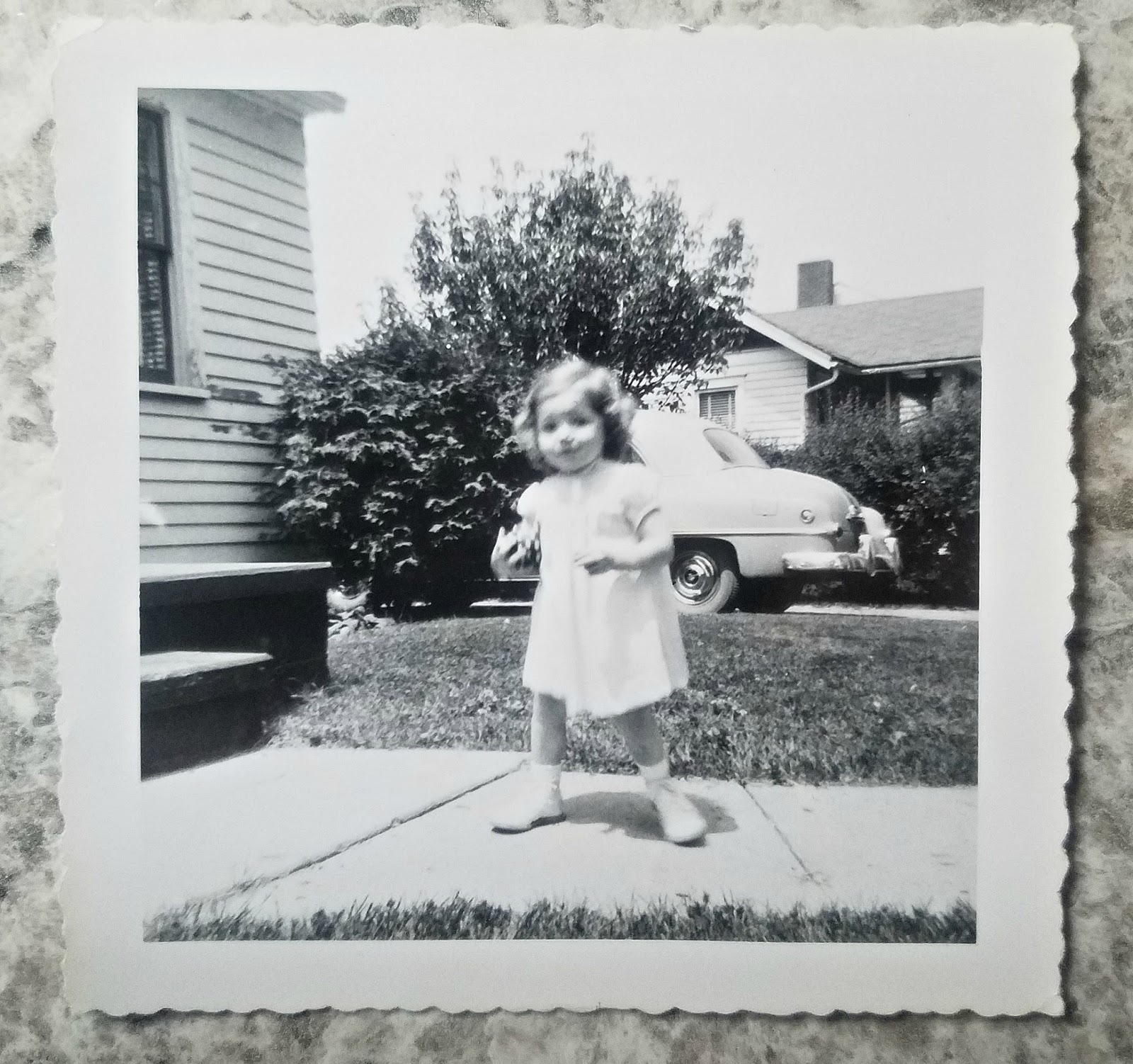
This is me at two year's old in front of our house.
And there's that car, I think.  Or it might be my uncle's car.
Two things immediately sprang to mind when I first held this book in my hands.  (I had no preconceptions about the story.)  The car on the cover reminded me of the one my parents had when I was a little girl.  The car was with us for a very long time because my parents did not believe in loans or mortgages.  If you didn't have the money for something, you did not get it or you started saving until you could afford it.  If something went wrong on the car, my dad could make it right.  (I learned more than I ever wanted to know about what was under the hood of a car.)

When I read All The Way To Havana (Godwin Books, Henry Holt and Company, August 29, 2017) written by Margarita Engle with illustrations by Mike Curato, it resonated with me for the reasons above but especially for the portrait of life in Cuba.  Affection for this family filled my heart.  Their inventiveness is truly inspirational.

We have a gift, and we have a cake, and today we're going to drive all the way to the big city to see my new baby cousin on his zero-year birthday. 

The boy goes on to tell us about the old cars on the island comparing the purrs of some to the little chick sound their car makes.  He and his father need to work on the car if they are to arrive in Havana.  He can see once the hood is lifted how repair after repair has been made using

wire, tape, and mixed-up scraps of dented metal.

The two of them adjust and tinker and adjust some more trying to get Cara Cara (the name of the car) to sound differently.  Nothing they do seems to fix it until...the little chick sound grows up.  It's a hen and she's ready to travel.  Friends who need a lift to their destination fill the seats.  It's a bouncy ride but the car keeps making her mechanical music.

Soon the scenery changes into the buildings across the skyline.  There are old cars of every color running down the street.  Their condition and the sounds they make fill the child's eyes and ears.  The steady honking is a city symphony.

At his aunt's house the gift is opened and the cake is eaten.  After much laughter and fun, the boy takes a siesta.  When he wakes the sky is dark and they leave in Cara Cara for home.  The next morning the boy and his father talk and again tend to their car.  Its heritage is a testament to hope.


In choosing to write this narrative from the point of view of the boy, Young People's Poet Laureate Margarita Engle speaks directly to the heart of child readers but also through his voice all who read this book will have a greater understanding of the people of Cuba.  The insertion of sounds supplies a lyrical rhythm which invites listeners (and readers) into the story with the boy.  Her concise sentences followed by longer ones also contribute to the cadence.  They read like a child thinks and talks.  Here is a sample passage.

So we purr cara cara

and we glide taka taka

and we zoom zoom---

zoom

cluck
cluck
cluck

beside farms, forests, beaches, and forts.


When stopping and savoring the opened dust jacket for the second time, I marveled at the use of light and shadow, design and layout and the details on both the front and the back.  The lines on the elements draw our eyes to the boy leaning against Cara Cara on the front.  To the left on the back, the hue used to provide a background for Margarita's and Mike's names is the canvas.  Set in an oval of a cream color is the car with the boy looking out the back window.  Two hens and chicks are busily pecking and walking around the bottom of the oval.  (Cara Cara and the boy are varnished.)

I gasped when I took off the jacket to see the book case.  Nearly covering the entire area is Cara Cara front to back, right to left on the case.  We are looking at the car from above.  It crosses the spine perfectly.  And then I saw the endpapers.

On the opening and closing endpapers, Mike Curato, on a background of dark yellow-orange, has drawn in detail, in black, twenty-four cars, most dated in the 1950s. (He labels the make, model and year.)  A colorful wash is brushed over each one.  With a page turn we have the verso page on the left and the title page on the right.  The text is set in the front window of Cara Cara which spans both pages.  It's as if we are in the front seat.


used pencil acrylic, paper, photo overlay, digital color in Adobe Photoshop, and other mixed-media 

to create these stunning illustrations.  His perspectives from inside the car looking outside and panoramic views along with zooming in close bring us willingly into the story.  There is animation in every picture, even when the boy is sleeping in his mother's arms. 

The details of the countryside and then in the city are nearly photographic but there is a quality of softness to them which works well with the matte-finished paper.  A full color palette greets us throughout the title.  A genuineness and warmth fill each visual.

One of my many favorite illustrations is when the boy is helping his dad repair the car before they leave for the city.  In the bottom corner sits the opened, heavy toolbox.  As our eyes travel upward we see a hen and two curious chicks.  They are moving to the right middle of the page.  Here the barefoot boy is standing on a wooden box on his tip-toes next to the car.  Another little chick is on the box.  All we can see is the child's feet, legs and the bottom portion of his shorts.  We can only see the lower half of Cara Cara.


With every reading of All The Way To Havana written by Margarita Engle with illustrations by Mike Curato my admiration and respect for this boy, his family and the people of Cuba grows.  The text and art blend but enhance one another elevating this book to something deeply meaningful; to something extraordinary.  I am grateful to Margarita Engle and Mike Curato for giving us All The Way To Havana.  An Author's Note and Illustrator's Note conclude the book.  I highly recommend this title for your personal and professional bookshelves. 

To learn more about Margarita Engle and Mike Curato and their other work please follow the links attached to their names to access their websites.  Mike Curato also maintains a blog.  On his website you can view interior images from this book.  On his blog he talks about his process and the trip to Cuba.  The book trailer premiere can be seen at All The Wonders.  You will enjoy the short Q & A.  Author, reviewer and blogger, Julie Danielson features artwork on her blog, Seven Impossible Things Before Breakfast after talking with Margarita and Mike the previous week at Kirkus.