Quote of the Month

When love and skill work together, expect a miracle. John Ruskin


Showing posts with label Family life-Cuba-Fiction. Show all posts

Sunday, October 10, 2021

Three Days Of Reading

On Friday, very early in the morning, life delivered an unexpected break in my daily routines.  It lasted for several days.  So, I read and read and read.  And I am still reading.


The first book I finished I started on Thursday night.  Your Heart My Sky: Love in a Time of Hunger (Atheneum Books for Young Readers, March 23, 2021) written by Margarita Engle is an exquisite portrait of living on the island of Cuba in the summer of 1991.  It is told in three voices of two teenagers, Liana and Amado, and a wise singing dog.  In this novel in verse, each poem, no more than three pages in length, is breathtaking.  You pause after reading each one.  I am still thinking about how Margarita Engle could embed such heartbreak, longing, and beauty into these poems.  Each poem is titled.


Although the government of Cuba is calling this el periodo especial en tiempos de paz, the special period in times of peace, for the majority of people it is a painful, frightening time of starvation.  Liana and Amando, have decided to forgo the government summer camp of farm labor.  It puts them both at a future disadvantage and on the radar of a government in total control of its people.


A chance encounter (or not if you believe the dog and I do) finds the duo working together in their desperate search for food for themselves and their families.  Their relationship gives them courage to do things like trading on the black market, helping those who shelter in caves before trying to make it off the island, and growing their own food in their family’s patios.  They do all this under the threat of discovery.


As their love grows, feeding their bravery, a tension enters their story.  Decisions need to be made.  Which comes first, hope or love?  Does one invite the other?  Or do they arrive together? 


Here is one of the poems.


Ode of Paz

Amado and Liana


Roaming

nomad

unpredictable

visitor

exhaling

aromas

of 

love’s

hunger

and hunger’s

love.  


There is a two-page author’s note at the conclusion of the book.  At the publisher’s website is a curriculum guide.  There is a short conversation with Margarita Engle and additional poems at The Book Page for the cover reveal.


On September 28, 2021, The Beatryce Prophecy (Candlewick Press) written by Kate DiCamillo with artwork by Sophie Blackall was released.  One of several reasons I was eager to read this was after watching a video on Instagram posted by Sophie Blackall. (https://www.instagram.com/p/CUXUk2cAZxC/)  Sophie Blackall was right.  Once I started the book, I did nothing else until I finished it.  Hours passed as the stories of a goat, a monk, a girl, and a boy unfolded and intertwined.


The goat, Answelica, is believed to be a demon by the monks of the Chronicles of Sorrowing.  Brother Edik dreads being anywhere near the beast who thrives on butting and biting the monks.  One morning his fear spikes as he enters the barn.  He finds a feverish young girl sleeping next to the goat, holding one of the goat’s ears.


The girl cannot remember anything about herself except her name.  Her name is Beatryce.  There are others who know exactly how she came to be alone with bloody and muddy clothing.  It has to do with a prophecy.


There will one day come a girl child who will unseat a king and bring about a great change.


The boy, Jack Dory, lost his parents in the dark woods by the hand of a wicked robber.  He lived with an older woman, Granny Bibspeak, until she died when he was twelve.  He remains in her home in a village that admires and respects the boy.  Jack Dory has the gifts of speed, remembrance, and mimicry.


Kate DiCamillo with this tale of mystery, intrigue, betrayal, haunting pasts, revenge, love and stories casts a spell that lingers long after the last word is read.  She reminds us how profoundly some things have changed, and others have not.  Sophie Blackall with her luminous endpapers, gorgeous first letters of each chapter, and full- and partial-page images breathes life into the characters and their circumstances.  Here is a passage.  


They were three:  Jack Dory, Beatryce, and a goat.

Jack Dory did cartwheels as he walked down the road.

He followed the cartwheels with several handsprings.

“You cannot do this, can you?” he said, calling back to Beatryce.

“I cannot do it because I must walk along and pretend to be a monk,” said Beatryce.

The satchel was slung across her chest.  It bumped against her hip as she walked.  Her heart felt heavy.

But the goat did not seem worried.  Answelica ran to Jack Dory, kicking up her heels and shaking her head, and then she ran back again and walked at a sedate pace beside Beatryce.

Jack Dory started to whistle a jaunty song.

Beatryce looked down at the goat.  She said, “I think he pretends to be happy.  I think that deep inside he is sad.  Those he loves are dead.  He is alone in the world.”

Answelica looked up at her, listening.

“I am not afraid,” Beatryce said to the goat. “I will not be afraid.”

Answelica nodded.

She bumped her head against Beatryce’s leg.  Beatryce took hold of her ear.

“I am not afraid at all,” said Beatryce again.


At the publisher’s website you can download a teacher’s guide, a curriculum guide, and a sample chapter.  You can also view an interior illustration. The cover reveal and a conversation between Kate DiCamillo, Sophie Blackall, and John Schumacher, librarian, guest lecturer at Rutgers, and writer, on his site, Watch. Connect. Read., is enlightening.


A graphic novel, an ARC, kept me turning pages faster than the lightning flashing during a weekend afternoon storm.  City of Dragons #1: The Awakening Storm (Graphix, an imprint of Scholastic) written by Jaimal Yogis with illustrations by Vivian Truong follows Grace as she absorbs the death of her father, the move to Hong Kong with her mother and new stepfather, starting classes at a private school, meeting three new distinctive friends, and the hatching of a dragon egg in her bathroom.  It seems the tales of an emperor and nine dragons she remembers her father telling her are not myth but reality.


Ramesh, her first-day friend, and Grace, through Ramesh’s tech skills, sneak away from a class field trip.  An old woman in the market speaks one word repeatedly to Grace as she holds her hand.  Then she gives her an egg.  The hatched egg, now concealed in Grace’s backpack the next day at school, brings two more students, Jing and James, into the group.  


That evening as the foursome try to figure out what the creature (Nate, named after Grace’s father) is, their only conclusion is that it is a dragon, a water dragon.  Very quickly they are pursued by unsavory characters who are part of a cult seeking to bring an enemy of the ancient Yellow Emperor back to power.  Unable to find the original old woman, they ask an elderly fishman known as the Southern Prophet for help.


Non-stop action heightened by realistic and witty dialogue by Jaimal Yogis amid detailed, expressive, and highly animated panels by Vivian Truong are certain to keep readers on the edge of their seats.  Hank, Grace’s stepfather, is not as he appears.  His boss, Dr. Kim has secrets of her own.  The Southern Prophet mourns the loss of his one true love, Mazu, a woman of the sea.  A trip to an island, a kidnapping, a wicked storm, and a series of earthquakes that might not be earthquakes elevate the tension.


This title is the first in a series.  The final page builds anticipation for the next book.  At the publisher’s website you can view eight interior pages.  Jaimal Yogis and Vivian Truong are interviewed about this title at The Beat.

Tuesday, September 12, 2017

A Ride and a Memory

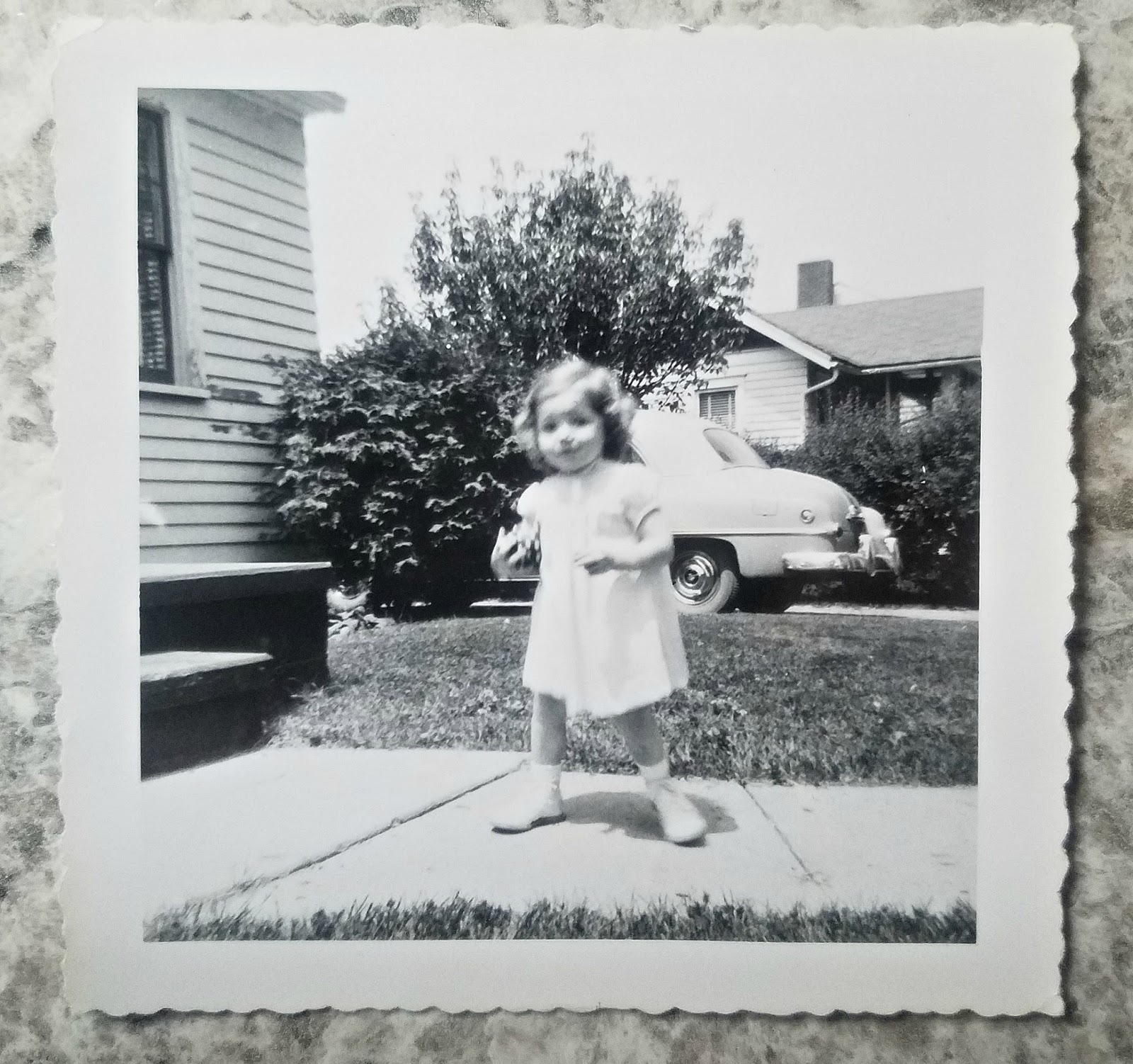
This is me at two year's old in front of our house.
And there's that car, I think.  Or it might be my uncle's car.
Two things immediately sprang to mind when I first held this book in my hands.  (I had no preconceptions about the story.)  The car on the cover reminded me of the one my parents had when I was a little girl.  The car was with us for a very long time because my parents did not believe in loans or mortgages.  If you didn't have the money for something, you did not get it or you started saving until you could afford it.  If something went wrong on the car, my dad could make it right.  (I learned more than I ever wanted to know about what was under the hood of a car.)

When I read All The Way To Havana (Godwin Books, Henry Holt and Company, August 29, 2017) written by Margarita Engle with illustrations by Mike Curato, it resonated with me for the reasons above but especially for the portrait of life in Cuba.  Affection for this family filled my heart.  Their inventiveness is truly inspirational.

We have a gift, and we have a cake, and today we're going to drive all the way to the big city to see my new baby cousin on his zero-year birthday. 

The boy goes on to tell us about the old cars on the island comparing the purrs of some to the little chick sound their car makes.  He and his father need to work on the car if they are to arrive in Havana.  He can see once the hood is lifted how repair after repair has been made using

wire, tape, and mixed-up scraps of dented metal.

The two of them adjust and tinker and adjust some more trying to get Cara Cara (the name of the car) to sound differently.  Nothing they do seems to fix it until...the little chick sound grows up.  It's a hen and she's ready to travel.  Friends who need a lift to their destination fill the seats.  It's a bouncy ride but the car keeps making her mechanical music.

Soon the scenery changes into the buildings across the skyline.  There are old cars of every color running down the street.  Their condition and the sounds they make fill the child's eyes and ears.  The steady honking is a city symphony.

At his aunt's house the gift is opened and the cake is eaten.  After much laughter and fun, the boy takes a siesta.  When he wakes the sky is dark and they leave in Cara Cara for home.  The next morning the boy and his father talk and again tend to their car.  Its heritage is a testament to hope.


In choosing to write this narrative from the point of view of the boy, Young People's Poet Laureate Margarita Engle speaks directly to the heart of child readers but also through his voice all who read this book will have a greater understanding of the people of Cuba.  The insertion of sounds supplies a lyrical rhythm which invites listeners (and readers) into the story with the boy.  Her concise sentences followed by longer ones also contribute to the cadence.  They read like a child thinks and talks.  Here is a sample passage.

So we purr cara cara

and we glide taka taka

and we zoom zoom---

zoom

cluck
cluck
cluck

beside farms, forests, beaches, and forts.


When stopping and savoring the opened dust jacket for the second time, I marveled at the use of light and shadow, design and layout and the details on both the front and the back.  The lines on the elements draw our eyes to the boy leaning against Cara Cara on the front.  To the left on the back, the hue used to provide a background for Margarita's and Mike's names is the canvas.  Set in an oval of a cream color is the car with the boy looking out the back window.  Two hens and chicks are busily pecking and walking around the bottom of the oval.  (Cara Cara and the boy are varnished.)

I gasped when I took off the jacket to see the book case.  Nearly covering the entire area is Cara Cara front to back, right to left on the case.  We are looking at the car from above.  It crosses the spine perfectly.  And then I saw the endpapers.

On the opening and closing endpapers, Mike Curato, on a background of dark yellow-orange, has drawn in detail, in black, twenty-four cars, most dated in the 1950s. (He labels the make, model and year.)  A colorful wash is brushed over each one.  With a page turn we have the verso page on the left and the title page on the right.  The text is set in the front window of Cara Cara which spans both pages.  It's as if we are in the front seat.


used pencil acrylic, paper, photo overlay, digital color in Adobe Photoshop, and other mixed-media 

to create these stunning illustrations.  His perspectives from inside the car looking outside and panoramic views along with zooming in close bring us willingly into the story.  There is animation in every picture, even when the boy is sleeping in his mother's arms. 

The details of the countryside and then in the city are nearly photographic but there is a quality of softness to them which works well with the matte-finished paper.  A full color palette greets us throughout the title.  A genuineness and warmth fill each visual.

One of my many favorite illustrations is when the boy is helping his dad repair the car before they leave for the city.  In the bottom corner sits the opened, heavy toolbox.  As our eyes travel upward we see a hen and two curious chicks.  They are moving to the right middle of the page.  Here the barefoot boy is standing on a wooden box on his tip-toes next to the car.  Another little chick is on the box.  All we can see is the child's feet, legs and the bottom portion of his shorts.  We can only see the lower half of Cara Cara.


With every reading of All The Way To Havana written by Margarita Engle with illustrations by Mike Curato my admiration and respect for this boy, his family and the people of Cuba grows.  The text and art blend but enhance one another elevating this book to something deeply meaningful; to something extraordinary.  I am grateful to Margarita Engle and Mike Curato for giving us All The Way To Havana.  An Author's Note and Illustrator's Note conclude the book.  I highly recommend this title for your personal and professional bookshelves. 

To learn more about Margarita Engle and Mike Curato and their other work please follow the links attached to their names to access their websites.  Mike Curato also maintains a blog.  On his website you can view interior images from this book.  On his blog he talks about his process and the trip to Cuba.  The book trailer premiere can be seen at All The Wonders.  You will enjoy the short Q & A.  Author, reviewer and blogger, Julie Danielson features artwork on her blog, Seven Impossible Things Before Breakfast after talking with Margarita and Mike the previous week at Kirkus.