Each being shares traits with other beings. Some of those characteristics are broad, others are more particular. No matter your age, you know this to be true. We, too, are drawn to those who share common interests. This is how connections, bonds, and friendships are formed.
It is only as those connections, bonds, and friendships grow that acknowledgements and adjustments are made. Something Beautiful (Atheneum Books for Young Readers, June 7, 2022) written and illustrated by Lita Judge explores how individuals embrace each other initially because of shared pursuits. As their circle of friends expands, something wondrous happens.
Ball was Mouse's favorite
and with it, he played alone.
Elephant arrived, wanting to play with Mouse and Ball. Together they had fabulous fun. A trio of pals formed when Giraffe appeared. Their interests were in perfect sync.
They didn't think anyone else was necessary to increase their joy. Soon, a prickly critter called out a greeting. Mouse, Elephant, and Giraffe were hesitant to welcome Porcupine. His idea of playing and snacking were weird.
Porcupine opened up a whole new view of the world for the other three animals when teaching them how to climb trees. What could possibly be better than this? Joy and the power of imagination burst over the foursome when Warthog danced beneath the tree.
She was everything they could possibly want until the running group unexpectedly bumped into Lion. Lion was sitting alone. He did not want to play when invited to join the group, so they sat with him. In those moments, Mouse, Elephant, Giraffe, Porcupine, and Warthog understood the value of stillness and what it could reveal. Six friends in their time together did find another truth, the most priceless truth of all.
From the first simple sentence, Lita Judge invites us into the story. We realize because alone is the final word in that sentence, Mouse will have company soon. With a page turn and another single sentence, Elephant is introduced. When each new animal makes an appearance, Lita Judge provides us with a few additional details. These details not only give us hints into the personalities of Elephant, Giraffe, Porcupine, Warthog, and Lion, but enlarge our view of the blossoming friendships and the definition of beautiful. Here are three consecutive sentences.
Warthog has a heart full of sunshine
and a head full of dreams.
Together, they discovered that flowers
were magic wands in disguise
and that ears can be
turned into wings.
Mouse, Elephant, Giraffe, Porcupine and Warthog
needed no one else
but then . . .
In looking at the open and matching dust jacket and book case, the first thing readers notice is the endearing trio. Their facial expressions have us wondering what each of them are thinking. The presence of Ball and the blue butterflies are full of promise. To the left of the spine, we are treated to text praising two previous titles, Flight School and Red Sled, both written and illustrated by Lita Judge. In the lower left-hand portion of the back, Porcupine does a little jig, leaves stuck to his quills. Several blue butterflies flutter nearby. Ball is above Porcupine. What will happen when gravity takes over? On the dust jacket the title text is embossed in a stunning blue hue. Lita Judge's name, the butterflies and Ball are varnished.
A vivid robin's egg blue covers the opening and closing endpapers. With a page turn, we see Mouse scampering toward the lower right-hand corner of the right page. On the formal title page, Mouse stands next to Ball.
One of the things in Lita Judge's artwork is her masterful use of white space. It frames her characters. It seems to hug them and lift them up.
Using
watercolor and digital editing,
these images depict energetic playfulness, joyous abandonment, calm contentment and curiosity, gracious acceptance, and pure wonderment. Readers will delight at the details, the settings, and the looks on each of the characters' faces. As you turn the pages, you find yourself continuously smiling and even laughing out loud. (You will also find yourself looking more intently at the pictures. Doesn't that knot in the tree look like Warthog's belly?)
One of my many favorite pictures is a single-page illustration. A large oval with softened edges is surrounded by white space. Near a tree is Porcupine. Leaves are stuck to his quills. Ball is stuck on top of his head. He is gnawing on his favorite snack, a gnarly twig. Mouse is trying it, but says (outside the frame)
Patooey!
We need to embody the sincere wisdom found in the words and artwork in Something Beautiful written and illustrated by Lita Judge. The openness of the animals and their willingness to accept differences leads to exquisite joy and the ultimate revelation. I highly recommend this title for your personal and professional collections.
To learn more about Lita Judge and her other work, please follow the link attached to her name to access her website. Lita Judge has accounts on Facebook, Instagram, Pinterest, and Twitter. At the publisher's website, you can view interior images including the full, open dust jacket.
These four words, first day of school, are replete with a range of emotions for people of all ages. Whether it is your first day of school ever or the thirtieth year in a row, there is a strong blend of anticipation and anxiety, and knowing and not knowing. If you are new to the community, your feelings are heightened.
When your attire, physical characteristics, and actions are different than those of your classmates, you draw attention to yourself. Some of it is unkind. The New Kid Has Fleas (Roaring Brook Press, June 15, 2021) written by Ame Dyckman with illustrations by Eda Kaban follows a unique new student and another who, through chance, befriends her. It is a tale full of twists and truths.
I'm not sure about the New Kid.
The narrator, a fellow classmate, is trying to be his best, but it is hard when the new kid takes off her shoes so she can go barefoot, howls in music, and pursues a different kind of food for lunch. Another student, Molly, tells the children the New Kid has fleas. She quietly hears the revelation. Does it bother her?
Stewart and our narrator want to be partners during the science project, but their teacher has other plans. The students' names are put in a bowl and are paired through the luck of the draw. Stewart and Molly are paired. Our narrator is paired with the New Kid.
This is an after-school project. The duo rides the bus to the New Kid's home. When our narrator steps inside, he is terrified at the parents, and siblings of the New Kid.
In the first of several surprises, the siblings are fun. Snack time, while not our narrator's usual fare, is tasty. The New Kid is brilliant in helping with the science project. The next day at school, Molly is strangely absent. When it is time to present their science project, it is a howling success. Given a chance, we can discover rare gifts in others.
Simple declarative sentences, short phrases, and single words by author Ame Dyckman fashion a story replete with humor. Word play adds to the laughter factor. Through the first-person narrative we are able to witness a transformation from first impressions to lasting friendship. Here is a passage.
Mom and Dad say don't stare.
That I should put myself in her shoes.
But the New Kid doesn't wear shoes.
And it's hard not to stare . . .
Painted digitally by illustrator Eda Kabanthe images in this title, beginning with the matching front dust jacket and book case, are highly animated and brimming with visual interpretation. We see a range of responses on the students' faces when the New Kid boards the school bus. And we are curious to see the silhouette of a wolf as a place holder for the title text. Without a doubt, we have to open this book!
On the back of the dust jacket a loosely formed rectangle, framed in lots of white space, holds an interior image of the students outside for lunch. The New Kid is climbing out on a branch to grab a squirrel. Beneath the illustration is a wolf cub. On the back of the book case is another interior image surrounded by white space. It shows the narrator playing with the New Kid's siblings.
The background on the opening and closing endpapers is first a light robin's-egg-blue morning sky and second the shadowy purple of dusk. On the opening endpapers a tree top and branch extend from the left-hand side. A squirrel leaps off the branch. On the closing endpapers, from a bough crossing the gutter, left to right, a squirrel leaps. In the upper, right-hand corner another branch is visible. On its end is a nest.
Each illustration, double-page pictures, smaller images on a single page, and single-page pictures, done in full color asks readers to pause and notice the children. Their facial expressions convey a lot. The narrator's looks invite giggles and grins. Page turn after page turn readers will notice an underlying current of warmth as understanding leads to friendship.
One of my many favorite illustrations is a double-page image paired with the above-noted text. We are brought close to seven of the students, most seated at their desks. Sunlight from rows of square windows beams across the scene casting a glow on the large-checked floor tiles. Our narrator, the boy, seated at his desk and paused in his work, is looking at the New Kid. She is intently working, one leg outstretched and the other bent with her foot on the seat. One of her shoes is on the desk and the other is on the floor, laces undone.
This book, The New Kid Has Fleas, written by Ame Dyckman with illustrations by Eda Kaban with compassion and comedy explores being new and how acceptance by one person can change everything. This story is about looking at people with open eyes, minds, and hearts. You'll want to share this widely and often. Be sure to have a copy on your professional and personal bookshelves.
To learn more about Ame Dyckman and Eda Kaban and their other work, please follow the link attached to their names to access their respective websites. Ame Dyckman has an account on Twitter. Eda Kaban has accounts on Instagram and Twitter. At Macmillan you can view interior images.
When the first day of school is the first for the youngest students, each child brings something remarkable to the learning experience, to their classrooms. For some, they are fully aware of their gift. For others, it is yet to be revealed. Becoming Vanessa (Alfred A. Knopf, June 15, 2021) written and illustrated by Vanessa Brantley-Newton is about a little girl with a sparkling personality. Her story is beautifully transformative.
Mom pulled at Vanessa's hair as she got it ready for the
first day of school. Mom was excited, and Vanessa
could tell she wanted her to be excited, too.
Vanessa was wondering if the other children would like her. At breakfast, her father reassured her, telling her she is special. She questioned how her classmates would know this about her.
At her mother's suggestion, Vanessa selected her own favorite items to wear. These were certain to alert her classmates that she is someone they will enjoy. Their reaction to her distinctive apparel was not exactly as she expected. Everyone was friendly, though.
During circle time, Vanessa wnet first explaining her love of drawing butterflies and the anticipated arrival of a sibling. Their questions to her were direct. For the rest of the day, Vanessa struggled to be comfortable with her classmates. She was, in a word, miserable.
The next morning, Vanessa dressed to blend in. She told her parents she wished her name were shorter and easier to write. Then her mother told her the story of her name. At school, on this day, circle time was special when Vanessa spoke. Just as special as she is.
With her words, author Vanessa Brantley-Newtoncreates a character we love from the first page. She is genuine in her thoughts, feelings, and conversations. Through a mix of dialogue and narrative, we find ourselves identifying with her first day jitters and circumstances. Her supportive parents, welcoming classroom, and resilient character allow her to soar. Here is a passage.
After that, things only got worse.
"I can't see
past her hat!"
"Too many feathers!"
Even her shoes were pinching her feet.
When you look at the open and matching dust jacket and book case, you are immediately drawn to the girl on the front looking out her window at the butterfly resting on a branch. Her smile, her hair in the colorful, beaded ties, and wide eyes behind her round, blue glasses are utterly charming. The delicate curtains framing the scene are like butterfly wings. The heart inside the o is the finishing touch.
To the left, on the back, Vanessa is standing in a flower garden placed on a golden background. She is holding one of her butterfly pictures. Two butterflies fly toward her. On the front and back of the dust jacket Vanessa, her butterfly picture, the butterflies, and title text are varnished.
On the opening endpapers is a scene as if we are looking through Vanessa's bedroom window, white sheer curtains on either side. Against a blue sky are shrubs, treetops, and a large branch. A caterpillar, a chrysalis, and two butterflies are featured. On the closing endpapers dotted-line paths in a variety of hues loop as do the butterflies making those paths. It's a splendid display bursting with color.
Illustrator Vanessa Brantley-Newton rendered these double-page and single-page visuals
using Posca pens, acrylic paint, Magic Markers, crayons, and watercolor paint on a Bristol board and collaged with hand-painted, printed, and found papers.
Although we notice the extra details in each setting, we linger on the people. Their faces, body postures, and clothing tell us little stories about each one. There is a special magic in every element fashioning a memorable whole.
One of my many favorite illustrations is a double-page picture. In this picture a parent and their child are walking left to right on the first day of school. They are traveling down a city sidewalk. Here we see a marvelous diversity of children. Two mothers are walking with their sons and two fathers are walking with their daughters. Vanessa and her dad are leading the group. You can feel the hope.
Becoming Vanessa written and illustrated by Vanessa Brantley-Newton could be about any one of us. It is a story of finding and embracing your true self. It asks us to spread our wings and fly. I highly recommend this title for your professional and personal collections.
To learn more about Vanessa Brantley-Newton and her other work, please follow the link attached to her name to access her website. Vanessa Brantley-Newton has accounts on Facebook and Instagram. At Penguin Random House you can view interior images. Vanessa Brantley-Newton is a showcased artist on KidLit TV. In this video she demonstrates how to make a collage.
There are those students whose excitement at attending school for the first time can hardly be contained. They are super prepared. They have a vision of how their experiences at school will be. Little Bat in Night School (Houghton Mifflin Harcourt, June 29, 2021) written and illustrated by Brian Lies takes a character highlighted pictorially only in his four previous bat books and gives this creature his own voice. Let's join him as darkness descends.
Little Bat was ready. He had everything he needed.
He had all his supplies and a backpack to hold them. He kept wondering if it was time to go. He was thrilled to meet the other bats.
When he finally walked into his classroom, imagine his surprise at seeing all kinds of animals, owls, raccoons, a ferret, and only two bats. They were already playing and not inclined to play with Little Bat. Seeking a place to hide he found another classmate hiding. It was Ophelia, an opossum.
They decided to join the others in circle time. They learned a song and the science behind stars and the moon. When it came time for show-and-tell, Little Bat had something no one else did. The students snuggled in pockets for nap time. During art Little Bat learned a lesson worth remembering from another student.
A munch time accident led to laughter and kindness. Recess was an opportunity to build literally and in their minds. Just as story time was taking them on another amazing adventure, the first rays of dawn drifted into the classroom. Guess who talked non-stop all the way home?
In a word, this story, authored by Brian Lies, is delight. Little Bat's enthusiasm, revealed in dialogue, his thoughts and the narrative, is contagious. The interactions between Little Bat and his mother and his classmates, especially Ophelia, are authentic. Here is a passage.
Little Bat flew into a cubby to hide, but someone
else was already there.
"Hi---what are you doing?" he asked.
"I'm just . . . hanging out," she replied.
"Oh," Little Bat said. "Is it okay if I hang out
here too?"
"I guess so," she said. "But why aren't you out
there with them?"
Opening the book case, readers notice on the left text usually found on the front and end flaps of the dust jacket. There are also thumbnails of two of the bat books, Bats at the Beach and Bats at the Library. On the front, right side, front and center is the lovable Little Bat. Around him and in his hands are colored pencils, crayons, an alligator pencil sharpener, a glue stick, a water bottle, and his backpack. The legs sticking out are a snack. He is grinning in happiness for the night adventure to come.
The opening and closing endpapers are a midnight blue. On the title page, Little Bat is holding a drawing he made of himself, hanging upside down. His crayons are scattered at his feet. On the verso above a small scene of Little Bat and his mother flying to the school are the words of the dedication,
To teachers, who bring light to the darkness.
These illustrations rendered
with acrylic and watercolor paints and colored pencil on Strathmore paper
make excellent use of white space. It places emphasis on the full color, highly detailed images. Many of these are single-page pictures or groups of smaller visuals to indicate activities and to highlight pacing.
Brian Lies brings us close to Little Bat and the other characters in his life and school. We feel as though we are there with him. The fact that the setting of night school is a classroom in an actual school adds to the enchantment of the tale.
One of my many favorite pictures in a single-page illustration, edge to edge. We zoom to a deep blue alphabet wall hanging with pockets. Letters, capital and lower case, c, d, e, f, j, k, l, m, q, r, s, t are on the pockets. The students are nestled inside the pockets for nap time. What a clever idea!
We all have expectations for the first day (night) of school. Sometimes there are surprises as our favorite flyer discovers in Little Bat in Night School written and illustrated by Brian Lies. An open mind and an open heart can lead to the best kind of learning. I highly recommend this book for both your classrooms and your personal collection.
To learn more about Brian Lies and his other work, please follow the link attached to his name to access his website. Brian Lies has accounts on Facebook, Instagram, Pinterest, and Twitter. The cover reveal and interview for this title were hosted by Dr. Dylan Teut on his blog, Mile High Reading. At the publisher's website you can download an activity kit.
Stepping into a new school for the first time can be intimidating. When you are not fluent in the language spoken there, it can add to your unease. The rhythm of familiar words, the only ones you've known, comfort you as the unfamiliar words confuse you. Isabel and Her Colores Go to School (Sleeping Bear Press, July 15, 2021) written by Alexandra Alessandri with illustrations by Courtney Dawson explores the glorious mind of a little girl who carries colors with her to view the world around her. Told in Spanish and English with Spanish, this story is a heartwarming representation of finding your place and finding a friend.
The night before the first day of school,
Isabel sat cross-legged on her bed,
coloreando with her favorite crayons:
rojo, verde, azul, rosado, morado, violeta.
La noche antes de su primer dia de escuela,
Isabel se sento en su cama con las piernas cruzadas,
coloreando con sus crayones favoritos:
rojo, verde, azul, rosado, morado, violeta.
She was worried about not speaking much English. To her it was reflected in cool colors. Spanish was warmth and joy. The next morning, she begged her mother not to take her to school. At school when she embraced her before leaving, her mother gave her words of encouragement. Isabel was still on the verge of tears.
Stepping into the classroom, Isabel heard her teacher, Miss Page, call out a welcome. All kinds of colors swirled around Isabel as other students entered the room. When Miss Page called out different portions of the day, Isabel watched the other students to know what to do. She did not understand her teacher.
Not seeing a place for her on the rug for story time, Isabel felt like she was shrinking into herself. Then another little girl offered her a place to sit. Isabel understood the word here. They exchanged names. All was well until Sarah asked Isabel a question. Isabel did not understand. Sarah did not understand Isabel's reply. A cheerful start had turned to sadness.
After lunch, Miss Paige announced another task. Isabel heard a word similar to one of her favorite things to do. She worked using an array of colors. She held her finished drawing out to Sarah. The girls exchanged words with the same meaning, one in Spanish and the other in English. One final moment of happiness led Isabel to believe another hue would portray school.
The cadence of the carefully chosen, poetic words in each sentence, in Spanish and English, penned by Alexandra Alessandribeckon to readers. We stand side by side with Isabel as she struggles to understand and confronts her fears. Her colors paint a picture of her emotions for us. The literary techniques and figures of speech employed by Alexandra Alessandri are excellent. Here is a passage.
It's okay to be scared." Mami's voice was
soft and amber like a ripened mango.
She gave Isabel a squishy, squashy hug.
"Al mal tiempo, buena cara," Mam said.
"To bad times, a good face."
---Es normal tener miedo---dijo mami,
con su voz dulce y dorada como el mango maduro.
Ella le dio a Isabel un abrazo do oso.
---Al mal tiempo, buena cara.
The pictorial presentation on the front, right, of the open dust jacket not only introduces us to Isabel but the flow of colors embedded with flowers and leaves from her backpack, grows as it crosses the spine to the left. Across the back, left, of the dust jacket, it covers nearly all the space. It continues to the back flap. On the front flap with a white background is the book's description with Sarah and Isabel chatting beneath the text.
On the entire book case is the flow of colores with flowers and two purple birds, one on either side of the spine. These waves of colors and flowers are found in varying patterns on both the opening and closing endpapers. The text on the title page is a repeat of that found on the dust jacket. Small flowers frame the words.
These vivid, lively illustrations by Courtney Dawson, single-page pictures and double-page visuals, are a pleasing combination of complementary colors on a variety of canvases. Swirls accompany the colors as Isabel envisions them. For most of the images we are close to Isabel and the other children, creating an intimacy with the story.
The wide-eyed expressions on the children (and adults) portray an openness. There is a spirit of acceptance in the classroom atmosphere, in Sarah, and in Isabel. This openness allows the courage of Isabel to shine.
One of my many favorite illustrations is a single-page picture. On a crisp white background, we move close to Sarah and Isabel. They are seated on the floor and facing each other. Their faces are full of happiness as they tell each other their names in their own languages. This is a defining moment full of promise.
This bilingual, luminescent story, Isabel and Her Colores Go to School written by Alexandra Alessandri with illustrations by Courtney Dawson, will have you viewing your world with a different set of eyes. Whether read during a story time or one-on-one, readers will be eager to seek a color for distinguishing exemplary moments in their lives. I highly recommend this title for your professional and personal collections.
To learn more about Alexandra Alessandri and Courtney Dawson, please follow the link attached to their names to access their websites. Alexandra Alessandri has additional resources for this book at her site. Alexandra Alessandri has accounts on Facebook, Instagram, Pinterest, and Twitter. Courtney Dawson has an account on Instagram. The cover reveal was hosted by Las Musas. Two sites of several highlighting this book are Latinxs in Kid Lit and at Jena Benton, Writer and Illustrator.
Different cultures have different customs relative to personal space. Greetings, goodbyes, and signs of affection vary from place to place and from person to person in those places. Some individuals are comfortable with another reaching out to touch them as a sign of goodwill and others are not. Sometimes the form of those contacts in greeting, in goodbyes, and with caring vary from a shoulder touch to a fist bump, pinkie shakes or an embrace.
Spending your days as an educator with children of all ages, you find creative ways to express welcome, compassion, praise and farewell, being respective of each individual's personal space. (Mrs. Piggly-Wiggly, a pig puppet, often helped me read aloud and turn book pages with my kindergarten and first grade students. Invariably as they were leaving, many of the students, knowing full well she was a puppet, gave her a hug as they went out the door.) Don't Hug Doug (He Doesn't Like It) (Putnam, G.P. Putnam's Sons, an imprint of Penguin Random House LLC, January 26, 2021) written by Carrie Finison with illustrations by Daniel Wiseman focuses with honesty on those children, people, who simply don't want others to hug them.
You can hug a pug.
(Awww!)
You can hug a bug.
(Maybe . . .)
Or a slug.
(Ewww!)
But don't hug Doug.
He doesn't like it.
With politeness, Doug asks not to be hugged. He does not like to be hugged. It's not that he doesn't like you, he does. Hugs are too much of everything he avoids.
There are things Doug likes. He has an assortment of collections he enjoys. He is especially fond of playing a harmonica with other harmonica players.
You might look at Doug and think this boy needs a hug. Don't hug Doug. It does not matter what the occasion is or the kind of hug it is. Doug is not a hugger.
There is one, only one, kind of hug he likes from one special person. Who gives this hug? When does he get this hug? If you are not this person and if it is not the right time of day, don't give Doug a hug. There are other individuals, beings, you can hug, but you need to ask permission first. This is a nod to their dignity.
What can you do if, like Doug, people don't want hugs? Like Doug, they might like high fives. Doug is a professional high fiver! He has perfected all kinds of high fives like the
elbow five, piggy five and spinny five.
How about you?
One of the first things you notice about the writing of this book is the upbeat narrative. Carrie Finisonexhibits great care in her word choices. She supplies multiple examples in support of and to reinforce Doug's desires using rhyming and repetition. In Doug's own words, after a series of statements, he jovially adds exactly what he means. Here is a passage.
Can you hug Doug's
pet potbellied pig?
Ask!
"Can we hug your pet potbellied pig?"
Yes, she loves hugs!
But be gentle.
She's a little scared
of strangers.
It's easy to see when looking at the open and matching dust jacket and book case, the drawings, artwork, of Daniel Wiseman highly complement the story. The buoyant color palette, body postures, and facial expressions are welcoming and warm. To the left, on the back, a page of interior illustrations is featured. They show Doug in four different situations. The narrator is asking if these four kinds of hugs are okay and Doug, with his usual happy disposition, replies. The backgrounds for all four shift from golden yellow to vibrant grass green, forest green, and then purple.
On the opening endpapers is a bold green with bright, dark yellow polka-dots. The same color combination is used on the closing endpapers. This time it is horizontal stripes. The basic design shown on the front of the jacket and case is replicated on the title page. This time the canvas is a crisp white and the title text is blue. Doug has another statement to make.
These digital drawings vary in size. Some span two pages, others are grouped in panels on a single page, and sometimes full pages, edge to edge. With every page turn you feel your happiness growing as you experience the merriment shown on the characters' faces and how they react to Doug and other beings. (Well, there is the slug grimace, though.) Don't you just love Doug's red glasses?
The other children and adults mirror a variety of races and ages. Frankenstein even makes an appearance. There are animals and robots, too. The dialogue, other than the narrator, is shown in speech balloons.
One of my many favorite illustrations is on a full page. Doug is shown kneeling as he makes a drawing of his pet potbellied pig using colors from his chalk collection. He is wearing his green and yellow-striped shirt, green pants, and miss-matched socks from his sock collection hanging on the wall behind him. On his purple carpet are scattered pieces of chalk, his harmonica, a game controller, and a book titled ROCKS OF THE WORLD. To the left of his sock collection is shelving with cubbies for his rocks.
You know when you read a book and it just feels right? This book, Don't Hug Doug (He Doesn't Like It) written by Carrie Finison with drawings by Daniel Wiseman, is one of those books. This is a book to share with everyone, individuals like Doug and others who need to understand the wishes of others. It will promote healthy discussions. This is a book about compassion and individuality you'll want to have in your professional and personal collections.
To learn more about Carrie Finison and Daniel Wiseman and their other work, please access their respective websites by following the link attached to their names. At Carrie Finison's site is a list of stops on her virtual tour for this book. A couple are storytimes in the future. Carrie Finison has accounts on Facebook, Instagram, and Twitter. Daniel Wiseman has accounts on Facebook, Instagram, and Twitter.
In the first meeting with my first principal in my first school, something he said has stayed with me for more than four decades. This was the first year for this principal in this building. He looked at an over-abundance of new staff seated around the conference table. The first thing he said to us was "without the children, we would not need you." He wanted us to know the students came first.
For me, not only did students come first, but I tried to look at them and say, "What if this was my child?" I wanted them to have every advantage, every opportunity, and every respect I had to offer. This is why certain books move me deeply. With every reading of All Because You Matter (Orchard Books, an imprint of Scholastic, Inc., October 6, 2020) written by Tami Charles with illustrations by Bryan Collier, I find tears welling in my eyes. Every single child deserves to be enveloped with the love and positivity pouring from the pages of this book.
They say that matter
is all things
that make up the universe:
energy
stars,
space . . .
If that's the case,
then you, dear child, matter.
The voice continues to tell the child how in a time before they were a hope, people were shaping a world to welcome this child. In this world they used their strength, physical and mental, to benefit those who were not yet born. Everything they did was for the future.
On the evening of the birth of this child stars signaled the worth of this birth and every moment that was to follow. Moments were chronicled, moments like first steps, first words, and the opening of a first book. The combination of all elements in this book were to lift him up. But . . .
There will not always be affirmation in this world. Your name, the way you dress, how you complete your schoolwork, and how you and others like you are viewed will have you questioning your value. You will ponder. You will doubt.
Then this precious child is reminded about those from whom he came. He is reminded about the depth of their accomplishments and character. He is reminded of the night he was born and how the stars shone. He is reminded that since the beginning of the beginning he and a multitude of others before and after him have always mattered.
Every carefully chosen word of author Tami Charles works toward a loving whole. She desires readers of this book to know they are important regardless of anything else they may see, hear, or read. She, sentence by sentence, fashions a verbal representation of this truth. By repeating specific words from the beginning of her narrative on the final pages she brings us full circle. Here is a passage.
The words and pictures
coming together like
sweet jam on toast,
musica blasting through barrios,
sun in blue sky . . .
all because you matter.
How could you not love the child featured on the front of the open dust jacket? Look at that beautiful face, so full of promise. A collage of petals frame either side of him. Illustrator Bryan Collier states in a note he begins with a single petal symbolizing a beginning and layers these to create blossoms. You can see faces in some of them. These depict those who have always believed you matter.
The collage of petals continues to the left of the spine, on the back of the dust jacket. It makes a valley in the center of the page. Across the starry sky, a single star streaks from left to right.
On the book case an interior image is expanded. It conveys a time when the child speculates on whether he will ever have value. He thinks this as his Pop Pop prays for those children gone:
Trayvon,
Tamir,
Philando.
On the opening and closing endpapers the collage of petals in various hues of blue form a canvas. They are replete with stars. On the first a single star speeds from left to right on the right side. On the second a moon hangs on the left side, a sliver beginning to show. Petals in a wallpaper pattern with blues and purple form a background for the verso and title pages.
Each illustration
created with collage and Winsor & Newton watercolor paint on 300lb. Arches watercolor paper
usually spanning two pages, with a portion left for a column for text, is a glorious representation and enhancement of the text. The color palette is luminous. The faces on the people are exquisite. You expect them to walk off the pages. Each element in these pictures is a meticulously placed piece.
One of my many, many favorite illustrations is toward the beginning of the book. The picture covers the entire left side, crosses the gutter and fills the left side of the right half. The text appears on the wallpaper-textured right side. The illustration features an African tribal chieftain with his left arm raised, fist clenched. His face reflects calm, purpose, and strength. Fanning to the left, above, and right of him are layers of petals, many of them have their tips folded down. There are many patterns, colors, and people on them. On the far left is a golden sky, hills, and pyramids. On the right is the starry sky with the silver of moon.
Thinking about this book, you cannot imagine a better pairing than this author and illustrator. For All Because You Matter written by Tami Charles with artwork by Bryan Collier, each one of them painstakingly added words and brush strokes and collage to make this stunning book for children, their parents and other adults who hold them in great affection. At the close of the book both Tami Charles and Bryan Collier include notes for readers. This book comes with my highest recommendation for your personal and professional collections. (I am adding my accolades to many others, professional and personal.)
To learn more about Tami Charles and Bryan Collier and their other work, please follow the link attached to their names to access their respective web sites. Tami Charles has accounts on Facebook, Instagram, TwitterandYouTube. Bryan Collier has accounts on Facebook, Instagram, and Twitter. At the publisher's website you can view interior images and read the notes found at the end of the book. On the Scholastic blog there is more from Tami Charles you might enjoy. At Scholastic's Ambassador of School Libraries, John Schumacher's site, Watch. Connect. Read., Tami Charles and Bryan Collier talk about this book. This book and Tami Charles are featured on The Children's Book Podcast with teacher librarian Matthew Winner. At We Need Diverse Books the book trailer is premiered. Tami Charles and Bryan Collier are also guests at Politics and Prose Bookstore.
In every person's life there comes a time when your spirits dip. You are faced with a situation in which your courage and comfort are challenged. You need to dig deep in your mind and heart and find your inner strength. You need to remember your talents and your achievements. For those who are younger, this is not always easily accomplished.
Two recently published titles offer the means for boosting your beliefs in your abilities in any given circumstance. The first, When You Need Wings (Atheneum Books for Young Readers, an imprint of Simon & Schuster Children's Publishing Division, March 3, 2020) written and illustrated by Lita Judge helps your imagination to soar to new heights. These heights reach out to hope.
On a day when you feel like no one is listening, and everyone is LOUD, and you are afraid, and you wish you could just disappear, shut your eyes and listen.
You will hear something extraordinary. It's not the rhythmic thumping of your heart. No, it's something you might not know you have. It's your wings, your inside wings.
No one but you know they are there, stored within your essence. You can use those wings to leave and to seek. They will assist you in discovering riches within yourself.
These riches help your soul to find joy. This joy will send you a song, a song to help you dance. You will not be alone in this joy. There are friends here, residing in this bliss.
It's important to keep listening. Your wings are waiting just for you. With them, you will soar.
Many times, when faced with a position you would rather avoid, your heart rate increases. To have Lita Judge ask readers to listen to this and describe it as
your very own wings, beating within
is sheer genius. When she expands on this idea with a suggestion of flying away to the wonderful world of imagining, we realize she is showing us the path to finding our own personal solace and bravery. The thoughts expressed in her ten sentences are encouraging but leave room for her glorious illustrations to expand our vision. These ten sentences are carefully placed page turn by page turn to provide expert pacing. Here are two portions of a single sentence.
and use them . . . to fly far away, if you need to today,
When you open the dust jacket you can see the white birds frame the feature on the front, right, as well as the back, left. The little girl with closed eyes and outstretched arms is clearly deep in thought. Her smile indicates happiness at what her mind is supplying her. The bird in the lower left-hand corner crosses the spine to the left. This bird and three others along with the title text are varnished.
To the left, the girl and her imaginary tiger friend are roaring with gusto and facing right. In a lightened portion to the right of them, two of Lita Judge's previous books are highlighted. Praises are listed for Red Sled and Flight School.
On the book case with a canvas of the palest cream and lavender white birds in a variety of perspectives fly from left to right. The opening and closing endpapers are a delicate hue of blue. Five pages, three single-page pictures and one double-page picture begin the narrative without words prior to the title page, another double-page picture. They tell the tale of a little girl leaving home and walking with her father to preschool.
In each of the subsequent illustrations, varying in size from double-page pictures to single-page images, framed or edge to edge, we are transported into a world of wonder as this little girl explores her potential and finds her fearlessness. The depictions of the children and their animal counterparts are jubilant and endearing. Their facial features, clothing and backpacks are pure delight.
The attention to detail in every scene by Lita Judge draws readers into the written and visual narrative. We glide on air to particular places; we gaze in fascination and play with abandon. We feel the freedom of finding our wings.
One of my many, many favorite illustrations spans two pages. A flock of white birds fills the air near the girl who is also in flight. Movement is shown in her hair, scarf, spread arms and trailing legs. They sail above treetops over a forest. Below, in the forest, golden light spills from the tiny windows in tiny homes. The colors used in the sky and forest are more subdued, but the girl's clothing is bright and cheerful as shown on the front of the dust jacket.
To know, to believe, you can close your eyes and find a beating center, is empowering. When You Need Wings written and illustrated by Lita Judge is a guide to this wondrous wealth within us. This is a book to be read often and widely. This is a book you will want to have on your personal and professional bookshelves.
To learn more about Lita Judge and her other work, please follow the link attached to her name to access her website. Lita Judge has accounts on Facebook, Instagram and Twitter. At the publisher's website you can view interior images. Please enjoy the following videos.
The second book, Be You! (Orchard Books, an imprint of Scholastic Inc., March 3, 2020) written and illustrated by Peter H. Reynolds, is a motivational manual for walking through the ups and downs life delivers. Every statement is a shout to lift you up. Every page turn will elevate your tenacity.
You were born to BE so many things.
Of those many things you were born to be, the narrator's desire is for you to be exactly who you are. You are advised to be ready to embrace whatever path is laid before you. You are told to investigate and seek answers.
There will come a time when an opportunity presents itself to you. Fear not and walk where you have not walked before. You are reminded to surround yourself with people you know love you as you are.
Regardless of the adversity you face, go through it. Don't end your endeavors. Celebrate those things which make you uniquely you. There is no shame in this. Choose compassion so others can be themselves. If there is something you fear, ask yourself why; then try.
Before you follow or join, think. Bravely go the right way for you. Pursue peace, the peace of pausing in being alone. Sometimes reaching a goal takes longer than you imagine. Sometimes reaching a goal requires assistance. Wherever you go and whatever you do, go with the knowledge you are sustained by affection, the affection of every connection you've ever made.
From beginning to end the words of Peter H. Reynoldsare like sunshine for your soul. He begins and ends this book with the same declaration, bringing readers full circle. He not only wants you to be you, but he tells you how to realize who you are. Single phrases preceded by
Be
are followed with a more complete explanation of the request. Here is a two-page passage.
Be your own thinker. Think for yourself and set your own unique course. It isn't always easy but you'll be heading in the direction of YOU.
When you look at the open dust jacket of this book, the sky-blue canvas mirrors the endless sky, full of possibilities, above our Earth. The child in the boat on the front, held aloft with balloons with hearts, is a symbol of a potent statement found in the book near the end. Love does indeed lift us up. The clouds and golden wishes streaming from the boat cross the spine to the left edge of the back. A single balloon drifts upward. Beneath it are the words:
Live a big life!
Many of the elements on the front and back of the dust jacket are varnished.
The book case, also in sky blue has the golden wishes spreading in a gentle wave from center left to the bow of the boat. Now the child in the boat is higher on the right and closer to the right edge. The opening and closing endpapers use the yellow orange color from the balloons as a background. In a lighter shade are written words describing what you can be. Peter H. Reynolds has placed a framed space in both sets; the first for your own writing and the second saying:
Go ahead. Be yourself. Be the best version of you. Each day is a new chance to be more you. ---Peter Hamilton Reynolds
On the title page the frame is held in the hands of the boat occupant in front of their face as they run, eyes closed across the page. In his signature style Peter H. Reynolds presents all kinds of children on the left beneath his declarative statement. On the opposite side in a variety of solid colors is his guiding text. At times the image on the left will extend to the right for emphasis. White space creates a dramatic effect.
The clothing worn by the children, the color of their hair and skin mirrors all the amazing types of personalities and ethnic groups. Their activities are as varied as they are. Each page is an invitation.
One of my many, many favorite illustrations is for the text noted above referencing
Be your own thinker.
It's a double-page picture on a crisp white canvas. On the left a group of four children and a canine companion are walking to the left. The children are wearing identical clothing and red and white striped birthday hats. The dog is wearing the same hat. On the right another child in different clothing carrying a walking stick is moving to the right edge. A happy cat is following as it looks at readers.
If there ever comes a day, or if you want to be prepared, when you doubt the direction you are taking or what makes you one-of-a-kind, Be You! written and illustrated by Peter H. Reynolds is the perfect book for you. Readers of all ages will discover and rediscover their individuality. During storytime expect listeners to change their body positions, leaning in and then sitting tall as the story concludes. I know you'll want a copy of this title in your personal and professional collections.
To learn more about Peter H. Reynolds and his other work, please access his website by following the link attached to his name. Peter H. Reynolds has accounts on Facebook, Instagram and Twitter. The publisher has developed a fabulous page with a video for you to enjoy and an audiobook sample. I hope you enjoy this video.
Throughout our lives, regardless of our age, it's perfectly normal to set, accomplish and shift goals. We greet each day working to fulfill these ambitions. And we dream dreams outside of what we see as possible, elaborate ponderings dependent on miracles. These keep us hopeful.
During these mental, and sometimes vocal deliberations, our closest companions endeavor to help us. They elevate our hope into the realm of maybe-this-could-be-real. Cowie (A Paula Wiseman Book, Simon & Schuster Books For Young Readers, January 7, 2020) written and illustrated by Elizabeth Rose Stanton is another charming, heartfelt title by a wise and talented woman who has given us Henny, Peddles and Bub.
This is Cowie.
Everyone called him Cowie
because Cowie loved everything about cows.
Their physical attributes and mental view of life were revered by this donkey. More than anything else, their position in the grass,
the green, green grass
on their side of the fence,
was cherished by Cowie. By grazing in the grass, they avoided carrying humans and other goods on their backs. And they definitely didn't pull any wagons.
Cowie made up mind. If he wanted to be a cow, he had to do cow-like things. He tried several activities, but he still felt more like a donkey than a cow. Then he tried to say MOO. Yikes! It came out backward. No matter how many times he tried, the sound was reversed. How does something like this happen?
His two friends, Duckie and Mousie, sensed their friend's sadness. Their first approach was to speak their sounds in reverse, but this did not make Cowie happier. They thought maybe something was physically wrong with Cowie. Everything was checked from bottom to top. He was A-okay except when he tried to moo again it came out
OOOOOOOOM.
After a couple of ideas and more attempts, Cowie's two pals knew exactly what to do. And they did it . . . with considerable effort. And you, readers, will laugh and laugh and laugh.
When Elizabeth Rose Stanton brings another of her gentle, lovable creatures into our lives, we welcome them willingly. In the persona of Cowie, we connect with the dilemma of wanting something which seems improbable. As the reasons for his love of cows are told to us, we understand his desires. Who among us has not wanted to emulate another, so as to be like them? As the story progresses with a blend of narrative and conversation, we are utterly surprised and completely delighted with his two friends' resolution. In fact, it's guaranteed you'll laugh out loud. Here is a passage.
Out came:
OOOOOM
Everyone stopped chewing
and swishing and mooing
and looked at Cowie.
I am making too much of a donkey of myself, he thought.
I will never be a cow.
The use of white space as an element in this book is outstanding. As you can see on the front of the dust jacket, even though the colors of the animals are soft, the white space lifts them up, as it does with the varnished title text. (All the animals are varnished on the front, also.) To the left, on the back, an interior image from the book has been placed. It is the scene which accompanies the text previously noted. All the cows are looking at Cowie with astonishment. Cowie's back is to readers, as he faces the group of cows.
The opening and closing endpapers are the same hue of blue as the title text on the front of the dust jacket. (I am awaiting my hardcopy, so I am working with an F & G.) Before the verso and title pages, Elizabeth Rose Stanton has placed a cowbell, looped with a pale blue ribbon, in the lower, right-hand corner. This is a foreshadowing. The image from the front of the dust jacket appears on the title page.
Rendered in pencil and watercolor, the illustrations are endearing and expressive. Elizabeth Rose Stanton also adds labels to two of the pictures to place emphasis on Cowie's reasons for loving cows. Her delicate lines, shading with the colors and facial expressions reveal her skill in using this medium. Careful readers will notice the inclusion of two previous characters in one of her pictures.
The care given to details is marvelous. When Cowie is sad, Mousie offers up a daisy and a tiny chick offers him a worm. When Duckie and Mousie are examining Cowie for any physical problems, Elizabeth Rose Stanton's refreshing sense of humor is seen in this series of images.
One of my many, many favorite illustrations is on a single page with a crisp, white background. Cowie is seated with his red halter hanging to the ground and his red-ribboned tail trailing behind him. Duckie is seated in front of him with a wing raised in question. The tiny chick is standing on his tail. Mousie is on top of Cowie's head with arms raised in triumph with a glowing lightbulb above Mousie's head. Cowie has his eyes raised up toward Mousie.
For readers who want a book to hug because they love the characters, one they'll want to read over and over, and one which will make them giggle, Cowie written and illustrated by Elizabeth Rose Stanton is a superb choice. While we'll not always be who we want to be, good friends can lend a paw or wing to make even our most unlikely dreams a reality. They'll have to add a healthy dose of silliness to the mix, too. I highly recommend this title for your personal and professional collections.
To learn more about Elizabeth Rose Stanton and her other work, please follow the link attached to her name to access her website. Elizabeth Rose Stanton has accounts on Facebook, Instagram, Pinterest and Twitter. Enjoy this video interview.
Each living breathing person has an opportunity to be uniquely wonderful. It's not easy to discover your gifts. Those things which set you apart from others come from listening to the voice of your heart. There's a lot of noise in the world. If you seek those who guide you and not define you, you will hear the truest of words. These words will help your soul to write its own melody.
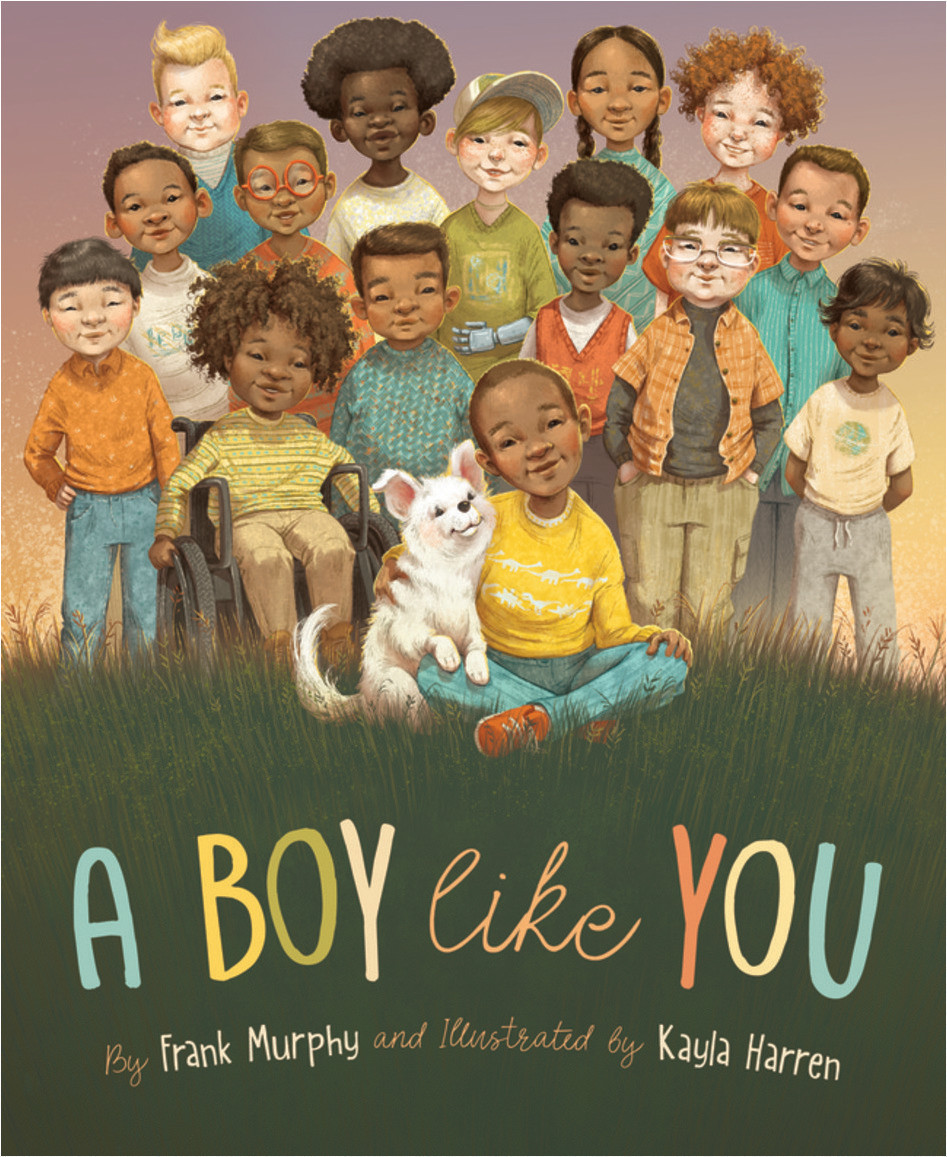
There will be times (regardless of your age) when you will be told you can't be true to yourself. A BOY like YOU (Sleeping Bear Press, July 15, 2019) written by Frank Murphy with illustrations by Kayla Harren is a book which will challenge those who would prevent you from shining your brightest light in the world. This book will inspire boys (and girls) so they are complete in every way.
There are billions and billions and billions of people in the world. But you are the only YOU there is! And the world needs a boy like you.
To begin an unseen narrator tells the reader a boy needs to be kind, helpful, smart and strong. Strong and smart are described in a sport setting as are other ways to participate appropriately. But . . . sports are only one area when a boy can be himself.
Boys are encouraged to be gardeners, bakers, musicians, writers, scientists and to keep making discoveries. It's only when you ask questions, you'll have the necessary answers. When speaking of having the courage to inquire, readers are told
fear and bravery are partners.
Being smart is when you know to request help. Being strong is being able to cry. Everyone cries, young and old, boys and men. It's good to understand dreams are meant to be followed, even if you reshape them as you work toward them.
Do you remember there are billions and billions and billions of people? They all have stories just like you. Their stories are as worthy as your stories. Listen and share. Be gracious and grateful. Be the person people will remember for caring for our planet and its people. Each reader, each boy, is reminded to be totally themselves. This is the joy this world needs.
The words spoken by the unseen narrator as written by Frank Murphyare full of promise. They are hopeful and helpful. The sentences fashion possible scenarios and offer the best choices; choices making boys (all readers) better people. The repetition of the two words Oh boy followed by a request creates a connecting thread throughout the book. Here is a passage.
Say, "Please." Say "Thank you." Say "I love you." (And if that's not exactly right, simply say "I like you.") And, maybe most importantly, say "How may I help?" Helping each other is the best way to make our world stronger. Oh boy, be thoughtful.
Every boy, every girl and every adult who looks at the front of the open and matching dust jacket and book case will see themselves or someone they know. The open, attentive and quietly happy expressions on all the boys' faces welcome you into their company. You want to know all of them. Their diverse racial, and ethnic backgrounds are a wondrous sight! The setting of a grassy field with a golden light in the background is splendid. To the left, on the back, praise for the book is shown on a darker golden yellow canvas with children running along the bottom. Our main character, his sibling and dog are among them.
On the opening and closing endpapers on a purple background are items found throughout the book. They reference all aspects of the multitude of opportunities offered to boys in this book. They are placed in seven loose vertical rows. On the title page our main character is walking with his dog beneath the text. A hummingbird is hovering above them.
Throughout the title the background colors are continually shifting from white, to blue, to green and to yellow. Sometimes the illustration spans across two pages, smaller images are grouped on a full page and other pictures are on a single page, edge to edge. Each picture follows and highlights the narrative. There is motion and emotion in each scene carefully depicted by artist Kayla Harren.
Readers will find the details fascinating. The boy and his father are both licking spatulas during a baking session. The text is cleverly placed on a bulletin board in the boy's classroom. On two separate pages being smart and brave are tied together with a bicycle riding lesson. Readers will appreciate the continuity of the boy and his pup pictured together as much as possible.
One of my many, many favorite illustrations is set on a white canvas. A loosely framed beach scene is the setting. On the upper portion of the picture is the water, sand and people enjoying the sunny day on towels and under umbrellas. In the lower portion of the image is a sand fence. In front of that on a path the boy is pulling a wooden wagon. His younger sibling and white dog are riding in the wagon. He is tossing a used water bottle into a recycling bin. A butterfly is poised over the dog's nose. The sun on the boy's t-shirt is wearing sunglasses. On the youngest child's shirt is a butterfly. The text reads
Leave every place you visit . . . better than you found it.
Every time you read this book, whether it's the first time or the tenth time, you will feel the positive energy from the words and pictures soak into your soul. A BOY like YOU written by Frank Murphy with illustrations by Kayla Harren is a title to have in every professional collection. You will certainly want a copy for your personal bookshelves. This book celebrates being exactly who you are meant to be. There are an Author's Note about Being Strong and From the Author sections at the end.
To learn more about Frank Murphy and Kayla Harren and their other work, please follow the links attached to their names to access their respective websites. Frank Murphy has accounts on Instagram and Twitter. Kayla Harren has accounts on Facebook and Instagram. This title is highlighted with an interview with Frank Murphy on Scholastic's Ambassador of School Libraries John Schumacher's Watch. Connect. Read. You can view the book trailer there. Frank Murphy and this book are featured on Writing and Illustrating, Kathleen Temean. Author illustrator Debbie Ridpath Ohi showcases Frank Murphy on INKYGIRL. Kayla Harren has an extensive post at Writing and Illustrating, Kathleen Temean with loads of process art, numerous images and an interview.
Being true to yourself is exhilarating and sometimes lonely. If there is something odd about you that sets you apart from everyone else, it can be tricky to find friends. There will be times when you wonder if you should conform in order to be less alone. Yet, giving up those things which make you wonderfully unique brings its own kind of sadness. It's an age-old mental conflict.
Being a naked mole rat has its own challenges, but Sweety (Schwartz & Wade Books, March 26, 2019) written and illustrated by Andrea Zuill portrays a girl with additional quirks. Some might say this youngster is hearing an entire symphony rather than only a different drummer. She (and readers) will come to understand no one is entirely apart from everyone.
Sweety was awkward. Even for a naked mole rat.
She was referred as a little square peg by her grandmother. Although the exact definition of this eluded her, she knew she was sometimes an outsider. Her description of something as simple as her doll when compared to others in her company was too bold and excessive. No one seemed to share her unusual hobbies. And how many students do you know who gave a book report
through interpretive dance?
Yes, Sweety was no ordinary naked mole rat. She did wish to be like others, but she also enjoyed being herself, too. When her Aunt Ruth, her mother's sister, came for visits, Sweety felt the best. These two were like the proverbial peas in a pod.
During her last visit Aunt Ruth told Sweety about being a little square peg. She encouraged her to hold tightly to those things making her a special individual. She also spoke about finding like-minded people. This gave Sweety a whole bunch of new thoughts to ponder.
If there were people like her out in the world, she needed to recognize them. How would she do this? Some of her ideas bordered on extreme, other plans were more conventional. It's when she decided on the best course to follow that the desired but unexpected happened.
There is something delightful about naming a naked mole rat Sweety. In doing this author Andrea Zuillhas our immediate attention. Her blend of conversational narrative with supporting dialogue makes further connections and adds considerable humor to the story. While we are smiling and sometimes laughing, we are also understanding Sweety and her need to stay exactly the way she is. Here is a passage.
And most people found her hobbies a bit bizarre.
Would you like to come over to my house and help me identify fungi? No, thank you.
I don't know about you, but seeing Sweety on the open and matching dust jacket and book case calmly seated on a bench among flowers on the front makes me grin . . . a lot. Those glasses with the thick lens and braces on her teeth set her apart quickly, but we also see a person . . .er . . .naked mole rat with a great deal of self-confidence. To the left, on the back, on a lighter canvas an image from the interior of the book shows Sweety loudly proclaiming through a bull horn her virtues to another naked mole rat in hopes of finding someone like her.
A deep golden brown covers the beginning endpapers and the color used in the title text covers the closing endpapers. On the title page beneath the text Sweety is seated underneath and next to lovely blue mushrooms with yellow flecks. She is reading a book.
Rendered in pen-and-ink, scanned and colored digitally the illustrations by Andrea Zuill are highly detailed and animated. On the first two-page picture she has an aside in parenthesis about naked mole rats, their lack of fur and their love of clothes. Her image sizes vary according to the story and pacing.
Her characters tend to be in bolder brighter colors set against a softer background. (You can see this on the front of the jacket and case and throughout the title.) Elements in visuals pay tribute to those things naked mole rats and Sweety enjoy; a chart of root vegetables in the underground classroom and a mushroom lamp in Sweety's bedroom. Facial expressions and body positions depict emotional moments but like the text also lend themselves to comedy.
One of my many favorite illustrations is a double-page pictures. We are underground in Sweety's classroom. Near the center of the picture her teacher is seated at her desk in front of a blackboard. To her right is the tunnel used as an entrance and exit. To the right of this is a set of bookshelves. Sweety is to the left of her teacher clothed in a purple one-piece suit, eyes closed and dancing with a pointed toe and arms flexed a la Martha Graham. Four classmates are seated at desks along the bottom of the two pages. One is asking about what book Sweety has read.
This is a book for those who embrace life with a difference and for those who do not. It helps the first group to stay the course and to not feel alone and reminds the second set of people everyone is valuable. Sweety written and illustrated by Andrea Zuill is a title you will want to have on your professional bookshelves and in your personal collection too. We all need reminding every now and then that different is superb.
To learn more about Andrea Zuill and her other work, please follow the link attached to her name to access her website. Andrea Zuill has an account on Twitter. At the publisher's website you can view the first few interior images. On KPBS Andrea Zuill chats about this book. Author, reviewer and blogger Julie Danielson features Andrea Zuill and this title at Seven Impossible Things Before Breakfast.