Quote of the Month

When love and skill work together, expect a miracle. John Ruskin


Showing posts with label Conduct of life-Fiction. Show all posts

Wednesday, November 3, 2021

Better Together #4

Each day circumstances present opportunities for us to discover potential personality traits or increase (or decrease) those we already have.  We may be shocked at what is revealed.  It is in these revelations our confidence grows.  Our comfort in expressing ourselves is deepened and widened.  

We come to understand there is more than one definition for certain attributes.  Be Strong (Roaring Brook Press, August 10, 2021) written by Pat Zietlow Miller with illustrations by Jen Hill, a companion title to their Be Kind (Roaring Brook Press, February 6, 2018), addresses this very concept.  A young girl struggles with being strong and its various meanings and power.  Her ultimate understanding benefits everyone.

My school gym has tall walls.
I never noticed them before.
But, today I have to climb them.

Classmates make it to the top of the wall without struggling.  Tanisha cannot get beyond the bottom.  She does not have the strength to pull herself up.

Some days, trying to lift the simplest things, are hard for her.  Her family tells her to be strong.  This is how you get through the tough times in life.

When she asks for help, Dad, Mama, and Grandma Zee give her real-life examples of strength.  Being strong is sacrificing your time to help others, speaking up again and again to right a wrong, and committing to a goal.  At school and home, Tanisha notices moments to put their advice in action.

Dad, Mama, and Grandma Zee each offer one more suggestion.  Sometimes the tasks she attempts seem daunting, but first one thing, then another thing, and finally a third thing keep her going. And Tanisha learns the most important definition of being strong.  What do you think it is?


To begin, Pat Zietlow Miller gives us a problem.  Climbing a rock wall is a situation many have faced, so we can easily find ourselves identifying with the protagonist.  She uses this to present other perspectives on being strong, other than the obvious physical one.  In the characters of Dad, Mama, and Grandma Zee and their instances, we see applications for being strong.  These applications are (or may be) present in each of our communities.  Pat Zietlow Miller establishes a rhythm in her storytelling by repeating three two-word phrases three times, connecting separate portions of the narrative.  Here is a passage.

Grandma Zee says being strong means not giving up.
Like when she started running.

At first, she barely jogged a block.
She worried people would laugh.
But she keeps going.

Day after day.
Block after block.
Even when it rains.


One look at the children holding up the sign displaying the title text on the front, right, of the open and matching dust jacket and book case sends a strong impression.  The diverse ethnicity and colorful array of clothing suggest differing personalities who have united in a common cause.  Of particular interest is the purple hue surrounding them.  Purple can imply royalty or in this case, future leaders strong in the knowledge of themselves.

To the left of the spine, on the back, Tanisha and Grandma Zee are featured on a pale and tiny herringbone pattern of white and gray.  They are seated on mats and working on touching their toes.  Over their heads are the words:

Together, we can be strong.

The people and the area closest to them on both the front and the back are varnished on the dust jacket.

The opening and closing endpapers are covered in the bright orange shade shown on the front of the jacket and case in the one child's clothing.  Tanisha and Grandma Zee are presented on the title page using a part of an interior illustration.  Together, they lift a heavy backpack, each grabbing a strap.

Jen Hill rendered these pictures using

gouache on paper and retouched with Adobe Photoshop. 

The image sizes, full-page pictures, double-page pictures, and two smaller pictures on a page, supply readers will different perspectives.  At times we are observers, watching Tanisha being strong enough to be on stage playing her accordion.  Sometimes we are standing with Tanisha, as if we are her shadow.  These are intimate but brief time periods with this character.

In several of the illustrations, Jen Hill uses white space as an additional element allowing the other elements to seek and hold our attention.  The tiny features on the characters' faces convey a range of emotions.  This is no easy task, but Jen Hill does it splendidly.

One of my many favorite illustrations is on a single page.  It is in the school cafeteria.  Two circular tables are placed next to each other.  Around these muted-yellow tables are deep purple blue chairs.  The cafeteria trays are an orange red in color.  Groups of students at both tables present a diverse representation.  We see Tanisha's strength at work on the table closest to us, toward the bottom of the page.  She is placing a sign on the table.  It reads:

make a friend.


Endearing readers to these characters and their circumstances in Be Strong written by Pat Zietlow Miller with illustrations by Jen Hill is accomplished by the realism portrayed in word and images.  We know people who encounter these same happenings.  And this title offers hopeful, doable solutions readers can use in their own situations.  I highly recommend this title for your personal and professional collections.

In accessing their websites by following the link attached to their names, readers can learn more about Pat Zietlow Miller and Jen Hill and their other work.  Pat Zietlow Miller has accounts on Instagram, Pinterest, and Twitter.  Jen Hill has accounts on Facebook, Instagram, Twitter, and Vimeo.  At Macmillan Publishers you can view interior images.  Pat Zietlow Miller has a guest post at PictureBookBuilders about this title.  She has a video interview at Action News 2, Wisconsin about this book and her other work.


Like the word, strong, the word courage has multiple meanings.  For some individuals, courage is instinctive.  For others, it is learned.  I Am Courage: A Book of Resilience (Abrams Books for Young Readers, September 7, 2021) written by Susan Verde with art by Peter H. Reynolds is the sixth book in a series by these two talented collaborators.  The focus on a single word is enhanced through a first-person narrative of affirmations.

When there are challenges in front of me,
when I feel unstable,
like I might fall . . .

This child's voice tells us that in spite of obstacles and hesitancy, there is a can-do attitude found within them.  Like the engine in the classic The Little Engine That Could, this child keeps going.  Bit by bit with a heart full of faith, this child realizes possibilities.  They state:

I am courage.

Instinct, recognition of one's strengths, and endurance, even in the face of fear, keeps this child moving forward.  A stumble does not stop this person because they have learned to ask others for help.  All these things give this child the courage to use their experiences to support others.

This confidence helps this child to continue no matter what happens.  This child constantly looks to their core for courage.  This, in turn, inspires others.  

I becomes we.  The qualities of one become the qualities of others.  The journey of one becomes the journey of many . . . together.


You cannot read the words written by author Susan Verde in this book without, page by page, feeling a spark inside you grow brighter and brighter.  Through the mindset of this child, we look at each setback as a test to ace.  Throughout the narrative after a series of thoughts, Susan Verde follows with two word:

I am.

She does use courage after those two words several times, but she also uses words synonymous to courage or words in support of courage.  This is how the story flows toward a conclusion embracing other persons in their quest for courage.  Here is a passage.

I can know there is no shame
in sharing.  I tell my story.

I can step in when others are struggling.
I know how to help.


There is much to be learned when removing the dust jacket and opening it up.  For this book, the illustration on the right, front, introduces us to the main character, the voice in this story.  This child, wearing a shirt with a symbolic flame within a shield, is the picture of resilience fueled by courage.  The body language says I stand strong.  In fact, this child radiates this attitude.  The first three title words are done in foil.

On the back, to the left of the spine, the child with their bike is joined by two other children with their bikes and a canine companion.  Each is carrying a flag bearing the flame.  As a reader we wonder how one becomes three (plus one more brilliant being).

Also, by removing the dust jacket, we view a stunning book case.  It is done entirely in black and shades of yellow.  From left to right, with the bikers riding to the right in a row, they appear as a force, a force for good.  The flags are now on the back of each bike.  The dog is carrying a flag in its mouth.  There is a wide band of black at the bottom representing the path.  The children and their bikes are in black except for a lighter yellow inside the wheels.  The background is a marbled golden yellow.  (We later realize this is an interior image.)

A rose swirl, a center spiraling outward, covers the opening and closing endpapers.  Perhaps this is a depiction of the deep down of which the protagonist speaks.  Each illustration by Peter H. Reynolds was

created using traditional and digital inks, gouache, watercolor, and tea.

These double-page and full-page pictures tell their own story.  Peter H. Reynolds uses a boy traveling on his bike to elevate the text by Susan Verde.  He begins with a palette of purple and blue hues transitioning to light, bright, white and yellow as canvases.  He works the dog into the story, first as something possibly to fear, but an accident changes this outlook.  As presented, we cannot help but relate to the three children.

One of my many favorite illustrations (besides the book case) is a single-page picture.  Night has fallen and stars pinprick along the top of the page.  Between a grove of trees, a small tent is pitched.  In the foreground the three children sit on big rocks around a small campfire.  The two boys sit across from each other, the dog, head on paws, next to his human.  The fire lights the face of the girl who needs help.  The main character is telling his story of courage and resilience.


You will want to keep this title, I Am Courage: A Book of Resilience written by Susan Verde with art by Peter H. Reyolds, ready to read repeatedly.  At the close of the book is an author's note and four yoga poses and breathing exercises to inspire you to be your best self.  You will want to have a copy of this book in both your professional and personal collections.

To learn more about Susan Verde and Peter H. Reynolds and their other work, please access their respective websites by following the link attached to their names.  Susan Verde has accounts on Facebook, Instagram, and Twitter.  Peter H. Reynolds has accounts on Facebook, Instagram, and Twitter.  At the publisher's website, you can view interior images.  There are activity sheets to download.


Blog posts, Better Together #1, Better Together #2, and Better Together #3, provide other titles to use with these two books if you like.

Tuesday, March 30, 2021

Rooted In Strength

Inside every individual runs a current of confidence.   This current can meander slowly with barely a ripple.  It can rage like rapids running through mountains.  Whether it is small and silent or large and loud, it is always there.  

Perhaps, the source of this current is the same for all individuals.  It is feed from multiple sources, some are tiny, others are beyond our senses.  The Tree In Me (Dial Books for Young Readers, March 16, 2021) written and illustrated by Corinna Luyken is a luminescent, melodic observation of that sustaining and binding force inside all of us.

The tree in me

is part apple,

It is not just part apple, but it is parts of other fruits and nuts.  It also tastes delicious.  The tree provides a place of cool and calm.  The tree provides a space of warmth and energy.  

This tree can be many things.  It is beginnings in seeds.  It is endings (and continuations) in stumps.  In between starting and stopping, it is a source of endless explorations and imaginations.  Many call it home.

From the tree comes gifts around it, under it and above it.  Close your eyes and reach out with your mind.  What do you see, feel, hear, taste or smell near the tree?  

This tree is solid, but able to bow when necessary.  It draws its strength from deep roots and a full crown.  It reaches to other trees, to their roots and crowns.  This is true.  You!


Every time the words penned by Corinna Luyken are read, it is as if you are being rocked in the serenity and security of a bed shaped of tree boughs.  The rhythm fashioned by the comparisons is a lasting lullaby.  In these seven beautifully formed sentences, a world within us is revealed. It is a shared world.  Here are some more words in the first sentence.

The tree in me

is part apple,

part orange-pear-almond-plum

(part yummm),  


When you open the dust jacket, the loveliness of the unfolding scene leaves you breathless before you softly gasp in awe and appreciation.  The portion of the crown shown on the right, front, with the child reaching for the fruit, extends over the spine and to the far-left side on the back. From the bottom of the left, slightly off center, is a thick sturdy tree trunk stretching over the spine.  From that trunk, two smaller branches grow, each covered in a gorgeous array of foliage.  The lush color palette of vivid pink, blue hues, golden yellows, and brown here is used throughout the book.  

On the book case the child has moved to nestle within a fork in a tree, other sturdy branches stretching to the top and left.  The crown covers the setting like an umbrella, across the top and down the left side.  In the fork on the right, above the child, a huge sun shines.  It's like a gigantic piece of fruit.  (You could look at this image all day.)

The same shades of color appear on the opening and closing endpapers.  The leaves are much closer to us.  It is like we are looking up at them, watching as light radiates down through the growth.

On the title page, the tree stands tall slightly right of the gutter, branches and crown spreading left and right over two pages.  The child stands in the field of flowers to the left of the tree, looking up at the fruit.

Each breathtaking illustration

was created using gouache, pencil, and ink.

These two-page pictures by Corinna Luyken bring us close to the child, inviting us into each experience.  Sometimes, the focus steps back broadening our vision.  We see more of the tree and its partners.  We see more children.  As their shared joy grows, so does our joy.  The blend of tiny details and larger brush strokes builds each enchanting moment, moments of discovery, growth, understanding, and connection.

One of my many, many favorite illustrations has the crown of the tree across the top.  Along the bottom is a presentation of grasses and flowers.  Both are in the same arresting hues.  The trunk and its roots begin in the lower, left corner moving toward the gutter.  On the right, hanging from staunch ropes is a large tire swing.  It is horizontal providing seating for three children.  They gleefully spin, heads back in happiness and contentment.


Uplifting, thoughtful, and inspiring through words, artwork, and impeccable pacing, The Tree In Me written and illustrated by Corinna Luyken is a book to read repeatedly.  I know it will promote rich musings you will want to share with others.  You need this title in your personal and professional collections.  Share it widely.  Gift it.

To learn more about Corinna Luyken and her other work, please visit her website by following the link attached to her name.  Corinna Luyken has accounts on Facebook, Instagram, and Twitter.  This book is showcased with an interview by Scholastic's Ambassador of School Libraries, John Schumacher, on his site, Watch. Connect. Read.

Wednesday, March 24, 2021

Go With The Flow

One of the many things you learn from being near or on water for most of your life is, it never stays the same.  Every minute, hour, or day, whether it is a stream, river, inland lake or one of the Great Lakes, it changes.  A difference in temperature, humidity, or wind determines if it is as smooth as glass, rippled, or rocky with waves.  Its fluid moods beckon to a host of flora, fauna, and humans.  A student of watery realms gains essential life insights.

Paddling down creeks or rivers rafting or canoeing, it is easy to observe our feathered friends, either as frequent visitors or residents.  Mel Fell (Balzar + Bray, an imprint of HarperCollinsPublishers, February 2, 2021) written and illustrated by Corey R. Tabor captures the can-do spirit of young kingfisher.  Determined thinking bolsters bravery.

One day, when Mama was away,
Mel decided it was time to learn to fly. 

Her sister, Pim, and her brother, Pip, were certain this was not the best idea.  Mel, having the good sense to be scared, was nevertheless going to fly.  Today was the day.  Springing up from the branch, she dove.

It was a long way down.  The affectionate squirrels tried to catch her.  Their attempts were not fruitful.  Buzzing bees simply could not stop her.  Down she went.  As you might assume, the efforts of a neighborly spider were unsuccessful.  

Mel fell straight down, plunging into the water.  She caught the right-sized fish in her sharp beak.  Using her wings, she surged from the water.  She was flying!  Up and up and up she went.

As she passed each of the resident tree members, they cheered for the courageous Mel.  When Mel reached the family branch, Mama was home.  Looking at each other, they spoke identical thoughts.  Attitude.


Using dialogue with narrative, author Corey R. Tabor fashions a tale guaranteed to keep you on the edge of your seat as you applaud the efforts of this young bird.  The tension builds as each of the friends try to prevent what they assume is a disaster.  Yet, Corey R. Tabor builds humor into the story with his word choices and descriptions as Mel whizzes past the tree trunk, on the way down and on the way up.  Here is a passage.

The squirrels tried to catch her.  They
really did.  They'd grown quite fond of
those squeaky little chirpers upstairs.

Blast!
Nuts!
Oof!
Aieeeeeee!

But it was no use.  They
missed her by a whisker.


The position of the text in relation to the spine on the matching dust jacket and book case is your first hint the reading of this book is going to be turned a bit.  To read the title horizontally, left to right, as it appears above, you need to put the spine on top.  The cheerful, full color palette with animated characters on the front, right, is another clue as to the enchanting events unfolding inside the covers.  The title text is raised to the touch.

To the left, on the back, with the spine on top, the textured white canvas continues.  On the left side is Mel's tree.  It stretches from top to bottom.  We can see the three bird siblings and Mama, the owl family, the beehive, the spider's web, and three squirrel tails sticking out from hollows in the trunk.

On the opening and closing endpapers and the first inside page is a vibrant pattern in two hues of spring green.  It features leaf prints like those on Mel's tree.  At the front, the next page is a close-up of the tree with the trunk on the right, branches extending off the top and left side.  At the back, the trunk is still on the right.  A single branch sticks out from the kingfisher home.  Mel is pushing one of her siblings to the edge of that branch.  The other one is holding to the branch with most of their body still in the hole.  This page also contains an author's note, the dedication and publication information.

On the title page (You are still reading this book turned.), the trunk of the tree on the right is shown from the top to the bottom of two pages.  Mama is on a branch above the nest hole in the trunk.  Mel is peering outside.

These illustrations rendered with

pencil, colored pencil, and acrylic paint, and assembled digitally

are vertical two-page pictures on the textured, white canvas on a matte-finished, heavier paper.  The one exception for the background is when we see Mel moving in the water.  At this point we turn the book again, so Mel is flying up.  The tree trunk is always on the right side.  

It's the facial expressions on the animals which elevate the humor as do their physical attempts to stop Mel on her way down.  Mel's eyes are closed all the way down until just before she hits the water.  Her eyes are closed on her way home but this time she spins her body around.

One of my many, many favorite illustrations is when Mel is flying up to her home.  Toward the bottom of the page two branches bleeding off the left side form a large "v".  Inside the "v" the spider has spun a web.  Mel shoots through the web, threads showing her speed upward.  Off to the right the spider spells "yay" and claps with all eight of her hands.  Mel has spun showing us her breast.  The fish in her beak is looking worried.  (There is more humor involving the fish at the end.)


Original in words, design and artwork, this book, Mel Fell written and illustrated by Corey R. Tabor, shows the results of adding a dive of faith plus resolve to equal success.  Whether you read this one on one or to a larger group, this is a story time treasure.  I highly recommend you add this title to your personal and professional collections.

To learn more about Corey R. Tabor and his other work, please follow the link attached to his name to access his website.  At the publisher's website you can read a sample.  They also have a book trailer there which supplies an example of how to read this title.

UPDATE:  On April 20, 2021 this title is highlighted by author, reviewer, and blogger, Julie Danielson at Seven Impossible Things Before Breakfast.  Here Corey R. Tabor talks about the spark for this book and his illustrative process.


By canoe, by raft, by fishing boat, by speed boat, by pontoon, by yacht, by houseboat or by sailboat, with every trip this passenger has stories to tell.  It can be a simple sunny day cruise.  It can be the most amazing fish tale every told.  It can be a my-dad-will-never-let-me-drive-the-boat-again-after-I ran-it-up-on-the-dock escapade.  It can be an I-can't-believe-I-survived ocean exploit.  These narratives, when combined with other multiple water travels, are an individual's existence from first to last breath.  In Sail (Little, Brown and Company, March 9, 2021) written and illustrated by Dorien Brouwers, readers explore the wild, wonderful, unpredictable, and sometimes frightening ride called life. 

We all have ships to sail
in life's adventurous tale. 

It does not matter the size or type of vessel.  There is one for each of us.  We release a ship from its moorings and with openness seek that which awaits us.

Regardless of the shape and height of the waves, we bravely welcome them.  If we feel as though we are off course, look to the sails and change direction. Stay sharp as the wind tosses the boat. 

If we tumble into the water, swim.  There are secrets beneath the waves, waiting to be found.  Go down.  Go deep.  Hold those secrets close.

When it is time, we rise to the surface. We do so with more knowledge and understanding.  From there, back in our boat, we go forward knowing there is much more to explore and achieve.  


Reading like a poem, a lullaby, and a loving letter offering encouragement, this book written by Dorien Brouwers asks us to be our best selves regardless of where we go and what we encounter.  Using watery realms analogous to life with us as sailors in a boat of our choosing, rhyming couplets create a comforting narrative.  In each of the couplets, emphasis is placed on a single word.  When those single words are strung together, they make a buoyant ring around the reader.  Here is a passage.

Search the ocean for the light.
Breathe in deep and don't lose sight.


The swirl of blue and white hues seen on the front of the dust jacket moves over the spine to the left, fashioning a vast expanse of water and opportunities.  The school of tiny fish racing in an arc on the front indicate a fast-moving current.  To the left, on the back, a smaller group of fish meander through the ocean.  This setting with the sailboat and its single passenger with a seabird flying nearby is the essence of anticipation.  

A whirlpool spins across the opening and closing endpapers.  It's a wild blend of blues and white.  Fish in both colors swim with the circular currents in constant motion.  On the verso and title pages, a double-page picture of a seascape presents several different kinds of sailboats in a sheltered space, a calm sea, with a red and white lighthouse on a nearby point of land.

Each two-page picture in this book was rendered

with watercolor on 220gsm Daler Rowney paper with monoprinted details added to it.

Their eloquent, textured depictions display sensory scenes.  In a superb mix of light and shadow, a variety of perspectives draws us into each image.

We are standing on a dock next to a row of boats, some large enough to dwarf us.  As our boat moves off the right side of the visual, we reach down to pull a large anchor loose from the bottom.  When a stormy sea surrounds us, we hold tight to the sail lines, trying to follow the right path.  Now in the ocean, we silently swim down and among the colorful creatures and plants.  Each perspective offers an original possibility.

One of my many, many favorite illustrations is in the murky depths.  Starfish, jellyfish, rays, scallops, and fish glide and rest.  Swimming with a school of fish is the child.  They are moving toward a giant vibrant octopus who occupies most of the left side.  In three of its arms, it holds keys.  What do these keys unlock?  I imagine each reader will have an answer, some the same and others strikingly divergent.


This book, Sail written and illustrated by Dorien Brouwers, like the water on which we traverse, will take on fresh meanings each time it is read with readers of all ages.  At the close of the title is a page of six questions with the heading,

Some Things to Think About.

This is a book which needs to be on your personal and professional bookshelves.

To learn more about Dorien Brouwers and her other work, please access her website by following the link attached to her name.  You can see interior illustrations at her website.  Dorien Brouwers has accounts on Instagram and Twitter. At the publisher's website is a marvelous, illustrated chat with the author about the book and her images.

(Note:  I was working with an F & G when writing this post.)

Thursday, March 11, 2021

Better Together #2

It is not only people who respond to compassion.  Humans with animal companions, veterinarians who heal and care for them, and scientists who study them usually agree the response from animals approached and treated with kindness is favorable.  In fact, there is evidence some animals experience a varied range of emotions. (Animal Emotions: Exploring Passionate Natures: Current interdisciplinary research provide compelling evidence that many animals experience such emotions as joy, fear, love, despair, and grief---we are not alone by Marc Bekoff, BioScience, Volume 50, Issue 10, October 2000)  An act of compassion or harmony does not need to be a grand gesture.  It can be as simple as a glance filled with warmth and affection.

Sometimes, the least of us are the ones who need to receive that glance, a caring word, a helping hand or even something done in complete anonymity the most.  Tiny Kitty, Big City (Balzar + Bray, an imprint of HarperCollinsPublishers, March 2, 2021) written and illustrated by Tim Miller simply, truthfully and with great affection is a gentle reminder of what it means to be charitable.  When we are mindful of others everyone wins.

Tiny kitty.
Big city.

When you are a tiny kitty, the city is more crowded.  It is a forest of feet and legs.  You hurry through the maze of people and vehicles as quickly and safely as possible.

Loud noises and barking dogs are frightening.  Bravery comes when joining with an iconic ally.  A warm day welcomes rest.  

An idyllic afternoon is spent dining and playing.  As evening descends, so does a snowstorm.  Nothing would be better than the warmth of a home.  Tiny kitty is chilly.

In darkness, a bluesy beat beckons.  Hearts swell at a serenade.  Love finds a way.


Using two words, kitty and city, and adding carefully selected, single adjectives, author Tim Miller tells a tale of being lost and found, and of finding what you may not have known you've lost.  The two-word phrases toggle back and forth as opposites and as responses.  The way this narrative is purposefully presented, we are able to understand the personality of the kitty and the characteristics of the city.  In those revelations, the tiny kitty and big city are able to meet in heartwarming rapport.  Here are two more two-word phrases.

Wildlife city.
Playful kitty.


Opening the dust jacket, we see the story beginning.  To the left, back, of the spine on pale blue is the tiny kitty peering from the inside of a tipped cardboard box.  On the front, right, the tiny kitty looks large compared to the big city in the background.  This reader likes to think of that as foreshadowing.  It is a hopeful concept.  The title text and tiny kitty are varnished.

You cannot look at the book case without smiling.  Across the opened book case is tiny kitty's face, up close and personal.  The nose and mouth are placed at the bottom of the spine.  One eye is on the left and the other eye is on the right.  This is a soul-to-soul stare.

Across the opening and closing endpapers, tiny pawprints, in blue on a cream canvas, loop back and forth beginning in the upper left-hand corner and running off the lower, right-hand corner.   The loops do change lengths.  Instead of going off the edge on the right side on the closing endpapers, the happy ending of this story is presented.

There are notable details for readers to see.  The words for the dedication are in the shape of a heart.  On the title page tiny kitty is staring into a puddle.  The kitty and the big city are reflected there.  Of the making of these illustrations artist Tim Miller says:

This book was made with acrylic gouache, with digital touch-ups.  Also my cat was sitting on my lap while I worked, so you might find some of her hair in the pictures.

Black lines define each element in these images.  Tim Miller presents multiple perspectives on his double-page pictures and his full-page pictures.  We look at the world from tiny kitty's point of view, from a person's point of view, and from a bird's gaze at the city below it.  These illustrations are full of emotion, fright, wonder, exhilaration, courage, contentment, fun, joy, and love.

One of my many, many favorite illustrations is a double-page picture.  The sky is golden in the middle of a sunny day.  Trunks and bare branches of trees rise in front of background buildings on the left.  In front of these a large "library lion", facing left, stretches across both pages.  A familiar building fills a large portion of the right side.  Asleep under the majestic feline's face is tiny kitty on the large legs and paws.


Guaranteed to be a read-aloud favorite and much requested title, Tiny Kitty, Big City written and illustrated by Tim Miller needs to be on your personal and professional bookshelves. In his dedication Tim Miller conveys his passion and purpose for this book.  We are grateful to him.

To learn more about Tim Miller and his other work, please follow the link attached to his name to access his website.  Tim Miller has accounts on Instagram and Twitter. This title is discussed, and Tim Miller is interviewed at Scholastic's Ambassador of School Libraries John Schumacher's Watch. Connect. Read. and at teacher librarian Travis Jonker's 100 Scope Notes.  Don't miss either of these posts!  They are fabulous as is the post Tim Miller wrote for the Nerdy Book Club. 


If you were to ask a group of people of various ages a year ago how they define peace, would those same people answer differently today?  Perhaps, a lot of their replies would change.  A global pandemic has a way of altering perspectives and priorities.  Also, if you were to ask this group how to obtain peace, express peace, or give peace, would their thinking have shifted?  Peace, Paz and Frieden (English, Spanish, and German translations of the same book) (North|South, March 2, 2021) written by Baptiste Paul and Miranda Paul with illustrations by Esteli Meza allows all ages to ponder those very questions.  It expresses through universal actions in easily understood words and lively, luminescent images, peace is for everyone, everywhere, and always.  

Peace is a hello,
a smile,
a hug.

Peace is for those who dare to be different and for those who quietly work alone.  When we show respect for others, extending common courtesies to them like looking at them when we share conversations, that is peace.  Sometimes peace starts with an unspoken gesture.  When shared ideas are discovered, that unspoken gesture blooms into a movement.

When we give to others when we have more than we need, that is peace.  Do these actions happen immediately?  No.  Peace is a good habit to nurture and have.  It's something we carry with us as if it is a part of our bodies. 

Peace is acknowledging our mistakes to ourselves and to others.  This peace brings a calm during day and night, happiness and sorrow.  Where there has been life, there has been peace.  What can and will we do to bring it to all parts of our planet?


Having read this aloud in both English and Spanish, the words of Miranda Paul and Baptiste Paul (and translator Aida Salazar), gently sing off the pages in the sweetest of melodies.  The thoughts and truths supplied through rhyming text envelope you.  The words in this narrative are an invitation readers will be unable to resist.  With intention the selected actions are possible, releasing all to enjoy the results.  Here is a passage.

Peace is on purpose.
Peace is a choice.
Peace lets the smallest of us
have a voice.

La paz es a proposito.
La paz es una eleccion.
La paz permite a los mas pequenitos
tener una voz.


When you look at the front (right) and back (left) of the opened dust jacket, it is like you are looking at a portrait of peace.  Look at the children from all backgrounds with different animals among a paradise of plants and trees.  Everyone is happy.  Everyone is enjoying the company of the others without discord.  On the back (left), there are three children, six animals and two insects, a butterfly and a bee. Across one of the large leaves, it reads:

Peace is a choice.
La paz es a proposito.

On the book case a muted gold is the canvas.  On the left side is information about the book and its creators.  On the front a sturdy brown trunk and several branches are seats for children and animals.  The leaves are a hue of blue and some are a shade of pink.  This tree scene is circled by a pale peach background.  At the base of the trunk an animal peeks out at readers.  The same white dove seen on the front of the jacket flies toward the tree here.

On the opening and closing endpapers three tiny flowers dot the bottom of a deep blue canvas.  The tree shown on the book case is placed in the center.  The children and animals are gone.  Within the blush-colored leaves is the word peace in multiple languages.

In a word, the artwork here by Esteli Meza is stunning.  Her style is distinctive, replete with vibrant rich colors.  The flora is bold and symbolic.  Children from all parts of the world are represented on each of the double-page pictures.  They are actively engaged with each other and the animals.  

With each reading you will notice a new detail.  When there is more than one animal, it looks as though they are a family.  Fish in the ocean swim forming the shape of a larger fish.  The white dove is in every image.  Readers will gasp at the four-page gatefold at the end of the book.  

One of my many, many favorite illustrations is for a single sentence.  It is night.  On the right we can see a sliver of the sky and two stars.  The dove is sleeping on a slim branch which winds up the right side and along the bottom on the right.  Two other branches fan out along the bottom on the right and left.  The body of a dozing lion covers most of the two pages.  A gray cat with a curved body and a girl with red hair in a braid lean against the lion's body.  A zebra is next to them.  The hues and pattern in the girl's dress complement the branches and leaves shown on the edges.  You know sweet dreams are being enjoyed by all.


This book, Peace, Paz, and Frieden written by Baptiste Paul and Miranda Paul with illustrations by Esteli Meza, is one to keep close.  It not only depicts peace with excellence but brings peace to all who read it.  You will want to read the Authors' Note at the end.  I highly recommend you place a copy or two in your professional collection as well as in your personal collection.

To learn more about Baptiste Paul, Miranda Paul, and Esteli Meza and their other work, please access their respective websites by following the link attached to their names.  Baptiste Paul has accounts on Facebook, Instagram, and Twitter.  Miranda Paul has accounts on Facebook, Instagram, Twitter, and YouTube.  Esteli Meza has accounts on Facebook, Instagram, and Twitter.  At the publisher's website are interior images, and multiple teacher resources.  At Simon & Schuster, there is one image not shown at the publisher's website.  At Scholastic's Ambassador of School Libraries John Schumacher's Watch. Connect. Read., the book trailer is premiered. Baptiste and Miranda talk about this book. 

UPDATE:  This title is showcased by author, reviewer, and blogger Julie Danielson at her site, Seven Impossible Things Before Breakfast.  There is an interview with Tim Miller and considerable process art.

Tuesday, November 17, 2020

Two Times The Glee #2

All you have to do is spend time outdoors watching wildlife or observe your family animal members to realize they are the source of constant comedy.  Their physical characteristics, mannerisms, and individual personalities mirror the exuberance in which they embrace life.  Unlike many humans, they have perfected the art of living in the moment.

These very qualities offer inventive authors and illustrators the opportunity to place them as characters in their narratives.  In her debut picture book as both author and illustrator Rebecca Jordan-Glum offers readers a look at a first encounter and the consequences of this meeting.  The Trouble with Penguins (Roaring Brook Press, November 3, 2020) shows readers exactly the kind of mischief penguins (and people) can generate when they forget the truth of together.

On the day the penguin discovered the person, everything changed.

The child, seated near a fire, was roasting a marshmallow. The penguin accepted the offer of the marshmallow, loving every bite of it.  The person showed the penguin how to roast marshmallows over an open fire.  

When it came time for the new pals to part, the child gave the penguin the best roasting stick.  When the penguin arrived among the other penguins, explaining the stick, the fire and marshmallows, they wanted to visit the person.  All was well with the group gathered around the fire, taking turns roasting a marshmallow until the acts of waiting and sharing were no longer accepted.  

All the penguins wanted their own fire.  What do you think the heat of all these individual blazes did to the ice?  It cracked into separate islands.  Now each penguin had a fire, a stick and roasted their own marshmallows.  For a time, they were happy, but doing something fun alone is not quite as fun as doing it together.  

Fortunately, penguins (like people) were apt, after careful thought, to make another decision.  One searched its memory, making comparisons.  A joyful beginning should be savored . . . repeatedly.


With her first two sentences author Rebecca Jordan-Glum establishes a storytelling rhythm.  She introduces a phrase which is repeated several more times, connecting important portions of the tale.  Her conversational phrases sprinkled with dialogue and asides in parenthesis are engaging in the most charming way.  Here is a passage.

"Oh, hello! I'm roasting marshmallows.
Would you like one?"

Of course the penguin would 
like a marshmallow. (It liked
it very much, in fact!)


Looking at the front, right, of the open dust jacket, you are readily aware of the rascals these penguins might prove to be.  As they frame the child, wearing a startled expression, they are highly animated.  It's likely they are proposing something unexpected to the person.  On the left side, the left wing of the penguin crosses the spine extending to the left, back.  Here, on the back, on a snowy background is a single penguin.  A trail of tracks marks its path to the right.  It is happily marching home carrying the stick given to it by the person.

On the book case, the penguins, as a group, are following the first penguin back to the child.  You can tell by their movements, body postures, and open mouths, they are excited.  They are placed on a snowy landscape filled with mounds and mountains.  The color palette of white, black, and shades of blue and purple create a pleasantly chilly setting.

An enormous panoramic view is spread across the opening endpapers.  It's a bird-eye view with the person's cabin, smoke coming from the chimney, small in the foreground in the far, left-hand lower corner.  Off to the right is a cluster of penguins, tiny and nearly centered.  The closing endpapers deliver a delightful conclusion.

Each image varies in size with respect to the story and its pacing.  We begin with a double-page picture, followed by two loosely framed images on a single page, and a full-page picture.  Not only do the sizes alternate but so do the perspectives.  There are three very expressive double-page illustrations with no words.  Everything works beautifully to supply readers with illustrations which envelope them.    Readers will enjoy the facial features on the child and the penguins, smiling at every page turn.

One of my many favorite illustrations is a double-page picture.  On a sea of hues of blue, purple, and pink are nine individual ice islands.  Five are on the left side.  Two cross the gutter.  And two are on the right.  The penguins are participating in a variety of activities.  One of them is balancing on the tip of a piece of ice, using the stick to balance.  Another is using the stick as a pole to twirl around and around suspending itsel- in the air.  Two penguins with ice islands next to each other have a single stick between them, each grasping one end with their wing.  A fish is jumping over the stick.  


Enchanting and humorous The Trouble with Penguins written and illustrated by Rebecca Jordan-Glum is a book to be relished repeatedly like the perfectly roasted marshmallow.  It is full of warmth like the cozy open fire shared by the person and the penguins.  You'll want this title in your personal and professional collections for a storytime featuring a cold or winter setting, a study of penguins, for a discussion to promote the sharing associated with true friendship, and for its wonderful storytelling.

To learn more about Rebecca Jordan-Glum and her other work, please follow the link attached to her name to access her website.  She has activities related to this book there for you.  Rebecca Jordan-Glum has accounts on Facebook, Instagram, and Twitter.  At the publisher's website you can view interior images.


In his newest offering Mike Boldt introduces us to a bear who needs encouragement in the art of playing a classic game.  He continually falls short in the main objective.  Find Fergus (Doubleday Books for Young Readers, November 3, 2020) is a read aloud treasure from beginning to end.  Fergus has a face and disposition guaranteed to create laughter.  

Fergus!
We already found you!
That was too easy.
Try hiding again.

This big, spectacle-wearing bear has zero capacity for hiding.  First, he stands in the open.  Next, he stands off to the side as if he is as thin as a piece of thread.  On his third attempt he stands behind a sapling, thinking his closed eyes will help.

The unseen narrator suggests blending in with a crowd.  Fergus does not grasp that concept either.  One fox and one duck are not a crowd.

Fergus does find larger, much larger groups but he still does not understand.  A bear is like a blinding star in a group of rabbits or even among larger animals.  Even a disguise similar to the animals where you strive to hide will not work.

By now Fergus is understanding a little bit, but he still needs to comprehend the fine art of hiding.  A brown bear with polar bears is not concealing oneself.  A countdown begins from ten to one.  Wowee!  Now that's the proper method for hiding, Fergus.


Having an unseen narrator, the readers, tell this story heightens the shared fun.  This is a wonderful technique by author Mike Boldt.  Short sentences in the form of comedic commentary, with carefully chosen words, move the story briskly with humor to its triumphant conclusion.  Here is a passage.

That's the right size . . .
but you're NOT a moose.

Still not a moose, Fergus.
Try bears.


Truthfully, I cannot look at the front, right, of the matching dust jacket and book case without laughing.  Fergus, his wide-eyed look amplified by his glasses, is trying without any luck to hide.  Title text does not make a good camouflage, Fergus.    On the back, to the left, the text reads:

Found you, Fergus!
Now go hide IN
this book so we
can come find you.

Here on the continued yellow canvas Fergus is down on all fours behind the ISBN.  His front portion and behind stick out prominently.  

The opening and closing endpapers, still with a yellow background, feature a sheet of paper.  It is 

The List of Things to Find.

There are only two things to find on the opening endpapers list.  On the closing endpapers list there are fourteen.  This longer list refers to the conclusion.  

For most of the story there is an image on the left with text in black on yellow on the right.  The text is in response to Fergus's latest action.  Fergus's actions are placed on a crisp white background, so the full-color elements stand out.  What accentuates the merriment is the facial features on all the animals.  Their eyes, mouths, and body postures are certain to invite readers to pause on every page turn.  The four-page gatefold will have readers gasping and laughing out loud.

One of my favorite illustrations is when Fergus does try to blend in with bears.  Choosing to stand among polar bears when you are a brown bear is not being out of sight. It brings to mind the phrase "Sticking out like a sore thumb." Nineteen polar bears clustered around Fergus are in various positions with all kinds of looks on their faces.  This is one of many pictures which will have you giggling or bursting out in laughter.


Find Fergus written and illustrated by Mike Boldt takes the game of hide-and-seek to a whole new level.  As a read aloud listeners will be laughing louder and louder at every page turn.  I know you will get requests to read it again.  A copy of this title will be a welcome addition on your personal and professional bookshelves.  

To learn more about Mike Boldt and his other work, please follow the link attached to his name to access his website.  Mike Boldt has accounts on Facebook, Instagram, Twitter, Vimeo, and YouTube.  At the publisher's website you can view interior pictures.  Mike Boldt and this book are featured on author Tara Lazar's Writing for Kids (While Raising Them).

Saturday, March 14, 2020

Duck. Duck. Listen.

It's not until you become an adult, or a parent yourself, that you realize all those sayings heard from your mom and dad are true and downright handy.  As children their repetition is enough to drive you bonkers.  You're sure "Many hands make light work" are words meant to enlist your help when you'd rather be doing something else.  You're positive "When in doubt, don't" is a phrase designed to take all the fun out of your life.

Fortunately, at any age, those words and phrases, unbidden, pop into your mind exactly when they are needed.  Follow Me, Flo! (Candlewick Press, March 10, 2020) written and illustrated by Jarvis brings readers into a ducky daughter and daddy relationship.  The cheerful words and illustrations depict a constant conflict between children and their parents with understanding.


There are certain things
that all little duckies must do every day:

Of those three things, eat, bathe and go to bed, Little Flo does not do even one.  She devours desserts.  She splashes through mud puddles.  She is noticeably absent at bedtime.

Her Auntie Jenna has a new nest so Little Flo and Daddy Duck are going to visit.  Daddy Duck insists Little Flo follow him.  Daddy Duck turns his request into a song which he sings to Little Flo.  Much to the bird's dismay, her father does not sing

VERY high 
and VERY LOUD.

Little Flo, determined to make her own music, sings an original follow me melody.  Her voice is high and loud. Intent on her personal tune, she is unaware of a new threat.  Roxy Fox is hungry.  Where is Daddy Duck?

Little Flo is on the run.  Words, singing words, come into her mind.  She follows those words.  Roxy Fox follows Little Flo.  Look at that darling duckie daughter go!  A series of surprises conclude this delightful tuneful tale.


On his first page Jarvis uses the storytelling technique of three to engage readers.  He also makes the story more intimate by including a little bit more within parentheses.  It's like he's whispering additional information to us.  He uses this again at the end of the story to create a circle.

When Daddy Duck sings his desires for Little Flo to follow him, it's an open invitation for readers to participate in the story.  In this musical interlude a rhythm is supplied in rhyming words and the use of opposites.  Little Flo also uses opposites in her melody adding to the fun as well as generating suspense.  Here are a few phrases from each of their songs.

"OK, Flo, but listen to me first.
We're off to somewhere new.
So stick to me like glue.


So Flo made up her own song.
"Follow, follow, follow me.
I'm little duckie
FLO!

"Follow, follow, follow me.
I'M SUPER-FAST,
NOT SLOW.


A first glimpse of all the joy within the pages of this book is seen on the matching dust jacket and book case.  These, as well as all the interior images, are rendered in

pencil, chalk, and paint and colored digitally.

The spring green canvas on the front is carried over on the other side of the spine, to the left.  The colors in the rocks, Little Flo, Daddy Duck and the insects all complement each other.  On the back, the left, Little Flo and Daddy Duck are gliding over the turquoise blue water of a pond.  A bee and a fly are keeping them company.  (I love that the ISBN here is showcased in a smaller version of the sign on the front of the jacket and case.)

The opening and closing endpapers are done in two tones of the palest lavender.  Rocks and grasses are placed among pond water.  Insects and a tiny bird share the scene.  On the title page (with the publication information), the dedication is carved into a heart on a tree truck behind a singing Little Flo and Daddy Duck.

The illustrations range in size from a cluster of three or two on a single page, single page, edge to edge, or double page, edge to edge.  Several times during the book, Jarvis supplies readers with a series of vertical panels to provide pacing and the passage of time.  Once triangle-shaped panels are used.

These illustrations welcome readers to reach out and touch them.  There is plenty of texture.  The details focus on the setting, the wide-eyed expressions and the extra creatures in the world of Little Flo and Daddy Duck.

One of my many, many favorite illustrations spans two pages.  It is when Little Flo and Daddy Duck are first starting their journey.  It is an up-close perspective of the duo.  Behind them is the forest, trees, bushes and flowers, in various pastel shades.  A bright blue and red butterfly flutters nearby.  Another blue and white polka-dotted butterfly rests on a series of vertical leaves on the left.  Little Flo and Daddy Duck are swimming along in the pond.  A bee follows them.  A ladybug pauses on a rock.  Musical notes in the same color as Daddy Duck appear above him.  This visual is happy, happy, happy.


This book, Follow Me, Flo! written and illustrated by Jarvis is a merry celebration of the affection, and sometimes conflict, between a child and their parent.  The inclusion of the songs within the story and lighthearted illustrations equals a superb storytime selection.  You can expect to have requests to read this repeatedly.  I highly recommend this for your personal and professional collections.

To learn more about Jarvis and his other wonderful work, please follow the link attached to his name to access his website.  Jarvis has accounts on Instagram and Twitter.  At the publisher's website and at Penguin Random House, you can view interior images.  I've also created a Pinterest board with other duck books and a few crafts for storytime fun.

Monday, July 15, 2019

To Be Me

Each living breathing person has an opportunity to be uniquely wonderful.  It's not easy to discover your gifts.  Those things which set you apart from others come from listening to the voice of your heart.  There's a lot of noise in the world.  If you seek those who guide you and not define you, you will hear the truest of words.  These words will help your soul to write its own melody.

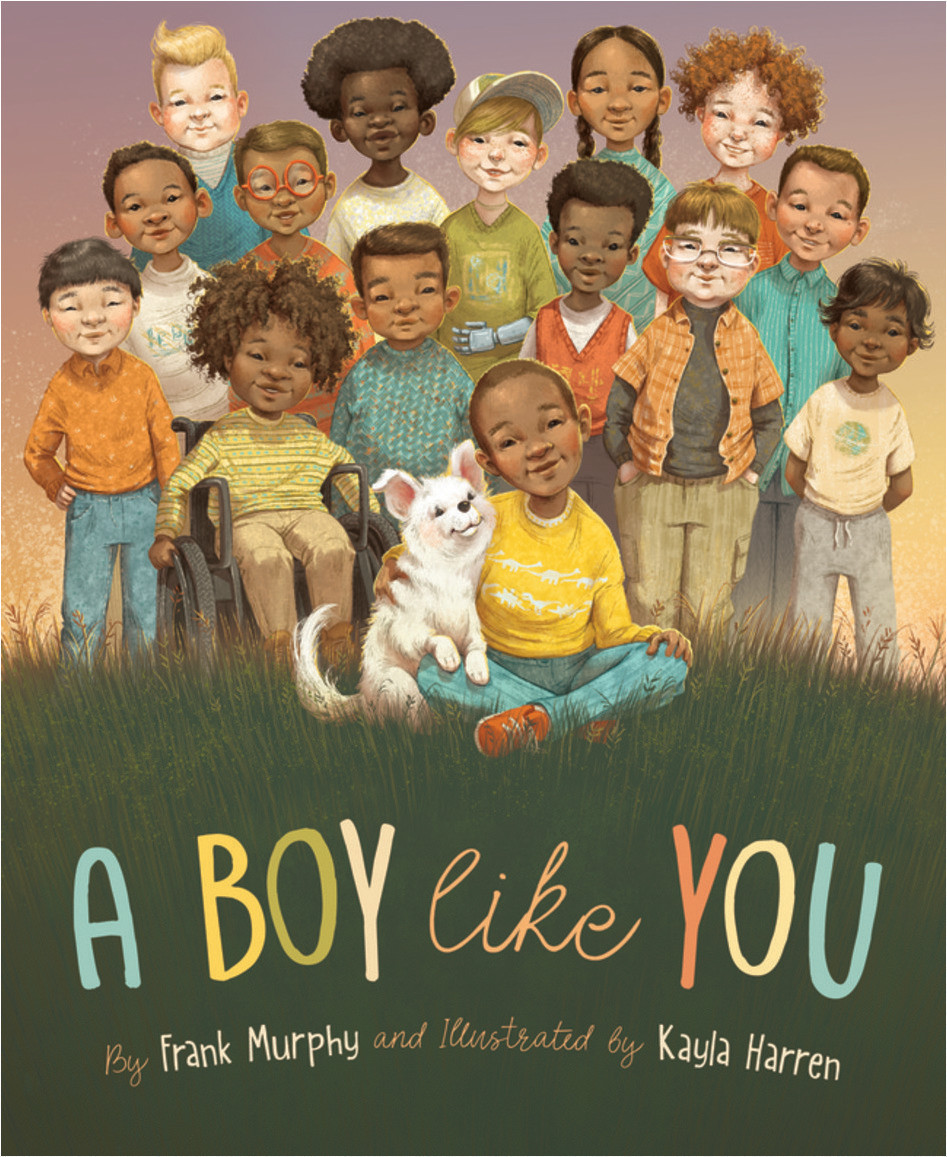
There will be times (regardless of your age) when you will be told you can't be true to yourself.  A BOY like YOU (Sleeping Bear Press, July 15, 2019) written by Frank Murphy with illustrations by Kayla Harren is a book which will challenge those who would prevent you from shining your brightest light in the world.  This book will inspire boys (and girls) so they are complete in every way.

There are billions and
billions
and billions
of people in the world.
But you are the only YOU there is!

And the world needs a boy like you.

To begin an unseen narrator tells the reader a boy needs to be kind, helpful, smart and strong.  Strong and smart are described in a sport setting as are other ways to participate appropriately. But . . . sports are only one area when a boy can be himself.

Boys are encouraged to be gardeners, bakers, musicians, writers, scientists and to keep making discoveries.  It's only when you ask questions, you'll have the necessary answers.  When speaking of having the courage to inquire, readers are told

fear and bravery are partners.  

Being smart is when you know to request help.  Being strong is being able to cry.  Everyone cries, young and old, boys and men.  It's good to understand dreams are meant to be followed, even if you reshape them as you work toward them.

Do you remember there are billions and billions and billions of people?  They all have stories just like you.  Their stories are as worthy as your stories. Listen and share.  Be gracious and grateful.  Be the person people will remember for caring for our planet and its people.  Each reader, each boy, is reminded to be totally themselves.  This is the joy this world needs.


The words spoken by the unseen narrator as written by Frank Murphy are full of promise.  They are hopeful and helpful.  The sentences fashion possible scenarios and offer the best choices; choices making boys (all readers) better people.  The repetition of the two words Oh boy followed by a request creates a connecting thread throughout the book.  Here is a passage.

Say, "Please."
Say "Thank you."
Say "I love you."
(And if that's not exactly right,
simply say "I like you.")

And, maybe most importantly, say
"How may I help?"

Helping each other is the best way
to make our world stronger.

Oh boy, be thoughtful.


Every boy, every girl and every adult who looks at the front of the open and matching dust jacket and book case will see themselves or someone they know.  The open, attentive and quietly happy expressions on all the boys' faces welcome you into their company.  You want to know all of them.  Their diverse racial, and ethnic backgrounds are a wondrous sight!  The setting of a grassy field with a golden light in the background is splendid.  To the left, on the back, praise for the book is shown on a darker golden yellow canvas with children running along the bottom.  Our main character, his sibling and dog are among them.

On the opening and closing endpapers on a purple background are items found throughout the book.  They reference all aspects of the multitude of opportunities offered to boys in this book.  They are placed in seven loose vertical rows.  On the title page our main character is walking with his dog beneath the text.  A hummingbird is hovering above them.

Throughout the title the background colors are continually shifting from white, to blue, to green and to yellow.  Sometimes the illustration spans across two pages, smaller images are grouped on a full page and other pictures are on a single page, edge to edge.  Each picture follows and highlights the narrative.  There is motion and emotion in each scene carefully depicted by artist Kayla Harren.

Readers will find the details fascinating.  The boy and his father are both licking spatulas during a baking session.  The text is cleverly placed on a bulletin board in the boy's classroom.  On two separate pages being smart and brave are tied together with a bicycle riding lesson.  Readers will appreciate the continuity of the boy and his pup pictured together as much as possible.

One of my many, many favorite illustrations is set on a white canvas.  A loosely framed beach scene is the setting.  On the upper portion of the picture is the water, sand and people enjoying the sunny day on towels and under umbrellas.  In the lower portion of the image is a sand fence.  In front of that on a path the boy is pulling a wooden wagon.  His younger sibling and white dog are riding in the wagon.  He is tossing a used water bottle into a recycling bin.  A butterfly is poised over the dog's nose.  The sun on the boy's t-shirt is wearing sunglasses.  On the youngest child's shirt is a butterfly.  The text reads

Leave every place you visit  . . . better than you found it.


Every time you read this book, whether it's the first time or the tenth time, you will feel the positive energy from the words and pictures soak into your soul.  A BOY like YOU written by Frank Murphy with illustrations by Kayla Harren is a title to have in every professional collection.  You will certainly want a copy for your personal bookshelves.  This book celebrates being exactly who you are meant to be.  There are an Author's Note about Being Strong and From the Author sections at the end.

To learn more about Frank Murphy and Kayla Harren and their other work, please follow the links attached to their names to access their respective websites.  Frank Murphy has accounts on Instagram and Twitter.  Kayla Harren has accounts on Facebook and Instagram.  This title is highlighted with an interview with Frank Murphy on Scholastic's Ambassador of School Libraries John Schumacher's Watch. Connect. Read.  You can view the book trailer there. Frank Murphy and this book are featured on Writing and Illustrating, Kathleen Temean.  Author illustrator Debbie Ridpath Ohi showcases Frank Murphy on INKYGIRL.  Kayla Harren has an extensive post at Writing and Illustrating, Kathleen Temean with loads of process art, numerous images and an interview.

Tuesday, February 26, 2019

It's No Yolk, You're Nice!

There are people known for always taking the high road in any given situation.  Regardless of circumstances they look for the silver lining.  They are the individuals others look to for support and consistency.  They live to be of service to others.

There is nothing wrong with striving for excellence but the drive for accepting nothing but perfection can take a toll.  It's a burden not all can bear regardless of their desires.  The Good Egg (Harper, an imprint of HarperCollinsPulishers, February 12, 2019), companion title to The Bad Seed, written by Jory John with illustrations by Pete Oswald is about one of a dozen who simply broke under the burden of being the best.

Oh, hello!
I was just rescuing this cat.
Know why?
Because I'm a good egg.

A verrrrrry good egg.


This egg's generosity knows no end.  Whatever you need done, from plant watering to house painting, this oval optimist is bursting with enthusiasm.  Good Egg has been this way as far back as he can remember, even though the other eleven companions in his residence exhibit far less than eggs-cellent behavior.

If these eleven find something to do wrong, they do it.  It is tiring to follow behind their antics making everything right, but Good Egg is a

verrrrrry good egg.

Do you think his housemates notice his worthy deeds?  They do not.  As to be expected our protagonist cracks.  There is no denying the tiny fissures along the top of his head.

A visit to his doctor confirms stress is the culprit.  He needs to stop trying to make the other eggs be as good as he is.  No one cares when he leaves.  After weeks of roaming without purpose Good Egg faces his aloneness and ponders his future.

He starts to focus on himself!  He does all those things he never had time to do previously.  The results are unexpected and life-changing.  Good Egg heads back to carton sweet carton and the surprises there are endless.


If the word play used in the title is not enough to signal to you the gift of humor employed by Jory John in his writing, by the third page when examples of the egg's goodness are being shared, you'll be laughing out loud.  It's not often you see an egg changing a tire on an automobile.  When we get to the naming of the companions in the carton and their daily devilry, readers will be giggling nonstop.

For added mirth Jory John repeats key phrases, uses terms usually reserved in reference to eggs and supplies conversations between the characters.  We can't help but feel a kinship with the Good Egg when he speaks to us in first person.  We shadow this being as he discovers the gift of balance in his life.  Here is a passage.

I told Meg and Peg and Greg and Clegg and Shel and
Shelly and Sheldon and Shelby and Egbert and Frank
and other Frank that I was leaving.

"I can't be the only good egg in a bad carton," I said.
"Blah blah blah," they replied.


Can you look at the front of the matching dust jacket and book case without smiling? I can't.  Those huge eyeglasses are the perfect added element to the wide-eyed happy egg's expression.  All the details in this picture, the text on the carton, the groceries surrounding Good Egg and the starry light radiating from the top invite us to read this book as soon as possible.  We can't wait to meet the Good Egg.  Some of the text and the main character are varnished on the jacket.

To the left, on the back, four egg cartons, stacked on top of each other, among other cartons in the background, provide a platform for Good Egg's home.  Underneath the lifted cover, the looks on the faces of the other eleven eggs are hilarious.  We know loads of laughter are in the offing.  The placement of the ISBN is eggs-actly where it should be.

The opening and closing endpapers in green with white feature fifteen other foods with the Good Egg framed by stars.  The title page image is a replica of the front of the jacket and case.  Pete Oswald

used scanned watercolor textures and digital paint to create the illustrations for this book.

Altering his perspective to complement the narrative and accentuate pacing, some of the pictures are full-page, small vignettes grouped on a single page or double-page visuals.  Every item contributes to a lively whole.  When Pete Oswald depicts the troublesome eggs and their actions, readers will be unable to contain their mirth.  When they go wild in the bathroom with toilet paper, toothpaste, the toilet and plunger, it's total chaos.  This supplies a wonderful contrast to the scenes which follow when Good Egg mends himself.  One of those small images shows him floating on the river in a flamingo tube sipping a lemonade drink.

One of my many, many favorite pictures is of Good Egg on a single page.  He is relaxing in a spa.  On the varied blue tiled floor are eight burning candles.  They surround a table.  On the table rests Good Egg in a white terry robe and wearing a towel turban.  He rests on a rolled-up towel.  A mask covers his face and cucumber slices are on his eyes.  The clock on the wall is pointing to ME time.


In this book, The Good Egg written by Jory John with illustrations by Pete Oswald, readers will be cheering for the egg always seeking to be as good as he can be.  They will empathize with his frustrations and enjoy his journey to finding a peaceful medium . . . for most of the time.  I highly recommend this title for your professional and personal collections.

To learn more about Jory John and Pete Oswald, please follow the links attached to their names to access their websites.  Jory John has an account on Twitter and Pete Oswald does, too.  Pete Oswald has an account on Instagram.  At the publisher's website you can view interior portions of the book.  Jory John visits with teacher librarian and blogger, Travis Jonker, on his site, 100 Scope Notes, to chat about his work and this book.