Quote of the Month

When love and skill work together, expect a miracle. John Ruskin


Showing posts with label Family Problems-Fiction. Show all posts

Monday, May 23, 2016

Under The Summer Sun

The word summertime signifies many things to many people.  In thinking about its arrival it seems to always begin in the same way.  It starts as a blank sheet of paper.  Regardless of or in spite of plans and spontaneous opportunities, the stark emptiness fills with memories, some of which will last a lifetime.

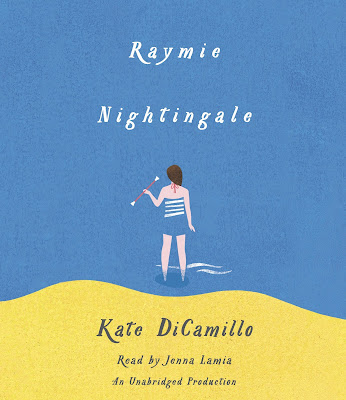
The tiniest variable or larger influence can and will make a difference.  Raymie Nightingale (Candlewick Press, April 12, 2016) written by Newbery Medalist (Flora & Ulysses: The Illuminated Adventures (Candlewick Press, September 24, 2013) Kate DiCamillo invites readers to participate in the transformative experience of three individuals.  No one will be unchanged.

There were three of them, three girls.
They were standing side by side.
They were standing at attention.

This trio of ten-year-old girls is taking baton twirling lessons.  It is the 5th day of June in 1975.  Raymie Clarke, Beverly Tapinski and Louisiana Elefante all want to enter the Little Miss Central Florida Tire contest.  Each one of them has very real reasons for participating.

Raymie's father, Jim Clarke, of Clarke Family Insurance has run away with a dental hygienist. If he sees Raymie's picture in the paper, surely he will come back.  To avoid staying in the county home and to get Archie back from the Very Friendly Animal Center, Louisiana needs to win the one thousand nine hundred and seventy-five dollars.  Sabotage is the only thing on Beverly's mind.  In a flurry of is-this-really-happening activities these very different people come together like parts of a single heart.

It all begins with a requirement to do a good deed, a book about Florence Nightingale and the Golden Glen Nursing Home.  Along the way a hand is held, screams are heard, a yellow bird finds freedom and Granny Elefante comes racing down the road in the family's rattletrap station wagon.  It's time to get the heck out of Dodge.  The wisdom of school librarian Mr. Option, a lifesaving coach, Mr. Staphopoulos and his sidekick, an eternal grinning Edgar, elderly Mrs. Borkowski and the insurance agency secretary Mrs. Sylvester is infinitely helpful.

A clandestine nighttime escapade increases their number.  Swans, sinkholes and shopping carts swirl together, stirred by the hands of the Fates.  The Rancheros are held together by hope...and a miracle.


There is richness to the writing of Kate DiCamillo.  We feel wealthy from the reading of her words.  Her descriptions of things we might not notice, those things we should notice and of everyday life with its too-much-sometimes sadness are overflowing with hope; the flame that can shrink to a tiny flicker or swell to a blazing inferno.  When we see the world through the eyes of her characters' lives we become better people.

Each of the three main characters comes to this improbable friendship with talents and troubles.  Their strengths, the best part of each of them, are revealed in the events, Raymie's thoughts and their conversations.  Rough and tumble Beverly, imaginative, ethereal and optimistic Louisiana and shy, careful and ultimately courageous Raymie are exactly what each of them needs to create an unbreakable bond.

 The secondary characters, especially Granny, are wonderfully marvelous.  Her energy, sense of adventure and creativity in the face of huge obstacles generate promise as well as providing the story with comic relief.  It's as if there are small stories all around the three girls (us) which contribute to their much larger story.

This narrative unfolds through DiCamillo's short chapters, beginning and ending with moments moving us forward as quickly as possible.  We have to know what will happen.  We have come to feel great affection for these three girls.   Here are only a few of my many marked passages.

The sun was way, way up in the sky, and the whole thing was like high noon in a Western.  But it was not a Western; it was baton-twirling lessons at Ida Nee's house in Ida Nee's backyard.

"Oh, my goodness," said Louisiana. "I'm just all filled up with feather and regrets.  And fears.  I have a lot of fears."
She stood there staring at both of them.  Her eyes were dark.  They were brown.  No, they were black, and they were set very deep in her fact.  She blinked.  "I've got a question for you," she said. "Have you ever in your life come to realize that everything, absolutely everything, depends on you?"
Raymie didn't even have to think about the answer to this question. "Yes," she said.
"Duh," said Beverly.
"It's terrifying, isn't it?" said Louisiana.
The three of them stood there looking at one another.
Raymie felt something expanding inside of her.  It felt like a gigantic tent billowing out.
This, Raymie knew, was her soul.

They were going very, very fast, and the car emitted a lot of noises:  screeches (from the piece of loose wood siding), thumps (from the door that would not stay closed), and a cacophony of mechanical grinding noises---the overworked and desperate sounds an engine makes when it has been pushed beyond its limits.


I've finished Raymie Nightingale written by Kate DiCamillo for the second time. With each reading it gets better; the sign of a classic.  This is a book to cherish.  This is a book to read aloud.  Her characters resonate with readers, bringing all our lives into perspective.  It is love which defines and binds us.

To learn more about Kate DiCamillo and her other books, please visit her website by following the link attached to her name.  At the publisher's website you can read the first five chapters, download an Event Kit loaded with activities, download a Teachers' Guide, and a Book Group Discussion Guide.  At another site you can lesson to an audio clip.  Scholastic's Ambassador for School Libraries, John Schumacher, chats with Kate DiCamillo on his blog, Watch. Connect. Read.  Kate DiCamillo is interviewed about this title at NPR All Things Considered, Public Libraries Online, and BuzzFeed Books. Enjoy the videos.


Monday, April 27, 2015

Holding Hope In Your HeART

Sometimes people can be unkind.  Sometimes people can be cruel.  Sometimes people fail to see who you truly are; dismissing your very essence.

From the time you are born, every day is one less day of life.  None of us truly know the number of those days.  For some the unkindness, the cruelty, and the feeling of being invisible are like a death knell.  For some, fighting a terminal illness, the bell rings louder.

When all the doors are closed by those people closest to us, the natural realm can provide a sanctuary, a place receptive to our deepest desires.  Unlike the humans in our lives, in this place, the plants and animals listen to us.  It's like we share a heartbeat in common.  In Nikki Loftin's newest title, Wish Girl (Razorbill, an imprint of Penguin Group (USA), February 24, 2015), two people, who need such a place, find one.

The summer before I turned thirteen, I held so still it almost killed me.

This is our introduction to Peter Stone.  He and his family have recently moved from San Antonio to Texas Hill Country living in the old Carlson place. The reasons for the new location are revealed within the story.  At this moment Peter is standing on a cliff overlooking a beautiful valley he has newly discovered.  A diamondback rattler is coiled around his ankles.  Peter is an introvert.  His gift is stillness.

That evening through conversations and arguments around the dinner table we meet his parents and two sisters, one fifteen years old and the other a toddler.  His mother, constantly distracted by the demands of working, motherhood and social media received a promotion at the bank where she is employed at the same time his father lost his job.  Hoping to resurrect his career as a drummer in a band, his dad is constantly practicing and leaving home during the day looking for gigs.

Everyone and everything they do in his family is loud.  Peter's quietness earns him labels of weird and wimp.  He is made to feel as though the state of affairs in which they find themselves is his fault.

The next day at the valley Peter meets Annie Blythe, a guest for two weeks at a near-by art camp.  She tells him she's a wish girl but in truth she is a girl wanting to change the course of her life.  She is about to begin a series of radiation and chemotherapy treatments for her cancer, the late effects possibly destroying what makes her who she is.  She, like Peter, is trapped by people who won't really listen to her.  Her gift is seeing beauty everywhere, even in people, even in Peter.  Her gift is making art from this beauty.

There are several other characters who figure prominently in the relationship growing between Peter and Annie.  One is the Colonel's wife, Mrs. Empson, a widow who owns the valley and surrounding property.  Her outspoken wisdom and no-nonsense ability to set things right, not to mention her skill in maneuvering her monster go-cart like a race car driver, earns respect from those who know her.

True evil appears in the personalities of brothers, Jake and Doug.  Their desire to prey on those weaker than them or those who can't escape their guns creates knot-in-your-stomach tension.  At the other end of the spectrum is the valley.  Readers, along with Peter and Annie, come to appreciate it as a living breathing force for good to those with pure hearts.  It is a place listening to wishes.

As the end of the two weeks comes to a close, one incident after another fall like dominoes toward a heartbreaking happening.  No character is left untouched.  No reader will forget.


With her first sentence Nikki Loftin pulls readers into her narrative and does not let go until the final word whispered by the wind.  We are completely captivated by Peter's and Annie's lives; watching page by page as their friendship is woven into something tight, true and eternal.  Our compassion for both expands as we, through thoughts and dialog, come to understand them as real people, people we already know or will know.  Annie through her acceptance of Peter gives him the first real happiness he has ever known.  Peter through his support of Annie gives her hope.

Loftin's descriptions of particular events bring you into the moments with exquisite clarity.  You are walking along with the characters, experiencing every emotional nuance with them.  You will long to visit this valley.  Here are some sample passages.

Just far enough away that I couldn't hear crying or yelling or drumming.
It had seemed like a dream.  For the first time in years, I hadn't heard cars or trains, TVs or video games or people.  Hadn't seen a roofline or even a plane in the sky.
I'd been alone for the first time in my whole life, almost.  I liked it.
No, I loved it.  Out there, my heartbeat was as loud as anything in the world.

"Art isn't pretty," Annie said, whirling around.  "It's transformative!  Real art changes you---whether you like it or not.  Real art isn't"---she looked down at the yarn thing in her hand---"it's not just wrapping yarn around sticks, or coloring in the lines.  Real art makes a difference.  It has meaning.  I'll show you tomorrow."

Like it was important to be true down here.  To each other and to ourselves.  Even if we couldn't be true anywhere else.
Especially because of that.


In looking at the dust jacket and each of the chapter beginnings with a dandelion and seeds floating in the air you know this is definitely a book about wishes.  Even more important, after reading this book, are the color choices, a red garnished in fluff, for Wish Girl, and Nikki Loftin's name and the book case in a rich golden yellow.  Both speak to specific aspects of the story.  I finished Wish Girl written by Nikki Loftin for the second time very early this morning with tears in my eyes.  This is a title destined to touch your heart, leaving a forever memory.  I highly recommend it.  I believe it would make an excellent read aloud.

To discover more about Nikki Loftin and her other work please follow the link attached to her name to access her website.  She wrote a guest post, Magical Places, about this title at the Nerdy Book Club.  Nikki Loftin is interviewed at The Hiding Spot hosted by Sara Grochowski.

Tuesday, June 11, 2013

Strong Enough To...

Growing up my life was a reflection of my parents having been children during the Great Depression.  There were no credit cards or checkbooks in our home.  Everything was paid for with cash, saving until the full cost of a car or home could be paid in full.  Staples in our pantry were always well-stocked; the fear of running out having made a life-long impression on both of them.  The stories of going without, the struggles of barely getting by, in turn and in time have directed how I live.

Despite hearing firsthand accounts from my parents, immersion by way of well-crafted historical fiction can and does give new insights into the hardships felt by others during this time period.  Writing her debut novel, Every Day After (Delacorte Press), Laura Golden returns readers to a world where wanting gets pushed aside by needing, where too much change reveals the depth of a person's character.  It's a time when some truths remain the same while others alter for the sake of survival.


I learned a lot from my daddy, but the number one most important thing is this:  never, ever, under any circumstances, let something get the best of you.  To do this, you gotta work with what you got, play the cards you been dealt, turn lemons into lemonade.  Too bad he wasn't around to see me doing just that, because one thing's for sure:  when it rains in the South, it pours.

With that opening paragraph larger-than-life, gutsy, Lizzie Hawkins has become each reader's new best friend.  We share her ups, which are too few and far between, and downs, one right after the other, over and over again.  Before we know it the walls in our reality have slid away, replaced by her town of Bittersweet, Alabama.

Losing his job at the steel mill sapped the vim and vigor right out of Lizzie's Daddy until one morning without so much as a goodbye, he left home, leaving her Mama a small note and Lizzie her grandmother's locket.  With his leaving her Mama became more and more withdrawn until she sat in the rocker on the porch or the wingback chair in the parlor all day, every day.  Eleven-(soon to be twelve)-year-old Lizzie has taken up all the household and gardening chores as well as mending from townsfolk.  The frightening part was it was a well-guarded secret, except from her best friend in the whole world, Ben.

Ben was as kind as Lizzie was feisty, seeing the goodness, however small, in everything and everyone. He had problems of his own, his father having passed away a short time ago.  The one slight crack in an otherwise long-standing, solid friendship was a new girl in their class, Erin.  Ben being Ben was more neighborly to her than Lizzie thought right.  After all, Erin had done nothing since her arrival last summer, except to bully and badger Lizzie.

Not only does Erin want to make sure she gets the attention due for best grades instead of Lizzie, she wants to make sure Lizzie never has the honor again.  Erin wants Lizzie gone from Bittersweet...permanently.  Fear of discovery feeds Lizzie's fervor to maintain appearances at all costs.

Eccentric Mr. Reed, the elderly town recluse, the large amiable Sheriff Dawson, banker Mr. Cooper, snooty, meddling Mrs. Sawyer, Erin's mother, wise Dr. Heimler, storekeepers, Mr. and Mrs. Hinkle, their teacher, Miss Jones and Mrs. Butler, Ben's mom, all figure prominently in the twists and turns of the escalating troubles confronting Lizzie.  A trap is laid.  Dogged and desperate, Lizzie knows escape to, not from, is her only hope.


Laura Golden breaths life into her characters through dialogue rich in local flavor.  Lizzie's conversations with each of the characters illuminates their personalities and hers, brilliant and blemished. Her journal entries, documenting events and her perceptions, help readers to see her growth, however slow it may seem at times.

Through Lizzie's voice we become acutely aware of the financial challenges facing people not only in Bittersweet, Alabama but in most of the United States during the Great Depression.  Vivid descriptions of place paint a picture of the town in our minds. Chapter headings, proverbs taken from Lizzie's Mama's favorite book, provide a closer look at the atmosphere within Lizzie's own home, especially before her Daddy left.  Here are several passages taken from the book displaying the attraction of Golden's writing.

Myra, along with about ten other nosy bystanders, trailed us into town.  We turned off Main onto Oak Street, then onto Mr. Reed's rutted dirt drive, which led directly to his house up on the hill behind town.  I didn't know about Ben, but I was as nervous as a long-tailed cat in a room full of rocking chairs.  We tiptoed over the junk in the front yard---cracked mirrors, broken chairs, rusty pitchforks and hoes---and onto the sagging front porch.

"Those church ladies probably think Mama's crazy for not coming to church lately.  A few of 'em came by to visit after Daddy left, to drop off a jar of jam or a batch of biscuits, but they never saw Mama.  I always told 'em she was scrubbing floors or gone into town.  They never seemed to doubt me.  But still, when they stopped showing, their mouths likely started moving.  Do you figure that's where Erin heard it?"
Ben shrugged and cleared his throat like he was gonna say something.  He didn't.
"Benjamin Butler!" I yelled.  "Did you hear me?"
It was times like these I'd have traded Ben for a girl in a blink.  Girls live to get riled up over stuff.  Boys would shake hands with the man who'd shot their dog.
He snatched up a rock and shot it into a sweet gum.  A single leaf floated to the ground.  "I just got a lot on my mind."


Beautifully conceived and executed, Every Day After, a labor of love, written by Laura Golden is a completely captivating work of historical fiction.  Nearly consumed in a single reading, I was compelled to discover answers about the characters' questionable futures and filled with admiration for Lizzie Hawkins.  This outstanding narrative will resonate with readers, the characters lives lingering and mingling with ours.

As is my custom a link to Laura Golden's website is embedded in her name above.  Here are links to four interviews where Laura talks about this book and the writing process, here, here, here and here.  Laura is the guest blogger at the Nerdy Book Club today.


Thursday, May 2, 2013

To The Rescue

We all need to be rescued from time to time whether it's once in a blue moon or if life is topsy-turvy, daily.  It can be as simple as helping to banish a bad mood or as critical as performing the Heimlich maneuver on someone choking.  Frequently we are well aware when we provide assistance to a person in need but on occasion the smallest gesture in word or deed, can make a significant difference without our knowledge.

Members of the animal kingdom are no different than we when it comes to needing human intervention. Having no voice our vigilance is of the utmost importance.  In her first chapter book of 2013, White Fur Flying (Margaret K. McElderry Books), Patricia MacLachlan writes about the varied forms rescue can assume.


"Once upon a time there was a wicked queen," said my younger sister, Alice.

In the Cassidy family Alice is the talkative sister, an observer of life, a weaver of outlandish tales and a writer jotting her latest thoughts in a journal.  Daddy is a veterinarian with a huge heart.  Mama with an equally large heart, rescues Great Pyrenees.  Zoe, the narrator, while not as talkative as Alice misses little of the world around her; she sees and knows much.

Into the mix are Kodi and May, Pyrs.  May will soon leave for a new home.  A recent addition is Lena, an African grey parrot whose favorite phrase, repeated in a British accent is "You cahn't know!"  It seems Mama is not the only rescuer; Daddy seeing the need to save this feathered mimic.

As the story begins a new family has moved into the home across the street appearing to be pretty much the opposite of the Cassidy crew.  The suit-wearing Mr. Croft comes and goes silently in his big black car.  Prim, proper Mrs. Croft seems uncertain and slightly fearful.  A boy, Philip, Alice's age, does not talk.  Philip is staying with the Crofts until his parents can work out some problems they are having.

Within a couple of days, outgoing Alice, wise Zoe, warm Mrs. Cassidy and the two dogs have welcomed Philip into the supportive, loving fold of their lively summer.  Philip still does not speak (except to Kodi and Lena) but he is now smiling and laughing.  When Mrs. Croft accepts an invitation for a tea date at their home, a new understanding of their neighbors is revealed to the Cassidy family.

With May in her new home, Mama has rescued two more Great Pyreness, Callie an adult female and Jack, a young male.  Very soon though the rhythm of their days changes.  In the middle of a stormy night, two are missing, one canine and one unable to speak.

Three leave to search; Mama has Kodi but Zoe has only her knowledge of the truth to assist her.  By morning all that has been lost are thankfully recovered.  Understanding and compassion can and does heal, sometimes the rescued becomes the rescuer.


Consistently Patricia MacLachlan delivers stories reaching into your heart, shaping it and holding it warmly surrounded by love.  When you step into the world of the Cassidy family, narrated by the older Zoe with the added day-to-day dialogue between the characters, you can't help but want to be a part of that world too.  The importance of a dog's ability to heal and help, to sense and see, what some humans can't is at the essence of this tale.

Each of the short chapters carefully connects to the next with a single profound closing sentence or remark.  Through the technique of Alice's writing MacLachlan offers further insights into what she hopes readers will take away from this book.  Alice's poem, You Can't Know, and the final pages of the book taken from her journal are pure perfection.  One of my favorite passages is:

My voice sounded loud in the quiet kitchen.
No one said anything.
"He thinks many things. And those things are trapped inside of him.  Maybe something happened that made him afraid to talk," I said.
I looked out the window.
"Except to Kodi," I added softly.
"Kodi and Phillip are friends in some way we don't know about," said Daddy.  "And it doesn't have much to do with words."


Happily and with confidence give White Fur Flying written with impeccable, masterful skill by Patricia MacLachlan to fans of her work, to those people who love dog books, or to someone who might need rescuing.  This story shows family dynamics at their very finest; full of understanding for the personalities traits of one another.  Also, if we choose to view those around us with the same care as our canine companions, bridges can be built and crossed.