Quote of the Month

When love and skill work together, expect a miracle. John Ruskin


Showing posts with label Ame Dyckman. Show all posts

Tuesday, August 10, 2021

Schooled In Perception

These four words, first day of school, are replete with a range of emotions for people of all ages.  Whether it is your first day of school ever or the thirtieth year in a row, there is a strong blend of anticipation and anxiety, and knowing and not knowing.  If you are new to the community, your feelings are heightened.

When your attire, physical characteristics, and actions are different than those of your classmates, you draw attention to yourself.  Some of it is unkind.  The New Kid Has Fleas (Roaring Brook Press, June 15, 2021) written by Ame Dyckman with illustrations by Eda Kaban follows a unique new student and another who, through chance, befriends her.  It is a tale full of twists and truths.

I'm not sure about the New Kid.

The narrator, a fellow classmate, is trying to be his best, but it is hard when the new kid takes off her shoes so she can go barefoot, howls in music, and pursues a different kind of food for lunch.  Another student, Molly, tells the children the New Kid has fleas.  She quietly hears the revelation.  Does it bother her?

Stewart and our narrator want to be partners during the science project, but their teacher has other plans.  The students' names are put in a bowl and are paired through the luck of the draw.  Stewart and Molly are paired.  Our narrator is paired with the New Kid.

This is an after-school project.  The duo rides the bus to the New Kid's home.  When our narrator steps inside, he is terrified at the parents, and siblings of the New Kid.

In the first of several surprises, the siblings are fun. Snack time, while not our narrator's usual fare, is tasty.  The New Kid is brilliant in helping with the science project.  The next day at school, Molly is strangely absent.  When it is time to present their science project, it is a howling success.  Given a chance, we can discover rare gifts in others.


Simple declarative sentences, short phrases, and single words by author Ame Dyckman fashion a story replete with humor.  Word play adds to the laughter factor.  Through the first-person narrative we are able to witness a transformation from first impressions to lasting friendship.  Here is a passage.

Mom and Dad say don't stare.
That I should put myself in her shoes. 
But the New Kid doesn't wear shoes.
And it's hard not to stare . . .    


Painted digitally by illustrator Eda Kaban the images in this title, beginning with the matching front dust jacket and book case, are highly animated and brimming with visual interpretation.  We see a range of responses on the students' faces when the New Kid boards the school bus.  And we are curious to see the silhouette of a wolf as a place holder for the title text.  Without a doubt, we have to open this book!

On the back of the dust jacket a loosely formed rectangle, framed in lots of white space, holds an interior image of the students outside for lunch.  The New Kid is climbing out on a branch to grab a squirrel.  Beneath the illustration is a wolf cub.  On the back of the book case is another interior image surrounded by white space.  It shows the narrator playing with the New Kid's siblings.

The background on the opening and closing endpapers is first a light robin's-egg-blue morning sky and second the shadowy purple of dusk.  On the opening endpapers a tree top and branch extend from the left-hand side.  A squirrel leaps off the branch.  On the closing endpapers, from a bough crossing the gutter, left to right, a squirrel leaps.  In the upper, right-hand corner another branch is visible.  On its end is a nest.

Each illustration, double-page pictures, smaller images on a single page, and single-page pictures, done in full color asks readers to pause and notice the children.  Their facial expressions convey a lot.  The narrator's looks invite giggles and grins.  Page turn after page turn readers will notice an underlying current of warmth as understanding leads to friendship.

One of my many favorite illustrations is a double-page image paired with the above-noted text.  We are brought close to seven of the students, most seated at their desks.  Sunlight from rows of square windows beams across the scene casting a glow on the large-checked floor tiles.  Our narrator, the boy, seated at his desk and paused in his work, is looking at the New Kid.  She is intently working, one leg outstretched and the other bent with her foot on the seat.  One of her shoes is on the desk and the other is on the floor, laces undone.


This book, The New Kid Has Fleas, written by Ame Dyckman with illustrations by Eda Kaban with compassion and comedy explores being new and how acceptance by one person can change everything.  This story is about looking at people with open eyes, minds, and hearts.  You'll want to share this widely and often.  Be sure to have a copy on your professional and personal bookshelves.

To learn more about Ame Dyckman and Eda Kaban and their other work, please follow the link attached to their names to access their respective websites.  Ame Dyckman has an account on Twitter.  Eda Kaban has accounts on Instagram and Twitter.  At Macmillan you can view interior images.


When the first day of school is the first for the youngest students, each child brings something remarkable to the learning experience, to their classrooms.  For some, they are fully aware of their gift.  For others, it is yet to be revealed.  Becoming Vanessa (Alfred A. Knopf, June 15, 2021) written and illustrated by Vanessa Brantley-Newton is about a little girl with a sparkling personality.  Her story is beautifully transformative.

Mom pulled at Vanessa's hair as she got it ready for the 
first day of school.  Mom was excited, and Vanessa 
could tell she wanted her to be excited, too.   

Vanessa was wondering if the other children would like her.  At breakfast, her father reassured her, telling her she is special.  She questioned how her classmates would know this about her.

At her mother's suggestion, Vanessa selected her own favorite items to wear.  These were certain to alert her classmates that she is someone they will enjoy.  Their reaction to her distinctive apparel was not exactly as she expected. Everyone was friendly, though.

During circle time, Vanessa wnet first explaining her love of drawing butterflies and the anticipated arrival of a sibling.  Their questions to her were direct.  For the rest of the day, Vanessa struggled to be comfortable with her classmates.  She was, in a word, miserable.

The next morning, Vanessa dressed to blend in.  She told her parents she wished her name were shorter and easier to write.  Then her mother told her the story of her name.  At school, on this day, circle time was special when Vanessa spoke.  Just as special as she is.


With her words, author Vanessa Brantley-Newton creates a character we love from the first page.  She is genuine in her thoughts, feelings, and conversations.  Through a mix of dialogue and narrative, we find ourselves identifying with her first day jitters and circumstances.  Her supportive parents, welcoming classroom, and resilient character allow her to soar.  Here is a passage.

After that, things only got worse.

"I can't see
past her hat!"

"Too many feathers!"

Even her shoes were pinching her feet.


When you look at the open and matching dust jacket and book case, you are immediately drawn to the girl on the front looking out her window at the butterfly resting on a branch.  Her smile, her hair in the colorful, beaded ties, and wide eyes behind her round, blue glasses are utterly charming.  The delicate curtains framing the scene are like butterfly wings.  The heart inside the o is the finishing touch.  

To the left, on the back, Vanessa is standing in a flower garden placed on a golden background.  She is holding one of her butterfly pictures.  Two butterflies fly toward her.  On the front and back of the dust jacket Vanessa, her butterfly picture, the butterflies, and title text are varnished.  

On the opening endpapers is a scene as if we are looking through Vanessa's bedroom window, white sheer curtains on either side.  Against a blue sky are shrubs, treetops, and a large branch.  A caterpillar, a chrysalis, and two butterflies are featured.  On the closing endpapers dotted-line paths in a variety of hues loop as do the butterflies making those paths.  It's a splendid display bursting with color.

Illustrator Vanessa Brantley-Newton rendered these double-page and single-page visuals

using Posca pens, acrylic paint, Magic Markers, crayons, and watercolor paint on a Bristol board and collaged with hand-painted, printed, and found papers.

Although we notice the extra details in each setting, we linger on the people.  Their faces, body postures, and clothing tell us little stories about each one.  There is a special magic in every element fashioning a memorable whole.

One of my many favorite illustrations is a double-page picture.  In this picture a parent and their child are walking left to right on the first day of school.  They are traveling down a city sidewalk.  Here we see a marvelous diversity of children.  Two mothers are walking with their sons and two fathers are walking with their daughters.  Vanessa and her dad are leading the group.  You can feel the hope.


Becoming Vanessa written and illustrated by Vanessa Brantley-Newton could be about any one of us.  It is a story of finding and embracing your true self.  It asks us to spread our wings and fly.  I highly recommend this title for your professional and personal collections.  

To learn more about Vanessa Brantley-Newton and her other work, please follow the link attached to her name to access her website.  Vanessa Brantley-Newton has accounts on Facebook and Instagram.  At Penguin Random House you can view interior images.  Vanessa Brantley-Newton is a showcased artist on KidLit TV.  In this video she demonstrates how to make a collage.


There are those students whose excitement at attending school for the first time can hardly be contained.  They are super prepared. They have a vision of how their experiences at school will be.  Little Bat in Night School (Houghton Mifflin Harcourt, June 29, 2021) written and illustrated by Brian Lies takes a character highlighted pictorially only in his four previous bat books and gives this creature his own voice.  Let's join him as darkness descends.

Little Bat was ready.  He had everything he needed.

He had all his supplies and a backpack to hold them.  He kept wondering if it was time to go.  He was thrilled to meet the other bats.

When he finally walked into his classroom, imagine his surprise at seeing all kinds of animals, owls, raccoons, a ferret, and only two bats.  They were already playing and not inclined to play with Little Bat.  Seeking a place to hide he found another classmate hiding.  It was Ophelia, an opossum.  

They decided to join the others in circle time.  They learned a song and the science behind stars and the moon.  When it came time for show-and-tell, Little Bat had something no one else did.  The students snuggled in pockets for nap time.  During art Little Bat learned a lesson worth remembering from another student.

A munch time accident led to laughter and kindness.  Recess was an opportunity to build literally and in their minds.  Just as story time was taking them on another amazing adventure, the first rays of dawn drifted into the classroom.  Guess who talked non-stop all the way home?


In a word, this story, authored by Brian Lies, is delight.  Little Bat's enthusiasm, revealed in dialogue, his thoughts and the narrative, is contagious.  The interactions between Little Bat and his mother and his classmates, especially Ophelia, are authentic.  Here is a passage.

Little Bat flew into a cubby to hide, but someone
else was already there.
"Hi---what are you doing?" he asked.
"I'm just . . . hanging out," she replied.
"Oh," Little Bat said.  "Is it okay if I hang out
here too?"
"I guess so," she said.  "But why aren't you out
there with them?" 


Opening the book case, readers notice on the left text usually found on the front and end flaps of the dust jacket.  There are also thumbnails of two of the bat books, Bats at the Beach and Bats at the Library.  On the front, right side, front and center is the lovable Little Bat.  Around him and in his hands are colored pencils, crayons, an alligator pencil sharpener, a glue stick, a water bottle, and his backpack.  The legs sticking out are a snack.  He is grinning in happiness for the night adventure to come.

The opening and closing endpapers are a midnight blue.  On the title page, Little Bat is holding a drawing he made of himself, hanging upside down.  His crayons are scattered at his feet.  On the verso above a small scene of Little Bat and his mother flying to the school are the words of the dedication,

To teachers, who bring light to the darkness.

These illustrations rendered

with acrylic and watercolor paints and colored pencil on Strathmore paper

make excellent use of white space.  It places emphasis on the full color, highly detailed images.  Many of these are single-page pictures or groups of smaller visuals to indicate activities and to highlight pacing.

Brian Lies brings us close to Little Bat and the other characters in his life and school.  We feel as though we are there with him.  The fact that the setting of night school is a classroom in an actual school adds to the enchantment of the tale.

One of my many favorite pictures in a single-page illustration, edge to edge.  We zoom to a deep blue alphabet wall hanging with pockets.  Letters, capital and lower case, c, d, e, f, j, k, l, m, q, r, s, t are on the pockets.  The students are nestled inside the pockets for nap time.  What a clever idea!


We all have expectations for the first day (night) of school.  Sometimes there are surprises as our favorite flyer discovers in Little Bat in Night School written and illustrated by Brian Lies.  An open mind and an open heart can lead to the best kind of learning.  I highly recommend this book for both your classrooms and your personal collection.

To learn more about Brian Lies and his other work, please follow the link attached to his name to access his website.  Brian Lies has accounts on Facebook, Instagram, Pinterest, and Twitter.  The cover reveal and interview for this title were hosted by Dr. Dylan Teut on his blog, Mile High Reading. At the publisher's website you can download an activity kit.


Stepping into a new school for the first time can be intimidating.  When you are not fluent in the language spoken there, it can add to your unease.  The rhythm of familiar words, the only ones you've known, comfort you as the unfamiliar words confuse you.  Isabel and Her Colores Go to School (Sleeping Bear Press, July 15, 2021) written by Alexandra Alessandri with illustrations by Courtney Dawson explores the glorious mind of a little girl who carries colors with her to view the world around her.  Told in Spanish and English with Spanish, this story is a heartwarming representation of finding your place and finding a friend.

The night before the first day of school,
Isabel sat cross-legged on her bed,
coloreando with her favorite crayons:
rojo, verde, azul, rosado, morado, violeta.  

La noche antes de su primer dia de escuela,
Isabel se sento en su cama con las piernas cruzadas,
coloreando con sus crayones favoritos:
rojo, verde, azul, rosado, morado, violeta.

She was worried about not speaking much English.  To her it was reflected in cool colors.  Spanish was warmth and joy.  The next morning, she begged her mother not to take her to school.  At school when she embraced her before leaving, her mother gave her words of encouragement.  Isabel was still on the verge of tears.

Stepping into the classroom, Isabel heard her teacher, Miss Page, call out a welcome.  All kinds of colors swirled around Isabel as other students entered the room.   When Miss Page called out different portions of the day, Isabel watched the other students to know what to do.  She did not understand her teacher.

Not seeing a place for her on the rug for story time, Isabel felt like she was shrinking into herself.  Then another little girl offered her a place to sit.  Isabel understood the word here.  They exchanged names.  All was well until Sarah asked Isabel a question.  Isabel did not understand.  Sarah did not understand Isabel's reply.  A cheerful start had turned to sadness.

After lunch, Miss Paige announced another task.  Isabel heard a word similar to one of her favorite things to do.  She worked using an array of colors.  She held her finished drawing out to Sarah.  The girls exchanged words with the same meaning, one in Spanish and the other in English.  One final moment of happiness led Isabel to believe another hue would portray school.


The cadence of the carefully chosen, poetic words in each sentence, in Spanish and English, penned by Alexandra Alessandri beckon to readers.  We stand side by side with Isabel as she struggles to understand and confronts her fears.  Her colors paint a picture of her emotions for us.  The literary techniques and figures of speech employed by Alexandra Alessandri are excellent.  Here is a passage.

It's okay to be scared." Mami's voice was
soft and amber like a ripened mango.
She gave Isabel a squishy, squashy hug.

"Al mal tiempo, buena cara," Mam said.
"To bad times, a good face."

---Es normal tener miedo---dijo mami,
con su voz dulce y dorada como el mango maduro.
Ella le dio a Isabel un abrazo do oso.
---Al mal tiempo, buena cara.


The pictorial presentation on the front, right, of the open dust jacket not only introduces us to Isabel but the flow of colors embedded with flowers and leaves from her backpack, grows as it crosses the spine to the left.  Across the back, left, of the dust jacket, it covers nearly all the space.  It continues to the back flap.  On the front flap with a white background is the book's description with Sarah and Isabel chatting beneath the text.

On the entire book case is the flow of colores with flowers and two purple birds, one on either side of the spine.  These waves of colors and flowers are found in varying patterns on both the opening and closing endpapers.  The text on the title page is a repeat of that found on the dust jacket.  Small flowers frame the words.

These vivid, lively illustrations by Courtney Dawson, single-page pictures and double-page visuals, are a pleasing combination of complementary colors on a variety of canvases.  Swirls accompany the colors as Isabel envisions them.  For most of the images we are close to Isabel and the other children, creating an intimacy with the story.

The wide-eyed expressions on the children (and adults) portray an openness.  There is a spirit of acceptance in the classroom atmosphere, in Sarah, and in Isabel.  This openness allows the courage of Isabel to shine.

One of my many favorite illustrations is a single-page picture.  On a crisp white background, we move close to Sarah and Isabel.  They are seated on the floor and facing each other.  Their faces are full of happiness as they tell each other their names in their own languages.  This is a defining moment full of promise.


This bilingual, luminescent story, Isabel and Her Colores Go to School written by Alexandra Alessandri with illustrations by Courtney Dawson, will have you viewing your world with a different set of eyes.  Whether read during a story time or one-on-one, readers will be eager to seek a color for distinguishing exemplary moments in their lives.  I highly recommend this title for your professional and personal collections.

To learn more about Alexandra Alessandri and Courtney Dawson, please follow the link attached to their names to access their websites.  Alexandra Alessandri has additional resources for this book at her site.  Alexandra Alessandri has accounts on Facebook, Instagram, Pinterest, and Twitter.  Courtney Dawson has an account on Instagram.  The cover reveal was hosted by Las Musas.  Two sites of several highlighting this book are Latinxs in Kid Lit and at Jena Benton, Writer and Illustrator.

Monday, July 6, 2020

Celebrating Laughter And Fantastical Creatures

Regardless of the creatures we choose to share the hours of our days, other than humans, there will be those who wish for the impossible.  When the word impossible is used, it can be for a variety of reasons.  Perhaps the community or home in which we reside does not allow certain animals.  Perhaps our family does not have the monetary means to support our heart's desire.  Or perhaps, this particular animal we have selected has characteristics for which we have been warned but decide to ignore.

There are those who have for generations longed to look out their window and see a unicorn grazing in the grass outside their home.  As long as we are imagining, there might be a note around the unicorn's neck saying this marvelous being now belongs to you.  After reading You Don't Want a Unicorn! written by Ame Dyckman with illustrations by Liz Climo all thoughts of this pursuit are dispelled, but that story ends with another warning, a wish, a poof, and the image of a fire-breathing dragon emerging from a cloud of green.  You Don't Want a DRAGON! (Little, Brown And Company, June 9, 2020), a companion title by this collaborative team, proves a point amid loads of laughter.

NOW you've done it!

SLURRRP!

I TOLD YOU not to wish for a dragon!

When it comes to having fantastical critters, this boy simply does not learn any kind of lesson.  His memory is short, truly short.  The narrator is quick to remind him of all the unicorn complications, while adding a dragon is even more problematic.  Despite the fun of flying, fire-breathing and eliminating danger in a single gulp, dragons can exhibit dog-like characteristics . . . only much, much bigger.

In case you dear reader might be wondering where charcoal originates, you won't wonder any longer.  People will be puzzled by your unwillingness to enjoy cookouts any longer.  Wagging, digging, and scooting are amplified.  Did I mention the fire already?

The most unplanned outcome is about to happen.  It happens again, again and again.  It's back to the wishing well for this little guy.  The narrator is encouraging though, because nearby is a Pet Adoption Day! event.

Within no time at all, the charming chap finds his super-duper pet.  As readers start to breathe a sigh of relief at the outcome, the new little explorer gets out of its cage.  Our hero is still in the midst of cleaning up the mess from the unicorns and dragon.  There is one particular item, this new resident cannot resist. 

POOF!


If there is one lady in children's literature who can conjure up hilarity, it's Ame Dyckman.  The unseen narrator does not waste a single second before beginning commentary loaded with comedy.  The voice begins with grudging acceptance of the joyful moments having a dragon can bring, but that ends abruptly.  The parallels between a dragon and a dog heighten the humor.

As the negative attributes begin to overwhelm our already traumatized protagonist, the narrator becomes even more determined, but also compassionate and willing to assist.  This is a lull, a tricky technique leading us to believe the story is to be quietly resolved. HA!  The pacing is precise and perfect as it takes us to a magical funny conclusion.  Here is a passage.

I know.  You're doing
your best!  But I haven't
even gotten to the most
GINORMOUS problem
with having a dragon: 

Dragons . . .
POINK!
get . . .
POINK! . . .


Rendered

with digital magic

laughter and love, the illustrations by Liz Climo start with the boy grasping the dragon's tail, a tad bit of trepidation in his demeanor.  Observant readers will notice he is still wearing his I ♥ Unicorns t-shirt but the word unicorns had been crossed out to make a place for the word dragons.  The dragon is thrilled to have been wished into existence.  The flames along the bottom are a huge hint of the scorching yet to be revealed.  The green on the dragon's body and the title text DRAGON! are shimmery.

To the left, on the back, on a canvas of red an interior image is displayed.  This is the first incident of the dragon being not quite so much fun.  The words:

BE CAREFUL
WHAT YOU WISH FOR . . .
AGAIN!

are in white.

The book case uses a white background, left to right, to highlight an enormous interior illustration.  It's the dragon in a huge pool of drool, sound asleep.  It's super gooey as the boy's hands demonstrate.  His facial expression is one of disgust.  An arrow points to the dragon with the word

ERNIE.

(These names are priceless.)

On the opening endpapers Ernie and the boy are portrayed in six different positions.  Flames and charcoal complete the pattern.  On the closing endpapers the six stances of Ernie and the boy are spread between the two pages.  The flames and charcoal are still there, but so are the newest pets.  They are all named. (I am still laughing.)

A double-page picture of the boy and his newly-wished-for dragon in the park by the wishing well greets readers on the title page.  White is used throughout as an element to great effect.  It helps the other images to appear to leap off the page. 

Small images, single-page pictures, and dramatic double-page visuals, highly animated, are laden with humor.  The looks on the boy's face and the dragon's face are certain to have readers laughing out loud.  The added details, the toilet paper roll on the dragon's foot, the burnt lampshade, the dragon eating BBQ CHIPS and the boy's broken piggy bank elevate every funny moment.

One of my favorite illustrations of many is a double-page image.  It's the inside of the boy's home after the unicorn party and the dragon's scooting.  The walls are white except where they've been burned, or the drywall is off, or the unicorns left a drawing and writing.  The pictures, still hanging, are askew.  There are still some balloons near the ceiling and some streamers.  Cupcakes and charcoal are scattered on the floor.  So is the broken piggy bank.  The boy, looking totally harried, is holding a fire extinguisher.  The dragon, behind him, is munching on chips.


Every day with laughter is cause for celebration.  This book, You Don't Want a DRAGON! written by Ame Dyckman with illustrations by Liz Climo will have you grinning, giggling, and guffawing.  You will have many requests for read it again.  This duo has created a wonderful companion title.  I highly recommend it for your personal and professional collections.

To learn more about Ame Dyckman and Liz Climo, and their other work, please follow the links attached to their names to access their respective websites.  Ame Dyckman has an account on Twitter. Liz Climo has accounts on Facebook, Instagram, Tumblr, and TwitterScholastic's Ambassador of School Libraries, John Schumacher, hosted the cover reveal at his site, Watch. Connect. Read.  You'll enjoy the conversation between him and Ame Dyckman and Liz Climo.  The publisher has a downloadable four-page storytime kit.  Ame Dyckman was featured at Picture Book Spotlight on March 31, 2020.

Tuesday, March 31, 2020

Looking For The Sunshine Side

Given the current circumstances around the world, it is safe to say with whatever people are coping, it is increasing exponentially hour by hour.  Every emotion, every incident is magnified.  Life is more terrifying.  Life is more beautiful.  Even time seems skewed; a week takes on the character of a month.


Into this comes a book revealing all the nooks and crannies in which we may find ourselves as we travel through our lives.  That's Life! (Little, Brown and Company, March 31, 2020) written by Ame Dyckman with illustrations by Cori Doerrfeld is a roller coaster ride exploring a range of experiences.  You will easily see yourself in the pages of this book.

KNOCK!
KNOCK!
Who could that be?

Life has shown up, as it always does, when we are completely unprepared.  We are instructed to be careful because Life is unpredictable.  In fact, it is downright wacky at times.

There is no guidebook for Life; learning is done on the run at a fast pace.  The thing is, Life can and does take you anywhere (literally) at any time.    We must appreciate these unplanned stops and starts.  What we need to realize about Life, too, is to expect the unexpected.

If Life bumps us off track, we swerve and resume.  Life continually reminds us our day to day situations are a series of opposites.  Life gives us something unsavory and we have the ability to make it delectable.  Let's be honest, Life is painful, but it doesn't stop.  Neither should we.

Every second is to be enjoyed because Life is finite.  In those rare moments of calm, Life will share how extraordinary and breathtaking it is.  For this reason, embrace Life, the results will fill your heart.


With the same glorious moments of laughter and light found in our lives, author Ame Dyckman delivers in full measure in her newest title.  It's wonderfully inventive (and perfect) to have life become a character with a capital letter.  This allows for the shift in contrasts Life delivers to be insightful but also humorous.  Here is a passage.

Don't waste a second.
Life is short, but---

CRASH!

Life, uh . . . finds a way.


The pristine white canvas on the open dust jacket (I'm working with an F & G.  My copy has not arrived, yet) joyfully highlights exuberant Life jumping out of the delivery box.  This illustrator's interpretation of the narrative will have you experiencing happiness at every page turn.  All the craziness of life is embodied in the fuzzy, constantly-in-motion figure.

To the left, on the back, the showcased protagonist, a wide-eyed little girl, is getting a kiss from Life, like we do from our canine companions.  She is putting on her coat, getting ready for an adventure.  The text reads:

Meet Life! Fun, messy, and MORE!

Cori Doerrfeld rendered these lively, colorful illustrations

in digital paint.

On the opening endpapers across a cloud-studded pale blue sky a red-and-white striped parachute is carrying the box labeled LIFE to its destination.  Two curious eyes peer from the inside of the box.  On the closing endpapers words of invitation are placed in a similar sky as multiple boxes drift in the air over a group of curious and excited children.  Life is busy at work, paper and pencil in hand, with the initial girl.

Each space is utilized by Cori Doerrfeld in her visual narrative.  On the verso page, the parachute releases the box upon the child's doorstep.  We see her kneeling on a chair at a table, making a list, on the title page.

Each image elevates the words of the story.  White space is used with excellence drawing our attention to the child and a specific moment.  These visuals are in various sizes dependent upon the desired emphasis.  For a single word of text and one loud sound effect we are gifted with a double-page picture.  When the story mentions you never know what

Life's gonna throw at you,

Life is shown throwing a Safari hat, paddle and life jacket to the girl.  This leads beautifully into the next scene of a wild raft trip and the upbeat wording.  Readers will delight in all the expressive facial features.

One of my many, many favorite illustrations is a response to the phrase---

When Life gives you lemons---

The girl has opened a box given to her by Life.  She's grinning at what she finds inside but Life is larger than life in this scene.  Life is giving, a nod in disguise, to a famous comedian.  This is one of those times when an illustrator tucks something in a book which speaks directly to older readers but also opens the door to a discussion.  I love this!


You could not ask for a more important book which addresses the issue of all the ups and downs life hands to all ages day after day.  In That's Life written by Ame Dyckman with illustrations by Cori Doerrfeld challenges are presented and they are countered with marvelous solutions being offered.  I highly recommend this book for your personal and professional collections.

To learn more about Ame Dyckman and Cori Doerrfeld and their other work, please access their websites by following the links attached to their names.  Ame Dyckman posts all kinds of goodness on Twitter daily.  Cori Doerrfeld has accounts on Facebook, Instagram and Twitter.  At the publisher's website you can join in the That's Life fun by participating in quiz.  Perhaps you will be amazed at the results.  Ame Dyckman and Cori Doerrfeld chat with writer and illustrator Jena Benton at her site.  Maria Marshall interviews Cori Doerrfeld on her site, July 2019.

Get to Know THAT'S LIFE! from LB School on Vimeo.

Thursday, March 28, 2019

Get It While You Can (Or Not)

What's a father to do when he wishes his lawn would look like a fairway at Pebble Beach in California?  He arms his two daughters with special diggers and their sand buckets for the beach.  Their task is to uproot fifty dandelions each before they can stop.  This goes on during spring and summer, day after day, year after year until they are saved by attending college.

Now you would think after spending your childhood and teen years battling the infamous yellow weeds, as an adult other measures for eliminating the menace would be taken. Nope.  To preserve the quality of water and protect her furry friend, this sister can be seen during spring and summer with digger and bucket in hand.  (Some lessons last a lifetime.)  For this reason, Dandy (Little, Brown And Company, April 1, 2019) written by Ame Dyckman with illustrations by Charles Santoso is a witty and gleeful take on the timeless battle with dandelions and of the enduring love of a father for his daughter.

Daddy spied something scary
on his perfect lawn.

He ran for his clippers.

Daddy was not fast enough.  Sweetie, his precious daughter, was already watering the dandelion.  She named it Charlotte.  Charlotte was her new best friend.  Daddy was worried, very worried, his neighborhood friends would notice the intruder growing in his otherwise flawless lawn.  They noticed.  He had to get rid of it.

As sneaky as a father can be, Daddy tried to slip away undetected during Sweetie's special times like book time and nap time.  Guess who was reading aloud to her best friend?  Guess who set up a tent in the yard next to her best friend?  The neighbors demanded action.  Daddy did his best, but his precious daughter was always there.

Soon Daddy had the ideal opportunity.  Sweetie was leaving for swimming lessons.  Goodbye Charlotte! The neighbors cheered as Daddy raced to eliminate that pesky pest.  WAIT!

Next to the dandelion was something that could not be ignored.  In the next moment an unplanned incident caused panic throughout the neighborhood.  The eternal conflict between consequences and choices must be resolved.  Take a deep breath.


Author Ame Dyckman is an absolute master of comic timing.  In her first sentence she sets us up for the charming and hilarious contrast between Daddy and Sweetie with three words:  scary, perfect and clippers.  He sees a weed.  She sees a flower.  When she names it and says it's her best friend, I dare you not to burst out laughing. 

With the continued conversations between Daddy and Sweetie and the comments of the neighborhood dads, the laughter factor continues to climb.  By repeating the utterly endearing greeting of

"Hi, Daddy!"

Ame Dyckman supplies readers with a wonderful cadence and heightens the difference between the perspective of a parent and their child.  Here is a passage.

He tried during snack time.
But Sweetie was there.
"Hi, Daddy!
We saved you a spot!"

Once again, Daddy hoped his friends wouldn't notice.


[I'm working with an F & G and can't wait to hold a finished copy in my hands.]

On the front of the dust jacket the pristine white background is a superb canvas for the portion of lawn shown, Daddy, Sweetie and the dandelion.  You immediately know there will be laughter because of the different looks on their faces; delight versus disgust.  Using grass and dandelions to form the title text is design genius.  There is a hint at the resolution.  Do you notice the clippers separating the author and illustrator names?

To the left, on the back, Daddy is zooming toward what he hopes is victory in conquering the dastardly dandelion when Sweetie is at her swimming lesson.  I won't say what tactic he's selecting, but it does take lawn tractors to a whole new level.  (Okay, I can't stop laughing . . . again.)

On the opening and closing endpapers illustrator Charles Santoso features a quiet, two-lane street curving through a neighborhood of neat-as-a-pin lawns and landscaping. Animal dads are hard at work maintaining the perfection.  There are distinct differences on the closing endpapers disclosing the conclusion. 

Rendered digitally with handmade pencil textures on top these illustrations elevate the comedy sky-high.  One of the first things readers notice are the facial expression on Daddy, Sweetie and the neighbors.  The eyes are brimming with emotion.  The body postures and movements are loaded with animation. 

Depending on the narrative Charles Santoso alters his images from double-page pictures to single-page visuals.  To show a series of actions in a short amount of time, he groups several smaller illustrations on a single page.  This builds tension and leads to the inevitable response from Sweetie.  For maximum impact the background and perspective changes. 

One of my many, many favorite illustrations is when Daddy is trying to destroy Charlotte during Sweetie's snack time.  After crawling away as she scoops out some chocolate chip cookies, he races into the yard with a goat gobbling up grass.  When he arrives at Charlotte, Sweetie is there.  For this scene Charles switches to a purple background with lines of frustration in yellow zigzagging out from the center.  Daddy is gritting his teeth with his hand to his head.  In his other hand he holds the rope attached to the goat.  The goat is seated next to Sweetie holding a tea cup as Sweetie pours.  Another tea cup for Daddy is placed next to a plate with the cookies on it.  One of Charlotte's leaves is through the handle of another cup.


It is guaranteed readers will ask to read or listen to Dandy written by Ame Dyckman with illustrations by Charles Santoso over and over and over again.  And no matter how many times it is read, they (everyone) will laugh; the combination of text and art connects with readers as it addresses the age-old discrepancies between parents' and children's points of view.  It also reminds us love wins . . . always.  You will want to read the author's note.  I highly recommend this title for your personal and professional book collections.

To learn more about Ame Dyckman and Charles Santoso and their other work, please follow the links attached to their names to access their websites.  Ame Dyckman has an account on Twitter.  Charles Santoso has an account with Instagram, Tumblr and Twitter.  Ame is interviewed at Writers' Rumpus.  Charles is interviewed at Kathleen Temean Writing and Illustrating.

Friday, February 1, 2019

An Appetite For Laughter

Sometimes when a book ends, it's not the final conclusion.  Oh, no . . . there is more story to tell.  The characters have a lot more to say.  They have a lot more to do.  When we are introduced to them, it's just a beginning full of promise.

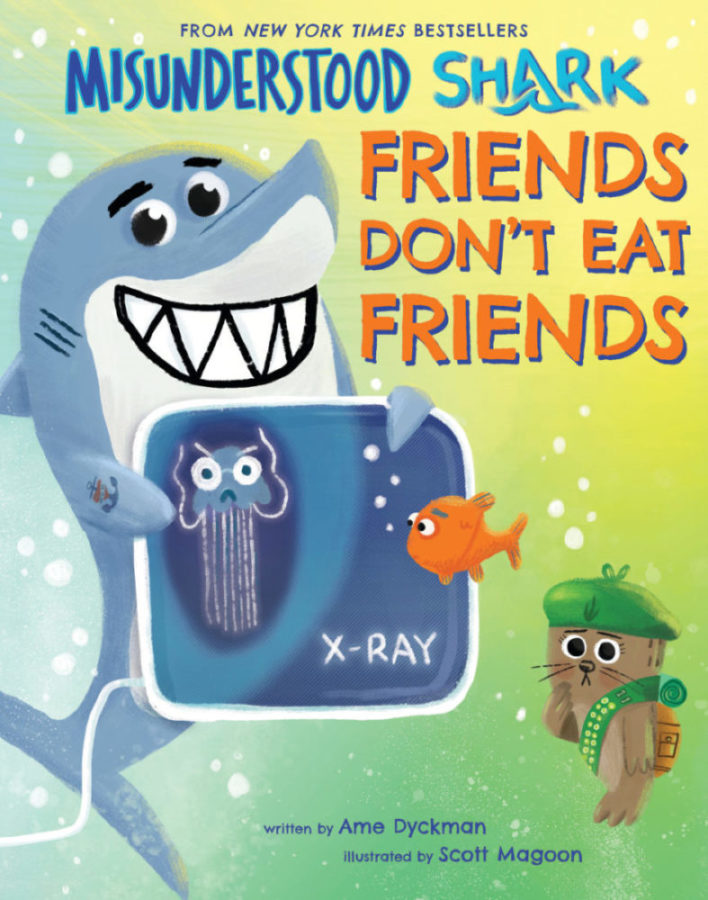
As the final pages and the closing endpapers, are disclosed in Misunderstood Shark (Orchard Books, an imprint of Scholastic Inc., April 24, 2018) readers feel disbelief as they try to digest what has happened.  The unknown fate of the fabulous Underwater World with Bob leaves us (and him) in the dark.  The companion title and sequel Misunderstood Shark Friends Don't Eat Friends (Orchard Books, an imprint of Scholastic Inc., January 29, 2019) written by Ame Dyckman with illustrations by Scott Magoon makes everything less murky as we peer into the depths of the water. 

Last time, on
Underwater World
with Bob . . .

Shark ATE ME!
Get me
OUT OF HERE!

"That's strange!
I can HEAR Bob.
But I can't SEE Bob."

As we barely get the page turned Shark has ejected Bob, a jellyfish, out of his stomach and the show does indeed try to go on.  The problem is Bob having a tizzy about being consumed by Shark.  When Shark realizes people are watching him, again, he utters his now famous defense.

"You MISUNDERSTOOD!"

Apparently, he was giving Bob an up-close-and-personal view of his inner self.  Bob's not buying it until his crew reminds him of his show.  We are then privy to one of his fun facts about sharks.  We go quickly from bones to cartilage to boogers. Bob is still not placated.  He WAS eaten.  Shark demands proof.

Suddenly the video feed is stopped.  Shark has expelled something else.  It's gross!  It's Bob's glasses.  Bob with dignity and an air of righteousness relates another fun fact about shark stomachs. (Who knew?)

Bob issues an ultimatum, followed a third fun fact.  Shark is in tears.  An argument about the definition of friendship has Shark clearly upset and he leaves.  When one of the crew remarks on his state of being, Bob panics.  They must STOP Shark!  Bob continually shares fun facts as they locate Shark.

There is a misunderstanding about Shark being in his cave pouting and a deeper discussion about the characteristics of friendship.  In an al-arm-ing turn of events everyone, Bob, Shark, the crew, and the people are horrified.  One watery resident is not.  Will this episode be a win for friendship?  Will the show continue?  Will anything change?  There are so many questions.  Stay tuned.

That's a WRAP!


No matter how many times you read this title, it is guaranteed you will be giggling and guffawing.  This is what happens when words and combinations of words are written by someone who has comedy running in their writer veins. Ame Dyckman is one of those people. Her sense of pacing is pure perfection.

The conversations between Bob and Shark along with the side commentary by the recording crew, other dwellers in their watery realm plus the people watching completely engage readers from endpapers to endpapers and everywhere in-between.  It's as if we are a part of the story.  With Shark in complete denial about who he is and what he is capable of doing, we are constantly laughing.  Here is a passage.

He's in his Sulking Grotto!

"Go 'way!"


THIS is his feeding frenzy? SUGAR?

You'll get cavities, Shark!

"Actually, shark teeth are coated in
fluoride.  Sharks don't get cavities!"

I'm so jealous.


As soon as you open the almost-matching dust jacket and book case, you'll feel the corners of your mouth curving into a smile.  From the back, left, to the front the recording and directing crew, and the tiny orange fish are aghast at what Shark has done and is doing.  How can he be grinning so broadly when he's eaten Bob?  Understandably Bob is not happy.  The X-RAY cord on the front runs to the back with the ISBN acting as a power source.  There is a clever touch to the title text with the wave and the shape of "A" in SHARK.

The canvas extends to both flap edges.  At the bottom of the back flap we see a new character who plays a part in this new volume.  On the front flap conversations are already beginning with comedic commentary.  Instead of wearing swimming gear as they did in the first book, Ame Dyckman and Scott Magoon are wearing boating head gear in their portraits on the back flap.  

Scott Magoon uses every inch of space to start and end the narrative along with his pictorial interpretations beginning and concluding with the endpapers.  His full-color palette with vibrant colors and bold sweeping lines invite reader participation.  Altering his point-of-view brings us further into the tale of Bob and Shark.  On the verso and title pages, text is held in place by Shark's body, the clapperboard and the squid's hat band.  

To add to the back and forth conversations and arguments of Bob and Shark small images are grouped on single pages before broadening into a double-page picture for emphasis.  At one point Scott Magoon adds a diagram/cut-away of a shark's body with Shark's changes which heightens the hilarity.  The variations in the background colors tend to determine mood and upcoming shifts in the narrative.

One of my many favorite illustrations is on a single page.  The background has gone a darker shade of ghastly green.  We are shown a close-up view of the scene.  Shark has turned green and is trying to hold his mouth closed.  His eyes are yellow.  The octopus, wide-eyed and frantic, holding the microphone boom and wearing headphones is yelling.

CUT THE VIDEO!
HE'S GONNA---

We know what's going to happen, but we have no idea why or what the results will be.  We must turn the page.


If you like laughter, books about sharks and other sea creatures, and titles about the ups and downs (and eating) of friends, Misunderstood Shark Friends Don't Eat Friends written by Ame Dyckman with illustrations by Scott Magoon is an excellent selection for you.  This is without a doubt a read-aloud winner.  You're sure to have requests for "read it again."  I highly recommend this title for your personal and professional book collections.  Be sure to follow the link to my blog post about the first book.  I include other titles you could use for a "swimmingly-super" story time.

To learn more about Ame Dyckman and Scott Magoon and their other work, please follow the links attached to their names to access their websites.  Both Ame and Scott have accounts on Twitter.  You can find Scott on Instagram.  You'll want to visit the publisher's website for some fun additional activities.  Ame Dyckman was interviewed this past November at Writers' Rumpus.

Friday, July 13, 2018

RUN! SWIM! For Your Lives!

Having survived more years than we can imagine, they have our deepest respect and for some of us, our fear.  They are serious apex predators of the sea.  To utter their name at an ocean beach full of swimmers is certain to have people scurrying in total panic.  In reality we harm more of them in any given year than they harm us.

Sharks have inspired blockbuster movies, week-long television series and bestselling books.  One of the newest titles with these fascinating fish as a central character is Misunderstood Shark (Orchard Books, an imprint of Scholastic Inc., April 24, 2018) written by Ame Dyckman with illustrations by Scott Magoon.  By the time you finish reading this book your respect for sharks will be strengthened as you roar with laughter.

Here we go,
Underwater World with Bob
broadcasting live
in 3 . . . 2 . . . 
. . . 1 . . .
Hey! Who did this?!

Bob barely has his first few sentences finished when a grinning shark bursts into view.  Needless to say several of the crew, two squid, are ready to run.  Bob, a jellyfish, reminds Shark not to eat a fish, a tiny orange one in his grasp, in front of the people watching.

When Shark realizes people can see him, his sweet reply is contrary to what they and everyone on the watery set believe to be true.

You misunderstood!

He says he was only showing the fish his new tooth.  Trying to recapture the audience's attention Bob entertains us with a 

Fun Fact 

about sharks and their teeth.  Continuing to speak Bob thinks he is chatting with Shark but the wily predator is after something, a baby seal, swimming on the surface. 

A similar scenario ensues with readers learning another informative item about sharks and their appetites.  Just when Bob (and dare I say readers) is beginning to trust Shark, he takes off in hot pursuit of an enticing scent.  As Shark speeds toward 

BLOOD

Bob decides to give us another interesting detail about sharks and their sense of smell.

Shark is closing in on the source of the blood.  People are scattering across the sand, leaving their belongings behind.  Shark is despondent at this treatment.  He was only trying to help.  Bob and the two squid are offering comfort (and comedy) at this current situation.  Will an act of compassion change the dynamics of Underwater World with Bob?  Stay tuned.


When it comes to writing humor Ame Dyckman is masterful.  By telling the tale through dialogue, it's as if we are viewing this entire show in real life.  Even before the narrative starts, the comments of the television crew are sure to have readers smiling.  They continue to offer tidbits of opinions heightening the humor.

By using repeating phrases in each situation Ame invites audience participation.  As we join in Bob's and Shark's refrains, we have no idea what Shark will say next, but when he does answer it's so ridiculous we can't help but laugh.  This rhythm sets us up grandly for the surprising conclusion.  Here is a passage.  

"Fine, Shark.  Maybe you weren't going to eat that fish . . ."
"Shark?"
"Where's Shark?"
"Oh, no." 


As soon as you open the dust jacket you know you are in for a delightful treat.  The image stretches from flap edge to flap edge.  On the back flap, Ame and Scott wearing appropriate swimming gear for above and below the water look as though they are characters in the book.  A group of green and blue fish swims below.  On the front flap Bob and the two squid offer comments intermingled with the blurb.  

Looking at the front we already know things might not go as Bob plans.  His look and the expression on Shark's face are not quite the same.  The design cleverly places Shark's fin in place for the letter "a".  To the left, on the back, the octopus, the cameraman, the two squid, the tiny orange fish and the baby seal are watching.  The ISBN is placed on the clapperboard.  The sea creatures, Ame and Scott are varnished on metallic blue hues.  On the book case all of the text has been removed except for the clapperboard.  The ISBN is replaced with the title of the show. 

The opening and closing endpapers are part of the story.  The squid, Bob and Shark offer conversation on both sets.  One features the sea in daylight and the other as darkness comes.  On the title and verso pages, the dedications and publication information are placed inside air bubbles.  One of the squid is holding the clapperboard with the title text (slightly alerted) on it.

All of the illustrations are bold and bright spanning single or double pages.  Sometimes Scott Magoon places a series of illustrations on a single page to indicate the passage of time and to accentuate pacing.  There is even a dramatic vertical, double-page picture.  To give us an indication of the importance of a particular point in the story the point-of-view will be switched; when Shark first sniffs the blood.

The layout of the elements is excellent; when Shark first appears during the show, when Bob is following Shark as he swims toward the baby seal, or when Shark starts to cry at the beach.  Readers will be looking for all the extra details like the tattoo on Shark's fin.  And the facial expressions on all the characters are outstanding.

One of my many favorite illustrations is a two-page image.  It's a scene with Shark sobbing at the people running away from him.  A first aid box with three bandages falling out of it is in the water next to Shark.  Beneath him Bob is talking to listeners (readers) about how likely it is to be bitten by a shark as opposed to being bitten by a person.  A crab, clam and starfish are watching.  On the right the two squid, one holding the clapperboard and the other the microphone boom pole offer opinions.  The first is wearing sunglasses on its forehead.  The other is wearing earphones.  These characters are all placed in an underwater seascape.


For a story time featuring humor or sharks, Misunderstood Shark written by Ame Dyckman with illustrations by Scott Magoon is a surefire winner.  This duo's combination of words and artwork will have readers laughing like loons.  For an interesting and funny shark theme I would pair it with Swimming With Sharks: The Daring Discoveries of Eugenie Clark written by Heather Lang and illustrated by Jordi Solano, Shark Lady: The True Story of How Eugenie Clark Became the Ocean's Most Fearless Scientist written by Jess Keating with illustrations by Marta Alvarez Miguens and DUDE! written by Aaron Reynolds with illustrations by Dan Santat.  You will want this title on your professional and personal bookshelves.

To learn more about both Ame Dyckman and Scott Magoon and their other work, please follow the links attached to their names to access their websites.  Scott has loads of extras about this book on his site.  Both Ame and Scott have Twitter accounts.  You can find Scott on Pinterest and Instagram.  The cover for this title was revealed by Scholastic Ambassador of School Libraries, John Schumacher, on his blog, Watch. Connect. Read.  He chats with both Ame and Scott.  Next you'll want to head over to the publisher's website to see what they offer regarding this title for readers.  Enjoy the videos.


UPDATE:  There's lots of fin-tastic fun at the OOM On Our Minds, Scholastic's blog with Ame and Scott, July 23, 2018. Ame Dyckman is interviewed at SHARKS 4 KIDS, July 27, 2018.  

Monday, November 6, 2017

If You Would Only . . .

The cost for it is usually free.  Some heed it immediately.  Others don't initially follow it, but realize the benefit of taking it.  There are those stubborn few who rarely listen.  Sometimes they have a good reason.

When author Ame Dyckman and illustrator Zachariah OHora collaborate readers are certain to find themselves part of numerous humorous situations.  In their newest title, READ THE BOOK, LEMMINGS! (Little, Brown And Company, November 7, 2017) we travel to the northern regions of the Arctic.  A trio of lemmings repeatedly fails to listen to advice, participating in risky behavior.

Foxy found a quiet spot 
to read his book
about lemmings.

This First Mate aboard the S. S. Cliff is shocked to discover the age-old belief of lemmings jumping off cliffs is simply not true.  After he utters this statement aloud, three passengers, lemmings, hearing the word jump respond by crying out

GERONIMO-O-O-O-O!

as they leap over the side of the ship.  Captain PB (Polar Bear), seated on a stool and reading his newspaper, barely acknowledges this mishap but makes a single statement.  Foxy, too, realizes they obviously did not read the book.

Peering at them through a telescope Foxy notices they need assistance to keep from drowning.  Using the Captain's bucket, filled with fish, he retrieves them from the chilly sea.  He promptly gives them different colored hats, red, yellow and pale gray, and names, Jumper, Me Too and Ditto. He has a few choice words for the trio.

He admonishes them to read the book, Everything About Lemmings.  It says lemmings don't jump off cliffs.  As soon as he says the word, jump, they jump . . . again.  Making an astute observation, Captain PB agrees.  The lemmings did not read the book.  Foxy saves them . . . again.

A little less friendly in his rescue, Foxy reprimands the lemmings giving them the book.  They return it a little too quickly.  Foxy does not say the word jump once but someone wearing a captain's hat does.  Three lemmings jump into the icy water.

This time Foxy dives, swims and saves the lemmings but he is clearly upset with them.  He can't figure out why they didn't read the book.  Their reply activates Foxy into full educator mode. The results give the Mate and his Captain the free time they need to continue their reading but something and three individuals are missing.  LEMMINGS!


In a short author's note Ame Dyckman explains how the idea for this book grew from a movie she saw as a child.  In her inventive mind a scenario unfolds giving us a hilarious story and a tribute to the power of reading.  No one but Ame could create the three names for those lemmings.

In the true fashion of a master weaver of tales she has Jumper, Me Too and Ditto jumping off the ship three times before the plot shifts revealing the difficulty.  The characters of Foxy the Mate and Captain Polar Bear are a perfect duo, the one clearly cleverer than the other, a speaker of few words and a repeated remark.  It makes for interesting conversations brimming with comedy.  Here is a sample passage.

"You know . . ." said Captain PB.
"I don't think they read the book."

HELP!
NEED HELP! called Jumper.
ME TOO! called Me Too.
DITTO! called Ditto. (page turn)

Foxy groaned.  "I hate to ask again . . ."


Upon opening the dust jacket (I'm working with an F & G.) an entire Arctic scene comes into view.  The three lemmings in their hats reading Foxy's book, upside down, is a huge hint of events to come.  To the left, on the back, the S. S. Cliff is drifting on a calm sea.  The cargo ship also happens to be an expressive whale.  It's equipped with a helicopter, a submarine, a crane, and a wheelhouse with satellite dishes.  A speech balloon coming from the ship states:

1.  READ THE BOOK.
2.  Don't jump off cliffs.
3.  Repeat.

We are also introduced to the limited color palette selected by illustrator Zachariah OHora.  The dark peach, white, gray, black, red, yellow and shades of teal are used throughout the book.  The title page is a close up of the ship with the text on the largest part of the whale.  We can see three tiny lemmings in the water by the whale's smile.  The opening endpapers have an explanatory sign attached to an iceberg stating the status of lemming jumping and their literacy.  The three yet unnamed lemmings are leaping from a nearby icy cliff.  On the closing endpapers, containing the dedications, author's note and publication information, the lemmings are now on that same iceberg with the sign.  Changes are being made as the S. S. Cliff sails away in the distance.

Rendered in acrylic on 90-pound acid-free Stonehedge paper the images alternate between two-page spreads, single-page pictures and several visuals on a single page.  We are even treated to a vertical illustration as the lemmings sink into the sea. These size shifts contribute to the pacing and emphasis on the narrative.  Zachariah also changes the perspective giving us an overview before bringing us close to the characters.

Careful readers will notice the extra details he includes like the lemmings on the book's spine, the message using the nautical signal flags, the captain giving a thumb's up for success and the narwhal swimming in the distance.  The expressions on the characters' faces leave no doubt as to their mood.  They range from bewilderment, fear, disgust, anger, indifference, affection and bliss, ignorant and otherwise.

One of my favorite of many illustrations is the first time all the characters are together on the S. S. Cliff.  We see Captain PB holding his newspaper and fishing rod with the currently empty bucket next to him.  Foxy is reading the Everything About Lemmings book.  The nautical signal flags are stretched over them.  The lemmings, on the right, are ready to jump after Foxy unknowingly says the word jump.  Tall icebergs tower from the sea, having been placed on either side of the peach sky. You can already feel the laughter inside you ready to burst out.


This book is like your favorite snack food, irresistible.  You can't read READ THE BOOK, LEMMINGS! written by Ame Dyckman with illustrations by Zachariah OHora only once either.  Each time you read it another tiny detail will catch your attention as you are giggling, louder and louder.  This is sure to be requested repeatedly at bedtime and story time.  You need to have a copy for your professional and personal bookshelves.

To discover more about Ame Dyckman and Zachariah OHora, please follow the links attached to their names to access their websites.  Zachariah maintains a Tumblr account.  At the publisher's website you can download an activity kit.  At Scholastic's Ambassador of School Libraries, John Schumacher's blog, Watch. Connect. Read., the cover is revealed as well as the book trailer premiere.  Zachariah OHora is featured on Brightly and PictureBooking, Episode 72.  I know you'll enjoy watching the fun and funny reading of this book by Ame and Zachariah at KidLit TV Read Out Loud.

Friday, February 17, 2017

You Were Warned...

The thing about wishes and wishing is they can be a tricky enterprise.  When we wish for something we tend to think of the outcome and not how it is achieved or what may happen if and when a wish comes true.  It's hard to remember it's a rarity if something happens in isolation; good or bad, there are consequences.

Nevertheless if we see a falling star, the first star of the night, or witness a rainbow or when it's 11:11 on the clock, we pull a turkey bone, we find a penny, or when we blow out birthday candles on our cake, we will be making a wish.  You Don't Want a UNICORN! (Little, Brown And Company, February 14, 2017) written by Ame Dyckman with illustrations by Liz Climo is an adventure in the unexpected.  It can be said this is a ride on the wild side filled with first-rate hilarity.

WAIT!
You were gonna wish for a unicorn, weren't you?
Wishing for a unicorn is a 
BIG MISTAKE!

An unseen narrator continues to offer advice but the little guy, clearly a huge fan of the mythical beast, lets go of his coin.  Within mere seconds of it dropping beneath the fountain waters,

POOF!

A unicorn of his dreams springs forth from a blaze of rainbows.  The voice continues with dread dripping from every word.

It would be safe to say the boy, riding upon the back of his new friend, does not heed one single syllable.  His wildest dream has come true.  When they arrive inside his home, the joy becomes tinged with problems, HUGE problems.  Did you know unicorns shed gold glitter?  And it sticks to everything...like glue.

If you think house-breaking a puppy is difficult, unicorns can't learn.  (You'll never look at a cupcake the same way again.)  You'll have to be extra careful giving them anything carbonated to drink.  Their burps are an explosion of color with no pot of gold at the end.  Just when you believe you might be able to handle all these "little" idiosyncrasies, the biggest surprise of all pays you a visit again and again and again and again.

Thankfully the narrator has continued to offer wisdom.  His final words must be heeded to undo what has been done.  It's not going to be easy.  Whew!  OH! NO! WAIT!


Using an unseen narrator to tell this story is sheer genius on the part of author Ame Dyckman.  The words she selects to use and their delivery make us active participants in this story.  Before the fourth sentence is even finished you will be laughing... guaranteed.  How many times have you warned a child not to do something and before the sound of your warning has faded away, they've done that very thing?

The cadence in which the narrator speaks through purposeful punctuation gives the story splendid pacing.  The repeated use of

Trust me.

increases the comedic effect.  It will also have you wondering why this particular narrator seems to be so well-informed about wishing and unicorns.  Here is the continuation of the first part.

Just step away and---
(PLIP)
Uh-oh.
Things are about to get--- (page turn)
POOF!
ugly.
Trust me.


All of the illustrations rendered

with digital magic

are animated with a high laughter factor on the dust jacket, book case and pages in bright cheerful colors.  The expression on the boy's face on the front of the jacket most definitely matches the title but we are not sure yet why or how the unicorn and boy are currently together.  The unicorn and the word Unicorn shimmer when tipped back and forth in the light.  To the left, on the back, with a purple background, the seated unicorn is burping a burst of color which bleeds over the spine.

The book case is an interior picture on a background of white.  Extra text with arrows has been added.  My lips are sealed as to the content of this image.  On the opening and closing endpapers, amid turquoise, pink, green and orange clouds (eighteen in total), are unicorns in various attire with unique physical characteristics.  There is a distinct difference between the two sets of endpapers reflecting the conclusion of the story.  (Tiny spots on these illustrations shimmer too.)

A large double-page picture provides the canvas for the title page as well as beginning the story.  Three children are playing in a park with a fountain.  Liz Climo alternates between two-page visuals, single page pictures and smaller pictures on one page to match and elevate the narrative's rhythm.  The characters stand out on the crisp white paper with few other details in the scenes colored.  The expressions on the boy's face match his every emotion and the activities of the unicorn.

One of my favorite illustrations is on a single page with a white background.  The unicorn is standing tall, golden horn surrounded by vivid sparkles.  Next to him is the boy grinning.  His eyes are wide open with happiness.  There is pink frosting in his hair and on his I ♥ Unicorns t-shirt.  They are both looking at the next page where the first of several surprises has appeared.  You just know from previous moments that this happiness is short-lived.


I have been smiling since I first read this book, when I read it again and as I was writing this post.  I can't help it.  You Don't Want a UNICORN written by Ame Dyckman with illustrations by Liz Climo is filled with laugh out loud episodes from beginning to the oh-uh end.  It's about wishing, learning and hope.  You have to hope that your next wish might be a little bit different.  Right?  I can already hear the requests for read it again.

To learn more about Ame Dyckman and Liz Climo and their other work please visit their websites by following the links attached to their names.  At the publisher's website you can download a storytime kit. John Schumacher, Scholastic's Ambassador of School Libraries, featured the cover reveal and book trailer premiere on his blog, Watch. Connect. Read.  You have to read and watch both of these!

Friday, April 15, 2016

Mishap Mayhem

As clearly as if heard yesterday instead of decades ago, I can remember our instructor of Safety Ed 101, a required course for freshman at Central Michigan University, saying there is no such thing as an accident.  In his opinion every such event can be traced to human error.  Based upon personal experience I would say his assessment is fairly accurate.

With that being said is life truly all of one thing or the other?  Are there not incidents with unplanned and surprising results?  The energetic collaborative duo of Ame Dyckman and Zachariah OHora that brought readers, Wolfie The Bunny (Little Brown and Company, February 17, 2015), has returned with a new title.  Horrible Bear! (Little, Brown and Company, April 5, 2016).  With a snap a kite flying expedition ends in uproarious and ruinous results.

A girl peeked into Bear's cave.  She reached---but he rolled.

The unsuspecting Bear has no idea he just crushed the girl's kite which unfortunately drifted through his doorway, landing on his sizable stomach.  Immediately yelling she erupts in anger, charges out the door, down the mountain, and past a picnicking goat.  Every step fuels her outrage as she heads for home.

Meanwhile back at the top of the mountain Bear is indignant, working himself into a terrible temper.  As he gives voice to all the unjust actions of the girl, an idea pops into Bear's mind.  He has a purposeful plan.  He pursues this purposeful plan which could not end well.  As Bear leaves his cave furious, the girl enters her home equally angry.

Nothing can deter the girl from continuing to rant.  Without thought or design she causes damage.  With sudden realization she runs to the door of her home.  Swinging it open she comes face to face with Bear.

Altered perceptions alter circumstances which alter behavior.  Usually.  For everyone.  But...


Ame Dyckman has a distinct knack for depicting pure true emotion.  Her characters feel deeply and with passion. Using a blend of dialogue and narrative every thought and action in any given moment is precisely portrayed.

Each sentence is carefully and simply worded contributing to impeccable pacing.  Through the repetition of key words and phrases readers will find themselves willingly joining the characters in their story.  Here is a sample passage.

The girl stomped down the mountain.
HORRIBLE BEAR!
She stomped through the meadow.
HORRIBLE BEAR!
She stomped all the way home
HORRIBLE BEAR!


The color palette, red, orange, yellow, purple, green, black, white and gray, selected by Zachariah OHora signals fun, lots of fun.  On the open dust jacket his signature use of black lines draw our attention to his finer details, facial expressions, the flowers, footwear, fur and the mop of red hair on the girl.  To the left, on the back, Bear is riding his purple bicycle, carrying his bat pal in the basket.  They are surrounded by a circle of flower heads.

Using the same background color as a canvas on the book case, OHora gives us a before (on the right) and after (on the left) portrait of the kite, sans string.  The opening and closing endpapers, on white, are extreme close-ups of the characters' heads.  On the former is the girl.  On the latter is Bear.  On the dedication and title pages, a single image begins the story of the kite flying mishap.

The illustrations, rendered in acrylic paint on 90-pound acid-free Stonehenge printing paper, contribute to the considerable charm of the story alternating in size based upon a desired impact.  Most of them are either single or double page spreads with two exceptions; when a group of three shows a quick succession of change.  OHora's perspectives are masterful bringing us close or farther away from the flow of the story.

I found myself stopping at every page turn looking at the details; Bear holding a tiny teddy bear, the goat's dressy attire and his squirrel companion's movements, Bear's camp T-shirt, the title of one of the girl's books, the familiarity of her favorite toy and the disheveled look of Bear when he arrives at the girl's house. One of my favorite illustrations is a close-up of Bear's reaction to the girl's dilemma.  It is on a single page of white. (I really like the use of the heavier matte-finished paper, too.) All we see is a close-up of one of Bear's paws.  It is extended and holding a solution to one of the girl's problems.  It's a powerful representation.


Horrible Bear! written by Ame Dyckman with illustrations by Zachariah OHora is a delightful story about jumping to and out of conclusions.  A willingness to admit a mistake makes the path to a lasting friendship much shorter.  You could not ask for a better read aloud or a book begging to be shaped into a reader's theater.

To learn more about Ame Dyckman and Zachariah OHora and their other work please follow the links attached to their names to access their websites.  Zachariah OHora maintains updates on his Tumblr pages.  Ame Dyckman is interviewed at 12 x12 12 Picture Books 12 Months.  Zachariah OHora is interviewed at Brightly and Culture of Soul.  John Schumacher, Scholastic's Ambassador of School Libraries, hosted the book trailer premiere at Watch. Connect. Read. as well as a chat with Ame Dyckman.  TeachingBooks. net contains pronunciations for both Ame Dyckman's name and Zachariah OHora's name.  Enjoy the book trailer.