Quote of the Month

When love and skill work together, expect a miracle. John Ruskin


Showing posts with label Charles Santoso. Show all posts

Friday, February 4, 2022

Hot, Hotter, Hottest

With winter storms currently pounding the United States from Texas to the tip of Maine, it is hard to believe record high temperatures are being set each year.  This is not just happening here, but around the world.  When these heat waves are combined with the lack of normal rainfall, it invites another form of record-breaking natural disasters, wildfires.  Certain portions of countries around the world are known for their annual wildfires, but with increasing regularity the size of these wildfires are epic.

As of August 11, 2021 it was noted in The Washington Post article,

The fires raging in Siberia are bigger than fires in Greece, Turkey, Italy, the
United States and Canada combined, with analysts warning that this year
could surpass Russia's worst fire year, 2012, according to Yaroshenko.  (Alexei Yaroshenko is a forestry expert with Greenpeace Russia.)

The bushfires between 2019 and 2020 in Australia were some of the worst ever experienced.  Named the Black Summer fires, the loss of animal life is hard to imagine.  It is estimated that three billion animals were killed or displaced (ABC News, Australia) during those fires. Wombat Underground: A Wildfire Survival Story (Little, Brown and Company, January 11, 2022) written by Sarah L. Thomson with illustrations by Charles Santoso follows a wombat and other animals native to Australia as fire sweeps through their residential space.  It is a story filled with possibilities, hope, and compassion.  

Deep in the dirt
under the hill
roots grip tight
air is cool
water slips and drips

drop

by drop

by drop

and Wombat digs.

Above Wombat, on the ground, Wallaby munches on leaves and Echidna listens.  Wombat keeps digging.  In the hot sun, Skink rests and soaks up the heat.  Slowly, that hot sun soaks up the little water in the earth.

Without Wombat knowing, it gets warmer and drier above ground.  Skink hides from the sun, Wallaby sips on remaining water, and Echidna wanders through brittle grasses.  Storm clouds gather.  A huge bolt of lightning strikes.

Sparks turn to flames.  The forest is on fire!  Sleeping Wombat is unaware.  Skink, Wallaby, and Echidna move as quickly as they can in front of the fire.  Slowly, Wombat comes awake.  As the threesome moves toward the hole in the hill, Wombat moves up toward the opening in the tunnel.

Wombat seeks to defend a home built by him and him alone.  The fire is taking a toll on Skink, Wallaby and Echidna.  What will Wombat do?  


Life, as it should be and as it changes for the animals, is described beautifully by author Sarah L. Thomson.  Repeatedly words and phrases supply a rhythm bringing us deeper into the setting.  The use of alliteration increases the poetic beat for readers.  We feel kinship with the animals and their surroundings due to naming them with a capital letter.  Their fear and desperation escalates through Sarah L. Thomson's words selected with intention.  These words, this narrative, draw us toward a hopeful conclusion, one believed to be true.  Here is a passage.

Flakes of fire
sail on the wind.
Ribbons of smoke
snake through the grass.
Fingers of flame claw up each tree.


When the open and matching dust jacket and book case are considered, you see four Australian animals caught in circumstances not of their making. (The scene from the front, right, crosses the spine to the left, including the arrival of Wallaby, Echidna, and Skink.  They look directly at Wombat.)  A range of emotions washes over you as you try to anticipate what the featured animals will do next.  The color palette chosen for this scene is used throughout the book to convey the habitat in its normal conditions and in its extreme situations.

A bright yellow is placed on the opening and closing endpapers signifying this is a story of survival and hope.  On the title page we see Wombat entering the hole in the hill.  Skink is resting on a rock near Wombat's entrance.  In this distance is Echidna.  Several native birds rest on tree branches framing the text.

Artist Charles Santoso rendered his illustrations digitally in Photoshop.  Most of them are double-page pictures, giving us views above and below ground.  These are particularly effective as the danger increases.  The native flora, the intricate details, ask us to pause.  Several times we are looking down on a specific scene, giving us a more panoramic view.  Once, when the storm approaches, we are looking up, as if we are the animals on the ground.  There is one wordless image except for a sound effect.

Through these images we are actively engaged with the animals.  We feel their calm as they go about their normal day, but also feel their panic as they try to outrun the flames.   It is never mentioned in the narrative, but Wallaby carries a baby in her pouch. 

One of my many favorite illustrations is a two-page picture.  The three animals, Skink, Echidna, and Wallaby with her baby, are in the foreground.  Their fear and misery are palpable.  Behind them, the fire has engulfed the area.  Flames are leaping from branch to branch, bush to bush, and along the grass.  Smoke fills the air.  On the left Skink tries to shield its eyes and Echidna lifts its burned feet as it looks backward.  Wallaby bows, her eyes closed and her fur singed. 


This work of fiction inspired by the bushfires of 2019-2020 in Australia, Wombat Underground: A Wildlife Survival Story written by Sarah L. Thomson with illustrations by Charles Santoso, reaches out and grabs you.  It won't let you go.  (It asks you to do further research and you do.  Here are two links, here and here, at the Climate Council (Australia) about wildfires.  Here are two recent articles in Time magazine about wildfires, here and here.  Here is an article about Wildfires and Climate Change found at the Center for Climate and Energy Solutions.  At NASA Global Climate Change, they talk about The Climate Connections of a Record Fire Year in the US West, dated February 22, 2021.)  At the close of the book in an author's note there are additional headings.  They are What starts fires?, If the fires happen every year, are they really so bad?, What made Australia's fires in 2019-2020 the worst in decades?, What happens to animals in a bushfire?, What's an echidna?  A wallaby? A skink?, and What about wombats?.  There are resources about wildfires and Australian animals listed on the final page.  I highly recommend this book for both your personal and professional collections. (This book is listed with others in a Booklist Booklinks article about wildfires and in the January 2022 issue of wildfire books published by the Wildland Fire Research Institute.)

To learn more about Sarah L. Thomson and Charles Santoso and their other work, please follow the link attached to their names to access their websites. Charles Santoso has accounts on Facebook, Instagram, and Twitter.  

Tuesday, April 28, 2020

Taking The Lead With Heart

There are books you hold in your hands and the story within their pages somehow reaches out to you immediately.  In this instance you are not abiding by the age-old proverb.  The cover is an open invitation and you accept it eagerly.

Is it the image on the dust jacket which holds your attention?  Does the author's name trigger a memory of another well-loved book they wrote?  Are you fond of the artwork of the illustrator?  With respect to this way, Charlie: Inspired by a real animal friendship (Abrams Books for Young Readers, April 21, 2020) written by Carol Levis with illustrations by Charles Santoso, it is a beautiful blend of all three.  This title is guaranteed to find a place, a forever place, in your reader's heart.

Jack watched the new animals scamper, hop, flap,
and trot their way into Open Bud Ranch.

Jack, a resident goat, knew some of the new arrivals would linger longer than others.  Some, like him, would spend the remainder of their lives on Open Bud Ranch.  Regardless of the outcome of any of these animals, Jack would keep his distance.  That was his way.  Charlie, a horse and a new arrival, did not keep himself separate from Jack.  This angered Jack.

Antonia, a human caretaker, on the ranch explained what Jack noticed.  Charlie was blind in one eye.  She could not heal his blindness.  Jack decided to watch Charlie.  One thing about Charlie caused him to wonder.  And one morning, Jack did an un-Jack like thing.  He said

"This way, Charlie."

One goat dweller leads another horse dweller to his favorite field, sharing the delicious goodness and the warmth of the sun.  The next day Jack led Charlie to another favorite part of the ranch.  One day changed into another day, until Jack was guiding Charlie every day.  The new friends would exchange questions and answers.  The new friends cared for each other, helping them to overcome fears, some deeply hidden in their minds and hearts.

One morning, Jack became upset with Charlie's happy-go-lucky outlook and well-used phrase.  They were both so shocked at his outburst, they didn't see an approaching storm.  Frightening danger quickly turned into a disaster.  Jack knew there was something he had to do for his Charlie.  That's what friends do.  The result of Jack's actions is nothing anyone could have predicted after his first meeting with Charlie.  It is better, much better, actually better than the best.


Several times during the reading of this narrative penned by Caron Levis, readers will pause, overwhelmed by waves of emotion. The poetic portrayals of specific moments are breathtaking.  The repetition of key phrases by Jack and Charlie not only connect them as friends but link them to readers through the rhythm of their story.  With her words, Caron Levis discovers the extraordinary in the everyday.  Here is a passage.

Jack noticed Charlie's eye had a soft glow---
                  like the moon,
which often guided Jack when he felt lost in the dark.

He wondered what Charlie used for a moon.


You know as soon as you see the open dust jacket, revealing the front and the back, this is an exceptional book.  The color palette used for the pastoral landscape and the brush strokes in the sky, trees, grass and flowers fashion a soft Monet-like texture.  On the front Jack, Charlie and the larger title text are varnished.

To the left, on the back, the scene from the front continues over the spine to the far left.  Branches from a large tree stretch from the left edge, leafy boughs bleeding off the top.  A smaller barn is placed in the upper, right portion of this back image.  As on the front sunlight casts a golden glow.

On the front of the book case a lost-looking Charlie stands in an evening without stars.  He is looking to the left.  On the left, coming from the spine, in a bit brighter light, Jack is looking back at an emerging Charlie, encouraging him forward.  Charlie is hesitant.  In a second image toward a brighter light Charlie is following Jack as they both look ahead. 

The opening and closing endpapers are a robin's egg blue.  On the title page two green leaves drift between clouds in a sunny sky.  On the verso and dedication pages readers are given a double-page picture of a truck bringing Charlie to the ranch.  It is a calm scene full of hope and promise.  The two leaves float over the entrance to the ranch.  On the verso page this sentence says much about Charles Santoso and his work for this book.

The illustrations for this book were made with digital brushes and love.

To enhance the text the size of the illustrations vary from double-page visuals, with larger perspectives and much closer points of view, to single-page pictures, clusters of smaller illustrations, loosely-framed horizontal pictures on a double-page picture, and vertical panels across two pages.  Each page turn represents Charles Santoso's skill in accentuating the magic found in certain moments.  To focus on drama in one portion of the book, circle illustrations are inserted in larger pictures.  The details in each picture are striking and captivating.

One of my many, many favorite illustrations spans two pages including three different images.  On the left a smaller Jack watches a smaller Charlie as he walks around trying to navigate an area with one good eye.  He staggers a bit and circles around and around.  On either side of the gutter is a portion of Charlie's face close to us.  On the left is his face with his good eye.  On the right is his face with his blind eye.  This part of his face is placed on a night setting.  To the right, Jack is standing in a field backed by trees and shrubs.  He is looking at the full moon overhead.  This is the picture for the text already noted. 


In a word, this book, this way, Charlie: Inspired by a real animal friendship written by Caron Levis with illustrations by Charles Santoso, is love.  It's about an affection between two animals, each with something broken in them, who heal through their friendship.  In an Author's Note Caron Levis talks about the real Jack and Charlie, her research and other animal friendships and human and animal relationships she knows.  I highly recommend this title for both your personal and professional collections.

To learn more about Caron Levis and Charles Santoso and their other work, please visit their respective websites by following the links attached to their names.  Caron Levis has additional resources for this title on her website.  Caron Levis has accounts on Facebook, Instagram and Twitter.  Charles Santoso has accounts on Facebook, Instagram and Twitter. At the publisher's website you can view interior images.  This title and Caron Levis and Charles Santoso are featured on KidLit TV for the cover reveal and for a read aloud by Caron Levis.  There is also another video, StoryMakers, where Caron Levis talks with Rocco Staino about this book.  It is featured on the read aloud page.

Thursday, April 4, 2019

Bat and the End of Everything Blog Tour

There are fictional characters so vividly portrayed, they became a part of the here and now.  They remind you of the diverse nature of human characteristics.  They remind you we all have struggles; some more visible than others.  They remind you to put your best self forward whenever you can because we need each other.  We are here to make every day better than the previous day.

On March 14, 2017 readers met a character named Bat, short for Bixby Alexander Tam, in the first book of a trilogy titled A Boy Called BAT (Walden Pond Press) written by Elana K. Arnold with illustrations by Charles Santoso.  It was and still is unthinkable to not feel affection for this boy, his family and his friends.  Every chapter pulled (pulls) us deeper into his world.


One year later on March 27, 2018 Bat and the Waiting Game (Walden Pond Press) continues the story of this irresistible child and his best animal friend, a skunk kit called Thor.  In this book Bat has to navigate big changes in his normal routine.  His sister, Janie, has won a part in the school play.

Her practices on Tuesdays and Thursdays mean Bat can't stay at home alone which translates into less time with Thor AND he must go to his friend's house after school.  Bat really does like Israel, but this new place is an adjustment for him.  Strengthening the boys' friendship is a school project.  They are building and planting a vegetable garden for Thor.

At the center of Bat's world is his relationship with Thor.  The skunk helps him deepen ties with his family and friends, figuring out challenges through comparisons. As the night of the musical gets closer Bat can hardly tolerate any more waiting for everything to go back to the way it was before Janie got the part.  An unexpected turn of events has disastrous results, but support of friends and family help Bat find a perfect silver lining.  Here are a couple of passage from this second title.

Bat liked it when he could concentrate on just one thing, and he liked it even better when the one thing he was concentrating on was something he loved, like taking care of Thor.
With his thumb, Bat gently stroked the white strip of fur that ran up Thor's snout and over his head.  Thor closed his shiny black eyes and it looked to Bat like he grinned, short milky whisker hairs curving upward.

Bat had never been in such an interesting vehicle.  Mom drove a perfectly average station wagon, and Dad had an uncomfortable tight sports car, with a hump in the middle of the back instead of a seat.
Israel's dad's truck was totally different.  It was like seeing a Great Dane after a lifetime of Chihuahuas.  It was the ostrich of the car world: impressively large.  (This comparison further illustrates Bat's love of animals.)

"I give up," Bat said.  "What's your favorite thing about baseball?"
"It's this," Dad said, relaxing in his seat and putting his arm around Bat's shoulders again.  "This, right here.  Sitting next to someone I love, having a snack and something to drink, enjoying the outside air together.  Spending time together.  Being with you."
Bat could point out to Dad that they could do most of these things back at the apartment, or at the park.  It didn't have to be at a baseball game.  Technically, Dad's argument was flawed.  But instead of pointing this out, Bat paid attention to the warmth and weight of Dad's arm across his shoulders.  He pinched off some cotton candy and popped it into his mouth, enjoying the way it changed from fluff into melting sweetness.  He looked out across the field, not trying to keep track of the players or the score.  Instead he tried to melt a little, like the cotton candy, and just be happy to be right there at the game with his dad.


Another year has passed.  Bat and the End of Everything (Walden Pond Press, March 26, 2019) written by Elana K. Arnold with illustrations by Charles Santoso begins with uncertainty for Bat and for readers.  Thor is growing and thriving under Bat's care.  The time to release him back into the wild is growing nearer. 

Chapter 1
An Offer

How do you say good-bye to a friend?
That's what Bixby Alexander Tam (known to everyone as Bat) was thinking about, sitting with Babycakes, the class rabbit, in the pen at the back of Mr. Grayson's class.  It was the first Monday in June.  In four days, the school year would end, and Bat would have to say good-bye.

Third grade will be finished.  Babycakes will no longer be his classroom pet.  Babycakes will be staying with another classmate for the summer.  Bat's best friend, Israel, is going to Canada for weeks to stay with a cousin.  Everything certain in Bat's world is changing.  The unknown makes him very anxious.  Every time anyone mentions Thor going to live in the wild, Bat changes the thread of the conversation.  As Thor grows so does the dread in Bat's heart. 

On the last day of school, Bat's dad picks him up and Janie at her school.  It's an Every-Other-Friday which means they spend the weekend with their dad.  As if there aren't enough shifts in Bat's life, his dad has a surprise which upsets Janie and puzzles Bat. 

Once summer vacation starts, Bat is spending the days with his mother at her vet clinic and working with her assistant, Laurence.  Bat is thrilled with this arrangement.  He gets to work with animals and have Thor close to him all day.

As the summer progresses there is a bit of alarm with Babycakes and her caregiver, a revealing talk with Janie, Bat and their dad, unexpected generosity by Janie, a first on mail day and a hard day for Bat which further endears readers to the bond between this boy and the skunk.  Chapter by chapter a gentle tension grows as we know Bat is going to have to part with Thor.  At the close of the last chapter in this book, and of the trilogy, readers will be totally and emotionally moved.


With Elana K. Arnold's writing readers are drawn to her stories and their characters.  Her use of language paints pictures as realistic as a photograph.  Her understanding of human nature, friendship, family dynamics, the bonds we develop with animals and of a child on the autism spectrum is what connects us to this story.  The conversations between the characters and Bat's thought processes are remarkable.  Here are a few passages.

Whether he liked it or not, summer was coming.  The warm weather, the end of school, even how big Thor was getting---all of it meant that summer was pretty much here already.  And there was nothing Bat could do to stop it.
He couldn't make time slow down.  He couldn't make Thor stay small.  Sitting in the back of Mom's station wagon, being driven home, Bat felt uncomfortably aware of how many things were out of his control.
"What would you like to eat for dinner?" Mom asked.  She turned on her blinker and steered them down Plum Lane, their street, toward their house in the middle of the block.
"Macaroni and cheese," Bat said decisively.  "And cupcakes for dessert."
"Okay," Mom said. "Maybe you and Janie can make the cupcakes while I work on the macaroni and cheese."
Bat nodded.  He felt better.  He wished everything was as easy to figure out as what to have for dinner.

"When I grow up and become a vet," Bat said, "maybe we could both work here.  And we could put a second hook on the wall, and we could hang our coats next to each other's, and it wouldn't matter who wore which coat, because we would both be Dr. Tam, DVM."
Mom's fingers were buttoning her coat, but they stopped when Bat spoke.  She reached over and put a hand gently on top of his head, a warm soft weight that Bat liked.  "There's nothing that would make me happier," she said.
Bat had his mom's warm hand on his head, and Thor's carrier in his hand, and a whole day of helping at the vet clinic in front of him.  He took a deep breath of lavender-peppermint, and he felt wonderful.


For this post I'm working with an ARC but nevertheless, the illustrations in black and white by Charles Santoso throughout the title further engage readers in the story, and to Bat, Thor and the other characters.  Each image coincides with memorable moments in the narrative.  The facial expressions on the characters, particularly their eyes, convey moods and emotions candidly.  Most of them are smaller but there are several full-page pictures.

One of my many favorite illustrations is of Bat and Thor after Bat has a particularly hard day.  Exhausted Bat holds Thor in his arm as he curls up on his side on his bed.  Tears start to fall, and Thor gently licks them from Bat's face.  They fall asleep together.  This is the picture Charles Santoso draws for us.  I nearly started to cry at the tenderness depicted. 


This book, Bat and the End of Everything written by Elana K. Arnold with pictures by Charles Santoso, is a beautiful story of a boy and his beloved skunk.  It's a portrait of love; the love of a child for an animal and the love of others for this child and his skunk.  I highly recommend this title for your professional and personal collections.

To learn more about Elana K. Arnold and Charles Santoso and their other work, please follow the links attached to their names to access their websites.  Elana K. Arnold has accounts on Instagram and Twitter.  Charles Santoso has accounts on Instagram and Twitter.  At the publisher's website you can read a sample.  Here is a link to an extensive educator's guide.


Elana K. Arnold is the author of books for middle-grade readers and teens. Her middle grade titles include A Boy Called Bat, A 2018 Global Read Aloud Book and Bat and the Waiting Game. Her teen titles include Damsel, a 2019 Michael L. Printz Honor Book and What Girls Are Made Of, a National Book Award and California Book Award Finalist.


BLOG TOUR STOPS

Nerdy Book Club----------------------------March 26
Kirsti Call------------------------------------March 27
Read Now Sleep Later----------------------March 30
Bluestocking Thinking----------------------April 1
The Book Monsters--------------------------April 2
Educate*Empower* Inspire* . . .Teach---April 3
Librarian's Quest----------------------------April 4
Novel Novice
Unleashing Readers
Lit Couch Lou--------------------------------April 5


Thursday, March 28, 2019

Get It While You Can (Or Not)

What's a father to do when he wishes his lawn would look like a fairway at Pebble Beach in California?  He arms his two daughters with special diggers and their sand buckets for the beach.  Their task is to uproot fifty dandelions each before they can stop.  This goes on during spring and summer, day after day, year after year until they are saved by attending college.

Now you would think after spending your childhood and teen years battling the infamous yellow weeds, as an adult other measures for eliminating the menace would be taken. Nope.  To preserve the quality of water and protect her furry friend, this sister can be seen during spring and summer with digger and bucket in hand.  (Some lessons last a lifetime.)  For this reason, Dandy (Little, Brown And Company, April 1, 2019) written by Ame Dyckman with illustrations by Charles Santoso is a witty and gleeful take on the timeless battle with dandelions and of the enduring love of a father for his daughter.

Daddy spied something scary
on his perfect lawn.

He ran for his clippers.

Daddy was not fast enough.  Sweetie, his precious daughter, was already watering the dandelion.  She named it Charlotte.  Charlotte was her new best friend.  Daddy was worried, very worried, his neighborhood friends would notice the intruder growing in his otherwise flawless lawn.  They noticed.  He had to get rid of it.

As sneaky as a father can be, Daddy tried to slip away undetected during Sweetie's special times like book time and nap time.  Guess who was reading aloud to her best friend?  Guess who set up a tent in the yard next to her best friend?  The neighbors demanded action.  Daddy did his best, but his precious daughter was always there.

Soon Daddy had the ideal opportunity.  Sweetie was leaving for swimming lessons.  Goodbye Charlotte! The neighbors cheered as Daddy raced to eliminate that pesky pest.  WAIT!

Next to the dandelion was something that could not be ignored.  In the next moment an unplanned incident caused panic throughout the neighborhood.  The eternal conflict between consequences and choices must be resolved.  Take a deep breath.


Author Ame Dyckman is an absolute master of comic timing.  In her first sentence she sets us up for the charming and hilarious contrast between Daddy and Sweetie with three words:  scary, perfect and clippers.  He sees a weed.  She sees a flower.  When she names it and says it's her best friend, I dare you not to burst out laughing. 

With the continued conversations between Daddy and Sweetie and the comments of the neighborhood dads, the laughter factor continues to climb.  By repeating the utterly endearing greeting of

"Hi, Daddy!"

Ame Dyckman supplies readers with a wonderful cadence and heightens the difference between the perspective of a parent and their child.  Here is a passage.

He tried during snack time.
But Sweetie was there.
"Hi, Daddy!
We saved you a spot!"

Once again, Daddy hoped his friends wouldn't notice.


[I'm working with an F & G and can't wait to hold a finished copy in my hands.]

On the front of the dust jacket the pristine white background is a superb canvas for the portion of lawn shown, Daddy, Sweetie and the dandelion.  You immediately know there will be laughter because of the different looks on their faces; delight versus disgust.  Using grass and dandelions to form the title text is design genius.  There is a hint at the resolution.  Do you notice the clippers separating the author and illustrator names?

To the left, on the back, Daddy is zooming toward what he hopes is victory in conquering the dastardly dandelion when Sweetie is at her swimming lesson.  I won't say what tactic he's selecting, but it does take lawn tractors to a whole new level.  (Okay, I can't stop laughing . . . again.)

On the opening and closing endpapers illustrator Charles Santoso features a quiet, two-lane street curving through a neighborhood of neat-as-a-pin lawns and landscaping. Animal dads are hard at work maintaining the perfection.  There are distinct differences on the closing endpapers disclosing the conclusion. 

Rendered digitally with handmade pencil textures on top these illustrations elevate the comedy sky-high.  One of the first things readers notice are the facial expression on Daddy, Sweetie and the neighbors.  The eyes are brimming with emotion.  The body postures and movements are loaded with animation. 

Depending on the narrative Charles Santoso alters his images from double-page pictures to single-page visuals.  To show a series of actions in a short amount of time, he groups several smaller illustrations on a single page.  This builds tension and leads to the inevitable response from Sweetie.  For maximum impact the background and perspective changes. 

One of my many, many favorite illustrations is when Daddy is trying to destroy Charlotte during Sweetie's snack time.  After crawling away as she scoops out some chocolate chip cookies, he races into the yard with a goat gobbling up grass.  When he arrives at Charlotte, Sweetie is there.  For this scene Charles switches to a purple background with lines of frustration in yellow zigzagging out from the center.  Daddy is gritting his teeth with his hand to his head.  In his other hand he holds the rope attached to the goat.  The goat is seated next to Sweetie holding a tea cup as Sweetie pours.  Another tea cup for Daddy is placed next to a plate with the cookies on it.  One of Charlotte's leaves is through the handle of another cup.


It is guaranteed readers will ask to read or listen to Dandy written by Ame Dyckman with illustrations by Charles Santoso over and over and over again.  And no matter how many times it is read, they (everyone) will laugh; the combination of text and art connects with readers as it addresses the age-old discrepancies between parents' and children's points of view.  It also reminds us love wins . . . always.  You will want to read the author's note.  I highly recommend this title for your personal and professional book collections.

To learn more about Ame Dyckman and Charles Santoso and their other work, please follow the links attached to their names to access their websites.  Ame Dyckman has an account on Twitter.  Charles Santoso has an account with Instagram, Tumblr and Twitter.  Ame is interviewed at Writers' Rumpus.  Charles is interviewed at Kathleen Temean Writing and Illustrating.

Tuesday, January 1, 2019

Happy New Year 2019---One Little Word

Three hundred sixty-five days have come and gone in what seemed like a heartbeat.  Where did 2018 go?  Did someone speed up the clock?  The sense of not being able to catch up seemed stronger this past year.

Many people have been selecting one little word at the beginning of each calendar year for more than a decade.  The One Little Word project was started in 2006 by Ali Edwards.  For this first post of 2019, still having 2018 books to highlight, I decided to generate a list and assign a single word to each title.  I will include links to the author, illustrator and publisher when able to do so.  I will provide a passage from the book.  May everything that is right and good flourish in this coming year for each of you.

CONFIDENCE

Neck & Neck (Little, Brown and Company, June 5, 2018) written and illustrated by Elise Parsley

"I just

love 

this guy!"

At that, 
Leopold sighed and turned . . .
. . . and gasped

at the
gleaming smile

bobbing beside him.
Book Chat with the Illustrator: Elise Parsley Returns from LB School on Vimeo.


NEIGHBORHOOD

Hey, Wall: A Story Of Art And Community (A Paula Wiseman Book, Simon & Schuster Books For Young Readers, September 4, 2018) written by Susan Verde with illustrations by John Parra

Hey, Wall!

Guess what?

I'm ready to change all that.


Book trailer premiere with chat at Watch. Connect. Read. with John Schumacher


COMPASSION

I Am Human: A Book of Empathy (Abrams Books for Young Readers, October 2, 2018) written by Susan Verde with illustrations by Peter H. Reynolds  

I have a feeling of wonder.

I am amazed by nature.

I have a playful side.

I find joy in friendships.

I am Human.


PERSPECTIVE

The Wall In The Middle Of The Book (Dial Books for Young Readers, October 2, 2018) written and illustrated by Jon Agee  

Wait a second.  What's going on?!

This is not supposed to happen
on this side of the wall!


Book trailer premiere at 100 Scope Notes with Travis Jonker


CHOICE

Little Brown (Beach Lane Books, October 2, 2018) written and illustrated by Marla Frazee

He knew he could be a dog who would---if given
half a chance---chase balls, run in circles, nap in
the shade, or get muddy.

But Little Brown just watched the others . . .
and got crankier and crankier.  


UNITY

We've Got the Whole World in Our Hands (Orchard Books, an imprint of Scholastic Inc., October 9, 2018) written and illustrated by Rafael Lopez

We've got the rivers and the mountains
in our hands.
We've got the oceans and the seas
in our hands.
We've got you and you've got me
in our hands.
We've got the whole world
in our hands.


EXPLORE

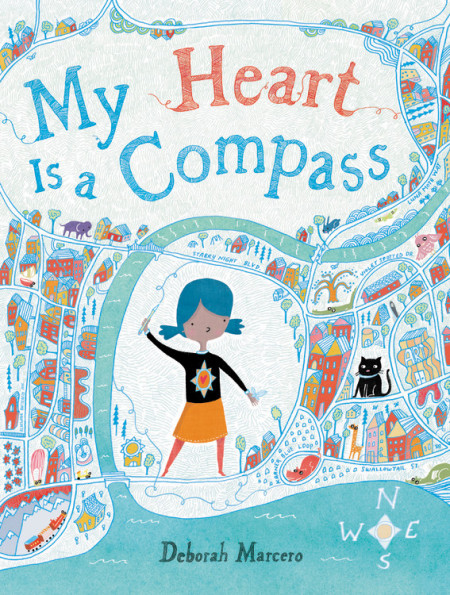
My Heart Is a Compass (Little, Brown and Company, November 6, 2018) written and illustrated by Deborah Marcero

It could have been anything.
Something exotic?
Something magical?
Did it even exist?
Where could she find such a thing?

For that, she needed a map.  Not an atlas or a globe.
To find the secret coordinates, she would
have to draw her own map.  

Watch the delightful book trailer premiere
at A Fuse #8 Production with Betsy Bird


STORY

No Boring Stories! (Viking, Penguin Young Readers, November 6, 2018) written by Julie Falatko with pictures by Charles Santoso

Those are boring stories!
I like books where strange stuff
happens.  But everyone says my
stories are too weird.

I think weird
stories are cool.

Remember the one you
wrote where the main
character was a discarded
shoe who loved to sing?

That sounds hilarious!


GIVE

Found. (Simon & Schuster Book for Young Readers, November 20, 2018) written by Jeff Newman with illustrations by Larry Day

This story is wordless.  It is a powerful statement on loss.  It speaks to giving when it's the hardest possible choice.  It's also about finding pure sweet love.


Tuesday, March 15, 2016

Not Here But Still Here

Body language and eyes convey the news even if a parent, staff member or student has not already spoken with you.  Sometime between the last time you saw this student and now, they have suffered a loss.  It happens to all of us no matter our ages, usually without warning.  Even if we know it's coming the hole in our hearts is huge.

When love is shared between two, day in and day out during the course of their lives, filled with ordinary and extraordinary events, the absence of one is keenly felt.  Ida, Always (Atheneum Books for Young Readers, an imprint of Simon & Schuster Children's Publishing Division, February 23 2016) written by Caron Levis with illustrations by Charles Santoso is first a look at the strength of a bond formed by two animals in captivity.  It further cements the belief that all animals can suffer the loneliness of losing the one loved.

Gus lived in a big park in the middle of an even bigger city.  Buildings grew around him and shifted the shape of the sky.

As sure as an alarm on a clock, each morning when the keeper Sonya brings food to Gus and Ida, two polar bears, they each leave the comfort of their respective caves to spend their day together.  They play with Ida's cherished yellow ball, frolic in their pool and rest on their favorite rock.  They have thoughtful conversations.

When Gus wonders, Ida answers.

"You don't have to see it to feel it," said Ida.
"Listen."

She reminds Gus what the noises they can hear mean.  Each day closes in the comfort of this constant cadence of their lives.

Upon waking one morning Gus is puzzled to hear all those city and park sounds without the presence of Ida.  He knows Ida is in her cave; her breathing reaches his ears.  Sonya explains to Gus about Ida being so ill her body will eventually sleep without waking.

Gus immediately runs to Ida angry and afraid.  She responds in kind, angry and afraid.  Eventually they sleep next to each other, quiet in their closeness.  Peace.

Days are brimming with ups and downs, silence and not silence.  Each evening ends the same, a mantra of longing.  Then Gus is alone.  BUT remembered words warm a soul like the sun brings heat to the fur of a polar bear sitting on a favorite rock.


When Caron Levis describes the Central Park Zoo, the habitat of Gus and Ida and the city surrounding them, she does so from personal experience creating a vision for readers.  Her use of short, informative sentences, the repetition of key phrases and a blend of dialogue and narrative supplies an invitation for us.  The sounds of the city are integral to the story.  Single words and near poetic sentences bring them from the page into our respective reading spaces. She compels us to become a part of Gus's and Ida's world.  We follow with pleasure and fall in love with these two magnificent creatures.  Here are two sample passages.

They heard buses groan; trucks rumble;
police whistle; taxis honk; pigeons coo;
people say Hey, Wait Yo, Hello;
and children laugh.

Two bears sniffled, two bear breaths panted, 
two bear hearts echoed each other's beat.


Even if you know absolutely nothing about this story, looking at the illustration on the opened matching dust jacket and book case portrays the affection felt by the two bears in their space within the confines of a city.  Charles Santoso's attention to the sky and skyline in this initial image, in the entire book, is spectacular extending from left to right, back to front.  Of particular notice is the color selected for the opening and closing endpapers; a lighter shade of purple followed by a darker hue.  I have always thought of purple as signifying royalty.  Surely by all accounts this is how these two bears were to all who visited them.

On the initial title page we are gazing at a pale blue sky filled with clouds in the faint shapes of polar bears. (Santoso does use shapes several more times within the body of the book.)  In small text we read the words

ida,

ALWAYS 


centered to the right edge.  The more formal title page, verso and dedication pages are a panoramic view of New York City and Central Park.  

Rendered digitally but looking like finely detailed paintings Santoso brings warmth of emotion to each picture.  Wide-angle views of the park from a bird's perspective and closer encounters with the two bears balance in a pleasing portrayal.  Visual size enhances the pacing; sometimes odd shaped or more traditional panels are used or a circular image framed in a liberal amount of white space.  These ask us to pause.

Santoso skillfully combines an interior look at the bears' homes while including the city in the background.  It is obvious he has studied his subjects conveying them realistically.  Can you see the small animal (s) he places in many pictures?  I see this as a constant and of life moving forward even in sadness.

One of my favorite illustrations, of several, spreads across two pages.  On the left in a circular display as the sun sets is the skyline of New York City with colored clouds and birds gathering for the evening in the trees.  It is framed in vegetation and rocks as if seen from a bear cave.  To the right inside the cave Gus and Ida are together, eyes closed and at rest.


Ida, Always written by Caron Levis with illustrations by Charles Santoso is a truly moving account of an enduring love and the loss of one part of a very special whole.  Thoughtfully written and illustrated, based upon a true story, it sends a beautiful message to everyone about grief.  It helps us to remember that what we cannot see can still be visible in our hearts.  An author's note is included on the last page.

To learn more about Caron Levis and Charles Santoso please visit their websites by following the links attached to their names.  They both have updated blogs linked at their websites. There is an excerpt from a developing activity guide on Caron Levis' blog. (Update:  April 18, 2016 The guide is now complete.) Charles Santoso has a Tumblr site. There are ten interior images at the publisher's website.  I think you will enjoy this radio interview. 


Here are some links to newspaper articles about Gus and Ida found at The Daily News, The New York Times, Huffpost Green and Gothamist.

Update:  March 17, 2016  I really enjoy when illustrators share portions of their process.  Here is a new tweet sent out by Charles Santoso.

Thursday, May 28, 2015

Two Terrible

In some situations defined as less than desirable, it's a good idea to give it the it could always be worse test.  Even then sometimes you feel so trapped, helpless or frightened you believe it is truly horrible until life gives you another set of circumstances which is much worse.  Given a choice it's a good time to apply the concept of the lesser of two evils.  In fact you will probably wonder why you thought the first prospect is dreadful.

Many times as a child it's hard to get adults to see your viewpoint.  Sean Ferrell has penned a story that is at once familiar and entirely unique.  Illustrator Charles Santoso enhances those words with every bit of available space.  I Don't Like Koala (Atheneum Books for Young Readers, an imprint of Simon & Schuster Children's Publishing Division, April 14, 2015) will stay with you long after the cover is closed.

Adam does not like Koala.

This gift, this toy, is the most disturbing thing he has ever received.  The eyes are weird, seemingly following him no matter where he is.  It's downright creepy.

Adam explains over and over to his parents how much he dislikes this Koala.  He finds it utterly disgusting.  They fail to comprehend how upset he is.

Each night Adam follows his typical bedtime habits.  Each night Adam hides Koala, hoping to never see him again.  He falls asleep alone and happy but every morning snuggled in bed with him is Koala.  YIKES!

He tries to throw him away at home.  He tries to leave him at the grocery store.  Adam's dad and mom retrieve Koala each time.  No matter how many times Adam repeats

"I don't like Koala!"

that toy is sticking to him like glue courtesy of his parents.

The eerie factor heightens when after a long trek Adam returns home to find Koala has arrived there first.  How is this possible?  He left him far away.  That evening getting ready for bed, Adam knows nothing on this earth is more sinister than Koala.  A double twist will leave you trembling... and grinning.


Readers jump in with both feet after reading the first sentence written by Sean Ferrell.  Why we ask?  Adam, in succinct sentences, speaks his mind through the narrator and his outbursts to his parents.  Ferrell provides a cadence with each set of words and pacing with the page turns.  We are emotionally invested in what happens to Adam.  That's why the two turns of events at the end are absolute perfection.  Here is another sample passage.

Adam puts Koala away.
Away is a lot of different places.

But every morning
when Adam wakes up...


There is no doubt Adam does not like Koala when readers first see the matching dust jacket and book case.  The look of utter disdain on his face as he flings the toy sends a powerful message.  On the back, to the left, in the lower right-hand corner Adam is carrying Koala in outstretched arms as if he is toxic.  

Illustrations rendered in pencil and colored digitally by Charles Santoso begin the story on the opening endpapers.  On the left a pair of hands is giving a joyful Adam a wrapped present.  With wonder and anticipation in his eyes Adam unties the ribbon on the right.  When looking at the jacket, case and initial endpapers, we are aware of the adept use of white space by Santoso.  On the verso and title page we see the loose ribbon and Adam's hand lifting the lid on the box.  One Koala eye is peeking out.  

With a page turn and the first sentence, Adam is standing far away holding the lid clearly distraught over his gift.  In a stroke of genius Santoso next places an extreme close-up of Koala across two pages.  The eyes are most certainly strange.  Someone goofed at the toy factory.  

Throughout the remainder of the narrative Santoso supplies a series of smaller images, sometimes framed like panels, along with larger ones to masterfully match the text.  Adam's expressions are truthful but hilarious at the same time.  The positions of Koala will have you laughing and wondering.  When Adam is brushing his teeth, just a portion of Koala can be seen looking in the mirror at him.

At one point Santoso throws readers a curve in his interpretation of Adam's trek and return home.  The final four images cover both pages and the closing endpapers.  They take place at night so the prevalent white space is replaced.  These make a huge statement.  


One of my favorite series of pictures spans across two pages.  In eleven small images we are privy to all the hiding places Adam tries to hide Koala.  In the final circular visual Adam is sound asleep smiling.  It's a wonderful set-up for the page turn.  


I Don't Like Koala written by Sean Ferrell with pictures by Charles Santoso is one of the best spooky but not too spooky books of 2015 so far.  No matter how many times I've read it, I keep laughing out loud at the combination of words and images.  Get ready to hear a chorus of read it again.  You might want to have a toy Koala available for hugging...or not.


To learn more about Sean Ferrell and Charles Santoso please follow the links attached to their names to access their websites.  Charles Santoso also maintains posts at Tumblr.  Follow this link to a book review and a series of illustrations at Seven Impossible Things Before Breakfast hosted by author and blogger, Julie Danielson.  You will be laughing by the end of the book trailer.