Quote of the Month

When love and skill work together, expect a miracle. John Ruskin


Showing posts with label books and reading. Show all posts

Wednesday, September 22, 2021

In His Own Time

As a student, a family member, and an educator, you experience the requirements of criteria to be met at certain grades, numbers assigned to books to "level" them, and programs in support of leveling, some with built-in quizzes and rewards.  You watch a beloved relative crushed by their slowness to read compared to their parents' expectations.  Countless times you've seen sadness pool in students' eyes when the book they want to read is either too high or too low of a required "level".  Supported by research, we know individuals learn at their own pace.

Some goals are more easily met than others, but if it is a desired milestone, it will be achieved.  It is not for us to say when.  A Walk in the Words (Nancy Paulsen Books, an imprint of Penguin Random House LLC, September 14, 2021) written and illustrated by Hudson Talbott is the personal chronicle of his struggle with words, reading, and books.

Drawing always came naturally to me.
I drew all the time.  I just did it,
like breathing. 

This child, this boy, created his own stories in pictures, every day.  He enjoyed words, too.  One word at a time was how he appreciated them.  When they were grouped in a sentence, he stumbled.  No one knew how slow he was at reading.  

Books terrified him.  Originally, they were fun.  They had loads of pictures and few words.  As the word count grew and the number of pictures lessened, he lived in fear people would realize he could not read like his classmates.  His loneliness in this knowledge was like walking through a forest made of words.

Remember though, this child, this boy, had a gift, the gift of drawing like breathing and drawing stories.  He used his love of both, drawing and stories to navigate through words.  He found what he knew to make a path toward what he wanted to know.

On this new adventure in reading, he made another discovery.  Speed is not essential.  Other notables were slow like him.  He experimented with words, drawing, and words and drawing combined.  He practiced and practiced.  In time, in his own time, the world, the world of readers, discovered this teller of tales.


Each time a page is turned, if it is the first or tenth time, we are brought into this very real story of conflict and triumph, of pursuing and finding.  Hudson Talbott expresses himself through vivid and specific descriptions of every emotional moment.  Even though we feel his frustration and fear, there is an undercurrent of courage.  As this determination is depicted and built little by little, Hudson Talbott is supplying readers with a type of guide or map.  We cheer for him and celebrate his success.  Here is a passage.

One big word
was stalking me---
overwhelm.  It described
the feeling of too many words
coming at me at the same time.

It made me want 
to give up.

But I loved stories
too much to quit.


Opening the matching dust jacket and book case, readers can first see on the front, right side, a backpack-wearing boy standing in a woods of words.  His stance, facial features and clenched fist are those of someone ready to reach their heart's desire, no matter what it takes.  He holds in his left hand his tools for pictorial storytelling.  This image invites us to stop and read all the words.  What do they mean to us?  What did they mean to this boy?  I believe it is important to note the light behind and around him.

The tree branches continue on the other side of the spine, to the left, on the back.  Has the implication of the words changed?  These words frame a blub about the book at the top by author Jacqueline Woodson.  Beneath this are praise statements for other books by Hudson Talbott.

On the opening and closing endpapers are marbleized shades of green like the floor in the forest.  On the title page is a single picture.  A pathway of stones holding some of the text leads to the boy standing under the R in WORDS.  This text is shaped like trees.  On the verso page childlike drawings frame the text.  They are an indication of Hudson's drawing at an early age.

These illustrations rendered 

in watercolors, colored pencil, and ink on Arches watercolor paper  

heighten the already immersive text.  They take us beyond the words, deeper into the journey.  The single-page and the double-page pictures in full color are highly animated, detailed and full of imagery.  The use of light and shadow and white space is exemplary.

One of my many favorite illustrations is the first double-page image.  We are in the living room of Hudson's home.  The room, its furniture, the floor, the family dog, and the children seen playing outside the window are done in grayscale.  In the center of the scene, in full color is a large sheet of paper covered in a story drawn by Hudson.  A box of colored pencils and box of crayons are shown scattered on the floor on the left side of the drawing.  On the right side of the gutter and across it slightly to the left, this drawing appears like water.  Hudson is 

diving into my own world.

His body to the left of the gutter is mostly out of the water.  The rest is swimming into the story.  This is ingenious.


Once you read A Walk in the Words written and illustrated by Hudson Talbott, you will be compelled for all the right reasons to share copies of this book with other children, parents, and educators.  It is a title supplying understanding and encouragement to others like Hudson.  It is a title for all of us.  Be sure to read the author's note at the end. (There is one portion which broke my heart.)  I highly recommend this title for your professional and personal collections.

To learn more about Hudson Talbott and his other work, please follow the link attached to his name to access his website.  Hudson Talbott has accounts on Facebook, Instagram, and Twitter.  You can view interior images at the publisher's website and at author, reviewer, and blogger Julie Danielson's site, Seven Impossible Things Before Breakfast.

Tuesday, January 1, 2019

Happy New Year 2019---One Little Word

Three hundred sixty-five days have come and gone in what seemed like a heartbeat.  Where did 2018 go?  Did someone speed up the clock?  The sense of not being able to catch up seemed stronger this past year.

Many people have been selecting one little word at the beginning of each calendar year for more than a decade.  The One Little Word project was started in 2006 by Ali Edwards.  For this first post of 2019, still having 2018 books to highlight, I decided to generate a list and assign a single word to each title.  I will include links to the author, illustrator and publisher when able to do so.  I will provide a passage from the book.  May everything that is right and good flourish in this coming year for each of you.

CONFIDENCE

Neck & Neck (Little, Brown and Company, June 5, 2018) written and illustrated by Elise Parsley

"I just

love 

this guy!"

At that, 
Leopold sighed and turned . . .
. . . and gasped

at the
gleaming smile

bobbing beside him.
Book Chat with the Illustrator: Elise Parsley Returns from LB School on Vimeo.


NEIGHBORHOOD

Hey, Wall: A Story Of Art And Community (A Paula Wiseman Book, Simon & Schuster Books For Young Readers, September 4, 2018) written by Susan Verde with illustrations by John Parra

Hey, Wall!

Guess what?

I'm ready to change all that.


Book trailer premiere with chat at Watch. Connect. Read. with John Schumacher


COMPASSION

I Am Human: A Book of Empathy (Abrams Books for Young Readers, October 2, 2018) written by Susan Verde with illustrations by Peter H. Reynolds  

I have a feeling of wonder.

I am amazed by nature.

I have a playful side.

I find joy in friendships.

I am Human.


PERSPECTIVE

The Wall In The Middle Of The Book (Dial Books for Young Readers, October 2, 2018) written and illustrated by Jon Agee  

Wait a second.  What's going on?!

This is not supposed to happen
on this side of the wall!


Book trailer premiere at 100 Scope Notes with Travis Jonker


CHOICE

Little Brown (Beach Lane Books, October 2, 2018) written and illustrated by Marla Frazee

He knew he could be a dog who would---if given
half a chance---chase balls, run in circles, nap in
the shade, or get muddy.

But Little Brown just watched the others . . .
and got crankier and crankier.  


UNITY

We've Got the Whole World in Our Hands (Orchard Books, an imprint of Scholastic Inc., October 9, 2018) written and illustrated by Rafael Lopez

We've got the rivers and the mountains
in our hands.
We've got the oceans and the seas
in our hands.
We've got you and you've got me
in our hands.
We've got the whole world
in our hands.


EXPLORE

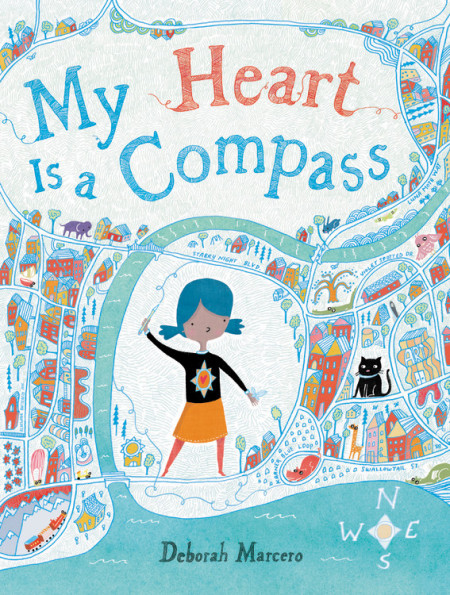
My Heart Is a Compass (Little, Brown and Company, November 6, 2018) written and illustrated by Deborah Marcero

It could have been anything.
Something exotic?
Something magical?
Did it even exist?
Where could she find such a thing?

For that, she needed a map.  Not an atlas or a globe.
To find the secret coordinates, she would
have to draw her own map.  

Watch the delightful book trailer premiere
at A Fuse #8 Production with Betsy Bird


STORY

No Boring Stories! (Viking, Penguin Young Readers, November 6, 2018) written by Julie Falatko with pictures by Charles Santoso

Those are boring stories!
I like books where strange stuff
happens.  But everyone says my
stories are too weird.

I think weird
stories are cool.

Remember the one you
wrote where the main
character was a discarded
shoe who loved to sing?

That sounds hilarious!


GIVE

Found. (Simon & Schuster Book for Young Readers, November 20, 2018) written by Jeff Newman with illustrations by Larry Day

This story is wordless.  It is a powerful statement on loss.  It speaks to giving when it's the hardest possible choice.  It's also about finding pure sweet love.


Monday, May 22, 2017

Tearing Down...Building Up

Even if you have a fear of heights, once you arrive and enter everything changes.  The small space, four walls with perhaps a single door, a single window and a roof to keep out the weather, is a place where memories lasting a lifetime are created.  Wishes are spoken aloud.  Promises are made.  Secrets are voiced.

When this haven is constructed by hand and with help, its value increases.  That Neighbor Kid (Simon & Schuster Books for Young Readers, May 9, 2017) written and illustrated by Daniel Miyares is about the art of reaching out and receiving.  Taking chances can lead to a far greater joy than believed is possible.

In a nearly wordless narrative a dreary day is the backdrop for a shift in a neighborhood dynamics.  A moving truck is parked in front of one of the houses on a street lined with sidewalks and filled with mature trees.  As the household items are unloaded, a boy reads a book in the back yard next to a large tree.  He is unaware of being watched.

We along with the observer realize he is focused on seeking sanctuary in that tree.  Still hidden the neighbor sees the new boy remove and take some of the boards on the fence dividing their property.  He then climbs up smaller pieces of wood nailed as steps to a top part of the tree.  The hammer stuck in his waistband drops.

The hammer is retrieved by the neighbor.  She arrives where the boy is puzzling over plans amid his bucket of nails and boards.  Looks, a single word and items for building are exchanged.  A crew of two now knows what to do.

The pure bliss they feel at their accomplishments glows like the colors now visible on the fall foliage.  Fun continues as the project and day come to an end.  A starry sky and glowing windows hold the hope for future endeavors.


One single word, the same word, is spoken by each of the characters once. This story conceived by Daniel Miyares thoughtfully looks at the development of friendship, the idea of offering advice and accepting it, of removing barriers to build something new, teamwork, and having the courage to do all of these things.  In the way each portion of the story unfolds, Daniel Miyares allows his readers to ask questions, think about their own choices and come to the realization the best and most lasting things rarely happen quickly.


When you open the dust jacket the scene of homes, the field of grasses and sky with a few clouds extends over the spine and to the left.  The difference is the colors fade.  It's the promise of friendship which adds brightness to the day.  The little details like the apple core next to the boy and the grasshopper on a bit of grass give authenticity to the image.

On the book case the elements are extremely spare on a cream background.  To the left the grasshopper remains but the grasses are few in number.  The girl, a smile playing about her mouth, crosses the spine.  She follows the boy running and carrying a board.  We don't see his entire body; part of him is off the case.  The opening endpapers are a wash of deep grays.  The closing endpapers are golden yellow with hints of brush strokes.

Rendered in ink and watercolor on Strathmore paper most of the pictures cover two pages.  These larger visuals reach out to envelope the reader.  When the two children meet and begin working together Daniel Miyares wants us to slow down and work alongside them.  These images are smaller and framed with the tree branches.  It's a beautiful thing to watch.  With each successive illustration more of the oak leaves turn from gray to autumn shades.

One of my favorite pictures of many (you could frame any of them to hang on a wall) is when the children are taking a break in their building.  We are looking at them from above.  The floor (maybe more) of the tree house is completed.  The plans are spread on the floor along with a saw, pencil, nails, boards and the hammer.  One of the windows is indeed in place casting a shadow over the girl lying on her back, smiling with pigtails spread behind her.  The boy, lying on his back, is holding a bright red leaf and smiling with legs crossed and one arm behind his head.  Sunlight is splashed on other portions of the illustration.  This is childhood at its finest.


There is a timeless quality to the story and the portrayal of the characters in Daniel Miyares's That Neighbor Kid.  Even the title supplies wonder; is it the girl or the boy who is the neighbor kid?  I can't imagine a personal or professional bookshelf without a copy of this book.

To learn more about Daniel Miyares and his other work please visit his website by following the link attached to this name.  Daniel has an account on Instagram.  You can view interior images from this book at the publisher's website.  Author, reviewer and blogger Julie Danielson talks with Daniel Miyares at Seven Impossible Things Before Breakfast.  In one of his Saturday videos to educator Colby Sharp, Scholastic Ambassador of School Libraries John Schumacher talks about this title at Watch. Connect. Read.  Daniel Miyares is featured at KidLit 411 and All The Wonders, Let's Get Busy, Episode #232.  

Tuesday, May 16, 2017

Nature's Champions

She entered our hearts and minds from the pages of a book eight years ago; a middle child in a family of seven, three older and three younger brothers.  Eleven years old in the summer of 1899 Calpurnia Virginia Tate thought and acted differently than girls did or were expected to during this time period in the hot heat of Texas.  The Evolution of Calpurnia Tate a debut novel written by Jacqueline Kelly and the recipient of a 2010 Newbery Honor award revealed to readers the quiet and not so quiet determination of a girl wanting to be allowed to pursue her own interests.  Not quite two years ago on July 7, 2015 The Curious World of Calpurnia Tate continued this young woman's journey to follow her own convictions amid history's events, the ups and downs of family life and the large disparity between what was appropriate for young men and young women.

In this second book the relationship between Callie Vee and her younger brother Travis strengthened.  Her pursuit of the natural sciences and his love of animals (wanting to make each one a pet) forged an unbreakable bond.  This past fall a new series for early readers, Calpurnia Tate, Girl Vet began featuring these two memorable characters.

Calpurnia Tate, Girl Vet Skunked! (Henry Holt and Company, October 4, 2016) written by Jacqueline Kelly with illustrations by Jennifer L. Meyer and jacket art by Teagan White begins as the title suggests with a skunk.  We all know the scenarios that single word raises in our collective minds.  The results are sure to be smelly.

None of the terrible things that happened need have happened at all if the skunk hadn't drawn attention to itself by ripping up our garden and stealing a bunch of vegetables.

The year was now 1901.  The skunk in question was a mama skunk.  One fine morning out for a walk, Travis heard the sound of what he believed was a kitten in the hollow of a tree truck.  It was a kit, a baby skunk and an orphan.

Of course, Travis enlisted Callie's help with the skunk's care.  She was dead set against keeping it, but Travis had already named it Stinky.  She simply couldn't resist his kind heart.  The two kept it hidden in a rabbit cage in the darkest part of the family barn.

All seemed to be going well, until with the help of a frantic Stinky another kit, near death, was discovered in the hollow trunk.  Now a cover story for items needed for its care was fabricated by Callie and Travis.  It was touch and go for the life of the second skunk, Winky, and for the devoted brother and sister in protecting their secret.  They might have succeeded except for one thing...the family dog named Ajax and a crazy decision by Travis one day at school.


In the second full length novel a veterinarian arrived in the town of Fentress, Texas.  Dr. Pritzker allowed Callie Vee to assist him with jobs around his office, to accompany him when he tended to sick animals and even read his books.  As you might expect this was kept strictly confidential from Callie Vee's mother who would be very unhappy with this arrangement.

In the second early reader title, Calpurnia Tate, Girl Vet Counting Sheep (Henry Holt and Company, April 4, 2017) written by Jacqueline Kelly with illustrations by Jennifer L. Meyer and jacket art by Teagan White Mrs. Tate might have need of the skills acquired thus far by her daughter.  Callie knows she walks a fine, well-guarded line but her Grandfather, an extraordinary and brilliant scientist living with them, offers continuous wisdom. A morning jaunt with him challenges her skills before they are critically tested.

What I am going to tell you about took place on our farm in Fentress, Texas, in the early spring of 1901.  Now if you don't live on a farm, you might not know that spring is the season when most of the animals have their babies, and places like ours were overrun with lambs and calves and piglets and kittens.

After one early morning expedition digging in the mud, Callie Vee earned the stern discipline of her mother but managed to venture out later with her grandfather.  During their time together she found a leaf containing three dots.  In true scientific investigative style, she studied them until the fateful day when they hatched into beautiful butterflies.

One of the three had an injured wing.  Over the course of several days with the help of Grandfather and encouragement from Travis, Callie Vee performed a minor miracle.  If sheep could talk one would be grateful for this butterfly's injury.

Mother Tate had a prize sheep with wool known for its unique softness.  She bred the sheep hoping to sell the lambs for their fine wool.  When it came time for the mother to birth, she demanded Travis fetch Dr. Pritzker. (Of course Callie Vee explicitly told her it would take several hours.  That shared knowledge did generate some uncomfortable questions.)  Ease turns to unease leaving no one but Calpurnia to demonstrate being smart, ready and lucky was an advantage with brothers and life.


With her adept use in painting a setting with words Jacqueline Kelly takes us back in time to the farm, surrounding meadows and woods and the banks of the river.  We can hear the gentle sound of the water, the hum of insects and the call of birds.  Through conversations with her brothers, especially Travis, her mother, Dr. Pritzker and their cook, Viola, we come to admire all the characters and find ourselves laughing out loud more than once.  The comparison between what is acceptable to Mrs. Tate and what Callie Vee actually does are miles apart.  Here are sample passages from both books.

Skunked!

I watched him to see if he got the joke.  It took him a moment, but then he laughed.  I always enjoyed making him laugh.  It was like the sun bursting out from behind the clouds on a gloomy day.

"Oh, boy, another one!" Travis cried, all excited.  Stinky grew even more excited at being reunited with his brother (or sister, who could tell?).  The three of them would have thrown a party if I'd let them.  The only one not excited by the reunion was yours truly.  No, not excited.  Not at all. 

Counting Sheep

Mother said, "Send us your bill, Doctor."
"Good heavens, Mrs. Tate, I did nothing to help.  I can't send a bill on Mother Nature's behalf.  No, no.  I bid you good day.

I left Mother and Travis staring at the lamb and walked the vet back to his buggy.  I gave his mare Penny a quick pat while he loaded up.

"Well, Calpurnia, is that the first lambing you've attended?"
"Yessir, although I've read all about it in your books."
He paused.  "Have you now?  Have you...uh...told your mother about your reading those books?"
Was he crazy?  Mother would likely have a fit if she found out.  "Never, Dr. Pritzker."


Each volume contains a variety of delicate black and white illustrations drawn by Jennifer L. Meyer.   The chapters begin with a thematic picture carried throughout each book, a reflection of the main storyline.  The size of the images heightens the emotional mood of the text varying from a partial page to a full page or spanning across two pages.

The intricate details draw readers into the illustrations, making us feel as though we are participating in the story beside the characters.  The facial expressions on the characters not only depict the current mood but endear us further to the people.  The flora and fauna are portrayed with realism and also an underlying appreciation for the natural world.

One of my favorite pictures in the first title is of Travis sneaking the newly found kit into the barn.  It covers one page.  As he walks past the horses, cow, and kittens he is holding a finger to his lips asking them to not utter a sound revealing his secret.  Jennifer L. Meyer has tucked a tiny mice into a ladle, up in the loft and around a hanging lantern.  In the second book one of my favorite illustrations, on a full page, is of Callie Vee holding a jar with the lid in her hand.  The butterflies are being released.  Travis watches while holding his beloved Bunny, an angora rabbit.  Two mice and several kittens watch too.  Both of these visuals create a vivid sense of time and place.


Calpurnia Tate Girl Vet Skunked! and Calpurnia Tate Girl Vet Counting Sheep written by Jacqueline Kelly with illustrations by Jennifer L. Meyer and jacket art by Teagan White are absolutely wonderful!  I have read them both twice and they get better with every reading.  The humor is genuine, the sense of history is true and the characters are irresistible.  Volume three is set to be released the first part of October 2017.  You won't want to miss a single one.

To learn more about Jacqueline Kelly and Jennifer L. Meyer please visit their websites by following the links attached to their names. Jennifer L. Meyer has a blog here.  The artist responsible for the jacket art, Teagan White, has a website here and Tumblr pages here.  You can read an excerpt from volume two at the publisher's website.
  

Thursday, May 11, 2017

Everything Is Good For Something, Right?

You keep watching it even though it's the most ridiculous television show, play, concert or movie you have ever seen.  You keep reading it even though it's without a doubt the goofiest thing you have ever read.  And then, to your own amazement, you read it again!  Let's face it, we love silly; the sillier the better.

On May 3, 2016 the twenty-fifth and final Elephant & Piggie book, The Thank You Book written and illustrated by Mo Willems was released.  He talks about it in this article at The Washington Post, Good night, Elephant & Piggie; a Q & A with Mo Willems.  He also speaks about a new series beginning in the fall of 2016, Elephant & Piggie Like Reading!  These books begin and end with commentary by the famous friends but other authors and illustrators write the stories.  The first two, The Cookie Fiasco by Dan Santat and We Are Growing by Laurie Keller, are huge hits.  In fact We Are Growing is the 2017 Theodore Seuss Geisel Award Medal Winner.

The third book, The Good for NOTHING Button! (An Elephant & Piggie Like Reading! Book, Hyperion Books for Children, May 2, 2017) written and illustrated by Charise Mericle Harper starts with Piggie answering Gerald's question with a classic reply.  I'm sure you're familiar with what children say when parents ask them what they are doing; especially if it's something they should not be doing.

What are you reading, Piggie?

Tee-hee!

Nothing.  

As the conversation concludes readers along with Gerald are eager to start the story.

Three birds, Yellow Bird, Red Bird and Blue Bird meet on a forest pathway.  A nearby worm looking from a hole in a tree stump is less than happy.  Yellow Bird can hardly wait to show the other two what he has.  Blue Bird is ecstatic at seeing this object, but quietly asks what it is.

It's a button, a red button that does

NOTHING!

Red Bird and Blue Bird are perplexed by this verbal revelation and actual demonstration.  Blue Bird asks to try.  He's happily flabbergasted.  When Red Bird points out being surprised is not nothing but something, the fun starts.  He then asks to press the button.  His response is not the same but it is certainly more than nothing.

Even though their reactions are entirely different this is starting to irritate Yellow Bird.  When Blue Bird pushes the red button again with an experience identical to the first time, Blue Bird and Red Bird draw another conclusion.  They break into song!

Yellow Bird explodes in frustration.  He repeatedly presses and pushes the button to demonstrate that it does absolutely NOTHING at all.  Red Bird and Blue Bird don't agree with this assessment.  Now Yellow Bird explodes in complete and utter exasperation.  In unison Red Bird and Blue Bird behave as every single reader will too!

Oh my goodness, Charise Mericle Harper!  The absurdity of a button you can carry and you can press that does nothing is hilarious.  What makes this even more over-the-top funny is the way the minds of Red Bird and Blue Bird work.  They are thinking outside the realm of obvious which to a literal bird like Yellow is thoroughly annoying.  Told entirely in dialogue the sentences and word choices are short, succinct and brimming with emotion.  The use of repetition of key phrases adds to the humor.  Here is a sample passage.

May I press the button?
Yes, Blue Bird. 
You may press
the button.
PRESS!
WOW!
Wow what? (Red Bird)
The button
is SO easy 
to press.
It surprised
me!
A surprise is NOT
nothing. (Red Bird)
That is true. (Blue Bird)


When you look at the front of the book case at the three birds, each wearing a different expression, you know this book is going to have comedic contrasts.  Careful readers will note the startled worm peeking out from behind the Elephant & Piggie logo.  The limited color palette, red, yellow, blue, touches of purple, dark pink, orange, brown, gray and pale green and blue for sky and earth, is used throughout the book.  On the opening and closing endpapers Gerald and Piggie are reading this book and laughing. On the closing endpapers the famous bird of bus-driving makes an appearance.

To supply pacing Charise Mericle Harper shifts her image sizes from two pages, to a single page, to a single oval or circle framed in white.  To increase the emotional impact several pictures are grouped on one page, separated by white space or a line.  The large, wide eyes of the characters, as do their wings (arms), mirror their current emotional state to great effect.

One of my several favorite illustrations is on a single page with a white canvas.  Red Bird and Blue Bird are in joyful moods.  Blue Bird has just pressed the button again and been entirely surprised.  This makes Red Bird laugh...a lot.  In the upper right-hand corner Yellow Bird is standing in disgust as if he just rolled his eyes.  His one wing is placed on his hip.  The opposite foot is tapping in irritation.


This book, The Good for NOTHING Button!, written and illustrated by Charise Mericle Harper is a surefire read aloud winner.  Read it with laughter in your voice, using multiple voices for the characters.  As soon as you finish it, I know your listeners will beg you to read it again.  The room will be filled with happiness.  Imagination is a wonderful thing.

To learn more about Charise Mericle Harper please follow the link attached to her name to access her website.  You are going to have loads of fun exploring her pages.  She has an account on Instagram. Charise Mericle Harper and this book is the subject of a blog post by teacher librarian Travis Jonker on his blog at School Library Journal, 100 Scope Notes.

Tuesday, May 9, 2017

Who's There? Beware!

There's nothing quite as wonderful as walking through a nature park in Michigan on a beautiful spring morning until your dog stops dead in her tracks.  She sharply turns her head looking intently into the woods.  Then a deep rumbling growl begins in her throat before the angry warning barks start.  You listen to see if the bird song has changed.  You look for any color or movement out of the ordinary but you see nothing.  You are still afraid knowing your canine companion has detected something unfriendly.

Quickly you alter your course.  The unknown has spoken to a keen primal instinct for preservation.  The Giant Jumperee (Dial Books for Young Readers, Penguin Young Readers Group, an imprint of Penguin Random House LLC, April 18, 2017) written and illustrated by beloved names in children's literature, Julia Donaldson and Helen Oxenbury, considers how beings approach what they cannot see and therefore might fear.

Rabbit was hopping home one day when he heard a loud voice coming from inside his burrow.

"I'm the GIANT JUMPEREE
and I'm scary 
as can be!"

After this frightening announcement Rabbit was not willing to enter the burrow.  Cries for assistance were answered by a nearby friend, Cat.  Cat was going to sneak inside and jump right on top of the boisterous intruder.

Cat was almost through the entrance when an ominous voice called out a warning.  She froze too spooked to move.  When she yelped for help Bear happened to reply.  Bear was more than ready to offer a "paw-sitive" outcome.

A bear is a pretty fearsome creature but when that voice bellowed out a dangerous promise, he paused.  Three animals do not want to enter the burrow but a fourth, Elephant, is willing to stick in his trunk and wrap it around the dastardly monster.  When the GIANT JUMPEREE speaks, you can with certainty guess the consequence.  These four friends have a serious problem.

Up in the top of a tree, Mama Frog hears Elephant's trumpets.  As casual as can be, Mama Frog volunteers to rid Rabbit's abode of this monstrosity.  Rabbit, Cat, Bear and Elephant all reiterate what might befall the courageous amphibian.  She bravely proceeds and issues her own challenge.  Will it be met?  Who or what can the GIANT JUMPEREE be?


Each time this title is read a smile will be forming and growing bigger as each animal approaches the burrow opening.  Julie Donaldson is a master at using repetition to build to a surprising conclusion; each animal replies to the challenge with the same response.  When a new animal asks a question, the answer is the same.  The warning issued by the GIANT JUMPEREE is different each time but the endings rhyme.  These repetitions and the rhyming create a marvelous cadence inviting reader participation.  There is not a reader in the world who has not heard Mama Frog's ultimate choice for the inhabitant of the burrow.  Here is a sample passage.

"Help! Help!" meowed Cat.
"What's the matter, Cat?" asked Bear.
"There's a Giant Jumperee in
Rabbit's burrow!" said Cat.
"Don't worry," said Bear.  "I'll put my
big furry paw inside and knock him down."


Rendered in watercolor the illustrations throughout and on the matching dust jacket and book case create a classic, comforting feel for the reader.  It's unlikely a rabbit, elephant, cat and bear would ever be seated in a field of flowers together but when Helen Oxenbury is the illustrator, it's as normal and extraordinary as can be.  Her play of light and shadow, delicate details, expressive facial features and soft, textured backgrounds and characters are a joy to see.  To the left, on the back, Rabbit is standing startled outside his burrow having just heard the declaration from the GIANT JUMPEREE.

The opening and closing endpapers are done in a soft, warm brown wash; almost like sepia tone.  On the first Rabbit is standing on a hill looking down at his burrow.  On the second all the characters are scampering with happiness down a hill.  On the first title page Rabbit is hopping along wearing a smile.  The formal title page and verso is a full color version of the opening endpapers.

With the exception of five smaller pictures, all of the images span two pages.  Careful readers will notice the passage of time in the shifting shades of color in the background skies.  For most of the visuals we are close to the characters.   Their body postures are endearing to the point you find yourself reaching out to hug them.

One of my many favorite illustrations is when Bear has been scared by the GIANT JUMPEREE.  He is pictured on the left side of the picture, leaning back on his front paws with his back paws close together in front of him.  Elephant is seated opposite him.  He is earnestly leaning forward reassuring Bear of his ability to rid them all of the GIANT JUMPEREE.  His back feet are in front with his two front feet resting between them.  They are sitting on a grassy meadow with hills and trees behind them.  Birds in the distance are flying.


You can be guaranteed of hearing listeners ask you to read The Giant Jumperee by Julia Donaldson with illustrations by Helen Oxenbury over and over again.  It's a delightful story of four faithful friends and a fifth companion willing to take a risk.  The results are surprising...and funny.  I highly recommend this as a read aloud, reader's theater or get out your puppets for some creative drama.  I would not be a bit surprised to see this title appear on the nominations for the 2018 Kate Greenaway Medal.

To learn more about Julia Donaldson and her other work, please visit her website by following the link attached to her name.  Helen Oxenbury is interviewed at Reading Rockets.  Author, reviewer, and blogger Julie Danielson talks about this title on her blog Seven Impossible Things Before Breakfast.  Julia Donaldson and Helen Oxenbury are featured regarding this title at Publishers Weekly.  Enjoy this video where Julia Donaldson and Helen Oxenbury talk about their collaboration on this book.


Monday, May 8, 2017

A PU Puzzler

On more than one occasion my canine companion stops in her tracks, nose sniffing the air with enthusiasm.  Her sense of smell proves to be acute and highly accurate repeatedly.  She may refuse to move, looking in one particular direction.  To be able to detect odors with her skill is usually astonishing; a signal for caution or a declaration of company's arrival.  At other times I imagine how unpleasant an aroma is.

As soon as the refrigerator door opens this same furry friend with four paws is sitting next to me; head lifted to savor the scents.  Most of them are wonderful.  When one is highly offensive enough to attract my attention, a search begins.  The Case Of The Stinky Stench (Lady Pancake Sir French Toast) (Sterling Children's Books, May 2, 2017) written by Josh Funk with illustrations by Brendan Kearney brings back the breakfast buddies introduced in Lady Pancake & Sir French Toast (Sterling Children's Books, September 1, 2015).  Within their realm something reeks.

Back in the kitchen and deep in the fridge,
past Trifle Tower, across Taco Bridge,
on a vacation at Marshmallow Coast,
sat Lady Pancake beside Sir French Toast.

Their idyllic hours are about to be interrupted.  Inspector Croissant, nephew to Sir French Toast, is rushing toward them.  A terrible tang is permeating the fridge.  It must be located immediately.   Croissant needs to succeed or his job is history.  Lady Pancake is sure Baron von Waffle is at the center of this repugnant problem.

It seems Waffle is not the culprit in this case; the odor increasing as tater tots make haste.  A green veggie gives them a clue but the water dweller in Corn Chowder Lake is not a helpful hint.  Pancake and Toast are certain the mystery will remain but the detective has everything to gain with finding a solution.

The trio trudges to new heights encountering a revolting stink.  There a cringe-worthy sight greets their eyes.  This guy has to go.  But wait!

Detective Croissant points out a well-known fact.  Back to the beginning the delectable gumshoes go. Will a foul fungus be their first failure?  Will this riddle be their ruin?  Can they turn this mess into success?


One thing is abundantly clear; Josh Funk can turn your refrigerator into a food fantasyland.  Readers will roam with relish through his tasty places as the rhyming words cook up a rhythmic feast for our minds and ears.  The clever use of a red herring educates as it entertains; no mystery is complete without at least one.  Acquainting readers with new characters heightens their desire to connect with the case. It will have them wondering when they will meet these fridge friends again. Here is a sample passage.

"What are you doing here?" Waffle said, sneering.
"I'm sleuthing," Croissant said.  "And you're interfering.
What do you know about smells that are vicious?"
"Nothing!" said Waffle.  "My home smells delicious."


I know for a fact when readers open the matching dust jacket and book case, the first thing they will do (after they smell it, Mr. Schu) is run their fingers over the jacket.  The title text, crown, mustache and decorative dots are raised.  The outline of Inspector Croissant has additional texture.  The colorful gummy bears will generate a comment or two.  To the left, on the back, we see the back of the bears, Lady Pancake and Sir French Toast.  In a spotlight stands Inspector Croissant looking right at the reader, ready to solve the case.

In keeping with the rich purple hues, outlines of food are etched on the opening and closing endpapers.  Nearly all of them are animated wearing looks of happiness.  In full color the food surrounding the text on the title page literally looks good enough to eat.  Rendered in pencils and digital media most of Brendan Kearney's illustrations span two pages, edge to edge.  To supply pacing he includes single page pictures and small visuals on a single page.  The vertical gatefold at the end is fabulous.

It's a given readers will pause at every page turn to look at all the included details.  The Trifle Tower, the labels on the maple syrup, the flag outside Baron won Waffle's abode (with gummy bears peeking out the door), and the inspector's suitcase and magnifying glass will increase the laughter factor along with the facial expressions when the stinky stench goes drifting past the fridge residents.  A super technique Kearney uses is to show outlines of the places previously visited behind the current scene.

One of my favorite of several illustrations is when the trio, Lady Pancake, Sir French Toast and Inspector Croissant, are rowing on Corn Chowder Lake.  We are looking at them as if through a porthole.  The lake is a golden orange with large chunks of corn, cheese and herbs floating in it.  The friends are rowing with carrot sticks for oars.  They are seated in a Portuguese Sardines can with the lid curled open with the key.


The Case Of The Stinky Stench (Lady Pancake Sir French Toast) written by Josh Funk with illustrations by Brendan Kearney is sure to have readers laughing out loud as they trek with the trio through the smelly refrigerator.  I guarantee you'll be looking and smelling in your appliance with fresh senses the next time you open the door.  Who knows who you will discover within the chilly realm?  Make sure you have a copy of this title for your personal and professional shelves to partner with the first book.

To discover more about Josh Funk and Brendan Kearney and their other work, please follow the links attached to their names to access their personal websites.  At Josh Funk's site he has quite a few fun things for readers to do.  Josh Funk maintains a blog here.  At The Children's Book Review a giveaway of both titles is in progress until June 5, 2017.  Author Josh Funk is featured at KidLit 411.  On KidLit TV Josh Funk reads Lady Pancake & Sir French Toast before he reveals the cover for this title.   I was thrilled to be able to interview Josh and present the book trailer premiere here at Librarian's Quest.

Friday, May 5, 2017

Pondering Purpose And Life's Passions

To think about possible outcomes, to envision a future full of the best life offers to us and what we can give back, is how we fill our hearts with hope.  As adults our purpose as we pursue our passions is to pave the way for opportunities for those who follow us.  As my mom always loved to say, "Wherever you go, leave it better than when you arrived."

In Matthew Cordell's first book in a proposed series, Wish (Disney Hyperion, March 3, 2015) elephant parents long for a child.  The arrival of this member in their family, after disappointments, is as if a miracle is granted to them.  The second book, Dream (Disney Hyperion, May 2, 2017) written and illustrated by Matthew Cordell extends and explores the overwhelming pure bliss parents feel when their baby enters their lives.

On the night you were born,
our world shined
bright as the sun.

Gorilla parents gaze with complete amazement at their new child as if hardly able to believe such joy is their joy.  Before them they see a life about to unfold.  This new life will change everything; change them.  As they fall asleep together, one dreams.

In the dream the eyes and voice of the child are remembered with great affection.  The parent imagines the growth of the children in its ability to grip its fingers and climb to new heights.  Huge emotions, some of them contrasting, are woven tightly together by these thoughts.

As the dream continues the child, more grown, ventures to new places.  A friend is found.  Play and similar pursuits are shared.  A bond is forged.  But then profound sadness comes and the parent will do anything to ease this particular pain.

The parent's thoughts keep on unfolding a possible future.  The child is a young adult having followed a passion for making art as a painter.  Upon waking questions and promises swirl in the parent's mind.  Birth.  Beginnings.


No matter how many times this title is read one thing is abundantly clear, love pours forth from these pages.  Matthew Cordell conveys in his carefully chosen words the deep emotions felt by parents when a child they believe will never be born arrives.  Matthew allows us to speculate along with the parent.

As the parent shares their dream you realize you are privy to an intimate experience.  In this small being a personality is ready to blossom and flower spreading their own special beauty into the world.  When we read we can't help but wonder how the rest of our lives will be directed.  What will we dream?  Here are two more sentences.

I dreamed of the many stars
in your small eyes.

Of the music in your voice surrounding
everything, everyone, everywhere.


The soothing mint green as a background for the front of the dust jacket lends itself to dreaming.  The multi-colored pieces spiraling upward from the child signify a wish realized.  They and the title text are varnished. This wonderment follows him throughout the story.  To the left, on the back, one of the interior images is placed.  A parent (mother) is standing outside their home as the other (father), on top of a hill above the house, holds the child up looking into his eyes.  On the book case another interior picture is shared on a canvas of rich lavender, showing the child in five separate phases of growth.  The opening and closing endpapers are patterned in the confetti representing wishes and dreams.

Above the text on the title page the parents are kneeling, both looking at their baby in adoration.  An elaborate curl or question mark in the multi-colored pieces extends upward from the little one.  With a page turn we see two pages of white.  On the far right a gorilla hand reaches from the bottom of the page.  It is holding a paint brush, stroking a line of green.  Throughout the story we come to understand a picture is being painted as elements in the visual are added.  This is blended in with the illustrations Matthew creates using bamboo pen and India ink and watercolor on paper.  Without words the final painting appears on the last two pages.  I can't wait to ask other readers who they think paints this picture during the story.

The illustrations in Matthew's signature style, loose lines, intricate details, and expressive facial features amid wonderful settings are set in liberal amounts of white space.  This technique draws our attention to those items in color.  The perspective is shifted to bring us close to the parents and their child or to give us a larger view of their surroundings.  Sometimes the pictures will cover one or even two pages loosely framed or page edge to page edge.  To depict several incidents over time, there are smaller visuals grouped on a single page.

One of my favorite of many illustrations is for the words

A great journey was beginning
on this very bright night. 

A deep blue sky is brushed across the top of the page with stars and a crescent moon.  The mother and father gorilla are standing in front of their home.  One (the mother) is holding the child up toward the sky.  A large pathway of the multi-colored pieces reaches from them covering the sky as it lifts upward. ( I determined the one gorilla was the mother because it looks as if the other larger gorilla is a silverback.)


It does not matter if you are a parent or not or if you are a child reading this book.  Dream written and illustrated by Matthew Cordell is about hope.  Children are our hope.  They are the promise of a future.  This title tells them love will follow them as they dream of the paths they may follow.  These two books Wish and Dream are truly beautiful.

To learn more about Matthew Cordell and his other work please follow the link attached to his name to access his website.  Matthew chats with author James Preller on this blog about the first book but this gives you an idea of how the proposed trilogy will be portrayed.  Matthew has an account on Instagram at cordell_matthew.  Enjoy these two images I was able to find online.


Tuesday, May 2, 2017

Pondering Politeness

When a total stranger offers you a polite greeting there are many ways to respond.  First and foremost is to take into account your surroundings and the time of day.  If it's any given hour during the morning, afternoon or early evening in a place filled with people you can return the greeting, nod, wave or smile.  All those actions are acceptable.

Unless you are unable to talk or understand the language, to do nothing might be considered rude. (Friendly people sometimes forget you might be shy.)  Perhaps there is another reason altogether as to your lack of speech.  Plankton Is Pushy (Scholastic Press, April 25, 2017), a companion title to Barnacle Is Bored (Scholastic Press, May 10, 2016), written and illustrated by Jonathan Fenske is a classic episode in the outgoing versus the reticent.

Why, hello,
Mister Mussel! 

Cheerfully, Plankton is out for a swim in the sea when he encounters Mussel, who looks rather grumpy.  He calmly waits for a response to his greeting.  When Mussel continues to rest on the sand in silence, Plankton repeats his words louder, perhaps thinking Mussel suffers some sort of hearing impairment.

Mussel just sits there wearing the same expression and expelling bursts of bubbles.  Plankton believes Mussel is in need of instructions in etiquette.  He proceeds to perform a scenario in which Mussel replies, giving him possible examples.  He then cheerfully, but with a bit of an instructive attitude, starts over.  You can almost feel Plankton's frustration increase when Mussel does absolutely nothing.

Trying another tactic Plankton speaks more slowly.  The results are identical.  Mussel does utter a sound.  Plankton moves from rage to pleading.

That's when a miracle seems to occur.  Plankton is overjoyed.  Several moments later not one, not two but three surprises are certain to have readers grinning from ear to ear.


As soon as we see Plankton, before he even utters a word, we know he is an upbeat kind of sea creature as he moves along whistling.  In this way Jonathan Fenske introduces us to his personality.  His happy-go-lucky temperament makes it impossible for him to pass Mister Mussel without speaking.

In the timeless tradition of the third-time-is-the-charm he attempts to convert Mussel to displaying similar cheerfulness.  This increases the tension building to the unforeseen consequences and heightening the comedy.  By having Plankton relate the narrative through his first person dialogue we are more intimately involved in the discourse and of course, better able to enjoy the hilarity when it happens.  Here is a sample passage.

So let's say we give this another whirl, okay?

WHY, HELLO, MISTER MUSSEL!

Really?
Nothing?

Grrrrrr.


The opened book case gives readers a very good idea of the state of the relationship between Plankton and Mister Mussel.  The facial features on both of the characters set the scene for a less than amiable meeting.  Plankton is in full lecture mode.  On the back, to the left, a larger version of Plankton is peeking from the spine on the right, hands to his body in disgust.  The bubbles we see on the front are replicated on the back around information about Jonathan Fenske.  Above this a short blurb ends with a question about the book.

Barnacle makes an appearance on the opening endpapers as Plankton approaches a grouchy Mister Mussel.  Making use of every bit of space, the closing endpapers announce a startling finale as we zoom in on the two main characters.  The color palette throughout of purples, gray, pinks, black, white, sand, sea blue and sea green and rage red work wonderfully with the text.

Jonathan Fenske conveys the mood and emotions of the story marvelously through body postures and facial expressions.  Plankton's eyes, eyebrows "hands" and feelers leave no doubt as to his exact state of mind.  This contrasts very well with the same stoic look on Mussel's face leading us (and Plankton) to the ultimate conclusion.  Fenske alternates the visual sizes from two page, to half page and then to single page, all of them edge to edge to supply pacing.

One of my favorite of several illustrations is one of the half-page pictures.  Plankton is giving Mussel a lesson in politeness.  He is telling him to say "Hello" in reply to his "Hello".  He has a sort of sarcastic look on his face as his "hands" form a mouth moving to say "Hello".  Who knew plankton could have so much pizzazz?


You know from your first glance at the book case, you are going to be smiling when you read this book.  Plankton Is Pushy written and illustrated by Jonathan Fenske is a lesson in politeness and in knowing when enough is enough.  The surprises are sure to prompt discussions.  Reading this aloud is wonderful.  It's been student tested with shared laughter as an outcome.

To discover more about Jonathan Fenske and his other work please visit his website by following the link attached to his name.  You will enjoy scrolling through his illustrations.  If you go to Scholastic's Instagram account you can click on the book cover and swipe through the first few pages.

Monday, May 1, 2017

A Brave Bovine And A Buddy

Decades ago my parents joined other couples in our local community to form a square dance group.  They would gather at the nearby township hall on Saturdays to dance.  There were often family nights and special celebrations for holidays.  One of the most memorable events was one particular Halloween.

Partners were required to go in costume.  Mom was all decked out in a homemade scarecrow outfit. My dad was about average build but he was strong, working in the same factory for more than forty-one years.  To see him standing in the doorway wearing pink ballerina attire, from head to toe, is something you never forget especially when a bald man is wearing a wig.

It's the contrast between what you know to be true and what you see that creates the comedy.  Moo Moo & Mr. Quackers present Moo Moo in a Tutu (Balzer + Bray, an imprint of HarperCollins Publishers, April 25, 2017) written and illustrated by Tim Miller provides readers with a similar disparity and much more.  You can hardly say the title without laughing.

Mr. Quackers, I just had the best idea in the whole world!

Another one?

This cow and this duck, best buddies, share an apartment in a large city.  Readers know what Moo Moo's idea is.  It's not until after several false guesses and a big reveal that Mr. Quackers fully comprehends.  He is flabbergasted!  How can a cow become a ballerina?

When Mr. Quackers points out the lack of training on Moo Moo's part, Moo Moo is not deterred regardless of a rather large crash during practice.  Lickety split the duo head to the theater across the street.  Moo Moo is ready to perform.  Ever the faithful friend Mr. Quackers is ready to watch.

Suspense builds as Mr. Quackers strolls down the aisle and takes a seat.  Moo Moo heads backstage assuring his pal nothing will be broken.  To the shock of the three ballerinas already on stage, Moo Moo joins them.

Moo Moo's impressive dancing makes for an unforgettable performance.  Leaving the theater and then at home, Moo Moo and Mr. Quackers have an interesting conversation brimming with possibilities.  This duck is certainly unprepared for their surprising next adventure.


Told entirely in dialogue placed in speech balloons, Tim Miller spins a narrative introducing us to Moo Moo and Mr. Quackers within the first few pages.  Their personalities and relationship are more thoroughly revealed as the story continues; the one firmly grounded on terra firma while the other seeks high-flying adventures.  Humor fills their conversations and their remarks to others.  Here is a sample passage.

But you've never taken ballet lessons.

It's okay.  I'm a quick learner.

CRASH

That last move is a little trickier
than it looks, but I've almost got it.

If you say so.


There's something about a cow wearing a pink tutu and leaping across a stage which causes instant laughter.  The expression Mr. Quackers is wearing enhances the absurdity of this entire situation on the front of the dust jacket.  The theater design with the spotlight beams making a geometric pattern with Moo Moo front and center is marvelous.  To the left, on the back, an image is framed and tacked to the wall.  It's Moo Moo painting a portrait of Mr. Quackers.  It's the first of many activities they enjoy.

Upon removing the dust jacket to reveal the book case, it's guaranteed readers will gasp.  The full moon, starry sky, night scene done in purple, black, grays and pale yellow is unexpected and wonderful.  The opening and closing endpapers in two shades of yellow showcase Mr. Quackers and Moo Moo in portraits hanging on the wall.  Continuing with the theater theme on the title page, Moo Moo and Mr. Quackers are pasting the text on paper to a marquee framed in lights.  The verso and dedication pages draw our attention to other fun they share together.

Rendered in brush and ink and digital hocus pocus the pictures vary in size from two pages, to two pictures on a single page and single page images.  Miller alternates his perspective to elevate the hilarity sky high.  The mouths on Moo Moo and Mr. Quackers coupled with their body language contribute to the laughter.  Careful readers will want to pause with every page turn to notice the details; the signage and book titles.

One of my favorite of several illustrations is for the dedication page.  It's a small image on a crisp white background.  Moo Moo is holding a roll of string attached to a kite.  Soaring in the air is a blue kite with a tail of pink ribbons.  Attached to the kite with lots of string is Mr. Quackers on his back.  His arms and feet are spread apart.


Moo Moo & Mr. Quackers present Moo Moo in a Tutu written and illustrated by Tim Miller is laughter waiting to burst forth from the pages as soon as you open the jacket and case.  The contrast in their character traits and comments not only supplies us with fun but allows us to see the strength of their friendship.  Whether read silently or shared one-on-one or with a group, get ready for loads of giggles and grins.

To discover more about Tim Miller and his other work, please follow the link attached to his name to access his website.  You can view interior images at the publisher's website.  At Scholastic's Ambassador of School Libraries John Schumacher's blog, Watch. Connect. Read.the book trailer is premiered along with a conversation.  At YA and Kids! Book Central Tim Miller writes a guest post.  At The Children's Book Review read Inside The Studio With Tim Miller. Tim Miller talks about the process for making this book at the Nerdy Book Club.  Third grade teacher (Mr. Stands-On-Desks-And-Shouts-I-Love-Reading) Colby Sharp shares about reading this book aloud with a Best Part of My Day post. At All The Wonders, Episode #351 teacher librarian Matthew Winner chats with Tim Miller, Donna Bray and Dana Fritts about this title.

Friday, April 28, 2017

Honoring Wordsmith Heroes

The month of April is coming to a close but the observance of National Poetry Month need not stop.  Let's just think of this month as an introduction to a literary form allowing everyone to express themselves in a variety of writing styles every single day of the year.  If you have a flair for visualizing shapes, pen a concrete poem.  If you wish to focus on the natural world, the five-seven-five syllable haiku is the perfect kind of poem for you.  If you enjoy even more structure, the five line cinquain asking for a single noun, two adjectives, three -ing participles, a four word phrase and closing with a synonym for the first noun is what you should write.  If you like the rhythms of rhyming create a couplet.

Poetry beckons to the universal qualities found in all people.  Out of Wonder: Poems Celebrating Poets (Candlewick Press, March 14, 2017) written by Kwame Alexander with Chris Colderley and Marjory Wentworth with illustrations by Ekua Holmes expresses the admiration held by these three poets and artist for twenty other poets.  They have collaborated to inspire others as they were inspired.

In the first of three parts, Got Style?, poets are featured for creating a signature style.  With recognition and respect the poems written about them underscore their individuality.  Kwame Alexander's How To Write A Poem celebrating Naomi Shihab Nye will have you reaching for the nearest means to record your thoughts.  The same peace we find in Robert Frost's contemplations is echoed in Marjory Wentworth's In Every Season.  Gathered thoughts, separated by pauses, lyrically define poetry in a manner reminiscent of the work of Nikki Giovanni using all lower case letters.  Snapshots by Chris Colderley is a loving tribute.

In Your Shoes, the second section, focuses on poetry written by one author (us?) which reads like it was written by a favorite poet.  Beginning with basketball and continuing the analogy dreams are shared, glory days of youth are remembered and heroes of Harlem are saluted in Walter, Age Ten celebrating Walter Dean Myers by Kwame Alexander.  We travel to the private place in Chile beloved by poet Pablo Neruda in The Music Of The Earth written by Marjory Wentworth.  Calm is found in nature by a man devoted to poetry, politics and his people.  Majestic musings about those who walked before us on Tambourine Mountain pays tribute to Judith Wright.  Chris Colderley asks us in Tambourine Things to hold a found fossil in our hands, listening and watch the shadows fall as the sun sets.

In the final part, Thank You, the three contemporary poets write poems regarding those poets who affected them in a deeply personal manner.

A poem can sometimes be so powerful that it might even feel as though the poet is speaking directly to us, as if we are in the middle of a private conversation.

They showcase Gwendolyn Brooks, Sandra Cisneros, William Carlos Williams, Okot p'Bitek, Chief Dan George, Rumi and Maya Angelou.  These poems do indeed beckon but they wrap themselves around you in the glory of the words.  You cannot help but feel the love as each poet's life story is revealed.


This collection of poems written by Kwame Alexander, Marjory Wentworth and Chris Colderley not only pays homage to twenty poets but introduces readers to the particular voice of these three poets.  After reading several of their poems you sense the similarity in how they approach the poet they are showcasing.  No matter which poem you are reading, whether written by Alexander, Wentworth or Colderley, you will find yourself without conscious thought sighing or gasping as you read the last line.  They are all brilliant.  I will share a portion of a poem written by each one.

From Walter, Age Ten
celebrating Walter Dean Myers

I'd like to soar one day
like Sweetwater Clifton high above the rim---
I wanna trot the globe
grab the world in my hands and
twirl a big ball of hope
from corner to corner.  ...
     Kwame Alexander

In Every Season
celebrating Robert Frost
... I have stopped to shake the dry snow
from the branches and watched the outline

of each bare tree sharpen like stone
and considered that quite often

life is too much like a pathless wood.
Still I have lived so long and traveled so far,

and I have climbed these hills and looked
at the world and descended.
    Marjory Wentworth

Snapshots
celebrating Nikki Giovanni

people forget...poetry is not just words on a page...it is...
a snowflake on your tongue...a tattoo on the inside of your arm...a dashiki and a kaftan...
tripping down the streets of Lincoln Heights...shouting from the hills of Knoxville, Tennessee...
    Chris Colderley


The warmth of the color palette and design radiates from the front of the matching dust jacket and book case.  The figure, arms raised and fingers spread, is moving to an unseen music, the poems we have yet to read.  On the back, to the left, on a golden background with hints again of musical notes, a list of the twenty poets is shown.  The deep purple of the title words is spread across the opening and closing endpapers.  The poets being celebrated are royalty in the world of literature.  Portions of geometric golden suns are displayed on the title page.  This design is used throughout the book as accents and for each of the three parts.

The artistic technique for creating these illustrations, collage on paper, used by Ekua Holmes presents readers with unique portrayals spreading across two pages, framed on a single page, as insets on a single page or edge to edge on a single page.  Vibrant colors are woven into each one.  Various papers give a texture to each visual, inviting readers to touch the pages.  Holmes varies her perspective in keeping with the poems.

With each page turn it's as if you are walking through an art gallery.  Elements in the illustrations reference the poet and the place in which the poem is set.  As soon as you finish, you will flip the pages to see all the pictures again.  They are striking...every single one.

One of my many favorite illustrations is the two-page spread for Snapshots.  Page edge to page edge a cool shade of green (teal?) provides a canvas for large snowflake designs.  Small white dots are blended with them.  Some of the snowflakes are in the foreground, some in the background.  On the left a boy wrapped in winter clothing is leaning back tasting the flakes with his tongue.  Opposite him on the right a girl is doing the same thing.  All we see is her face peeking out of a hooded coat.  Red, a darker shade of green and a golden yellow are chosen for their clothing.


Every bookshelf needs to hold a space for one or more copies of Out of Wonder: Poems Celebrating Poets written by Kwame Alexander with Chris Colderley and Marjory Wentworth with illustrations by Ekua Holmes.  In a word this title is stunning.  Prior to Kwame Alexander's Preface is a Contents.  At the conclusion of the book six pages are dedicated to giving readers more information about the twenty selected poets.  They are also listed by Ancient And Foreign-Language Poets, Nineteenth-Century Poets, Twentieth-Century Poets and Contemporary Poets.  Short biographical paragraphs are included for Kwame Alexander, Chris Colderley and Marjory Wentworth.

To acquaint you further with Kwame Alexander, Marjory Wentworth and Ekua Holmes please follow the links attached to their names to access their websites. NPR Morning Edition features this title in an interview with Kwame Alexander.  Marjory Wentworth is highlighted at knowitall.org   The Horn Book podcast 2.8 has Ekua Holmes as a guest.  Ekua Holmes visits The Brown Bookshelf for an interview.  At Penguin Random House you can view the first ten pages.  Candlewick Press has created a teacher's guide. Teacher librarian Jennifer Reed wrote a blog post at Reederama about using this title in her school library.
Collage Artist | Ekua Holmes Video from AugustineMonica Films on Vimeo.