Quote of the Month

When love and skill work together, expect a miracle. John Ruskin


Showing posts with label Marine animals-Fiction. Show all posts

Saturday, March 2, 2019

Beneath The Waves Pastry Prevails

Six months ago, a movement came to international attention.  In August 2018, Greta Thunberg, a sixteen-year-old Swedish student turned political activist, began to strike to bring attention to climate change.  Throughout the world student-driven events in the form of strikes are growing.  A website, FridaysForFuture, is a central location for information.  On March 15, 2019 a global day of action is set in place.  For those who educate and encourage children, telling them they can save the world, hope grows.

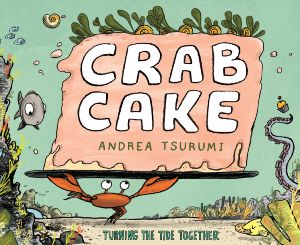
What these children and young adults do not know is they might have unexpected allies. . . under the ocean waves.  Crab Cake: Turning The Tide Together (Houghton Mifflin Harcourt, February 5, 2019) written and illustrated by Andrea Tsurumi presents a marvelous tale of typical and not-so-typical inhabitants of the ocean realm.  A single defining moment causes the formation of a new normal.

Under the sea,
where sunlight
touches sand,
lies a place
that's home to 
many incredible
creatures.

Clownfish, Manta Ray, Tangs, Sea Turtle and Scallop go about their days doing what is normal for a clownfish, a manta ray, tangs, a sea turtle and a scallop.  Crab does not go about his day doing what is normal for a crab.

Crab bakes cakes.

No matter how any of the other residents of this watery world spend their days, Crab continues to bake cakes, leaving them like a sweet delicious path among his companions.  Even those individuals who can't stop eating whatever or whoever they find, Crab just keeps baking cakes.  Life is beautiful in its sameness until suddenly it's not.

In the deepest dark of night danger is dumped into the watery world.  The dwellers are dumbfounded.  They become like statues unable to function but . . . not Crab.  Crab creates yet another confection for consumption.  This time is different.  This time everyone single soul comes to enjoy what Crab baked.

When a questions is asked of the group, an answer is given.  Many work as one until the job is done. In the morning, a shock awaits another community above the sea.  Down below, what do you think Crab and his ocean crew are doing?


A rhythm as gentle as a slow-moving current is supplied with the narrative flow written by Andrea TsurumiWhen each group of ocean occupants is introduced, she has them engaged in an activity.  This is followed by

Crab bakes cakes. 

This happens three times inviting reader participation.  It leads us into and provides a sharp contrast to the dreadful incident.  It also supplies an opportunity for the sea creatures to work as a single unit for their common good.  Here is a passage.

Toadfish sings.
Pufferfish puffs up. 
Octopus hides in a coconut.
Moray Eel pops out of her cave.

And Crab . . .


You know with one look at the open and matching dust jacket and book case, this book is full of goodness and surprises.  It's not often crabs are carrying cakes adorned with snail shells and seaweed.  Do you see that tentacle reaching out to grab the cupcake?  Is that fish snacking on a chocolate chip cookie?

To the left, on the back, a fish is wearing a croissant for a hat as a shark munches on a doughnut.  In the sea above this activity there is a subtle hint of the danger to come.  Will readers wonder?  Most of the elements, other than the seascape, are varnished.

On the opening and closing endpapers in sea green, outlines of white jellyfish are swimming upward.  Within each body is a sweet treat.  Pieces of cakes and pies, and cookies, float in delectable delight.  On the verso page we see a hint of the danger again.  Opposite this on the title page, Crab is baking using an undersea volcano.

The illustrations rendered

using graphite on Bristol vellum and digital color

by Andrea Tsurumi are double-page pictures until the mood of the story shifts.  Then a series of panels on six separate pages place greater emphasis on the change.  This pacing is excellent.  Andrea Tsurumi varies her color palette to indicate emotional highs and lows.

Intricate details welcome readers to pause on the pages drawing them further into the story.  The expressions on the creatures' faces mirror the story superbly.  Readers will see bits of humor inserted in some of the images.

One of my many favorite illustrations spreads across two pages.  On both sides of the gutter Crab is carrying a huge three-layer cake embellished with items from the sea.  On either side are all kinds of flora found along the ocean bottom.  A clam is taking a bite of a cookie.  A fish is enjoying another pastry.  A wooden spoon drifts nearby.  Are those muffins among the seaweed?  A larger fish looks in amazement at the cake.


What readers will realize is Crab Cake: Turning The Tide Together written and illustrated by Andrea Tsurumi is a tale about taking charge.  It's about working to take back the goodness you enjoy.  It shows the power of one to effect change.  I highly recommend this title for your professional and personal collections.

To learn more about Andrea Tsurumi and her other work, please follow the link attached to her name to access her website.  You'll enjoy the cover reveal by Elizabeth Bird, Collection Development Manager at Evanston Public Library system, at A Fuse #8 Production.  Author, reviewer and blogger Julie Danielson highlights the artistic process by Andrea Tsurumi on her site, Seven Impossible Things Before Breakfast.  It's fabulous!  Andrea Tsurumi stops by Mile High Reading hosted by Dylan Teut, director for the Plum Creek Children's Literacy Festival in Seward, Nebraska to talk about this book, her process and other work. Andrea Tsurumi has accounts on Instagram and Twitter.

UPDATE:  Please enjoy The Children's Book Podcast with Andrea Tsurumi and teacher librarian Matthew C. Winner, April 30, 2019 about this book.

Friday, February 1, 2019

An Appetite For Laughter

Sometimes when a book ends, it's not the final conclusion.  Oh, no . . . there is more story to tell.  The characters have a lot more to say.  They have a lot more to do.  When we are introduced to them, it's just a beginning full of promise.

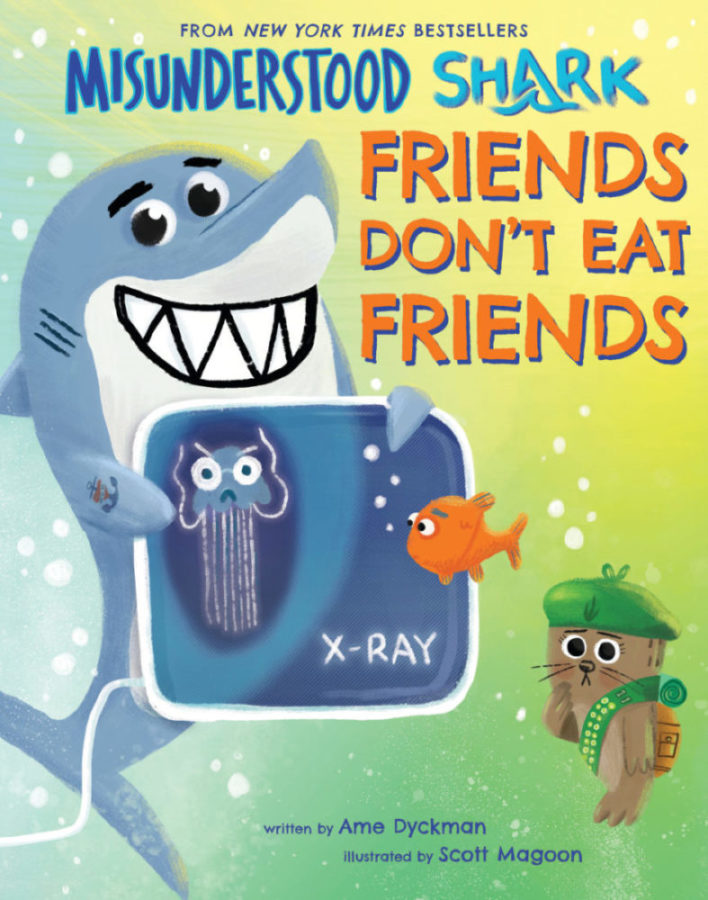
As the final pages and the closing endpapers, are disclosed in Misunderstood Shark (Orchard Books, an imprint of Scholastic Inc., April 24, 2018) readers feel disbelief as they try to digest what has happened.  The unknown fate of the fabulous Underwater World with Bob leaves us (and him) in the dark.  The companion title and sequel Misunderstood Shark Friends Don't Eat Friends (Orchard Books, an imprint of Scholastic Inc., January 29, 2019) written by Ame Dyckman with illustrations by Scott Magoon makes everything less murky as we peer into the depths of the water. 

Last time, on
Underwater World
with Bob . . .

Shark ATE ME!
Get me
OUT OF HERE!

"That's strange!
I can HEAR Bob.
But I can't SEE Bob."

As we barely get the page turned Shark has ejected Bob, a jellyfish, out of his stomach and the show does indeed try to go on.  The problem is Bob having a tizzy about being consumed by Shark.  When Shark realizes people are watching him, again, he utters his now famous defense.

"You MISUNDERSTOOD!"

Apparently, he was giving Bob an up-close-and-personal view of his inner self.  Bob's not buying it until his crew reminds him of his show.  We are then privy to one of his fun facts about sharks.  We go quickly from bones to cartilage to boogers. Bob is still not placated.  He WAS eaten.  Shark demands proof.

Suddenly the video feed is stopped.  Shark has expelled something else.  It's gross!  It's Bob's glasses.  Bob with dignity and an air of righteousness relates another fun fact about shark stomachs. (Who knew?)

Bob issues an ultimatum, followed a third fun fact.  Shark is in tears.  An argument about the definition of friendship has Shark clearly upset and he leaves.  When one of the crew remarks on his state of being, Bob panics.  They must STOP Shark!  Bob continually shares fun facts as they locate Shark.

There is a misunderstanding about Shark being in his cave pouting and a deeper discussion about the characteristics of friendship.  In an al-arm-ing turn of events everyone, Bob, Shark, the crew, and the people are horrified.  One watery resident is not.  Will this episode be a win for friendship?  Will the show continue?  Will anything change?  There are so many questions.  Stay tuned.

That's a WRAP!


No matter how many times you read this title, it is guaranteed you will be giggling and guffawing.  This is what happens when words and combinations of words are written by someone who has comedy running in their writer veins. Ame Dyckman is one of those people. Her sense of pacing is pure perfection.

The conversations between Bob and Shark along with the side commentary by the recording crew, other dwellers in their watery realm plus the people watching completely engage readers from endpapers to endpapers and everywhere in-between.  It's as if we are a part of the story.  With Shark in complete denial about who he is and what he is capable of doing, we are constantly laughing.  Here is a passage.

He's in his Sulking Grotto!

"Go 'way!"


THIS is his feeding frenzy? SUGAR?

You'll get cavities, Shark!

"Actually, shark teeth are coated in
fluoride.  Sharks don't get cavities!"

I'm so jealous.


As soon as you open the almost-matching dust jacket and book case, you'll feel the corners of your mouth curving into a smile.  From the back, left, to the front the recording and directing crew, and the tiny orange fish are aghast at what Shark has done and is doing.  How can he be grinning so broadly when he's eaten Bob?  Understandably Bob is not happy.  The X-RAY cord on the front runs to the back with the ISBN acting as a power source.  There is a clever touch to the title text with the wave and the shape of "A" in SHARK.

The canvas extends to both flap edges.  At the bottom of the back flap we see a new character who plays a part in this new volume.  On the front flap conversations are already beginning with comedic commentary.  Instead of wearing swimming gear as they did in the first book, Ame Dyckman and Scott Magoon are wearing boating head gear in their portraits on the back flap.  

Scott Magoon uses every inch of space to start and end the narrative along with his pictorial interpretations beginning and concluding with the endpapers.  His full-color palette with vibrant colors and bold sweeping lines invite reader participation.  Altering his point-of-view brings us further into the tale of Bob and Shark.  On the verso and title pages, text is held in place by Shark's body, the clapperboard and the squid's hat band.  

To add to the back and forth conversations and arguments of Bob and Shark small images are grouped on single pages before broadening into a double-page picture for emphasis.  At one point Scott Magoon adds a diagram/cut-away of a shark's body with Shark's changes which heightens the hilarity.  The variations in the background colors tend to determine mood and upcoming shifts in the narrative.

One of my many favorite illustrations is on a single page.  The background has gone a darker shade of ghastly green.  We are shown a close-up view of the scene.  Shark has turned green and is trying to hold his mouth closed.  His eyes are yellow.  The octopus, wide-eyed and frantic, holding the microphone boom and wearing headphones is yelling.

CUT THE VIDEO!
HE'S GONNA---

We know what's going to happen, but we have no idea why or what the results will be.  We must turn the page.


If you like laughter, books about sharks and other sea creatures, and titles about the ups and downs (and eating) of friends, Misunderstood Shark Friends Don't Eat Friends written by Ame Dyckman with illustrations by Scott Magoon is an excellent selection for you.  This is without a doubt a read-aloud winner.  You're sure to have requests for "read it again."  I highly recommend this title for your personal and professional book collections.  Be sure to follow the link to my blog post about the first book.  I include other titles you could use for a "swimmingly-super" story time.

To learn more about Ame Dyckman and Scott Magoon and their other work, please follow the links attached to their names to access their websites.  Both Ame and Scott have accounts on Twitter.  You can find Scott on Instagram.  You'll want to visit the publisher's website for some fun additional activities.  Ame Dyckman was interviewed this past November at Writers' Rumpus.

Friday, July 13, 2018

RUN! SWIM! For Your Lives!

Having survived more years than we can imagine, they have our deepest respect and for some of us, our fear.  They are serious apex predators of the sea.  To utter their name at an ocean beach full of swimmers is certain to have people scurrying in total panic.  In reality we harm more of them in any given year than they harm us.

Sharks have inspired blockbuster movies, week-long television series and bestselling books.  One of the newest titles with these fascinating fish as a central character is Misunderstood Shark (Orchard Books, an imprint of Scholastic Inc., April 24, 2018) written by Ame Dyckman with illustrations by Scott Magoon.  By the time you finish reading this book your respect for sharks will be strengthened as you roar with laughter.

Here we go,
Underwater World with Bob
broadcasting live
in 3 . . . 2 . . . 
. . . 1 . . .
Hey! Who did this?!

Bob barely has his first few sentences finished when a grinning shark bursts into view.  Needless to say several of the crew, two squid, are ready to run.  Bob, a jellyfish, reminds Shark not to eat a fish, a tiny orange one in his grasp, in front of the people watching.

When Shark realizes people can see him, his sweet reply is contrary to what they and everyone on the watery set believe to be true.

You misunderstood!

He says he was only showing the fish his new tooth.  Trying to recapture the audience's attention Bob entertains us with a 

Fun Fact 

about sharks and their teeth.  Continuing to speak Bob thinks he is chatting with Shark but the wily predator is after something, a baby seal, swimming on the surface. 

A similar scenario ensues with readers learning another informative item about sharks and their appetites.  Just when Bob (and dare I say readers) is beginning to trust Shark, he takes off in hot pursuit of an enticing scent.  As Shark speeds toward 

BLOOD

Bob decides to give us another interesting detail about sharks and their sense of smell.

Shark is closing in on the source of the blood.  People are scattering across the sand, leaving their belongings behind.  Shark is despondent at this treatment.  He was only trying to help.  Bob and the two squid are offering comfort (and comedy) at this current situation.  Will an act of compassion change the dynamics of Underwater World with Bob?  Stay tuned.


When it comes to writing humor Ame Dyckman is masterful.  By telling the tale through dialogue, it's as if we are viewing this entire show in real life.  Even before the narrative starts, the comments of the television crew are sure to have readers smiling.  They continue to offer tidbits of opinions heightening the humor.

By using repeating phrases in each situation Ame invites audience participation.  As we join in Bob's and Shark's refrains, we have no idea what Shark will say next, but when he does answer it's so ridiculous we can't help but laugh.  This rhythm sets us up grandly for the surprising conclusion.  Here is a passage.  

"Fine, Shark.  Maybe you weren't going to eat that fish . . ."
"Shark?"
"Where's Shark?"
"Oh, no." 


As soon as you open the dust jacket you know you are in for a delightful treat.  The image stretches from flap edge to flap edge.  On the back flap, Ame and Scott wearing appropriate swimming gear for above and below the water look as though they are characters in the book.  A group of green and blue fish swims below.  On the front flap Bob and the two squid offer comments intermingled with the blurb.  

Looking at the front we already know things might not go as Bob plans.  His look and the expression on Shark's face are not quite the same.  The design cleverly places Shark's fin in place for the letter "a".  To the left, on the back, the octopus, the cameraman, the two squid, the tiny orange fish and the baby seal are watching.  The ISBN is placed on the clapperboard.  The sea creatures, Ame and Scott are varnished on metallic blue hues.  On the book case all of the text has been removed except for the clapperboard.  The ISBN is replaced with the title of the show. 

The opening and closing endpapers are part of the story.  The squid, Bob and Shark offer conversation on both sets.  One features the sea in daylight and the other as darkness comes.  On the title and verso pages, the dedications and publication information are placed inside air bubbles.  One of the squid is holding the clapperboard with the title text (slightly alerted) on it.

All of the illustrations are bold and bright spanning single or double pages.  Sometimes Scott Magoon places a series of illustrations on a single page to indicate the passage of time and to accentuate pacing.  There is even a dramatic vertical, double-page picture.  To give us an indication of the importance of a particular point in the story the point-of-view will be switched; when Shark first sniffs the blood.

The layout of the elements is excellent; when Shark first appears during the show, when Bob is following Shark as he swims toward the baby seal, or when Shark starts to cry at the beach.  Readers will be looking for all the extra details like the tattoo on Shark's fin.  And the facial expressions on all the characters are outstanding.

One of my many favorite illustrations is a two-page image.  It's a scene with Shark sobbing at the people running away from him.  A first aid box with three bandages falling out of it is in the water next to Shark.  Beneath him Bob is talking to listeners (readers) about how likely it is to be bitten by a shark as opposed to being bitten by a person.  A crab, clam and starfish are watching.  On the right the two squid, one holding the clapperboard and the other the microphone boom pole offer opinions.  The first is wearing sunglasses on its forehead.  The other is wearing earphones.  These characters are all placed in an underwater seascape.


For a story time featuring humor or sharks, Misunderstood Shark written by Ame Dyckman with illustrations by Scott Magoon is a surefire winner.  This duo's combination of words and artwork will have readers laughing like loons.  For an interesting and funny shark theme I would pair it with Swimming With Sharks: The Daring Discoveries of Eugenie Clark written by Heather Lang and illustrated by Jordi Solano, Shark Lady: The True Story of How Eugenie Clark Became the Ocean's Most Fearless Scientist written by Jess Keating with illustrations by Marta Alvarez Miguens and DUDE! written by Aaron Reynolds with illustrations by Dan Santat.  You will want this title on your professional and personal bookshelves.

To learn more about both Ame Dyckman and Scott Magoon and their other work, please follow the links attached to their names to access their websites.  Scott has loads of extras about this book on his site.  Both Ame and Scott have Twitter accounts.  You can find Scott on Pinterest and Instagram.  The cover for this title was revealed by Scholastic Ambassador of School Libraries, John Schumacher, on his blog, Watch. Connect. Read.  He chats with both Ame and Scott.  Next you'll want to head over to the publisher's website to see what they offer regarding this title for readers.  Enjoy the videos.


UPDATE:  There's lots of fin-tastic fun at the OOM On Our Minds, Scholastic's blog with Ame and Scott, July 23, 2018. Ame Dyckman is interviewed at SHARKS 4 KIDS, July 27, 2018.  

Saturday, November 18, 2017

The Call Of The Sea

No matter how much we study and learn, they will continue to astound us, some more than others.  We think we know, given a certain set of circumstances, how they will act. With each feat, our admiration grows for members of the animal kingdom.

In 2016 an octopus residing in the National Aquarium of New Zealand in Napier, New Zealand decided it was time for a change of scenery.  Inky's Great Escape: The Incredible (And Mostly True) Story Of An Octopus Escape (Sterling Children's Books, November 7, 2017) written by Casey Lyall with illustrations by Sebastia Serra proposes an account of this clever getaway.  This octopus knew his capabilities, saw an opportunity and traded captivity for freedom.

Inky was the greatest escape octopus of all time.  He'd slithered his way out of every trap invented and lived to tell the tale.

All these escapes had taken their toll, so when fishermen caught him one day; he decided to go with the flow.  He ended up staying with another octopus named Blotchy at an aquarium.  Their days and nights were filled with fun and games and plenty of stories. 

Having lived in the aquarium for as long as he could remember, Blotchy found Inky's accounts of daring deeds a bit hard to believe.  One quiet evening when they were alone, Blotchy issued a challenge.  Inky accepted it with confidence, declaring it would be his best escapade ever.

A plan was designed by the masterful Inky.  As time passed Blotchy teased him, saying he was all talk and no action but Inky knew waiting was integral to the success of the operation.  An aquarium worker finally provided a sliver of possibility.

Using all his mental and physical skills, the eight-armed creature crept from the confines of both his tank and the building.  A trail told the tale of the triumphant avenue toward the open water.  Inky did indeed make history but a mystery remains. 


Using a marvelous blend of fact and fiction author Casey Lyall recounts an adventure to remember.  She provides a potential introduction and conclusion to the famous news headlines, answering questions readers might have about the escape artist and his tank mate.  Humor is interjected in the form of the games they played, hide-and-seek, charades and Crazy Eights, and the subtle mention of the bookshelves Blotchy maintains.

The conversations between Inky and Blotchy clearly indicate their different personality traits.  Her description of the magnificent disappearing act will have readers on the edge of their collective seats.  Here are sample passages.

Inky's limbs swirled as he hauled himself
along the tiles.  He forged ahead while the
"Incredible Idea for an Ingenious Escape"
unfolded perfectly.

All the creatures in the
aquarium had their sights
set on Inky.  They watched
his every move, hardly
daring to blow a bubble. 


The color palette used in the matching, opened dust jacket and book case will have readers grinning in pleasure.  The flora and fauna of the world in the aquarium invite them to reach for their closest reference books on residences of octopuses.  By placing the broken chains on either side of Inky, we know he is a one-of-a-kind octopus.  To the left, on the back in an extension of the scene on the right, Blotchy looks with respect and affection at a poster declaring:

INKY
THE GREATEST ESCAPE
OCTOPUS
OF ALL TIME.

Readers will love the raised elements and use of foil.

In shades of blue and green, ocean creatures swim on the different opening and closing endpapers.  In the first one, Inky is moving off the right edge.  In the final endpapers, the poster announcing Inky's accomplishments is set among coral and seaweed as the animals gather to read it.  The verso and title pages are a continuation of the opening endpapers with Inky leaving a trail of bubbles from left to right as he appears under the title text smiling up at the words.

Rendered in pencil and ink and then digitally colored the bright, spirited illustrations by Sebastia Serra span two pages.  To indicate the passage of time or separate incidents other smaller images are placed within the larger context.  Sebastia Serra alters his perspectives bringing us close to Inky and Blotchy and then giving us a larger view of the tanks within the aquarium.  This brings the story into our space.  His attention to details welcomes readers to pause at page turns.

One of my many favorite pictures is when Inky has taken advantage of the aquarium worker's mistake.  Most of his body is on top of the tank; a few arms are still in the water.  Inky is looking back at Blotchy and asking the octopus to come with him.  Oblivious to what is happening, the worker walks away to the right wearing headphones and carrying a ladder.  The fish in the tank next to Inky and Blotchy, on the right, are all pointing upward and watching the event.  The aquarium is dark except for two overhead lights shining on particular portions of the tanks.  Tiny explanatory signs are posted in front of each tank window. 


Inky's Great Escape: The Incredible (And Mostly True) Story of An Octopus Escape written by Casey Lyall with illustrations by Sebastia Serra vividly brings to life for the intended audience (and those of us lucky enough to read it aloud) a story of opportunity, patience and possibilities.  It highlights the truth, heightens our desire for more information and illuminates the power of inventiveness in readers and the author and illustrator.  Your professional and personal collections need to make space for this title.

To learn more about both Casey Lyall and Sebastia Serra and their other work, please visit their websites by following the links attached to their names.  The cover reveal for this title with a short Q & A with the illustrator and author appears at This Picture Book Life.  Here is a link to one of many accounts of Inky's real life escape as noted by NPR.