Quote of the Month

When love and skill work together, expect a miracle. John Ruskin


Friday, August 17, 2012

Out Of Desperation-Magic?

For several months now I have had two extremely large cardboard boxes stored in my garage.  I know before the winter wood delivery, I should cut them up and take them to the recycling center.  But there's something about those boxes that prevents me from doing so.

I have strong memories of childhood creations fashioned from boxes.  When I look at those in my garage I see hidden potential, endless possibilities.  Ghostopolis (2010) and Bad Island (2011), two of numerous graphic novels by Doug TenNapel have garnered several honors.  It was with expectant glee when his newest title, Cardboard, also published by Scholastic Graphix, arrived on my doorstep less than two days ago.  Having read all three I can say, without reservation, Cardboard is another rousing representation of TenNapel's outstanding talent as a storyteller and graphic artist.

With no prospects for work in sight, Mike, a carpenter is on his way home, wondering what he can possibly afford for his son, Cam's birthday.  A small roadside stand with a vocal, unusual vendor grabs his attention. The stranger produces

the best, most amazing, and utterly stupendous gift in the history of the universe.

This gift which can only be given to a really good kid, (Mike assures him his son is the best of the best.), is a cardboard box.  The cost of the box happens to equal the only change Mike has left in his pocket.  The wily old man warns Mike to be sure to obey the two rules attached to the purchase of the box.

True to Mike's assessment of his son, Cam is not disappointed with his present.  Father and son spend the rest of the evening building a boxer, a man, from the cardboard.  Imagine their surprise, when awakened in the middle of the night, to find that the man, they name Bill, has come to life.

Marcus, the neighborhood bully, and his sidekick, Pink Eye, are quick to notice the addition to Cam's household.  No amount of money, of which Marcus has a handy supply, can convince Cam to part with Bill. Having neglected to comply with the two rules, a near deadly attack at the hands of the malicious duo, causes the inventive Mike to save the day but open the way for disaster.

What was already a fast paced tale shifts into high as the thieving Marcus's wicked plan for world cardboard domination spins completely out of control.  Monstrous mayhem ensues as each moment could mean the difference between life or death for all the characters.  Readers will not be able to turn the pages fast enough to discover how the individual plot lines converge to produce a satisfying, and in one instance a wholly unexpected, conclusion. 

With clever, laugh-out-loud humorous, snappy dialogue Doug TenNapel spins a story of characters caught in the ups-and-downs of life, real and fantastical.  Built into the non-stop action are the honest, open discussions of the son and father at the loss of their mother and wife.  A romantic spark is added by the sincere attentions of the neighbor woman, Tina.  Questions about the emotional makeup of bullies or what it means to be fully human are addressed with thoughtful insight.

Here is a single passage.

Bill:  Good morning, Mr. Mike.  How's the jaw? (Bill is sitting at the kitchen table when Mike walks in.)
Mike:  It's fine, thanks.
Mike: You're reading books now? 
Bill: Yeah.
Bill:  Cam is teaching me about all the great books of Western civilization. (He's holding a book titled The Wrath of Khan.)
Mike:  I see.

Preferring to work in the more traditional ink and brush, Doug TenNapel has nevertheless shown his mastery at designing graphics digitally.  Varied panel sizes on each page mirror and extend the narrative giving it a pulse that slows or speeds accordingly.  Sound effects are boldly splashed across the page adding to the emotionally impact.

Time stood still as I entered the world of Cardboard, completely captivated by the characters' lives, the rip-roaring action, the heartfelt pauses and the expressive, impressive illustrations.  Doug TenNapel gives his audience a story to be enjoyed again and again, noticing more detail and subtleties at each reading.  Multiple copies will be necessary.

Thursday, August 16, 2012

Open Your Eyes, Look At Your World

Every summer and fall my Dad would take me fishing; not so much to see what we could catch but to be out on the lake or the river enjoying the sights and sounds.  Each fall we would go bow hunting (me with a camera only), not once ever bringing anything home except knowledge learned about animals, trees and plants courtesy of my Dad.  I came away from all these adventures knowing more about the world in which I live and having some wonderful tales to tell.

Nature for all its strengths, cycles, and inpersceptible changes is fragile; needing to maintain a balance, susceptible to those who should be protecting it.  The more understanding our children have, the more appreciation for our planet will become a part of their everyday thinking.  Outside Your Window: A First Book of Nature (Candlewick Press, February 14, 2012) written by Nicola Davies with illustrations by Mark Hearld is a narrative and pictorial marvel for all ages.

A series of lyrical observations have been penned for each of the four seasons.  There are free verse poems, poems with words that rhyme and even a new twist on a nursery chant.  Sometimes a numbered list will appear; for chickens or dens.

Recipes follow poems, so do secrets of savings seeds and even a way to help our feathered friends weather the winter.  There is breathtaking, singular beauty captured by words within these pages; musings about water in all its forms, the flight of gulls, songs we hear in summer, ponds and tide pools, night, stars, wind and more.  Nicola Davies uses language like eyes noticing the simple, elevating it in all its majesty.

Here are some lines taken from poems in each of the seasons.

Spring

... Inside its brown coat and layers like an onion,
a tiny pulse beats,
counting out the days like a calendar,
so the bulb knows winter's almost gone...

Summer

The breeze shivers through the barley,
and the sea sighs.
Far away an owl is calling
and a star shines. ...

Autumn

Fresh from the tree
the apple sits in your hand,
cool and round,
and streaked with sunset colors.

Winter

... They look like smoke, or a curtain rippling in the breeze.
Every turn and swoop they make together--
as if their flying is a dance that they all know by heart. ...

When removing the book's dust jacket readers are greeted with a different color scheme; rather than the cool blues and greens of the jacket, the book case is in warm rusts and golds with circular visuals centered, picturing a closeup of a mouse and a frog.  Endpapers are done in a patterned, steely, blue-gray.  (Interestingly enough if you go to Nicola Davies's website linked above you will see that two covers (jackets) were made for this book; one for the United States and one for the United Kingdom.)

Mark Hearld employs mixed media to form what can only be described as stunning pictures.  He is a talented painter, lineoleum block printer and enjoys collecting items, patterned papers, to include in his works of collage. Printed on soft, heavy paper stock readers are treated to two page spreads usually highlighting a single poem.

His eye for color, composition, attention to detail and perspective is truly gifted.  These magical, mesmerizing portrayals of the everyday are a call for us to be aware, to notice the little things.  Under each season if I could frame a single visual (not that any are not worthy), I would frame the illustration for Spring, Flowers and Honey, Harvest and Deer In The Dawn.

Not just a first look at our outside world for children but a work of art, Outside Your Window: A First Book of Nature written by Nicola Davies with pictures by Mark Hearld is a must read.  It is 109 pages of pure pleasure to be enjoyed at a single sitting, savored by the seasons or one poem at a time.  There are two different links to the work of Mark Hearld embedded in his names above.  Enjoy the video below of his process and art.


UPDATE:  This video was added in March 2016.

Wednesday, August 15, 2012

Buzzing Up The Best

Earlier this summer Larry Ferlazzo, educator and blogger at Larry Ferlazzo's Websites of the Day... introduced a new web 2.0 application followed, not quite a month later, by a post written by Joyce Valenza, teacher-librarian and blogger at NeverEndingSearch.  Both speak to the site specifically for educators, BeeClip EDU as opposed to the sister site, BeeClipdesigned for the general population.  Both sites can be used free of charge (BeeClip EDU is free for 1 teacher/30 students) and invite exploration without registration.


I will focus my exploration on BeeClip EDU as BeeClip is not to be used by anyone under the age of 16.  Please read the inclusive terms of service and a privacy policy which users are required to observe. BeeClip EDU is a company registered in England and Wales.

Persons under the age of 16 using this site must have the prior explicit permission of a parent, guardian or school teacher.  (In the United States this age would probably be 13 in accordance with our laws.) Scrapbooks created by students within BeeClip EDU are by default private to the user, their classmates and teacher.  A teacher can enable a feature so scrapbooks by students can be embedded outside the BeeClip EDU space.

In their about section BeeClip EDU states:

Our two main goals are to save teachers time and empower student creativity.

Some general observations are: all student work is contained in what BeeClip EDU calls a walled garden, collaboration between students can only be done if they are in the same class (click on the Editors button at the top of the screen on the right), a tool called a Beeclipper can be installed in favorites to easily clip items for a scrapbook, and BeeClip EDU works best if Adobe Flash Player 10+ is installed on your computer.

To begin I clicked on the green Try now button.  A seven slide overlay is placed over the work surface as an introduction.  Your clips (uploaded or gathered) will appear to the left of the workspace when that tab is clicked.  To place them in a scrapbook, simply drag them over.

Extras, template backgrounds for pages, can be added to make the scrapbook more visually appealing and personal.  On the right icons representing the addition of all kinds of text, background colors, and download or print pages, are options.  More tabs next to Your clips and Extras on the left provide users with the ability to search Google for images, import photos from Flickr or search and paste in a URL from YouTube.

I decided to design a series of pages around a focus on books, reading and libraries from books I had at home. First I needed to delete all the items on the introductory page.   Second I did a Google image search for a book cover.  Once found I selected it with a click.  I could then place it on the scrapbook page by dragging it and I could also place it in the Your clips folder by dragging it to that tab.

An image or video placed on a page can be brought forward, sent back, deleted or used as the entire background. If a border has been added (from the Extras) it can be removed.  The item can be sized through the use of the dots and squares on the perimeter or rotated by clicking on the green dot and turning with your mouse.  A text box cannot have a border added.

[I found the best way to continue was to register.  To register you need to select a display name, user name, password and email address.  In order to create a scrapbook you need a project.  A project can only be created if you have a class.  For purposes of exploring this site Xena, my Warrior Princess, chocolate lab, became a student.  Teachers upon registering are given a unique registration code so students can register on their own.]

Once I created a project platform I could add a scrapbook.  (This was much better than playing around with the pre-registration introductory page.)
When you begin you are asked to choose a style:  none, collage, portfolio, photo album, scrapbook or moodboard.  From there a double box space appears.  On the left images can be uploaded or found when searching.  They are then dragged to the right side.

Once you have completed this second step you are taken to the screen which originally appeared when you explored the site without registration.  Changing backgrounds is as easy as finding one in Extras  and dragging it over to the page.  Pages can be added with a click.  At the bottom of the working area all created pages are displayed; so you can toggle back and forth making changes as necessary by clicking on a specific page.

When the scrapbook is completed it can be viewed by all the students within your class.  To control what students (and you) can do with the created scrapbooks go to Project Settings in the upper right hand corner of your project view (go to dashboard first).  From there you can determine with a yes or no selection about the use of comments, embedding, Google images, YouTube, and Flickr images.

I spent hours in BeeClip EDU; it was that much fun to use.  There are small images, stickers, that can be added to each page which I found could be used as a backgroud for text.  Any time a scrapbook has been completed it can still be edited by clicking on the tab in the upper right hand corner of the pages.  This is a very new release with huge educational potential.

Tuesday, August 14, 2012

The Force Is Still With Us-Stronger Than Ever

There are two, of many, things that have stood the test of time: Star Wars and the Japanese art of paper folding, origami.  The first's popularity has never diminished in thirty-five years and the love of shaping the latter has continued for centuries.  What these two cultural icons of human history have in common is the widely and wildly popular middle grade book series created by the mind of Tom Angleberger; an energetic, innovative look at a group of middle school students.

Now a little more than two years after the publication of the first book, The Strange Case of Origami Yoda in March of 2010, followed by Darth Paper Strikes Back in August of 2011, the third volume, The Secret of the Fortune Wookiee (Amulet Books), amid much anticipation, was released this month. Consumed in a single sitting (I could not stop reading.), this book makes one of my Dad's favorite sayings, "Anticipation is greater than realization" not ring true in any way, shape or form.  The Secret of the Fortune Wookiee far exceeds what I might have imagined it to be.

Even if readers have not read the previous two books in the series, the first four pages offer an explanation of events up to this point in an upbeat, conversational tone.

Every case file begins with a question....
The first time it was "Is Origami Yoda real?"
Then "Will Darth Paper destroy Origami Yoda?"
It looked like THIS case file was going to start-and end-with the question:
How can you have a case file without Dwight?

The entire cast of characters at McQuarrie Middle School has returned minus Dwight.  Dwight, the guy with the origami Yoda finger puppet, eccentric but seeming to get to the heart of any situation through the voice of Yoda, is attending Tippett Academy having been suspended from McQuarrie until January.  On the second day sans Dwight, the crew has gathered in the library, before morning classes, contemplating their boredom when Sara, a neighbor of Dwight's and Tommy's crush, strolls in with big news.  That morning Dwight tossed a plastic baggie out his bedroom window containing another finger puppet--a Wookiee, Fortune Wookiee, a cootie catcher like none other.

This newest member of the paper Star Wars menagerie is to only be used for emergencies per Dwight's instructions to Sara.  Plus without the intercession of the school librarian, Mrs. Calhoun, Principal Rabbski nearly had Fortune Wookiee banned.  It gets even better when Sara reveals Han Foldo, another puppet who will interpret Chewbacca's unique language.

What follows is a book jam-packed with episodes as one student after another presents Sara with problems needing answers that typically might plague students; a boy worried a secret will be revealed, a sixth grade girl who has a crush on a boy who doesn't even know she exists, or a boy terrified of eating his grandmother's traditional Thanksgiving culinary speciality.  As in the previous two titles each chapter is written in the voice of a specific character with comments by Tommy and Harvey at the end.  Interspersed among these are chapters about worrisome changes in Dwight.

Something not quite right is in the air at McQuarrie Middle School.  The mystery of Dwight's apparent new normalcy is not the only "game afoot".  In an ending where characters readers have come to know and yes, love, the Force is strong...and as we know, Yoda is never wrong.

Tom Angleberger is one of those authors who nails life and the special lingo in a middle school setting with perfection.  The dialogue could not be better, capturing the sense of urgency and importance of these situations and events to the students involved.  The play on words, the references to Star Wars, enhances his "Super" command of pacing, plot and language.

Here are a couple of passages.

"I can see you haven't learned one thing about not acting like animals since you were in my class! That was a new level of embarrassment! What on earth were you hardheads doing, anyway?"
"Tommy just blew his nose on my snowtrooper!"
"Correction," whispered Kellen. "Snot trooper."
"SHUT UP," I hissed.  If Kellen made me laugh, Howell would explode all over again.   ...

...We got to the office before Rabbski, so we had to sit in there and wait.
"Nice going!" I said.
And Harvey goes, "Me? You did it!"
"Yeah, I played a LITTLE joke.  You're the one that acted like a BIG baby, made us all look like idiots, and got us in trouble!"
"Yeah," said Kellen, "and I didn't even---"
The door opened.  ...

(As an aside here I need to also point out the versatility of Angleberger as a writer.  I have read his other books outside this series, Fake Mustache and Horton Halfpott: Or, The Fiendish Mystery of Smugwick Manor; or, The Loosening of M'Lady Luggertuck's Corset.  His ability at descriptions, creating a sense of place and time and again, the dialogue between the characters, shifts splendidly between the types of story as it should with all well written books.)

The cover and front matter art for The Secret of Fortune Wookiee was done by Jason Rosenstock, Cece Bell (Angleberger's wife, also an author and illustrator) and Tom Angleberger.  Throughout the remainder of the book all the small sketches in the borders of the pages as well as the larger pictures were done by Angleberger adding to the feel of this being a true "case file" crafted by middle school students.  The acknowledgments at the book's end are well worth reading.

Fans of the earlier Origami Yoda volumes will read The Secret of Fortune Wookiee by Tom Angleberger eagerly and repeatedly but so will anyone wanting to read a great story with unforgettable characters.  Will there be another in the series?  You'll have to listen to Yoda.

Follow the link to Tom Angleberger's name above to enjoy all the excellent pluses of his website.  Follow this link to an interview given at The Seattle Times by Angleberger. 

Monday, August 13, 2012

A Cat With Good Taste

Shelves in my dining room are home to more than seventy-five cookbooks and as many magazines.  A single drawer is filled with carefully labeled envelopes stuffed with clipped recipes.  I read cookbooks like some people read fiction. 

Surprisingly enough the students at the elementary and middle school (in my new district) were thrilled when I began purchasing those geared for them to circulate.  The demand was high.  For someone, like myself, who loves to cook for others, I was more than pleased to see my selections enjoyed over the years.

Growing up I can remember hearing the cooking show, The French Chef, on television and even peeking in from time to time to watch.  This week will mark the 100th anniversary of Julia Child's birth on August 15, 1912.  Author Susanna Reich has written Minette's Feast: The Delicious Story of Julia Child and Her Cat (Abrams Books for Young Readers) with illustrations by Amy Bates, not only to inform but as a tribute to a woman who made cooking joyful for many.

Minette Mimosa
McWilliams Child was a very
lucky cat, perhaps the luckiest
cat in all of Paris.

Within the first pages it begins with Minette in the home of Julia and Paul Child.  But the narrator takes readers back to when the Childs first arrived in Paris; speaking of their affection for one another, their love of exploring the sights, sounds and... the foods of France. They filled their dark, often chilly, apartment with the coziness of family and friends.  Having no children they were fortunate enough to have a cat choose them; filling their lives with the missing ingredient.

Minette's meal of choice was mouse or bird but even in the beginning Julia would serve her little tidbits of leftovers.  Having set her sights on improving her cooking skills, Julie began asking the vendors at the market for advice and eventually signed up for classes at Le Cordon, the creme de la creme of cooking schools.  When Julia perfects a new recipe, the guests's delight is no equal compared to the total glee of the cat when finally receiving her share of the tasty treat.

Susanna Reich sets the table with her words, enticing readers to the meal placed before them; a single portion but nevertheless an important part of Julia Child's life.  Her descriptions flow like a melody.  To start and finish the narrative she uses the same group of sentences, a reflection by Minette about the sounds and smells wafting in and out of the Child home.

Her blend of the cat's daily activities with those of Julia and Paul is seamless.  French words and phrases are introduced into the story, enhancing the flavor.   The last pages are filled with an afterword, notes, sources, a glossary and pronunciation guide and an author's note.

Here is a single passage.

They nibbled croissants in cafes where cats curled on chairs.
They munched on baguettes in bistros where birds warbled in cages.
They dined on rolls in restaurants where little white poodles nestled at ladies' feet.

Out of habit, as is my custom,  I unfolded the book jacket which is designed as two windows.  The front as you can see features Julia, Minette and an array of ingredients, and an open book around her stove with notable architectural structures of Paris in the background.  The jacket back is a window with panes opening outward to the city with kitchen utensils on the counter and the wee little mouse looking from the corner, cheese in hand.

The book's cover though is not a replica of the jacket but a reversal of the final two page spread in the book.  Illustrator Amy Bates, using pencil and watercolor, then gives us endpapers, opening and closing pages in a red-and-white-checked tablecloth pattern.  Warm earth tones permeate throughout as the size and shape of illustrations compliment and extend the storyline.

Detail is exquisite; the numbers on the wall beneath measuring cups showing their capacity, the bent heads of Julia and Paul depicting their love of each other and life, and the period attire on all the characters.  Extras such as the apartment upper floor rooms shown as a cross-section, an invitation to join the Child's world, are an integral part of the illustrations.  If I could frame one illustration it would be the two page spread of Julia in four different working poses as she cooks her heart out in the Paris apartment kitchen with Minette beneath the table eyes glued to the mouse peeking from the hole under the stove.

The writing by Susanna Reich blended with the illustrations of Amy Bates brings to younger readers the essence of an unforgettable American cook in Minette's Feast: The Delicious Story of Julia Child and Her Cat.  On June 19, 2012 Julie Danielson at Seven Impossible Things Before Breakfast focuses on the impressive artwork of Bates.  Susanna Reich has numerous links at her website for further exploration.

Follow this link for more biographical information on Julia Child coupled with a short video.

In this video Susanna Reich talks about her career in writing leading up to Minette's Feast: The Delicious Story of Julia Child and Her Cat.


This interview repeats some information in the previous video but expands on other details.

This combination of Julia Child moments is wonderful.

Saturday, August 11, 2012

Twitterville Talk #61

Twitter continues to be the best place for second by second up-dates regarding professional development, book titles, new best practices, levity in the workday and unbelievable connections with people who love what they do; especially the love of books and reading, integrating the changing technologies into our professional and personal lives.  Have a relaxing, laughter-filled weekend and be sure to take time to read.

A resource-filled website was brought to my attention, Writer's Notebook, hosted by Julie Ballew, literacy coach.

Thanks to Donalyn Miller, reader, teacher, blogger and author of The Book Whisperer found at The Book Whisperer for this tweet.


File this under the best possible way to extend the enjoyment of a favorite book to its masses of readers, Harry Potter summer camp brings Hogwarts to Riverhead.

A tip of the hat to Travis Jonker, elementary school librarian, reviewer for School Library Journal and blogger at 100 Scope Notes.


This is one idea I find very intriguing,  Twitter and Facebook Might Soon Replace Traditional Teacher Professional Development.

Many thanks to Scholastic Teachers for this tweet.


Ever since I enjoyed my first book, the way they are put together, the flow of words, the illustrations and medium used, the feel of the paper, the binding and the typeface, has been fascinating; the combined arts creating a pleasing whole.  Check out the Periodic Table of Typeface.

Thanks to Galley Cat for this tweet.


Thanks goes to Jo Knowles, young adult author and blogger for her post this week titled:
Teachers Write 10: Who Do You Love? How Do You Love?


For many students the act of mind-mapping is an engaging way to promote language and writing.  I found this article full of promise, Language Gardening--Using Grammatical Mind Maps in Language Learning.

Thanks to Joan Young, elementary teacher and academic coach, blogging at Finding Ways for All Kids to Flourish.


Ever on the lookout for opportunities to educate staff and students about the value of copyright, I appreciated this post, New Creative Commons license chooser, at NeverEndingSearch by blogger and high school librarian, Joyce Valenza.  Thanks!


Have you ever wondered what it would be like if you could truly step into your favorite book or at the very least---10 Artifacts from Literature That We Wish Were Real.

I would love to have a garage door like this.  Talk about a statement proclaiming what you love.

Thanks to Scholastic for these tweets.


This link to a video interview, Author Walter Dean Myers: 'Reading Is Not Optional' for Kids is a must see.  Thanks for John Schumacher for this tweet.


Thanks to John Schmacher, elementary librarian,  for the tweet about this video regarding the Ivy and Bean books.  It pairs nicely with the next tweet.  Be sure to visit on a daily basis his blog at Watch. Connect. Read.


Celebrate The 1st Annual International Ivy & Bean Day, October 13, 2012.

Thanks to Chronicle Kids for the link and tweet. 


NPR Books conducted a poll and here are the results:  Your Favorites: 100 Best Ever Teen Novels.


As soon as it came out I read The Fault in Our Stars by John Green.  Although there were parts where I could not stop crying for pages and pages, it was so well written and moving, when he tweeted about a video he posted on YouTube, I had to watch it.  Clearly he is a writer geared for young adults and high school teens.  But for some reason this video says it all.  Writers care about their readers, educators care about their students.  Let's hope this is the best school year ever!


An Open Letter to Students Returning to School

Elementary librarian, Debbie Alvarez (recently moved to Hong Kong from Oregon) posts, Styling Librarian:  Retro Post on Reading Styles-appealing characteristics in books:   This essay is an excellent opportunity to think about what we read and why.  Thanks for the post and tweet.


When you think about science fiction and its authors like Jules Verne and what has come true, it's pretty amazing.  Check out this---Ray Bradbury Predictions Fulfilled [infographic]

Thanks for this tweet goes to Jennifer Lagarde, 2012 Library Journal Mover & Shaker found at The Adventures of Library Girl.


Under the category of I have to do this---Create a Screensaver of Your Favorite Books

A Harry Potter Periodic Table ?

Thanks to Random House for these tweets.


These are a few of my collectible quotes for the week.


Friday, August 10, 2012

The Fabulous Twenty-Six...Picture Book August 10 for 10... #pb10for10


This will be my first time participating in what is now the third annual August 10 for 10 hosted by Mandy Robek of Enjoy and Embrace Learning and Cathy Mere of Reflect & Refine:  Building a Learning CommunityThis is a time for people who love picture books to come together highlighting those books used in a classroom setting previously, those they intend to use this coming year, those with a common theme or those they would have to have with them in case they are stranded on a desert island.  Because my personal collection is extensive and after spending thirty-four years as a school librarian, picking only ten seemed impossible.  But as I tell my students start small and build up. 

I love alphabet books and have been collecting them for quite some time.  My list includes ten (plus one)(shoulder shrug) some of which I have used in the classroom for lessons, some because their approach to the alphabet is innovative or clever and all for their illustrations.  I have listed them in order by publication date.


1.  A My Name is Alice (Dial Books for Young Readers, 1984) by Jane Bayer, pictures by Steven Kellogg
Students have loved this book for years and years.  The rhyming and rhythm are contagious.  It invites prediction on every turn of page.  As a follow up activity students work in pairs thinking of a letter, names for the wife and husband beginning with the same letter, a place to live using the chosen letter, what they might sell and an animal for each beginning with the letter.  They can then pick the place where they live or either of the animals to do further research.


2.  Alphabatics (Simon & Schuster Books for Young Readers, 1986) written and illustrated by Suse Macdonld (Caldecott Honor Book, 1987)
Creativity abounds in this book where gradually a letter changes into a word beginning with the same letter.  Students love to figure out what the letter becomes as well as think up their own. 


3.  Animalia (Harry N.Abrams, Inc., 1986) written and illustrated by Graeme Base
 I will never forget the first time I saw this book.  I spent days looking at the illustrations searching for as many words beginning with each letter of the alphabet not to mention trying to find a small portion of the stripe-shirted boy hidden in each detailed picture (which Base states took more than three years to complete).  This is a wonderful volume to use when teaching alliteration, or extending vocabulary. I believe there are still posters available for each of the letters.  My favorite is, of course, Lazy Lions Lounging in the Local Library.


4.  Tomorrow's Alphabet (Greenwillow Books, 1996) by George Shannon with pictures by Donald Crew 

A is for seed---
tomorrow's APPLE
B is for eggs----
tomorrow's BIRDS
U is for stranger---
tomorrow's US

This is another of those books that invites readers to think outside the box; many times asking them to predict a less than tangible answer.  After a read through a class alphabet book is generated.  Every year I am impressed by the thoughtful pages designed by the students.


5.  Quilt Alphabet (Holiday House, 2001) by Lesa Cline-Ransome, illustrated by James E. Ransome
This is a collection of poems for each letter of the alphabet.  The poems are riddles which describe something which might be found in a country setting.  My favorite is for the letter "N":

As the sun lies down
for an evening nap
And the day begins to fade
The moon and stars come out
to play
And the sky pulls
down the shade

The poems might be difficult for younger children; varying each year with a particular grade level.  This volume could be used for a study of country life, historical fiction, a themed unit on quilts, poetry or an alphabet study.  I use it with younger students having them create a quilt block (graphically) with a letter in the center.  In one corner goes the letter before the center letter and in the opposite corner the letter which follows.  In the alternate corners are pictures of items beginning with the center letter.


6.  Alphabet Under Construction (Henry Holt and Company, 2002) written and illustrated by Denise Fleming
This is used in conjunction with an author study of Denise Fleming, as a Caldecott Award winning author.  The same mouse appears in another of her titles, Lunch which acquaints readers with colors, fruits and vegetables.


7.  The Hidden Alphabet (Roaring Brook Press, 2003) written and illustrated by Laura Vaccaro Seeger
This book is an example of sheer beauty.  The students love the lift and look idea. 


8.  Alphabeasties and other Amazing Types (Blue Apple Books, 2009) by Sharon Werner and Sarah Forss

I cannot even begin to imagine the time it took to compile the art for this book.  Every time I look through it, I find something I have never seen before.  Each animal representing a letter of the alphabet is created with a compilation of those letters. Surrounding the animal are visuals of other words beginning with the same letter.  There are flaps to flip and folds to open.  Created on heavy paper it is bookmanship at its best.  (Is bookmanship a word?) If you do an image search in Google or Bing you can see other images found in the book.


9.  L M N O Peas (Beach Lane Books, 2010) written and illustrated by Keith Baker
We are peas---alphabet peas!
We work and play in the ABCs.
I never would have thought to have peas act out occupations but this book is a boatload of fun.  Try it with a unit on possible careers or things people do outside of their daily work.


10.  Apple Pie ABC (Disney/Hyperion Books, 2011) written and illustrated by Alison Murray
This delectable volume follows a dog and his human during a pie baking adventure.  I reviewed this here.  I really like the idea of taking the letters of the alphabet to create short phrases when combined are a story.


10A.  Z is for Moose written by Kelly Bingham, pictures by Paul O. Zelinsky
I could not make a list without including this book.  Certainly it is one of the best alphabet books of 2012.  My full review is here.


Okay, I am sorry but I was about to close this post out when I remembered another that must, must be included.
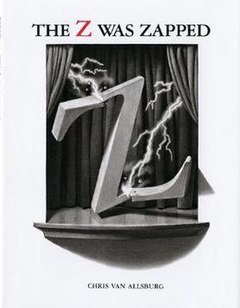
The Z Was Zapped written and illustrated by Chris Van Allsburg.  Each year all the grades complete an author study of this phenomenal illustrator.

I will try to follow the rules better next year.