Quote of the Month

When love and skill work together, expect a miracle. John Ruskin


Showing posts with label counting. Show all posts

Wednesday, December 8, 2021

One Is Never Lonely

When you define one according to Merriam Webster, it is being a single unit or thing.  So, this morning one school librarian walked her dog along one route in one town.  If you really think about it, is that the whole truth?

Is there more to the one school librarian, her one dog, their one route, and the one town in which they reside? Author Susan Hood and illustrator Linda Yan believe there is.  We Are One: How the World Adds Up (Candlewick Press, November 2, 2021) introduces a variety of mathematical concepts and expands our perspectives at the same time.  This is what makes our world so marvelous!
One can be one thing
all on its own---
one star,
one stream,
one stick,
one stone.

But those on their toes, those using their smarts,
know one can be more than the sum of its parts.

Our views are broadened one number at a time.  How many combinations of two can you imagine that equal one?  How many slices of bread make one sandwich?

Number by number, three, four, and five allow us to see how combinations of each can make one.  A haiku poem is formed with three lines.  How many points are there on a single compass?  Famous author Williams Shakespeare determined each of his plays would have five acts.

A way for the blind to see incorporates the number six.  The next time you look at a rainbow what number will come to mind?  What geometric shape has eight sides?

This numerical journey ends with nine and ten, but there is more to consider.  We know we are one individual human being, but are we not part of an ever expanding number beyond ten?  Numbers grow larger and larger when we go beyond our family, our workplace (school), our community, our country and our Earth.  And yet, that greatness, that vastness, comes back to the beginning.


We are joyfully welcomed into this counting realm with rhyming couplets meticulously penned by Susan Hood. We are skillfully presented with multiple parts that equal one.  On each page recounting these truths is more information.  Along the bottom like a conversational aside, Susan Hood supplies us with fascinating facts relative to the number being discussed. (These are in a golden yellow band.)  Here is a passage.

Three letters together spell out the word you!

Letters add up to words.  Words add up to sentences.  Many stories and poems follow the rule of
three, a writing principle that suggests characters and events are more satisfying when they come in
threes.  Just think of "The Three Little Pigs" and "Three Billy Goats Gruff."  From a three-ring circus to
the three primary colors, the rule of three (omne trium perfectum in Latin) says trios equal perfection. 


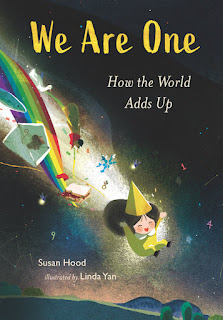
The digitally rendered illustrations by Linda Yan first seen on the matching dust jacket and book case elevate the happiness radiating from the text.  The image on the jacket and case stretches from the far left edge on the back to the far right edge on the front.  Multiple elements mentioned in the narrative and pictorially interpreted page by page spill from the top of the far-left corner in a trail of stardust behind our guide dressed in yellow.  Numbers tumble down from this pathway, falling to the rounded horizon.  Those elements and the main character are varnished on the jacket; making a stunning contrast to the dark atmosphere.

The opening and closing endpapers are covered in a bright sea green.  On the title page, the child wearing their yellow suit and pointed hat is standing on a stool on a rounded surface.  Colored building blocks are scattered about them.  A tripod holding a telescope is directly in front of them.  The dark sky holds tiny colored numbers like stars.

Two-page pictures and full-page visuals flawlessly flow from beginning to end.  Careful readers will see elements in one illustration appear in the next one or two or three or four.  The sandwich mentioned in the number two sequence is next to the child in the first image.  That sandwich is carried away by two mice into their hole.  It is the food for their wedding reception.

Linda Yan, complementing the text, brings us close to a particular scene when necessary or moves back to give us a larger view.  We see the mice carrying the sandwich to their hole from a distance, back with the child.  In the next image, she is peeking through the mouse hole.  We are brought close to the mice as they marry.

Readers will delight in seeking the child in each picture.  Sometimes she is larger than life, and other times you have to search for her.  Toward the end of the book, the child is joined by other children of diverse ethnicity and genders.  Total bliss resonates.

One of my many favorite illustrations is for the number five and the reference to five moves central to ballet.  We are inside a dance studio.  Light beams in three arched windows along the upper portion of the picture.  In front of the windows are a bluebird (large), a giraffe, a fictional character, a red squid, and pig.  They are all wearing ballet slippers and tutus as they demonstrate the five poses.  Our guide, still wearing her signature yellow, also has a tutu.  A musical score with notes is behind her as she runs across the wooden floor.


As soon as you understand the rhythm of the words written by Susan Hood and the accompanying artwork by Linda Yan, you will find yourself wondering what will be revealed with the next page turn in We Are One: How the World Adds Up.  You won't be able to stop thinking of other numbers.  How much fun is that?!  At the close of the book are Source Notes, Sources and Resources, Especially for Kids (sections expanding on the facts given in most of the numerical discussions), and More About How the World Adds Up:  Here are some other things that come in groups of . . . Under each number beginning with ten are lists to get you thinking.  I know you'll want to have a copy of this book in both your personal and professional collections.

By accessing their respective websites, following the link attached to their names, you can discover more about Susan Hood and Linda Yan and their other work.  Susan Hood has accounts on Facebook, Instagram, and Twitter.  Linda Yan has an account on Twitter.  At Penguin Random House, you can view interior images.

Tuesday, July 30, 2019

One Feathered Wing

Just shy of eight year ago I wrote this in a note on Facebook.

Stepping from my doorway this morning, my eyes were greeted with an avian invasion; hundreds and hundreds carpeted my neighbors' lawns.  With my nearing they lifted as one feathered wing, gliding, soaring, swooping to another yard, continually joined by ten, twenty or thirty more.  As closer I came, finally the multitude rose above the lofty treetops, their command of air masterful as they left my sight.  Silence and the promise of more heat and humidity fell like an unwelcome cloak about my shoulders as Xena and I walked past the now empty parched grasses of the vacant field.

As a librarian, I begin to research as soon as I arrived back home.  For the first time in six decades of living, I had been gifted with witnessing a starling murmuration.  It is forever etched in my memory as one of the most incredibly beautiful things I have ever seen.

To see these birds fly in flawless synchronization is a remarkable experience; one which reminds us of the fascinating, fearless and stunning power of nature.  One Dark Bird (Beach Lane Books, an imprint of Simon & Schuster Children's Publishing Division, July 16, 2019) written by Liz Garton Scanlon with illustrations by Frann Preston-Gannon presents an illuminating portrait for younger readers of this spellbinding phenomenon.  It begins, as so many wonderful things do, with a single individual.

1
dark bird
perched way up high
a view of town
a taste of sky

Presently, this one starling is joined by others.  They come together as two, three and four.  Now there are ten.  Quickly, as if receiving a cue from a conductor, five more make fifteen birds.

We keep counting as they keep coming.  The groups are getting larger.  The initial group of fifteen has more than doubled.  Now hundreds and hundreds and hundreds of birds fill the sky.

Suddenly their free flying is nearly frozen.  An enemy flies near them.  They join swirling and swerving as if one mind acts for all of them.  They flee to safety, looping and circling through the now starry sky. 

Then, an unspoken decision is made.  They break apart journeying to destinations as separate aerial acrobats.  Hundreds and hundreds and hundreds leave.  There are ten, nine, eight, and seven.   All too soon, we end, coming full circle, to one.


To combine counting with this breathtaking event fully engages readers by drawing them into the gathering of the flock.  The rhythmic and rhyming words of author Liz Garton Scanlon create a gentle but vibrant cadence.  It's an invitation to spread our arms and joyously glide with our avian companions.  The use of alliteration further heightens the melodious narrative.  Here is a passage.

flapping fervor
noisy clutch

they dance together
without touch


The image of the single starling flying over a community on the open and matching dust jacket and book case extends from flap edge to flap edge.  The blend of vivid blues, greens, and golden yellow and orange with splashes of white act to accentuate the iridescent colors of the bird.  The few birds seen on the front multiply to the left, on the back, and on the front flap.  The placement of the ISBN incorporates it into a rooftop.  On the dust jacket the title text is in gold foil along with some of the stars there and on the back.

On the opening and closing endpapers hundreds of birds, a murmuration, are shown.  On the first scene the sky is much lighter as opposed to the darkening sky in the second scene.  On the dedication, verso and title pages, the single starling is flying toward the right edge of the right side.  Beneath the bird on a pale green-washed sky is the town.  

Illustrator Frann Preston-Gannon rendered these illustrations using a mixture of both digital and hand-drawn techniques.  At times we will be brought close to the birds or are given a more panoramic view to emphasize the number.  The buildings and homes are shown both in full color and/or etched in the background.  Members of the town, from diverse races and ethnic backgrounds, are shown going about their daily business, whether it's work or play. We can see them in their windows and watch them following the flight of the birds.

As the numbers of birds increases, we are taken directly into the flock.  You can almost hear the beating of wings and the sound of feathered swoops, dipping up and down and around.  All the pictures span two pages.

One of my many, many favorite images is between sunset and the full moon rising in the dusk.  The homes and building are bathed in golden light accenting reddish tones with spots of green.  Over the buildings the starlings by the thousands move in a large wave with the majority in the center.  Their formation is highlighted with white.  Above them in the sky, a few stars wink around the shining celestial orb.


If you are seeking to enhance a theme on birds, spectacular natural occurrences, counting or to engage readers in sheer wonder, One Dark Bird written by Liz Garton Scanlon with illustrations by Frann Preston-Gannon is the ideal title.  A symphony of words and art recreate the beauty of murmuration.  On the title page an explanation of murmuration is given.  I highly recommend this title for your personal and professional collections.

To learn more about Liz Garton Scanlon and Frann Preston-Gannon and their other work, please follow the links attached to their names to access their respective websites.  Liz Garton Scanlon maintains accounts on Facebook and Twitter.  Frann Preston-Gannon maintains accounts on Facebook, Instagram and Twitter.  Liz Garton Scanlon is interviewed on Only Picture Books.  You can view interior images, including one of my favorite ones, at the publisher's website.

Thursday, November 5, 2015

Holding On To Beauty

They walk among the towering fifty foot tall ponderosa pines and tamarack trees grazing on grasses and bushes.  You can see them as darkness falls away to daylight, in the mid-morning or late afternoon hours, and at twilight.  They can be heard munching on apples at two am if you have to go outside with your dog.  Chain link fences surrounding homes built more than thirty years ago mean nothing to them.  This is their land.  It has been for centuries.

Gliding through our city and outlying suburbs alone, in pairs or large groups, the white-tailed deer are a reminder of our need to protect and preserve.  As stewards of our fragile planet our vigilance is not an option.  Counting Lions: Portraits from the Wild (Candlewick Press, October 13, 2015) writing by Katie Cotton, illustrations by Stephen Walton and a foreword by Virginia McKenna draws readers into the wild with stunning artwork and poetic observations.

One lion
sits and watches his rough-and-tumble pride.
He surveys the golden savanna, and a flicker catches his eye---something moving in the grass.

This big cat, a monarch, a sentinel and a soldier, ever attentive, rules, observes and fights to safeguard his family.  It seems fitting the group is called a pride.  His look is fierce and filled with purpose.

As a page is turned the numbers advance.  Two gorillas, a mother and child, nose to nose, are so close they are sharing the same air.  Tiny at birth, the baby will stay near for several years.

Tall, graceful and spotted they reach for leaves.  Three giraffes roam the grasslands on long legs with stretched necks.  Nestled near three cubs a majestic tiger stares and dares anyone to come near her family.

Did you know elephants walk from the day they are born?  Five search for food and water where others have traversed before them.  They are not found anywhere else in our world, these Ethiopian wolves.  Even though they are six in number, they work as one.

Seven cuddle and get cozy as a storm swirls about them in Antarctica.  Wearing no crown, these Emperor penguins live an unimaginable existence in a land of ice and snow.  Every two to four years these female turtles move en masse to lay their eggs.  Eight swim toward the sands.  How much longer will these creatures grace our oceans?

Wearing bold-hued feathers nine macaws line a limb.  Their chatter informs each other of the latest forest gossip.  Displaying coats which leave no doubt as to their identity, ten zebras lean down to quench their thirst.  Though their heads are bowed, their eyes miss nothing.  Others seeking them for dinner need the water too.  Fifty-five animals altogether, from one to ten, counting on us.


For each specie Katie Cotton has penned sentences lyrical in style.  We are taken to the place, we are keenly aware of the animals' physical qualities, and we are asked questions.  Each piece begins and ends with a number followed by the name.  This along with vivid description, alliteration and the repetition of the number followed by a noun in the next to last line create a pleasing rhythm.  Here is the completion of the first.

...A challenger to his throne?
His muscles tighten.  He throws back his huge head,
about to roar---but it is only a lioness, returning with a kill.
He settles down to keep watch again.
Who knows what he has seen?
One king.
One lion.


Mesmerizing is a word which comes to mind when first looking at the matching dust jacket and book case.  These images rendered by Stephen Walton in charcoal reach out, grab you and don't let go.  You can't turn away.  You want to sit and study every single one.  On the back, to the left three giraffes look at you from the left-hand corner. The orange color of the title text is replicated on the opening and closing endpapers.

Throughout the book the only colors are the white background, the orange text and shades of charcoal.  The first image is the only one on a single page.  The rest span both pages, the narrative placed outside the scope of each picture.  You will find yourself frequently reaching out to the page wanting to touch one of the featured animals.

Light and shadow and fine lines create beings ready to break free from the confines of the page at any moment.  You believe if you close your eyes and then open them; the animals might be alive in the room with you.  The way they stare right at you is marvelous.

One of my favorite illustrations of several is the five elephants ranging in ages.  The younger ones stay close to their parent in the grass.  The notched ears and wrinkled skin are exquisitely portrayed.  You can almost hear them breathing.  For the moment they have paused to eat but you know they'll move on soon.


Counting Lions: Portraits from the Wild written by Katie Cotton with illustrations by Stephen Walton and an introduction by Virginia McKenna is an eloquent, poignant look at ten different animals, some needing our help more than others.  At the close of the book several paragraphs are dedicated to supplying more details about each of them.  Information is included about the author, illustrator and the role of Virginia McKenna as a champion for wildlife.  There is also a page of websites for those seeking additional facts.

To learn more about Stephen Walton and his work please follow the link attached to his name to access his website.  This is a link to a blog post, Why I don't edit 'proper books' for grown-ups, by Katie Cotton which gives you a feel for her passion for picture books.  Enjoy the book trailer provided by the UK publisher.


Be sure to stop by Kid Lit Frenzy hosted by educator Alyson Beecher to view the titles selected by other bloggers participating in the 2015 Nonfiction Picture Book Challenge.

Sunday, August 10, 2014

There's No AcCounting For My Love Of Picture Books---Picture Book 10 for 10

I am so excited to be participating with many others in this annual tribute to picture books.  It's an opportunity for book people to showcase those titles they simply love.  These are picture books they highly recommend for use in classrooms and sharing with other readers of all ages.

10 for 10 Picture Books is hosted by Cathy Mere, educator and blogger at Reflect & Refine: Building a Learning Community and Mandy Robek, educator and blogger at Enjoy and Embrace Learning.  All of the lists are collected in a single spot to be used as a continual resource.  Here is the link for all the participants last year. In 2012 I listed ten plus two top alphabet books.  It's not that I'm necessarily a rule breaker but this is very hard.  For 2013 I could only narrow it down to fifteen so Xena picked her top ten dog books out of those.

This year I decided again to focus on titles which might be considered strictly for younger students.  All of them can used to spread the joy of numbers and counting.  Sharing these books with them is pure fun.  I think laughter and learning are a pretty good combination.  Each of them also offers opportunities for older students to draw, search for images and write; making their own versions.

Here are my top ten...eleven...books on counting and numbers.  If a link is embedded in the title, it takes you to my complete review of the book.


1.  1-2-3 Peas (Beach Lane Books, 2012) Keith Baker

One cannot help but smile when looking at the cover of 1-2-3 Peas; a smile guaranteed to last well after the last page is turned.  Never has a counting book been quite as much fun as when written and illustrated by Keith Baker with the assistance of his personable peas.  Clever readers will be searching the pages for the consistent appearance of a special visitor.


2.  Count The Monkeys (Disney Hyperion Books, 2013) Mac Barnett, author, Kevin Cornell, illustrator

When we are asked by a friend to put the silverware on the table, we expect to see forks, spoons and knives in the drawer, not screwdrivers, wrenches and hammers.  I'm here to tell you, readers, when you open the cover of Count the Monkeys (Disney Hyperion Books) by Mac Barnett with illustrations by Kevin Cornell, you can take any expectations you might have and throw them out the window.   You are lured into the pages of this book expecting to count...well...monkeys.


3.  123 versus ABC (Harper, 2013) Mike Boldt

Beginning with my youngest patrons' first visit, through song, dance and hand motions, I introduce letters and numbers explaining, one will help them find fiction (even if organized by genre), the other will give them direction in locating nonfiction materials.  I tell them repeatedly year after year, if they know their letters and can count, they will be able to locate the correct book in any library.  The two systems, alphabetical and numerical, work together to create addresses for every item in the library.  Their school library is a lively practice field for using the public library, moving them toward independence.
In this respect numbers and letters or letters and numbers have equal importance.  But in that wonderful world of "What-If", what happens when letters and numbers arrive at the same place at the same time believing themselves to be the guest of honor?


4.  Musk Ox Counts (A Neal Porter Book, Roaring Brook Press, 2013) Erin Cabatingan, author, Matthew Myers, illustrator

Five-year-old children are not the only ones who get a kick out of knowing numbers.  The dubious duo who made their first appearance in A Is For Musk Ox have returned.  Mr. Que Sera Sera is still driving his striped companion crazy with his inability to follow the plan.


5.  Flight 1-2-3 (Chronicle Books, 2013) Maria van Lieshout

Flight 1-2-3 captures the same magic in the exploring of an airport, the deciphering of the signage, counting what can be seen and traveling by plane.  It is a companion to her Backseat A-B-See (Chronicle Books, April 11, 2012).


6.  Ten Little Caterpillars (Beach Lane Books, 2011) Bill Martin Jr, author, Lois Ehlert, illustrator

With every other line rhyming Martin created counting verses with a catchy cadence.  Readers follow each of these ten caterpillars into their habitats of flowers, fruits, vegetables, a pool, weeds and even the sea matched by close encounters with fowl, fish and feathered friends of the backyard, woods and field.  They are never idle, always in motion; crawling, wriggling, climbing, falling or scaling.  When the number ten is reached that little caterpillar hangs in stillness awaiting the change the spring will bring---miraculous metamorphosis.


7.  One Two That's My Shoe! (Disney Hyperion, 2011)

I love it when my mind's eye sees something while my conscience eyes are focused on something else entirely.  While looking ahead at a special section in the public library this past week, what should register on my radar but the  Alison Murray book, One Two That's My Shoe!(Disney-Hyperion Books)  I was as pleased as could be to see the rascally familiar black and white pooch on the cover in all his lovable glory.

As in the first book, Apple Pie ABC, Georgie and his human, Grace, are characters in the retelling of an old nursery rhyme.  Alison Murray's version of "One, Two, Buckle My Shoe" is a series of classic "catch-me-if-you-can" snapshots.  This youthful chant has never been better than when altered by the clever words and artwork of Murray.

8. 1 to 20, Animals Aplenty (POW) Katie Viggers

This rhyming counting book will have readers singing along before they (or you) know what is happening.
1 fox in a pair of socks
2 gorillas looking in mirrors
3 llamas wearing pajamas
At times one page ties in with another creating a delightful continuity.  The illustrations are simply charming.  At the end a one through ten pyramid with a corresponding eleven through twenty pyramid provide tiny thumbnails of the previous pictures.  The closing endpapers feature a world map with the animals placed in their habitats.  When differentiation is needed the kinds of animals are labeled.


9.  Bugs by the Numbers (Blue Apple Books, 2011) Sharon Werner and Sarah Forss

Readers are surrounded by numbers at every turn of the page. Squiggling lines attached to numbers decorate the front and back endpapers.  Upon closer inspection the lines are facts about the bug featured with that number.   What this typographical wizard duo has done is to combine research with art.  Rarely has a more captivating technique been employed to make learning so appealing. (Do a Google image search for the title to get peeks inside the book.  It is amazing,)


10.  Baby Bear Counts One (Beach Lane Books, 2013) Ashley Wolff

As humans we get to not only share in the explorations of our own young but also in those of the animal world.  If we could comprehend how it might be for them, Baby Bear Counts One is an appealing example.  This companion to the gorgeous Baby Bear Sees Blue is as warm and engaging further bonding us to the lovable cub and his mother.  Sounds leads to enumerating elements in this bear cub's world. 


11.  Dog Loves Counting (Alfred A. Knopf) Louise Yates

We know from his two previous titles, Dog Loves Books (Alfred A. Knopf, 2010) and Dog Loves Drawing (Alfred A. Knopf, 2012), our small, white, perky canine pal is usually able to accomplish whatever his heart desires.  You have to love the way Dog approaches everything in his life; how books are central to each and every adventure.  Dog Loves Counting pursues Dog's yearning for sleep by bringing numbers and animals together in an enlightening escapade.  Wouldn't it be fun to find other animals and the numbers they might represent?


I know I can count on all of you to take time for reading. Enjoy!

Thursday, January 2, 2014

It's A Bear-Y Good Thing, Again

I've said it before and I'll say it again, one of the best things about working with children, especially the little ones, in addition to the high laughter factor, is you get to experience so many things anew.  Year after year there are many firsts; things to see, hear, taste, smell and touch.  Their eagerness to know, understand and discover is not hindered by any preconceptions.  In a word, it's joy.

As humans we get to not only share in the explorations of our own young but also in those of the animal world.  If we could comprehend how it might be for them, Baby Bear Counts One (Beach Lane Books, an imprint of Simon & Schuster Children's Publishing Division, September 24, 2013) written and illustrated by Ashley Wolff is an appealing example.  This companion to the gorgeous Baby Bear Sees Blue is as warm and engaging further bonding us to the lovable cub and his mother.

Deep down in the den,
Baby Bear perks his furry ears.
Thockthockthockthockthock!

In reply to his question of who woke him up, his Mama says it is a woodpecker getting ready for winter by seeking extra food.  Baby Bear walks out of the den to see one woodpecker holding one insect in his beak.  Another sound plus falling acorns startles Baby Bear.

He wants to know who hit him.  Answering Mama explains it is the squirrels gathering more nuts in preparation for the shifting season.  When he climbs the tree, he sees two squirrels, each one holding an acorn.

At the pond beavers slap their tails.  In the field deer and crows raid the corn from the still-standing stalks.  Back in the forest amid the twisting and turning vines, turkeys enjoy a feast of grapes.

As Baby Bear and Mama travel in and around the forest near their den, new sounds acquaint him with animals in preparation for winter; buzzing, ker-plipping and ker-plopping, honking and expected tinging.  Each sound is connected to a new number from one to ten.  When the two are comfortable in their den again, circled in the warmth of each other, snowflakes fall.


Animals' survival depends on their daily sensory perceptions and abiding by their instinctive habits when summer moves to autumn.  This cadence found in nature is brought to the narrative by Ashley Wolff's writing.  Every time Mama interprets the sounds to Baby Bear, her sentences end with

before winter comes.

We are made keenly aware of the activity in the forest, pond and field but her use of language;

hunting beetles, collecting acorns, gathering twigs and storing up honey.

Readers learn more than counting with Baby Bear.


I could look at the pictures Ashley Wolff made printing linoleum blocks in black on Arches Cover paper for hours.  Each new reading reveals the richness in her hand-colored watercolor work.  The illustration covering the front and back jacket extends to the edges of the flaps. Baby Bear enjoying an apple in the meadow and Mama Bear nearby ready to pluck an apple for her from the tree are among the insects, small creatures, grasses and flowers.  This scene is altered and featured on two more double-page spreads, four pages, in the book for the number seven.

Warm tones consistent with autumn radiate from all the two-page illustrations extending and enhancing this story.  We may see Baby Bear with his Mama at a distance or zoom-in to focus on the animals of interest he is counting.  Each intricate element is depicted with care.

This is one of those books where selecting a favorite illustration is impossible. I love them all for their color, layout (the way the text is placed within the picture as part of the design), the inclusion of all the flora and fauna (the little mouse around the den and the three hanging bats in both books) and for the expressions on Baby Bear's face at each new discovery and on Mama's as she patiently considers her answer.  Ashley Wolff's gift as an artist, her love for these characters and their world, is infused on every page.


Baby Bear Counts One written and illustrated by Ashley Wolff is full of happiness, an excitement which comes with curiosity acknowledged.  I can't think of a better way to begin the New Year than with Baby Bear and Mama.  So snuggle in, gather one or more listeners, and get ready for requested repeat readings.

Please follow the links embedded in Ashley Wolff's names to read more about her work at her website and on her blog.  If you would like to see more illustrations from the book, go to the publisher's website linked here.  I certainly hope Baby Bear and his Mama will return for more adventurous wanderings.

Friday, July 5, 2013

And The Winner Is...

Beginning with my youngest patrons' first visit, through song, dance and hand motions, I introduce letters and numbers explaining, one will help them find fiction (even if organized by genre), the other will give them direction in locating nonfiction materials.  I tell them repeatedly year after year, if they know their letters and can count, they will be able to locate the correct book in any library.  The two systems, alphabetical and numerical, work together to create addresses for every item in the library.  Their school library is a lively practice field for using the public library, moving them toward independence.

In this respect numbers and letters or letters and numbers have equal importance.  But in that wonderful world of "What-If", what happens when letters and numbers arrive at the same place at the same time believing themselves to be the guest of honor?  What happens is 1 2 3 versus A B C (Harper, an imprint of HarperCollinsPublishers) written and illustrated by Mike Boldt.

Hello! I'm so glad you chose to read this book about Numbers!

Hi! I'm so happy you chose to read this book about Letters.

So begins the book and the debate between the number one and the letter A.  The crowd and volume grows as additional numbers and letters chime in the lively discussion.  Whose book is this anyway?

Matters escalate when one distinguished, briefcase carrying alligator appears.  He's wondering what to do as he has been asked to be in the book.  Number grabs him because there is only one.  Letter takes him back because alligator begins with A.  The fun really starts when two bears arrive in cars now numbering 3.   2...3...B...C  Oh, boy...hang on readers.

An explosion of letters and numbers start to fill the pages; four dinosaurs carrying five eggs, six frogs delivering eight hot dogs to seven gobbling geese along with nine ice-cream cones.  Yikes!  It's a letters and numbers jamboree! Letter A and Number One are really getting in the groove as more animals arrive with items galore.

As the numbers and participants continue to grow, the two of them are actually starting to realize the absurdity of the whole predicament, especially when a pile of twenty-five balls of yarn appear.  Now let's see...  The duo reach a simultaneous conclusion strolling off, arms around their shoulders, until.... What's he doing here?


Not missing a beat, Mike Boldt begins the spirited dialogue on the double-page title spread.  Speech balloons hold one, two, three or four sentences, phrases or words depending on the fervor of the speaker and their desire to make a point.  You can feel the tension and speed of the quick-witted banter increase as the numbers get higher and the end of the alphabet gets closer.  The best part of the entire conversation is the fun the two are having trying to gain an advantage.


Opening the jacket and cover to see the entire matching illustration, the confused alligator is on the left (back) wondering if this is a book about numbers or letters and where is the front cover anyway?  Using Corel Painter Boldt digitally creates a colorful cast of characters.  His numbers and letters, like cartoon personalities with stick arms and legs, move freely among the animated animals.

It's the attention to detail coupled with the narrative which will have readers returning again and again to look over each and every page.  On one two-page spread readers can see a goose balancing two ice-cream cones on their bill, a frog sporting a black bow tie taking an order with notepad and pencil, and four dinosaurs delivering not just plain eggs but decorated Easter eggs.  By the time Number and Letter are up to 16 and 17, Pigs and Queens, the two are seated at a table, wearing headphones like two sportscasters.  Each illustration is alive, in motion and just plain fun.

1 2 3 versus A B C with words and pictures by Mike Boldt is an alphabet and counting book all rolled into one rollicking good time.  It is the perfect book to use as creative drama with students.  In fact as I was working on this review this conversation took place on Twitter.


Wouldn't it be fantastic to get a whole class of upper elementary students to act the book out for younger students?

By following the link embedded in Mike Boldt's name you will be taken to his website.  The second link is to his blog where he talks about the process for making this book.  This link is to the publisher website and a one page activity sheet. Plus you have to love a book with a dedication that reads:

For my wife, Natalie, who is #1 and A+ in my book.

Thursday, August 30, 2012

Peas, Pass More Peas

Getting children to eat their vegetables is an age-old frustration felt by mothers on a universal level.  It has been the source of countless jokes, cartoons and picture books.  The ingenuity of mothers to get their children to eat peas in particular is only equaled by their sons and daughters schemes to avoid them at all costs.

Given their less than desirable lure at the dinner table, it was pure pleasure to see them in LMNO Peas (Birch Lane Books, 2010) written and illustrated by Keith Baker.   This happy-go-lucky, unique alphabet book uses peas as people rhyming their way through the ABCs highlighting various occupations, recreational pastimes and everyday living.

We're acrobats, artists, and astronauts in space.
We're builders, bathers, and bikers in a race. 

Baker has followed the success of that title with a new one, 1-2-3 Peas (Beach Lane Books, July 2012).

As the numbers one through ten are counted, each is accompanied by a rhyme with the pea(s) engaged in an activity followed by the repetition of a single word mirroring their actions.

One pea searching---
look, look, look,
Two peas fishing---
hook, hook hook.

Verbs describe the peas in boats, a garden patch, an airplane, a swimming pool, or on a track, stage or scaffold.  When the reader arrives at eleven the numbers are mentioned up to nineteen with a single sentence tying them together.  From twenty to one hundred the numbers are counted by tens continuing with poetic rhythms as the robust, round, green guys and gals form, move, snooze, piece, gaze, group, giggle, and drift toward their goal.

Propelling this counting chant through the pages are the digitally rendered effervescent illustrations of Baker.  His book jacket, spreading across the back and front gathers the peas together, each moving to the beat.  Endpapers are green on green, a series of dots resembling the spirited spheres.

All the visuals are blended together across two pages regardless of whether they're devoted to a single number or two.  The colorful, textures on each gives one the sense of having gathered together fabric pieces to make a animated whole.  What really pulls the reader into the pages are the peas.

Using the tiniest of details, infused with subtle humor, it takes no stretch of the imagination to picture a world peopled with peas running parallel to our own.  For example, when the number seventy takes a turn with

seventy peas singing---la, la, la

instead of having them simply in separate groups around the gigantic 70, Baker creates an entire scene. The seven is rooted in the ground with king-size flowers growing upward, as a large line of notes weaves through the two numerals.   Strategically placed are groups of peas representing singing in its varied forms (opera, in the shower, barbershop quartet, etc) giving puny nods to well-known musical figures.  Whatever these peas pursue it is done so with panache.

One cannot help but smile when looking at the cover of 1-2-3 Peas; a smile guaranteed to last well after the last page is turned.  Never has a counting book been quite as much fun as when written and illustrated by Keith Baker with the assistance of his personable peas.  Clever readers will be searching the pages for the consistent appearance of a special visitor.

I highly recommend this title for one-on-one sharing or with a group.  Every reading will bring new discoveries.  I'm having a hard time not seeing a passel of hand-crafted peas being passed around or held by students during the storytime.

Tuesday, August 21, 2012

Chasing That Shoe

I love it when my mind's eye sees something while my conscience eyes are focused on something else entirely.  While looking ahead at a special section in the public library this past week, what should register on my radar but the new Alison Murray book, One Two That's My Shoe!(Disney-Hyperion Books, June 5, 2012)  I was as pleased as could be to see the rascally familiar black and white pooch on the cover in all his lovable glory. 

As in the first book, Apple Pie ABC, Georgie and his human, Grace, are characters in the retelling of an old nursery rhyme.  Alison Murray's version of "One, Two, Buckle My Shoe" is a series of classic "catch-me-if-you-can" snapshots.  This youthful chant has never been better than when altered by the clever words and artwork of Murray.

Grace is all comfy in the big red chair reading with Georgie comfortably resting, his head on her lap.  When she leaves the room, Georgie follows.  Spying her pair of red shoes unattended on the floor, keeping his eyes on Grace, Georgie picks one up, running away.  One and two have been counted.

Once three and four have been noted Georgie has left the house.  Leading his girl on a merry path through a group of butterflies, into the tulips, through the trees, past laundry on a line and into chicks with hens, the dog on the run is clearly having great fun as the counting is done.  Finding himself in a bit of trouble, Georgie is grateful for Grace's intervention; giving her the most favored show of affection, a doggy kiss. 

As in Apple Pie ABC the front cover foreshadows the storyline Murray will chose to follow but the back cover, rather than a continuation of the front, again gives readers a hint about the book's conclusion.  The endpapers, front and back, feature large blocks framing elements from Georgie's romp with Grace in the upper left-hand corner pursuing the wayward dog as he scurries off the page in the lower right-hand corner.  In this volume red is still prevalent but in use as more of an accent color.

Alison Murray has chosen to vary her palette from the warmer shades of red, orange and yellow with spots of blue found in Apple Pie ABC to the cooler hues of greens and blues with more white space; numbers are in white within squares of blue.  Beneath each number in a paler, dusty turquoise are small representations of the objects used in the counting; three teddy bears, five butterflies, seven trees.  The two page spread including the verso and title page actually begin the story. 

With the exception of four pages all the visuals are two page spreads; indicating the chase is on.  Despite Georgie's escape with Grace's shoe, Murray has made it clear with the lift of an eyebrow, the curve of a mouth and open-eyed looks, this game may have been played and even enjoyed before...well, at least on Georgie's part.  Combining digital drawings with textures created using other mediums, works in these illustrations to give readers a sense of lightness, playfulness and inviting openness. 

One Two That's My Shoe! is not only a rousing variation of an old favorite but the illustrations by Alison Murray are so charming readers will be leaning in as the pages are turned.  Join in the counting waggery with this delightful duo.  This title begs to be used in creative drama.