Quote of the Month

When love and skill work together, expect a miracle. John Ruskin


Showing posts with label Polar bear-Fiction. Show all posts

Tuesday, October 20, 2020

Walks On The Wild Side

They walk among us, sometimes seen, and other times unseen.  Purpose is in every step they take.  A future destination guides their direction.  Perhaps they follow a well-worn path or a completely new route.  For some it takes only a day to reach their intended place and for others it is considerably longer. 

One creature known for its unhurried and steady pace is a turtle.  Turtle Walk (Greenwillow Books, an imprint of HarperCollinsPublishers, October 6, 2020) written and illustrated by Matt Phelan is a family's exceptional trek through what is expected toward something extraordinary.  This journey will be long remembered by readers for its priceless and precious delight.

Turtle walk. Nice and slow.

Here we go.

Four turtles leave their home on a green spring day.  They pass by other wildlife enjoying the season.  Voices, the two youngsters, ask if they have arrived yet.  The answer is no.

Time passes, summer sun, is warming blooming blossoms, active insects, and happy children swinging on swings on a playground.  Fireflies light the family huddled together at night.  They have not reached their goal.

Leaves are turning autumn shades of orange, red, and yellow.  People and animals are gathering apples and nuts.  A jack-o-lantern glows.  The family rests but have not come to the right spot.

Snow blankets the ground, making the traveling much slower.  The turtles still go.  When the now familiar question is asked, the answer is in the affirmative.  Another question is asked, and a surprising answer is given.  No one is anticipating the pure bliss which follows as a circle is closed.


Carefully selected words by author Matt Phelan guide readers into the story.  Their repetition elevates the narrative and encourages participation.  This repetition is also a wonderful literary technique to lead us into the contrasting conclusion.  The spare text allows for the illustrations to further enhance the story.


When you open the dust jacket the white canvas on the front, right, and back, left, accentuates the vivid green turtles and the title text representative of the four seasons, spring, summer, autumn, and winter featured in the interior.  This text is varnished.  On the back one of the smaller turtles in on the back of an adult (mother).  Beneath them in purple are the words:

NICE AND SLOW.
HERE WE GO.

On the book case the two younger turtles, left of the spine, are moving to catch up with their parents.  The adults are moving toward the right edge of the front.  On the opening and closing endpapers, the cool purple of winter provides color.  Prior to the title page an adult (father) comes out of their home in a mudbank by the pond.  Two butterflies glide by and above him.  On the double-page picture for the title page, the father beckons to the mother on the left as the two little ones yawn and stretch as they wake up, on the right.  All the letters in the title text are shades of green.

Watercolor and pencils were used to prepare the full-color art

by artist Matt Phelan.  The illustrations extend across full pages, double pages, or are clustered in loose shapes on a single page.  Black text is on white and white text is used on most of the colors in the scenes.

Each image is replete with delicate details and charming depictions of animals and some humans.  The turtles can be seen in more panoramic views like when they walk beneath black-eyed Susans or brought close to readers when they are asleep among a pile of autumn leaves.  These varying views complement the pacing and lead us, along with the younger turtles, to the marvelous moment and the expansive winterscape view.

One of my many, many favorite illustrations is during a summer evening.  The turtle family is huddled together, the two adults encircling the youngsters.  They are cozy in a circle of green.  About them are swirls of twilight blues.  Above them in golden circles, bodies glowing are five fireflies.  The perspective places us closer to the fireflies looking somewhat down on the turtles.  All the turtles are smiling at this wondrous sight.


When you read Turtle Walk written and illustrated by Matt Phelan for the first time, you do so knowing you will be reading it again and again.  The exquisite images implore you to join them on their walk as the words provide a rhythm for their journey.  I highly recommend this title for your personal and professional collections.  

To learn more about Matt Phelan, please follow the link attached to his name to access his website.  Matt Phelan has accounts on Facebook, Instagram, and Twitter.  Matt Phelan was the featured creator on Author Spotlight Friday at Annie's Bookstop WorcesterHe visits author, reviewer, and blogger Julie Danielson's Seven Impossible Things Before Breakfast today to talk about this book.  At the publisher's website is a two-page activity guide.


Up in the far northern realm of the Arctic there lives an animal who touches noses with the same kind of animal to ask for food.  Can you imagine swimming as fast as six miles per hour?  These animals can do this because of their specially designed paws and legs.  They have black skin, but appear white because their fur is translucent, reflecting light.

It is a survival characteristic to have white fur when living in the Arctic.  Polar bears sometimes blend in with their surroundings.  A Polar Bear in the Snow (Candlewick Press, October 13, 2020) written by Mac Barnett with art by Shawn Harris follows a polar bear on a trip through the snow.  This bear moves with purpose.
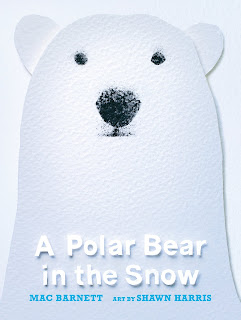
There is a polar bear in the snow.

We cannot see this polar bear in the snow until it raises its nose to test the air.  Then the bear wakes up and begins to move. We have no idea where he is going or why he is intently going in one direction.

There are lots of seals in the snow, but the polar bear passes them.  He does not wish to eat.  He also does not wish to seek the sanctuary of a cave in the blowing snow.  

When the unseen narrator questions whether this polar bear is seeking a man, the answer is a resounding

NO!

This polar bear keeps on going through the snow until he can see his reflection in the water of the sea.  Now we know where the polar bear is going, but we still don't know why.  

When the reason is revealed readers will smile, wishing they have white fur so they can join this polar bear.  Once again on the snow, the polar bear is ready to go.  Where?


Individually the sentences are simple, but when they are connected, they form a captivating story, a story which will have you smiling from the beginning to the last two words.  You are not sure where the narrative or the bear is leading you, compelling you forward, page turn by page turn.  Mac Barnett cleverly asks questions and supplies answers while repeating one key sentence. 


You can already tell from looking at the open and matching dust jacket and book case, the artwork by Shawn Harris is going to be as brilliant as sun on a landscape newly coated with fresh snow.  Using 

cut paper and ink

he, through light and shadow, creates luminous images, realistically textured.  On the front, right, the polar bear looks right at the reader.  What does that look tell us?  The title text is varnished and raised.  To the left, on the back, all we see are the indentations of paw prints in snow, moving away from us.  

The opening and closing endpapers are a turquoise blue.  The verso and title pages have a snowy look to them.  The letters on the title page, due to shadowing, appear as if they are floating.  The same snowy look continues on the first two pages with the single sentence on the left.  Each change in the first three visuals are subtle, then the cut paper artistry begins in earnest.  These illustrations span two pages.

Shawn Harris brings us close to the polar bear, then we see him in an enormous vista of snowy mounds and hills. After encountering the seals, as they vanish, we see only his back half rambling off the right side.  Our point of view of him walking through the snowy wind is as if we are one of the Arctic foxes looking out from a cave.

When the polar bear in the snow reaches the sea, the hues of blue are crisp and cool.  The next three illustrations are breathtaking in their perspectives and depictions.  The third one is wordless, but most readers will gasp in admiration.

One of my many, many favorite illustrations (I can't select a sea scene without spoiling it for readers.) is when the polar bear walks past the cave with the Arctic fox family watching him.  Most of the polar bear is to the right of the gutter.  His head is bent as he leans into the snowy breeze.  The opening of the cave does cross to the left of the gutter.  To give readers a perception of how deep the foxes are in the cave, Shawn Harris has layered torn white paper with each circle a little bit larger than the one underneath it.  The foxes are placed in the far left, bottom corner.  There is an adult, and three young foxes.  Their body postures indicate curiosity.


When you think of the Arctic, snow, and polar bears you would never imagine the clever use of language and art found in A Polar Bear in the Snow written by Mac Barnett with art by Shawn Harris.  You can easily use this book in a study of bears, the Arctic, snow, or for the sheer pleasure of a superb story.  You will definitely be reading it more than once at a single sitting.  Readers will want to listen to it repeatedly.  Your personal and professional collections will not be complete without a copy of this book.

To learn more about Mac Barnett and Shawn Harris and their other work, please follow the link attached to their names to access their websites.  Mac Barnett has another site here. He has an account on Instagram.  Shawn Harris has an account on Instagram, Pinterest, and YouTube. At Penguin Random House you can view interior images.  I hope you will enjoy these two videos.


Thursday, January 11, 2018

Lost And Found, It Goes Around

There will be times, more often than not, when in a given situation individuals will be expected to act in a specific manner.  Action may be taken as expected but sometimes the best choice, the right choice, is unforeseen.  It is surprising to all those involved.

Even in the world of animals there are cases of unlikely alliances, some lasting a lifetime.  Pup and Bear (Schwartz & Wade Books, October 3, 2017) written by Kate Banks with illustrations by Naoko Stoop is a tender story of maternal instincts determining choice.  In the harsh world of the Arctic it can be the difference between life and death.

WHOOSH!
When the great gray owl swooped down,
screeching whoo-whoo,
the Arctic wolves knew that the Big Freeze
was on its way.

Shelter was sought in order to survive the bitter cold, raging winds and snowy drifts.  With the passage of time, the beginning of a new season caused the ice to melt and break apart.  A wolf pup was adrift on a piece of ice, separated from the pack.

After sliding into the water, swimming and swimming, he reached land, exhausted.  Curled up in a ball, he slept.  He was awakened by a polar bear.  She was not the mother he wanted but the polar bear told him to have faith, taking him to her den.  Her promise of food and warmth assured him.

For them it was not all food gathering and snuggling in the den but play and discipline too.  The pup grew into an adult, no longer needing the polar bear.  Another winter came in the Arctic wilderness.  The wolf had his own pack now, no longer alone.  One bitter day this wolf discovered a polar bear cub, alone without a mother.

This was not the mother the polar bear cub wanted but the wolf told the baby to have faith.  Once again a promise of food and warmth was given.  A life for a life . . . was repaid.


As you read the words penned by Kate Banks you become deeply attached to the events unfolding in this story.  The severe climate in the Arctic vividly described and the loss of mothers for the wolf cub and polar bear cub are dangerous situations in which readers will feel an immediate compassion. Kate Banks repeats key phrases and dialogue creating a storytelling rhythm linking the two children and their adopted protectors together.  This is the beauty of this tale; the universe, Mother Nature, supplying a balance.  Here are several passages.

The pup was shy and frightened.
"Aren't you going to eat me?" he asked.
"Polar bears eat wolves."

"Not this one," said the polar bear, shaking her head.
"Climb on my back, and I will take you to my den."


When you look at the front, right, of the unfolded, matching dust jacket and book case, the gentleness of the polar bear female wrapping her body protectively about the wolf cub envelopes you.  The simplicity of this scene is intrinsically powerful. The sky and wintry landscape continues over the spine to the back on the left.  These words are in the sky:

"I am not your mother," said the polar bear,
"but I can cuddle you and keep you safe."

The scene spans to the edges of both flaps.

On the opening endpapers heads lifted and howling to the snowy sky is a pack of five Arctic wolves.  The predominant color is green.  A family of polar bears on a blue and snowy background strides into the snow on the closing endpapers.  The verso and title pages are a soft black.  Blue and white evergreen trees span from side to side.  The text is in white.  This is a stunning presentation.

Naoko Stoop rendered these breathtaking visuals using acrylic paint, ink, pencils, and pastels on plywood, and digitally finished them.  Each page turn reveals a double-page picture, a grouping of smaller illustrations or single-page images.  They enhance the poetic pacing.  Emotions are conveyed in the perspectives employed.

One of my many favorite illustrations is on a single page.  A large frame of white with a blue wash fashions a loose oval border around a small picture.  A blue-green sky blends into a tan and white ground.  Upon this walks the great mother polar bear leaning down to the small gray wolf cub.  It is the ultimate visual of maternal affection.


Author Kate Banks and illustrator Naoko Stoop have given children's literature a luminous look at how creatures protect one another when given the opportunity in the right conditions.  Pup and Bear is memorable and moving.  I highly recommend this title for all collections, professional and personal.

To learn more about Kate Banks and Naoko Stoop and their other work, please visit their websites by following the links attached to their names.  They both maintain blogs in addition to their websites.  Their Twitter accounts are here and here.  To view interior pages in this title visit the publisher's website.

Tuesday, March 15, 2016

Not Here But Still Here

Body language and eyes convey the news even if a parent, staff member or student has not already spoken with you.  Sometime between the last time you saw this student and now, they have suffered a loss.  It happens to all of us no matter our ages, usually without warning.  Even if we know it's coming the hole in our hearts is huge.

When love is shared between two, day in and day out during the course of their lives, filled with ordinary and extraordinary events, the absence of one is keenly felt.  Ida, Always (Atheneum Books for Young Readers, an imprint of Simon & Schuster Children's Publishing Division, February 23 2016) written by Caron Levis with illustrations by Charles Santoso is first a look at the strength of a bond formed by two animals in captivity.  It further cements the belief that all animals can suffer the loneliness of losing the one loved.

Gus lived in a big park in the middle of an even bigger city.  Buildings grew around him and shifted the shape of the sky.

As sure as an alarm on a clock, each morning when the keeper Sonya brings food to Gus and Ida, two polar bears, they each leave the comfort of their respective caves to spend their day together.  They play with Ida's cherished yellow ball, frolic in their pool and rest on their favorite rock.  They have thoughtful conversations.

When Gus wonders, Ida answers.

"You don't have to see it to feel it," said Ida.
"Listen."

She reminds Gus what the noises they can hear mean.  Each day closes in the comfort of this constant cadence of their lives.

Upon waking one morning Gus is puzzled to hear all those city and park sounds without the presence of Ida.  He knows Ida is in her cave; her breathing reaches his ears.  Sonya explains to Gus about Ida being so ill her body will eventually sleep without waking.

Gus immediately runs to Ida angry and afraid.  She responds in kind, angry and afraid.  Eventually they sleep next to each other, quiet in their closeness.  Peace.

Days are brimming with ups and downs, silence and not silence.  Each evening ends the same, a mantra of longing.  Then Gus is alone.  BUT remembered words warm a soul like the sun brings heat to the fur of a polar bear sitting on a favorite rock.


When Caron Levis describes the Central Park Zoo, the habitat of Gus and Ida and the city surrounding them, she does so from personal experience creating a vision for readers.  Her use of short, informative sentences, the repetition of key phrases and a blend of dialogue and narrative supplies an invitation for us.  The sounds of the city are integral to the story.  Single words and near poetic sentences bring them from the page into our respective reading spaces. She compels us to become a part of Gus's and Ida's world.  We follow with pleasure and fall in love with these two magnificent creatures.  Here are two sample passages.

They heard buses groan; trucks rumble;
police whistle; taxis honk; pigeons coo;
people say Hey, Wait Yo, Hello;
and children laugh.

Two bears sniffled, two bear breaths panted, 
two bear hearts echoed each other's beat.


Even if you know absolutely nothing about this story, looking at the illustration on the opened matching dust jacket and book case portrays the affection felt by the two bears in their space within the confines of a city.  Charles Santoso's attention to the sky and skyline in this initial image, in the entire book, is spectacular extending from left to right, back to front.  Of particular notice is the color selected for the opening and closing endpapers; a lighter shade of purple followed by a darker hue.  I have always thought of purple as signifying royalty.  Surely by all accounts this is how these two bears were to all who visited them.

On the initial title page we are gazing at a pale blue sky filled with clouds in the faint shapes of polar bears. (Santoso does use shapes several more times within the body of the book.)  In small text we read the words

ida,

ALWAYS 


centered to the right edge.  The more formal title page, verso and dedication pages are a panoramic view of New York City and Central Park.  

Rendered digitally but looking like finely detailed paintings Santoso brings warmth of emotion to each picture.  Wide-angle views of the park from a bird's perspective and closer encounters with the two bears balance in a pleasing portrayal.  Visual size enhances the pacing; sometimes odd shaped or more traditional panels are used or a circular image framed in a liberal amount of white space.  These ask us to pause.

Santoso skillfully combines an interior look at the bears' homes while including the city in the background.  It is obvious he has studied his subjects conveying them realistically.  Can you see the small animal (s) he places in many pictures?  I see this as a constant and of life moving forward even in sadness.

One of my favorite illustrations, of several, spreads across two pages.  On the left in a circular display as the sun sets is the skyline of New York City with colored clouds and birds gathering for the evening in the trees.  It is framed in vegetation and rocks as if seen from a bear cave.  To the right inside the cave Gus and Ida are together, eyes closed and at rest.


Ida, Always written by Caron Levis with illustrations by Charles Santoso is a truly moving account of an enduring love and the loss of one part of a very special whole.  Thoughtfully written and illustrated, based upon a true story, it sends a beautiful message to everyone about grief.  It helps us to remember that what we cannot see can still be visible in our hearts.  An author's note is included on the last page.

To learn more about Caron Levis and Charles Santoso please visit their websites by following the links attached to their names.  They both have updated blogs linked at their websites. There is an excerpt from a developing activity guide on Caron Levis' blog. (Update:  April 18, 2016 The guide is now complete.) Charles Santoso has a Tumblr site. There are ten interior images at the publisher's website.  I think you will enjoy this radio interview. 


Here are some links to newspaper articles about Gus and Ida found at The Daily News, The New York Times, Huffpost Green and Gothamist.

Update:  March 17, 2016  I really enjoy when illustrators share portions of their process.  Here is a new tweet sent out by Charles Santoso.

Friday, March 6, 2015

Finders Keepers?

After a storm you walk along a rock-strewn beach and discover a perfectly-shaped heart rock.  You pick it up to add to your collection.  Leaves are falling like rain in the woods as autumn colors surround you.  You bend to find one to press between the pages of an old book, hoping to save even some of its brilliance.  Scurrying to your car after grocery shopping in the winter cold, an out-of-place object catches your eye.  It's a twenty dollar bill.  This decision to keep or not to keep is different.

It could even be argued picking up the rock or leaf is not the right choice. Finding something offers possibilities or opportunities.  Virgil & Owen (Bloomsbury, January 27, 2015) written and illustrated by Paulette Bogan is about the discovery of many things.

"I found a polar bear, Mom," said Virgil,
"and I'm keeping him."

Virgil is a bow-tie wearing penguin.  To say his mom is a bit stunned would be an understatement.  Virgil, secure in his ownership of the found bear, issues his first directive.

He tells the bear he belongs to him.  Without asking he further informs the bear he needs to follow Virgil.  Stopping to enjoy the company of a group of terns in the water is not part of Virgil's plan.  Everyone is happy except for Virgil. 

In no mood to share the bear, Virgil wants to move to another spot.  There's nothing like a romp in the snow with a bunch of seals.  A good time is had by all except for Virgil.  Getting more frustrated by the minute, Virgil urges the bear to leave with him.  

A colony of penguins swirls around on the ice with the polar bear in tow.  Everyone is smiling with joy except for Virgil.  He is stomping mad.  When he issues his repeated commands, he is shocked at the polar bear's reply.  It seems the polar bear has a name and he is not budging.  

Well, that's the last snowflake for this perturbed penguin.  It's time for pouting alone.  Owen, the polar bear, and company have other suggestions.  There are antics in Antarctica for all and much more.


Using a blend of dialogue and narrative, Paulette Bogan presents a story simply told but the implications are more far-reaching.  Younger readers will fully understand Virgil's need for control but in comparison will know he needs to change.  Bogan engages her readers with the repetition of pivotal phrases which I suspect they will be more than willing to say out loud.  Here is a single passage.

The polar bear slipped and slid with
the seals.  Everyone had fun.
Virgil did not have fun.
"You are my polar bear," said Virgil
"Come with me."


On the matching dust jacket and book case, Paulette Bogan hints at the outcome of the story by having Owen and Virgil standing eye to eye, paw to flipper.  On the left, back, the two are walking away from the reader, footprints in the snow under a starry sky.  The opening and closing endpapers tell a tale of their own; two completely unique scenes in shades of blue and white highlighting the South Pole animals (except for Owen) in various activities.  Virgil stands alone eyes lifted upward beneath the title.  It is followed by the verso and dedication pages which offer an explanation as to Owen's appearance.

All of the illustrations, rendered with 

Sakura Micron pens (waterproof) and Winsor Newton Water Colour on Arches cold press watercolor paper, 

span, edge to edge, across two pages.  Bogan's selection of shades of blue and white definitely convey the cold of the region but the contrasting hues of orange, red, yellow and lavender match the warmth of the story's resolution.  Touches of humor are depicted on the seal's faces, in the chattiness of the other penguins and with the green bow tie Virgil wears.  Owen's gentle mouth and the bug-eyes of Virgil are full of expression; happiness, authority, disgust, anger and friendship. Bogan extends the text by picturing why Vigil is not laughing, having fun or feeling the wonderful.  

One of my favorite pictures is when the polar bear, Owen, is floating on a small ice floe splashing with the flock of terns.  One is on his head.  Others are flipping in the air, bouncing in the waves or enjoying the sight from land. Virgil, flippers on his hips, is looking very unhappy drenched in unwanted water.  It's a comic contrast.

Virgil & Owen written and illustrated by Paulette Bogan is not only about the discovery of a polar bear, it's a warmhearted story of finding your true nature and accepting the gift of friendship.  It's one of those books which listeners and readers alike will be eager to share and discuss.  Each time I've read this, I've pictured it as a reader's theater.  I think there's fun to be found within these pages too.

For more information about Paulette Bogan please visit her website by following the link attached to her name.  Paulette Bogan was a visitor at teacher librarian extraordinaire John Schumacher's blog Watch. Connect. Read.  

I used to read a book while riding my bike with no hands.  Now I read lying down.  It's much safer.

I like the touch of humor in what she says here, in her books and in her illustrations.  

Thursday, December 18, 2014

Glacial Good Will

On more than one occasion I have been aboard a sailboat in the Atlantic Ocean only to wonder if my last moments on this earth were quickly approaching. An unforeseen gust of wind changes the tilt of the deck nearly throwing me overboard.  Luckily my cheekbone became friends with the rigging; a baseball-size bump being my only souvenir.  A blue sky quickly turns black as a squall blows in.  When the captain, who never wears a life-jacket, dons his and asks everyone else to put one on, you feel fear travel from the top of your head to the tip of your toes in mere seconds.

For these reasons those hardy souls who traveled, in conditions fit for neither humans or animals, across oceans to seek a better life have my utmost respect.  To do so alone without the company of a single friend or family is truly commendable. Simon And The Bear: a Hanukkah Tale (Disney Hyperion, September 2, 2014) written by Eric A. Kimmel with illustrations by Matthew Trueman traces a journey filled with one marvel after another.

When Simon set out for America, he promised his mother and brothers and sisters that he would work hard and save money.  As soon as he could, he would send tickets for all of them.

His mother packs his knapsack to the brim with food and several traditional items for observing Hanukkah.  He has hard-boiled eggs, salted herring, heavy black bread and lots of latkes.  A dreidel, matches, a box of candles and a small menorah are carefully placed inside.

Simon's luck begins when he purchases the final ticket on a ship sailing to America.  Nothing, not even the rolling ship, can discourage his joy at getting closer and closer to his destination.  This happiness is short-lived when during the night the boat begins to sink after striking an iceberg.

When Simon goes to climb on the last lifeboat after helping others to safety, a man calls out to have them wait.  Unfortunately there is no more room.  He throws a family heirloom to Simon to give to his son.  What happens next clearly demonstrates the true character of Simon.  He trades places with the man.  Can you imagine how he feels watching all the lifeboats leave without him?

As the ship sinks into the icy waters Simon, knapsack in hand, leaps.  Does he land in the water?  No!  He finds himself standing on the very iceberg responsible for destroying their vessel.  As the gravity of his situation threatens to overcome him, he remembers his Mother's parting words.  This is the first night of Hanukkah.  Perhaps a miracle will happen to him. He uses the shamash to light the first candle.  He spins his dreidel hopefully.

Soon the little light from his candles sputter out. Plunged in darkness Simon hears and sees something new.  I'm sure his heart nearly stops when a huge white bear joins him on the iceberg.  His guest enjoys the food his mother knew he would need.  Well...most of it.

The two, shipwreck survivor and mother ice bear, develop a relationship over the course of seven days and nights.  On the eighth night Simon is hoping for one more blessing as the light from all the candles glows.  Without warning, again surrounded by only the moon, stars, dark and the silent sea, the bear who has kept him warm every night stands and swims away.  Simon calls out in fear.  The night provides a reply.


Whenever I begin a tale crafted by Eric A. Kimmel, I feel as if I have walked through a door into a simpler life when nightly stories told around a fire burning for warmth would entertain eager listeners.  Even though they might take place in another time or place, he brings them to the here and now to make a print upon your reader's heart.  His narrative speaks of beliefs not only essential to his Jewish character but profound truths about life.

Specific word choices form sentences binding you to narrative while introducing you to terms associated with Hanukkah.   Similes draw you into significant moments.  Dialogue endears you to the characters. Here are two sample passages.

His bunk was in the hold, with three hundred other people packed together like herring in a barrel.  When the ship sailed, the barrel began to roll.

"Are you hungry, bear?" Simon said brightly, trying not to show his fear.  Slowly and carefully, he opened his pack.  "Have I got a treat for you!" he said.  He handed a latke to the bear, who gobbled it down.
"Delicious, isn't it? Have some more," Simon cooed.  "Better to eat latkes than to eat me!"


Look at the face of Simon on the front dust jacket and book case.  It's happy in the light of the Hanukkah candles.  As he tells his stories an attentive bear curves around his body listening.  Readers are already questioning how Simon came to be celebrating Hanukkah sitting on ice next to a bear.  On the back a separate image shows only the head of the bear as it moves through the water.  The text reads

Miracles can happen to anyone,
                                                          anywhere,
                                                                                even in the darkest of times.

The opening and closing endpapers are a northern night sky filled with stars.  The only difference is at the end a crescent moon hangs in the upper left-hand corner.  Beneath the title Matthew Trueman has placed a small oval picture. On a shelf of ice sits the menorah.  Next to it are two large bear prints.  This oval shape is used again to feature potato latkes wrapped in paper, a dreidel and a menorah, with all its candles burning, on an icy surface beneath the author's note at the end.

With the exception of four single images, all of Trueman's illustrations span two pages.  Each one creates an unmistakable atmosphere laden with emotion; the sadness of leaving, the excitement of a grand new adventure, the fear of an impending disaster, the hesitancy in making choices, the overwhelming sense of being alone in a vast unfriendly place, the comfort of custom, the relief of companionship and the gratitude of receiving miracles.  Deep blue hues and shades of white act as an excellent choice for those scenes highlighting the colors used for Simon and the goodness found in his knapsack.  The first and final illustrations offer a fuller range of color portraying familial love.

One of my favorite illustrations of several is of the ship sinking, the deck on a tilt.  Upon looking through the railing the night sky is displaying its usual starry brightness.  Ship windows are still yellow with light.  On the deck is the man in the fur coat, his arm extended after throwing his watch to Simon.  Two other passengers can be seen with him in the life boat waiting to be lowered.  This is a major turning point in the story.  Trueman brings us in close so we can see all the facial expressions on his characters.  I've always liked the way he does faces with his own signature depiction of eyes, noses, ears and mouths.


Heartwarming to the core Simon And The Bear: A Hanukkah Tale penned by Eric A. Kimmel and pictured by Matthew Trueman is an exceptional choice for a holiday book; a perfect blend of the work of a master teller of tales and an accomplished illustrator.  I highly recommend you give it a place on your shelves.  A brief author's note at the end offers explanations for the original miracle of the lighting of the menorah, the preparation of latkes and the spinning of the dreidel with its letters.

Please follow the links embedded in Eric A. Kimmel's and Matthew Trueman's names to access their websites.  Each provides additional information about their other work.  This link takes you to TeachingBooks.net for a pronunciation of Eric A. Kimmel's name.

Tuesday, November 19, 2013

Little Girl...Big Dreams, Big Adventures

If you time it right on a full moon night, sitting on the horizon, it looks close enough to touch.  At the darkest hour, when the air is clear, high in the sky overhead, with little stretch of your imagination, you believe it to be closer than it is.  These are the times when visiting the moon for polite conversation seems possible.

In her debut picture book, Red Knit Cap Girl (Megan Tingley Books, an imprint of Little, Brown and Company, June 2012), author illustrator Naoko Stoop introduced readers to one small girl wearing her signature articles of clothing, who takes the time to nurture her curiosity.  This small child has a deep appreciation for the natural world.  This small child dreams big.

In the forest, there is time to wonder about everything. Red Knit Cap Girl wonders about flowers, butterflies, leaves, and clouds.

What Red Knit Cap Girl wants more than anything else is to talk with the Moon.  To get close enough she goes out on a tall branch and has her friend White Bunny lean out over a reflection on the pond.  These don't work, of course, so she asks another friend, Hedgehog how he thinks she can reach the Moon.

His suggestion of seeking advice from Owl, has her approaching his old oak tree in the darker parts of the forest.  He tells her the Moon is much too far away...

"...but if you want, she will bend down to listen to you."

Now Red Knit Cap Girl must do something to get the Moon's attention.  She gathers her friends Bear, Squirrel, Hedgehog, White Bunny and two little white birds, to plan a festive welcome for the Moon that evening.  Each has suggestions and offers of help.

Perhaps small glows of light will let the Moon know Red Knit Cap Girl is waiting for her.  Paper lanterns are made and hung; the merrymaking begins but is greeted only with silence.  In fact, the Moon seems to be absent from the night sky this evening.  Owl and Nature herself provide the answer to making a big dream come true.


Simple delightful sentences surround readers with warmth taking them into the story of Red Knit Cap Girl and her forest friends.  A mixture of narration and conversation tell the tale.  A gentle childlike cadence, perfected by Naoko Stoop using the structure of threes, summons readers to continue.  Here is a single passage.

"The Moon might like decorations," says Hedgehog.
"I can hang them because I am tall," says Bear.
"I can help because I am nimble," says Squirrel.


Readers immediately notice the unique background on the jacket and cover of this title.  Naoko Stoop uses acrylic, ink and pencil on plywood to render her illustrations. If you open the jacket two separate illustrations, the front highlighting Red Knit Cap Girl and White Bunny in a circle of light, the back with the two friends sitting on a branch looking at a large moon, are designed in pleasing symmetry.  The cover, different, has a much stronger wood background depicting each of the characters at play.

Blue shaded, swirled marble-like endpapers, are dotted with varying round white spots...moonbeams?  The pictures move from double page spreads, edge to edge, to single edge to edge pages and to other single pages with large plywood background frames, elements slipping past the edges to depict movement. Colored hues of the backdrop suggest times of day surrounding the delicate-featured characters.  Stoop shows the passage of time with the ever-increasing size of the Moon's shape.  One of my favorite illustrations is a single page.  Red Knit Cap Girl is seated on a branch with Bear, Hedgehog, White Bunny, Squirrel and the two birds, with a single lantern hanging below, glowing, as they long hopefully for the Moon.


I couldn't have been happier to realize this month brought the release of another title by Naoko Stoop, Red Knit Cap Girl To The Rescue (Megan Tingley Books, an imprint of Little, Brown and Company).  If your view of life is optimistic, chances are you will seize opportunities when others might not.  You will see no danger to yourself in assisting another in trouble.

It's a windy day in the forest.  Red Knit Cap Girl and her friends are playing together. 

As Bear, Hedgehog, Squirrel and White Bunny fashion telescopes, hats and kites from paper, Red Knit Cap Girl spies something clearly in distress out on the open water.  A small polar bear cub is floating on a chunk of ice, having strayed from its home and mother.  Without giving it a second thought, Red Cap Girl makes a large paper airplane glider which she and White Bunny use to bring the wayward stranger to shore.

When the Moon rises in the evening, Red Knit Cap Girl chats with her about finding Polar Bear Cub's family.  As the new day begins, it finds her and her friends busily building a boat to sail across the ocean.  Following the Moon's light, hanging on tight during a turbulent storm and under the guidance of a pair of Orcas, the trio, Red Knit Cap Girl, White Bunny and Polar Bear Cub, journey to the cold north.

New wonders flicker in colored hues across a night sky.  A shoreline stops the boat's passage as all gaze at a world filled with ice and snow.  Is this where Polar Bear Cub will find his family?


It is the innocence, kindness and wondering of Red Knit Cap Girl which shines through in her dialogue with her friends in this story.  The response by them to the goodness she embodies is seen in the narrative.  The bond between readers and this book is strengthened by having each of the characters, the Moon, Owl, Hedgehog, Squirrel, Bear and White Bunny (plus the two little white birds) from the previous title reappear.  Here is an example.

They sail north in search of Polar Bear Cub's home.
"I hope it's not too far away..." says Red Knit Cap Girl.
"Follow the light of the Moon," calls Owl.


On the front and back jacket there is a balanced lightness; the blue sky over the pale shades of golden tan (the plywood) is reversed on the back as Polar Bear floats forlornly in the sea.  It's interesting to note the letters in the title are breezing along with Red Knit Cap Girl and White Bunny as they fly to the rescue.  All the characters are enjoying their paper toys on the cover as leaves float by them.  A variegated mixture of greens with tiny white dots above, color the opening and closing endpapers.

The attractive blend in illustrative sizes seen in the first book is repeated in this title with blues, greens and golds being the more predominant colors. When Red Knit Cap Girl first sees Polar Bear Cub, it is through the circle of her paper telescope.  That same size circle is used to frame several more single page pictures rather than the wide plywood frames used in the previous title.  One of my favorite illustrations is the two pages depicting the storm at sea; stylized pointed waves reaching toward jagged lightning bolts as White Bunny, Polar Bear Cub and Red Knit Cap Girl hold on tight squeezing their eyes closed.  Stoop even gives Polar Bear Cub a paper rain poncho to wear.


Red Knit Cap Girl and Red Knit Cap Girl To The Rescue written and illustrated by Naoko Stoop will not only endear readers to the main character and her friends, but will make us all strive to view the world, appreciate life, through her eyes.  Readers of all ages will find these books completely charming.  I thank Naoko Stoop for bringing these books into the children's literature world.

To learn more about Naoko Stoop and her artwork please visit her website by following the link embedded in her name.  She was featured at Seven Impossible Things Before Breakfast.  Red Knit Cap Girl was on The New York Times Best Illustrated Books last year.  I was personally thrilled to discover Naoko Stoop's Etsy shop. For an additional interview with Naoko Stoop about Red Knit Cap Girl To The Rescue at Carter Higgins's blog, Design of the Picture Book, follow this link.