Quote of the Month

When love and skill work together, expect a miracle. John Ruskin


Showing posts with label Alice Faye Duncan. Show all posts

Wednesday, January 26, 2022

Erasing Injustice

When you hear the word erase, depending on your life experiences, it can have different meanings.  A wave can erase an afternoon of sandcastle building.  A heavy snowfall can erase deer tracks across your yard or wet paper toweling can erase muddy pawprints on a wood floor.  If using a pencil, you can erase a written mistake.  As an artist, depending on your medium, you can usually erase a wrong color or line or element out of balance with the whole.  The delete key can erase something in a matter of seconds, much to your horror sometimes.

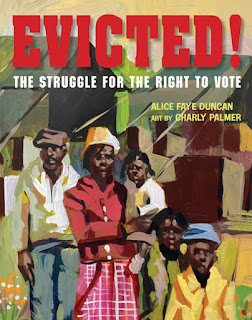
Injustice is much harder to erase.  It can take decades to right a wrong and then, some people don't see, understand or accept that a change has happened.  To them, there was nothing to erase.  Evicted!: The Struggle For The Right To Vote (Calkins Creek, an imprint of Astra Books For Young Readers, January 11, 2022) written by Alice Faye Duncan with art by Charly Palmer is about a pivotal time in American history.  It focuses on the injustices happening in Fayette County, Tennessee concerning voting rights and specifically the Tent City Movement. You won't be able to turn the pages fast enough as the stories of key figures unfold, intertwine, and challenge oppression.
Prologue to Freedom
This is the story of a battle, a boy, and his broken-hearted blues.
It is James Junior's journey through turbulent times in Fayette County, Tennessee.  The people in Fayette County lived apart. Black and white children went to separate schools.  Jim Crow signs hung high.

This initial paragraph of five is preceded by a moving dedication page, acknowledgements which read like an author's note, a quotation by William Herbert Brewster, sections titled Mapping a Movement and Tent City Profiles and a contents page listing twenty-two portions in this profound, intentional narrative.  Fourteen people are named in the Tent City Profiles along with their birth and death dates.  Some are living today.

For the remainder of Prologue to Freedom, we read of voter suppression due to fear of retaliation by the Ku Klux Klan or White Citizens Council.  We read of Black land owners, John McFerren and Harpman Jameson who rallied, in the face of fear for their lives, to form voter registration drives.  We read and are asked to remember the men, women, and their families who were a part of this movement.

In each of the narrative sections, James "Junior" Jamerson is a thread tying them together from an early age to his mid teenage years.  We read how he and his younger sister were rescued by their grandmother, Golden Jamerson, and taken to live with their uncle, Harpman Jameson.  In The Legend of Burton Dodson, we marvel at a man who escapes a rain of bullets only to be later tried and sent to jail for a crime he did not commit.  There was no jury of peers for him.  You had to be registered to vote to be a part of the jury.  This was a call to action for John McFerren, a local farmer.  John formed and was the president of the Fayette County Civic and Welfare League.

We hardly dare breathe as we read a poem in the voice of Thomas Brooks, now a ghost.  He was lynched. (The newspaper article account of this is listed in the bibliograhy.  It is haunting to read.)  Harpman, a World War II Navy veteran, decided to join with John McFerren.  Being a father to Junior (Anne died at age six) changed him.  His wife, Minnie, also joined, but she lost her teaching position ofr registering to vote.  For others that registered, after the crops were harvested they were evicted from their homes.

By now a federal lawsuit had been filed by attorney James Estes on behalf of the League.  Black registered voters had been blocked from voting.  They were also named on a "blacklist" and denied medical services, insurance on homes and cars was canceled, and the purchase of groceries and gasoline was prohibited.  A compassionate Black landowner, Shephard "Papa" Townsend, set up army surplus tents purchased from an anonymous white merchant for the evicted people.  The tide was about to turn.

Up until now, not many people knew what was happening in Fayette County.  The photographs of Ernest Withers of the people living in Tent City changed everything.  Prominent national newspapers sent people to cover the story.  The federal government sent people to investigate.  Dr. Martin Luther King Jr. and President John F. Kennedy now knew.  College students began to spend their summers assisting with voter registration and protesting for civil rights.  In 1967, quiet James "Junior" Jamerson graduated from Fayette County High, having integrated it in 1966. 


The poetry and prose written by Alice Faye Duncan is powerful and engaging from the first words we read to the last words in the Epilogue.  Her meticulous research, including many phone and in-person interviews, is evident in each line we read.  She wants us to know and understand the fourteen people in the profile section.  Her highly-descriptive essays on them with personal facts bring them to life for readers.

Alice Faye Duncan's choice of words for her sentences convey time, place, motivation and mood with excellence.  We are there with these people.  We are able to get a sense of what was happening and what they were feeling.  Here are two portions of longer passages, chapters.  

RAP-TAP-TAP! His grandmother knocked.  A grumbling in her feeble mind made her remember the children.  She stood on the porch in a blue work jacket, and mismatched brogan boots.  She wore a crumpled old church hat with a silver cross around her neck.  Golden was her name.

When Mama Golden opened the unlatched door and shuffled toward the bed, James Junior shot up to hug her with all his strength.  Baby Ann stretched out her arms for Golden to pick her up.  Golden helped the children button their clothes over frayed pajamas.  She tied their scuffed-toe shoes, and they all sat on the bed, watching black storm clouds gather and waiting on a savior.


While his shelter was sure, James Junior worried for friends.  He was especially fearful for Jo Nell Johnson, a girl in his fifth-grade class.  Her parents had seven children and worked for a white landlord with an evil reputation.

One evening as Junior walked the lonely path home from school and whizzing snow cleaved to his hat and coat, he followed rabbit tracks along the trail and posed a question to the listening trees.

"If the Johnsons go register, what's gonna happen to poor Jo Nell?"


(I am working with an F &G.)
When you open the dust jacket, the artwork of Charly Palmer spreads from left to right across the spine in a two-page visual.  It features families living in Tent City, the tents in the background.  They stand shoulder to shoulder, side by side, somber but determined expressions on their faces.  Each brush stroke is filled with emotion.  We are brought into this scene through the placement of shades of red in the clothing and in the nearby flowers.  They join with the red used in the first word of the title text.  

The opening and closing endpapers are a dark, but bright spring green, elevating the colors on the title page and the pastel hues on the last page of the book.  Each painting spans two pages, supplying space through a wash of color for the text.  Charly Palmer's pictorial interpretation of the text is stunning.

He takes us into the peoples' lives represented in the pages of this book.  He takes us to the places in their lives.  He takes us back in time.  He takes us to spaces, not necessarily mentioned in the text, that symbolize the people, places and time.  For example, the image for the quote by William Herbert Brewster, which makes no reference to a residence, depicts the home of a sharecropper.  We are brought close to this representation so we can see every portion of its structure.  The contents' text is placed deep inside a cornfield, representing the work of the people. 

These illustrations rendered

in acrylic on illustration board

do shift their perspective to accentuate the text or Charly Palmer's interpretation of it.  For the pages speaking about the Tent City, we are first given a more panoramic, birds-eye view.  We shift to a close-up scene of a wagon loaded with possessions moving among the tents.  Then, we see families at work in their daily lives there.  A man is chopping wood.  A woman hangs up laundry.  Two children stand silently and two dogs romp.

One of my favorite illustrations is toward the end of the book.  James Junior is seated on a sofa with his grandma Golden.  Their backs are to us.  They face the television set in the living room.   A plant is placed on top of the television set with a small table and lamp off to the side.  Framed artwork hangs on the wall on either side of the television.  James Junior and his grandmother are watching the broadcast about the attacks by white state troopers on the nonviolent activists marching on the Edmund Pettus Bridge in Selma in 1965.  The first sentence of this section titled Golden reads:

James Junior remembered 1965 with a furious clarity.


Surely, every student of United States history should read Evicted!: The Struggle For The Right To Vote written by Alice Faye Duncan with art by Charly Palmer.  This book serves two purposes.  It documents history with purpose and facts and it is a call to action.  The right to vote should never be taken for granted.  It is to be protected and preserved.  At the close of the book are seven pages dedicated to the Fayette County Timeline.  Photographs are used here.  This is followed by a Resource Guide including Books Of General Interest, Music, Documentary Films And Websites, and Places To Visit. There are then and now photographs of James "Junior" Jamerson.  There are pictures of Mary M. Williams and Levearn Townsend.  There is a two-page bibliography, an author's note and an illustrator's note.  I highly recommend a copy of this title for your professional and personal collections.  Please, take the time to read this book.

To learn more about Alice Faye Duncan and Charly Palmer, please access their websites by following the link attached to their names.  Alice Faye Duncan has accounts on Facebook, Instagram, and Twitter.  Charly Palmer has active accounts on Facebook and Instagram.  At the publisher's website, there is a discussion guide.  At Penguin Random House, you can view interior images.  At School Library Journal, A Fuse # 8 Production, Elizabeth Bird gives her insights about the book and interviews Alice Faye Duncan.  Alice Faye Duncan is interviewed recently by author, reviewer, and blogger Julie Danielson at Chapter 16, A Community of Tennessee Writers, Readers & Passersby.

Wednesday, January 2, 2019

Listen To The Music Of Her Words

We read their words.  We listen to their words.  We study their words.  Their words sing to our souls and enter our beating hearts.

Like composers of musical masterpieces, poets supply us with the ability to create our own melodies from their words.  Surely some of those melodies we make are the same, but others will resonate in differing harmonies.  In her eighty-three years one wonderful woman left her poetic mark on the world.  A Song for Gwendolyn Brooks (Sterling Books for Children, January 1, 2019) written by Alice Faye Duncan (Memphis, Martin, And The Mountaintop: The Sanitation Strike of 1968)  with illustrations by Xia Gordon is a lovely and loving lyrical and stunning pictorial tribute.

I
SING a song for Gwendolyn Brooks
Sing it loud---a Chicago blues.

Skip to the beat of elevated trains.
They grumble, rumble, and roll real fast.

In 1925 Gwendolyn Brooks was eight years old, unsure of what was possible.  Even then she wrote daily in her journals while other girls and boys were at play.  Writing was a solitary experience for this gifted child.

Her father worked as a janitor to support his family.  Her mother stayed at home.  A younger brother was Gwendolyn's best friend.  Gwendolyn watches the world of her Chicago home and it watches her.  Others are not always kind.

Her parents see her gift and support it completely.  When accused of plagiarism by a school teacher, Mrs. Brooks marches with her daughter back to school and settles the matter immediately.  Gwendolyn pens an original poem on the spot.  Now this beautiful child understands what her parents have always known.

She is allowed to write instead of working inside or outside of their home.  Before graduating high school, her poetry is published in the Chicago Defender.  Her mother declares how high her fame will go.

Gwendolyn studies with other poets, she wins a contest, she graduates from college, marries and a son is born to her and her husband.  She writes and writes, and her fame grows.  In 1950 Gwendolyn Brooks wins a Pulitzer Prize; the first Black American to win this award.  Her mother was right.


Within seconds you find the fibers in your being, your breathing, syncing to the rise and fall of the stanzas written by Alice Faye Duncan.  Each of the nine portions of her narrative about poet Gwendolyn Brooks begins with

SING a song for Gwendolyn Brooks.

This joyful declaration is followed by individual incidents, descriptions of her days and family life and being a part of the community on the South Side of Chicago.  Alice Faye Duncan includes several of Gwendolyn Brooks' poems to emphasize her biographical portrait.  Here is a passage,

VI
SING a song for Gwendolyn Brooks.
Chicago teems with Black sharecroppers from Dixie towns.

While jobs are scarce in the Great Depression,
Migrants slog and scrounge for decent work.

Gwen is Sweet Sixteen in '33.
She is feathery voice and flickering flame.
She gushes and giggles over Shakespeare sonnets.

Her parents are wise and see her light.
They do not yell, "Go mop the floor!"
And when high school chums must look for work,
Gwendolyn is free to sit and think.


The front of the dust jacket (I am working with a digital copy of the book.) is completely breathtaking.  The color palette radiates warmth and light and the pure truth of knowing you have chosen the right path for your life.  This is the face of a woman you want to know.  This is the face of an astonishing human being.

The opening and closing endpapers appear to be a dark gray with pale yellow scroll work of leaves and flowers in diagonal rows.  This is in direct reference to opening and closing selections of Alice Faye Duncan's narrative.  On the title page the lively smiling face of Gwendolyn Brooks looks to the left of readers.

Each of the distinctive illustrations by Xia Gordon appear to be a double-page picture even if a section seems to be a separate full page.  The hues used blend seamlessly from left to right.  For most of the images a pale yellow, almost cream, figures prominently connecting one page to the next.  Her people and other significant elements are created with smooth flowing lines and a noticeable use of highlights and shadows.

One of my many favorite illustrations spans two pages.  The text references the neighborhood where Gwendolyn lives with her husband and son.  This community fuels her writing.  Xia Gordon chooses to focus on a church and its steeple going through the clouds.  Shades of orange, yellow, red and purple color the buildings.  Clouds gather and swirl in tan, cream and white.


This biographical accolade to this remarkable poet, A Song for Gwendolyn Brooks written by Alice Faye Duncan with illustrations by Xia Gordon, is marvelous, uplifting and inspirational.  It would be an excellent choice for an introduction to writing, a study of American poets, a unit on biographies or the art of writing poetry.  At the close of the book there is an author's note, Gwendolyn Brooks timeline, suggested reading by Gwendolyn Brooks and a bibliography.  I highly recommend this title for your professional and personal collections.

To learn more about Alice Faye Duncan and Xia Gordon and their other work, please follow the links attached to their names to access their websites.  Both Alice Faye Duncan and Xia Gordon have accounts on TwitterAlice Faye Duncan and Xia Gordon are also on Instagram.  The cover reveal and an interview can be found at A Fuse # 8 Production hosted by Elizabeth Bird.  Alice Faye Duncan is interviewed by author Deborah Kalb.


Educator Alyson Beecher is hosting the 2019 Nonfiction Picture Book Challenge at Kid Lit Frenzy.  I am very grateful for this opportunity to participate and to find other nonfiction books.


Monday, September 17, 2018

Sixty-Five Days In 1968

Every single day with every breath they take people from all walks of life are striving to mend things which are broken.  These things cannot be fixed with super glue, a hammer and nails, or scissors and tape.  They are made whole with courage, persistence, intelligence, compassion and sacrifice.

Efforts by those trying to repair a breach in what should be and what is often work in anonymity. Other times we are aware of the struggles even if they are in another part of the world, country or area in which we live.  They are headlines on the evening news. They have a place in human history.  Memphis, Martin, And The Mountaintop: The Sanitation Strike Of 1968 (Calkins Creek, an imprint of Highlights, August 28, 2018) written by Alice Faye Duncan with illustrations by R. Gregory Christie depicts an event with unforgettable results.

MEMPHIS---1968
I remember Memphis.
I remember the stinking sanitation strike.
Alley cats, rats, and dogs rummaged through piles of trash.
Black men marched through Memphis with protest signs raised high.
I also marched in '68 with red ribbons in my hair.

Fifteen memories of moments are recalled through the first person voice of a little girl in poetry and prose.  Following an initial introduction, a parallel is made between two storms the day two sanitation workers, Echol Cole and Robert Walker, died.  The first is a rain storm and the second is a strike.

Less than two weeks after the workers' deaths and repeated failed negotiation attempts with Mayor Henry Loeb, workers numbering 1,300 left their jobs and marched from February 12, 1968 to April 16, 1968.  Money was tight beyond imagining; no lights and no telephone but help came. Organizations formed and organizations reached out in support.  Workers attended rallies and strategized.  At home wives asked and wondered how much longer will this last.

As Lorraine, the little girl, read the latest newspapers and magazines, given to her mother, a maid for a local family, her family learned of Dr. King's visit on March 18, 1968.  His speech bolstered the minds and hearts of all listeners especially when he set a date to return.  He did not come back, Mother Nature intervened.

On March 28, 1968 Dr. King and thousands of others gathered in Memphis to march.  It ended in violence on Beale Street.  Mayor Loeb called in the National Guard and a curfew was put in place.  Looking out your window and seeing tanks roll by was frightening.

On April 3, 2018 Dr. King returned speaking as a dreamer to all the dreamers in attendance at the church.  At the close of the next day at the Lorraine Motel Dr. Martin Luther King, Jr., crusader for equal rights and the eradication of poverty for workers, was assassinated.  Sadness trickled down people's faces then and later when forty thousand strong still marched in silence to honor a promise and the strike ended shortly thereafter.  We still weep today.


There will be books you read once, twice, three time and more because the writing compels you to do so.  This book written by Alice Faye Duncan is one of those books.  By having the events recollected by a nine-year-old girl with working parents, her father a sanitation worker and her mother, a maid, we have a personal connection.  We are not just reading about facts; we see everything through the eyes of a child directly involved.

The technique of breaking the narrative into fifteen separate reflections is brilliant in creating understanding and pacing.  Specific details of the conditions of the sanitation workers, the marches, the meetings, the impact on families' lives, the setbacks, the victories and Dr. Martin Luther King, Jr. bring us into this history. Here are portions of two passages.

When they could take the abuse no more, 1,300 men deserted their
garbage barrels.  They organized a labor strike on February 12, 1968.
In the morning and afternoon, for sixty-five days, sanitation workers
marched fourteen blocks through the streets of downtown Memphis.
From Clayborn Temple to the steps of City Hall, they squared their
shoulders, raised their heads, and carried their picket signs.
My daddy marched in that number.  He marched for better pay.
He marched for decent treatment.  My daddy marched for me.

He said, "All labor has dignity."
Dr. King's voice was loud and stirring.
I listened with my parents from a crowded church pew as the
famous leader drafted a plan to march in Memphis with the
striking men.
Dr. King set a date for March 22.
Daddy leaned toward Mama's ear.  He said, "We need everybody
to march that day."
Mama did not waver.
She assured Daddy, "I'll take off work.  You can count on me."
Then Mama patted my hand and said, "We will take Lorraine. 
She can march with us.


When first looking at the front of the dusk jacket, you know this title is going to be intensely individualistic.  Placing Lorraine Jackson on the balcony of the Lorraine Motel draws up deeply into her story.  Children have the remarkable gift of getting to the soul of any situation.  They are unencumbered by past experiences. (I am working from a digital galley.)  On the title page striking sanitation workers, carrying blank and white picket signs, crowd beneath the title text.

All of the illustrations painted with Acryla Gouache by R. Gregory Christie span two pages.  Each is like a piece of art hanging in a gallery of pictorial history.  What readers will recognize initially are the facial features on the people portrayed.  They reflect an array of emotions.

In some of the scenes the elements are more abstractly depicted than being realistic representations.  At times the realism is so vivid you feel as though your five senses are awakened. When the sanitation worker is carrying a rusted barrel of garbage, it drips down on his clothes and person.  For the haiku Omen the snowy vista is stark, bitter cold and windy.

One of my many favorite illustrations is for the piece titled Black Widow.  The background like many of the images is a golden swirl of color.  On the left and right marchers wearing their best clothing silently form behind the dignified, majestic figure of Coretta Scott King. In contrast to those behind her, her clothing and facial features are most prominent.  It's an impressive portrait.


When you read Memphis, Martin, And The Mountaintop: The Sanitation Strike Of 1968 written by Alice Faye Duncan with illustrations by R. Gregory Christie you will be moved to tears more than once.  I expect as a read aloud the classroom will be as silent as the marchers through Memphis on April 8, 1968 before they burst with questions and comments.  At the conclusion of the title is an informative and detailed time line from January 1, 1968 to April 16, 1968.  A museum (National Civil Rights Museum at the Lorraine Motel) to visit is listed as well as sources and source notes.  I highly recommend this book for your personal and professional collections.

To learn more about Alice Faye Duncan and R. Gregory Christie, please access their websites by following the links attached to their names.  Alice Faye Duncan maintains an account on Twitter.  At a publisher's website you can view interior images.  At A Fuse #8 Production by Elizabeth Bird Alice Faye Duncan is interviewed along with a cover reveal.  Alice is also showcased at KidLit411 and LILbooKlovers.