Quote of the Month

When love and skill work together, expect a miracle. John Ruskin


Showing posts with label Charly Palmer. Show all posts

Tuesday, March 1, 2022

Defying The Forces Of Nature

Whether the court is inside or outside, it is there.  It does not matter if you are a member of the team or of the spectators, you sense it.  It is always there regardless of the level of the game, high school, college or professional.  It's there during a three-on-three tournament in a capital city.  When you and the people in your neighborhood play it at the park or in someone's yard, it is there.  You can't hear it, but you feel it.  It silently swirls around the sounds of hands slapping on balls and balls bouncing on hard surfaces.  

It is excitement and anticipation and the possibility of witnessing something unexpected.  This is the game of basketball.  The Legend of Gravity: A Tall Basketball Tale (Farrar Straus Giroux, January 4, 2022) written and illustrated by Charly Palmer elevates the excitement, anticipation and possibility to the height of legend.  You not only want to believe it is true, you believe it to be true.

I've heard you young folks talking about who is the best ballplayer
to ever grace the court.  Like that"King James" someone or
other.  He's not too shabby.

                                      But have you ever heard of Gravity?

An initially unnamed narrator goes on to explain that Gravity is a phenomenal player not the force that keeps everything anchored to earth.  As the story goes, one day toward the end of June, when some players, Liquid, Sky High, and Left 2 Right, were on the local outside court, a new kid strolled up to the group.  He wanted to join them in a three-on-three.

When Liquid threw him the ball, a tad cranky at being stopped in his current discourse, the boy caught it like the superb pass it was not.  The new guy's moves on the court with that ball had the other players standing stone still and quieter than quiet.  When Liquid asked this new player his street name, he said he did not have one.  The narrator gave him the name of Gravity.  And just like that, he was now a member of the playground team, Eagles.

Word spread of his incredible playing abilities.  He once racked up 150 points . . . in the first quarter.  The Eagles through Gravity felt like champions.  They traveled by foot, bike, and bus to other blacktop courts to beat other teams.  Yes, this was a summer to remember!

As the summer came to a close, the "Best of the Best" pickup tournament was to be held in Milwaukee, Wisconsin.  For the first time, the Eagles believed they could win.  Their strategy was simple, at all costs get the ball to Gravity.  By Sunday, their hopes were soaring.  The East Side Flyers made it to Sunday, too.  Their players were the stuff of history in the game.

By the time the half of the championship game arrived, the score between the Eagles and the East Side Flyers was tied.  The Eagles's strategy was not working.  Gravity was barely standing.  Not much of a talker, Gravity spoke to his team saying words they would remember for the rest of their lives.  Words which have echoed for decades.  The Eagles were a changed team and that made all the difference.  


You cannot read the words penned by Charly Palmer without feeling a surge of hope.  You know with every phrase, he is building toward the spectacular.  His narrator speaks with the veracity only a firsthand observer could.  This narrator also knows basketball, relating courtside moments like a play-by-play sports commentator.  The decription of the street names of the players on both of the championship teams and what they represent are marvelous.  Here are two passages.

We had always been good, but we had never won a 
championship.  We thought Gravity would be our missing
link.  Truth be told, he was often a one-man show.  Gravity
once jumped so high that we were able to go out for ice
cream before he came down.

EAST SIDE FLYERS
SPIDER
Yusef "Spider"
Woodruff had
hands so quick,
you'd swear he
had eight of them.


When you open the matching dust jacket and book case, you see on the front, right side, a portrait of the young man who defied the norm.  His shy confident smile gives us a hint of his on and off court demeanor.  The planets and stars above him are a testament to his capabilities.  The same deep blue mix of colors on the front travels over the spine to the left, the back of the jacket and case.  Here three sentences from the text invite readers to learn about Gravity.  Between the text is a drawing within the circle of a basketball.  It features the hands of the players in solidarity before a tip-off.

The opening and closing endpapers are in basketball orange.  On the title page, a basketball is at rest on an outside court.  The verso and first page are a bird's eye view of the city of Milwaukee.  The subsequent images are a blend of full-page and double-page pictures.  Sometimes a series of smaller visuals are included on a single page to show a succession of quick moments on the court.  Other times double pages are divided into panels.

The bold, bright colors selected by Charly Palmer work beautifully with the bold strokes of his brush.  His paintings reflect shadows and light drawing our attention to the characters, especially to Gravity.  Charly Palmer might add explanatory words with his images to further define the text.

We are given intimate views of the art of basketball playing.  In one illustration, the foreground shows us tennis shoes and the lower half of Gravity's legs with silhouettes of other players in the background.  In another image we stand back a bit to watch players meeting during a game and devising a plan of play.

One of my many favorite illustrations is a double-page picture.  On the left, five members of the Eagles have collected on the court, holding ice cream cones.  They are looking up at Gravity.  His body is far above them, legs spread in a jump.  One hand is posed for balance.  The other hand holds the basketball.  Some celestial bodies are near Gravity.  To the right of the players and across the gutter is the darkness of space and colorful planets.  Gravity has indeed eluded gravity.


In his debut as both author and illustrator, Charly Palmer with The Legend of Gravity: A Tall Basketball Tale showcases a game many people love to play and watch.  His words and artwork capture the true spirit of this sport, especially as it is played in outside parks and playgrounds.  In an author's note at the end, Charly Palmer speaks about streetball legends and this book being a dedication to them.  This title will resonate with most readers of all ages.  It is read-aloud gold.  I highly recommend you have a copy on your personal and professional bookshelves.

To learn more about Charly Palmer and his other work, please follow the link attached to his name to access his website.  Charly Palmer has accounts on Facebook and Instagram.  At the publisher's website you can view interior images.

Wednesday, January 26, 2022

Erasing Injustice

When you hear the word erase, depending on your life experiences, it can have different meanings.  A wave can erase an afternoon of sandcastle building.  A heavy snowfall can erase deer tracks across your yard or wet paper toweling can erase muddy pawprints on a wood floor.  If using a pencil, you can erase a written mistake.  As an artist, depending on your medium, you can usually erase a wrong color or line or element out of balance with the whole.  The delete key can erase something in a matter of seconds, much to your horror sometimes.

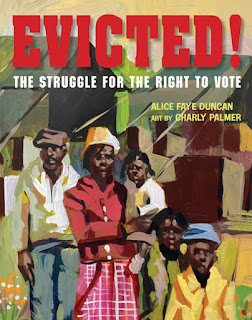
Injustice is much harder to erase.  It can take decades to right a wrong and then, some people don't see, understand or accept that a change has happened.  To them, there was nothing to erase.  Evicted!: The Struggle For The Right To Vote (Calkins Creek, an imprint of Astra Books For Young Readers, January 11, 2022) written by Alice Faye Duncan with art by Charly Palmer is about a pivotal time in American history.  It focuses on the injustices happening in Fayette County, Tennessee concerning voting rights and specifically the Tent City Movement. You won't be able to turn the pages fast enough as the stories of key figures unfold, intertwine, and challenge oppression.

Prologue to Freedom
This is the story of a battle, a boy, and his broken-hearted blues.
It is James Junior's journey through turbulent times in Fayette County, Tennessee.  The people in Fayette County lived apart. Black and white children went to separate schools.  Jim Crow signs hung high.

This initial paragraph of five is preceded by a moving dedication page, acknowledgements which read like an author's note, a quotation by William Herbert Brewster, sections titled Mapping a Movement and Tent City Profiles and a contents page listing twenty-two portions in this profound, intentional narrative.  Fourteen people are named in the Tent City Profiles along with their birth and death dates.  Some are living today.

For the remainder of Prologue to Freedom, we read of voter suppression due to fear of retaliation by the Ku Klux Klan or White Citizens Council.  We read of Black land owners, John McFerren and Harpman Jameson who rallied, in the face of fear for their lives, to form voter registration drives.  We read and are asked to remember the men, women, and their families who were a part of this movement.

In each of the narrative sections, James "Junior" Jamerson is a thread tying them together from an early age to his mid teenage years.  We read how he and his younger sister were rescued by their grandmother, Golden Jamerson, and taken to live with their uncle, Harpman Jameson.  In The Legend of Burton Dodson, we marvel at a man who escapes a rain of bullets only to be later tried and sent to jail for a crime he did not commit.  There was no jury of peers for him.  You had to be registered to vote to be a part of the jury.  This was a call to action for John McFerren, a local farmer.  John formed and was the president of the Fayette County Civic and Welfare League.

We hardly dare breathe as we read a poem in the voice of Thomas Brooks, now a ghost.  He was lynched. (The newspaper article account of this is listed in the bibliograhy.  It is haunting to read.)  Harpman, a World War II Navy veteran, decided to join with John McFerren.  Being a father to Junior (Anne died at age six) changed him.  His wife, Minnie, also joined, but she lost her teaching position ofr registering to vote.  For others that registered, after the crops were harvested they were evicted from their homes.

By now a federal lawsuit had been filed by attorney James Estes on behalf of the League.  Black registered voters had been blocked from voting.  They were also named on a "blacklist" and denied medical services, insurance on homes and cars was canceled, and the purchase of groceries and gasoline was prohibited.  A compassionate Black landowner, Shephard "Papa" Townsend, set up army surplus tents purchased from an anonymous white merchant for the evicted people.  The tide was about to turn.

Up until now, not many people knew what was happening in Fayette County.  The photographs of Ernest Withers of the people living in Tent City changed everything.  Prominent national newspapers sent people to cover the story.  The federal government sent people to investigate.  Dr. Martin Luther King Jr. and President John F. Kennedy now knew.  College students began to spend their summers assisting with voter registration and protesting for civil rights.  In 1967, quiet James "Junior" Jamerson graduated from Fayette County High, having integrated it in 1966. 


The poetry and prose written by Alice Faye Duncan is powerful and engaging from the first words we read to the last words in the Epilogue.  Her meticulous research, including many phone and in-person interviews, is evident in each line we read.  She wants us to know and understand the fourteen people in the profile section.  Her highly-descriptive essays on them with personal facts bring them to life for readers.

Alice Faye Duncan's choice of words for her sentences convey time, place, motivation and mood with excellence.  We are there with these people.  We are able to get a sense of what was happening and what they were feeling.  Here are two portions of longer passages, chapters.  

RAP-TAP-TAP! His grandmother knocked.  A grumbling in her feeble mind made her remember the children.  She stood on the porch in a blue work jacket, and mismatched brogan boots.  She wore a crumpled old church hat with a silver cross around her neck.  Golden was her name.

When Mama Golden opened the unlatched door and shuffled toward the bed, James Junior shot up to hug her with all his strength.  Baby Ann stretched out her arms for Golden to pick her up.  Golden helped the children button their clothes over frayed pajamas.  She tied their scuffed-toe shoes, and they all sat on the bed, watching black storm clouds gather and waiting on a savior.


While his shelter was sure, James Junior worried for friends.  He was especially fearful for Jo Nell Johnson, a girl in his fifth-grade class.  Her parents had seven children and worked for a white landlord with an evil reputation.

One evening as Junior walked the lonely path home from school and whizzing snow cleaved to his hat and coat, he followed rabbit tracks along the trail and posed a question to the listening trees.

"If the Johnsons go register, what's gonna happen to poor Jo Nell?"


(I am working with an F &G.)
When you open the dust jacket, the artwork of Charly Palmer spreads from left to right across the spine in a two-page visual.  It features families living in Tent City, the tents in the background.  They stand shoulder to shoulder, side by side, somber but determined expressions on their faces.  Each brush stroke is filled with emotion.  We are brought into this scene through the placement of shades of red in the clothing and in the nearby flowers.  They join with the red used in the first word of the title text.  

The opening and closing endpapers are a dark, but bright spring green, elevating the colors on the title page and the pastel hues on the last page of the book.  Each painting spans two pages, supplying space through a wash of color for the text.  Charly Palmer's pictorial interpretation of the text is stunning.

He takes us into the peoples' lives represented in the pages of this book.  He takes us to the places in their lives.  He takes us back in time.  He takes us to spaces, not necessarily mentioned in the text, that symbolize the people, places and time.  For example, the image for the quote by William Herbert Brewster, which makes no reference to a residence, depicts the home of a sharecropper.  We are brought close to this representation so we can see every portion of its structure.  The contents' text is placed deep inside a cornfield, representing the work of the people. 

These illustrations rendered

in acrylic on illustration board

do shift their perspective to accentuate the text or Charly Palmer's interpretation of it.  For the pages speaking about the Tent City, we are first given a more panoramic, birds-eye view.  We shift to a close-up scene of a wagon loaded with possessions moving among the tents.  Then, we see families at work in their daily lives there.  A man is chopping wood.  A woman hangs up laundry.  Two children stand silently and two dogs romp.

One of my favorite illustrations is toward the end of the book.  James Junior is seated on a sofa with his grandma Golden.  Their backs are to us.  They face the television set in the living room.   A plant is placed on top of the television set with a small table and lamp off to the side.  Framed artwork hangs on the wall on either side of the television.  James Junior and his grandmother are watching the broadcast about the attacks by white state troopers on the nonviolent activists marching on the Edmund Pettus Bridge in Selma in 1965.  The first sentence of this section titled Golden reads:

James Junior remembered 1965 with a furious clarity.


Surely, every student of United States history should read Evicted!: The Struggle For The Right To Vote written by Alice Faye Duncan with art by Charly Palmer.  This book serves two purposes.  It documents history with purpose and facts and it is a call to action.  The right to vote should never be taken for granted.  It is to be protected and preserved.  At the close of the book are seven pages dedicated to the Fayette County Timeline.  Photographs are used here.  This is followed by a Resource Guide including Books Of General Interest, Music, Documentary Films And Websites, and Places To Visit. There are then and now photographs of James "Junior" Jamerson.  There are pictures of Mary M. Williams and Levearn Townsend.  There is a two-page bibliography, an author's note and an illustrator's note.  I highly recommend a copy of this title for your professional and personal collections.  Please, take the time to read this book.

To learn more about Alice Faye Duncan and Charly Palmer, please access their websites by following the link attached to their names.  Alice Faye Duncan has accounts on Facebook, Instagram, and Twitter.  Charly Palmer has active accounts on Facebook and Instagram.  At the publisher's website, there is a discussion guide.  At Penguin Random House, you can view interior images.  At School Library Journal, A Fuse # 8 Production, Elizabeth Bird gives her insights about the book and interviews Alice Faye Duncan.  Alice Faye Duncan is interviewed recently by author, reviewer, and blogger Julie Danielson at Chapter 16, A Community of Tennessee Writers, Readers & Passersby.

Thursday, October 12, 2017

Using Her Gift

Each individual has within them a gift.  How they determine to use it or not to use it will chart the course of their lives.  For some it appears early and easily.  For others it takes time for the answer to present itself.

In 1932 a girl child was born in Prospect Township, South Africa.  Mama Africa! How Miriam Makeba Spread Hope With Her Song (Farrar Straus Giroux for Young Readers, an imprint of Macmillan Publishing Group, LLC, October 10, 2017) written by Kathryn Erskine with illustrations by Charly Palmer is the story of this girl child's life.  Her memorable music will long hold a place in history.

Miriam sang as soon as she could talk and danced as soon as she could walk.

She sang for family, friends and in her church's Sunday school choir.  Singing gave her a feeling of freedom in a world without freedom for people of color.  In South Africa, regardless of your ethnic group, nonwhite people suffered under apartheid, a system of laws designed to enforce segregation.

Miriam used her voice, her songs, to protest these laws, this inequality.  She sang her songs in the languages of the ethnic groups, disguising their meaning from the ruling white government.  Her popularity soared like her words.

She met people like Nelson Mandela championing for racial equality for everyone.  Regardless of the risks she continued to perform and spent time in jail.  Miriam did not silence her voice.  She sang for her people.  She sang for freedom.

An accident and a death fueled her anger and prompted her performance in an anti-apartheid movie.  This brought attention to Miriam and apartheid.  She left South Africa singing in Europe and the United States.  She had to be careful though because her family still remained in her homeland.  She was not careful enough.  Miriam was banned from returning home to South Africa.

The protests in South Africa increased.  Those killed and jailed increased. Miriam told about everything in her songs.  She was invited finally to speak at the United Nations about South Africa.  Those there heard her voice, a voice strong for her people.

Even when her songs were banned in South Africa, her people listened.  More people around the world listened but it was a stunning event in the township of Soweto that shocked the world even more.  Miriam sang louder.  Other singers joined her.

It was fourteen years after this event before Miriam lifted her voice in sheer joy for the freedom gained by her people.  She could go home after thirty years.  Eighteen years later Miriam died singing.  She used her gift with her last breath.


The narrative penned by Kathryn Erskine is a poetic tribute to this remarkable woman.  Each portion of text is like a verse in a song whose volume grows.  They are connected by particular words.  Some of the last words in one portion will be included in the beginning of the next section.  Kathryn not only educates us about Miriam, but the environment in which she lived.  Historical facts about apartheid in South Africa are threads in the fabric of Miriam's life.

We become personally attached to this woman's life through noted specific incidents such as nonwhite people in South Africa having to have passes to leave their neighborhoods.  If they didn't have passes they were jailed.  Even if they had passes the police could or would say they were not legal.  Kathryn also uses Miriam's personal quotations and words from her songs to add emphasis.  Here is a sample passage.

South Africans, many of them, both black and white, protest apartheid---marching, striking, speaking, writing.  Some black protesters must flee the baases.  They go to northern Africa and find Mama Africa.

Mama Africa helps the refugees---young men and women, even children.  She gives them food, clothes, and song.  When her song becomes too loud for some, they say she is not a singer but a politician.  "I am no politician," she says.  "I just see what I think is wrong and what is right."


The bright bold colors used by artist Charly Palmer are a reflection of the essence of Miriam Makeba.  Her portrait shown on the front of the dust jacket is fully alive.  You expect to hear her singing at any minute.  The use of light and shadow is extraordinary as is the use of blue hues to frame her face and upper body.  To the left, on the back, the final passage written by Kathryn Erskine is placed in vibrant text, like a marquee, over an African landscape with silhouettes of people along the bottom. (I am working with an F & G.)

The same lively shades of blue and purple color the title page with a nearly full figure of Miriam singing on the right side of the page.  Yellow, red and green are used in the title text. (I am wondering if the significance of these colors refers to the South African flag.)  White text is used on the following pages for the verso and dedication pages done in those same shades of blue and purple.

With each page turn readers view a double-page picture filled with color, mood and emotion.  It's as if we are walking in a gallery from painting to painting as the story visually unfolds.  You become involved on a very personal level.  You feel the joy of a little girl singing, the deep sadness when she cannot go swimming at the same beach as whites, the contemplation of a young woman listening to Billie Holiday and Ella Fitzgerald protest songs on records, the sheer terror of being stopped by the police and producing a pass, the depth of grief from being banned from your county as tears become musical notes and the horror of Soweto as fallen bodies shift to barbed wire to protesters and then to a musical score. 

One of my many favorite illustrations is when Miriam Makeba is invited to speak at the United Nations.  She begins slowly and quietly but as she thinks about Nelson Mandela her voice becomes louder and louder telling truths.  Kathryn Erskine ends with the voice of Mama Africa being like the roar of a lion.  In an arc of deep blues beginning in the upper left-hand corner the members listening at the United Nations are seen in shadow moving to cover nearly half of the right side.  In the center of the circle are lighter shades and white.  This provides space for the text.  To the left a lioness roars over the figure of Miriam Makeba speaking.  Stars radiate up from Miriam through the body of the lioness. This is a stunning depiction by Charly Palmer.


Readers can't help but be grateful to author Kathryn Erskine and illustrator Charly Palmer for their work in celebrating the life of this woman in Mama Africa!  How Miriam Makeba Spread Hope With Her Song.  In an extensive three page Author's Note with quotations by Miriam Makeba Kathryn Erskine explains her connection to Miriam Makeba.  She says:

I hope that through reading her story you can understand that, even in the face of great odds, you always have a voice and your voice is powerful.

A selected bibliography of books and audio and video recordings, further reading of picture books and books for older readers is included.  A glossary is to be present in the final book released.  You will want to have this book on your professional shelves.  It will be an honor to make it a part of my personal collection.  Excellent picture books of this kind promote relevant discussions and further research.  (I have already spent hours researching Miriam Makeba and apartheid.)

To further acquaint you with Kathryn Erskine and Charly Palmer and their other work, please visit their websites by following the links attached to their names.  At the publisher's website you can view interior images.  Author, reviewer, and blogger Julie Danielson features Charly Palmer at Kirkus and follows with artwork at Seven Impossible Things Before Breakfast the next week.


Be sure to visit KidLit Frenzy hosted by educator Alyson Beecher to view the other titles chosen by bloggers participating in the 2017 Nonfiction Picture Book Challenge.