Quote of the Month

When love and skill work together, expect a miracle. John Ruskin


Showing posts with label Size-Fiction. Show all posts

Thursday, April 21, 2022

To What Extent

Sometimes before you open a book, it is like looking at a gift-wrapped present.  You know who the giver is, but you have no idea what is inside.  You speculate as to the contents aloud and in your mind, knowing the truth will not be revealed until the paper is removed and the box is opened.

This is exactly how it was with Big And Small And In-Between (Chronicle Books, April 12, 2022).  I knew of the considerable work of the creators Carter Higgins and Daniel Miyares.  They are both authors and illustrators.  In this collaboration, Carter Higgins is author and Daniel Miyares is illustrator.  Having previously not read any reviews or revelatory chatter, after pausing at the opening and closing endpapers and the image before the verso and title pages, with a growing smile I turned to the first page.  I gasped.

BiG
things

Those two words are only read after unfolding a cleverly made box topped with a bow and tag with the number one on it.  With a page turn we discover twelve big things tangible, felt, and imagined.  We realize the warmth of the sun and its power to begin a day, the feeling before jumping into a huge mound of autumn leaves, the courage of doing something for the first time, and how a day at the beach is big in more than one way.

A square becomes a rectangle with a dachshund to welcome us into the in-between portion of this narrative. Here thirteen thoughts disclose highly anticipatory instances.  We recall (or wish we could recall) being on a teeter-totter when it is neither up or down but balanced in the center or the line when a boat is above water but also reflected in the water under it.  How about the caterpillar that is no longer an egg, but is about to flutter wings as a butterfly? How about the moment just before you bite into a s'more when the marshmallow is the right kind of soft and the chocolate is melting to perfection?  

A partial stem and partial leaf of a dandelion about ready for wishes holds the number 3.  A teeny, tiny door opens with a single dandelion seed on it for our exploration of small things.  If you listen you might hear the sound of a single raindrop falling in a puddle, a puddle providing water for a butterfly to quench its thirst.  If you look carefully, you can see snails beneath the cover of leaves and grass. It is a small creature inside a small shell leaving an almost invisible trail.  The final small thing of twelve takes us back to the ocean.  We are there just as a hole is formed, a castle is built, and we stand gazing at the expanse of water.  What does this tell us about big, in-between, and small things?

Surprisingly, there is a number four. Here we read and see the majesty of big, small, and in-between working together.  We pause and ponder at what we have read and seen in each portion of this book.  It is a proclamation from and of the heart.  


When you read the words written by Carter Higgins, you are drawn into each moment with her sensory descriptions.  Her lyrical phrases are like a lullaby, but also an awakening.  She is asking us to realize and participate in each of the big, small, and in-between happenings.  She takes the everyday and shows us how it is exceptional.  Here is a passage from each portion.  Can you guess which one is for big, small, and in-between?

a handful of NICKELS
that fell out of a pocket
and got smushed in the sofa

the SUN right before it slips away
when it is going
                     going
                              gone

how QUIET it gets
when it's your turn onstage
and you're not sure
about your talent


The images by artist Daniel Miyares we first see on the book case give us an idea of the wealth we are to find within the pages.  On the front, right side of the open case, is a balance of elements big and small and in-between.  They depict a collection of possibilities.  

To the left of the wide and bright yellow spine, on the back, is an oval-shaped illustration.  It shows three of the children showcased in the book riding down a street on their bicycles.  It is autumn.  The sky is replete with the colors of a setting sun. They are riding toward it.  Some autumn leaves break the frame to draw our eyes toward the text.  This text invites us to be travelers in the big, small, and the in-between.

On the opening endpapers in warmer hues of sunrise and sunset, as a background wash, we see items one might have from being in the portrayed occasions.  To name a few, there are odd checkers, jacks, a playing card, an acorn, a bottle cap, a wishbone, crayons, seashells, and leaves.  On the closing endpapers, in cooler shades, more often found at dusk, we are shown a pocket watch, a jump rope, an origami crane, a pencil, pinecone and a baseball.  These are some of the featured items.

When you turn the page, after the opening endpapers, we see a seated dog, with a tail extending over the gutter to the left, a wagging tail.  We cannot see the entire face of the canine, but it is happy.  A tennis ball rests between its paws.  A tag hanging from its collar reads:

This book belongs to

These pictures

rendered in graphite, gouache, and digital collage

are intricately detailed, textured, and expressive.  They alternate in size from full-page images with wide white frames, to full-page pictures, edge to edge, double-page visuals, and small images together.  There is a vertical delicious double-page picture, and a dramatic gatefold at the conclusion.  

The same characters and their pet companions reappear throughout the book.  Sometimes one image ties to the next one.  Some of the perspectives and use of light and shadow will have you marveling at the skill of Daniel Miyares.  One word (okay, two) comes to mind when you look at each illustration, alive and splendid.

One of my many favorite illustrations is for one of the above-noted quoted passages.  It is a four square picture with wide frames on a single page.  In the first scene, a child is reading a book in a swing on their porch as the sun sets.  Their dog is standing and watching them holding its tennis ball in its mouth.  Hopeful. In the next scene, it is barely light enough outside to read, but the child keeps reading. His socks and shoes are off and on the porch. They are lying down more than sitting up.  The tennis ball is next to the dog, now resting.  In the third image, the child is reading under a blanket with a flashlight, still in the porch swing.  The dog is curled and sleeping.  In the final illustration, an adult is carrying the child inside as the dog follows.  In the final two pictures stars fashion pinpoints of light in the sky.


This book, Big And Small And In-Between written by Carter Higgins with artwork by Daniel Miyares, is a total sensory experience.  You savor every example, thinking about if it is one you've shared, and if it is not, what you have done that might be similar, or completely different.  You cannot stop thinking about this book, about how others will respond to it, and the wonderful conversations and activities it will promote.  I highly recommend you place at least one copy or two in your professional collections and one in your personal collections.

To learn more about Carter Higgins and Daniel Miyares and their other work, please access their websites by following the link attached to their names.  Carter Higgins has accounts on Instagram and Twitter.  Her blog is linked here.  Daniel Miyares has accounts on Instagram, Twitter, and YouTube.  At the publisher's website, you can view interior images.  On Saturday, April 23, 2022, there is an Instagram takeover hosted by Weller Book Works highlighting this book with Carter Higgins and Daniel Miyares.

Wednesday, August 7, 2019

Mighty Moments From The Air

This past July 2019 was the hottest month recorded worldwide.  In the state of Alaska, the city of Anchorage recorded its hottest month ever in July 2019.  This heat, one of three ingredients necessary for wildfires, is a contributing factor in the fifty-eight wildfires burning in Alaska as of July 15 2019.  In Siberia, Russia, more than seven million acres have burned to date and the fires are still raging.  Smoke from those fires have reached North America and Canada.  The wildfires in California 2018 were the worst for that state in recorded history.

Wildfires are not new, but their devastation is increasing. In fact, those wildfires naturally started serve a purpose. To combat wildfires there are a combination of crews on land and those who work from the air.  Little Smokey (Alfred A. Knopf, an imprint of Random House Children's Books, August 6, 2019) written and illustrated by Robert Neubecker explores the work of those aerial fighters of wildfires, focusing on the purpose of each individual, regardless of their size.

At Nif-C (the National Interagency Fire Center), everyone has a job.

Each plane has a name, except for the newest and smallest plane.  Names are not given to the planes but earned.  Buster, a water tanker, is fast as the water is released on the fire below him.  Bruno, a water scooper, is much larger.  And Bertha, tops the previous two in size.  She is loaded with fire retardant for the enormous fires.

When the first fire of the hot summer season is sighted Buster, Bruno and Bertha fly to the rescue.  The little plane asks the tower to go, too.

"No, little plane.  You are too small."

The three planes return with tales of success.  The little plane waits and watches.

One day when perfecting her flying, she spots a fire.  She is not allowed to leave and assist with the other three planes.  At first the flames die down but gusts of wind fan them into a fury.  The little plane is told to wait by the tower.

A situation develops with the three big Bs struggling.  The little plane pleads.  Being the littlest can be an advantage.  On this day, the smallest plane at Nif-C gets her name. . . Smokey.


The selection of words and length of the sentences written by Robert Neubecker are precisely geared toward the intended audience.  For the introduction of the three larger planes, three sentences are used for each of them.  This grouping of three sentences continues until single sentences contribute to enhanced pacing and a building tension.  The number of sentences in the subsequent passages and the punctuation create a wonderful cadence for this story.  The addition of dialogue involves the reader to a greater extent.  Here is a passage.

The wind comes up.
Flash! Fire!
The fire springs back,
larger than ever.

"Tower! Tower! I can help!"
"No, little plane.
You are too small."


When readers open the matching dust jacket and book case, they see loads of action amid the flames of blazing wildfires and billowing smoke.  On the front, Little Smokey has received her name.  The slight black brush stroke for a smile indicates her pleasure in being a part of the crew of larger planes.  Every line, while portraying her realistically, works to convey her enthusiasm.

To the left, on the back, when she dives into the canyon, readers will note her name is not on her plane yet.  In this particular image, every line depicts her determination in the face of the roaring fire.  Her brows are furrowed, and her eyes are together.  Her mouth is grim.  Above the tree-lined walls of the narrow corridor, Buster, Bruno and Bertha hover and wait while spreading water and fire retardant where they can.

On the opening and closing endpapers, a vivid orange-yellow shade has been placed.  On the initial title page, crests of blue mountains peek over a vast green forest.  Careful readers will notice three forest animals tucked in the trees.  On the formal title page, a double-page picture displays the airfield, tower and airport for the National Interagency Fire Center in Boise, Idaho.  All four planes are featured along with other vehicles, buildings and human personnel.

Each image, rendered

using watercolors, pencils, and a Mac

and either a double-page picture or several grouped on a single page, provides pacing, an appropriate setting or vista, action and emotion from the characters which reaches out to engage readers.  The color palette is bright with liberal uses of red, orange and yellow.  The shades in the sky are indicative of the time of day and the strength of the wildfire.

We are aware of the dimensions of the planes by their placement in the illustrations.  Whenever possible Little Smokey is seen flying in the background.  Readers will love the facial features on all the planes.

One of my many, many favorite illustrations is a double-page picture for the introduction of Bruno, the water scooper.  A large lake with a little wave action is painted across most of the two pages.  Along the top is a row of evergreens.  A road leading to the lake fashions a break in the trees.  Little Smokey is above that break in the trees.  On the lake, Bruno, scooping up the water, leaves three foaming trails behind him.  His "mouth" is open, with his teeth showing.  The contrast between the hues on the planes and the natural setting is gorgeous.


One of the main ideas readers will realize when reading Little Smokey written and illustrated by Robert Neubecker is to never give up despite your size.  Everyone has a place and a purpose.  Everyone.  It is guaranteed you will be asked to read this title repeatedly.  At the close of the book, information with these headings is presented, How Do Wildfires Start?, Who Fights Wildfires?, Firefighting Crews, Aerial Firefighting, What Can You Do?, and For More Information.  I highly recommend this book for your personal and professional collections.

To learn more about Robert Neubecker and his other work, please follow the link attached to his name to access his website.  This book is showcased on author, reviewer and blogger Julie Danielson's Seven Impossible Things Before Breakfast.  Once I read her post, I could hardly wait for this book's release.  At the publisher's website you can view interior images and at Robert Neubecker's website.  I know you will enjoy this video interview with Robert Neubecker.  He speaks about working on this title.


Tuesday, February 20, 2018

Fearless Frightening Feline

Children like to play a game of sorts; a game based upon one's ability to sneak up and scare another individual.  It can last one day or months.  It's usually enjoyed with two individuals.  The scarer takes great delight in their skill of stealth and of instilling pure panic.

Usually, but not always, size is also a characteristic contributing to the fear factor.  In The Tiptoeing Tiger (Candlewick Press, February 6, 2018) written and illustrated by Philippa Leathers a cub is perfecting his techniques at being terrifying. The results are not exactly as he expects.

Everyone in the forest knew that tigers were sleek, silent, and totally terrifying.  

You knew when a tiger was coming even before you saw it, the forest went silent as the residents vanished from sight.  When Little Tiger walked in the forest it was business as usual.  He was after all, small.

To Little Tiger's dismay, his brother laughed at him.  In fact, he told Little Tiger there was no animal in their forest he could scare.  Little Tiger was not the kind of tiger to back down from a challenge.

The tiptoeing began in earnest.  Both Boar and Elephant had logical reasons for not being frightened.  The monkeys could not stop gleefully giggling.

Shaken out of his sadness by a jumping frog the cub believed he had another chance.  Ever so slowly he moved silently to the pond.  He gave a mighty roar.  His brother was entirely mistaken.


Philippa Leathers supplies readers and listeners with a storytelling rhythm using the sequence of three and repetition.  Three descriptive characteristics are used to define a tiger.  Little Tiger tries three times, with no success, to frighten animals.  When he tiptoes, we read

Tiptoe, tiptoe, tiptoe . . .

These techniques, working with the blend of narrative and dialogue, welcome reader participation.  Here is a passage.

"You don't scare me," yawned Boar.  "I could hear you coming a mile away."
"Bother!" said Little Tiger, and he set off again to find someone to scare.


Rendered in pencil and watercolor, combined digitally the illustrations beginning on the matching dust jacket and book case invite readers into the forest setting, following Little Tiger.  It's nearly impossible to resist smiling or curbing a desire to know what Little Tiger will do next.  To the left, on the back, the forest floor continues.  On the far left a group of rocks provide a perch for a small forest bird who watches Little Tiger with interest.

On the opening and closing endpapers a lovely array of forest ferns creates a green on green pattern.  This continues on the next page at the beginning and ending of the book.  Beneath the text on the title page, Little Tiger is about to wake his sleeping brother.

The majority of the pictures span two pages with appropriate flora and fauna in each scene.  When Philippa Leathers shifts the image size and perspective, it is to enhance the pacing in the story.  Children and (kids at heart) are going to want to reach out and touch the animal characters.  Their physical characteristics are realistic with a touch of adorable.

One of my many favorite illustrations is when Little Tiger is tiptoeing toward Boar.  From left to right, from forest to mud patch in a field, the cub moves sneakily across two pages. First he peeks from behind a tree, then moves to another tree and then tiptoes ever so carefully toward the sleeping boar.  You can feel the tension as you grin.


Looking at and sharing the front of the dust jacket and book case is only the beginning of the laughter you will hear when reading The Tiptoeing Tiger written and illustrated by Philippa Leathers.  Everyone will be able to connect to the feeling of being smaller than you desire.  We've all been little.  It's the resilience of Little Tiger and his willingness to face the truth which will endear him to you.  Make sure you have a copy of this title for your professional and personal collections.  And be ready to roar with your readers and listeners.

To learn more about Philippa Leathers and her other work, please follow the link attached to her name to access her website.  At the publisher's websites, here and here, you can view interior images.  The illustrations are a page turn apart.

Monday, January 29, 2018

Hear Me Roar . . . Meow

Without a doubt I am a one hundred percent dog person.  That does not necessarily mean I am not a cat person.  To tell you the truth, I have never been sure exactly how cats relate to me.  They are a lot harder to read, for me, than dogs.

The most time I ever spent with a cat was in high school.  One of my good friends was allowed to share her life with one.  No matter where we all went or how many people spent the night in the presence of that cat, it always, without fail, ended up on my pillow the next morning.  Sometimes it was literally on my head.

We know cats come in all shapes and sizes from almost all corners of the world.  I Am A Cat (Abrams Books for Young Readers, February 6, 2018) written and illustrated by Galia Bernstein, her debut title as both author and illustrator, presents us with a discussion.  This discourse begins with several simple declarations.

"Hello, my name is Simon.
I am a cat.  Just like you!"

The small gray cat makes these statements standing in front of a panther, tiger, cheetah, puma and a lion.  Simon's assertions freeze them, wide-eyed, where they sit, like deer caught in the headlights.  Seconds later they are laughing like he told them the best joke they've ever heard.

The first to point out the error of his thinking is the lion.  Simon can't be a cat.  Where are his mane and the tuft at the end of his tail? And the sounds he makes can hardly be considered a roar.

Cheetah points out Simon's size and shape in contrast to his own physique.  Simon would be left in the dust if the two of them raced.  Mountain dweller Puma notes he knows

fuzzy little rabbits

with more stamina that Simon.  Panther mentions the lack of his living in a proper habitat similar to his own.  Looking down at Simon with more than a little disrespect, Tiger asserts he looks more like a particular rodent than a majestic big cat.

When Simon professes his bewilderment announcing their differences, he challenges how they can all be cats.  Lion's reply mentions all the traits they share together.  When he finishes, Simon makes the only conclusion he can.  Lion, Puma, Panther, Tiger and Cheetah with a lot of scrutiny and mumbling answer as only they can.  Cats will be cats.


Galia Bernstein's sense of humor bursts forth immediately and without warning when the big cats respond to Simon's first three sentences.  Our interest and participation in the story comes when we read (listen) to the big cats' refutations.  You can almost hear them speaking as each one enumerates their distinctive traits.  This technique increases the subtle tension, leading us to yet another surprise in the narrative.  With cleverness Galia Bernstein weaves truths about each cat and cats in general into the dialogue.  Here is a passage.

"A cat?" said Lion.  "Don't be silly, dear boy.  You can't be a cat because I am a cat, and you are nothing like me at all. . . ."


Rendered digitally with applied hand-painted textures the illustrations, beginning with the opened dust jacket, invite readers to reach out and touch them.  The lower portion of the seated big cats extends over the spine to the far left side and into a portion of the flap.  On the right, one of the tiger's feet, legs and his tail covers a section of the right flap.  The text there curves around the curve of the tail.  The look on Simon's face on the front leads readers to believe something is about to happen.

On the book case a white canvas provides a background for Simon on the front, licking a paw as he looks up.  To the left, on the back, the entire group of cats forms a sleeping mound with Tiger as the base.  The opening and closing endpapers are an orange-red.  Under the text on the title page, Simon rests on a branch as if it's a hammock.  With a page turn we see his paw prints move from the far left page to where he sits on the right page.

For all of the illustrations white space is used with excellence as a design element.  The heavier, matte-finished paper highlights all the cats.  With the exception of two, all of the images by Galia Bernstein span two pages.  What she does to supply further interest and engagement for readers is to shift the perspective.  We move from a wider view to a close-up, see Simon as if we are seated with the big cats, and we see the big cats around us as if we are Simon looking up at them.

One of my many favorite illustrations is the first one without words.  As soon as I saw it the first time and every subsequent time, laughter bubbles up inside me.  You know something is going to change within the next few moments.  You hold your breath.  From left to right across two pages we see the upper portion and heads of the big cats in a row, Panther, Tiger, Cheetah, Puma and Lion.  They are in different poses.  Their eyes are wide open and their facial features are frozen.  It's the perfect picture to preface what follows.


Written and illustrated by Galia Bernstein I Am A Cat answers the age old question of what makes cats (or us) the same while honoring our differences.  The blend of illustrations, dialogue and humor will make this a title frequently requested at story time.  It would be a fantastic book to include in a unit on cats, fiction or nonfiction.  You will need to have this as part of your professional and personal collections.

By following the link attached to Galia Bernstein's name, you can access her website to learn more about her and her other work. Although the posts on her blog are older they give insight into her art.  Enjoy the book trailer.

Friday, October 20, 2017

A Can-Do Attitude

Where there's a will, there's a way

This old English proverb has been uttered for centuries usually by parents, mentors or best friends.  It's a small bit of encouragement which rings true.  When will and way coincide great things are achieved; dreams come true.

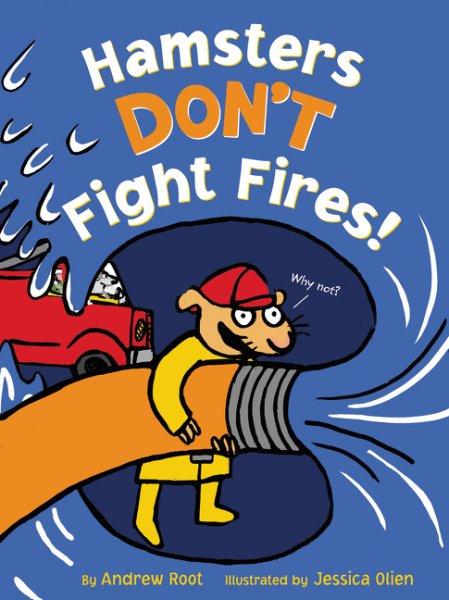
There will be times when your desires, your passion for a particular outcome, will appear downright silly to anyone but you.  Hamsters DON'T Fight Fires! (Harper, an imprint of HarperCollinsPublishers, September 12, 2017) debut book by author Andrew Root with illustrations by Jessica Olien tells the tale of a hamster with a big idea.  When you consider the size of an average hamster is about six inches long, this little guy's ambitions are off the charts.

Hugo was a hamster.

As a hamster Hugo had certain stellar attributes; some being generosity, quality cuisine creator, careful eater and a dancer ranking up there with Fred Astaire.  Hugo was wise enough to know there were certain things at which he did not excel.  In addition to being short and not exactly strong, he was not what you would consider a good candidate for a career as a firefighter.

He could not shake his deep desire to be a firefighter because there were some aspects of the job, he knew he could do.  Hugo's willingness to help others plus his love of the fire engines and the attire of the firefighters were certainly assets.  His best friend Scarlett, a snake, shared her unlikely dream, encouraging him to persevere.

(Let's pause here for a second, reader.  If a hamster and a snake can be friends, perhaps Hugo has a chance at being a firefighter.)

With hope in his heart, Hugo had a chat with the chief at the fire station.  Unfortunately there was one problem after the other with the suits being too large the least of his obstacles.  Hugo was suddenly jolted out of his dejected thinking when the fire station received a call for help.  A fire was raging in Great Woods.

Before he knew what was happening he was given a too-big suit and was riding on the back of the fire truck.  At the site of the fire Hugo felt more frustrated than ever at his inability to help but a frightened 

CHEEP! CHEEP! 

sent him into creative action.  The fate of the baby bird and Hugo's career is left for you to discover.  Let's just say there's a new 

four-alarm firehouse chili

being cooked down at the station.


When Andrew Root begins this narrative with a simple declarative sentence we can immediately conjure a vision of the physical characteristics for Hugo. When Andrew continues with a list of his personality traits and those things at which he struggles, this gives readers a bit of comedy.  It's not all hamsters who can win running races or should avoid bowling.  You have to admit, too, the words hamster and firefighting are rarely seen in the same sentence together.

This is when the soul of the story is presented through the remarks of Scarlett, bolstering Hugo and helping him to maintain hope.  Andrew allows us to see Hugo's passion become tangible in his actions.  Here is a sample passage.

Hugo was still nervous, but he decided that Scarlett was right.
Even though he was small, perhaps he should try to become a firefighter.
He gathered his courage, walked down to the station house, and convinced
the chief to give him a chance.


When readers get a first look at the opened matching dust jacket and book case, they will be amazed to see a hamster holding a fire hose.  It's a fabulous design technique to have the spray of water make a circular frame around Hugo.  The use of primary and secondary colors for most of the book along with the heavier black outlines has huge appeal for the intended audience.  

To the left, on the back, set within a red canvas is one of the interior images.  Within the oval, Hugo is having a hard time sliding down the fire pole. It is a tad bit too high.  Bright orange covers the opening and closing endpapers.  Another interior image is featured beneath the text on the title page.

Using Photoshop the illustrations were created digitally by Jessica OlienTo enhance pacing their size varies from double-page spans to groups of small vignettes and to single-page pictures.  The thoughts of Hugo and Scarlett, their dreams, are shown in large loose circles like balloons.  Jessica adds her own bits of humor and reinforces the notion of working with perseverance toward your goal by, for example, showing Scarlett with her tail through the handle on a cup of coffee labeled NASA. (You have to read the book.)  Her use of color and the facial expressions on the characters heighten the emotion in each given situation. 

One of my favorite of many pictures is when Hugo is first riding on the back of the fire truck.  This spreads across two pages.  In the far right corner is a section of grass along the roadway.  From there to the left page edge is the road.  A blue car is driving away at the top of the right side.  Most of the pages are filled with the back of the fire truck.  We can see the ladder on the top.  Hanging on to the back is the chief, a raccoon.  Next to him on the left is Hugo, gripping the edge for dear life.  His mouth is wide open.  (I wonder what he is saying.)


Younger readers will easily identify with Hugo in Hamsters DON'T Fight Fires! written by Andrew Root with illustrations by Jessica Olien.  They will comprehend size should not hamper your dreams while enjoying Hugo's journey.  I can't wait to share this title with readers.  You should share it with your readers too. They will find Hugo absolutely adorable.

To learn more about Andrew Root and Jessica Olien and their other work, please follow the links attached to their names to access their websites.  The book trailer was premiered at Scholastic's Ambassador of School Libraries, John Schumacher's website, Watch. Connect. Read.  I believe you are not only going to enjoy the fresh, snappy trailer but the manner in which Andrew completes John's sentences.
 

Monday, February 13, 2017

Sharing The View

There are distinct advantages to being small in size and height.  You can be comfortable in small spaces when traveling.  When wanting to curl up on a sofa or chair to take a snooze or read a good book, you'll be cozier quicker than most other people.  You will always be excellent at playing hide-and-seek.  When you need to reach something on a grocery shelf, you can feel confident stepping on other shelves to reach an item, knowing nothing will break.  Your younger students will feel like they share something in common with you.  Your older students will get a kick out of coming up to you and stating, "I'm almost taller than you are."

One notable disadvantage is the overwhelming feeling of not being able to see when you are in a large crowd.  Thankfully our other senses are stronger when one is unable to function properly.  Pax and Blue (A Paula Wiseman Book, Simon & Schuster Books For Young Readers, February 7, 2017) written and illustrated by Lori Richmond gives us a peek at a budding friendship between a human and a bird who share common character traits.  The boy has, as you will discover, another beautiful sense he has nurtured.

Some kids have a dog or a cat or a fish.
Pax has a pigeon he calls Blue.

Each morning Pax chats with Blue and gives him a bit of toast.  He understands very well how being little can be a challenge.  One morning Pax's mom is in a hurry.

Pax can't chat with Blue.  Pax can't give Blue a piece of toast.  Pax is being pulled along by his mom.  Blue does not understand.

Pax is very worried about leaving Blue without so much as a word or sharing his food.  Blue does what any hungry, lonely pigeon would do.  He follows Pax.  Immediately Blue can see this is a mistake.  Everyone is huge.  Where is he?

When Blue's presence is discovered on the subway car, feathers fly, literally and figuratively.  The adults create chaos.  Pax creates peace.  He is thrilled to see his friend.  He knows exactly what to do.  When some least expects it, a child becomes a hero.


Children have an innate desire to help those, especially animals, not noticed by adults.  They feel a kinship with them.  Lori Richmond has expressed this desire and kinship wonderfully.  In her simple sentences she speaks to the empathic portion of all readers' hearts which may be large or in need of growth.  In the character of Pax she shows us how a relationship is formed between a child and an animal.  She also helps us to understand once a friendship like this is formed, a true friend feels responsible. Here are several sentences (which can be seen with the illustrations at the publisher's website).

But this morning was different.
Pax knew little ones can get rushed along---
especially when Mom can't be late.
Blue didn't understand.

And there was no on to explain.

The deliberate, limited color palette seen on the opened dust jacket is used by Lori Richmond throughout the book.  The only stand-out colors are on Pax and Blue drawing our attention to them rather than the other people or the surroundings.  To the left, on the back, is a rear view of the subway car with the ISBN strategically placed.  Staring out the window is the head of Blue.

A pale purple covers the book case.  A wide, black spine extends into the canvas.  Walking across the bottom beneath the title text and author name is Blue, tracks extending from the back to the front.  On the spine the text is in silver foil. The opening and closing endpapers are a shade of the green seen on the front of the dust jacket.

Rendered in ink, watercolor, and charcoal, and composited digitally each image is a delicate portrait enhancing the text.  Some of the illustrations are placed on one page loosely framed on the matte-finished paper.  Others extend across two pages, edge to edge.  For emphasis and emotional impact Lori places single elements on one page, shifting the perspective.  Her stacked picture of the interior of the subway station is brilliant.

One of my many favorite illustrations is of Pax looking at Blue after pandemonium broke out in their car.  There is quite a bit of purple on this page.  On the right Pax is hanging upside down looking under the seat at Blue on the left.  All we see of both of them is their heads (and one of Pax's hands).  It is a huge moment of connection between friends.


In a busy world where everything seems to move at a too-fast pace, Pax and Blue written and illustrated by Lori Richmond is a marvelous reminder for us to notice those smaller than we are.  It asks us to view the world with the eyes of others and to choose compassion.  I highly recommend you place this on your professional and personal bookshelves.  I would pair it with Little Elliot, Big City and How To Be A Bigger Bunny.

Take a moment or two to visit Lori Richmond's website by following the link attached to her name.  She has a page talking about the creative process for this book.  Follow the second link attached to her name.  At the publisher's website you can view interior images.  Lori has been interviewed at Mile High Reading,  Karlin Gray's blog, Monica Wellington's news,  KidLit 411, and 32/7.  You can read about Lori Richmond's family vacation journals at the DailyMail.

Monday, November 14, 2016

Inching Upward On The Outside

As a teacher librarian you see all the students each and every year as they attend your particular school.  Regardless of the level, elementary, middle or high school, they take great delight in measuring their height to yours. When you've been a whopping five foot, one and a quarter inch tall your whole adult life, their joy at finally getting close to or exceeding your height usually results in laughter for everyone.

On February 10, 2015 readers were introduced to a young frog with very particular opinions on his state of being in the title I Don't Want To Be A Frog.  He's back in a companion book I Don't Want To Be Big (Doubleday Books For Young Readers, October 11, 2016) written by Dev Petty with illustrations by Mike Boldt.  He may have accepted being a frog but he is more than determined to stay small.

You need to eat your dinner.
I don't want to.
You don't want to GROW?

Frog and his dad are engaged in an interesting conversation.  His father wants to understand and Frog is more than ready with an explanation.  Frog is a tad bit worried about getting too tall.  Then he's concerned about being too small.  (Ants are a part of their food group.)

Being tall is not on Frog's wish list.  In his way of thinking his dad can carry him to anything worthy of seeing.  As far as reaching delectable delights, he makes a valid point. He has 

BIG friends.  

When his dad finally sits him down to probe further into his lack of desire to be big, Frog has a lengthy litany of reasons.  He is positively certain of not wanting to be big.  As he is making a visual comparison, Pig wanders into their discussion.

Frog says the problem is he simply does want to be big regardless of Pig's reasonable reply of things, by their very nature, growing.  Pig points out some of the advantages of being big like mud and garbage.  It's Pig's final observation that throws Frog into the middle of a free-for-all.  A long held secret of generations is shared.


Told entirely in dialogue the parent and child each speak perfectly in their roles providing a contrast brimming with humor.  Dev Petty has a creative knack for getting inside her character's minds and speaking for them with a knowing voice.  After Frog's initial declaration, his dad patiently asks questions.  Frog's answers lose their credibility because his logic seems a little off.  This technique by Petty leads to Pig's final revelation, getting to the heart of why Frog does not want to grow. Here is a portion of the continuation of the first three sentences.

I don't want to be BIG.
Why not?
Well...first you're one inch,
and then two inches, then three...
When does it stop?
You can't stay small forever.
An ant stays small forever.


The bright, bold colors on the matching dust jacket and book case are used throughout the title.  You can feel a laugh bubbling up inside you as soon as you see Frog sitting by the letter G with his arms crossed, declaring the title.  To the left, on the back, using the ISBN as his soapbox, Frog issues another announcement as one of his big friends (with a trunk) fills most of the space, looking cramped.  On both the opening and closing endpapers, this big friend is holding a pencil to mark Frog's position on a vertical ruler.  There is a difference between the two reflecting the conclusion of the narrative.  On the opening flap, Frog begins his case for not being BIG with a hilarious outburst.

What makes the illustrations in this book truly enjoyable and downright fun are the various backgrounds, element placements and perspectives illustrator Mike Boldt uses.  His canvases are pale green, white, lavender, light blue, a faint golden hue, dark purple, and bright yellow.  In the speech bubbles certain words are sized larger and colored differently to intensify their meaning. 

Many of the pictures are on single pages but when the double page images appear, they make you stop and notice the shift in the story.  The first one is wordless.  After seeing it you will tend to agree with Frog's answer to his dad.  It's the facial expressions and body postures of the characters which elevate the laughter factor to new heights.  

One of my favorite illustrations is on a single page.  It is in reply to one of Frog's questions.  Frog is sitting on the ground, mouth wide open and pointing. Next to him is a tree...a big tree. Regardless of the size an elephant fails to hide behind it.  The elephant is saying in a quiet voice...Nope.


I Don't Want To Be Big written by Dev Petty with illustrations by Mike Boldt will have readers laughing continuously.  The images extend the humor of the story at the perfect place, on point every time.  Be sure to read this aloud repeatedly using your best frog and pig voices.  

I know you'll want to learn more about Dev Petty and Mike Boldt and their other work.  You can find this by visiting their websites, following the links attached to their names.  They both maintain blogs here and here respectively.  Author Dev Petty is interviewed at KidLit 411.  John Schumacher, Scholastic's Ambassador of School Libraries, showcased the cover reveal and book trailer on his blog Watch. Connect. Read.  Dev Petty takes over the blog for the cover reveal chatting about the book.  She comes back again for the book trailer release.  You can get a peek at some interior pictures at the publisher's website.

Monday, March 7, 2016

A Puzzling Predicament

For three hundred sixty-five days you and your best friend have been planning for this single day of pure childhood bliss.  Squirreling away weekly allowances and odd-job monies earned in the neighborhood are part of the grand scheme.  Past experiences help you to generate a list of those places you must visit and of those things you must do.  You have been dreaming with ever growing excitement about the mix of sights, sounds, smells and tastes of an afternoon at the fair.

It seems as though the car ride is endless but your parents finally have the car parked; you and your friend are walking to the entrance.  Strolling through the gateway, you stop and look at each other, your grins growing.  You Must Be This Tall (Margaret K. McElderry Books, an imprint of Simon & Schuster Children's Publishing Division, March 8, 2016) written and illustrated by Steven Weinberg (Rex Finds an Egg! Egg! Egg!) is about a day at the fair full of the expected fun of shared activities with more than one surprising twist.

Frank and Harold are at the fair.

Frank and Harold are as inseparable as the proverbial two peas in a pod except they are snakes.  Of the pair Frank is very long (tall) and thin.  Harold is much sturdier and shorter.

As soon as they can, they are enjoying one romping, rollicking ride after another.  Certainly this twosome is nearing exhaustion or at the very least dizzy from all their experiences.  On the contrary, they nearly shed their skins when they see the ultimate fair marvel spread before them, The Rattler.  This is the roller coaster of all roller coasters.  There is one huge problem.

A very persistent pig announces:

YOU MUST BE THIS TALL.

Harold is too short.  Even standing on the tip of his rattle, Harold is a smidgen too small.

Ever the faithful friend, Frank has a plan.  Actually Frank has several plans.  A costume booth helps them with Frank's first idea.  Unfortunately the proprietary pig has keen eyesight.  Will the high-wire, trapeze strategy work?

Frank's final approach to this dilemma is so shocking readers will be stunned.  They can't believe they are witness to this tactic but they might find themselves bursting aloud in laughter.  A persnickety pig meets his match.


Each sentence written by Steven Weinberg builds a narrative not unlike a roller coaster.  We go up, up, and up enjoying all their fun and then plunging down when they encounter the height requirement.  As Frank puts his plans into action we start going up, up, and up again and down over and over until we reach the top, crowning achievement.  When we descend to the start it is with great satisfaction.

Lots of action is infused into the story with word choices like slammin' and bouncin'.  Adjectives like scary and smelly are completely understandable and reader friendly and sure to elicit knowing nods.  If your younger self (or in my case recently) has tried to reach something on a top shelf, like hidden cookies, two of the pages might find you sitting up straighter or standing on your tippy toes.  Here is a short sample passage.

No fair!
Hang in there, Harold.
Frank has a new idea...
Together they
s t r e t c h ! ...


A kaleidoscope of color in a full illustration stretching from side to side on the open matching dust jacket and book case greets readers' eyes.  We immediately understand the problem Frank and Harold are facing.  Frank looking longingly to the left watching others, a rabbit, duck and beaver, ride the Rattler, increases our empathy.  On the opening and closing endpapers on a darker teal canvas Steven Weinberg has placed a woven wonderment of snake bodies stretching from top to bottom in vertical, rows, looking like an intricate fun-filled maze.  Careful eyes will note the differences between the two endpapers.

Frank and Harold are featured in their contrasting lengths (heights) on the two pages dedicated to the title.  Frank is hanging over the row of fair pennants mouth open above the T in tall as Harold strives to reach the top of the letter L.   Their friendship is further depicted by their happy postures on the verso and dedication pages.

Rendered in watercolor and pencil, then colored digitally the images match the pacing of the narrative.  A blend of single page visuals is followed by several smaller pictures grouped together and then there are double-page spreads.  One of them requires readers to rotate the book vertically as the pig proclaims the requirement each time.  As the team races toward the final outcome Weinberg uses only large visuals across both pages.

The expressions on the faces of Frank and Harold are sure to have readers smiling.  Frank's tongue is as demonstrative as his body.  All kinds of animals are enjoying the fair; a moose, shark and turtle ride the roller coaster on one of the interior images as two mice, a balloon-carrying turtle and an elephant stand in line. (The mice suffer the same fate as Harold.)  Frank's friendship toward Harold is continually noted by the curling of his body's around Harold in comfort.

One of my favorite illustrations of many is the first one.  Frank and Harold have just entered the fair.  They are standing beneath two strands of pennants.  In the background without the firm, bold, and blue outlines is the pink and brown landscape of a desert.  Harold and Frank are holding ice cream cones with the ends of their tails, although the scoop is falling from Frank's cone.  Their grins could not possibly be bigger.  A nearby cactus acts as a holder for three small white flags.


To reinforce the power of friendship, teamwork and the unforeseen twist a story can take You Must Be This Tall written and illustrated by Steven Weinberg is a splendid choice.  I am certain you will be reading it more than once at a sitting.  The subtle word play will be duly noted by the more sophisticated readers.  You'll want to find this title at your favorite book shop tomorrow on its release date.

To learn more about Steven Weinberg and his other work please take a moment to visit his website by following the link attached to his name.  At the publisher's website you can view several interior images.  When his first book was released author, reviewer and blogger Julie Danielson hosted Weinberg at Seven Impossible Things Before Breakfast.

Wednesday, December 30, 2015

Be Aware Of These Bears And Their Books Part I

An unexpected encounter with them puts our lives in danger.  They are the largest land carnivore on our planet.  They are ferocious but generally shy and when observed from a safe distance intriguing. When seen in a toy shop, we select them to become cherished friends.  In 2002 a centennial celebration marked their creation.

In literature, as characters, we laugh at their antics, marvel at their insights and ingenuity and more times than not make room in our hearts for what they represent. As 2015 comes to a close there are five titles featuring bears I would like to highlight in two separate posts.  I Thought This Was A Bear Book (Aladdin, an imprint of Simon & Schuster Children's Publishing Division, August 4, 2015) written by Tara Lazar with illustrations by Benji Davies gives readers a peek at the potential for problems when books fall from a shelf.

Once upon a time there were three bears.
Zark! Zoot! Zinder!
DOING  WHOOSH  CLANG 

A spacecraft crashes into the woods normally populated by residents from the land of fairy.  A green being has lost his book and needs to return to Planet Zero.  No one is more surprised by this turn of events than Papa, Mama and Baby Bear.

Prince Zilch is panic-stricken at his plight.  He needs to return to page twenty-seven immediately.  These berry-picking bears, who are sick of eating porridge, are unfortunately more interested in exploring his other-worldly vehicle.  Their fumbling fixes any chance Prince Zilch has of leaving on schedule.  Both the alien and largest bear appeal to the reader for help.  As luck would have it you-know-who, the girl with the golden hair, arrives.

With only certain items on hand, chairs, beds and busted bits, the bears do their best to assist the royal visitor out of their story.  Nothing seems to work.  As parents snooze, Baby Bear proposes a plan.  It might work.  WHOA!  Now look what we've done!


With a talent for fracturing fairy tales Tara Lazar very quickly alters the norm by introducing a character from a different galaxy...er...story.  His language is easy to understand although he does tend to favor the letter z.  Told entirely in dialogue between the characters and at times directed at the reader, humor is prevalent.  The use of alliteration adds to the buoyant cadence.  Here is a sample passage.

Papa Bear Well, maybe you can bounce out of the book using our beds.
Goldilocks Jeesh, can't a girl get some shut-eye around here?


Digitally rendered using an array of hues, leaning toward secondary colors, Benji Davies introduces the characters on the front of the matching dust jacket and book case.  He peaks our curiosity as to the importance of the open books with familiar faces looking from and leaving the pages.  To the left, on the back, Papa, Mama and Baby Bear are walking away from us toward the berry bushes.  Prince Zilch is zooming past with his signature pink cloud trailing behind his spaceship.

One of the shades of green from the bears' book is used on the opening and closing endpapers.  A page turn shows a child leaving a book case as books slip from position and fall to the floor.  An alien vehicle zooms from one into Goldilocks & The 3 Bears.  On the verso and title pages the image from the back of the jacket and case is extended with an enlarged book on the left.

Picture sizes vary from two pages to single pages and to several on a single page.  Many of them have rounded corners with white space acting as a frame.  The dialogue is placed in colorful balloons of pink, yellow, orange and two shades of blue depending on who is speaking.  Plan on laughing out loud at the details Davies adds to enhance the story.

One of my favorite illustrations spans two pages.  First the alien and then Papa Bear are talking directly to the reader.  The fallen spaceship is behind them.  Behind the vehicle Baby Bear and Mama Bear are smiling and waving at a busload of tourists who have stopped to take their pictures as if they are bears in a national park.  I dare you not to smile.

I Thought This Was A Bear Book written by Tara Lazar with illustrations by Benji Davies is definitely a bear book filled with fractured fairy tale fun.  It's a tribute to the power of story and those who read them.  To discover more about Tara Lazar and Benji Davies please follow the links attached to their names to access their websites.  Tara Lazar includes a teacher's guide and fun activities as well as links to other posts about this book.  At the publisher's website you can view three additional interior images.  


Readers were and will continue to be enchanted with the father and son duo and their winding adventures in The Bear's Song and The Bear's Sea Escape.  In a third title, The Bear's Surprise (Chronicle Books, September 15, 2015) written and illustrated by Benjamin Chaud spring has sprung.  Roles are reversed as Papa Bear seems to have vanished.

Deep in the forest, Little Bear awakens to the sounds of spring.  Outside his cozy den, birds are chirping, animals are scurrying, and Little Bear smells the sweet scent of flowers.

Little Bear's joy at the shift in the seasons is short-lived as he notices his father is absent.  Could he be near the yellow glow beyond the trees?  The shining sun lights the way along an unexplored trail.

Within mere minutes Little Bear is standing in front of a large hole in a hillside.  Could this lead him to Papa?  It's a huge, huge cave filled with beings from fantasy, now and the past.  Oh!  What's this?

How did Little Bear get into a washing machine?  Who are all these creative creatures and people straight from the realm of whimsy?  Little Bear rushes toward a large red tent.  He thinks he spies Papa Bear's behind.  A crowd has gathered and is making their way toward seats.  Suddenly the lights are lowered.

Papa Bear and Little Bear are making magic with their planned and unplanned performances.  The watchers cheer and applaud as Little Bear soars higher and higher.  He flies.  He lands.  He leans.  Oh. ... This is indeed a surprise, a wonderful gift of spring.


Carefully written sentences, brimming with descriptive adjectives and verbs, place readers squarely in the bears' world.  Benjamin Chaud repeatedly asks readers questions, inviting them to turn the pages closely following Little Bear.  Punctuation asks us to pause and ponder his next move.  Here is a sample passage.

Little Bear darts through a collection of quirky clowns, costumed cats, and other curiosities until he spots something behind a great red curtain.  Isn't that Papa Bear's fuzzy brown bottom?  With three quick hops, Little Bear enters the circus tent.  What will he find?


The muted earth tones seen on the matching dust jacket and book case are used by Benjamin Chaud throughout the book.  The fine lines, multitude of details and fascinating characters are his signature style for these bear books.  To the left, on the back, a small oval image amid a golden yellow background foreshadows the surprise.  A similar hue colors the opening and closing endpapers acting as a canvas for a pattern of large white stars.  On the opening right side Baby Bear is seen flying through the air wearing a circus hat.

Beginning with the title page Chaud starts his new technique for this title.  Each two pages contain one or more cut-outs encouraging us join Little Bear.  You will marvel at their placement.  The exquisite intricacy of the elements placed in each two-page illustration will take your breath away.

One of my favorite pictures is when Little Bear goes into the hole in the hillside and enters the cave.  All the passages and little rooms are amazing.  They are filled with creatures you might expect to see; foxes, moles and a skunk.  There is a tiny yellow submarine exploring in the water.  A creature from the age of dinosaurs hangs from the ceiling as bats flit from place to place.  People from the past and present have made their homes here.  You will gasp when you spy two memorable fictional characters.


The Bear's Surprise written and illustrated by Benjamin Chaud is another stunning title in the series.  Readers of all ages will read this over and over looking for new items on every page.  At the publisher's website three more images can be viewed.  Even though this book trailer is in French you can get a closer peek at some of the pictures.  It's also interesting to see the dust jacket used for the French version.


As she did in Inside Outside and Flashlight Lizi Boyd asks us to expand our inventive nature in her newest title.  Big Bear Little Chair (Chronicle Books, October 6, 2015) is a book of concepts.  Opposites combine, two characters' lives intertwine.

Big Bear
little chair
Big Plant
little cocoon

A bird, a zebra, a butterfly, and an elephant are paired with a trick, a rock, a broom and an umbrella.  Is that a star and the moon?  Little Bear is as surprised as Big Bear to see the size of his chair.

What do an owl, a meadow, a lion, a sea, a rabbit and a forest have in common?  They are all matched with little things.  Most are normal, but one is quite extraordinary.  Ahhh....now Big Bear and Little Bear are together next to a little chair (and a big chair).

Another item has been added to the comparisons.  We read from big to little and finally to tiny.  Who's driving the little bus?  What's near the big seal?  Who's walking through the little village in the big snowstorm?  Tales are told.  There are bears in chairs too.


Lizi Boyd divides the book into four sections.  Within the first three she includes six comparisons.  The attention of readers is guaranteed with her ingenious selections.   With each page turn we wonder if we will see an owl on a branch or a zebra with a broom.


Red, white, black and gray are the only colors Lizi Boyd uses in this title.  The red is extended on the dust jacket and book case to the back on the left.  The circles used to hold the title text on the front frame pictures of an owl, an elephant and a turtle on the back.  The endpapers are done in two shades of gray, each with a different graphic design.

A variety of shapes are featured in each single page visual.  Rendered in gouache the lines range from delicate to precise.  Careful readers will notice how the expressions change on Big Bear and Little Bear as the book progresses.  Each animal showcased in the images is content and smiling.

One of my favorite pictures is for big meadow and little salamander.  The flowers in the meadow are done primarily in gray with added details in black on a white background.  The lines are extremely intricate.  Tucked in at the bottom is a small bright red salamander.

Big Bear Little Chair written and illustrated by Lizi Boyd is many things in one.  The graphic designs are impeccable.  The size and shape of the book is perfect for the intended audience.  To learn more about Lizi Boyd please follow the link attached to her name to access her website.  At the publisher's website are three more interior images.  Lizi Boyd wrote a blog post at Chronicle Books about this title.  Enjoy the book trailer.


Monday, August 4, 2014

In Small Packages

By the time I got to high school, it was abundantly clear my growth spurt was over.  My short stature even earned me the nickname "Stub" given to me by one of the tallest guys in our graduating class.  Difficulties continued in college especially waiting in crowds to enter the auditorium on campus for concerts.  Even today, after large sporting events, I fight the panic of not being able to see in the crush of people moving toward the exits.

Being a smaller person allows you to have a tried and true empathy for all the students who pass through your classroom at the elementary school level.  In your heart of hearts you understand how a taller person can glance around a room or scene missing someone as if they are invisible, not necessarily because of age but because of height.  Debut author illustrator Mike Curato gives us a peek into the world of a big-hearted being in Little Elliot, Big City (Henry Holt and Company, August 26, 2014).  

Little Elliot was an elephant.

Looking at Elliot it's easy to see how he would stand out in a herd of elephants gathered around a watering hole.  He happens to be white with pastel polka dots.  He is also rather small in size.

Place this little guy in a big city where he lives and he just about disappears among the throngs of people, cars and buses and tall buildings.  Things others find easy are downright challenging for him.  You try catching a cab when your dimensions are similar to a fire hydrant.

Even though the easiest of tasks at home takes extra effort, Elliot is one positive pachyderm looking for the smallest gifts life offers.  He does not miss what others might.  There is one other thing too.  Elliot loves cupcakes.

His quest for this delicious delectable bit of confection is not without its own trials.  But...even down in the dumps, this little elephant takes notices.  A trunk can reach new heights especially with the help of a friend.


Spare text, single explanatory sentences or a meaningful phrase, penned by Mike Curato tell Elliot's story of life in the big city.  Each choice made by the narrator is careful; opening the way for pictorial interpretation.  By the second sentence readers feel a compassion growing for this little elephant.  There is not one among us who has not felt different than others on at least one occasion.


Rendered in pencil, then scanned and colored in Photoshop (thank you for answering my questions Mike Curato), the soft warmth of the illustrations begins on the dust jacket.  Two things stand out on the front; the joy of Elliot and the depiction of the words big city as if they are lighted buildings in the cityscape.  The back asks a question and gives an answer while picturing a turn of events.  The opening and closing endpapers are patterned in pale blue and pink dots acting as frames for images of cupcakes, Elliot and his quirky-eared pal.

Beginning with a rich two-page spread, Mike Curato introduces us to Elliot as he walks down the steps of his row house in the city.  With a turn of page we are inside, noting the decor from decades earlier as well as the framed pictures of desserts on the wall.  As Elliot emerges from the subway (and next, below, as he waits for a train) we become fully aware of his size amid the vehicles, people and buildings of the busy street.

Providing interest to engage his readers Curato alters his image sizes; two-page and single page to accentuate a thought or a series of smaller visuals to define a statement. His shading, the play of light and shadows, is marvelous.  This coupled with the color palette assists in creating a feeling of nostalgia, a comfort associated with home.

I love every single illustration in this book!  Elliot sitting in the sink to wash his dishes, the little girl on the wordless two pages noticing him standing off alone in the crowd, and the picture of the cupcakes, Elliot's trunk peeping just above the counter with his friend perched on the end, a monetary bill waving in his extended hands are three of my favorites.  I think I actually sighed when I saw the last two pages of the night skyline, the outline of the lighted bridge and my eyes drawn to the happy setting looking through the window in Elliot's home.


I predict a HUGE gathering of readers of all ages (and sizes) falling in love with Little Elliot, Big City, a heartwarming tale of friendship found, written and illustrated by Mike Curato.


Please follow the link embedded in Mike Curato's name to access his website.  A blog tour will be beginning soon.  All the information is on this page.  Follow this link to the publisher's website for an Activity Kit.  UPDATE: Here is an interview of Mike Curato at Seven Impossible Things Before Breakfast.  Here is the link to a blog post released on August 26, 2014 by Mike Curato.  Follow this link to Matthew C. Winner Let's Get Busy podcast with Mike Curato.


I received an ARC of this title from my favorite independent book store, McLean & Eakin Booksellers of Petoskey, Michigan.  I have a copy on order with them.  I hope you, too, can obtain your copy of Little Elliot, Big City from your favorite independent book store.  Be sure to check your nearest public library also.

Tuesday, July 8, 2014

Point Of View

It happens when you use a magnifying glass. It happens when you look through a microscope, a telescope or a pair of binoculars.  It happens when you select zoom or wide angle on a camera.  It happens when you look through your picture window at night; then deciding to go outside, lie down on the grass and look up at the starry sky.

Every single time you have changed your perspective.  In doing this you are making before and after comparisons; adjusting the proportions according to how things are being seen.  The newest title by author illustrator Henry Cole, Big Bug (Little Simon, an imprint of Simon & Schuster Children's Publishing Division) explores the concept of scale by taking readers on a journey to a farm.

Big bug
Little bug
Big leaf

Beginning with a familiar insect found nearly everywhere except for the extreme northern and southern regions of our planet, we get up close and personal with a ladybug.  When we step back we can see how much smaller it appears on a leaf.  Moving even farther away the leaf is only one of many on the stalk of a wildflower.

A curious dog wanders over to the bunch of flowers leaning in to smell them; adding another dimension to the perception of size.  In a field a milk cow turns to look at the dog.  They are both animals on a very large farm over which a cloud-studded sky stretches.

On the now dwarfed farm (beneath the canopy of the sky) there is a tree.  Readers are taken back to locations near the buildings, moving toward the barn and then the house.  The day is coming to a close as we draw near to a single luminous window.  Inside the farmer is petting the dog.  Something else has made its way into the house.


Using only forty-nine words in a collection of two word phrases all of which include either big or little Henry Cole masterfully constructs a meaningful narrative.  Readers quickly become comfortable with the alternating cadence predicting the comparison to come on the next set of two pages.  Cole is careful to include only those elements easily identified by younger readers as normally found on a farm and the surrounding area.


It's as if we have become a ladybug ourselves as we look at the open dust jacket and book case on Big Bug.  It's a nice design item to have the title as an overlay.  Opening the cover we zoom back to see a pale leafy green background sprinkled with bunches of tiny ladybugs on the opening endpapers. (The closing endpapers are part of the story.  You will have to read the book.)

Each illustration extends edge to edge in an array of realistic rich colors.  You feel as though you've stepped into the center of a pastoral setting; taking a day to wander and wonder.  Having been raised on a farm, Cole adds warmth to each picture with known details.

For each contrast we might zoom in or out depending on Cole's depiction of the subjects.  This, incorporated with the narrative, adds interest.  The text for each comparison reflects word choice; a larger font for the big phrase, a smaller size for the little phrase.

Of course my favorite illustration is the one depicting

Little flower
Big dog

bringing our attention from right to left toward the dog's face near the flowers.  The brush strokes, line work and shading contribute to a texture we can nearly feel as we touch the page.  It's easy to imagine a slight breeze blowing through the grass, hearing the sniffing of the dog and bending to smell sunshine caught in its fur.


Big Bug written and illustrated by Henry Cole is brilliant in its simple portrayal of scale.  Not only does it introduce readers to this concept but encourages them to make their own observations in their own settings.  I can envision using this book to promote discussions as well as combined visual and writing mini-projects using traditional, digital or virtual tools.

For more information about Henry Cole visit his website by following the link embedded in his name.  He includes numerous pages about his illustrative process. This link takes you to the publisher's website offering a peek at several pages.  There is a series of interviews with Henry Cole at Reading Rockets.  Enjoy the video below.


Reviewed from my own copy purchased at McLean & Eakin in Petoskey.