Quote of the Month

When love and skill work together, expect a miracle. John Ruskin


Showing posts with label Perseverance (Ethics)-Fiction. Show all posts

Wednesday, November 3, 2021

Better Together #4

Each day circumstances present opportunities for us to discover potential personality traits or increase (or decrease) those we already have.  We may be shocked at what is revealed.  It is in these revelations our confidence grows.  Our comfort in expressing ourselves is deepened and widened.  

We come to understand there is more than one definition for certain attributes.  Be Strong (Roaring Brook Press, August 10, 2021) written by Pat Zietlow Miller with illustrations by Jen Hill, a companion title to their Be Kind (Roaring Brook Press, February 6, 2018), addresses this very concept.  A young girl struggles with being strong and its various meanings and power.  Her ultimate understanding benefits everyone.

My school gym has tall walls.
I never noticed them before.
But, today I have to climb them.

Classmates make it to the top of the wall without struggling.  Tanisha cannot get beyond the bottom.  She does not have the strength to pull herself up.

Some days, trying to lift the simplest things, are hard for her.  Her family tells her to be strong.  This is how you get through the tough times in life.

When she asks for help, Dad, Mama, and Grandma Zee give her real-life examples of strength.  Being strong is sacrificing your time to help others, speaking up again and again to right a wrong, and committing to a goal.  At school and home, Tanisha notices moments to put their advice in action.

Dad, Mama, and Grandma Zee each offer one more suggestion.  Sometimes the tasks she attempts seem daunting, but first one thing, then another thing, and finally a third thing keep her going. And Tanisha learns the most important definition of being strong.  What do you think it is?


To begin, Pat Zietlow Miller gives us a problem.  Climbing a rock wall is a situation many have faced, so we can easily find ourselves identifying with the protagonist.  She uses this to present other perspectives on being strong, other than the obvious physical one.  In the characters of Dad, Mama, and Grandma Zee and their instances, we see applications for being strong.  These applications are (or may be) present in each of our communities.  Pat Zietlow Miller establishes a rhythm in her storytelling by repeating three two-word phrases three times, connecting separate portions of the narrative.  Here is a passage.

Grandma Zee says being strong means not giving up.
Like when she started running.

At first, she barely jogged a block.
She worried people would laugh.
But she keeps going.

Day after day.
Block after block.
Even when it rains.


One look at the children holding up the sign displaying the title text on the front, right, of the open and matching dust jacket and book case sends a strong impression.  The diverse ethnicity and colorful array of clothing suggest differing personalities who have united in a common cause.  Of particular interest is the purple hue surrounding them.  Purple can imply royalty or in this case, future leaders strong in the knowledge of themselves.

To the left of the spine, on the back, Tanisha and Grandma Zee are featured on a pale and tiny herringbone pattern of white and gray.  They are seated on mats and working on touching their toes.  Over their heads are the words:

Together, we can be strong.

The people and the area closest to them on both the front and the back are varnished on the dust jacket.

The opening and closing endpapers are covered in the bright orange shade shown on the front of the jacket and case in the one child's clothing.  Tanisha and Grandma Zee are presented on the title page using a part of an interior illustration.  Together, they lift a heavy backpack, each grabbing a strap.

Jen Hill rendered these pictures using

gouache on paper and retouched with Adobe Photoshop

The image sizes, full-page pictures, double-page pictures, and two smaller pictures on a page, supply readers will different perspectives.  At times we are observers, watching Tanisha being strong enough to be on stage playing her accordion.  Sometimes we are standing with Tanisha, as if we are her shadow.  These are intimate but brief time periods with this character.

In several of the illustrations, Jen Hill uses white space as an additional element allowing the other elements to seek and hold our attention.  The tiny features on the characters' faces convey a range of emotions.  This is no easy task, but Jen Hill does it splendidly.

One of my many favorite illustrations is on a single page.  It is in the school cafeteria.  Two circular tables are placed next to each other.  Around these muted-yellow tables are deep purple blue chairs.  The cafeteria trays are an orange red in color.  Groups of students at both tables present a diverse representation.  We see Tanisha's strength at work on the table closest to us, toward the bottom of the page.  She is placing a sign on the table.  It reads:

make a friend.


Endearing readers to these characters and their circumstances in Be Strong written by Pat Zietlow Miller with illustrations by Jen Hill is accomplished by the realism portrayed in word and images.  We know people who encounter these same happenings.  And this title offers hopeful, doable solutions readers can use in their own situations.  I highly recommend this title for your personal and professional collections.

In accessing their websites by following the link attached to their names, readers can learn more about Pat Zietlow Miller and Jen Hill and their other work.  Pat Zietlow Miller has accounts on Instagram, Pinterest, and Twitter.  Jen Hill has accounts on Facebook, Instagram, Twitter, and Vimeo.  At Macmillan Publishers you can view interior images.  Pat Zietlow Miller has a guest post at PictureBookBuilders about this title.  She has a video interview at Action News 2, Wisconsin about this book and her other work.


Like the word, strong, the word courage has multiple meanings.  For some individuals, courage is instinctive.  For others, it is learned.  I Am Courage: A Book of Resilience (Abrams Books for Young Readers, September 7, 2021) written by Susan Verde with art by Peter H. Reynolds is the sixth book in a series by these two talented collaborators.  The focus on a single word is enhanced through a first-person narrative of affirmations.

When there are challenges in front of me,
when I feel unstable,
like I might fall . . .

This child's voice tells us that in spite of obstacles and hesitancy, there is a can-do attitude found within them.  Like the engine in the classic The Little Engine That Could, this child keeps going.  Bit by bit with a heart full of faith, this child realizes possibilities.  They state:

I am courage.

Instinct, recognition of one's strengths, and endurance, even in the face of fear, keeps this child moving forward.  A stumble does not stop this person because they have learned to ask others for help.  All these things give this child the courage to use their experiences to support others.

This confidence helps this child to continue no matter what happens.  This child constantly looks to their core for courage.  This, in turn, inspires others.  

I becomes we.  The qualities of one become the qualities of others.  The journey of one becomes the journey of many . . . together.


You cannot read the words written by author Susan Verde in this book without, page by page, feeling a spark inside you grow brighter and brighter.  Through the mindset of this child, we look at each setback as a test to ace.  Throughout the narrative after a series of thoughts, Susan Verde follows with two word:

I am.

She does use courage after those two words several times, but she also uses words synonymous to courage or words in support of courage.  This is how the story flows toward a conclusion embracing other persons in their quest for courage.  Here is a passage.

I can know there is no shame
in sharing.  I tell my story.

I can step in when others are struggling.
I know how to help.


There is much to be learned when removing the dust jacket and opening it up.  For this book, the illustration on the right, front, introduces us to the main character, the voice in this story.  This child, wearing a shirt with a symbolic flame within a shield, is the picture of resilience fueled by courage.  The body language says I stand strong.  In fact, this child radiates this attitude.  The first three title words are done in foil.

On the back, to the left of the spine, the child with their bike is joined by two other children with their bikes and a canine companion.  Each is carrying a flag bearing the flame.  As a reader we wonder how one becomes three (plus one more brilliant being).

Also, by removing the dust jacket, we view a stunning book case.  It is done entirely in black and shades of yellow.  From left to right, with the bikers riding to the right in a row, they appear as a force, a force for good.  The flags are now on the back of each bike.  The dog is carrying a flag in its mouth.  There is a wide band of black at the bottom representing the path.  The children and their bikes are in black except for a lighter yellow inside the wheels.  The background is a marbled golden yellow.  (We later realize this is an interior image.)

A rose swirl, a center spiraling outward, covers the opening and closing endpapers.  Perhaps this is a depiction of the deep down of which the protagonist speaks.  Each illustration by Peter H. Reynolds was

created using traditional and digital inks, gouache, watercolor, and tea.

These double-page and full-page pictures tell their own story.  Peter H. Reynolds uses a boy traveling on his bike to elevate the text by Susan Verde.  He begins with a palette of purple and blue hues transitioning to light, bright, white and yellow as canvases.  He works the dog into the story, first as something possibly to fear, but an accident changes this outlook.  As presented, we cannot help but relate to the three children.

One of my many favorite illustrations (besides the book case) is a single-page picture.  Night has fallen and stars pinprick along the top of the page.  Between a grove of trees, a small tent is pitched.  In the foreground the three children sit on big rocks around a small campfire.  The two boys sit across from each other, the dog, head on paws, next to his human.  The fire lights the face of the girl who needs help.  The main character is telling his story of courage and resilience.


You will want to keep this title, I Am Courage: A Book of Resilience written by Susan Verde with art by Peter H. Reyolds, ready to read repeatedly.  At the close of the book is an author's note and four yoga poses and breathing exercises to inspire you to be your best self.  You will want to have a copy of this book in both your professional and personal collections.

To learn more about Susan Verde and Peter H. Reynolds and their other work, please access their respective websites by following the link attached to their names.  Susan Verde has accounts on Facebook, Instagram, and Twitter.  Peter H. Reynolds has accounts on Facebook, Instagram, and Twitter.  At the publisher's website, you can view interior images.  There are activity sheets to download.


Blog posts, Better Together #1, Better Together #2and Better Together #3, provide other titles to use with these two books if you like.

Saturday, January 6, 2018

Two Letters, A Single Word, A Single Note

With every tick of the clock, the opportunity for change is present regardless of the previous minutes, days, weeks, months or years in the past.  We are six days into a new year.  Anticipation fills the air.  People seem more determined than ever to pursue a difference, a difference for the greater good and ultimately for them.

Throughout social media people are selecting one word to guide them through the year.  These words are highly significant for them.  The explanations they offer for their choices are heartfelt and inspiring.  La La La: A story of hope (Candlewick Press, October 3, 2017) written by Kate DiCamillo with illustrations by Jaime Kim has been on my desk next to my computer since its release.  With each reading the reminder to readers, to me, to reach out with our voice is strengthened.  And sometimes when a single word is lifted in song it resonates more beautifully.

La

A little girl opens her mouth and releases a word into the world, not once, not twice but three times.  She waits for a reply.  She tries again.  There is still no response.

Slightly discouraged she walks until leaves drift down toward her.  She sings her word, hoping for an answer.  The leaves lead her to a place filled with natural splendor.  She continues to send the one-word melody toward a rock, a tree and all the branches on the tree.  She runs along a pond, singing.  She is greeted with silence.

Darkness has fallen. The leaves beckon her back into the special spot.   A strong light illuminates the surrounding area in a beam as it rises in the sky.  The little girl sings.  She does everything she can believing this marvelous moon can and will sing back to her.  The only sound is the stillness of the night.

Sad and a little bit mad, she drags the object she used to get close to the moon back and sits.  As she drifts off to sleep, a soft, gentle La leaves her lips.  A loud musical note wakes her up. In wonder she watches, she runs and a quiet, joyful nighttime conversation dispels her aloneness.


In her singular use of words to express an idea or a belief Kate DiCamillo takes one word, one very small word, and depicts the value in courage and persistence.  She allows us to see how the child does not give up even when exhaustion wraps around her.  Kate also reminds us to wait.  Sometimes the answer we seek takes time to arrive.  It usually appears when we least expect it.  When it makes its presence known, it's much better than we imagined.


Look at the child, hands clasped, foot lifted in a little dance, eyes closed and mouth open in song.  There is something heartwarming and endearing about her facial expression, clothing and stance.  You want to know her.  You want to be her friend.  We are not privy yet when looking at the dust jacket as to the source of the circular light around her but the colors selected suggest a warm connection.  As the shade of rose red bleeds to the spine it leads us to the darker shades of purple indicative of nighttime on the back.  Leaves and stardust frame the words:

What if you were
able to connect with someone?

What if you were
able to sing?

The book case expands on the presentation on the jacket back.  Both sides are covered in purple with star dust.  Extending from the spine are mirror images of flowers and leaves.  The opening and closing endpapers are a silvery blue, like dusk.

Rendered using watercolor, sumi ink, and digital techniques Jaime Kim elevates the narrative to a magical realm.  The type of paper, heavier without any gloss, allows the child, the leaves and additional elements to cast a shiny reflection when tilted in the light.  They seem to move on the pages.  It's a masterful technique.  When the special spot covers two pages, the illustration literally glows.

As the child moves from point to point our eyes follow her flawlessly.  We are completely intrigued with her movements and secretly cheer for her success as Jaime Kim adds new delicate details.  Readers will be captivated by the significance of the leaves.

One of my many favorite illustrations is at night.  The little girl is getting closer and closer to the source of the song she heard.  She steps through tall grasses, parting the plants.  The moon is reflected in the water in front of her.  Stardust and leaves tumble in the air.  Vegetation borders the pond.  A tall tree extends from the right side.  As an inset, Jaime Kim has added a small framed picture on the right side.  It's a close-up of the child's face.  Her mouth is forming an "o" in awe of what she sees.


No matter how many times you read La La La: A story of hope written by Kate DiCamillo with illustrations by Jaime Kim, it will leave you deeply moved and inspired.  Children have many lessons to teach us if we keep open to all they have to offer.  Kate DiCamillo and Jaime Kim both speak at the close of the book.  I highly recommend you place this title in all your collections.  In case you might be wondering about the power of the single word sung, I started singing La La La from my office.  My puppy, Mulan, two rooms away came running.

To learn more about both Kate DiCamillo and Jaime Kim and their other work, please visit their websites by following the links attached to their names.  At Penguin Random House you are given a peek at several interior pages in the book's beginning.  At Candlewick Press there is a teacher's guide about using wordless books in the classroom.  For the introduction of the book trailer Scholastic's Ambassador of School Libraries, John Schumacher, interviews Kate here and Jaime on the following day at Watch. Connect. Read., his blog.

Friday, October 20, 2017

A Can-Do Attitude

Where there's a will, there's a way

This old English proverb has been uttered for centuries usually by parents, mentors or best friends.  It's a small bit of encouragement which rings true.  When will and way coincide great things are achieved; dreams come true.

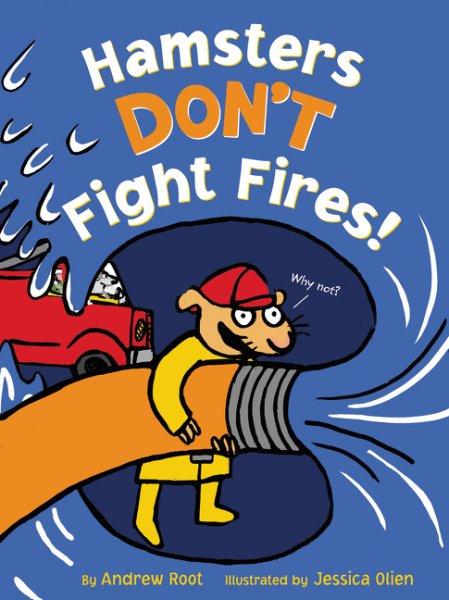
There will be times when your desires, your passion for a particular outcome, will appear downright silly to anyone but you.  Hamsters DON'T Fight Fires! (Harper, an imprint of HarperCollinsPublishers, September 12, 2017) debut book by author Andrew Root with illustrations by Jessica Olien tells the tale of a hamster with a big idea.  When you consider the size of an average hamster is about six inches long, this little guy's ambitions are off the charts.

Hugo was a hamster.

As a hamster Hugo had certain stellar attributes; some being generosity, quality cuisine creator, careful eater and a dancer ranking up there with Fred Astaire.  Hugo was wise enough to know there were certain things at which he did not excel.  In addition to being short and not exactly strong, he was not what you would consider a good candidate for a career as a firefighter.

He could not shake his deep desire to be a firefighter because there were some aspects of the job, he knew he could do.  Hugo's willingness to help others plus his love of the fire engines and the attire of the firefighters were certainly assets.  His best friend Scarlett, a snake, shared her unlikely dream, encouraging him to persevere.

(Let's pause here for a second, reader.  If a hamster and a snake can be friends, perhaps Hugo has a chance at being a firefighter.)

With hope in his heart, Hugo had a chat with the chief at the fire station.  Unfortunately there was one problem after the other with the suits being too large the least of his obstacles.  Hugo was suddenly jolted out of his dejected thinking when the fire station received a call for help.  A fire was raging in Great Woods.

Before he knew what was happening he was given a too-big suit and was riding on the back of the fire truck.  At the site of the fire Hugo felt more frustrated than ever at his inability to help but a frightened 

CHEEP! CHEEP! 

sent him into creative action.  The fate of the baby bird and Hugo's career is left for you to discover.  Let's just say there's a new 

four-alarm firehouse chili

being cooked down at the station.


When Andrew Root begins this narrative with a simple declarative sentence we can immediately conjure a vision of the physical characteristics for Hugo. When Andrew continues with a list of his personality traits and those things at which he struggles, this gives readers a bit of comedy.  It's not all hamsters who can win running races or should avoid bowling.  You have to admit, too, the words hamster and firefighting are rarely seen in the same sentence together.

This is when the soul of the story is presented through the remarks of Scarlett, bolstering Hugo and helping him to maintain hope.  Andrew allows us to see Hugo's passion become tangible in his actions.  Here is a sample passage.

Hugo was still nervous, but he decided that Scarlett was right.
Even though he was small, perhaps he should try to become a firefighter.
He gathered his courage, walked down to the station house, and convinced
the chief to give him a chance.


When readers get a first look at the opened matching dust jacket and book case, they will be amazed to see a hamster holding a fire hose.  It's a fabulous design technique to have the spray of water make a circular frame around Hugo.  The use of primary and secondary colors for most of the book along with the heavier black outlines has huge appeal for the intended audience.  

To the left, on the back, set within a red canvas is one of the interior images.  Within the oval, Hugo is having a hard time sliding down the fire pole. It is a tad bit too high.  Bright orange covers the opening and closing endpapers.  Another interior image is featured beneath the text on the title page.

Using Photoshop the illustrations were created digitally by Jessica OlienTo enhance pacing their size varies from double-page spans to groups of small vignettes and to single-page pictures.  The thoughts of Hugo and Scarlett, their dreams, are shown in large loose circles like balloons.  Jessica adds her own bits of humor and reinforces the notion of working with perseverance toward your goal by, for example, showing Scarlett with her tail through the handle on a cup of coffee labeled NASA. (You have to read the book.)  Her use of color and the facial expressions on the characters heighten the emotion in each given situation. 

One of my favorite of many pictures is when Hugo is first riding on the back of the fire truck.  This spreads across two pages.  In the far right corner is a section of grass along the roadway.  From there to the left page edge is the road.  A blue car is driving away at the top of the right side.  Most of the pages are filled with the back of the fire truck.  We can see the ladder on the top.  Hanging on to the back is the chief, a raccoon.  Next to him on the left is Hugo, gripping the edge for dear life.  His mouth is wide open.  (I wonder what he is saying.)


Younger readers will easily identify with Hugo in Hamsters DON'T Fight Fires! written by Andrew Root with illustrations by Jessica Olien.  They will comprehend size should not hamper your dreams while enjoying Hugo's journey.  I can't wait to share this title with readers.  You should share it with your readers too. They will find Hugo absolutely adorable.

To learn more about Andrew Root and Jessica Olien and their other work, please follow the links attached to their names to access their websites.  The book trailer was premiered at Scholastic's Ambassador of School Libraries, John Schumacher's website, Watch. Connect. Read.  I believe you are not only going to enjoy the fresh, snappy trailer but the manner in which Andrew completes John's sentences.
 

Monday, February 22, 2016

Wily Wind

It can be as gentle as puppy's breath or as fierce as a lion's roar.  It scatters seeds planting them where they fall. It creates currents in the sky for gliding birds. It moves boats of all shapes and sizes through waters, large and small.

It sends visual, vocal and written messages a few feet or across an unknown amount of miles.  The wind can unwittingly (or maybe by plan) lend a helping hand in the forming of friendships.  The Red Hat (Disney Hyperion, December 8, 2015) written by David Teague with illustrations by Antoinette Portis traces paths taken amid great gusts.

Billy Hightower lived atop the world's tallest building.
Even the clouds didn't reach so high.

When you live higher than the clouds, you miss out on some of nature's more welcome moments.  The one thing you always have is wind.  Some days are breezier than others.  On those days, the wind is a complete trickster.

Rather than wide open sky, Billy Hightower finds himself, after a series of changes, one morning looking at another building higher than the clouds.  On the roof of this towering structure is a girl; a girl wearing a red hat.  He shouts out his name.  The wind blows it up and over those two super skyscrapers.

A paper airplane is creased and folded.  Written on the surface is a message for the girl from Billy Hightower.  The wind swirls it out of reach.  A kite with words on the tail suffers a similar fate at the whims of the wind.

With determination and more than a little courage Billy Hightower appears on his roof again with a large blanket.  Oh, my Billy!  First it billows out and then ascending like a balloon the wind carries the boy toward the girl in the red hat.  A relentless burst of boisterous breezes foils his plans and steals her hat.

Back on terra firma despite the howling blasts Billy Hightower strides toward his goal, as resolute as ever.  Something catches his eye.  His heart swells with happiness.  His now knows he can reach new heights.


As surely as a warm spring breeze swirls dandelion puffs skyward, the words written by David Teague will lift your spirits.  Simple sentences and phrases full of wonderful verbs supply a blustery atmosphere as well as describing a boy with wishes he is willing to make come true.  Teague uses repetition to reinforce Billy's intentions.

Then he folded it, and folded it, and folded it...

Through this story we are beside Billy each time he tries to connect with the girl, adding more thoughts to each message.  In this boy we are able to see how a hindrance becomes the means to an end when a creative mind is at work.  Here are two more sentences.

The wind howled.
It yowled down alleyways,
almost stopping him cold.


When I opened up the dust jacket the use of four colors with spot glossy whirls of a light teal made me whisper in appreciation.  The sky, swirls and clouds continue to the left over the spine to the back.  The flaps are in red with white text.  It's a stunning combination. The stolen hat shaped like a heart sends us a hint of the warmth found in this story.

The book case is white, front and back.  Shiny light teal whorls come from the lower left-hand corner on the back meeting another whorl coming from the lower right-hand side of the front.  Tucked in their center is the girl's red hat.  The opening and closing endpapers are the same blue as on the dust jacket with clouds along the bottom.  Black and white buildings peek through the tops of the clouds.  The wind currents are shown swooping across the entire image.  This is carried over to the verso and title pages.

Antoinette Portis begins by alternating between double-page images and single page pictures framed in white.  The single pages are tied together over the gutter through creative design.  From the moment Billy brings the blanket to the roof, the remainder of the illustrations spans both pages as the narrative intensifies.  Another color, gray, becomes more visible when Billy lands on the ground walking through the city.

The heavy black lines, the color palette and shifts in perspective completely captivate readers.  We don't know what a page turn will bring but we can hardly wait to find out.  Portis tucks in little details to make the story more endearing; the shape of a balloon caught in tree branches and the name of the girl's building.

One of my favorite illustrations is of Billy drifting through the sky.  He's still among the clouds, arms stretched high as the wind holds the blanket aloft. (All we can see are the grasped corners of the blanket.)  As you would expect his mouth and eyes are wide open in surprise and anticipation as to what might happen.  Along the bottom of the visual are a row of city buildings in black.  The swirls of air are wrapped around him, carrying him down.


When the Children's Choice Book Award nominees were announced last week John Schumacher, Scholastic's Ambassador of School Libraries, posted the press release on his blog, Watch. Connect. Read.  The Red Hat written by David Teague with illustrations by Antoinette Portis was selected as one of the Children's Choice Illustrator hopefuls.  The blend of text and art in this story is a brilliant example of less is more.  Whether it means to or not the wind fuels a growing warmth on every page.  This book offers readers a chance to discuss and ponder many things.

To learn more about David Teague and Antoinette Portis please visit their websites by following the links attached to their names.  I really enjoyed this post by Betsy Bird, Collection Development Manager of the Evanston Public Library system, at Fuse #8 Production, School Library Journal.  In the final publication the text she speaks about in her second to last paragraph is wonderfully visible.