Quote of the Month

When love and skill work together, expect a miracle. John Ruskin


Showing posts with label Henry Cole. Show all posts

Tuesday, April 21, 2020

Fifty Years Of Energy and Efforts For Mother Earth

For fifty years it's been the same date every year.  On April 22, 2020 around our planet Earth Day celebrations are going digital for the first time in its history.  A host of prominent people are participating.  The organizers promise to

flood the world with messages of hope, optimism and, above all---action.

Numerous recent publications shine a light on the means for all of us to make a difference in our natural world.  We need not do anything grand.  Even the smallest endeavor can bring about change.  We must engage with our world because it depends on us, all of us.

From a true story comes The Bear's Garden (Imprint, a part of Macmillan Publishing Group, LLC, March 24, 2020) written by Marcie Colleen with illustrations by Alison Oliver.  Through the imagination of a child a dream takes shape.  Through an accident and efforts of many, this dream becomes a reality.

IN THE BIG, BUSTLING CITY, all the people were busy.

They did not see the neglected buildings, but a little girl did.  To her they offered opportunity.  To her they were an invitation to grow, play and love.  This child made her own beauty.

Planting seeds in an old tomato can, she and her stuffed toy bear nourished tiny sprouts. The can placed on her windowsill, provided sun and fresh air to the plants.  One day, a bird flew by, knocking the can to the ground beneath her apartment window.  It rolled and rolled right across the street.

In the vacant lot where the can rested, those small plants grew.  The child cared for them with water and her affectionate heart.  She talked to them, giving them encouraging words.  Those busy people soon noticed the little girl and her plants.  

When the girl had to leave, she worried about what would happen to her garden. She left her bear, loaded with hugs, to act as guardian.  The single act of a generous spirit bloomed in her absence.  Upon her return, she and her bear were surrounded by beautiful bounty.


To begin author Marcie Colleen gives us a broad overview of the city and then leads us to a single child whose outlook is in contrast to many others.  Simple sentences build toward an astonishing conclusion.  We become more invested in the story with the use of dialogue when the little girl voices her thoughts.  Her faith in her stuffed toy bear (and life in general) as presented in the narrative is endearing and enduring.  Here is a passage.

One night, the girl's imagination
spilled onto the sidewalk, 
rolled across the street,
and sprouted.


The scene on the front of the dust jacket gives a close view of the child and her bear enjoying the beauty the garden is offering to them.  Their eyes closed in contentment present a calming representation.  The sky and clouds continue over the spine to the left, the back of the jacket.  There the garden continues with buildings in the background.  The title text on the front is embossed in foil.  The little girl, her stuffed toy bear and some of the leaves and blossoms are varnished.

On the book case, the position of the girl and her stuffed toy bear are the same but everything else is different.  Their eyes are wide open in cheer.  The garden is bursting with color and blooms spreading over the spine to the left at the back.  In a word, it's joy.

On the opening endpapers is an aerial view of this New York City area with a pin placed where the garden is.  The bear's face is on the pin.  On the closing endpapers the visual is enhanced and closer.  Multiple gardens are shown.  This closer view is also shown on the verso and title pages, but no gardens are visible yet.

These illustrations rendered by Alison Oliver using 

marker, pencil, brush pen, charcoal, cut paper, and Photoshop

depict varying perspectives, a bird's eye view, multiple moments grouped in a two-page picture or in four separate wordless frames.  They span two pages and single pages.  Black as a background is used to fabulous effect.

The personality of the little girl shines on every page through her facial expression and body postures. The portrayal of the bear is vivid to the extent you expect it to come to life.  The bond between the child and the toy is as real as any human relationship.  

One of my many, many favorite illustrations is on a single page.  The little girl is seated near the tiny plants, the can tipped to spill them and now planted in soil.  Near her is an empty cardboard box with a black kitten inside.  On top of the box is a teapot.  In front of her toy stuffed bear, a tiny mouse, a pigeon and the plants are teacups.  The girl, smiling, is holding a teacup, ready to sip.  It's a garden party.


This book, The Bear's Garden written by Marcie Colleen with illustrations by Alison Oliver, is brimming with hope.  It's certain to inspire others to begin community gardens.  At the close of the book an Author's Note explains the garden which sparked this story.  I highly recommend this title for both your personal and professional collections.

To learn more about Marcie Colleen and Alison Oliver and their other work, please follow the links attached to their names to access their respective websites.  At Alison Oliver's website you can view the endpapers and interior images.  Marcie Colleen has accounts on Facebook, Instagram and Twitter.  Alison Oliver has accounts on Facebook and Instagram.  At the publisher's website you can view interior images.  Marcie Colleen is featured at The Children's Book Podcast with Matthew Winner.  She and this book are also highlighted by Debbie Ridpath Ohi at her website, Inkygirl.  Please enjoy this peek at the book case courtesy of Let's Talk Picture Books.
The Bear's Garden by Marcie Colleen and Alison Oliver from Let's Talk Picture Books on Vimeo.


Although in northern Michigan at the moment snow is swirling in high winds, for months collective minds here and in other parts of the world have been turning to gardening. Seeds and soil have been gathered.  On warmer days, walks have revealed shoots from bulbs pushing through the dirt and perennials are starting to turn green as buds get larger.  In My Garden (Neal Porter Books, Holiday House, March 24, 2020) written by the late Charlotte Zolotow (1915-2013) with illustrations by Philip Stead is a journey through the seasons.  It is a shared trip through time and the offerings Nature bestows on all of us if we choose to notice.

IN THE SPRING what I love best in my garden
are the birds building nests.

As the narrator chats with us, she quickly relates other things about the garden for which she has affection; things like tulips, violets and other seasonal blooms. There is also one thing, above all others, which is enjoyed the most.  This is kite flying.  It is not the only thing done, but it is the best.

Other flowers take the center stage in the summer.  Among the most prized are roses of all colors.  Lunching under the pear tree is one of the narrator's greatest pleasures in the summer.  Birdsong, gliding butterflies and dips in a stream provide other delights.

In autumn, leaves shifting from green to an array of colors and animals collecting food for winter are observations appreciated, but the chrysanthemums are the narrator's favorite part of this season in their garden.  There is also an assortment of activities to like in the fall but raking leaves is number one on the list.  JUMP!

When the garden is covered with snow, sculpting different shapes, this is the best part of the season.  Of all the outdoor pursuits during these blustery months, ice skating upon the frozen pond is simply the best.  Gliding on this watery world offers time for reflection and appreciation.


Each time the words written by Charlotte Zolotow for this book are read, their timeless quality envelopes you.  You are wrapped in the narrator's respect for each sensory impression.  You experience on a personal level each thing done.  A repetition of certain phrases creates a calmly cadence.  With her words, Charlotte Zolotow transports you to the garden.  Here is another passage.

In the spring what I love most to do is fly kites.
     Of course there are other things I
love to do---play dolls and roller skate
and skip rope.


What readers first notice about the open and matching dust jacket and book case, are the two figures under the pear tree in the garden.  This introduces us to the visual interpretation of Charlotte Zolotow's words by Philip Stead.  The bird resting on the E in the title is a nod to the first line in the story.  The red tulips refer to the next lines of the story.  This entire scene on the right, front, is one of participants standing in a sanctuary.

To the left, on the back, poetic words are framed in a circle of flowers, leaves and colors of the four seasons.  Two more birds are featured prominently in a blend of blue, yellow and purple.  On the opening and closing endpapers a soft shade of purple has been placed.

On the initial title page, a bird rests on the letter E.  For the formal title page and verso, a cat is perched on a stone wall stretching from left to right across both pages.  Bright yellow rays shine from the upper right-hand corner as green and purple shade the area on the right.

This artwork by Philip Stead is

handmade using oil-ink monotype techniques and carbon transfer printing.

Each illustration spanning two pages is a study in perspective, design and color.  We are given larger views and then brought closer to individual settings.  We look straight at a scene or peer down from above.  We are participants and observers.  One double-page picture during spring and winter are wordless but convey the essence of the narrator's words.

One of my many, many favorite images is the one for the first sentence of this story.  On the left, along the bottom a shade of pale green shifts to spring green before it crosses the gutter.  In the first green are three birds, gathering twigs for a nest.  One red tulip stands tall on the left side of the gutter.  To the right of the gutter two other red tulips behind a birdhouse on the ground frame it.  Two birds are in front of the birdhouse and a third is on the roof.  The spring green hue changes to yellow as it moves up the page.  On the far right a tree truck extends off the page.  Another bird is leaning out from the trunk, twigs in its beak.  The birdhouse is palest green with purple and yellow.


Regardless of your age or the time of day, In My Garden written by Charlotte Zolotow with illustrations by Philip Stead will supply your soul with much needed serenity.  Philip Stead's artwork elevates the stunning rhythm of Charlotte Zolotow's poetic perceptions.  This book has my highest recommendation for your personal and professional collections.

To learn more about Charlotte Zolotow and Philip Stead and their other work, please access their websites by following the links attached to their names.  Philip Stead has another site with information titled The Stead Collection.  An article at Publishers Weekly addresses the reissue of Charlotte Zolotow's book with Philip Stead's artwork.  At author and teacher librarian Travis Jonker's blog, 100 Scope Notes, at School Library Journal, a video highlights how Philip Stead made the artwork for this book.  At the publisher's website there is a link to an Educator's Guide for this title.


In his newest brilliant artistic entry in children literature, author illustrator Henry Cole does not disappoint.  The conception and illustration of One Little Bag: An Amazing Journey (Scholastic Press, an imprint of Scholastic Inc., April 7, 2020) is a wordless display of transformation.  It is a loving tribute to people, their lives and their love of each other and our Earth.

Prior to the title page, Henry Cole in a series of framed single-page pictures, horizontal and vertical panels and two large double-page pictures, takes us through the process of making paper from logged timber to large rolls of paper to the delivery of boxes of paper bags and to the use of a single bag at a small community market. We follow one particular tree through the use of spot color as it makes its way from the forest, to a logging truck, to the paper mill, the processes at the mill, and the packing of one paper bag among hundreds in a box.  The final two-page image before the title page is an amazing display of the interior of a small grocery store highly stocked with all kinds of items.  People walk on wooden floors with carts laden with their groceries.  At the counter is a boy and his father and the brown-colored paper bag.

The father, having drawn a red heart on the bag, uses it as a lunch bag for his son's school meal.  After a nightmare, the bag is used to mute a flashlight as comfort next to the child's bed.  As the boy grows up the bag is always present, used for a variety of purposes.  When he leaves for college, the bag goes with him.

His musical gift for guitar playing attracts the attention of another guitar-playing individual, a young woman.  The bag holds rolled up music. As they study together during college and enjoy outings with each other the bag is nearby.  The young woman draws another heart on the bag prior to the young man's proposal of marriage.

As the two journey through their shared lives, the bag's presence is noted.  At the birth of their son, another heart appears on the bag attached to the baby's bed.  When the new boy's grandfather visits, readers will know it is the first boy.  Years pass, memories are made by the grandfather and his grandson and another heart is added.  The bag's final use after decades is poetic, purposeful and perfect.


In his dedication Henry Cole states:

TO MY MOM
WHO INSPIRED THIS STORY,
TO ALL THOSE
WHO PACK LUNCHES EVERY DAY,
AND TO THOSE
WHO ALWAYS CARRY REUSABLE BAGS.

Each carefully visualized image, rendered using

Micron ink pens on Strathmore Bristol paper

by Henry Cole is an ode to our forests, trees, paper, paper bags and recycling.  It also addresses the abiding love of family and the nearness of the bag in some of the simplest but most memorable moments of his characters' lives.  The black and white illustrations with only spot color of brown and red are exquisitely detailed and highly emotional in their portrayals.

On the open and matching dust jacket and book case, we are presented with two points of view.  On the front, the bag is introduced to us through the boy and his father as they shop in the local market.  To the left, on the back, a doe peers from behind the trunk of a large tree among a stand of large trees, their tops not visible to us.  The forest floor is carpeted with grass and wildflowers.  A single butterfly sips at one of the flowers.

On the opening and closing endpapers the view of the woodlands is expanded.  The doe is still present on the far left.  A flock of turkeys cautiously moves through the trees on the right.  The tree which becomes the bag is the only bit of color in this black and white artwork.

Each page turn is a revelation of the tree's and bag's journey.  To accentuate pacing the picture sizes vary as does their point of view.  We move from a single-page picture to a series of four smaller pictures on the opposite page as we step back farther and farther.  Henry Cole's placement of smaller pictures on one or two pages is intentional as is the placement of the bag in each image.

The characters' facial features and body postures supply readers with a range of emotions.  The settings in which they are shown contribute to the personal involvement of readers in this story.  We are there with the characters in each situation.

One of my many, many favorite illustrations is when the original boy, now a grandfather, is walking with his grandson.  It is a single-page picture, page edge to page edge.  They are walking on a path in the forest.  Their backs are to us.  They are holding hands.  The grandfather on the left is using a cane to aid his walking.  The family cat follows along on the boy's right.  He holds the bag, now bearing four hearts, in his right hand.  As we look ahead of the duo, through the trees, Henry Cole has placed a glow, a lightening.


This book, One Little Bag: An Amazing Journey conceived and illustrated by Henry Cole, is as they say in the children's literature community, a heartprint book.  It will leave a mark on your heart.  This story and the characters will remain in your mind long after the book is finished.  It will cause you to pause in the future, reflecting on its intelligent message so marvelously delivered.  At the close of the book in an Author's Note, Henry Cole speaks about his personal story and the premise for writing this story.  I can't imagine any collection of books without a copy of this title.

To learn more about Henry Cole and his other work, please follow the link attached to his name to access his personal website.  Henry Cole has accounts on Facebook and Twitter.  The cover reveal for this book is at Nerdy Book Club.  Henry Cole is interviewed about this title at The Horn Book and Publishers Weekly.


Our rewards from Nature are proportionate to the attention we give it.  The more we look, the more we see.  Every detail is a delightful discovery.

In her newest release, A New Green Day (Neal Porter Books, Holiday House, April 14, 2020), Antoinette Portis asks us to think about alternate descriptions for that which is familiar.  Through her words and illustrations, magic happens.

"Morning lays me on your pillow, an invitation, square and warm.
Come out and play!"

Who is speaking in these first two sentences?  With a page turn we realize we have been welcomed to participate in a guessing game with elements found in Nature.  Sunlight is talking first.

We are asked to follow a doodle on a path and a map within a home.  What we hold in our hand, can act as a measuring tape.  A newborn in a nearby stream is a form of punctuation, a pause before adulthood.

A pebble is a sweet delicacy if a river is the taster.  Is there a mountain that can move toward you?  This answer will surprise you.  It is usually a prelude to 

"I'm a chorus 
of a million tiny voices. . . ."

and several more wondrous riddles which follow.

Other apt descriptions have you searching your mind for answers as you put the clues together.  As the summer day comes to a close, a final voice calls to sleepers.  It's a reminder of what we have seen and what we have yet to see.


Using lyrical but carefully chosen words, author Antoinette Portis, presents two-sentence puzzles for readers to ponder.  She requests of readers to contemplate beyond our initial thoughts allowing us to witness beauty we might otherwise miss. Fourteen poems following a similar premise lead us to a new appreciation of our world.  


The amazing shades of green which light up trees, shrubs and plants as spring turns to summer move from the right, front, to the left, back, of the open and matching dust jacket and book case.  The garland of leaves extends from flap edge to flap edge on the jacket.  Placing them on a crisp white background gives them a special glow.  We are introduced to the character who proceeds through the summer day on the front of the jacket and case.  The title text on the jacket is varnished.

On the opening and closing endpapers and the first and last page turn are brush strokes, looking somewhat like marble.  They are in various shades of green. Prior to the title page, on white, is a single tiny cricket.  Across the two pages given for the title are five different leaves, all in green hues.

The initial two sentences of each poem are placed in a colorful but muted square on white.  For the answer to the poem, a full-page picture is offered.  These illustrations rendered by Antoinette Portis 

using brush and sumi ink, leaf prints, vine charcoal and hand-stamped lettering with color added digitally,

supply readers with different points of view.  We stand next to a sleeping child. We are at eye level with a snail.  We see an enlarged tadpole as if we are with it in a stream.  We watch from the safety of a neighborhood of homes as lightning slices into a tree.

One of my many, many favorite illustrations is for the answer to the first riddle poem.  Below the words

says sunlight

the little girl, one pigtail spread across her pillow, sleeps with her face turned away from readers, to the left.  Her red top provides a contrast to the white pillow with shadows and the green of her blanket.  As sunlight comes in through the window, we see outlines of leaves on a tree outside her home on her blanket and top.  A new day is gently beginning.


Inspiring and hopeful, A New Green Day written and illustrated by Antoinette Portis is a book to read repeatedly.  It celebrates our planet and elements large and small found everywhere.  It requires us to think.  It encourages us to see the magic in the ordinary.  Perhaps we can write our own puzzle poems.  I highly recommend this title for your personal and professional collections.

To learn more about Antoinette Portis, please follow the link attached to her name to access her website.  Antoinette Portis has accounts on Facebook, Instagram and Twitter.  At the publisher's website there is a link to an Educator's Guide.


Never has it been more apparent than the beginning of 2020 how vital the outside world is to all living things.  We humans, if not previously so appreciative, are now.  We recognize the value of embracing what has been so freely present.  The urgency of preserving and protecting it is heightened.  

In their first collaboration author Deborah Underwood and illustrator Cindy Derby work to show readers the allure of what we find beyond the four walls of our homes.  Outside In (Houghton Mifflin Harcourt, April 14, 2020) looks at the benefits of becoming one with the world around us.  It awakens memories of the past bringing it to the present.

ONCE
we were part of Outside
and Outside was part of us.

There was nothing between us.

This has changed considerably.  Now, even when we venture to the Outside, we do so enclosed in another form of Inside.  Our recollections of 

ONCE

are clouded.

The most important thing to remember is that Outside has not forgotten.  It tugs at those murky memories.  It does so with bursts of color and growth.  

The sunlight streaming through a window is a reminder.  Birdsong is a reminder.  Twigs brushing on rooftops are a reminder.  Outside is calling to us through our senses.

If we stop to think about it, Outside is responsible for our care.  It gives us food.  It gives us clothing.  It gives us shelter.  It brings itself to the Inside when we hug and cuddle our dogs and cats.

Outside is a clock.  We mark our days with light and darkness.  Sometimes Outside sneaks in through tiny creatures.  It might race through pipes only to return from where it came.  Outside implores us.  Will we respond?


A lilting rhythm in the words written by Deborah Underwood recalls a collective time in our consciousness.  A very personal connection is fashioned by having Outside become a character in the story.  The examples of Outside reminding us are always present for us to experience, but in Deborah Underwood's stellar use of language, they are enchanting.  They cast a spell and we willingly allow it to work.  Here are two sentences.

It beckons with smells:
sunbaked,
fresh,
and mysterious.

Outside cuddles us
in clothes,
once puffs of cotton.


The open dust jacket for this book is entirely varnished.  Small portions of the images on the left, back, and the right, front, bleed to the flaps.  The glorious display of Outside as presented on the front with the girl and her cat walking from Inside is uplifting and comforting.  You will find yourself pausing to look at all the details embedded in this illustration (and in all the illustrations throughout the book.)  The play of light and shadow is outstanding.  On the back the Outside opens from the bottom and slightly left like a beautiful blossom.  The blend of greens and blues is luminous.

On the book case moving from the deep blue hues on the left and over the spine to the right, we are drawn to a doorway.  Light streams in through the opening.  As we gaze through the doorway, we see, with anticipation, the Outside.

On the opening and closing endpapers in brush strokes of green on white, Outside calls to us.  Swirls of leaves, branches and tiny creatures greet our eyes.  A page turn at the beginning and end reveal green on green and a cluster of evergreens.  On the initial title page, the child, standing on a pathway, is looking back at the Outside.  On the double-page picture for the formal title page, she is now seated on a large tree branch enjoying the Outside spread before her.

Each image, rendered

with watercolor and powdered graphite on cold press paper

by artist Cindy Derby, mirrors an affection for Outside and the words by Deborah Underwood. 

Some of the lines were created with dried flower stems and thread soaked in ink.

Although the colors are bright and bold, as are the pictures they disclose, there is a soft texture about each one.  All the visuals span two pages or single pages.  To accentuate the text, perspective is shifted, sometimes within a single image. 

One of my many, many favorite illustrations is a two-page picture.  The little girl's body is resting on the floor, her head on the left and the rest of her body is on the left, crossing the gutter and her feet are stretching nearly to the right edge. Her eyes are closed as her body curls around the sleeping and curled form of her dog.  Lying on top of her, eyes closed, is her black cat. The cat is on the right.  The girl's top, a mix of red, blue and orange highlights her form and the forms of her dog and cat.  This picture of the Outside is not only universal but happening more often in our current world circumstances.  


This book, Outside In written by Deborah Underwood with illustrations by Cindy Derby, is to be read and shared often.  I expect you will receive requests of read it again.  It restores our ties to the Outside.  It is a balm, a treasure, for a craving we sometimes can't identify.  You'll want to have a copy of this title for your personal and professional bookshelves.

To learn more about Deborah Underwood and Cindy Derby and their other work, links attached to their names allow you to access their respective websites.  Deborah Underwood has accounts on Facebook, Instagram and Twitter.  Cindy Derby has accounts on Facebook, Instagram and Twitter. Author, reviewer and blogger Julie Danielson showcases this book and the artwork of Cindy Derby on her blog, Seven Impossible Things Before Breakfast.  Enjoy the recent video below made by Cindy Derby where she demonstrates how she made some of the art for this book.

Friday, March 20, 2020

Finding Solace In Nature

In times of great adversity, the people on this planet tend to seek calm in our natural world.  During the current crisis of a pandemic around the world, the arrival of spring in the northern hemisphere is a welcome declaration of hope.  Despite what is happening in the human world, nature stays the course.  The sighting of a first robin, a sliver of a rainbow or the tips of tulip leaves poking through the dirt send our spirits soaring.

Like spring itself, bursting forth with new life, many March releases in children's literature embrace the wonders of our outdoor environment.  Nesting (Katherine Tegen Books, an imprint of HarperCollinsPublishers, March 3, 2020 written and illustrated by Henry Cole focuses on the annual ritual of robins becoming a pair, building a nest and how the hatched eggs grow and prosper to become part of the flock.  A marvelous color palette will fully fascinate readers.

It is an early spring morning.
The ground is covered with frost.
From the branch of an apple tree, 
a robin starts to sing.

He sings a warning to other males and sings an invitation to a nearby female.  Together the new duo finds materials to fashion a nest in a discovered nook.  Completed it provides a place with purpose for the female.

She lays one, two, three, four eggs.  They are a brilliant blue against the nest.  Calmly she cares for those eggs, as the baby birds grow inside.  When they finally hatch, they rely completely on their parents.  They need to be fed and fed and fed some more.  Their parents are busy flying to and from the nest.

This nest shelters the tiny birds from a brief storm.  It harbors them when a sneaky snake wants them for food.  Like fierce warriors the male and female robins chase the intruder away.

Soon feathers form on the babies and they grow, crowding each other out of the nest.  As fledglings they learn to fly and find their own food.  When spring turns to summer and summer turns to autumn the robins prepare for winter and their long flight south.  Even as the snow falls, we know they will return in the spring to chase away males and call for a female to begin the cycle once more.


The beauty of these birds is presented in the simplicity of the language used by Henry Cole.  Each moment in this life cycle is described in careful detail to replicate the scene for readers.  Henry Cole also establishes a rhythm in the use of his words similar to the rhythm of robins in each season. We are very much a part of their lives.  Here is a passage.

The nest is finished.
It is perfect.
It is just the right size and shape.
The mother robin settles into it and sits quietly.


The most striking, visually arresting, aspect of the matching and open dust jacket and book case is between the three robin's eggs and the nest.  If you've ever seen robin's eggs in the wild, Henry Cole has depicted this in stunning reality.  The title text on the jacket is done in copper foil.

To the left, on the back, on a cream background, three baby robins, now with feathers, are struggling to find a spot in the nest.  They have outgrown their home.  On the opening and closing endpapers is a canvas of brilliant robin's egg blue.

The title page is a vast display of the bare branches of a single tree reaching out from left to right on a double-page picture.  The male robin is flying toward it from the lower, right-hand corner.  All the images by Henry Cole are rendered in

Micron pens and acrylic paints.  

For the most part they appear in black and white.  The illustration sizes range from double-page pictures to single-page visuals framed in fine lines, to groupings of smaller images on a single page, a series of vertical panels on two pages or clusters of rectangles on two pages and full-page pictures, edge to edge.  For the slightest bit of shading, the robin's egg blue is sometimes used as spot color.  The most impressive use of this blue is in the eggs.  The delicate lines used by this artist and his details are nearly photographic.

One of my many, many favorite illustrations spans nearly two pages.  It's as if we are looking from the bottom of a tree up to the bird's nest in the nook where is rests.  Leaves swirl in the wind as lightning cuts a jagged edge through the sky.  The nest is firmly in place with the female robin faithfully sitting on the babies to protect them.  This is in black and white.  A column is created on the left by the expanse of the image from left to right crossing the gutter.


As an introduction to spring as a season of rebirth, a study of birds or robins in particular, Nesting written and illustrated by Henry Cole is excellent.  One page at the end is devoted to five more facts about robins in an Author's Note.  I highly recommend this title for your personal and professional collections.

To learn more about Henry Cole and his other work, please follow the link attached to his name to access his website.  Henry Cole has an account on Facebook.


There is no doubt about the value of bees as essential elements in world ecology.  Due to their drastic reduction in population, more people have entered the field as keepers of bees.  Kaia and the Bees (Candlewick Press, March 10, 2020) written by Maribeth Boelts with illustrations by Angela Dominguez explores life with a young girl whose father is a beekeeper.

I'm the brave type.
Like hottest-hot-pepper brave.
And furry-spider-in-the-basement brave.

Despite her bold claims, Kaia was not brave around bees.  Being stung once was enough to instill fear in her.  And to make matters worse, her dad, a beekeeper, had thousands of bees in hives on the roof of their building.

Her father, knowledgeable about bees, explained to her their value but she never went with him to the hives.  Did she tell her friends about her fear?  She did not.  They thought she was an expert like her dad until one day her dread was revealed.

Her friends' reaction to her fear made Kaia mad and determined to face her foe.  She donned protective gear and followed her dad, also in a suit, hood and gloves, to the roof.  As her father explained the bees and hives to Kaia her bravery increased.  Then she made the mistake of removing her glove.  Kaia was stung again!  She did not go back to the roof.

Soon it was time to get the honey from the hives.  Kaia, her mother and father worked all day in their kitchen, filling jars with honey.  A quiet conversation with her father, another insect incident and final understanding completes this story of bees and courage, and a parent and their child.


Written with the experience of being a keeper of bees, Maribeth Boelts uses a blend of first person narrative and dialogue to convey Kaia's story.  Each of the characters are realistic in their demeanor so as to connect with readers.  Maribeth Boelts' ability to weave information into the story of Kaia and her fear of bees is outstanding.  Here is a passage.

The honey flows, and I want to draw a picture.
But no crayon is that golden, and you can't draw the smell
of warm, sweet honey filling our apartment.


Kaia's face, deftly portrayed, front and center on the right of the open and matching dust jacket and book case, asks a question of readers.  We want to know why Kaia appears to fear the bees.  We want to know why Kaia is near bees.  The use of purple and golden yellow, complementary colors, is a pleasing design choice.

To the left, on the back, on a purple canvas, Kaia is standing to the left of her father as he lifts a frame of bees from the hive.  Both are wearing beekeeping apparel.  In the upper, left-hand corner is a large portion of honeycomb with two bees working on it.

The opening and closing endpapers are an enlarged honeycomb in rich golden-yellow shades with three bees hard at work.  These three are placed in the corners.  One is coming in from the bottom of the page.

These illustrations by Angela Dominguez rendered with

colored pencil on illustration board, with color added digitally

are as bright and bold as Kaia.  The full-color images on a crisp white background invite readers into the story.  A variety of perspectives and image sizes supplies readers with a captivating and pleasing visual glimpse into facing a fear.

One of my many favorite illustrations is a full-page picture, edge to edge.  On a very pale blue background we are close to Kaia.  With her gloved hands on either side of her face she is facing forward, gazing at a bee drinking water.  You can see she is becoming more relaxed around the bees.  She is excited to see the bee in its own setting.


Kaia and the Bees written by Maribeth Boelts with illustrations by Angela Dominguez is a book to be enjoyed for numerous reasons.  It's a story of bravery.  It's a story of beekeeping.  It's a story of how to care for those who can't care for themselves.  I highly recommend this book for both your personal and professional collections.

To learn more about Maribeth Boelts and Angela Dominguez and their other work, please follow the links attached to their names to access their respective websites.  Maribeth Boelts has accounts on Instagram and Twitter.  Angela Dominguez has accounts on Instagram and Twitter.  At the publisher's website and Penguin Random House you can view interior images.  At the publisher's website is an Author's Note you can download and print.  Maribeth Boelts is the guest blogger for March 2020 at The TeachingBooks Blog.  Illustrator Angela Dominguez talks to us about this book in a video.


As children, if we are fortunate, there will be someone young or old who will ignite a spark within us for the natural world.  They will teach us to notice and value every aspect of the landscape around us.  We will learn everything large and small, seen and unseen, has a place.  The Keeper of Wild Words (Chronicle Books, March 10, 2020) written by Brooke Smith with illustrations by Madeline Kloepper presents an affectionate relationship between a grandmother and her granddaughter.  This relationship blooms into an appreciation for and preservation of words and what they represent.

At the end of a long cinder lane,
surrounded by meadows
and pine trees and sky
that wrapped around and back again,

Brook ran up to her grandmother's door,
swung it open,
and she belonged.

On this day she had a request for her grandmother.  Brook needed something for the first day of school, something special for show-and-tell.    Her grandmother had a request of her, too.  Her grandmother, Mimi, was an author.  Mimi had a list of words, words that were disappearing because they were not being used.  She asked Brook to protect these words by being The Keeper of Wild Words.

Mimi showed the list of words to Brook asking her to take a walk, from light until dark to discover the words.  As soon as they began, the first word, WREN, uttered a melody to capture their attention.  Flowers sprang from the ground, fruit grew on prickly vines and seeds from large trees were at her feet.

At a nearby pond tiny MINNOWS and a BEAVER swam.  Herbs around the pond offered a sharp, savory treat as a water bird took flight.  Bright-patterned insects and a bounty of wildflowers fluttered and blanketed her path.

A rare sight of STARLINGS flew in unison where Mimi and Brook rested.  From the meadow into the forest, they walked.  Quietly they moved to cherish the flora and fauna, not disturbing either.  A final sighting, a final word, not only brought the day full circle but gave Brook a loving look at the origin of her name.  That evening a grandmother and her granddaughter paused, remembered and celebrated wild words.


Like the world seen in this book, the words written by Brooke Smith are connected in a constant and enchanting chain.  Each one serves as a priceless piece in a larger whole.  Each time a word is disclosed, the scene is described with poetic joy.  There is a blend of narrative and dialogue making the shared day and evening personal, intimate.  Here is a passage.

POPPIES in the corner of the yard
suddenly popped open!
Paper petals reaching to the sun.


When you open the dust jacket the foreground of the flowers, close to the reader, extends over the spine to the far-left flap (and on the right).  The area on the other side of the path where Brook and Mimi walk also extends over the spine to the flap edges.  Portions of the dandelion floating in the air on the right, float on the left, too.  A tiny butterfly glides on the far left.  By the body language and facial expressions on Brook and Mimi we are aware of their close relationship.  The title text is varnished.

On the book case is a pattern of flowers, ferns, leaves, birds, feathers, animal prints, seeds, and a nest.  They are tiny.  They look as if they have been gathered by a naturalist for safekeeping.

On the opening endpapers Brook, wearing her bicycle helmet, rides past a group of flowers, ferns and shrubs to her grandmother's house.  The verso and title pages are a continuation of this floral design.  A wren is placed on the left.  On the right, the text is written on a piece of notebook paper tucked into the grass.

Each illustration created by Madeline Kloepper using

mixed media and Photoshop

spans two pages, except for two single-page pictures.  At times we are shown a larger, nearly panoramic view and then brought close to the characters in a natural setting for emphasis.  The colors and lines are soft.  The details are delicate.  Even inside Mimi's home we are a part of nature.

One of my many favorite illustrations is when the twosome is first beginning their walk.  On the left, Mimi and Brook have stopped among bunches of violets.  In a closer perspective dozens and dozens of red poppies nod from the right across the gutter to the left.  In the center of this setting a full sun, rays extended, shines.


Not only is The Keeper of Wild Words written by Brooke Smith with illustrations by Madeline Kloepper a tribute to words and our natural world, it is a daily adventure between two like souls.  At the close of the book is a two-page Author's Note.  This is followed by an envelope adhered to the binding in which to store your own wild words.  The closing endpapers feature a notebook paper on the left and items of nature on the right.  This book is a wonderful choice for your personal and professional collections.  It inspires us to write down and seek our own wild words.

To learn more about Madeline Kloepper, please follow the link attached to her name to access her website.  Madeline Kloepper has an account on Instagram.  At the publisher's website you can view interior images.  At this link you can listen to a portion of the audiobook on SoundCloud.  Courtesy of this video by Let's Talk Picture Books you can view the book case.


The Keeper of Wild Words by Brooke Smith and Madeline Kloepper from Let's Talk Picture Books on Vimeo.


With millions and millions of people around the world currently confined to their homes under a quarantine or because of isolation, the appeal of the outdoor world and being a part of it has more allure than ever.  Why is it we don't fully appreciate the value of something until it's no longer readily available?  During this time some will be able to go solo in parks or designated walkways or neighborhoods, some will dream of days when nature will envelope them again, others will recall countless adventures in the outdoors, and many can travel within the pages of a book.  HIKE (Candlewick Press, March 17, 2020) conceived and illustrated by Pete Oswald is a nearly wordless trek into the best nature has to offer.

We start as the sun starts to rise on a neighborhood in the suburbs.  A dad, still clad in his pajamas and holding a cup of coffee, gently wakes his child up.  Slow to wake, the child suddenly jumps from bed remembering what this day will bring.  The child and their father, dress and pack, and drive from their home, through the city and into the country.

The road takes them higher and higher until they reach a trail head.  Putting on their backpacks, they head up the path into the forest and into the mountains.  They observe birds and wildlife as they are observed in kind.  Pictures are taken, sketches are made and each turn on the trail reveals new fun like a thrown snowball and challenges like crossing a log over a swift river.

After resting and snacking, they continue to climb.  Now wearing helmets, they scale rocks to top a ledge with a spectacular view.  Later, on more level ground, readers will be intrigued to see them pause.  An item is removed from the child's backpack.  A picture as proof is taken.

As shadows lengthen and the sun starts to dip from the sky, the duo reaches their car.  A celebration of their accomplishments is enjoyed before the drive home begins.  The car moves down the mountain, into the city, the suburbs and into their driveway.  Nighttime rituals fill this home with warmth as one final deed of the day chronicles their HIKE.


Pete Oswald has conceived a story of companionship and exploration with memorable achievements in a single day.  He offers, through this book, a means for others to partake in comparable activities.  He shows us how to treat each other and our world with respect and love.


On the matching and open dust jacket and book case, readers gaze in complete admiration at the design of the title with the father and child climbing up the letters.  Small moments in their day are depicted in each letter.  By placing these elements on white our focus is directed at the characters and the title.

To the left, on the back, is a majestic forested mountain scene.  Bald eagles float in a sky wispy with clouds.  The text here reads:

A father and child head out on a hike,
keeping a cherished family tradition alive.

On the opening and closing endpapers in shades of brown is a map of the trip from their home to a star shown in the mountains.  From the opening endpapers a page turn shows the parent and child, dressed and carrying their backpacks, standing side by side with their walking sticks in hand.  The title page, a two-page picture is a bird's eye view of their home with the cityscape and mountains in the background as the sun rises.

Pete Oswald rendered these pictures digitally with the few words, sounds, lettered by hand.  Images are single page, double page, and groups of smaller illustrations to indicate the passage of moments.  Sometimes with a minimum of details a great deal of emotion is conveyed as when we are only shown one hand reaching for another hand after a frightening deed.  Like real life, these glimpses are powerful and meaningful.  We are aware continually of the mood of the child and father through their expressive faces.  In each scene Pete Oswald has captured the rich and rare experience of being a part of nature.  His images are sensory in every aspect.

One of my many, many favorite illustrations is a double-page picture.  It is a bird's eye perspective of the father and child walking on the path in the forest.  Tall trees and grass stretch from either side of the path.  Flowers, like stars, are sprinkled throughout the setting.  In the upper left-hand portion of the visual a fox slowly moves.  On the other side of the path, on the left, a female bird perches on a nest with three eggs high in a treetop.  On the right, near the gutter, the male bird brings another twig to the nest.  The duo walks toward the upper, right-hand corner of the page.  You know they walk in silence except for the sounds of the forest.


This book, HIKE conceived and illustrated by Pete Oswald, is a glorious day spent with nature.  To hike in the woods in the mountains is a unique undertaking but to do so with someone you love, it's extraordinary.  This is cleverly and creatively presented by Pete Oswald.  I highly recommend this title for your professional and personal bookshelves.

To learn more about Pete Oswald and his other work, access his website by following the link attached to his name.  Pete Oswald has accounts on Facebook, Instagram and Twitter.  At the publisher's website and at Penguin Random House you can view interior images.  This title is featured at author, reviewer and blogger Julie Danielson's Seven Impossible Things Before Breakfast and at Mel Schuit's Let's Talk Picture Books.

Friday, August 5, 2016

Chaos In The Classroom

As an educator there will be pets and critters of all kinds in your classroom; it's inevitable.  They will be there as welcome or surprise guests or as permanent members for the school year.  If you are a teacher librarian in your building the number of animal visitors increases.

Classrooms want to share their pet bringing it to the library for a lesson, individual students bring in their much-loved pals and then there are those students who've captured something from the out-of-doors they can hardly wait to show you.  These gals and guys come to you before school or between classes carefully carrying a jar with a lid punched full of holes or a larger box in a similar state.  You learn over the years to quickly and cheerfully ask what is in the container.  You may be asked to identify the animal, discover its favorite habitat or meal and always to share in the joy of "look what I found."

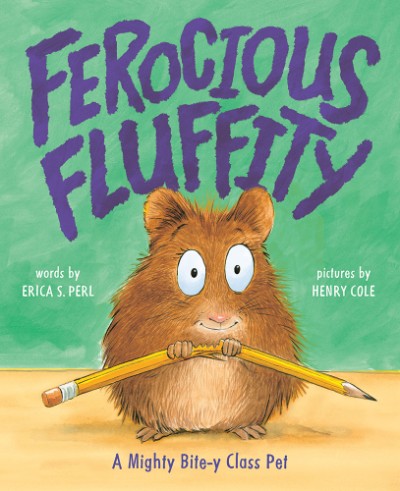
Most pets residing in classrooms as valued members have been selected for particular qualities.  Obviously the safety of all the students is important.  Ferocious Fluffity: A Mighty Bite-y Class Pet (Abrams Books for Young Readers, July 19, 2016) written by Erica S. Perl with illustrations by Henry Cole proves normal behavior can go awry.

The box was big and tall and wide.
Could there be a pet inside?

There was a pet inside; an adorable looking bundle of fur.  They were advised to

"Look---don't touch." 

by Mr. Drake their teacher.  They named her Fluffity.  Everyone wanted to take her out of her cage and hold her.  Everyone.

One morning Mr. Drake was late.  The students saw this as a golden opportunity.  Fluffity was removed from her home.  YIKES!  She bit the gals.  She bit the guys.  She bit everyone.

The children ran like crazy from the room voicing their distress.  Like Mary's nursery-rhyme lamb that hamster followed them everywhere.  Mr. Drake finally arrived at his classroom, upset to see the mess.  Searching for his students and the wayward Fluffity Mr. Drake walked straight into trouble.

Tricks were tried but nothing worked until a clever student substituted the behavior of one furry friend for another.  Rest assured things are more normal in Room 2-D now.  All will be well...or will it?


We are enticed to read and race along with the action through the rhyming, rhythmic story penned by Erica S. Perl.  She captures our attention with the "what-if" suggestion of a classroom pet gone wild and keeps it with one comedic moment after another.  As the tension builds we don't expect the "why-didn't-I-think-of-that resolution or the concluding twist.  Here is a sample passage.

Children screamed and children ran:
Zander, Zara, Sydney, Stan,
Kevin K., and Kevin B.
At their heels was Fluffity.


Rendered in watercolor the illustrations created by Henry Cole for this title are brimming with wide-eyed innocence and curiosity in contrast with disbelief and understandable panic.  This heightens the pure fun.  Readers can see this first on the dust jacket.  Fluffity looks cute as can be on the front but as our eyes move left to the back we see a continuance of the tabletop.  In the center of the page Mr. Drake and his students are peering anxiously from behind an overturned table they are using as a barrier.

On the book case an interior image, enlarged, shows six students running down the hallway in fear with Fluffity hot on their heels.  That a tiny hamster could be the cause of this kind of mayhem is hilarious.  As a compliment to the yellow on the book case background, the opening and closing endpapers are purple.  Even before the story starts Cole has six small images of Fluffity on the title, verso, and dedication pages.  She looks the very picture of harmless except for her love of chewing indicated on the handle of a pair of scissors and a ruler.

A palette full of cheerful color is used throughout on nine two-page images, several pages of smaller illustrations on white and three single page visuals including one final uproarious picture.  Point of view is shifted to draw our attention to particular scenes.  Cole's special brand of humor is evident in the characters' facial expressions as well as the details in his visuals.  Two of the bulletin board headings proclaim:

YOU'RE OFF TO A GOOD START WITH A GOOD BOOK

BOOKS YOU CAN REALLY SINK YOUR TEETH INTO! 

One of my favorite illustrations of many is of the children in the gym.  They are all gripping the rocks on the climbing wall, looking in fear at the small hamster waiting below them.  Fluffity appears tiny in comparison but by now readers know the truth.


As a lively read aloud sure to ignite shared laughter Ferocious Fluffity: A Mighty Bite-y Class Pet written by Erica S. Perl with illustrations by Henry Cole is a fantastic selection.  The text and images work together to give readers a story to be enjoyed repeatedly.  I can hear the shared giggles and grins already.

To learn more about Erica S. Perl and Henry Cole and their other work, please follow the links attached to their names to access their websites.  Erica S. Perl has another site which can be viewed here.  Both Erica S. Perl and Henry Cole were interviewed at Reading Rockets with links respectively here and here.  On Scholastic's Ambassador for School Libraries John Schumacher's blog Watch. Connect. Read. the book trailer for this title is revealed as well as an interview with Erica S. Perl.  At educator Colby Sharp's blog, sharpread, Erica S. Perl is interviewed about this title, reading and writing.   Her responses are sure to make you smile.  Two years ago Henry Cole was a guest at The Picturebooking Podcast.

Thursday, June 9, 2016

A Fascinating Fellow To Follow

Regardless of how many times it has been attempted, we all continue to try to get as close to something in the natural world as we possibly and safely can.  We know deep down inside that as soon as our nearness makes the creature feel unsafe, it will leave.  Most people who have a sincere respect and affection for all living things in nature try to convey their true intentions of "do no harm" but the need for survival is fortunately a strong instinct.

There is a long standing notion, with good reason, cats can't help but stalk birds and birds will keep their distance.  Spot, the Cat (Little Simon, an imprint of Simon & Schuster Children's Publishing Division, March 1, 2016) conceived and illustrated by Henry Cole begins with a bird and of course, a cat.  It is a quest, a tour, and a search.  Without words readers can see how many stories become parts of a larger story.

Spot, the cat, aptly named for a large spot on his fur, lives in an apartment with his young male human.  Curious about a bird outside one day, and unable to resist the lure of an open window, the cat leaves.  Climbing down a vine and a handrail, the feline finds himself in the thick of the hustle and bustle of city life.  Back at the apartment the boy notices immediately his companion has left.

As the cat wanders the sidewalks and streets, the boy wastes no time in printing flyers about his missing friend, posting them as often as he can along those same sidewalks and streets.  We follow as Spot leaves the residential area with neighborhood shops and crosses a nearby river on a stony bridge.  He and the boy are seen in a park full of people flying kites, bicycling, jogging, lying in the sun, walking their dogs and a wayward child finds a way to play in the fountain, to a caregiver's dismay.

Surely someone at the weekend Farmers Market will have seen Spot but the boy has no luck there.  Running past sightseers at the museum, calling for Spot, leaves the child increasingly disheartened.  Spot, on the other hand, is enjoying people watching.

Outside the arches of two different stations the boy seeks his beloved pal.  Spot, the bird long forgotten, is on a mission.  It seems that all roads do lead to Rome, or is that home?


A panoramic, intricate portrayal of row houses and apartments on the matching dust jacket and book case introduces readers to the wonder awaiting them within the pages of this book.  The first image here extends from edge to edge, left to right, back to front across the spine. (Be sure to run your hands over the embossed dust jacket.  Children really love this added feature.)  We meet Spot, the cat, and his boy.  One is on the roof, peering through a telescope and the other is looking upward from their apartment window.  You simply have to look at every home, inside every window and along the roof tops.  Another hue of blue, a light turquoise rather than the dusty sky blue on the jacket and case, provides the background for the opening and closing endpapers.

On the initial title page, Henry Cole, gives us a close-up view of Spot, curled and sleeping.  I really love the way the title can be read two ways.  It names the cat but also invites us to look for the cat within each image.  Cole starts the story on the more formal title page with Spot staring at the bird perched on the edge of one of their flower pots outside on the ledge.

Most of the illustrations span two pages.  The single page pictures or smaller images grouped together are loosely framed in white space.  The fine lines, hatching, shading and care given to the tiniest of details are impeccable.  You will find yourself more than once reaching out to touch the pages; sure you will be able to feel the fabric on the sofa, the roughness of leaves, the brick on the buildings, the grass in the park or the splash of water from a fire hydrant.

Each scene is vividly depicted to the extent you can almost hear the chatter of people, the sound of cars and honking horns, the clicking of a scooter on a sidewalk, the splash of waves along a river bank as a barge passes, the flap of kites in a stiff breeze or the noises associated with travel within a train station.  Each person, their facial expressions and body movements are the smaller stories within the larger story.  There is potential bursting forth from every illustration.  Careful readers will notice specific writing on the side of a truck or the pictures and words on the banners hanging in the front of the museum.

One of my many favorite illustrations is of the Farmers Market.  All the varied vendors welcome us as readers or as possible shoppers or wanderers in the scene itself.  Fruits, vegetables, flowers, and eggs are plentiful.  All types of people are buying and selling.  Two dogs, one on a leash, are part of the scene.  At this point the boy is very close to Spot as he shows a flyer to a merchant.  Spot casually walks away on the other side of the truck, over boxes of produce.


Each page turn is a work of art worthy of framing in Spot, the Cat by Henry Cole.  I can only imagine the time dedicated to creating each picture, the delicacy of each creating warmth and charm.  By requesting us, without words, to search for Spot along with his boy, we are active participants in this story, making the ending all the sweeter.


To discover more about Henry Cole, his other publications and works of art please visit his website by following the link attached to his name.  He includes his creative process and some fun activities too.  To view interior illustrations (three including one of my favorites) please follow this link to the publisher's website.

Tuesday, July 8, 2014

Point Of View

It happens when you use a magnifying glass. It happens when you look through a microscope, a telescope or a pair of binoculars.  It happens when you select zoom or wide angle on a camera.  It happens when you look through your picture window at night; then deciding to go outside, lie down on the grass and look up at the starry sky.

Every single time you have changed your perspective.  In doing this you are making before and after comparisons; adjusting the proportions according to how things are being seen.  The newest title by author illustrator Henry Cole, Big Bug (Little Simon, an imprint of Simon & Schuster Children's Publishing Division) explores the concept of scale by taking readers on a journey to a farm.

Big bug
Little bug
Big leaf

Beginning with a familiar insect found nearly everywhere except for the extreme northern and southern regions of our planet, we get up close and personal with a ladybug.  When we step back we can see how much smaller it appears on a leaf.  Moving even farther away the leaf is only one of many on the stalk of a wildflower.

A curious dog wanders over to the bunch of flowers leaning in to smell them; adding another dimension to the perception of size.  In a field a milk cow turns to look at the dog.  They are both animals on a very large farm over which a cloud-studded sky stretches.

On the now dwarfed farm (beneath the canopy of the sky) there is a tree.  Readers are taken back to locations near the buildings, moving toward the barn and then the house.  The day is coming to a close as we draw near to a single luminous window.  Inside the farmer is petting the dog.  Something else has made its way into the house.


Using only forty-nine words in a collection of two word phrases all of which include either big or little Henry Cole masterfully constructs a meaningful narrative.  Readers quickly become comfortable with the alternating cadence predicting the comparison to come on the next set of two pages.  Cole is careful to include only those elements easily identified by younger readers as normally found on a farm and the surrounding area.


It's as if we have become a ladybug ourselves as we look at the open dust jacket and book case on Big Bug.  It's a nice design item to have the title as an overlay.  Opening the cover we zoom back to see a pale leafy green background sprinkled with bunches of tiny ladybugs on the opening endpapers. (The closing endpapers are part of the story.  You will have to read the book.)

Each illustration extends edge to edge in an array of realistic rich colors.  You feel as though you've stepped into the center of a pastoral setting; taking a day to wander and wonder.  Having been raised on a farm, Cole adds warmth to each picture with known details.

For each contrast we might zoom in or out depending on Cole's depiction of the subjects.  This, incorporated with the narrative, adds interest.  The text for each comparison reflects word choice; a larger font for the big phrase, a smaller size for the little phrase.

Of course my favorite illustration is the one depicting

Little flower
Big dog

bringing our attention from right to left toward the dog's face near the flowers.  The brush strokes, line work and shading contribute to a texture we can nearly feel as we touch the page.  It's easy to imagine a slight breeze blowing through the grass, hearing the sniffing of the dog and bending to smell sunshine caught in its fur.


Big Bug written and illustrated by Henry Cole is brilliant in its simple portrayal of scale.  Not only does it introduce readers to this concept but encourages them to make their own observations in their own settings.  I can envision using this book to promote discussions as well as combined visual and writing mini-projects using traditional, digital or virtual tools.

For more information about Henry Cole visit his website by following the link embedded in his name.  He includes numerous pages about his illustrative process. This link takes you to the publisher's website offering a peek at several pages.  There is a series of interviews with Henry Cole at Reading Rockets.  Enjoy the video below.


Reviewed from my own copy purchased at McLean & Eakin in Petoskey.

Thursday, August 9, 2012

Look Out! Pig On The Loose!

Clearly I have a passion for pigs, at least as characters in books. (Memories of driving by their farms in the community near my childhood home are clearly cemented in my olfactory files.  Phew!)  I have posted about the middle grade novels, The Adventures of Nanny Piggins and Nanny Piggins and the Wicked Plan written by R. A. Spratt with hilarious illustrations by Dan Santat, a porker opposed to being clean, Pirates Don't Take Baths written and illustrated by John Segal, a new take on The Three Little Pigs in Emily Gravett's Wolf Won't Bite!, a barnyard group loving their dirt at all costs in Hogwash! by Karma Wilson with illustrations that tickle the funny bone by Jim McMullan, a spooky snack lover in Hampire! by Sudipata Bardhan-Quallen with expressive pictures by Howard Fine, siblings reluctantly surfing in the delightful Pig Kahuna written and illustrated by Jennifer Sattler, the precocious Olivia Goes to Venice written and illustrated by Ian Falconer and those cooks, Piggies in the Kitchen, by Michelle Meadows with laughable visuals by Ard Hoyt.  So it goes without saying, when I saw the cover displaying an undiscovered "pig" book at my public library, I stopped in my tracks.

The very same day, John Schumacher, K-5 librarian and blogger at Watch. Connect. Read. posted this on Twitter.  I know it as much as the next person, having continually reminded my students over the years and mentioned it previously on my blog, you can't judge a book by its cover.  I double dog dare you, no I triple hog challenge you, to not pick up I Know a Wee Piggy (Dial Books for Young Readers)written by Kim Norman with pictures by Henry Cole once you've feasted your eyes on the pig, front and center, ears spread like wings, wide-eyed with the goofiest grin plastered on his face.

I know a wee piggy...
who wallowed in BROWN.
Upside down, he wallowed in brown.
"But brown is not for me," he said. "I think I'll add a rinse of ..."

It's off to the fair, it's that time of year here too, for a red and white checked, shirt-wearing boy with his prize pig in hand. This squirmy little bundle of squeaky-clean pinkness has other plans.  The first puddle of mud he can find is like pure heaven.

Scampering through the vegetable displays ablaze in red, off to the cow barn for a bit of white, diving into the tufts of cotton candy for sticky puffs of pink, this little porker is on the run grinning at all his fun.  Each time he encounters another part of the fair, a new colorful coat is added to his body. Layer upon layer, like skins on an onion, paint, grass, clay and a scarf collide in brilliance.

There's no stopping this artistic endeavor!  But wait, oh, no...pigs can swim?  Who knew?  His last blast is into blue...in more ways than one.

Using the familiar format and her own special take on I Know An Old Lady Who Swallowed a Fly, author Kim Norman takes readers on a tantalizing tour in this tale of basic tints and tones.  Rhyming lines create a cumulative rhythm like a hand motioning readers to join the romp.  Expressive verbs, shout, sigh and bellow, underscore the persistence of this pig.

Royal purple endpapers provide a hint as to the outcome.   The sure, black lines done by Henry Cole's hand within the pages provide the playful, purposeful outline for the bright hues of his illustrations rendered in acrylic paints and colored pencil.  The facial expressions on the rascally porcine couldn't be better; he's clearly filled with unadulterated joy as everyone else is aghast.

Cole uses white space to his advantage illuminating the color words in the exact color; showcasing each line as it is added with a spot illustrations of the most recent improvements, so to speak.  On the left side are full color visuals bleeding out to the edge, showcasing the free-for-all fair escapades.  Sometimes this pattern is mixed up with two page spreads for emphasis and an extra dose of laughter.

Author Kim Norman and illustrator Henry Cole have crafted a surefire winner in I Know a Wee Piggy introducing colors, a trip to the country fair, and a wayward pig bent on seeing the sights, bringing newness to a beloved tune.  This title is guaranteed to bring about laughter, singing and probably a bit of dancing.  Tra...la...la...
Please follow the links to the author's and illustrator's websites embedded in their names.  Kim Norman has plenty of additional resources for educators to use in connection to her books.


Friday, April 13, 2012

Oh, Those Chickens...

Another candidate in the 2012 Children's Choice Book Award list for K-2nd grade voters takes readers down on the farm.  Three Hens and a Peacock (Peachtree Publishers) written by Lester L. Laminack, illustrated by Henry Cole, is a classic tale of the-grass-is-not-always-greener-on-the-other-side.  Role reversals nearly ruin the ignorant participants.

Down on Tucker's farm all was as it should be; cows grazing, hens laying, dog dozing and vegetable stand waiting.  But when the back doors on a red delivery door fly open, an oversized box crashing open on the road, the quiet is about to be interrupted.  A prancing, preening peacock fans out his feathers shrieking; he has never known life on a farm.

As the misplaced newest member of the barnyard gang swaggers along the roadside, cars halt, cameras and wallets at the ready.  Better than a billboard this fowl is a blessing to business as each day passes.  But all is not blatantly blissful, the hens are in a tizzy.

Why should the peacock get the easy job when they do all the work of producing the eggs?  Peacock's feelings of usefulness crumble.  Remember the dog lounging on the porch?  He's got a plan.

Dressed to the nines in dazzling jewels those cluckers strut their stuff and puff and whew...they're pooped.  And let's face it, that door to the hen house was not made for a peacock.  Puzzled, Mr. and Mrs. Tucker watch these changes remarking on what they really want.

Luckily their conversation is overheard by one frustrated bird who gladly wishes to resume his rightful position.  All's well that ends well, until another truck goes by.  Oh...oh...

Laminack tells a tale laced with laughter.  His conversational tone about business not so usual sets the stage for consummate comedy.  His timing is im-peck-able.

Spirited, vivid illustrations created by Henry Cole in watercolor, ink and colored pencil pop off the pages.  His jacket and cover art when opened indeed show the three bugged-eyed beauties poking through peacock feathers but also the rear view, six spindly legs and three feathery behinds.  Front endpapers awash in a spray of peacock prettiness are not mirrored on the closing endpapers.  Instead we see the foursome fearfully watching from the right edge, watching what has fallen into their midst.

Whether angry, exasperated, inquiring, pleased or exhausted his fowl's features, eyes, beaks, wings and legs, say it all.  Not to be missed are the eyes on the contented cows following the comings and goings nor the expression on the knowing, observant canine's mouth.  Cole must have giggle goo mixed in with his media. 

Lester L. Laminack and Henry Cole have partnered to present a funny, farm frolic, Three Hens and a Peacock, destined to be a story time favorite.