Quote of the Month

When love and skill work together, expect a miracle. John Ruskin


Friday, June 17, 2016

To Be Named

In two days another Father's Day will be celebrated.  Families will be paying tribute to dads, uncles, grandfathers, older brothers and significant men in their lives.  For me it will be another Father's Day without my dad.  It will be a day to remember all the memorable moments we shared and those times I've wished for him to be with me.  It will be a day to miss him but to reflect on how much a part of my life he still is on a daily basis.  The tools in his original carpenter's belt are used often, his initials etched in the handles.  The care of my gardens and lawn reflect his green-thumb gifts.  The maintenance of everything I own, making them last beyond the time they should, is due to his constant attention to detail.  It's as if he is right beside me, guiding me.

Dads play important parts in all our lives.  In Sherman Alexie's first picture book, Thunder Boy Jr. (Little, Brown and Company, May 10, 2016) illustrated by Yuyi Morales, a son speaks to readers about his beloved father.  The boy is unsure how to address a huge problem he has.

Hello, my name is 
Thunder Boy.

As his younger sister proclaims he is Thunder Boy Smith.  At birth he received this name from his father.  He would much rather have been given a normal name like Sam. (That's what his mom wanted to call him.)  He is not the only Thunder Boy either, he is Thunder Boy Jr.  His dad is Thunder Boy Sr.

This might be okay but his dad is affectionately and with respect called Big Thunder.  He is Little Thunder.  This does not seem right to him.  He shares a secret with readers.

I HATE MY NAME!

The boy keeps this secret to himself out of love for his dad.  He does imagine being named for accomplishments in his young life.  For touching a wild orca on the nose perhaps he should be named

NOT AFRAID OF TEN THOUSAND TEETH.  

He thinks how much his dog enjoys chasing his own tail and the costume tail Thunder Boy Jr. sometimes wears.  Maybe his name should be

CAN'T RUN FAST WHILE LAUGHING.

He thoughtfully ponders nine possibilities.  How can he be truly himself when he shares a name with his dad?  This little guy does not know what to do with his unhappiness.  Someone far wiser has an answer.  Your heart will swell with the same joy Thunder Boy Jr. feels.


Even though Thunder Boy Jr. has a personal, real dilemma, Sherman Alexie, forms each sentence so readers realize the boy is living in a home filled with loving family members.  We form a compassionate connection to him as he speaks to us.  When he relates his experiences, each which could serve to give him a name more specific to him alone, his exuberance, his zest for life, sails off the pages.  Alexie also uses repetition with excellent effect.  Here is a sample passage.

People call him 

BIG THUNDER.

That nickname is a storm
filling up the sky.

People call me

LITTLE THUNDER.

That nickname makes me
sound like a
burp or a fart.


One of the first things I do when reading a book is to check to see how the artist created the illustrations.  This is what I read on the verso for this book.

The illustrations for Thunder Boy Jr. were made from the remains of an antique house in Xalapa, Mexico, where Yuyi now has her studio and where she created this book.  When the rotting roof and some of the walls came down, she picked out old wood as well as clay bricks that she later scanned and used their colors and textures to digitally paint the illustrations.  

This is why when you open the matching dust jacket and book case, you have to marvel at the force radiating from the images.  The bold outlines and vibrant colors on the sizzling backgrounds are full of energy.  A collage of circles in red, magenta, yellow, turquoise, black and gray fashion a pattern on the opening and closing endpapers.

Text balloons, speech bubbles, are placed throughout the narrative holding narrative words as if they're spoken.  This involves all the characters, even the family's dog.  All of the pages are connected across the gutter even if they portray a separate moment.

Within the story Yuyi Morales, in a series of pictures, includes a mini-story of the boy and his sister disagreeing over the possession of a large colorful ball.   Two other elements which I really like are first the size of the parents with respect to the children.  Our parents are and will remain larger than life to us.  The other aspect is when Thunder Boy Jr. is imagining possible names; the father is a part of the orca and the mountain.

Readers will notice elements from one picture carried into another one; the children riding their bikes, the playing of the guitar and the presence of the bear, coyote (wolf) and snake.  You will want to stop and look at every detail in picture after picture.  The image of Thunder Boy Jr. powwow dancing is stunning.

One of my favorite of many illustrations is of Thunder Boy Jr., his sister and their dog playing in the dirt.  It looks to be fairly muddy with dark brown splotches spreading out from the children and the dog.  The brother and sister are sliding through it on pieces of cardboard.  Their faces are glowing as they laugh and laugh and laugh.  You want to jump in and join them!


With each reading of Thunder Boy Jr. written by Sherman Alexie with illustrations by Yuyi Morales your affection for this boy and his father will grow.  You can almost hold the joy found in these pages in your hands.  This IS a book for everyone.  It is wonderful to read it aloud.


To learn more about Sherman Alexie and Yuyi Morales and their other work please follow the links attached to their names to access their respective websites.  Sherman Alexie and this title are discussed at The Washington Post.  Sherman Alexie is interviewed on NPR Books about Thunder Boy Jr.  Teacher librarian and 2014 Caldecott committee member Travis Jonker premieres the book trailer on his blog, 100 Scope Notes.  It's a superb trailer.  Both Sherman Alexie and Yuyi Morales are on Twitter at @Sherman_Alexie @yuyimorales  Yuyi Morales is a 2016 Sendak Fellow.  I have enjoyed following her tweets about this experience.

To Follow Or To Break

Nearly every evening it was a routine during dinner.  Looking to make sure my mom was preoccupied, my dad would pick up a piece of food with his fingers. Inevitably my mom would catch him in the act exclaiming "Use your fork!"  Dad would laughingly reply "Fingers were made before forks!"  We would all laugh despite the fact we had heard this so many times we had lost count.

Even though my dad was able to do this, no one else dared to do the same.  If household "directives" were not followed, there were consequences; consequences of the variety insuring said "directives" would be followed in the future.  Rules Of The House (Disney Hyperion, May 3, 2016) written by Mac Barnett with illustrations by Matt Myers will have you rethinking your position on obeying rules.

Ian always followed the rules.
Here he is following the rule
ALWAYS PACK A TOOTHBRUSH.

Ian never falters in his steadfast adherence to what his family or society at large requires of him.  Ian's older sister Jenny is the exact opposite.  She takes particular delight in breaking the rule of not pinching.  OUCH!

The two are on their way with their dad to a large cabin in the woods to spend their vacation.  As the brother and sister squabble in the back seat, their dad reminds them of another rule,

DON'T TELL LIES.

The decor in the house is quaint and classic with an old potbelly stove, a claw-foot bath tub and a bearskin rug.  Ian loves all this stuff.  To his delight a set of rules, numbering four, have been left by The Management.  The last one states the red door is to be left unopened, ALWAYS.  Jenny agrees to comply but still calls Ian toady.

A variety of outdoor activities are enjoyed during the day but when inside the house Jenny breaks the first three rules with abandon and determination.  When Ian cautions her and chants his familiar phrase, Jenny snaps and...opens the red door.  HA!  Not one little thing happens. BUT when Ian and Jenny are all snuggled in bed, the fright comes into the night.

It's simply too scary for words.  Okay...okay...here are a few hints.  Someone is about to become an entree.  Did I mention monsters?  Another someone has to make decisions completely out of the ordinary.  Power to toothbrushes and to them who wield them!


With impeccable pacing and a masterful story arc, Mac Barnett has our attention from the very first page.  We are invited into the story with his wording as he makes statements and then demonstrates the veracity of each.  The trio of rules woven into this initial portion of the narrative is integral to the conclusion.

Barnett carefully creates the contrast between the siblings with a blend of text and dialogue.  You know something is about to change when you read two defining sentences at the close of the outdoor activities.  There is a shift in the atmosphere of the story.  It gets scary but not too scary after Jenny opens the red door.  Two short phrases speak volumes.  As readers' heart rates increase so does the tension in this tale racing toward the ending.  Here is a sample passage.

Best of all was a framed piece of paper
in the hallway that said

THE RULES OF THE HOUSE

"Look!" said Ian.  "Rules!"
"You're such a toady," said Jenny,
and then pinched him.
"OUCH!" said Ian.  "You're not
supposed to---OUCH!"

Ian drew a deep breath and read out
the rules with gusto.


Appropriately inviting and scary the front of the dust jacket screams you have to read this book.  Artist Matt Myers incorporates the tree trunk letters into the landscape.  The fiery red glow from the inside of the house draws our attention to the animated items.  To the left, on the back, a single toothbrush is highlighted in a yellow star with the rule printed beneath it.  The book case, left and right, is the red door.  We are doomed as soon as we open this book.  A pale sea green is used for the opening and closing endpapers perhaps in reference to an eye color mentioned in the story.  The title page and verso images are the red door.  Opposite the verso Myers has the children jumping back in fear at something they have seen.  The stage is set.

The picture sizes and perspectives are altered to fit the mood of the story; each one creating a separate effect.  Myers places a smaller image within a large visual.  He gives us a bird's eye view of the day's fun, mapping it out before us.  This allows for the contrast in what is to come; those haunting (but not too haunting) scenes of the cabin after everyone has gone to bed, the awful encounters in the children's bedroom and the kitchen.  The background colors play a significant role also noting a change in the current conditions.  Myers' use of light and shadow works wonderfully.

One of my favorite illustrations is of Ian standing outside in the dark wearing his pajamas and carrying his toothbrush.  He is standing on a small hill thinking.  Evergreen trees are placed in the background with silhouettes of more trees behind those.  His head is framed in a full moon.


On the first reading of this book, Rules Of The House written by Mac Barnett with illustrations by Matt Myers, I thought---Gals and guys are going to love this book!  It's a fantastic combination of scary and fun.  Beneath the fast-paced action runs an exploration of rules; when to follow them and when to break them.

To discover more about Mac Barnett and Matt Myers please visit their websites by following the links attached to their names.  Enjoy the video interviews of Mac Barnett at Reading Rockets.  Mac Barnett speaks at TED, Why a good book is a secret door.  Both Mac Barnett and Matt Myers are on Twitter.  @macbarnett and @myerspaints  Enjoy the video chat below with Mac Barnett and Matt Myers at Politics & Prose Bookstore.


Thursday, June 16, 2016

Creeping, Crawling, Flying, Swimming, Jumping Into Our Lives

The universe has a gift sometimes for bringing humor into a situation.  It's not every day you walk into your kitchen to run water into the sink and have the children's tune The Ants Go Marching One By One pop into your head.  This is exactly what happened yesterday and again this morning.  It seems lack of rain was bringing the wee critters into my home.  I politely asked them to leave.  Mother Nature replied to my request by providing a rain shower which ended the situation entirely.

Our planet is swarming with insects and invertebrates that make their homes inside and outside our residences.  For the most part sharing space with them is acceptable unless they create dangerous conditions for us.  The Big Book Of Bugs (Thames & Hudson, April 18, 2016) written and illustrated by London-based author illustrator Yuval Zommer is brimming with facts and fun about insects and invertebrates.

Can you find . . .
. . .exactly the same fly 15 times in
this book?  Watch our for imposters.

With this challenge on the title page readers begin to seek and find fascinating information in the twenty-six two-page chapters.  First an explanation and comparison of invertebrates and insects is offered.  This is followed by suggestions of places to spy bugs and the importance of respecting them.  A further breakdown of similarities and differences between insects, snails and slugs, spiders, centipedes and millipedes and worms is given.

In many of the chapters, in addition to a series of amazing characteristics for each group, we are asked to locate a specific bug (s) engaged in an activity.  Two dung beetles are rolling poo into big balls.  We need to find them among all the other creatures busily moving among the foliage on the two-page first section dedicated to beetles.  Have you ever seen a ladybug without spots?

Do the wings on butterflies or moths feel like dust?  Which one prefers to flit about at night?  Wow!  A queen ant has been known to live for fifteen years!  Bees communicate locations with a special dance.  Termites keep cool in their huge towers even in the heat as it rises out through a chimney.  Flies and dragonflies creatively search for food with particular skills; multiple eye lenses (4000) and large eyes for seeing into the distance.

Small birds, amphibians and mammals will probably give a giant centipede a wide berth; especially if one is hungry.  Did you know that crickets and grasshoppers do not make their songs in the same manner?  In praying mantis's circles the female is larger than her male counterpart making him a tasty meal for her.  Earthworms can sense danger uniquely.

After discussing a variety of insects and invertebrates Zommer highlights bug beginnings, how bugs move, bugs living inside our homes, the benefits of bugs and establishing outside places specifically for these creatures. In case we may not have found all fifteen flies, their whereabouts are shown at the end.  Two pages showcase becoming familiar with vocabulary.  To close this exemplary title, an index is included.

For each of the two-page chapters Yuval Zommer poses a question or gives us a partial statement.  He follows with easily understood answers and sentences.  Those truths he selects to share with readers are captivating; between four and seven per section.  Here are some samples.

Some moths have "pretend" eyes
The big spots on an owl moth's wings
look like eyes and scare enemies.

They are bad flyers
Crickets and grasshoppers have two
pairs of wings, but most aren't good
at flying.  And some can't fly at all.

A beetle with a snorkel
A water scorpion can float to
the surface and take in air
through a tube.


When you open the book case of this title, the array of expressive, spirited insects and invertebrates spreads across the spine to the back on the left.  Yuval Zommer adds a mosquito flying above the crowd and a spider dropping down on a string of silk.  If you, the reader, look at each bug carefully you will discover a bit of comedy, a smidgen of glee in every one.  A pale blue, cloud-like effect provides a canvas on the opening and closing endpapers.  Zommer has a group of honey bees moving through the center first and at the conclusion flying off the pages.

In the illustrations the intricate and exquisite lines along with the shades of color are spectacular.  Zommer layers many, many tiny parts to create a type of collage.  You have to stop at every page turn to fully appreciate these fabulous pictures.  The experience for readers is more tactile due to the heavier matte-finished paper used in this book.

The variety of settings keeps readers completely engaged.  On the first two pages his "bugs" are leaving the pages of an open book.  Bright-colored tennis shoes and the bottom portion of blue jeans are seen walking among these critters as tools used to document what has been found and seen are nearby. Trees, leaves, flowers, a window sill, tiny tunnels beneath a sandy mound, honey bee hives, tall termite towers, a picnic, a pond, and underground are all part of this marvelous volume.

One of my many favorite illustrations is for pond bugs.  On the surface of the pond a paper boat fashioned from a newspaper page floats as a snail crawls up the point, a bug sits on the edge and dragonflies come in for a landing.  Bugs glide on the water's surface.  Bugs swim, dive and scoot underwater through the seaweed, along pebbles and rocks and the sandy bottom.


I can't imagine a professional or personal shelf without a copy of this beautiful, informative nonfiction picture book. The Big Book of Bugs written and illustrated by Yuval Zommer is a celebration of our natural world.  I would plan on multiple copies.  Bug expert Barbara Taylor is named as a consultant.

To learn more about Yuval Zommer please follow the link attached to his name.  At The Guardian Children's books page, Yuval Zommer visits to provide colorful instructions in How to draw...bugs.

UPDATE:  Enjoy this short book trailer and see interior images come to life. 


It is a distinct pleasure each week to participate in the 2016 Nonfiction Picture Book Challenge hosted by educator Alyson Beecher at Kid Lit Frenzy.  Please visit this site to see what titles were selected this week by other participating bloggers.


Tuesday, June 14, 2016

Beware! One Could Be Lurking Near You...

You have probably been living under the notion they have vanished from the face of the Earth, never to be seen again.  Their skeletons have been found and now stand on display in museums.  Countless volumes examining everything there is to know about them line the shelves in libraries.  Children read those countless volumes retaining and conversing with others about details too numerous to count.

In fact it might be said these guys and gals are known to assume some of those distinguishing traits prevalent in those creatures they understand so well.  Field Guide To The Grumpasaurus (Clarion Books, an imprint of Houghton Mifflin Harcourt, June 7, 2016) From The Notes Of (written and illustrated by) Edward Hemingway describes what you can expect from close encounters with these critters.  I shudder to think what might happen.

Curious about the world's most fearsome creature?

The Grumpasaurus can be located by the storm cloud hovering overhead.  Its furious eyes and brow, perpetual frown, lack of heart (strange but true) and spiked tail are noticeable physical characteristics.  It is at its very worst after a complete catastrophe.

Just as you would bolt with due haste and batten down the hatches before a terrible storm do so when the Grumpasaurus becomes more frightful.  You should move as far away as possible.  The sounds it makes are deafening and said to rattle the windows from miles away.

There are certain adults, not children or animals, who will on occasion venture near this fearsome being.  They do not quake in terror but stand still with fortitude and patience.  When the Grumpasaurus's disposition reaches a breaking point, there will be only one thing left to do.  It's an activity many of the Grumpasaurus kind dread the most.  DO NOT MOVE CLOSER!

There might be one more way to dispel this extreme inclination.  If anyone so dares, it involves treating the calamity with care.  Don't stare but something has vanished into thin air.  Again...for the moment.


The narrative is designed as a naturalist's journal beginning with the introductory sentence on the title page.  Short descriptive sentences are linked to specific areas of the Grumpasaurus's body so we are well informed.  Between these labeled diagrams are conversational insights and warnings; while factual they will be inclined to produce smiles and outright laughter.  It is clear with the seamless flow of the story Edward Hemingway is an astute observer of this specie.  Here is a sample passage.

When it's done sulking, the Grumpasaurus will always seek out
the nearest adult, demand some attention, and get ready to
speak its mind.

You may want to plug your ears...


When opening the dust jacket you can more fully see the design of a spiral bound notebook.  The color palette here is used throughout the title as is the format for pointing out specific quirks of this being.  To the left, on the back, we are given the rear view of the Grumpasaurus with further conclusive characteristics.  The book case background is the rich chocolate brown seen in the spikes of this grouchy critter.  A darker brown is used along the wide spine.  To the right and left are cream-hued ovals.  The Grumpasaurus is in the first and to the left is the small black cat holding the trademark multi-hued umbrella.  When it rains or storms this comes in handy.

The opening and closing endpapers are done in two shades of blue.  Each is a reflection of the mood of the story at the beginning and at the end.  The title page welcomes readers into the guide with the dark cream-colored, lined paper of a notebook with the spirals along the left edge.  A pair of binoculars is placed between the title text and the introduction.  Many of the subsequent pictures are framed in a darker shade indicating wear and age of the notebook pages.

The images rendered in oils on panels portray the spirit of the writer documenting what is seen.  Each page turn, the verso, the dedication and thanks and the story itself truly give a sense of information gathering and exploring.  We are not quite sure what we will see next, but we can hardly wait to do so.  Hemingway alters his perspective depending on the mood of the Grumpasaurus.  The black cat companion is placed accordingly and also mirrors the emotional state of affairs.  This character's expressions are perfection.  (Only portions of the adult are shown which is wonderful.)

One of my favorite illustrations (I can hardly keep from laughing.) is when the Grumpasaurus is disgusted with the most recent activity.  Standing with hands on hips, the creature is wearing a red towel tucked around its waist.  On its head is a huge pinkish towel, acting as a turban.  The look on the Grumpasaurus's face is hilarious.  A trail of water behind it leads across the gutter and to the cat on the left.  This feline friend is looking a bit bedraggled and sopping wet.


If you should happen to come upon one of these creatures or wish to advise a group of listeners to be on the lookout for this disagreeable specimen, Field Guide to The Grumpasaurus From The Notes of Edward Hemingway is exactly the book you need.  This title allows us to examine ourselves for the possibility of shifting into this very thing.  You should expect giggles and grins, knowing nods and requests of read it again.  

To learn more about Edward Hemingway and his other work, please follow the link attached to his name to access his website.  Edward Hemingway and his studio mates were interviewed at Pen & Oink.  On June 11, 2016 the New York Post featured Edward Hemingway in an article, Why Hemingway's grandson will never grow a beard.  Follow this link to get a peek at the book case.

UPDATE:  Be sure to watch the book trailer featured along with an interview with Edward Hemingway at Scholastic's Ambassador for School Libraries, John Schumacher's blog, Watch. Connect. Read.

Monday, June 13, 2016

Consummate Canine Companion

A word was never spoken but she, with the sixth sense they all possess, knew.  If I would quietly close a book with tears streaming down my face or sob when watching a movie, she would move as close to me as possible.  Her body would absorb the sadness; perhaps she would offer me a quick kiss of reassurance.  When this strength is missing from your life, this unconditional love, this flawless friendship, you feel it keenly.

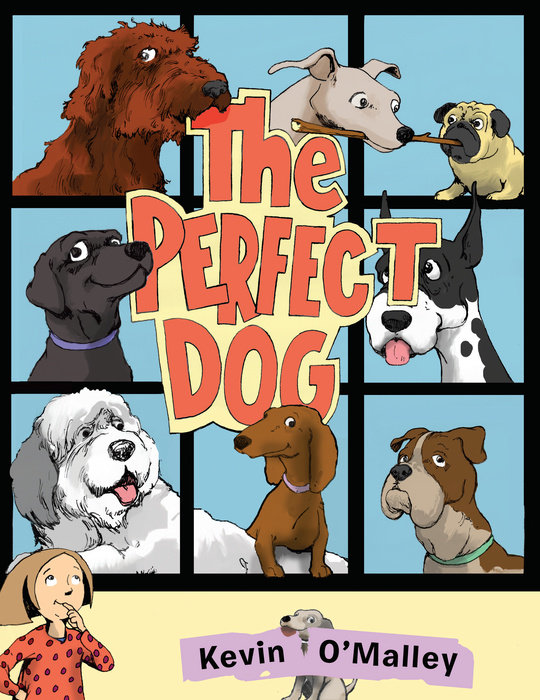
Never is having this relationship more important than when tragedy strikes.  Their ability to bring comfort, peace and a glimmer of happiness to your soul when there is none is uncanny.  The Perfect Dog (Crown Books for Young Readers, an imprint of Random House Children's Books, May 31, 2016) speaks to seeking the one dog above all others who will be your best buddy...forever.


My parents said
we could get a dog.

And I know the perfect
dog...

It's obvious this girl has been waiting a very long time for a pooch pal to become a part of her family.  She has a mental checklist ready.  We are fortunate to get the inside scoop as she examines more than twenty kinds of canines.

Size is carefully considered, as are all attributes, in a series of three comparisons until it might be too much;

The perfect dog should be big...
bigger...
biggest!
Maybe not this 
big.


Hair length (fur) is of vital concern especially when it comes to upkeep.  Will the dog communicate in an appropriate manner?  Will he or she drool excessively?  Will a bow tie suffice or will an extensive wardrobe be necessary?

For some dogs you might need to be an Olympian; their exercise needs are off the charts.  With these expectations in mind it's time to make a selection.  Two new prospects are presented.  Dogs will be dogs.


With comedy radiating from every page, Kevin O'Malley reveals not only an enormous sense of humor but a sure knowledge of dog behavior and traits. The rhythm generated with an adjective, a comparative and superlative asks readers to participate.  When O'Malley switches it up four times, it invites us to shift the beat and pause.  It makes the twists great...greater...greatest!


Rendered in ink on Graphics 360 paper with a Hunt nib and colored in Photoshop the illustrative fun created by Kevin O'Malley begins on the matching dust jacket and book case.  The eight dogs featured along with the young girl on the front are all wearing animated looks.  One is chewing a letter in the title text, two are tugging on a stick, a third is cross-eyed from the letter t resting on its nose and a smaller dog is leaning on the back of a larger dog.  These dogs are ready to run.  To the left, on the back, is a dog dish holding some toys.  A leash and a dog bone are part of the design.  Nine tiny circular dog portraits run along the spine.

On the opening and closing endpapers twenty-four dogs appear within round, overlapping frames of varying sizes.  Each is labeled correctly.  O'Malley's depictions are full of get-up-and-go.  On the title page the text is wrinkled as if it's a piece of fabric being tugged by the dog below it. The verso text is within a circle; a leash is hanging on the fine black-line frame with a dog dish beneath it.

Pale backgrounds provide a canvas for the comparisons which are placed on single pages or in groups of four over two pages.  The facial expressions on the girl are hilarious.  The dogs are most definitely loving every single minute in her presence.  O'Malley's font styles are a direct reflection of the observations.

One of my favorite series of illustrations is for the words fast, faster, fastest and maybe not this fast.  Each of the words looks like they are moving in a blur.  At first the girl is walking along, then she is jogging, then all we see is a portion of her arm on the left holding the leash as a greyhound streaks across the page and finally she is completely horizontal as another unseen dog pulls her to the right.


As a read aloud The Perfect Dog written and illustrated by Kevin O'Malley encourages listeners to join in the narrative.  The laughter supplied in the text and images is contagious.  You can expect this to be popular with dog lovers and others who enjoy a playful romp in the realm of language.


To learn more about Kevin O'Malley please visit his website by following the link attached to his name.  At two publishers' websites you can view different interior images from this title here and here.  Kevin O'Malley is showcased in an article about this book in The Baltimore Sun.

Friday, June 10, 2016

Swimming Away From Fear

As educators we hear revelations either told in a group setting or in confidence.  When something is spoken to us in trust, we have a responsibility to protect what we have heard.  Sometimes though we need to go back and speak with the child, telling them for their well-being this information should not be kept a secret.  It's a fine line, a judgment call, wondering whether these details were shared for the sole reason of the need for another to know or as a cry for help.

Theodore Seuss Geisel Award winners for 2015 (You Are (Not) Small) Anna Kang and Christopher Weyant deliver to readers another delightful tale.  Can I Tell You a Secret? (Harper, an imprint of HarperCollinsPublishers, May 31, 2016) explores the dilemma of whether to keep or share a secret.  Some secrets are harder or bigger or both than others.

Pssst!

Yes, you.
Hi.
Could you come here for a sec?

This small green frog asks us to come nearer and nearer.  When he is satisfied we are close enough, he reveals that he has a secret.  You know he wants to tell you his secret but he has to make sure without a doubt you will not tell another single soul.

When he is secure in the knowledge you can be trusted, the truth is shared.  He cannot swim.  He is afraid of the water.  As you can imagine this is a huge problem for a frog.  He's carried this conundrum with him since he was a wee tadpole.

Continuing his conversation with us, his readers, he goes further explaining how he has guarded this knowledge.  Our friendly frog is very clever but getting pretty pooped with this predicament.  His response to a statement lets us know the unseen conversationalist (us) suggests he tell his parents.  This is much easier said than done.

Does he do it the first time?  Does he do it the second time?  Will the third try be the charm?  Montague (Monty) has no idea how his parents are going to respond.  Wonderful surprises greet readers.


Author Anna Kang speaks throughout this story with the sure understanding of a child's perspective.  The conversational exchanges between Monty, the frog child, and the reader are genuine.  The sentences are short and easily understood.  The purposeful punctuation conveys the heartfelt emotion in this set of circumstances. Here are two sample passages.

And I am very sad.
Because I really want to swim.
I'm a frog, after all!
What should I do?

What's that?  You think I should tell someone?
Like my parents?
Are you sure?  POSITIVE?
You wouldn't lie to me, right?


On the matching dust jacket and book case, on the front, readers meet an exceedingly concerned guy.  He stands out to readers with his coloring and expressive eyes on a background of white.  We are also drawn to the red in the title text.  To the left, on the back of the opened jacket and case, an interior image is displayed.  Looking directly at us, posed on a cattail over the resting lily pads in the pond, he asks what we are already thinking.  How can a frog keep this kind of secret?  The opening and closing endpapers are covered in a vivid frog green.

A two page illustration covers the formal title page.  Frogs are lined up on a cattail as if it's a diving board over the pond.  A lifeguard is on duty.  Our frog friend is off to the right side sitting on a rock, looking rather forlorn.

Throughout the title the white canvas works to superb effect highlighting every mood.  Christopher Weyant rendered the pictures with watercolors and ink on 260 lb Arches paper.  His visuals extend the text on either two pages, single pages or two images on a single page.  The eyes on his frogs are pure happiness.  When he zooms in on Monty we can feel the intensity of the situation.  (Attentive readers will spot the Easter egg.)  Weyant closes the book with an illustration similar to the first one but noticeably different on the dedication and verso pages.

One of several favorite illustrations is when Monty is showing us how he maintains his secret.  In a single page image he is clinging to the leg of a heron.  The bird cranes its neck downward, scowling at the young frog.  Another frog peeks out of the water wondering at Monty's tactic.  A dragonfly hovers, watching.  Cattails frame the bottom of the picture, the pond.


You simply can't help but smile reading Can I Tell You a Secret?  written by Anna Kang with illustrations by Christopher Weyant.  The blend of narrative and illustrations is, regardless of Monty's secret, full of joy and compassion.  I have to say I burst out laughing at the last twist at the end.  I can already hear the requests of read it again.

To learn more about Anna Kang and Christopher Weyant please visit their websites by following the links attached to their names.  After the publication of their first two books, Anna Kang was interviewed at Cracking The Cover. 


Thursday, June 9, 2016

A Fascinating Fellow To Follow

Regardless of how many times it has been attempted, we all continue to try to get as close to something in the natural world as we possibly and safely can.  We know deep down inside that as soon as our nearness makes the creature feel unsafe, it will leave.  Most people who have a sincere respect and affection for all living things in nature try to convey their true intentions of "do no harm" but the need for survival is fortunately a strong instinct.

There is a long standing notion, with good reason, cats can't help but stalk birds and birds will keep their distance.  Spot, the Cat (Little Simon, an imprint of Simon & Schuster Children's Publishing Division, March 1, 2016) conceived and illustrated by Henry Cole begins with a bird and of course, a cat.  It is a quest, a tour, and a search.  Without words readers can see how many stories become parts of a larger story.

Spot, the cat, aptly named for a large spot on his fur, lives in an apartment with his young male human.  Curious about a bird outside one day, and unable to resist the lure of an open window, the cat leaves.  Climbing down a vine and a handrail, the feline finds himself in the thick of the hustle and bustle of city life.  Back at the apartment the boy notices immediately his companion has left.

As the cat wanders the sidewalks and streets, the boy wastes no time in printing flyers about his missing friend, posting them as often as he can along those same sidewalks and streets.  We follow as Spot leaves the residential area with neighborhood shops and crosses a nearby river on a stony bridge.  He and the boy are seen in a park full of people flying kites, bicycling, jogging, lying in the sun, walking their dogs and a wayward child finds a way to play in the fountain, to a caregiver's dismay.

Surely someone at the weekend Farmers Market will have seen Spot but the boy has no luck there.  Running past sightseers at the museum, calling for Spot, leaves the child increasingly disheartened.  Spot, on the other hand, is enjoying people watching.

Outside the arches of two different stations the boy seeks his beloved pal.  Spot, the bird long forgotten, is on a mission.  It seems that all roads do lead to Rome, or is that home?


A panoramic, intricate portrayal of row houses and apartments on the matching dust jacket and book case introduces readers to the wonder awaiting them within the pages of this book.  The first image here extends from edge to edge, left to right, back to front across the spine. (Be sure to run your hands over the embossed dust jacket.  Children really love this added feature.)  We meet Spot, the cat, and his boy.  One is on the roof, peering through a telescope and the other is looking upward from their apartment window.  You simply have to look at every home, inside every window and along the roof tops.  Another hue of blue, a light turquoise rather than the dusty sky blue on the jacket and case, provides the background for the opening and closing endpapers.

On the initial title page, Henry Cole, gives us a close-up view of Spot, curled and sleeping.  I really love the way the title can be read two ways.  It names the cat but also invites us to look for the cat within each image.  Cole starts the story on the more formal title page with Spot staring at the bird perched on the edge of one of their flower pots outside on the ledge.

Most of the illustrations span two pages.  The single page pictures or smaller images grouped together are loosely framed in white space.  The fine lines, hatching, shading and care given to the tiniest of details are impeccable.  You will find yourself more than once reaching out to touch the pages; sure you will be able to feel the fabric on the sofa, the roughness of leaves, the brick on the buildings, the grass in the park or the splash of water from a fire hydrant.

Each scene is vividly depicted to the extent you can almost hear the chatter of people, the sound of cars and honking horns, the clicking of a scooter on a sidewalk, the splash of waves along a river bank as a barge passes, the flap of kites in a stiff breeze or the noises associated with travel within a train station.  Each person, their facial expressions and body movements are the smaller stories within the larger story.  There is potential bursting forth from every illustration.  Careful readers will notice specific writing on the side of a truck or the pictures and words on the banners hanging in the front of the museum.

One of my many favorite illustrations is of the Farmers Market.  All the varied vendors welcome us as readers or as possible shoppers or wanderers in the scene itself.  Fruits, vegetables, flowers, and eggs are plentiful.  All types of people are buying and selling.  Two dogs, one on a leash, are part of the scene.  At this point the boy is very close to Spot as he shows a flyer to a merchant.  Spot casually walks away on the other side of the truck, over boxes of produce.


Each page turn is a work of art worthy of framing in Spot, the Cat by Henry Cole.  I can only imagine the time dedicated to creating each picture, the delicacy of each creating warmth and charm.  By requesting us, without words, to search for Spot along with his boy, we are active participants in this story, making the ending all the sweeter.


To discover more about Henry Cole, his other publications and works of art please visit his website by following the link attached to his name.  He includes his creative process and some fun activities too.  To view interior illustrations (three including one of my favorites) please follow this link to the publisher's website.